.avif)
Support costs are a function of time. Every ticket takes time. That time costs money. Most brands have never calculated how much, or what changes when AI handles the load.
- 50% median first response time cut in half after AI Agent enablement
- 2.1x more work handled by AI than the human team at 50%+ automation
- $73K net annual saving at the lowest automation tier, after platform costs
Why support costs more than it should
Every ticket costs time. That time costs money. A human agent has roughly 160 working hours per month, and there is a hard ceiling on how many conversations one person can handle.
A $150M brand handles 4x the ticket volume per agent that a $5M brand does, yet smaller brands end up paying more per resolution without realizing it. When volume grows, headcount grows with it. That is the cost structure AI breaks.
Customers get faster answers
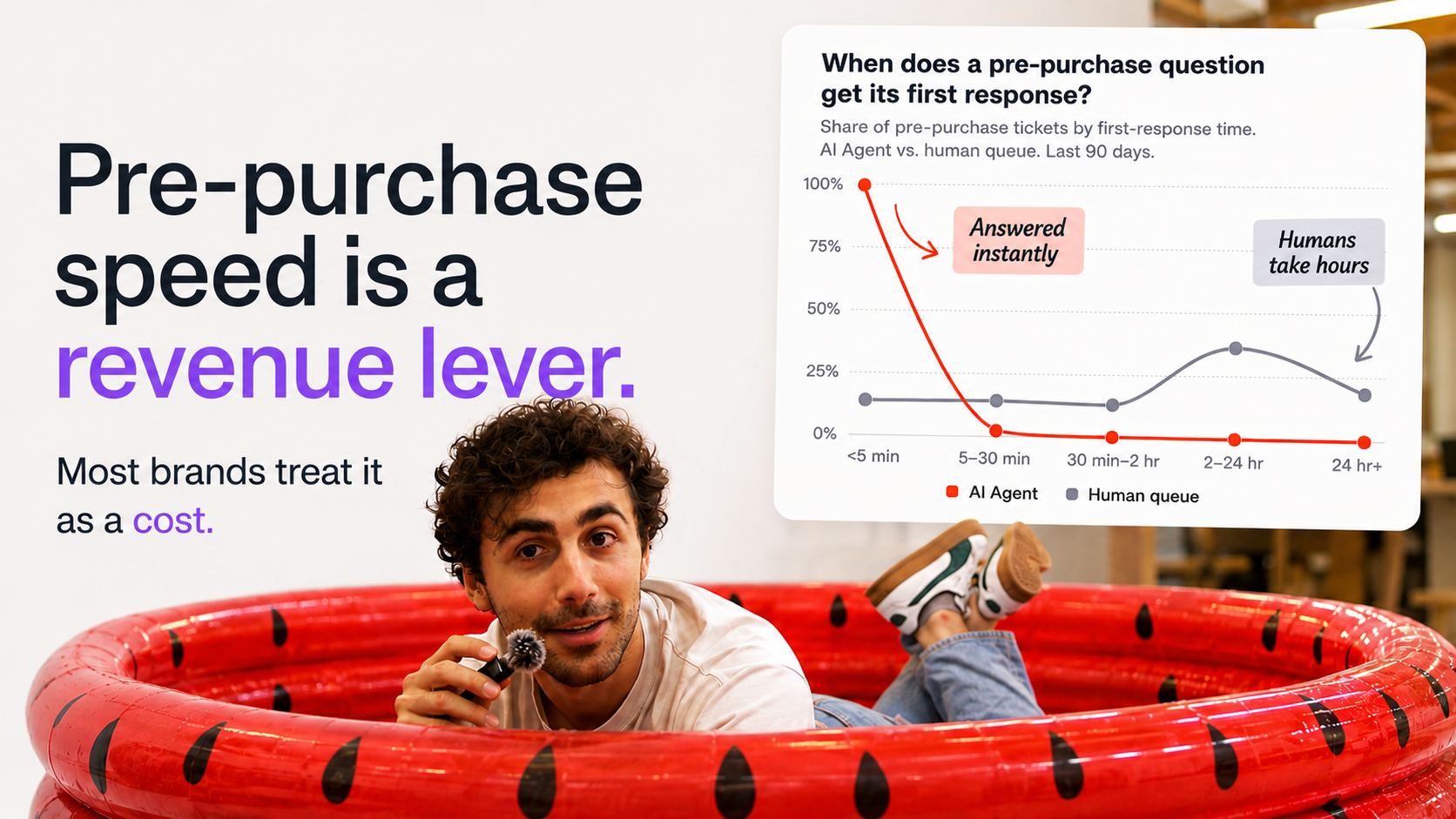
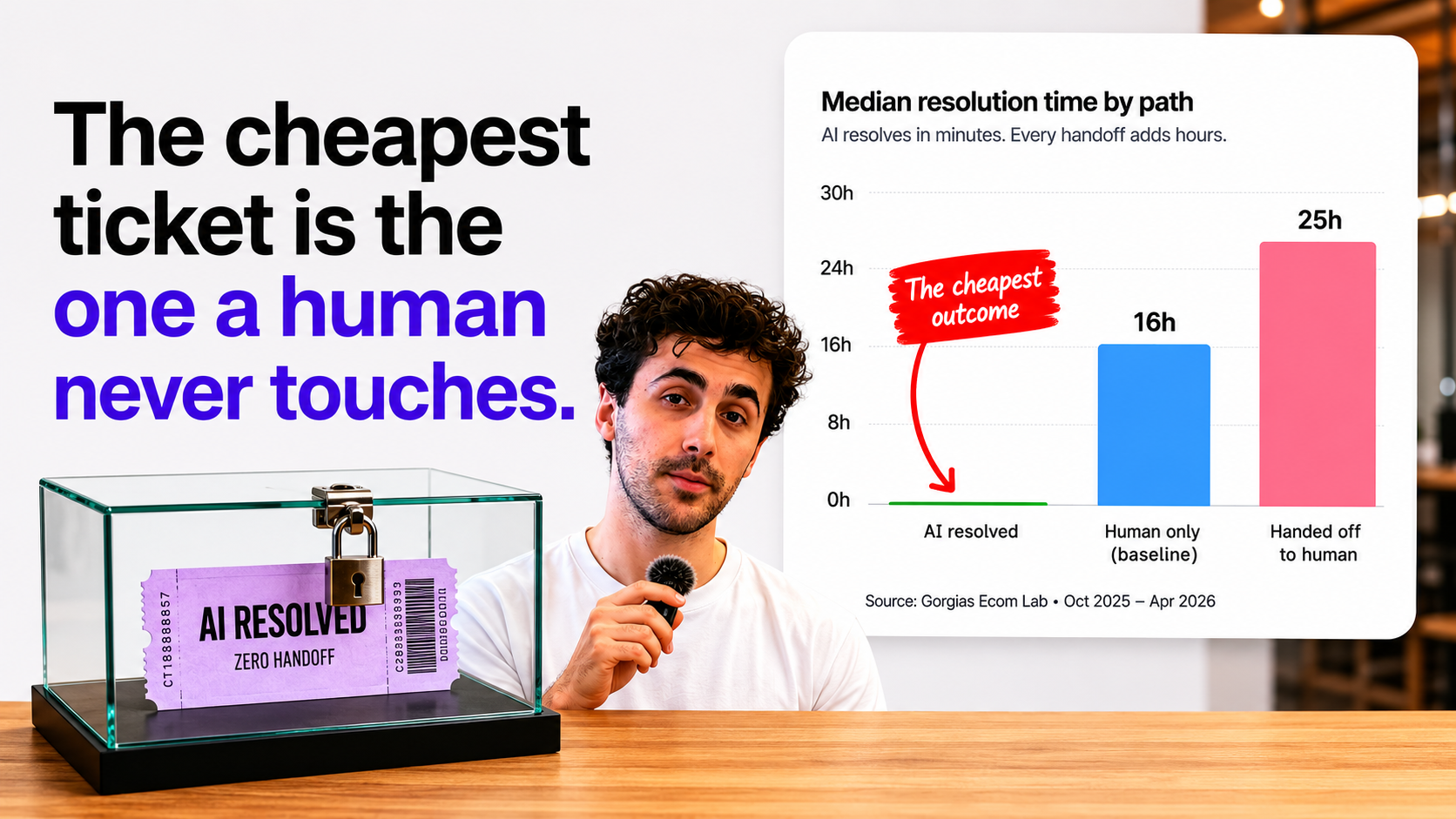
After enabling AI Agent, response times and resolution times both drop dramatically.
AI handles the simple tickets instantly. Human agents see shorter queues and can focus on the complex ones.
Teams scale without hiring
As automation rate rises, AI absorbs more of the workload. At 50%+ automation, AI is doing more than the human team.
How to read this: at the 10-20% automation tier, the average brand has about 6 human agents. AI is handling the same ticket volume as 1 additional full-time agent. At 50%+ automation, AI does the work of 6.3 agents, while the average human team at that tier is just 3 people. The lines cross: AI is handling more volume than the entire human team.
This holds up under growth. Among brands that grew ticket volume by 20%+ year over year, human effort did not grow at the same rate.
Brands grouped by AI automation rate, showing how ticket growth translates into human workload. Read left to right: as automation increases, ticket volume grows faster but human effort per ticket shrinks.
At 60%+ automation, ticket volume nearly tripled while human hours grew just 6%. The time saved is not idle. Teams reinvest it into training AI on brand-specific responses, surfacing insights on inventory gaps, shipping issues, and product feedback, and turning customer conversations into data that drives business strategy.
What that saves
Nearly 1 in 4 brands (23.5%) reduced their team after enabling AI Agent. Of those, 51% achieved all three: fewer people, same ticket volume, same or more revenue.
Brands that reduced by at least one person saw each remaining agent handle 29% more tickets (254 to 329 per month), while revenue grew 22%.
Estimated annual savings by automation tier, after platform costs. Even at the lowest tier, AI Agent pays for itself, saving 4+ agents and $73K/year net.
Even at the lowest automation tier, brands net $73K per year after platform costs.
The bottom line
Every quarter below 30% automation is a quarter spent hiring to keep up with volume AI could handle. The brands above 50% are absorbing growth with the same team. They are scaling support without scaling cost.
Methodology
Platform-level behavioral data from Gorgias merchants. First response time compares 30 days before AI Agent enablement to days 60-120 after, using medians. Year-over-year efficiency compares the post-enablement window to the same calendar period one year earlier. AI agent equivalents calculated as automated tickets divided by human tickets per active user. Headcount analysis requires teams of 3+ and at least 100 AI-closed tickets. ROI assumes $20K blended annual cost per agent (weighted average of US-based and offshore support hires) and $9K average annual platform cost. Data as of March 2026.