.avif)
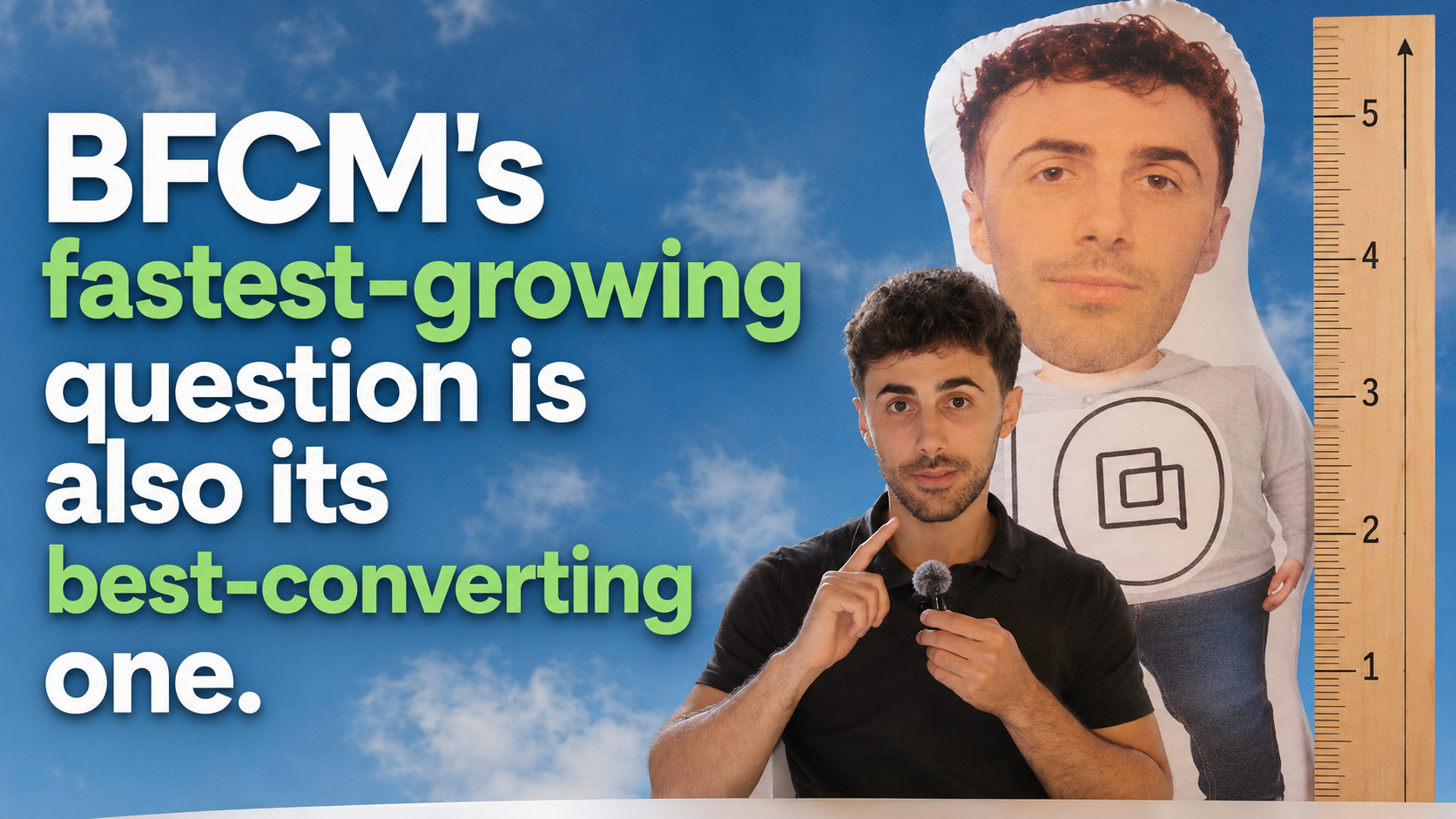
A question asked before checkout is not a support ticket. It is an undecided purchase. Answer it in seconds, and the order lands at a higher cart value.
- +45% higher average order value on orders the pre-purchase AI influenced versus the site average
- 11 hrs median wait when a pre-purchase question goes to the human queue. With AI, 22 seconds
- 1 in 9 support inquiries is a pre-purchase question. A sale to close, not a cost to resolve
Two types of customer contact. One is a revenue opportunity.
Support gets measured as a cost center. Cost per ticket, tickets per agent, deflection rate. That math is right for one kind of contact and wrong for the other.
A question asked after an order ships is a cost. The customer already paid. The job is resolution, and resolution has a known price. Order status, returns, shipping, account changes. This is what CX teams are built to handle.
A question asked before checkout is not a cost. It is an undecided purchase. "Does this come in wide?" "Will it arrive by Saturday?" "What is the return window if it does not fit?" These are not tickets to deflect. They are the last variable between a browser and a buyer.
Across the Gorgias platform, roughly 1 in 9 support inquiries is a pre-purchase question. Most brands route it through the same queue, with the same staffing and the same priority, as a post-purchase one. They are pricing a revenue event like a cost event.
The speed gap: 22 seconds or 11 hours
A shopper in the consideration phase has a short decision window. The product is in front of them, the card may already be saved, and the question is not hard. It is a size lookup, a shipping estimate, a policy check. An AI Agent answers it in seconds.
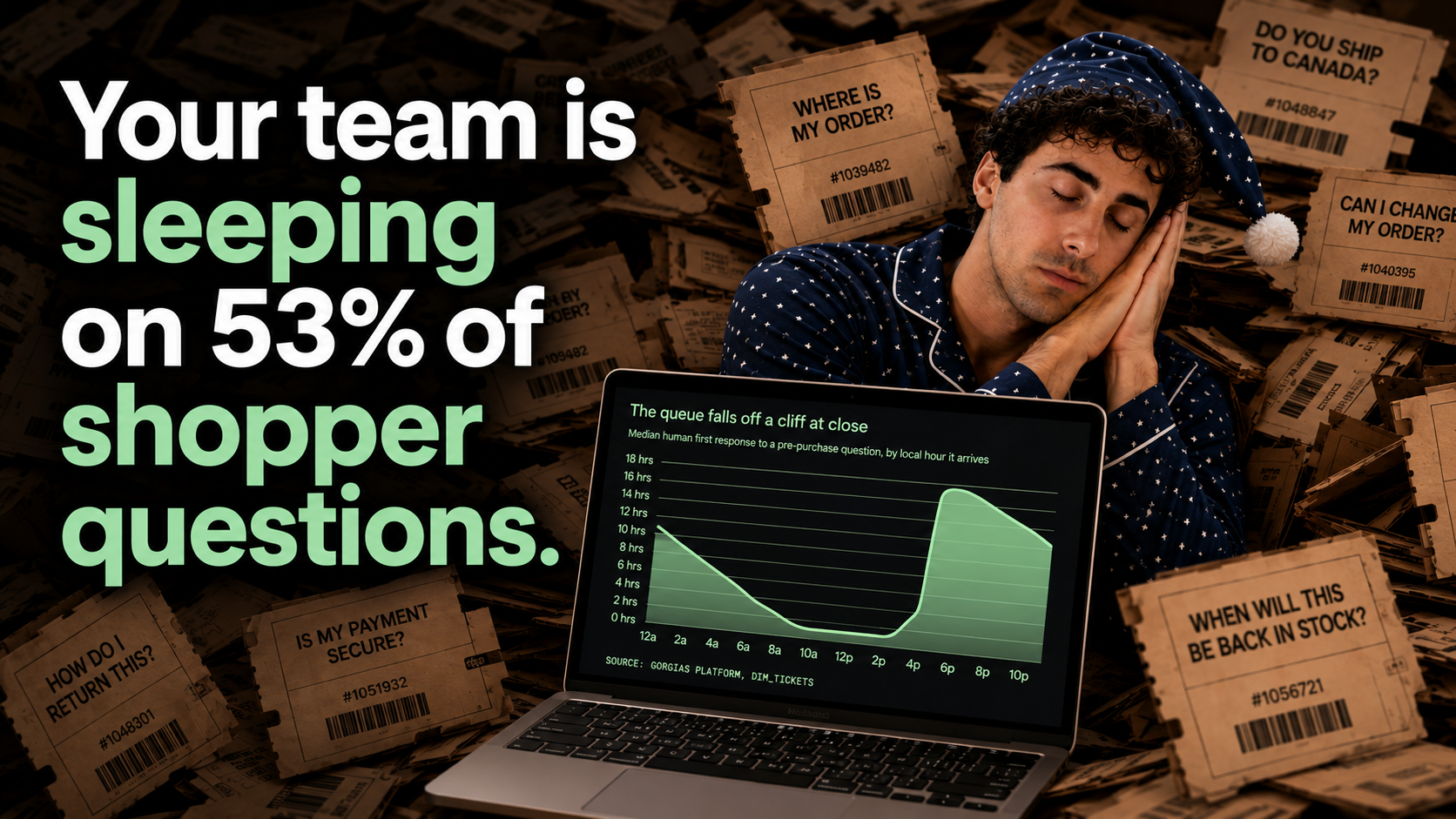
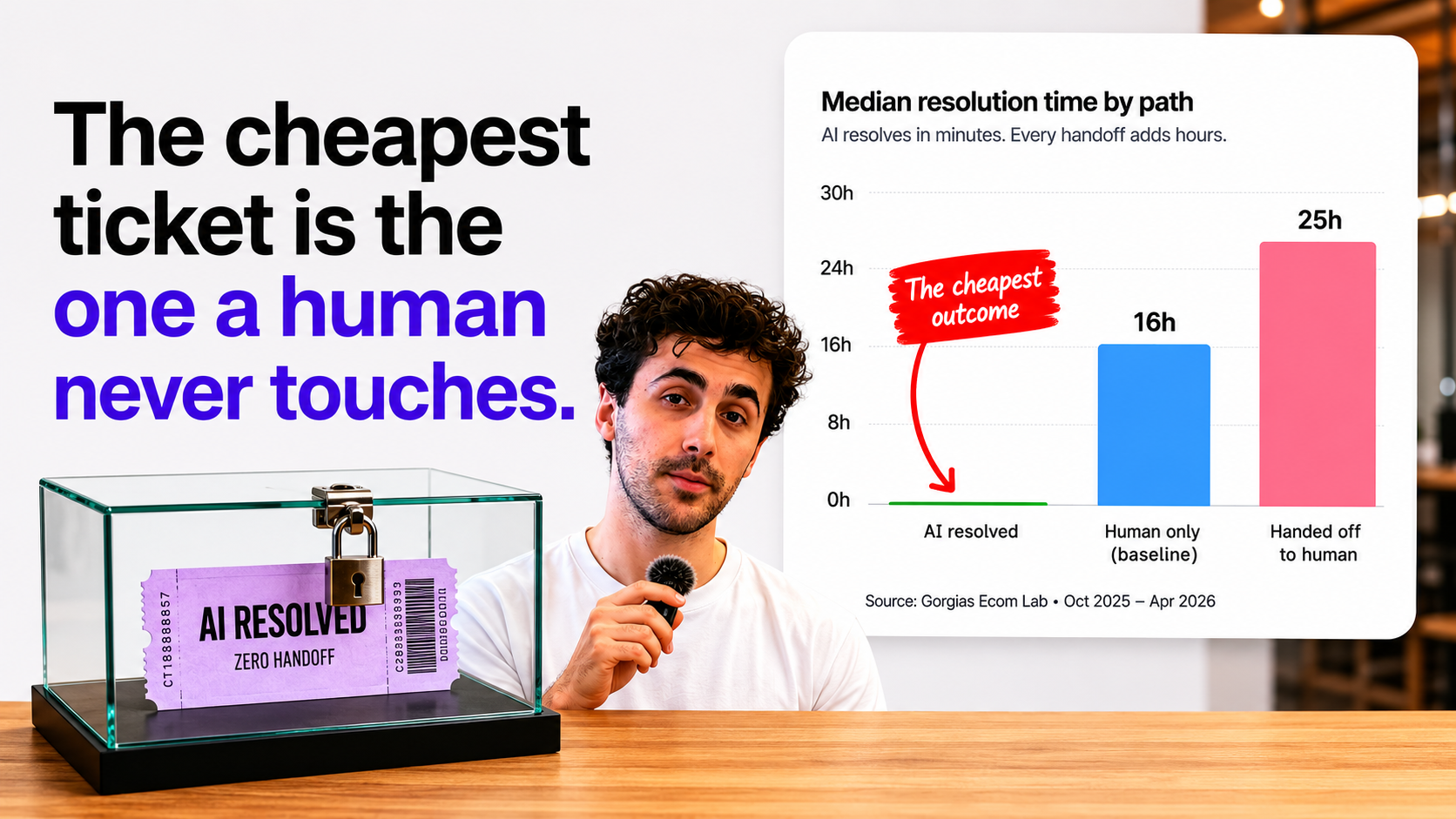
When a pre-purchase question is handled by AI Agent, the median first response is 22 seconds. When the same question goes to the human queue, the median first response is 11 hours. And because human teams are typically staffed only during business hours, the questions that arrive at night, over a weekend, or during a holiday wait the longest of all.
That is not a gap a brand can staff its way across. It is the difference between answering inside the decision window and answering after it has closed.
AI Agent answers 98% of pre-purchase questions in under five minutes. The human queue answers 13% that fast. Most of the rest wait: 61% of human-handled pre-purchase questions wait more than two hours, and 22% wait a full day or longer. By then the shopper has decided, and usually not in the brand's favor.
The lever is speed. Not politeness, not resolution quality, not channel. Speed.
What an instant answer is worth
Speed is only interesting if it moves money. It does, and the amount is measurable.
Gorgias attributes an order to the pre-purchase AI Agent (Shopping Assistant) when a shopper interacts with it before completing a purchase. On brands that have turned it on, it influences 1.5% to 2.7% of GMV*, depending on size. That is revenue tied to a conversation the brand would otherwise have missed or answered hours late.
The orders it influences are also bigger. Average order value on AI-influenced pre-purchase orders is 45% higher than the site average on the same brands. A shopper who gets an answer gets confidence, and confidence shows up as a larger basket.
Smaller brands see the highest influence rate, because more of their traffic runs through chat and their catalog is simpler to assist on. Larger brands convert a smaller share but at a higher basket. The pattern holds across every tier: the answer is worth more than the ticket cost it replaces.
This is an associative figure, not a causal one. Higher-intent shoppers are more likely to open the assistant in the first place. The point is not that the AI manufactured the basket. It is that the revenue lands on the orders where the buying question got answered, and lands late or not at all where it did not.
The bottom line
Pre-purchase support is not a support category. It is a conversion category. The question a shopper asks before checkout is the last decision variable before they buy or leave, and the median brand answers it in 11 hours.
The brands that closed the gap did not staff up. They put an AI Agent on the buying question so it gets answered in seconds, around the clock, and let the human team keep the post-purchase work. The result is not a CSAT line item. It is revenue that was never going to appear in a support dashboard, because it was going to appear as a bounce, an abandoned cart, and an order on a competitor's site.
The pre-purchase question is already arriving. The only variable a brand controls is how fast it answers.
Methodology
Platform-level behavioral and commercial data from Gorgias merchants. Customer-status accounts only; spam excluded unless AI Agent billed and non-positive first response times excluded. Pre-purchase questions are identified by intent in product availability, details, usage, promotion, warranty, or wholesale. Ticket metrics use the last 90 days minus a 7-day billing lag; queries that read AI Agent state are clamped to ticket dates on or after April 25, 2025. First response time is the median per account, then the median across accounts; "handled by AI Agent" versus "human queue" splits on whether the ticket had any AI Agent involvement, not on channel. Pre-purchase revenue influence (GMV influenced rate, average order value) uses the Shopping Assistant order-attribution pipeline over the last 31 complete days on Shopping-Assistant-enabled, non-trial accounts; Shopping Assistant data is valid from its July 17, 2025 launch date. An order is "influenced" when a shopper interacted with the pre-purchase AI Agent before purchasing; this is associative attribution, not proof of cause, and higher-intent shoppers self-select into the assistant. The GMV influenced rate is influenced GMV as a share of ecommerce (web) GMV on the same enabled accounts, and average order value on influenced orders is compared to all web orders on those accounts. GMV bands exclude Named (>$150M) tier from public tables for sample-size reasons. A general conversion-rate-by-response-time curve is not reported: order-to-ticket attribution exists only for AI-handled tickets, so a human-side conversion curve is not derivable from platform data without circularity. Efficiency, headcount, and net-savings figures are cited from the AI Adoption Index and Support Economics rather than re-derived here; those use a $20K blended annual agent cost and $9K platform cost. Median is used throughout where distributions are skewed. Source: Cortex (dim_tickets, dim_accounts, dim_convert_orders, ai_agent_product_metrics_history, fct_chat_tracking) Data as of May 2026.