.avif)
Ecommerce does not close at 6pm, in fact, you could go as far as to say that's when it comes to life.
- 53% of pre-purchase questions arrive outside business hours
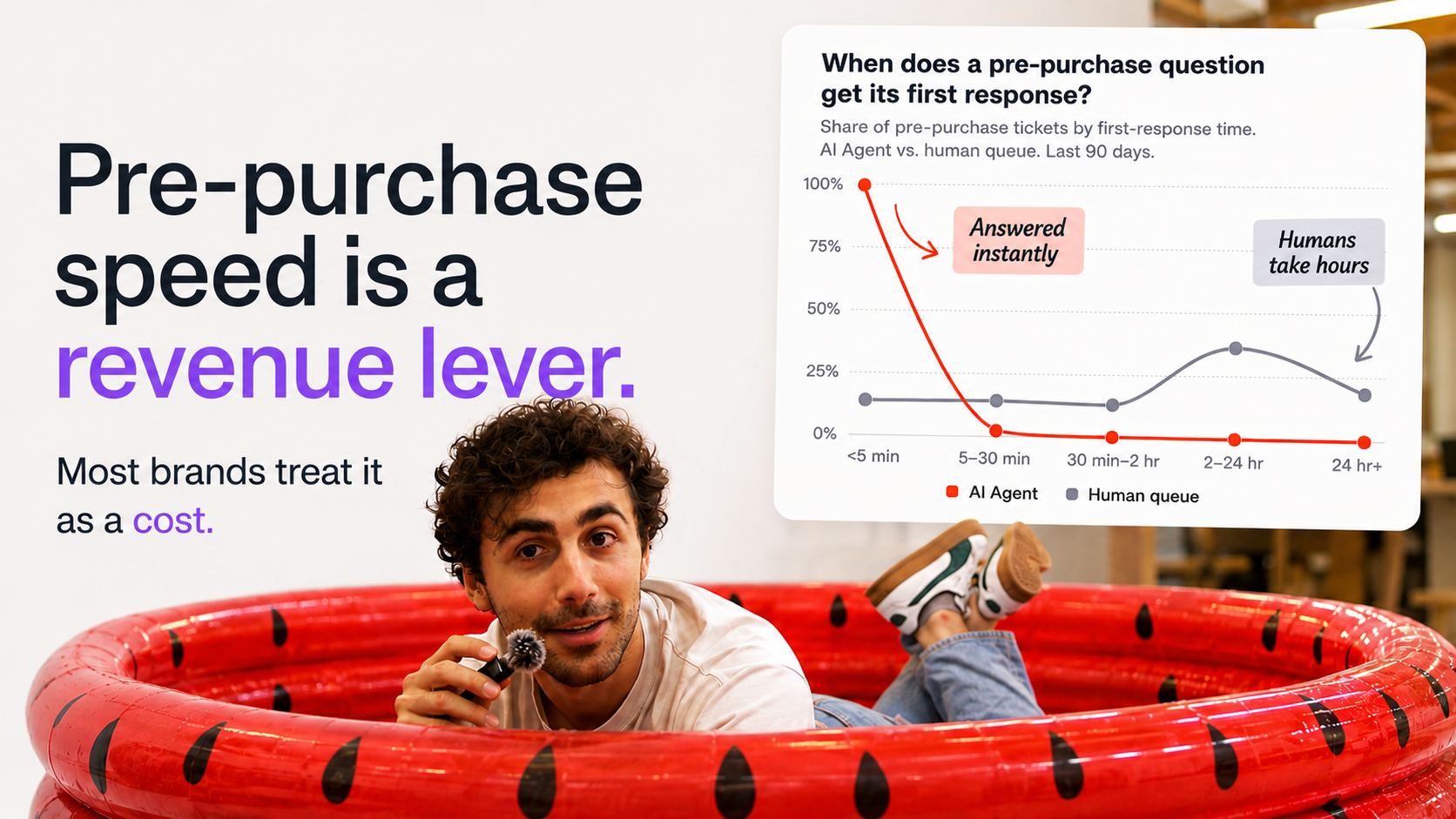
- 16 hrs median human first response to an after-hours buying question. An AI Agent answers in 23 seconds
- 55% of AI-assisted revenue comes from conversations that start after hours
Demand and office hours work on opposite clocks
Support is staffed like an office job. You log on around nine, work your tickets, and log off around six. After that it is lights out until the next day, and longer if it rolls into the weekend.
Shoppers run on the opposite clock. They browse after they have clocked off their own jobs, in the evenings and on weekends, when coverage is thinnest. That is the disconnect: the store is open, the team is not.
Measured on each merchant's own local clock, the median brand takes 53% of its pre-purchase questions outside business hours. One in five lands on a weekend. Buying questions also skew later than support questions in general, which cluster nearer to 51%. The questions that decide a sale arrive disproportionately when the team is gone.
The skew is not a quirk of one segment. It holds across every GMV band, from brands under $5M to brands above $150M, all within a point of the same 53%. The categories that skew latest are the discretionary ones people browse from the couch, Toys and Games, Apparel, Electronics, all above 54%. The ones that skew earliest are the practical and B2B categories people buy at their desks, Hardware and Office Supplies nearer 46%. The more a purchase is a want rather than a need, the later the question arrives.
After hours, the queue doesn't slow down. It stops.
If most buying questions arrive after hours, you would expect response times to get a little worse in the evening. They do. But "a little worse" badly understates what is happening.
During business hours, the median first response to a pre-purchase question is 2.2 hours. After hours, it stretches to about 15 hours, a human queue running roughly seven times slower on the majority of its buying questions. And the transition is not gradual. A question that comes in at 2pm is answered in about two hours. The same question at 4pm waits until the next morning. The worst time to ask is not the middle of the night, it is late afternoon, right after the team stops taking new work.
Bigger teams soften the drop but none escape it. Brands above $150M in GMV pull their after-hours first response down to about eight hours through wider coverage. Brands under $5M sit above fifteen. Every size sees first response go from one to three hours during the day to eight hours or worse at night. The cliff is universal. Only its depth changes.
CSAT says nothing is wrong. That is the tell.
The obvious place to look for damage is customer satisfaction. If shoppers are waiting all night for an answer, surely CSAT collapses. It does not. Positive CSAT on pre-purchase tickets is 86% during business hours and 85% after hours. It barely moves.
At first glance that is reassuring. At second glance it is the tell. CSAT only surveys people who stayed long enough to have an interaction. The shopper who asked a question at 10pm, got impatient, and bought somewhere else is never surveyed. That shopper is not recorded as unhappy in your dashboard. They are simply absent.
So the better question is not "are customers satisfied when we eventually answer?" It is "how much revenue never gets the chance to happen because the answer came too late?"
AI Agent is awake in the exact window you go dark
A human queue has a schedule. AI Agent does not. On pre-purchase questions, the median human response after hours is about fifteen hours. AI Agent answers in 23 seconds, and it is just as fast at 3am on a Sunday as at 11am on a Tuesday. The response time is flat across the entire clock.
That gap matters because these are not abstract support interactions. They are buying moments. When we look at AI-assisted revenue, orders where a Shopping Assistant conversation influenced the purchase, 55% of it comes from conversations that start outside business hours. The majority of assisted revenue is transacted in the exact window where most brands have historically gone dark.
This is a volume story, not a big-basket story. After-hours assisted orders carry a slightly lower average value than business-hours ones, around $190 against $199. There are just far more of them. The revenue is not a handful of large late-night purchases. It is the ordinary buying a storefront does around the clock while the support team is offline.
Always-on coverage doesn't create a Monday backlog
The natural objection is that answering around the clock just moves the work. If shoppers are asking questions at night and on weekends, someone has to clear all of that volume on Monday.
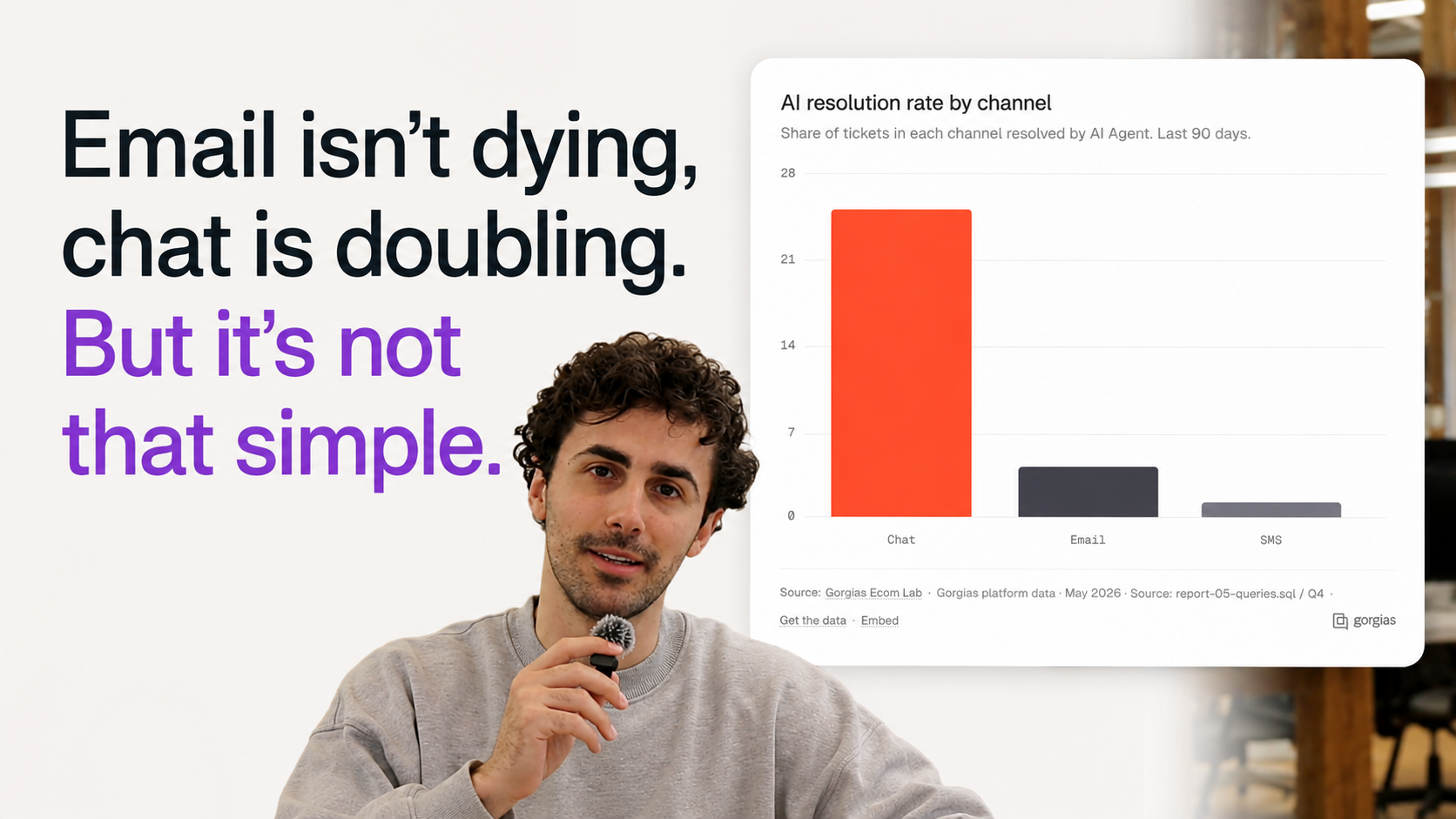
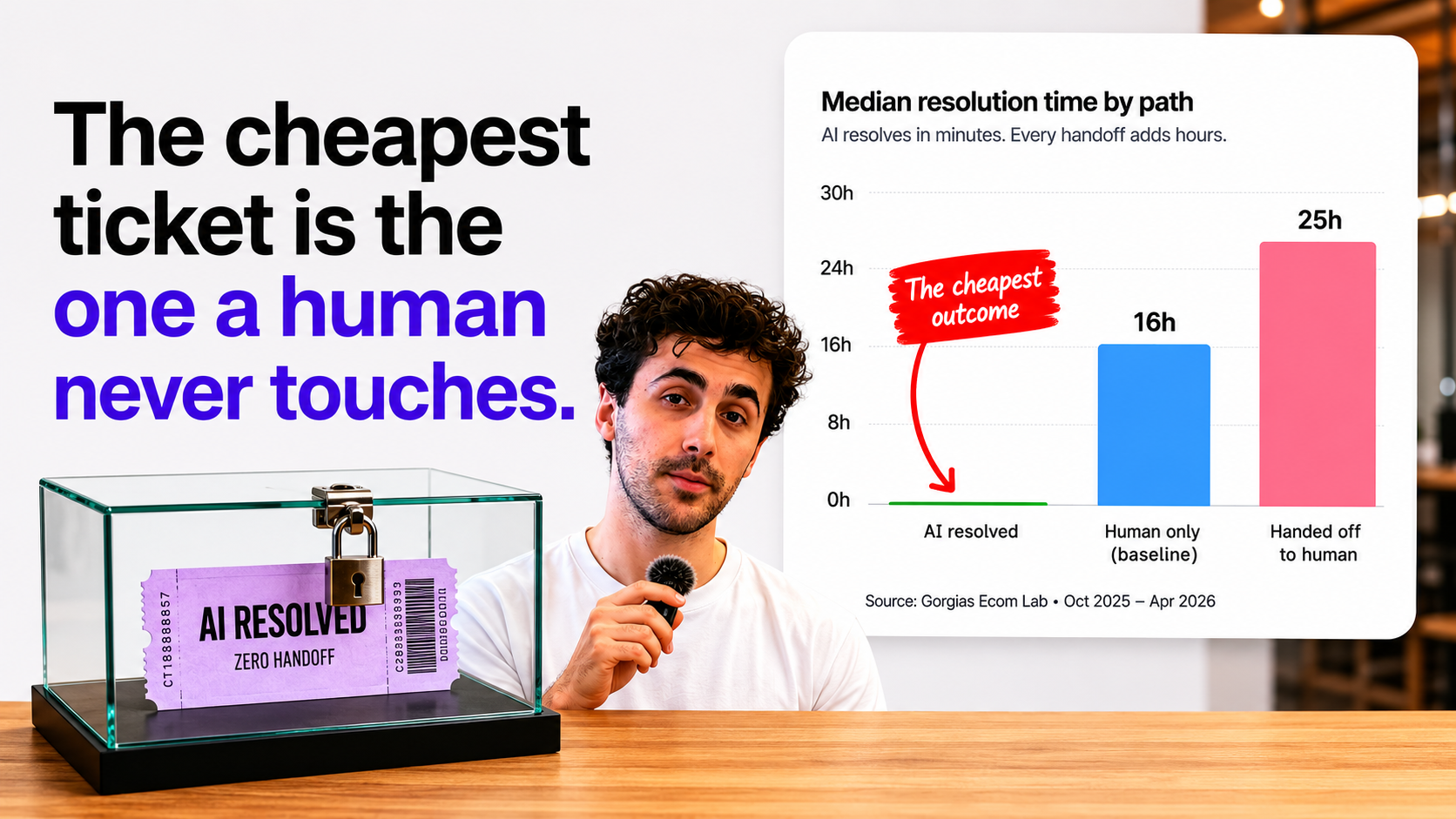
The data points the other way. After hours, Shopping Assistant resolves 91% of pre-purchase conversations on its own, with no human handover, a higher self-resolution rate than during business hours. Pre-purchase volume runs about 39% heavier after hours, yet the number of conversations escalated to a person rises only about 14%, and the handover rate actually falls, from 21% during business hours to 17% after. More questions arrive, and a smaller share of them reach a human.
Monday morning does not become a crime scene of unread tickets. Most of the weekend buying questions have already been answered, and the human team is left with the small number of conversations that genuinely needed them.
The bottom line
The store never closes. The team does. A majority of the questions that decide a purchase arrive in the hours when nobody is staffed to answer them, the wait on those questions runs seven times longer than during the day, and the cost of that gap never shows up in a satisfaction score. It shows up as revenue quietly transacted, or quietly lost, while the office is dark.
Covering that window used to mean paying people to work nights and weekends. It no longer does. The hours when a brand goes dark are now the hours it can answer fastest, and they are where the majority of the next sale is already being decided.
Methodology
Platform-level performance and revenue-attribution data from Gorgias merchants, last 90 days minus a 7-day billing lag. Business hours versus after hours is computed on each merchant's own local clock, taken from the account's business-hours timezone setting; business hours are Monday to Friday, 9am to 6pm local, and after hours is everything else, including weekends. Population: customer-status accounts, internal Gorgias accounts excluded, pre-purchase conversations identified by intent, on the chat, email, and contact-form channels, with a minimum of 30 tickets per account for share metrics. AI Agent state is clamped to on or after April 25, 2025, and Shopping Assistant revenue attribution uses data on or after its July 17, 2025 general-availability date. First response time is the median per account, then the median across accounts, non-positive durations excluded; medians are used because auto-timeouts distort the mean. Shares are per-account medians, so each merchant counts once rather than being weighted by volume. AI-assisted revenue is the value of web orders influenced by a Shopping Assistant conversation, attributed to the local hour that conversation started, trials excluded; the after-hours share measured 56% and is reported as 55% to match prior published figures. Self-resolution is the share of Shopping Assistant conversations closed without a human handover. Caveats: CSAT is subject to survivorship, since shoppers who leave before interacting are never surveyed; revenue attribution covers AI-influenced conversations only; all relationships are associative, not causal; a small number of accounts default their timezone to UTC. Data as of July 2026.