Join us for Moments That Matter: Meet the Modern Helpdesk
September 10 at 12PM EST.
Save your seat


This analysis pulled data from brands that enabled Gorgias's conversational AI tool for customer support, AI Agent, and hit a minimum threshold of 100 AI-closed tickets. That threshold matters — it filtered out the accounts where AI was technically switched on but doing absolutely nothing useful. You've seen that situation. This data excludes it.
The details:
The most efficient support teams aren't hiring more agents. They're letting AI close the majority of their tickets.
This analysis set out to answer one simple question: Does AI actually reduce human workload, and by how much?
Five variables were measured: headcount, AI automation rate, tickets per agent, hours spent per ticket, and first response time. The prediction was that higher automation rates would reduce human effort per ticket. The data proved it right — with one important catch.
Brands automating less than 23% of their tickets were still hiring more agents. Brands that automated more saw the opposite: at 80% automation, teams are doing the same work with 65% fewer hours and 57% fewer agents.
The average agent handles about 18 tickets a day. Automation rate is the primary lever for how far that number can stretch. Here's everything the data found.
Lorem ipsum dolor sit amet, consectetur adipiscing elit, sed do eiusmod tempor incididunt ut labore et dolore magna aliqua. Ut enim ad minim veniam, quis nostrud exercitation ullamco laboris nisi ut aliquip ex ea commodo consequat.
The most efficient support teams aren't hiring more agents. They're letting AI close the majority of their tickets.
This analysis set out to answer one simple question: Does AI actually reduce human workload, and by how much?
Five variables were measured: headcount, AI automation rate, tickets per agent, hours spent per ticket, and first response time. The prediction was that higher automation rates would reduce human effort per ticket. The data proved it right — with one important catch.
Brands automating less than 23% of their tickets were still hiring more agents. Brands that automated more saw the opposite: at 80% automation, teams are doing the same work with 65% fewer hours and 57% fewer agents.
The average agent handles about 18 tickets a day. Automation rate is the primary lever for how far that number can stretch. Here's everything the data found.
Your ticket volume went up 77%. Your agent hours went up 24%. Leadership probably called that a win. Here's what actually happened: AI absorbed the gap.
Without AI, a 77% ticket surge would have done exactly what you'd expect — it would have lengthened queues, burned out agents, and forced a hiring conversation. Instead, the brands that enabled AI grew their total hours at roughly one-third the rate of their volume growth, because AI was eating the additional tickets before humans ever touched them.
For anyone who's ever had to justify a headcount request by forecasting ticket volume, this changes the math entirely. More tickets in the queue is no longer an automatic signal to hire. The real question is whether your automation rate is high enough to absorb them.
Why hours per 1,000 tickets? Because raw headcount and total hours are noisy. They move for all kinds of reasons that have nothing to do with efficiency. Hours per 1,000 tickets isolates whether humans are genuinely working less per unit of work — which is the actual question worth answering.
Here's the part that should make you rethink every conversation you've had about "AI as a nice-to-have." The relationship between automation rate and human effort saved doesn't move in a straight line. It curves and accelerates.
At 1–20% automation, hours per ticket dropped 26%. At 20–40%, it's 32%. At 60%+, it's 58%.

Starting hours per 1,000 tickets ranged from 1,182 to 2,133 across automation tiers. After AI adoption, every single tier converged toward 750–890 hrs/1K. The teams that were the least efficient — the ones buried deepest — saw the largest absolute gains. That makes sense. They had the most room to improve.
There's some noise in the curve. There are dips around the 7–10% and 28–32% automation ranges, which likely reflects teams retraining on harder ticket types as the simpler ones get automated away. That's a real and predictable friction point, not a reason to stop. The overall direction is consistent. Sub-20% automation bends the curve meaningfully, but the real payoff hits hard above 40%.
One in four brands reduced headcount after enabling AI. Let's talk about what actually happened to those teams — because the story splits in two, and one half is a cautionary tale.
Two things were measured:
When both improve together, the team is genuinely doing more with less. When they move in opposite directions, someone is getting squeezed.
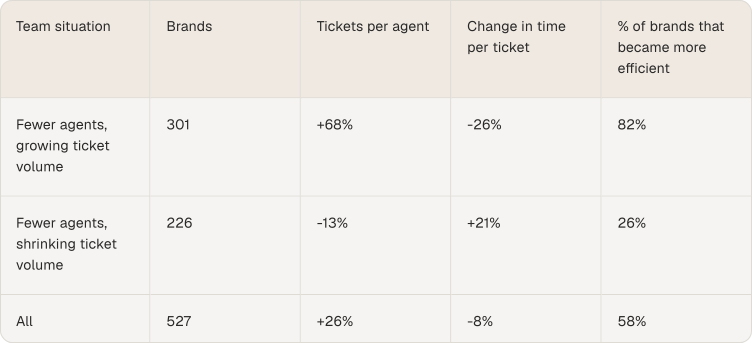
What happened when brands reduced headcount: Teams of 3+ agents that reduced headcount after enabling AI Agent
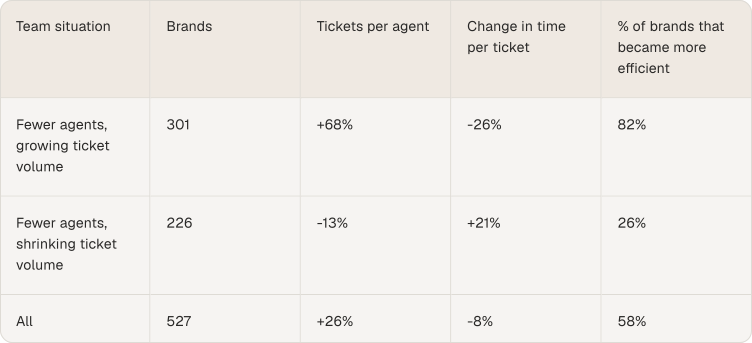
Those 226 brands that cut staff while also receiving fewer tickets? They got less efficient. Hours per ticket rose 21%, and only 26% of them saw any improvement. Without enough incoming volume for AI to absorb, cutting the team just meant the remaining agents were working harder on every ticket. That's the version of this story that ends with burnout and attrition.
The 301 growing brands are the real signal. AI absorbed the routine work, so the agents who remained were only touching complex, high-context issues. That's why even with fewer people, time per ticket fell — and this held true even for brands with automation rates below 30%.
After enabling AI Agent, average first response time dropped from 19 hours to 13 hours — a 32% reduction. But the median drop is the number worth paying attention to: from 11.0 hours to 5.5 hours, a 51% reduction.
The median drop being larger than the average drop is telling you something specific. It means AI disproportionately eliminated the longest wait times — the tickets that sat for 18, 24, 36 hours while your queue backed up and a customer stewed. The worst customer experiences improved the most.
Here's the mechanic: AI responds in near-zero time (median AI first response time is roughly 0.01 hours), but the real win isn't just the AI replies themselves. It's what happens to the queue. AI clears simple tickets instantly, so your human agents can get to the complex ones faster, with shorter queues and more focus.
Worth being clear-eyed about: handoffs to humans still require resolution time. This is a first-touch metric, not a full-resolution metric. But for customers, a 51% reduction in median first response time means faster replies to quick questions, faster acknowledgment of complicated ones, and a direct, measurable slash in the wait times that drive your CSAT scores into the ground.
The brands that got the most out of AI didn't just flip a switch and walk away. They actively managed their automation rate. That's the difference between AI as a checkbox and AI as an actual operational lever.
Here's what to do with all of this: