TL;DR:
The way shoppers buy online has shifted and customers are at the center.
They no longer want to scroll through product pages, dig through FAQs, or wait 24 hours for an email reply. They open a conversation, ask a specific question, and expect a useful answer in seconds. Brands that can’t deliver these experiences at scale are seeing customer hesitation turn into abandoned carts and lost revenue.
This shift has a name: conversational commerce. It's the practice of using real-time, two-way conversations as your primary sales channel, through chat, AI agents, messaging apps, and voice.
What started as an experiment for early adopters has become a key growth lever, with 84% of ecommerce brands treating conversational commerce as a strategic pillar this year vs. last year.

We surveyed 400 ecommerce decision-makers across North America, the U.K., and Europe to understand how conversational commerce and AI are reshaping the ecommerce landscape. These findings are complemented by aggregated and anonymized internal Gorgias platform data from 16,000+ ecommerce brands.
The State of Conversational Commerce in 2026 trends report breaks down all of the findings, including five key trends shaping the ecommerce landscape.
{{lead-magnet-1}}
A few years ago, adding an AI chatbot to your site that could provide tracking links and Help Center article recommendations was a differentiator. Today, it's table stakes. McKinsey found that 71% of shoppers expect personalized experiences, and 76% get frustrated when they don't get them.
Right now, most ecommerce professionals use AI, with 93% having used it for at least 1 year. Enthusiasm is accelerating quickly, with only 30% of ecommerce professionals rating their excitement for AI at 10/10 in April 2025. Similarly, while AI adoption rose steadily year over year, it reached a clear peak in 2026.

The use cases driving this adoption are practical and high-volume:

These are the tickets that flood brands’ inboxes every day. AI agents resolve them instantly, without pulling teams away from conversations that actually require human judgment.
Explore AI adoption and use case data in more depth in the full report.
The traditional ecommerce funnel, visit site, browse products, add to cart, check out, is losing ground. Shoppers now discover products on Instagram, ask questions via direct message, and complete purchases without ever visiting a website.

Conversational AI is actively increasing revenue, with 79% of brands reporting that AI-driven interactions have increased sales and conversion in their business.

The practical implication is that every channel is becoming a storefront. Creating personalized touchpoints with customers earlier in the journey, through proactive engagement, is impacting the bottom line.
Read the full report to explore how AI conversions have increased QoQ by industry.
Pre-purchase hesitation is one of the biggest conversion killers in ecommerce. A shopper lands on your product page, has a question about sizing or compatibility, can't find the answer quickly, and leaves. That's a lost sale that had nothing to do with your product.
Conversational AI changes that dynamic. When a shopper can ask a question and get an accurate, personalized answer in real time, the friction disappears.
Brands using Gorgias saw this play out at scale in 2025. When AI Agent recommended a product, 80% of the resulting purchases happened the same day, and 13% happened the next day.

Brands are further accelerating the buying cycle through proactive engagement. On-site features such as suggested product questions, recommendations triggered by search results, and “Ask Anything” input bars drove 50% of conversation-driven purchases during BFCM 2025.
Explore how AI is collapsing the purchase cycle in Trend 3 of the report.
There's a persistent narrative that AI is making CX teams redundant. The data tells a different story. 62% of ecommerce brands are planning to grow their teams, not cut them. But the scope of those teams is changing.

New roles are emerging around AI configuration and quality assurance. Teams are investing in technical members to write AI Guidance instructions, develop tone-of-voice instructions, and continuously QA results.
CX teams are also bridging the gap between support goals and revenue goals, as the two functions increasingly overlap.

The result is CX teams that are more technical than they were before. Agents who once spent their days answering repetitive tickets are now spending that time on higher-value work: complex escalations, VIP customer relationships, and improving the AI systems and knowledge bases that handle the volume.
Learn more about the evolution of CX roles in Trend #4.
Despite increasing AI adoption, data shows that ecommerce brands shouldn’t strive for 100% automation. Winning brands are building systems in which AI handles repetitive tier-1 tickets, and humans handle complex, sensitive cases.

AI handles speed and scale. It resolves order-tracking requests at 2 a.m., processes return-eligibility checks in seconds, and answers the same shipping question for the thousandth time without compromising quality.
Human agents handle conversations that require context, empathy, or decisions that fall outside the standard playbook. There are several topics where shoppers still prefer human support.

Successful hybrid systems require continuous iteration, meaning reviewing handover topics, Guidance, and reviewing AI tickets on a weekly basis.
Discover how leading brands are balancing human and AI systems in Trend #5.
The 2026 trends are about expansion and standardization. The 2030 predictions are about what comes next.

Voice-based purchasing is the biggest bet on the horizon. Only 7% of brands currently use voice assistants for commerce, but 89% expect it to be standard by 2030. The vision is a customer who can reorder a product, check their subscription status, or manage a return entirely over the phone.
Proactive AI is the other major shift. Rather than waiting for a customer to reach out, AI will anticipate needs based on browsing behavior, purchase history, and where someone is in their relationship with your brand. Think of it as the digital equivalent of a sales associate who remembers what you bought last time and knows what you're likely to need next.
Explore where ecommerce brands are allocating their AI budgets in the full report.
The brands winning in 2026 are creating smart, scalable systems where AIhandles volume and humans handle nuance. They’re treating every conversational channel as an opportunity to serve and sell.
The data is clear: AI adoption is accelerating, customer expectations are rising, and the revenue impact of getting this right is measurable.
{{lead-magnet-1}}
TL;DR:
In 2025, chat’s growth outpaced email by 2.5x quarter over quarter. Chat has become our most powerful customer experience tool for how shoppers discover products, ask questions, and decide to buy.
We knew it needed an upgrade, so we reimagined the entire experience from the ground up.
The result is 36% more engagement with product recommendations, nearly 2.25x more shoppers add-to-cart, and 7.3% more customer engagement.
In this post, we'll walk you through our thinking, what’s new in Chat, and how brands are already seeing big gains.
Chat has outpaced email support. Today’s shoppers prefer the speed of quick chat conversations over email. And when shoppers make a new move, we watch, listen, and move with them.
This behavioral shift isn’t happening in isolation. It aligns with the rise of conversational commerce and proves a universal move toward real-time conversations in ecommerce.
In fact, the signals were already there. Two years of building AI Agent showed us just how much design shapes behavior. The interface is the experience, and we knew that pushing chat experiences to closely resemble human interactions would transform how shoppers engage.
Our new and updated chat brings that vision to life. We believe that shopping is moving from static pages to conversations. This new update is built for how people actually want to shop.
The new design turns live chat into an interactive shopping surface made for modern shoppers. We've brought together multiple ways for shoppers to jump into chat, added clickable replies instead of typing, browsable product cards right in the conversation, and quick cart access.
Let's walk through what's new.
Chat now comes in a softer color palette that adapts to your store’s branding. We removed message bubbles in favor of an airy design that brings in the familiarity of speaking to your favorite conversational AI assistant. Every interaction now has the breathing room for deeper conversation and personalization.

It’s now easier for shoppers to get an answer with quick reply buttons and suggested questions in Chat. This replaces the tree-based flows of the previous Chat, removing the need to follow a fixed path. Shoppers can find answers faster without typing text-heavy explanations.

Browsing and buying within Chat is now possible. Previously, it only supported product links that would open in a new page. With the upgrade, you can view item details without leaving the conversation. Shoppers can browse, compare products, and add to cart in one place.

We’re keeping the context by removing the external redirects. The new interface lets shoppers browse product recommendations right in chat. View key product details, images, descriptions, variants, and pricing without opening a new tab.

Chat adds clickable questions on product pages — like “Is this true to size?” or “What’s the difference between shades?” — designed to match what a shopper is likely wondering in the moment. These context-aware prompts help remove buying hesitation before shoppers even think to ask.

Chat adds instant access to shopper actions, like a cart button and an orders button for returning customers. Shoppers can jump straight to their cart or check on an existing order without waiting for an agent to give them a status update.

Every update in Chat drives performance. We didn’t simply give it a makeover, we also fine-tuned its underlying mechanics.
When product suggestions are easy to browse, shoppers interact with them more. The new product cards make shopping feel natural, allowing customers to explore items at their own pace. That convenience led to a 36% increase in engagement with recommended products.
Chat keeps the entire shopping journey inside the conversation, from browsing and asking questions, to adding to cart and checking out. This new layout removes the usual tab-switching between chat and the website. Less friction has led to more than double add-to-cart actions than before the redesign.
Chat's cleaner design and contextual entry points make it easier for shoppers to start a conversation. With suggested questions on product pages and quick reply buttons, more visitors are choosing to engage earlier in their journey. This has resulted in a 7.3% lift in chat engagement.
Conversational commerce has moved from concept to reality. Chat makes it part of the everyday shopping experience, letting shoppers browse, ask questions, compare products, and check out in one interaction. It brings the ease of the in-person shopping experience into the digital world.
We built Chat to redefine the shopping experience. We hope you see it reflected in your customers’ journeys.
Book a demo to see what's possible with the new experience.
The best in CX and ecommerce, right to your inbox

TL;DR:
Customer education has become a critical factor in converting browsers into buyers. For wellness brands like Cornbread Hemp, where customers need to understand ingredients, dosages, and benefits before making a purchase, education has a direct impact on sales. The challenge is scaling personalized education when support teams are stretched thin, especially during peak sales periods.
Katherine Goodman, Senior Director of Customer Experience, and Stacy Williams, Senior Customer Experience Manager, explain how implementing Gorgias's AI Shopping Assistant transformed their customer education strategy into a conversion powerhouse.
In our second AI in CX episode, we dive into how Cornbread achieved a 30% conversion rate during BFCM, saving their CX team over four days of manual work.
Before diving into tactics, understanding why education matters in the wellness space helps contextualize this approach.
Katherine, Senior Director of Customer Experience at Cornbread Hemp, explains:
"Wellness is a very saturated market right now. Getting to the nitty-gritty and getting to the bottom of what our product actually does for people, making sure they're educated on the differences between products to feel comfortable with what they're putting in their body."
The most common pre-purchase questions Cornbread receives center around three areas: ingredients, dosages, and specific benefits. Customers want to know which product will help with their particular symptoms. They need reassurance that they're making the right choice.
What makes this challenging: These questions require nuanced, personalized responses that consider the customer's specific needs and concerns. Traditionally, this meant every customer had to speak with a human agent, creating a bottleneck that slowed conversions and overwhelmed support teams during peak periods.
Stacy, Senior Customer Experience Manager at Cornbread, identified the game-changing impact of Shopping Assistant:
"It's had a major impact, especially during non-operating hours. Shopping Assistant is able to answer questions when our CX agents aren't available, so it continues the customer order process."
A customer lands on your site at 11 PM, has questions about dosage or ingredients, and instead of abandoning their cart or waiting until morning for a response, they get immediate, accurate answers that move them toward purchase.
The real impact happens in how the tool anticipates customer needs. Cornbread uses suggested product questions that pop up as customers browse product pages. Stacy notes:
"Most of our Shopping Assistant engagement comes from those suggested product features. It almost anticipates what the customer is asking or needing to know."
Actionable takeaway: Don't wait for customers to ask questions. Surface the most common concerns proactively. When you anticipate hesitation and address it immediately, you remove friction from the buying journey.
One of the biggest myths about AI is that implementation is complicated. Stacy explains how Cornbread’s rollout was a straightforward three-step process: audit your knowledge base, flip the switch, then optimize.
"It was literally the flip of a switch and just making sure that our data and information in Gorgias was up to date and accurate."
Here's Cornbread’s three-phase approach:
Actionable takeaway: Block out time for that initial knowledge base audit. Then commit to regular check-ins because your business evolves, and your AI should evolve with it.
Read more: AI in CX Webinar Recap: Turning AI Implementation into Team Alignment
Here's something most brands miss: the way you write your knowledge base articles directly impacts conversion rates.
Before BFCM, Stacy reviewed all of Cornbread's Guidance and rephrased the language to make it easier for AI Agent to understand.
"The language in the Guidance had to be simple, concise, very straightforward so that Shopping Assistant could deliver that information without being confused or getting too complicated," Stacy explains. When your AI can quickly parse and deliver information, customers get faster, more accurate answers. And faster answers mean more conversions.
Katherine adds another crucial element: tone consistency.
"We treat AI as another team member. Making sure that the tone and the language that AI used were very similar to the tone and the language that our human agents use was crucial in creating and maintaining a customer relationship."
As a result, customers often don't realize they're talking to AI. Some even leave reviews saying they loved chatting with "Ally" (Cornbread's AI agent name), not realizing Ally isn't human.
Actionable takeaway: Review your knowledge base with fresh eyes. Can you simplify without losing meaning? Does it sound like your brand? Would a customer be satisfied with this interaction? If not, time for a rewrite.
Read more: How to Write Guidance with the “When, If, Then” Framework
The real test of any CX strategy is how it performs under pressure. For Cornbread, Black Friday Cyber Monday 2025 proved that their conversational commerce strategy wasn't just working, it was thriving.
Over the peak season, Cornbread saw:
Katherine breaks down what made the difference:
"Shopping Assistant popping up, answering those questions with the correct promo information helps customers get from point A to point B before the deal ends."
During high-stakes sales events, customers are in a hurry. They're comparing options, checking out competitors, and making quick decisions. If you can't answer their questions immediately, they're gone. Shopping Assistant kept customers engaged and moving toward purchase, even when human agents were swamped.
Actionable takeaway: Peak periods require a fail-safe CX strategy. The brands that win are the ones that prepare their AI tools in advance.
One of the most transformative impacts of conversational commerce goes beyond conversion rates. What your team can do with their newfound bandwidth matters just as much.
With AI handling straightforward inquiries, Cornbread's CX team has evolved into a strategic problem-solving team. They've expanded into social media support, provided real-time service during a retail pop-up, and have time for the high-value interactions that actually build customer relationships.
Katherine describes phone calls as their highest value touchpoint, where agents can build genuine relationships with customers. “We have an older demographic, especially with CBD. We received a lot of customer calls requesting orders and asking questions. And sometimes we end up just yapping,” Katherine shares. “I was yapping with a customer last week, and we'd been on the call for about 15 minutes. This really helps build those long-term relationships that keep customers coming back."
That's the kind of experience that builds loyalty, and becomes possible only when your team isn't stuck answering repetitive tickets.
Stacy adds that agents now focus on "higher-level tickets or customer issues that they need to resolve. AI handles straightforward things, and our agents now really are more engaged in more complicated, higher-level resolutions."
Actionable takeaway: Stop thinking about AI only as a cost-cutting tool and start seeing it as an impact multiplier. The goal is to free your team to work on conversations that actually move the needle on customer lifetime value.
Cornbread isn't resting on their BFCM success. They're already optimizing for January, traditionally the biggest month for wellness brands as customers commit to New Year's resolutions.
Their focus areas include optimizing their product quiz to provide better data to both AI and human agents, educating customers on realistic expectations with CBD use, and using Shopping Assistant to spotlight new products launching in Q1.
The brands winning at conversational commerce aren't the ones with the biggest budgets or the largest teams. They're the ones who understand that customer education drives conversions, and they've built systems to deliver that education at scale.
Cornbread Hemp's success comes down to three core principles: investing time upfront to train AI properly, maintaining consistent optimization, and treating AI as a team member that deserves the same attention to tone and quality as human agents.
As Katherine puts it:
"The more time that you put into training and optimizing AI, the less time you're going to have to babysit it later. Then, it's actually going to give your customers that really amazing experience."
Watch the replay of the whole conversation with Katherine and Stacy to learn how Gorgias’s Shopping Assistant helps them turn browsers into buyers.
{{lead-magnet-1}}

TL;DR:
Your AI sounds like a robot, and your customers can tell.
Sure, the answer is right, but something feels off. The tone of voice is stiff. The phrases are predictable and generic. At most, it sounds copy-pasted. This may not be a big deal from your side of support. In reality, it’s costing you more than you think.
Recent data shows that 45% of U.S. adults find customer service chatbots unfavorable, up from 43% in 2022. As awareness of chatbots has increased, so have negative opinions of them. Only 19% of people say chatbots are helpful or beneficial in addressing their queries. The gap isn't just about capability. It's about trust. When AI sounds impersonal, customers disengage or leave frustrated.
Luckily, you don't need to choose between automation and the human touch.
In this guide, we'll show you six practical ways to train your AI to sound natural, build trust, and deliver the kind of support your customers actually like.
The fastest way to make your AI sound more human is to teach it to sound like you. AI is only as good as the input you give it, so the more detailed your brand voice training, the more natural and on-brand your responses will be.
Start by building a brand voice guide. It doesn't need to be complicated, but it should clearly define how your brand communicates with customers. At minimum, include:
Think of your AI as a character. Samantha Gagliardi, Associate Director of Customer Experience at Rhoback, described their approach as building an AI persona:
"I kind of treat it like breaking down an actor. I used to sing and perform for a living — how would I break down the character of Rhoback? How does Rhoback speak? What age are they? What makes the most sense?"
✅ Create a brand voice guide with tone, style, formality, and example phrases.
Humans associate short pauses with thinking, so when your AI responds too quickly, it instantly feels unnatural.
Adding small delays helps your AI feel more like a real teammate.
Where to add response delays:
Even a one- to two-second pause can make a big difference in a robotic or human-sounding AI.
✅ Add instructions in your AI’s knowledge base to include short response delays during key moments.
Generic phrases make your AI sound like... well, AI. Customers can spot a copy-pasted response immediately — especially when it's overly formal.
That doesn't mean you need to be extremely casual. It means being true to your brand. Whether your voice is professional or conversational, the goal is the same: sound like a real person on your team.
Here's how to replace robotic phrasing with more brand-aligned responses:
|
Generic Phrase |
More Natural Alternative |
|---|---|
|
“We apologize for the inconvenience.” |
“Sorry about that, we’re working on it now.” (friendly) |
|
“Your satisfaction is our top priority.” |
“We want to make sure this works for you.” (friendly) |
|
“Please be advised…” |
“Just a quick heads up…” (friendly) |
|
“Your request has been received.” |
“Got it. Thanks for reaching out.” (friendly) |
|
“I will now review your request.” |
“Let me take a quick look.” (friendly) |
✅ Identify your five most common inquiries and give your AI a rewritten example response for each.
One of the biggest tells that a response is AI-generated? It ignores what's already happened.
When your AI doesn't reference order history or past conversations, customers are forced to repeat themselves. Repetition can lead to frustration and can quickly turn a good customer experience into a bad one.
Great AI uses context to craft replies that feel personalized and genuinely helpful.
Here's what good context looks like in AI responses:
Tools like Gorgias AI Agent automatically pull in customer and order data, so replies feel human and contextual without sacrificing speed.
✅ Add instructions that prompt your AI to reference order details and/or past conversations in its replies, so customers feel acknowledged.
Customers just want help. They don't care whether it comes from a human or AI, as long as it's the right help. But if you try to trick them, it backfires fast. AI that pretend to be human often give customers the runaround, especially when the issue is complex or emotional.
A better approach is to be transparent. Solve what you can, and hand off anything else to an agent as needed.
When to disclose that the customer is talking to AI:
For more on this topic, check out our article: Should You Tell Customers They're Talking to AI?
✅ Set clear rules for when your AI should escalate to a human and include handoff messaging that sets expectations and preserves context.
We're giving you permission to break the rules a little bit. The most human-sounding AI doesn't follow perfect grammar or structure. It reflects the messiness of real dialogue.
People don't speak in flawless sentences every time. We pause, rephrase, cut ourselves off, and throw in the occasional emoji or "uh." When AI has an unpredictable cadence, it feels more relatable and, in turn, more human.
What an imperfect AI could look like:
These imperfections give your AI a more believable voice.
✅ Add instructions for your AI that permit variation in grammar, tone, and sentence structure to mimic real human speech.
Human-sounding AI doesn’t require complex prompts or endless fine-tuning. With the right voice guidelines, small tone adjustments, and a few smart instructions, your AI can sound like a real part of your team.
Book a demo of Gorgias AI Agent and see for yourself.
{{lead-magnet-2}}

TL;DR:
You’ve chosen your AI tool and turned it on, hoping you won’t have to answer another WISMO question. But now you’re here. Why is AI going in circles? Why isn’t it answering simple questions? Why does it hand off every conversation to a human agent?
Conversational AI and chatbots thrive on proper training and data. Like any other team member on your customer support team, AI needs guidance. This includes knowledge documents, policies, brand voice guidelines, and escalation rules. So, if your AI has gone rogue, you may have skipped a step.
In this article, we’ll show you the top seven AI issues, why they happen, how to fix them, and the best practices for AI setup.
{{lead-magnet-1}}
AI can only be as accurate as the information you feed it. If your AI is confidently giving customers incorrect answers, it likely has a gap in its knowledge or a lack of guardrails.
Insufficient knowledge can cause AI to pull context from similar topics to create an answer, while the lack of guardrails gives it the green light to compose an answer, correct or not.
How to fix it:
This is one of the most frustrating customer service issues out there. Left unfixed, you risk losing 29% of customers.
If your AI is putting customers through a never-ending loop, it’s time to review your knowledge docs and escalation rules.
How to fix it:
It can be frustrating when AI can’t do the bare minimum, like automate WISMO tickets. This issue is likely due to missing knowledge or overly broad escalation rules.
How to fix it:
One in two customers still prefer talking to a human to an AI, according to Katana. Limiting them to AI-only support could risk a sale or their relationship.
The top live chat apps clearly display options to speak with AI or a human agent. If your tool doesn’t have this, refine your AI-to-human escalation rules.
How to fix it:
If your agents are asking customers to repeat themselves, you’ve already lost momentum. One of the fastest ways to break trust is by making someone explain their issue twice. This happens when AI escalates without passing the conversation history, customer profile, or even a summary of what’s already been attempted.
How to fix it:
Sure, conversational AI has near-perfect grammar, but if its tone is entirely different from your agents’, customers can be put off.
This mismatch usually comes from not settling on an official customer support tone of voice. AI might be pulling from marketing copy. Agents might be winging it. Either way, inconsistency breaks the flow.
How to fix it:
When AI is underperforming, the problem isn’t always the tool. Many teams launch AI without ever mapping out what it's actually supposed to do. So it tries to do everything (and fails), or it does nothing at all.
It’s important to remember that support automation isn’t “set it and forget it.” It needs to know its playing field and boundaries.
How to fix it:
AI should handle |
AI should escalate to a human |
|---|---|
Order tracking (“Where’s my package?”) |
Upset, frustrated, or emotional customers |
Return and refund policy questions |
Billing problems or refund exceptions |
Store hours, shipping rates, and FAQs |
Technical product or troubleshooting issues |
Simple product questions |
Complex or edge‑case product questions |
Password resets |
Multi‑part or multi‑issue requests |
Pre‑sale questions with clear, binary answers |
Anything where a wrong answer risks churn |
Once you’ve addressed the obvious issues, it’s important to build a setup that works reliably. These best practices will help your AI deliver consistently helpful support.
Start by deciding what AI should and shouldn’t handle. Let it take care of repetitive tasks like order tracking, return policies, and product questions. Anything complex or emotionally sensitive should go straight to your team.
Use examples from actual tickets and messages your team handles every day. Help center articles are a good start, but real interactions are what help AI learn how customers actually ask questions.
Create rules that tell your AI when to escalate. These might include customer frustration, low confidence in the answer, or specific phrases like “talk to a person.” The goal is to avoid infinite loops and to hand things off before the experience breaks down.
When a handoff happens, your agents should see everything the AI did. That includes the full conversation, relevant customer data, and any actions it has already attempted. This helps your team respond quickly and avoid repeating what the customer just went through.
An easy way to keep order history, customer data, and conversation history in one place is by using a conversational commerce tool like Gorgias.
A jarring shift in tone between AI and agent makes the experience feel disconnected. Align aspects such as formality, punctuation, and language style so the transition from AI to human feels natural.
Look at recent escalations each week. Identify where the AI struggled or handed off too early or too late. Use those insights to improve training, adjust boundaries, and strengthen your automation flows.
If your AI chatbot isn’t working the way you expected, it’s probably not because the technology is broken. It’s because it hasn’t been given the right rules.
When you set AI up with clear responsibilities, it becomes a powerful extension of your team.
Want to see what it looks like when AI is set up the right way?
Try Gorgias AI Agent. It’s conversational AI built with smart automation, clean escalations, and ecommerce data in its core — so your customers get faster answers and your agents stay focused.

TL;DR:
Shopping today isn’t a linear funnel. It’s a fluid conversation. Browse → question → help → buy → return → repeat.
Every step is a dialogue between the shopper’s intent and the brand’s response.
But what bridges the gap between “just looking” and “I’m buying” isn’t persuasion or urgency — it’s suggestion: the subtle design, timing, and language cues that guide action without forcing it.
When done well, suggestion becomes the architecture of trust. It’s also the best way to make AI-powered experiences feel human-first, not tech-first.
This article explores how the power of suggestion — rooted in behavioral psychology and UX design — shapes modern conversational commerce.
{{lead-magnet-1}}
The average ecommerce shopper faces thousands of micro-decisions from the moment they land on a site. Which product? Which variant? Which review to trust? Which shipping method? Each one adds cognitive weight.
Psychologist Barry Schwartz coined the term The Paradox of Choice to describe how abundance often leads to paralysis. In his research, participants faced with too many options were less likely to make a choice and less satisfied when they did.
In ecommerce, that means overload costs conversions. When shoppers must evaluate too many variables, they hesitate, second-guess, or abandon.
Shoppers today expect empathy and ease, not persuasion. When you suggest rather than push, you signal empathy and support.
This is especially important for conversational commerce. Suggestion humanizes automation by making AI interactions feel like conversations rather than transactions.
When you push and persuade, you create a memorable experience for customers — but it’s not the kind you want them to remember.
One Reddit thread perfectly captures the problem: a user tried to cancel their Thrive Market membership and had to ask nine times before the chatbot complied.

Each time, the AI assistant tried to talk them out of it (offering deals, guilt-tripping responses, or irrelevant messages) until the customer’s frustration boiled over.
The thread exploded not just because it was mildly infuriating, but because it illustrated what customers fear most about automation: a lack of empathy.
Suggestion is how you design for trust, ease, and interaction. And for ecommerce and CX professionals, suggestion bridges browsing and buying by prompting dialogue in a gentle, psychologically sound way.
The magic of suggestion is that it works with human psychology, not against it. It bridges the space between what a shopper wants to do and what helps them do it.
That’s the foundation of the Fogg Behavior Model, developed by Stanford’s Dr. BJ Fogg. The model states that behavior happens when three things intersect:
When these three align, the likelihood of action skyrockets.
In conversational commerce, suggestion is the gentle push that turns intent into interaction.
Below are five ways to apply suggestion with agentic AI (think chat, assistants, and marketing tools) to drive trust, dialogue, and conversion.
A first impression shapes the entire interaction.
A greeting like “Need help?” or “Looking for something special?” signals availability without applying pressure. It’s the digital equivalent of a store associate smiling and saying, “Let me know if you need anything.”
This works because of linguistic framing, which is a form of persuasive language that subtly shapes how people interpret intent.
In practice, this means:
Take a look at Glamnetic. Its shopping assistant sits at the bottom-right corner of every page. While shoppers scroll on the homepage, a prompt appears: “Shop with AI.” It’s transparent about being an AI chat, but subtle enough to be there for shoppers when they’re ready to use it at their own leisure.

Gorgias Shopping Assistant is an easy way to do this. At the right moment, Shopping Assistant appears with a greeting such as “Need help?” or “Chat with our AI!” It’s friendly, low-pressure, optional, more “Hey I’m here if you need” than “Buy now!”
If you’ve ever scrolled through 80 product filters and given up, you’ve experienced choice overload. This is the Paradox of Choice in action:
More options = higher cognitive effort = lower satisfaction.
Suggestion works because it reduces mental effort. When an AI assistant limits quick-reply options to just a few (say, “Long sleeve,” “Short sleeve,” “Sleeveless”), it transforms chaos into clarity.
Each small tap provides forward momentum, a concept known as the goal-gradient effect: the closer we feel to completing a goal, the faster and more positively we act.
How can you apply this to agentic AI?
Gorgias’s Shopping Assistant does this well, surfacing only the most relevant next steps. Instead of forcing open-ended typing, it guides shoppers through mini-decisions that build confidence. Here’s an example from Okanui, showing four clear options to reply to Shopping Assistant.

Before a shopper reads a single word of text, their brain has already judged whether your interface feels safe to engage with.
That’s the Aesthetic–Usability Effect — when people perceive something as visually appealing, they assume it will be easier and more trustworthy to use.
Design psychologist Don Norman put it best: “Attractive things work better because they make people feel better.”
Here’s why visual subtlety matters:
OSEA’s product description page is a beautiful example of unintrusive design in action. The buttons have rounded edges, the 10% offer isn’t covering other page elements, and the chat sits in the bottom-right corner, making it easily accessible if a shopper has questions about the product.

Timing is everything in suggestion-based design. Even the most thoughtful interaction will fail if it appears at the wrong moment.
That’s where the Fogg Behavior Model becomes tactical: Behavior = Motivation × Ability × Prompt
When shoppers are motivated (interested in a product) and able (engaging is easy), a well-timed prompt (chat bubble, message, or offer) turns potential into action.
But mistime it, and you risk the opposite. A chat that appears too early feels like spam. Too late, and the user’s interest window closes.
Here’s how to align the timing sweet spot:
Gorgias Shopping Assistant does all of the above. Using context — such as the current page, conversational context, and cart behavior — helps the AI trigger prompts like “Need help choosing a size?” or “Have questions about shipping?”

Every small suggestion — a phrase, a button shape, a pause, a tone — creates what behavioral economists call a moment of micro-trust.
Individually, these moments may feel insignificant. But together, they turn a static interface into a relationship.
When greeting, choices, design, and timing align, conversation becomes the natural outcome — not the goal. That’s what conversational commerce gets right: it reframes success from “did they convert?” to “did they connect?”
For CX teams, this shift requires designing for the emotional continuity of the experience:
We love this example from Perry Ellis to drive this tip home:

As AI continues to shape how people shop, brands face a choice: Design for control, or design for trust.
Suggestion is the path to the latter.
The right cue, delivered at the right time, reminds people that even in automated spaces, there’s still room for empathy and understanding.
Gorgias was built on the belief that great commerce starts with conversation, not conversion.
{{lead-magnet-2}}

TL;DR:
Handing trust over to AI can be intimidating. One off-brand reply and you undo the reputation and customer loyalty you’ve worked so hard to build.
That’s why we’ve made accuracy our top priority with Gorgias AI Agent.
For the past year, the Gorgias team has been hard at work fulfilling the pressing demand for accuracy and speed. AI Agent is getting smarter, faster, and more reliable, and merchants and their customers are happier with the output.
Here’s the data.
{{lead-magnet-1}}
This year, AI Agent’s accuracy rose from 3.55 to 4.08 out of 5, a 14.9% improvement from January. This average score is based on CX agents' ratings of AI Agent responses in the product, on a scale of 1 to 5.

In the past year, we’ve improved knowledge retrieval, added new integrations, expanded reporting features, and asked for more feedback in-product.
We saw the steadiest leap in July, right after the release of GPT-5. AI Agent began reaching levels of consistency and accuracy that agents could trust.
Clear, easy-to-understand language helps people trust what they’re reading. Website Planet found that 85% more visitors bounced from a page when typos were present. That’s why we’ve made it a priority for AI Agent to respond to customers with correct grammar, syntax, and tone of voice.
The efforts have paid off: AI Agent scores a high 4.77 out of 5 in language proficiency compared to 4.4 for human agents. The result is error-free messages that are easy to read and consistent with your brand vocabulary.

Accuracy isn’t just about saying the right thing; it’s also about how a message lands. For that reason, we track AI Agent’s communication quality. Did it reply with empathy? Did it exhibit active listening and respond with clear phrasing?
Recently, AI Agent is even scoring slightly above humans with 4.48 out of 5 in communication, compared to 4.27. This means AI Agent captures the nuance of every message by considering the background context and acknowledging customer frustration before it gives customers a solution.
What happens when a ticket ends without a clear answer? Customers feel neglected and leave the chat still unsure. This can make your brand look out of touch, leaving customers with the lingering feeling that you don’t care.
But don’t worry, we built AI Agent to close that loop every time: AI Agent’s resolution completeness score sits at a perfect 1 out of 1, compared to 0.99 out of 1 for human agents.
In practice, this means customers feel cared for and understood, while your team receives fewer follow-ups, giving them more time to focus on strategic, high-priority tasks.
Read more: A guide to resolution time: How to measure and lower it
Building a great product is a two-way conversation between our engineers and the people who use it. We listen, review feedback, ship changes, and measure what improves.
From January to November 2025, AI Agent quality rose from about 57% to 85%. August was the first big step up, and September kept climbing. Brands are seeing fewer low-quality or incorrect answers and more steady decisions.
This is proof that merchants and their shoppers are witnessing the improvements we’ve been making, for the better.

Related: The engineering work that keeps Gorgias running smoothly
At the end of the day, what matters is how customers feel when they talk to support. Do they trust the answer? Do they find it helpful? Are they running into more friction with AI than without it?
Our data shows that customers are appreciating AI assistance more and more. Since the start of 2025, AI Agent on live chat has gotten a CSAT score 40% closer to the average CSAT of human agents. For email, the gap has narrowed by about 8%.
The goal is to eventually achieve a gap of zero. At this point, AI’s support quality is indistinguishable from that of humans. To get there, we’re focusing on practical improvements like accuracy, clear language, complete answers, and better handoff rules.

How we measure CSAT gap: The CSAT gap is calculated by subtracting AI CSAT from human CSAT. When the number is closer to zero, AI is catching up. When it’s negative, AI is still below human results.
Behind every accurate AI reply is a team that cares about the details. AI Agent doesn’t make up answers—it follows what you teach it. The more effort your team puts into maintaining an up-to-date Help Center and Guidance, the better the customer experience becomes.
As we look ahead to 2026, we’re focused on fine-tuning knowledge retrieval logic, refining Guidance rules, and continuously learning from feedback from you and your customers.
We’re proud of the strides AI Agent continues to make, and can’t wait for more brands to experience the accuracy for themselves.
Want to see how AI Agent delivers exceptional accuracy without sacrificing speed? Book a demo or start a trial today.
{{lead-magnet-2}}

TL;DR:
Speed gets all the glory in customer support. The faster the reply, the happier the customer. That’s not always true. When CX teams chase response times at the expense of accuracy or empathy, they often end up with the opposite effect. Frustrated customers, burned-out agents, and slipping CSAT are common when speed is the only priority.
As more teams adopt AI tools that promise instant results, the risk grows. Quick responses mean nothing if they’re wrong or robotic.
In this post, we’ll unpack why “fast” doesn’t always mean “good” and how an accuracy-first approach to AI leads to better support, and stronger customer relationships in the long run.
{{lead-magnet-1}}
Response time has become the go-to measure of “good” support. Dashboards light up green when messages are answered in seconds, and teams celebrate shaved-down handle times.
But focusing on speed alone can create a dangerous blind spot.
When “fast” becomes the only KPI that matters, CX leaders make speed-at-all-costs decisions. They may roll out untrained AI tools, overuse canned replies, or push agents to close tickets before solving real problems.
On paper, the metrics look great. In reality, customer sentiment quietly drops.
It’s no surprise that 86% of consumers say empathy and human connection matter more than a quick response when it comes to excellent customer experience.
Fast support might satisfy your dashboard, but thoughtful, accurate service is what satisfies your customers.
A chatbot replies instantly, but gives the wrong answer. The customer follows up again, frustrated. Now your ticket volume has doubled, your agents are backlogged, and the customer’s confidence in your brand has dropped.
That’s the hidden cost of speed-first support. When teams prioritize quick replies over correct ones, CSAT falls, costs rise, and trust erodes. Customers remember the experience, not the timestamp.
They want to feel understood and confident that their issue is solved. A fast reply that misses the mark doesn’t deliver reassurance, empathy, or clear next steps. It’s not speed they value. It’s resolution, accuracy, and a sense that someone genuinely cared enough to get it right.
Bad AI answers sting more than slow ones because they feel careless. Especially when they repeat the same mistakes. Accuracy builds credibility; speed without it breaks it.
Boody, for example, found the balance. With AI trained on their tone of voice and workflows, they reduced response times from hours to seconds while maintaining a high CSAT score and freeing agents for meaningful work.
The bamboo apparel brand uses Gorgias AI Agent to reassure the customer that someone is on the way to help, especially for urgent situations. It’s been instrumental in collecting preliminary information for more nuanced situations, like photos and product numbers for warranty claims.
As Boody’s CX Manager, Myriam Ferraty, explained the key is using AI to provide instant low-effort answers when customers need a prompt response.
“If a customer reaches out about product feedback or issues, AI Agent prompts the customer to give us all the information we need. When an agent gets to the ticket, they can jump into solution mode right away.” —Myriam Ferraty, CX Manager at Boody
Boody found a way to avoid the “fast but frustrating” trap by pairing speed with quality, and the numbers prove it:
These results show what happen when CX teams train AI thoughtfully, it can becomes a trusted extension of the support team, instead of only increasing speed booster.

Takeaway: Fast and good is possible, but only when your AI is trained, guided, and measured for precision, not just speed.
Read more: How CX leaders are actually using AI: 6 must-know lessons
Many CX teams expect AI to “just work” out of the box. They install a shiny new tool, flip the switch, and hope it starts solving tickets overnight. But AI isn’t a magic button. It’s a new team member. And like any new hire, it needs training, context, and feedback to perform well.
Untrained AI can quickly go off-script. It might give inconsistent answers, slip into the wrong tone, or worse, hallucinate information altogether. The consequences are confused customers, damaged trust, and more cleanup work for your human agents.
AI performs best when it’s trained on your brand voice, policies, and knowledge base. The best CX teams don’t settle for default settings or cookie-cutter templates. They invest time to train their AI. That’s what turns it from a generic chatbot into a genuine brand representative.
Cocorico, a French fashion brand, shows what this looks like in practice. Instead of setting AI loose, their team invested time in teaching it how to communicate naturally and on-brand. Within just a few months, they achieved:
At first, Cocorico’s Ecommerce Manager, Margaux Pourrain, admitted she was hesitant to trust AI, “We were apprehensive about launching AI. On the technical side, I thought, ‘Would the AI respond professionally? Would it respond appropriately? Could it create more work by requiring constant verification?’ On the customer experience side, I was nervous it would feel impersonal.”
Her doubts didn’t last long. Once trained on Cocorico’s workflows and brand tone, AI transformed how the team engaged with customers, “AI Agent responds so personally that customers often don’t realize they’re talking to AI. We’ve even seen customers interacting playfully and joking around with Maurice.”
Takeaway: With proper training and oversight, AI can become a trusted teammate that enhances customer experience rather than diluting it.
Read more: How AI Agent works & gathers data
When CX teams chase faster replies above all else, it’s easy to forget that great support involves connection. Agents and AI start focusing on closing tickets instead of solving problems.
Speed-only goals create fast but flat experiences that technically help customers but don’t feel human.
Over-automation can strip away the warmth and personality that make a brand memorable. Customers might get an answer in seconds, but if it lacks empathy or context, trust takes a hit. Research supports that brands that prioritize emotional intelligence in support interactions see stronger loyalty and retention rates.
TUSHY, the bidet brand known for its witty tone, took a more thoughtful approach to automation. With Gorgias Shopping Assistant, pre-sale questions about compatibility, installation, and recommendations are handled automatically. This frees up human agents to focus on relationship-building conversations.
As Ren Fuller-Wasserman, TUSHY’s Senior Director of Customer Experience, explained, keeping conversations authentic was central to their approach:
“Too often, a great interaction is diminished when a customer feels reduced to just another transaction. With AI, we let the tech handle the selling, unabashedly, if needed, so our future customers can ask anything, even the questions they might be too shy to bring up with a human. In the end, everybody wins!”
That human touch has paid off. TUSHY’s Shopping Assistant mirrors their playful brand voice and delivers real results:
“Shopping Assistant has been a game-changer for our team, especially with the launch of our latest bidet models,” Fuller-Wasserman said. “Expanding our product catalog has given customers more choices than ever, which can overwhelm first-time buyers. Now, they’re increasingly looking to us for guidance on finding the right fit for their home and personal hygiene needs.”
Takeaway: Automation shouldn’t erase your brand’s humanity, it should amplify it. When AI is trained to reflect your tone and values, it can boost both efficiency and emotional connection.
The future of customer support doesn’t involve being the fastest. Instead it means being the most reliable. Accuracy-first AI reframes automation from a race to respond into a strategy to build trust.
When customers get the right answer, in the right tone, every time, they’re more likely to stay loyal, even if it takes a few seconds longer.
So what does accuracy-first AI actually look like?
Accuracy-first AI is a mindset shift. Teams that treat AI as a coachable teammate, not a plug-and-play tool, will unlock faster resolutions and higher CSAT in the long run.
Read more: Coach AI Agent in one hour a week: SuitShop’s guide
Speed might win you a customer’s attention, but accuracy is what earns their trust. Fast replies mean little if they’re wrong, off-brand, or robotic. The real differentiator in modern CX isn’t how quickly you respond, it’s how effectively you resolve issues and make customers feel understood.
AI should enhance your team’s expertise, not replace it. Train it on your tone, coach it like a new hire, and measure it on quality as much as efficiency.
The brands that will thrive in the AI era won’t always be the fastest. They’ll be the most reliable, human, and consistent.
Looking for AI-led support that’s fast and human? Book a demo with Gorgias to see how accuracy-first automation can elevate your support.
{{lead-magnet-2}}

TL;DR:
Everyone talks about how important it is for your ecommerce tools to drive business growth, boost productivity, and deliver a high return on investment. But the equally important (yet often overlooked) third layer is how a tool affects the people using it day-to-day.
The moment CX and ecommerce leaders start noticing slipping KPIs, frustrated agents, or rising support costs, they ask themselves a question, “Is it time to look for something new?” Sticking with the same tool might seem easier — no demos, evaluations, migrations, onboarding, or retraining involved.
But ignoring the shortcomings of your current CX platform can snowball into larger issues over time.
When CX agents don’t like the platform they’re working in daily, bigger problems arise:
Beyond the thousands of dollars saved in operational costs or hours saved per ticket, Gorgias helps CX agents focus on what they do best — creating the best customer experience possible.
When a platform makes agents’ lives easier, they have more time to focus on the moments that matter, like proactively reaching out to VIPs, sending surprise birthday gifts, or empathetically handling nuanced tickets. Not to mention, they enjoy doing it.
At our annual customer conference, Gorgias Connect, we asked three CX leaders to share their experiences using Gorgias. Aside from the impressive FRTs and CX-generated revenue metrics, one theme stood out — they all mentioned how much their agents enjoyed using Gorgias.
Emily Weiss first launched a beauty blog and community, Into the Gloss, in 2010 as a space dedicated to sharing real information, advice, and tips with real people.
This laid the groundwork for Glossier, launching in 2014 with a fresh “skin first, makeup second” philosophy. Amidst the “full glam” era of makeup defined by smoky eyes and bold lips, Glossier’s skincare-oriented approach disrupted the norm.
From the beginning, Glossier has attracted a strong community thanks to its products designed based on community feedback and its social media presence. Today, more than a decade later, the brand has evolved, but its core principles have stayed the same.
As a customer-obsessed beauty brand, it’s no surprise that Glossier takes a thoughtful approach to customer experience.
We sat down with Cati Brunell-Brutman, Head of CX at Glossier, to dive into how the team uses Gorgias to make their lives easier while creating better relationships with customers.
How do you approach customer experience at Glossier?
I always like saying customer experience vs. customer service because I think customer service feels like we’re just solving problems in a transactional way. Customer experience is proactive and involves looking at the entire customer journey.
Our team interacts with customers from the moment they first land on the website to when they become repeat users of a product, and eventually, when they become subscribers. There are many opportunities along the way for our team to connect with people, engage in conversations, and make complementary product recommendations.
This was what our founder really wanted this team to be—beauty editors. Everyone on the CX team is an editor (or a product expert), making curated recommendations. My vision for our CX team is to give them more time to lean into that.
What are you doing differently now to make sure that your team and your business are more resilient?
My motto for the year is simplify and automate. I don't want anyone on my team to spend their whole day in a Google spreadsheet. So I’m asking questions like, ‘What can I automate? How can I connect tools?’
I really look to my team, especially the newer members, for this, and encourage them to ask, 'Why do we do this?' Because if the answer is because we've always done it that way, that's not a good enough answer for me.
I’m focusing on finding those moments to simplify things so that the team can concentrate on impactful work, such as creating connections and engaging with people. That’s what I really want my team to focus on because it’s what brings value to their work, our customers, and the brand.
How did your team react when you switched to Gorgias from your previous platform?
We actually had our agents weigh in on this. We showed them demos of all the platforms we were considering and had them attend the meetings to speak with the teams.
Then, we ran a poll in Slack and asked the team, ‘If you were making this decision, what platform would you choose?’ All of the agents unanimously voted for Gorgias. So, we’re definitely fans.
How has implementing AI into your CX strategy affected the team?
Throughout the industry, I think people are concerned that there’s going to be a transition to a state where CX is 100% AI, everybody is going to lose their jobs, and customers won’t be able to talk to a person.
But as we've implemented AI at Glossier, we’ve maintained the same team size as when we first started. We just have so much more automation of things like with WISMO tickets, returns, exchanges, and basic tickets that we don’t need a human to answer with macros for six hours straight.
With the additional capacity, what can your team now focus on?
The team is actually able to do more work because they're not dealing with an antiquated technical system, which makes their jobs easier and also saves us money in the long run.
Now, our agents can perform tasks that actually require a human. AI can send out tracking links, and people can do the people work.
We receive a lot of questions about our products, like how to use them or specific recommendations. And that's when we want a person to sit down, look at the customer’s selfie, and do a shade match. Then our editors can ask follow-up questions about what the shopper is looking for and why.
What makes your agents unique, and how does Gorgias help support them?
One of the things that I really love about Glossier is that our editors — our agents — are people, and we have customers who know them by name.
It’s really unique, and they’re almost like internet celebrities within our community. I'll go to our Reddit page and see customers posting screenshots of their conversations with our agents, and other customers will reply saying ‘Oh my gosh, yes!’ or ‘They helped me too!’
Customers will DM us things like ‘This editor recommended a lipstick for me. It was great, I love it. Can that person recommend a blush for me as well?’
Being able to aggregate all those conversations across social media DMs, emails, and chats in one place is invaluable.
Where would your team be without Gorgias?
Having a really bad time in Gmail.
In 2008, Tom Patterson was a medical salesperson frustrated with ill-fitting undershirts. This problem he faced every day was the catalyst for him to found Tommy John, a dual-gender underwear, loungewear, and apparel company.
Tommy John launched with its flagship product, the Stay-Tucked Undershirt, to solve Tom’s initial struggle that he knew other customers were also facing. Fast-forward a few years, and Tommy John expanded into more categories with innovative underwear product lines
Customer comfort has always been the main priority for Tommy John, embedded in everything from product design to its Best Pair Guarantee. The CX team is responsible for maintaining a customer experience that is just as smooth and seamless as the products they're buying.
Max Wallace, CX Director at Tommy John, shared his experience migrating from a legacy platform to Gorgias and how it impacted his team.
What motivated you to find a new platform?
We knew we had to seriously explore other options when we were assigned yet another Customer Success Manager on our former platform after having gone through several in a short span. It felt like we were starting from scratch every time, which made it challenging to elevate our CX alongside such a critical partner.
We wanted to do right by our customers and our agents, ensuring they had the reporting and tools they needed, plus more. Gorgias really offered all of those things.
What was most important to you and your team when evaluating helpdesks?
We didn’t want anything that was reinventing the wheel. One platform we looked at wasn’t doing the agents justice by only allowing them to view their own tickets.
We really wanted our agents to have a holistic understanding of the volume we’re receiving, which Gorgias provides. Now they have this fleshed-out understanding of every customer interaction, and that’s been a game-changer. They’ve been loving it.
How has Gorgias impacted agent productivity and impact?
We have definitely seen greater speed and productivity. Even something as simple as macro suggestions has helped steer new agents in the right direction. That’s going to be huge during peak seasons, like BFCM.
And the fact that agents can move seamlessly between conversations without losing context means they’re handling more interactions, faster, with less frustration. They feel confident in their workflows, rather than being bogged down in repetitive tasks.
Within two months, using Gorgias’s AI Agent has enabled agents to minimize time-consuming manual tasks and spend more time with high-intent customers, generating over $100,000 in sales.
I’m confident Gorgias will help us achieve our goal of making selling and CX much more integrated. We do want to reward our team for their efforts in driving sales, and we can track conversion rates per agent in Gorgias.
Why was voice integration such a priority for your team?
Before, our agents didn’t have visibility into previous phone calls that other agents had taken. I can't tell you how many times there has been confusion regarding what's going on with the customer because our agents did not have visibility into the customer’s history. We’d have to pull the call recording, pass it along, and by then, the customer would have already been waiting.
So it was essential for us to find a helpdesk that we could use voice with. Now with Gorgias Voice, agents can look back in the timeline, listen to the call, or even read a transcript or AI-generated summary. That’s just been amazing, and they’re loving that.
Tying revenue back to call tickets, where most of our upselling and cross-selling happens, has been another huge win.
How did agents react after the switch?
The number one thing that validates that we made the right decision is that our agents truly love Gorgias.
Two weeks after going live, we asked, ‘Do you feel you will be more efficient working in Gorgias than our previous platform?’ And it was unanimous — Gorgias, completely. And this was just two weeks in, with everyone still getting their feet wet.
We sent out a survey, and seeing every single person answer in favor of Gorgias told me everything I needed to know about how quickly the team was adapting and how much they preferred the platform.

What has been the CX team’s feedback after using Gorgias for a while?
Gorgias has really paid off for our agents in terms of their efficiency. Being able to transition seamlessly from a phone call to a follow-up email with just one click is amazing. And having all of that in the timeline — phone calls, emails, chats — that can’t be beat.
Eric Girouard founded Brunt Workwear in 2019 to fill a gap in the market for comfortable, high-quality workwear for skilled tradespeople. He came from blue-collar roots himself, and many of his friends and family also work in the trades.
Eric started the company in his garage, focusing on direct-to-consumer sales. Brunt Workwear aims to create products that aren’t just for tradespeople, but are actually built by them.
The workwear brand incorporates a significant amount of customer feedback into the design process to create products that actually make their lives easier. Brunt Workwear’s commitment to its customers is even more evident in its product naming convention — each product is named after a specific tradesworker.
When we spoke with Ruth Trieger, Director of Customer Experience, she shared how the CX team achieves its goal of making solutions as easy as possible for their busy customers — and why agent satisfaction can’t be overlooked.
How do you think about the state of CX today?
The best retail or CX advice I’ve ever received is to think of everyone who walks into your store or visits your website as someone entering your home. For every visitor, you will do some basic things, such as taking their coat or offering them something to eat or drink. But if you truly want to make someone feel welcome, you’re going to meet them in a way that aligns with their preferences and makes them feel like they’re a part of something.
When you make someone feel welcome, they build an emotional connection with a brand that far transcends any product. That’s a powerful thing.
As I consider customer experience and the growth of AI, I realize there is a constant need to deliver fantastic experiences while using the right amount of resources. If you can do that while still creating a memorable experience, you have a customer for life.
What is your goal when designing experiences for Brunt Workwear’s customers?
Our customer is very busy and very hardworking. They have very little spare time. So if or when something goes wrong, I encourage my team to think, ‘How can we make the solution as easy as possible?’ That’s our goal — to put ourselves in their shoes and reduce friction wherever we can.
AI can handle repetitive questions, allowing our agents to jump in quickly when nuance or empathy is needed most. What matters is making sure we are there for customers in the moments that really count.
How does Gorgias help your team achieve these goals compared to previous platforms you’ve worked with?
I come from a customer service training background, and I am used to teams needing weeks to train someone on a platform. With Gorgias, I was able to navigate the system myself in very little time.
As a young but fast-growing brand, we have to be very nimble and change things quickly. Gorgias enables us to do that with a level of ease I've never experienced in my career, so we’re really grateful for the platform.
I love that our agents can interface with the platform in a way that is very easy, which is good for them. From a productivity and metrics standpoint, if they’re moving easily through a platform, I also know that means they’re able to accomplish more touchpoints with our customers — more phone conversations, more emails, more chats. And that means we are helping more people.
How does improved agent satisfaction tie back to business results?
At the end of the day, if you don’t have a happy, high-functioning team, you have literally nothing in all the world. We have a talented team, and the more customers they interact with, the more likely those people are to stay with the brand. So we see an increase in customer lifetime value when our agents can spend more time with our customers.
What additional opportunities does AI open up for your team?
AI is not replacing the human touch; it’s giving us more room to lean into it. It reduces friction so that CX agents can take on higher-value work like running close-the-loop programs, proactively reaching out on the phone, and answering faster.
If a customer is asking, ‘Where is my order?’, I don’t need to take up an agent’s time with that because AI can get them a simple, fast answer. Then, when another customer needs somebody’s time, they’re there because that person isn’t answering a mountain of tickets.
That’s the exciting part, AI handles the repetitive stuff, and our agents get to focus on making real connections.
How has Gorgias enabled you to communicate the value of CX to the broader business internally?
The reporting in Gorgias has allowed us to become a true strategic partner in the business. CX sees everything: what’s working, what’s not, and what customers are asking about. For every new product launch, every campaign, and every change, my team is on the front lines. With Gorgias’s reporting, we can bring that insight back to the rest of the organization and help shape smarter decisions.
What’s been cool is that we’re now part of the feedback loop in a much more meaningful way. Without Gorgias, we would not be able to add the same level of value as a strategic partner. That’s where I see our role continuing to shift — becoming more proactive, faster at serving customers, and a critical business function.
At the end of the day, CX knows what’s working, what isn’t, and how customers are feeling. The more we vocalize that, the better off the entire company is.
Happy, empowered agents deliver the kind of experiences that keep customers loyal and businesses growing.
Glossier, Tommy John, and Brunt Workwear show what’s possible when teams have a platform designed for them. More efficiency, more impact, and more human connections. Because when agents love their platform, everyone wins.
{{lead-magnet-2}}

TL;DR
You’re seconds away from hitting “buy now,” but one last question nags at you: does this shade actually match my skin tone? You open a live chat, only to be met with a bot that pastes a help-center article. So you close the tab.
Today’s shoppers crave immediacy and authenticity. They expect real answers, not ticket numbers. Yet too many ecommerce brands still rely on static FAQs, delayed email replies, or chatbots that feel anything but conversational. The result is often missed sales, frustrated customers, and eroding loyalty.
Conversational commerce bridges that gap. By meeting customers where they are, in real time and on their terms, brands can turn every interaction into an opportunity to build confidence and connection.
In this post, we’ll explore how leading ecommerce brands use Gorgias to strengthen trust and loyalty through real-time conversations across the entire customer journey, from discovery to delivery and beyond.
{{lead-magnet-1}}
Conversational commerce is the blending of conversation and shopping. Instead of forcing customers to navigate pages, FAQs, or documents, brands engage shoppers in real time through natural, two-way dialogue. This usually takes place over:
Unlike traditional live chat, you meet customers wherever they are. Conversational commerce easily switches across channels (chat, SMS, Instagram, WhatsApp, etc.) while preserving context, tone, and personalization.
The goal is to make every interaction feel as natural as a text with a friend, but with the power to guide a purchase, resolve an issue, or suggest a product.
So, how are top brands putting conversational commerce into practice to build real trust? Let’s dive into four examples.
Imagine browsing foundation shades late at night, unsure which one will suit your skin tone. That hesitation is often enough to make a shopper abandon their cart.
That was the challenge for bareMinerals. More than half of their incoming support tickets were product questions. Many of them were about shade matching, formulation updates, or discontinued SKUs.
They needed a way to replicate the helpfulness of a beauty advisor you can call on as you browse a store.
So bareMinerals brought in Shopping Assistant, an AI-powered virtual beauty consultant built to answer product-discovery questions in real time.
It integrates with their Shopify catalog (so it never suggests out-of-stock items), trained on the nuances of context, product benefits, and discontinued color conversions.
Here’s what happened within 30 days:
Takeaway: By offering real-time, contextual product guidance that mirrors an in-store consultant, bareMinerals eliminated guesswork, reduced returns, and strengthened trust before a single purchase is finalized.
One of the most anxiety-inducing moments for any shopper? Waiting for their order. Questions like “Has my order shipped yet?” or “Where’s my package?” often lead to multiple back-and-forth contacts, burdening support and testing customer patience.
Underwear brand Tommy John experienced this firsthand. Their CX team felt the strain of repetitive, predictable post-order questions, which could be better spent on complex cases. The team needed an automated fix without a huge lift, and so they adopted AI Agent.
AI Agent handled the bulk of their routine tickets, pulling from order data and pre-configured guidance to reply instantly without agent involvement.
See how AI Agent instantly jumped in to help a customer who needed to change their address:

The impact was immediate:
Takeaway: Post-purchase communication is a trust moment. Fast, accurate, and proactive responses reassure customers that their order matters.
Returns are often a brand’s biggest trust test. When a customer navigates through the hassle of a return, they’re watching closely: Is this going to be smooth and transparent, or frustrating and impersonal?
Orthofeet, a leading orthopedic footwear brand knew this too well. Before Gorgias, their CX stack was disjointed, a combination of Freshdesk, Dialpad, and outsourced chat. As they grew, this meant tickets piled up without central visibility. They needed a tool that gathered every piece of context in one place.
That’s when they implemented AI Agent. As AI Agent handled tier-1 queries, like validating return eligibility under Orthofeet’s policy and directing customers to the returns portal, agents gained more time to focus on VIP customers, nuanced issues, and phone conversations.

The results were powerful:
Takeaway: Conversational commerce helps you blend technology and humanity to deliver scalable, emotionally resonant support. Even when things go wrong, a thoughtful conversational experience can repair, rather than erode, trust.
Conversational commerce can create selling moments inside conversations you already have with shoppers.
Arc’teryx, known for its technical outdoor gear, wanted to guide customers choosing between products like the Beta AR and Beta SL jackets. With Shopping Assistant, they turned real-time product questions into opportunities to upsell, cross-sell, and educate.
When shoppers linger on a page or ask for comparisons, the AI offers quick, tailored recommendations, suggesting the right jacket, complementary layers, or accessories. The result? More confident buyers and higher-value orders.
The results speak volumes:
Takeaway: Smart, conversational prompts transform everyday chats into meaningful sales moments, proving support channels can drive revenue, not just resolve tickets.
Every conversation is a chance to earn (or lose) trust. Whether it’s helping a shopper find their perfect shade, tracking an order, or smoothing out a return, conversations can turn moments of uncertainty into opportunities for connection.
Brands like bareMinerals, Tommy John, Orthofeet, and Arc’teryx prove that conversational commerce builds stronger relationships, higher retention, and measurable revenue.
The future of ecommerce will revolve around conversations that create trust at every click.
If you want to see how Gorgias can bridge support and sales for you, book a demo today.
{{lead-magnet-2}}

TL;DR:
We recently unveiled the latest upgrades to Gorgias Helpdesk during Moments that Matter: Meet the Modern Helpdesk.
The event was hosted by Bora Shehu, VP of Product Design, with updates from John Merse (VP of Product), Fraser Bruce (Senior Solutions Consultant), Nicole Simmen (Senior Manager, Customer Implementation), and a customer story from Michael Duran (Operations Manager, Authentic Brands).
From quality of life improvements to brand new features, here’s what’s waiting for you in Gorgias.
Watch the full presentation here:
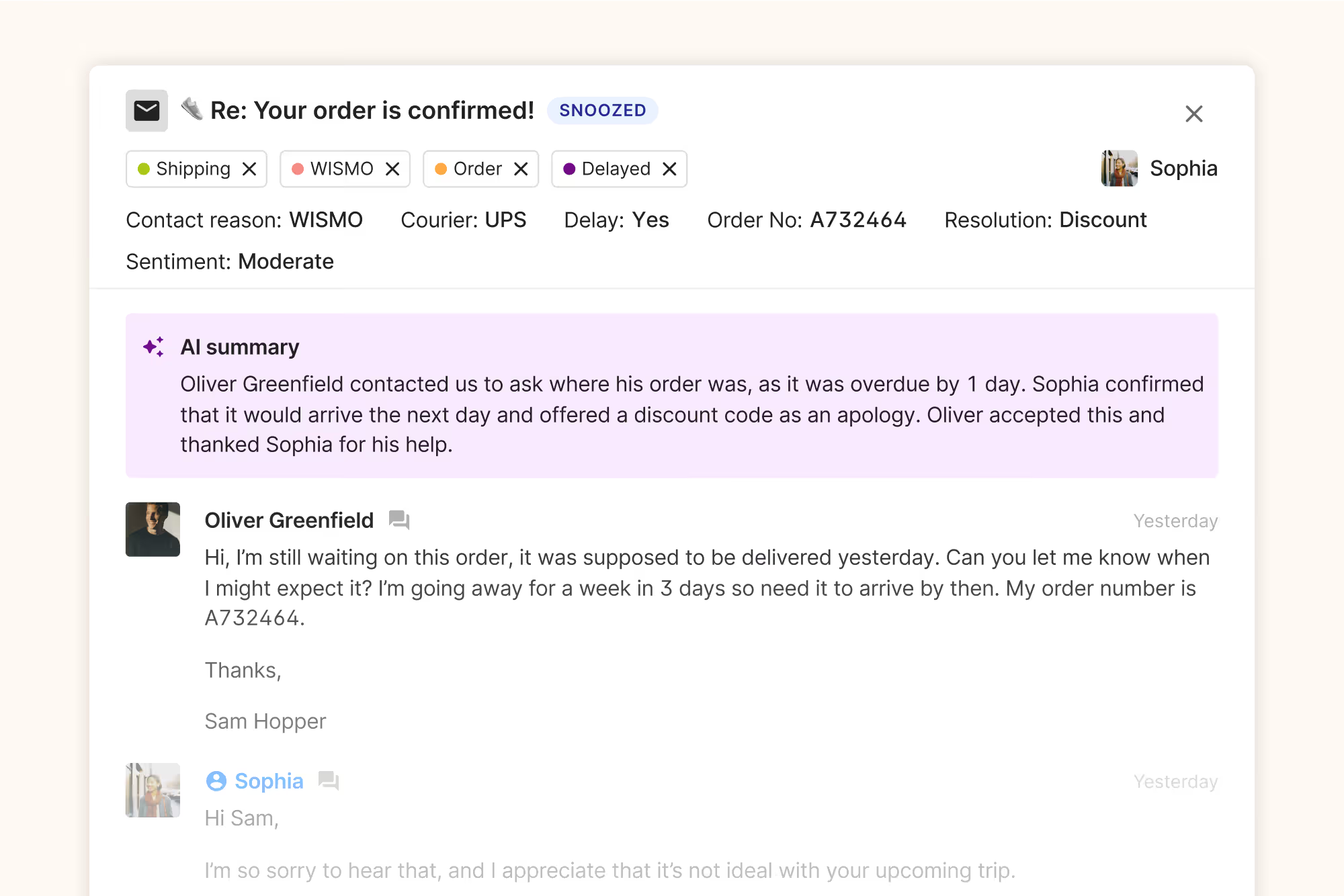
Agents shouldn’t have to dig for context. Every conversation now comes with Ticket Summaries. Whether an agent has jumped into a ticket mid-conversation or is dealing with a new customer, these AI-generated summaries tell the whole story in no time.
We’ve also given the Customer Timeline a makeover. Now, you can glance at past tickets and order updates in one clean view. Plus, a dedicated Order View lets agents dive into past purchases without leaving the ticket or opening a new tab.

Agents have always had visibility into customer history, but now that context is easier to act on.
Ticket Fields automatically tags tickets with AI-detected reasons, whether that’s shipping questions or product feedback, to help organize your conversations more effectively.
Then, add in another layer of data using Customer Fields (in beta) to note whether you’re speaking to a longtime, VIP customer or a customer with a history of high returns.
All of this data can be funneled into your ticket reports, making it easier for your team to discover new insights about your products, support quality, and more.

Taking your brand global doesn’t have to mean hiring a whole new team or spending extra on a localization tool. AI-powered translations (in beta) will soon be available on the helpdesk.
Finally, your team will be able to support customers in any language in real-time. Customers write in their native language, agents respond in theirs, and the exchange feels natural on both sides.

How many times has an urgent ticket been buried at the bottom of your inbox? The new Priority Scoring system prevents that by automatically labeling tickets as Low, Normal, High, or Critical based on your Rules.
For example, you might label a negative Facebook comment with threatening sentiment as ‘High,’ or bump high-value shoppers to the top with a ‘Critical’ label. This ensures your team always sees the conversations that need the most attention, so no sensitive issue slips through the cracks.
Now in beta, our flow-based IVR (interactive voice response) system lets teams on Gorgias Voice build customized call journeys for every type of conversation. Route customers through interactive menus, segment them based on their data, or direct them to voicemail, and schedule SMS follow-ups and callbacks.
To match agent availability, you can set business hours per phone number and per channel across storefronts. Teams also have more flexibility with ring strategies (ring available agents all at once or one at a time), wrap-up time between calls, and faster availability refreshes.

We understand that CX teams need more than surface-level KPIs—they need to know what’s actually driving performance, revenue, and retention.
With Dashboards, you can build reports focused on CX data you care about, from agent performance to product return trends. Then, filter by store or sub-brand to zoom in on the details each team is responsible for.
We’re also introducing the Human Response Time metric to show how quickly your team responds to escalations from AI Agent. This gives you a clear sign of what issues require human attention, how fast they’re resolved, and whether you need to adjust staffing.

Leave the moving to us—we now manage migrations in-house. Depending on your plan, our Implementation team will transfer emails, customers, macros, and more for you. Combined with 99.99% uptime, switching platforms is smoother, faster, and more reliable than ever.
For accelerated performance, consider our 50-in-50 implementation program, which aims to resolve 50% of your ticket volume using AI Agent within 50 days.
Enterprise customers receive a dedicated Enterprise CSM, optimization workshops, and 24/7 support to get the most out of Gorgias from day one.
Our teams are hard at work changing the landscape of customer experience. Here’s what’s on the Gorgias Product Roadmap:
Our latest helpdesk updates make it easier than before to create memorable customer moments.
As Bora Shehu, our VP of Product Design, said, “We hope that the tools we’re building help you spend less time on robotic work, and more time on impactful human work that grows your businesses through the power of conversations.”
If you’re not on Gorgias yet and want to see what’s possible, book a demo today.
{{lead-magnet-1}}

TL;DR:
Sizing has long been a friction point for ecommerce fashion shoppers.
Without the ability to try items on, 58% of shoppers resort to "bracketing"—ordering multiple sizes of the same piece and returning what doesn’t fit.
While it gives customers a temporary fix, it ultimately creates frustration for them and logistical headaches for brands.
The result is rising return rates, higher costs, and wasted resources. To break this cycle, ecommerce brands need to rethink how they guide shoppers toward the perfect fit. The good news is that many brands are already showing the way by using AI-powered tools and smarter product experiences to replicate the fitting room from the comfort of home.
{{lead-magnet-1}}
Recent data highlights just how severe the return challenge has become for fashion and apparel retailers:
In addition, rapidly rising concerns around sustainability and climate change, as well as heightened awareness around over-consumption, are prompting consumers to make changes in their purchasing habits.
Brands who prioritize well-fitting, long-lasting pieces and reduce carbon footprints and the amount of clothing diverted to landfills by lowering returns can actually benefit from a strategic edge.
“Those who choose to approach sustainability with a long-term mindset even while battling short-term problems will be rewarded with more efficient business operations and a competitive advantage,” writes McKinsey in its State of Fashion 2025 report.
Most brands already have size charts, but shoppers don’t want to measure themselves, or find those charts to be inaccurate.
When shoppers lack confidence in choosing the right fit, they either abandon their carts or rely on bracketing, both of which lower profitability and customer trust.
Forward-looking fashion and apparel brands are solving sizing issues by using tools for a more intuitive shopping experience. This ultimately helps them build loyalty, increase retention, and reduce returns.
Rather than purely providing static size charts on your website, opt for AI-generated personalized fit recommendations instead.
For example, European fashion retailer Zalando reduced size-related returns by 10% using AI-driven advice.

The brand flags whether an item is true to size or not. It also offers the ability for customers to see recommendations based on logged fit-based return reasons, past purchases, and other clothing items that fit them well.
Zalando also launched a body measurement feature in 2023 where shoppers can actually scan themselves for more accurate size advice.

As AI grows in proficiency, there are more tools than ever to help shoppers visualize product scale and fit.
For example, accessory shop LeSportsac uses Tangiblee, a product experience tool, to help customers understand scale and what fits inside each bag.

Performance hunting gear shop KUIU takes another approach. It uses a photo-based layering guide, so shoppers can see how the size and fit look with multiple layers on a model. Different model stats shown within product photography give contextual sizing cues.

Sleep shop Cozy Earth takes a similar route, stating model height and size on product photos.

Some brands are helping shoppers pick the right size with interactive quizzes based on factors like height, weight, and the sizes of other clothing items that fit well. SuitShop is among those brands using a Fit Finder quiz on its website.

Similarly, Psycho Bunny leverages the AI tool True Fit as a size finder on product pages.

Ergonomic shoe brand Orthofeet eliminates sizing qualms altogether by including customizable inserts inside each box. Fitting spacers ensure a snug fit and arch enhancement for those who need it, helping shoppers get comfortable shoes that fit.

Jonas Paul Eyewear shares the “try it on at home” approach, offering a free or low-cost home try-on kit.

Gorgias Shopping Assistant helps brands meet that need by delivering human-like guidance at scale, giving shoppers instant answers that feel personal.
For example, VESSEL uses Shopping Assistant in chat to provide real-time support on sizing and inventory, helping customers choose with confidence. By addressing fit questions directly, Shopping Assistant reduces returns and builds trust at the point of purchase.

Similarly, outdoor clothing retailer Arc‘teryx provides an “ask me anything” AI chat where shoppers can confirm any questions they have around fit or sizing.

Sizing for ecommerce fashion and apparel brands has become a business-critical challenge. With 70% of returns tied to fit issues and nearly half of shoppers abandoning purchases over inconvenient returns, brands that replicate the fitting room online stand to gain a competitive advantage.
From Zalando’s 10% reduction in size-related returns to VESSEL’s use of AI-powered chat, the path is clear: investing in smarter size chart solutions pays off with higher retention, lower costs, and stronger sustainability.
The brands that provide fitting room-level experiences online now will set themselves apart from the rest.
Book a demo to see how Gorgias, the leading conversational commerce platform, helps fashion brands cut returns, drive sales, and deliver fitting-room level experiences online.
{{lead-magnet-2}}

TL;DR:
While your competitors are still making customers wait days for email replies, the smartest brands are having conversations that close sales in real time.
Instead of forcing customers to search through FAQs or go through an automation loop, conversational commerce lets you have instant chats through live chat, messaging apps, and even AI assistants.
In this guide, we’ll explain conversational commerce, where it delivers the most value, and how to start using it to drive revenue and improve CX without overwhelming your team.
Conversational commerce means using real-time, two-way conversations as your storefront. Rather than bottling up questions in FAQ pages or forcing customers to wait for your support team to respond, you can instantly connect via:
Maybe someone is on your product page and asks a question like, “Does this jacket run large?”. Through chat, they get an instant answer, increasing the chance of a sale. Or a shopper receives personalized recommendations via WhatsApp and checks out, all without leaving the app.
These channels allow you to meet customers where they already are, effortlessly. When paired with AI chatbots, you can deliver fast, accurate responses 24/7, even while your team is off the clock. That means better experiences for your customers and more sales captured for your brand.
Conversational commerce bridges the gap between shopping and support. It turns your support team (and AI tools) into revenue drivers by helping shoppers feel seen, heard, and ready to buy.
Conversational commerce means bringing your storefront into the flow of conversation, wherever that happens for your customers.
Here’s where those conversations typically happen:
This is a chat widget on your site, often in the bottom right corner, where shoppers can ask questions and receive immediate answers from a human agent or automation.
It’s a quick path to support or purchase, which one agent can manage multiple chats from simultaneously, boosting efficiency and keeping things personal.
These smart helpers use Natural Language Processing (NLP) to understand what shoppers mean beyond what they type. They guide customers through questions, offer product suggestions, handle FAQs, and can sometimes complete transactions right in the chat, even handling post‑purchase support like order status or returns.
Natural Language Processing (NLP): The processing of understanding and interpreting natural language using computers. NLP is used in tasks such as sentiment analysis, summarization, speech recognition, and more.
Think WhatsApp, Facebook Messenger, WeChat, and SMS—the apps where customers already spend their time in their day-to-day. Instead of sending them to shop on your website, you bring the shopping to them. Answer their questions, provide recommendations, and win purchases in a channel they already trust.
Voice assistance isn’t limited to smart speakers like Siri and Alexa anymore.
Now, AI voice support lets brands deliver natural conversations over the phone, without needing a massive contact center team. These AI voice agents can:
AI-powered voice support combines the human feel of a phone call with the speed and accuracy of automation. It's especially useful for high-ticket products, customers who prefer calling, or peak season overflow when your human team is maxed out.
Conversational commerce isn’t a CX buzzword. When done right, it directly impacts your bottom line.
Here’s how it pays off for ecommerce brands:
When customers can ask questions and get answers in real time, whether it's sizing info, shipping details, or help choosing between products, they’re far more likely to hit “buy.”
Success story: Clothing brand Tommy John generated $106K+ in sales in just two months through conversation-led upselling and cross-selling, with a 15% conversion rate.
Conversational commerce tools like AI agents help offload the repetitive support tasks, including answering questions like “Where’s my order?” or “What’s your return policy?”
With that time back, agents get time back to:
Instead of getting buried in basic tickets, your team gets to do the work that really moves the needle for your customers and your business.
Related: Every successful marketing campaign starts with a customer question
The right nudge at the right moment, like a personalized recommendation from an AI shopping assistant, can turn a single item into a full cart. You can also recover more abandoned checkouts by re-engaging customers directly through chat or a messaging app.
Read more: You’re missing out on sales without an AI shopping assistant—here’s why
Conversational commerce lets you meet customers with a human (or human-like) touch. When your brand is helpful, fast, and easy to talk to, shoppers remember and return.
In the long run, that means better customer retention, higher lifetime value, and more organic growth through word of mouth.
Conversational commerce shines brightest when the stakes are high or when the moment is just right.
Here are the critical moments where a real-time conversation can make all the difference:
A customer’s on your product page, they’ve added an item to their cart, but are hesitating. Maybe they’re unsure about sizing, shipping time, or which variation to choose. This is where a quick, helpful chat, automated or human, comes in and becomes the difference between bounce and conversion.
Pro tip: Use proactive chat prompts based on page behavior to start the conversation before the shopper leaves.
After a customer hits “place order,” expect more questions to roll into your inbox. Where’s my order? How do I track it? What’s your return policy? Post-purchase excitement—and anxiety—is normal, and a smart AI agent helps you get ahead of these questions while putting customers at ease.
Black Friday. Holiday rush. Product drops. These are prime opportunities to boost revenue—but they also flood your support team. Conversational commerce tools help you scale without sacrificing quality, keeping shoppers happy and sales flowing.
If you sell skincare, supplements, tech, or anything that requires a bit of education, your customers likely need guidance before they commit. A personalized conversation helps them find the right fit and feel more confident in their purchase.
Conversational commerce sounds exciting, and it is. But before you dive in, it’s worth thinking through a few key factors to set your team (and your customers) up for success.
You don’t need a full-blown chatbot army on Day 1. Start with your highest-impact touchpoints, like pre-sale FAQs or WISMO questions, and layer in automation over time. The goal is to generate clear ROI early, then expand once you see traction.
Here’s how to gradually implement automation into your CX process:
The goal isn’t to automate everything, it’s to automate smartly so your team can spend time where it counts: high-touch sales, VIP support, and strategic growth.
Do you have in-house agents ready to handle live chat? Or do you need automation to handle the bulk of it? Make sure your setup aligns with your team’s bandwidth.
Pro tip: Tools like Gorgias AI Agent and Shopping Assistant can handle the support and sales heavy lifting, making them perfect for lean CX teams.
Your customers aren’t just on your website. They’re messaging on Instagram, browsing via mobile, or checking their texts. To deliver great conversational commerce, you’ll want to show up in the places your shoppers already use.
Pro tip: Don’t spread your efforts too thin. Start with the channel that aligns with your goals and customer behavior, live chat, SMS, or social DMs, and build from there.
Ready to make conversational commerce part of your CX strategy? You don’t need to overhaul your tech stack or hire a whole new team. With Gorgias, you can start fast, stay lean, and scale smart.
Here’s how:
Gorgias AI Agent is designed to take repetitive tickets off your team’s plate, from “Where’s my order?” to “How do I make a return?” It understands natural language, pulls in relevant customer data, and responds in seconds—all using your brand’s approved knowledge.
The result is faster responses, fewer tickets, and more time back for your team.

While AI Agent, covers the support front, Shopping Assistant is your digital salesperson. It engages high-intent shoppers in real time, recommends the right products, and even upsells or cross-sells based on what the customer is browsing.
Whether it’s helping someone choose the perfect shade or nudging them to complete their cart, Shopping Assistant is designed to increase AOV and reduce abandonment.

Every time a shopper lands on your site, scrolls through Instagram, or replies to a shipping update, they’re opening the door to a conversation. The brands that show up quickly, helpfully, and with the right message, are the ones winning loyalty and revenue.
With AI Agent, you can automate accurate responses to common questions, giving your team time back without sacrificing customer experience. And with Shopping Assistant, you can turn those conversations into conversions, offering personalized recommendations, upsells, and discounts based on shopper intent.
You don’t need a massive team or months of setup to start. Just the right tools, and a strategy built for your customers.
Book a demo and learn how Gorgias helps you turn every conversation into an opportunity to grow.
{{lead-magnet-2}}