

How to Connect Gorgias to Claude or ChatGPT (6 Workflows to Try Right Now)
A few things to know before you connect Gorgias MCP:
- Compatible AI tools: Claude, ChatGPT, Cursor, and any other MCP-compatible client
- Cost: Included in your existing Gorgias paid plan at no extra cost.
- AI Agent: Not required. Helpdesk-only customers have full access.
- Availability: Currently in open beta, open to all paid plan customers.
Ask your helpdesk anything, and get a real answer from your actual data in seconds.
Gorgias MCP connects your Gorgias account directly to Claude, ChatGPT, Cursor, or any other MCP-compatible AI tool. No more exporting data or re-explaining context every time you need a different angle on your tickets. Ask a question, follow up, and execute, all in the same conversation.
This guide covers what Gorgias MCP is, how to connect it, and six specific workflows you can run in your first session.
What is Gorgias MCP?
The Model Context Protocol (MCP) enables AI systems to link directly with other tools.
The Gorgias MCP provides a first-party bridge, giving you a secure, direct connection between your chosen AI assistant and your Gorgias account.
Once connected, your LLM of choice can:
- Read and search your tickets and customer history
- Analyze patterns across CSAT scores, ticket volume, and resolution time
- Review your macros, rules, and tags
- Audit your AI Agent guidances and handoff tickets
- Draft new AI Agent guidances based on your existing setup
- Check user permissions and team configuration
How to connect Gorgias MCP
Setup takes about five minutes. Here is what you need and how to do it.
What you need:
- A Gorgias paid plan (any plan, AI Agent not required)
- An active subscription to Claude, ChatGPT, Cursor, or another MCP-compatible tool
Steps:
- Open your AI tool and navigate to its settings. Look for an Integrations, Connectors, or MCP section.
- Add a new MCP server using this endpoint: mcp.gorgias.com/mcp?gorgias_subdomain=YOUR-SUBDOMAIN. Replace YOUR-SUBDOMAIN with the part of your Gorgias URL that comes before .gorgias.com.
- Authorize the connection via OAuth. You will be prompted to log into your Gorgias account.
- Open a new chat and ask your first question.
The exact steps vary slightly depending on which AI tool you use.
Read more: The Gorgias MCP setup guide specifically walks through Claude, ChatGPT, and Cursor.
6 workflows to run in your first session
Each workflow below includes the exact prompt to copy. Adjust the specifics to match your store, and run it in your first session.
1. Find out why your CSAT dropped last month
CSAT dips are easy to spot in your dashboard. The cause is harder. Figuring it out usually means opening tickets one by one, building a custom filter, and reading through results one by one.
The prompt:
- "Show me all tickets from the last 30 days with a CSAT rating of 1 or 2. Group them by the most common themes and tell me what customers said."
What you get: A grouped breakdown of the patterns behind your low scores, based on what customers wrote.
Follow-up prompts:
- "Were any of these customers VIPs or high-order-value shoppers?"
- "Which agent handled the most tickets in this group?"
2. Audit your AI Agent handoffs and close the biggest gap
Handoff reports tell you how many tickets AI Agent escalated to your team. They rarely tell you why. Diagnosing the root cause and writing new guidance to fix it are usually two separate tasks that happen days apart, if at all.
With Gorgias MCP, you can do both in the same conversation.
The prompt:
- "Show me the last 50 tickets that AI Agent handed off to a human agent. What are the three most common reasons it couldn't resolve them?"
Then, without starting a new chat:
- "Draft a new AI Agent guidance to handle [the top reason from above]. Use the format of my existing guidances."
What you get: A diagnosis of where AI Agent is struggling and a ready-to-review draft guidance to address the top gap. You apply it manually in Gorgias, but the thinking is done.
Follow-up prompts:
- "Are these handoffs concentrated on a specific product category or ticket tag?"
- "How do these handoff reasons compare to last month?"
3. Map customer friction points to your product pages
This is one of the most powerful early use cases customers have found. By connecting Gorgias MCP with the Shopify MCP, you can link what customers complain about in tickets to the product pages where that friction lives.
To use this workflow, connect both Gorgias MCP and Shopify MCP oto your AI tool first.
The prompt:
- "What are the most common complaints or questions about [product name or category]? For each one, note whether the issue could be addressed by improving the product description, adding sizing information, or clarifying the return policy."
What you get: A prioritized list of friction points tied to specific content gaps on your product pages, ready to hand off to your product or merchandising team.
Follow-up prompts:
- "Which of these friction points appears most often in tickets tagged as returns?"
- "Are any of these issues specific to one variant or size?"
4. Get a custom ticket volume breakdown without building a report
Gorgias's built-in reports cover the core metrics well. But when you need a specific cut, ticket volume by intent for a particular channel, or resolution time broken down by tag, getting there requires an export and a spreadsheet.
Ask for exactly what you need instead.
The prompt:
- "Break down our ticket volume for the last 30 days by intent. Show me the top 10 intents, the volume for each, and the average resolution time per intent."
What you get: A custom breakdown you can copy directly into a slide or share with your team, built from a single question.
Follow-up prompts:
- "Which intent has the highest first-contact resolution rate?"
- "Compare this to the previous 30-day period. What changed the most?"
5. Find every topic your macros don't cover
Every support inbox has repeat questions that agents are still answering manually. Some of those topics may already have a macro, but others show up again and again without consistent macro usage. This workflow helps surface the best candidates to standardize next.
The prompt:
- “Look at all tickets from the last 60 days. Which topics or questions appear most often, and for which of them do we see little or no macro usage? List the top 10.”
What you get: A ranked list of frequent support topics that appear to be handled manually most of the time, helping your team prioritize where a new or better macro could save the most effort.
Follow-up prompts:
- “Draft a macro response for the most common topic in that list.”
- “Which of these topics has the longest average first response time?”
- “Which of these topics already use macros sometimes, but not consistently?”
6. Clean up your tag taxonomy
Tag libraries tend to grow organically. Over time, teams end up with overlapping labels like “return,” “returns,” and “return-request,” along with tags that are rarely used and naming patterns that make reporting harder to trust. This workflow helps identify cleanup opportunities based on how tags are actually used on tickets.
The prompt:
- “Review the tags used on tickets in my Gorgias account. Flag any that appear to overlap in meaning, are used fewer than five times total, or seem inconsistent with the others. Group your suggestions by consolidation opportunity.”
What you get: A list of likely tag issues grouped by type — duplicates, low-use tags, and inconsistent naming — based on actual ticket usage, with consolidation suggestions your team can act on.
Follow-up prompts:
- “For the duplicates you flagged, which version is used more often? That’s the one I’ll keep.”
- “Which of these low-use tags have appeared at all in the last 90 days?”
- “Which consolidation opportunities would have the biggest reporting impact?”
Get more out of the data you already have
Everything in the workflows above is already sitting in your Gorgias account. Gorgias MCP just makes it conversational.
Not sure where to start? Try workflow 1 (CSAT drop report) or workflow 6 (tag cleanup) first. Both deliver results quickly and work regardless of how your account is configured.
Gorgias MCP is currently in open beta and available to all paid plan customers.
TL;DR:
- Gaia for Zendesk is a free Chrome extension that analyzes your Zendesk ticket history and identifies gaps in your AI Agent setup.
- It generates ready-to-review guidances, instructions, voice-of-customer analysis, and Copilot procedures — nothing is applied without your approval.
- Install it in five minutes and run your first analysis in under a minute.
Getting more out of your Zendesk AI Agent comes down to better configuration. The problem is that auditing your own setup requires time you don't have.
Gaia for Zendesk is a free Chrome extension from Gorgias that clears that backlog in minutes. It connects to your Zendesk account, reads your tickets, and generates the components your AI Agent needs to resolve more conversations without escalation.
Below, you'll find everything you need to get started: how to install Gaia, what it can do, and the use cases teams are already putting it to work for.
Jump to:
- Who is this for?
- What is Gaia for Zendesk?
- Why use Gaia instead of configuring it yourself?
- How to install Gaia for Zendesk
- Four ways to use Gaia for Zendesk
Who is this for?
Zendesk Suite admins and agents who want to set up or improve their Zendesk AI Agent (and, optionally, Zendesk Copilot).
Throughout this article, "AI Agent" refers to Zendesk's own AI Agent feature, not Gorgias's product. Gaia is the Gorgias-built Chrome extension that helps you configure it.
What is Gaia for Zendesk?
Gaia for Zendesk is a free Chrome extension built by Gorgias that connects to your Zendesk account and analyzes your real ticket history.
It autonomously transforms that data into the core components your Zendesk AI Agent needs to resolve more tickets without human intervention: guidances, instructions, voice-of-customer insights, and Copilot procedures.
Gaia opens automatically as a side panel on any .zendesk.com page. You choose a workflow, Gaia runs the analysis and generates structured drafts, and you review and approve what should be applied to your Zendesk workspace.
What Gaia can do:
- Improve your Zendesk AI Agent: Scans escalated tickets, identifies gaps in your existing setup, and proposes targeted updates to your guidances.
- Create your first instructions: Generates 15 best-practice AI Agent instructions, adapted from Gorgias templates and tailored to your ticket data.
- Analyze your tickets: Produces a voice-of-customer report covering ticket volume, intents, and escalation patterns from the last 90 days.
- Create your first procedures: Drafts 10 Copilot procedures using the Gaia WHEN/IF/THEN format (requires the Copilot add-on in Zendesk).
Good to know: Gaia is autonomous in how it analyzes your data and generates recommendations, but nothing is applied without your approval.
Why use Gaia instead of configuring it yourself?
How well your AI Agent performs comes down to how well it is configured. Clear instructions, well-defined intents, and up-to-date procedures are what separate an AI Agent that resolves tickets from one that escalates them — and building that foundation manually takes time most teams do not have.
Gaia removes that constraint by turning your existing support data into structured, ready-to-review outputs:
- Skip the blank page. Start from drafts generated from your own ticket history instead of building from scratch.
- Get from setup to first results faster. Gaia analyzes up to 90 days of tickets in minutes and produces implementation-ready content, so you move from setup to value in hours, not weeks.
- Stay in control. Every output is surfaced for review so you can validate accuracy and alignment with your policies.
- Keep improving over time. Re-run Gaia regularly to capture new intents, identify gaps, and maintain coverage as your business evolves.
Tip: Teams that define five or more strong guidances typically see a meaningful lift in the share of tickets their AI Agent resolves without escalation. Gaia is designed to help you reach and expand beyond that baseline quickly.
How to install Gaia for Zendesk
Installation takes about five minutes. You'll need admin access to your Zendesk account to generate an API token.
Make sure you're using Google Chrome or another Chromium-based browser (such as Edge or Brave). Gaia is not available for Safari or Firefox at launch.
Follow these steps:
1. Install the Gaia for Zendesk extension. Go to the Chrome Web Store listing for Gaia for Zendesk by Gorgias and click Add to Chrome. Confirm the permissions to complete installation.
2. Generate a Zendesk API token. In Zendesk, navigate to Admin Center › Apps and integrations › Zendesk API. Enable Token access if needed, then click Add API token. Copy and store the token securely (it will not be visible again).
3. Open the Gaia extension and add your credentials. Click the Gaia icon in your Chrome toolbar, then open Settings. Enter:
- Zendesk subdomain: the part before .zendesk.com in your account URL (for example, acme if your URL is acme.zendesk.com).
- Email: the email of the Zendesk admin who created the API token.
- API token: paste the token you generated in step 2.
4. Click Save. Gaia will validate the connection.
5. Open any Zendesk page. Navigate to any page in your Zendesk account. Gaia will appear as a side panel where you can select a workflow and begin.
Four ways to use Gaia for Zendesk
Here are the four most common ways teams use Gaia for Zendesk.
1) Audit and improve an existing AI Agent setup
Best for: Teams already using Zendesk AI Agent or Answer Bot but not reaching their automation goals
Select Improve my AI Agent. Gaia analyzes escalated tickets against your current guidances to identify missing intents, unclear instructions, and outdated logic, then proposes prioritized improvements.
2) Bootstrap AI Agent from a blank slate
Best for: Teams starting without an established AI configuration
Select Create my first instructions. Gaia generates a foundational set of 15 instructions covering common ecommerce scenarios (order status, refunds, cancellations, shipping, returns).
3) Run a voice-of-customer analysis
Best for: Support, CX, and operations teams planning improvements or reporting on performance
Select Analyze my tickets. Gaia summarizes ticket volume, top intents, and escalation drivers to highlight where automation or process improvements will have the greatest impact.
4) Roll out Copilot procedures
Best for: Teams using Zendesk Copilot who want consistent, scalable agent workflows
Requires the Copilot add-on in Zendesk. Select Create my first procedures. Gaia converts real agent behavior into structured WHEN/IF/THEN procedures that standardize how common scenarios are handled.
Your AI Agent is resolving less than it should — and it’s costing you
Gaia connects to your Zendesk account, reads your ticket history, and shows you exactly where your setup is falling short. Install the free Chrome extension and run your first analysis in under a minute.

Newsletter Signup
The best in CX and ecommerce, right to your inbox
Featured articles
Ticket Volume: How to Measure It, Benchmark It, and Reduce It
TL;DR:
- Ticket volume is your support workload: It counts every customer inquiry across every channel in a given time period.
- High volume signals friction in your business: Spikes usually point to unclear policies, product issues, or gaps in your website experience.
- Every ticket has a real cost: Agent time, tooling, and overhead add up fast — and they compound during peak seasons.
- Automation reduces volume without reducing quality: AI tools and self-service deflect repetitive questions while keeping customers satisfied.
- Measurement drives improvement: Tracking volume by channel, category, and time period reveals exactly where to focus your efforts.
Your ticket volume number is probably wrong. If customers are reaching you through email forwards, Slack DMs, or channels that bypass your helpdesk, those tickets aren't being counted, and your SLA reporting is built on incomplete data. This guide covers how to get an accurate count, break it down by channel and category, and use your vertical benchmark to figure out whether your volume is actually a problem or just normal for your industry.
What is ticket volume?
Ticket volume is the total number of customer inquiries your support team receives across all channels — email, live chat, phone, social media, and contact forms — within a specific time period. It is the most direct measure of your team's workload.
Do not confuse it with contact rate. Contact rate = tickets ÷ orders (or customers). That normalized number is more useful for benchmarking and planning because it accounts for business growth. Raw ticket volume tells you how busy your team is. Contact rate tells you whether support demand is outpacing your business.
How to calculate your ticket volume
Start by looking at the last 30 days of customer conversations, no matter where they currently live.
Pull these four numbers:
- Total customer questions received across all channels
- Breakdown by channel (email, chat, social DMs, phone, contact forms, etc.)
- Breakdown by category (shipping, returns, product questions, account issues)
- Tickets or conversations per order during the same period — this gives you your contact rate baseline
Here’s how to pull that data depending on your setup:
Gmail or Outlook
Open your inbox or Sent folder and filter by the last 30 days. Count how many customer conversations came in during that period. You can also copy subject lines into ChatGPT or Claude to group conversations by topic.
Shopify Inbox
Go to Inbox > Conversations and review your recent conversations. Count how many messages you received and look for repeated themes or questions.
Any helpdesk (Gorgias, Zendesk, Freshdesk, Help Scout, etc.)
Most helpdesks have ticket reporting or exports built in. Search “export tickets” or “ticket report” in your platform’s help center. From there, you can pull:
- Total tickets
- Channel breakdown
- Top ticket categories
- Tickets over time
If a large portion of customer questions are still happening in untracked places like Slack DMs, personal inboxes, or Instagram comments, your reporting is incomplete. Before optimizing support operations, route customer conversations into one shared system so you can accurately measure volume, response times, and recurring issues.
Why your volume breakdown matters more than the total
A raw ticket count tells you how busy your team is. The breakdown tells you what to fix.
|
Category |
What high volume signals |
What to do |
|
"Where is my order?" |
No proactive shipping updates; poor tracking page |
Automate WISMO with AI Agent; add tracking link to order confirmation |
|
Returns and exchanges |
Confusing return policy; no self-serve portal |
Add a clear returns page; enable self-serve exchange flows |
|
Sizing and product questions |
Weak product page content |
Add size guides, FAQs, and fit notes directly on product pages |
|
Account and subscription issues |
Customers can't self-serve basic account changes |
Build or improve your Help Center; enable self-serve account management |
|
Payment and billing |
Checkout friction or unclear pricing |
Fix at the source — this is rarely a support problem |
Run this categorization for your last 30 days. Your top two or three categories are your highest-leverage targets.
Track volume alongside these KPIs
Ticket volume only tells part of the story. Track it alongside:
- Contact rate (tickets ÷ orders) — so you know if volume is growing faster than your business
- First response time (FRT) — volume spikes show up here first
- Average handle time (AHT) — high AHT + high volume = a capacity problem
- Cost per ticket — total support costs ÷ total tickets, the clearest financial measure
- Backlog size — a growing backlog is the earliest warning sign that volume is outpacing capacity
- Deflection rate — tickets resolved through self-service or automation without agent involvement
How to reduce ticket volume without reducing quality
Once you know what is driving your volume, address each category at the source. The goal is to eliminate unnecessary tickets.
Automate the highest-volume, lowest-complexity tickets first. WISMO inquiries, order status checks, and basic return initiations require no agent judgment. An AI Agent connected to your ecommerce platform can handle these end-to-end without a human stepping in. When a question is too complex, the AI escalates it with full context attached.
Build self-service content around your top categories. A Help Center that directly addresses your most common ticket types is the highest-leverage tool for sustained volume reduction. Start with your top five categories. Write one article per category. Surface those articles on relevant product pages, in checkout, and in post-purchase emails — before customers need to search.
Send proactive messages at the moments that generate the most tickets. Post-purchase is the single highest-value touchpoint: an order confirmation that includes a tracking link, estimated delivery window, and a clear link to your return policy eliminates a large share of inbound questions before they are ever submitted.
Measure deflection, not just volume. Deflection rate, the percentage of issues resolved through self-service or automation, is the metric that tells you whether your volume reduction efforts are actually working. Track it weekly alongside CSAT for automated interactions to make sure quality is holding.
Ticket volume benchmarks
The all-industry average is not your benchmark. Ticket volume per 100 orders varies 2.4x across verticals, so comparing yourself to a cross-industry number will either make you complacent or create false urgency.
According to Gorgias platform data from March 2026 across 14 verticals at the $10M GMV band, here is what tickets per 100 orders actually looks like by vertical:
|
Vertical |
Tickets per 100 orders |
|
Electronics |
46 |
|
Vehicles & Parts |
46 |
|
Hardware |
41 |
|
Luggage & Bags |
32 |
|
Home & Garden |
32 |
|
Sporting Goods |
32 |
|
Baby & Toddler |
24 |
|
Business & Industrial |
25 |
|
Animals & Pet Supplies |
25 |
|
Apparel & Accessories |
22 |
|
Health & Beauty |
21 |
|
Arts & Entertainment |
21 |
|
Food & Beverages |
20 |
|
Toys & Games |
19 |
Source: Gorgias Ecom Lab, March 2026
High ticket volume is not always a sign of poor CX — it often reflects product complexity. Electronics brands generate nearly one ticket per two orders because customers have more pre- and post-purchase questions about technical products. Food and Beverage brands generate about one in five. That gap is not a performance difference; it is a category difference.
The right question is not "are we below 10 tickets per 100 orders?" It is "are we above or below our vertical peers?" Find your row. That is your baseline. Then use the reduction tactics above to move below it.
How to predict ticket volume if your tool charges per ticket
If your ticketing tool uses usage-based pricing, where your bill scales with ticket volume rather than agent headcount, forecasting volume directly affects your budget.
The core formula is simple:
Projected tickets = projected orders × (tickets per 100 orders ÷ 100)
So if you expect 2,000 orders next month and your vertical median is 22 tickets per 100 orders, your forecast is approximately 440 tickets.
But a flat monthly estimate misses the real risk: peak seasons. A volume spike during BFCM that triples your order volume will also triple your ticket count — and your bill — unless you have guardrails in place.
To build a more accurate forecast:
- Use your contact rate, not raw volume. Divide your tickets by orders for each of the last 12 months. This gives you a stable ratio that accounts for business growth and seasonal swings.
- Apply that ratio to your order forecast. If your marketing team has a sales projection for November, multiply it by your contact rate to estimate support volume.
- Separate your AI-handled tickets from agent-handled tickets. Some platforms bill differently for automated resolutions versus human ones. If you're using an AI Agent to deflect WISMO and returns, those deflected tickets may not count toward your billable volume at all — which changes the math significantly.
- Build in a buffer for peak periods. Your contact rate tends to rise during high-demand periods, not just your order volume. First-time customers generate more tickets than repeat buyers, and BFCM brings a disproportionate share of first-timers.
Before signing any usage-based contract, ask two questions: What counts as a billable ticket? And is there a hard cap on monthly charges? Variable billing only works in your favor if you have clear definitions of what triggers a charge and a ceiling on how high costs can go during an unexpected spike.
If your platform bills per ticket resolved by a human agent (not AI), your deflection rate becomes a financial metric, not just an operational one. Every percentage point of additional deflection directly reduces your bill.
Start reducing ticket volume today
Begin by identifying your top ticket categories, then work backward to find the root cause of each one.
From there, layer in self-service content, automation, and proactive messaging to address those root causes directly. The result is a support operation that handles more customers and a team that spends its time on the work that actually requires human judgment.
Book a demo to see how Gorgias helps ecommerce brands reduce ticket volume and improve customer experience at the same time.
{{lead-magnet-2}}
Gorgias AI Agent Pricing, Explained
TL;DR:
- AI Agent is priced per resolved interaction, not per seat or per message. You only pay when the AI fully resolves a conversation on its own.
- Most plans are $0.90 per resolved interaction. Starter plans begin at $1. Plans include 90 to 2,500+ automated interactions per month.
- If you go over your plan, overage fees apply per additional interaction. Rates vary by tier and are lower on annual plans.
- Your automation rate emerges from usage over time. Start by estimating your ticket volume and pick an interaction allotment that fits.
- AI Agent runs on email, chat, and SMS, and includes tone of voice customization, Actions, multi-language support, vision, and performance reporting.
If you're wondering what it costs to add AI Agent to your Helpdesk, you're in the right place. This article walks through how pricing works, what counts as a billable interaction, and how to think about the investment before talking to anyone on our team.
The good news: there are no seat fees, no per-message charges, and no token-based billing. You pay for conversations your AI actually resolves. If you've looked into other AI tools for customer support and found the pricing models confusing or hard to predict, Gorgias AI Agent works differently.
What is a billable interaction?
A billable interaction is counted when the AI resolves a customer conversation entirely on its own. The customer asks something, the AI handles it, the conversation closes. That's one interaction.
If the AI can't fully resolve a conversation and hands it to a human agent, that ticket shifts over to your regular Helpdesk plan. It becomes a standard resolved ticket. You're not charged for both.
A few things that don't count as billable interactions:
- Emails that come in but no one replies to
- Spam or filtered messages
- Conversations resolved by a human agent
This matters most for brands coming from seat-based tools. With Gorgias, your whole team can work in the platform. Agent seats are unlimited. Pricing scales with what your AI is actually doing, not with how many people have access.
Understand the difference between seat-based vs. usage-based pricing.
How AI Agent plans work
AI Agent is an add-on to your Gorgias Helpdesk plan. The two are priced separately but work together. Your Helpdesk plan covers all the conversations your human agents resolve. Your AI Agent plan covers the interactions the AI resolves on its own.
When you choose a plan, you select how many automated interactions you want included per month. Depending on your plan, that ranges from 90 to 2,500+ interactions, with custom interaction numbers available for enterprise. You can see the full breakdown on the Gorgias pricing page.
Each resolved conversation costs $0.90 on most plans. Starter plans begin at $1 per resolved conversation. You only pay for fully automated interactions, meaning conversations the AI handles from start to finish without a human stepping in.
Choosing the right plan
The main input is your average monthly ticket volume. From there, you estimate how many of those conversations AI could realistically handle on its own.
Order status updates, return requests, and shipping questions tend to be the highest-volume ticket types AI resolves well. AI Agent actions shows the full range of what it can handle, which makes it easier to estimate your starting number.
Your actual automation rate, meaning the share of total tickets the AI ends up resolving, emerges from usage over time. Most brands start with their most repetitive ticket types and expand from there as they see results.
Related: Which Gorgias plan should you choose?
What happens if you go over your plan
You're charged an overage fee for each additional automated interaction if you exceed your plan's baseline in a given month. The exact rate depends on your plan tier and whether you're on a monthly or annual subscription.
Generally, the higher your plan tier, the lower your overage rate. Annual plans also carry lower overage rates than monthly plans. So if you're regularly going over, upgrading to a higher tier or switching to annual often works out cheaper than paying overage fees month after month.
If you're on a Support + Shopping Assistant plan, the overage rate is $1.50 per interaction across all paid tiers. If you're on a Support-only plan, rates range from $1.00 to $2.00 per interaction on monthly plans, and $0.83 to $1.67 on annual plans, depending on your tier.
For seasonal businesses, forecasting your customer service volume before peak periods is the best way to choose the right plan size and avoid unexpected fees.
How to think about the cost
At $0.90 per resolved interaction on most plans, each AI resolution costs less than a human agent handling the same ticket. Once you know what a human-resolved ticket costs your business, the comparison becomes straightforward.
For brands building an internal case for the investment, how to pitch AI Agent to your boss covers the ROI framing in detail.
To see what results look like in practice, how 10 brands transformed customer support into revenue has real ecommerce examples.
What's included with AI Agent
AI Agent comes with everything you need to set it up, customize it, and improve it over time:
- Knowledge training — AI Agent learns from your Shopify data, store website, Help Center articles, URLs, documents, and custom guidance. The more content it has, the more accurately it responds.
- Tone of voice — set instructions for how AI Agent sounds, whether that's professional, friendly, or something else, and it stays consistent across every conversation.
- Actions — connect AI Agent to your other tools so it can complete tasks like cancelling an order, processing a return, or modifying a subscription without a human stepping in. See what AI Agent can do.
- Multi-language support — AI Agent detects the language a customer writes in and replies in the same language automatically.
- Vision — AI Agent can read and understand images, so it can handle tickets where customers share photos of damaged items or order issues.
- Performance reporting — track automation rate, CSAT, first-response time, and ticket topics directly in the dashboard.
- Testing — preview how AI Agent responds to real customer questions before going live or after making changes.
- Handover to humans — AI Agent automatically passes conversations to your team when it lacks confidence, detects frustration, or encounters a topic you've marked for human handling.
Learn more: Gorgias AI Agent guardrails: What they are and how to configure them
Curious what AI Agent would automate for your store?
The best way to get a sense of what AI Agent will cost is to look at your own ticket volume and the types of questions your customers ask most. From there, the right plan becomes much clearer.
If you want to talk through the numbers with someone from our team, book a demo and we'll walk through it with you.
If you'd rather keep exploring first, here are a few good next reads:
- AI Agent keeps getting smarter — the latest performance data across the Gorgias customer base
- 10 must-know AI Agent use cases — the ticket types brands are automating today
- How 10 brands transformed customer support into revenue — real ecommerce results
- How to customize AI Agent with 7 brand voice examples — what the experience looks like for customers
{{lead-magnet-2}}
Introducing Helpdesk 2.0: Built for How Agents Work
TL;DR:
- Built directly from agent feedback, Helpdesk 2.0 fixes real workflow pain points. The redesign focuses on reducing friction and helping agents handle more context-heavy tickets.
- A chat-style interface replaces the old email layout. Conversations are easier to follow and resolve in one view.
- Customer context is shown beside the conversation in a right-side panel. Agents can view history, orders, and details without leaving the ticket.
- AI handoffs come with clear summaries. Agents instantly see what happened, what was tried, and what to do next.
- Navigation is simpler and faster across teams. Clean menus, structured queues, and multi-store access keep agents moving efficiently.
Helpdesk 2.0 starts with the people who use it most: the agents.
We spent time understanding customer support from the agent's seat. What do they reach for constantly? What slows them down? What does a better workday look like?
Everything we found is in this brand-new update.
Why we redesigned Helpdesk
Conversational commerce is the new standard.
In customer support, this means customers expect context to remain intact wherever they reach out, whether a conversation starts on social, moves to email, or ends on a call.
This new approach to support has also changed the agent's role. Recurring tickets, like order status checks, shipping updates, and returns, are now handled by AI. What lands in the agent inbox are edge cases that require human judgment and troubleshooting, or tickets that require the full picture.
However, the original Helpdesk was built for a different era of support.
Context was separated across views rather than built into the conversation itself. It's something one in five Gorgias customers flagged, through support tickets, NPS surveys, and conversations with our team. So, we got to work.
Helpdesk 2.0 is the result.
What's new in Helpdesk 2.0
Here's a look at everything that changed.
Read conversations the way they're meant to be read
Conversations have a natural rhythm, one that’s already found in every messaging tool we use. We brought that same layout into the helpdesk.
Say goodbye to the 2000s email interface and hello to chat bubbles. This updated design changes how quickly you can orient yourself and resolve the ticket in one go.
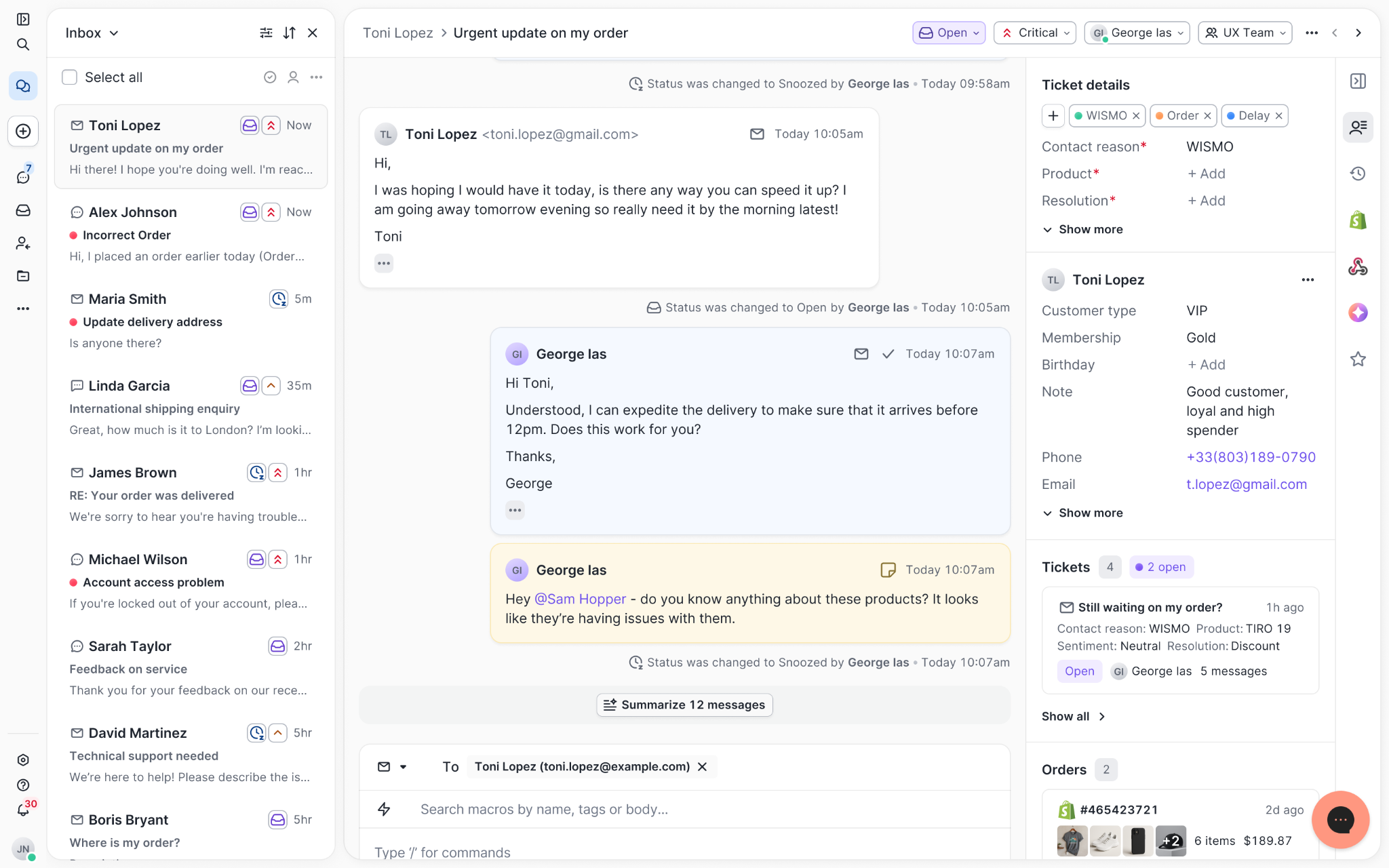
Chats with customers now look like real conversations, using the speech bubble style you’re familiar with on popular messaging apps.
Check customer history without losing your place
Checking a customer's history used to mean leaving the conversation, an extra step that interrupted what should have been a smooth workflow.
Now, past conversations open in a sidebar next to the active conversation. You can view a customer’s full history, search through their timeline, and open prior tickets without going to a new page.

Check past conversations, orders, and customer details in the brand-new Customer Timeline.
See order details the moment you open a ticket
Order information is easier to reference than ever. Open a ticket, and you instantly see the customer's recent orders, marked with product images and invoice details at a glance. Need to dig deeper? Click on an order, and the expanded information appears in the same panel.
For teams using custom integrations, apps are fixed in a quick-access integration menu on the right.
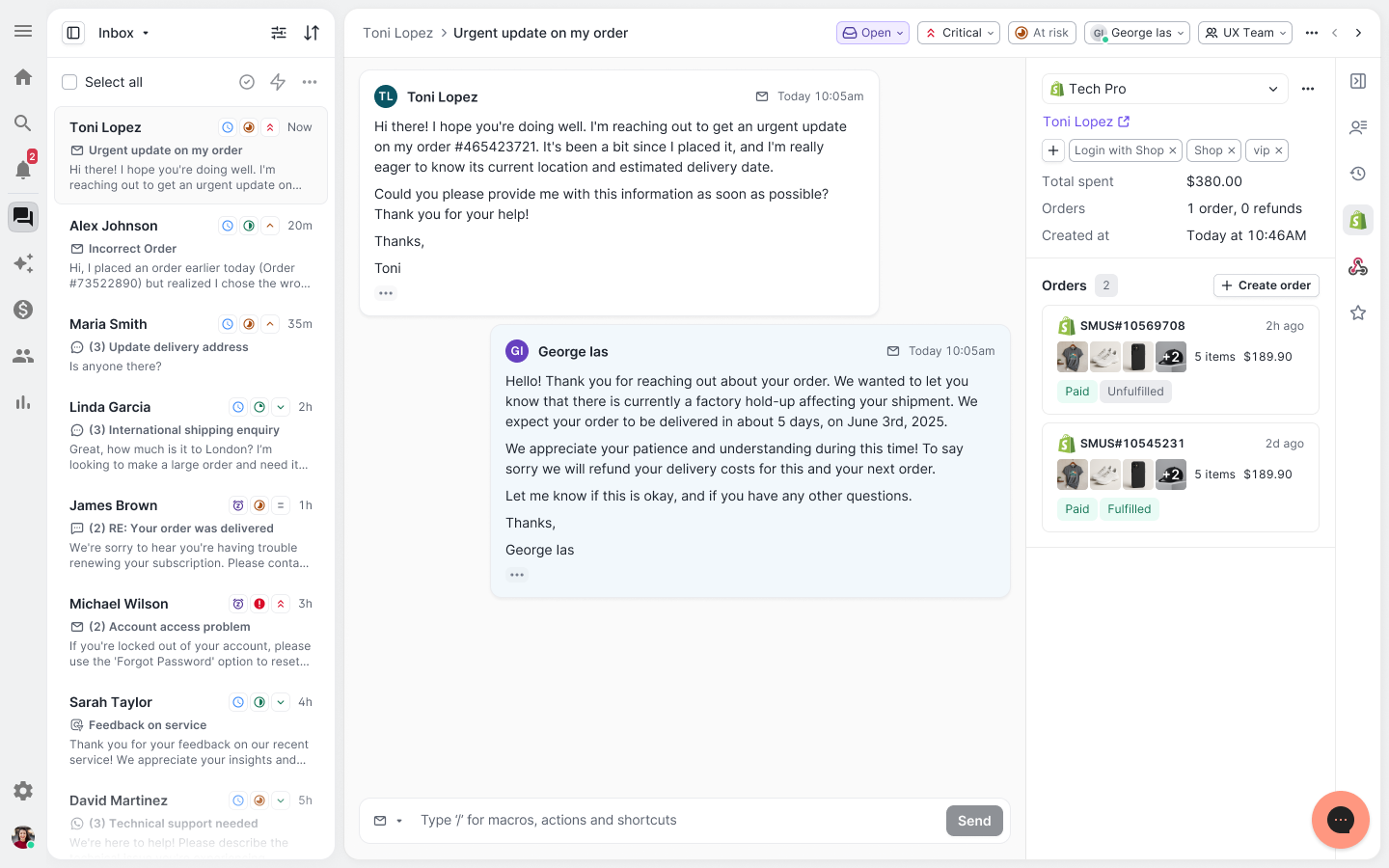
See order details, product images, and totals at a glance on the right panel, without leaving the conversation.
Pick up where AI left off
You shouldn't have to dig through a thread to figure out what AI already tried. Now you don't have to.
When AI Agent escalates a conversation, it includes a concise handover summary that mentions the issue, what actions were taken, and why it was passed to your team.
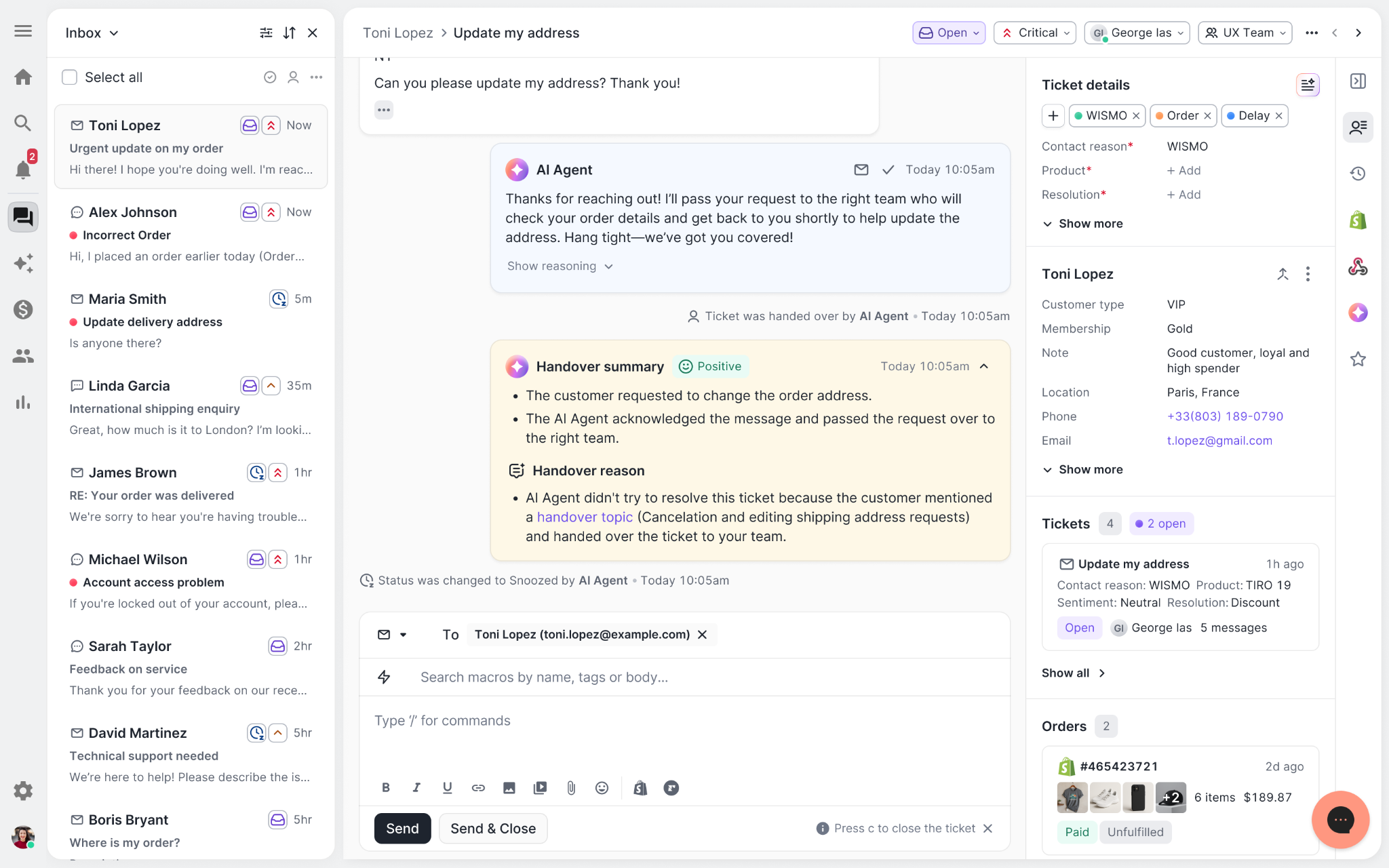
Escalated tickets include a brief AI-generated handover summary, marked in yellow, for quick reference.
Move faster across every store and team
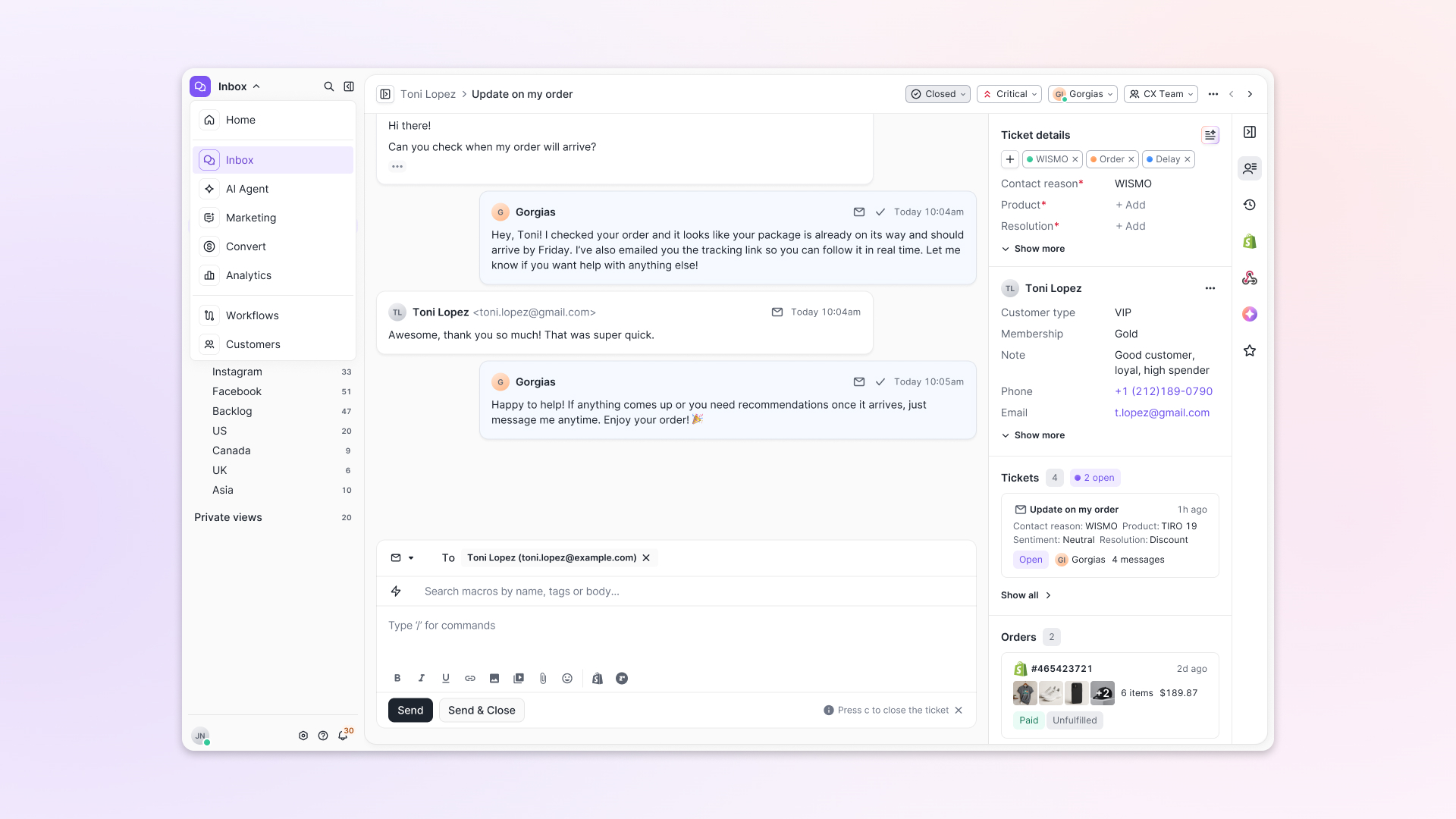
We restructured and simplified the navigation. The left sidebar organizes everything into clear categories: Inbox, AI Agent, Marketing, and Analytics, so anyone on your team knows exactly where to go.
To quickly update your knowledge base or adjust a workflow, both now live right in the sidebar. For teams managing multiple stores, switching between them is just as straightforward, accessible from the sidebar, so agents can move between inboxes without breaking their flow.
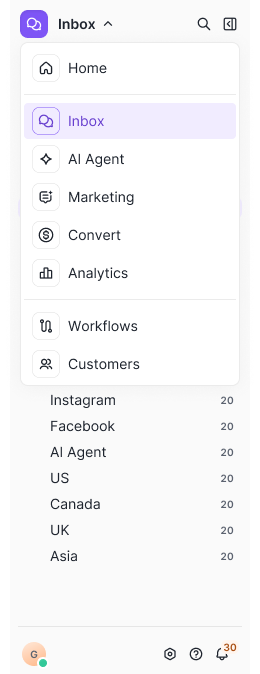
Agents can switch between stores and their corresponding inboxes directly from the left menu.
A workspace that works the way agents do
Support comes down to the person on the other end of the conversation. We built Helpdesk 2.0 is to make sure they have everything they need to show up for that moment.
The best way to see the difference is to work in it. Start a free trial today.

7 CRO A/B Tests to Reduce Customer Support Tickets


Further reading

Marketing's Biggest Secret, Finally Revealed by Nik Sharma
This episode’s featured guest is Nik Sharma, the CEO at Sharma Brands. He works with founders and executives of a wide variety of brands to launch their digital platform, develop an acquisition and retention strategy, expand their channels, and optimize their revenue. He has worked with big brands such as Bill Blass, Roc Nation, and Haus, and he is on the podcast today to discuss the importance of customer service.
Customer service is a brand’s frontline of defense. They are the first to know when something is wrong, broken, or if anything can be done better. By identifying the needs, concerns, and issues of the customer faster than anyone else, they can also fix or address problems before it gets any bigger and becomes damaging to the company. For example, when Nik was working with Judy, an emergency kit brand, there was an issue with their discount code. It simply was not working but no one knew until an online shopper got in contact with customer service. Immediately, the code was fixed and although Judy must have lost several potential customers during the mistake, they could have lost far more if customer service were not there to receive and respond to the matter.
It is important to keep the customer happy. If it is their first time ordering from a brand and they have a less than stellar experience, they are most likely not going to order again. They will not give any of the company’s second products a try, such as the more expensive purchases or subscriptions. That is why customer service is there to pacify the consumer and their issues, acting as a prevention method to any bad experiences. By offering even simple solutions from a technical standpoint, such as dealing with refunds or providing a shipping label, the customer is excited that the brand provided them with a solution.
Through this excitement and acknowledgement, an intimate relationship is created between the brand and customer. The customer feels valued as the brand understands and emphasizes with them. They recognize that they will be taken care of and as more customers begin to feel the same way, a community is built. Every company talks about wanting to build a community and all the strategies that it will take to do so, but the easiest and fastest way to accomplish that is by just having an efficient customer support team. Even a simple third-party logistics team can give a significant boost to a brand by providing front-line workers for customers.
It is not an exaggeration to say that customer service is the most vital piece of a brand. Nik has seen firsthand what good customer service can do and how much feedback, both positive and negative, it can receive. By offering world-class customer experiences, it can boost businesses to new heights and maximize profits. To speak to Nik and to get a further insight into the importance of customer service, he can reached via text at 917-905-2340.
Building delightful customer interactions starts in your inbox
