


Newsletter Signup
The best in CX and ecommerce, right to your inbox
Featured articles
Ticket Volume: How to Measure It, Benchmark It, and Reduce It

Gorgias AI Agent Pricing, Explained
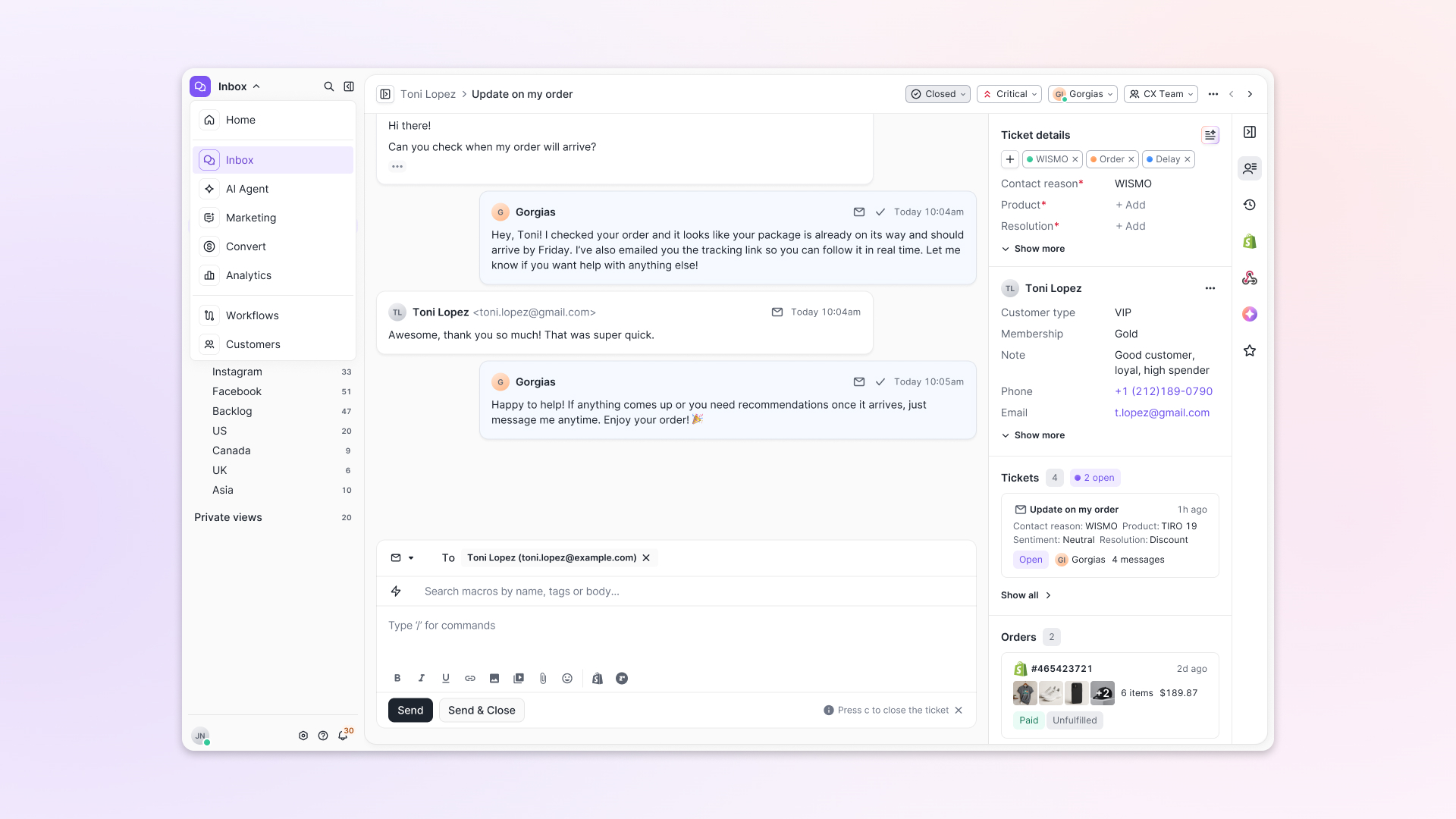
Introducing Helpdesk 2.0: Built for How Agents Work
TL;DR:
- Built directly from agent feedback, Helpdesk 2.0 fixes real workflow pain points. The redesign focuses on reducing friction and helping agents handle more context-heavy tickets.
- A chat-style interface replaces the old email layout. Conversations are easier to follow and resolve in one view.
- Customer context is shown beside the conversation in a right-side panel. Agents can view history, orders, and details without leaving the ticket.
- AI handoffs come with clear summaries. Agents instantly see what happened, what was tried, and what to do next.
- Navigation is simpler and faster across teams. Clean menus, structured queues, and multi-store access keep agents moving efficiently.
Helpdesk 2.0 starts with the people who use it most: the agents.
We spent time understanding customer support from the agent's seat. What do they reach for constantly? What slows them down? What does a better workday look like?
Everything we found is in this brand-new update.
Why we redesigned Helpdesk
Conversational commerce is the new standard.
In customer support, this means customers expect context to remain intact wherever they reach out, whether a conversation starts on social, moves to email, or ends on a call.
This new approach to support has also changed the agent's role. Recurring tickets, like order status checks, shipping updates, and returns, are now handled by AI. What lands in the agent inbox are edge cases that require human judgment and troubleshooting, or tickets that require the full picture.
However, the original Helpdesk was built for a different era of support.
Context was separated across views rather than built into the conversation itself. It's something one in five Gorgias customers flagged, through support tickets, NPS surveys, and conversations with our team. So, we got to work.
Helpdesk 2.0 is the result.
What's new in Helpdesk 2.0
Here's a look at everything that changed.
Read conversations the way they're meant to be read
Conversations have a natural rhythm, one that’s already found in every messaging tool we use. We brought that same layout into the helpdesk.
Say goodbye to the 2000s email interface and hello to chat bubbles. This updated design changes how quickly you can orient yourself and resolve the ticket in one go.
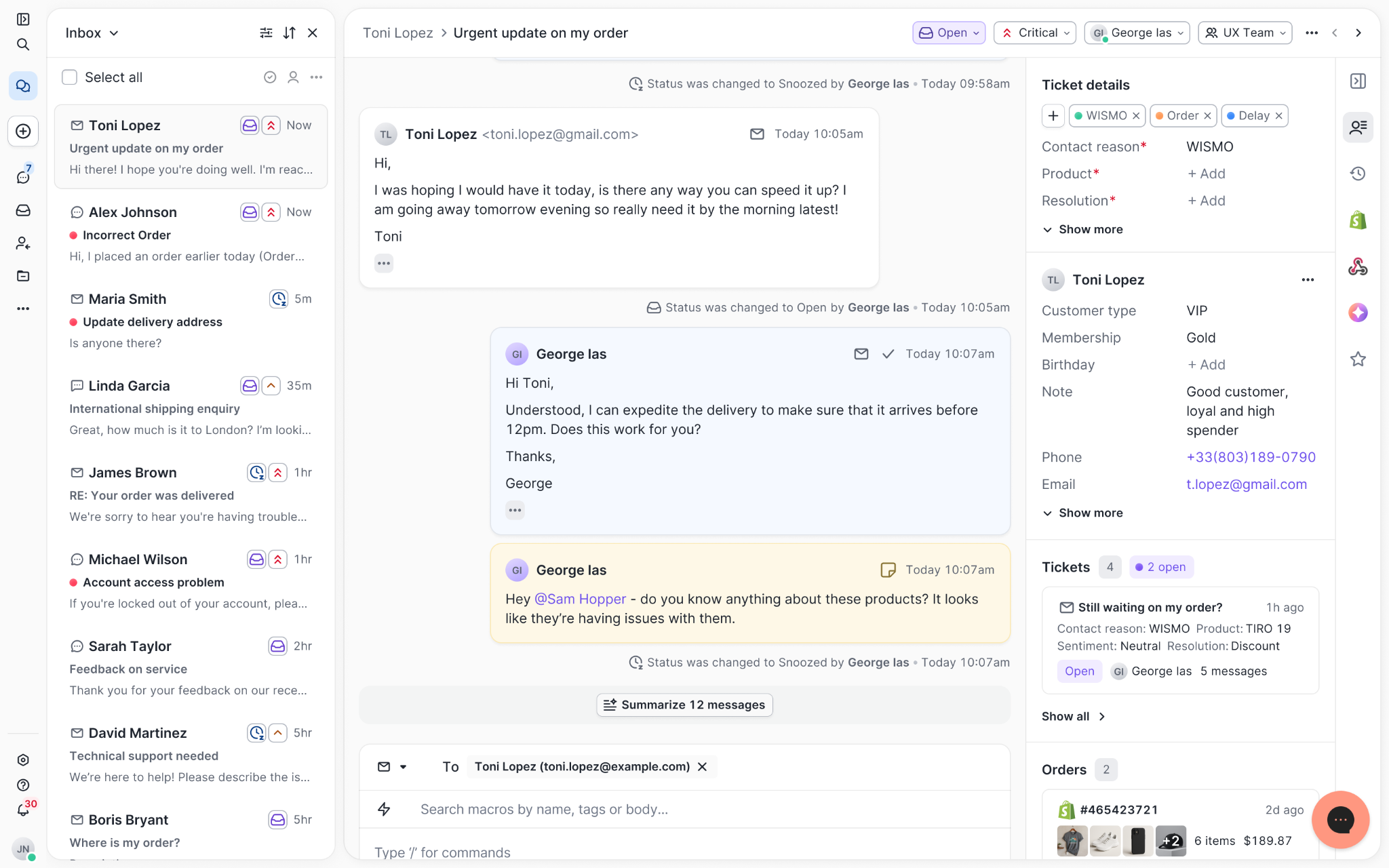
Chats with customers now look like real conversations, using the speech bubble style you’re familiar with on popular messaging apps.
Check customer history without losing your place
Checking a customer's history used to mean leaving the conversation, an extra step that interrupted what should have been a smooth workflow.
Now, past conversations open in a sidebar next to the active conversation. You can view a customer’s full history, search through their timeline, and open prior tickets without going to a new page.

Check past conversations, orders, and customer details in the brand-new Customer Timeline.
See order details the moment you open a ticket
Order information is easier to reference than ever. Open a ticket, and you instantly see the customer's recent orders, marked with product images and invoice details at a glance. Need to dig deeper? Click on an order, and the expanded information appears in the same panel.
For teams using custom integrations, apps are fixed in a quick-access integration menu on the right.
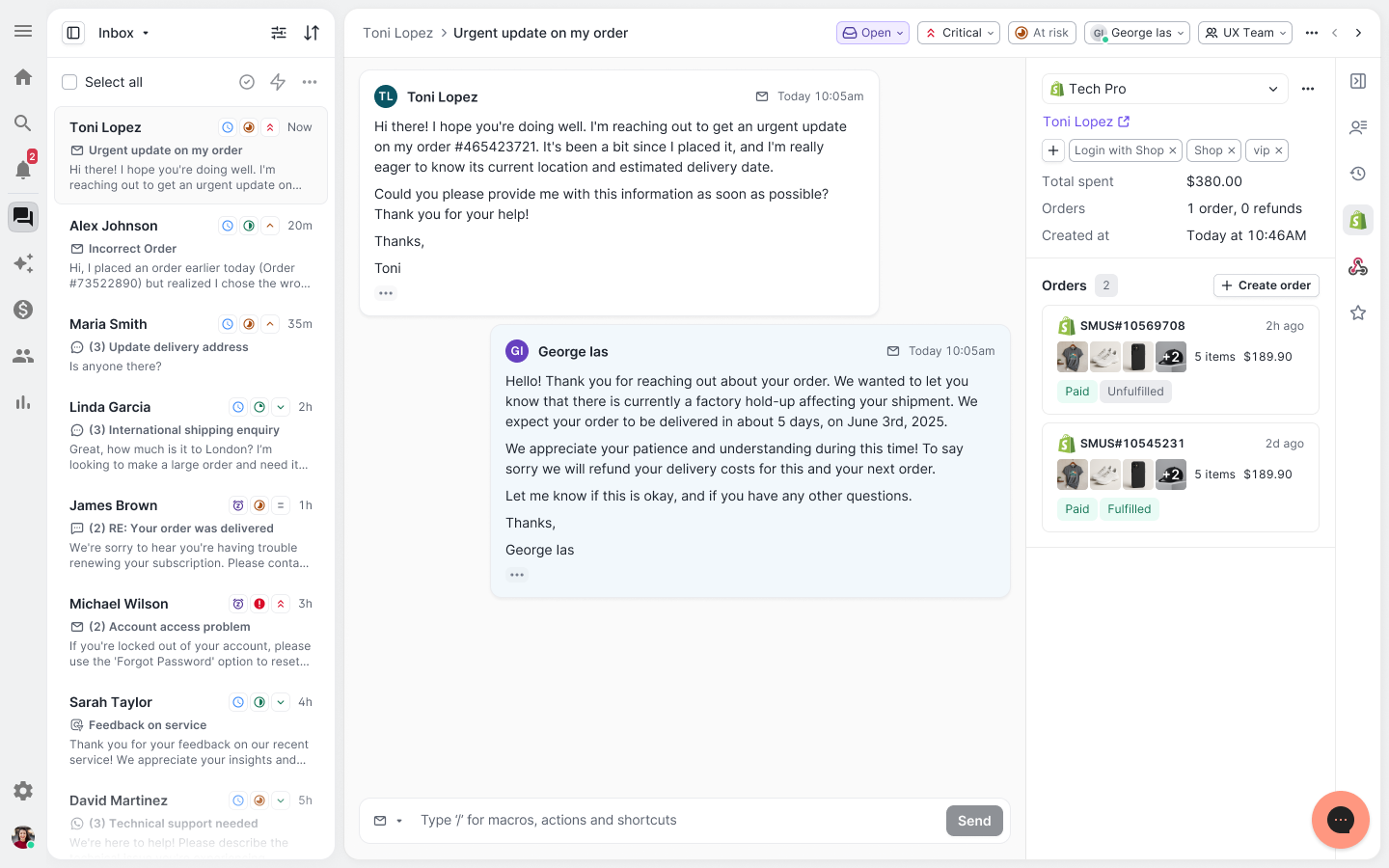
See order details, product images, and totals at a glance on the right panel, without leaving the conversation.
Pick up where AI left off
You shouldn't have to dig through a thread to figure out what AI already tried. Now you don't have to.
When AI Agent escalates a conversation, it includes a concise handover summary that mentions the issue, what actions were taken, and why it was passed to your team.
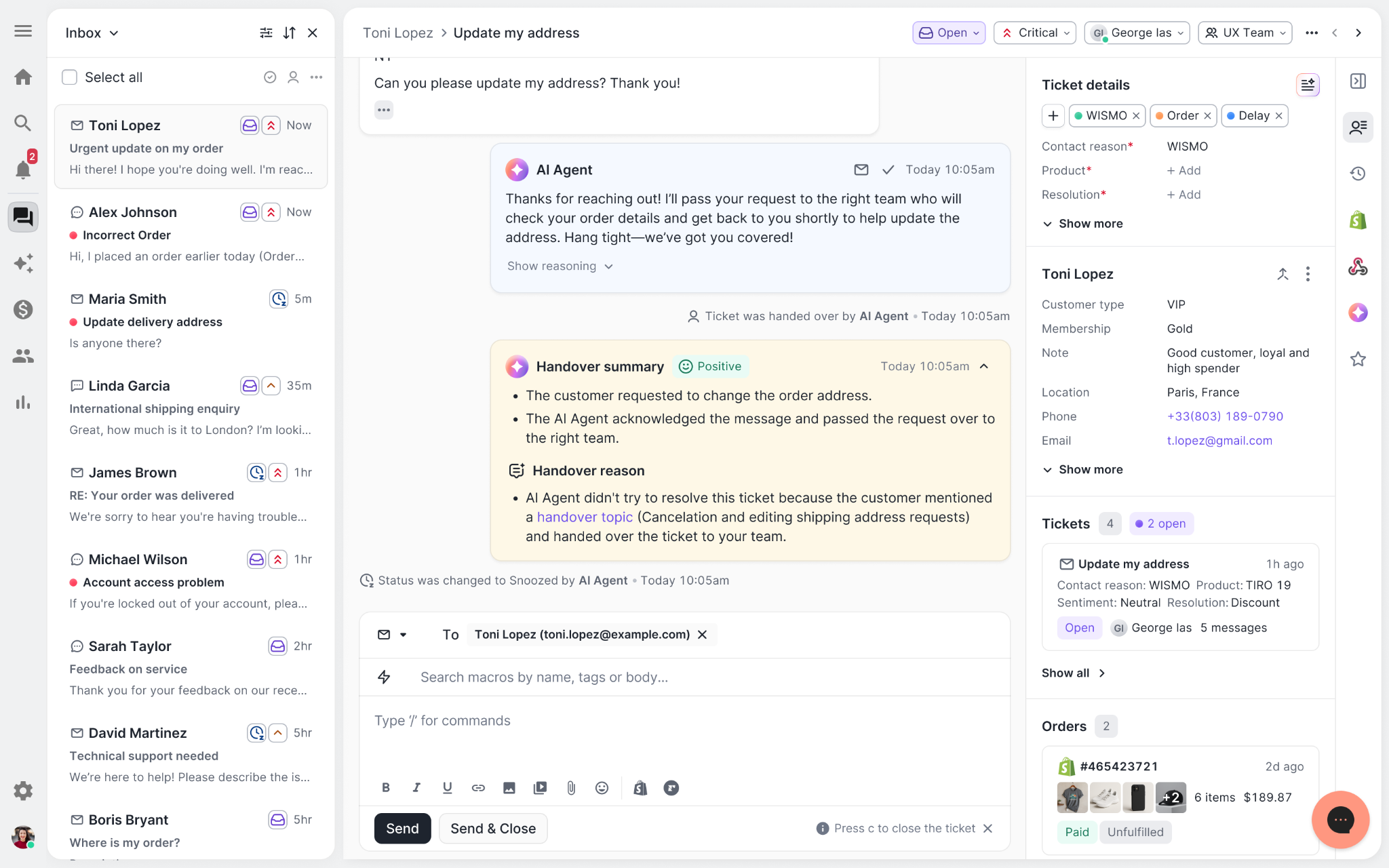
Escalated tickets include a brief AI-generated handover summary, marked in yellow, for quick reference.
Move faster across every store and team
We restructured and simplified the navigation. The left sidebar organizes everything into clear categories: Inbox, AI Agent, Marketing, and Analytics, so anyone on your team knows exactly where to go.
To quickly update your knowledge base or adjust a workflow, both now live right in the sidebar. For teams managing multiple stores, switching between them is just as straightforward, accessible from the sidebar, so agents can move between inboxes without breaking their flow.
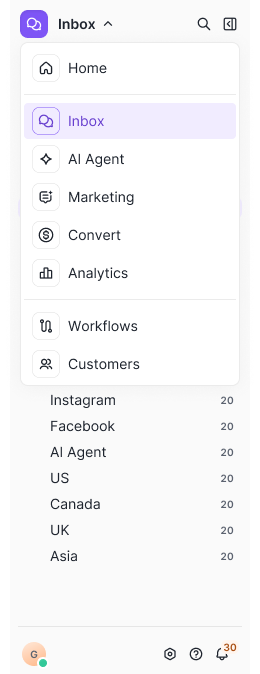
Agents can switch between stores and their corresponding inboxes directly from the left menu.
A workspace that works the way agents do
Support comes down to the person on the other end of the conversation. We built Helpdesk 2.0 is to make sure they have everything they need to show up for that moment.
The best way to see the difference is to work in it. Start a free trial today.


Further reading


Boost sales through SMS and customer service integrations

How To Scale Customer Support During Peak Season
The Peak Season is a stressful period for most merchants. According to a recent study, 75% of them are concerned about the rising customer service needs during that time of the year. Let’s walk through some of the best practices to make the most out this increase in customer service needs.
 |
But first, let’s read about a customer support story that happened a while ago.
The Black Fridge Story
Dan is hanging-out in his kitchen when he realizes that his fridge is no longer working. He decides to contact the customer support team of the fridge merchant and waits for an answer. Unfortunately for Dan, this happens a week before Black Friday and the merchant team is lost under the huge spike in tickets.
 |
So Dan waits three days before his request is taken care of by a contractor hired two days ago to help with the workload. Dan gets redirected to the manufacturer of the fridge and, also after 3 days, gets a first answer.
Dan gets into what is called ‘the maze’ and gets redirected to another person. Seven days after he first contacted the merchant, he finally gets a technician to come at his place fix his fridge. The technician comes over but realizes he need some parts to fix the fridge that take another 7 days to be delivered. The parts that arrive are not the right ones and a new order needs to be made.
It’s been more than two weeks since Dan first tried to get help and this makes him crazy. He goes back to the fridge merchant to ask for a fridge replacement and gets a response after 4 days. He gets told that replacements cannot be made as it goes against the merchant policy.
Dan starts telling the story on social media to kill the merchant reputation. The story goes viral and eventually Dan gets his fridge replaced.
Nobody wins in this story, and this terrible situation could have been avoided with a few of the coming tips.
Tip #1: Leverage support to promote your marketing efforts
What’s the open rate of your email promotions? 5, 10, 20%? And what’s the open rate of customer service messages? Probably close to 100%. So what if you made these promotions in those customer support tickets to leverage on the support you’re making?
 |
Tip #2: Your support staff should be your sales associates
Make sure your customer support heroes provide the same experience to your potential customers as if they were physically going to a store and being advised. You’ll end up making relationships with your customers and turning them into ambassadors for your brand.
Tip #3: Create macros for the most common Peak Season questions
We pulled out the tickets of 600 customers to understand some of the most common questions that your team can expect to receive. Here are the results we got.
 |
Those make up for 40% of your requests. You can actually prepare for it to decrease your response time. There are three ways to do so:
- Make sure you have one macro for each question. If you are not familiar yet with macros, check this out.
- Make sure your FAQ sectionis up to date to answer these questions.
- Set up automatic responses so they get answers straight away to these common questions.
Tip #4: Respond faster to wow your customers
People usually expect you to answer within two hours if not more. By responding in a few minutes you’ll make your customers amazed by your efficiency and will prevent them from going to your competitors. Best, they’ll spread the word on how professional you are and you might end up gaining a few more customers on the way. Here’s an interesting graph we came up with using our customer service statistics.
 |
The repeat rate is the % of your customers who are going to make a new purchase after they already made an order. As you can see, people who already called for the customer service help and got a good experience out of it are way more likely to make a new purchase.
Tip #5: Staff to handle the support spike
You might want to hire a few temporary people to handle the spike in tickets. Bear in mind however that these guys don’t know your product so make sure to train them a few days before accordingly. Make it a rule that if one of your support guys can’t answer a question within five minutes, then it’s best for them to pass it over to somebody else, instead of rushing into giving a wrong answer and end up like Dan in our fridge story.
Tip #6: Build a wall of love to boost morale and track comment
While your team maybe be stressed out by the workload, make sure you build a system that highlights the best reviews and show them they are making people happy and doing a good work.
Takeaways
By increasing the number of people on your customer support team (tip #5) to handle the tickets spike and focusing on not only answering requests fast to impress them (tip #4) using of macros and other tools (tip #3) but also giving them a proper experience (tip #2), you’ll be sure to turn your customers into ambassadors for your brand but also increase your repeat rate. Make sure to also leverage the support spike by including promotions in your requests answers (tip #1). Finally, don’t forget to cheer up your team by creating a wall of love (tip #6) to let them know about the great reviews they get from happy customers.

A Year of Customer Service Quotes to Inspire Support Agents
Being a support agent has got to be one of the most trying jobs a person can have. Dealing with unhappy customers in your helpdesk isn’t anyone’s idea of a good time. So, if you want your team to treat your customers as invited guests, even under tense circumstances, it’s your job to motivate them. These excellent customer service quotes can help.
Here’s How to Leverage Customer Service Quotes to Inspire Your Support Team
Whether you’re a support team manager or the owner of your company, you know that keeping your staff encouraged and upbeat at work is crucial to efficient customer service operations, especially in the face of challenging interactions with frustrated customers. It’s one way to reduce the load on your support team. So, you need to do what you can to keep your environment cheerful.
Think of your team as a group of football players and yourself their cheerleader. You need to use positive language, words of affirmation, and other motivational tactics to keep your support machine well-oiled and increase customer loyalty. So, where do customer service quotes come in?
Chalkboard/Whiteboard
 |
Yes, offices still use whiteboards or chalkboards. If you’re one of them, this might be the best way to deliver your quotes. If you work in an office with your team, you can use a chalkboard or whiteboard, posted in a visible place, to display your motivational tidbits for the month. You don’t need any animations or tricks to get the point across — just make sure the quote is written legibly.
 |
Email is one of the most commonly used communication channels in every business. So, alternatively, if you work with a remote team, a monthly email with a quote followed by your own thoughts can help promote an optimistic vibe within your operations. Your staff is likely checking emails all day anyway. So, you can be sure they’ll see your message, and they can save it to their personal desktop if they want to. (By the way, check out these 16 email templates to help your agents deliver quality service quickly.)
Desk Reminder
 |
Everyone has a desk, right? If this is true, and if your team is small enough, you can give (by hand or mail, depending on where your staff works) each employee a poster or card to display at their own desk. They can pin it to the wall behind their workspace or keep it in a drawer to remind them each time they open it.
Custom Calendars
 |
And, if you’re feeling creative, you can create custom desk calendars with a new quote displayed for each month of the year. This idea is nice because it’s functional as well as fun. Plus, it gives staff the feeling that they’ve gotten a gift. Gifts in themselves are pretty effective workplace motivators.
Mass Text Messages
 |
Finally, if you want to leverage technology, consider setting up a staff opt-in for an SMS campaign wherein you send the quotes directly to the mobile phones of your support agents. Or, send a text message to each support agent individually. The great thing about this idea is that your agents are likely on their phones when they’re not working, so it keeps your operations at the front of their minds.
A Customer Service Quote for Each Month of the Year
Now, let’s look at a year’s worth of quotes to keep your team feeling like their perky, happy selves. Whether you’re sending out a monthly email all year long, or posting your quote next to the portrait on the wall of your employee of the month, you’ll need twelve of them -- one for each month of the year. So, here you go!
- January: “A customer talking about their experience with you is worth ten times that which you write or say about yourself.”
- David J. Greer
January is the beginning of a new year. In most places, it’s still cold outside, the holidays are over, and your staff are just getting back into the swing of things after the holiday rush at work and festivities at home. When it comes to an inspiring customer service quote, you need one that sets the stage for the rest of the year.
What better place to start than reminding your staff that their performance at work will affect the entire company. The above quote is from David J. Greer, coach and author of Wind in Your Sails: Vital Strategies That Accelerate Your Entrepreneurial Growth. In this book, Greer uses sailing metaphors and experiential wisdom to convey some powerful business messages.
 |
The above quote should warm your team up nicely. And, it should remind them that, at the end of the day, a review can make or break your business. So, their job is to deliver the kind of experience that enhances your company’s word-of-mouth marketing, not harms it.
- February: “Get closer than ever to your customers. So close that you tell them what they need well before they realize it themselves.”
- Steve Jobs
The second month of the year is a time of romance. February 14th is Valentine’s Day. At this time, most people across the globe celebrate their love in remembrance of St. Valentine, the patron of affianced couples. So, your quote for the month should at least attempt to reflect this. And, it should inspire the team to want to lean-in more intimately to customers’ needs.
Fortunately for you, the late Steve Jobs, magnate, entrepreneur, investor, and co-founder of Apple, said just what your team needs to hear. His advice is to get close to the customer. You and your team can use the tokens of affection you see around you as reminders of how to treat shoppers that come to you with their problems.
 |
This customer service quote serves as a reminder that the relationship between your brand and your shoppers should feel like a personal one -- there should be a spark ready to ignite. And, when you really care about people, you naturally want what’s best for them. Since you’re theoretically the experts in everything related to your product offering, you should know what to offer before their questions are even asked.
- March: “We see our customers as invited guests to a party, and we are the hosts. It’s our job every day to make every important aspect of the customer experience a little bit better.”
- Jeff Bezos
March is the month for St. Patrick’s Day (and my great grandmother’s birthday) celebrations and Spring Equinox. In a nutshell, festivities and fun happen in March. People are getting out and having a good time. So, this month’s customer service quote should reflect this.
And, guess what? Jeff Bezos, entrepreneur, investor, and CEO/ founder of Amazon, can shine some light on what you need. Follow his lead and be amazing hosts to your party guests. You can’t offer your shoppers drinks, but you can give them an experience that they won’t forget. And, if your team is having fun, so will your customers. Make each day better than the last.
 |
Help you support team imagine that your brand is a party and everyone on the other end of the line is a welcomed friend. Cultivating a great shopping and support experience is a surefire way to increase your eCommerce conversion rates and make every day more enjoyable. When everyone is having fun, everyone wins!
- April: “Don’t try to tell the customer what he wants. If you want to be smart, be smart in the shower. Then get out, go to work and serve the customer!”
- Gene Buckley
April showers bring May flowers. The word April is derived from Latin aperit, which means “open.” And, one of the most important customer service skills your agents can possess is the ability to be open to the needs of your shoppers. At the very least, the needs of the customer must come before those of the support staff. So, remind your team with the perfect customer service quote.
Gene Buckley has you covered. The senior director of customer success, health, and life sciences at Microsoft knows the right time to be smart -- in the shower. The right time to be smart is not when your customer needs you. Actually, when you’re working, you need to be humble.
 |
Here’s a brighter, more emotional way to say the customer is always right. Save your critical thinking for the moments when you’re alone -- before you fall asleep at night and in the shower. When you’re serving, be present and serve. Listen and make sure the customer knows you’re listening.
- May: “Make a customer, not a sale.”
- Katherine Barchetti
In May, flowers are starting to bloom, Spring is officially in the air, and people are experiencing more happiness in general. For some people, life seems more colorful. So, this month, you might want to keep things simpler than usual. You might want to inspire agents with a quote that gets straight to the point.
The retail success story, Katherine Barchetti was Pittsburgh’s retail success story. While her stores are no longer open, her wisdom lives on. She built an empire based on the idea that the customer was much more important to success than sales. In reality, the two go hand-in-hand. But, her words are a great reminder for any support agent.
 |
Envision your customer as a person, not a series of dollar signs. You don’t like being treated like a thing, and neither do your shoppers. Help your agents remember this wisdom with the above quote. In the end, this is the simplest idea at the core of every successful customer service ecosystem.
- June: “A business absolutely devoted to service will have only one worry about profits. They will be embarrassingly large.”
- Henry Ford
June is the first month of Summer. Children are getting out of school, barbecues are starting, and people are getting outdoors more. They’re also spending. And, if you focus on the right things, you could be a major player in where they spend. And, the right things aren’t what most people think. How can you remind your agents what the right frame of mind is at this time of year?
Henry Ford, the magnate behind Ford motors, requires no introduction, as his empire is strong even decades after his passing. What did Ford have to say about customer service? Basically, he said it is everything. Absolute devotion to service is his idea of the key ingredient for success. And, it would be unwise to disagree. So, share his wisdom with your agents in June.
 |
Let this serve as a reminder of how truly important the job of a support agent is in the big picture. Service is the heart of a thriving brand.
- July: “Customers want positive, consistent experiences. Consistency creates confidence, which can lead to retention and loyalty.”
- Shep Hyken
July is when freedom rings. In the United States, independence day falls in July, when people are getting together playing games and lighting off fireworks. Hint: this happens every year, consistently. And, people continue to celebrate the same way each time. So, it might be a helpful idea to share a reminder with your staff about the value of consistencye, potentially with the help of call scripts. But, how?
Take a look at this quote from Shep Hyken, who speaks nationwide to expert audiences about customer service and experience. He says that consistent positivity is what drives retention and loyalty from shoppers. Hyken has been featured on major television channels and is trusted and endorsed by enterprise brands. His advice is worthwhile for any support team.
 |
Not only is the job of a support agent to be positive and make customers happy -- true satisfaction also stems from a consistent experience of your brand. When people know what to expect from you, they begin to trust you. And, when people trust you, they want to put effort into maintaining a relationship.
Your support agents, by delivering a consistent, positive experience, play a major role in the success of your company. Share this quote to remind them.
- August: “Your most unhappy customers are your greatest source of learning.”
- Bill Gates
August is the time of year when parents are getting ready to send their kids back to school. Schedules are being rattled yet again. And, it’s the time of year when people are soaking up the last of their Summer vacations, which might cause a bit of anxiety. There’s so much going on that consumers might be a bit more on-edge than usual. How can you help your agents cope?
Your go-to for this month, Bill Gates -- principal founder of the Microsoft corporation -- provides an excellent reminder of the fact that not every learning opportunity comes wrapped in a pretty package. In fact, the dissatisfied customers you come across can be the best teachers. Use this as a reminder to find the silver lining and take everything you can from every situation.
 |
Not every support experience within your operations is going to feel pleasant. So, use dissatisfaction as an opportunity to learn about products, service tactics, and communication. Your agents should be learning how to transmute tense situations into opportunities to optimize your brand experience. So, this month use the above quote to remind them of this.
- September: “Good customer service costs less than bad customer service.”
- Sally Gronow
Ah, September -- the beginning of Fall and prep time for your final quarter operations. You’re probably getting ready for the busiest season of the year. While you’re trying to figure out how to cut costs, your support agents are still plugging away at their jobs, wondering if they’re going to have to help train the new prospects showing up for your customer service interviews. What’s a good quote to share with your team?
Sally Gronow is the head of customer service at Dŵr Cymru Welsh Water in the UK. And, while you may not have heard of her, she has a simplistic yet genius answer. Your support staff could find great wisdom in the reminder that a crappy experience is going to cost so much more than a great one, even if it takes more effort to provide it; use the idea to keep your service team motivated this month.
 |
Sometimes, it can feel like a lot of work to help a customer through an emotionally mucky issue. But, in the end, it will take a lot more effort to dig yourself out of the hole created when you fail to help them. Poor reviews, loss of retention, and devastating negative word of mouth can kill your business. The responsibility of going the extra mile to deliver satisfaction falls on your support team.
- October: “Customer service shouldn’t just be a department; it should be the entire company.”
- Tony Hsieh
October is a time for harvest; this is the time of year when people come together to reap the rewards of the past year’s efforts. Community is one of the main themes of the month outside the office. So, you should try to create the same theme inside your company. And, luckily, just the quote exists to remind your support team.
The CEO of Zappos (an outrageously successful online shoe and clothing retailer), Tony Hsieh, said something that fits perfectly with the idea of community. He said that customer service is more than just one group of people within a company, that it should be everyone in the company. And, his wisdom is the perfect reminder for this time of year.
 |
You may or may not be able to depend on the other forward-facing departments to have the same level of impact as the service team. But, remember that a support agent’s job is the backbone of the company. And, together, your team can move mountains. In the end, the ability to serve the customers well is the central indicator of a successful company.
- November: “Next time you get bad service, speak up. Remember: it’s your money you are defending – money you worked hard for. Tell the company and others. Use the internet and social media. That’s how customer service will improve for all of us.”
- Larry Winget
For every retailer, Black Friday and Cyber Monday are days you’ve been prepping for all year. And, your support team knows this. If you participate in the promotions, these days are going to be your busiest days of the year, especially where customer support is concerned. It might be a good idea to get your team ready by flipping the script -- what are consumers (not CEOs and support experts saying?
Larry Winget, author and self-proclaimed “Pitbull of Personal Development,™” encourages consumers to speak out when their expectations aren’t met by customer service teams and brands. The people are cheering each other on with empowering words to ‘say something’ when they’re dissatisfied. So, while your team is under enough pressure to succeed already, it’s crucial that they know how a bad experience could affect your operations.
 |
Just to stir things up a bit, throw in a customer service quote from a consumer. Make sure your support staff knows that everything they say and do will be scrutinized by the customers they are serving. And, it also has the potential to be seen and heard by the public. So, remind your team to give people something positive to talk about!
- December: “Exceed your customers’ expectations. If you do, they'll come back over and over. Give them what they want - and a little more.”
- Sam Walton
You’ve made it through Black Friday, but your year isn’t over. Consumers are still shopping for last-minute holiday gifts and they’re celebrating. They’re giving each other gifts, sharing time together, and partying it up this time of year. What they’re trying to do is exceed their loved ones’ expectations to express their love.
Sam Walton, founder of Walmart and Sam’s Club, said something that fits the sentiment perfectly. He said that companies should go above and beyond the expectations of their shoppers. And, that’s how he grew a small kingdom for himself, from the ground up.
 |
Here’s a little reminder that the best practice for agents is to take each interaction a step further than expected -- from dissatisfaction to delight. Keep your team reminded of this and you might be able to crown yourself as well.
What other customer service quotes do you use to motivate your team?
Interested in an easy, full-featured support system for your online store? Start your free trial of Gorgias today.

6 examples of successful brand partnerships for Shopify
Building and promoting a Shopify store can be a grind. That's why more and more stores are looking for ways to boost their cred (and profitability) through brand marketing partnerships.
Teaming up with another brand to boost awareness and profits is nothing new. Everyone from Bonne Belle & Dr. Pepper to BMW & Louis Vuitton has joined marketing forces in the past—with epic results.
The good news is, you can use some of the past brand marketing partnerships to build your own partnership ideas for your Shopify store.
In this guide, we're going to walk you through six examples of successful brand marketing partnerships, and how you can replicate their success stories into your Shopify store.
Why should Shopify stores look to partner with other brands?
Partnering up with another brand is one of the oldest marketing tricks in the book.
However, a lot of Shopify owners struggle to see how a partnership can work in eCommerce. The reality is, it's the message behind the partnership, and the way a campaign is built, that makes it successful—not the platform the products are being sold through.
The positives for partnering with another brand are endless. Firstly, your store builds up a strong partnership with another brand and boost your bottom line. And if the partnership is successful, it can make your store a more sought after choice for other stores wanting to partner up.
The big win of partnering up is, more often than not, one of the brands is a little less known than their partner. Not everyone will be willing to spend their hard-earned cash in an eCommerce store that hasn't built up its name yet. But partnering with a brand that's doing well in the eCommerce space? Yeah, that's going to drive traffic straight through your doors.
Not only will partnerships make you more reputable, but it can also decrease the risk for shoppers that are making a purchase on a new site for the very first time.
But other wins come out of successful brand marketing partnerships.
#1. You can join PR forces
When it comes to marketing budgets, it's only natural that one partner will have a larger budget than the other. If you're joining up with another brand, the budget burden of marketing a new campaign or product is instantly halved.
But it's not just about chopping your marketing budget. Any influencers, bloggers, and high-level journalists that your partnering brand has relationships with can also be opened up to your store. Use them to your advantage.
#2. More resources = better offers and giveaways for your customers
Okay, so the advantage of being able to join budgets with a partnering store is a big one.
If you do decide to join forces with another store, you can pool money for a cash award or products for a bundled giveaway in exchange for a customer's email address.
The reward? You will be collecting a bunch of new email addresses for remarketing campaigns later, long after the partnership has run its course.
#3. Partnerships can create a ton of awareness for both brands
Whether the partnering store is selling similar products to yours or they're in a completely different field, combining brands means you can bring a ton of awareness to your brand through new audiences.
According to Gregory Pollack from MarketingProfs, the secret to a partnership's success and awareness relies on integration.
"Well-crafted partnership brand marketing should include every possible touchpoint that your business has with its customers—both traditional and non-traditional marketing, including the Internet, special events, advertising, promotions, public relations, packaging, merchandising, and a host of other marketing components," he writes.
"Marketing alliances don't just present an opportunity to create promotions; they also establish a base from which to create distribution opportunities, providing a great chance to leverage either geographic distribution or merchandising within a store."
Okay, so now you know why you should be partnering up with another brand. Let's look at how you can use past successful brand marketing partnerships to supercharge your own successful campaigns.
6 examples of successful partnerships you should steal
- Apple and Hermès
The popularity of the Apple Watch has been insane. The product has outsold every last one of the biggest names in the watch industry over the past two years:

In 2018 alone, Apple sold 22.5 million of its trademark watches. It makes sense, then, that fashion giant Hermès was keen to get a piece of the (Apple) pie.
The partnership between the two brands was first carved out in 2015. It proved so popular that Apple geared the release of the third Apple Watch around the new Hermès Apple collection.

It's a super smart collab. Not only has Apple been able to market the Hermès version of the watch at three times the regular sales price ($1400 a pop), it has also exposed their product to more fashion-conscious consumers.
Fashion Director Roseanne Morrison said the collab has proven a success for both brands.
"I think some of those collaborations have been good for both brands because it elevates some of these long-term heritage brands to a new level of technological synergy that can help them get younger customers," she said.
How can you use it in your own store?
If you are struggling to crack into a new market, this type of campaign is perfect for getting consumers to look at your products in a whole new light.
Has a tech store caught your eye recently that you can see matching up with the quirkiness or edginess of your own store? Do you own an office supply store that is struggling to crack into the millennial market?
Reach out to a brand which is absolutely nailing the market you are trying to crack. See if they would be interested in building a product, or joining promotional efforts. Chances are, your potential partner is also struggling in the market that you're dominating.
2. Spotify & Hulu

Spotify and Hulu have recently decided to bundle up their products and offer them both at a discounted price.
The partnership works on a two-tiered system.
For the first 3 months, the user gets Hulu for $2.97. After that, they will get both services for $5 cheaper than if they were paying for both services separately.
It's super smart if people were already thinking about signing up for Hulu (it might be the push they need to sign up). And if a customer is already paying for both services separately, it will be saving them money.
It's also a win-win for Spotify and Hulu. Both brands are opened up to a different target audience, and a lot of consumers may be curious to give the products a try purely because of the low price tag.
These partnerships take a lot of work, but the benefits can be worth it.
How can you use it in your own store?
Even if you aren't selling tech, you can still use this example in your own store. Pair up with another Shopify store, and ask them if they would be willing to bundle some products with yours for a discount.
The best way to do this would be to run a promotional campaign that boosts both brands. Try selling the product bundles on a separate landing page, so you're able to track and measure their success effectively.
3. HDX Hydration and Clean Bottle
Everybody loves free samples.
The key to making sure you aren't throwing away money with free samples is partnering up with a store that aligns with your target market.
It was this formula that drove the partnership between HDX Hydration and Clean Bottle.

HDX Hydration sells clean, healthy hydration mixes for bottled water. They were only just starting out in their Shopify journey when they approached Clean Bottle to collaborate.
HDX Hydration knew they had to crack their target market to succeed. By teaming up with a company that produced easy-to-clean water bottles, they quickly narrowed in on their target market.
The company approached Clean Bottle and asked them to ship free samples of their product with their purchases. This ensured that their freebies were landing in the hands of customers that were already qualified for their product.
How can you use it in your own store?
Team up with a company that could include your free samples in their shipments. Or go one step further, and offer to include their free samples in your shipments as well.
By having a minimum spend, your partner will also increase their profits on their sales. The allure of a free gift is sometimes all it takes to push the customer to spend more.
4. BuzzFeed & Best Friends Animal Society
There is a reason so many brands team up with a charity. Consumers love to feel like they're helping out society when they make a purchase.
BuzzFeed recently teamed up with Best Friends Animal Society to boost pet adoption numbers.
The idea was simple. The animal charity would tap into BuzzFeed's 200M+ readership, and BuzzFeed would publish an article called, "We Interviewed Emma Watson While She Played With Kittens And It Was Absolutely Adorable."

Obviously, not everyone has a massive readership like BuzzFeed, but the idea is used by charity groups everywhere. Pair up with a company, and consumers will feel better making purchases when they know their money is going to charity.
How can you use it in your own store?
Pair with up a charity for social cred. Studies show that consumers are more responsive when there is a single charity involved, so approaching one and inviting them to partner up is enough.
Pick a charity that will align with your brand. A 2015 study by the Huffington Post found 92% of companies said brand alignment is the single most crucial factor when selecting a charitable partner, so choose wisely.
For example, if your store sells organic candles, then a charity that helps with environmental causes would be a better fit than a charity that helps with cancer research. Apps like Easy Donation can be customized to include your chosen charity at your checkout.

Making it easier for a customer to donate can be crucial to the success of the partnership and the amount of money you end up raising for them.
5. H&M & Alexander Wang
Who remembers when Alexander Wang partnered up with H&M? Yeah, it was weird. But it worked.
While H&M is known for their bargain purchases, an entry-level Alexander Wang product can cost hundreds of dollars. The collab seems like an unlikely partnership—until you strip it back to find out what each brand gained from it.

While H&M were able to boost their status as a credible and fashionable brand through the partnership, Wang was also exposed to a new target audience. Customers that might not have thought about high-end fashion before were suddenly being exposed to it in their typical purchasing environment.
The success of the collaboration isn't a one-off. Karl Lagerfeld, Stella McCartney, and Balmain have also had successful partnerships with the clothing shop.
How can you use it in your own store?
If you're selling up-market items of any description, you're already limiting your market to those with expensive taste.
Think about stores that share a similar style, but offer products at a completely different price point. Reach out and ask if they would be willing to run a cross-collaboration, where you each featured your products on each other's sites for a month.
JCPenney ran a similar campaign recently with brand Sephora. They included a link to the brand in their top navigation, that allowed customers to shop from the Sephora collection directly on JCPenney.

This allows for one-stop shopping and is ideal if you're collaborating with another store but want to retain traffic.
Better yet, you could connect with a brick and mortar store that doesn't have an online presence. Offer to sell their products on your site for exposure, and in return, ask them to give coupon codes to every customer that makes a purchase in their store.
6. LucasFilm & CoverGirl
Makeup and… Star Wars? It happened.
In 2015, LucasFilms paired up with CoverGirl to create Light and Dark Side makeup lines to win over a younger, female audience.

The partnership meant both brands were given extensive press coverage during the lead up to the film's premiere. And it paid off. 8 weeks of high impact Primetime TV promoting and micro-targeting resulted in a 725% boost in retailer sell-in, and the campaign became the #1 trending topic on Facebook.
It's not the first time CoverGirl had paired up with a film. In 2013, they teamed up with The Hunger Games in a similar campaign that resulted in a 400% sales increase for CoverGirl.
How can you use it in your own store?
This campaign should be mirrored by stores who are already successful and are looking to open up new target markets. If you are just starting out, try a less-risky partnership from one of the other ideas on our list.
If you're up for it—think outside the box. Reach out to a store that you would never think of partnering up with.
If you own a clothing store, why not try collaborating with a fellow pet supply store? As of now, 70% of all U.S. households now own a pet, and the market was valued at $72.1 billion in the U.S. alone last year. It's statistics like this that prove thinking outside the box could be worth its while when it comes to brand partnerships.
Brand partnerships are perfect for Shopify stores—if they are executed correctly
There are a ton of reasons why brands enter into partnerships (and you may be wondering why you haven't tried it before now).
Using another brand can boost your credit and your marketing capabilities. Plus, brand collaborations also offer your store a unique way to expose your brand to an entirely new target audience.
But partnerships aren't easy. To make brand collaborations work, you need to pick the right partner, and put in the groundwork. Use famous collabs (that have worked) from the past to brainstorm ideas about how you could partner up with another brand, and don't be afraid to think outside the box when you're approaching brands to join forces with. Sometimes, the most unlikely brand marketing partnerships turn out to be the most successful.

Who are the Certified Shopify Plus Partners?
Shopify Plus has a ton of features that make them stand out from other e-Commerce platforms. One of the main differences between Shopify vs Shopify Plus is the open app marketplace for standard users and the Shopify Plus technology partner program. And, successful store owners know you should always hire a Shopify expert over a run of the mill agency.
That’s why the partner program is so helpful. So, what exactly makes these certified technology and service partners stand out from the rest? Read on to find out.
What is the Shopify Plus Partner Program?
Anyone running an online store has heard of Shopify, and high-volume sellers have explored the Shopify Plus platform. And, when thinking of making the switch, it’s important to know what help is available.
The standard Shopify platform has other types of partners such as affiliates and developers.
The Shopify Plus partner program, first launched in 2016, is a directory of hand-selected technologies and services that have been vetted by the platform itself.
Partners are proven to have expert e-commerce and platform experience, so they can be trusted by any Shopify Plus merchant.
Both technology and service partners have access to an exclusive resource database to help them grow with the Plus platform and continually provide better service to their users. The community works together as a team, collaborating to create a Shopify Plus partner ecosystem; this gives merchants access to a holistic growth platform rather than standalone services and software options.
Access to Shopify Plus Partners is one of the biggest merchant benefits of upgrading to Shopify Plus.
Not on Shopify Plus? Check out our review (or our comparison with the standard Shopify plan) to help make your decision.
How are the Shopify Plus Partners Selected?
Anyone who wants to become a Shopify Plus partner goes through a rigorous screening process. Applications are taken seriously and only top agencies and software solutions are chosen.
How Many Partners are There?
Currently, Shopify Plus has 65 technology partners and 127 service partners (51 agencies and 76 solutions). Like the platform itself, the partner program is an exclusive community. While these numbers are likely to grow with the platform, they probably won’t scale as quickly as the standard Shopify options because of what it takes to get in.
Technology Shopify Plus Partners Overview
With a standard plan, you have access to nearly any Shopify app you can think of. With a Plus plan, the platform recommends and enables easy integration with only the best e-commerce software.
Technology partners give merchants seamless integrations with popular tech:
- SEO/ SEM
- PIM
- Search
- EDI
Accessibility to these options helps online store owners accelerate growth through the use of advanced software.
What Technologies are Available?
26 different types of e-commerce software are available from technology partners in the Shopify Plus partner program. Everything from affiliate marketing to POS and warehouse management can be enhanced with an app. 11 of these options work with the Shopify Flow app, which turns tasks into automation.
Not all Shopify Plus apps are yet compatible with the Flow interface, but those that are stand out from the rest. Take a look at compatible apps in the Shopify Plus partner technology section to see what they can do for your online sales operations.
1. dotdigital Engagement Cloud
 |
Image source: dotdigital
The Engagement Cloud by dotdigital can help you build committed, enduring relationships with your customers. Connect with and empower your shoppers with a suite of tools including email, mobile, social, and advertising. Implement automation, segmentation, and rich customer profiles.
In a nutshell, this is an advanced customer relationship management (CRM) platform to integrate with your Shopify store. It collects, stores, and analyzes data about your customers to help you make the most informed shopper interaction decisions.
2. Gorgias
 |
[Youtube embed code in comment]
Use Gorgias, the complete Shopify helpdesk, to help your customer service representatives view all of your messaging platforms from one location. Your reps can edit customer orders without leaving the app. And, you can automate answers to simple, frequently asked questions, freeing up time for your team to focus on answering more complex queries.
Trust a top rated solution to provide your shoppers and customers with the best possible service experience of your e-commerce brand.
3. Klaviyo
 |
Image source: Klaviyo
One of the most full-featured e-commerce email marketing campaign platforms is available on Shopify Plus with Flow integration. Klaviyo makes your email campaigns more intelligent and effective through powerful segmentation, detailed analytics, and informative reports.
This platform shines brightly in a sea of fierce competition because it has everything you need to create, implement, automate, and analyze your email marketing efforts with the least amount of work. Users are satisfied and it’s made the cut.
4. Listrak
 |
Image source: Listrak
Listrak is a customer data empowered digital marketing cloud that promises to deliver results. From a 360-degree customer profile to customer insights, AI personalization, and conversion rate optimization (CRO), this platform will help you orchestrate all of your cross channel marketing promotions.
Compared to other similar platforms, Listrak users have three times higher engagement, six times higher revenue, and two times higher conversion. Overall, it is a trusted solution to bring your marketing efforts to the next level.
5. LoyaltyLion -
 |
Image Source: LoyaltyLion
Loyalty Lion knows that an online merchant’s future success depends entirely on its existing customers. So, they deliver a solution for web retail store owners to create data-fueled loyalty programs as unique as their brand. This app is proven to help businesses increase customer retention and sales.
In addition, it’s trusted as a solution for thousands of e-commerce companies worldwide. It enables top-of-the-line rewards programs that can award a specified amount of points for any action taken on the connected website and more.
6. Nosto
 |
Image source: Nosto
Nosto helps you personalize the customer experience you deliver. It collects data to analyze shoppers’ omnichannel behaviors and purchases. The world’s leading digital commerce AI can give your website visitors targeted, personalized recommendations based on what trends it recognizes in their behavior.
Top machine engineers, data scientists, and PHDs have been working for the past seven years to continually improve the patented technology. If you want to inspire your customers, this app is well worth looking into.
7. Bronto
 |
Image Source: Bronto
Leading the way in e-commerce email marketing, Bronto by Oracle integrates seamlessly with Shopify Plus. The API is versatile with many tools to help you deliver optimized campaigns. You can store customer data and purchase information in the existing CRM, or integrate it with another. Create personalized email campaigns that you can send at the right time, to the right shoppers.
Automation is handled through an easy-to-use drag and drop interface, so most merchants aren’t overloaded with the frustration of learning new, complicated technology.
8. Smile
 |
Image source: Smile
Smile.io is the solution that can help you turn first-time shoppers into lifetime buyers. The app is reward program management made easy. You can design a program your way, then make changes instantly, in real time. Using the system will negate the need for your IT or dev team to work on your promotions by simplifying the processes.
You can view your program member details to see what actions users have taken and see their points balances and other information. A simple reporting dashboard will help you see important customer data that can help influence better future campaigns.
9. Swell Rewards
 |
Image source: Swell
Another great reward platform management platform (created by Yotpo) on the Shopify Plus technology partner program is Swell. Using this app, you can create tailored customer experiences using multiple campaign options. Maximize engagement and enhance your brand with 15 out-of-the-box campaigns that will drive high-value purchase behaviors.
The flexible program logic includes granular campaign settings that enable you to customize your program to your own specific goals. Using the VIP tiers, you can encourage your customers to take actions that drive them up the ladder for higher reward benefits.
10. Tapcart
 |
Image source: Tapcart
Tapcart will help you retain customers by creating your own aesthetically appealing mobile app. Sync it with your store and experience eight times more sales from customers who download and use your app. Nurture more customer loyalty, improve your buyer retention, and boast about your newfound 26-second average checkout time.
The beauty is that you can design and update your app from anywhere, including your mobile phone. So, change your colors and fonts and upload new content on the go. Leverage built-in oush notifications to get your customers back after shopping. Tapcart integrates with many other e-commerce apps available with Shopify Plus.
11. Yotpo
 |
Image source: Yotpo
Leverage a full-suite e-commerce solution to create more happy customers and drive more online sales.
- Reviews and Ratings
- Visual Marketing
- Loyalty and Referrals
- Customer Insights
You can use Yotpo to showcase user-generated content (UGC) across your website, easily collect reviews, and display your visual content with reviews to optimize your brand image. In addition, you can Q&A for more detailed product descriptions.
Use your UGC across multiple marketing channels and build loyalty programs that encourage repeat purchases.
Related: Our list of the best Shopify apps on the market.
Service Partners Overview
Shopify Plus service partners are the best of the best agencies and solutions for e-commerce business services. Those who leverage them know they are the smartest options for building their brand.
Service partners work in a wide range of fields.
- Product Development
- Retail Strategy and Activations
- e-Commerce Business Strategy
- Functional e-Commerce Strategy
- Technical e-Commerce Strategy
- Brand Strategy and Identity (Marketing)
Expert agency knowledge assures high-volume sellers the most robust strategies, including customer service, increasing their likelihood of success. Service partners are likely to understand the tools available from technology partners, so they open highly-targeted, specialized doors for online store owners.
What Services are Available?
According to the service partners page on the Shopify Plus website, Between the 127 service partners recommended by Shopify Plus, there are solutions and agencies in 40 countries and 22 industries providing 19 different services.
- 3-D Modeling - Leverage one of five trusted 3-D modeling services to help your business achieve commercial success. In e-commerce, this is a powerful way to compete with the best.
Furniture retailers and others have been using this technology to deliver three-dimensional image representations of what their products will look like in the customer’s home. Work with agencies and solutions that already know your audience and best practices.
- Accessibility Compliance - You should adjust your website for accessibility. Why? Because you create better experiences for customers with disabilities. This fact is just as true as it is offline -- there’s a reason brick and mortar businesses install wheelchair ramps and use braille.
Your digital store is no different. Getting an expert to help you will improve your reputation and brand recognition because you will become more inclusive.
- Automation With Shopify Flow - Being the first ecommerce automation platform to streamline manual tasks, Shopify Flow has become a must-have for high-volume online stores. Integrating your store with the system will free up time for your team so you can focus on the tasks that really matter.
You can even use the platform to track, analyze, and report on how well your automation helps your bottom line. Doing so informs your future automation strategy. You should select a service that understands your needs.
- Brand Strategy and Brand Identity - Customers purchase products because of a story that they have bought into. I believe it was Seth Godin who said something along the lines of, “If we all made purchase decisions based on the truth, everyone would drive a used Honda.”
Your brand identity is your story, and it’s why people choose to purchase from you or click away forever. Shopify Plus’ partner brand services work with companies like you every day and know what it takes to tell a tale of success.
- Business Strategy - Your business strategy is your company’s foundation. It is everything you stand on. All e-commerce companies need a strong business strategy to survive. And, they need to continually make updates based on the insights they receive about their sales.
So, you need to have someone analyze your business plan, from time to time, helping you make adjustments where they are needed. Choose someone you can trust from the Shopify Plus partner program directory.
- Content Strategy and Development - The fundamentals of creating a successful content marketing strategy are complex, to say the least. Many online store owners get this part wrong from the beginning.
One of the best ways to make sure your content is helping you drive sales is to hire an expert. Choose a vetted partner to give yourself the highest chance for success and rest easy knowing you’re making the right moves.
- Digital Marketing Strategy and Execution - Just because your store exists online doesn’t make you a digital marketing expert. After all, the two are not mutually exclusive. It’s important that you work with others who understand this.
Your service provider should see what creates success and what causes failure daily. Use the partner of your choice to ensure the highest chance of increased ROI from your digital marketing efforts.
- Fulfillment Services - Outsourcing the fulfillment process to a third-party vendor can improve your operations by freeing them up from a lengthy returns process and human error on your part. Put someone trustworthy in charge of your order fulfillment so you can focus on running a business without excess stress.
If they’re in the partner program, you can rely on them to live up to their word, otherwise, they wouldn’t be there.
- International Expansion - If you’re looking for an undeniable opportunity to scale your operations, look no further than international expansion. By selling your products overseas, you open new sales channels worldwide.
And, if you implement your ideas with best practices in mind, you’re most likely to see increased sales and profits with your online store. Make the most of your exports and new stores with someone who knows exactly what to do and has proven their expertise.
- Mobile App Development - The development of mobile apps for sales has revolutionized the way people shop. Use an app to send push notifications to your shoppers, provide an enhanced and convenient experience, and watch the sales roll in -- if you do it right anyway.
Find a consultant who works on a daily basis with brands like yours to shine on the Shopify Plus platform. If you get this right, your sales could start to increase faster than you think.
- Ongoing Website Management - You already know that your online store isn’t a “set it and forget it” machine. It requires maintenance. And, the more often you upgrade your website, the better.
Furthermore, not everyone knows the ropes of the inside of Shopify Plus’ e-commerce platform. Since the partner service developers have undergone rigorous scrutiny before being able to join, you are most likely to find a solution with one of them.
- Product Development - When it’s time to come up with new products to sell in your store, you need a lot of information. But, what factors are most likely to bring you success? And, what factors are likely to cause your inevitable failure as an online store? Work with someone who knows so that you don’t have to make a costly mistake.
- Retail Strategy and Activations - Your business strategy should include -- but won’t always be synonymous with -- your retail strategy. While you may end up getting lucky with a business strategist who also has retail strategy expertise, this isn’t always going to be the case. When you need someone to help you determine how you’re going to sell your products, check out the partner program first. This is where you’re most likely to find exactly what you need.
- Systems Integrations - You’re not going to become a high-volume online seller by cutting corners. You will want to use the best quality and most effective tools you can afford. But, you don’t want to get tied into any contracts you can’t uphold, and you shouldn’t have to take risks with your software.
So, find an integration specialist from a trusted source to make the most of your Shopify Plus store operations. Make sure the tools you use are compatible with one another to avoid customer-end hiccups that could destroy your sales.
- Virtual and Augmented Reality - Hand-in-hand with 3-D modeling, virtual and augmented reality can serve you by bringing your products into the customer’s home before they ever make a purchase. Work with someone seasoned with the intricacies of the processes.
- Website Audit and Optimization Strategy - Your website audit and optimization strategy will fall in line with your digital marketing, but won’t always be the same. Instead, sometimes you will need someone to come in and go over your website with a fine-toothed comb to tell you what you could be doing better, and what you’re already doing well.
- Website UX Design and Development - A user experience (UX) designer will audit your website, much like referenced above, but their focus will be on how a customer will experience your site as opposed to search engines, etc. Consult an expert by checking out the partner program directory.
- Wholesale/ B2B - Are your a wholesale or B2B seller who seems to run into the problem that people assume all best practices are suited to B2C operations? If so, you’ll need wholesale and B2B services to keep your strategy on track.
Your market is completely different than someone in retail, so get help with your strategy from someone who knows your audience well. Choose a wholesale specialist to consult with about your operations.
- e-Commerce Strategy - Now, this one should be a no-brainer, and you’ve made it this far, so you’re an expert, right? Well, wouldn’t it be nice to work with someone who is an expert in your niche, on your platform, and knows today’s best practices?
Probably, yes. So, make sure you’re getting the right person by looking in Shopify Plus partner directory first.
Final Thoughts
Are you ready to grow your Shopify store, or looking to upgrade to Shopify Plus? Learning about the partner options available with the platform will help you make an informed decision. And, there’s more where that came from. Subscribe to the Gorgias newsletter to receive more industry knowledge to help you make the right e-commerce decisions.

Understanding Shopify Plus Pricing & Cost
Without a doubt, Shopify is one of the most popular e-commerce platforms. Entrepreneur magazine ranks it as one of the Top 6 Ecommerce Platforms for Small Businesses. And Inc. Magazine ranks Shopify in their list of Top Seven E-Commerce Platforms. What’s more, Market Watch calls Shopify “the leading multi-channel commerce platform”.
Headquartered in Ottawa, Ontario, Shopify is an e-commerce platform for both online stores and retail POS (point-of-sale) systems. Shopify describes itself as “One platform with all the ecommerce and point of sale features you need to start, run, and grow your business.”
According to Shopify, more than 800,000 businesses in 175 countries use its e-commerce platform. For the calendar year 2018, the platform’s total gross merchandise volume exceeded $41.1 billion. In a recent earnings forecast, Shopify expects 2019 revenue to be between $1.48 billion and $1.50 billion.
Out of the box, Shopify offers a low threshold for entry and is easy to set up and use. Shopify offers several basic plans and pricing models for a variety of business types and sizes. Their entry pricing model serves as an excellent example for current and future startups to emulate.
However, for more robust businesses and existing enterprises looking to migrate to a new e-commerce platform, there is Shopify Plus. Launched in 2014 the Plus option is geared towards enterprise level businesses. As a result, it is more robust. In this article, we’ll explore Shopify Plus, look at Shopify Plus pricing, and compare it to a few other e-commerce platforms.

Advantages of Shopify Plus
While Shopify is adequate for your average e-commerce outfit, larger enterprises have more extensive c-commerce needs. Consequently, these companies need better-than-average solutions. As a result, many flagship brands, including Kylie Jenner, Red Bull, and others, use Shopify Plus.
Even though all of Shopify’s options (including Shopify Plus) use the same dashboard, editor, and help center, Shopify Plus offers these enterprise-level companies much more functionality than any of Shopify’s other plans.
For example, Shopify Plus comes with unlimited staff accounts along with personalized help and support. On top of that, it can handle over 10,000 transactions per minute. This means that large-volume retailers don’t need to worry about whether their site will crash. Marketing educator, consultant, and SEO specialist Nate Shivar lists a several of Shopify Plus’ other main advantages.
- Scaling Reliability — Proven infrastructure which supports enterprise-level businesses or business’ scaling up to that enterprise level; also beneficial for retailers who need seasonal scaling to accommodate increased holiday traffic
- International Deployment — Built-in tools like geo-targeting, currency, and language options to easily and quickly expand internationally
- APIs, Integration & Extensions — Add-on friendly and easily extensible with its own App Store ecosystem
- Predictable Pricing — Starts at $2,000 per month, which includes a lot of beneficial services:
- Development and Maintenance — Includes hosting, servers, bug fixes, order management, bandwidth, feature implementation, and file storage are all part of the platform
- Technical Support and Account Management — Dedicated account manager for each client
- Marketing — Includes many standard marketing tools
All of these features make Shopify Plus an ideal option for launching an e-commerce site or adding e-commerce options to existing sites.
Check out our in-depth post of the benefits of Shopify Plus for more information.
The Base Costs of a Shopify Plus License
As stated above, the Shopify Plus annual licensing fee starts at $2,000 per month. So you could plan on spending at least $24,000 per year on the license alone. In addition, you will spend an extra percentage depending on your revenue. Since Shopify Plus bases pricing on usage and sales volume, the license cost increases when you exceed $800k in a month.
On top of the basis licensing fee, Shopify Plus also has a fee structure based on revenues. This is the actual pricing of the platform. There is a ceiling to this pricing — the maximum license fee is $40,000 monthly. For example, according to Shopify Plus pricing, a $1,000,000 per month company pays $2,500 in monthly licensing fees. In order for that same merchant to pay the maximum $40,000 monthly license fee, they would need to reach $16 million in monthly sales.
So what does $2,000 a month buy you on the Shopify Plus platform? This monthly license covers a number of services, including:
- Hosting Fees
- Maintenance Costs
- Version Upgrades
- Native Multi-channel Capabilities
- Shopify’s POS solution — along with integrated selling solutions for eBay, Facebook, and Amazon
- Account Management — including a dedicated Launch Manager and Account Manager who typically provides:
- General Shopify support and suggestions
- About 3 hours per month of basic front-end development work
- Guidance for growing your store
- Onboarding support
- General Shopify Plus solutions advice
Overall, the Shopify Plus pricing structure is competitive. Especially considering that this cost includes hosting. Specifically, this pricing positions the platform on the lower end for enterprise-level e-commerce solutions.
But what if you already have an e-commerce presence? Can you migrate to Shopify Plus? The short answer is ‘Yes’. If your business already has an online store, but have thought of switching to a new platform, then this Shopify Plus pricing guide is perfect for you. This guide won’t dive into the technicalities of migration, but it will mainly focus on options and pricing.
Moving an Existing E-commerce Site to Shopify Plus
An increasing number of retailers have chosen to move to Shopify Plus including MVMT, Gymshark, Hawkers, puravida, and Emma Bridgewater. Of course the Shopify Plus website touts all the platform’s features, benefits, and perks. However, Shopify does not explicitly list the cost of migrating your site from your current e-commerce platform to Shopify Plus.
In general, the lack or standard pricing for moving your site to Shopify Plus is mainly because each business is unique. Specifically, Shopify Plus asks you to contact them, so they can walk you through the process, plans, and pricing. This makes sense, especially considering that your specific Shopify Plus pricing depends on several factors including scale, revenue, traffic, and others.
Side Costs of Shopify Plus
Although Shopify doesn’t outline the side costs of migration, at the same time, there are some sample prices from third-parties that serve as solid guidelines. Based on a hypothetical mid-level Shopify Plus project, we’ve outlined some more specific pricing for a mid-level enterprise’s first year of using Shopify Plus. Overall, a mid-level user could expect to spend between $130,200 and $270,200 during their first year with Shopify Plus. Below is a cost breakdown:
- $60,000 to $200,000 — The average build cost for a Shopify Plus site; depends on the scope of the project and complexity of the site
- $24,000 annually — Annual Shopify Plus licensing cost, starting at $2000 per month; this increases based on your revenue level
- $36,000 annually — BAU development costs
- $7,200 annually- Third party services for shipping, personalization, search, etc.
- $3,000 annually (about $250 per month) — Average yearly app costs
Factoring in Costs for Shopify Apps
Shopify Plus has a great deal of functionality. At the same time, third-party apps boost and extend its capacity even further. These apps meet needs like enhanced SEO tools, enterprise-level functionality, and enhanced site personalization. As a result, when talking about Shopify Plus pricing, be aware that you’ll need to spend money on additional apps for improved functionality of your e-commerce site.
In general, the norm for Shopify Plus third-party apps to pay a monthly licensing fee. One of the great benefits of this pricing model is the low cost of entry. Yet at the same time, paying a monthly fee for numerous apps tends to add up. If you are accustomed to Magento, which generally offers one-off license fees for apps, this will require an adjustment to your budgeting.
So even though you’ll spend less money up front, your total monthly costs for Shopify Plus apps may be more than you’re accustomed to. What’s more, apps have different monthly costs — licensing fees for Shopify Plus apps range from $50 to $500 each. However, one major benefit of monthly app licenses is that if you don’t like an app or find you don’t need it, you simply stop using it and find another app.
Be aware that if your business requires a specialized, custom-made app, then you’ll pay a premium for it. For example, development firms tend to charge $90 to $175 per hour for built-from-scratch apps. So the actual cost of the app will depend on its complexity, function, and size.
Related: Our list of the best Shopify apps for ecommerce merchants.
Site Design and Build Costs
Regarding site design and build, Shopify Plus does offer templates you to purchase. Yet if you choose a template, you’ll inevitably want to personalize it to differentiate your site from all the other e-commerce sites out there. This means you’ll pay for personalization, either in the form of a tailor-made site or a heavily-modified template.
Whether you do this design and build work in-house or contract with a design firm or a freelancer, it is important to factor in this cost. Depending on your needs, the estimated cost for this service might range between $75,000 and $100,000 (or more). And of course, the actual cost hinges on the complexity of your site and your business’ specific needs. Larger merchants with more complex needs will spend considerably more during the design and build process.
When migrating your site to Shopify Plus, make sure you work with a firm or freelancer who specializes in this platform. Overall, the firm you choose should be both creative and practical. This means they should deliver a unique, attractive, user-friendly site which also delivers exceptional functionality on every level.
Because of this, finding the right agency to build your site is key to success. Consider working with a Shopify Plus Technology partner to ensure you get the build possible.
Payment Processing Costs Via Shopify Payments
On top of the licensing fees, every merchant pays payment processing costs to a payment processor. This is true whether you use Shopify Payments or third-party processor. At the same time, you might find lower charges by using a third-party payment processor. In addition, be aware that Shopify does charge a 0.15% fee if you use a third-party payment provider.
Shopify Plus Pricing Compared to Other Platforms
How does Shopify Plus pricing stack up to other e-commerce platforms? Below we examine a few of the most popular platforms and compare them to Shopify Plus:
Shopify Plus vs Shopify

When talking about Shopify Plus, it’s helpful to introduce regular Shopify. With this plan, you get a 14-day free trial period without any up-front setup fees. Simply you can jump in and set up your store while you decide which pricing plan best fits your needs. There are three monthly pricing options:
- Basic Shopify (for starting your new business) - $29 per month
- Shopify (for growing your business) - $79 per month
- Advanced Shopify (for scaling your business) - $299 per month
Each of these plans comes with different options and levels of service for your business. All three come with an online store, sales channels, 24/7 customer support, unlimited products, the Shopify POS app, and other features. Yet, as you can imagine, the more you pay, the more options you get for your business.
For example, the Basic plan includes 2 Staff Accounts while the Shopify and Advanced Shopify include 5 and 15 Staff Accounts respectively. In addition, Advanced Shopify has exclusive features like an Advanced Report Builder and Third-party Calculated Shipping Rates. However, Shopify Plus definitely has even more to offer.
Read our in-depth comparison of Shopify and Shopify Plus.
Shopify Plus vs Magento 2 Commerce

First released in 2008 by Varien, Inc, Magento is an open-source platform. Written in PHP, Varien originally developed this e-commerce software with the help of volunteers. Varien released the first general-availability version of Magento on March 31, 2008. After changing hands a couple of times, Adobe later acquired the platform. On November 17, 2015, Magento 2.0 was released.
Overall, Shopify Plus is less expensive than Magento 2 Commerce. According to Ecommerce Guide:
The ‘Total Cost of Ownership’ of a website built on Shopify Plus tends to be cheaper than a site built on Magento 2 Commerce.
The site also suggests that this lower cost makes Shopify Plus a better option for businesses that are currently at lower revenue levels. The article also details a few other costs comparisons between Shopify Plus and Magento:
- Design/ Build Costs — Magento Commerce builds tend to cost more than Shopify Plus projects. One reason for Shopify Plus’ lower build cost is that the builds involve less integration work and less backend development. In the end, less time working on the build means you spend less money up front. Specifically, Ecommerce Guide estimates spending about $100,000 for a Shopify Plus build and between $150,000 to $500,000 for a Magento 2 Commerce build.
- License Fees — Although both Shopify Plus and Magento 2 Commerce come with a license fee, Shopify Plus charges on a monthly fee while Magento charges an upfront, annual license fee. As is the case with Shopify Plus, Magento also bases the fee on your business’ revenue level. However, Magento bills you up front annually as ‘Gross Merchandise Value’. So for Magento Commerce licensing fees, expect to pay about $2,000 per month if you’re at the lowest monthly level fee.
- Hosting — As stated above, the $2,000 per month Shopify Plus license fee includes hosting. Shopify Plus hosting includes security patches, SSL certificates, PCI compliance, and other things. In comparison, Magento offers two options. Magento 2 Commerce Cloud has a similar hosting package but at a slightly higher monthly fee. Magento’s base cost is around $3,333 which includes the license and hosting.
- Site Maintenance — For monthly maintenance, fixes, and updates, Shopify Plus is typically cheaper than Magento.
At the end of the day, Shopify Plus is generally less expensive than Magento 2 Commerce. At the same time it depends on your business’ specific needs.
Shopify Plus vs WooCommerce

For small to large-sized online merchants that use WordPress, WooCommerce is a popular open-source e-commerce plugin. Designed specifically for WordPress, it launched September 27, 2011. The fact that the plugin is free (the base product) easy install makes it an attractive to businesses of a certain size.
In a comparison article, Simon Gondeck puts Shopify Plus up against Woo Commerce. He bases his comparison on several factors. Gondeck uses the example of a lower mid-market ecommerce business making between $1 million and $10 million in annual sales.
For a Shopify Plus site, he estimates the build cost (design and development) to be around $30,000. The monthly license fee is $2,000 per month, but Gondeck adds an estimated $2,000 per month for ‘developer maintenance costs’. At the end of the first year, he estimates the cost for a Shopify Plus site to be about $78,000. However, once the site is fully developed, the second year cost would drop to an estimated $48,000 per year.
For WooCommerce, Gondeck estimates the build cost to be about the same as Shopify Plus (around $30,000). However, he believes WooCommerce has lower month to month maintenance fees and costs. Although the developer maintenance costs are similar (about $2,000 per month), the monthly license fee (which includes the domain and hosting costs) is only about $200 per month. With all the costs totaled up, WooCommerce comes in at around $55,200 for the first year with an ongoing annual cost of about $26,400 per year.
Yet in the end, Shopify Plus pricing comes out slightly higher than WooCommerce in a head-to-head comparison. Gondeck recommends Shopify Plus for its simplicity and ease of use out of the box. He specifically recommends this e-commerce platform “for larger businesses with no current ecommerce presence.”
Shopify Plus vs BigCommerce Enterprise

Founded in 2009, BigCommerce develops e-commerce software for businesses. According to the company, the BigCommerce platform has processed $16 billion in total sales.
Like Shopify, BigCommerce has also launched an enterprise-level platform, BigCommerce Enterprise. Launched in May 2015, the platform was designed to accommodate high-volume retailers. And like Shopify Plus, BigCommerce also hosts some big name brands such as Skullcandy and Ford. So how does Shopify Plus pricing compare to BigCommerce Enterprise?
As we’ve already said a couple of times, Shopify Plus pricing starts at $2,000 per month with increases based on your sales volume. Also, Shopify Plus has no hosting fees, support fees, or monthly maintenance costs. In contrast, BigCommerce Enterprise’ pricing various greatly. Like Shopify Plus, BigCommerce doesn’t explicitly list prices for the Enterprise platform. However, according to WebMakeWebsites, you can get a basic plan for around $400 per month.
However, Nate Shivar puts the BigCommerce Enterprise’s monthly price at around $1,000. Yet, depending on your business’ capacity and needs, the high end of the monthly fee can add up to $15,000 per month. In the end, Paul Rogers states:
The pricing of Shopify Plus and BigCommerce generally comes out very similar — the licensing is comparable (with BigCommerce Enterprise being based on order volume and Shopify Plus being a GMV model with a minimum fee) and build costs are generally in the $75k – $200k bracket for both, in my experience. Shopify Plus does have some additional charges if you choose to use an external payment provider, but this is relatively low (0.25%).
Like Shopify Plus pricing, your actual BigCommerce pricing monthly depends on your sales, traffic, and other factors.
In Conclusion: Advantages of Shopify Plus
Without a doubt, Shopify is one of the top e-commerce platforms available today. And with Shopify Plus, enterprise-level businesses benefit from exceptional functionality to meet all their e-commerce needs. Compared to popular platforms like Magento, WooCommerce, and BigCommerce, Shopify Plus is a great platform for new e-commerce sites or for companies looking to migrate to a more robust platform. So whether you’re already at the enterprise level or you have plans to scale up to the next level like Campus Protein, Shopify Plus is certainly one of your best e-commerce options.
Still on the fence? Read our in-depth review of Shopify Plus.
Gorgias is a customer support helpdesk providing flawless customer service for Shopify stores. Currently, we partner with over 1,000 merchants and our Starter plan is only $10/month. Get started for free or schedule a demo today! Or Contact Us Today to learn more about what we can do for your Shopify site.

How to Calculate the Marginal Cost of Customer Service
And the Margin that Customer Service Impacts Your Net Profit.
In, The State of the Ecommerce Customer Service Industry Report for 2019, we found that a surprising 79% of respondents do not know the cost of a support ticket on the company.
This is quite scary, as this metric helps define the overall profitability of the product, and set reinvestment schedules for the growth of your company.
If costs overtake margin, you lose money with every sale.
While the Gorgias mission is to turn customer service from a cost center into a revenue generator, we do need to acknowledge the raw costs of customer support in order to bake it into our calculation of margin.
What metrics are we going to cover:
- Cost per support ticket.
- Cost per order.
- Cost per revenue.
Why should you track these metric?
- It helps baseline your opportunity for growth and profitability.
- You can make concerted efforts to lower your cost with customer service improvements.
- You can track indicators that something is going wrong with your business, and may require extra attention from the Head of Ecommerce or COO.
- You can hold your head of customer service accountable for staying within appropriate margins, and incentivize them accordingly.
Now, let’s get into it…
Step 1: Calculate your Cost Per Ticket
Here’s the data you need to collect:
Total cost of customer service. This includes technology, employees, managers, office space, equipment, travel… Everything. This should be easy to calculate if your accounting department is doing their job; they should be able to just hand you over a number. A monthly breakdown of the trailing 12 months is best.
Tickets per month. This can be found in your Gorgias dashboard under “Statistics.
Be sure to set the dates to match appropriately:

Now that we have these two numbers, we can get an understanding of our cost per support ticket.
Simply divide: In this example, we’ve got 1651 tickets in December. We spent ~$4500 on customer service. Therefore each ticket costs us $2.73.
Knowing your average cost per ticket helps you understand the time and value behind resolving customer inquiries. If this number goes up, then you’re inquiries are getting more complex - its either taking more time or more people to answer the same number of questions.
If you ever see this number spike, it’s likely due to a flaw in your product design. Immediately begin looking for commonalities among tickets, inspecting your inventory, and trying to get to the root of the problem before you make even more customers unhappy.
Step 2: Calculate Your Support Cost Per Order
Next up, you need to know your support cost per order, in order to bake customer support into your margin.
Here’s the data you need to collect:
- Orders per month.
To find this, simply log in to your Shopify dashboard, go to Orders, and add in a couple filters:

You can then “select all” and it will tell you the count of orders. For additional accuracy, you may want completed orders, not including refunds or other issues.
For our example month, we placed 2621 orders. That gives us a cost per order of $1.73
According to our Ecommerce Customer Service data, we estimate that small stores will see 88 support tickets per 100 orders, or roughly 1.1 support tickets for every $100 in revenue.
While large stores, with over $500k revenue/month, will see only 56 support tickets per month and .4 support tickets per every $100 in revenue.
How does your support cost per order compare with these benchmarks? Let us know in the comments below.
Calculate Your Cost Per Revenue
Sometimes it's helpful to calculate your cost per revenue as well, which is simply grabbing your net sales number from Shopify and dividing by tickets.
Data you need to collect:
Revenue.
Step 3: Consult with COO / Head of Ecommerce
You were previously calculating your margin without including the cost of support…
Even though support drives customer satisfaction, retention, and, in some cases, sales, it also has a clear impact on margin.
How does this new metric affect your COGS? Your margin?
If your average order value is $50, with a $13 margin, you now have only a $11.27 margin.
How does that affect your advertising objectives?
How does it affect your ability to invest into product research?
What can you do to improve your cost per order?
A lot. Mostly, this is called: ticket mitigation.
Here’s some of the more common opportunities:
- Updating your FAQ page.
- Improving your product detail pages.
- Video explainers.
- Onboarding videos.
- Educational retargeting campaigns,
- Stricter / more clear checkout processes.
- Improved notification emails to users.
- Faster shipping.
- Implementing new channels like SMS, on-site chat, or phone.
Final Thoughts
When you hire a new support agent, or manager, you will see your costs go up.
This is the nature of business: you’re investing in a new hire with the expectation that there will be more demand for them to fulfil.
You’re job, as an operations manager, head of Ecommerce, or COO, is to make sure those costs don’t get out of control while you look to scale your business.
Figure out what margins are acceptable to you and invest in growth cautiously. We’ve seen all too many companies fail because they oversupply and hit stretches of low demand.
That being said, if the business has healthy cashflow, and reasonable growth, I’d invest more in customer service before upping my ad budget.
It takes time to onboard new agents, and if you don’t have someone matching that demand, you’re creating unhappy customers, which is a surefire way to eat your margins even faster.
Building delightful customer interactions starts in your inbox
