
.png)

Newsletter Signup
The best in CX and ecommerce, right to your inbox
Featured articles
Ticket Volume: How to Measure It, Benchmark It, and Reduce It
Gorgias AI Agent Pricing, Explained
Introducing Helpdesk 2.0: Built for How Agents Work
TL;DR:
- Built directly from agent feedback, Helpdesk 2.0 fixes real workflow pain points. The redesign focuses on reducing friction and helping agents handle more context-heavy tickets.
- A chat-style interface replaces the old email layout. Conversations are easier to follow and resolve in one view.
- Customer context is shown beside the conversation in a right-side panel. Agents can view history, orders, and details without leaving the ticket.
- AI handoffs come with clear summaries. Agents instantly see what happened, what was tried, and what to do next.
- Navigation is simpler and faster across teams. Clean menus, structured queues, and multi-store access keep agents moving efficiently.
Helpdesk 2.0 starts with the people who use it most: the agents.
We spent time understanding customer support from the agent's seat. What do they reach for constantly? What slows them down? What does a better workday look like?
Everything we found is in this brand-new update.
Why we redesigned Helpdesk
Conversational commerce is the new standard.
In customer support, this means customers expect context to remain intact wherever they reach out, whether a conversation starts on social, moves to email, or ends on a call.
This new approach to support has also changed the agent's role. Recurring tickets, like order status checks, shipping updates, and returns, are now handled by AI. What lands in the agent inbox are edge cases that require human judgment and troubleshooting, or tickets that require the full picture.
However, the original Helpdesk was built for a different era of support.
Context was separated across views rather than built into the conversation itself. It's something one in five Gorgias customers flagged, through support tickets, NPS surveys, and conversations with our team. So, we got to work.
Helpdesk 2.0 is the result.
What's new in Helpdesk 2.0
Here's a look at everything that changed.
Read conversations the way they're meant to be read
Conversations have a natural rhythm, one that’s already found in every messaging tool we use. We brought that same layout into the helpdesk.
Say goodbye to the 2000s email interface and hello to chat bubbles. This updated design changes how quickly you can orient yourself and resolve the ticket in one go.
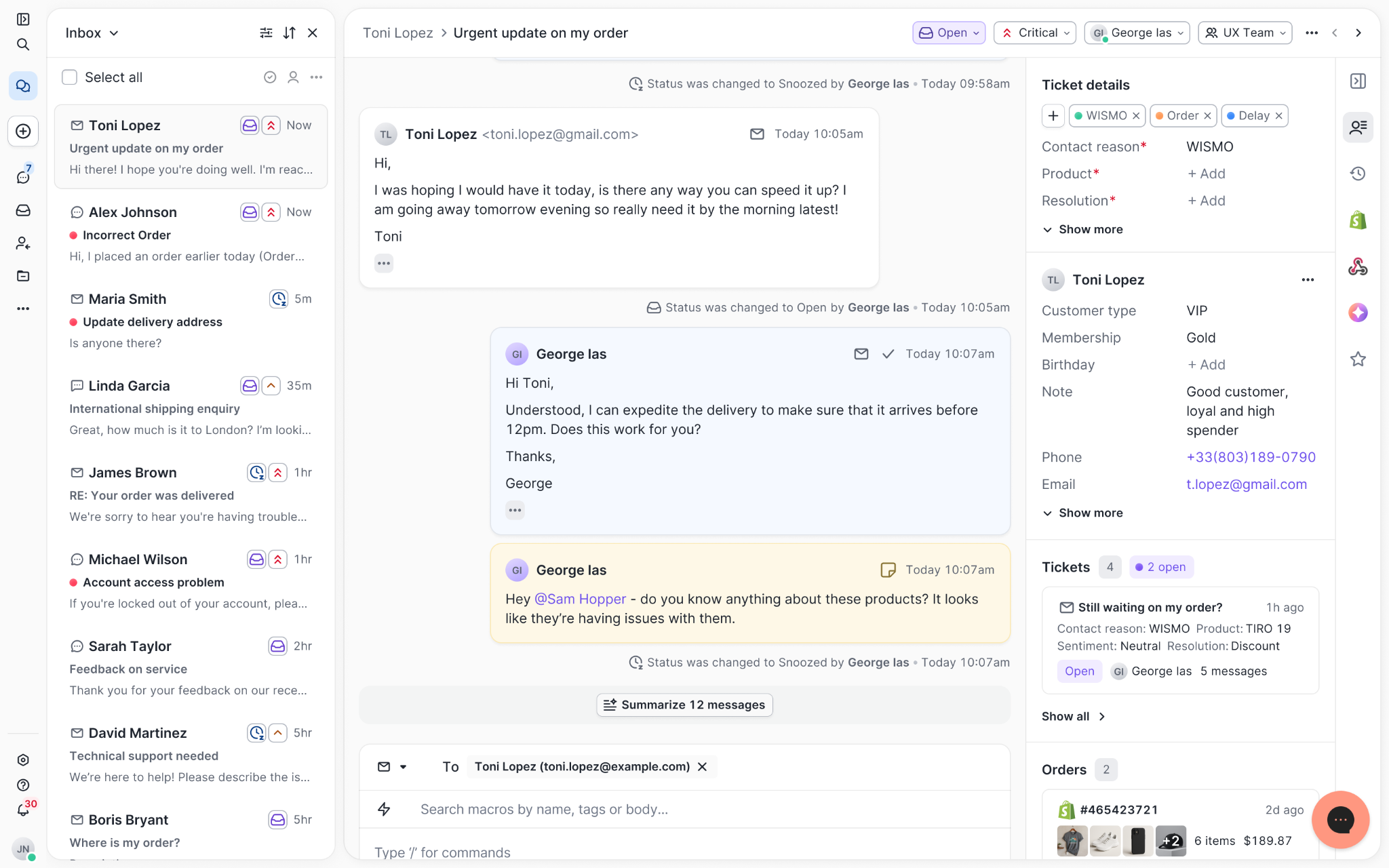
Chats with customers now look like real conversations, using the speech bubble style you’re familiar with on popular messaging apps.
Check customer history without losing your place
Checking a customer's history used to mean leaving the conversation, an extra step that interrupted what should have been a smooth workflow.
Now, past conversations open in a sidebar next to the active conversation. You can view a customer’s full history, search through their timeline, and open prior tickets without going to a new page.

Check past conversations, orders, and customer details in the brand-new Customer Timeline.
See order details the moment you open a ticket
Order information is easier to reference than ever. Open a ticket, and you instantly see the customer's recent orders, marked with product images and invoice details at a glance. Need to dig deeper? Click on an order, and the expanded information appears in the same panel.
For teams using custom integrations, apps are fixed in a quick-access integration menu on the right.
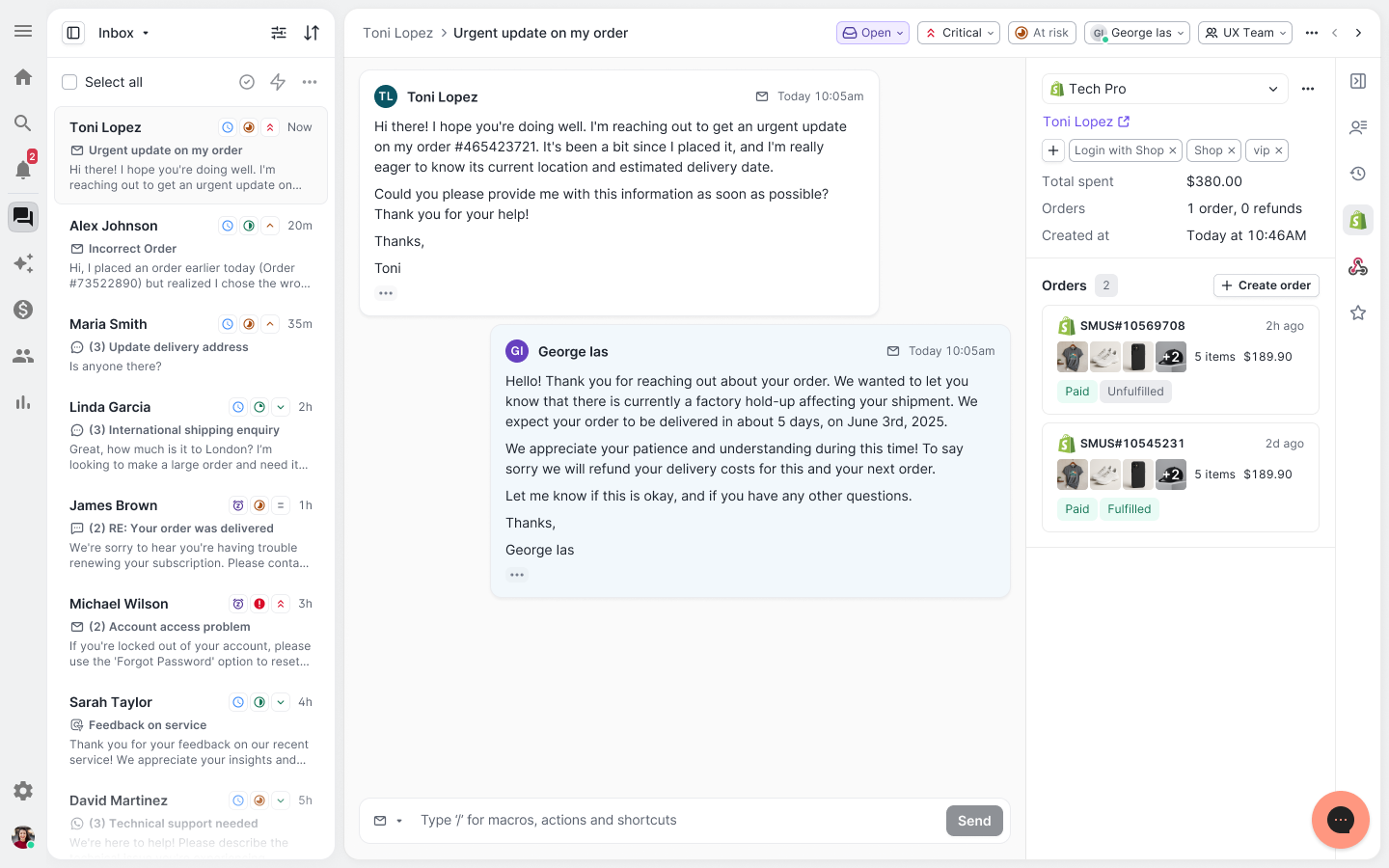
See order details, product images, and totals at a glance on the right panel, without leaving the conversation.
Pick up where AI left off
You shouldn't have to dig through a thread to figure out what AI already tried. Now you don't have to.
When AI Agent escalates a conversation, it includes a concise handover summary that mentions the issue, what actions were taken, and why it was passed to your team.
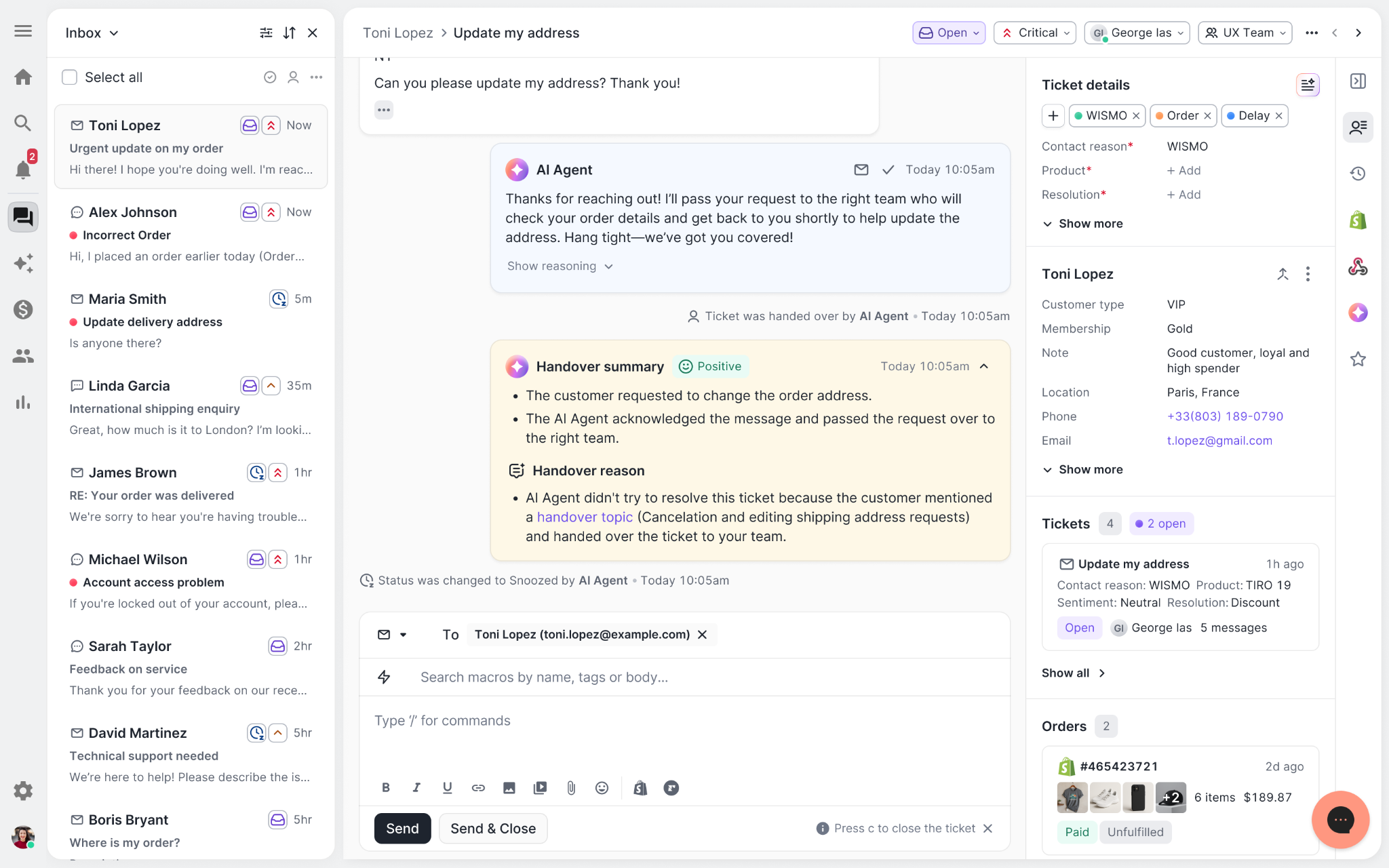
Escalated tickets include a brief AI-generated handover summary, marked in yellow, for quick reference.
Move faster across every store and team
We restructured and simplified the navigation. The left sidebar organizes everything into clear categories: Inbox, AI Agent, Marketing, and Analytics, so anyone on your team knows exactly where to go.
To quickly update your knowledge base or adjust a workflow, both now live right in the sidebar. For teams managing multiple stores, switching between them is just as straightforward, accessible from the sidebar, so agents can move between inboxes without breaking their flow.
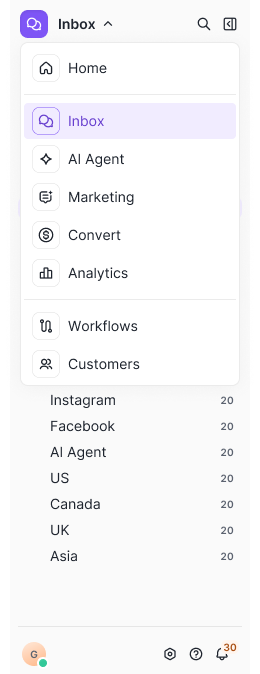
Agents can switch between stores and their corresponding inboxes directly from the left menu.
A workspace that works the way agents do
Support comes down to the person on the other end of the conversation. We built Helpdesk 2.0 is to make sure they have everything they need to show up for that moment.
The best way to see the difference is to work in it. Start a free trial today.


Further reading

The Hidden Cost of Not Adopting AI in Ecommerce
TL;DR:
- Ecommerce brands not using AI are falling behind, as 77.2% already use it daily to boost efficiency and revenue.
- AI saves time and cuts costs, like Trove Brands saving $23K/month and reducing cancellations by 70%.
- Customers want speed and privacy—AI provides fast, judgment-free answers in sensitive categories.
- AI empowers support teams by handling routine tasks so agents can focus on high-value interactions.
Doing nothing when there’s rapid change happening in an industry is risky business.
Right now, according to our latest report, 2025 Ecommerce Trends, 77.2% of ecommerce professionals are already using AI in their day-to-day work. What happens if you’re part of the 22.8% that isn’t?
Inaction is action — one that’s a quiet drain on revenue, resources, and reputation.
Every minute spent on manual work is a minute your competitors are focusing on higher-value customer interactions, improving CX, testing offers, and scaling campaigns.
And the cost of falling behind is compounding fast. Here’s what you’re losing when you pass on AI.
Time lost = money lost
As support volume grows, so does the cost of inefficiency.
Nearly 80% of CX professionals say AI saves them time. In fact, 83.9% of support leaders using AI in Gorgias say it has made their teams more efficient.
Trove Brands experienced this firsthand:
- They reduced missed cancellations by 70%
- And saved $23,000/month in labor costs by automating repetitive support tasks
If AI can handle 70% of your support tickets, your team finally has the time — and headspace — to focus on the 30% that actually builds trust, drives repeat revenue, and improves the customer experience.
Trust when customers need it most
Hot take: AI isn’t impersonal. Not using it is.
In 2024, nearly one-third of CX leaders worried AI would make interactions feel less human. A year later, that number dropped by half.
Why? Brands started to see that AI wasn’t hurting the customer experience, it was removing friction from it.
For sensitive or personal products — think wellness supplements, intimate gifts, or anything a shopper might feel awkward asking about — AI creates space for honesty without judgment. And that can change the outcome entirely.
“Too often, a great interaction is diminished when a customer feels reduced to just another transaction,” said Ren Fuller-Wasserman, Senior Director of Customer Experience at TUSHY. “With AI, we let the tech handle the selling — unabashedly, if needed — so our future customers can ask anything, even the questions they might be too shy to bring up with a human. In the end, everyone wins.”
It’s a powerful point, especially for brands where discretion matters. AI removes that barrier.
You're losing trust if your support experience still makes customers hesitate. For many, that means being able to get an answer without needing to explain themselves first.
Revenue hiding behind unanswered questions
Every unanswered pre-sale question or missed upsell is revenue slipping through your fingers.
Product recommendations alone have the potential to increase revenue by up to 300%, boost conversion rates by 150%, and drive 50% higher AOV. But those results don’t come from hoping customers find what they need. They come from proactively guiding them.
That’s where AI comes in.
With Gorgias AI Agent and automation features, for example, Kirby Allison
- Increased conversions by 23%
- Grew sales from support by 46% in just two months
“Our favorite features are definitely Flows and Article Recommendations. They drive so much automation for us. Shoppers get answers to their questions by themselves — what’s the right size hanger, where is my order, what shoe polish would you recommend, etc,” said Addison Debter, Head of Customer Service.

Flows let Kirby Allison surface up to six commonly asked questions directly in the chat widget. When clicked, each one opens a relevant help article — no agent needed.

Auto responses also allowed the team to handle common inquiries like sizing, shipping, and order tracking before a human ever steps in.

If your support team isn’t set up to handle pre-sale conversations at scale, the cost isn’t just in time. It’s in all the revenue you never realize you’re missing.
A CX team stretched thin
It might sound counterintuitive, but AI gives your team more space to be human.
The myth that AI replaces agents is still floating around in some circles, but the reality inside fast-growing ecommerce teams looks different.
In fact, AI frees up time for your team to focus on what they do best: solving complex problems, building relationships, and creating moments that actually drive loyalty.
SuitShop is a perfect example of this in action. When the team adopted AI Agent, they paired automation with intentional escalation:
“We’re helping customers feel confident during some of the most important moments in their lives — weddings, proms, job interviews, and everything in between. Naturally, my biggest concern with introducing AI was: ‘Will customers feel like they’re getting the same level of care from AI?’ But learning that AI Agent would pull knowledge from our Help Center articles and Macros, which are already written in our brand voice, made me feel more confident,” said Katy Eriks, Director of Customer Experience.
AI was able to handle common pre-sale questions like shipping timelines and product availability, while human agents stepped in for customizations, wedding-specific questions, and tailored styling support.
The goal wasn’t to remove the human element. It was to give their agents the time and context to show up more meaningfully.
The longer you wait, the harder it is to catch up
In just one year, AI adoption among Gorgias users jumped from 69.2% in 2024 to 77.2% in 2025.
Excitement is rising, too: 55.3% of ecommerce professionals now rate their interest in AI as 8–10 out of 10, up from 45.6% the year prior.
AI is no longer in its experimental phase. It’s the standard, baked into everyday workflows across ecommerce.
If you’re still on the sidelines, 2026 is going to feel like a catch-up game.
The good news? You don’t have to overhaul everything to get started.
So while we’re on the topic of speed, let’s walk through how to start implementing AI for your brand.
How to get started with AI
You don’t need to automate everything on day one. The best CX teams start small, pick the right entry points, and give AI the same level of care you’d give a new team member. Here’s how to roll out AI in a way that actually works:
1. Vet your options thoughtfully
When searching for a new AI tool to help you manage CX, look for one that:
- Offers strong tone-of-voice control so your AI doesn’t sound like a chatbot from 2012
- Delivers consistently accurate responses, even as inputs and workflows evolve
- Provides real post-sale support to help your team troubleshoot, train, and scale usage
Price matters, but it shouldn’t be your only filter.
Also, AI should make your team feel more capable. If it feels like a bolt-on or requires constant developer help, it’s going to create friction, not solve it.
2. Make someone own it
The most successful AI implementations all have one thing in common: someone owns it.
“One of our CX Managers spent 30–40 hours a week building and refining AI. That ownership was critical,” said Sarah Azzaoui, VP of Customer Experience at Clove, when she was explaining how her team first got started with AI.
What many people don’t realize is that AI isn’t going to be perfect out of the gate. AI takes real time and intention to build out. Assigning a clear point person — or better, a small squad — ensures someone is tracking performance, making optimizations, and flagging edge cases.
3. Involve your CX team from the start
No one knows your customer conversations better than your support team. They see the full range of questions, tone, friction points, and emotional nuance every day.
Bringing them into the AI rollout early helps you:
- Identify which questions are repetitive and low-stakes
- Flag which issues should always be handled by a human
- Set realistic expectations across the org about what AI should handle vs. what it could handle
This step also builds trust. If your agents feel like AI is something being done with them instead of to them, adoption is smoother and the outcomes are better.
4. Start small with the right topics
One of the biggest mistakes brands make with AI is trying to do too much, too soon. AI rollout should feel like a phased launch, not a switch flip.
Start in a test environment if your platform allows for it. Roll out automation in stages — by topic, channel, or ticket type — and QA every step of the way.
We suggest beginning with high-volume, low-complexity tickets like:
- “Where’s my order?”
- Subscription pauses or cancellations
- Returns and exchanges
- Store policies and FAQs
Platforms like Gorgias offer tools like Auto QA that track whether AI responses hit the right tone, offer accurate answers, and resolve issues effectively. Use those tools to catch gaps early and monitor performance over time.
That slow, deliberate rollout pays off in performance. At Psycho Bunny, AI Agent now automates 30% of customer tickets, with custom messaging that reflects their brand tone and processes.
Once you’re ready to scale, you’ll feel more confident that the simple queries are handled correctly while you start to train the AI on more nuanced questions.
For example, Gorgias’s Guidance feature gives AI access to non-public SOPs so it knows how to respond or when to escalate.
“The Guidance feature is so important,” said Tosha Moyer, Senior Customer Experience Manager at Psycho Bunny. “We have a lot of processes that we definitely don’t want described in a customer-facing article, but we want AI Agent to be able to access that information and manage tickets accordingly.”
5. Prep your knowledge base
Even the best AI platform can’t succeed without solid inputs.
Before you roll out, take a hard look at your help docs and macros:
- Are they accurate?
- Are they clear and consistent in tone?
- Are they tagged so AI can understand when to use them?
Think of this step as training your AI. The stronger your internal content library, the more helpful and brand-aligned your AI will be across every channel.
6. Communicate with customers
Whether you disclose AI usage is up to you, but be intentional.
Some brands choose anonymity for a more seamless experience. Others find that transparency builds trust, especially when something goes wrong.
What matters most is that your approach aligns with your brand tone and customer expectations — and that clear escalation paths are in place if a conversation needs a human.
Research shows that 85% of consumers want companies to share their AI assurance practices before rolling out AI-powered experiences. Customers are open to AI. But they expect clarity when it counts.
7. Scale the program over time
Once you’ve built the foundation, scaling AI across your CX org becomes a lot easier.
“We started with cancellations. Now we’re rolling out warranty claims, retention campaigns, and more,” said the team at Trove Brands.
After proving value with one or two ticket types, look for opportunities to expand:
- Pre-purchase product recommendations
- Exit-intent offers via chat
- Predictive personalization
- Multichannel automation across email, SMS, and live chat
The goal is to implement smarter automation that makes your team more effective and your customers more supported.
The future is human + AI
The best CX teams aren’t choosing between AI and human agents. They’re choosing both and building stronger systems because of it.
“It’s not human agents vs. AI,” said the team at Clove. “Our team helped shape the AI strategy — and that changed everything.”
But ignoring AI? That comes at a cost. And it’s not just inefficiency. It’s:
- Missed sales from unanswered questions
- Slower support that erodes customer trust
- Burnt-out teams stuck in reactive mode
- Lower CSAT from inconsistent experiences
- And eventually, falling behind as the rest of the market moves forward
It’s time to build it into your workflows. Not just as a helper, but as a core part of your team.
Start using Gorgias AI Agent to reduce ticket load, recapture revenue, and deliver the kind of support that actually feels personal.
{{lead-magnet-1}}

7 Customer Requests AI Agent Actions Resolve End to End
TL;DR
- Actions are tasks AI Agent performs for customers, autonomously. From address changes and subscription pauses to order cancellations and refunds, Actions resolve requests end to end, even when your human agents are offline.
- Actions connect directly to your ecommerce stack. They work natively with Shopify and leading fulfillment, subscription, and returns apps, including ShipMonk, ShipHero, ShipStation, ShipBob, Stay AI, Recharge, Loop, Skio, and Wonderment.
- Use pre-built Actions or build your own. There are 15 Action templates across Orders, Subscriptions, Returns & Exchanges, and Marketing, or you can build custom Actions with HTTP requests.
- Watch out for setup snags. Conflicting skills, multiple matching Actions, older orders, or broken logic can block an Action from executing.
Automated responses don't actually resolve anything. In reality, they increase customer wait time.
What a customer really wants is immediate resolution, whether they're looking to cancel an order, change a shipping address, or pause a subscription. And the bar keeps rising: in our 2026 State of Conversational Commerce Report, 96% of ecommerce professionals now use AI in their roles, with order tracking, returns, and refunds among the top use cases driving adoption.
Below, we'll go over the 7 most common customer service requests you can resolve with AI Agent Actions, so your team gets time back to strengthen customer relationships, increase revenue, and improve your CX strategy.
{{lead-magnet-1}}
What are AI Agent Actions?
AI Agent Actions are tasks AI Agent can complete for your customers, such as canceling an order or updating a shipping address.
Instead of handing it off to a human agent, AI Agent resolves the ticket by connecting to your ecommerce apps and performing the action on its own. Actions are how AI Agent does the work in its Support Agent role: not just telling a shopper what will happen, but making it happen, directly inside your Helpdesk.
You get full control over when and how Actions are executed. Before performing an Action that changes data, AI Agent asks the customer for confirmation, respecting your processes and maintaining a high level of customer service. Once an Action has been taken, you can share feedback with your AI Agent to reinforce its behavior or fine-tune it further.
Top 7 customer requests you should be automating with AI Agent Actions
Ready to resolve requests in seconds? Activate these pre-built Actions in Gorgias to keep your team efficient and your customers happy. Choose from 15 Action templates, which you can edit to fit your workflow. You can even create custom Actions.

1. Customer wants to update their shipping address
Action to use: Update shipping address
Supported apps: Shopify, ShipMonk, ShipHero, ShipStation
Incorrect shipping addresses lead to costly re-shipments, delays, and even refunds. Catch errors early to keep customers satisfied and excited about their order.
Why do you need this Action? The reality is your agents aren't available 24/7. Unless you hire a team to cover night and weekend shifts (which is unlikely), requests will be missed. AI Agent fills that gap, handling time-sensitive issues when your team is off the clock. Missing them isn't just about poor customer experience, it can also lead to extra costs, like reshipping orders.

2. Customer wants to cancel an order
Action to use: Cancel order
Supported apps: Shopify, ShipMonk, ShipHero, ShipStation
Perhaps a customer ordered the wrong item, chose the wrong size, used the wrong card, or simply changed their mind. Allow them to quickly cancel their order and receive a refund in one go.

“Actions responds to tickets within about 30 seconds and is available 24/7. Regardless of when a customer places their order, the likelihood of quickly catching and canceling the order has increased by 70% since we started using Actions. It’s an exceptional result."
—Jon Clare, VP of Customer Service at Trove Brands
3. Customer wants to cancel their subscription
Action to use: Cancel subscription
Supported apps: Recharge, Stay AI, Skio, Loop
Cancellations are going to happen. When a customer is set on leaving, a fast, friction-free cancellation protects the relationship and leaves the door open for them to return later, which keeps your churn rate in check. AI Agent confirms the request, cancels the active subscription, and frees your team from manual back-and-forth.
4. Customer wants to skip or pause a shipment
Actions to use: Skip next subscription shipment, or Pause subscription
Supported apps: Stay AI, Recharge, Loop, Skio
Subscriptions shouldn't be all or nothing. Let customers skip a shipment or pause their subscription, so they can come back when they're ready. Giving them full control lets them manage their subscription on their own terms, reducing churn in the process.
When the customer is ready to come back, AI Agent can also handle the Resume subscription Action, so reactivating is just as easy as pausing.

5. Customer lost or damaged their order in transit
Action to use: Reship order for free
Supported apps: Shopify, ShipMonk
No customer expects a lost or damaged order. Let customers know that you have their backs by reshipping a new order free of charge. Fast resolutions during unexpected events demonstrate your commitment to customer satisfaction.
“An instant response builds confidence. We live in a world with short attention spans, so customers appreciate how quickly we can respond to their inquiries. Customers aren’t worrying unnecessarily for longer than they have to for an address change or order cancellation.”
—Mia Chapa, Sr. Director of Customer Experience at Glamnetic
6. Customer wants to know their return shipping status
Action to use: Send return shipping status
Supported app: Loop
Customers want to know that their return package is on its way to you, so they can redeem their refund. Easily send them a shipment tracking link to give them that peace of mind.
7. Customer wants to know about order status
Action to use: Get order info
Supported apps: Shopify, ShipHero, ShipMonk, ShipStation, ShipBob, Wonderment
Based on Gorgias data, order status ranks among customers' top 10 questions for support teams. Reassure your customers with quick updates on their orders, including product details, shipping progress, expected delivery date, and other helpful information.
AI Agent Actions speak louder than words
If you want…
- Fewer repetitive tickets
- Faster customer support
- Happier customers who get what they need instantly
- More time for your team to strategize
- Lower costs and higher efficiency
Why Actions matter more than ever
Actions aren't just a time-saver, they're how conversations turn into outcomes. 79% of brands say AI-driven conversational commerce has increased their sales and purchase rates, and the brands seeing the biggest returns use AI to resolve issues end to end, not just deflect them.
When an order gets fixed, a subscription gets saved, or a return gets started in seconds, you protect both the relationship and the revenue. (See how brands are turning support into a revenue channel in Conversations Are Becoming a Revenue Channel.)
Book a demo to see AI Agent Actions work in real time and start automating what you shouldn’t be doing manually anymore.
{{lead-magnet-2}}

How to Write Guidance with the “When, If, Then” Framework
TL;DR:
- AI Agent is only as good as the instructions you give it. Clear Guidance enables it to perform like your best support teammate.
- The “When, If, Then” framework makes writing Guidance easy and repeatable. Start with the scenario (when), define the conditions (if), and list specific actions (then) to create structured Guidance.
- Use Guidance to handle frequently asked questions, like returns, cancellations, or discount code inquiries, so your team can focus on more complex issues.
- If your Guidance isn’t working, formatting or logic gaps might be to blame. Check for missing conditions, unsupported tasks, or confusing formatting.
AI Agent is built to deliver fast, accurate support at scale, but like any teammate, it performs best when given clear and specific instructions.
That’s where Guidance comes in. Writing structured prompts that tell your AI Agent exactly what to do in a given scenario helps reduce escalations, speed up resolutions, and create a more consistent customer experience.
One simple, repeatable way to do that is with the “When, If, Then” framework.
In this post, we’ll show you how it works, using examples from our Gorgias Academy course, Improve AI Agent with Better Guidance.
You’ll learn how to write Guidance that results in:
- Fewer escalations
- Faster resolutions
- Smarter, more consistent AI behavior
Let’s break it down.
{{lead-magnet-1}}
What is Guidance?
Guidance is how you tell your AI Agent what to do. It’s a set of instructions that outlines how your AI Agent should respond in specific situations.
When Guidance is available, your AI Agent follows it first, even before checking your Help Center or website content.
That means if your Guidance is missing, unclear, or incomplete, your AI Agent might escalate the ticket, or worse, give a confusing or unhelpful response. Here’s an example:
Let’s say a customer wants to return an item. A human agent would send them a link to the return portal and explain the steps. But without that instruction in Guidance, your AI Agent might skip straight to escalation, turning a simple request into unnecessary work for your team.
That’s why clear, step-by-step Guidance is key to help your AI Agent respond the way your best support agent would.

Learn more: Create Guidance to give AI Agent custom instructions
Introducing the “When, If, Then” framework
Sometimes it’s hard to know where to start when writing Guidance. The “When, If, Then” framework gives you a simple, repeatable structure to follow, so there’s no need to guess.
Taking this approach mirrors how AI Agent processes information behind the scenes. When you write clear Guidance, your AI Agent can follow it step by step, just like a support teammate would.
Let’s walk through the three parts of the framework.
WHEN: Set the scenario
Start by identifying the situation your Guidance applies to. This is the trigger or scenario. Use it as the title of your Guidance so it’s easy to find later.
Example:
- WHEN a shopper asks to return an order
- WHEN a customer wants to cancel their subscription
Keep it simple and action-oriented. You’re setting the stage for what comes next.

IF: Add conditions
Once you’ve defined the scenario, add any conditions that determine what should happen. “If” statements help your AI Agent understand what to do based on specific details, like timing, order history, or customer tags.
Example:
- IF the order was placed less than or equal to 15 days ago
- IF the customer has a VIP tag in Shopify
Use as many “if” conditions as needed to guide different outcomes. Just make sure you cover all the possibilities so your AI Agent doesn’t get stuck.
THEN: Define the actions
This is where you tell your AI Agent exactly what to do. Be specific and use bullet points or numbered steps to keep things clear.
Example:
- Tell the shopper they’re eligible for a return
- Send them a link to the return portal
- Let them know they’ll receive a prepaid label once the form is submitted
The more clearly you outline the steps, the more consistently your AI Agent will perform.
The framework keeps your Guidance simple, structured, and easy to understand—for both your team and your AI Agent. When your AI Agent knows exactly what to do, it can deliver fast, accurate, and helpful responses that keep customers happy.
Put it all together
Say a shopper messages your store asking to return an item and you want AI Agent to send them to your return portal.
Here’s how this looks in a complete piece of Guidance:
WHEN a shopper asks to return an order:
IF the order was placed less than or equal to 15 days ago,
THEN
- Tell the shopper they’re eligible for a return
- Send them a link to the return portal
- Let them know they’ll receive a prepaid label via email once they submit the form
9 support scenarios made better with Guidance
These nine scenarios come up constantly in ecommerce support, and they’re perfect candidates for automation. They follow predictable patterns and are quick to resolve when your AI Agent knows what to do.
Use the examples below to jumpstart your setup. Each one is written using the When, If, Then framework and can be copied directly into Gorgias.
1. Where’s my order? (WISMO)
WHEN a customer asks about their order status:
IF tracking information is available,
THEN
- Provide the tracking number and link to the carrier's tracking page.
- Inform the customer of the expected delivery date.
IF tracking information is unavailable,
THEN
- Inform the customer that the order is being prepared for shipment.
- Provide an estimated shipping date.
2. What size should I order?
WHEN a customer inquires about product sizing for [item name]:
IF the customer asks what size to get, or mentions they’re unsure about sizing,
THEN
- Share the sizing chart or guide.
- Offer recommendations based on common fit feedback.
3. Can I change my shipping address?
WHEN a customer requests to change their shipping address:
IF the order has not been fulfilled,
THEN
- Confirm the new address with the customer.
- Update the shipping address in Shopify (or your chosen platform).
IF the order has already been fulfilled,
THEN
- Inform the customer that the address cannot be changed.
- Provide options for order interception or return.
4. Can I cancel my order?
WHEN a customer asks to cancel their order:
IF the order has not been fulfilled,
THEN
- Confirm that we can cancel their order.
- Tell them they’ll receive their refund in 5-10 business days.
IF the order has already been fulfilled,
THEN
- Inform the customer that the order cannot be cancelled.
- Help to initiate a return once the item is delivered.
5. How do I return an item?
WHEN a customer asks about returning an item:
IF the return is within the allowed return window of [x] days after the order was received,
THEN
- Provide the return instructions and link to the return portal.
- Inform the customer about the refund process.
IF the return window has expired,
THEN
- Inform the customer that the return period has ended.
- Offer alternative solutions if available.
6. Do you have any discount codes?
WHEN a customer inquires about discounts or promo codes:
IF there is an active promotion for [item name],
THEN
- Share the current discount code and its terms.
IF there are no active promotions for [item name],
THEN
- Inform the customer that there are no current promotions.
- Suggest subscribing to the newsletter or following social media for future promos.
7. I want to pause my subscription.
WHEN a customer requests to pause their subscription:
IF the customer has an active subscription,
THEN
- Provide instructions on how to pause the subscription through their account.
- Confirm the pause and inform them of the next billing date.
8. When will this item be back in stock?
WHEN a customer asks about product restocking:
IF a restock date is available,
THEN
- Inform the customer of the expected restock date.
IF the restock date is unknown,
THEN
- Offer to notify the customer when the product is back in stock.
- Suggest similar products.
9. Do you ship internationally?
WHEN a customer inquires about international shipping:
IF international shipping is available,
THEN
- Confirm that international shipping is offered.
- Provide estimated delivery times and any additional fees.
IF international shipping is not available,
THEN
- Inform the customer that shipping is limited to specific regions.
Pro Tip: Test out your Guidance by going to AI Agent > Test, and iterate as you go.
Troubleshooting: Why Guidance might not trigger
If your AI Agent isn’t following your Guidance, or it’s escalating tickets you thought it could handle, run through this quick checklist to spot the issue:
- Has a descriptive, easy-to-understand name: Name your Guidance based on the scenario (e.g. When a shopper asks about returns).
- Clear IF and THEN conditions: Make sure your Guidance spells out what to do when a condition is met.
- Covers all variations (no gaps in logic): Don’t leave your AI Agent hanging. Include fallback instructions for all scenarios.
- No wall-of-text formatting: Break things up with line breaks, headers, and spacing to help AI Agent scan quickly.
- Clearly written steps with bullets or numbers: Use lists to make actions easy to follow, like you would for a teammate.
- Doesn’t include unsupported tasks: Avoid unsupported instructions like “send macro,” “assign to agent,” or “delay the response.”
Bonus: Let AI do the heavy lifting
Don’t have time to write Guidance from scratch? The good news is AI can help with that, too.
AI-generated Guidance is available for all AI Agent subscribers. This feature analyzes your historical ticket data and uses it to generate ready-to-use, customizable prompts for your AI Agent.
Here’s what it does:
- Analyzes past tickets to identify common support scenarios
- Generates step-by-step Guidance based on what’s worked before

Ready to level up your Guidance?
Clear, structured Guidance is the key to unlocking better performance from your AI Agent. With just one well-written “When, If, Then” prompt, you can reduce escalations, speed up resolutions, and give your shoppers a smoother experience.
Not sure where to start? Try writing Guidance for one common question today—like returns, order status, or promo codes. Or, if you want to go deeper, check out our free Gorgias Academy course.

When Should You Migrate Helpdesks? 5 Signs to Watch Out For
TL;DR:
- Your helpdesk shouldn't hold you back. If your team is buried in tickets or bouncing between tools, your platform might be the problem—not your process.
- Rising ticket volumes, slower response times, and clunky integrations are signs you’ve outgrown your platform. Don’t wait for these issues to impact revenue or retention.
- You’re not alone—fast-growing brands hit these roadblocks too. Dr. Bronner’s, Psycho Bunny, and Audien Hearing all switched platforms to support bigger growth with less friction.
- Helpdesk migration doesn’t have to be scary. With the right migration support, you can move quickly, avoid downtime, and give your team a tool they actually want to use.
As ticket volume grows, even the best CX teams start running into roadblocks: limited integrations, repetitive manual work, clunky interfaces, and slower response times. You patch things together. You make it work... until you can’t.
Many growing ecommerce brands find themselves trapped in a system that demands constant workarounds just to function.
If your current customer service platform feels more like a burden than a backbone, you’re not alone—and you’re not stuck.
In this post, we’ll walk through:
- The key signs it’s time to switch platforms
- What to prioritize when choosing your next one
- How brands like Pepper made a smooth move to Gorgias
The 5 warning signs you’ve outgrown your helpdesk
There’s a tipping point most brands hit as they scale. The signs are subtle at first—maybe your agents are taking longer to respond, or the volume of customer support tickets quietly outpaces your team. Then it starts affecting revenue, customer satisfaction, and retention. Big yikes.
Left unchecked, small inefficiencies can snowball into bigger operational challenges.
Catch these warning signs before they start costing you growth:
1. Rising ticket volume and slower resolution times
Support teams that are always playing catch-up rarely have time to focus on higher-value work. If your inbox is constantly overflowing or first response times are creeping up, it’s likely a sign your tools aren’t scaling with your business.
That’s exactly what happened with apparel brand Psycho Bunny.
“As we grew and expanded, we needed a tool that was better suited for Shopify, easier to manage, and offered better support to help us get the most out of the tool,” said Jean-Aymeri de Magistris, VP IT, Data & Analytics, and PMO at Psycho Bunny.
2. Agents constantly toggling between tabs and tools
If your agents are spending more time gathering context than solving problems, you’re losing time (and likely, patience) on both sides of the conversation. Fragmented tools can seriously undercut productivity.
Dr. Bronner’s experienced this firsthand, juggling Salesforce, spreadsheets, and disconnected systems.
“When I joined, we were logging calls and emails in Excel. It wasn’t scalable,” recalled Emily McEnany, Senior CX Manager at Dr. Bronner’s.
3. Clunky or missing integrations with your ecommerce stack
Some platforms require technical support even for small changes, such as custom workflows, new automations, or basic integrations. That may work at the start, but it becomes a bottleneck as your brand grows.
Disconnected systems strip away context, increasing the risk of mistakes. Whether it’s pulling up an order status or managing a return, agents need tools that work together, not against each other.
4. You’re stuck answering the same questions over and over
Every support team deals with repetitive inquiries. But without automation or self-service options, those tickets eat into your team’s time and keep you from focusing on higher-impact conversations.
Nude Project struggled to keep up with their ticket volume due to Zendesk’s lack of intuitive automation features. During Black Friday, the team received a record-high number of tickets—more than double their average volume.
“Connecting with customers through a screen is not always easy. With the high volume of messages, we need a tool that simplifies operational tasks while enabling effective communication and organization,” said Raquel J. Méndez, CX Manager at Nude Project.
5. Onboarding takes too long
Your platform should be easy for new hires to learn and for your team to evolve with. If ramping up agents takes weeks (or months), the platform might be getting in the way more than it’s helping.
Arcade Belts went through this process, trying one system, then switching back to one that better matched their needs.
“It just took a demo or two to realize what was actually going to support our team the way we needed,” their Ecommerce Coordinator, Grant, shared.
If any of these challenges sound familiar, you’re not alone.
The important part is recognizing when you’ve outgrown your current setup—and knowing that there are options out there to help you move faster.
What to look for when switching CX platforms
Switching platforms isn’t just about solving today’s problems. It’s about creating space for your team to be efficient, serve customers better, and turn support from a cost center into a real growth engine.
Need to migrate to a new platform? Look for the following:
1. A system that keeps up with rising ticket volumes
As your brand grows, support volume naturally increases.
Find a stable infrastructure that can handle that growth, has zero platform lag, and a robust engineering team that continuously makes the tool better for your needs.
To Psycho Bunny, Zendesk was a “legacy tool”—so they switched to Gorgias.
In just a few weeks, they migrated all historical conversations, tags, and Macros to Gorgias. Jean-Aymeri, their VP IT, credits Gorgias’s helpful onboarding specialists for making it effortless to integrate their apps and onboard their team onto a brand new tool.
Related: The engineering work that keeps Gorgias running smoothly
2. Automation for repetitive tasks (that maintains the human touch)
From “where’s my order” questions to return policies, prioritize AI tools that can automate repetitive inquiries.
Dr. Bronner’s implemented AI Agent to handle rising volumes of FAQs, allowing their team to focus on complex requests that require a human touch.
In just two months, they saw:
- 45% of all customer service tickets automated
- $100,000 saved per year by switching from Salesforce to Gorgias
- 4 days per month in team time savings
- 11% higher customer satisfaction score
By systematizing the simple stuff, they freed up bandwidth to focus on what matters most—building relationships and solving more nuanced problems.

3. Built-in features that turn support into sales
More brands are rethinking how support contributes to revenue. Look for a tool that combines support and sales. The most effective ones use AI to initiate upselling conversations, so your team can generate new revenue without needing to scale headcount at the same rate.
For jewelry brand Caitlyn Minimalist, which normally saw 30,000 tickets per month, AI Agent was the perfect fit. On top of answering FAQs, AI Agent also helped recommend products based on customer needs.
These conversations often begin as simple inquiries (“What should I get for my friend’s birthday?” or “What product suits me?”) and end in a purchase—handled entirely by AI. In fact, AI Agent’s conversion rates were 150% higher than the team average, proving that automation can support and sell.
4. A more efficient workflow—without relying on developers
The last thing scaling brands should have to worry about is relying on developers for basic changes. That includes being able to create macros and automations in-house and access key customer data without toggling across tools.
The platform should fit into your existing ecommerce stack—not fight against it.
That’s where Audien Hearing found themselves before switching to Gorgias.
“I’ve seen companies lose a lot of money because it’s not efficient,” said Zoe Kahn, former VP of CX. “You try to save money early on, but then you look at your helpdesk a year later and think, ‘Oh no, what’s happening?’”
Since switching from Richpanel, Audien Hearing’s CX team has been able to run CX on their own terms—without the bottlenecks.
They now resolve 9,000 tickets per month through self-service alone (including a customer knowledge base), cut first response times by 88%, and reduced return rates by 5%. With more time for one-on-one conversations, CSAT jumped from 80 to 86.
What migration actually looks like
“But migration sounds hard.”
We get it. Moving your entire CX operation can feel intimidating. But with the right partner (and the right platform), it doesn’t have to be.
Here’s how Gorgias makes switching smooth and stress-free:
- A dedicated onboarding team: Our team is with you every step of the way—from initial setup to post-launch optimization.
- A platform built for ecommerce workflows: Gorgias is designed to work the way ecommerce brands do, not the other way around.
- Fast setup and agent training: Most brands are up and running in days, not weeks. And because the interface is intuitive, teams can get comfortable quickly without heavy, time-consuming training.
- Full data migration support: Whether you’re moving from Gladly, Zendesk, or another platform, we’ll help you bring your history, macros, and workflows over smoothly.
Most Gorgias customers are fully live within just a few days—ready to serve customers faster, smarter, and with less manual lift.
How Pepper made a smooth switch to Gorgias
When fast-growing intimates brand Pepper outgrew their old CX platform, they knew they needed a system that could scale with them—without sacrificing speed or quality.
“Gladly didn’t offer any automation or inbox organization features. Our queue got really messy. We got 400 tickets a day during Black Friday, and we didn’t clear that backlog until the following Spring. We knew we couldn’t do that again,” explained Gabrielle McWhirter, CX Operations Lead at Pepper.
With Gorgias, Pepper was able to:
- Fully migrate their workflows and history
- Train their team quickly on the new platform
- Launch their AI Agent ("Penelope") to automate more than 50% of support tickets

And the results spoke for themselves:
- 16.5x ROI on AI-driven sales interactions
- 90%+ decrease in first response and resolution times
- 18% uplift in average order value
See how Pepper made the switch happen (and why they’re never looking back):
Is it time to make the switch?
If you’re seeing the warning signs, here’s a quick gut check:
- You’re drowning in tickets and toggling between tabs
- You can’t track or tie support to revenue
- You need better integration with your tech stack
- You’re not using automation, or it’s not actually saving time
- Your team dreads logging into your current tool
The right platform won’t just help your team work better. It’ll help you drive more revenue, boost customer retention, and actually make customers want to talk to you.
See what switching to Gorgias could do for your brand. Book a demo today.
{{lead-magnet-1}}

11 Ways CX Teams Can Turn Customer Touchpoints Into Revenue
TL;DR:
- Your CX team drives revenue: Build trust, remove friction, and influence buying decisions across the customer journey
- Optimize existing processes: Automate tasks, address concerns proactively, and create efficient handoffs
- Spot risk early: Use tagging and sentiment detection to re-engage customers before they churn
- Protect VIPs: Prioritize loyal customers, create moments of delight, turn supporters into advocates
Rising tariffs. Shipping delays. Unpredictable price hikes. For ecommerce, it's an understatement to say the pressure is rising. If you're on the CX team, you're already facing the fire head-on — all the customer frustration, confusion, and hesitation.
CX teams are on the frontlines of support and sales. You're shaping customer trust, buying decisions, and brand loyalty.
From pre-sales conversations to loyalty programs, it’s time to rethink the customer journey, so you can turn every interaction into an opportunity to grow your revenue.
{{lead-magnet-1}}
Reframe CX’s role across the customer journey
Customer service isn’t just about reacting to problems. It can be a proactive and strategic function that helps you stabilize and even grow your revenue.
Think about it this way: you have the power to turn everyday customer moments into wins.
At every stage of the customer journey, you can turn:
- Purchase hesitation -> confidence to buy (pre-sales)
- Concern → relief (post-purchase)
- Disinterest -> re-engagement (loyalty)
- Returning customers → brand advocates (advocacy)
This isn’t about being pushy for sales. It's about anticipating needs and putting systems in place that protect customer relationships and revenue.
As you update your CX workflow, keep these two questions in mind:
- How can I positively influence revenue?
- How can I reduce the risk of losing it?
1. Resolve pre-sales hesitation with education
Most pre-sales hesitation is rooted in uncertainty: What’s the return policy? How much is shipping? Will this fit? Will it arrive in time?
Reduce customer effort and build confidence with automation as your CX team’s first line of defense. Anything else more complicated, your agents can take care of.
Automate repetitive questions
Start by setting up automated answers for the questions your team responds to every day, especially the ones that delay conversions:
- Where is my order?
- Do you ship internationally?
- How much is shipping?
- Do you accept returns?
- Are your prices affected by tariffs?
There are a few ways to automate these questions in Gorgias:
- Flows: Automated conversations designed to resolve common inquiries without agent intervention
- AI Agent: Conversational AI that answers customer questions in chat and email, trained on your internal documents and brand voice
- Help Center: A self-serve, customer-facing knowledge base of help articles, FAQs, guides, and product resources
Read more: How to optimize your help center for AI Agent
Proactively guide shoppers
Be the compass for the wandering window shoppers and browsers. They might not know exactly what to get, but with the right nudge, you can guide them toward the right product and a fuller cart.
Try these chat prompts:
- Don’t know what size to get? Check out our sizing guide to get your perfect fit!
- Need help choosing the right carry-on? Here’s a quick comparison of our top sellers.
- We offer free shipping for orders over $60!
- What’s your skin type — dry, oily, or combination?
Offer discounts based on shopper intent
Sometimes, a discount is all a customer needs to take their order to checkout. Instead of storewide promo codes, use AI to offer tailored discounts to shoppers who show strong intent to buy. This can help reduce abandoned carts and leave customers with a great impression of your brand.
Here are some of the best times to offer a discount:
- A first-time shopper is hesitant because of the price
- A shopper adds an item to their cart, then asks about shipping or return policies
- A shopper asks if they should wait for a sale
Recommend products in real time
If shoppers can’t quickly find what they’re looking for, they’ll leave. Real-time product recommendations help resolve indecision and increase average order value.
Examples of when real-time suggestions drive conversions:
- A shopper asks for jeans in medium — AI suggests bestsellers in their size
- A returning customer mentions loving a nude-colored top — AI recommends similar or matching items
- A product is out of stock — AI suggests alternatives based on color or style

Hand off high-intent shoppers to live agents
High-intent questions are usually specific and goal-oriented — things like:
- What size should I get?
- How soon can this ship?
- Is this item still in stock?
When customers ask questions that directly impact their ability to purchase, it’s a strong buying signal. If they don’t get a fast response, they’ll probably abandon their cart.
So, how do you encourage shoppers to keep shopping?
Activate chat on your website and equip it with automated features, such as Flows, and/or conversational AI, like AI Agent.
No matter what setup you choose, always have a protocol ready to hand off to a human agent when needed.
In Gorgias, you can set up Rules or use AI Agent handover rules to automatically route conversations based on specific keywords, topics, or customer behavior.

2. Alleviate post-purchase concerns
After buying, customers may want to change their order or just need reassurance that everything is on its way.
If customers feel ignored during this critical window, you risk losing their business.
The easy fix? Eliminate friction, reassure customers, and make it easy for them to stay excited about their purchase.
Automate order status updates
Customers expect full visibility into their orders. Give them full access to this information, and you'll receive fewer WISMO requests.
Integrate your helpdesk with your 3PL or shipping provider to automatically send real-time updates on order status. If customers have an account portal, give them a tracking link.
Pro Tip: If delays are expected, automate messages to let customers know ahead of time. Being proactive keeps customers informed and reduces the need for reactive support.
Turn negative experiences into retention moments
When something goes wrong, like a delay, a lost package, or unexpected fees, it's how you respond that matters most.
Empower your CX team to act quickly. For example:
- Offer store credit, loyalty points, or free shipping perks to impacted customers
- Prioritize VIP or first-time buyers for fast-tracked resolutions
- Escalate critical post-purchase issues to senior agents
You can also use sentiment detection to flag frustrated customers early. Gorgias has built-in customer sentiment detection that automatically identifies tones like urgent, negative, positive, or even threatening language. You can create Rules that tag these conversations and route them to the right agent for faster handling.
Read more: Customer sentiments
3. Re-engage at-risk customers and reduce churn
Just because a customer is at risk doesn’t mean you’ve lost them. Identifying and re-engaging at-risk customers is one of the highest-impact things you can do to protect revenue.
Spot risk early
Pay attention to repeat patterns that signal dissatisfaction. Common early indicators include:
- Multiple shipping complaints
- Frequent refund or return requests
- Negative or urgent sentiment in support tickets
- Long periods of customer inactivity after purchase
Use sentiment detection and Ticket Fields (ticket properties) to tag these signals automatically. With this data identified, you’ll start to spot patterns that can help you address issues, giving customers a reason to stay.

Build recovery flows
Once you’ve identified your at-risk customers, use win-back strategies, like:
- Offering discount codes, loyalty perks, or free returns
- Sending personalized emails or messages acknowledging the issue and offering solutions
- Prioritizing conversations for your most experienced agents or account managers
When handled thoughtfully, a churn-risk customer can become one of your strongest advocates because you showed up when it mattered most.
4. Build loyalty by surprising your best customers
Don’t forget, there are already customers who love you! These loyal customers don’t just come back to buy again — they bring friends, amplify your brand, and give your business stability when you need it most.
Identify and prioritize VIPs
Use customer data to identify customers who purchase frequently, spend more, or have referred others. Tag them as VIPs in your helpdesk so that their requests are prioritized.
For example, in Gorgias, you can use Customer Fields (customer labels and properties) to group your customers under:
- VIP
- Repeat purchaser
- High lifetime value
- Promoter
When you know who your top customers are, you can offer more personalized service and make sure every interaction strengthens their connection to your brand.
Create brand advocates through small gestures
You don’t need to offer huge discounts to let customers know you appreciate them. Small, thoughtful gestures often make the biggest impact:
- Send handwritten thank-you notes with their orders
- Offer a free gift, upgrade, or loyalty perk after a milestone purchase
- Include a referral code they can share with friends
- Feature loyal customers on your social media channels (with their permission)
If you’re using macros and automations, you can even trigger some of these surprise-and-delight actions automatically, making it easier to scale while keeping the personal touch.
Make revenue your outcome at any time
We know how overwhelming uncertain times can be. It’s easy to think you need to reinvent your entire strategy just to keep up.
But the truth is, you already have what you need. You have a team that knows your customers. You have conversations happening every day that can protect, nurture, and even grow your business.
By grounding yourself in what’s already working and creating proactive systems, you can turn uncertainty into strong and steady growth.
{{lead-magnet-2}}

Store Policies by Industry, Explained: What to Include for Every Vertical
TL;DR:
- Clear policies reduce tickets. When customers can’t find return windows or shipping timelines, they turn to your support team — often unnecessarily.
- Each vertical has different CX needs. A fashion shopper wants fit info. An electronics buyer needs setup help. Tailor your policies to match.
- Proactive placement matters. Don’t bury policies in the footer — surface them in product pages, chat, emails, and account portals where customers actually look.
- Policy + AI = self-service support. Gorgias’s AI Agent can guide shoppers to answers instantly, reducing WISMO and freeing up your team for high-value work.
For many ecommerce teams, store policies are an afterthought, tucked away in the footer or buried deep in the FAQ. But they shouldn’t be.
Great customer experience (CX) starts before a customer reaches out. And with 55% of shoppers preferring self-service support, your store policies are often their first stop for answers.
In this guide, we break down the must-have policies for five key ecommerce verticals, based on real Gorgias ticket data. From shipping delays to subscription changes, you’ll learn how to prevent tickets before they happen.
{{lead-magnet-1}}
Why store policies are a CX power move
If you’re constantly fielding questions about returns, shipping times, or order changes, it’s a policy opportunity.
Well-crafted store policies are one of your CX team's most effective tools for setting expectations, building trust, and preventing support issues before they happen. When done right, they turn common friction points into effortless experiences.
Common blind spots that lead to tickets
When policies are vague or hard to find, customers turn to your inbox, driving up ticket volume and slowing down your support team.
Here are the most common blind spots we see:
- Unclear or missing return windows lead to questions like, “Can I still return this?”
- No defined process for exchanges or edits confuses customers who need to fix an order.
- Subscription rules hidden in fine print frustrate loyal customers trying to pause, skip, or cancel.
- Shipping timelines that shift without explanation cause “Where’s my order?” messages that could’ve been avoided.
When policies aren’t clear or easy to find, customers turn to your inbox. And that means more tickets, wait times, and pressure on your team.
Proactive policies = fewer tickets, happier customers
Based on real data from Gorgias, these are the top 10 tickets customers send across channels like chat, contact forms, and email:
- Order damaged
- No reply tickets
- Shipping policy
- Shipping change
- Order change
- Product question
- Return status
- Thank you tickets
- Discount request
- Shipping status
What do most of these have in common? You can address them with clear, accessible policies.
15 store policies you need, organized by industry
Customer expectations aren’t one-size-fits-all, and your store policies shouldn’t be either.
What shoppers expect from a fashion brand is very different from what they need from a wellness company or electronics provider.
We’ve broken down the top policy must-haves by vertical, using real-world examples from Gorgias customers and ticket data.
Use these examples as your plug-and-play guide to write better policies, reduce ticket volume, and create smoother support experiences — no matter what you sell.
Apparel and fashion
When it comes to fashion, uncertainty drives tickets. “Will this fit?” “Can I return it?” “Where’s my order?” The most successful fashion brands like Princess Polly cut down on support volume by making these answers easy to find before customers ever reach out.
Key policies to prioritize
- Returns and exchanges: Be clear on timeframes, conditions, and the process. Bonus points for adding visuals or quick links to return portals.
- Size guide and fit: To minimize confusion, include details on model sizing, garment measurements, and fit notes.
- Order changes: Let customers know how to update their order before it ships.
- Shipping timelines: Set expectations around processing and delivery windows (especially during peak seasons).


Where to share store policies
- Link return and shipping policies on product detail pages (PDPs).
- Trigger chat campaigns with the sizing guide when shoppers linger on product pages.
- Add return instructions in post-purchase emails to cut “How do I return this?” tickets.
Consumer goods
Consumer goods customers often want to know two things right away: “What’s it made of?” and “When will it get here?” These questions can quickly pile up in your inbox if your policies aren’t front and center.
Trove Brands, home to household favorites like BlenderBottle and Owala, solves this by proactively answering product and shipping questions across their site and emails.
Key policies to prioritize
- Shipping: Share estimated delivery times, carrier information, and instructions on how customers can track their orders.
- Product specs and materials: List dimensions, materials, care instructions, and safety notes to avoid product-related confusion.
- Damage/defect resolution: Set clear expectations around what qualifies as a defect and how customers can report it.
- Warranty or guarantee: Outline what’s covered, for how long, and how to claim it, especially important for durable goods.

At the end of each product page, BlenderBottle shares a support menu where shoppers can find information on order status and replacement parts.

Where to share store policies
- Embed product-related FAQs directly on PDPs to answer questions where they arise.
- Use conversational AI assistants like AI Agent to automatically resolve tickets related to product questions and damaged orders.
- Add warranty and damage policy links in order confirmation and shipping emails to keep customers informed.
Read more: What's the secret to reducing WISMO requests?
Consumer electronics
In electronics, clarity is everything. Customers want to know how to use the product, what to do if it doesn’t work, and how to get a replacement — without jumping through hoops.
Over-the-counter hearing aid company Audien Hearing nails this by creating crystal-clear support content around setup, shipping, and returns, so customers can troubleshoot confidently and independently.
Key policies to prioritize
- Warranty/repairs: Explain what’s covered, how to file a claim, and turnaround times for repairs or replacements.
- Returns and exchanges: Clearly state the return window, list of eligible items, processing time, and whether you accept refunds, in-store credit, or exchanges.
- Shipping and delivery expectations: Share average delivery timelines and what to expect once a product ships.
- Troubleshooting steps: Provide self-service guides for common issues like connectivity, battery life, or setup confusion.
Audien Hearing has clear visual policies that make it simple for shoppers to find the info they need quickly.

Where to share store policies
- In chat, set up an automated flow that answers questions like “How do I set this up?” or “Can I return this?”
- Let customers track their return or exchange process, especially when high-value items are involved.
- Create step-by-step guides, accompanied by video or images, in your Help Center for setup and basic troubleshooting.
- Include warranty and return information in the product packaging, so customers have it readily available in case something goes wrong.
Health and wellness
In the health and wellness space, trust and transparency are everything. Customers want to feel confident that the products they’re using are safe and that the support will be just as thoughtful as the product itself.
Brands like period underwear brand Saalt do this exceptionally well, pairing clear product education with empathetic policies that guide customers through everything from first use to subscription changes.
Key policies to prioritize
- Product safety and use: Provide detailed instructions, safety disclaimers, and FAQs for first-time users, especially for intimate or ingestible products.
- Returns (especially for hygiene items): Be upfront about what can and can’t be returned, and include compassionate language to build trust.
- Order change or cancellation: Make it easy to update or cancel orders, especially for items that ship quickly or automatically.
- Subscription FAQs: Clearly explain how to skip, pause, or cancel a subscription, and what benefits subscribers get.
Saalt lets customers phrase questions themselves or choose from a dropdown menu.


Where to share store policies
- Prioritize clarity on your contact form by using dropdowns or checkboxes to organize customer inquiries by topic.
- Let AI Agent handle recurring product questions like “How do I use this?” or “Is this safe?” to free up your team.
- Include shipping and return info in SMS flows so customers can get answers on-the-go, without needing to email.
Food and beverage
Food and beverage customers tend to be both curious and cautious. They want to know what they’re putting in their bodies — and what to do if something goes wrong with the order.
Brands like Everyday Dose get ahead of these concerns by making their policies clear, accessible, and customer-first.
Key policies to prioritize
- Ingredient and allergen disclaimers: Transparency is everything. List ingredients, possible allergens, and sourcing details to build trust.
- Subscription changes: Give customers full control to pause, skip, or cancel deliveries with minimal friction.
- Damaged orders: Outline what customers should do if a product arrives broken or spoiled, and how fast they can expect a replacement.
- Shipping and delivery FAQs: Cover delivery timeframes, how orders are packed, and what to do if a shipment is delayed.
Everyday Dose lists frequently asked questions and makes it simple for customers to find important allergen and ingredient information.

Given that Everyday Dose is a mushroom supplement brand, many shoppers will likely have questions around allergens and exact ingredients. On each of their product pages, there is a clear “Read the Label” button.


Everyday Dose also has a chat which encourages customers to click through to the correct support link or to track their order.

Where to share store policies
- Enable self-service order management on chat to give customers real-time updates on shipping status and subscription changes.
- Feature policy links prominently in your customer account portal — especially for managing subscriptions.
- Include your damage/return policy in post-purchase and thank-you emails, so customers know exactly what to do if something’s wrong.
Pro Tip: Use a conversational AI platform to handle common questions at scale. For example, Gorgias’s AI Agent can instantly respond to FAQs like “How much is shipping?” or “When will my order arrive?” — all in your brand’s voice. And when a request needs a human touch, it routes the ticket to the right agent automatically.
Best practices for writing and distributing store policies
Even the most well-written policy won’t reduce tickets if it’s buried three clicks deep in your footer. To truly support your customers (and lighten your team’s workload), your policies need to show up in the right places, at the right moments.
Here’s how to get them in front of customers when they need them most:
Surface policies across key customer touchpoints
- Product detail pages: Link to size guides, shipping timelines, or ingredient lists directly on PDPs.
- Chat: Use a combination of automated flows and conversational AI to proactively suggest relevant policies based on the customer’s question or page.
- Help center: Turn your most common ticket topics into easy-to-scan articles with clear titles and headers.
- Email flows: Include return and warranty info in post-purchase emails, shipping updates, and thank-you messages.
- Account portals: Make it easy for customers to manage subscriptions, view order policies, and find FAQs in their account dashboard.
- SMS or mobile support: Include quick policy reminders in transactional texts, like shipping delays or renewal reminders.
3 core elements of a strong store policy
- Clear: Use plain language, short sentences, and bullet points. Avoid legal jargon.
- Accessible: Link them prominently in your footer, header, Help Center homepage, chat, and product pages.
- Actionable: Tell customers exactly what to do — where to click, who to contact, and what to expect.
Well-placed policies turn support into a self-service experience. They empower your customers to get what they need without ever opening a ticket — and that’s a win for everyone.
Turn store policies into your first line of support
Clear, proactive policies do more than answer questions. They prevent tickets, build trust, and make your support team’s job easier. By tailoring your policies to your industry and placing them where customers actually need them, you turn potential friction points into smooth experiences.
Want to take it a step further? Book a demo to see Gorgias’s AI Agent handle common inquiries like shipping, returns, and product questions, across chat, email, and contact forms.
{{lead-magnet-2}}

How CX Leaders are Navigating Tariffs with Transparency
If you're an ecommerce leader right now, you’re likely facing a new wave of uncertainty. Rising tariffs, disrupted imports, and sudden cost increases are putting pressure on your margins, and your customer relationships.
At Gorgias, we are working with thousands of brands that are grappling with tough calls: adjust prices, shift sourcing, or absorb costs to protect loyalty. And while the supply chain is where these issues start, the customer experience is where they play out.
Whether you’re a growing DTC or an enterprise brand, your customers deserve transparency. We know the pressure you're under, and we're here to help you navigate it. To help you not only manage the conversation, but lead it with clarity, empathy, and speed.
Ecommerce brands are in an impossible position right now, following the 24 hours news cycle, and waiting to see how tariffs will cut into profits and impact their business.
For customers? It can create confusion, frustration, and a flurry of angry tickets if brands aren’t proactive and transparent. But here's the truth: how your team talks about tariffs is just as important as what they say.
These moments of friction, and how you communicate these changes to your customers can be opportunities to build trust, reduce churn, and even demonstrate the real revenue power of your team. In a moment when clarity and trust are everything, the role of CX leaders is more important than ever.
When tariffs hit, CX takes the call
Tariffs may seem like a back-end issue, but in reality, they shape front-end experiences—from product pricing and availability to fulfillment speed and satisfaction.
For ecommerce brands, especially those sourcing from China or shipping globally, these trade shifts hit close to home. Products get more expensive, shipping slows down, and some SKUs disappear altogether.
And CX teams are often the first to hear about it. The question isn’t if you should communicate tariff implications, but how.
What customers actually want to know
Here’s the good news: customers don’t expect you to control global trade policy. But they do expect honesty.
What matters most right now is:
- Transparency: Be clear about what’s changing and why.
- Timing: Tell them before they find out at checkout.
- Empathy: Acknowledge that increased prices or delays are frustrating and explain what you're doing to help.
And even more specifically, your customers are likely looking for answers to three simple questions:
- Did the price increase? Why?
- Why can’t I find this product anymore?
- Is my order going to be delayed?
In times of change, trust becomes foundational. If you're not upfront about what’s happening and how it affects them, customers will fill in the blank, or worse, turn to competitors.
How to talk tariffs without losing trust
Be clear, not complicated
Tariffs are complex, but your messaging shouldn’t be. Strip out the policy jargon and explain the changes in human terms. Let customers know what’s changing, why it’s happening, and what steps you’re taking to protect their experience.
Instead of: “Due to regulatory changes impacting import duties…”
Say: “Because of new tariffs, some of our prices have gone up. Here’s why, and what we’re doing to keep costs down.”
Say the same thing everywhere
From your Help Center to your agents to your email updates, your message should be consistent. Mismatched explanations create confusion and erode trust. Align your team on the key talking points and update scripts and automations across all customer touchpoints.
Speaking of your Help Center, now might be a great time to create an article specifically about tariffs and how you’re approaching them. The article can serve as a source of truth for your customers and your AI agents on the front lines answering questions.
Lead with empathy
Customers don’t just want the facts, they want to know you care. Acknowledge the frustration, and offer reassurance. Small gestures like a personalized note or a shipping perk can show you’re on their side.
Be specific and honest
Generic messages fall flat. Give customers details that they can rely on: Are the changes permanent? Are you absorbing part of the cost? Is a specific product impacted? When you’re upfront about the situation, and how you’re responding to it, you build credibility.
Decide how AI Agents should help
Times of uncertainty are times to cut costs, but it may also mean increased ticket volume. AI agents can help on the frontlines. But be sure to build your handovers to escalate to your team in the right moments to build trust.
Start with transparency: Beis sets the bar
Luggage brand, Beis, recently sent an email to customers that is a great example in customer-first communication. Rather than quietly raising prices or burying fees in checkout, they called it what it was: tariffs.

They explained the change clearly, why it was happening, and what customers could expect. And most importantly, they acknowledged the frustration. No spin, or vague language, just a clear message from a brand that respects its customers enough to be honest with them.
This kind of proactive messaging does more than prevent a flood of support tickets. It creates alignment between the brand and the customer. Beis didn’t make the rules but they’re navigating them with their customers, not in spite of them.
Make it a CX conversation, not just a policy page
Too often, tariff policies get relegated to the FAQ page or terms and conditions. Customers typically only land there after they’re already confused or upset.
Instead, CX should treat tariffs as a key part of the customer journey and be equipped to speak about them empathetically and clearly.
1. Proactive chat leads to fewer surprises
Add a proactive message to your chat widget that addresses tariff-related questions before they even come up. A short note like, “You may notice some pricing changes – here’s why,” with a link to your FAQ or a specific article, helps to deflect confusion and prevents cart abandonment.
2. Update your FAQ with key information
Surface timely information right where customers are most likely to look. Use your chat or search function to include a clear callout.
“Looking for information on recent pricing or shipping updates? Here’s what changed.”
This type of visibility empowers self-service, and reduces ticket volume.
3. Equip your agents with scripts that are genuine
Don’t leave your support team guessing. Create internal scripts with clear language on what to say (and what to avoid) when talking tariffs. Script empathy, not just compliance: Empower agents with language that acknowledges the inconvenience while reinforcing the brand's values.
Say:
- We’ve made some pricing updates due to new tariffs, and we’re doing everything we can to minimize the impact.
- We know this change may be frustrating. Here’s how we’re helping our customers through it.
Avoid:
- Overly technical or vague terms like “regulatory adjustments” or “economic climate shifts.”
- Any messaging that deflects responsibility or blames external factors without explanation.
4. Build smart macros for Tariff FAQs
If you’re using automation, make sure your AI Agent and autoresponders can explain tariff policies accurately and compassionately. Use macros to ensure fast, consistent replies, without sacrificing tone. Some key macro themes to create:
- Why did prices increase?
- Are tariffs permanent?
- Is my order delayed because of tariffs?
- Why is this product no longer available?
Each macro should strike a balance of clarity, empathy, and brand voice, offering both the what and the why.
You can’t control tariffs. But you can control trust.
Tariffs might be out of your control. But how you talk about them? That’s entirely in your hands.
This is your moment as a CX leader, not just to react but to lead. To turn friction into transparency, tension into trust, and confusion into connection. Because when policies change overnight and customer confidence is on the line, the brands that communicate with honesty, consistency, and care don’t just survive. They strengthen loyalty.
Your customers don’t expect perfection. They expect clarity. They expect empathy. And they expect you to show up.
At Gorgias, we’re here to make sure you can. With tools to automate answers, personalize conversations, and empower your team to deliver the kind of CX that builds long-term brand equity, even when times get tough.

Stop Chargebacks Before They Start: The Power of Fast Customer Support
TL;DR:
- Most chargebacks occur due to poor merchant communication rather than fraud. Customers choose this path when they feel ignored or frustrated.
- 80% of customers report never being contacted by merchants after filing a chargeback. 23% file immediately after an issue and 38% file within 1-3 days if unresolved.
- The most common chargeback reason is "product not received" (35%). 79% of all chargebacks are actually "friendly fraud" filed for invalid claims.
- Prevention requires fast customer support and automated chargeback management. Combining Gorgias for AI-powered support with Chargeflow for automated dispute management provides a comprehensive solution with faster resolutions and higher win rates.
Chargebacks are more than a thorn in a merchant’s side — they’re a growing financial and operational threat. According to Ethoca, chargebacks are projected to more than double, from $7.2 billion in 2019 to $15.3 billion by 2026 in the U.S. alone. And while fraud plays a role, the primary reason customers file chargebacks is simpler: they feel ignored.

At Chargeflow, we recently published a comprehensive report analyzing why customers dispute chargebacks. The findings were eye-opening. While it’s true that fraud is a real concern, most chargebacks happen for a different reason: a lack of communication between merchants and customers.
Top stats from Chargeflow’s report:
- 23% of customers file a chargeback immediately after an issue.
- 38% file a chargeback within 1-3 days if unresolved.
- 80% report never being contacted by the merchant.
- 52% are likely to dispute if the response is too slow.
When customers feel ignored or frustrated, they often turn to their bank for a solution instead of reaching out to the merchant first. Understanding these behaviors is key to preventing disputes before they escalate and cause chaos.
So, what actually drives customers to dispute charges? Here’s what the data says.
Why customers file chargebacks
While chargebacks are often the cost of doing business, the truth is that many disputes are preventable — but only if merchants understand the root causes. We identified five key drivers behind chargebacks.
1. Customers take immediate action
According to our research, most customers file a dispute right away after encountering an issue, leaving no opportunity to resolve the problem. Another 38% file within one to three days if they don’t receive a timely response.
Why? Customers assume the fastest way to get their money back is by filing a chargeback, especially if they receive no response from the merchant.
2. Lack of communication leads to disputes
We found that 80% of customers never receive a follow-up after filing a chargeback. Additionally, 64% of customers state immediate communication is crucial, yet many businesses fail to reach out.
- 90% of customers tried to reach out to the merchant first.
- If they don’t receive a response, they quickly file a dispute.
Why? Customers expect businesses to be proactive. When they don’t hear back quickly, they assume the merchant won’t help, making a chargeback seem like the best option.
3. Chargebacks are too easy for customers
98% of customers report a neutral to highly satisfactory experience when filing chargebacks, and only 12% are denied.

Why? Many customers believe chargebacks are faster and easier than dealing with merchants directly, especially if return policies are unclear.
4. Transaction issues drive chargebacks
The most common reason for filing a chargeback is “product not received” (35% of the cases). Other common reasons included:
- Fraudulent transaction claims - 16%
- Product significantly not as described - 15%
- Unauthorized transaction - 15%
Why? When customers don’t receive clear shipping updates or experience delivery delays, they assume their order won’t arrive and file a chargeback rather than waiting.
5. Friendly fraud is a major problem
Friendly fraud occurs when a cardholder makes a legitimate purchase but later disputes the charge as fraudulent or unauthorized, leading their card issuer to reverse the payment.
Our research found that:
- 21% of customers admitted to not fully understanding the chargeback process.
- Another 20% aren’t even aware of what a chargeback is.
- 97% of consumers believe they’ve never filed a chargeback incorrectly, while only 3% admit they have.

According to our State of Chargebacks report, 79% of chargebacks are actually friendly fraud, meaning they were filed for invalid reasons.
Why? Many customers mistakenly believe that a chargeback is just another way to request a refund, rather than a process intended for fraud or merchant failure.
📌 The takeaway: Most chargebacks aren’t actual fraud, but rather a result of customer confusion, impatience, or poor communication from merchants.
The solution: how to stop chargebacks before they happen
Merchants who want to stop chargebacks before they happen need a two-part strategy:
- Fast, customer-focused support to resolve issues before customers dispute charges.
- Automated chargeback management to detect and fight disputes efficiently, so merchants don’t lose revenue to invalid claims.
Chargebacks result from slow response times, poor communication, and unresolved issues, not fraud. Adopting AI-driven customer support and chargeback automation allows businesses to significantly reduce disputes and retain more revenue.
How AI-powered support & chargeback automation work together
Instant responses prevent frustration-driven chargebacks
Many chargebacks happen because customers don’t receive a fast enough response. In fact, 52% say they will dispute a charge if the response time is too slow. AI-powered chatbots provide real-time support, resolving issues before they escalate.
Proactive communication reduces uncertainty
Customers expect updates regarding orders and refunds, but often don’t receive them. 80% of customers report never hearing from a merchant after filing a chargeback.
Automated order updates, refund confirmations, and proactive notifications keep customers informed, reducing unnecessary disputes.
24/7 availability ensures no issues go unanswered
Customers expect round-the-clock support, but most businesses can’t provide live assistance. AI-powered ticketing and automation ensure every customer receives help, regardless of the time zone or urgency.
The result? Fewer chargebacks, faster resolutions, and increased customer satisfaction.
Actionable strategies for improving response times
Prioritize long-term clients
It’s impossible to please every customer. On average, chargebacks take 50 days to resolve successfully. Focus your energy on retaining high-value, long-term customers.
Prioritize high-risk inquiries
Lost inquiries take on average 15 days to resolve, and lost chargebacks take 38 days. Prioritize cases based on impact.
Build efficient escalation systems
Advanced automated ticketing systems can route inquiries and prioritize urgent cases.
Use pre-approved resolution templates
Ensure customer service teams have quick-response templates to speed their resolutions.
Work closely with shipping carriers
“Product not received” was the most cited reason for delivery-related chargebacks. Work closely with carriers and third-party suppliers to improve fulfillment and reduce disputes.
Leverage chargeback management tools
Use automated tools for real-time analytics, enhanced communication, and proactive alerts, which will reduce response times.
Gorgias & Chargeflow: A fully automated chargeback prevention system
Successfully tackling chargebacks requires both proactive customer support and automated dispute management. That’s why Gorgias and Chargeflow work so well together to give merchants a comprehensive defense against disputes.
Post-purchase automation isn’t just about reducing customer support workload or quick replies. It's about finding the most effective ways to increase customer loyalty and prevent disputes.
Learn more about how AI-driven automation enhances post-purchase experiences here.
How Gorgias prevents chargebacks with conversational AI
- Automated real-time responses engage customers before they decide to dispute charges.
- Proactive customer communication ensures customers receive updates on their orders, refunds, and transactions.
- 24/7 availability ensures customers receive the support they need without increasing overhead.
How Chargeflow automates chargeback prevention & recovery
- Pre-dispute alerts notify merchants before a chargeback is finalized and provide proactive intervention.
- AI-powered chargeback responses to automate evidence collection and improve win rates.
- Smart analytics to help merchants understand why disputes happen and how they can prevent them.
Final thoughts: Stop chargebacks before they start
As you know, chargebacks are costly, frustrating, but most importantly, preventable. Our research shows that most chargebacks don’t stem from fraud, but from poor communication, slow response times, and customer uncertainty.
By prioritizing fast, AI-driven customer support and automated chargeback management, merchants can resolve issues before they escalate, improve customer experience, and protect their revenue.
With Gorgias handling proactive customer support and Chargeflow managing chargeback disputes, merchants get a powerful, end-to-end prevention system that ensures fewer chargebacks, higher dispute win rates, and, at the end of the day, happier customers.
Don’t let chargebacks drain your revenue. Take control today with faster, smarter automation.
Download Chargeflow’s full Psychology of Chargebacks Report to dive deeper into the data and start preventing disputes before they happen.
Building delightful customer interactions starts in your inbox
