Search our articles
Search

Featured articles

Conversational Shopping Trends

Conversations Are Becoming a Revenue Channel: The Data Proves It

Brands using AI-driven conversational commerce are seeing measurable gains in purchase rates, retention, and AOV. The data from 16,000+ ecommerce brands shows why conversation has become the new path to checkout.
By Gabrielle Policella
0 min read . By Gabrielle Policella

TL;DR:

  • Customer journeys are collapsing to a single conversation. The traditional browse-and-buy journey is giving way to AI-guided shopping that moves from discovery to purchase in a single exchange.
  • 79% of brands say AI-driven conversational commerce has increased their sales and purchase rates.
  • AI-only influenced orders grew 63% in a single year, from 2.7 million in Q1 to 4.4 million in Q4.
  • Brands treating conversation as a revenue channel. They’re not just a support function, generating higher AOV, shorter buying cycles, and stronger retention.

The page-based shopping experience dominated for decades. Customers would search, browse, compare, abandon, get retargeted, return, and eventually buy (sometimes). 

That journey is no longer the only option.

Shoppers are turning to chat, messaging, and AI-powered tools to find what they need. Instead of clicking through product pages or reading static FAQs, they ask questions, have back-and-forth conversations, and get answers that move them closer to a purchase in real time. The path to checkout has changed, and the brands that recognize this are pulling ahead.

Read our 2026 State of Conversational Commerce Report to learn more about conversation commerce trends from 400 ecommerce decision-makers and 16,000+ ecommerce brands using Gorgias. 

{{lead-magnet-1}}

The shopping journey has collapsed into a single thread

The traditional shopping journey was a solo experience. A shopper had a need, searched for options, browsed across sessions, and eventually made a decision — often days later, after being retargeted multiple times. Support only entered the picture after the purchase.

Side-by-side comparison showing traditional page-based shopping with multiple steps and drop-offs versus a streamlined conversation-led journey with AI guidance and fewer friction points.

The conversation-led journey collapses that timeline:

  1. A shopper recognizes a need and starts a conversation via chat, messaging, or a search-triggered prompt
  2. An AI agent asks clarifying questions about preferences, budget, and constraints
  3. The AI provides personalized product recommendations in real time
  4. The shopper validates concerns about fit, compatibility, delivery, and returns, all inside the conversation
  5. The shopper completes the purchase directly within or immediately after that exchange
  6. The AI picks up the conversation post-purchase for order tracking and proactive support
  7. A human agent steps in only when the situation calls for it

What used to take days now takes minutes. Discovery, evaluation, and purchase happen in a single thread.

Conversation is a revenue strategy, not a support upgrade

79% of brands agree that AI-driven conversational commerce has increased sales and purchase rates in their business. When brands were asked to rank the highest-return areas:

  • 38% cited improved customer support efficiency
  • 23% pointed to higher customer retention and loyalty
  • 20% saw improved purchase rates

Those numbers reflect something important: the value of conversation compounds. Faster support reduces friction. Better retention raises lifetime value. More confident shoppers buy more often and spend more per order.

The brands seeing the biggest returns aren't just using AI to deflect tickets. They're using it to create one-to-one shopping experiences at scale.

What the data shows about AI-influenced orders

Looking at AI-only influenced orders across key verticals like Apparel and Accessories, Food and Beverages, Health and Beauty, Home and Garden, and Sporting Goods, the growth across a single year was significant. 

Quarterly bar chart showing conversations linked to orders increasing from about 2.7M in Q1 to 4.4M in Q4, with a small share influenced by AI.
Quarterly bar chart showing conversations linked to orders growing from about 753K in Q1 to just over 1M in Q4, with a small AI-driven portion.
Quarterly bar chart showing conversations linked to orders growing from about 2.05M in Q1 to 2.82M in Q4, with a small portion influenced by AI.
Quarterly bar chart showing conversations linked to orders increasing from about 651K in Q1 to 978K in Q4, with a minor AI contribution.
Quarterly bar chart showing conversations linked to orders rising from about 322K in Q1 to 509K in Q4, with minimal AI influence.

Across industries, ecommerce brands saw AI step into conversations, reduce shopper hesitation, and drive higher QoQ conversion rates. 

Learn more about AI-powered revenue generation in the full 2026 Conversational Commerce Report.

Why brands are making this a strategic priority

84% of brands say the strategic importance of conversational commerce is higher than it was a year ago. 82% agree it will be mainstream in their sector within two years.

Statistics showing 84% of brands increased the strategic importance of conversational commerce and 82% expect AI-driven conversational commerce to become mainstream within two years.

That shift is registering at the leadership level because of what conversational commerce does to the buying experience. Creating one-to-one touchpoints earlier in the journey drives higher AOV, shorter buying cycles, and stronger purchase rates. Shoppers who get real-time answers to their questions are more confident.

What this looks like in practice: TUSHY

TUSHY, known for eco-friendly bidets and bathroom essentials, is a useful example of what happens when you take conversational commerce seriously.

Bidets aren't an impulse purchase. Shoppers have real questions about fit, compatibility, and installation. Those questions used to go unanswered until the CX team could respond, often after the customer had abandoned the cart.

TUSHY used Gorgias's AI Agent and shopping assistant capabilities to automate pre-sales support. AI Agent engaged shoppers in real-time conversations, addressed their concerns directly, and built confidence at the moment of highest intent.

This resulted in a 190% increase in chat-based purchases, a 13x return on investment, and twice the purchase rate of human agents.

How to apply this to your strategy

You don't need to overhaul your entire operation to start seeing results. The most effective approach is to start where the impact is clearest and expand from there.

A few places to begin:

  • Pre-sales chat. Identify your most common pre-purchase questions (sizing, compatibility, shipping timelines) and ensure your AI can answer them confidently and promptly.
  • Product page engagement. Use proactive chat prompts triggered by page behavior to start conversations before shoppers leave.
  • Post-purchase follow-up. Let AI pick up the conversation after checkout with order updates and proactive support, reducing inbound volume and building trust.
  • Human escalation. Define clearly which situations require a human agent – complex issues, emotional exchanges, high-stakes decisions. 

Want to see the full picture of where conversational commerce is headed in 2026? Read the full report to explore the data, trends, and strategies shaping the next era of ecommerce.

{{lead-magnet-1}}

min read.
Conversational Commerce Trends

The State of Conversational Commerce: 5 Trends Reshaping Ecommerce in 2026

Explore 5 key trends from The State of Conversational Commerce Trends Report in 2026.
By Gabrielle Policella
0 min read . By Gabrielle Policella

TL;DR:

  • AI is resolving tickets, not just replying. AI now handles 31% of customer interactions for ecommerce brands, and that number is expected to nearly double within two years.
  • Every channel is becoming a storefront. Conversations are replacing the traditional browse-and-buy journey, with 79% of brands reporting sales from AI-driven interactions. 
  • AI is shortening the buying cycle. 93% of AI-influenced purchases happen within the first 48 hours of the conversation. 
  • CX teams are changing, not shrinking. Ecommerce brands are actively hiring for more technical roles to implement, coach, and maintain AI. 
  • The winning model is hybrid. AI handles volume and speed, while humans handle complexity and judgment. 

The way shoppers buy online has shifted and customers are at the center. 

They no longer want to scroll through product pages, dig through FAQs, or wait 24 hours for an email reply. They open a conversation, ask a specific question, and expect a useful answer in seconds. Brands that can’t deliver these experiences at scale are seeing customer hesitation turn into abandoned carts and lost revenue. 

This shift has a name: conversational commerce. It's the practice of using real-time, two-way conversations as your primary sales channel, through chat, AI agents, messaging apps, and voice. 

What started as an experiment for early adopters has become a key growth lever, with 84% of ecommerce brands treating conversational commerce as a strategic pillar this year vs. last year. 

Bar chart showing percentage of customer interactions handled by AI: 31% in 2025 and 47% within the next two years.

We surveyed 400 ecommerce decision-makers across North America, the U.K., and Europe to understand how conversational commerce and AI are reshaping the ecommerce landscape. These findings are complemented by aggregated and anonymized internal Gorgias platform data from 16,000+ ecommerce brands.

The State of Conversational Commerce in 2026 trends report breaks down all of the findings, including five key trends shaping the ecommerce landscape. 

{{lead-magnet-1}}

Trend 1: AI is table stakes for ecommerce and it’s no longer just about efficiency

A few years ago, adding an AI chatbot to your site that could provide tracking links and Help Center article recommendations was a differentiator. Today, it's table stakes. McKinsey found that 71% of shoppers expect personalized experiences, and 76% get frustrated when they don't get them. 

Right now, most ecommerce professionals use AI, with 93% having used it for at least 1 year. Enthusiasm is accelerating quickly, with only 30% of ecommerce professionals rating their excitement for AI at 10/10 in April 2025. Similarly, while AI adoption rose steadily year over year, it reached a clear peak in 2026.

Bar chart showing ecommerce professionals using AI: 69.2% in 2024, 77.2% in 2025, and 96% in 2026.

The use cases driving this adoption are practical and high-volume:

  • Order tracking and status updates
  • Returns, exchanges, and refund requests
  • Shipping FAQs and delivery estimates
Bar chart showing AI use cases across ecommerce: customer support automation (96%), AI product recommendations (88%), automated tracking updates (69%), AI personalization (64%), inventory control (51%), dynamic pricing (36%), and order fulfillment (18%).

These are the tickets that flood brands’ inboxes every day. AI agents resolve them instantly, without pulling teams away from conversations that actually require human judgment.

Explore AI adoption and use case data in more depth in the full report. 

Trend 2: Conversations are the new path to checkout

The traditional ecommerce funnel, visit site, browse products, add to cart, check out, is losing ground. Shoppers now discover products on Instagram, ask questions via direct message, and complete purchases without ever visiting a website.

Side-by-side comparison of page-based and conversation-led customer journeys, highlighting AI-driven real-time recommendations, proactive information, and post-purchase support within a single conversation.

Conversational AI is actively increasing revenue, with 79% of brands reporting that AI-driven interactions have increased sales and conversion in their business.

Bar chart showing percentage of customer interactions handled by AI: 31% in 2025 and 47% within the next two years.

The practical implication is that every channel is becoming a storefront. Creating personalized touchpoints with customers earlier in the journey, through proactive engagement, is impacting the bottom line. 

Read the full report to explore how AI conversions have increased QoQ by industry.  

Trend 3: AI is accelerating the purchase cycle

Pre-purchase hesitation is one of the biggest conversion killers in ecommerce. A shopper lands on your product page, has a question about sizing or compatibility, can't find the answer quickly, and leaves. That's a lost sale that had nothing to do with your product.

Conversational AI changes that dynamic. When a shopper can ask a question and get an accurate, personalized answer in real time, the friction disappears. 

Brands using Gorgias saw this play out at scale in 2025. When AI Agent recommended a product, 80% of the resulting purchases happened the same day, and 13% happened the next day. 

AI chat interface recommending apparel items based on cart contents, alongside statistic stating 93% of purchases occur within 48 hours of an AI agent’s recommendation.

Brands are further accelerating the buying cycle through proactive engagement. On-site features such as suggested product questions, recommendations triggered by search results, and “Ask Anything” input bars drove 50% of conversation-driven purchases during BFCM 2025. 

Explore how AI is collapsing the purchase cycle in Trend 3 of the report.

Trend 4: AI is making CX teams more technical 

There's a persistent narrative that AI is making CX teams redundant. The data tells a different story. 62% of ecommerce brands are planning to grow their teams, not cut them. But the scope of those teams is changing.

Bar chart of expected headcount changes over 12 months: 21% increase significantly, 41% increase somewhat, 28% stay the same, 9% decrease somewhat, and 1% decrease significantly.

New roles are emerging around AI configuration and quality assurance. Teams are investing in technical members to write AI Guidance instructions, develop tone-of-voice instructions, and continuously QA results. 

CX teams are also bridging the gap between support goals and revenue goals, as the two functions increasingly overlap.

Donut chart indicating 77% of companies report at least some convergence between support and sales functions due to AI.

The result is CX teams that are more technical than they were before. Agents who once spent their days answering repetitive tickets are now spending that time on higher-value work: complex escalations, VIP customer relationships, and improving the AI systems and knowledge bases that handle the volume.

Learn more about the evolution of CX roles in Trend #4. 

Trend 5: The future is hybrid: AI-first, humans when it counts

Despite increasing AI adoption, data shows that ecommerce brands shouldn’t strive for 100% automation. Winning brands are building systems in which AI handles repetitive tier-1 tickets, and humans handle complex, sensitive cases. 

Chart showing which inquiries are handled by AI vs. humans.

AI handles speed and scale. It resolves order-tracking requests at 2 a.m., processes return-eligibility checks in seconds, and answers the same shipping question for the thousandth time without compromising quality. 

Human agents handle conversations that require context, empathy, or decisions that fall outside the standard playbook. There are several topics where shoppers still prefer human support.

Bar chart showing customers prefer human support for order issues (54%), product advice (35%), and returns or refunds (24%).

Successful hybrid systems require continuous iteration, meaning reviewing handover topics, Guidance, and reviewing AI tickets on a weekly basis. 

Discover how leading brands are balancing human and AI systems in Trend #5. 

Where conversational commerce is heading by 2030

The 2026 trends are about expansion and standardization. The 2030 predictions are about what comes next.

Bar chart showing brand expectations by 2030: 89% expect AI voice purchasing, 29% expect AI multilingual support, and 19% expect proactive AI upsells and cross-sells.

Voice-based purchasing is the biggest bet on the horizon. Only 7% of brands currently use voice assistants for commerce, but 89% expect it to be standard by 2030. The vision is a customer who can reorder a product, check their subscription status, or manage a return entirely over the phone.

Proactive AI is the other major shift. Rather than waiting for a customer to reach out, AI will anticipate needs based on browsing behavior, purchase history, and where someone is in their relationship with your brand. Think of it as the digital equivalent of a sales associate who remembers what you bought last time and knows what you're likely to need next.

Explore where ecommerce brands are allocating their AI budgets in the full report. 

Start building your conversational commerce strategy today

The brands winning in 2026 are creating smart, scalable systems where AIhandles volume and humans handle nuance. They’re treating every conversational channel as an opportunity to serve and sell.

The data is clear: AI adoption is accelerating, customer expectations are rising, and the revenue impact of getting this right is measurable.

{{lead-magnet-1}}

min read.
72% of Gorgias Uses AI

72% of Gorgias Uses AI for Decisions: How We Did It

Most companies are still figuring out how to integrate AI into their daily work. At Gorgias, nearly everyone is using it.
By Howard (Greg) Gregory
0 min read . By Howard (Greg) Gregory

Four months ago, our analysts were dealing with a barrage of questions. "What's our ARR by segment?" "Build me a dashboard for this quarter's pipeline." Quick asks piled up behind complex deep dives. Stakeholders waited for answers that should have taken seconds, and analysts spent their time fielding requests instead of doing the strategic work that creates the most value.

Today, anyone at Gorgias can ask a question in plain language and get an accurate, contextualized response in seconds. Not from a colleague or dashboard, nor from a generic answer from the internet. But a response built on our business context. We call it Cortex, our flagship internal AI agent.

In two months, Cortex went from an idea to fielding thousands of questions every week, recommending actions across the business, and deprecating the need for manual dashboard creation. While most companies right now are treating AI as an initiative — at Gorgias, AI is already part of how we work. 72% of Gorgias employees use Cortex each week, and that number is only growing.

We didn’t achieve this by simply plugging a large language model into our stack. LLMs are a critical part of the equation, but they aren't the driving force — it’s everything else under the hood: the infrastructure, context, platform architecture, and the team that brings it all together.

The framing problem most companies get wrong

The instinct across many companies today is to start with the model, pick a provider to solve a specific challenge, or invest heavily in getting the data right. All reasonable starting points, but most of them solve for one use case. Underneath that approach is a framing problem: seeing AI as an initiative — something you assign and measure. Seeing AI as another tool your company uses versus how your company operates. 

We started somewhere different. Every company is built on four pillars: customers, people, product, and decisions. AI investments tend to place heavy emphasis on the first three. We started with the fourth. Our bet was that if we built everything around the need to make effective decisions first, asking what Gorgias needed to know to operate well, then our AI would become dramatically more powerful.

Cortex is that philosophy in practice

Cortex is our flagship internal AI agent, and the product where we established the tenets that now run through everything else we build: composable and modular infrastructure, governed context, and accessible from wherever decisions happen. Cortex lives in Slack, as well as across LLM vendors, in its own browser extension, and even on its own dedicated internal site.

Cortex doesn’t stop at answering questions. It can read and write to Notion, file Linear tasks, create HTML apps, automate signal delivery, and more. It operates across every layer of our stack, from dashboards to data pipelines, because we designed it as one integrated system. It is this connection that adds remarkable depth to what people can ask, and what they get in return.

A Sales Lead is pitching and asks Cortex for the full picture of the merchant. In a customized PDF, Cortex lists coverage gaps, pre-sale intent signals, and product fit options. Everything the sales lead needs to walk in with confidence.

A Senior Product leader asks, "How are we performing against OKR #1, and what can my team do to help accelerate it?" Cortex returns a full ARR breakdown, projected end-of-month attainment, segment-level findings, and connects it all back to company-level strategies. A suite of recommendations customized to the leader, the performance, and the signals that bridge how they can support our goals. The kind of answer that used to take someone a week to put together.

These aren't simple lookup queries. They require deep business context spanning multiple areas. Cortex handles these because its Decision Engine gives it the information to reason against governed data, metric definitions, and business context, turning a generic answer into a credible one.

Overnight, teams have built Cortex into how they work. They’re spending less time searching and more time finding answers, not because they were told to, but because Cortex reduced the distance between question and decision.

Flexibility as the foundation

Cortex’s modular infrastructure allows us to experiment and add new capabilities freely. We’ve already built two more internal AI agents made for entirely different use cases, but using the same Decision Engine as Cortex.

GAIA, our internal experimentation AI Agent, helps our customers identify opportunities in their AI Agent Guidance design. It takes institutional knowledge across our teams and turns it into a scalable system that drives automation and value to our customers. Our CEO, Romain Lapeyre, has been its most vocal advocate since day one. 

When we needed a platform for investor readiness and board preparation, we built Oracle. Our board decks and talk tracks are informed and built with the same AI, and our numbers are validated every step of the way. 

We’re continuing to expand new AI agents internally, exploring how they can create value for customers and our own teams.

AI has transformed how data teams create value, and we’ve already shifted to account for it

When AI handles thousands of analytical questions each week, the highest-value work for a data team shifts permanently. Late 2025, we repositioned from a Data Analytics function into a Decision Intelligence function — a structural change in what we own and how we operate. 

Today, our analysts focus on the most sensitive, complex, and forward-looking decisions and analyses. They partner more deeply with stakeholders by driving next steps from signals. They're even building entirely new capabilities that didn't exist in their role descriptions months ago. Things like AI skills for Cortex, context curation, and insight and recommendation delivery. The role of the analyst hasn't diminished. It's expanded to encompass the most meaningful work an analyst can do: driving outcomes and ensuring those decisions can achieve them.

The Decision Intelligence Operating Model
The Decision Intelligence operating model focuses the team on outcomes.

Our business support model has changed, too. Instead of embedding analysts and dedicated engineers within functional teams, we align capacity to the highest-impact company objectives and move fluidly across them. This model works even better because Decision Intelligence brings together both analytics and engineering teams under one roof.

Elliot Trabac leads our Data, Context and AI Engineering teams. The Decision Engine, Cortex, GAIA, and the platforms I've described exist because of the infrastructure his team innovated and built from the ground up. Noemie Happi Nono leads our Decision Strategy and Operations team, driving decision outcomes with stakeholders, advancing the development of Cortex skills and capabilities, and pushing into new areas of analysis every day.

Together, they're shaping what a modern data function looks like when AI becomes a standard building block for how a company operates.

What’s next for the Decision Intelligence team

The question of ROI is long gone. AI has opened the floodgates to more trusted and meaningful signals than ever. The natural next evolution is Proactive Intelligence, signals surfaced toward what you need to know, before you ask. And we're already building this because our architecture is designed to support it.

In the coming weeks, members of the Decision Intelligence team will go deeper into themes I've touched on here. Yochan Khoi, a Senior Analytics Engineer on our team, recently published a technical walkthrough of our context layer and will go further into building context strategies that scale. Others will cover infrastructure, analytical partnerships, evolving data assets into decision assets, and the cost and efficiency gains that make sustained AI investment viable.

AI hasn't changed the most important element of data and analytics functions — delivering outcomes — but it has raised the bar for what it looks like and how far we can take it. We’re just getting started.

7 min read.
Create powerful self-service resources
Capture support-generated revenue
Automate repetitive tasks

Further reading

Outlook Support New Editor

Outlook support & New editor

By
1 min read.
0 min read . By

We've been busy, but not deaf!

Last few months we got lots of feedback about our extension and found to our delight that most people are satisfied, but still a few recurrent issues came up:

  • The HTML/WYSIWYG editor sucks.
  • No support for Outlook.com.

We listened and now we're presenting:

  • A brand new editor
  • Support for outlook.com
  • More on the Rich-Text editor

WYSIWYG editors for the web are notoriously buggy and are just difficult to develop.

I have yet to see one that is bug free. There are few venerable editors that do a good job like TinyMCE, FKEditor or CKEditor.. but they are big and all have edge cases that break the intended formatting and add a lot of garbage html.

There are newer good quality editors in town such as Redactor. The one that got my attention and finally landed in Gorgias is this wonderful editor called which is super lightweight, uses modern content-editable (no i-frames) and 'just works' most of the time. That's not to say it's perfect, but it's good enough and I'm satisfied with it's direction in terms of development.

Enjoy it and as always send us bug-reports or feedback on: support@gorgias.com

No items found.
Richpanel Alternatives

7 Richpanel Alternatives That Deliver Better Support

By Gorgias Team
min read.
0 min read . By Gorgias Team

TL;DR:

  • Gorgias is the strongest choice for Shopify brands that want automation and in-ticket actions. It’s built for ecommerce workflows and can handle tasks like returns, refunds, and order edits without switching tools.
  • Zendesk is best for large, complex support operations. It offers deep customization and scalability, but requires more setup and often additional integrations for ecommerce use cases.
  • Intercom fits teams that combine support with sales or marketing. Its strength is proactive messaging and engagement, not deep order management.
  • Help Scout and Freshdesk are simpler, lower-cost options. They work well for smaller teams that need solid ticketing, but offer limited automation and ecommerce-specific functionality.
  • Kustomer and Tidio serve more niche needs. Kustomer is ideal for CRM-first support with rich customer context, while Tidio works best for small teams focused on pre-sale chat and basic automation.

You've already decided Richpanel isn't the answer. The question is what to replace it with.

If you're hitting Richpanel's ceiling, it usually looks like one of three things: your AI deflects tickets but can't resolve them, your agents view order data but still switch tabs to act on it, or your automation coverage stalls as ticket volume grows. The platform was built for self-service — not for teams that need to actually do things inside conversations at scale.

This guide compares seven alternatives built for ecommerce brands, with honest assessments of where each one wins, where it doesn't, and who it's actually right for.

Top 7 Richpanel alternatives: feature and pricing comparison

One thing to flag before reading this table: "Shopify integration" means different things on different platforms. Viewing order data inside a ticket is not the same as editing an order, issuing a refund, or applying a discount code without leaving the helpdesk. The table distinguishes between the two.

Tool

Starting Price

Pricing Model

Shopify Integration

AI Capability

Best For

Gorgias

$10/month

Per-ticket

Native; view + act

Resolves tickets (60% automation)

Scaling Shopify brands

Zendesk

$55/agent/month

Per-agent

App-based; view only

Advanced, requires add-ons

Enterprise, multi-industry

Freshdesk

$15/agent/month

Per-agent

App-based; view only

Basic bots, add-ons required

SMBs, multi-industry

Help Scout

$20/user/month

Per-agent

App-based; view only

Basic AI assistance

Teams prioritizing simplicity

Kustomer

~$89/agent/month

Per-agent

App-based; view only

AI routing and suggestions

CRM-focused teams

Intercom

$29/seat/month

Per-agent

App-based; view only

AI chatbot, Fin AI agent

Sales + support teams

Tidio

$29/month

Flat-rate

Basic; view only

Lyro AI chatbot

Micro-businesses, pre-sale chat

Understanding helpdesk pricing before you compare tools

Before you evaluate features, learn about pricing models because the model determines whether your costs stay predictable.

Per-agent pricing charges a monthly fee per user on your team. Zendesk, Freshdesk, and Help Scout use this model. It's predictable until your team grows, then adds up fast.

Per-ticket pricing charges based on how many tickets you resolve each month. It rewards teams that automate well: the more you automate, the lower your effective cost per ticket.

Flat-rate pricing charges a single monthly fee regardless of agents or volume. It works at a very small scale but typically comes with feature or usage caps that create problems as you grow.

The reason this matters before you look at any comparison table: a per-agent tool at $55/agent looks cheaper than a per-ticket tool at $360/month — until you have six agents and 2,000 tickets, and the math flips. Know your current ticket volume and team size before you read any pricing number in this article.

{{lead-magnet-1}}

The 7 best Richpanel alternatives for ecommerce brands

Not all helpdesks understand ecommerce. Here are seven alternatives to Richpanel, each with distinct strengths for different types of brands.

1. Gorgias

Best for: Shopify and Shopify Plus brands processing hundreds of orders per day who want automation that resolves tickets, not just deflects them.

Gorgias is built specifically for ecommerce — not adapted for it. That distinction matters when you're evaluating what the platform can actually do inside a ticket versus what it can only display.

The core difference from Richpanel is in how automation works. Gorgias's AI Agent is designed for conversational commerce, meaning it doesn't run on pre-configured messages — it understands context and responds naturally. It can even execute actions, such as initiating a return, applying a discount code, and closing a ticket, without a human agent touching it. That's how it reaches 60% automation coverage for most ecommerce brands.

For support managers, the operational impact is straightforward: your team handles the conversations that actually require judgment, and the platform handles everything else.

Pricing

  • Starter: $10/month (50 tickets)
  • Basic: $60/month (300 tickets)
  • Pro: $360/month (2,000 tickets)
  • Advanced: $900/month (5,000 tickets)
  • Enterprise: Custom

Read more: Which Gorgias plan should you choose? (Pricing breakdown)

AI and automation

Where Richpanel's AI tells a customer how to start a return, Gorgias's AI Agent actually starts it. Key capabilities:

  • Intent detection across WISMO, returns, exchanges, and product questions
  • Autonomous actions — refunds, cancellations, discount codes, without human escalation
  • Generative responses trained on your store data, macros, and brand voice
  • 60% automation coverage for most ecommerce brands out of the box

Shopify integration

Native, not app-based — agents can edit orders, issue refunds, and create discount codes directly inside a ticket. Supports multiple Shopify stores from one dashboard, with automation rules triggered by Shopify data like order value, customer tags, and VIP status. For Shopify Plus brands, Gorgias includes multi-store management, custom automation at scale, and dedicated onboarding — most Plus merchants go live in under two weeks.

Read more: The Gorgias & Shopify integration: 8 features your support team will love

Channels

  • Email, live chat, voice, SMS
  • Instagram DM, Facebook Messenger, WhatsApp
  • Social comment management

Integrations

100+ native ecommerce integrations covering the tools Shopify brands actually use: Klaviyo, Attentive, Recharge, Loop, ShipStation, and Yotpo among them. Agents get full customer context — purchase history, active subscriptions, recent campaigns — without leaving the ticket.

2. Zendesk

Best for: Large, multi-channel retailers with dedicated support ops teams, complex escalation workflows, or multi-brand operations that need enterprise-grade configurability.

Zendesk is the default choice for enterprise support operations — and that's both its strength and its limitation for ecommerce brands. It can handle almost any support configuration at any scale, but that flexibility comes with complexity and cost that many Shopify teams don't need.

For support managers coming from Richpanel, the biggest adjustment is setup time. Zendesk is highly customizable, but out of the box it doesn't understand ecommerce workflows. Shopify integration requires a third-party app, and AI features are add-ons rather than native to the core product.

Pricing

  • Suite Team: $55/agent/month
  • Suite Growth: $89/agent/month
  • Suite Professional: $115/agent/month
  • Enterprise: Custom

Read more: Zendesk pricing: Plans, add-ons, and if it’s worth it

AI and automation

Useful at higher tiers, but not included in base plans — expect to pay extra. What you get:

  • Intelligent triage and routing based on ticket content and history
  • Ticket summarization and macro suggestions to speed up agent responses
  • Advanced bots for deflection at scale
  • Limitation: none of it connects to Shopify data natively, so the AI works with conversation context only — not order history

Shopify integration

App-based via the Zendesk marketplace. Agents can view order data inside tickets but can't act on it — refunds, edits, and cancellations still require switching to Shopify admin. For high-volume teams, that tab-switching adds up. Zendesk can scale to Shopify Plus volume, but expect to involve a solutions partner — the configuration required to make it work well for ecommerce isn't something most teams can stand up on their own.

Channels

  • Email, live chat, voice, SMS
  • Facebook, Instagram, WhatsApp, X
  • Help center and community forums

Integrations

1,000+ integrations across CRM, ERP, marketing, and ecommerce. The caveat: "integration available" doesn't always mean seamless — many require configuration or a solutions partner to work properly.

3. Freshdesk

Best for: SMBs and mid-market teams that need a broad feature set at a lower per-agent cost and aren't primarily Shopify-focused.

Freshdesk is one of the most widely used helpdesks in the market, and its appeal is straightforward: it covers a lot of ground at a price point that's hard to argue with. For teams coming from Richpanel, it's a credible step up in ticketing sophistication and reporting depth — without the enterprise price tag of Zendesk.

The trade-off is that Freshdesk is a general-purpose tool. It doesn't speak ecommerce natively, and its Shopify integration has the same limitation as Zendesk's: agents can see order data, but acting on it requires leaving the helpdesk.

Pricing

  • Free: $0 (up to 10 agents)
  • Growth: $15/agent/month
  • Pro: $49/agent/month
  • Enterprise: $79/agent/month

Read more: Freshdesk pricing guide: What you actually pay

AI and automation

Freshdesk's AI features, branded as Freddy AI, are functional but uneven depending on which plan you're on. What you get:

  • Freddy Answer Bot for ticket deflection via self-service, similar in approach to Richpanel
  • Ticket categorization and routing based on content and priority
  • Suggested responses to help agents reply faster
  • Limitation: the most useful AI features sit behind the Pro and Enterprise tiers, so the $15/agent entry point doesn't reflect what you'd actually need to make automation work

Shopify integration

App-based, with the same view-only limitation as Zendesk. Agents can pull up order details inside a ticket but can't take action without switching tabs. There's no native understanding of ecommerce workflows — things like return automations or order-triggered rules require custom configuration or third-party apps.

Channels

  • Email, live chat, phone
  • Facebook, Instagram, WhatsApp, X
  • Help center and community forums

Integrations

1,000+ integrations via the Freshworks marketplace. Ecommerce coverage exists but is slimmer than Zendesk's. Expect to do more legwork connecting the tools your Shopify stack relies on.

4. Help Scout

Best for: Small to mid-sized teams that prioritize a clean agent experience and handle lower ticket volumes without complex automation needs.

Help Scout occupies a specific niche: it's the helpdesk for teams that find tools like Zendesk and Freshdesk overwhelming and want something that feels closer to email. Setup is fast, the interface is clean, and agents can get productive quickly without a long onboarding process.

For support managers evaluating it as a Richpanel alternative, the honest assessment is this: Help Scout solves the inbox and collaboration problem well, but it won't solve the automation problem. If limited automation is what's pushing you off Richpanel, Help Scout isn't the answer.

Pricing

  • Standard: $20/user/month
  • Plus: $40/user/month
  • Pro: $65/user/month

AI and automation

Help Scout's AI features are the most recent addition to the platform and are still maturing. What's available:

  • AI Summarize to condense long threads for faster agent context
  • AI Assist for drafting and improving replies
  • Basic automation rules for routing and tagging
  • Limitation: there's no AI Agent capable of resolving tickets autonomously — the AI assists humans, it doesn't replace the human step

Shopify integration

App-based and view-only. Agents can see customer order history inside conversations, but order actions require going to Shopify directly. No native ecommerce automation triggers.

Channels

  • Email, live chat
  • Facebook and Instagram messages
  • Help center

Integrations

Lighter integration library than Zendesk or Freshdesk with around 50+ native integrations. Covers the basics but thins out quickly for teams with more complex Shopify tech stacks. A Zapier connection extends this, but adds another layer to maintain.

Read more: Help scout review: Pros, cons, and alternatives

5. Kustomer

Best for: Mid-market to enterprise brands that want a CRM-first approach to support, where full customer history matters more than the number of tickets resolved.

Kustomer's core idea is different from every other tool on this list. Instead of organizing support around tickets, it organizes it around customers. Every interaction, from purchases and conversations to returns and complaints, lives on a single customer timeline that agents see before they respond to anything.

For support managers coming from Richpanel, the appeal is depth of context. Where Richpanel shows you the ticket, Kustomer shows you the person. The trade-off is complexity and cost. This is not a platform you stand up in a week, and the pricing reflects that.

Pricing

  • Enterprise: ~$89/agent/month
  • Ultimate: ~$139/agent/month
  • Custom enterprise pricing available

Read more: Kustomer pricing guide: What you’ll actually pay

AI and automation

Kustomer's AI is built around its CRM data model, which gives it more customer context to work with than most platforms. What you get:

  • Intelligent routing that assigns tickets based on customer history, sentiment, and agent skill
  • AI-suggested responses drawn from full customer timeline, not just the current ticket
  • Workflow automation triggered by CRM data — lifetime value, churn risk, order frequency
  • Limitation: like Zendesk, the AI doesn't connect to Shopify natively, so ecommerce-specific automation still requires custom configuration

Shopify integration

App-based and view-only at the ticket level. Where Kustomer differentiates is in pulling Shopify purchase data into the customer timeline. Agents get a richer picture of buying behavior than they would in most helpdesks. Acting on orders still requires leaving the platform.

Channels

  • Email, live chat, voice, SMS
  • Facebook, Instagram, WhatsApp, Twitter
  • Self-service portal

Integrations

Solid coverage across CRM, marketing, and ecommerce tools. Klaviyo, Recharge, and Shopify are all supported. The integration depth varies — some connections are richer than others and may require development resources to configure properly.

6. Intercom

Best for: Teams that run support and sales or marketing from the same platform — where proactive engagement and reactive support need to live together.

Intercom sits at the intersection of customer support and customer engagement. It's known for its messenger-first experience and its AI agent, Fin, which is one of the more capable AI support tools on the market. For brands where support is closely tied to conversion — think high-consideration products, subscription businesses, or brands with active sales chat — Intercom makes that connection explicit.

For support managers evaluating it as a Richpanel alternative, the key question is whether you need that sales and marketing layer. If you just need a better helpdesk, Intercom may be more than you need and priced accordingly. If your support team is also expected to drive revenue, it's worth a serious look.

Pricing

  • Essential: $29/seat/month
  • Advanced: $85/seat/month
  • Expert: $132/seat/month
  • Enterprise: Custom

AI and automation

Intercom's Fin AI agent is one of the strongest on this list for conversational resolution. What you get:

  • Fin AI agent that resolves tickets across chat, email, and social using your knowledge base and help content
  • Proactive messaging triggered by customer behavior — cart abandonment, browsing patterns, order events
  • Workflow builder for multi-step automations across the customer lifecycle
  • Limitation: Fin's resolution rate depends heavily on the quality of your help content — teams with thin knowledge bases will see lower automation coverage than the headline numbers suggest

Shopify integration

App-based and view-only for order data. Intercom's strength is in behavioral data rather than transactional data from Shopify. For brands where understanding browsing and purchase intent matters as much as order status, that's a meaningful difference. For teams that primarily need to act on orders, it's still a tab-switching situation.

Channels

  • Live chat, email, SMS
  • Instagram, Facebook, WhatsApp
  • In-app messaging and push notifications

Integrations

Strong integration library with good coverage of ecommerce and marketing tools. Klaviyo, Stripe, Salesforce, and Shopify are all supported. The platform is built with product and growth teams in mind as much as support teams, so the integrations reflect that breadth.

7. Tidio

Best for: Small ecommerce businesses or early-stage brands that want AI-powered chat for pre-sale engagement and basic support at a low entry price.

Tidio is the most limited tool on this list in terms of helpdesk depth, and it's worth being upfront about that. It's not trying to be a full support operations platform — it's a chatbot-first tool that happens to include a shared inbox. For teams coming from Richpanel with growing ticket volumes and complex post-purchase support needs, Tidio is likely a step sideways, not forward.

Where it does earn its place on this list: if your primary support challenge is pre-sale engagement and basic FAQ deflection, and your team is small enough that per-agent pricing on other tools becomes disproportionately expensive, Tidio's flat-rate model makes it genuinely cost-effective.

Pricing

  • Free: $0 (up to 50 conversations)
  • Starter: $29/month
  • Growth: $59/month
  • Plus: $749/month

AI and automation

Tidio's AI product is Lyro, a conversational AI chatbot trained on your help content. What you get:

  • Lyro AI for handling common questions automatically across chat
  • Pre-built automation flows for cart abandonment, welcome messages, and basic FAQ responses
  • Basic ticket routing to assign conversations to the right agent
  • Limitation: Lyro operates primarily in chat — it doesn't extend across email or social the way a full AI agent would, and it can't take actions on orders

Shopify integration

Basic. Tidio connects to Shopify to display order status information in chat, which is enough for simple WISMO queries. It doesn't support order editing, refunds, or any transactional actions from within the platform. For Shopify Plus brands, this integration depth will feel immediately insufficient.

Channels

  • Live chat, email
  • Facebook Messenger, Instagram
  • SMS via third-party integration

Integrations

Covers the basics — Shopify, Klaviyo, Mailchimp, and a handful of other common tools. The integration library is noticeably thinner than every other platform on this list, which becomes a constraint as your tech stack grows.

Which Richpanel alternative fits your situation

The honest answer is that most teams narrow this down to two or three tools quickly once they're clear on two things: how much of their ticket volume they want to automate, and how deeply they need to work inside Shopify without leaving the platform.

Here's how the shortlist typically looks by situation:

You're on Shopify and support is your biggest operational bottleneck

Gorgias is the obvious choice. The native Shopify integration and AI automation coverage are meaningfully ahead of everything else on this list for ecommerce-specific workflows. If your team is spending time on WISMO, returns, and order edits, those are exactly the tickets Gorgias automates.

You're a large retailer with complex multi-team support operations

Zendesk. The configurability, SLA management, and reporting depth justify the cost and setup investment at enterprise scale. Just factor in a solutions partner and don't expect it to work out of the box for ecommerce.

Your support team also owns sales and proactive engagement

Intercom. If the line between support and revenue generation is blurry on your team — subscription brands, high-consideration products, anything with an active sales chat motion — Intercom's combination of Fin AI and proactive messaging tools is worth the premium.

You need something simpler and cheaper while you're still finding your footing

Help Scout for inbox management, Freshdesk if you need more ticketing structure. Both are easier to set up than Zendesk and cheaper than Gorgias at low ticket volumes. Understand that you're trading automation capability for simplicity.

Your primary challenge is pre-sale engagement, not post-purchase support

Tidio. It's not a full helpdesk, but if chatbot-driven lead capture and basic FAQ deflection is the actual problem, it's cost-effective and fast to set up.

Customer history and lifetime context matter more than ticket speed

Kustomer. If your support philosophy is built around knowing the customer rather than closing the ticket, the CRM-first data model is genuinely differentiated. Be prepared for the implementation investment.

Explore more before you decide

If you're still in research mode, these might help:

If Gorgias is already at the top of your shortlist, start a free trial and see how it handles your actual workflows.

Introducing Helpdesk 2.0

Introducing Helpdesk 2.0: Built for How Agents Work

By Gorgias Team
min read.
0 min read . By Gorgias Team

TL;DR:

  • Built directly from agent feedback, Helpdesk 2.0 fixes real workflow pain points. The redesign focuses on reducing friction and helping agents handle more context-heavy tickets.
  • A chat-style interface replaces the old email layout. Conversations are easier to follow and resolve in one view.
  • Customer context is shown beside the conversation in a right-side panel. Agents can view history, orders, and details without leaving the ticket.
  • AI handoffs come with clear summaries. Agents instantly see what happened, what was tried, and what to do next.
  • Navigation is simpler and faster across teams. Clean menus, structured queues, and multi-store access keep agents moving efficiently.

Helpdesk 2.0 starts with the people who use it most: the agents. 

We spent time understanding customer support from the agent's seat. What do they reach for constantly? What slows them down? What does a better workday look like? 

Everything we found is in this brand-new update.

Why we redesigned Helpdesk

Conversational commerce is the new standard. 

In customer support, this means customers expect context to remain intact wherever they reach out, whether a conversation starts on social, moves to email, or ends on a call.

This new approach to support has also changed the agent's role. Recurring tickets, like order status checks, shipping updates, and returns, are now handled by AI. What lands in the agent inbox are edge cases that require human judgment and troubleshooting, or tickets that require the full picture.

However, the original Helpdesk was built for a different era of support.

Context was separated across views rather than built into the conversation itself. It's something one in five Gorgias customers flagged, through support tickets, NPS surveys, and conversations with our team. So, we got to work. 

Helpdesk 2.0 is the result.

What's new in Helpdesk 2.0

Here's a look at everything that changed.

Read conversations the way they're meant to be read

Conversations have a natural rhythm, one that’s already found in every messaging tool we use. We brought that same layout into the helpdesk. 

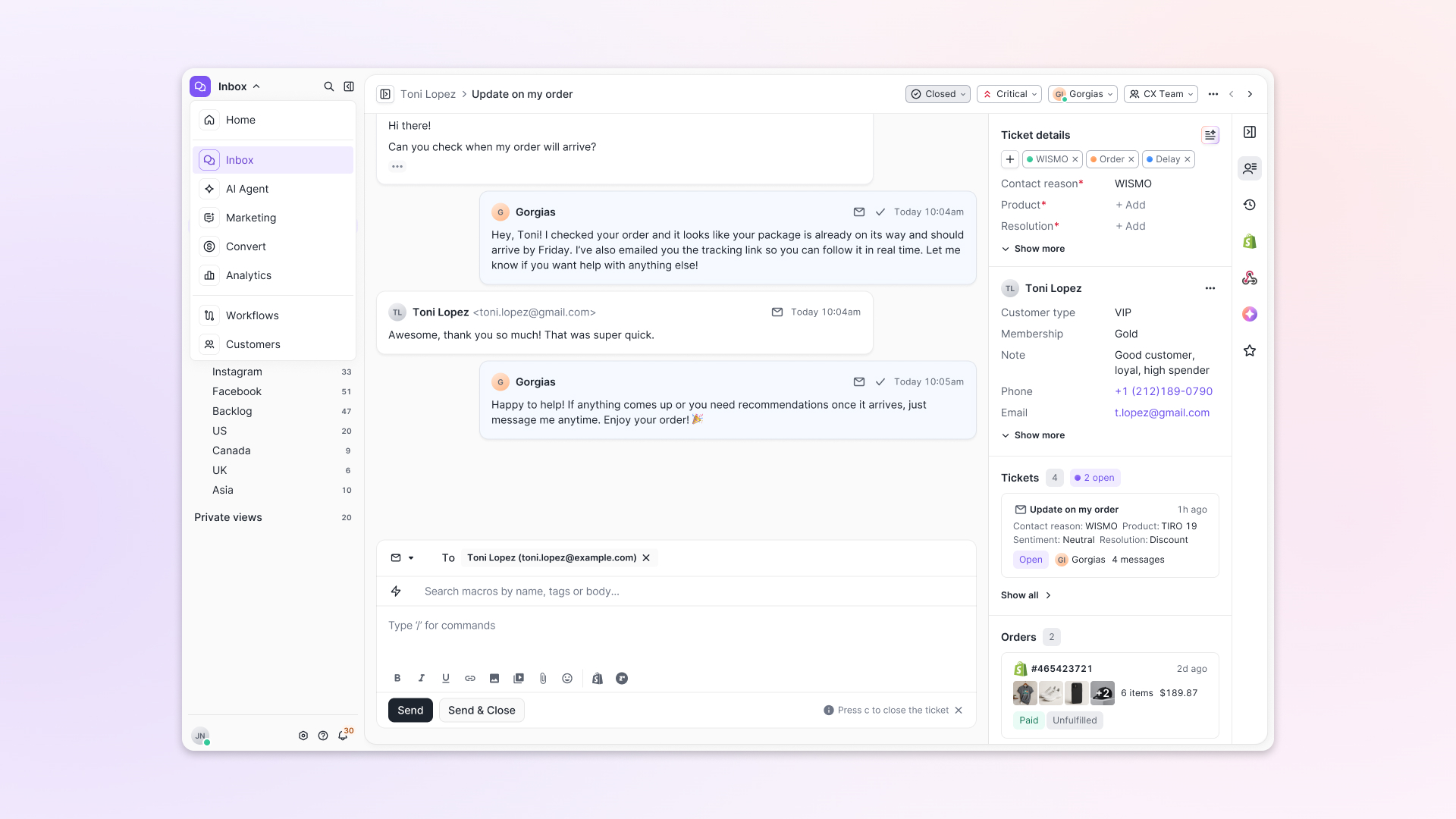
Say goodbye to the 2000s email interface and hello to chat bubbles. This updated design changes how quickly you can orient yourself and resolve the ticket in one go.
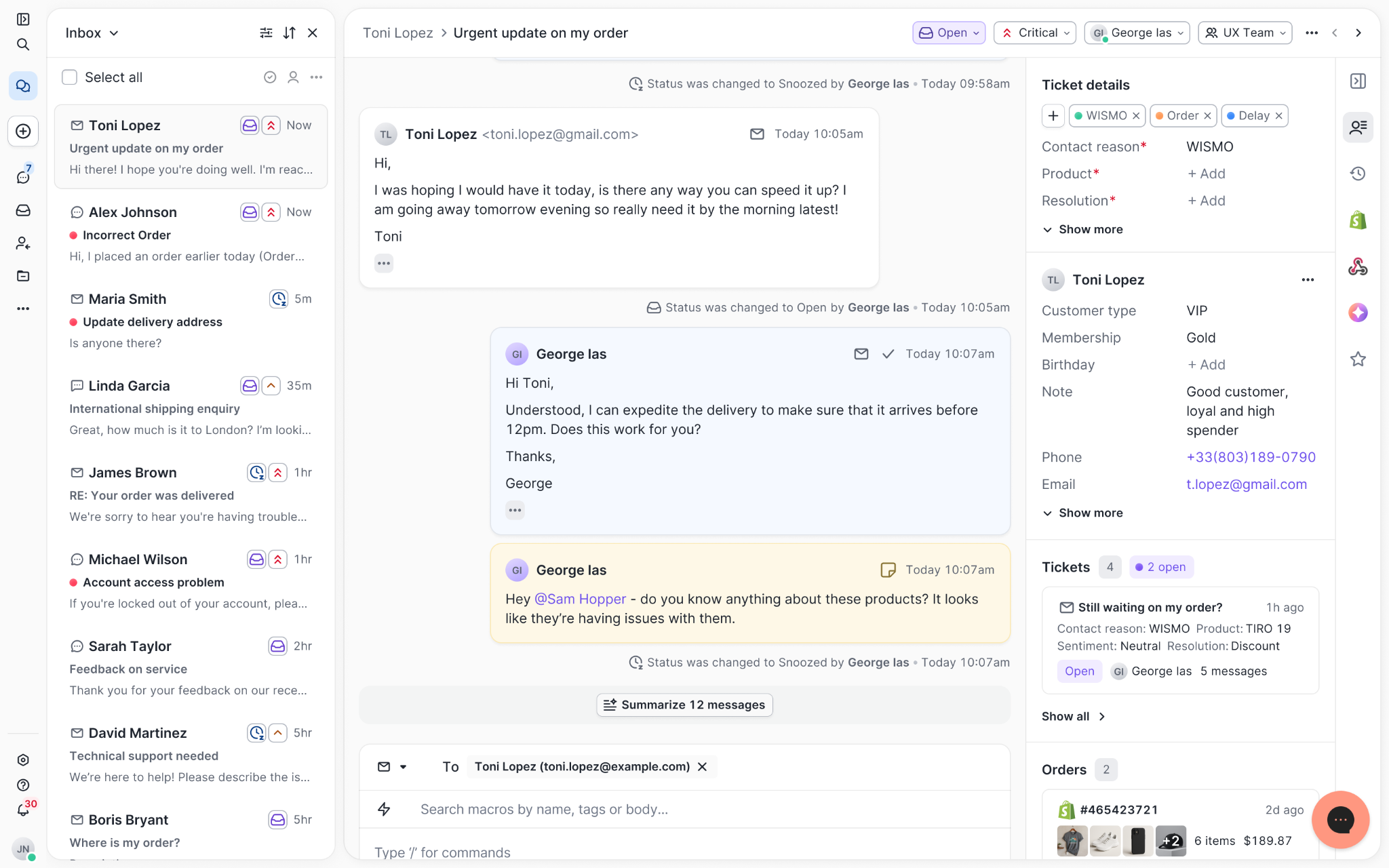
Gorgias's Helpdesk 2.0 uses chat bubbles to format conversations.

Chats with customers now look like real conversations, using the speech bubble style you’re familiar with on popular messaging apps.

Check customer history without losing your place

Checking a customer's history used to mean leaving the conversation, an extra step that interrupted what should have been a smooth workflow.

Now, past conversations open in a sidebar next to the active conversation. You can view a customer’s full history, search through their timeline, and open prior tickets without going to a new page.

The Customer Timeline allows you to scroll through past tickets, orders, and customer information.

Check past conversations, orders, and customer details in the brand-new Customer Timeline.

See order details the moment you open a ticket

Order information is easier to reference than ever. Open a ticket, and you instantly see the customer's recent orders, marked with product images and invoice details at a glance. Need to dig deeper? Click on an order, and the expanded information appears in the same panel.

For teams using custom integrations, apps are fixed in a quick-access integration menu on the right.
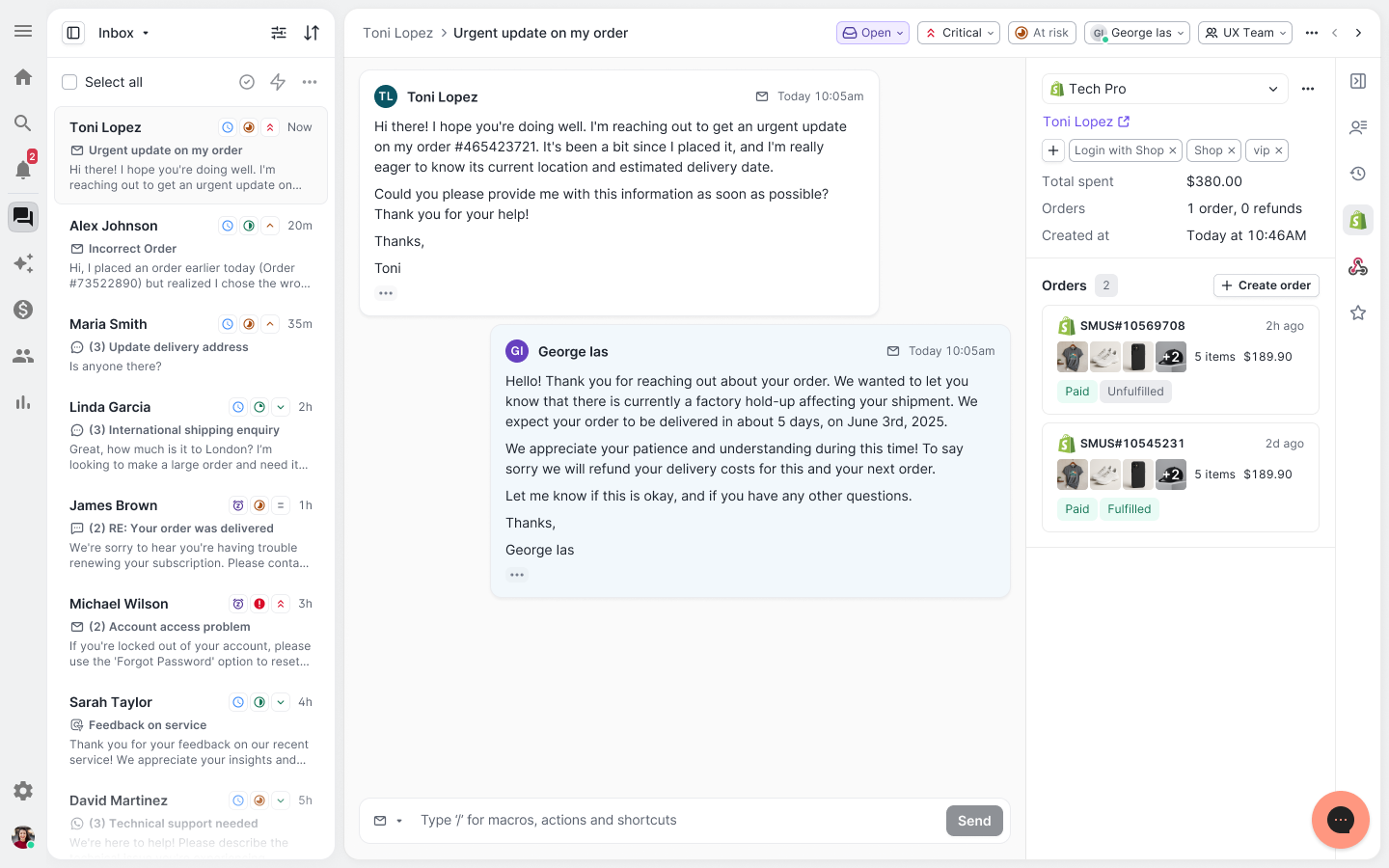
Orders include product images, number of items, total, time created, and the order number.

See order details, product images, and totals at a glance on the right panel, without leaving the conversation.

Pick up where AI left off

You shouldn't have to dig through a thread to figure out what AI already tried. Now you don't have to.

When AI Agent escalates a conversation, it includes a concise handover summary that mentions the issue, what actions were taken, and why it was passed to your team.
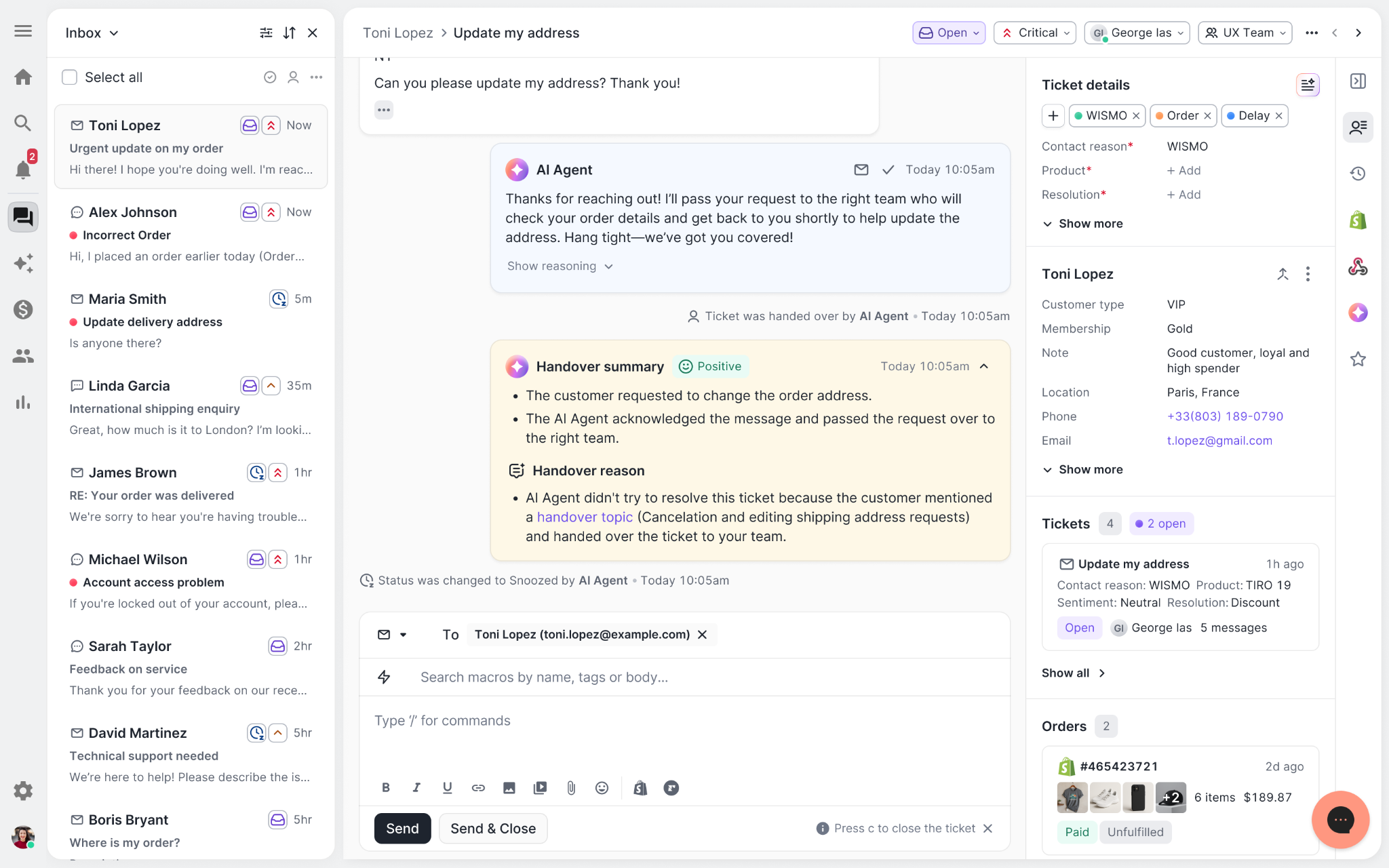
AI Agent includes a handover summary in the ticket thread.

Escalated tickets include a brief AI-generated handover summary, marked in yellow, for quick reference.

Move faster across every store and team

We restructured and simplified the navigation. The left sidebar organizes everything into clear categories: Inbox, AI Agent, Marketing, and Analytics, so anyone on your team knows exactly where to go.

To quickly update your knowledge base or adjust a workflow, both now live right in the sidebar. For teams managing multiple stores, switching between them is just as straightforward, accessible from the sidebar, so agents can move between inboxes without breaking their flow.
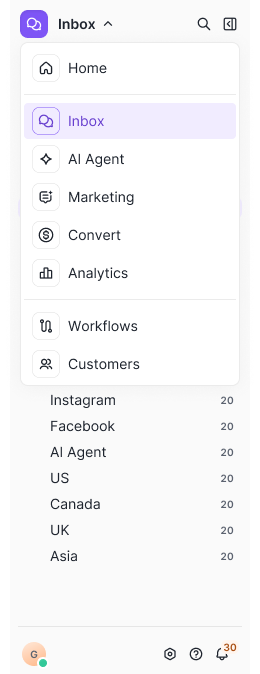
Gorgias Helpdesk 2.0 menu

Agents can switch between stores and their corresponding inboxes directly from the left menu.

A workspace that works the way agents do

Support comes down to the person on the other end of the conversation. We built Helpdesk 2.0 is to make sure they have everything they need to show up for that moment.

The best way to see the difference is to work in it. Start a free trial today.
Yuma AI Alternatives

8 Best Yuma AI Alternatives for Ecommerce Brands

By Gorgias Team
min read.
0 min read . By Gorgias Team

TL;DR:

  • Yuma AI charges per resolution, which gets expensive fast for high-volume stores
  • Most alternatives offer predictable monthly pricing and deeper Shopify integrations
  • Gorgias leads with native ecommerce AI that handles support and drives sales
  • Consider your order volume, channels, and tech stack when choosing
  • Setup time ranges from hours (Gorgias) to months (enterprise tools)

Yuma AI works well for basic ticket deflection, but many ecommerce brands outgrow its limitations quickly. The per-resolution pricing becomes unpredictable as you scale, and the focus on simple deflection misses opportunities to drive revenue through conversations.

The best alternatives offer subscription pricing, deeper ecommerce integrations, and AI that can both resolve tickets and increase sales. We've tested the top options to help you find the tool for your brand's needs.

What is Yuma AI for ecommerce support?

Yuma AI is an artificial intelligence tool that automatically responds to customer service emails for ecommerce brands. This means it reads incoming support tickets and tries to answer them without human help. The platform charges you each time it successfully resolves a customer inquiry, which they call per-resolution pricing.

The tool focuses on deflection rate, or the percentage of tickets handled entirely by AI. Yuma learns from your past customer conversations and help center articles to generate responses. When it can't handle a ticket, it passes the conversation to your human agents.

Why ecommerce brands look for Yuma AI alternatives

Brands start searching for alternatives when Yuma's limitations become clear. The biggest issues emerge as your business grows and your support needs become more complex.

Cost unpredictability: Per-resolution pricing sounds appealing until your ticket volume spikes. During Black Friday Cyber Monday or after a viral social media post, your support costs can double or triple overnight. You lose control over your monthly expenses.

Limited ecommerce actions: Yuma can answer basic questions but can't perform the actions your customers actually need. It can't cancel orders, process returns, or update shipping addresses. Your team still handles all the real work.

Channel gaps: Most customer conversations happen outside email. If your shoppers message you on Instagram, text you questions, or use live chat, Yuma can't help. You need separate solutions for each channel.

Setup complexity: Getting Yuma to understand your brand voice and policies takes weeks of training. You're paying for resolutions while the AI learns, often giving incorrect answers during the learning period.

8 Yuma AI alternatives, compared

Here's how the top alternatives compare to each other in terms of user, pricing, setup time, and Shopify compatibility.

Platform

Best for

Pricing model

Setup time

Shopify integration

Gorgias

Shopify brands wanting revenue + support

Subscription

Hours

Native

Zendesk AI

Large enterprises with complex needs

Per-agent + add-ons

Weeks

App-based

Intercom Fin AI

Proactive chat engagement

Per-agent + usage

Weeks

App-based

Ringly.io

Email automation focus

Per-resolution/subscription

Days

API

Freshdesk

Small businesses needing basics

Per-agent + tiers

Weeks

App-based

DigitalGenius

Enterprise custom workflows

Custom pricing

Months

API

Alhena AI

Simple ticket deflection

Per-resolution

Days

API

My AskAI

Basic chatbot needs

Subscription

Hours

Widget

The best Yuma AI alternatives for ecommerce brands

Each platform takes a different approach to AI customer service. Some focus purely on cost reduction, while others help you grow revenue through better conversations.

1. Gorgias

Gorgias is a customer service platform built specifically for ecommerce brands that sell on Shopify. This means every feature connects directly to your store data, orders, and customer information. The AI Agent doesn't just answer questions — it can take actions like processing returns, updating orders, and recommending products.

The platform treats customer service as a revenue driver, not just a cost center. Your AI can upsell customers, recover abandoned carts, and turn support conversations into sales opportunities. Everything happens in one unified inbox across email, chat, SMS, social media, and phone.

Gorgias integrates natively with Shopify, which means no complex API setup or data syncing issues. Your team can see order history, customer details, and take actions without switching between tools. The AI learns your brand voice quickly and starts resolving tickets within hours of setup.

Main features:

  • AI Agent that resolves tickets and drives sales
  • Native Shopify integration with real-time order data
  • Unified inbox for all customer channels
  • Revenue-focused automation and upselling tools
  • Self-service order tracking and returns

Ideal for:

  • Shopify brands processing high order volumes
  • Teams managing both support and sales conversations
  • Brands wanting fast implementation and quick results
  • Companies seeking predictable monthly costs

Pricing:

  • Subscription-based helpdesk with transparent tiers
  • AI Agent available as a flat monthly add-on
  • No surprise charges based on ticket volume

2. Zendesk AI

Zendesk serves companies across all industries, from airlines to banks to ecommerce. The AI features are add-ons to their core helpdesk platform. Zendesk AI can suggest responses to agents, categorize tickets automatically, and power basic chatbots.

The platform works well for large enterprises with dedicated IT teams and complex support workflows. However, the ecommerce-specific features require custom development or third-party apps. You'll need separate tools to handle order management, returns processing, and product recommendations.

Pricing:

  • Per-agent monthly subscription starting at $25 USD
  • AI features cost extra on top of base plans
  • Enterprise features require higher-tier plans

3. Intercom Fin AI

Intercom focuses on proactive customer engagement through live chat and messaging. Fin AI powers their chatbot, which can answer questions from your help center and knowledge base. The tool excels at starting conversations and qualifying leads before they reach your sales team.

Fin works well for pre-purchase questions and basic support, but lacks deep ecommerce functionality. You can't process orders, handle returns, or access detailed customer purchase history within the platform. Complex post-purchase issues require switching to other tools.

Pricing:

  • Seat-based subscription plus usage fees for AI resolutions
  • Costs increase with chat volume and AI usage
  • Multiple pricing tiers based on features needed

4. Ringly.io

Ringly.io focuses specifically on automating email support for ecommerce brands. The AI learns from your historical tickets to automatically respond to common questions. It positions itself as a direct alternative to Yuma with similar per-resolution pricing options.

Since Ringly only handles email, you'll need other solutions for chat, social media, and phone support. The tool also lacks the order management capabilities that modern ecommerce brands need. Your team still manually processes returns, cancellations, and order updates.

Pricing:

  • Per-resolution pricing similar to Yuma
  • Subscription options available for predictable costs
  • Pricing scales with ticket volume

5. Freshdesk (Freddy AI)

Freshdesk targets small and medium businesses across industries. Freddy AI can automate ticket routing, suggest responses to agents, and power basic chatbots. The platform offers good value for teams just starting with AI automation.

Like other general-purpose helpdesks, Freshdesk requires additional setup for ecommerce-specific workflows. The Shopify integration exists but doesn't provide the deep, native functionality that specialized platforms offer. You'll spend more time configuring and maintaining integrations.

Pricing:

  • Per-agent subscription with different AI features by tier
  • Entry-level plans include basic automation
  • Advanced AI requires higher-tier subscriptions

6. DigitalGenius

DigitalGenius targets large enterprises with highly complex support workflows. The platform integrates with existing CRM and helpdesk systems like Salesforce and Zendesk. It offers extensive customization options and can handle industry-specific requirements.

The complexity that makes DigitalGenius powerful also makes it overkill for most ecommerce brands. Implementation takes months and requires significant technical resources. The platform works better for companies with dedicated IT teams than for agile online stores.

Pricing:

  • Custom enterprise pricing based on requirements
  • Typically combines subscription and usage-based fees
  • Implementation and consulting costs are additional

7. Alhena AI

Alhena AI offers ticket deflection similar to Yuma, focusing on reducing the number of inquiries that reach your human agents. The tool sits on top of your existing helpdesk to intercept and answer common questions automatically.

Alhena shares Yuma's limitations around ecommerce functionality and per-resolution pricing unpredictability. It can answer basic questions but can't take the actions customers need, like processing returns or updating orders. You're still paying for each resolution while handling the complex work manually.

Pricing:

  • Per-resolution pricing model
  • Costs vary based on ticket volume
  • No subscription alternatives offered

8. My AskAI

My AskAI lets you create a simple chatbot based on your website content and help center articles. You can embed the widget on your site to answer basic questions automatically. The tool focuses on self-service rather than full support automation.

This works well for answering simple questions but can't handle complex ecommerce tasks. The chatbot can't access order data, process returns, or take any actions beyond providing information. It's a starting point for self-service, not a complete support solution.

Pricing:

  • Subscription-based with tiers by usage
  • Pricing based on number of questions and content sources
  • No per-resolution fees

How we evaluated Yuma AI alternatives for ecommerce

We tested each platform from the perspective of a growing ecommerce brand. Our evaluation focused on practical impact rather than feature lists. We looked at how quickly you can get value, how well the tools integrate with your existing stack, and what the true costs look like at scale.

Key evaluation criteria:

  • Ecommerce integration depth: Can the AI access order data and take actions, or just read information
  • Implementation speed: How quickly can you start seeing results without extensive setup
  • Pricing predictability: Whether costs remain stable as your business grows
  • Channel coverage: How many customer touchpoints the platform can handle natively
  • Action capabilities: Whether the AI can resolve issues completely or just provide information

What to expect when switching from Yuma AI

It's easy for teams to underestimate what happens when migrating from one tool to another. The transition period can impact response quality, workflows, and even customer satisfaction if not planned carefully.

AI retraining time

Tools like Yuma rely heavily on past conversations. When you switch, not all of that training carries over. Some platforms can start resolving tickets within hours, while others take weeks to reach acceptable accuracy.

Temporary performance dips

It’s common to see a short-term drop in automation rate or response quality during the first few days. Teams that phase rollout — keeping humans in the loop while AI ramps — avoid most of this risk.

Data and workflow migration

Macros, help center content, and policies don’t always transfer cleanly. Expect to rebuild or refine parts of your setup, especially if your workflows are complex.

Channel consolidation

If you’re moving from an email-only tool to a multi-channel platform, this is often the biggest unlock. It also requires rethinking how your team manages conversations across chat, social, and SMS.

The fastest transitions happen when the platform already understands ecommerce data like orders, returns, and customer history, not just conversation logs.

Related: When should you migrate helpdesks? 5 signs to watch out for

How to choose the right Yuma AI alternative for your tech stack

The right Yuma alternative depends on what your team needs and what kind of support experience you want to build. You don't have to compare every feature at once, just start with these four steps:

1. Decide what you need AI to do

Some tools are built to answer simple questions. Others can fully resolve support requests or even help drive sales.

If your main goal is to reduce ticket volume, a basic automation tool may be enough. If you need AI to handle actions like returns, order updates, or product recommendations, look for a platform with deeper ecommerce functionality.

2. Look at where your customers contact you

If most of your conversations happen over email, a narrower tool may work. But if your team also manages live chat, social media, and SMS, you’ll need a platform that supports those channels together.

The more your customer conversations are spread across channels, the more important it is to keep everything in one place.

3. Consider how well the platform fits your tech stack

Some tools require custom integrations and ongoing technical support. Others are easier to launch because they connect directly to platforms like Shopify.

If your team is lean, a tool with native ecommerce integrations will usually get you live faster and reduce maintenance over time.

4. Choose a pricing model that matches your growth

Per-resolution pricing can work at lower volumes, but it becomes harder to predict as your ticket count grows.

If your support volume changes often during launches, promotions, or peak season, a subscription model usually gives you more control over costs.

The best choice is the one that fits your current operations without limiting what your team can do next.

Pick an AI platform that scales with you

If you’re moving away from Yuma, decide first whether you need a standalone AI tool or a full helpdesk with built-in AI. Most growing ecommerce brands benefit from a unified platform that can both automate and take action across channels.

Gorgias combines automation with revenue-driving features, built specifically for ecommerce brands.

Still comparing options? See how the best AI helpdesk tools stack up.

Want to test it yourself? Start a free trial.

Prefer a walkthrough? Book a demo.

AI in Customer Service

AI in Customer Service: What Actually Works

By Gorgias Team
min read.
0 min read . By Gorgias Team

TL;DR:

  • AI in customer service uses chatbots, machine learning, and natural language processing to provide instant support and automate repetitive tasks
  • Key benefits include reduced response times, lower support costs, and improved customer satisfaction through 24/7 availability
  • Common use cases range from order tracking automation to intelligent routing and agent assistance tools
  • Implementation requires clear goals, data integration, and human oversight to maintain quality
  • The future points toward more autonomous agents and proactive support capabilities

Most ecommerce support teams hit the same ceiling: ticket volume grows faster than the team can scale.

AI in customer service changes that equation. It automates repetitive requests, reduces response times, and turns support into a channel that can influence revenue, not just cost.

In this guide, we’ll walk through what AI actually does in customer service, the use cases that drive results, and how to implement it step by step.

{{lead-magnet-1}}

What is AI in customer service?

AI in customer service is technology that automates and enhances support operations using machine learning and natural language processing. This means your support team can provide instant, accurate answers to common questions and intelligently route complex issues without manual effort.

Natural language processing (NLP) is the technology that helps computers understand human language. This allows conversational AI to understand what your customers mean, even when they don't use specific keywords.

The core components work together to create a seamless experience:

  • Intent detection: AI identifies what customers need from their messages
  • Automated responses: The system provides instant answers to common questions
  • Smart routing: Complex issues get sent to the right human agent
  • Cross-channel support: AI works across email, chat, SMS, and social media

Machine learning is what makes AI smarter over time. This means the system learns from every interaction and gets better at understanding your customers and resolving their issues.

Benefits of AI in customer service for ecommerce brands

For ecommerce brands, AI delivers measurable outcomes that directly impact your bottom line. You're not just adding technology — you're solving real business problems.

Instant response times mean your customers get answers immediately, even at 2 a.m. or during Black Friday rushes. No more waiting for your team to come online or catch up on tickets.

Cost reduction happens because AI handles repetitive inquiries automatically. You can scale support without scaling headcount, which means lower cost per contact and better margins.

Improved scalability lets you handle massive spikes in ticket volume during peak seasons. Your team stays focused on complex issues while AI manages the routine stuff.

Customer satisfaction improves when people get fast, consistent answers. AI doesn't have bad days or forget your return policy — it delivers the same quality response every time.

Your agents become more productive when they're not stuck answering "Where's my order?" for the hundredth time. They can focus on building relationships and solving complex problems that actually require human judgment.

Revenue generation happens when AI can recommend products, assist with checkout, and recover abandoned carts. Your support interactions become sales opportunities.

Explore real AI uses cases for ecommerce → 10 must-know AI Agent use cases for instant resolutions

AI in customer service examples and use cases

The real value of AI shows up in specific, practical applications. For ecommerce, this means automating the high-volume tasks that consume the most time and have the biggest impact on customer experience.

Order tracking automation for instant WISMO answers

"Where is my order?" (WISMO) is the most common question in ecommerce. AI connects directly to your shipping and order management systems to provide real-time tracking updates automatically.

The system can handle delivery exceptions and proactively notify customers of delays. This turns a potential negative experience into a positive one by keeping customers informed.

Returns and exchanges workflows for zero-touch resolution

AI manages the entire returns process without agent intervention. It checks if an order is eligible for a return based on your policy, generates a return label, and provides instructions to the customer through automated actions.

When integrated with returns platforms, AI offers complete resolution without any human handoff. Your customers get what they need, and your team saves time.

Intelligent routing and prioritization for faster responses

Not all tickets are created equal. AI categorizes incoming tickets by intent, sentiment, and urgency, then automatically routes them to the right agent or team.

High-priority issues get handled first, and specialized teams get the tickets they're best equipped to resolve. This means faster resolution times and better customer experiences.

Agent copilot and summarization for higher productivity

AI acts as a copilot for your human agents by providing real-time response suggestions and pulling relevant articles from your knowledge base. It also automatically summarizes long conversations.

This helps agents resolve issues faster and with greater accuracy. They spend less time searching for information and more time helping customers.

Sentiment and intent detection for better triage

Understanding a customer's emotional state is critical for good service. AI analyzes the language and tone of messages to detect sentiment like frustration or anger.

The system automatically escalates sensitive conversations to senior agents or managers for immediate attention. This prevents small issues from becoming big problems.

Voice and IVR enhancements for low-friction calls

AI powers interactive voice response (IVR) systems that intelligently route calls and provide answers to common questions. It can offer self-service options like sending a call to SMS.

Real-time call transcription and summaries help with quality assurance and training. Your team gets better insights into customer needs and agent performance.

Help center optimization and article suggestions for accurate self-service

AI powers your Help Center search and dynamically recommends relevant articles to customers in chat. It analyzes support conversations to identify gaps in your knowledge base.

This means customers find answers faster, and you know exactly what content to create next. Your self-service experience gets better over time.

Discounts and revenue assist for higher conversion

AI can offer personalized discount codes to high-intent shoppers and re-engage customers who have abandoned their carts. It provides tailored product recommendations based on conversation context and browsing history.

Your support interactions become sales opportunities that drive revenue while solving customer problems.

Related: How to automate your WISMO tickets

How do you implement AI in customer service

A successful AI implementation is strategic, not just technical. You need a phased approach focused on clear goals and measurable results.

Step 1: Define goals and CX constraints

Start by identifying what you want to achieve. Are you trying to reduce first response time, lower cost per ticket, or increase your automation rate?

Set specific, measurable goals that align with your business objectives. At the same time, establish clear guardrails for what AI should and should not handle.

Sensitive or complex issues should always escalate to a human. This protects your brand and ensures customers get appropriate care when they need it most.

Step 2: Prioritize high-volume intents and channels

You don't need to automate everything at once. Analyze your support ticket data to identify the most common, repetitive inquiries.

For most ecommerce brands, this includes:

  • Order status and tracking questions
  • Return and exchange requests
  • Basic product information
  • Shipping and delivery inquiries
  • Account and subscription management

Start by automating these intents on channels where customers expect fast, simple answers, like live chat and SMS.

Step 3: Integrate data sources and guardrails

AI needs context to be effective. Connect it to your core ecommerce systems, including your order management system, inventory platform, and customer data platform.

This allows AI to perform real actions, like checking an order status or processing a return. Set up clear escalation rules and fallback options for when AI cannot resolve an issue.

Data integration is what makes AI powerful — without it, you're just running a fancy chatbot that can't actually help customers.

Step 4: Pilot, measure, and scale with human oversight

Launch your AI with a limited scope, such as handling one specific question type on a single channel. Closely monitor its performance using metrics like resolution rate and customer satisfaction.

Use this data to refine AI behavior, then gradually expand its responsibilities as you gain confidence in its performance. Always maintain a human-in-the-loop process for quality review.

Scaling too fast without proper oversight can damage customer relationships. Take your time and get it right.

Learn more: How to build an AI-driven support strategy

AI customer service best practices and guardrails

Scaling automation without sacrificing quality requires discipline and clear guidelines. These practices ensure your AI operates safely, accurately, and in line with your brand standards.

Data privacy and security must be your top priority. Ensure your AI platform handles customer data responsibly and complies with all relevant privacy regulations.

Preventing AI hallucinations means limiting your AI to verified information sources, such as your Help Center and integrated apps. This prevents it from providing incorrect or fabricated answers.

Clear escalation protocols ensure complex or sensitive issues get routed to human agents quickly. Design reliable handoff rules that protect your customers and your brand.

Continuous performance monitoring helps you track key metrics like accuracy, resolution rate, and customer satisfaction. You need to understand AI's impact and identify areas for improvement.

Regular optimization treats your AI like a team member that needs ongoing coaching. Use analytics and agent feedback to review and improve its performance regularly.

Transparency with customers builds trust and manages expectations. Be upfront when customers are interacting with AI, and make it easy for them to reach a human when needed.

Read more: Turning AI implementation into team alignment with Rhoback

What is the future of AI in customer service

AI capabilities in customer service are evolving rapidly. While today's tools focus on automating and assisting, the future points toward more autonomous and proactive systems.

Autonomous agents will handle increasingly complex, multi-step tasks from end to end without human intervention. Think complete order modifications, not just status updates.

Multimodal AI will seamlessly understand and respond across different formats, including text, voice, images, and video. Customers can send a photo of a damaged product and get an instant resolution.

Proactive support uses predictive analytics to identify potential customer issues before they happen. AI reaches out with solutions before customers even know there's a problem.

Real-time translation breaks down language barriers, allowing brands to offer high-quality support to a global customer base without hiring multilingual agents.

Deeper personalization leverages a complete view of the customer's history to deliver hyper-personalized support and shopping experiences. Every interaction feels tailored to that specific customer.

These advances will make AI even more valuable for ecommerce brands looking to scale without sacrificing quality.

Get started with AI in customer service for ecommerce

AI in customer service works best when deployed with clear goals and proper guardrails. Start with high-volume, repetitive inquiries where automation delivers immediate value.

Want to try Gorgias for yourself? Start a free trial →

Prefer a walkthrough with an expert? Book a demo →

15 Gladly Alternatives for Ecommerce Brands

By Gorgias Team
min read.
0 min read . By Gorgias Team

TL;DR:

  • Gladly's unified customer view comes with high costs and limited ecommerce integrations
  • Most brands switch from Gladly due to pricing, automation limitations, or lack of Shopify-specific features
  • Top alternatives include Gorgias (ecommerce-focused), Kustomer (enterprise), and Zendesk (scalable)
  • Compare alternatives based on automation capabilities, pricing model, and ecommerce integrations
  • Migration from Gladly typically takes two to four weeks with proper planning

Gladly pioneered identity-based support, where every customer interaction lives in one conversation thread. But for ecommerce brands, that innovation often comes with trade-offs. High per-agent pricing, limited automation, and weak ecommerce integrations push many brands to explore alternatives.

This guide compares 15 helpdesks that deliver what Gladly promises — unified customer support — while addressing its gaps in automation, pricing flexibility, and ecommerce-specific features. We'll cover the top platforms, key reasons to switch, and how to choose the right tool for your brand.

12 Gladly alternatives compared: pricing, automation, and ecommerce fit

The best Gladly alternative depends on your specific needs, from budget and team size to automation requirements and Shopify integration depth. While Gladly offers a unified customer view, many alternatives provide more robust ecommerce integrations, flexible pricing, and powerful AI capabilities at a lower total cost.

Platform

Starting Price

Best For

Key Strength

Automation Level

Ecommerce Integrations

Gorgias

$10/month

Shopify brands

Revenue generation & automation

AI-powered

100+

Kustomer

$89/agent/month

Enterprise brands

CRM capabilities

Advanced

Limited

Zendesk

$55/agent/month

All-purpose support

Scalability & marketplace

Advanced

Moderate

Intercom

$39/seat/month

Proactive engagement

Conversational marketing

AI-powered

Moderate

Re:amaze

$29/staff/month

Small ecommerce teams

Multichannel support

Basic

Good

Freshdesk

$15/agent/month

Cost-conscious teams

Affordability

Basic

Limited

Front

$19/seat/month

Collaborative teams

Shared inbox

Basic

Limited

Help Scout

$20/user/month

Simplicity-focused teams

Ease of use

Basic

Limited

Zoho Desk

$14/agent/month

Zoho ecosystem users

Affordability

Moderate

Limited

HubSpot Service Hub

$18/month (2 users)

HubSpot CRM users

Marketing alignment

Moderate

Good

Kayako

$15/agent/month

Journey mapping

Customer insights

Basic

Limited

LiveAgent

$9/agent/month

Real-time support

Live chat & voice

Basic

Limited

The best Gladly alternatives for ecommerce brands

Choosing a helpdesk is a long-term commitment. Below is a detailed breakdown of the top Gladly alternatives, focusing on features, pricing, and ideal use cases for growing ecommerce brands.

Gorgias

Gorgias is a conversational commerce platform built specifically for ecommerce brands. It addresses Gladly's core weaknesses for online retailers by combining a powerful helpdesk with deep Shopify integration, revenue-driving tools, and advanced AI automation.

Unlike Gladly's per-agent model, Gorgias uses usage-based pricing that scales with your business, not your headcount. The platform unifies support and sales, allowing teams to manage orders, issue refunds, and recommend products directly within customer conversations.

Its AI Agent can automate up to 60% of common inquiries like "Where is my order?" returns, and product questions. This frees up agents to focus on complex issues and revenue-generating activities.

Main features:

  • Unified inbox across email, chat, SMS, voice, and social
  • Native Shopify integration with order management
  • AI Agent for automated responses
  • Revenue tracking and attribution
  • Self-service flows and Help Center
  • 100+ ecommerce app integrations

Ideal for:

  • Shopify brands doing $1M+ in revenue
  • Teams prioritizing automation and efficiency
  • Brands wanting to track support's revenue impact
  • Companies scaling from two to 50 support agents

Pricing:

  • Starts at $10/month for 50 tickets
  • Usage-based pricing (not per seat)
  • AI Agent add-on available
  • Free seven-day trial

{{lead-magnet-1}}

Kustomer

Kustomer is an enterprise-focused CRM platform that provides a unified timeline view of each customer. It consolidates interactions from various channels into a single, chronological conversation. This makes it a strong choice for large businesses that need a comprehensive, 360-degree view of each customer.

However, its strength in CRM capabilities means less focus on ecommerce-specific workflows. While it integrates with platforms like Shopify, the functionality isn't as deep as purpose-built tools. Kustomer's pricing and minimum seat requirements place it firmly in the enterprise category.

Pricing:

  • Enterprise pricing requires contacting sales
  • Per-agent model starts around $89/agent/month
  • Minimum seat requirements often apply

Zendesk

Zendesk is one of the most well-known names in customer service software. It offers a scalable, all-purpose helpdesk with a vast app marketplace and the ability to support businesses of all sizes.

For ecommerce brands, Zendesk can be a solid choice, but it requires significant configuration and integration work to match the out-of-the-box functionality of an ecommerce-specific platform. Core ecommerce features like order management and revenue tracking often depend on third-party apps.

Pricing:

Intercom

Intercom excels at proactive, conversational engagement. It's best known for its powerful chat widget and automation features designed to engage website visitors, qualify leads, and onboard new users.

While it has strong AI and automation capabilities, its focus is more on marketing and sales engagement than post-purchase ecommerce support. Brands looking for deep order management or returns handling within their helpdesk may find Intercom's ecommerce integrations less comprehensive.

Pricing:

  • Essential starts at $39/seat/month
  • Advanced at $99/seat/month
  • Expert at $139/seat/month

Re:amaze

Re:amaze is a helpdesk and live chat platform designed for small to medium-sized ecommerce businesses. It offers a good balance of multichannel support, including email, chat, social media, and SMS, in a single shared inbox.

Its native integrations with Shopify, BigCommerce, and WooCommerce are a key advantage. Compared to Gladly, Re:amaze is more affordable and more focused on the needs of online stores. However, its automation capabilities are more basic.

Pricing:

Freshdesk

Freshdesk is a popular helpdesk known for its user-friendly interface and affordable pricing, including a free plan for small teams. It offers a comprehensive suite of tools for ticketing, reporting, and automation.

While Freshdesk is a capable general-purpose helpdesk, it lacks the deep ecommerce integrations found in specialized platforms. Ecommerce brands will need to rely on marketplace apps or custom development to bring customer order data into the agent workspace.

Pricing:

Front

Front is a customer communication hub that centers around the shared inbox. It's designed to foster team collaboration by bringing emails, social media, and other channels into a single interface where teams can assign, comment on, and resolve conversations together.

Front is not a traditional helpdesk and lacks many core features ecommerce support teams rely on, such as deep Shopify integration, advanced reporting, and AI-powered automation. It's best for teams that prioritize internal communication over specialized support workflows.

Pricing:

  • Starter at $19/seat/month
  • Growth at $59/seat/month
  • Scale at $99/seat/month

Help Scout

Help Scout is a helpdesk platform that prioritizes simplicity and a human-centric approach to customer service. It offers a clean, uncluttered interface and focuses on features that facilitate personal, helpful conversations.

Like many general-purpose helpdesks, Help Scout's ecommerce capabilities are limited. While it has a Shopify integration, it doesn't allow for actions like editing orders or issuing refunds directly from the helpdesk.

Pricing:

Zoho Desk

Zoho Desk is the customer service module of the broader Zoho suite of business applications. Its biggest advantage is seamless integration with other Zoho products, like Zoho CRM. It's also one of the most affordable and feature-rich helpdesks on the market.

The platform's context-aware AI, Zia, can help agents with suggestions and automate simple tasks. However, its primary focus is serving the wider Zoho ecosystem, and its ecommerce-specific features aren't as developed as platforms built exclusively for online retail.

Pricing:

  • Standard at $14/agent/month
  • Professional at $23/agent/month
  • Enterprise at $35/agent/month

HubSpot Service Hub

HubSpot Service Hub is customer service software that's fully integrated with HubSpot's CRM, Marketing Hub, and Sales Hub. This makes it an excellent choice for businesses already invested in the HubSpot ecosystem.

Service Hub provides a solid set of helpdesk tools, including a shared inbox, knowledge base, and reporting. However, its core strength is its connection to the HubSpot CRM, not its ecommerce-specific functionality.

Pricing:

  • Free tools available
  • Starter at $18/month (includes two users)
  • Professional at $450/month (includes five users)

Kayako

Kayako is a helpdesk platform that focuses on providing a personal and context-rich customer experience. It offers a unified view of the customer journey by mapping out interactions across different channels.

Kayako is a general-purpose tool and lacks the deep integrations with ecommerce platforms that are critical for efficient online retail support. It's a good option for businesses that prioritize understanding the customer journey but don't require extensive ecommerce automation.

Pricing:

  • Inbox at $15/agent/month
  • Growth at $30/agent/month
  • Scale at $60/agent/month

LiveAgent

LiveAgent is a helpdesk solution that excels in real-time support channels like live chat and voice. It offers one of the most comprehensive live chat widgets on the market, along with a built-in call center.

The platform also includes gamification features to motivate support agents. While it provides a wide array of features at an affordable price, its focus is on real-time communication rather than the specific needs and workflows of ecommerce brands.

Pricing:

  • Small at $9/agent/month
  • Medium at $29/agent/month
  • Large at $49/agent/month

What is Gladly?

Gladly is a customer service platform built around identity-based support. Instead of treating each new email or chat as a separate ticket, Gladly consolidates all interactions from a single customer into one continuous conversation thread. This gives agents a complete history of every touchpoint, regardless of the channel.

This approach eliminates the need for ticket numbers and helps agents provide more personal and context-aware support. The platform is designed to be people-centric, not case-centric.

Key Gladly features:

  • Unified customer view: All interactions are organized in a single conversation timeline
  • Omnichannel support: Native support for email, chat, voice, SMS, and social messaging
  • Customer timeline: Complete history of purchases, conversations, and notes without switching tabs
  • Voice integration: Built-in phone support without third-party telephony tools

Gladly pricing:

  • Hero plan starts around $150/agent/month
  • Superhero plan is approximately $180/agent/month
  • Annual contracts and minimum seat requirements are typical

Who needs a Gladly alternative?

While Gladly's people-centric model is innovative, it's not the right fit for every business, especially in ecommerce. Brands often seek alternatives when they face challenges with pricing, automation, or lack of ecommerce-specific functionality.

High-growth ecommerce brands need pricing that scales with order volume, not just agent headcount. They also require deep integrations with platforms like Shopify to manage orders and track support's impact on revenue.

Cost-conscious teams find Gladly's high per-agent cost and annual contracts prohibitive. Teams looking for more flexible, usage-based pricing or lower monthly fees will find better value in alternatives.

Automation-first organizations want to automate a significant percentage of their support volume and need more advanced AI than Gladly offers. They require tools that can fully resolve tickets, not just route them.

Specialized support needs include businesses that rely on specific workflows for returns, subscriptions, or loyalty programs. These brands need a platform with a rich ecosystem of ecommerce integrations that Gladly lacks.

How we selected the best Gladly alternatives

We evaluated dozens of helpdesks based on criteria that matter most to growing ecommerce brands. Our methodology focused on identifying platforms that not only match Gladly's core promise of a unified customer view but also solve its primary shortcomings for online retailers.

Core evaluation criteria:

  • Pricing model: Flexible pricing, including usage-based models aligned with ecommerce seasonality
  • Automation capabilities: Advanced rules engines, AI-powered intent detection, and true self-service options
  • Ecommerce integrations: Deep, native integrations with Shopify, BigCommerce, and key ecommerce apps
  • Implementation speed: Fast time-to-value, allowing teams to get up and running in days, not months
  • Support quality: Level of expertise and responsiveness of the platform's own support team
  • Scalability: Ability to support growth from a small team to a large, multi-department organization

Key features to compare in Gladly alternatives

When evaluating your options, focus on how each platform handles the core jobs of an ecommerce support team. Look beyond marketing claims and dig into specific functionality that will impact your team's daily workflow and your brand's bottom line.

Unified customer view capabilities:

  • Single timeline vs separate tickets: Does the platform offer a continuous conversation or individual cases?
  • Cross-channel threading: How well does it connect conversations across different channels?
  • Data integration depth: How deeply does it integrate customer data from your ecommerce platform?

Automation and AI features:

  • Intent detection: Automatic ticket categorization based on customer requests
  • Smart routing: Assignment based on agent skills, language, or business rules
  • AI responses: Accuracy and customization of AI-generated replies
  • Self-service: Modern Help Center and automated chat flows that resolve issues

Ecommerce-specific functionality:

  • Order management: Can agents view and manage orders directly within the helpdesk?
  • Revenue attribution: Does it track sales generated by the support team?
  • Product tools: Features for recommending products or creating discount codes
  • App integrations: Connections with returns and subscription management apps

Pricing and scalability:

  • Contract requirements: Minimum seat requirements or long-term contracts
  • Pricing model: Agent seats vs ticket volume
  • Cost evolution: How pricing changes as your team and ticket volume grow

What to do next

Start by auditing your current Gladly usage. Export your ticket data to identify common inquiry types and your cost per ticket. This gives you a baseline for evaluating alternatives.

Then, narrow your shortlist to two or three tools and test them using real scenarios. Focus on what impacts your team: automation rate, handle time, and access to order data.

If you're still deciding, these guides can help:

Want to test it with your own data? Start a free trial and see how Gorgias handles real support volume.

Best Enterprise Support Platforms for Ecommerce

By Gorgias Team
min read.
0 min read . By Gorgias Team

TL;DR:

  • Enterprise support platforms combine AI automation, omnichannel messaging, and ecommerce integrations to handle high-volume customer interactions at scale
  • The best platforms offer deep Shopify integration, AI-powered ticket deflection, and unified customer data across all touchpoints
  • Gorgias leads for ecommerce brands, while Zendesk and Salesforce serve broader enterprise needs
  • Key evaluation criteria include total cost of ownership, implementation timeline, and integration depth with your existing tech stack
  • Enterprise platforms differ from SMB tools in scalability, security requirements, and dedicated support resources

Enterprise support platforms do more than manage tickets. They unify customer conversations across email, chat, social, SMS, and voice into a single workspace. The right platform connects your support data to your ecommerce stack, turning every interaction into an opportunity to resolve issues and drive revenue. This guide compares 12 platforms built for high-volume ecommerce operations.

{{lead-magnet-1}}

Enterprise support platforms compared

An enterprise support platform is a centralized system that manages high volumes of customer interactions across multiple channels. This means you can handle thousands of conversations from email, chat, social media, and phone calls in one place. Unlike basic help desks, these platforms integrate deeply with your business systems and offer advanced automation.

Platform

Starting Price

Key Strengths

Best For

Notable Limitations

Gorgias

$10/month

Ecommerce-native, deep Shopify integration, AI Agent

Shopify Plus brands focused on support-driven revenue

Less suited for non-ecommerce businesses

Zendesk

$55/agent/month

Mature feature set, broad industry use

General enterprise use across industries

Complex and costly to customize for ecommerce

Salesforce

$25/user/month

Deep CRM integration, enterprise ecosystem

Companies already using Salesforce

High total cost, complex implementation

Intercom

$39/seat/month

Strong conversational tools, proactive messaging

SaaS and tech companies

Expensive at scale, less post-purchase focus

Freshdesk

$15/agent/month

Good value, broad feature set

Mid-market all-in-one solution seekers

Less advanced AI and automation

Kustomer

$89/user/month

Customer timeline view, data aggregation

B2C brands needing complete customer history

Higher price, resource-intensive

Front

$59/seat/month

Collaborative inbox, team communication

Teams needing heavy email collaboration

Not a traditional helpdesk, limited automation

Zoho Desk

$14/agent/month

Zoho ecosystem integration, affordable

Businesses using other Zoho products

Dated interface, less retail specialization

Help Scout

$20/user/month

Simplicity, clean UI, human-centric

Small to mid-sized teams prioritizing ease

Lacks advanced enterprise features

Gladly

$150/agent/month

Radically personal, conversation-centric

High-end brands focused on premium service

Very expensive, not built for efficiency

ServiceNow

Custom

Powerful ITSM, extreme scalability

Large enterprises with complex needs

Overkill for most ecommerce, very expensive

Tidio

$29/month

Strong live chat, easy setup

Small businesses focused on chat support

Lacks enterprise omnichannel depth

Best enterprise support platforms for ecommerce

Choosing the right platform depends on your business model, primary sales channels, and growth goals. Here are the top solutions for enterprise ecommerce brands.

Gorgias

Gorgias is a conversational commerce platform built specifically for ecommerce brands. This means it combines customer support with sales capabilities in one system. Its key advantage is deep, native integration with Shopify, allowing your team to manage orders, issue refunds, and apply discounts directly from the helpdesk.

The platform unifies conversations from email, live chat, SMS, voice, and social media into a single view. You get customer data from over 100 ecommerce integrations automatically. The Gorgias AI Agent can automate up to 60% of common inquiries like "Where is my order?" It also acts as a shopping assistant, providing product recommendations and converting shoppers in real time.

Main features:

  • AI Agent for automated resolutions and revenue generation
  • Native Shopify integration with real-time order management
  • Unified inbox for email, chat, SMS, voice, and social channels
  • Revenue tracking and conversion analytics for support interactions
  • Self-service flows and Help Center with AI-powered article suggestions

Ideal for:

  • Shopify Plus brands with high ticket volume
  • Ecommerce teams focused on support-driven revenue
  • Brands seeking fast AI implementation without complex setup

Pricing:

  • Starter plans from $10 USD/month
  • Pro and Advanced tiers with volume-based pricing
  • Custom Enterprise pricing with dedicated support

Zendesk

Zendesk is one of the most established customer service software platforms. It offers comprehensive tools that work across many industries beyond ecommerce. The platform is known for flexibility, an extensive app marketplace, and mature features including ticketing, knowledge base, and robust reporting.

For enterprise teams, Zendesk provides advanced security, compliance, and customization options. However, its generalist approach means achieving deep ecommerce functionality often requires costly third-party apps and complex configuration.

Pricing:

  • Suite Team from $55 USD/agent/month
  • Suite Growth from $89 USD/agent/month
  • Suite Professional from $115 USD/agent/month
  • Enterprise pricing available

Salesforce Service Cloud

Salesforce Service Cloud is powerful for enterprises already using the Salesforce ecosystem. Its greatest strength is seamless integration with Salesforce CRM, providing a complete view of each customer. It offers extensive capabilities for case management, automation, and omnichannel routing at massive scale.

This power comes with significant complexity and cost. Implementation often takes months and requires specialized expertise. For ecommerce brands not already using Salesforce, the platform can be overkill.

Pricing:

  • Essentials from $25 USD/user/month
  • Professional from $75 USD/user/month
  • Enterprise from $150 USD/user/month
  • Unlimited from $300 USD/user/month

Intercom

Intercom pioneered conversational support, focusing on proactive engagement through its messenger. It excels at engaging users on-site and in-app, making it popular with SaaS and technology companies. The platform includes live chat, chatbots, and targeted outbound messaging campaigns.

While Intercom's conversational tools are strong, its focus is more on user acquisition than the full post-purchase ecommerce experience. Managing high volumes of transactional support inquiries can be less efficient compared to platforms with traditional ticketing foundations.

Pricing:

  • Essential from $39 USD/seat/month
  • Advanced from $99 USD/seat/month
  • Expert from $139 USD/seat/month

Freshdesk

Freshdesk offers a user-friendly and affordable helpdesk solution with broad features. It provides omnichannel ticketing, AI-powered automation, and self-service options. The straightforward interface makes it relatively easy for teams to get started.

For enterprise ecommerce, Freshdesk is a solid, cost-effective option. However, its AI and automation capabilities are generally less sophisticated than specialized platforms.

Pricing:

  • Growth from $15 USD/agent/month
  • Pro from $49 USD/agent/month
  • Enterprise from $79 USD/agent/month

Kustomer

Kustomer uses a customer-centric data model, organizing all interactions into a single timeline view rather than separate tickets. This provides agents with rich, chronological context for every customer. The platform is designed for B2C brands and offers strong omnichannel and automation capabilities.

The main trade-off is Kustomer's higher price point and potential complexity of managing its data-heavy environment. It's best suited for brands that prioritize a deep, historical view of each customer over pure ticket-processing speed.

Pricing:

  • Enterprise from $89 USD/user/month
  • Ultimate from $139 USD/user/month
  • Custom pricing for larger deployments

Front

Front is a collaborative customer communication platform centered around a shared inbox. It brings emails, SMS, and social messages into a single space where teams can assign, comment on, and resolve conversations together. Its strength lies in facilitating internal collaboration around external communication.

Front is not a traditional helpdesk. It lacks robust ticketing structure, deep automation, and performance reporting that most enterprise support teams require.

Pricing:

  • Growth from $59 USD/seat/month
  • Scale from $99 USD/seat/month
  • Premier from $229 USD/seat/month

Zoho Desk

Zoho Desk is an affordable helpdesk that's part of the broader Zoho suite of business applications. Its biggest advantage is tight integration with other Zoho products, like Zoho CRM. It offers solid omnichannel support, workflow automation, and AI-powered assistance.

For businesses not already using the Zoho ecosystem, it functions as a capable standalone helpdesk. However, its user interface can feel less modern than competitors.

Pricing:

  • Standard from $14 USD/agent/month
  • Professional from $23 USD/agent/month
  • Enterprise from $40 USD/agent/month

Help Scout

Help Scout is known for simplicity, clean design, and focus on providing a human-centric support experience. It offers a shared inbox, knowledge base, and live chat in a straightforward package that's easy to learn and use.

This focus on simplicity means Help Scout lacks many advanced automation, reporting, and enterprise-grade security features required by large-scale operations.

Pricing:

  • Standard from $20 USD/user/month
  • Plus from $40 USD/user/month
  • Pro from $65 USD/user/month

Gladly

Gladly offers a "radically personal" approach to customer service, eliminating tickets in favor of a lifelong conversation stream with each customer. The platform centers all communication around the individual shopper, regardless of channel.

This premium approach comes at a very high price point. Gladly is designed for luxury and high-end brands where the cost of providing exceptional, high-touch experience is justified.

Pricing:

  • Hero from $150 USD/agent/month
  • Super Hero from $180 USD/agent/month
  • Custom enterprise pricing

ServiceNow

ServiceNow dominates enterprise IT Service Management and extends those capabilities to external customers through its Customer Service Management product. It excels at automating complex, cross-departmental workflows and operates at immense scale.

For most ecommerce brands, ServiceNow is overly complex and expensive. Its foundation is in IT and internal processes, not the fast-paced, revenue-focused world of online retail.

Pricing:

  • Custom enterprise pricing only
  • Typically starts at $100 USD/user/month

Tidio

Tidio started as a live chat and chatbot tool for small businesses and has expanded to serve larger teams. Its strengths are ease of use, strong chat automation capabilities, and affordable entry point.

While effective for chat, Tidio lacks true omnichannel depth and robust backend management features of a full enterprise support platform.

Pricing:

  • Starter from $29 USD/month
  • Growth from $59 USD/month
  • Tidio+ from $749 USD/month

Features that define an enterprise support platform

Enterprise features go beyond basic ticketing to enable scale, security, and strategic value. These capabilities separate a true enterprise platform from a standard help desk.

Omnichannel support

Omnichannel support means managing all customer conversations from a single, unified inbox. This includes email, live chat, social media DMs, SMS, and voice calls. The key is maintaining seamless conversation flow and full customer context as shoppers move between channels.

Your customers don't think in channels — they think in conversations. When someone starts a conversation on Instagram and continues it via email, your team needs to see the full history without switching tools.

AI automation and self-service

At enterprise scale, automation is essential. This includes AI-powered ticket routing, intent detection, and automated responses for common questions. It also extends to customer-facing self-service tools.

Modern AI can handle complex scenarios beyond simple FAQ responses:

  • Order management: Processing returns, exchanges, and cancellations automatically
  • Product recommendations: Suggesting items based on browsing behavior and purchase history
  • Issue resolution: Troubleshooting problems and escalating only when human intervention is needed

Analytics and reporting

Enterprise platforms provide deep, customizable analytics. This goes beyond basic metrics like first response time. You get real-time dashboards, SLA tracking, agent performance scorecards, and custom reports that connect support activity to business outcomes.

The best platforms show you how support conversations drive revenue, not just how quickly you respond to them.

Security and compliance

Large businesses have strict security requirements. Enterprise platforms offer SOC 2 compliance, single sign-on, multi-factor authentication, and role-based access controls to protect customer data. They also provide audit logs and options for data residency to meet global compliance standards.

Security isn't optional at enterprise scale — it's table stakes.

Integrations and data model

An enterprise platform must act as the central hub for customer data. This requires deep, bi-directional integrations with other systems like your ecommerce platform, ERP, and marketing tools. A flexible API and unified customer data model create a single source of truth.

When your support team can see order history, subscription details, and marketing engagement in one view, they can provide better service and drive more revenue.

Ecommerce workflows

For retail brands, the platform must support specific ecommerce workflows. This includes viewing and modifying orders, processing returns and exchanges, managing subscriptions, and tracking revenue generated from support interactions — all directly within the helpdesk interface.

Generic business software forces your team to jump between systems. Ecommerce-native platforms let them work where the conversation happens.

Enterprise support platforms vs SMB help desks

As your business grows, the tools that worked for a small team start to break. The differences between enterprise platforms and small-to-midsize business help desks reflect fundamental differences in scale, complexity, and strategic needs.

Scope and scale differences

SMB help desks handle smaller teams and manageable ticket volumes. Enterprise platforms are engineered for hundreds of thousands of interactions across multiple brands, regions, and languages. They include advanced routing, multi-brand support from a single instance, and robust user permissions to manage large, distributed teams.

When you're processing thousands of tickets daily across multiple time zones, you need different tools than a five-person team handling dozens of emails.

Ecosystem and integration differences

SMB tools offer basic integrations. Enterprise platforms provide deep, two-way data synchronization with core business systems. They have extensive APIs, support custom integrations, and connect to data warehouses for advanced business intelligence.

This creates a unified data ecosystem rather than a collection of disconnected tools.

Support and partnership differences

With SMB tools, support is often limited to email or chat. Enterprise platform vendors act more like strategic partners. They provide dedicated success managers, implementation support, guaranteed uptime SLAs, and ongoing strategic guidance.

You're not just buying software — you're buying a relationship that helps you scale.

How to choose an enterprise support platform for ecommerce

Making the right choice requires clear evaluation of your business needs, technical stack, and long-term goals. Focus on these key areas to find the platform that best fits your operation.

Match customer channels

Start by auditing where your customers actually contact you. Are they on Instagram, SMS, or still primarily using email? Ensure the platform you choose has native, robust support for the channels your customers prefer.

Don't choose based on what you think customers should use — choose based on what they actually use.

Check integration depth with Shopify and your stack

For ecommerce brands, deep integration with your store platform is non-negotiable. Look for bi-directional sync that allows agents to take action directly from the helpdesk. Verify that the platform also connects seamlessly with your other critical tools.

The best integrations feel invisible — your team shouldn't know they're using multiple systems.

Model total cost of ownership and ROI

Look beyond the per-seat license fee. Calculate total cost of ownership, which includes implementation, training, and necessary third-party apps. Measure this against potential return on investment from increased agent efficiency, higher ticket deflection rates, and support-driven revenue.

A more expensive platform that drives revenue can be cheaper than a "budget" option that doesn't.

Validate implementation timeline and admin load

Some platforms take months to implement and require a dedicated administrator. Others can be running in days. Be realistic about your team's resources and choose a platform with an implementation timeline and ongoing maintenance load you can support.

The fastest implementation isn't always the best, but the slowest is rarely worth it.

Confirm security and governance

Work with your IT and legal teams to confirm the platform meets your company's security and compliance standards. This includes data encryption, access controls, and adherence to regulations like GDPR or CCPA.

Don't treat security as an afterthought — it's harder to fix later than to get right from the start.

Start transforming your enterprise support

The right enterprise support platform transforms customer conversations into competitive advantage. Whether you're scaling from SMB tools or evaluating alternatives to your current platform, focus on solutions that match your ecommerce operations and growth trajectory.

Book a demo to see how Gorgias delivers enterprise-grade support built specifically for ecommerce.

{{lead-magnet-2}}

Seat-Based vs. Usage-Based Pricing

Seat-Based vs. Usage-Based Pricing: Which Model Fits Your Ecommerce Support Stack?

By Gorgias Team
min read.
0 min read . By Gorgias Team

TL;DR:

  • Seat-based pricing charges a fixed fee per agent, regardless of usage. It’s predictable and easy to budget, but you may overpay during slow periods or when agents are underutilized.
  • Usage-based pricing charges based on actual activity like tickets or AI interactions. It scales with demand and can be more efficient, but costs are harder to forecast and can spike.
  • Pricing model matters as much as the price itself. The wrong structure can lead to wasted spend, surprise overages, and ongoing friction with finance.
  • Seasonality and AI usage heavily influence total cost. Volume swings and automation can quickly make one model more cost-effective than another.
  • Hybrid pricing balances predictability and flexibility. A base fee plus usage charges reduces risk, especially when paired with strong billing guardrails.

Picking a support platform is one decision. Figuring out whether you can actually forecast the bill is another. For ecommerce brands, the pricing model — how costs are calculated, what drives them up, and what happens during a volume spike — often creates more friction than the price itself.

This guide breaks down seat-based, usage-based, and hybrid pricing in ecommerce CX to help you answer the questions that matter most: Will this be easy to budget? What happens if usage spikes? Will you overpay during slow seasons? And how does AI complicate the cost?

{{lead-magnet-1}}

Why pricing model matters as much as price

The wrong pricing model creates budget problems, internal friction, and surprise charges even if the platform itself is a strong fit. That's why the structure of how you're billed matters as much as the number on the invoice.

A seat-based model might look affordable until you're paying for 15 agents during a slow January when half the team is idle. A usage-based model might seem efficient until a Black Friday spike generates an overage nobody budgeted for. The model shapes how costs behave across seasons, headcount changes, and AI adoption. The wrong fit creates friction at renewal, during audits, and every time you have to explain a variable invoice to finance.

The real tradeoff isn't just predictability versus flexibility. It's whether your pricing structure matches how your team actually operates, and whether you can explain it clearly enough to get and keep internal buy-in.

What is seat-based pricing vs usage-based pricing?

Category

Seat-Based

Usage-Based

What you pay for

Number of agents

Activity (tickets, AI, etc.)

Cost

Fixed per seat

Varies with usage

Predictability

High

Lower

Flexibility

Low

High

Main risk

Paying for unused seats

Cost spikes with high volume

The core difference is simple: seat-based pricing ties your costs to team size, and usage-based pricing ties your costs to activity. Everything else flows from that distinction.

With seat-based pricing, you pay a flat fee per user regardless of how much your team actually uses the platform. Predictable, easy to budget, but you pay the same whether agents are handling 500 tickets a day or 50.

With usage-based pricing, you're billed for what you actually consume: tickets resolved, conversations handled, AI interactions completed. Costs can scale down during slow periods, but also up when volume spikes.

Most platforms today sit somewhere between the two, with a base fee for core access and usage charges on top for features like AI or automation. Understanding the billing units in play is key to forecasting what you'll actually pay.

Common billing units in CX tools:

  • Seats: fixed fee per agent or user account
  • Tickets or conversations: charges per support interaction handled
  • Automations: fees per workflow or rule triggered
  • AI interactions or resolutions: costs tied to AI-handled or AI-resolved conversations

Five questions to ask before you choose a pricing model

Before evaluating pricing models, it helps to get clear on what you actually need from a billing structure. These are the questions worth answering before you start comparing plans.

  1. Can I forecast this cost 12 months out? If your finance team needs a fixed number for annual planning, that requirement should drive your model decision as much as any feature comparison.
  2. What's the worst-case scenario if usage spikes? Know the ceiling before you sign. Understand exactly what triggers an overage, how much it costs, and whether you can set a hard cap to prevent it.
  3. Where are we most likely to pay for something we don't use? Seat-based models create waste during slow seasons. Prepaid usage volume creates waste if forecasts are off. Identify which risk is more manageable for your team before committing to a structure.
  4. How does AI change our cost exposure? If you're evaluating a platform with AI features, treat AI pricing as a separate evaluation. Understand the billing units, the thresholds, and what happens when AI usage scales up.
  5. Can we explain this bill to finance every month? Variable costs require justification. If your invoice will fluctuate, make sure you have the data and guardrails in place to explain why, and a clear ceiling on how high it can go.

Seat-based pricing: where it works and where it creates friction

Seat-based pricing means the bill is fixed, the math is simple, and finance knows exactly what to expect every month.

It works best for teams with stable headcount and consistent ticket volume year-round. If your support team size doesn't change much and your demand is predictable, seat-based pricing removes a lot of billing complexity without many cons.

The friction shows up when your usage doesn't match your headcount. During slow seasons, you're paying full price for seats that aren't generating much value. When AI starts resolving a large share of your tickets, the per-agent model starts to feel misaligned with where the work is actually happening. And when other teams want occasional platform access, such as marketing pulling customer insights or finance reviewing chargeback data, every additional user has a cost attached.

Seat-based pricing works well when:

  • Your support headcount is stable year-round
  • Ticket volume is consistent and predictable
  • Your finance team requires fixed, forecastable costs

It creates friction when:

  • You're paying for idle seats during off-peak seasons
  • AI or automation is handling a significant share of your ticket volume
  • Cross-team access needs are growing but budget is tight

Usage-based pricing: where it works and where buyers hesitate

Usage-based pricing is the more efficient model on paper. You pay for what you use, costs scale with demand, and you're not carrying unused capacity through slow seasons.

It works best for lean teams, highly automated operations, and brands with significant volume swings between peak and off-season. If AI is resolving the majority of your tickets, usage-based pricing reflects that reality better than paying per human agent.

The hesitation is legitimate, though. Variable billing is harder to forecast, harder to explain to finance, and carries real overage risk if usage spikes faster than expected. There's also a definitional problem: not every platform defines billable units the same way. A "conversation" on one platform may not equal a "conversation" on another, which makes apples-to-apples comparisons difficult.

Usage-based pricing works well when:

  • Your ticket volume varies significantly across the year
  • AI or automation handles a large share of your support volume
  • You want costs to scale down during slow periods, not just up during peaks

It creates friction when:

  • Monthly cost variance makes internal budgeting and approvals difficult
  • Billable unit definitions are unclear or hard to monitor
  • Growth in support volume automatically means a higher bill without a clear ceiling

Why seasonality changes the pricing decision in ecommerce

For seasonal ecommerce brands, the pricing model question is more urgent than it is for most SaaS buyers. A structure that works fine for a stable support team can create serious budget problems when your ticket volume in November is five times what it is in February.

Usage-based pricing looks like the natural fit. Costs go up during peaks and come back down in slow periods. But variable billing during your highest-revenue, highest-stress period of the year carries its own risk. An unexpected overage in November is a harder conversation to have than one in March.

The goal isn't just a model that scales up during peak season. It's one that scales back down reliably afterward, has a clear ceiling on costs, and doesn't lock you into commitments based on peak-period usage for the rest of the year. Before signing anything, make sure you understand exactly how the pricing behaves at both ends of your volume range, not just the high end.

Is a hybrid pricing model the better fit?

Hybrid pricing is the most practical option for most ecommerce teams. It reduces the most common risks on both sides: the waste of paying for unused seats and the unpredictability of a fully variable bill.

A typical hybrid structure includes a base fee for core platform access and usage-based charges on top for features like AI, automation, or high-volume messaging. You get cost certainty for everyday operations and flexibility where your usage is harder to predict.

Common hybrid structures include:

  • Base platform fee + usage: fixed access to core features, variable charges for premium capabilities
  • Seat fee + usage threshold: per-agent pricing up to a usage limit, then per-unit charges above it
  • Bundled usage + overage pricing: a set amount of usage included in the plan, with clear rates for anything above it

The risk is complexity. When you're tracking multiple billing meters at once, forecasting gets harder, auditing gets harder, and explaining the bill to finance gets harder. A hybrid model is only better than a pure usage model if it's transparent enough to actually manage.

Billing guardrails that reduce pricing risk

Regardless of which model you choose, the platforms that handle pricing best give you tools to stay in control of costs.

The most important controls to look for are usage caps that set a hard ceiling on monthly consumption, alert thresholds that notify you before you hit a limit, and transparent overage rules with published rates rather than ambiguous "contact us" language. Beyond those basics, look for clear definitions of what counts as a billable event, flexibility to upgrade or downgrade mid-cycle without penalties, and monthly commitment options that let you test a pricing model before locking into an annual contract.

If a vendor can't clearly answer what triggers a charge, what the ceiling is, and how you'll be notified before you hit it, that's a signal the pricing structure will be harder to manage than it needs to be.

How AI changes pricing for support platforms

AI introduces a second pricing layer that many buyers don't fully account for until after they've signed. Here's how it changes the pricing equation:

  • AI doesn't fit per-seat billing. It works 24/7, handles variable volumes, and its value isn't tied to a single human user
  • Platforms charge for work performed, not access. You pay for conversations handled, tickets resolved, or API calls made
  • Common billing units vary by platform. Per conversation, per resolution, token-based, or tiered by complexity
  • Per-resolution pricing is the most value-aligned. You only pay when the AI successfully closes a ticket without human intervention
  • AI costs are harder to forecast than seat costs. Usage is less predictable than headcount, especially during peak seasons
  • Hard caps and escalation rules are essential. Without them, AI usage can scale faster than your budget allows
  • AI pricing often requires a separate evaluation. Treat it as a second pricing decision, not a footnote to the core platform cost

How to choose the right pricing model for your support stack

No single model works for every ecommerce brand, but most teams fit a recognizable pattern. Work through these steps to identify the right fit.

Step 1: Assess your team and volume stability

If your headcount and ticket volume are consistent year-round, seat-based pricing is likely the simpler, lower-risk choice. If either fluctuates significantly, move to step 2.

Step 2: Map your seasonal exposure

Identify the gap between your peak and off-peak support volume. The wider that gap, the more a fixed seat-based model will cost you in unused capacity during slow periods.

Step 3: Evaluate your automation and AI maturity

If AI or automation is already handling a significant share of your tickets, or you plan to scale it, evaluate AI pricing as a separate layer. A platform that looks affordable on seats may become expensive once AI usage is factored in.

Step 4: Clarify your finance and procurement requirements

Understand what your internal approval process requires. If finance needs a fixed annual number, that constraint should shape your model decision before you start comparing features.

Step 5: Match the model to your profile

  • Stable team, predictable volume: seat-based
  • Seasonal business or variable demand: usage-based
  • Growing team or heavy AI usage: hybrid

Make the pricing model work for your ecommerce support goals

The right pricing model matches how your team actually operates.

As your support volume grows and AI takes on more of the workload, reassess your pricing structure at least once a year. The model that made sense at 10 agents may work against you at 30.

Once you've identified the right model, the next step is finding the right plan.

See how Gorgias pricing is structured and which plan fits your team.

No items found.

Building delightful customer interactions starts in your inbox

Registered! Get excited, some awesome content is on the way! 📨
Oops! Something went wrong while submitting the form.
A hand holds an envelope that has a webpage coming out of it next to stars and other webpages