

Trend #5
The future is hybrid: AI-first, humans when it counts
Despite common assumptions, customers care less about who they’re talking to and more about getting their questions resolved quickly. But for complex, sensitive cases, they want to be able to reach a human without being stuck in an automation loop.
The brands that win in 2026 will move beyond the either/or debate and adopt a hybrid model for customer conversations. AI serves as the first line of defence, handling repetitive pre- and post-sales questions, while humans step in for high-value interactions.
Many ecommerce brands are already adopting this approach by using a mix of AI and human agents for most inquiries:
Customer inquiries handled by AI vs Humans
| Customer Inquiry | AI | Human Agent | Mix of Both |
|---|---|---|---|
| High-value orders | 20% | 27% | 53% |
| Complex or sensitive complaints | 12% | 60% | 28% |
| Requests for refunds/returns | 8% | 30% | 62% |
| Changes to order | 27% | 12% | 61% |
| Order tracking | 38% | 4% | 58% |
Customers still prefer humans for specific scenarios
AI can answer most questions accurately and instantly, but customer preferences vary significantly by interaction type. When asked which scenarios require human support over AI, customers draw clear lines.
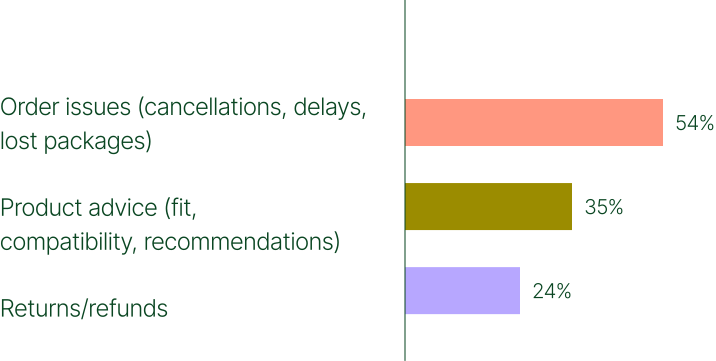
Order problems, especially when money, time sensitivity, or accountability are involved, trigger the strongest demand for human assistance. Customers want to know that someone is handling their situation and can act quickly to rectify the issue, rather than waiting for an escalation.
Product advice sits in the middle. Many customers are getting more comfortable with AI-powered recommendations, given how personalized they can get. But a significant portion still values human expertise, particularly for high-ticket items or gifting.
Returns and refunds show the lowest preference for human support. AI is becoming better at autonomously processing straightforward transactions, like refunds or exchanges. Unsurprisingly, when customers want their money back, they prioritize speed over human-to-human contact.
AI handles volume, humans handle escalation
Think about the repetitive actions that eat up ecommerce teams’ bandwidth: issuing refunds, cancelling orders, updating shipping addresses, and applying discounts. Neither customers nor agents want to spend time on these tasks that could easily be resolved instantly.
With AI’s capabilities improving, there’s little need for routine tasks like this to be escalated. Yet escalation rates remain high for many teams.
When AI encounters ambiguity, detects customer frustration, or faces a scenario outside its training, it routes the conversation to a human agent with full context.
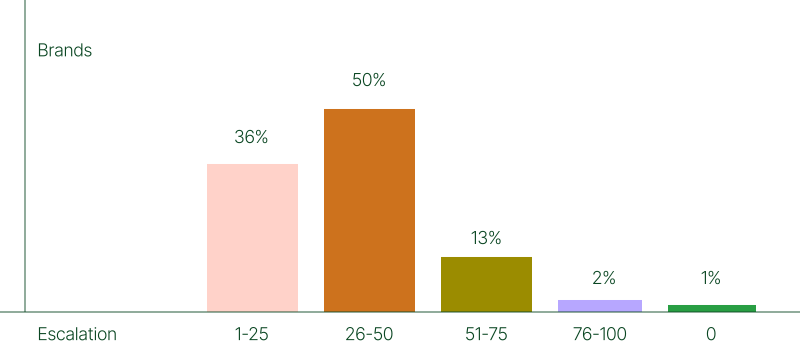
86% of brands report that at least a quarter of AI conversations eventually involve a human. This is often intentionally designed to protect the brand’s reputation, effectively route tickets, and allow human agents to pick up exactly where the AI agent left off.
AI personalization remains a work in progress
Investing in a custom tone of voice and AI knowledge documents ensures that AI agents sound and feel like your brand. But ecommerce brands still face hurdles when it comes to personalizing AI touchpoints.


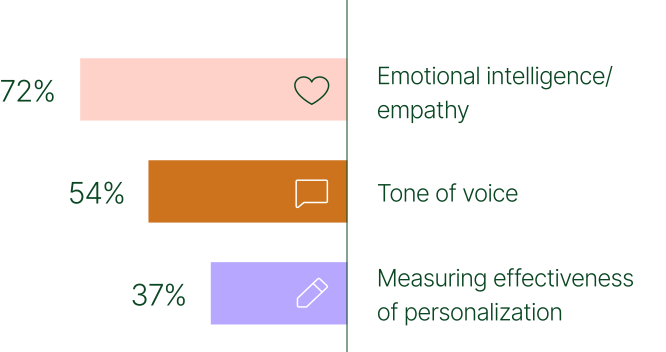
The personalization gaps reveal the next area of improvement for AI. Nearly three-quarters of brands are struggling with emotional intelligence and translating brand voice into AI conversations at scale. Unlike traditional CX metrics, personalization is harder to measure. This is where ongoing oversight and improvement are essential to ensure customers feel understood.
Trust in AI is higher than ever, but not universal
Customer acceptance of AI-driven support has grown significantly. They’re beginning to expect and accept AI as a core part of their experience, but it’s not sufficient on its own for every interaction.

Trust in AI is a direct result of investment. Teams that commit to custom tone of voice, testing, and QA processes unlock exponential returns across efficiency, quality, and revenue.

The AI-driven QA process frees CX leads to focus on tone, empathy, and coaching instead of spending hours every week in Excel sheets.