

How to Connect Gorgias to Claude or ChatGPT (6 Workflows to Try Right Now)
A few things to know before you connect Gorgias MCP:
- Compatible AI tools: Claude, ChatGPT, Cursor, and any other MCP-compatible client
- Cost: Included in your existing Gorgias paid plan at no extra cost.
- AI Agent: Not required. Helpdesk-only customers have full access.
- Availability: Currently in open beta, open to all paid plan customers.
Ask your helpdesk anything, and get a real answer from your actual data in seconds.
Gorgias MCP connects your Gorgias account directly to Claude, ChatGPT, Cursor, or any other MCP-compatible AI tool. No more exporting data or re-explaining context every time you need a different angle on your tickets. Ask a question, follow up, and execute, all in the same conversation.
This guide covers what Gorgias MCP is, how to connect it, and six specific workflows you can run in your first session.
What is Gorgias MCP?
The Model Context Protocol (MCP) enables AI systems to link directly with other tools.
The Gorgias MCP provides a first-party bridge, giving you a secure, direct connection between your chosen AI assistant and your Gorgias account.
Once connected, your LLM of choice can:
- Read and search your tickets and customer history
- Analyze patterns across CSAT scores, ticket volume, and resolution time
- Review your macros, rules, and tags
- Audit your AI Agent guidances and handoff tickets
- Draft new AI Agent guidances based on your existing setup
- Check user permissions and team configuration
How to connect Gorgias MCP
Setup takes about five minutes. Here is what you need and how to do it.
What you need:
- A Gorgias paid plan (any plan, AI Agent not required)
- An active subscription to Claude, ChatGPT, Cursor, or another MCP-compatible tool
Steps:
- Open your AI tool and navigate to its settings. Look for an Integrations, Connectors, or MCP section.
- Add a new MCP server using this endpoint: mcp.gorgias.com/mcp?gorgias_subdomain=YOUR-SUBDOMAIN. Replace YOUR-SUBDOMAIN with the part of your Gorgias URL that comes before .gorgias.com.
- Authorize the connection via OAuth. You will be prompted to log into your Gorgias account.
- Open a new chat and ask your first question.
The exact steps vary slightly depending on which AI tool you use.
Read more: The Gorgias MCP setup guide specifically walks through Claude, ChatGPT, and Cursor.
6 workflows to run in your first session
Each workflow below includes the exact prompt to copy. Adjust the specifics to match your store, and run it in your first session.
1. Find out why your CSAT dropped last month
CSAT dips are easy to spot in your dashboard. The cause is harder. Figuring it out usually means opening tickets one by one, building a custom filter, and reading through results one by one.
The prompt:
- "Show me all tickets from the last 30 days with a CSAT rating of 1 or 2. Group them by the most common themes and tell me what customers said."
What you get: A grouped breakdown of the patterns behind your low scores, based on what customers wrote.
Follow-up prompts:
- "Were any of these customers VIPs or high-order-value shoppers?"
- "Which agent handled the most tickets in this group?"
2. Audit your AI Agent handoffs and close the biggest gap
Handoff reports tell you how many tickets AI Agent escalated to your team. They rarely tell you why. Diagnosing the root cause and writing new guidance to fix it are usually two separate tasks that happen days apart, if at all.
With Gorgias MCP, you can do both in the same conversation.
The prompt:
- "Show me the last 50 tickets that AI Agent handed off to a human agent. What are the three most common reasons it couldn't resolve them?"
Then, without starting a new chat:
- "Draft a new AI Agent guidance to handle [the top reason from above]. Use the format of my existing guidances."
What you get: A diagnosis of where AI Agent is struggling and a ready-to-review draft guidance to address the top gap. You apply it manually in Gorgias, but the thinking is done.
Follow-up prompts:
- "Are these handoffs concentrated on a specific product category or ticket tag?"
- "How do these handoff reasons compare to last month?"
3. Map customer friction points to your product pages
This is one of the most powerful early use cases customers have found. By connecting Gorgias MCP with the Shopify MCP, you can link what customers complain about in tickets to the product pages where that friction lives.
To use this workflow, connect both Gorgias MCP and Shopify MCP oto your AI tool first.
The prompt:
- "What are the most common complaints or questions about [product name or category]? For each one, note whether the issue could be addressed by improving the product description, adding sizing information, or clarifying the return policy."
What you get: A prioritized list of friction points tied to specific content gaps on your product pages, ready to hand off to your product or merchandising team.
Follow-up prompts:
- "Which of these friction points appears most often in tickets tagged as returns?"
- "Are any of these issues specific to one variant or size?"
4. Get a custom ticket volume breakdown without building a report
Gorgias's built-in reports cover the core metrics well. But when you need a specific cut, ticket volume by intent for a particular channel, or resolution time broken down by tag, getting there requires an export and a spreadsheet.
Ask for exactly what you need instead.
The prompt:
- "Break down our ticket volume for the last 30 days by intent. Show me the top 10 intents, the volume for each, and the average resolution time per intent."
What you get: A custom breakdown you can copy directly into a slide or share with your team, built from a single question.
Follow-up prompts:
- "Which intent has the highest first-contact resolution rate?"
- "Compare this to the previous 30-day period. What changed the most?"
5. Find every topic your macros don't cover
Every support inbox has repeat questions that agents are still answering manually. Some of those topics may already have a macro, but others show up again and again without consistent macro usage. This workflow helps surface the best candidates to standardize next.
The prompt:
- “Look at all tickets from the last 60 days. Which topics or questions appear most often, and for which of them do we see little or no macro usage? List the top 10.”
What you get: A ranked list of frequent support topics that appear to be handled manually most of the time, helping your team prioritize where a new or better macro could save the most effort.
Follow-up prompts:
- “Draft a macro response for the most common topic in that list.”
- “Which of these topics has the longest average first response time?”
- “Which of these topics already use macros sometimes, but not consistently?”
6. Clean up your tag taxonomy
Tag libraries tend to grow organically. Over time, teams end up with overlapping labels like “return,” “returns,” and “return-request,” along with tags that are rarely used and naming patterns that make reporting harder to trust. This workflow helps identify cleanup opportunities based on how tags are actually used on tickets.
The prompt:
- “Review the tags used on tickets in my Gorgias account. Flag any that appear to overlap in meaning, are used fewer than five times total, or seem inconsistent with the others. Group your suggestions by consolidation opportunity.”
What you get: A list of likely tag issues grouped by type — duplicates, low-use tags, and inconsistent naming — based on actual ticket usage, with consolidation suggestions your team can act on.
Follow-up prompts:
- “For the duplicates you flagged, which version is used more often? That’s the one I’ll keep.”
- “Which of these low-use tags have appeared at all in the last 90 days?”
- “Which consolidation opportunities would have the biggest reporting impact?”
Get more out of the data you already have
Everything in the workflows above is already sitting in your Gorgias account. Gorgias MCP just makes it conversational.
Not sure where to start? Try workflow 1 (CSAT drop report) or workflow 6 (tag cleanup) first. Both deliver results quickly and work regardless of how your account is configured.
Gorgias MCP is currently in open beta and available to all paid plan customers.
TL;DR:
- Gaia for Zendesk is a free Chrome extension that analyzes your Zendesk ticket history and identifies gaps in your AI Agent setup.
- It generates ready-to-review guidances, instructions, voice-of-customer analysis, and Copilot procedures — nothing is applied without your approval.
- Install it in five minutes and run your first analysis in under a minute.
Getting more out of your Zendesk AI Agent comes down to better configuration. The problem is that auditing your own setup requires time you don't have.
Gaia for Zendesk is a free Chrome extension from Gorgias that clears that backlog in minutes. It connects to your Zendesk account, reads your tickets, and generates the components your AI Agent needs to resolve more conversations without escalation.
Below, you'll find everything you need to get started: how to install Gaia, what it can do, and the use cases teams are already putting it to work for.
Jump to:
- Who is this for?
- What is Gaia for Zendesk?
- Why use Gaia instead of configuring it yourself?
- How to install Gaia for Zendesk
- Four ways to use Gaia for Zendesk
Who is this for?
Zendesk Suite admins and agents who want to set up or improve their Zendesk AI Agent (and, optionally, Zendesk Copilot).
Throughout this article, "AI Agent" refers to Zendesk's own AI Agent feature, not Gorgias's product. Gaia is the Gorgias-built Chrome extension that helps you configure it.
What is Gaia for Zendesk?
Gaia for Zendesk is a free Chrome extension built by Gorgias that connects to your Zendesk account and analyzes your real ticket history.
It autonomously transforms that data into the core components your Zendesk AI Agent needs to resolve more tickets without human intervention: guidances, instructions, voice-of-customer insights, and Copilot procedures.
Gaia opens automatically as a side panel on any .zendesk.com page. You choose a workflow, Gaia runs the analysis and generates structured drafts, and you review and approve what should be applied to your Zendesk workspace.
What Gaia can do:
- Improve your Zendesk AI Agent: Scans escalated tickets, identifies gaps in your existing setup, and proposes targeted updates to your guidances.
- Create your first instructions: Generates 15 best-practice AI Agent instructions, adapted from Gorgias templates and tailored to your ticket data.
- Analyze your tickets: Produces a voice-of-customer report covering ticket volume, intents, and escalation patterns from the last 90 days.
- Create your first procedures: Drafts 10 Copilot procedures using the Gaia WHEN/IF/THEN format (requires the Copilot add-on in Zendesk).
Good to know: Gaia is autonomous in how it analyzes your data and generates recommendations, but nothing is applied without your approval.
Why use Gaia instead of configuring it yourself?
How well your AI Agent performs comes down to how well it is configured. Clear instructions, well-defined intents, and up-to-date procedures are what separate an AI Agent that resolves tickets from one that escalates them — and building that foundation manually takes time most teams do not have.
Gaia removes that constraint by turning your existing support data into structured, ready-to-review outputs:
- Skip the blank page. Start from drafts generated from your own ticket history instead of building from scratch.
- Get from setup to first results faster. Gaia analyzes up to 90 days of tickets in minutes and produces implementation-ready content, so you move from setup to value in hours, not weeks.
- Stay in control. Every output is surfaced for review so you can validate accuracy and alignment with your policies.
- Keep improving over time. Re-run Gaia regularly to capture new intents, identify gaps, and maintain coverage as your business evolves.
Tip: Teams that define five or more strong guidances typically see a meaningful lift in the share of tickets their AI Agent resolves without escalation. Gaia is designed to help you reach and expand beyond that baseline quickly.
How to install Gaia for Zendesk
Installation takes about five minutes. You'll need admin access to your Zendesk account to generate an API token.
Make sure you're using Google Chrome or another Chromium-based browser (such as Edge or Brave). Gaia is not available for Safari or Firefox at launch.
Follow these steps:
1. Install the Gaia for Zendesk extension. Go to the Chrome Web Store listing for Gaia for Zendesk by Gorgias and click Add to Chrome. Confirm the permissions to complete installation.
2. Generate a Zendesk API token. In Zendesk, navigate to Admin Center › Apps and integrations › Zendesk API. Enable Token access if needed, then click Add API token. Copy and store the token securely (it will not be visible again).
3. Open the Gaia extension and add your credentials. Click the Gaia icon in your Chrome toolbar, then open Settings. Enter:
- Zendesk subdomain: the part before .zendesk.com in your account URL (for example, acme if your URL is acme.zendesk.com).
- Email: the email of the Zendesk admin who created the API token.
- API token: paste the token you generated in step 2.
4. Click Save. Gaia will validate the connection.
5. Open any Zendesk page. Navigate to any page in your Zendesk account. Gaia will appear as a side panel where you can select a workflow and begin.
Four ways to use Gaia for Zendesk
Here are the four most common ways teams use Gaia for Zendesk.
1) Audit and improve an existing AI Agent setup
Best for: Teams already using Zendesk AI Agent or Answer Bot but not reaching their automation goals
Select Improve my AI Agent. Gaia analyzes escalated tickets against your current guidances to identify missing intents, unclear instructions, and outdated logic, then proposes prioritized improvements.
2) Bootstrap AI Agent from a blank slate
Best for: Teams starting without an established AI configuration
Select Create my first instructions. Gaia generates a foundational set of 15 instructions covering common ecommerce scenarios (order status, refunds, cancellations, shipping, returns).
3) Run a voice-of-customer analysis
Best for: Support, CX, and operations teams planning improvements or reporting on performance
Select Analyze my tickets. Gaia summarizes ticket volume, top intents, and escalation drivers to highlight where automation or process improvements will have the greatest impact.
4) Roll out Copilot procedures
Best for: Teams using Zendesk Copilot who want consistent, scalable agent workflows
Requires the Copilot add-on in Zendesk. Select Create my first procedures. Gaia converts real agent behavior into structured WHEN/IF/THEN procedures that standardize how common scenarios are handled.
Your AI Agent is resolving less than it should — and it’s costing you
Gaia connects to your Zendesk account, reads your ticket history, and shows you exactly where your setup is falling short. Install the free Chrome extension and run your first analysis in under a minute.

Newsletter Signup
The best in CX and ecommerce, right to your inbox
Featured articles
Ticket Volume: How to Measure It, Benchmark It, and Reduce It
TL;DR:
- Ticket volume is your support workload: It counts every customer inquiry across every channel in a given time period.
- High volume signals friction in your business: Spikes usually point to unclear policies, product issues, or gaps in your website experience.
- Every ticket has a real cost: Agent time, tooling, and overhead add up fast — and they compound during peak seasons.
- Automation reduces volume without reducing quality: AI tools and self-service deflect repetitive questions while keeping customers satisfied.
- Measurement drives improvement: Tracking volume by channel, category, and time period reveals exactly where to focus your efforts.
Your ticket volume number is probably wrong. If customers are reaching you through email forwards, Slack DMs, or channels that bypass your helpdesk, those tickets aren't being counted, and your SLA reporting is built on incomplete data. This guide covers how to get an accurate count, break it down by channel and category, and use your vertical benchmark to figure out whether your volume is actually a problem or just normal for your industry.
What is ticket volume?
Ticket volume is the total number of customer inquiries your support team receives across all channels — email, live chat, phone, social media, and contact forms — within a specific time period. It is the most direct measure of your team's workload.
Do not confuse it with contact rate. Contact rate = tickets ÷ orders (or customers). That normalized number is more useful for benchmarking and planning because it accounts for business growth. Raw ticket volume tells you how busy your team is. Contact rate tells you whether support demand is outpacing your business.
How to calculate your ticket volume
Start by looking at the last 30 days of customer conversations, no matter where they currently live.
Pull these four numbers:
- Total customer questions received across all channels
- Breakdown by channel (email, chat, social DMs, phone, contact forms, etc.)
- Breakdown by category (shipping, returns, product questions, account issues)
- Tickets or conversations per order during the same period — this gives you your contact rate baseline
Here’s how to pull that data depending on your setup:
Gmail or Outlook
Open your inbox or Sent folder and filter by the last 30 days. Count how many customer conversations came in during that period. You can also copy subject lines into ChatGPT or Claude to group conversations by topic.
Shopify Inbox
Go to Inbox > Conversations and review your recent conversations. Count how many messages you received and look for repeated themes or questions.
Any helpdesk (Gorgias, Zendesk, Freshdesk, Help Scout, etc.)
Most helpdesks have ticket reporting or exports built in. Search “export tickets” or “ticket report” in your platform’s help center. From there, you can pull:
- Total tickets
- Channel breakdown
- Top ticket categories
- Tickets over time
If a large portion of customer questions are still happening in untracked places like Slack DMs, personal inboxes, or Instagram comments, your reporting is incomplete. Before optimizing support operations, route customer conversations into one shared system so you can accurately measure volume, response times, and recurring issues.
Why your volume breakdown matters more than the total
A raw ticket count tells you how busy your team is. The breakdown tells you what to fix.
|
Category |
What high volume signals |
What to do |
|
"Where is my order?" |
No proactive shipping updates; poor tracking page |
Automate WISMO with AI Agent; add tracking link to order confirmation |
|
Returns and exchanges |
Confusing return policy; no self-serve portal |
Add a clear returns page; enable self-serve exchange flows |
|
Sizing and product questions |
Weak product page content |
Add size guides, FAQs, and fit notes directly on product pages |
|
Account and subscription issues |
Customers can't self-serve basic account changes |
Build or improve your Help Center; enable self-serve account management |
|
Payment and billing |
Checkout friction or unclear pricing |
Fix at the source — this is rarely a support problem |
Run this categorization for your last 30 days. Your top two or three categories are your highest-leverage targets.
Track volume alongside these KPIs
Ticket volume only tells part of the story. Track it alongside:
- Contact rate (tickets ÷ orders) — so you know if volume is growing faster than your business
- First response time (FRT) — volume spikes show up here first
- Average handle time (AHT) — high AHT + high volume = a capacity problem
- Cost per ticket — total support costs ÷ total tickets, the clearest financial measure
- Backlog size — a growing backlog is the earliest warning sign that volume is outpacing capacity
- Deflection rate — tickets resolved through self-service or automation without agent involvement
How to reduce ticket volume without reducing quality
Once you know what is driving your volume, address each category at the source. The goal is to eliminate unnecessary tickets.
Automate the highest-volume, lowest-complexity tickets first. WISMO inquiries, order status checks, and basic return initiations require no agent judgment. An AI Agent connected to your ecommerce platform can handle these end-to-end without a human stepping in. When a question is too complex, the AI escalates it with full context attached.
Build self-service content around your top categories. A Help Center that directly addresses your most common ticket types is the highest-leverage tool for sustained volume reduction. Start with your top five categories. Write one article per category. Surface those articles on relevant product pages, in checkout, and in post-purchase emails — before customers need to search.
Send proactive messages at the moments that generate the most tickets. Post-purchase is the single highest-value touchpoint: an order confirmation that includes a tracking link, estimated delivery window, and a clear link to your return policy eliminates a large share of inbound questions before they are ever submitted.
Measure deflection, not just volume. Deflection rate, the percentage of issues resolved through self-service or automation, is the metric that tells you whether your volume reduction efforts are actually working. Track it weekly alongside CSAT for automated interactions to make sure quality is holding.
Ticket volume benchmarks
The all-industry average is not your benchmark. Ticket volume per 100 orders varies 2.4x across verticals, so comparing yourself to a cross-industry number will either make you complacent or create false urgency.
According to Gorgias platform data from March 2026 across 14 verticals at the $10M GMV band, here is what tickets per 100 orders actually looks like by vertical:
|
Vertical |
Tickets per 100 orders |
|
Electronics |
46 |
|
Vehicles & Parts |
46 |
|
Hardware |
41 |
|
Luggage & Bags |
32 |
|
Home & Garden |
32 |
|
Sporting Goods |
32 |
|
Baby & Toddler |
24 |
|
Business & Industrial |
25 |
|
Animals & Pet Supplies |
25 |
|
Apparel & Accessories |
22 |
|
Health & Beauty |
21 |
|
Arts & Entertainment |
21 |
|
Food & Beverages |
20 |
|
Toys & Games |
19 |
Source: Gorgias Ecom Lab, March 2026
High ticket volume is not always a sign of poor CX — it often reflects product complexity. Electronics brands generate nearly one ticket per two orders because customers have more pre- and post-purchase questions about technical products. Food and Beverage brands generate about one in five. That gap is not a performance difference; it is a category difference.
The right question is not "are we below 10 tickets per 100 orders?" It is "are we above or below our vertical peers?" Find your row. That is your baseline. Then use the reduction tactics above to move below it.
How to predict ticket volume if your tool charges per ticket
If your ticketing tool uses usage-based pricing, where your bill scales with ticket volume rather than agent headcount, forecasting volume directly affects your budget.
The core formula is simple:
Projected tickets = projected orders × (tickets per 100 orders ÷ 100)
So if you expect 2,000 orders next month and your vertical median is 22 tickets per 100 orders, your forecast is approximately 440 tickets.
But a flat monthly estimate misses the real risk: peak seasons. A volume spike during BFCM that triples your order volume will also triple your ticket count — and your bill — unless you have guardrails in place.
To build a more accurate forecast:
- Use your contact rate, not raw volume. Divide your tickets by orders for each of the last 12 months. This gives you a stable ratio that accounts for business growth and seasonal swings.
- Apply that ratio to your order forecast. If your marketing team has a sales projection for November, multiply it by your contact rate to estimate support volume.
- Separate your AI-handled tickets from agent-handled tickets. Some platforms bill differently for automated resolutions versus human ones. If you're using an AI Agent to deflect WISMO and returns, those deflected tickets may not count toward your billable volume at all — which changes the math significantly.
- Build in a buffer for peak periods. Your contact rate tends to rise during high-demand periods, not just your order volume. First-time customers generate more tickets than repeat buyers, and BFCM brings a disproportionate share of first-timers.
Before signing any usage-based contract, ask two questions: What counts as a billable ticket? And is there a hard cap on monthly charges? Variable billing only works in your favor if you have clear definitions of what triggers a charge and a ceiling on how high costs can go during an unexpected spike.
If your platform bills per ticket resolved by a human agent (not AI), your deflection rate becomes a financial metric, not just an operational one. Every percentage point of additional deflection directly reduces your bill.
Start reducing ticket volume today
Begin by identifying your top ticket categories, then work backward to find the root cause of each one.
From there, layer in self-service content, automation, and proactive messaging to address those root causes directly. The result is a support operation that handles more customers and a team that spends its time on the work that actually requires human judgment.
Book a demo to see how Gorgias helps ecommerce brands reduce ticket volume and improve customer experience at the same time.
{{lead-magnet-2}}
Gorgias AI Agent Pricing, Explained
TL;DR:
- AI Agent is priced per resolved interaction, not per seat or per message. You only pay when the AI fully resolves a conversation on its own.
- Most plans are $0.90 per resolved interaction. Starter plans begin at $1. Plans include 90 to 2,500+ automated interactions per month.
- If you go over your plan, overage fees apply per additional interaction. Rates vary by tier and are lower on annual plans.
- Your automation rate emerges from usage over time. Start by estimating your ticket volume and pick an interaction allotment that fits.
- AI Agent runs on email, chat, and SMS, and includes tone of voice customization, Actions, multi-language support, vision, and performance reporting.
If you're wondering what it costs to add AI Agent to your Helpdesk, you're in the right place. This article walks through how pricing works, what counts as a billable interaction, and how to think about the investment before talking to anyone on our team.
The good news: there are no seat fees, no per-message charges, and no token-based billing. You pay for conversations your AI actually resolves. If you've looked into other AI tools for customer support and found the pricing models confusing or hard to predict, Gorgias AI Agent works differently.
What is a billable interaction?
A billable interaction is counted when the AI resolves a customer conversation entirely on its own. The customer asks something, the AI handles it, the conversation closes. That's one interaction.
If the AI can't fully resolve a conversation and hands it to a human agent, that ticket shifts over to your regular Helpdesk plan. It becomes a standard resolved ticket. You're not charged for both.
A few things that don't count as billable interactions:
- Emails that come in but no one replies to
- Spam or filtered messages
- Conversations resolved by a human agent
This matters most for brands coming from seat-based tools. With Gorgias, your whole team can work in the platform. Agent seats are unlimited. Pricing scales with what your AI is actually doing, not with how many people have access.
Understand the difference between seat-based vs. usage-based pricing.
How AI Agent plans work
AI Agent is an add-on to your Gorgias Helpdesk plan. The two are priced separately but work together. Your Helpdesk plan covers all the conversations your human agents resolve. Your AI Agent plan covers the interactions the AI resolves on its own.
When you choose a plan, you select how many automated interactions you want included per month. Depending on your plan, that ranges from 90 to 2,500+ interactions, with custom interaction numbers available for enterprise. You can see the full breakdown on the Gorgias pricing page.
Each resolved conversation costs $0.90 on most plans. Starter plans begin at $1 per resolved conversation. You only pay for fully automated interactions, meaning conversations the AI handles from start to finish without a human stepping in.
Choosing the right plan
The main input is your average monthly ticket volume. From there, you estimate how many of those conversations AI could realistically handle on its own.
Order status updates, return requests, and shipping questions tend to be the highest-volume ticket types AI resolves well. AI Agent actions shows the full range of what it can handle, which makes it easier to estimate your starting number.
Your actual automation rate, meaning the share of total tickets the AI ends up resolving, emerges from usage over time. Most brands start with their most repetitive ticket types and expand from there as they see results.
Related: Which Gorgias plan should you choose?
What happens if you go over your plan
You're charged an overage fee for each additional automated interaction if you exceed your plan's baseline in a given month. The exact rate depends on your plan tier and whether you're on a monthly or annual subscription.
Generally, the higher your plan tier, the lower your overage rate. Annual plans also carry lower overage rates than monthly plans. So if you're regularly going over, upgrading to a higher tier or switching to annual often works out cheaper than paying overage fees month after month.
If you're on a Support + Shopping Assistant plan, the overage rate is $1.50 per interaction across all paid tiers. If you're on a Support-only plan, rates range from $1.00 to $2.00 per interaction on monthly plans, and $0.83 to $1.67 on annual plans, depending on your tier.
For seasonal businesses, forecasting your customer service volume before peak periods is the best way to choose the right plan size and avoid unexpected fees.
How to think about the cost
At $0.90 per resolved interaction on most plans, each AI resolution costs less than a human agent handling the same ticket. Once you know what a human-resolved ticket costs your business, the comparison becomes straightforward.
For brands building an internal case for the investment, how to pitch AI Agent to your boss covers the ROI framing in detail.
To see what results look like in practice, how 10 brands transformed customer support into revenue has real ecommerce examples.
What's included with AI Agent
AI Agent comes with everything you need to set it up, customize it, and improve it over time:
- Knowledge training — AI Agent learns from your Shopify data, store website, Help Center articles, URLs, documents, and custom guidance. The more content it has, the more accurately it responds.
- Tone of voice — set instructions for how AI Agent sounds, whether that's professional, friendly, or something else, and it stays consistent across every conversation.
- Actions — connect AI Agent to your other tools so it can complete tasks like cancelling an order, processing a return, or modifying a subscription without a human stepping in. See what AI Agent can do.
- Multi-language support — AI Agent detects the language a customer writes in and replies in the same language automatically.
- Vision — AI Agent can read and understand images, so it can handle tickets where customers share photos of damaged items or order issues.
- Performance reporting — track automation rate, CSAT, first-response time, and ticket topics directly in the dashboard.
- Testing — preview how AI Agent responds to real customer questions before going live or after making changes.
- Handover to humans — AI Agent automatically passes conversations to your team when it lacks confidence, detects frustration, or encounters a topic you've marked for human handling.
Learn more: Gorgias AI Agent guardrails: What they are and how to configure them
Curious what AI Agent would automate for your store?
The best way to get a sense of what AI Agent will cost is to look at your own ticket volume and the types of questions your customers ask most. From there, the right plan becomes much clearer.
If you want to talk through the numbers with someone from our team, book a demo and we'll walk through it with you.
If you'd rather keep exploring first, here are a few good next reads:
- AI Agent keeps getting smarter — the latest performance data across the Gorgias customer base
- 10 must-know AI Agent use cases — the ticket types brands are automating today
- How 10 brands transformed customer support into revenue — real ecommerce results
- How to customize AI Agent with 7 brand voice examples — what the experience looks like for customers
{{lead-magnet-2}}
Introducing Helpdesk 2.0: Built for How Agents Work
TL;DR:
- Built directly from agent feedback, Helpdesk 2.0 fixes real workflow pain points. The redesign focuses on reducing friction and helping agents handle more context-heavy tickets.
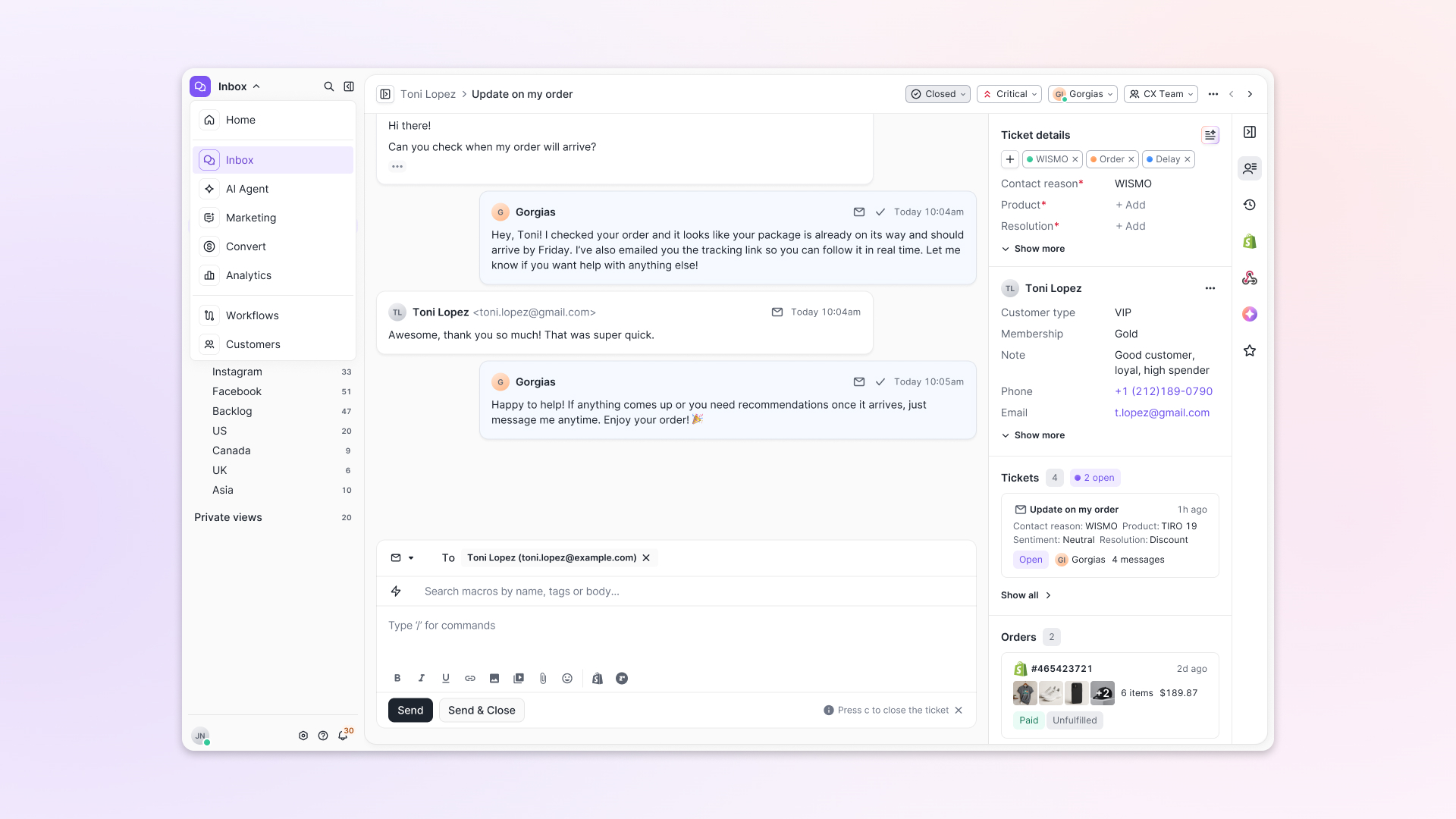
- A chat-style interface replaces the old email layout. Conversations are easier to follow and resolve in one view.
- Customer context is shown beside the conversation in a right-side panel. Agents can view history, orders, and details without leaving the ticket.
- AI handoffs come with clear summaries. Agents instantly see what happened, what was tried, and what to do next.
- Navigation is simpler and faster across teams. Clean menus, structured queues, and multi-store access keep agents moving efficiently.
Helpdesk 2.0 starts with the people who use it most: the agents.
We spent time understanding customer support from the agent's seat. What do they reach for constantly? What slows them down? What does a better workday look like?
Everything we found is in this brand-new update.
Why we redesigned Helpdesk
Conversational commerce is the new standard.
In customer support, this means customers expect context to remain intact wherever they reach out, whether a conversation starts on social, moves to email, or ends on a call.
This new approach to support has also changed the agent's role. Recurring tickets, like order status checks, shipping updates, and returns, are now handled by AI. What lands in the agent inbox are edge cases that require human judgment and troubleshooting, or tickets that require the full picture.
However, the original Helpdesk was built for a different era of support.
Context was separated across views rather than built into the conversation itself. It's something one in five Gorgias customers flagged, through support tickets, NPS surveys, and conversations with our team. So, we got to work.
Helpdesk 2.0 is the result.
What's new in Helpdesk 2.0
Here's a look at everything that changed.
Read conversations the way they're meant to be read
Conversations have a natural rhythm, one that’s already found in every messaging tool we use. We brought that same layout into the helpdesk.
Say goodbye to the 2000s email interface and hello to chat bubbles. This updated design changes how quickly you can orient yourself and resolve the ticket in one go.
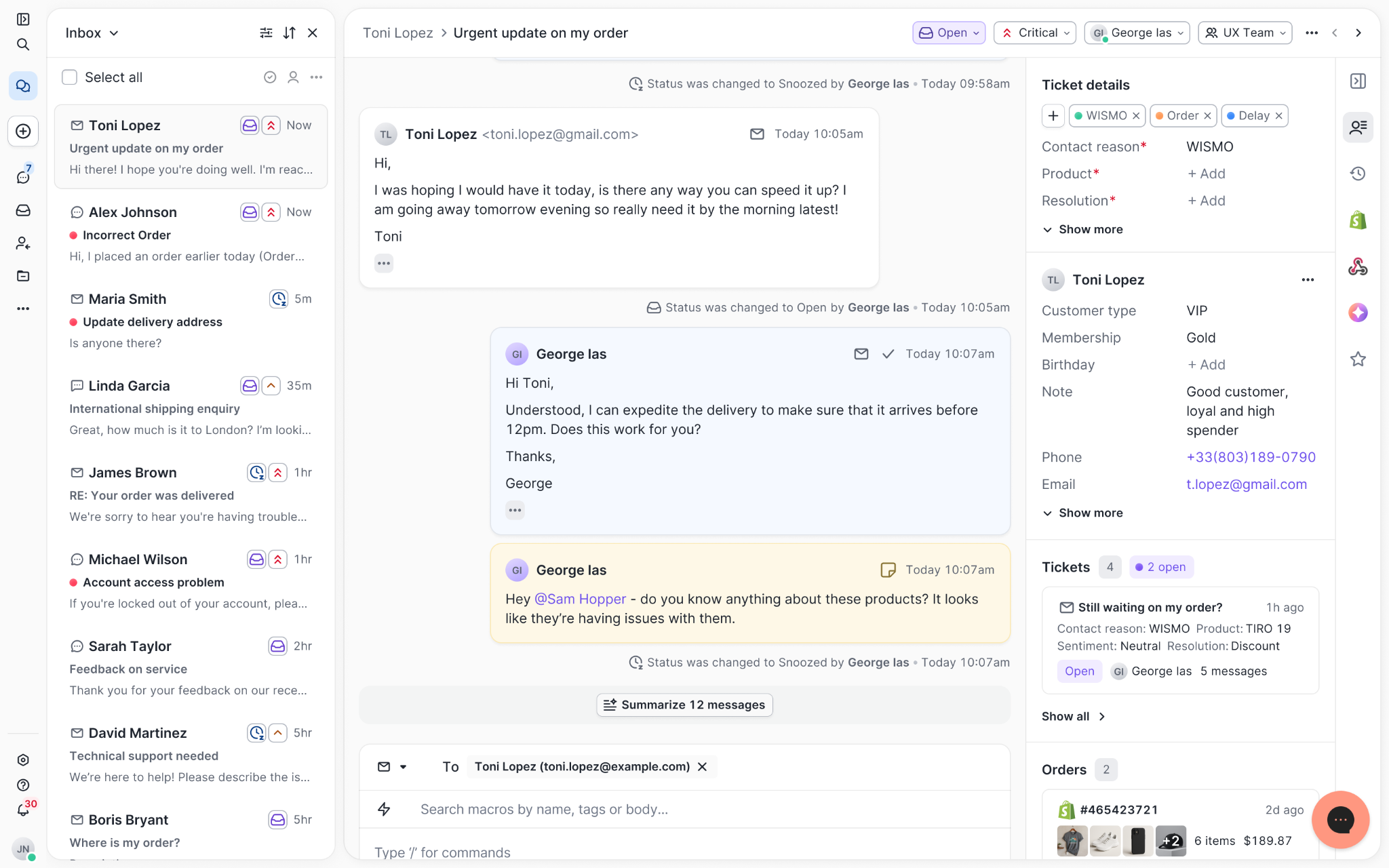
Chats with customers now look like real conversations, using the speech bubble style you’re familiar with on popular messaging apps.
Check customer history without losing your place
Checking a customer's history used to mean leaving the conversation, an extra step that interrupted what should have been a smooth workflow.
Now, past conversations open in a sidebar next to the active conversation. You can view a customer’s full history, search through their timeline, and open prior tickets without going to a new page.

Check past conversations, orders, and customer details in the brand-new Customer Timeline.
See order details the moment you open a ticket
Order information is easier to reference than ever. Open a ticket, and you instantly see the customer's recent orders, marked with product images and invoice details at a glance. Need to dig deeper? Click on an order, and the expanded information appears in the same panel.
For teams using custom integrations, apps are fixed in a quick-access integration menu on the right.
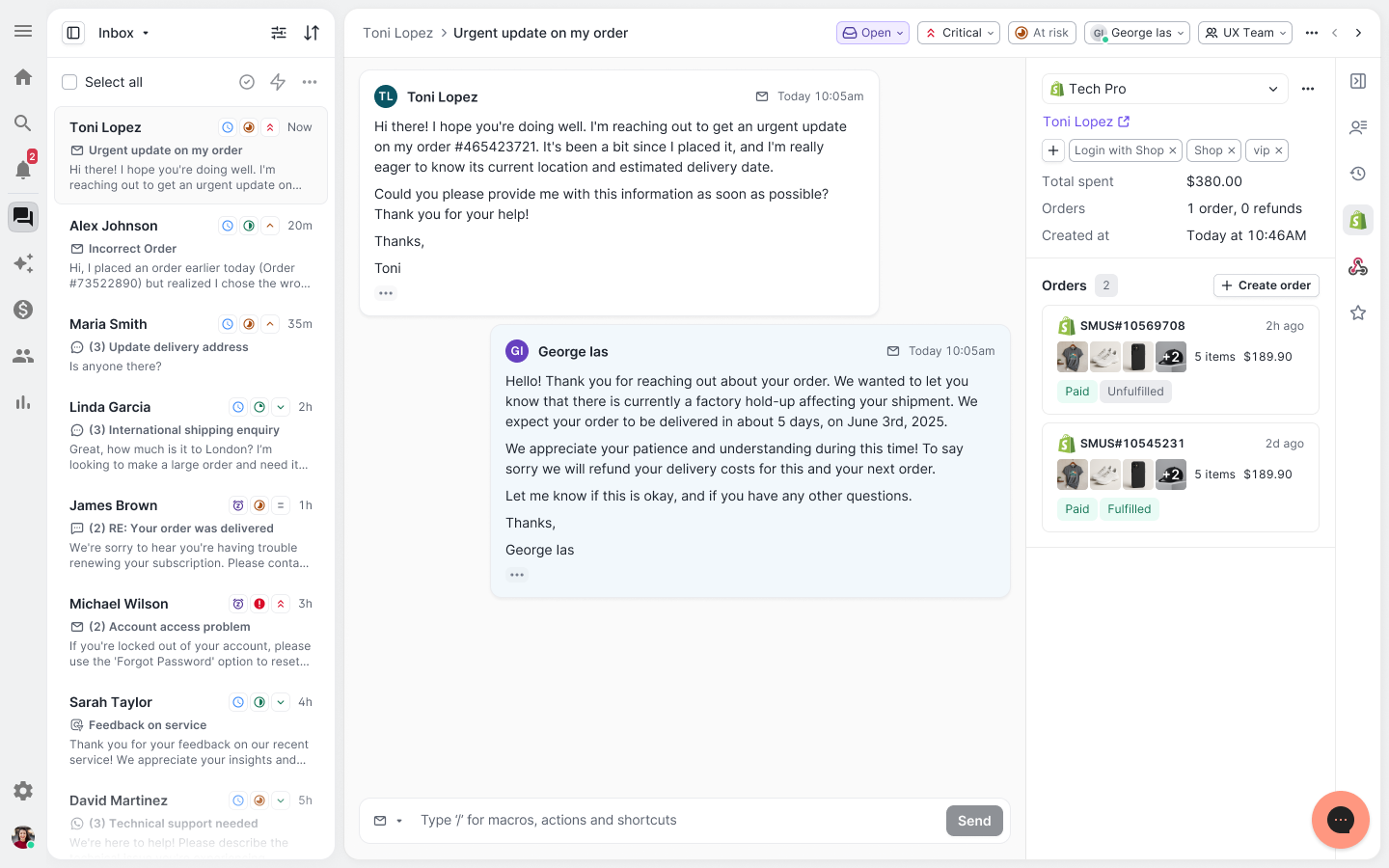
See order details, product images, and totals at a glance on the right panel, without leaving the conversation.
Pick up where AI left off
You shouldn't have to dig through a thread to figure out what AI already tried. Now you don't have to.
When AI Agent escalates a conversation, it includes a concise handover summary that mentions the issue, what actions were taken, and why it was passed to your team.
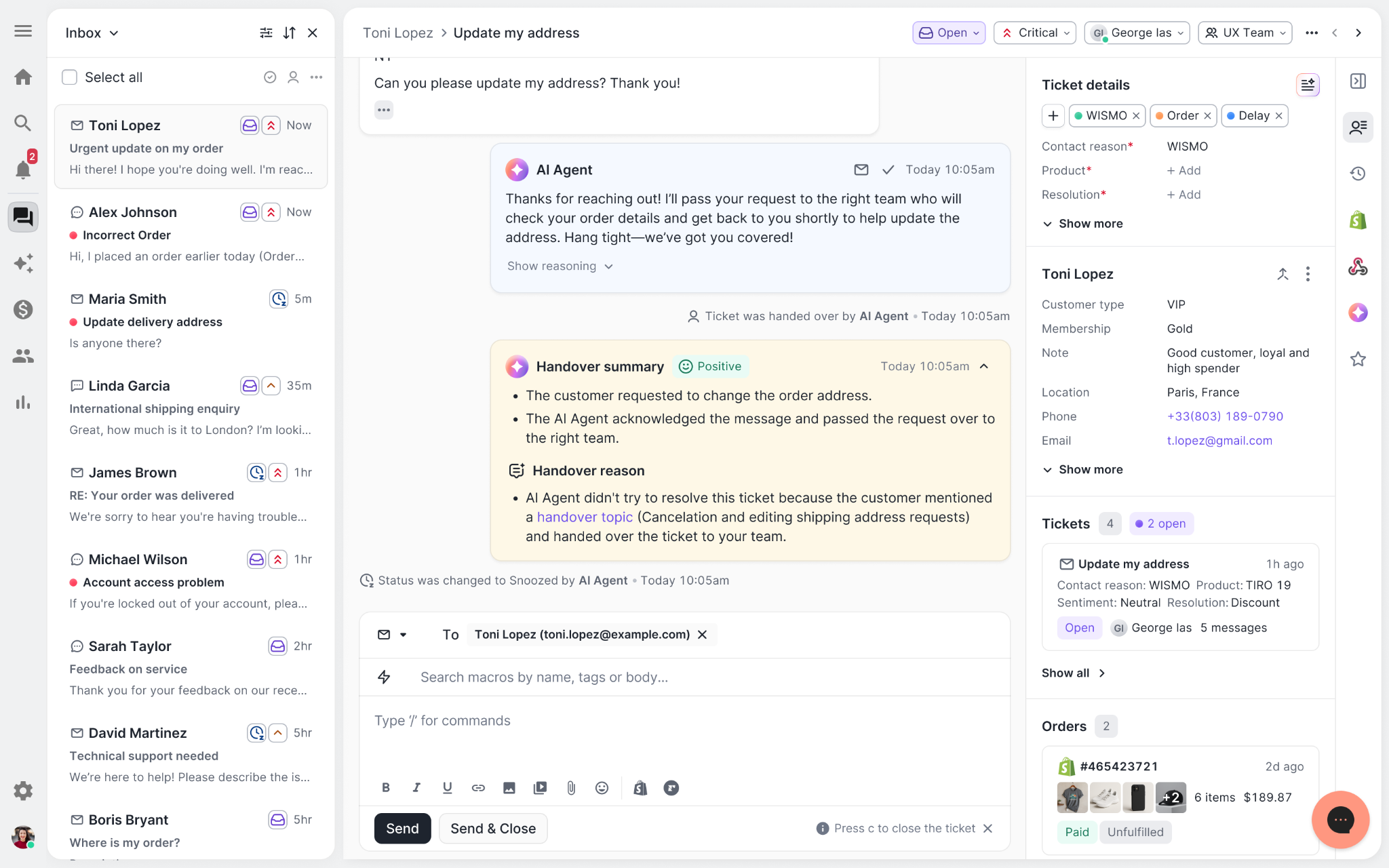
Escalated tickets include a brief AI-generated handover summary, marked in yellow, for quick reference.
Move faster across every store and team
We restructured and simplified the navigation. The left sidebar organizes everything into clear categories: Inbox, AI Agent, Marketing, and Analytics, so anyone on your team knows exactly where to go.
To quickly update your knowledge base or adjust a workflow, both now live right in the sidebar. For teams managing multiple stores, switching between them is just as straightforward, accessible from the sidebar, so agents can move between inboxes without breaking their flow.
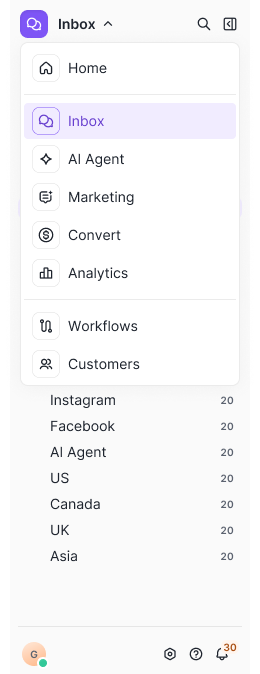
Agents can switch between stores and their corresponding inboxes directly from the left menu.
A workspace that works the way agents do
Support comes down to the person on the other end of the conversation. We built Helpdesk 2.0 is to make sure they have everything they need to show up for that moment.
The best way to see the difference is to work in it. Start a free trial today.
7 CRO A/B Tests to Reduce Customer Support Tickets


Further reading
AI in CX Webinar Recap: Turning AI Implementation into Team Alignment
TL;DR:
- Implement quickly and iterate. Rhoback’s initial rollout process took two weeks, right before BFCM. Samantha moved quickly, starting with basic FAQs and then continuously optimizing.
- Train AI like a three-year-old. Although it is empathetic, an AI Agent does not inherently know what is right or wrong. Invest in writing clear Guidance, testing responses, and ensuring document accuracy.
- Approach your AI’s tone of voice like a character study. Your AI Agent is an extension of your brand, and its personality should reflect that. Rhoback conducted a complete analysis of its agent’s tone, age, energy, and vocabulary.
- Embrace AI as a tool to reveal inconsistencies. If your AI Agent is giving inaccurate information, it’s exposing gaps in your knowledge sources. Uses these early test responses to audit product pages, help center content, Guidance, and policies.
- Check in regularly and keep humans in control. Introduce weekly reviews or QA rituals to refine AI’s accuracy, tone, and efficiency. Communicate AI insights cross-functionally to build trust and work towards shared goals.
When Rhoback introduced an AI Agent to its customer experience team, it did more than automate routine tickets. Implementation revealed an opportunity to improve documentation, collaborate cross-functionally, and establish a clear brand tone of voice.
Samantha Gagliardi, Associate Director of Customer Experience at Rhoback, explains the entire process in the first episode of our AI in CX webinar series.
Top learnings from Rhoback’s AI rollout
1. You can start before you “feel ready”
With any new tool, the pre-implementation phase can take some time. Creating proper documentation, training internal teams, and integrating with your tech stack are all important steps that happen before you go live.
But sometimes it’s okay just to launch a tool and optimize as you go.
Rhoback launched its AI agent two weeks before BFCM to automate routine tickets during the busy season.
Why it worked:
- Samantha had audited all of Rhoback’s SOPs, training materials, and FAQs a few months before implementation.
- They started by automating high-volume questions such as returns, exchanges, and order tracking.
- They followed a structured AI implementation checklist.
2. Audit your knowledge sources before you automate
Before turning on Rhoback’s AI Agent, Samantha’s team reviewed every FAQ, policy, and help article that human agents are trained on. This helped establish clear CX expectations that they could program into an AI Agent.
Samantha also reviewed the most frequently asked questions and the ideal responses to each. Which ones needed an empathetic human touch and which ones required fast, accurate information?
“AI tells you immediately when your data isn’t clean. If a product detail page says one thing and the help center says another, it shows up right away.”
Rhoback’s pre-implementation audit checklist:
- Review customer FAQs and the appropriate responses for each.
- Update outdated PDPs, Help Centre articles, policies, and other relevant documentation.
- Establish workflows with Ecommerce and Product teams to align Macros, Guidance, and Help Center articles with product descriptions and website copy.
Read more: How to Optimize Your Help Center for AI Agent
3. Train your AI Agent in small, clear steps
It’s often said that you should train your AI Agent like a brand-new employee.
Samantha took it one step further and recommended treating AI like a toddler, with clear, patient, repetitive instructions.
“The AI does not have a sense of good and bad. It’s going to say whatever you train it, so you need to break it down like you’re talking to a three-year-old that doesn’t know any different. Your directions should be so detailed that there is no room for error.”
Practical tips:
- Use AI to build your AI Guidance, focusing on clear, detailed, simple instructions.
- Test each Guidance before adding new ones.
- Treat the training process like an ongoing feedback loop, not a one-time upload.
Read more: How to Write Guidance with the “When, If, Then” Framework
4. Prioritize Tone of Voice to make AI feel natural
For Rhoback, an on-brand Tone of Voice was a non-negotiable. Samantha built a character study that shaped Rhoback’s AI Agent’s custom brand voice.
“I built out the character of Rhoback, how it talks, what age it feels like, what its personality is. If it does not sound like us, it is not worth implementing.”
Key questions to shape your AI Agent’s tone of voice:
- How does the AI Agent speak? Friendly, funny, empathetic, etc…?
- Does your AI Agent use emojis? How often?
- Are there any terms or phrases the AI Agent should always or never say?
5. Use AI to surface knowledge gaps or inconsistencies
Once Samantha started testing the AI Agent, it quickly revealed misalignment between Rhoback’s teams. With such an extensive product catalog, AI showed that product details did not always match the Help Center or CX documentation.
This made a case for stronger collaboration amongst the CX, Product, and Ecommerce teams to work towards their shared goal of prioritizing the customer.
“It opened up conversations we were not having before. We all want the customer to be happy, from the moment they click on an ad to the moment they purchase to the moment they receive their order. AI Agent allowed us to see the areas we need to improve upon.”
Tips to improve internal alignment:
- Create regular syncs between CX, Product, Ecommerce, and Marketing teams.
- Share AI summaries, QA insights, and trends to highlight recurring customer pain points.
- Build a collaborative workflow for updating documents that gives each team visibility.
6. Build trust (with your team and customers) through transparency
Despite the benefits of AI for CX, there’s still trepidation. Agents are concerned that AI would replace them, while customers worry they won’t be able to reach a human. Both are valid concerns, but clearly communicating internally and externally can mitigate skepticism.
At Rhoback, Samantha built internal trust by looping in key stakeholders throughout the testing process. “I showed my team that it is not replacing them. It’s meant to be a support that helps them be even more successful with what they’re already doing," Samantha explains.
On the customer side, Samantha trained their AI Agent to tell customers in the first message that it is an AI customer service assistant that will try to help them or pass them along to a human if it can’t.
How Rhoback built AI confidence:
- Positioned AI as a personal assistant for agents, not a replacement.
- Let agents, other departments, and leadership test and shape the AI Agent experience early.
- Told customers up front when automation was being used and made the path to a human clear and easy.
Read more: How CX Leaders are Actually Using AI: 6 Must-Know Lessons
Putting these into practice: Rhoback’s framework for an aligned AI implementation
Here is Rhoback’s approach distilled into a simple framework you can apply.
- Audit your content: Ensure your FAQs, product data, policies, and all documentation are accurate.
- Start small: Automate one repetitive workflow, such as returns or tracking.
- Train iteratively: Add Guidance in small, testable batches.
- Prioritize tone: Make sure every AI reply sounds like your brand.
- Align teams: Use AI data to resolve cross-departmental inconsistencies and establish clearer communication lines.
- Be transparent: Tell both agents and customers how AI fits into the process.
- Refine regularly: Review, measure, and adjust on an ongoing basis.
Watch the full conversation with Samantha to learn how AI can act as a catalyst for better internal alignment.
📌 Join us for episode 2 of AI in CX: Building a Conversational Commerce Strategy that Converts with Cornbread Hemp on December 16.
{{lead-magnet-1}}

How to Use AI in Ecommerce: Leaders' Guide
TL;DR:
- AI in ecommerce spans customer support, personalization, operations, and fraud prevention
- Top use cases include conversational AI assistants, personalized recommendations, and demand forecasting
- CX leaders see the highest ROI from AI that automates repetitive support and drives sales
- Start with one high-impact use case and measure conversion, resolution time, and revenue lift
- Successful implementation requires clear metrics, pilot testing, and gradual scaling
AI has moved from experimental technology to essential infrastructure for ecommerce brands. The smartest CX leaders are using it to handle repetitive support tickets, personalize shopping experiences, and predict customer needs before they arise.
This guide breaks down the AI use cases that actually move the needle for ecommerce teams. You'll learn which applications deliver immediate ROI, how to implement them without disrupting operations, and how to measure success.
Types of AI use in ecommerce
Different AI technologies handle different parts of your ecommerce business. Understanding what each type does helps you pick the right tool for each job.
Generative AI
Generative AI creates new content from existing information — whether that's product descriptions, email responses, or marketing copy. It writes in a natural tone that matches your brand voice instead of sounding robotic.
Where it’s used: AI agents in chat, automated content creation for product pages, and personalized email campaigns
Large language models (LLMs)
LLMs are the engines behind conversational AI. They understand context, handle complex customer questions, and generate human-like responses at scale.
Where it’s used: Customer support chatbots, content generation tools, automated response systems
Predictive analytics
Predictive analytics uses your historical data to forecast future outcomes. It tells you which customers are likely to churn, what products will be in demand next month, and when to reorder inventory.
Where it’s used: Customer lifetime value forecasts, at-risk customers detection, and seasonal inventory planning
Machine learning
Machine learning algorithms spot patterns in your data that humans would miss. These systems learn and improve over time, making smarter recommendations and decisions with each interaction.
Where it’s used: Product recommendations, dynamic pricing, fraud detection, and customer segmentation
Computer vision
Computer vision teaches machines to understand images and videos. It analyzes visual content to identify products, detect quality issues, and recognize patterns.
Where it’s used: Automated product tagging, quality control checks, counterfeit detection, and visual inventory management
Visual search
Visual search lets customers upload photos to find similar products in your catalog. Instead of describing what they want, they show you.
Where it’s used: Reverse image search, style matching, and "shop the look" features
Benefits of AI for ecommerce brands
AI delivers real improvements you can measure across revenue, costs, and customer satisfaction. Here's what happens when you implement AI the right way.
Increases sales with personalization
AI analyzes how customers browse, what they've bought before, and their preferences to create personalized experiences at scale. Product recommendations become spot-on. Marketing messages hit the right tone. Prices adjust based on what customers are willing to pay.
You get higher conversion rates, bigger average order values, and more repeat purchases. Personalization that would take your team hours happens instantly.
Reduces operational costs with automation
AI handles the repetitive tasks that eat up your team's time. Support tickets get answered immediately. Product descriptions write themselves. Inventory levels adjust based on predicted demand.
This cuts operational costs while freeing your team to focus on strategic work. Instead of answering "where's my order" hundreds of times, your agents handle complex issues that actually need human judgment.
Improve decision-making with faster data processing
AI analyzes massive amounts of data in seconds that would take your team days or weeks to process manually. It connects patterns across millions of customer interactions, inventory movements, and sales transactions instantly.
Instead of digging through spreadsheets, you get clear answers about what's working, what's not, and what to do next. Your team moves faster and makes more informed decisions across marketing, inventory, and customer experience.
AI use cases in ecommerce that move the needle
These AI applications deliver immediate impact for ecommerce brands. Each use case solves a specific problem while driving measurable results.
Power conversational commerce and AI assistants
AI agents handle customer conversations across chat, email, and social channels. They answer product questions, process returns, and guide shoppers to the right items. Unlike basic chatbots, modern AI assistants understand context and keep conversations flowing naturally.
Key capabilities your AI assistant should have:
- Instant FAQ answers: Resolves common questions without human help
- Order management: Processes modifications and cancellations automatically
- Smart recommendations: Suggests products based on customer needs
- Seamless escalation: Hands off complex issues to human agents
The best AI assistants learn from every conversation, getting better at helping customers over time.
Personalize product recommendations
Recommendation engines analyze customer behavior to suggest products they actually want. AI considers browsing history, past purchases, what similar customers bought, and store inventory to deliver suggestions.
Effective recommendations show up throughout the shopping experience:
- Homepage personalization: Customized based on past visits
- Product page suggestions: "Customers also bought" recommendations
- Post-purchase upsells: Relevant add-ons in order confirmations
- Cart recovery: Alternative products for abandoned items
Forecast demand and plan inventory
AI predicts future demand by analyzing historical sales, seasonal trends, market conditions, and external factors. This prevents stockouts during busy periods and reduces excess inventory when sales slow down.
Your demand forecasting should consider:
- Sales patterns: Historical data and seasonal trends
- Marketing impact: Upcoming campaigns and promotions
- Market conditions: Competitor pricing and economic factors
- External events: Weather patterns and local happenings
Create and localize product content
Generative AI writes product descriptions, creates marketing copy, and translates content for international markets. This scales your content production without sacrificing quality or losing your brand voice.
AI content generation handles:
- Product descriptions: Written from basic specifications
- SEO content: Optimized category and landing pages
- Localization: Content adapted for different markets
- Testing variations: Multiple versions for A/B testing
Enhance search and product discovery
AI-powered search understands natural language queries and shopping intent. Instead of just matching keywords, it figures out what customers actually want. Visual search lets customers find products by uploading photos.
Modern search AI includes:
- Natural language understanding: Handles complex, conversational queries
- Smart corrections: Recognizes synonyms and fixes typos
- Visual search: Finds products from uploaded images
- Personalized results: Tailored based on browsing history
Optimize prices and revenue in real time
Dynamic pricing AI adjusts your prices based on demand, competition, inventory levels, and customer segments. This maximizes revenue while keeping you competitive in the market.
Your pricing optimization should monitor:
- Competitor movements: Real-time price tracking across competitors
- Inventory costs: Stock levels and holding expenses
- Customer sensitivity: How price changes affect different segments
- Demand patterns: Seasonal and promotional impacts
Detect and prevent payment and account fraud
AI identifies fraudulent transactions before they go through. Machine learning models analyze transaction patterns, user behavior, and device information to flag suspicious activity.
Fraud detection systems watch for:
- Unusual patterns: Purchases that don't match normal behavior
- Account takeovers: Signs someone else is using the account
- Payment mismatches: Credit cards that don't match shipping addresses
- Address anomalies: Shipping locations that seem suspicious
How leaders implement AI without the chaos
Successful AI implementation needs strategy, not just technology. Follow this approach to avoid common mistakes and deliver results you can measure.
Define outcomes and success metrics
Start with clear business goals. What specific problem will AI solve for you? How will you know if it's working? Set baseline measurements before you implement anything so you can track real improvement.
Track these essential metrics:
- Customer metrics: How fast you resolve issues, satisfaction scores, effort scores
- Operational metrics: How many tickets AI deflects, automation rate, cost per ticket
- Revenue metrics: Conversion improvements, average order value increases, customer lifetime value
Document your current performance for each metric. This becomes your starting point for measuring AI impact.
Pilot one use case and A/B test impact
Pick one high-impact use case for your pilot program. Run it alongside your existing processes to compare performance. This controlled approach proves ROI before you roll out AI everywhere.
Follow these pilot best practices:
- Clear success criteria: Choose a use case with obvious win conditions
- Sufficient data collection: Run for at least 30 days to gather meaningful results
- Direct comparison: A/B test AI against your current process
- Complete monitoring: Track both numbers and customer feedback
- Document learnings: Record what works for your broader rollout
How to measure ROI of AI use
Measuring AI ROI means tracking both quick wins and long-term value. Focus on metrics that directly connect to business outcomes.
Track conversion, resolution time, and revenue lift
Monitor three core categories to understand your AI impact.
Conversion improvements:
- Recommendation performance: How much AI suggestions boost conversion rates
- Cart abandonment reduction: Fewer customers leaving with AI assistance
- Upsell success: Higher rates of additional purchases
Efficiency gains:
- Resolution speed: How much faster AI resolves customer issues
- First contact resolution: More problems solved in one interaction
- Automation rate: Percentage of tickets handled without human help
Revenue impact:
- Revenue per visitor: Increased earnings from each site visitor
- Customer lifetime value: Long-term value improvements
- Cost savings: Money saved through automation
Calculate ROI by comparing these metrics before and after AI implementation. Include both direct revenue gains and cost savings in your calculations.
Getting started checklist for ecommerce teams
Use this checklist to launch your first AI use case successfully.
Assessment:
- Identify your biggest customer pain points from support data
- Calculate current cost per ticket and resolution time
- Check if your tech stack can integrate with AI tools
Planning:
- Select one use case with clear ROI potential
- Define success metrics and improvement targets
- Create a rollout timeline with specific milestones
Implementation:
- Configure AI with your brand voice and policies
- Train your team on new AI tools and workflows
- Launch pilot with a small group of customers
Optimization:
- Review performance against your success metrics
- Collect feedback from both agents and customers
- Scale successful use cases gradually across your business
Start transforming your customer experience with AI
Your next step is simple. Pick one use case that addresses your biggest pain point. Measure the impact. Then expand from there.
Book a demo to see how Gorgias helps ecommerce brands implement AI that drives real results.
{{lead-magnet-2}}

The Future of Ecommerce: What the Data is Already Telling Us
TL;DR:
- AI crossed the trust threshold in 2025. Customer satisfaction with AI support now nearly matches human agents, with brands reporting 85% confidence in AI-generated responses.
- Documentation quality separates high performers from everyone else. Brands with clear help center content automate 60%+ of tickets, while those with vague policies plateau at 20-30%.
- Support is becoming a scalable revenue channel. AI-powered product recommendations are driving 10-97% AOV lifts across brands by making every conversation a sales opportunity.
- Connected context matters more than response speed. Customers expect you to remember them across every channel, and systems that share data seamlessly will define premium CX by 2026.
- Post-purchase experience predicts repeat purchases better than marketing. 96% of customers will repurchase after an easy return experience. How you handle returns, delays, and problems will determine customer lifetime value.
While most ecommerce brands debate whether to implement AI support, customers already rate AI assistance nearly as highly as human support. The future isn't coming. It's being built in real-time by brands paying attention.
As a conversational commerce platform processing millions of support tickets across thousands of brands, we see what's working before it becomes common knowledge. Three major shifts are converging faster than most founders realize, and this article breaks down what's already happening rather than what might happen someday.
Documentation quality separates high performers from the rest
By the end of 2026, we predict that the performance gap between ecommerce brands won't be determined by who adopted AI first. It will be determined by who built the content foundation that makes AI actually work.
Right now, we're watching this split happen in real time. AI can only be as good as the knowledge base it draws from. When we analyze why AI escalates tickets to human agents, the pattern is unmistakable.
The five topics triggering the most AI escalations are:
- Order status, 12.4%
- Return requests, 7.9%
- Order cancellations, 6.1%
- Product quality issues, 5.9%
- Missing items, 4.6%
These aren’t complicated questions — they're routine questions every ecommerce brand faces daily. Yet some brands automate these at 60%+ rates while others plateau at 20%. The difference isn't better AI. It's better documentation.
What the leading brands are doing
Take SuitShop, a formalwear brand that reached 30% automation with a lean CX team. Their Director of Customer Experience, Katy Eriks, treats AI like a team member who needs coaching, not a plug-and-play tool.
When Katy first turned on AI in August 2023, the results were underwhelming. So she paused during their slow season and rebuilt their Help Center from the ground up. "I went back to the tickets I had to answer myself, checked what people were searching in the Help Center, and filled in the gaps," she explained.
The brands achieving high automation rates share Katie's approach:
- Help Center articles written in customer language, not internal jargon
- Policies with explicit if/then logic instead of “contact us for details”
- Regular content audits based on which questions trigger escalations
- Deep integration between their helpdesk and ecommerce platform, so AI can access real-time data
AI echoes whatever foundation you provide. Clear documentation becomes instant, accurate support. Vague policies become confused AI that defaults to human escalation.
Read more: Coach AI Agent in one hour a week: SuitShop’s guide
What happens next
Two distinct groups will emerge next year. Brands that invest in documentation quality now will deliver consistently better experiences at lower costs. Those who try to deploy AI on top of messy operations will hit automation plateaus and rising support costs. Every brand will eventually have access to similar AI technology. The competitive advantage will belong to those who did the unexciting work first.
Thoroughness matters more than speed in customer support
Something shifted in July 2025. Gorgias’s AI accuracy jumped significantly after the GPT-5 release. For the first time, CX teams stopped second-guessing every AI response. We watched brand confidence in AI-generated responses rise from 57% to 85% in just a few months.
What this means in practice is that AI now outperforms human agents:
- Language proficiency: AI scores 4.77/5 versus humans at 4.4/5
- Empathy and communication: AI at 4.48/5 versus humans at 4.27/5
- Resolution completeness: AI at a perfect 1.0 versus humans at 0.99
For the first time, AI isn't just faster than humans. It's more consistent, more accurate, and even more empathetic at scale.
This isn't about replacing humans. It's about what becomes possible when you free your team from repetitive work. Customer expectations are being reset by whoever responds fastest and most completely, and the brands crossing this threshold first are creating a competitive moat.
At Gorgias, the most telling signal was AI CSAT on chat improved 40% faster than on email this year. In other words, customers are beginning to prefer AI for certain interactions because it's immediate and complete.
What happens next
Within the next year, we expect the satisfaction gap to hit zero for transactional support. The question isn't whether AI can match humans. It's what you'll do with your human agents once it does.
AI finally makes support-as-revenue scalable
The brands that have always known support should drive revenue will finally have the infrastructure to make it happen on a bigger scale. AI removes the constraint that's held this strategy back: human bandwidth.
Most ecommerce leaders already understand that support conversations are sales opportunities. Product questions, sizing concerns, and “just browsing” chats are all chances to recommend, upsell, and convert. The problem wasn't awareness but execution at volume.
What the data shows
We analyzed revenue impact across brands using AI-powered product recommendations in support conversations. The results speak for themselves:
- An outdoor apparel brand saw 29.41% AOV uplift and 6.88% chat conversion rate by helping customers understand technical product details before purchase
- A furniture brand achieved 12.26% GMV uplift by guiding parents to age-appropriate furniture for their children
- A lingerie brand reached 16.78% chat conversion rate by helping customers find the right size through conversational guidance
- A home decor brand saw 97.15% AOV uplift by recommending complementary pieces based on customers' existing furniture and color palettes
It's clear that conversations that weave in product recommendations convert at higher rates and result in larger order values. It’s time to treat support conversations as active buying conversations.
What happens next
If you're already training support teams on product knowledge and tracking revenue per conversation, keep doing exactly what you're doing. You've been ahead of the curve. Now AI gives you the infrastructure to scale those same practices without the cost increase.
If you've been treating support purely as a cost center, start measuring revenue influence now. Track which conversations lead to purchases, which agents naturally upsell, and where customers ask for product guidance.
Connected customer data matters more than quick replies
We are now past the point where response time is a brand's key differentiator. It is now the use of conversational commerce or systems that share details and context across every touchpoint.
Today, a typical customer journey looks something like this: see product on Instagram, ask a question via DM, complete purchase on mobile, track order via email. At each step, customers expect you to remember everything from the last interaction.
What the leading brands are doing
The most successful ecommerce tech stacks treat the helpdesk as the foundation that connects everything else. When your support platform connects to your ecommerce platform, shipping providers, returns portal, and every customer communication channel, context flows automatically.
A modern integration approach looks like this. Your ecommerce platform (like Shopify) feeds order data into a helpdesk like Gorgias, which becomes the hub for all customer conversations across email, chat, SMS, and social DMs. From there, connections branch out to payment providers, shipping carriers, and marketing automation tools.
As Dr. Bronner’s Senior CX Manager noted, “While Salesforce needed heavy development, Gorgias connected to our entire stack with just a few clicks. Our team can now manage workflows without needing custom development — we save $100k/year by switching."
What happens next
As new channels emerge, brands with flexible tech stacks will adapt quickly while those with static systems will need months of development work to support new touchpoints. The winners will be brands that invest in their tools before adding new channels, not after customer complaints force their hand.
Start auditing your current integrations now. Where does customer data get stuck? Which systems don’t connect to each other? These gaps are costing you more than you realize, and in the future, they'll be the key to scaling or staying stagnant.
Post-purchase experience determines repeat purchase rate
Post-purchase support quality will be a stronger predictor of customer lifetime value than any email campaign. Brands that treat support as a retention investment rather than a cost center will outperform in repeat purchase rates.
What the data shows
Returns and exchanges are make-or-break moments for customer lifetime value. How you handle problems, delays, and disappointments determines whether customers come back or shop elsewhere next time. According to Narvar, 96% of customers say they won’t repurchase from a brand after a poor return experience.
What customers expect reflects this reality. They want proactive shipping updates without having to ask, one-click returns with instant label generation, and notifications about problems before they have to reach out. When something goes wrong, they expect you to tell them first, not make them track you down for answers.
The quality of your response when things go wrong matters more than getting everything right the first time. Exchange suggestions during the return flow can keep the sale alive, turning a potential loss into loyalty.
What happens next
Brands that treat post-purchase as a retention strategy rather than a task to cross off will see much higher repeat purchase rates. Those still relying purely on email marketing for retention will wonder why their customer lifetime value plateaus.
Start measuring post-return CSAT scores and repeat purchase rates by support interaction quality. These metrics will tell you whether your post-purchase experience is building loyalty or quietly eroding it.
The roadmap to get ahead of the competition
After absorbing these predictions about AI accuracy, content infrastructure, revenue-centric support, context, and post-purchase tactics, here's your roadmap for the next 24 months.
Now (in 90 days):
- Audit your top 10 ticket types using your helpdesk data
- Build or improve Help Center documentation using actual customer language
- Set up basic automation for order tracking and return eligibility
- Implement proactive shipping notifications
Next (in 6-12 months):
- Use AI support on your highest-volume channel
- Measure support metrics tied to revenue influence
- Launch a self-service return portal with exchange suggestions
- Expand conversational commerce to social channels (Instagram, WhatsApp)
- Train support team on product knowledge and consultative selling
Watch (in 12-24 months):
- Voice commerce integration is maturing
- AI reaching zero satisfaction gap with humans for transactional support
- Social commerce shifting from experimental to primary
- Support conversations becoming the main retention driver over email marketing
Tomorrow's ecommerce leaders are investing in foundations today
The patterns we've shared, from AI crossing the accuracy threshold to documentation quality, are happening right now across thousands of brands. Over the next 24 months, teams will be separated by operational maturity.
Book a demo to see how leading brands are already there.
{{lead-magnet-2}}

What is an AI Chatbot? A Complete Guide for Ecommerce
TL;DR:
- AI chatbots give ecommerce stores instant, 24/7 support without growing your team. They handle common tasks like order tracking, returns, and product questions using conversational AI.
- Unlike scripted bots, modern AI chatbots understand context and nuance. They recognize intent even when customers don’t use exact keywords and can escalate complex issues to humans when needed.
- Combining AI with live agents creates a seamless support experience. Bots handle routine tickets while humans take over when empathy or deeper problem-solving is required.
- AI chatbots reduce support costs and drive more revenue. They free up agents, improve response times, boost conversions, and increase customer satisfaction.
- To choose the right chatbot, focus on ecommerce-specific features. Prioritize deep integrations, brand tone training, clear escalation paths, and performance analytics.
Your customers expect answers now, not in hours, not tomorrow, but the instant they ask. An AI chatbot handles order tracking, returns, and product questions around the clock without hiring more support agents.
For ecommerce brands buried in repetitive tickets while trying to keep service personal, AI chatbots turn support costs into actual revenue. Here's everything you need to know about choosing and implementing the right solution for your store.
What is an AI chatbot?
An AI chatbot is conversational software that uses large language models (LLMs) to chat with customers. This means it can hold natural conversations with your shoppers, answer their questions, and help them resolve tasks without human intervention.
Unlike older chatbots that followed pre-set scripts, AI chatbots understand context and nuance. They can interpret what a customer really means, even when they don't use exact keywords. For example, if someone asks, "Can I get my money back?" the chatbot understands they're asking about returns, not requesting a literal cash withdrawal.
Modern AI chatbots use techniques like retrieval-augmented generation to pull information from verified sources — like your Help Center or product catalog — ensuring accurate answers. When they encounter issues beyond their capabilities, they know to escalate to human agents.
Related: What is conversational AI? The ecommerce guide
AI chatbots vs live chat
While these chat tools both facilitate conversations, they serve different purposes and have unique strengths.
Feature |
AI Chatbot |
Live Chat |
|---|---|---|
Availability |
24/7 automated |
Business hours |
Response time |
Instant |
Minutes to hours |
Handling capacity |
Unlimited concurrent |
Limited by staff |
Personalization |
Data-driven |
Human intuition |
Complex problem solving |
Limited, escalates |
Full capability |
Cost structure |
Per conversation/month |
Per agent seat |
Live chat excels at solving complex or sensitive issues that require human empathy and judgment. AI chatbots provide instant, 24/7 answers to common questions.
The most effective approach combines AI chatbots with seamless human handoff. The chatbot handles initial inquiries, and if it can't resolve the issue, it escalates the conversation — along with all context — to a live agent. Modern platforms blend these capabilities into unified helpdesk solutions.
How an AI chatbot works for ecommerce
When asks a question in your website’s chat tool, your AI chatbot follows a sophisticated process to deliver accurate answers in seconds:
- Natural language processing (NLP): Breaks down the customer's message to understand their core request
- Intent recognition: Detects whether they're tracking an order, asking about returns, or seeking product information
- Vector search: Converts questions into mathematical representations to find the closest match in your knowledge base, understanding questions asked in different ways
- Context window: Maintains conversation history to reference earlier messages and hold natural, back-and-forth dialogue
- API integrations: Connects to your Shopify store and other tools for real-time access to order details, inventory, and customer data
- Grounding and confidence thresholds: Anchors responses to verified information and escalates to human agents when unsure
This combination allows AI chatbots to handle routine inquiries while knowing when to bring in your support team for complex issues.
Benefits of AI chatbots for ecommerce brands
AI chatbots deliver measurable improvements to both customer experience and business outcomes. They transform your support operation from a cost center into a revenue driver.
Better customer engagement and loyalty
Customers expect instant, personalized answers no matter the time — and AI chatbots do these at scale. Using your brand’s knowledge base, AI chatbots maintain your brand voice and guidelines while giving unique responses to customers. This means better customer education, engagement, and a higher likelihood of conversion.
Lower operational costs and higher efficiency
AI interactions cost significantly less than human support. By automating repetitive tickets, you scale support without adding headcount — a crucial move during peak seasons. Tedious work is dramatically reduced, giving agents time to strategize, address complex tickets, and build deeper customer relationships.
Increased revenue and conversions
An AI chatbot’s ability to detect customer intent means it knows when to upsell your products. Whether it is dealing with a new customer or a returning one, AI keeps conversations proactive by providing personalized recommendations,
What to use an AI chatbot for in your ecommerce store
Start by automating your highest-volume, repetitive inquiries. This delivers the fastest ROI and lets your team focus on conversations that actually need human expertise.
Answer "Where is my order?" instantly
WISMO tickets likely dominate your inbox. Connect your chatbot to shipping carriers via API for real-time tracking, split shipment explanations, and delay notifications. Set up proactive shipping updates to prevent these tickets entirely. The bot escalates only when packages are missing.
Process returns and exchanges without agent involvement
Your chatbot checks return eligibility, generates labels, and communicates refund timelines. Integrate with Loop or ReturnGO for self-service. It suggests exchanges over refunds to preserve revenue — swapping a wrong size instead of losing the sale. Complex cases like damaged goods get escalated with full context.
Guide shoppers to the right products
Turn your chatbot into a sales associate that recommends products based on browsing history, answers sizing questions, suggests gifts, and bundles complementary items. Instantly addressing purchase-blocking questions about materials or stock availability removes friction and increases conversions.
Related: Guide more shoppers to checkout with conversation-led AI
AI chatbot risks and limitations for ecommerce
While powerful, AI chatbots have limitations you need to understand and plan for. Being aware of these risks helps you implement safeguards and set appropriate expectations:
- AI chatbots can sometimes generate plausible but incorrect answers, a phenomenon called “hallucination.” Using grounding techniques that anchor responses to verified information from your knowledge base helps prevent this. Regular monitoring and quality assurance are essential for maintaining accuracy.
- Data privacy and security require careful attention. Your chatbot must comply with regulations like GDPR and PCI standards when handling customer information. Look for platforms with built-in safety filters and data redaction features to protect sensitive information.
- Brand voice can drift over time as the AI learns from interactions. Regular audits ensure responses stay consistent with your intended tone and messaging. Complex emotional situations requiring human empathy should always escalate to human agents — AI cannot replace genuine human connection in sensitive circumstances.
How to choose an AI chatbot for your ecommerce store
Selecting the right AI chatbot requires evaluating platforms based on ecommerce-specific needs, not generic chatbot features. Focus on solutions built specifically for online retail.
Define priority intents
Analyze your support ticket data to identify the most common customer questions. These become your priority intents that the chatbot must handle excellently. Differentiate between must-have intents like order tracking and returns versus nice-to-have intents like detailed product education.
Calculate potential deflection rates for each intent category to understand the business impact. Focus on intents that represent high volume and clear resolution paths.
Map required integrations
Create a comprehensive list of your essential tools and platforms:
- Shopify: Core ecommerce platform integration
- Shipping carriers: Real-time tracking and delivery updates
- Returns platforms: Automated returns processing
- Review systems: Customer feedback management
- Subscription tools: Recurring order management
- Loyalty programs: Customer tier and rewards information
Look for platforms with deep, native integrations rather than basic API connections. Native integrations provide richer data access and more reliable performance.
Set guardrails and escalation
Define clear boundaries for AI capabilities and establish escalation triggers:
- Sentiment detection: Route frustrated customers to human agents
- Keyword triggers: Escalate conversations mentioning legal issues or health concerns
- Repeated failures: Hand off when AI cannot resolve after multiple attempts
- VIP customers: Provide premium support routing for high-value customers
Ensure the handoff process preserves conversation context so human agents can continue seamlessly where AI left off.
Validate brand tone
Your chatbot represents your brand in every interaction. The platform should allow you to train the AI on your specific brand guidelines, approved language, and desired tone of voice.
Test responses across different scenarios and customer types to ensure consistency. Look for platforms that provide ongoing monitoring tools to prevent tone drift over time.
Plan analytics and QA
Choose a platform with robust analytics and quality assurance capabilities:
- Performance dashboards: Real-time metrics on key performance indicators
- Conversation reviews: Tools for auditing AI interactions
- Feedback loops: Systems for continuous training and improvement
- A/B testing: Capabilities to optimize response strategies
Core performance metrics:
- CSAT scores: Compare customer satisfaction for AI versus human interactions
- Deflection rate: Percentage of tickets resolved without human intervention
- Containment rate: Conversations completed entirely by AI
- Average handle time: Speed of resolution for different inquiry types
- First contact resolution: Issues solved in a single interaction
Business impact metrics:
- Revenue attribution: Sales directly influenced or generated by the chatbot
- Cost per resolution: AI versus human agent cost comparison
- Self-service adoption: Customers successfully using AI for resolution
- Abandonment rate: Conversations left unfinished by customers
Set realistic benchmarks based on your industry and business model. Use these metrics to identify improvement opportunities and demonstrate return on investment to stakeholders.
Transform your customer experience with Gorgias AI Agent
Ready to join thousands of ecommerce brands using AI to delight customers and drive revenue? Gorgias AI Agent integrates seamlessly with Shopify to deliver instant, accurate support that sounds just like your brand.
Book a demo to see how AI Agent can handle your specific use cases and start automating within days, not months.
{{lead-magnet-2}}

10 Best AI Platforms for Customer Support (With Pricing)
TL;DR:
- AI customer support tools go beyond speed and actually reduce workload. The right platform automates repetitive tickets so your team can focus on high-value conversations.
- AI works by using natural language processing (NLP) to generate real-time, context-aware responses. NLP helps the AI understand customer intent and reply in a way that matches your knowledge base and brand tone.
- Choosing the right platform depends on your business type, budget, and goals. Gorgias is ideal for ecommerce, Shopify Inbox offers a solid free option, and Zendesk or Intercom fit larger or multichannel teams.
- Take a phased approach when implementing AI. Start small by automating common inquiries, train the AI on your brand voice, and expand based on performance.
- Top brands are already seeing ROI from AI. Companies like Psycho Bunny, Osea Malibu, and Dr. Bronner’s use AI to cut costs, boost efficiency, and improve customer satisfaction.
If you lead a support team today, you’re probably evaluating AI tools with a different lens than you were a year ago. The question isn’t only “How fast is it?” It’s “What work will this actually take off my team’s plate?”
By 2026, Forrester predicts 30% of enterprises will build parallel AI functions, including hiring managers to train AI agents, ops teams to tune their performance, and specialists to step in when things go wrong.
That means choosing the right AI platform isn’t optional — it’s a step into the future of support work.
In this list, we cover what AI for customer support is, how it helps customer experience teams hit their goals, the top platforms to consider, how to evaluate and implement them, and the brands already seeing results.
Jump ahead:
- Best for ecommerce brands: Gorgias
- Best for large multichannel teams: Zendesk
- Best for limited budgets: Shopify Inbox
- Best for email-only support: Help Scout
- Best for in-app messaging: Intercom
- Best for small and mid-sized businesses: Tidio
- Best for Freshworks ecosystems: Freshdesk
- Best for automation at scale: Ada
- Best for compliance-sensitive brands: Level AI
What is AI for customer support?
AI for customer support is software that uses artificial intelligence to manage and automate customer interactions. It can respond to customers on channels like chat, email, and social messaging — even before a human agent needs to step in.
It works by using natural language processing (NLP) to understand intent and generate contextually relevant replies. Instead of following rigid scripts like traditional chatbots, AI produces responses in real time based on your policies, data, and brand voice.
Because of this, AI can handle a significant share of repetitive tickets while giving agents the space to focus on more complex and relationship-driving issues.
Read more: What is conversational AI? The ecommerce guide
How AI helps customer support teams hit their goals
By automating repetitive tasks, AI frees up human agents to focus on complex problems that require empathy and creative thinking.
Here's how AI improves your support metrics:
- 24/7 availability: AI provides instant responses around the clock, even when your team is offline
- Deflection rate: AI resolves common questions without human intervention, reducing overall ticket volume
- First contact resolution: AI delivers consistent answers from your knowledge base, solving more issues in one interaction
- Average handle time: Automation speeds up resolutions by giving agents context and suggested replies
- Customer satisfaction: Faster, more accurate support leads to happier customers
AI also helps you scale during peak seasons like Black Friday without hiring temporary staff. This efficiency translates into lower costs and a more strategic support operation.
The best AI platforms for customer support
Choosing the right AI platform depends on your industry, team size, and specific challenges. We evaluated solutions based on AI capabilities, ease of use, integrations, and business fit.
Best for ecommerce brands: Gorgias
Pricing: $40/month
Gorgias is a conversational AI platform built specifically for ecommerce. Its deep integration with Shopify lets it automate up to 60% of support tickets with direct access to Shopify actions right in the platform.
The AI Agent can edit orders, issue refunds, and apply discount codes directly in your helpdesk. This means customers get instant help with common requests like order changes or returns. The platform also powers personalized product recommendations and proactive chat campaigns, turning your support team into a revenue driver.
Gorgias offers tiered pricing starting with a Starter plan for small brands and scaling to enterprise solutions.
Best for large multichannel teams: Zendesk
Pricing: $55/month
Zendesk is an enterprise-grade platform with mature AI features. Its Answer Bot and intelligence tools help manage high volumes across multiple channels. Zendesk is known for scalability and extensive integrations.
The AI analyzes intent and sentiment to route tickets effectively and provide agents with helpful context. You can automate responses to common questions while ensuring complex issues reach the right specialists.
However, Zendesk's complexity and higher price point can overwhelm smaller teams. It's best for businesses that need its full suite of enterprise features.
Best for limited budgets: Shopify Inbox
Pricing: Free
Shopify Inbox is a free live chat tool built specifically for Shopify brands, making it an easy entry point for teams that want to experiment with AI support. The AI suggests replies based on customer messages, helping agents respond quickly without needing a full helpdesk.
Because it’s tied directly to Shopify, agents can see customer details, past orders, and cart activity right inside the chat. This gives small teams enough context to answer common questions fast and keep shoppers moving toward checkout.
That said, Shopify Inbox’s automation capabilities are limited. It’s best for smaller brands testing live chat or those who need a no-cost solution. This means teams that want deeper automation will likely outgrow it.
Best for email-only support: Help Scout
Pricing: $25/month
Help Scout focuses on simplicity and human-centric customer service. Its AI features, including Beacon and AI Assist, are straightforward and easy to implement. The AI suggests replies to agents and pulls relevant articles into conversations.
This platform is ideal for teams that want a clean interface and simple AI augmentation. While user-friendly, its AI capabilities aren't as advanced as platforms like Gorgias or Intercom.
Best for in-app messaging: Intercom
Pricing: $0.99 per resolution with your current helpdesk
Intercom excels at conversational support, particularly for product-led and SaaS companies. Its AI chatbot, Fin, uses advanced language models to provide natural, human-like conversations within your app or website.
Intercom's AI can qualify leads, onboard new users, and resolve support questions by referencing your knowledge base. It's excellent for engaging users during their product experience.
The pricing model is usage-based, which can become expensive as you scale and add more advanced AI capabilities.
Best for small and mid-sized businesses: Tidio
Pricing: $24.17/month
Tidio combines live chat and basic chatbot features, making it popular with small businesses. It features a visual flow builder for creating simple chatbots without coding.
Tidio offers a free plan with limited features, with paid plans unlocking more capabilities. While it's a great starting point for chat automation, it lacks sophisticated NLP and deep integrations needed for complex operations.
Best for Freshworks ecosystems: Freshdesk
Pricing: $49/month
Freshdesk offers Freddy AI, which provides omnichannel support capabilities. It's a strong choice for businesses already using other Freshworks products. Freddy AI automates responses, suggests solutions to agents, and predicts customer needs.
The platform includes workflow automation and predictive contact scoring to help prioritize tickets. Freshdesk offers several pricing tiers, but the most powerful AI features are on higher-priced plans.
Best for automation at scale: Ada
Pricing: $499/month
Ada is a pure-play conversational AI platform designed for enterprise automation. It offers a powerful, no-code bot builder for creating sophisticated automation flows for complex use cases.
Ada handles massive scale and integrates with existing helpdesks. Because it focuses solely on automation, it can achieve very high deflection rates. The downside is that you need a separate system for human agents and enterprise-level pricing.
Best for compliance-sensitive brands: Level AI
Pricing: $35 per agent + $1500+ per integration + platform fees
Level AI specializes in quality assurance and agent performance. Instead of focusing on ticket deflection, it analyzes customer conversations to provide real-time coaching and feedback to agents.
The platform uses sentiment analysis, topic detection, and agent screen recording to identify coaching opportunities. It's excellent for large teams focused on improving agent quality and consistency. However, it's a specialized solution that requires a separate helpdesk.
How to evaluate and implement AI for customer support
Adopting AI requires a strategic approach, not just a technical one. Successful implementation starts with clear planning and phased rollout. Instead of automating everything at once, focus on early wins and expand from there.
1. Define goals and KPIs for automation
Before starting, determine what you want to achieve. Are you trying to reduce response times, lower cost-per-ticket, or improve customer satisfaction scores? Set specific, measurable goals like "achieve 30% ticket deflection for order inquiries within 60 days."
Establish baseline metrics before implementing AI. This lets you accurately track progress and demonstrate return on investment.
2. Select channels and intents to automate first
Start with low-hanging fruit, or basic, repetitive customer inquiries. For most ecommerce brands, this means questions like "Where is my order?", "What is your return policy?", and basic product questions.
Prioritize channels where you receive the most inquiries, whether email, live chat, or social media. By tackling your most frequent questions first, you'll see the biggest impact on your team's workload.
3. Train AI on brand voice and policies
Your AI is only as smart as the information you provide. A comprehensive and current knowledge base is critical for success. The AI uses these articles to learn your policies, product details, and brand voice.
Set up clear guardrails and escalation rules. Define which topics the AI shouldn't handle — like angry customers or complex technical issues — and create seamless handoff processes to human agents. Getting your AI brand voice right ensures consistent, on-brand interactions across all automated responses.
Which companies use AI for customer support?
Today’s leading brands are fully leveraging AI to help deliver high-quality support. Take a look at how AI helps these four brands win:
Psycho Bunny uses AI to double revenue without adding headcount
What they use AI for: Automating 25–30% of repetitive tickets across email and chat on Gorgias after switching from Zendesk.
Results: Faster responses (1-minute email first response time), reduced seasonal hiring, and 10% YoY savings in operational costs.
Osea Malibu uses AI to cut QA time by 75%
What they use AI for: Automatically reviewing 100% of tickets daily with Auto QA to surface tone, adherence, and macro-usage issues.
Results: 15 minutes of weekly QA versus over 1 hour, and faster coaching cycles that improve agent performance and customer experience.
Dr. Bronner’s uses AI to save $100k/year
What they use AI for: Automating routine support questions to improve efficiency and reduce reliance on Salesforce.
Results: Automated 45% of inquiries in two months, saved $100k per year, and improved CSAT by 11%.
Ekster uses AI to do the work of four agents
What they use AI for: Automating high-volume, repetitive questions to offset a leaner support team and manage peak-season spikes.
Results: Automated 27% of customer support tickets and kept service levels high despite losing almost half of their support team.
Stay reliable with the right AI platform
The strongest platforms aren’t just chatbots. They’re systems that make your agents’ jobs easier, automate the repetitive work they’re tired of, and help you bring in more revenue.
If you’re still hesitant, you’re not alone. Most CX leaders worry about where to start. The safest path is to focus on the problems that slow your team down today, roll out AI in phases, and refine as you go.
When you do that, AI stops being a risky bet and becomes one of the most dependable parts of your operation.
Book a demo to see how the right platform can make that shift a whole lot easier.
{{lead-magnet-2}}
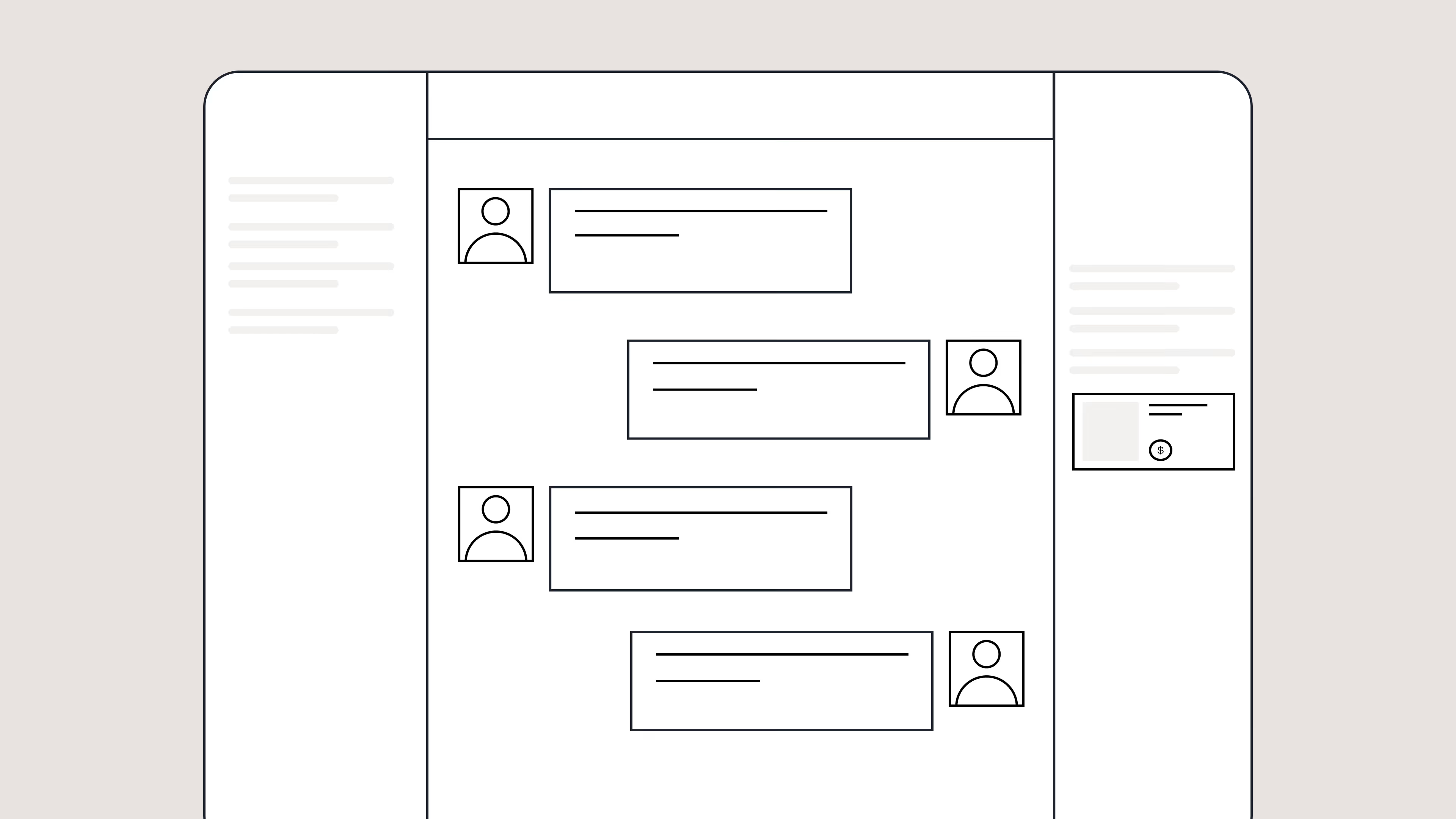
Best Helpdesk Solutions for Ecommerce Brands in 2026
TL;DR:
- Modern helpdesk solutions combine AI automation with human support to handle customer inquiries across email, chat, social, SMS, and voice
- The best platforms for ecommerce integrate directly with Shopify and your tech stack to provide order context and enable self-service
- Leading solutions now automate repetitive tickets while empowering agents to deliver personalized, revenue-driving conversations
- Pricing typically ranges from free starter plans to enterprise tiers based on agent seats and features
- Gorgias leads for Shopify brands, while Zendesk and Freshdesk serve broader omnichannel needs
Customer support has evolved beyond simple ticket management. Today's helpdesk solutions unite every customer conversation in one platform while automating repetitive tasks through AI.
For ecommerce brands, this means turning support from a cost center into a revenue driver. The right helpdesk connects to your Shopify store, understands your customers' order history, and helps agents resolve issues faster.
We evaluated the top platforms based on their ecommerce capabilities, AI features, and ability to scale with growing brands.
What is a helpdesk solution?
A helpdesk solution is a centralized platform that manages all customer support interactions across channels like email, chat, social media, and phone. This means you can see every customer message in one place instead of jumping between different apps and platforms.
The system organizes customer inquiries into tickets, routes them to the right agents, and tracks resolution from start to finish. Think of it as your command center for customer conversations.
Modern helpdesk platforms go beyond basic ticketing. They integrate with your ecommerce platform to pull order data, automate responses to common questions, and provide self-service options through knowledge bases and AI assistants.
The core components work together to streamline your support:
- Unified inbox: All customer messages from every channel appear in one view
- Smart routing: Tickets automatically go to the right agent based on topic or urgency
- Automation tools: Macros and AI handle repetitive questions without human intervention
- Knowledge base: Self-service articles let customers find answers independently
- Performance tracking: Dashboards show response times and customer satisfaction scores
How we evaluate helpdesk solutions for ecommerce
We tested each platform against criteria that matter most for online stores. Our evaluation focused on real-world ecommerce scenarios like order tracking inquiries, return requests, and pre-purchase questions.
We wanted to see which tools empower agents to solve problems quickly while maintaining a personal touch. Speed matters, but so does the human connection that builds loyalty.
Our testing covered these key areas:
- Ecommerce integrations: How well does it connect to Shopify, BigCommerce, and other platforms you already use?
- AI capabilities: Can it actually understand and respond to complex customer questions accurately?
- Setup simplicity: How long from signup to resolving your first ticket?
- Agent experience: Is the interface intuitive with helpful shortcuts and features?
- Customer experience: Do shoppers get fast, helpful responses through multiple channels?
- Growth potential: Will it handle more tickets and team members as you scale?
We prioritized platforms that understand ecommerce workflows. This means recognizing order numbers in messages, accessing complete customer purchase history, and letting agents process refunds without switching between different tools.
The best helpdesk solutions for ecommerce brands
We ranked these platforms based on their ability to serve ecommerce teams specifically. Each excels in different areas, from AI automation to enterprise scalability.
Platform |
Starting Price |
Free Plan |
AI Included |
Shopify App |
Best For |
|---|---|---|---|---|---|
Gorgias |
$10/month |
Yes (limited) |
Yes |
Native |
Shopify brands |
Zendesk |
$19/agent/month |
No |
Add-on |
Yes |
Enterprises |
Freshdesk |
Free |
Yes |
Yes (paid tiers) |
Yes |
Growing teams |
Intercom |
$39/month |
No |
Add-on |
Yes |
SaaS companies |
Gladly |
Custom |
No |
Yes |
Yes |
Voice-heavy support |
Kustomer |
$89/agent/month |
No |
Yes |
Yes |
Journey mapping |
Help Scout |
$20/user/month |
No |
Yes |
Yes |
Email teams |
Gorgias, for Shopify brands
Gorgias is purpose-built for ecommerce, with deep Shopify integration that turns support into a sales channel. The platform pulls complete order history and customer data directly into tickets.
This means your agents can modify orders, issue refunds, and recommend products without leaving the helpdesk. They see everything they need to help customers and drive sales in one screen.
Best for: DTC brands on Shopify looking to automate support while driving revenue
Limitations: Less suited for B2B or non-ecommerce businesses
Key features include AI Agent that handles up to 60% of inquiries automatically, revenue tracking on support interactions, and one-click order management actions. The AI capabilities focus on natural language understanding trained specifically on ecommerce scenarios, automatic intent detection, and personalized product recommendations.
Zendesk, for omnichannel enterprises
Zendesk offers the most comprehensive channel coverage with mature features for large support teams. The platform excels at complex workflows and custom integrations but requires more setup time than ecommerce-specific alternatives.
Best for: Enterprise brands needing advanced customization and global support
Limitations: Steep learning curve and higher costs for small teams
The platform includes Zendesk AI for automated responses, workforce management tools, and advanced routing capabilities. AI features cover predictive satisfaction scores, intelligent triage and routing, and sentiment analysis across all customer interactions.
Freshdesk, for multichannel support
Freshdesk balances functionality with affordability, offering strong multichannel support and automation features. The platform includes built-in phone support and field service management uncommon at its price point.
Best for: Growing businesses wanting enterprise features without enterprise pricing
Limitations: Limited ecommerce-specific features compared to specialized platforms
Key features include Freddy AI assistant, collision detection to prevent duplicate work, and parent-child ticketing for complex issues. AI capabilities handle auto-categorization of tickets, thank you detection to close resolved tickets, and AI-powered knowledge base suggestions.
Intercom, for conversational support
Intercom pioneered conversational support with its messenger-first approach. The platform excels at proactive engagement and combines support with marketing automation and product tours.
Best for: SaaS and tech companies prioritizing chat and in-app messaging
Limitations: Email support feels secondary; expensive for large teams
Features include Fin AI agent for instant answers, custom bots with a visual builder, and integrated product tours. AI capabilities include Resolution Bot trained on help articles, custom answers for specific queries, and multilingual AI support.
Other notable helpdesk platforms
Gladly builds complete customer profiles that follow conversations across channels. Agents see the entire history in one timeline, eliminating the need to ask customers to repeat themselves. Best for brands where phone support is critical.
Kustomer treats each customer as a complete profile rather than a series of tickets. The platform's timeline view shows every interaction, order, and event in chronological order. Best for brands wanting deep customer insights and journey mapping.
Help Scout maintains email's personal touch while adding collaboration features. The platform intentionally keeps things simple, making it ideal for teams that don't need complex workflows. Best for small teams prioritizing email support.
Helpdesk benefits for ecommerce customer experience
A modern helpdesk transforms how ecommerce brands interact with customers. Beyond resolving issues faster, these platforms turn support conversations into opportunities for growth.
Revenue impact happens through support in several ways:
- Proactive sales assistance: Agents recommend products based on what customers are browsing or have purchased before
- Cart recovery: Automated messages re-engage shoppers who abandoned their carts
- Upselling opportunities: AI suggests complementary items during support conversations
- Retention improvement: Fast, helpful resolution prevents customers from switching to competitors
Operational efficiency improves across your team:
- Ticket deflection: Self-service options reduce the number of tickets hitting your inbox
- Faster resolution: Automation handles routine inquiries instantly, freeing agents for complex issues
- Agent productivity: One-click actions eliminate repetitive tasks like looking up orders
- Reduced training time: Centralized knowledge and customer data help new agents get up to speed quickly
The compound effect is significant. Brands using modern helpdesks report higher customer satisfaction scores, increased average order values, and reduced support costs. When agents spend less time on repetitive tasks, they focus on building relationships that drive loyalty and repeat purchases.
Key features to look for in helpdesk solutions
Not all helpdesk features deliver equal value for ecommerce teams. Focus on capabilities that directly impact customer experience and team efficiency rather than getting distracted by bells and whistles you won't use.
|
Feature Category |
Must-Have |
Nice-to-Have |
Advanced |
|---|---|---|---|
Channels |
Email, Chat |
Social, SMS |
Voice, Video |
Automation |
Macros, Rules |
AI responses |
Predictive routing |
Integration |
Ecommerce platform |
Email marketing |
ERP, WMS |
Analytics |
Response time, CSAT |
Revenue tracking |
Predictive insights |
Self-service |
Knowledge base |
Community |
AI assistant |
Core functionality you need:
- Unified inbox: See all channels in one view without switching between tabs or apps
- Smart routing: Automatically assign tickets based on topic, urgency, or which agent has the right skills
- Collision detection: Prevent multiple agents from answering the same ticket and confusing customers
- Bulk actions: Update multiple tickets at once to save time on administrative tasks
AI and automation that actually helps:
- Intent detection: Understand what customers need without manually tagging every ticket
- Auto-responses: Answer common questions instantly with accurate, helpful information
- Suggested replies: Help agents respond faster with AI recommendations based on context
- Workflow automation: Trigger actions automatically based on conditions you set
Ecommerce-specific features that matter:
- Order management: View and modify orders directly within tickets without switching systems
- Customer timeline: See complete purchase and interaction history in one place
- Product catalog access: Reference current inventory, specifications, and pricing
- Revenue attribution: Track which support interactions influence sales and repeat purchases
Self-service capabilities customers expect:
- Knowledge base: Searchable help articles with analytics showing what customers actually read
- Chat widgets: Embedded assistance on your website that feels natural and helpful
- Contact forms: Structured inquiries that gather the right information upfront
- Order tracking: Let customers check status without contacting support
How to choose a helpdesk solution for your brand
Selecting the right helpdesk requires matching platform capabilities to your specific needs. Start with your current pain points and where you want to be in 12 months, not just what sounds impressive in demos.
Assess what you actually need:
- Volume analysis: Count your average daily tickets and identify peak periods like holidays or product launches
- Channel audit: List where customers currently contact you and which support cannels matter most
- Team structure: Consider current agent count, skill levels, and how you want to organize work
- Tech stack: Document existing tools that need to integrate seamlessly
Evaluate platforms the right way:
- Request demos: See the platform handling your actual use cases, not generic examples
- Start free trials: Test with real tickets and your actual agents, not just administrators
- Check references: Talk to similar brands using the platform about their real experience
- Review roadmaps: Make sure the vendor's direction aligns with where your business is headed
Plan implementation for success:
- Map your current workflows before migrating anything
- Clean up historical data so it imports smoothly
- Train power users first to become internal champions
- Run systems in parallel during transition to avoid disruption
- Gather feedback from agents and customers, then iterate
The best helpdesk aligns with how your team works today while supporting where you're headed tomorrow. Don't choose based on features you might need someday — choose based on problems you need to solve right now.
Helpdesk pricing models and typical costs
Helpdesk pricing varies widely based on features, team size, and vendor approach. Understanding the models helps you budget accurately and avoid surprise costs that blow up your monthly expenses.
Common pricing structures work like this:
- Per-agent pricing: Pay for each support team member who needs access
- Tiered plans: Feature bundles at set price points with clear upgrade paths
- Usage-based: Cost scales with ticket volume or customer contacts
- Freemium: Basic features free with paid upgrades for advanced capabilities
Most ecommerce brands end up paying between $50-$500 USD monthly for helpdesk software, depending on team size and features needed. Entry-level plans start free or around $10 per agent, while advanced features like AI and voice support can push costs to $100+ per agent monthly.
Hidden costs that catch teams off guard:
- Implementation fees: One-time setup and migration charges that can run thousands of dollars
- Training costs: Time investment for vendor-led or self-directed learning
- Integration expenses: Connecting to existing tools often requires developer time
- Add-on features: AI, advanced analytics, and additional channels usually cost extra
Calculate return on investment by tracking:
- Time savings: Reduced handle time multiplied by agent hourly cost
- Deflection value: Tickets avoided through self-service and automation
- Revenue impact: Sales influenced by support interactions and recommendations
- Retention improvement: Reduced churn from better, faster customer experience
Most brands see positive ROI within three to six months when accounting for efficiency gains and revenue impact. The key is measuring what matters, not just what's easy to track.
Get started with an ecommerce-ready helpdesk
Your next step depends on your current situation. If you're drowning in tickets, start with a platform that offers quick AI automation to handle the repetitive stuff. If customer experience is suffering, prioritize platforms with strong self-service and omnichannel features.
The right helpdesk doesn't just solve today's problems — it scales with your ambitions and turns support into a competitive advantage. Book a demo to see how leading ecommerce brands transform support into a growth engine that drives revenue while keeping customers happy.
{{lead-magnet-2}}

Customer Experience in Ecommerce: The Complete Guide
TL;DR:
- Customer experience (CX) encompasses every interaction a customer has with your brand, from first discovery through post-purchase support
- CX differs from customer service by including the entire journey, not just support touchpoints
- Great ecommerce experiences drive higher retention rates, increased lifetime value, and stronger word-of-mouth marketing
- Measuring CX requires tracking both quantitative metrics (CSAT, NPS) and qualitative feedback across all channels
- Modern CX relies on omnichannel tools, AI automation, and self-service options to meet customer expectations
Customer experience shapes how shoppers perceive your brand at every touchpoint. From the moment they discover your store through ads or social media to their post-purchase support interactions, each moment contributes to their overall impression.
For ecommerce brands, this means coordinating everything from your website design to your shipping notifications to your return process. The brands that excel at CX turn one-time buyers into loyal customers who spend more and recommend your products to others.
What is customer experience?
Customer experience is the overall perception a shopper has of your brand based on every interaction they have with you. This means everything from seeing your Instagram account to unboxing their order and getting help from your support team shapes how they feel about your business.
CX includes three types of responses from your customers. Cognitive responses are what they think about your brand. Emotional responses are how your brand makes them feel. Behavioral responses are the actions they take, like making a purchase or leaving a review.
Your customer experience spans multiple touchpoints and stages:
- Discovery touchpoints: Social media ads, search results, influencer mentions, word-of-mouth recommendations
- Shopping touchpoints: Website browsing, product pages, checkout process, payment options
- Fulfillment touchpoints: Order confirmation emails, shipping notifications, delivery experience, packaging
- Support touchpoints: Live chat conversations, email responses, return processes, help center articles
Each touchpoint either builds trust or creates friction. When you nail the experience across all these moments, customers come back for more.
How is customer experience different from customer service?
Category |
Customer Service |
Customer Experience |
|---|---|---|
Core Function |
Reacts to problems |
Shapes the full journey |
Scope |
Support interactions only |
Every touchpoint with the brand |
Primary Goal |
Fix issues after they happen |
Prevent issues and create positive moments |
Channels |
Email, chat, phone |
Marketing, website, product, shipping, returns, support |
Ownership |
Support team |
Entire company |
Metrics |
Response time and resolution rate |
Retention, lifetime value, referral rates |
Business Impact |
Improves satisfaction during issues |
Drives long-term loyalty and revenue |
Relationship |
One piece of the experience |
The full system customers move through |
Customer service is reactive support when problems arise. Customer experience is proactive engagement across your customer's entire journey with your brand.
Think of customer service as one piece of a much larger puzzle. Customer service focuses on solving problems after they happen, while customer experience shapes the entire journey that a customer goes through — from their welcome email, all the way to their conversation with an agent after purchase.
Why customer experience matters in ecommerce
Customer experience becomes your advantage when products and prices look similar across brands. A better experience makes shoppers choose you, come back again, and recommend you to others.
These are the main benefits of investing in customer experience as an ecommerce business.
Good first impression for new customers
A strong first experience builds confidence. When shoppers understand your product, know what to expect, and can get quick answers, buying feels easy instead of risky. Clear details remove second thoughts. Helpful support fills in any gaps. A checkout that “just works” keeps people moving forward rather than leaving you for a competitor.
Lower operating costs
When customers can find answers on their own, your team spends less time on repetitive questions. Good CX practices like communicating before issues pop up help your team avoid a wave of preventable tickets. And when your product info is accurate and helpful? You’ll notice fewer returns and disappointed reviews. All of this reduces workload and saves money as you grow.
Related: The hidden power and ROI of automated customer support
Stronger brand reputation
People love to talk about brands that make their lives easier, and that starts with the customer experience. A well-thought-out customer experience becomes strong enough to inspire positive word-of-mouth reviews, viral social shares, and a better reputation.
What makes a great customer experience in ecommerce
A great customer experience is the one shoppers barely notice because nothing gets in their way. The path from browsing to buying feels simple, and customers never have to wonder what to do next. When the experience feels this easy, it builds trust — and trust becomes the reason they come back.
Here are the core components that lead to that kind of experience.
Accuracy
As AI becomes essential to customer experience, accuracy is the new standard customers judge you by. Speed matters, but it's worthless if the answer is wrong. Shoppers want one-touch resolutions, not back-and-forth conversations or unnecessary escalations.
Related: AI Agent keeps getting smarter (here’s the data to prove it)
Speed
Speed still matters because most shoppers want to get in, get what they need, and get out. When they have a question about items already in their cart, a quick answer can be the difference between a completed order and an abandoned one. Slow support creates doubt, while fast responses and reliable shipping options keep momentum going and help customers finish their purchase with confidence.
Read more: Why faster isn’t always better: The pitfalls of fast-only customer support
Personalization
A 2024 survey found that about 80% of consumers expect personalized interactions from the brands they shop with personalization expectations. When recommendations feel relevant, customers feel understood and are more likely to come back.
Transparency
All your customers want is honesty. Showing accurate inventory, reliable shipping estimates, and clear return policies all build trust from the very start. Make your expectations clear, and you're less likely to face returns, complaints, and frustrated customers.
Accessibility
The best customer experiences feel intuitive. Give shoppers a clear path to the details they need, whether they’re checking sizing or reviewing return policies. Nothing should feel tucked away. Visible support options and intuitive navigation help customers move toward checkout without second-guessing the process.
How to measure customer experience (metrics and KPIs)
You need both numbers and stories to understand your customer experience performance. Quantitative metrics show you what's happening. Qualitative feedback explains why it's happening.
CSAT
Customer Satisfaction (CSAT) measures immediate happiness with specific interactions. Ask customers to rate their experience after support conversations or purchases. This gives you real-time feedback on individual touchpoints.
NPS
Net Promoter Score (NPS) measures overall loyalty by asking how likely customers are to recommend your brand. Scores range from zero to 10. Promoters (9-10) drive growth through referrals. Detractors (0-6) may damage your reputation through negative word-of-mouth.
Customer effort
Customer Effort Score (CES) measures how much work customers put in to get help. Lower effort scores predict higher loyalty. Customers remember when you make things easy for them.
Handle times
Average handle time (AHT) and first contact resolution (FCR) measure your support team's efficiency. While not direct customer experience metrics, they impact how customers perceive your responsiveness and competence.
Churn rate
Churn rate shows the percentage of customers who stop buying from you. High churn often signals experience problems that need attention. Track churn by customer segments to identify patterns.
Customer lifetime value
Customer lifetime value (CLV) predicts total revenue from each customer relationship. Improving experience is one of the most effective ways to increase CLV. Happy customers buy more often and spend more over time.
What you need to run your first customer experience function
A customer experience strategy is the plan for how your brand treats customers from the moment they discover you to the moment they buy again. The easiest way to think about it is in layers.
1. Customer-facing interactions
This is the top layer and the part customers notice first. Clear product pages, helpful support, fast shipping updates, and easy returns all belong here. These touchpoints affect how customers feel about buying from you. A strong strategy starts with deciding what “a great experience” looks like at each of these moments.
Quick Tip: Start small. Pick one or two touchpoints that cause the most friction, like a product page or the returns process, and improve them first. Early wins give you the confidence to keep expanding your CX foundation without getting overwhelmed.
2. Customer research
To deliver an unforgettable experience, you need to know what customers actually want. This layer focuses on gathering real feedback from reviews, surveys, and customer conversations. You don’t need a complex process for this — just a consistent way to spot patterns and record what customers love and don’t love.
Read more: How to use CX data to improve marketing, messaging & conversions
3. Journey planning
Once you understand your customers, map out their relationship with your brand from first click to repeat purchase. It can be a simple outline that shows the main steps customers take and where friction typically occurs. This layer helps you prioritize the improvements that will have the greatest impact.
4. Roles and responsibilities
It’s time to get in the weeds: decide who owns which part of the customer journey. Who will handle product info? Respond to support tickets? Oversee shipping and logistics? Clear ownership ensures a consistent experience even as the business grows.
Here are some guiding questions to help decide who should own what:
- Which parts of the customer journey should the CX team own right now? This might include support responses, FAQs, returns communication, and post-purchase messaging. It typically wouldn’t own inventory, shipping operations, or product page content.
- Which tasks take the most time or create the most friction for customers? These become your first areas to delegate or hire for.
- If you could hire one person next, what CX work would they take over immediately? This helps you prioritize whether you need a support specialist, a CX operations role, or someone focused on retention.
5. Tools and systems behind the scenes
This is the foundation layer that supports your entire CX function. You need tools that bring customer data together, help your team communicate with shoppers, automate repeat questions, and show how you’re performing. A good CX platform becomes the backbone of your operation.
We recommend using an ecommerce-specific helpdesk with the following features:
- Omnichannel: Your helpdesk should integrate all your support channels — from email and chat to SMS and social media — and funnel them into a single inbox for quick responding.
- AI-powered chat features: Customers ask questions even when your team is offline. Ensure you can resolve their issues with an AI chat trained on your policies and can deliver accurate answers 24/7.
- In-depth analytics: Improvement is key to meeting customer expectations. It’s imperative that your tool comes with analytics on agent performance, automation opportunities, customer satisfaction, and product insights.
Read more: Best AI helpdesk tools: 10 platforms compared
Put your customer experience strategy into motion
You now have the building blocks of what makes a strong customer experience. The next step is to put those elements into practice by improving the touchpoints customers feel most strongly about and tightening the systems that support them.
AI-powered support helps you do this at scale by resolving repeat questions instantly and giving your team more time for work that moves the business forward.
Book a demo to explore how leading ecommerce brands use Gorgias to automate up to 60% of support inquiries.
{{lead-magnet-2}}

The Future of Conversational Commerce for Ecommerce Brands
TL;DR:
- Conversational commerce uses real-time messaging to turn conversations into sales through chat, AI, and messaging apps
- Success comes from focusing on high-intent moments across the customer journey, from pre-purchase guidance to post-purchase automation
- The best tech stack for conversational commerce combines AI agents, helpdesks, and Shopify data for personalized experiences
- Future trends include agentic assistants, visual search, and stronger safeguards for customer trust
Online shopping has transformed from simple catalogs to live selling to conversational commerce — all in just a few years. The advent of conversational AI has turned shopping into a collaborative activity, with AI agents, or smart chatbots, assisting with searches, recommendations, and purchases.
As conversational commerce evolves, brands that embrace it now will be best positioned to nurture their customer base and unlock new revenue opportunities.
In this post, we'll explore how AI is reshaping conversational commerce, where it drives the most ROI, and the technology you need to implement it successfully today and beyond.
{{lead-magnet-1}}
What is conversational commerce?
Conversational commerce is a sales and support strategy that uses real-time conversations to help customers shop, often via a conversational AI tool. This means you can sell products and solve problems through chat, messaging apps, and voice assistants.
Think of it as bringing your store into the conversation. When a customer asks “Does this jacket run large?” through chat, they get an instant answer that helps them decide to buy.
The core channels for conversational commerce include:
- Live chat widgets: Pop-up chat boxes on your website where customers can ask questions
- AI assistants: Smart chatbots that understand natural language and can complete tasks
- Messaging apps: WhatsApp, Facebook Messenger, and SMS where customers already spend time
- Voice assistants: Phone support powered by AI that can handle calls 24/7
This approach bridges the gap between shopping and support. Your support team becomes a revenue driver by helping shoppers feel confident and ready to buy.
How AI is changing conversational commerce for ecommerce brands
AI is the engine making conversational commerce work at scale. Modern AI can understand what customers mean, not just what they type, making conversations feel natural and helpful.
Round-the-clock conversations with generative AI
Generative AI and large language models have changed everything. These systems can understand context, detect emotions, and respond like a human would. This means your AI can handle complex questions about sizing, shipping, or product compatibility without sounding robotic.
You can train AI on your specific brand voice, policies, and product information. When a customer asks about your return policy, the AI responds using your exact guidelines and tone. This makes every automated conversation feel authentic and accurate.
Conversion uplift with proactive messaging
Modern AI doesn't just wait for customers to ask questions. It watches shopper behavior and jumps in at the right moment to help.
If someone spends three minutes on a product page without buying, AI can offer help with sizing or answer common questions. If a customer adds items to their cart but hesitates at checkout, the AI can address concerns about shipping costs or return policies.
This proactive approach catches customers before they leave your site. The result is fewer abandoned carts and more completed purchases.
Transparent escalations from AI to human, and vice versa
Customers want to know when they're talking to AI versus a human. Smart brands are transparent about their AI use and make it easy to escalate to human agents when needed.
The key is using AI to enhance the experience, not replace human connection entirely. Set clear boundaries for what your AI can handle and always provide an obvious path to human help for complex issues.
Where conversational commerce drives ROI across the customer journey
Conversational commerce impacts every touchpoint from discovery to retention. Here's where it delivers the biggest returns.
Pre-purchase guidance and conversion lift
When shoppers have questions about products, fast answers make the difference between a sale and a lost customer. Conversational tools provide instant responses about sizing, materials, compatibility, and shipping.
AI agents can also act as personal shoppers. They analyze browsing behavior and recommend products that match what the customer is looking for. This guidance removes friction and gives shoppers confidence to buy.
Key benefits include:
- Instant answers: No waiting for email responses or searching through FAQ pages
- Personalized recommendations: AI suggests products based on browsing history and preferences
- Confidence building: Customers feel supported in their purchase decisions
Cart recovery and reduced abandonment
Cart abandonment costs ecommerce brands billions in lost revenue. Conversational commerce offers a direct solution by engaging hesitant shoppers at checkout.
Instead of generic pop-ups, AI can start personalized conversations addressing specific concerns. Maybe the customer is worried about shipping costs or return policies. The AI can explain your policies or offer a small discount to encourage completion.
This personal touch turns potential lost sales into revenue. Customers appreciate the help and are more likely to complete their purchase.
Post-purchase automation and lower costs
The most common support tickets are post-purchase questions like, “Where is my order?” AI can handle these inquiries instantly, providing tracking updates, processing returns, or modifying orders without human intervention.
This automation dramatically reduces ticket volume for your support team. Your agents can focus on complex issues that require human judgment while AI handles the routine stuff. The result is lower support costs and faster resolution times.
Retention campaigns and higher lifetime value
Conversational channels like SMS and WhatsApp are perfect for staying connected with customers after purchase. You can send personalized offers, new product announcements, or win-back campaigns directly to their phones.
These messages feel more personal than email because they arrive in apps customers use daily. Higher engagement leads to more repeat purchases and stronger customer relationships.
Best practices to implement conversational commerce in 2025
You don't need to overhaul everything at once. Smart implementation starts small and scales based on results.
Start with high-intent touchpoints
Focus on pages where conversations will have the biggest impact. These are places where customers are actively making decisions or need help.
High-impact locations include:
- Product pages: Answer questions about features, sizing, and compatibility
- Checkout pages: Address last-minute concerns about shipping or returns
- Order tracking pages: Provide instant updates to reduce support tickets
Deploy chat on these pages first. Measure the impact before expanding to other areas of your site.
Integrate data and systems
Conversational commerce works best when connected to your other tools. Integration with Shopify, your customer relationship management system, and shipping software gives agents complete context.
When a customer starts a chat, your agent (human or AI) can see their order history, past conversations, and loyalty status. This eliminates the need for customers to repeat information and enables truly personalized service.
Measure conversation-to-conversion
Track metrics that matter for your business, not just support efficiency. While response time is important, the real goal is understanding how conversations impact revenue.
Key metrics to monitor:
- Conversion rate from chat: How many chat conversations lead to purchases
- Average order value: Whether chat customers spend more than average
- Cart recovery rate: How many abandoned carts get saved through conversation
Set up proper attribution to connect conversations to sales. This proves the value of your conversational commerce investment.
Keep human handoff obvious
AI is powerful but can't solve every problem. Make it easy for customers to reach human agents when needed.
Train your AI to recognize complex issues, frustrated language, or specific keywords that require human help. Display the “talk to a human” option prominently in your chat interface. This builds trust and ensures customers never feel trapped in automation.
The tech stack for conversational commerce on Shopify
Building effective conversational commerce requires the right tools working together. For Shopify brands, this means platforms that integrate deeply with your store data.
AI Agent for support and sales
A modern AI Agent does more than answer questions. It's trained on your brand voice and policies to handle both support tickets and sales conversations.
Your AI can resolve common inquiries like order tracking while also guiding shoppers with product recommendations. It can apply discount codes, answer pre-sale questions, and even upsell related products. This makes it a 24/7 revenue driver, not just a support tool.
Read more: How AI Agent works & gathers data
Ecommerce-centric helpdesk
Customers contact you through email, chat, social media, SMS, and phone. A helpdesk made for ecommerce brings all these conversations into one place.
This gives your team complete visibility into every customer interaction. They can see the full conversation history regardless of channel and provide consistent, informed responses. No more asking customers to repeat their issues or losing context when switching between platforms.
Voice and SMS for real-time engagement
Phone and text support shouldn't require separate systems. Integrated voice and SMS solutions work within your existing helpdesk.
Features like interactive voice response menus help customers self-serve common requests. SMS is perfect for order updates, shipping notifications, and marketing campaigns. The ability to seamlessly move conversations between channels gives customers ultimate flexibility.
What the future of conversational commerce looks like for DTC brands
Several trends will shape conversational commerce in the next few years. Preparing for these changes gives you competitive advantage.
Agentic assistants and guided selling
The next evolution is agentic AI that can complete multi-step tasks autonomously. Instead of just answering questions, these assistants will take action on behalf of customers.
Imagine a customer saying “I need to exchange this shirt for a larger size.” An agentic assistant could process the return, generate a shipping label, create a new order for the correct size, and send tracking information — all in one conversation.
This level of automation makes shopping truly effortless. Customers get what they need without jumping between systems or waiting for human agents.
Read more: Stop resolving these 7 tickets manually (Use AI Agent Actions instead)
Visual and voice search and faster discovery
How customers find products is changing rapidly. Soon, shoppers will upload photos of items they like and ask AI to find similar products in your store. Voice search will become more sophisticated, letting customers describe what they want in natural language.
To prepare, ensure your product catalog has rich descriptions and proper tagging. This helps AI understand and match products to these new search methods. Brands that optimize for visual and voice discovery will capture more traffic.
Security and safeguards in AI commerce
As more transactions happen through conversations, security becomes critical. Customers need to trust that their data is safe and their interactions are legitimate.
This means implementing strong fraud prevention, being transparent about AI use, and following privacy-by-design principles. Building customer trust requires balancing personalization with privacy protection. Brands that get this right will have lasting competitive advantage.
Turn conversations into revenue with Gorgias
Gorgias combines conversational AI, an omnichannel helpdesk, and deep Shopify integration to deliver true conversational commerce. Our AI automates up to 60% of common inquiries while increasing conversion rates through personalized shopping assistance.
Ready to see conversational commerce in action? Book a demo to learn how Gorgias can level up your customer experience.
{{lead-magnet-2}}
Building delightful customer interactions starts in your inbox
