


Newsletter Signup
The best in CX and ecommerce, right to your inbox
Featured articles
Ticket Volume: How to Measure It, Benchmark It, and Reduce It
Gorgias AI Agent Pricing, Explained
Introducing Helpdesk 2.0: Built for How Agents Work
TL;DR:
- Built directly from agent feedback, Helpdesk 2.0 fixes real workflow pain points. The redesign focuses on reducing friction and helping agents handle more context-heavy tickets.
- A chat-style interface replaces the old email layout. Conversations are easier to follow and resolve in one view.
- Customer context is shown beside the conversation in a right-side panel. Agents can view history, orders, and details without leaving the ticket.
- AI handoffs come with clear summaries. Agents instantly see what happened, what was tried, and what to do next.
- Navigation is simpler and faster across teams. Clean menus, structured queues, and multi-store access keep agents moving efficiently.
Helpdesk 2.0 starts with the people who use it most: the agents.
We spent time understanding customer support from the agent's seat. What do they reach for constantly? What slows them down? What does a better workday look like?
Everything we found is in this brand-new update.
Why we redesigned Helpdesk
Conversational commerce is the new standard.
In customer support, this means customers expect context to remain intact wherever they reach out, whether a conversation starts on social, moves to email, or ends on a call.
This new approach to support has also changed the agent's role. Recurring tickets, like order status checks, shipping updates, and returns, are now handled by AI. What lands in the agent inbox are edge cases that require human judgment and troubleshooting, or tickets that require the full picture.
However, the original Helpdesk was built for a different era of support.
Context was separated across views rather than built into the conversation itself. It's something one in five Gorgias customers flagged, through support tickets, NPS surveys, and conversations with our team. So, we got to work.
Helpdesk 2.0 is the result.
What's new in Helpdesk 2.0
Here's a look at everything that changed.
Read conversations the way they're meant to be read
Conversations have a natural rhythm, one that’s already found in every messaging tool we use. We brought that same layout into the helpdesk.
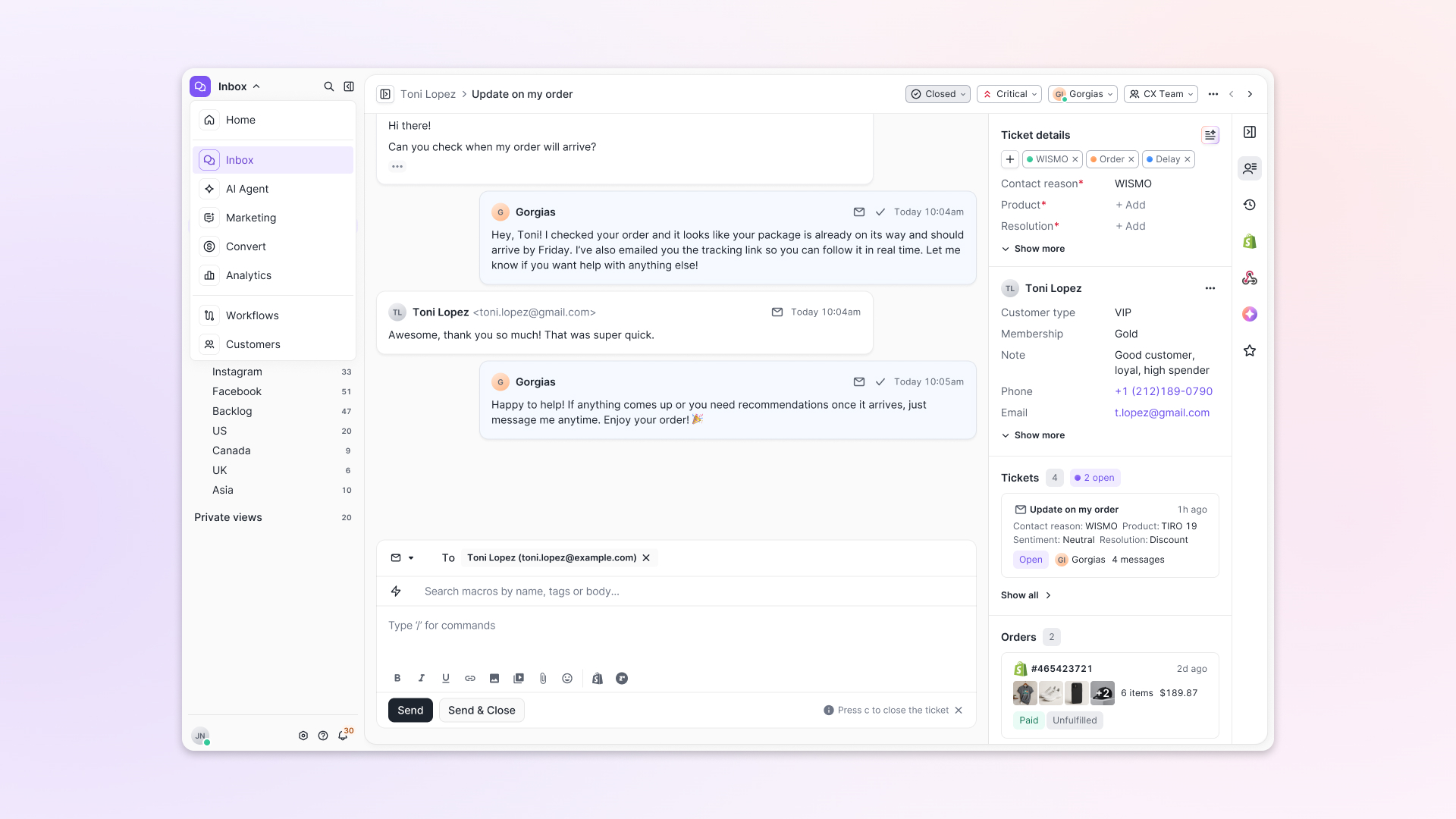
Say goodbye to the 2000s email interface and hello to chat bubbles. This updated design changes how quickly you can orient yourself and resolve the ticket in one go.
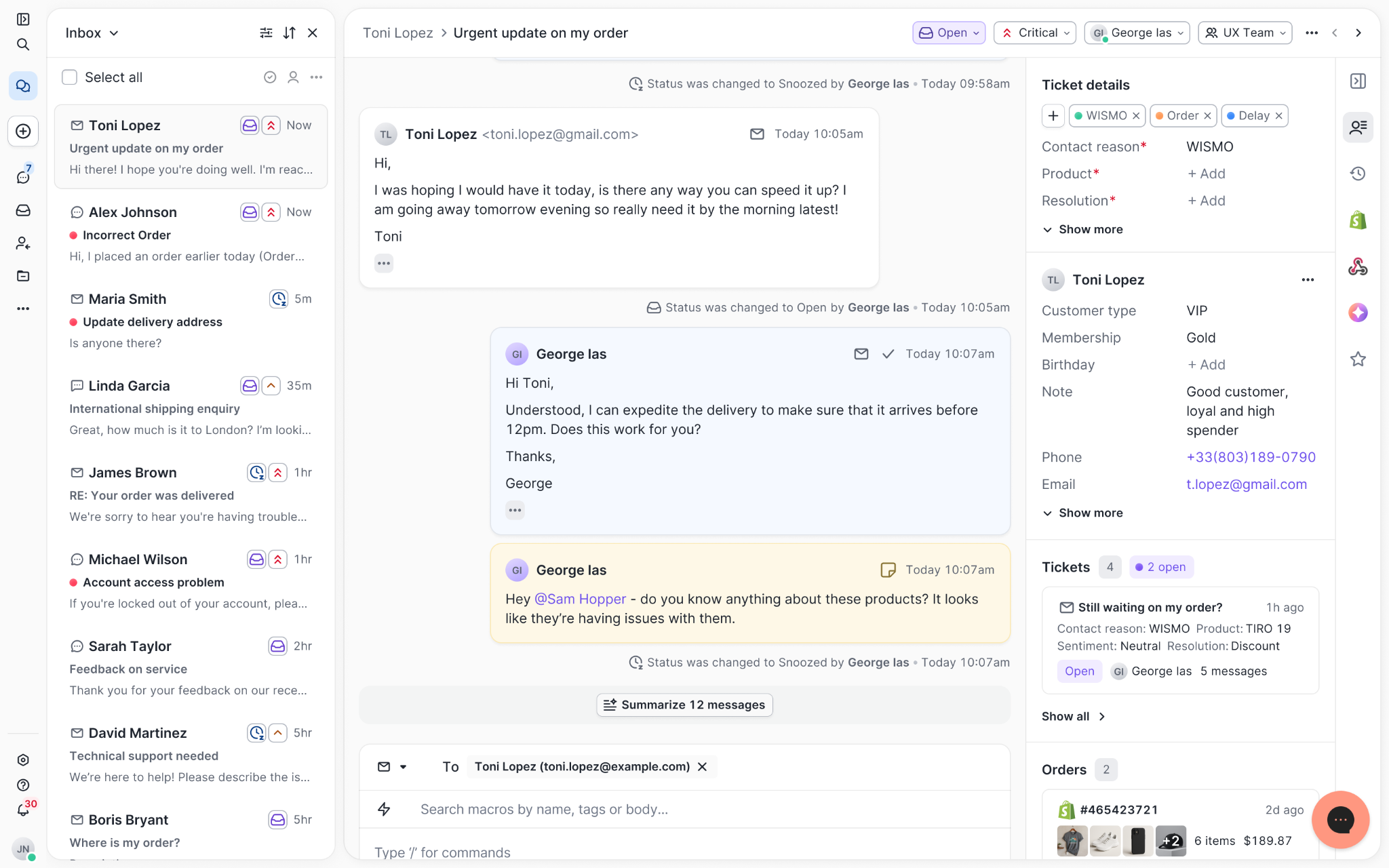
Chats with customers now look like real conversations, using the speech bubble style you’re familiar with on popular messaging apps.
Check customer history without losing your place
Checking a customer's history used to mean leaving the conversation, an extra step that interrupted what should have been a smooth workflow.
Now, past conversations open in a sidebar next to the active conversation. You can view a customer’s full history, search through their timeline, and open prior tickets without going to a new page.

Check past conversations, orders, and customer details in the brand-new Customer Timeline.
See order details the moment you open a ticket
Order information is easier to reference than ever. Open a ticket, and you instantly see the customer's recent orders, marked with product images and invoice details at a glance. Need to dig deeper? Click on an order, and the expanded information appears in the same panel.
For teams using custom integrations, apps are fixed in a quick-access integration menu on the right.
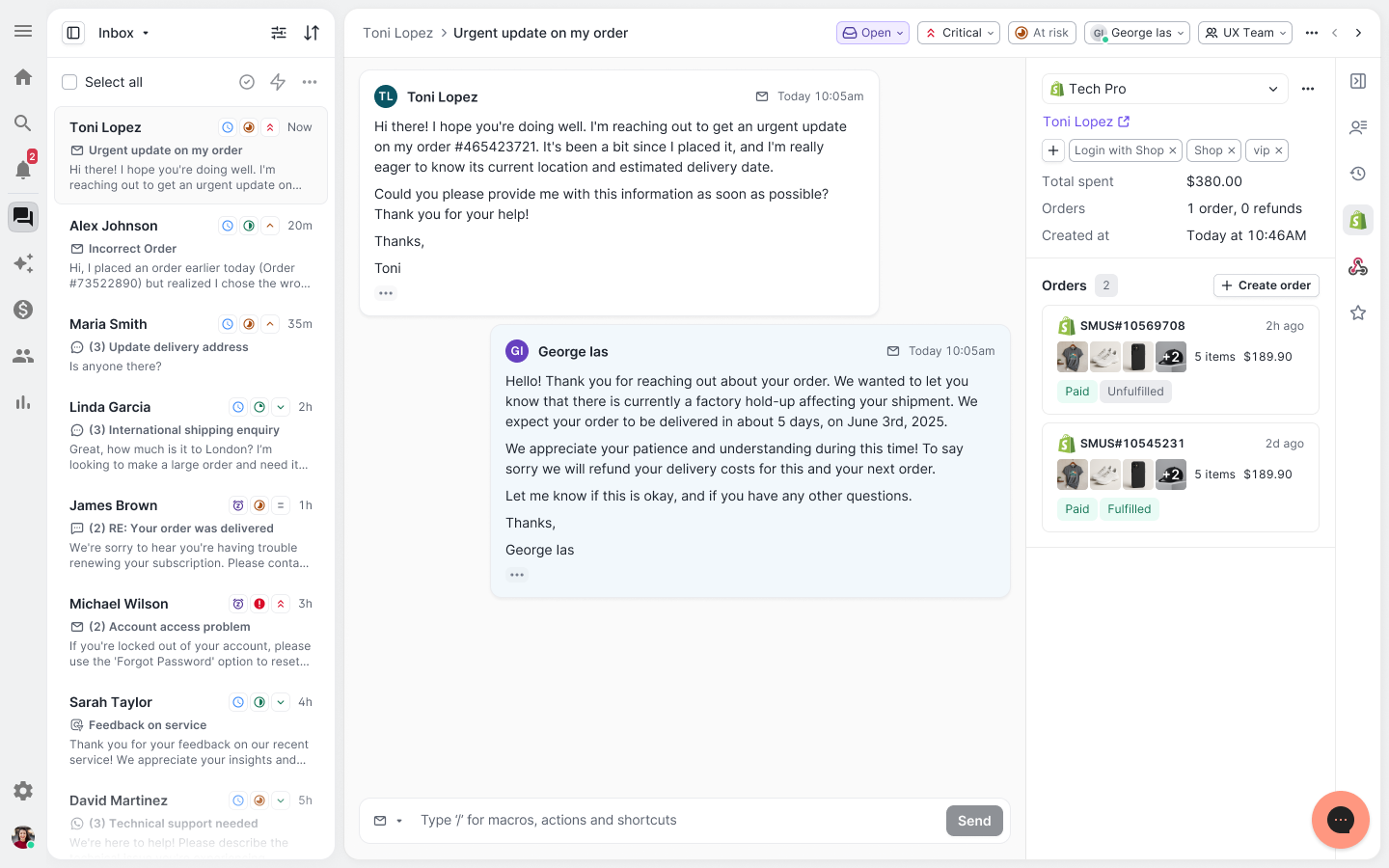
See order details, product images, and totals at a glance on the right panel, without leaving the conversation.
Pick up where AI left off
You shouldn't have to dig through a thread to figure out what AI already tried. Now you don't have to.
When AI Agent escalates a conversation, it includes a concise handover summary that mentions the issue, what actions were taken, and why it was passed to your team.
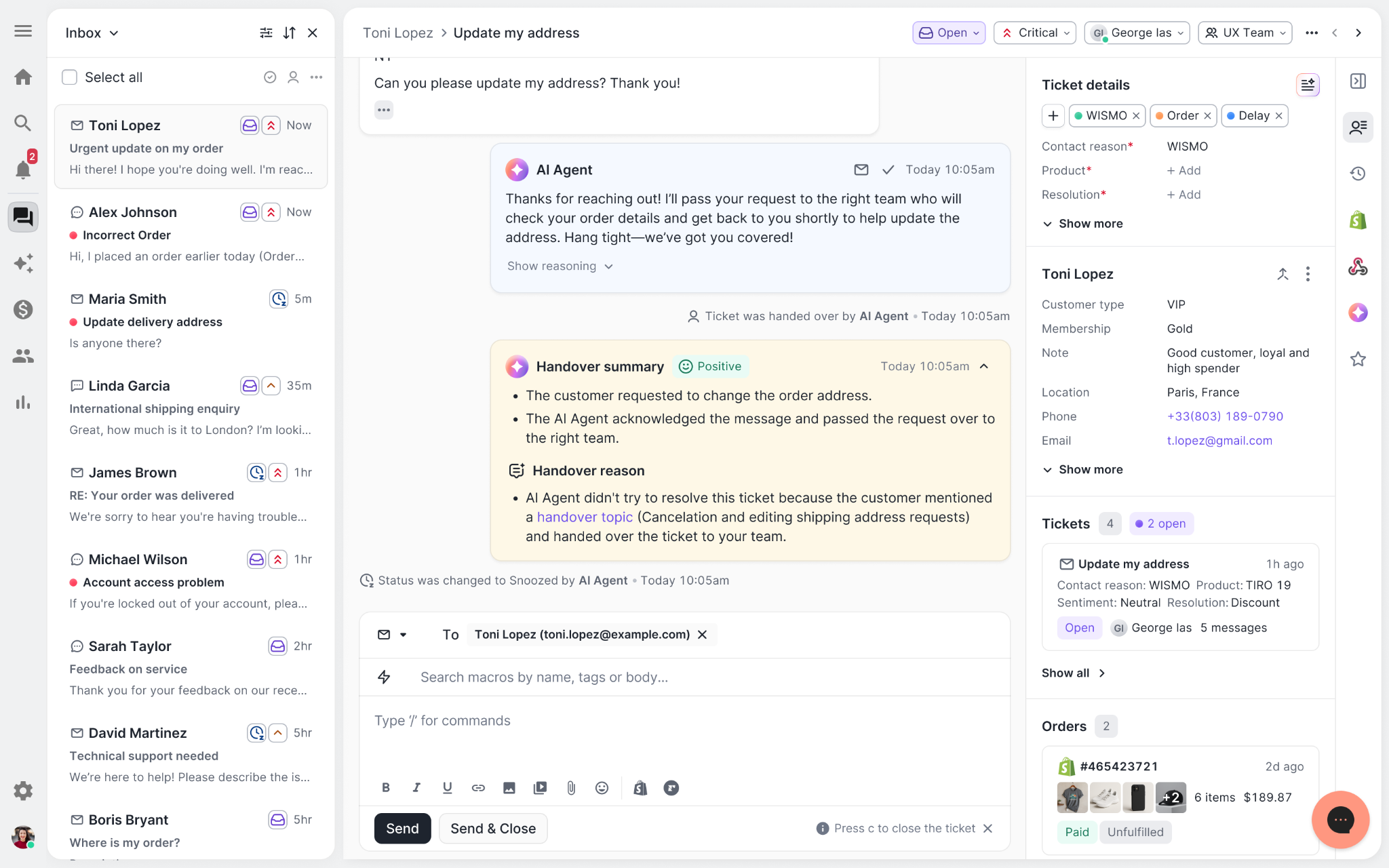
Escalated tickets include a brief AI-generated handover summary, marked in yellow, for quick reference.
Move faster across every store and team
We restructured and simplified the navigation. The left sidebar organizes everything into clear categories: Inbox, AI Agent, Marketing, and Analytics, so anyone on your team knows exactly where to go.
To quickly update your knowledge base or adjust a workflow, both now live right in the sidebar. For teams managing multiple stores, switching between them is just as straightforward, accessible from the sidebar, so agents can move between inboxes without breaking their flow.
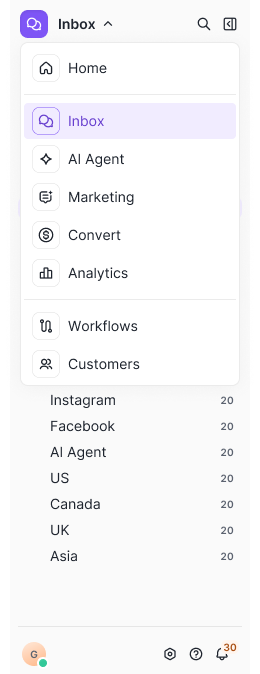
Agents can switch between stores and their corresponding inboxes directly from the left menu.
A workspace that works the way agents do
Support comes down to the person on the other end of the conversation. We built Helpdesk 2.0 is to make sure they have everything they need to show up for that moment.
The best way to see the difference is to work in it. Start a free trial today.


Further reading

Create a 5-Star Customer Experience with Reviews & UGC
Standing out and building a community of loyal fans is hard, and it’s even harder after the surge online shopping had in 2020. The mammoth amount of competition out there is constantly fighting for even the tiniest slice of ecommerce action.
To gain a competitive edge, brands must put their customers first.
In fact, companies voted customer experience as the most exciting opportunity for businesses over the next year, and it makes sense. Why? It’s because the customer experience drives sales. Research shows that brands with a customer experience mindset drive revenue 4-8% higher than the rest.
When your customers have a bad experience, it can wreak havoc on a brand and dramatically affect the bottom line. The problem is, it can be tricky to improve, especially if you don’t know where to start or what your customers actually want. This is where those customer reviews come into play
Not only do they help bolster customer support best practices, but these powerful assets give you a deep understanding of your customers — something that DTC brands are leveraging to the max. Customer-centric brands like Born Primitive, Beardbrand, Bombas, Tuff Wraps, and WAG are nailing customer experience by tapping into reviews and using them to leverage the buyer journey.
Read on to learn how reviews and UGC are helping brands create a 5-star customer experience.
Reduce the risk of returns
A clothing brand isn’t going to know how a jacket sits on every single body type, and they’re certainly not going to include this information in their product descriptions. Unfortunately, this can be a sticking point, especially since online shoppers aren’t able to try on products before they buy.
This unsurprisingly leads to more returns (while in-store returns are around 8%, online returns hover around 25%).
There’s a solution though, by strategically using reviews and UGC, brands can provide online shoppers with in-depth insights to help customers get exactly what they’re looking for. This is particularly essential for brands that use reviews with additional product and customer attributes, like shopper size and product color or type.

Born Primitive does exactly this, sharing customer attributes and photos alongside reviews to help buyers get an idea about how items might look on them.
Improve products and procedures
Your products are the crux of your business.
Fail to get your products right, and you’ll struggle to grow a flourishing business. This is one of the most important customer support tips for Shopify merchants — know thy customer and give them what they want.
Brands can fuel product development and internal procedures with customer feedback to continue to optimize the customer experience, all you need to do is listen.
Using real-life feedback from buyers to improve how they view and buy products, as well as the products themselves, ties into the customer-centric vision that successful DTC brands share. It also shows your customers that you’re an honest, and transparent brand working to give them the best product and best experience.
Take LSKD, for example. They’re using customer reviews to improve their products and to better align with customer wants and needs. The brand uses Okendo to capture reviews, respond to them, and gather crucial customer feedback.

In fact, the brand’s popular Rep Tights have been molded over the years by customer feedback to ensure they take on the attributes buyers are looking for. Through reviews, customers are able to share their thoughts on specific product points to fuel development.
Involving customers in this part of the process creates a community around a brand, and ensures you’re giving customers what they want.
And think about it: if a brand is giving customers everything you need, why would they go elsewhere?
Provide personalized and efficient customer support
Support and customer experience go hand-in-hand. If customer support is good, the customer experience tends to be good too.
Creating a good customer support experience is all about streamlining responses and separating those easy-to-answer questions from more complex ones. Brands can use reviews to automate commonly asked questions and personalize support based on the type of review a customer has given.
On a more basic level, reviews help retailers identify customers who might be experiencing problems with their order. This, in turn, allows brands to address and resolve issues by responding to customer reviews, turning the experience from bad to good in a matter of minutes. Which can end up saving a company from hitting a bit of a rough patch, or issue with further customer responses.

Tuff Wraps regularly replies to less-than-stellar reviews with extra information and an email address that customers can use to get in touch with support. This can help customers feel seen and heard and completely turn around what was initially a poor experience. Combining reviews and customer support in this two-pronged approach aligns with the common best practices for customer support on Shopify.
If you’re experiencing this issue with customers leaving negative reviews, we’ve got something that might help. With Gorgias’ integration with Okendo, you’re able to diagnose these problems and handle them seamlessly from a single dashboard. By leveraging this integration, merchants gain full visibility on customer reviews and their support history.
Use reviews to carve a better customer experience
As many of us know, reviews are key to creating a positive customer experience, especially when they form such a crucial part of the buying journey. Shoppers actively seek out peer reviews before they buy to get a better understanding of a product.
This is where Okendo can come in again, since it encourages customers to leave reviews complete with visuals and helpful attribute information. You can then use the reviews that come rolling in to glean valuable insights into the customer experience and identify ways to improve your products and the overall experience for your buyers.
Signup to Gorgias and leverage reviews to create a 5-star customer experience.

Why we raised our Series B, and what that means for our merchants
The Covid-19 pandemic has dramatically accelerated the move from offline to online in retail. This got us busier than ever supporting our merchants, new and old, to ensure we help them work towards providing exceptional customer service.
The latest example of this is Black Friday and Cyber Monday, where Shopify saw an uptick of 75% GMV when compared to last year.
As a result of this huge ecommerce spike, 2020 has been a massive year for Gorgias.
At the beginning of the year, we had just 30 people on our team and now, we’re sitting at over 100 incredible people working each and every day to help serve 5,000+ merchants.

The reason our team grew so much this year is to support the growth of our merchants.
Throughout the year, order volume has massively increased and therefore, lots of customers have been contacting businesses through customer service. We went from having 2 million support requests a month on Gorgias to 6 million during the holiday season.

So today, we’re announcing a $25m series B lead by Rajeev Dham at Sapphire Ventures, with participation of Jason Lemkin (SaaStr), François Meteyer (Alven) and other historic investors.
What’s our goal with this round?
We want to accelerate our progress towards our mission to transform support from painful to exceptional for merchants.
We asked our merchants and learned that they have the following needs: first they want their support to be fast and high quality, then they want to optimize their cost, and once they’ve done that, they are willing to shift the way they think about support to make it a profit center.

In 2021, we want to focus on the top questions our merchants are getting, which account for 60% of the support volume. By empowering support agents to respond faster to these frequent questions, we’re aiming at reducing first response time for our merchants and at increasing the quality of their support. This will free up agents time so that they can focus more on the more complex questions their customers are asking.

How are we going to do this?
- We’re building a help center so customers can self serve and find immediate answers to their most common questions
- We’re going to work on becoming a platform so that third party developers can integrate with Gorgias and provide more value to agents
- We’re improving our macro suggestions so that agents spend less time typing repetitive text and more time on custom responses
- We’re also adding new channels, including Instagram DMs, Whatsapp, phone and others
You can learn more about our next quarter roadmap here.
Looking further ahead into the future, our goal is to change the role of support from responding to customers’ issues to helping the business grow.
2021 is going to be a new chapter for us. With this round, we’re going to double our team to 200 people across all our hubs, in San Francisco, Belgrade, Paris, Charlotte, Toronto and Sydney.
If you’d like to join the adventure and help us improve the daily lives of 3 million support agents in the US (and more worldwide), we’re hiring aggressively in all these locations.
I want to thank our amazing team for helping build a company that has an impact on 60 million customers yearly, and the 5000 merchants who’ve decided to use our product every day.
The adventure continues, we’re more excited than ever!
Alex & Romain
.avif)
Ecommerce Business Plan: Complete Guide and Template
TL;DR:
- An ecommerce business plan maps your online store's strategy, operations, and financial goals to guide growth and secure funding
- Core sections include executive summary, company overview, market analysis, products and pricing, marketing plan, operations, and financial projections
- Unlike traditional retail plans, ecommerce business plans prioritize digital acquisition, logistics partnerships, and technology infrastructure
- A solid plan helps you secure funding, make data-driven decisions, and scale profitably — startups with business plans grow 30% faster
- Use a structured template to ensure you cover all essential components without getting overwhelmed by the process
An ecommerce business plan is your roadmap to build and scale a profitable online store. It outlines your target market, strategy, and financial projections to give you clarity as you grow.
A well-crafted plan keeps you focused on acquiring customers and driving revenue. Unlike traditional retail, ecommerce plans prioritize digital marketing, logistics, and technology infrastructure — the pillars of online commerce. According to research from Wiley, startups with a business plan grow 30% faster. A Harvard Business Review study also found they are 16% more likely to succeed.
This guide walks through every component of an ecommerce business plan. We provide actionable insights and expert tips to help you create a plan that works.
{{lead-magnet-1}}
What is an ecommerce business plan?
An ecommerce business plan is a strategic document that outlines your online store's objectives, target market, competitive positioning, operational approach, and financial projections. It serves as both a roadmap for growth and a tool for securing funding from investors or lenders. This document translates your business idea into a concrete strategy. It identifies potential challenges and shows stakeholders where your business is headed.
Unlike traditional retail business plans, ecommerce plans prioritize digital customer acquisition, logistics partnerships, and technology infrastructure. Your plan should address how you'll drive traffic to your store, fulfill orders efficiently, and leverage data to optimize the customer experience. The business world can be harsh — about 45% of businesses fail in the first five years. A comprehensive ecommerce business plan helps you avoid becoming part of that statistic.
Every ecommerce business benefits from a plan — whether you're launching a new store, seeking venture capital, or scaling an existing operation. Create your initial plan before launch, then revisit it quarterly to adjust for market changes, new product lines, or shifts in customer behavior. Here's who needs an ecommerce business plan:
- New store founders validating their business idea and go-to-market strategy
- Entrepreneurs seeking funding from investors or lenders
- Established merchants planning expansion or new product lines

Core components of an ecommerce business plan
A comprehensive ecommerce business plan includes seven essential sections. Each component serves a specific purpose — from defining your market to projecting your finances. Together, they create a complete picture of your business strategy, operational approach, and growth projections. Below, we break down what goes into each section so you can craft a plan that's both thorough and actionable.
Executive summary
The executive summary is a one-page overview of your entire business plan. It highlights your business concept, target market, competitive advantage, financial needs, and projected outcomes. Think of it as your elevator pitch in written form — concise, compelling, and complete. Even though it appears first, you should write it last. This allows you to distill the most important points after completing all other sections.
Your executive summary should answer these questions: What problem does your store solve? Who are your customers? What makes you different from competitors? How much funding do you need, and what will you use it for? This section needs to grab your reader's attention and convince them it's worth their time to read the entire document. Keep it under 300 words and focus on the most compelling aspects of your business model and unit economics.
Use clear, confident language that reflects your brand voice. Avoid jargon and focus on demonstrating what makes your business unique.
- Business concept and value proposition
- Target market and customer personas
- Competitive advantage and differentiation
- Financial highlights and funding needs
- Key milestones and growth projections
Company overview
Your company overview describes the fundamentals of your business: your name, legal structure, mission, and team. This section gives readers context on who you are and how you're organized to execute your plan. It typically appears second and provides vital details about your ecommerce business, including the size of your company, your location, and what you want to achieve.
Specify your legal structure — LLC, S-corp, sole proprietorship, or partnership — and explain why you chose it. Include your business name, domain, physical address (if applicable), and founding date. If you have a unique founder-market fit story that demonstrates your expertise in the space, share it here. This helps build credibility and shows you understand the market you're entering.
Your mission statement explains why your business exists. In a few sentences, it should describe what you strive to accomplish.
Introduce key team members, highlighting relevant experience and roles. Make sure you paint a picture of your team that showcases their professionalism and finest skills. If you're a solo founder, explain how you'll handle operations and growth as you scale. Consider outlining these team roles:
- Founder/CEO
- Operations manager
- Marketing lead
- Customer service lead

Market analysis
Market analysis is where you prove there's demand for your products. This section should demonstrate both your expertise and provide a thorough analysis of your current market. If you plan on tapping into a new market, you should also analyze it. Start by defining your target market — the specific group of customers most likely to buy from you. You must understand your target market. Never assume that everyone will want to buy your products. Create detailed buyer personas that include demographics, psychographics, pain points, and shopping behaviors.
Calculate your total addressable market (TAM), serviceable addressable market (SAM), and serviceable obtainable market (SOM). TAM represents the entire market for your product category. SAM narrows it to the segment you can realistically serve based on your business model and resources. SOM is the portion you can capture in the near term, considering competition and market dynamics. The industry market size is often a huge factor for investors that will read your business plan. You should also note if the market is declining or growing.
Identify your direct and indirect competitors. You want to know who is thriving in your niche, and why. Analyze their strengths, weaknesses, pricing, and customer reviews. This could be everything from their weaknesses to their web traffic, to their product and pricing strategy. Use a strengths, weaknesses, opportunities, and threats (SWOT) analysis to map your position relative to the competition. The more you know about your competition, the better you will be able to position yourself to stand out.
- Direct competitors: Same products, same target market
- Indirect competitors: Different products, same customer need
Highlight relevant trends that support your business case — shifts in consumer behavior, emerging technologies, or regulatory changes. Show investors you understand the market dynamics that will influence your success. This demonstrates your command of the competitive landscape and validates your business opportunity.
Products and pricing strategy
Describe what you sell, including SKU count, product categories, and any proprietary features. Explain your unique selling proposition—what makes your products different or better than alternatives. Describe all of your products, explaining their key benefits and features. They need to address a need that customers have or opportunities in the market. Show how your products differ from competitors. Highlight why customers will choose your product over other options. If you plan to expand your product line, outline your roadmap for the weeks, months, and years to come.
Detail your pricing strategy: cost-plus (markup on COGS), value-based (pricing tied to customer perceived value), or competitive (matching or undercutting competitors). A monetization strategy is a detailed plan about how to generate revenue for your products. Justify your pricing with data on production costs, competitor pricing benchmarks, and customer willingness to pay. Consider these pricing factors:
- Production and fulfillment costs
- Competitor pricing benchmarks
- Target profit margins
- Customer perceived value
If you have patents, trademarks, or proprietary technology, mention them here. Intellectual property can be a significant competitive moat. Even without formal IP, explain how your branding, customer experience, or supply chain creates defensibility. This helps investors understand what makes your business sustainable in the long term.
Marketing and sales plan
Your marketing plan outlines how you'll attract and convert customers. This segment of your business expansion plan is where you share your comprehensive marketing plan, identifying how you plan to promote your products, attract leads, and retain customers. Start with brand positioning—how you want customers to perceive your store relative to competitors. Define your brand voice, key messaging, and value proposition. Your marketing strategy will determine your growth.
List your primary acquisition channels: organic search (SEO), paid ads (Google, Meta), social media, email marketing, influencer partnerships, or affiliate programs. For each channel, estimate customer acquisition cost (CAC) and expected conversion rates. Here are the primary channels to consider:
- Organic search (SEO and content marketing)
- Paid advertising (Google Ads, Meta Ads)
- Social media (Instagram, TikTok, Pinterest)
- Email marketing and SMS campaigns
- Influencer partnerships and affiliate programs
- Referral programs and word-of-mouth
Calculate your customer lifetime value (LTV)—the total revenue you expect from a customer over their relationship with your brand. Your CAC should be significantly lower than LTV (ideally a 3:1 ratio or better). Map the customer's path from awareness to purchase. Identify key conversion points and drop-off risks.
Explain how you'll retain customers through lifecycle marketing: welcome campaigns, post-purchase follow-ups, loyalty programs, and win-back campaigns. To retain customers, consider rewarding them through a loyalty program. Retention is often more profitable than acquisition, so plan for it from the start.
Gymshark example: This go-to-market (GTM) strategy turned Gymshark into a category leader in athletic apparel, demonstrating the power of a well-executed marketing plan.

Operations & logistics
Operations and logistics cover how you'll source, store, and ship products. This section accounts for the day-to-day operations of your ecommerce store. Describe your supply chain: Will you manufacture in-house, work with wholesalers, or dropship? Identify key suppliers, lead times, and minimum order quantities (MOQ). Production is a very important component of success, so be very detailed.
Choose your fulfillment model: in-house (you handle storage and shipping), third-party logistics (3PL), or dropshipping. Each has trade-offs in cost, control, and scalability. Define your service level agreements (SLAs) for shipping speed and accuracy. Consider whether you will sell your products to international customers, how long it will take to package and ship them, and whether a third party shipment company will be necessary.
List the technology you'll use to manage operations: ecommerce platform (Shopify, BigCommerce), warehouse management system (WMS), inventory tracking tools, and shipping integrations. Explain how you'll monitor inventory turns and avoid stockouts or overstock. Here, you should include how much inventory you have at any given time and plan for how you will store, handle, and track product lines. Key operational metrics to track include:
- Inventory turnover rate
- Order fulfillment time
- Shipping accuracy and on-time delivery
- Supplier lead times
Transformer Table example: Transformer Table scaled globally by partnering with reliable 3PL providers and optimizing their shipping strategy. Their business plan included detailed logistics planning, allowing them to fulfill orders efficiently across multiple countries while maintaining high customer satisfaction. This operational excellence became a key competitive advantage.
Financial plan
Your financial plan proves that your ecommerce store can be successful. Start with your revenue model: How do you make money? Detail your pricing, sales volume projections, and expected growth rate. Create a three-to-five-year P&L (profit and loss) statement showing projected revenue, COGS, operating expenses, and net income. You will have the opportunity to demonstrate profitability by translating all the components of your business into numbers.
List your startup costs: inventory, platform fees, marketing, legal fees, and initial payroll. Undoubtedly, equipment will be required for your business to operate — list out what you have on hand, what you will need before you launch, and what you might need as your business grows. Build a cash flow forecast showing monthly inflows and outflows for your first year. Cash flow statements show the cash that comes in and goes out each month. Identify your break-even point — the moment when revenue covers all expenses.
Startup Costs: Inventory, Platform fees, Legal & licensing, Initial marketing
Operating Costs: Marketing, Payroll, Shipping, Platform fees
Calculate your unit economics: gross margin per product, CAC, LTV, and CAC:LTV ratio. These metrics show whether your business model is sustainable. If you're seeking funding from investors, specify how much you need, what you'll use it for, and when you expect to reach profitability.
Runway is how long you can operate before running out of cash. Build in contingency plans for slower-than-expected growth or unexpected expenses. Forecasting cash flow is very important, even if it is an imprecise practice. It allows you to prepare for a variety of different circumstances, such as a quiet season, and demonstrate how you will adapt your ecommerce business strategy accordingly. Investors want to see that you've thought through downside scenarios.

Platform & tech stack for your ecommerce business
Your ecommerce platform is the foundation of your online store. Popular options include Shopify (easy setup, extensive app ecosystem), BigCommerce (scalability and built-in features), and WooCommerce (flexibility for WordPress users). Choose based on your technical skills, budget, and growth plans. The platform you select will influence everything from your site's performance to your ability to integrate essential tools.
Beyond your platform, you'll need a payment gateway (Stripe, PayPal), CRM for customer service (Gorgias), email service provider (Klaviyo, Mailchimp), and analytics tools (Google Analytics, Shopify Analytics). Each tool should integrate seamlessly with your platform to create a unified tech stack. Your business plan should list the software, hardware, and machinery critical to the success of your operations. Here are the must-have tools:
- Ecommerce platform
- Payment gateway
- CRM and helpdesk
- Email service provider
- Shipping and fulfillment software
- Analytics and reporting tools
- Marketing automation platform
Customer service is revenue-critical for ecommerce. A helpdesk like Gorgias centralizes support across email, chat, social media, and voice — integrating with Shopify to provide agents full customer context. AI Agent can automate repetitive inquiries, freeing your team to focus on high-value interactions. Gorgias integrates with Shopify and over 100 ecommerce tools. This helps you streamline customer service and drive revenue with personalized support. Planning for customer support infrastructure from the start ensures you can scale efficiently while maintaining customer satisfaction.
Template & examples
We've created a structured approach to help you build your ecommerce business plan efficiently. A template includes all seven core sections with prompts and guidance to help you cover every essential component. Starting with a clear framework ensures you don't miss critical elements and helps you organize your thoughts systematically.
You now have the resources and tools to write a comprehensive business plan.
Traditional business plans are comprehensive (20-30 pages) and ideal for seeking funding. Lean business plans are shorter (1-2 pages) and focus on key metrics — perfect for internal planning or quick iterations. Choose the format that matches your immediate goals:
Traditional business plan:
- Comprehensive detail (20-30 pages)
- Includes appendices and supporting documents
- Best for investor presentations and funding applications
Lean business plan:
- Concise overview (1-2 pages)
- Focuses on key metrics and assumptions
- Best for internal planning and rapid iteration
Expert tips for writing your ecommerce business plan
A strong business plan is built on solid research. Before writing, gather data on your market, competitors, and customers. Use tools like Google Trends, SEMrush, and industry reports to validate your assumptions. The more evidence you provide, the more credible your plan. This research phase is critical — it's the foundation that supports every claim you'll make about your business opportunity.
Avoid jargon and buzzwords. Write in plain language that anyone — investors, partners, or team members — can understand. Use short sentences and paragraphs to improve readability. Bold key terms like SMART goals (Specific, Measurable, Achievable, Relevant, Time-bound) and use bullet lists to break up dense information. Your goal is to communicate clearly, not to impress with complex terminology.
Your business plan isn't static. Revisit it quarterly to adjust for market changes, new product launches, or shifts in customer behavior. Treat it as a living document that evolves with your business. Your business plan helps you attract investors. It also helps you overcome common obstacles that ecommerce businesses face. By planning ahead, you increase your chances of success and help to ensure that your business will enjoy a continued fruitful future.
Get support for your ecommerce business
Customer service is a critical component of your ecommerce business plan — it directly impacts retention, revenue, and brand reputation. Planning for customer support infrastructure early ensures you can scale efficiently while maintaining high satisfaction. When you map out your operations and technology stack, include how you'll handle customer inquiries, resolve issues, and turn support interactions into revenue opportunities.
Gorgias is built specifically for ecommerce businesses, integrating seamlessly with Shopify, Magento, BigCommerce, and 100+ other tools in your tech stack. Our AI Agent automates up to 60% of repetitive customer inquiries — like order tracking, returns, and product questions — freeing your team to focus on complex issues and personalized service. With full customer context at your agents' fingertips, you can deliver the kind of support that drives loyalty and repeat purchases.
Your business plan should account for customer service as a growth driver, not just a cost center. Gorgias helps you:
- Automate workflows and AI-powered responses to reduce response times
- Drive revenue through personalized support and upselling
- Scale efficiently without proportionally growing your support team
- Use insights from customer conversations to improve products and operations
See how Gorgias can support your ecommerce growth — book a demo today.
{{lead-magnet-2}}

Boost the quality of your customer service with conversation reviews
By doing quality assurance on the support side, you’re able to see what’s working, what triggers customers and how to train your team to improve. It’s also a great tool for your team’s personal development as a support agent.
Since it’s time consuming though, everyone wants to find a way to streamline.
The good news?
Klaus can do it, and there’s officially an integration that you can use with your Gorgias account to streamline it. Klaus is a quality review tool that helps you create a perfect customer experience for buyers and potential buyers
So, how does this help with the issues you may be facing with customer support quality assurance?
Let’s dive in.
It’s A Time Saver
As we just talked about earlier, customer assurance can be a time sucker. You may be manually looking at transcripts and organizing everything yourself, but there’s no need to do it this way. You know at Gorgias how much we love saving you time, so here’s how to reduce that with our new Klaus integration.
By pulling conversations automatically from your helpdesk, you can get instant review samples with erases the manually part of copy and pasting transcripts. Using Klaus, there’s also manual filtering options to help you quickly, and seamlessly, find specific cases or keywords you’re looking for.
For example, say you were curious about those tickets that took several responses to solve, or ones that received negative ratings from customers, you can easily pull those up in an instant
Notifications are also automatic when it comes to using Slack or email. By setting up these notifications, you’re able to ensure that none of your support agents misses a piece of their feedback. Thus saving you time, and constant reminders, to ensure that they receive these reviews.
It’s Efficient
You all know how we love having all our data and information in one place, and Klaus is the same as Gorgias. Their dashboard which allows you to track you team’s performance over time, see the aspects of their communication they may be struggling with and looking into their quality scores (which will get into), really makes things easy.
This full overview makes things efficient for you to see the overall health of your customer support team for your ecommerce business.
On top of that, reporting efficiencies are really easy. Reporting, no matter the department, tends to take up a lot of time. With Klaus, you can have all your efforts easily viewable in the dashboard.
Chris Lavoie, Tech Partner Manager
It’s Personalized
No matter the size of your ecommerce business or support team, you’re always going to want to know how each of your members are doing. Using customizable scorecards with Klaus you can create these to add in a rating criteria for a number of different situations (an unlimited about by the way!).
This is helpful when it comes to working with multiple teams or support channels since it allows you to efficiently track quality in as much detail as you need based on what you’d set the customizable scorecards for.
Klaus also lets you choose between different rating scales. For example, a binary thumbs up/down suit some people, while others would rather use the 3 or 5 point scoring system -- you choose what you prefer!
At Gorgias, we’re continuing to work on partnerships that will make your life easier, and Klaus is one of those that will make the difference in a critical part of your strategy. Haven’t tried Gorgias out yet? Give it a try for 7-days free and see how it can make your life more efficient and simple when it comes to your ecommerce store and customer support.
Your online store, mixed with the e-commerce helpdesk Gorgias, and topped with the quality review tool Klaus - that’s how you cook purr-fect customer experiences for your buyers.
You don’t even have to write this recipe down because we’re excited to announce that we’ve just released the native Gorgias and Klaus integration! You can now pull your customer conversations from Gorgias seamlessly into Klaus for internal support QA and provide consistent feedback to your agents.
There’s a number of reasons why Gorgias can be the best solution for your online store. And there’s a lot of sense in using it together with Klaus if you want to provide your customers with top-notch customer care.
Let’s look into the magic that you can unleash with the Gorgias and Klaus integration.
Gorgias for extraordinary e-commerce experiences
If you’re running an online store then you probably already know that e-commerce customer service is not just about helping your users. It’s about converting customers, increasing sales, and growing your business.
To reap the benefits of having a revenue-driving e-commerce support team, set your team up for success with the right tools. A regular helpdesk may be enough to give timely answers to your online visitors’ questions, but it might not reveal the full potential of each of your customer interactions.
That’s why dedicated ‘e-commerce helpdesks’ are a thing now, and why Gorgias has become so successful in this category. Here’s what sets Gorgias apart from other more generic helpdesk solutions:
- Focus on converting visitors into customers: Give your customers the same kind of personalized service that you would when visiting a physical store. Chat with customers to give recommendations, feedback, and special offers.
- Engage with people before they visit your store: Gorgias allows your agents to respond to people’s questions and comments on your social media ads and posts. Increase your ad effectiveness and sales results in one go.
- Track your support team’s sales results: See which support interactions - in text messages, social media answers, and live chat conversations on your website - lead to sales. Build your sales and support strategies to maximize the results.
Gorgias also delivers information about the customers’ previous orders and other nifty functionalities that help you turn your customer service team into a sales department - and, as a matter of fact, a very successful one.
But how can you make sure that your customer service agents actually nail every sales opportunity hiding in your support interactions? That’s where Klaus comes in.
Klaus for consistent customer care quality
 |
Klaus is a conversation review and support QA tool dedicated to helping your agents make the most out of every support interaction. It’s a platform for having a systematic insight into your customer conversations, providing consistent feedback to your agents, and gaining control over support performance.
You can’t improve your support quality if you don’t measure it. And Internal Quality Score - the metric of conversation reviews - does just that. It makes the quality of your customer service quantifiable and allows you to track and compare your team’s performance over time.
While some smaller teams prefer to manage their internal quality reviews in spreadsheets, companies like Automattic, Wistia, PandaDoc, and Geckoboard, have trusted the manual work behind support QA to Klaus. Here’s why:
- Instant review samples: Klaus pulls conversations automatically in from your helpdesk. That means no manual copy-pasting of ticket data and saves you a good few hours every week.
- Advanced filtering options help you find the specific cases you’re looking for - e.g., those that took several responses to solve, or those that received a negative rating from your customers.
- Customizable scorecards: Create as many scorecards as you’d like. If you’re working with multiple teams or support channels, you can create a separate rubric for each. Add the rating criteria that makes sense to each particular situation, and track the quality in as much detail as necessary.
- Klaus also allows you to choose between different rating scales: a binary thumbs up/down suit some teams, while others prefer the 3- or 5-point scoring. The choice is yours.
- Quality metrics dashboard: Track your team’s performance over time, see which aspect of their communication they are struggling with the most, and zoom into specific agents’ quality scores. You’ve got a full overview of how your team performs against your quality standards.
- Klaus’ quality dashboard makes reporting ridiculously easy, too. All the efforts you put into training and coaching can now easily be seen reflected in your team’s performance.
- Automatic notifications: Slack and email notifications make sure that none of your agents ever miss a single piece of their feedback. Learning about their areas of improvement is the only way your team can become better at what they do, so make sure your agents get the feedback they need.
Klaus is a very dynamic and customizable tool and that’s why it works well with all customer service teams. If you want to boost your online store sales results through your support team, make sure you create the respective rating categories, measure your agents’ performance in them, and give regular feedback on how to score higher.
We’re firm believers of support-driven growth and we’ve written more about building customer loyalty through customer service here. Go forth and prosper!
Gorgias + Klaus join forces
Your e-commerce customer service is running on Gorgias and now you want to start improving your customer service quality and drive more sales with Klaus? Can be done easily.
 |
Connecting your Gorgias account with Klaus is easy as one-two-three with our native integration seamlessly connecting these software solutions. To set up the connection:
- Sign in to your Klaus account or create one if you don’t have it already (comes with a 14-day free trial, no strings attached).
- Connect your Gorgias account with Klaus with the help of your Gorgias’ subdomain (yourcompanyname.gorgias.com) and API key.
- Create your quality scorecard: define your quality criteria in rating categories and accompany it with a suitable rating scale.
- Invite your team members to the Klaus party. We’ve already pulled the list of your team members over from your Gorgias account, all you have to do is decide who gets to be the reviewers, agents, and admins of your account.
- Review your first conversation (and the second, and the third - we know, it’s addictive). Track your team’s progress in the quality dashboard.
There you go, you’ve built yourself a scalable way of assessing your support team’s performance and providing individual feedback to your agents with no unnecessary hassle.
The Gorgias and Klaus integration can give your customer service such an advantage that it almost sounds unfair. Poor competitors of yours!
Getting control over your support interactions and turning them into your sales reps is an art that not everyone can master. Working with the right tools is a quick shortcut to success.
We’re excited to welcome Gorgias into our extended family connected through our native integrations. Which other integrations would you like to see on our list? Share your thoughts in our online CX community The Quality Tribe.


Creating a Seamless Customer Experience with Gorgias & BigCommerce
No matter what product or service you sell, customer support is always one of the highest priorities. If you don’t give your customers the best support and experience possible, a few things can happen:
- You can lose customers… fast
- Receive poor reviews
- Stress out your own internal team
- And much more.
The good news is, if you’re here you’re already thinking in the right way -- you want to enhance your support so that it’s seamless for both the customer, and your team.
That’s why all BigCommerce store owners can now integrate with Gorgias to deliver an outstanding customer support experience to consumers.
 |
Gorgias is all about the customer-first model and this aligned vision with BigCommerce stores can bring your business to the next level.
But Why Does It Matter?
We touched on that a little bit already, but let’s dive in more on why support actually matters.
Countless business owners view the support side as a cost centre, but when you look at it as more than that, this is when you really start seeing success. By improving satisfaction overall, you’re able to maintain loyal customers, which is key to growing your store. On top of that, you can increase engagement on-site and also across social channels because when people have a good experience with a brand, they love to share the story.
Of course, at the end of the day, it also heavily contributes to sales. Using live chat and other means of customer support channels you can advise people quickly on what the best product for them is. When you create those loyal customers, word of mouth can be one of your strongest driving forces.
How To Actually Give Customers World-Class Experiences
Nowadays your audience and customers are everywhere. On top of that, they want the same experience across all channels which can sound very overwhelming. That being said, it is possible to make everything from social media to live chat, phone and beyond (we’ll talk about that in a little bit) work together seamlessly. By making all these channels easier to check on and respond on, it’ll help immensely with organization and responsiveness.
 |
We all know that the faster you respond the happier the customer will be. The issue is, countless stores have a low response time, and this offers a big opportunity for those who can do better. Not only does it lead to higher customer satisfaction, but it can lead to more sales too.. For instance, if someone is asking your support team about a particular product, there’s a good chance they have other stores open in other tabs, and if you can answer that customer first they may be more likely to go with your product over another.
Lastly, don’t forget that sounding robotic isn’t cool and customers can usually read right through it. By being human, you’re able to have a more personal relationship with customers as opposed to something strictly transactional. By personalizing answers, your customer will truly feel like you care and know them, making it far more likely that they’ll purchase from your store again.
How can Gorgias help BigCommerce brands?
Well, let’s start with a couple words from Iris Schiefer, Sr. Strategic Partnerships Manager, EMEA at BigCommerce. She knows what Gorgias can do to help shop owners out, saying that it “allowsBigCommerce merchants to offer an exceptional support experience and deepen relationships with customers.”
 |
This is fairly broad, and that’s because there’s lots of ways Gorgias can benefit your BigCommerce store. By using Gorgias, you can actually cut your customer support first response times and ticket resolution time without losing that precious human touch element.
Gorgias allows BigCommerce merchants to offer an exceptional support experience and deepen relationships with their customers. We are strongly aligned in terms of both our values and dedication to providing best-of-breed solutions to our merchants - We couldn't be happier to have Gorgias on board as a BigCommerce partner.
- Iris Schiefer, Sr. Strategic Partnerships Manager, EMEA at BigCommerce
We understand, it sounds too good to be true, but it is possible. So, let’s dive into a few things you’ll be able to do if you integrate Gorgias into your BigCommerce store.
One place for customer support
You can connect BigCommerce along with all your communication channels including email, social media, phone, live chat and more to Gorgias. This centralizes everything into one platform so that it's all in one place. This allows you to not miss any requests, and handle responses much faster.
With Gorgias, you can view your customer’s order history easily from the BigCommerce backend. This way, you can ensure speed and accuracy in responses as opposed to switching between tabs or cutting and pasting.
Personalization becomes easy and far less time consuming as well. With Gorgias, you can integrate data provided by BigCommerce like first name, shipping address and much more. This gives you the opportunity to send automatic and accurate messages for a personalized customer experience.
Repetitive questions can get frustrating, but Gorgias also has a function to get to these quickly and easily. You can automate answers to common questions to save valuable time for your team, that way they can focus on new customers and those with more complicated requests.
When you integrate Gorgias, you’re also using advanced machine learning to detect the intent, along with sentiment of each and every message. This means that by learning about tracking updates, return policies and urgency, Gorgias helps set priorities and categorize tickets based on what they’re all about.
Just like every other area of your business, tracking customer support performance is essential. Using Gorgias you can track KPIs to ensure you and your team are on track to delivering incredible support.
How does the Gorgias + BigCommerce integration work?
By integrating Gorgias, you’ll be able to also integrate with some of the biggest Apps in the BigCommerce Marketplace including Klaviyo, Omnisend, Smile.io and many more.
Now, how do you get started? It’s easier than you might think:
- Sign up for Gorgias (if you haven’t already).
- Go to your BigCommerce account and Install the Gorgias App.
- You’ll receive a request to access your store from Gorgias then click Confirm, then Connect.
- From there, you just add in your Gorgias authentication credentials, which is simply just your Gorgias helpdesk name.
- After hitting save, you can now sync your BigCommerce customers who haven’t placed an order by selecting “sync customers who haven’t placed an order.” Then select the order cut off and hit Save.
- Now, you’ll see an active green icon and this means you’re good to go!
You can find a more detailed step by step guide here.
Are you building out your ecommerce tech stack and seeking more app recommendations for BigCommerce? Check out our lists of:
By the way, if you haven’t already signed up for Gorgias, you can start off by getting a free, 7-day trial to test it out on your BigCommerce store!

How to Boost Sales with Blog Content for eCommerce Brands
The fact is that content marketing can help an eCommerce brand immensely, given that content is a foundational element for visibility in the SERPs, social media engagement, the cultivation of thought leadership and industry authority, lead generation, customer self-service, and other vital business activities.
But the reality is that most blogs fail, and for a variety of different reasons. One of the most prevailing is that it doesn’t generate immediate results, ultimately discouraging future content creation.
However, there are various tactics that merchants can use to cultivate traffic to blogs and boost conversions as a result of those visits.
For merchants who want to take advantage of the benefits that content marketing has to offer, here are seven ways to boost conversions with eCommerce blog content.
Focus on User Intent
One of the best ways to gain more site visitors who turn into paying customers is to create content that targets the intent of the user.
Of course, “user intent” is the reason behind the individual’s Google search. It is the outcome they aim to achieve.
For instance, if a consumer searches "best Bluetooth headphones," the intent behind the user's search is to obtain information that will narrow down their purchase options to just a couple of products.
When looking at how people search, there are three main types of user intents, often referred to as “Do, Know, Go.” Those intents are:
- Transactional (Do): Here, a consumer is aiming to make a purchase or some other form of transaction.
- Informational (Know): With this type of search, people are looking to learn, as in the aforementioned headphones example.
- Navigational (Go): When conducting such a search, users are trying to get to a specific website or location. These can often be branded searches.
When creating content for a blog, merchants will likely be targeting information queries. These types of searches will result in a consumer finding high-ranking materials that relate to their search for knowledge.

Alternatively, a transactional search will often lead shoppers directly to product pages.
However, this isn’t to say that sellers shouldn’t link to their item listings within information blogs, assuming that the product is relevant to the piece. This can actually be a great way to pull a shopper from the top of the funnel down to deeper stages. More on this momentarily.
The sales funnel model is something that marketers use to delineate the path to purchase that consumers take. While there are numerous iterations of this model, the basics are that:
- Consumers become aware of a product
- Prospects then begin to consider the product, research and compare their options
- Consumers make a decision and purchase a product or service
The job of site owners is to get consumers to move through the entirety of the brand’s sales funnel. Since awareness and research are highly dependent on the content offerings available to shoppers, merchants must craft quality content that targets top-of-funnel prospects.
Optimizing top-of-funnel content relies on uncovering and integrating long-tail keywords into various pieces. Since long-tail phrases are highly-specific and generate less search volume (and more conversions) than broad-head keywords, these phrases are a must.
Fortunately, a variety of tools such as Answer the Public, Keyword Tool, Ubersuggest and many others are geared specifically towards this task.
While all of these tools are extremely useful, Answer the Public is a favorite as it provides long-tail keywords questions that consumers are searching, thereby cluing in retailers even further as to what precisely potential buyers want to know.
In addition to these tools, sellers can also mine incredibly useful information about consumer queries from sites like Quora, Reddit and similar boards.
Speaking of answering questions, we also recommend you host an FAQ page on your website to help customers. Check out our free FAQ template to get started.
Optimize for SEO
While this idea was touched upon slightly with targeting long-tail terms and phrases, there is a lot more to optimizing content for conversions than just plugging in a few keywords.

For retailers to get the visibility required to earn clicks and conversions, it is necessary to optimize blog posts according to Google’s SEO ranking factors. Some tactics that merchants will want to utilize include:
- Optimizing for the targeted keyword
- Employing keyword variations
- Adding images and optimizing alt tags
- Linking to authoritative, relevant external pages
- Including related links to internal destinations
- Ensuring content is readable/scannable
- Creating a proper meta title
Additionally, while meta descriptions have no bearing on SEO performance, they do influence clicks, which does impact rankings. Therefore, crafting a concise, alluring and accurate meta description is also a necessity.
Link to a Relevant Product
Linking to a product within a piece of content is a simple yet effective tactic for driving clicks to product pages and earning conversions.
However, the key thing to remember here is that the item must be relevant to the content. If sellers create a blog centered on ways to remedy plantar fasciitis and then include a link to great running shoes, that link will generate very few clicks and even fewer sales.
Alternatively, if a seller talks about and links to shoes or inserts for plantar fasciitis, it is far more likely that the content will earn sales as a result of the internal link.
The point of the post is to solve the reader's problems. If merchants have a product that can achieve that goal, then it is vital to include a link to the item. That said, do not promote products that are not relevant to the piece just for the sake of promotion. Doing so could damage a store’s credibility in the consumer’s eyes.
Employ Social Proof
Social proof has become a necessity in the eCommerce industry. With all the shady dealings that are happening online, consumers want to know that what they are getting is the real deal.
Therefore, including social proof within content and on product pages is a powerful strategy for increasing conversions and encouraging that elusive second purchase.
Some excellent forms of social proof that can be deployed in content or on product pages include:
- Testimonials
- Reviews
- User-generated content from social media

By providing the evidence that other customers love their purchase, others are more likely to follow the same path.
Utilize Visuals
Visuals are a critical element for content.
Including images throughout blogs dramatically increases the readability of the piece and helps consumers to retain more of the information contained therein. The fact is, nobody likes reading massive walls of text.

Therefore, several ways that merchants can increase the readability of a piece and keep it engaging include:
- Using screenshots to demonstrate ideas, topics of discussion or uses of a product
- Employ visual indicators like graphs or charts to highlight figures
- Summarize blog posts using embeddable, easily shared infographics
There are a slew of tools out there for creating such visuals, including Canva, Pablo, Easil and many others.
If merchants are looking to create content that converts, visuals are a must.
Include a Clear Call-to-Action
No matter if merchants are looking to drive traffic to product pages, get readers to share a post or simply generate comments, including a clear, direct call-to-action is vital to meeting that goal.
The fact is that if a merchant wants to achieve something with their content, they often must make it explicit by letting consumers know what step they should take next.

By including a call-to-action at the end of a piece for visitors to check out a product page or other content, retailers are far more likely to generate conversions than if they were to leave consumers to their own devices.
Retarget Content
For retailers who employ tracking pixels, those who visit their site can be retargeted to on Google, through social media and other popular online destinations.
Retargeting is an essential tactic for earning more conversions as consumers have already shown interest in a brand’s offerings–be they content or products.
While some consider retargeting to be an off-putting practice, looking at the facts about retargeting shows that this strategy is extremely useful in reaching consumers, generating sales and optimizing conversion rates.
In today’s attention economy, merchants must remain top-of-mind. Retargeting adverts help them achieve that end.
Final Thoughts
Creating eCommerce content that drives conversions is critical for merchants to compete in the increasingly crowded online retail industry. Moreover, by targeting user intent with such pieces, sellers can reel in new readers and bolster their customer base while still catering to existing shoppers.
For other ways to grow your ecommerce store, check out our list of ecommerce growth tactics.
Utilize the strategies listed above to help ensure that your company’s content earns the visibility it needs to generate clicks and conversions from shoppers–new and old. Don't have enough time to start a blog? Check out our ecommerce customer service automation guide to see how you can save time by automating many of the repetitive tasks that go into running an online store.

Building delightful customer interactions starts in your inbox
