Search our articles
Search

Featured articles

Conversational Shopping Trends

Conversations Are Becoming a Revenue Channel: The Data Proves It

Brands using AI-driven conversational commerce are seeing measurable gains in purchase rates, retention, and AOV. The data from 16,000+ ecommerce brands shows why conversation has become the new path to checkout.
By Gabrielle Policella
0 min read . By Gabrielle Policella

TL;DR:

  • Customer journeys are collapsing to a single conversation. The traditional browse-and-buy journey is giving way to AI-guided shopping that moves from discovery to purchase in a single exchange.
  • 79% of brands say AI-driven conversational commerce has increased their sales and purchase rates.
  • AI-only influenced orders grew 63% in a single year, from 2.7 million in Q1 to 4.4 million in Q4.
  • Brands treating conversation as a revenue channel. They’re not just a support function, generating higher AOV, shorter buying cycles, and stronger retention.

The page-based shopping experience dominated for decades. Customers would search, browse, compare, abandon, get retargeted, return, and eventually buy (sometimes). 

That journey is no longer the only option.

Shoppers are turning to chat, messaging, and AI-powered tools to find what they need. Instead of clicking through product pages or reading static FAQs, they ask questions, have back-and-forth conversations, and get answers that move them closer to a purchase in real time. The path to checkout has changed, and the brands that recognize this are pulling ahead.

Read our 2026 State of Conversational Commerce Report to learn more about conversation commerce trends from 400 ecommerce decision-makers and 16,000+ ecommerce brands using Gorgias. 

{{lead-magnet-1}}

The shopping journey has collapsed into a single thread

The traditional shopping journey was a solo experience. A shopper had a need, searched for options, browsed across sessions, and eventually made a decision — often days later, after being retargeted multiple times. Support only entered the picture after the purchase.

Side-by-side comparison showing traditional page-based shopping with multiple steps and drop-offs versus a streamlined conversation-led journey with AI guidance and fewer friction points.

The conversation-led journey collapses that timeline:

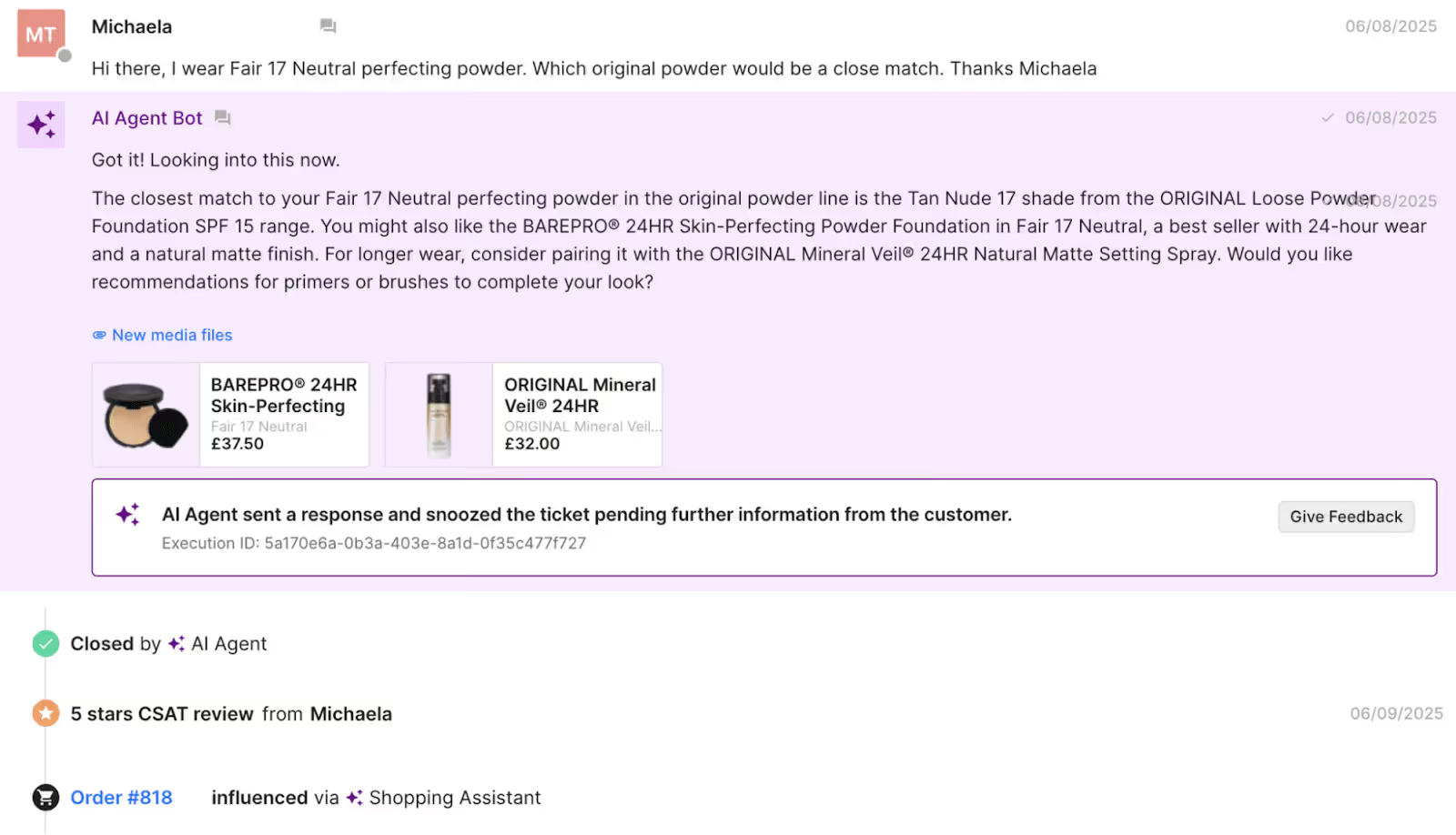
  1. A shopper recognizes a need and starts a conversation via chat, messaging, or a search-triggered prompt
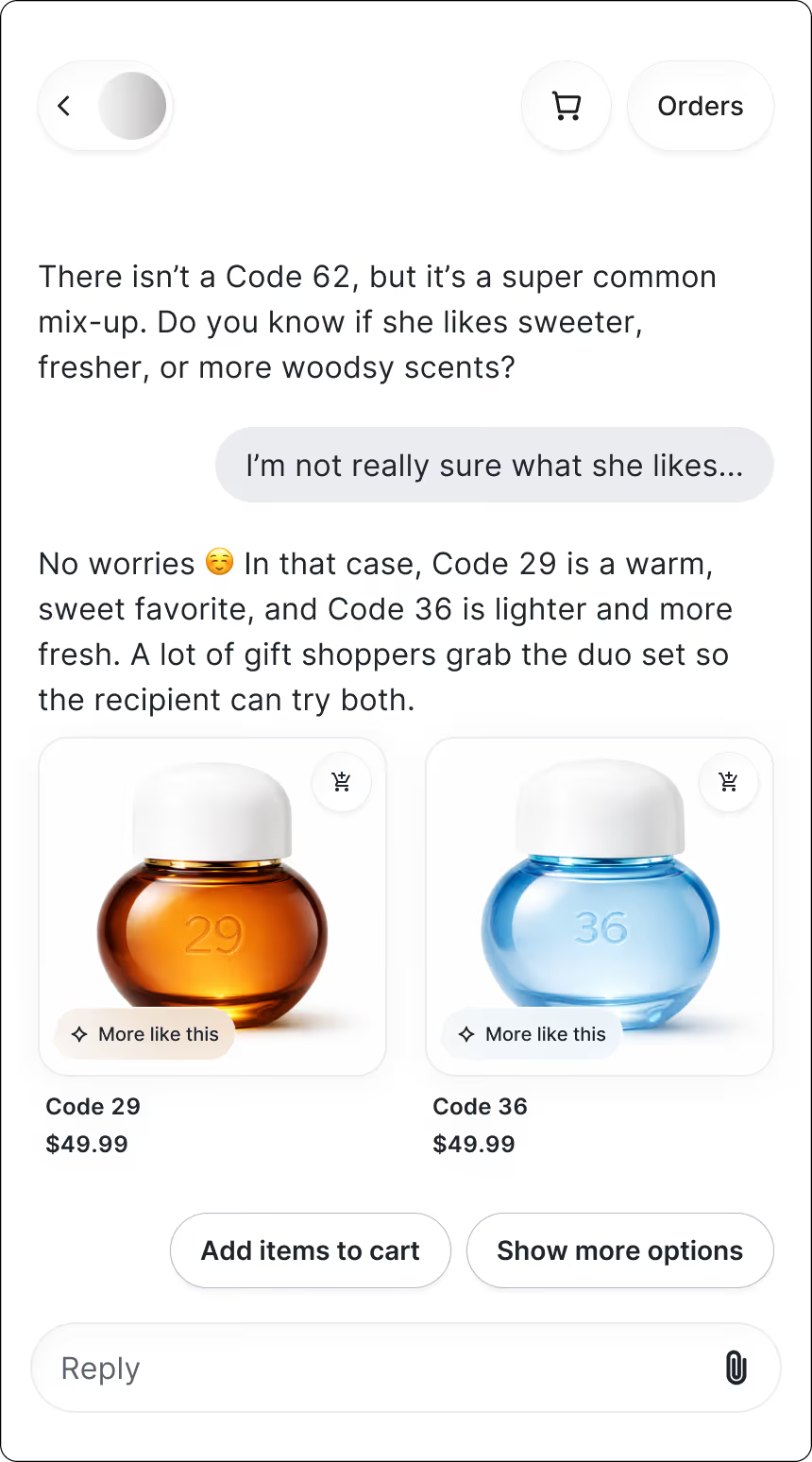
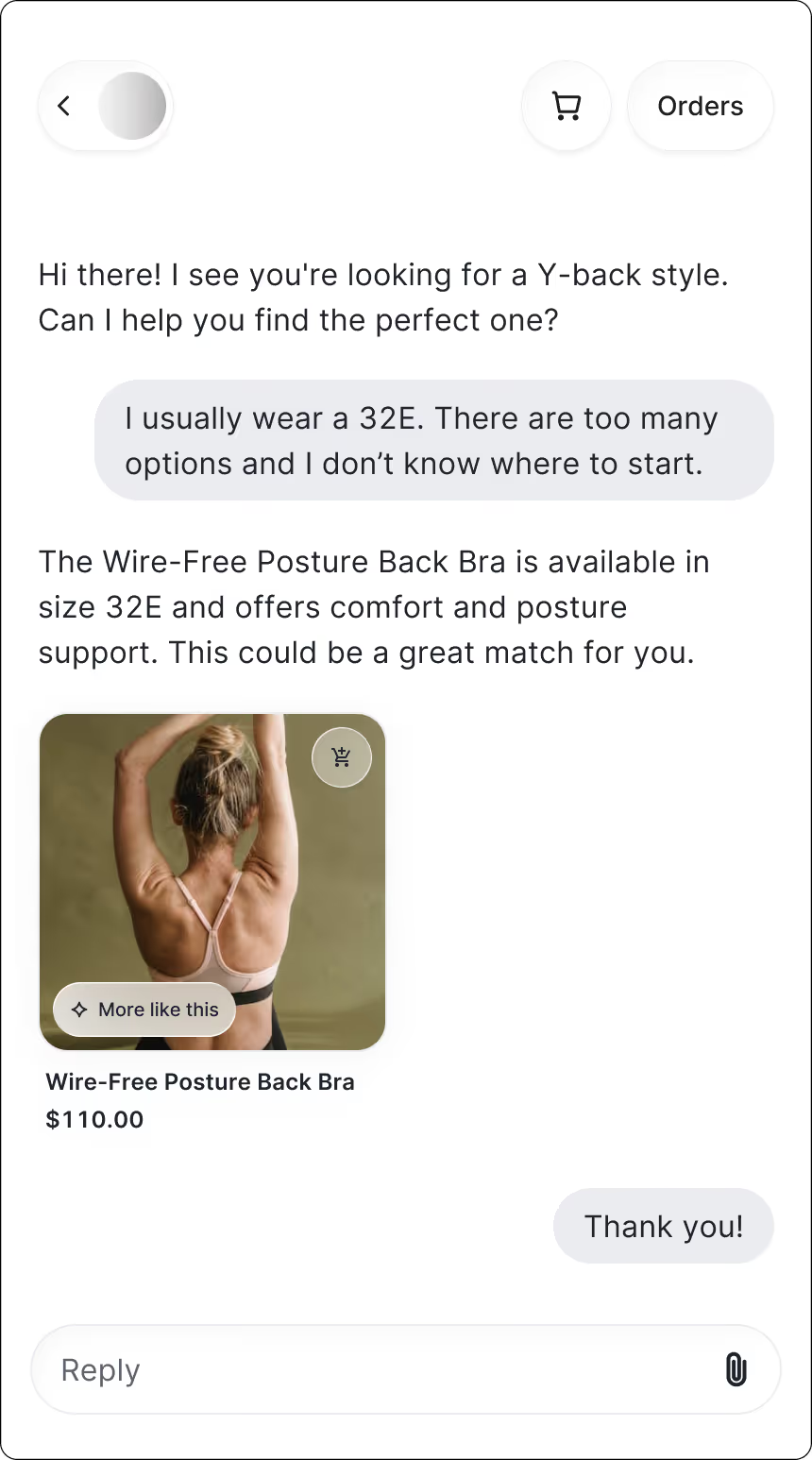
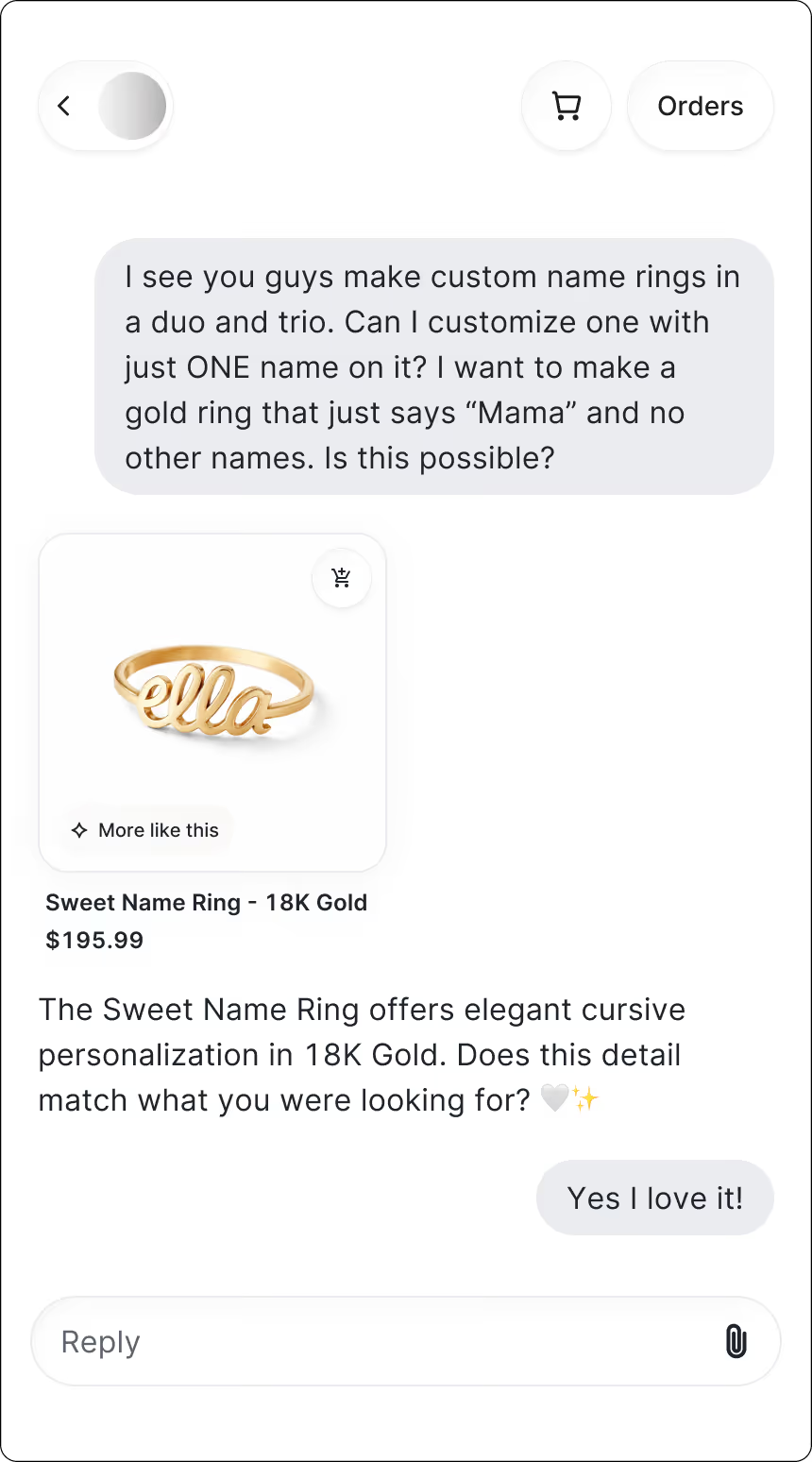
  2. An AI agent asks clarifying questions about preferences, budget, and constraints
  3. The AI provides personalized product recommendations in real time
  4. The shopper validates concerns about fit, compatibility, delivery, and returns, all inside the conversation
  5. The shopper completes the purchase directly within or immediately after that exchange
  6. The AI picks up the conversation post-purchase for order tracking and proactive support
  7. A human agent steps in only when the situation calls for it

What used to take days now takes minutes. Discovery, evaluation, and purchase happen in a single thread.

Conversation is a revenue strategy, not a support upgrade

79% of brands agree that AI-driven conversational commerce has increased sales and purchase rates in their business. When brands were asked to rank the highest-return areas:

  • 38% cited improved customer support efficiency
  • 23% pointed to higher customer retention and loyalty
  • 20% saw improved purchase rates

Those numbers reflect something important: the value of conversation compounds. Faster support reduces friction. Better retention raises lifetime value. More confident shoppers buy more often and spend more per order.

The brands seeing the biggest returns aren't just using AI to deflect tickets. They're using it to create one-to-one shopping experiences at scale.

What the data shows about AI-influenced orders

Looking at AI-only influenced orders across key verticals like Apparel and Accessories, Food and Beverages, Health and Beauty, Home and Garden, and Sporting Goods, the growth across a single year was significant. 

Quarterly bar chart showing conversations linked to orders increasing from about 2.7M in Q1 to 4.4M in Q4, with a small share influenced by AI.
Quarterly bar chart showing conversations linked to orders growing from about 753K in Q1 to just over 1M in Q4, with a small AI-driven portion.
Quarterly bar chart showing conversations linked to orders growing from about 2.05M in Q1 to 2.82M in Q4, with a small portion influenced by AI.
Quarterly bar chart showing conversations linked to orders increasing from about 651K in Q1 to 978K in Q4, with a minor AI contribution.
Quarterly bar chart showing conversations linked to orders rising from about 322K in Q1 to 509K in Q4, with minimal AI influence.

Across industries, ecommerce brands saw AI step into conversations, reduce shopper hesitation, and drive higher QoQ conversion rates. 

Learn more about AI-powered revenue generation in the full 2026 Conversational Commerce Report.

Why brands are making this a strategic priority

84% of brands say the strategic importance of conversational commerce is higher than it was a year ago. 82% agree it will be mainstream in their sector within two years.

Statistics showing 84% of brands increased the strategic importance of conversational commerce and 82% expect AI-driven conversational commerce to become mainstream within two years.

That shift is registering at the leadership level because of what conversational commerce does to the buying experience. Creating one-to-one touchpoints earlier in the journey drives higher AOV, shorter buying cycles, and stronger purchase rates. Shoppers who get real-time answers to their questions are more confident.

What this looks like in practice: TUSHY

TUSHY, known for eco-friendly bidets and bathroom essentials, is a useful example of what happens when you take conversational commerce seriously.

Bidets aren't an impulse purchase. Shoppers have real questions about fit, compatibility, and installation. Those questions used to go unanswered until the CX team could respond, often after the customer had abandoned the cart.

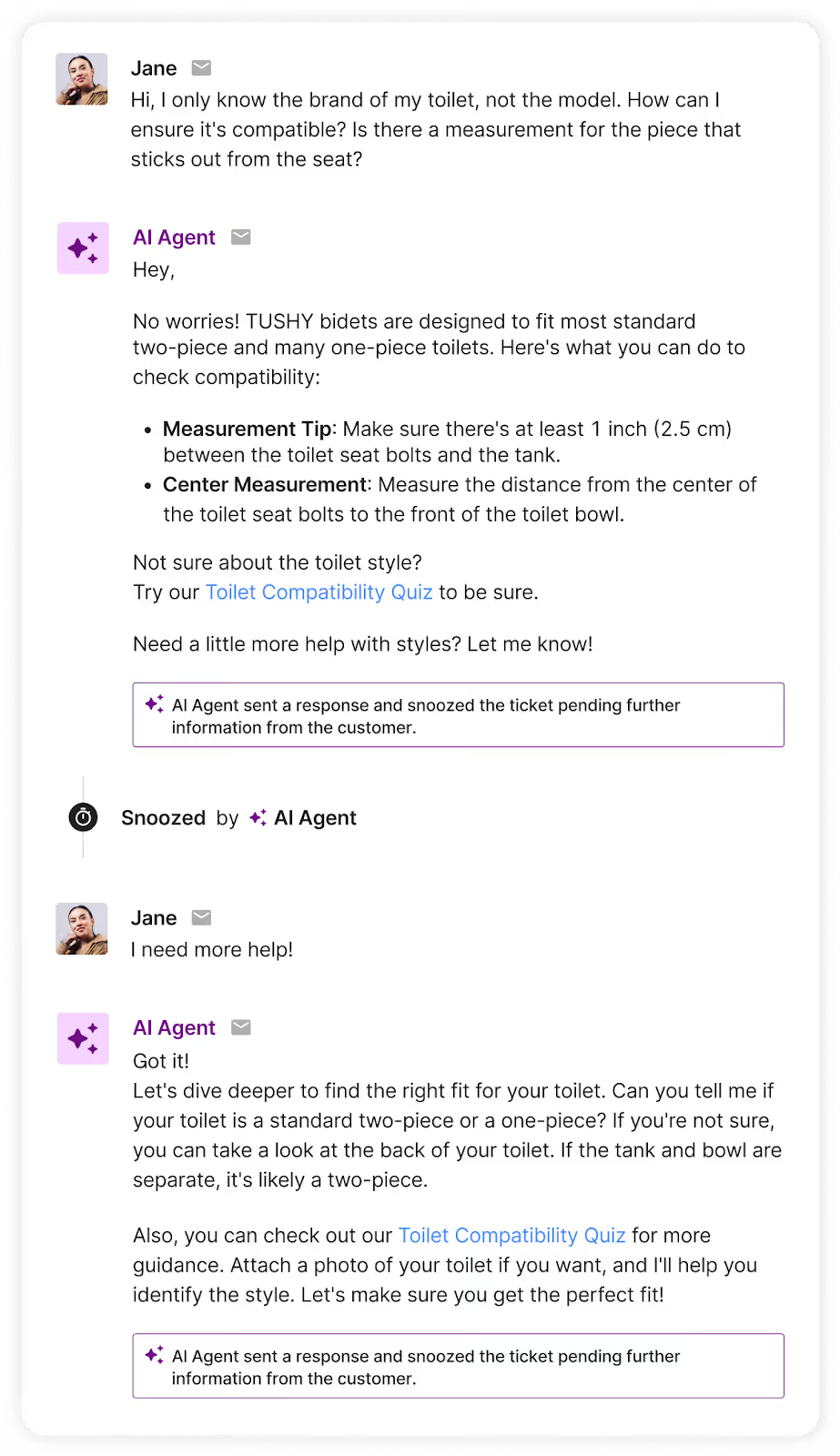
TUSHY used Gorgias's AI Agent and shopping assistant capabilities to automate pre-sales support. AI Agent engaged shoppers in real-time conversations, addressed their concerns directly, and built confidence at the moment of highest intent.

This resulted in a 190% increase in chat-based purchases, a 13x return on investment, and twice the purchase rate of human agents.

How to apply this to your strategy

You don't need to overhaul your entire operation to start seeing results. The most effective approach is to start where the impact is clearest and expand from there.

A few places to begin:

  • Pre-sales chat. Identify your most common pre-purchase questions (sizing, compatibility, shipping timelines) and ensure your AI can answer them confidently and promptly.
  • Product page engagement. Use proactive chat prompts triggered by page behavior to start conversations before shoppers leave.
  • Post-purchase follow-up. Let AI pick up the conversation after checkout with order updates and proactive support, reducing inbound volume and building trust.
  • Human escalation. Define clearly which situations require a human agent – complex issues, emotional exchanges, high-stakes decisions. 

Want to see the full picture of where conversational commerce is headed in 2026? Read the full report to explore the data, trends, and strategies shaping the next era of ecommerce.

{{lead-magnet-1}}

min read.
ai adoption trends

AI Is Table Stakes for Ecommerce: What the Data Tells Us About 2026

AI adoption in ecommerce has reached 96% in 2026, with use cases spanning support automation, personalization at scale, product discovery, and end-to-end operations.
By Gabrielle Policella
0 min read . By Gabrielle Policella

TL;DR:

  • AI adoption is rapidly accelerating. 96% of ecommerce professionals now use AI in their roles, up from 69% in 2024.
  • AI has moved beyond support automation. Use cases have evolved into revenue generation, personalization, and logistics.
  • Brands are tying AI success to profit-and-loss outcomes. 60% of brands consider AOV a top indicator of AI effectiveness.  

A year ago, ecommerce brands were still debating whether AI was worth the investment. That debate is over. Today, nearly every ecommerce professional uses AI to do their job.

The shift isn't just about adoption. It's about what AI is used for and how brands measure its impact. Support automation was the entry point. Now, AI is embedded across the full operation, from product recommendations to inventory control to real-time shopping conversations.

In our 2026 State of Conversational Commerce Report, we break down trends on AI usage among 400 ecommerce decision-makers and 16,000+ ecommerce brands using Gorgias. 

{{lead-magnet-1}}

AI adoption has reached a tipping point

If we rewind 12 months ago, the industry was still split on AI. Some ecommerce professionals were excited, but most were still hesitant. In 2024, 69% of ecommerce professionals used AI in their roles. By 2025, that number reached 77%. In 2026, it hit 96%.

Ecommerce professionals using AI: 69.2% in 2024, 77.2% in 2025, and 96% in 2026.

The confidence numbers back it up. 71% of brands say they are confident using AI for ecommerce, and 73% are satisfied with its business impact. 

In early 2025, only 30% of ecommerce professionals rated their excitement for AI at 10/10. Today, zero percent of respondents describe themselves as hesitant about AI. 

Views on AI among ecommerce professionals: 33% say it’s transforming their business, 50% see steady improvements, 18% say it hasn’t delivered, and 0% remain hesitant.

AI use cases now span the full ecommerce stack

Using AI in ecommerce is not new. In fact, it dates back to the 1980s with the invention of algorithms and expert systems. And if you’ve ever leveraged similar product recommendations or chatbots, you’ve already integrated AI into your ecommerce stack. 

Modern AI is far more sophisticated. 

With the rise of agentic commerce and conversational AI, brands began leveraging AI agents to automate the processing of repetitive support tickets. That’s still happening today, but the scope has expanded beyond the support queue. 

AI use cases in ecommerce include customer support automation (96%), product recommendations (88%), tracking updates (69%), personalization (64%), inventory control (51%), dynamic pricing (36%), and order fulfillment (18%).

Ecommerce brands are deploying AI across every layer of their operation:

  • Customer support automation: 96%
  • Product recommendations: 88%
  • Automated tracking and status updates: 69%
  • Personalization: 64%
  • Inventory control: 51%
  • Dynamic pricing and discounting: 36%
  • Order fulfillment: 18%

When brands were asked which channels contribute most to their AI success, conversational channels dominated. Social media messaging led at 78%, followed by SMS at 70%, and website live chat at 51%. Shoppers want fast, personal conversations, and AI is the best way to deliver that at scale.

Learn more about AI adoption, perception, and use case trends in the full 2026 Conversational Commerce Report.

How AI is changing CX success metrics

For decades, customer support success meant fast response times and high satisfaction scores. Those are still important indicators of success, but leading brands are adding revenue-focused metrics to their dashboards.   

91% of brands still track CSAT as a measure of AI's impact. But 60% now include AOV as a top indicator, and higher-revenue brands earning $20M+ are focusing on metrics like total operating expenses, cost per resolution, incremental revenue, and one-touch ticket rate.

AI impact measured by 91% customer satisfaction, 60% average order value, and 43% resolution time.

AI can now start a conversation, ease customer doubts, sell, upsell, and recover abandoned carts in a single conversation. When you’re only measuring CSAT, you’re ignoring the real ROI of conversational AI investment. 

AI makes every conversational channel a storefront

Virtual shopping assistants now proactively engage shoppers, adapt to their needs in real time, and offer contextual product recommendations and upsells. When the moment calls for it, they can close the deal with a targeted discount. 

Gorgias brands using AI Agent's shopping assistant capabilities nearly doubled their purchase rates and converted 20–50% better than those using AI Agent for support only.

Orthofeet, the largest provider of orthopedic footwear in the US, is a concrete example of this in practice. Using Gorgias, they achieved:

  • 56% of support tickets automated in 2 months
  • Email response times down from 24 hours to 35 seconds
  • Double-digit revenue growth without adding headcount. 

What this means for your AI strategy

The data tells a clear story: AI has evolved beyond a tool for handling tier 1 support tickets. It’s a core part of your revenue generation strategy. 

57% of brands are already using AI for 26–50% of all customer interactions, and 37% expect that share to rise to 51–75% within the next two years. The brands building toward that range now are the ones who will have the operational advantage when it matters most.

The practical question isn't whether to invest in AI. It's where to focus first. Based on where brands are seeing the most impact, three priorities stand out:

  • Start with high-volume, low-complexity tickets. WISMO (where is my order) inquiries, return policy questions, and order status updates are where AI delivers the fastest return. Automate these first.
  • Expand into conversational channels. Social messaging and SMS are where AI is driving the most success right now.
  • Connect AI performance to revenue metrics. If you're only measuring CSAT and response time, you're missing half the story. Add AOV, conversion rate, and incremental revenue to your reporting.

Want to go deeper on the full 2026 conversational commerce trends? Read the complete report for data across every major AI use case in ecommerce.

{{lead-magnet-1}}

min read.
Conversational Commerce Trends

The State of Conversational Commerce: 5 Trends Reshaping Ecommerce in 2026

Explore 5 key trends from The State of Conversational Commerce Trends Report in 2026.
By Gabrielle Policella
0 min read . By Gabrielle Policella

TL;DR:

  • AI is resolving tickets, not just replying. AI now handles 31% of customer interactions for ecommerce brands, and that number is expected to nearly double within two years.
  • Every channel is becoming a storefront. Conversations are replacing the traditional browse-and-buy journey, with 79% of brands reporting sales from AI-driven interactions. 
  • AI is shortening the buying cycle. 93% of AI-influenced purchases happen within the first 48 hours of the conversation. 
  • CX teams are changing, not shrinking. Ecommerce brands are actively hiring for more technical roles to implement, coach, and maintain AI. 
  • The winning model is hybrid. AI handles volume and speed, while humans handle complexity and judgment. 

The way shoppers buy online has shifted and customers are at the center. 

They no longer want to scroll through product pages, dig through FAQs, or wait 24 hours for an email reply. They open a conversation, ask a specific question, and expect a useful answer in seconds. Brands that can’t deliver these experiences at scale are seeing customer hesitation turn into abandoned carts and lost revenue. 

This shift has a name: conversational commerce. It's the practice of using real-time, two-way conversations as your primary sales channel, through chat, AI agents, messaging apps, and voice. 

What started as an experiment for early adopters has become a key growth lever, with 84% of ecommerce brands treating conversational commerce as a strategic pillar this year vs. last year. 

Bar chart showing percentage of customer interactions handled by AI: 31% in 2025 and 47% within the next two years.

We surveyed 400 ecommerce decision-makers across North America, the U.K., and Europe to understand how conversational commerce and AI are reshaping the ecommerce landscape. These findings are complemented by aggregated and anonymized internal Gorgias platform data from 16,000+ ecommerce brands.

The State of Conversational Commerce in 2026 trends report breaks down all of the findings, including five key trends shaping the ecommerce landscape. 

{{lead-magnet-1}}

Trend 1: AI is table stakes for ecommerce and it’s no longer just about efficiency

A few years ago, adding an AI chatbot to your site that could provide tracking links and Help Center article recommendations was a differentiator. Today, it's table stakes. McKinsey found that 71% of shoppers expect personalized experiences, and 76% get frustrated when they don't get them. 

Right now, most ecommerce professionals use AI, with 93% having used it for at least 1 year. Enthusiasm is accelerating quickly, with only 30% of ecommerce professionals rating their excitement for AI at 10/10 in April 2025. Similarly, while AI adoption rose steadily year over year, it reached a clear peak in 2026.

Bar chart showing ecommerce professionals using AI: 69.2% in 2024, 77.2% in 2025, and 96% in 2026.

The use cases driving this adoption are practical and high-volume:

  • Order tracking and status updates
  • Returns, exchanges, and refund requests
  • Shipping FAQs and delivery estimates
Bar chart showing AI use cases across ecommerce: customer support automation (96%), AI product recommendations (88%), automated tracking updates (69%), AI personalization (64%), inventory control (51%), dynamic pricing (36%), and order fulfillment (18%).

These are the tickets that flood brands’ inboxes every day. AI agents resolve them instantly, without pulling teams away from conversations that actually require human judgment.

Explore AI adoption and use case data in more depth in the full report. 

Trend 2: Conversations are the new path to checkout

The traditional ecommerce funnel, visit site, browse products, add to cart, check out, is losing ground. Shoppers now discover products on Instagram, ask questions via direct message, and complete purchases without ever visiting a website.

Side-by-side comparison of page-based and conversation-led customer journeys, highlighting AI-driven real-time recommendations, proactive information, and post-purchase support within a single conversation.

Conversational AI is actively increasing revenue, with 79% of brands reporting that AI-driven interactions have increased sales and conversion in their business.

Bar chart showing percentage of customer interactions handled by AI: 31% in 2025 and 47% within the next two years.

The practical implication is that every channel is becoming a storefront. Creating personalized touchpoints with customers earlier in the journey, through proactive engagement, is impacting the bottom line. 

Read the full report to explore how AI conversions have increased QoQ by industry.  

Trend 3: AI is accelerating the purchase cycle

Pre-purchase hesitation is one of the biggest conversion killers in ecommerce. A shopper lands on your product page, has a question about sizing or compatibility, can't find the answer quickly, and leaves. That's a lost sale that had nothing to do with your product.

Conversational AI changes that dynamic. When a shopper can ask a question and get an accurate, personalized answer in real time, the friction disappears. 

Brands using Gorgias saw this play out at scale in 2025. When AI Agent recommended a product, 80% of the resulting purchases happened the same day, and 13% happened the next day. 

AI chat interface recommending apparel items based on cart contents, alongside statistic stating 93% of purchases occur within 48 hours of an AI agent’s recommendation.

Brands are further accelerating the buying cycle through proactive engagement. On-site features such as suggested product questions, recommendations triggered by search results, and “Ask Anything” input bars drove 50% of conversation-driven purchases during BFCM 2025. 

Explore how AI is collapsing the purchase cycle in Trend 3 of the report.

Trend 4: AI is making CX teams more technical 

There's a persistent narrative that AI is making CX teams redundant. The data tells a different story. 62% of ecommerce brands are planning to grow their teams, not cut them. But the scope of those teams is changing.

Bar chart of expected headcount changes over 12 months: 21% increase significantly, 41% increase somewhat, 28% stay the same, 9% decrease somewhat, and 1% decrease significantly.

New roles are emerging around AI configuration and quality assurance. Teams are investing in technical members to write AI Guidance instructions, develop tone-of-voice instructions, and continuously QA results. 

CX teams are also bridging the gap between support goals and revenue goals, as the two functions increasingly overlap.

Donut chart indicating 77% of companies report at least some convergence between support and sales functions due to AI.

The result is CX teams that are more technical than they were before. Agents who once spent their days answering repetitive tickets are now spending that time on higher-value work: complex escalations, VIP customer relationships, and improving the AI systems and knowledge bases that handle the volume.

Learn more about the evolution of CX roles in Trend #4. 

Trend 5: The future is hybrid: AI-first, humans when it counts

Despite increasing AI adoption, data shows that ecommerce brands shouldn’t strive for 100% automation. Winning brands are building systems in which AI handles repetitive tier-1 tickets, and humans handle complex, sensitive cases. 

Chart showing which inquiries are handled by AI vs. humans.

AI handles speed and scale. It resolves order-tracking requests at 2 a.m., processes return-eligibility checks in seconds, and answers the same shipping question for the thousandth time without compromising quality. 

Human agents handle conversations that require context, empathy, or decisions that fall outside the standard playbook. There are several topics where shoppers still prefer human support.

Bar chart showing customers prefer human support for order issues (54%), product advice (35%), and returns or refunds (24%).

Successful hybrid systems require continuous iteration, meaning reviewing handover topics, Guidance, and reviewing AI tickets on a weekly basis. 

Discover how leading brands are balancing human and AI systems in Trend #5. 

Where conversational commerce is heading by 2030

The 2026 trends are about expansion and standardization. The 2030 predictions are about what comes next.

Bar chart showing brand expectations by 2030: 89% expect AI voice purchasing, 29% expect AI multilingual support, and 19% expect proactive AI upsells and cross-sells.

Voice-based purchasing is the biggest bet on the horizon. Only 7% of brands currently use voice assistants for commerce, but 89% expect it to be standard by 2030. The vision is a customer who can reorder a product, check their subscription status, or manage a return entirely over the phone.

Proactive AI is the other major shift. Rather than waiting for a customer to reach out, AI will anticipate needs based on browsing behavior, purchase history, and where someone is in their relationship with your brand. Think of it as the digital equivalent of a sales associate who remembers what you bought last time and knows what you're likely to need next.

Explore where ecommerce brands are allocating their AI budgets in the full report. 

Start building your conversational commerce strategy today

The brands winning in 2026 are creating smart, scalable systems where AIhandles volume and humans handle nuance. They’re treating every conversational channel as an opportunity to serve and sell.

The data is clear: AI adoption is accelerating, customer expectations are rising, and the revenue impact of getting this right is measurable.

{{lead-magnet-1}}

min read.
Create powerful self-service resources
Capture support-generated revenue
Automate repetitive tasks

Further reading

The Updated Gorgias Helpdesk: Built for the Moments that Matter

By Christelle Agustin
min read.
0 min read . By Christelle Agustin

TL;DR:

  • Get instant context with Ticket Summaries. Jump into any conversation without digging through past messages or tabs.
  • Organize tickets and customers with Ticket and Customer Fields. Attach properties to tickets and customers to see the whole picture, then turn it into reportable data.
  • Support global customers with real-time translations. Engage in natural conversations in your customer’s language without paying for another tool.
  • Resolve urgent issues with Priority Scoring. Rank tickets by importance, so high-value or sensitive issues don’t get overlooked.
  • Onboard quickly with in-house migration. Whether you’re coming from Zendesk or Richpanel, Gorgias handles the move for you.

We recently unveiled the latest upgrades to Gorgias Helpdesk during Moments that Matter: Meet the Modern Helpdesk

The event was hosted by Bora Shehu, VP of Product Design, with updates from John Merse (VP of Product), Fraser Bruce (Senior Solutions Consultant), Nicole Simmen (Senior Manager, Customer Implementation), and a customer story from Michael Duran (Operations Manager, Authentic Brands).

From quality of life improvements to brand new features, here’s what’s waiting for you in Gorgias.

Watch the full presentation here:

Support faster with built-in ticket summaries

Agents shouldn’t have to dig for context. Every conversation now comes with Ticket Summaries. Whether an agent has jumped into a ticket mid-conversation or is dealing with a new customer, these AI-generated summaries tell the whole story in no time.

We’ve also given the Customer Timeline a makeover. Now, you can glance at past tickets and order updates in one clean view. Plus, a dedicated Order View lets agents dive into past purchases without leaving the ticket or opening a new tab.

View a customer’s conversation history on the Customer Timeline.

Enrich your data with detailed ticket and customer properties

Agents have always had visibility into customer history, but now that context is easier to act on.

Ticket Fields automatically tags tickets with AI-detected reasons, whether that’s shipping questions or product feedback, to help organize your conversations more effectively.

Then, add in another layer of data using Customer Fields (in beta) to note whether you’re speaking to a longtime, VIP customer or a customer with a history of high returns.

All of this data can be funneled into your ticket reports, making it easier for your team to discover new insights about your products, support quality, and more.

Gorgias Customer Fields lets you label customers
Provide each customer with a Customer Field label to enhance context and streamline customer segmentation.

Speak every customer’s language with instant translations

Taking your brand global doesn’t have to mean hiring a whole new team or spending extra on a localization tool. AI-powered translations (in beta) will soon be available on the helpdesk.

Finally, your team will be able to support customers in any language in real-time. Customers write in their native language, agents respond in theirs, and the exchange feels natural on both sides.

Customer messages translated from Spanish to English with AI
Instant AI translations let agents and customers interact in their preferred language without external tools.

Never miss urgent tickets with Priority Scoring

How many times has an urgent ticket been buried at the bottom of your inbox? The new Priority Scoring system prevents that by automatically labeling tickets as Low, Normal, High, or Critical based on your Rules. 

For example, you might label a negative Facebook comment with threatening sentiment as ‘High,’ or bump high-value shoppers to the top with a ‘Critical’ label. This ensures your team always sees the conversations that need the most attention, so no sensitive issue slips through the cracks.

Shape every call journey with the new IVR flow builder

Now in beta, our flow-based IVR (interactive voice response) system lets teams on Gorgias Voice build customized call journeys for every type of conversation. Route customers through interactive menus, segment them based on their data, or direct them to voicemail, and schedule SMS follow-ups and callbacks.

To match agent availability, you can set business hours per phone number and per channel across storefronts. Teams also have more flexibility with ring strategies (ring available agents all at once or one at a time), wrap-up time between calls, and faster availability refreshes.

With Gorgias Voice, you can select which team receives inbound customer calls, how the call is routed, and the ringing behavior.

Stay on top of every goal with custom dashboards

We understand that CX teams need more than surface-level KPIs—they need to know what’s actually driving performance, revenue, and retention. 

With Dashboards, you can build reports focused on CX data you care about, from agent performance to product return trends. Then, filter by store or sub-brand to zoom in on the details each team is responsible for.

We’re also introducing the Human Response Time metric to show how quickly your team responds to escalations from AI Agent. This gives you a clear sign of what issues require human attention, how fast they’re resolved, and whether you need to adjust staffing.

Effortless, in-house migration for new joiners

Leave the moving to us—we now manage migrations in-house. Depending on your plan, our Implementation team will transfer emails, customers, macros, and more for you. Combined with 99.99% uptime, switching platforms is smoother, faster, and more reliable than ever.

For accelerated performance, consider our 50-in-50 implementation program, which aims to resolve 50% of your ticket volume using AI Agent within 50 days.

Enterprise customers receive a dedicated Enterprise CSM, optimization workshops, and 24/7 support to get the most out of Gorgias from day one. 

What’s coming next

Our teams are hard at work changing the landscape of customer experience. Here’s what’s on the Gorgias Product Roadmap:

  • Cleaner, minimal interface. We’re giving our UI a new look to reduce clutter and highlight key information, making conversations front and center.
  • Detailed order view. Quickly view past purchases and make order updates without opening new tabs or interrupting your workflow.
  • Shop right in chat. Soon, product photos, descriptions, and even customer reviews will be shown directly in Gorgias Chat, so shopping experiences are as frictionless as possible.
  • Scheduled CSV exports. Prove the value of CX with automated exports, perfect for stakeholders, whether they use Gorgias or not. 
  • New integration with Assembled Workforce Management. Our partnership will help you leverage Gorgias ticket data to optimize forecasting and agent scheduling.
  • Role-based access control. Decide which dashboards, views, conversations, and settings can be accessed by each user role.
  • Okta single sign-on. Let your team sign in to Gorgias using the same authentication service you use for the rest of your tech stack.

The future of support starts with your helpdesk

Our latest helpdesk updates make it easier than before to create memorable customer moments.

As Bora Shehu, our VP of Product Design, said, “We hope that the tools we’re building help you spend less time on robotic work, and more time on impactful human work that grows your businesses through the power of conversations.”

If you’re not on Gorgias yet and want to see what’s possible, book a demo today.

{{lead-magnet-1}}

How Online Sizing Solutions Are Replacing the Fitting Room

By Alexa Hertel
min read.
0 min read . By Alexa Hertel

TL;DR:

  • 58% of fashion shoppers “bracket” orders—buying multiple sizes and returning what doesn’t fit. This drives high return rates, increased costs, and customer frustration.
  • 70% of returns are due to sizing issues. Nearly half of shoppers abandon carts over inconvenient returns.
  • Leading solutions include: AI-powered fit tools, 3D visualizations that show scale and model stats, “fit finder” tools, at-home fitting experiences, and AI-powered customer support.
  • Brands that replicate the fitting room online gain higher retention, lower costs, and stronger sustainability.

Sizing has long been a friction point for ecommerce fashion shoppers.

Without the ability to try items on, 58% of shoppers resort to "bracketing"—ordering multiple sizes of the same piece and returning what doesn’t fit. 

While it gives customers a temporary fix, it ultimately creates frustration for them and logistical headaches for brands. 

The result is rising return rates, higher costs, and wasted resources. To break this cycle, ecommerce brands need to rethink how they guide shoppers toward the perfect fit. The good news is that many brands are already showing the way by using AI-powered tools and smarter product experiences to replicate the fitting room from the comfort of home. 

{{lead-magnet-1}}

Returns are getting unsustainable 

Recent data highlights just how severe the return challenge has become for fashion and apparel retailers: 

  • 46% of shoppers have abandoned a purchase because return methods were inconvenient. 
  • Fashion and apparel brands get twice as many return requests than any other industry.
  • According to Gorgias data, 70% of returns are due to sizing confusion.
  • “Will this fit me?” is one of the top reasons customers contact support.

In addition, rapidly rising concerns around sustainability and climate change, as well as heightened awareness around over-consumption, are prompting consumers to make changes in their purchasing habits. 

Brands who prioritize well-fitting, long-lasting pieces and reduce carbon footprints and the amount of clothing diverted to landfills by lowering returns can actually benefit from a strategic edge. 

“Those who choose to approach sustainability with a long-term mindset even while battling short-term problems will be rewarded with more efficient business operations and a competitive advantage,” writes McKinsey in its State of Fashion 2025 report.

Effective sizing solutions for ecommerce brands 

Most brands already have size charts, but shoppers don’t want to measure themselves, or find those charts to be inaccurate.  

When shoppers lack confidence in choosing the right fit, they either abandon their carts or rely on bracketing, both of which lower profitability and customer trust. 

Forward-looking fashion and apparel brands are solving sizing issues by using tools for a more intuitive shopping experience. This ultimately helps them build loyalty, increase retention, and reduce returns. 

Implement AI-powered body measurement tools

Rather than purely providing static size charts on your website, opt for AI-generated personalized fit recommendations instead. 

For example, European fashion retailer Zalando reduced size-related returns by 10% using AI-driven advice.

Two phone screens showing Zalando app size recommendations and product page.
Zalando provides size recommendations based on what’s in a customer’s cart.

The brand flags whether an item is true to size or not. It also offers the ability for customers to see recommendations based on logged fit-based return reasons,  past purchases, and other clothing items that fit them well. 

Zalando also launched a body measurement feature in 2023 where shoppers can actually scan themselves for more accurate size advice.  

Zalando app shows body measurements and personalized clothing size recommendations.
Zalando uses machine learning to predict customer sizes by scanning customer photos.

Show size and scale in product photos 

As AI grows in proficiency, there are more tools than ever to help shoppers visualize product scale and fit. 

For example, accessory shop LeSportsac uses Tangiblee, a product experience tool, to help customers understand scale and what fits inside each bag.

Online tool Tangiblee shows tote bag size on a silhouette model with comparison items below.
LeSportsac helps shoppers visualize the capacity of their bags with a 3D visualization tool by Tangiblee.

Performance hunting gear shop KUIU takes another approach. It uses a photo-based layering guide, so shoppers can see how the size and fit look with multiple layers on a model. Different model stats shown within product photography give contextual sizing cues.

Male model shows four layered hunting outfits with listed gear details on the right.
KUIU visualizes size and fit with full body photos of models in their clothes, including model height and clothing sizes.

Sleep shop Cozy Earth takes a similar route, stating model height and size on product photos.

Woman models olive bamboo pajama set with button top and pants on Cozy Earth product page.
Cozy Earth's product photos include the model's height and clothing size.

Introduce “fit finder” tools 

Some brands are helping shoppers pick the right size with interactive quizzes based on factors like height, weight, and the sizes of other clothing items that fit well. SuitShop is among those brands using a Fit Finder quiz on its website.  

SuitShop fit finder page with couple in matching cream suits walking.
SuitShop offers a fit finder quiz to match customers to their perfect suit size.

Similarly, Psycho Bunny leverages the AI tool True Fit as a size finder on product pages. 

Psycho Bunny men's polo page with True Fit sizing tool overlay.
Psycho Bunny uses True Fit to provide recommendations that match customer measurements.

Bring the fitting room home 

Ergonomic shoe brand Orthofeet eliminates sizing qualms altogether by including customizable inserts inside each box. Fitting spacers ensure a snug fit and arch enhancement for those who need it, helping shoppers get comfortable shoes that fit.

Orthofeet shoe display highlighting wide toe box and comfort features.
Orthofeet assures customers about sizing by including removable spacers in all orders.

Jonas Paul Eyewear shares the “try it on at home” approach, offering a free or low-cost home try-on kit. 

Jonas Paul kids home try-on glasses kit with multiple frames in box.
Jonas Paul sells home try-on kits to bring the sizing experience to customers.

Leverage AI-powered customer support

Gorgias Shopping Assistant helps brands meet that need by delivering human-like guidance at scale, giving shoppers instant answers that feel personal. 

For example, VESSEL uses Shopping Assistant in chat to provide real-time support on sizing and inventory, helping customers choose with confidence. By addressing fit questions directly, Shopping Assistant reduces returns and builds trust at the point of purchase.

A customer asks Gorgias Shopping Assistant about golf gloves for women.
Gorgias Shopping Assistant helps a customer find women’s golf gloves.

Similarly, outdoor clothing retailer Arc‘teryx provides an “ask me anything” AI chat where shoppers can confirm any questions they have around fit or sizing. 

Arc'teryx Atom Hoody women's product page with AI shopping assistant chat.
Arc'teryx uses AI to answer questions about their Atom Hoody.

The future for ecommerce size guides 

Sizing for ecommerce fashion and apparel brands has become a business-critical challenge. With 70% of returns tied to fit issues and nearly half of shoppers abandoning purchases over inconvenient returns, brands that replicate the fitting room online stand to gain a competitive advantage.

From Zalando’s 10% reduction in size-related returns to VESSEL’s use of AI-powered chat, the path is clear: investing in smarter size chart solutions pays off with higher retention, lower costs, and stronger sustainability. 

The brands that provide fitting room-level experiences online now will set themselves apart from the rest.

Book a demo to see how Gorgias, the leading conversational commerce platform, helps fashion brands cut returns, drive sales, and deliver fitting-room level experiences online.

{{lead-magnet-2}}

Conversational Commerce: A Complete Beginner's Guide

By Holly Stanley
min read.
0 min read . By Holly Stanley

TL;DR:

  • Conversational commerce replaces static support with real-time conversations. Instead of making customers wait or dig through FAQs, brands can respond instantly via chat, messaging apps, and voice assistants.
  • The main types are live chat, AI assistants, messaging apps, and voice support. Each helps guide shoppers and answer questions instantly.
  • It’s most effective during key moments like cart hesitation, post-purchase anxiety, and peak seasons. Proactive conversations reduce drop-offs and boost conversions.
  • Start small and scale. Begin with repetitive questions or cart recovery, then layer in automation and AI as you grow.

While your competitors are still making customers wait days for email replies, the smartest brands are having conversations that close sales in real time.

Instead of forcing customers to search through FAQs or go through an automation loop, conversational commerce lets you have instant chats through live chat, messaging apps, and even AI assistants.

In this guide, we’ll explain conversational commerce, where it delivers the most value, and how to start using it to drive revenue and improve CX without overwhelming your team.

What is conversational commerce?

Conversational commerce means using real-time, two-way conversations as your storefront. Rather than bottling up questions in FAQ pages or forcing customers to wait for your support team to respond, you can instantly connect via:

  • Chat
  • AI agents
  • Messaging apps
  • Voice assistants

Maybe someone is on your product page and asks a question like, “Does this jacket run large?”. Through chat, they get an instant answer, increasing the chance of a sale. Or a shopper receives personalized recommendations via WhatsApp and checks out, all without leaving the app.

These channels allow you to meet customers where they already are, effortlessly. When paired with AI chatbots, you can deliver fast, accurate responses 24/7, even while your team is off the clock. That means better experiences for your customers and more sales captured for your brand.

Conversational commerce bridges the gap between shopping and support. It turns your support team (and AI tools) into revenue drivers by helping shoppers feel seen, heard, and ready to buy.

Types of conversational commerce

Conversational commerce means bringing your storefront into the flow of conversation, wherever that happens for your customers. 

Here’s where those conversations typically happen:

  1. Live chat
  2. AI assistants
  3. Messaging apps
  4. Voice assistants

1. Live chat

This is a chat widget on your site, often in the bottom right corner, where shoppers can ask questions and receive immediate answers from a human agent or automation.

It’s a quick path to support or purchase, which one agent can manage multiple chats from simultaneously, boosting efficiency and keeping things personal.

2. AI assistants

These smart helpers use Natural Language Processing (NLP) to understand what shoppers mean beyond what they type. They guide customers through questions, offer product suggestions, handle FAQs, and can sometimes complete transactions right in the chat, even handling post‑purchase support like order status or returns.

Natural Language Processing (NLP): The processing of understanding and interpreting natural language using computers. NLP is used in tasks such as sentiment analysis, summarization, speech recognition, and more.

3. Messaging apps

Think WhatsApp, Facebook Messenger, WeChat, and SMS—the apps where customers already spend their time in their day-to-day. Instead of sending them to shop on your website, you bring the shopping to them. Answer their questions, provide recommendations, and win purchases in a channel they already trust.

4. Voice assistants

Voice assistance isn’t limited to smart speakers like Siri and Alexa anymore.

Now, AI voice support lets brands deliver natural conversations over the phone, without needing a massive contact center team. These AI voice agents can:

  • Answer common questions using branded knowledge
  • Route calls or escalate when needed
  • Handle returns, exchanges, or order tracking
  • Personalize support based on customer intent and past behavior

AI-powered voice support combines the human feel of a phone call with the speed and accuracy of automation. It's especially useful for high-ticket products, customers who prefer calling, or peak season overflow when your human team is maxed out.

The benefits of conversational commerce for ecommerce brands

Conversational commerce isn’t a CX buzzword. When done right, it directly impacts your bottom line.

Here’s how it pays off for ecommerce brands:

  1. Higher conversion rates
  2. Faster and more efficient support
  3. Bigger carts, fewer drop-offs
  4. Stronger customer relationships

1. Higher conversion rates

When customers can ask questions and get answers in real time, whether it's sizing info, shipping details, or help choosing between products, they’re far more likely to hit “buy.”

Success story: Clothing brand Tommy John generated $106K+ in sales in just two months through conversation-led upselling and cross-selling, with a 15% conversion rate.

2. Faster and more efficient support

Conversational commerce tools like AI agents help offload the repetitive support tasks, including answering questions like “Where’s my order?” or “What’s your return policy?”

With that time back, agents get time back to:

  • Handle complex or sensitive customer issues
  • Follow up with VIP customers
  • Collaborate with marketing and sales teams to improve processes
  • QA conversations to enhance human and AI agent performance
  • Update knowledge docs used by AI tools for more accurate resolutions

Instead of getting buried in basic tickets, your team gets to do the work that really moves the needle for your customers and your business.

Related: Every successful marketing campaign starts with a customer question

3. Bigger carts, fewer drop-offs

The right nudge at the right moment, like a personalized recommendation from an AI shopping assistant, can turn a single item into a full cart. You can also recover more abandoned checkouts by re-engaging customers directly through chat or a messaging app.

Read more: You’re missing out on sales without an AI shopping assistant—here’s why

4. Stronger customer relationships

Conversational commerce lets you meet customers with a human (or human-like) touch. When your brand is helpful, fast, and easy to talk to, shoppers remember and return. 

In the long run, that means better customer retention, higher lifetime value, and more organic growth through word of mouth.

When conversational commerce creates the biggest impact 

Conversational commerce shines brightest when the stakes are high or when the moment is just right.

Here are the critical moments where a real-time conversation can make all the difference:

  1. When shoppers have items in their cart but are hesitating to check out
  2. Right after customers place an order, and anxiety starts to kick in
  3. During peak shopping seasons like Black Friday and Cyber Monday
  4. When customers are browsing complex products like skincare, makeup, or apparel

1. When shoppers have items in their cart but are hesitating to check out

A customer’s on your product page, they’ve added an item to their cart, but are hesitating. Maybe they’re unsure about sizing, shipping time, or which variation to choose. This is where a quick, helpful chat, automated or human, comes in and becomes the difference between bounce and conversion.

Pro tip: Use proactive chat prompts based on page behavior to start the conversation before the shopper leaves.

2. Right after customers place an order, and anxiety starts to kick in

After a customer hits “place order,” expect more questions to roll into your inbox. Where’s my order? How do I track it? What’s your return policy? Post-purchase excitement—and anxiety—is normal, and a smart AI agent helps you get ahead of these questions while putting customers at ease.

3. During peak shopping seasons like Black Friday and Cyber Monday

Black Friday. Holiday rush. Product drops. These are prime opportunities to boost revenue—but they also flood your support team. Conversational commerce tools help you scale without sacrificing quality, keeping shoppers happy and sales flowing.

4. When shoppers are browsing complex products like skincare, makeup, or apparel

If you sell skincare, supplements, tech, or anything that requires a bit of education, your customers likely need guidance before they commit. A personalized conversation helps them find the right fit and feel more confident in their purchase.

What to consider before you start

Conversational commerce sounds exciting, and it is. But before you dive in, it’s worth thinking through a few key factors to set your team (and your customers) up for success.

  1. Cost vs. ROI: Start small, scale smart
  2. Team resources: Who’s managing the conversations?
  3. Customer expectations: Meet them where they are

1. Cost vs. ROI: Start small, scale smart

You don’t need a full-blown chatbot army on Day 1. Start with your highest-impact touchpoints, like pre-sale FAQs or WISMO questions, and layer in automation over time. The goal is to generate clear ROI early, then expand once you see traction.

Here’s how to gradually implement automation into your CX process:

  • Identify your top repetitive questions. Use your support data to pinpoint your most common tickets. For most brands, these are WISMOs, shipping concerns, and product-specific questions.
  • Create macros for your most-asked questions. These macros will be used to answer the top recurring questions. For agents, this means no more copy-pasting the same responses.
  • Build out self-service automation flows. Once you’re feeling more comfortable with automation, set up self-service flows to let customers resolve their own needs, like checking order status, starting a return, or finding their size.
  • Automate your top channels. Don’t stop at email. Automate responses on live chat, Instagram DMs, and SMS too. Shoppers expect speed everywhere, not just on your site.
  • Maintain impact, then introduce conversational AI. If your CSAT is still healthy after these changes, you can expand to using conversational AI for faster support and team efficiency.

The goal isn’t to automate everything, it’s to automate smartly so your team can spend time where it counts: high-touch sales, VIP support, and strategic growth.

Learn more: How Dr. Bronner's saved $100K/year by switching from Salesforce, then automated 50% of interactions with Gorgias

2. Team resources: Who’s managing the conversations?

Do you have in-house agents ready to handle live chat? Or do you need automation to handle the bulk of it? Make sure your setup aligns with your team’s bandwidth.

Pro tip: Tools like Gorgias AI Agent and Shopping Assistant can handle the support and sales heavy lifting, making them perfect for lean CX teams.

3. Customer expectations: Meet them where they are

Your customers aren’t just on your website. They’re messaging on Instagram, browsing via mobile, or checking their texts. To deliver great conversational commerce, you’ll want to show up in the places your shoppers already use.

Pro tip: Don’t spread your efforts too thin. Start with the channel that aligns with your goals and customer behavior, live chat, SMS, or social DMs, and build from there.

How to get started with conversational ecommerce in 2 steps

Ready to make conversational commerce part of your CX strategy? You don’t need to overhaul your tech stack or hire a whole new team. With Gorgias, you can start fast, stay lean, and scale smart.

Here’s how:

1. Start with AI Agent for 24/7 support

Gorgias AI Agent is designed to take repetitive tickets off your team’s plate, from “Where’s my order?” to “How do I make a return?” It understands natural language, pulls in relevant customer data, and responds in seconds—all using your brand’s approved knowledge.

The result is faster responses, fewer tickets, and more time back for your team.

Gorgias AI Agent supports and performs actions on behalf of customers.

2. Add Shopping Assistant to drive revenue

While AI Agent, covers the support front, Shopping Assistant is your digital salesperson. It engages high-intent shoppers in real time, recommends the right products, and even upsells or cross-sells based on what the customer is browsing.

Whether it’s helping someone choose the perfect shade or nudging them to complete their cart, Shopping Assistant is designed to increase AOV and reduce abandonment.

Gorgias Shopping Assistant understands context and suggests products to browsing shoppers.

The future of ecommerce is conversational

Every time a shopper lands on your site, scrolls through Instagram, or replies to a shipping update, they’re opening the door to a conversation. The brands that show up quickly, helpfully, and with the right message, are the ones winning loyalty and revenue.

With AI Agent, you can automate accurate responses to common questions, giving your team time back without sacrificing customer experience. And with Shopping Assistant, you can turn those conversations into conversions, offering personalized recommendations, upsells, and discounts based on shopper intent.

You don’t need a massive team or months of setup to start. Just the right tools, and a strategy built for your customers.

Book a demo and learn how Gorgias helps you turn every conversation into an opportunity to grow.

{{lead-magnet-2}}

Best AI Helpdesk Tools: 10 Platforms Compared

By Tina Donati
min read.
0 min read . By Tina Donati

TL;DR:

  • The best AI helpdesks offer smart ticketing, self-service, and sales automation. They combine multi-channel support, give teams flexible AI control, and double as an upselling tool that drives revenue.
  • Each tool has a unique strength. Gorgias is best for ecommerce brands , Zendesk offers enterprise-level customization, Intercom is great for SaaS engagement, and Tidio is easy for small teams.
  • There are also standalone AI tools that integrate with existing helpdesks. Platforms like Ada, Siena, and Yuma offer automation without requiring a full platform switch.
  • Advanced AI features vary in price and availability. Some are bundled, while others charge per resolution or limit access to higher tiers.

Every delayed reply, missed ticket, or frustrated customer costs more than just satisfaction—it hits revenue, loyalty, and your brand reputation. That’s why more and more brands are investing in AI helpdesks to automate the tedious parts of their job.

But with so many options on the market, choosing the right AI helpdesk can feel overwhelming. Should you prioritize conversational AI? Multi-channel support? No-code customization? Or pricing that scales with your team?

{{lead-magnet-1}}

We’ve reviewed the 10 best AI helpdesks available in 2025, evaluating them across AI capabilities, ease of use, integrations, analytics, and pricing. 

Helpdesk

AI Features

Main Strength

Potential Limitation

Best For

Starting Price

Gorgias

AI Agent, Shopping Assistant, Auto QA

Multi-channel ecommerce support, AI shopping assistant

Ecommerce-focused

Scaling and enterprise ecommerce brands

$10/month per agent

Zendesk

Copilot, AI triage, Zendesk QA

Enterprise-grade omnichannel support

Can be complex for smaller teams

Large enterprises like banks and airlines

$25/month per agent

Intercom

Fin AI, Fin Tasks, Fin Insights

Conversational AI, proactive support

Higher learning curve for complex workflows

SaaS and mid-to-large businesses

$39/month per agent

Gladly

Gladly Hero, Sidekick Chat, Sidekick Voice

Conversation-centric support, loyalty focus

Complex implementation onboarding process

Customer-focused businesses that prioritize loyalty

Custom pricing

Kustomer

AI Agents for Reps, AI Agents for Customers

CRM-centric support

Unintuitive and laggy user interface

Mid-to-large enterprises

$89/month per agent

Tidio

Lyro AI Agent

Easy-to-use automation for small teams

May not scale for large enterprise workflows

Small to mid-sized ecommerce/service businesses

Free, $29/month per agent

Freshdesk

Freddy AI

Affordable multi-channel support

Advanced AI limited to higher tiers

SMBs and mid-market companies

$18/month per agent

Ada

Ada Voice, Ada Email

Self-service chat automation

Basic features cost extra

Large enterprise businesses

$499/month

Siena

Customer Service Agent, Reviews Agent, Siena Memory

Automated support

Lack of visibility into support and AI performance

Mid-market ecommerce and SaaS

$500/month

Yuma

Support AI, Sales AI, Social AI

Self-service & automation for growing teams

Limited integrations with broader sales stacks

Established ecommerce brands

$49/month per agent

How we evaluated the best AI helpdesks in 2025

To create this list, we evaluated each platform based on a combination of functionality, AI capabilities, usability, and industry applicability. 

Our goal was to provide a resource that CX leaders, ecommerce managers, and support teams can rely on when choosing a helpdesk that fits their business needs.

Here’s how we approached the evaluation:

  1. Feature set assessment: Each tool was reviewed for its core helpdesk features, including ticket management, multi-channel support, workflow automation, and reporting capabilities.
  2. AI sophistication: Platforms were evaluated on the depth of their AI offerings. This included natural language processing (NLP), predictive analytics, proactive messaging, and automated resolution capabilities.
  3. Ease of use and setup: We considered setup time, onboarding complexity, and the learning curve for both agents and admins.
  4. Industry applicability: We examined which industries each tool serves best. Some platforms are tailored for ecommerce, while others are more enterprise or service-focused.
  5. Pricing transparency and scalability: We noted starting costs, AI feature availability by tier, and potential scaling considerations. Affordability and scalability were important, particularly for fast-growing teams that need to balance cost with AI functionality.
  6. Supporting resources: We reviewed customer support, integrations, documentation, and community resources. A strong helpdesk not only provides AI features but also ensures teams can implement and optimize them effectively.

By following this methodology, we created a balanced, objective view of each helpdesk, highlighting what makes them unique, their strengths, limitations, and who will benefit most from them.

The best AI helpdesks of 2025

Gorgias

Gorgias is an AI helpdesk designed for ecommerce brands, helping teams streamline support while boosting both efficiency and personalization.

By unifying all customer touchpoints—email, chat, social media, voice, and SMS—into a single dashboard, Gorgias allows support teams to manage interactions without toggling between platforms.

Unlike most helpdesks, its AI capabilities go beyond basic automation. In addition to support, its AI can influence sales by assisting, recommending, and upselling to customers based on their shopping behavior.

Best for: Scaling startups and mature ecommerce enterprises looking to expand support capacity without increasing headcount

Potential limitations: Gorgias is focused primarily on ecommerce brands, which means it may be less suitable for companies that don’t use ecommerce platforms.

Pricing: Starts at $10/month, with advanced AI features available as an add-on.

Main features:

  • Automated ticket routing: AI triages incoming customer queries and assigns them to the right agent.
  • AI-generated responses: Provides instant, context-aware replies to common questions.
  • Sentiment analysis: Flags frustrated customers to prioritize urgent tickets.
  • Multi-channel AI support: Integrates across email, chat, Shopify, social media, and 100+ ecommerce apps.
  • Macros and workflow automation: AI suggests relevant responses and automates repetitive tasks.

AI features:

  • AI Agent: Conversational AI that can update, refund, and replace orders, cancel/skip subscriptions, and even carry out custom-made actions.
  • Shopping Assistant: A proactive AI tool that guides, upsells, and recommends products to shoppers through chat. It helps CX teams increase sales and AOV.
  • Auto QA: Upgrades service quality by automatically evaluating 100% of private text conversations, whether handled by a human or AI. Each message is scored on metrics like Resolution Completeness, Brand Voice, and Accuracy.

Zendesk

Zendesk is a widely adopted AI helpdesk solution that caters to teams of all sizes, from small businesses to large enterprises. It’s known for its robust ticketing system, extensive integrations, and customizable workflows, making it a versatile choice for teams across industries.

Best for: Non-ecommerce enterprises and businesses like airlines and banks

Potential limitations: Advanced AI features and enterprise-level plans can be expensive for smaller teams, and some users report that customization for niche workflows can be time-consuming.

Pricing: Starts at $25/month per agent, with advanced AI features and enterprise options available on higher tiers.

Zendesk Auto Assist suggests a reply.
Zendesk Copilot suggests replies, which agents can approve or edit.

Main features:

  • Unified ticketing: Centralizes requests from email, chat, phone, social media, and messaging apps.
  • Macros and workflow automation: Automates routine responses and processes to reduce agent workload.
  • Advanced analytics: Offers real-time dashboards and reporting to track support performance and customer satisfaction.
  • Multi-channel support: Integrates seamlessly with major ecommerce, CRM, and communication platforms.

AI features:

  • Copilot: Assists support agents in providing consistent replies, suggests next steps, and can even perform actions on agents’ behalf.
  • AI triage: Automatically categorizes tickets and routes them to the appropriate team member.
  • Zendesk QA: Scores the quality of interactions to help you get an overview of support performance.

Intercom

Intercom combines live chat, messaging, and AI automation into a single platform that focuses on proactive customer engagement. Its conversational AI makes it easy for teams to interact with customers in real time, while its automation tools help reduce response times and increase efficiency. 

Best for: SaaS companies, software companies, and mid-market teams

Potential limitations: Companies looking for a plug-and-play AI solution will need to invest time in setting up Intercom. Customers report a steep learning curve when creating workflows, organizing users, and implementing new automations.

Pricing: Starts at $39/month per seat. Fin AI is available as a standalone product for $0.99 per resolution (50 resolutions per month minimum) if you have an existing helpdesk.

Intercom's Fin AI comes with a preview environment to test AI responses.
Intercom’s Fin AI lets you test its responses before you go live.

Main features:

  • Live chat and messaging: Provides instant support via website, mobile apps, and email.
  • Inbox and workflow management: Centralizes customer conversations and automates repetitive tasks.
  • Customer segmentation: Enables targeted messaging based on behavior, subscription plans, or engagement levels.

AI features:

  • Fin AI: Intercom’s AI assistant responds to common questions, freeing agents to handle complex issues.
  • Fin Tasks: Performs actions like retrieving order details, processing refunds, reorders, and more.
  • Fin Insights: Provides a deep look into recurring trends and issues across conversations.

Gladly

Gladly is a customer service platform built around the concept of conversation-centric support, treating every customer interaction as a continuous dialogue rather than isolated tickets. 

Best for: Customer-focused brands that prioritize personalized, ongoing conversations over transactional support—especially retail, financial services, and subscription businesses that want to strengthen loyalty.

Potential limitations: Smaller teams may find it more than they need, and advanced customization can require professional services.

Pricing: Available on request, with plans typically tailored to enterprise support teams and scaled based on users and features.

Gladly's Customer Profile lets you see customer details including relationships and conversation history.
View customer details, relationships, and past conversations on Gladly.

Main features:

  • Unified customer timeline: Combines all interactions—email, chat, social, SMS—into a single, chronological view.
  • Personalized workflows: Tailors automation and routing to individual customer needs.
  • Team collaboration tools: Enables seamless handoffs and internal notes for faster issue resolution.

AI features:

  • Gladly Hero: Customer profiles created from conversations that include preferences, relationships, and purchase history.
  • Sidekick Chat: Instant answers to requests like returns, account updates, and refunds.
  • Sidekick Voice: Real-time, AI-powered phone support with SMS follow-ups.

Kustomer

Kustomer is a CRM-centric AI helpdesk that integrates customer support and relationship management in one platform. Its AI capabilities allow teams to automate repetitive tasks, route tickets intelligently, and gain insights into customer history, making it ideal for businesses with complex support workflows.

Best for: Mid-to-large enterprises that prioritize powerful, custom reporting

Potential limitations: Users report an unintuitive and laggy interface, which can slow down large support teams that handle high support volumes.

Pricing: Starts at $89/month per seat, with AI features available as add-ons.

Kustomer's AI Agent for Reps provides quick summaries of conversations.
Kustomer’s AI Agent for Reps provides a summary of conversations for handoffs.

Main features:

  • Unified customer profiles: Consolidates all interactions, purchases, and support history in one view.
  • Workflow automation: Streamlines processes with rules-based ticket routing and escalation.
  • Advanced reporting: Tracks key support metrics and agent performance.

AI features:

  • AI Agents for Reps: Offers real-time assistance, from drafting responses to updating records and summarizing conversations.
  • AI Agent for Customers: Allows the creation of multiple AI Agents for specialized tasks.

Tidio

Tidio is an AI-powered live chat and messaging platform built for small to mid-sized businesses looking to combine automation with personalized support. Its ease of setup and affordability make it a strong choice for teams new to AI helpdesks.

Best for: Small to mid-sized ecommerce or service-based businesses looking for an easy-to-use AI chat solution to automate FAQs

Potential limitations: May not scale well for large enterprise businesses. 

Pricing: A free plan is available, with paid plans starting at $29/month per agent and AI features as add-ons.

Tidio's Lyro AI provides suggested questions to answer so it can expand its knowledge.
Tidio’s Lyro provides suggestions for improving its knowledge.

Main features:

  • Live chat and messenger integration: Supports website chat, email, and social messaging.
  • Drag-and-drop chatbot builder: No coding required to deploy automated responses.
  • Ticket management: Organizes queries for quick resolution by agents.

AI features:

  • Lyro AI Agent: Conversational AI that answers questions based on support content.

Freshdesk

Freshdesk is a helpdesk platform that combines AI automation, omnichannel support, and workflow management. It’s known for ease of use and affordability, making it popular among SMBs and mid-market companies.

Best for: SMBs and mid-market companies looking for an affordable, easy-to-implement AI helpdesk

Potential limitations: Some advanced AI functionality is limited to higher-tier plans. Large enterprises may require additional configuration to fully leverage AI features.

Pricing: Plans start at $18/month per agent, with AI capabilities and advanced automation available on higher tiers.

Freshdesk's Freddy AI can help reword responses for better communication.
Freshdesk’s Freddy AI can help improve responses by rephrasing, enhancing tone, and expanding.

Main features:

  • Multi-channel ticketing: Consolidates email, chat, phone, and social support.
  • Automation and workflows: Rules and macros automate repetitive tasks.
  • Analytics and reporting: Provides insights into performance and customer satisfaction.

AI features:

  • Freddy AI: Fetches order details, resolves questions, updates customer profiles, and more using approved data.

Standalone AI tools you can integrate with existing helpdesks

Not ready to move helpdesks? These standalone AI tools plug into your existing helpdesk to add automation, self-service, and conversational support.

Ada

Ada is focused on conversational automation, enabling teams to provide self-service solutions that reduce ticket volume while improving response times

Its no-code interface makes it accessible for non-technical teams, and its AI capabilities allow for personalized customer interactions at scale.

Best for: Large enterprise businesses looking to reduce support tickets through chat-based support

Potential limitations: Basic features that are free on competitor platforms cost extra on Ada, which limits smaller businesses looking for an all-in-one solution.

Pricing: Starts at $499/month for essential AI features. Higher-tier plans are available on request.

Adjust how Ada's AI agent responds to certain questions.
Ada lets you coach your AI on how to respond to specific questions.

Main features:

  • No-code chatbot builder: Quickly design and deploy AI chatbots across web, mobile, and messaging apps.
  • Ticket deflection: Automates repetitive queries to reduce human agent workload.
  • Multi-language support: Offers conversational support in multiple languages to serve global audiences.

AI features:

  • Ada Voice: AI-powered phone support that can respond to customers, take action, and escalate issues in real-time.  
  • Ada Email: Instant, personalized replies for email threads with the ability to hand off to agents.

Siena

Siena is focused on providing automated support for rapidly growing ecommerce and SaaS brands. With an emphasis on efficiency and self-service, Siena helps teams reduce ticket volume and respond faster, while giving managers visibility into performance metrics.

Best for: Mid-market ecommerce and SaaS companies that want to combine automation with insights

Potential limitations: Lacks clear visibility into AI performance, which can keep support teams in the dark about support performance and customer satisfaction.

Pricing: Starts at $500/month with automated tickets at $0.90 each. 

A conversation between a customer and Siena.
Siena can adjust its voice to suit your brand’s tone. 

Main features:

  • Omnichannel support: Handles email, chat, and social media from a single dashboard.
  • Custom workflows: Automates repetitive tasks and ticket routing based on rules and customer data.
  • Reporting and analytics: Tracks support KPIs and team performance in real time.

AI features:

  • Customer Service Agent: Provides contextual, automated responses for common queries.
  • Reviews Agent: Responds to every customer review with personalized feedback.
  • Siena Memory: Stores key details from customer interactions and turns them into insights reports.

Yuma 

Yuma is focused on conversational automation and self-service solutions. It is designed to reduce agent workload while providing fast, personalized responses, making it appealing to growing ecommerce teams.

Best for: Established ecommerce brands looking to integrate sophisticated conversational AI alongside their current helpdesk

Potential limitations: Limited integrations with broader sales stacks mean brands prioritizing sales will have a hard time creating a smooth workflow.

Pricing: Starts at $350/month for 500 resolutions, with higher-tier plans for more resolutions.

Yuma AI can respond to your social media comments.
Yuma AI automatically responds to comments across your social media channels.

Main features:

  • Omnichannel support: Handles chat, email, and social messaging from one platform.
  • Self-service portals: Allows customers to resolve common issues independently.
  • Workflow automation: AI assists with repetitive tasks and ticket routing.

AI features:

  • Support AI: Replies to customers on email, WhatsApp, SMS, and social media using your brand’s voice.
  • Social AI: Instant responses to social media comments, DMs, and tags. 
  • Sales AI: Guides shoppers to the relevant product and tracks bestsellers.

What features to look for in a good AI helpdesk

The best AI helpdesk makes support efficient, personalized, and scalable. 

Here’s a quick checklist of what to look for when evaluating an AI helpdesk:

  • Smart ticket management
  • Self-service workflows
  • Multi-channel support
  • Sales and upselling capabilities
  • User-friendly AI controls
  • Performance insights
  • AI learning and improvement

Feature

What It Is

Benefit to CX Team

Smart ticket management

AI that deflects repetitive tickets and routes complex issues to agents via macros, recommendations, and copilots

Frees up time for higher-value tasks like customer retention and streamlined experiences

Self-service workflows

Automated execution of order edits, address changes, refunds, and cancellations—whenever customers ask

Eliminates time spent on repetitive requests while offering 24/7 support

Multi-channel support

All-in-one platform consolidating email, chat, SMS, social media, and phone interactions

Eliminates the need to switch between platforms while giving customers a variety of contact options

Sales and upselling capabilities

AI that analyzes shopper behavior and delivers targeted assistance, product recommendations, and offers

Maximizes revenue impact for CX teams by directly influencing customer buying decisions

User-friendly AI controls

Intuitive tools and toggles for adjusting AI behavior through knowledge bases

Allows teams to test and deploy AI quickly without technical expertise

Performance insights

Dashboards displaying performance metrics, support KPIs, revenue impact, plus custom reporting

Maintains support quality while providing scalable insights that grow with your business

AI learning and improvement

Quality assurance features that improve AI through feedback, corrections, and knowledge updates

Enables accurate responses that lead to consistent support quality and increased customer satisfaction

Key takeaways from our review

The future of customer support is AI-driven, and the tools you choose today will define the efficiency, responsiveness, and satisfaction of your support team tomorrow. 

If it's still early in your AI helpdesk journey, we have additional resources to help you learn more from the pros before getting started:

You Don’t Need More Tools: You Need Teams Who Use Them Right

By
min read.
0 min read . By

TL;DR:

  • Most brands underuse their support tools: Gorgias has powerful features, but many teams don't take full advantage of them.
  • Atidiv’s CX experts unlock Gorgias’s full potential: From tagging and macros to dashboards and rules, Atidiv ensures every feature drives value.
  • Smart tagging creates strategic insights: Agents tag every interaction to surface product feedback, customer sentiment, and emerging trends in real time.
  • Macros and Rules streamline support: Atidiv builds brand-consistent Macros and uses Rules to reduce manual work and clutter.

You don’t need more software—just better usage: Atidiv transforms existing tools like Gorgias into engines for efficiency, growth, and retention.

If you’re like most ecommerce brands, you’ve invested in great tools like Gorgias to streamline support, automate workflows, and deliver personalized experiences at scale. But here’s the hard truth: Having the tools doesn’t mean you’re using them well.

We see it all the time. Gorgias is live, Macros are written, a few Rules are set, and then… chaos. Tags go unused, dashboards lack insight, and your agents are still drowning in tickets.

That’s why leading brands aren’t just buying tech, they’re partnering with teams who know how to use it. That’s where Atidiv comes in.

{{lead-magnet-1}}

The tools are there. Most teams just don’t maximize them.

Gorgias is a powerful platform. Out of the box, it gives you:

  • Custom tagging and views
  • Automation rules to speed up repetitive tasks
  • Macros that standardize your brand voice
  • Real-time dashboards and revenue attribution

But without the right people using these tools effectively, it’s just noise. Atidiv’s CX specialists are trained Gorgias power users, and they make sure every feature works hard for your brand.

What happens when CX teams know the tool inside out

Here’s how Atidiv leverages Gorgias to drive real results:

Smart tagging for strategic insights

Atidiv agents don’t just respond to tickets, they tag every interaction with purpose.

  • Common product issues? Tagged.
  • Pre-sale objections? Tagged.
  • VIP customers? You bet—tagged.

This turns your inbox into a live dashboard of customer sentiment, product feedback, and emerging trends, no extra software required.

Macros that actually get used

Atidiv writes and maintains Macros that go beyond “Thanks for reaching out.”

  • Dynamic responses tailored to each issue
  • Integrated links to help center articles or policies
  • Embedded personalization that keeps your brand voice consistent

These aren’t just canned replies—they’re crafted CX responses built to scale.

Gorgias Macros can be enhanced with the addition of dynamic variables pulled from your ecommerce platform, tags, snooze rules, Shopify actions, and more.

Enhance your Macros with tags, snooze rules, Shopify actions, and other dynamic variables.

Dashboards that drive decisions

Every Atidiv client gets a customized Gorgias dashboard. It’s built by Atidiv’s Team Leads to track what matters:

  • CSAT trends
  • SLA performance
  • Volume by tag or channel
  • Revenue generated from support

No more wondering if your support is working, now you know.

Rules that eliminate repetition

We use Gorgias Rules to route tickets, send auto-replies, and tag intents, reducing ticket clutter by up to 30%.

The result? Agents spend more time on high-impact conversations and less time chasing tracking numbers.

Gorgias Rules automatically trigger based on your chosen conditions.

Run your support on autopilot with Gorgias Rules that automatically trigger based on your chosen conditions.

A real-world example: What this looks like in practice

A fast-growing superfood brand came to Atidiv with Gorgias already live, but underutilized. They were answering tickets manually, tracking performance in spreadsheets, and dealing with repeat questions daily.

Within 30 days, Atidiv helped them:

  • Build >10 custom macros
  • Implement >5 auto-routing and tagging rules
  • Clean up and standardize 50+ tags
  • Created 15+ executive views
  • Launch a real-time performance dashboard
  • Reduce first response time by approximately 45%
  • Retention analysis using tags
  • Surface batch of products with bad taste based on tag trends

And no, they didn’t need to buy any new tools.

It’s not about more tech, it’s about more leverage

Most brands think their next CX win will come from another app or integration. But the real unlock often comes from better use of what they already have.

That’s what Atidiv offers:

  • CX teams that are fluent in Gorgias
  • Leadership layers that manage performance and QA
  • Strategic use of features you’re already paying for
  • Flexibility to scale up or down without hiring overhead

The bottom line

You don’t need to overhaul your tech stack. You need a team that can turn Gorgias into a strategic engine for support, growth, and insight.

Atidiv makes it possible, with trained agents, experienced leaders, and a deep understanding of what Gorgias can do when used to its full potential.

→ Want to get more out of the tools you already have? Let’s talk about how Atidiv + Gorgias can transform your support operation.

How CX Leaders are Actually Using AI: 6 Must-Know Lessons

By Tina Donati
min read.
0 min read . By Tina Donati

TL;DR:

  • Train your AI like a new hire. Give it tone guidelines, review weekly, and keep refining to stay on-brand.
  • Adapt AI to real customer behavior. Adjust tone and timing to improve satisfaction, even if the answer stays the same.
  • Use AI to drive sales, not just support. Top brands use it to answer product questions and guide pre-purchase decisions.
  • Start small and improve as you go. Begin with one common question and test often to build momentum.

If you’ve been side-eyeing AI and wondering if it’s just hype, you’re not alone. A lot of CX leaders were skeptical, too:

“I used to be the loudest skeptic,” said Amber van den Berg, Head of CX at Wildride. “I was worried it would feel cold and robotic, completely disconnected from the warm, personal vibe we’d worked so hard to build.”

But fast forward to today, and teams at Wildride, OLIPOP, bareMinerals, and Love Wellness are using AI to do more than just deflect tickets. They’re…

  • Cutting costs without cutting corners
  • Driving revenue before a customer even checks out
  • Delivering fast, on-brand, human-feeling support at scale

Here are six lessons you can steal from the brands doing it best.

{{lead-magnet-1}}

1. Think of AI as your sidekick

We need to get one point across clearly: AI isn’t about replacing your support team.

For brands with lean CX teams, burnout is a serious problem. And it’s one of the biggest reasons AI adoption is accelerating.

“I was constantly seeing the same frustrating inquiries—sponsorship asks, bachelorette party freebies, PR requests… 45% of our tickets were these kinds of messages,” said Nancy Sayo, Director of Consumer Services at global beauty brand, bareMinerals.

“Once I realized AI could handle them with kindness and consistency without pulling in my team, I was sold.”

bareMinerals' AI Agent answers a collaboration/PR request with an on-brand tone of voice and empathy.
Gorgias AI Agent helps bareMinerals resolve questions about collaborations and PR requests within seconds. 

Instead of thinking of AI as a replacement, think of it as an enhancement. 

It’s about making sure your CX team doesn’t burn out answering the same five questions 50 times a day.

With Gorgias AI Agent, Nancy’s team now uses automation to absorb the high-volume, low-conversion noise, freeing up their seasoned agents to focus on real revenue-driving moments.

“We use AI to handle low-complexity tickets. And we route higher-value customers to our human sales team—people who’ve been doing makeup for over a decade and really know what they’re doing.”

TL;DR? The smartest teams use AI to take the weight of repetitive tickets (“Do you ship internationally?” “Can I get free samples?”) off their shoulders so agents can focus on conversations that build trust, drive loyalty, and increase LTV.

2. Train your AI like a team member

While you can get started with AI quickly for simple queries, we don't recommend using it “out of the box.” And honestly, that’s a good thing.

Brands that “set it and forget it” are missing the point. Because if you want AI to sound exactly like your brand—not like every other chatbot on the internet—you need to give it the same context you’d give a new hire.

Amber van den Berg, Head of Customer Experience at baby carrier brand Wildride, wrote out detailed tone guidelines, including:

  • Dos and don’ts for customer conversations
  • Approved Dutch-to-English translations
  • Example replies for nuanced, emotional questions
  • Pre-written macros for product recs and delivery issues
Each conversation is evaluated using an Auto QA Score to help train Wildride's AI Agent.
Wildride uses Gorgias Auto QA to train their AI Agent, Lisa, to improve its language, communication, and resolution skills.

“Lisa, our AI agent, is basically a super well-trained intern who never sleeps. I give her the same updates I give my human team, and I review Lisa’s conversations every week,” said Amber. “If something feels off-brand, too robotic, or just not Wildride enough, I tweak it.”

The feedback never stops, and that’s what makes Lisa so effective.

Related: Meet Auto QA: Quality checks are here to stay

3. Let AI mirror the pacing of real conversations

Even when AI gets it right, customers might not always feel like it did. Especially if the tone of voice is off or if your customer base just isn’t used to automation.

“Our CSAT was low at first,” said Nancy Sayo of bareMinerals. “Even if the response was accurate and beautifully written, our older customers just didn’t want to interact with AI.”

So Nancy’s team adapted. Rather than giving customers a blunt “no” to product requests, they restructured the flow:

“If someone asked for free product, we’d say, ‘We’ll send this to the team and follow up.’ Then, 3-5 days later, the AI would close the loop. It softened the blow and made customers feel heard—even if the answer didn’t change.”

That simple tweak raised CSAT and created a better customer experience without requiring a human to step in.

Inside Gorgias, teams like bareMinerals review AI performance weekly, not just to catch mistakes, but to optimize for tone, satisfaction, and brand feel. They use:

  • CSAT reporting to spot dips in sentiment
  • Conversation analytics to flag where AI may be losing trust
  • Macro editing to quickly adjust common replies

AI gives you the flexibility to test, tweak, and tailor your approach in a way traditional support channels never could. 

AI Agent's performance metrics include coverage rate, automated interactions, success rate, customer satisfaction, and more.
Track AI Agent’s performance in Gorgias and see how many of your tickets it automates, as well as its success rate, total interactions, and more.

4. Use AI to drive sales—not just support

Too many CX teams still treat AI like a glorified autoresponder. But the most forward-thinking brands are using it to guide shoppers to checkout.

“Our customers often ask: ‘Which carrier is better for warm weather?’ or ‘Will this fit both me and my taller partner?’” said Amber van den Berg, Head of CX at Wildride. “Lisa doesn’t just answer—she gives context, recommends features, and highlights small touches like the fact that a diaper fits in the side pocket.”

With Gorgias Shopping Assistant, brands can turn AI into a proactive sales assistant—answering product questions in real time, referencing what’s in the customer’s cart, and nudging them toward the best option with empathy.

5. CX insights should power the rest of your business

Great support doesn’t stop at the inbox. At Love Wellness, CX is the connective tissue between ecommerce, product, and marketing.

“We meet quarterly with our CX and ecommerce teams to review top questions, objections, and patterns,” said Mckay Elliot, Director of Amazon at Love Wellness. “That feedback goes straight into product development and PDP optimizations on both DTC and Amazon.”

But it’s not just a quarterly ritual. Feedback sharing is embedded in the culture, and they do this with a Slack channel dedicated to customer feedback. 

Dropping in insights is part of the team’s daily and weekly responsibilities. It helps everyone stay close to the content, and it sparks real collaboration on what we can improve. They then use those insights to improve ad messaging and content.

Love Wellness has an internal feedback channel in their Slack
Love Wellness’s team shares customer feedback internally through Slack.

Your team has so much data they can review between channels like email, SMS, chat, and social media—both compliments and complaints. You need to be willing to listen to every customer’s needs.

Read more: Why customer service is important (according to a VP of CX)

6. Don’t overthink it, start small

One of the biggest mistakes brands make with AI? Trying to do too much, too soon.

Rolling out AI should feel like a phased launch, not a switch flip. The best results come from starting simple, testing often, and iterating as you go.

“We started with one simple question—‘Do you ship internationally?’—and built from there,” said Amber van den Berg of Wildride.

“And if it doesn’t work? You can always turn it off,” added Anne Dyer, Sr. Manager of CX & Loyalty Marketing at OLIPOP. “The key is to test, review, and keep iterating. AI should enhance your human experience, not replace it.”

Test out conversations in Gorgias's AI Agent Test environment
Before you go live with AI Agent, see how it responds to inquiries in the Test environment.

If your helpdesk supports it, start in a test environment to preview answers before going live. Then roll out automation gradually by channel, topic, or ticket type and QA every step of the way.

For most brands, the best starting point is high-volume, low-complexity tickets like:

  • “Where’s my order?”
  • Subscription pauses or cancellations
  • Returns and exchanges
  • Store policies and FAQs

You don’t need to solve everything on day 1. Just commit to one question, one channel, and one hour per week. That’s where real momentum starts.

Related: Store policies by industry, explained: What to include for every vertical

How do you measure the impact of AI in CX?

Most CX teams are used to tracking classic metrics like ticket volume and CSAT. But when AI enters the mix, your definition of success shifts. It’s not all about how fast you handle tickets anymore—it’s about how customers feel after conversations with AI, team efficiency, and the quality of every interaction.

Here are the metric CX teams used to track without AI—and what they track now with AI:

Metrics Tracked Before AI

Metrics Tracked After AI

Total ticket volume

% of tickets resolved by AI

Average first response time

Response time by channel (AI vs. human)

CSAT (overall)

CSAT + sentiment on AI-resolved tickets

Tickets per agent/hour

Time saved per agent + resolution quality

Burnout rate or turnover

Agent satisfaction or eNPS

The best use of AI makes space for human touch

AI isn’t here to replace your CX team. It’s here to free them up, so they can focus on deeper, more meaningful conversations that build loyalty and drive revenue.

So if you’re on the fence, start small. Train it. Review weekly. Build the muscle.

You’ll be surprised how quickly AI becomes your favorite intern.

If you want more tips from the experts featured today, you can:

Why Consolidated Doesn’t Mean Compromised: Top 3 Myths Debunked

By Holly Stanley
min read.
0 min read . By Holly Stanley

TL;DR:

  • Consolidation doesn’t mean giving up flexibility. The right all-in-one tools are modular and API-friendly, so teams can customize and integrate freely.
  • You gain efficiency, not lose features. One platform means fewer gaps, less manual work, and faster support.
  • It’s more affordable and faster than you think. Consolidation cuts hidden costs and delivers ROI quickly.
  • Gorgias is built for ecommerce. With a deep Shopify integration and 100+ apps to connect to, it can scale with CX teams, no matter their size.

If your CX team is juggling a dozen different tools just to answer one support ticket, you’re not alone. According to our 2025 Ecommerce Trends report, 42.28% of ecommerce professionals use six or more tools every day. Plus, nearly 40% spend $5,000–$50,000 annually on their tech stack.

That’s a lot of money and a lot of tabs.

It’s no wonder “tech stack fatigue” is setting in. But while many brands are ready to simplify, there’s still hesitation around consolidation. The biggest fear is that all-in-one tools are too rigid or basic to handle the complexity of a growing business.

But the truth is, consolidation doesn’t mean compromise. When done right, it means clarity, speed, and control. It also means fewer tools, smoother workflows, and faster customer support. 

Let’s bust some myths and show you what smart consolidation looks like.

{{lead-magnet-1}}

Myth #1: “All-in-one tools are too rigid”

One of the biggest blockers to consolidation is compatibility. Fifty-two percent of ecommerce professionals said they hesitate to consolidate because they’re worried about tools not playing nicely together. 

That hesitation makes sense. In the past, “all-in-one” tools meant being locked into a single provider’s ecosystem, with limited integrations and rigid workflows. For CX teams managing fast-moving ops and dozens of tools, from email and returns to reviews and subscriptions, the idea of losing flexibility is a non-starter. 

Reality: All-in-one tools are modular, not monolithic

Modern support platforms have moved away from monolithic systems and toward modular API-friendly designs that give brands control instead of constraints. 

If you choose the right platform, consolidation doesn’t lead to a loss of functionality. Instead, it means getting a better-connected system that works smarter.

Just ask Audien Hearing who uses Gorgias’s open API to create an integration with its warehouse software to manage returns directly in Gorgias instead of a shared Google spreadsheet.

They also combine the power of Gorgias Voice with an integration to Aircall to resolve thousands of questions a day. This integration enables agents to access customer and order data directly from Gorgias while on a call—staying in one workspace.

“It's amazing that we're able to create any custom solutions we want with Gorgias's open API. Gorgias is way more than a typical helpdesk if you utilize the features it offers,” says Zoe Kahn, VP of Retention and Customer Experience at Audien Hearing.

View the customer conversation, details, and integration information in one view in Gorgias
Access and update customer data from any integration—without leaving Gorgias—so you can handle inquiries in a single workspace.

Read more: The Gorgias & Shopify integration: 8 features your support team will love 

Myth #2: “We’ll lose features we rely on”

Another common hesitation around consolidation is the risk of putting all your eggs in one basket. If everything runs through one tool, what happens when something breaks or you need to pivot?

It’s understandable, many teams worry that one tool can’t possibly do everything well. Maybe it won’t support their preferred channels, or the automation will be too limited. Or maybe they’ve been burned by a platform that promised too much and delivered too little.

Reality: All-in-one tools reduce gaps, not capabilities

In reality, consolidating gives CX teams more freedom, not less.

Instead of stitching together half a dozen tools and hoping they sync, teams using a single, well-integrated platform gain:

  • A centralized view of the customer
  • Cleaner workflows with fewer manual handoffs
  • Less time spent training agents on multiple systems
  • And fewer gaps in data or context

Under one system, your team doesn’t have to jump between tabs anymore. They can just focus on helping customers, quickly and consistently.

Take it from Osea Malibu, a seaweed‑infused skincare brand that transformed their support quality assurance process using Gorgias Auto QA. Their manual QA system was time-consuming and couldn’t scale as ticket volume surged. But the switch made impressive improvements:

  • QA time reduced by 75%, from over an hour per week to just 15 minutes
  • 100% of tickets now automatically quality‑checked, instead of a small manual sample
  • CSAT increased (during BFCM) to 4.74/5, reflecting better consistency and faster resolutions
Gorgias Auto QA lets agents give feedback on AI and human agent resolutions
Empower both human and AI agents to give more accurate answers with Gorgias’s Auto QA feature.
“Gorgias Auto QA saved me so much time. What used to take over an hour now only takes 15 minutes a week, and I no longer have to worry about spreadsheets.” —Sare Sahagun, Customer Care Manager at Osea Malibu

Myth #3: “Consolidation is expensive and time-consuming”

On paper, consolidation sounds smart. But 47.6% of ecommerce professionals say cost is a barrier, and 40.3% worry about the time it takes to implement a new system.

Sticking with a fragmented stack isn’t exactly cheap or quick, either. Between training new agents, managing multiple vendors, and patching together tools that don’t fully sync, the hidden costs add up fast.

Reality: Consolidation reduces overhead and busywork

It’s not actually consolidation that drains your resources—it’s complexity. And with Gorgias, simplifying pays off fast.

Trove Brands is a standout example. After centralizing their support with Gorgias, they implemented AI-powered order cancellation workflows and saw:

  • 45% of tickets automated, cutting manual workload
  • 70% reduction in failed order cancellations, saving costs and frustration
  • 99.93% faster first response time during BFCM 2024 (from 11 hours 30 minutes to just 30 seconds)
Gorgias AI automatically detects tickets and assigns them with the proper tag
Reduce hours of admin work thanks to AI that labels tickets according to your brand’s system.

Related: The hidden cost of not adopting AI in ecommerce

What’s the top benefit of consolidating your tech stack?

The biggest benefit of fewer tools is efficiency. It’s also a direct line to real business impact.

Constant tab-switching and duplicate data entry mean way too much time spent managing platforms instead of helping customers.

When you consolidate your tech stack, your team spends less time learning new systems, chasing down info, or waiting for one tool to sync with another. 

Instead, they get everything they need in one place, faster replies, smoother workflows, and happier customers.

And that all adds up to better CSAT, lower churn, and a support team that’s finally free to focus on what matters.

What makes Gorgias different from other all-in-one platforms?

Gorgias is built specifically for ecommerce brands, with features that reflect the way CX teams actually work.

As Shopify’s only Premier Partner for customer support, we offer a native integration that pulls in key order data and context automatically, so agents have everything they need without switching platforms. That means conversations, AI, automation, revenue data, and reporting are in one place.

Our open app ecosystem allows you to connect to 100+ tools like Shopify, Klaviyo, Yotpo, and Recharge in just a few clicks. Need more customization? Our add-ons, like AI Agent and Voice let you level up at your own pace.

Whether you're handling hundreds of tickets a week or scaling globally, Gorgias adapts—so you don’t have to keep reinventing your support stack every six months.

Time to rethink your stack

Dr. Bronner’s, a globally recognized organic soap and personal care brand, made the switch from Salesforce to Gorgias to keep up with growing support demands, and it paid off fast.

Here are the results they saw with Gorgias:

  • $100,000 saved in the first year by cutting licensing and developer costs
  • 45% of all customer queries automated after just 2 months
  • 74% reduction in ticket resolution time, powering faster support
  • 11% increase in CSAT, thanks to quicker, more personalized responses

“We don’t get boxed out because we only work with Gorgias tools. Gorgias deeply understands the needs of CX, Shopify, and orders and how those tools work together so that it’s really easy for us to work across the board throughout those tools and that didn’t exist in our last setup at all,” says Emily McEnany, Senior CX Manager at Dr. Bronner’s.

If you’re still stitching together half a dozen tools to handle support, it might be time to ask: Is your tech stack helping you or holding you back?

With Gorgias, you get centralization and flexibility, so your team can move faster, serve better, and scale smarter.

Book a demo or dive into the full 2025 Ecommerce Trends report to see how other brands are rethinking their stacks.

{{lead-magnet-2}}

You’re Missing Out on Sales Without an AI Shopping Assistant—Here’s Why

By Alexa Hertel
min read.
0 min read . By Alexa Hertel

TL;DR:

  • Shoppers won’t wait for help—so they leave. Without instant answers, you’re losing sales to hesitation and unanswered questions.
  • AI shopping assistants step in right away. They guide, recommend, and resolve concerns in real time, 24/7.
  • They boost conversions and AOV. Brands like Pepper and TUSHY saw up to 62% more conversions after adding one.
  • They go beyond chatbots. AI assistants proactively sell, using browsing behavior to tailor messages and close more carts.
  • Gorgias Shopping Assistant is built for Shopify brands. It starts conversations, mirrors your brand voice, uses browsing data, suggests products, and sends dynamic discounts.

Shoppers aren’t always going to reach out and ask the questions they have, especially if they’re going to have to wait for a response from a CX team. 

That means you’re losing sales to friction, indecision, or information gaps. 

In 2025, the average cart abandonment rate is 70.19%. But if you can find an AI tool that doubles as a support and sales agent, it could make all the difference. 

Gorgias’s Shopping Assistant, for example, has brought a 62% uplift in conversion rate for brands that implement it.

Ahead, learn where you can leverage an AI shopping assistant to increase conversions and craft better purchase experiences. 

{{lead-magnet-1}}

What is an AI shopping assistant? 

An AI shopping assistant is a chat tool powered by AI to provide pre-sales support for shoppers. It can answer questions, make product recommendations, and help guide shoppers in the right direction if they’re stuck. 

Gorgias's Shopping Assistant is a powerful, hyper-personalized AI tool built for Shopify brands. Unlike other AI tools, Shopping Assistant starts conversations with customers, not the other way around. It’s uniquely tailored for each customer by tracking browsing behavior during each session and remembering what shoppers say, keeping conversations natural and recommendations relevant. 

It’ll also chat with shoppers in your own brand voice, as its responses are pulled right from the knowledge you feed it. 

At which point do brands lose sales in the customer journey?

The stages of the customer journey where common drop-off points occur for brands that lack proactive support include: 

  • Discovery (casual browsing)
  • Interested (considering making a purchase)
  • Ready to buy (strong purchase intent)  

1) Discovery (casual browsing) 

There’s a big chance that shoppers—especially first-timers—have questions, but aren’t willing to wait for a human to get back to them. And when your CX team is off the clock? Customers will likely leave altogether.

An AI shopping assistant can help you engage customers right away, even outside your business hours.

Bra brand Pepper uses Gorgias Shopping Assistant to help shoppers find their perfect size. When it detects hesitation, Shopping Assistant points customers to the sizing guide.

This proactive approach creates an easy path for conversation and sets the precedent that any questions will be answered immediately, providing a better––and less confusing––experience. 

Grid of bras from Pepper with chat popup offering fit advice and style recommendations.
Pepper uses Gorgias Shopping Assistant to proactively engage hesitant customers. Pepper

“With Shopping Assistant, we’re not just putting information in our customers’ hands; we’re putting bras in their hands,” says Gabrielle McWhirter, CX Operations Lead at Pepper. 

Pepper's underwire bra collection with AI chat asking for size, style, and fit preferences.
Customers can ask Pepper's AI Agent anything to help inform their purchase. Pepper

Impact these metrics 📈

For shoppers in the Discovery stage, using a Shopping Assistant boosts clicks and time on site and reduces bounce rate. It does this by surfacing specific questions on relevant product pages. Pepper boosted their conversion rate by 19% with Gorgias Shopping Assistant.

Read more: How Pepper’s AI Agent automates 54% of support and converts 19% of conversations

2) Interested (considering making a purchase)  

In a retail environment, a salesperson can give shoppers recommendations by asking a few questions, especially if they’re unsure of what to buy. 

AI shopping assistants have the ability to mirror those in-person shopping experiences by interacting with customers in real-time to help them find their perfect match.

Shoppers can give as much (e.g., “Help! What dress is suitable for a wedding reception?”) or as little information as they’d like, and the AI shopping assistant will do the rest. 

It’s possible even for questions that are slightly vague, like a customer who types in “how to make up” without any other context:

AI Agent suggests a starter makeup kit after customer confirms interest in learning makeup.
Gorgias’s AI Shopping Assistant is ready to assist shoppers, regardless of the amount of context they provide. 

For example, jewelry shop Caitlyn Minimalist uses Shopping Assistant to recommend products, engaging interested customers and bringing them closer to a purchase.

Gorgias Shopping Assistant recommended a customer with a pre-sale question about allergens, jewelry care, and shipping time.

“As a result of Shopping Assistant, we've seen a measurable lift in AOV through more meaningful customer interactions,” says Anthony Ponce, Head of Customer Experience at Caitlyn Minimalist. 

“Our clients are provided the right information at the right time, creating a seamless experience that builds trust and drives confident purchases." 

Impact these metrics 📈

According to data from Gorgias, email is the highest volume support channel, with ~25% of that tied to pre-sales. AI shopping assistants tackle these pre-sales asks and also upsell by recommending complementary products. This can lead to a boost in average order value (AOV) and conversion rate. 

Read more: How Caitlyn Minimalist uses Shopping Assistant to turn single purchases into jewelry collections

3) Ready to buy (strong purchase intent) 

The main reasons customers abandoned a cart in 2025 include:

  • Extra costs (like shipping, fees, taxes) - 39% 
  • Delivery times were too slow - 21% 
  • Checkout was too complicated or long - 18% 
  • Didn’t like return policy - 15% 

An AI shopping assistant can mitigate or resolve these issues. They resolve crucial questions—like delivery time or return policies—that need in-the-moment answers. By alleviating pre-sale concerns, they give customers the confidence to make a purchase.

For example, bidet brand TUSHY leverages Shopping Assistant to answer questions about toilet compatibility that might flush a pending sale. 

AI Agent explains toilet fit, asks for more info, and links to a toilet compatibility quiz.
TUSHY uses AI Agent to automatically resolve concerns like toilet compatibility.

Aside from quelling customer concerns, Shopping Assistant can also send discount codes to close deals. Unlike general discount codes you find across the internet, these discounts are uniquely generated for each customer, keeping them engaged and on your site.

Impact these metrics 📈

AI shopping assistants can reduce cart abandonment rate and increase conversion rate. Gorgias Shopping Assistant adjusts to your sales strategy by sending customers discount codes that can be the final nudge to checkout.

Read more: How TUSHY uses Shopping Assistant to drive 190% higher chat conversion rate by building customer confidence

Why traditional chatbots don’t cut it anymore

Most AI tools are built just for support. They deflect tickets and answer FAQs, but they’re not built to sell. 

Shopping Assistant proves that support teams can also drive revenue by upselling, suggesting exchanges, and giving shoppers the confidence to try a brand for the first time (or to give it another shot).

Gorgias’s AI Shopping Assistant uses context-based decision making and looks for specific behavioral signals: 

  • Products viewed - Which product pages have they visited?
  • Pages views - What pages have they explored, like FAQs, reviews or categories?
  • Current page - Which page are they currently browsing?
  • Purchase history – What have they bought from this brand before?
  • Cart data - What items are currently in their cart?

Feature

Traditional Chatbot

AI Shopping Assistant

Deflect tickets

Answer frequently asked questions

Upselling

Proactively reaching out to offer support

Use context-based signals to guide shoppers to checkout

Improve conversions with Gorgias Shopping Assistant 

Ultimately, the cost of not adopting AI can be higher than the investment of implementing it. 77.2% of ecommerce professionals use AI to improve their work. Why not extend those benefits to your customers? 

AI Shopping Assistants help you create better customer experiences overall. These tools help reduce customer effort, increase average order value, save would-be-lost sales, and create more customer touchpoints.  

Hire the always-on Shopping Assistant that never misses a sale.

{{lead-magnet-2}}

Building delightful customer interactions starts in your inbox

Registered! Get excited, some awesome content is on the way! 📨
Oops! Something went wrong while submitting the form.
A hand holds an envelope that has a webpage coming out of it next to stars and other webpages