Search our articles
Search

Featured articles

Food & Beverage Self-Service

How Food & Beverage Brands Can Level Up Self-Service Before BFCM

Before the BFCM rush begins, we’re serving food & beverage CX teams seven easy self-serve upgrades to keep support tickets off their plate.
By Alexa Hertel
0 min read . By Alexa Hertel

TL;DR:

  • Most food & beverage support tickets during BFCM are predictable. Subscription cancellations, WISMO, and product questions make up the bulk—so prep answers ahead of time.
  • Proactive CX site updates can drastically cut down repetitive tickets. Add ingredient lists, cooking instructions, and clear refund policies to product pages and FAQs.
  • FAQ pages should go deep, not just broad. Answer hyper-specific questions like “Will this break my fast?” to help customers self-serve without hesitation.
  • Transparency about stock reduces confusion and cart abandonment. Show inventory levels, set up waitlists, and clearly state cancellation windows.

In 2024, Shopify merchants drove $11.5 billion in sales over Black Friday Cyber Monday. Now, BFCM is quickly approaching, with some brands and major retailers already hosting sales.

If you’re feeling late to prepare for the season or want to maximize the number of sales you’ll make, we’ll cover how food and beverage CX teams can serve up better self-serve resources for this year’s BFCM. 

Learn how to answer and deflect customers’ top questions before they’re escalated to your support team.

💡 Your guide to everything peak season → The Gorgias BFCM Hub

Handling BFCM as a food & beverage brand

During busy seasons like BFCM and beyond, staying on top of routine customer asks can be an extreme challenge. 

“Every founder thinks BFCM is the highest peak feeling of nervousness,” says Ron Shah, CEO and Co-founder of supplement brand Obvi

“It’s a tough week. So anything that makes our team’s life easier instantly means we can focus more on things that need the time,” he continues. 

Anticipating contact reasons and preparing methods (like automated responses, macros, and enabling an AI Agent) is something that can help. Below, find the top contact reasons for food and beverage companies in 2025. 

Top contact reasons in the food & beverage industry 

According to Gorgias proprietary data, the top reason customers reach out to brands in the food and beverage industry is to cancel a subscription (13%) followed by order status questions (9.1%).

Contact Reason

% of Tickets

🍽️ Subscription cancellation

13%

🚚 Order status (WISMO)

9.1%

❌ Order cancellation

6.5%

🥫 Product details

5.7%

🧃 Product availability

4.1%

⭐ Positive feedback

3.9%

7 ways to improve your self-serve resources before BFCM

  1. Add informative blurbs on product pages 
  2. Craft additional help center and FAQ articles 
  3. Automate responses with AI or Macros 
  4. Get specific about product availability
  5. Provide order cancellation and refund policies upfront
  6. Add how-to information
  7. Build resources to help with buying decisions 

1) Add informative blurbs on product pages

Because product detail queries represent 5.7% of contact reasons for the food and beverage industry, the more information you provide on your product pages, the better. 

Include things like calorie content, nutritional information, and all ingredients.  

For example, ready-to-heat meal company The Dinner Ladies includes a dropdown menu on each product page for further reading. Categories include serving instructions, a full ingredient list, allergens, nutritional information, and even a handy “size guide” that shows how many people the meal serves. 

The Dinner Ladies product page showing parmesan biscuits with tapenade and mascarpone.
The Dinner Ladies includes a drop down menu full of key information on its product pages. The Dinner Ladies

2) Craft additional Help Center and FAQ articles

FAQ pages make up the information hub of your website. They exist to provide customers with a way to get their questions answered without reaching out to you.   

This includes information like how food should be stored, how long its shelf life is, delivery range, and serving instructions. FAQs can even direct customers toward finding out where their order is and what its status is. 

Graphic listing benefits of FAQ pages including saving time and improving SEO.

In the context of BFCM, FAQs are all about deflecting repetitive questions away from your team and assisting shoppers in finding what they need faster. 

That’s the strategy for German supplement brand mybacs

“Our focus is to improve automations to make it easier for customers to self-handle their requests. This goes hand in hand with making our FAQs more comprehensive to give customers all the information they need,” says Alexander Grassmann, its Co-Founder & COO.

As you contemplate what to add to your FAQ page, remember that more information is usually better. That’s the approach Everyday Dose takes, answering even hyper-specific questions like, “Will it break my fast?” or “Do I have to use milk?”

Everyday Dose FAQ page showing product, payments, and subscription question categories.
Everyday Dose has an extensive FAQ page that guides shoppers through top questions and answers. Everyday Dose

While the FAQs you choose to add will be specific to your products, peruse the top-notch food and bev FAQ pages below. 

Time for some FAQ inspo:

3) Automate responses with AI or macros

AI Agents and AI-powered Shopping Assistants are easy to set up and are extremely effective in handling customer interactions––especially during BFCM.  

“I told our team we were going to onboard Gorgias AI Agent for BFCM, so a good portion of tickets would be handled automatically,” says Ron Shah, CEO and Co-founder at Obvi. “There was a huge sigh of relief knowing that customers were going to be taken care of.” 

And, they’re getting smarter. AI Agent’s CSAT is just 0.6 points shy of human agents’ average CSAT score. 

Obvi homepage promoting Black Friday sale with 50% off and chat support window open.
Obvi 

Here are the specific responses and use cases we recommend automating

  • WISMO (where is my order) inquiries 
  • Product related questions 
  • Returns 
  • Order issues
  • Cancellations 
  • Discounts, including BFCM related 
  • Customer feedback
  • Account management
  • Collaboration requests 
  • Rerouting complex queries

Get your checklist here: How to prep for peak season: BFCM automation checklist

4) Get specific about product availability

With high price reductions often comes faster-than-usual sell out times. By offering transparency around item quantities, you can avoid frustrated or upset customers. 

For example, you could show how many items are left under a certain threshold (e.g. “Only 10 items left”), or, like Rebel Cheese does, mention whether items have sold out in the past.  

Rebel Cheese product page for Thanksgiving Cheeseboard Classics featuring six vegan cheeses on wood board.
Rebel Cheese warns shoppers that its Thanksgiving cheese board has sold out 3x already. Rebel Cheese  

You could also set up presales, give people the option to add themselves to a waitlist, and provide early access to VIP shoppers. 

5) Provide order cancellation and refund policies upfront 

Give shoppers a heads up whether they’ll be able to cancel an order once placed, and what your refund policies are. 

For example, cookware brand Misen follows its order confirmation email with a “change or cancel within one hour” email that provides a handy link to do so. 

Misen order confirmation email with link to change or cancel within one hour of checkout.
Cookware brand Misen follows up its order confirmation email with the option to edit within one hour. Misen 

Your refund policies and order cancellations should live within an FAQ and in the footer of your website. 

6) Add how-to information 

Include how-to information on your website within your FAQs, on your blog, or as a standalone webpage. That might be sharing how to use a product, how to cook with it, or how to prepare it. This can prevent customers from asking questions like, “how do you use this?” or “how do I cook this?” or “what can I use this with?” etc. 

For example, Purity Coffee created a full brewing guide with illustrations:

Purity Coffee brewing guide showing home drip and commercial batch brewer illustrations.
Purity Coffee has an extensive brewing guide on its website. Purity Coffee

Similarly, for its unique preseasoned carbon steel pan, Misen lists out care instructions

Butter melting in a seasoned carbon steel pan on a gas stove.
Misen 

And for those who want to understand the level of prep and cooking time involved, The Dinner Ladies feature cooking instructions on each product page. 

The Dinner Ladies product page featuring duck sausage rolls with cherry and plum dipping sauce.
The Dinner Ladies feature a how to cook section on product pages. The Dinner Ladies 

7) Build resources to help with buying decisions 

Interactive quizzes, buying guides, and gift guides can help ensure shoppers choose the right items for them––without contacting you first. 

For example, Trade Coffee Co created a quiz to help first timers find their perfect coffee match: 

Trade Coffee Co offers an interactive quiz to lead shoppers to their perfect coffee match. Trade Coffee Co

Set your team up for BFCM success with Gorgias 

The more information you can share with customers upfront, the better. That will leave your team time to tackle the heady stuff. 

If you’re looking for an AI-assist this season, check out Gorgias’s suite of products like AI Agent and Shopping Assistant

{{lead-magnet-2}}

min read.

What is Conversational AI? The Ecommerce Guide

Learn about the different types of conversational AI and its benefits for ecommerce.
By Gorgias Team
0 min read . By Gorgias Team

TL;DR:

  • Conversational AI combines natural language processing, machine learning, and generative AI to create human-like interactions
  • For ecommerce, it automates customer service, drives sales through personalized recommendations, and scales support 24/7
  • Key types include chatbots, voice assistants, and AI agents that handle both support and sales tasks
  • Implementation requires defining clear goals, choosing an ecommerce-ready platform, and connecting your tech stack

Conversational AI changes how ecommerce brands interact with customers by enabling natural, human-like conversations at scale, helping reduce customer churn

Instead of forcing shoppers through rigid menus or making them wait for support, conversational AI understands questions, detects intent, and delivers instant, personalized responses. 

This technology powers everything from customer service chatbots to voice assistants, helping brands automate repetitive tasks while maintaining the personal touch customers expect. 

For ecommerce specifically, it means handling order inquiries, providing product recommendations, and recovering abandoned carts — all without adding headcount.

What is conversational AI?

Conversational AI is a type of artificial intelligence that allows computers to understand, process, and respond to human language through natural, two-way conversations. This means your customers can ask questions in their own words and get helpful answers that feel like they're talking to a real person.

Unlike basic chatbots that only recognize specific keywords, conversational AI actually understands what your customers mean. It can handle typos, slang, and complex questions that have multiple parts. The AI learns from every conversation, getting better at helping your customers over time.

Think of it as having a super-smart team member who never sleeps, never gets frustrated, and remembers every detail about your products and policies. This AI team member can chat with customers on your website, answer questions through social media, or even handle phone calls.

What are the key components of conversational AI?

Conversational AI works because several smart technologies team up to understand and respond to your customers. Each piece has a specific job in making conversations feel natural and helpful.

Natural Language Processing (NLP) is the foundation that breaks down human language into pieces a computer can understand. This means when a customer types "Where's my order?" the AI can identify the important words and grammar structure.

Natural Language Understanding (NLU) figures out what the customer actually wants. This is the smart part that realizes "Where's my order?" means the customer wants to track a shipment, even if they phrase it differently like "I need to check my package status."

Natural Language Generation (NLG) creates responses that sound human and helpful. Instead of robotic answers, it crafts replies that match your brand's voice and provide exactly what the customer needs to know.

The dialog manager keeps track of the entire conversation. This means if a customer asks a follow-up question, the AI remembers what you were just talking about and can give a relevant answer.

Your knowledge base stores all the information the AI needs to help customers. This includes your return policy, product details, shipping information, and any other facts your team would use to answer questions.

How does conversational AI work?

Conversational AI follows a simple three-step process that happens in seconds. Understanding this process helps you see why it's so much more powerful than old-school chatbots.

1) It processes input across voice and text with NLP

When a customer sends a message or asks a question, the AI first needs to understand what they're saying. For text messages from chat, email, or social media, the system breaks down the sentence into individual words and analyzes the grammar.

For voice interactions like phone calls, the AI uses speech recognition to turn spoken words into text first. Modern systems handle different accents, background noise, and natural speech patterns without missing a beat.

2) It detects intent and context with NLU

Once the AI has the customer's words, it needs to figure out what they actually want. The system looks for the customer's intent — their goal or what they're trying to accomplish.

For example, when someone asks "Can I return this sweater I bought last week?" the AI identifies the intent as wanting to make a return. It also pulls out important details like the product type and timeframe.

The AI also uses context from earlier in the conversation. If the customer mentioned their order number earlier, the AI remembers it and can use that information to help with the return request.

3) It generates responses with NLG

After understanding what the customer wants, the AI creates a helpful response. It might pull information from your knowledge base, personalize the answer with the customer's specific details, or generate a completely new response using generative AI.

The system also checks how confident it is in its answer. If the AI isn't sure about something or if the topic is too complex, it knows to hand the conversation over to one of your human agents.

What are the types of conversational AI?

Different types of conversational AI work better for different situations in your ecommerce business. Understanding these types helps you choose the right solution for your customers and team.

Chatbots handle scripted and AI-driven chat

Chatbots are the most common type you'll see on websites and messaging apps. Early chatbots followed strict scripts — if a customer's question didn't match the script exactly, the bot would get confused and give unhelpful answers.

Modern AI-powered chatbots understand natural language and can handle much more complex conversations. The best systems combine both approaches: using simple rules for straightforward questions and AI for everything else.

These chatbots work great for answering common questions about shipping, returns, and product details. They can also help customers find the right products or guide them through your checkout process.

Voice assistants manage speech-based requests

Voice assistants bring conversational AI to phone support and other voice channels. These aren't the old phone trees that made customers press numbers to navigate menus.

Instead, customers can speak naturally and get helpful answers right away. Voice assistants can look up order information, explain your return policy, or even process simple requests like address changes.

This works especially well for customers who prefer calling over typing, or when they need help while their hands are busy.

Read more: How Cornbread Hemp reached a 13.6% phone conversion rate with Gorgias Voice

AI agents and copilots assist teams and customers

AI agents are the most advanced type of conversational AI. Unlike chatbots that mainly provide information, AI agents can actually take action on behalf of customers.

These systems connect to your other business tools like Shopify, your shipping software, or your returns platform. This means they can do things like:

  • Process returns: Start a return and send the customer a shipping label
  • Update orders: Change a shipping address or add items to an existing order
  • Handle refunds: Issue refunds for eligible orders automatically
  • Manage subscriptions: Skip shipments or update subscription preferences

Copilots work alongside your human agents, suggesting responses and pulling up customer information to help resolve issues faster.

Read more: How AI Agent works & gathers data

What are the benefits of conversational AI for ecommerce?

Conversational AI delivers real business results for ecommerce brands. The benefits go beyond just making your support team more efficient — though that's certainly part of it.

24/7 availability means you never miss a sale or support opportunity. Customers can get help at 2 a.m. or during holidays when your team is offline. This is especially valuable for international customers in different time zones.

Instant responses prevent cart abandonment and customer frustration, improving first contact resolution. When someone has a question about sizing or shipping, they get an answer immediately instead of waiting hours or days for an email response.

Personalized interactions at scale drive higher average order values. The AI can recommend products based on what customers are browsing, their purchase history, and their preferences, just like your best salesperson would.

Cost efficiency comes from handling repetitive questions automatically. Your human agents can focus on complex issues, VIP customers, and revenue-generating activities instead of answering the same shipping questions over and over.

Multilingual support helps you serve global customers without hiring native speakers for every language. The AI can communicate in dozens of languages, opening up new markets for your business.

What are the most valuable conversational AI use cases for ecommerce?

Certain moments in the shopping experience create the biggest opportunities for conversational AI to drive results. Focus on these high-impact use cases first.

Pre-purchase questions are your biggest conversion opportunity. When someone is looking at a product but hasn't bought yet, quick answers about sizing, materials, or compatibility can close the sale. The AI can also suggest complementary products or highlight features the customer might have missed.

Order tracking makes up the largest volume of support tickets for most ecommerce brands. Customers want to know where their package is, when it will arrive, and what to do if there's a delay. AI handles these WISMO requests instantly by pulling real-time tracking information.

Returns and exchanges can be complex, but AI excels at the initial screening. It can check if an item is eligible for return, explain your policy, and start the return process. For straightforward returns, customers never need to wait for human help.

Cart recovery works best when it's immediate and personal. AI can detect when someone abandons their cart and reach out through chat or email with personalized messages, discount offers, or answers to common concerns that prevent purchases.

Post-purchase support keeps customers happy after they buy. The AI can send order confirmations, provide care instructions, suggest related products, and handle simple issues like address changes.

How do you implement conversational AI in an ecommerce tech stack?

Getting started with conversational AI doesn't require a complete overhaul of your systems. The key is starting with clear goals and building your capabilities over time.

Step 1: Define goals and KPIs for automation

The best automation opportunities are found in your tickets. Look for questions that come up repeatedly and have straightforward answers. Common examples include order status, return policies, and basic product information.

Set realistic goals for your first phase. You might aim to automate 30% of your tickets or reduce average response time by half. Track metrics like:

  • Automation rate: Percentage of tickets resolved without human intervention
  • Customer satisfaction: How happy customers are with AI interactions
  • Revenue impact: Sales influenced by AI recommendations or cart recovery

Step 2: Choose an ecommerce-ready AI platform

Not all conversational AI platforms understand ecommerce needs. Look for a platform that integrates directly with Shopify and your other business tools. This connection is essential for pulling real-time order data, customer history, and product information.

Your platform should come with pre-built actions for common ecommerce tasks like order lookups, return processing, and subscription management. This saves months of custom development work.

Make sure you can control the AI's behavior through clear guidance and rules. You need to be able to set your brand voice, define when to escalate to humans, and update the AI's knowledge as your business changes.

Step 3: Connect Shopify and key tools, then iterate

Start your implementation by connecting your Shopify store to give the AI access to order and customer data. Don’t forget to integrate the rest of your tech stack like shipping software, returns platforms, and loyalty programs.

Launch with a few core use cases like order tracking and basic product questions. Monitor the AI's performance closely and gather feedback from both customers and your support team. Use this data to refine the AI's responses and gradually expand its capabilities. 

The best approach is iterative — start small, learn what works, and build from there.

What are the challenges and risks of conversational AI?

While conversational AI offers significant benefits, you need to be aware of potential challenges and plan for them from the start.

Accuracy concerns arise when AI systems provide incorrect information or "hallucinate" facts that aren't true. Prevent this by using platforms that ground responses in your verified knowledge base and product data rather than generating answers from scratch.

Brand voice consistency becomes critical when AI represents your brand to customers. Set clear guidelines for tone, style, and messaging. Test the AI's responses regularly to ensure they align with how your human team would handle similar situations.

Data privacy requires careful attention since conversational AI handles sensitive customer information. Choose platforms with strong security measures, data encryption, and compliance with regulations like GDPR. Look for features like automatic removal of personal information from conversation logs.

Over-automation can frustrate customers when complex issues require human empathy and problem-solving. Design clear escalation paths so customers can easily reach human agents when needed. Train your AI to recognize when a situation is beyond its capabilities.

Integration complexity can slow down implementation if your chosen platform doesn't work well with your existing tools. This is why choosing an ecommerce-focused platform with pre-built integrations is so important.

Turn conversations into revenue with conversational AI

The brands winning with conversational AI start with clear goals, choose the right platform, and iterate based on real performance data. They don't try to automate everything at once. They focus on high-impact use cases that deliver real results.

Ready to see how conversational AI can transform your ecommerce support and sales? Book a demo with Gorgias — built specifically for ecommerce brands.

{{lead-magnet-2}}

min read.
LLM-Friendly Help Center

How to Make Your Help Center LLM-Friendly

Your Help Center doesn’t need a rebuild. It just needs a smarter structure so AI can find what customers ask about most.
By Holly Stanley
0 min read . By Holly Stanley

TL;DR:

  • You don’t need to rebuild your Help Center to make it work with AI—you just need to structure it smarter.
  • AI Agent reads your content in three layers: Help Center, Guidance, and Actions, following an “if / when / then” logic to find and share accurate answers.
  • Most AI escalations happen because Help Docs are vague or incomplete. Start by improving your top 10 ticket topics—like order status, returns, and refunds.
  • Make your articles scannable, define clear conditions, link next steps, and keep your tone consistent. These small tweaks help AI Agent resolve more tickets on its own—and free up your team to focus on what matters most.

As holiday season support volumes spike and teams lean on AI to keep up, one frustration keeps surfacing, our Help Center has the answers—so why can’t AI find them?

The truth is, AI can’t help customers if it can’t understand your Help Center. Most large language models (LLMs), including Gorgias AI Agent, don’t ignore your existing docs, they just struggle to find clear, structured answers inside them.

The good news is you don’t need to rebuild your Help Center or overhaul your content. You simply need to format it in a way that’s easy for both people and AI to read.

We’ll break down how AI Agent reads your Help Center, finds answers, and why small formatting changes can help it respond faster and more accurately, so your team spends less time on escalations.

{{lead-magnet-1}}

How AI Agent uses your Help Center content

Before you start rewriting your Help Center, it helps to understand how AI Agent actually reads and uses it.

Think of it like a three-step process that mirrors how a trained support rep thinks through a ticket.

1. Read Help Center docs

Your Help Center is AI Agent’s brain. AI Agent uses your Help Center to pull facts, policies, and instructions it needs to respond to customers accurately. If your articles are clearly structured and easy to scan, AI Agent can find what it needs fast. If not, it hesitates or escalates.

2. Follow Guidance instructions

Think of Guidance as AI Agent’s decision layer. What should AI Agent do when someone asks for a refund? What about when they ask for a discount? Guidance helps AI Agent provide accurate answers or hand over to a human by following an “if/when/then” framework.

3. Respond and perform

Finally, AI Agent uses a combination of your help docs and Guidance to respond to customers, and if enabled, perform an Action on their behalf—whether that’s changing a shipping address or canceling an order altogether.

Here’s what that looks like in practice:

Email thread between AI Agent and customer about skipping a subscription.
AI Agent skipped a customer’s subscription after getting their confirmation.

This structure removes guesswork for both your AI and your customers. The clearer your docs are about when something applies and what happens next, the more accurate and human your automated responses will feel.

A Help Center written for both people and AI Agent:

  • Saves your team time
  • Reduces escalations
  • Helps every customer get the right answer the first time

What causes AI Agent to escalate tickets, and how to fix it

Our data shows that most AI escalations happen for a simple reason––your Help Center doesn’t clearly answer the question your customer is asking.

That’s not a failure of AI. It’s a content issue. When articles are vague, outdated, or missing key details, AI Agent can’t confidently respond, so it passes the ticket to a human.

Here are the top 10 topics that trigger escalations most often:

Rank

Ticket Topic

% of Escalations

1

Order status

12.4%

2

Return request

7.9%

3

Order cancellation

6.1%

4

Product - quality issues

5.9%

5

Missing item

4.6%

6

Subscription cancellation

4.4%

7

Order refund

4.1%

8

Product details

3.5%

9

Return status

3.3%

10

Order delivered but not received

3.1%

Each of these topics needs a dedicated, clearly structured Help Doc that uses keywords customers are likely to search and spells out specific conditions. 

Here’s how to strengthen each one:

  • Order status: Include expected delivery timelines, tracking link FAQs, and a clear section for “what to do if tracking isn’t updating.”
  • Return request: Spell out eligibility requirements, time limits, and how to print or request a return label.
  • Order cancellation: Define cut-off times for canceling and link to your “returns” doc for shipped orders.
  • Product quality issues: Explain what qualifies as a defect, how to submit photos, and whether replacements or refunds apply.
  • Missing item: Clarify how to report missing items and what verification steps your team takes before reshipping.
  • Subscription cancellation: Add “if/then” logic for different cases: if paused vs. canceled, if prepaid vs. monthly.
  • Order refund: Outline refund timelines, where customers can see status updates, and any exceptions (e.g., partial refunds).
  • Product details: Cover sizing, materials, compatibility, or FAQs that drive most product-related questions.
  • Return status: State how long returns take to process and where to check progress once a label is scanned.
  • Order delivered but not received: Provide step-by-step guidance for checking with neighbors, filing claims, or requesting replacements.

Start by improving these 10 articles first. Together, they account for nearly half of all AI Agent escalations. The clearer your Help Center is on these topics, the fewer tickets your team will ever see, and the faster your AI will resolve the rest.

How to format your Help Center docs for LLMs

Once you know how AI Agent reads your content, the next step is formatting your help docs so it can easily understand and use them. 

The goal isn’t to rewrite everything, it’s to make your articles more structured, scannable, and logic-friendly. 

Here’s how.

1. Use structured, scannable sections

Both humans and large language models read hierarchically. If your article runs together in one long block of text, key answers get buried.

Break articles into clear sections and subheadings (H2s, H3s) for each scenario or condition. Use short paragraphs, bullets, and numbered lists to keep things readable.

Example:

How to Track Your Order

  • Step 1: Find your tracking number in your confirmation email.
  • Step 2: Click the tracking link to see your delivery status.
  • Step 3: If tracking hasn’t updated in 3 days, contact support.

A structured layout helps both AI and shoppers find the right step faster, without confusion or escalation.

2. Write for “if/when/then” logic

AI Agent learns best when your Help Docs clearly define what happens under specific conditions. Think of it like writing directions for a flowchart.

Example:

  • “If your order hasn’t arrived within 10 days, contact support for a replacement.”
  • “If your order has shipped, you can find the tracking link in your order confirmation email.”

This logic helps AI know what to do and how to explain the answer clearly to the customer.

3. Clarify similar terms and synonyms

Customers don’t always use the same words you do, and neither do LLMs. If your docs treat “cancel,” “stop,” and “pause” as interchangeable, AI Agent might return the wrong answer.

Define each term clearly in your Help Center and add small keyword variations (“cancel subscription,” “end plan,” “pause delivery”) so the AI can recognize related requests.

4. Link to next steps

AI Agent follows links just like a human agent. If your doc ends abruptly, it can’t guide the customer any further.

Always finish articles with an explicit next step, like linking to:

  • A form
  • Another article
  • A support action page

Example: “If your return meets our policy, request your return label here.”

That extra step keeps the conversation moving and prevents unnecessary escalations.

5. Keep tone consistent

AI tools prioritize structure and wording when learning from your Help Center—not emotional tone. 

Phrases like “Don’t worry!” or “We’ve got you!” add noise without clarity.

Instead, use simple, action-driven sentences that tell the customer exactly what to do:

  • “Click here to request a refund.”
  • “Fill out the warranty form to get a replacement.”

A consistent tone keeps your Help Center professional, helps AI deliver reliable responses, and creates a smoother experience for customers.

LLM-friendly Help Centers in action

You don’t need hundreds of articles or complex workflows to make your Help Center AI-ready. But you do need clarity, structure, and consistency. These Gorgias customers show how it’s done.

Little Words Project: Simple formatting that boosts instant answers

Little Words Project keeps things refreshingly straightforward. Their Help Center uses short paragraphs, descriptive headers, and tightly scoped articles that focus on a single intent, like returns, shipping, or product care. 

That makes it easy for AI Agent to scan the page, pull out the right facts, and return accurate answers on the first try.

Their tone stays friendly and on-brand, but the structure is what shines. Every article flows from question → answer → next step. It’s a minimalist approach, and it works. Both for customers and the AI reading alongside them.

Little Words Project Help Center homepage showing six main categories: Orders, Customization, Charms, Shipping, Warranty, and Returns & Exchanges.
Little Words Project's Help Center uses short paragraphs and tightly scoped articles to boost instant answers.

Dr. Bronner’s: Making tools work for the team

Customer education is at the heart of Dr. Bronner’s mission. Their customers often ask detailed questions about product ingredients, packaging, and certifications. With Gorgias, Emily and her team were able to build a robust Help Center that helped to proactively give this information.

The Help Center doesn't just provide information. The integration of interactive Flows, Order Management, and a Contact Form automation allowed Dr. Bronner’s to handle routine inquiries—such as order statuses—quickly and efficiently. These kinds of interactive elements are all possible out-of-the-box, no IT support needed.

Dr. Bronner's Help Center webpage showing detailed articles, interactive flows, and order management automation for efficient customer support.
The robust, proactively educational Help Center, integrated with interactive flows and order management via Gorgias, streamlines detailed and routine customer inquiries.

Read more: How Dr. Bronner's saved $100k/year by switching from Salesforce, then automated 50% of interactions with Gorgias 

Ekster: Building efficiency through automation and clarity

Ekster website and a Gorgias chat widget. A customer asks "How do I attach my AirTag?" and the Support Bot instantly replies with a link to the relevant "User Manual" article.
Gorgias AI Agent instantly recommends a relevant "User Manual" article to a customer asking, "How do I attach my AirTag?", demonstrating how structured Help Center content enables quick, instant issue resolution.

When Ekster switched to Gorgias, the team wanted to make their Help Center work smarter. By writing clear, structured articles for common questions like order tracking, returns, and product details, they gave both customers and AI Agent the information needed to resolve issues instantly.

"Our previous Help Center solution was the worst. I hated it. Then I saw Gorgias’s Help Center features, and how the Article Recommendations could answer shoppers’ questions instantly, and I loved it. I thought: this is just what we need." —Shauna Cleary, Head of Ecommerce at Ekster

The results followed fast. With well-organized Help Center content and automation built around it, Ekster was able to scale support without expanding the team.

“With all the automations we’ve set up in Gorgias, and because our team in Buenos Aires has ramped up, we didn’t have to rehire any extra agents.” —Shauna Cleary, Head of Ecommerce at Ekster

Learn more: How Ekster used automation to cover the workload of 4 agents 

Rowan: Clean structure that keeps customers (and AI) on track

Rowan’s Help Center is a great example of how clear structure can do the heavy lifting. Their FAQs are grouped into simple categories like piercing, shipping, returns, and aftercare, so readers and AI Agent can jump straight to the right topic without digging. 

For LLMs, that kind of consistency reduces guesswork. For customers, it creates a smooth, reassuring self-service experience. 

Rowan's Help Center homepage, structured with six clear categories including Piercing Aftercare (19 articles), Returns & Exchanges, and Appointment Information.
Rowan’s Help Center uses a clean, categorized structure (Aftercare, Returns, Shipping) that lets customers and AI Agents jump straight to the right topic.

TUSHY: Balancing brand voice with automation

TUSHY proves you can maintain personality and structure. Their Help Center articles use clear headings, direct language, and brand-consistent tone. It makes it easy for AI Agent to give accurate, on-brand responses.

TUSHY bidet customer help center webpage showing categories: Toilet Fit, My Order, How to Use Your TUSHY, Attachments, Non-Electric and Electric Seats.
Explore articles covering Toilet Fit, My Order, How to Use Your TUSHY, and various Bidet Attachments, all structured for easy retrieval and use.
“Too often, a great interaction is diminished when a customer feels reduced to just another transaction. With AI, we let the tech handle the selling, unabashedly, if needed, so our future customers can ask anything, even the questions they might be too shy to bring up with a human. In the end, everybody wins!" —Ren Fuller-Wasserman, Senior Director of Customer Experience at TUSHY

Quick checklist to audit your Help Center for AI

Ready to put your Help Center to the test? Use this five-point checklist to make sure your content is easy for both customers and AI to navigate.

1. Are your articles scannable with clear headings?

Break up long text blocks and use descriptive headers (H2s, H3s) so readers and AI Agent can instantly find the right section.

2. Do you define conditions with “if/when/then” phrasing?

Spell out what happens in each scenario. This logic helps AI Agent decide the right next step without second-guessing.

3. Do you cover your top escalation topics?

Make sure your Help Center includes complete, structured articles for high-volume issues like order status, returns, and refunds.

4. Does each article end with a clear next step or link?

Close every piece with a call to action, like a form, related article, or support link, so neither AI nor customers hit a dead end.

5. Is your language simple, action-based, and consistent?

Use direct, predictable phrasing. Avoid filler like “Don’t worry!” and focus on steps customers can actually take.

By tweaking structure instead of your content, it’s easier to turn your Help Center into a self-service powerhouse for both customers and your AI Agent.

Make your Help Center work smarter

Your Help Center already holds the answers your customers need. Now it’s time to make sure AI can find them. A few small tweaks to structure and phrasing can turn your existing content into a powerful, AI-ready knowledge base.

If you’re not sure where to start, review your Help Center with your Gorgias rep or CX team. They can help you identify quick wins and show you how AI Agent pulls information from your articles.

Remember: AI Agent gets smarter with every structured doc you publish.

Ready to optimize your Help Center for faster, more accurate support? Book a demo today.

{{lead-magnet-2}}

min read.
Create powerful self-service resources
Capture support-generated revenue
Automate repetitive tasks

Further reading

8 AI Trends in Ecommerce: What’s Changing and How to Prepare

By Holly Stanley
min read.
0 min read . By Holly Stanley

TL;DR:

  • AI is reshaping ecommerce, giving early adopters a competitive edge. From visual search to dynamic pricing, these tools meet rising customer expectations and drive growth.
  • Conversational AI boosts support efficiency and customer satisfaction. Solutions like Gorgias AI Agent automatically resolve up to 60% of tickets while personalizing responses across channels.
  • Personalization now extends beyond product recommendations. AI is customizing everything from discounts to website layouts in real-time, creating unique experiences that convert.
  • AI automation streamlines back-end operations for inventory and pricing. By predicting demand and adjusting prices dynamically, brands improve margins while reducing stock issues.

AI is no longer a futuristic concept associated with sci-fi movies and robots. It’s driving real change in ecommerce right now. Currently, 84% of ecommerce businesses list AI as their top priority. And it’s only getting bigger. By 2034, the ecommerce AI market is expected to hit $62.64 billion

Brands that use AI to improve personalization, automate customer support, and refine pricing strategies will have a major competitive edge. 

The good news? Most brands are still figuring it out, which means there’s huge potential for early adopters to stand out.

Let’s dive into the key AI trends shaping ecommerce in 2025, and how you can use them to future-proof your business.

1. Visual search

Instead of searching for keywords, shoppers can upload a photo and instantly find similar or matching products. Visual search eliminates the guesswork of finding the right words to describe an item and reduces friction in the search process. 

In 2025, improvements in computer vision and machine learning will make visual search faster. AI will better recognize patterns, colors, and textures, delivering more precise results in real-time. 

For customers, visual search simplifies product discovery while brands benefit from increased average order values. Visual search creates more opportunities to surface related products that customers might miss during manual searches, ultimately boosting conversion and revenue.

Pinterest is already doing it. With Pinterest Lens, users can take a picture on the spot to find similar products or ideas to help them with easier purchases or creative projects.

Screenshot of Pinterest Lens camera search on iPhones showing plants and living room furnishings
Pinterest users can snap pictures of furniture or other objects like clothing and find similar items for sale using the app’s visual search feature.

Pro Tip: Optimize product images and metadata (like color, size, and material) so your products appear accurately in visual search results. Clean, high-quality images and detailed tagging will make your catalog easier for AI to process and match.

2. Conversational AI

Conversational AI, like Gorgias AI Agent, already handles 60% of customer conversations. Brands that adopt it often see more than a 25% improvement in customer satisfaction, revenue, or cost reduction.

Soon, advanced natural language processing (NLP) will make it easier for customers to use text, voice, and images to find exactly what they’re looking for. These multimodal capabilities will elevate support conversations, resulting in fewer abandoned carts and support teams that can focus on more complex issues.

For example, Glamnetic uses AI Agent to manage customer inquiries across multiple channels, resolving 40% of requests automatically while maintaining a personalized touch. Their AI can automate responses to common questions, recommend products based on browsing history, and even track orders in real-time. 

Screenshot of Glamnetic homepage and AI agent responding to customer question about nail kit inclusions
AI Agent can respond to repetitive questions as well as provide personalized recommendations 

Pro Tip: Invest in AI chat tools that integrate with your customer support system and sync with real-time product and order data. Your responses will be accurate and timely, without losing the personal touch.

Read more: The Gorgias & Shopify integration: 8 features your support team will love  

3. Product recommendations 

According to McKinsey, omnichannel personalization strategies, including tailored product recommendations, have a 10-15% uplift potential in revenue and retention. But with only 1 in 10 retailers fully implementing personalization across channels, there’s a massive opportunity for brands to innovate.

In 2025, AI-driven product recommendations will become even more precise by analyzing customer behavior, preferences, and purchase history in real-time. Predictive AI will adjust recommendations on the fly, showing customers the right products at the right moment.

Take Kreyol Essence as an example. They use Gorgias Convert to track customer behavior and recommend products based on past purchases and browsing patterns. When a customer buys a hair mask, AI suggests complementary products like scalp oil or leave-in conditioner — increasing average order value without feeling pushy.

The creation of product bundles featuring Kreyol Essence’s S.O.S Serum, helped boost sales.

Personalization boosts sales by helping customers discover products they actually want. Plus, it creates a more tailored shopping experience, which encourages customers to return.

Pro Tip: Test different recommendation strategies, like “frequently bought together” or “you may also like,” to see which ones drive the most conversions.

Learn more: Reduce Customer Effort with AI: A Smarter Approach Than Surprise and Delight 

4. Voice commerce 

In 2025, more customers may use smart speakers and voice assistants like Alexa and Google Assistant to shop hands-free. AI will improve voice recognition and contextual understanding, so it’s easier for customers to find products they want.

Instead of fumbling with a keyboard, customers will be able to say, “Order more coffee pods,” and AI will not only recognize the request but also pull up the preferred brand and size based on past orders. Less friction will make the buying process more intuitive, especially for repeat purchases.

Voice commerce expands shopping accessibility and creates a more convenient experience for busy customers. It also opens the door for brands to surface product recommendations and upsell during the conversation.

Pro Tip: Optimize product descriptions and catalog structure for voice search. Clear, simple language and detailed product tags will help AI understand and surface the right products.

5. Dynamic pricing

A recent McKinsey report suggests that investing in real-time customer analytics will continue to be key to adjusting pricing and more effectively targeting customers.

In 2025, machine learning will allow ecommerce brands to adjust product prices instantly based on demand, competitor pricing, and customer behavior. If a competitor drops their price on a popular item, AI can respond immediately, so you stay competitive without sacrificing margins.

Machine learning will also refine pricing models over time, finding the sweet spot between profitability and customer conversion.

For example, AI might detect that customers are more likely to buy a product when it’s priced at $29.99 rather than $30, and adjust accordingly. More competitive pricing means higher revenue and better margins, but it also increases customer trust when prices are consistent with market trends.

Pro Tip: Test different pricing strategies and monitor how they affect sales and customer behavior.

6. Better customer insights

According to McKinsey, AI-driven personalization and customer insights can improve marketing efficiency by 10-30% and cut costs significantly.

In 2025, AI will analyze customer data like purchase history, browsing patterns, and feedback to generate smarter, more actionable next steps. Instead of guessing what customers want, brands will have the data to predict it.

For example, Shopping Assistant can identify a shopper’s interest level and purchase intent and then use it to adjust its conversational strategy. It analyzes shopper data like browsing behavior, cart activity, and purchase history.

Here’s how it would behave for different customers:

  • A browsing customer: AI Agent will ask clarifying questions
  • An interested customer: AI Agent provides tailored recommendations and handles objections
  • A customer with an intent to buy: AI Agent assists with checkout, payment, and nudges purchase
Shopping Assistant collects shopper data to customize its conversational support and sales strategies.

7. Personalized shopping 

AI-driven personalization leads to a 5-10% higher customer satisfaction and engagement. Yet, only 15% have fully implemented it across all channels — leaving a huge gap to fill.

In 2025, AI-driven personalization will go beyond product recommendations. Brands will be able to adjust website layouts based on customer preferences, highlight products that align with their style, and even customize customer service interactions.

A higher level of personalization will boost conversion rates and customer satisfaction. When customers feel like a brand “gets” them, they’re more likely to make a purchase and come back for more. 

For example, Shopping Assistant can adjust discounts and provide smart incentives to drive sales. When adjusting for discounts, AI Agent analyzes shopper behavior, including browsing activity, cart status, and conversation context, to offer a discount based on how engaged and ready the shopper is to buy.

Gorgias's AI Agent for Sales can adjust its discount strategy by analyzing customer intent.
Shopping Assistant tailors its discounts according to a shopper’s behavior and purchase intent.

Pro Tip: Use AI to test different personalization strategies and refine them based on performance data. Small adjustments, like changing product order or highlighting specific categories, can have a big impact on sales. 

8. Automated inventory management

Keeping the right products in stock at the right time is about to get a whole lot easier. In 2025, AI will predict demand patterns and automate restocking decisions based on sales trends, seasonality, and customer behavior. Instead of manually tracking inventory, AI will handle it in real time to avoid stock issues.

For example, AI could notice a spike in orders for a specific product right before the holidays. It could then automatically increase stock levels to meet demand or scale back on items that aren’t moving as fast. Real-time tracking means fewer missed sales and less wasted inventory.

Efficient inventory management not only cuts costs but also improves the customer experience. When products are consistently available, customers are more likely to trust and stick with your brand.

Pro Tip: Implement AI-powered inventory management to sync data across all sales channels. This ensures accurate stock levels and seamless fulfillment, whether customers are shopping online or in-store.

Embrace AI trends in your ecommerce store in 2025

AI makes it easier for brands to deliver a personalized and efficient shopping experience. From helping customers find products faster with visual search to automating support with conversational AI, there are plenty of opportunities for personalization.  

The brands that adopt and refine these strategies now will be better positioned to meet customer expectations and stay ahead of the competition. Start by implementing conversational AI and later test some other AI trends like personalized suggestions. 

Ready to see how AI can upgrade your brand? Book a demo to see AI Agent in action.

{{lead-magnet-1}}

How to Bridge the Sales Gap with AI and Human Intelligence

By Alexa Hertel
min read.
0 min read . By Alexa Hertel

TL;DR:

  • Combine AI and human agents for the best sales and support experience. Gorgias AI Agent handles repetitive tasks and pre-sales questions instantly 24/7, so human agents can focus on complex interactions.
  • Proactively engage shoppers with AI to drive conversions. AI Agent's Shopping Assistant skill checks browsing behavior and cart data to offer recommendations and real-time assistance, leading to higher sales.
  • Reduce drop-off rates with Shopping Assistant's floating query bar. Customers can ask questions in real time, while the Shopping Assistant understands the buying intent and adjusts its sales strategy to nudge them toward the checkout.
  • Lower support costs with AI Agent. Brands using AI Agent see major time and cost savings while reducing response times, increasing revenue, and keeping support teams efficient.

Ecommerce brands are under pressure to convert more shoppers, but relying only on AI or human agents can lead to missed sales opportunities. While 34% feel that the use of AI improved their customer experience, according to Statista, 27% feel it hasn’t made a difference — suggesting that AI alone isn’t always the answer.

It’s true that AI speeds up responses and personalizes interactions at scale, while human agents build trust and close complex deals. But the solution isn't to choose one over the other.

This article will evaluate the strengths of both AI and human agents, offering insights to help you optimize and scale your pre-sale strategies using a hybrid AI-human intelligence approach.

{{lead-magnet-1}}

How combining AI & human assistance improves the shopping experience

Using AI and human support agents together in a hybrid approach will directly impact your success as a brand. It allows you to:  

  1. Minimize friction and navigation frustrations
  2. Instantly answer pre-sales questions to reduce drop-off
  3. Proactively engage with customers and offer help with a floating query bar
  4. Help with Quality Assurance
  5. Personalize product recommendations and upsells
  6. Reduce costs and increase return on investment

1) Minimize friction and navigation frustrations

Reducing customer effort is one of the key ways to spark delight and satisfaction from customer interactions. The more stress-free and simple you can make navigating the shopping experience, the better.

AI comes in handy here in many ways, like:

  • Providing instant responses
  • Giving shoppers an easy way to locate and interact with support 
  • Automating FAQs 
  • Automating order edits
  • Personalizing product recommendations 
  • Performing upsells and cross-sells

All of these traits combined make a much easier experience for customers and an efficient, streamlined process for the brand. When agents aren’t bogged down with questions like these, they can focus on high-touch situations. 

2) Instantly answer pre-sales questions to reduce drop-off

Pre-sales support moves the needle by answering crucial customer questions that might be blocking a purchase. Tools like Shopping Assistant make a world of difference on your store’s website. A part of AI Agent, Shopping Assistant has a 75% higher conversion rate than human agents, on average.

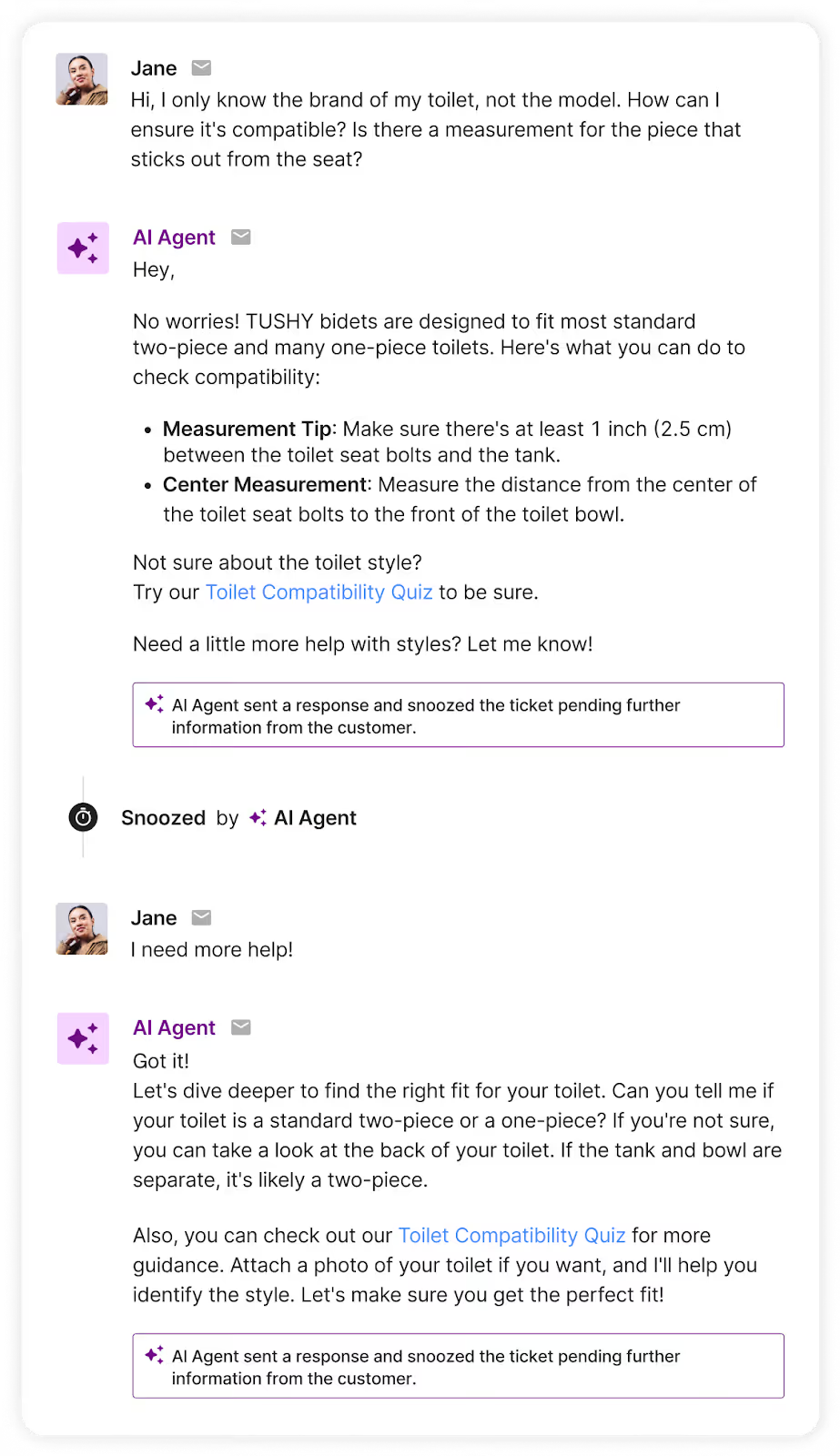
Here’s an example of what it looks like from bidet company TUSHY: 

A shopper asking for bidet compatibility help and TUSHY's AI Agent collecting more details to fully resolve their pre-sales question.  

3) Proactively engage with customers and offer help with a floating query bar

AI understands a shopper’s journey by tracking key behavioral signals: products and pages viewed, purchase history, and cart data. 

The floating query bar transforms product search into a seamless conversation, eliminating the need for clicks, filters, or endless navigation. It allows customers to find what they're looking for through natural conversation with the Shopping Assistant—wherever they are on your site.

Because AI tracks this information, it can personalize interactions based on the signals above. It does this by asking clarifying questions and remembering previous interactions in the same session.

This type of proactive support actually leads to more sales: it garnered almost 10k in revenue for jewelry shop Caitlyn Minimalist. ‍

”Customers interact with the Shopping Assistant like they would a customer service rep—it’s a two-way conversation where they answer questions and get personalized product recommendations,” says Gabi, Customer Service Lead at Caitlyn Minimalist.

That success was similar for beauty shop Glamnetic

“An instant response builds confidence,” says Mia Chapa, its Sr. Director of Customer Experience. 

“We live in a world with short attention spans, so customers appreciate how quickly we can respond to their inquiries.”

Glamnetic's homepage uses AI Agent's floating query bar for proactive customer and sales support
Need help? Glamnetic invites shoppers to use AI Agent’s floating query bar to ask questions.

4) Help with Quality Assurance

Quality assurance in CX is the process of ensuring that each customer interaction fits a specified list of criteria (communication, resolution completeness, attitude, etc.).

While this process has largely been a manual and time-consuming one, AI changes that for support teams.

AI-powered QA can actually review all tickets, is a scalable solution, is more consistent in its review process, saves time, and even provides instant agent feedback. 

Manual QA, on the other hand, is a time-consuming and slow process, and often means feedback is delayed until leaders have the chance to review tickets. Even once they get to QA, there's a limit to how many tickets they can review in a given time frame. 

Feature spotlight: Meet Auto QA: Quality checks are here to stay

5) Personalize product recommendations and upsells

AI can even make product recommendations for shoppers. These recommendations are based on browsing actions like if they repeatedly view the same pages and check return and shipping policies. It also tracks their entire behavior across your store: products and pages viewed, purchase history, cart data, and cart abandonment data.  

Caitlyn Minimalist achieved incredible outcomes by leveraging AI for personalized recommendations:

  • 59% reduction in customer response time
  • 25% conversion rate
  • $9,800 in direct revenue generated by AI Agent

“We've always based our customer service on a patient, empathetic point of view because a lot of people purchase for important moments in their lives—weddings, deaths, graduations. People are gifting in response to big life moments, so we need the Shopping Assistant to really listen to our customer’s situation and support them,” says Michael Holcombe, Co-owner and Director of Operations at Caitlyn Minimalist.

Shopping Assistant can also handle objections and offer discounts, if price is what’s stopping customers from completing a purchase. 

AI Agent for Sales provides discounts to customers based on their shopping behavior
Shopping Assistant turns hesitant shoppers into enthusiastic customers with dynamic discounts.

6) Reduce costs and increase return on investment

We’re not talking about reducing headcount. AI just supports agents in being able to handle their core responsibilities better. For example, mybacs was able to double the number of tickets they resolved without adding a single person to the team.

“This isn’t a matter of eliminating jobs, but giving our employees their primary jobs back," says Luke Wronski, CEO of RiG’d Supply. “Our hope is to have AI give us the time back to have a conversation with you about the stuff that keeps us stoked to do what we do.”

Aside from saving money on hiring additional human agents, AI helps your support team reduce costs in other ways. 

For Dr. Bronners, that meant 4 days per month in team time-savings by handling routine inquiries efficiently, and $100,000 saved per year by switching from Salesforce to Gorgias.

Top AI tool for CX: Gorgias AI Agent

Gorgias is hands down the best AI tool—not just for CX, but also for teams like web, ecommerce, and marketing. And our customers couldn’t agree more.

“We were hesitant at first, but AI Agent has really picked up on our brand’s voice. We’ve had feedback from customers who didn’t even realize they were talking to an AI,” says Lynsay Schrader, Lab and Customer Service Senior Manager at Jonas Paul Eyewear

Here’s a complete rundown of how Gorgias AI Agent bridges gaps in customer experience: 

Pain Point

AI Agent

Limited working hours

Operates 24/7 so customers don’t have to wait for a response.

Juggling multiple conversations at once

Can chat with as many customers as needed, and even remembers details within the same conversation.

Answering repetitive questions

Resolves frequently asked questions in seconds, freeing agents to focus on more complex requests.

Limited time/lack of opportunity to provide proactive support

Suggests solutions before customers encounter problems, uses advanced analytics to assess shopper intent, and adjusts strategies to nudge customers toward the checkout.

Engaging customers with personalized messages

Uses AI-powered intent scoring that evaluates user behavior, engagement, and responses in real-time to tailor responses, and sales strategy, and predict purchase likelihood.

Using on-brand language across the team

Consistently speaks in your brand’s tone of voice using Guidance and internal documents.

Not enough time to focus on sales

Engages customers with conversation starters, overcomes sales objections with recommendations, and guides users to purchase decisions with context-aware communication.

Combine humans with AI for powerful results 

A hybrid human and AI Agent approach is the best way to level up your customer support operations and sales strategy.

Book a demo with us to see the power of AI Agent.

{{lead-magnet-2}}

How to Build the Perfect CX Report in Gorgias (7 Dashboard Examples)

By Christelle Agustin
min read.
0 min read . By Christelle Agustin

TL;DR:

  • CX reports help you track performance, trends, and team impact. They show how support efforts drive business goals, but manual reporting often buries key insights.
  • Gorgias Dashboards can be customized with 70+ metrics. You can mix and match KPIs like automation rate, resolution time, and CSAT to create reports that fit your needs.
  • You can add filters to drill down into key insights. Filter reports by tags, channels, ticket fields, agents, integrations, and more to uncover trends and make data-driven decisions.
  • You can create up to 10 dashboards in Gorgias. Each dashboard can include up to 20 charts, helping you track multiple CX priorities in one place.

As a CX manager, your reporting is your strategic advantage. It's how you prove your team's value, identify emerging trends, and determine exactly what decisions to make.

But when creating those reports becomes time-consuming? That's when insights get buried.

With Gorgias Dashboards, you can build CX reports rooted in your business goals. Unlike standard reports, these customizable dashboards allow you to mix and match over 70 metrics and KPIs, so you can track progress on efforts like reducing your ticket backlog, boosting automation rate, and more.

In this post, we’ll tell you why CX reporting matters, how to set up Dashboards in Gorgias, and show you seven different ways to customize them based on your business needs.

7 Dashboard examples based on your goals

With 70+ charts and metrics to choose from, there are endless ways to style your dashboard. To make it easier for you, we’ve put together seven dashboards for specific use cases.

Setup 1: The performance overview dashboard

Let’s start with the basics. This is an all-in-one dashboard for a high-level overview of support and agent performance.

Recommended metrics to track:

  • Average CSAT over time – Tracks CSAT trends and helps identify when and why satisfaction fluctuates.
  • Agent performance (Closed tickets, CSAT, FRT, Ticket Handle Time) – Provides a comparative view of agent efficiency and effectiveness.
  • Automation rate – Measures the percentage of interactions resolved without an agent.
  • Resolution completeness rate – Ensures agents are fully addressing customer inquiries before closing tickets.
  • Busiest times – Identifies peak support hours for better staffing decisions.
  • Created vs. closed tickets – Helps track whether ticket volume is increasing, decreasing, or stabilizing.
  • Support-driven revenue – Shows how CX efforts contribute directly to revenue.
  • Overall time saved by agents – Quantifies the operational efficiency of automation and support workflows.
A custom dashboard that gives a high-level overview of support performance.
A dashboard for an overview of CX performance.

Setup 2: Recover from low CSAT 

Trying to bump up your CSAT score? This dashboard will help you improve customer satisfaction by keeping metrics related to response time and customer sentiment in your line of sight.

Recommended metrics to track:

  • Average CSAT – Track overall customer sentiment.
  • CSAT over time – Identify trends in satisfaction scores.
  • Resolution time – Assess the average time tickets are resolved.
  • First response time – Ensure customers are getting quick responses.
  • Messages per ticket – Analyze whether customers need to follow up multiple times to get an issue resolved.
  • Comment highlights – Identify recurring customer complaints and positive feedback.

Make sure to add a filter for customer satisfaction scores of 1-2 stars to dig into the reasons for low scores. Go to Add Filter > Satisfaction score > check 1 and 2 stars, as shown below:

Dashboards can be filtered for customer satisfaction score, allowing your team to analyze specific issues.

What to look out for:

  • If CSAT drops when resolution times increase, implement low-lift fixes like automating your most asked questions with Flows
  • If messages per ticket are high, train agents on clearer communication to resolve issues in fewer touches. Macros are an excellent way to let agents send complete and on-brand replies. 
  • Take note of recurring topics found in both positive and negative customer comments. Use these insights to finetune your CX.
Recovering from low CSAT dashboard
Recover from low CSAT with a dashboard highlighting response times and customer reviews.

Setup 3: Catch up on your Chat tickets

Peak seasons are the ultimate test of how robust your customer support organizational structure is, and nowhere is it more obvious than in your chat tickets. Without well-trained agents and proper automations in place, it’s easy to drown. Here’s a dashboard to keep up with chat inquiries.

Recommended metrics to track:

  • Open tickets – Track the number of unresolved chat tickets.
  • Created vs. closed tickets – See if new tickets are outpacing resolutions.
  • First response time – Identify delays in initial responses.
  • Resolution time – Track how long it takes to close tickets.
  • Busiest times – Understand when ticket volume is highest.
  • Agent performance – Compare workload distribution amongst agents.

Don’t forget to toggle the filter for the chat channel by clicking Add Filter > Channel > Chat.

Catch up on chat tickets dashboard
Catch up on open chat tickets with a dashboard showcasing open vs. closed tickets, response times, and your busiest times of the week.

What to look out for:

  • More open tickets than closed? Adjust your agent schedule or use conversational AI like AI Agent to automate up to 60% of your inquiries.
  • Slow first response time? The average CX team has a first response time of 10 hours. Reduce response time by using AI and automation to quickly resolve common questions.
  • Take note of the busiest times of the week to schedule agents accordingly.

Setup 4: Improve SLA compliance

Maybe you’re in this rut: You’ve established your SLAs (service level agreements), but your team is struggling to meet them. What now? 

Go back to the data. With this SLA compliance dashboard, you can look at exactly how many tickets have breached or achieved SLAs while monitoring agent performance. This dashboard is ideal for brands that provide warranties and/or limited-time return windows.

Recommended metrics to track:

  • Tickets with breached SLAs – Track service requests that exceed the SLA timeframe.
  • Achieved and breached tickets – Compare SLA compliance over time.
  • Ticket handle time – Measure how long agents spend on service-related tickets.
  • Agent performance (Closed tickets, CSAT, FRT, Handle Time) – Identify service efficiency gaps.
  • Busiest times – Understand peak service request periods to optimize scheduling.

You may find that breached SLAs are caused by certain topics (like refunds) or channels (like social media). Dive deeper by adding a filter for contact reason and channel. Click Add Filter > Contact Reason / Channel

A custom dashboard used to improve SLA compliance on support tickets.
Maintain SLA compliance with a dashboard focusing on breached tickets, first response time, and the busiest times of the week.

What to look out for:

  • If SLA breaches increase, improve agent scheduling and automate follow-ups with AI Agent, Flows, and Macros.
  • If certain agents have longer handle times, review training and escalation procedures.
  • If the busiest times overlap with SLA breaches, reallocate staffing to high-volume periods.

Setup 5: Reduce refund & return requests

Constant returns and refund requests are issues you want to address immediately. Looking at return reasons per customer is inefficient. Instead, get the bigger picture with a dashboard that highlights customer sentiment and product data.

Recommended metrics to track:

  • Ticket Fields - Top Used Values – Track the most common reasons for returns (e.g., “wrong size,” “poor quality,” “damaged on arrival”).
  • Comment highlights – Identify patterns in customer complaints about product issues.
  • Reviewed tickets – Ensure all return-related issues are properly reviewed and categorized.
  • Resolution time – Track how long it takes to resolve return/refund tickets.
  • Support-driven revenue – Assess whether support teams are turning return requests into exchanges or alternative purchases.

Pro Tip: This dashboard works best if you have a Ticket Field for Contact Reason and Return as a Contact Reason. Then you can add a filter for return-related tickets by clicking Add Filter > Contact Reasons > Return.

A custom dashboard used to reduce refund and return requests.
Reduce returns and refunds by using a dashboard that tracks customer sentiment.

What to look out for:

  • Pay close attention to your top return reason. This can help you improve product quality, packaging, shipping logistics, and policies.
  • If CSAT is low for return-related tickets, update your return policies or consider giving customers in-store credit, exchanges, or discounts.

Related: 12 ways to upgrade your data and trend analysis with Ticket Fields

Setup 6: Monitor customer sentiment on product quality

From food and beverage to skincare brands, product quality is central to your success. Use this dashboard to keep an eye on how customers feel about your products, then use the data to implement changes customers actually want.

Recommended metrics to track:

  • Ticket Fields - Top Used Values – Track commonly used feedback labels (e.g., “too salty,” “bland,” “packaging issue”).
  • Trend - Evolution of top 10 used values – Monitor changes in product sentiment over time.
  • Comment highlights – Identify trends in positive and negative feedback.
  • Reviewed tickets – With our AI-powered quality assurance feature, Auto QA, ensure return-related tickets follow your brand’s policies.
  • Satisfaction score – Understand how product issues impact CSAT.

You can analyze specific customer sentiments (like tickets that only say “too salty”) by applying a filter. For example, you would click Add Filter > Ticket Field Filters > Flavor > Too Salty.

A custom dashboard used to monitor customer sentiment on product quality.
Improve product quality by tracking customer sentiment and satisfaction scores in a dashboard.

What to look out for:

  • Take note of your top used ticket value, so you can adjust your product formulation, packaging, etc.
  • If you’ve made recent changes to your product, analyzing the trend of your top 10 used values is a great way to understand how customers feel about those changes.
  • Improve your satisfaction score based on customer reviews.

Setup 7: Optimize social media support

More and more customers are using social media apps to shop — in fact, the global social commerce market is projected to grow by 31.6% each year through 2030. The best way to give browsers a good first impression of your brand is by prioritizing social media support.

Recommended metrics to track:

  • Channel performance – Compare social media ticket volume to email and chat.
  • Tickets with breached SLAs – Ensure fast responses on high-priority platforms.
  • First response time (by channel) – Ensure social media inquiries receive timely responses.
  • Conversion rates from live chat/helpdesk – Measure how well support influences sales.
  • Top performers – First response time – Highlight the agents excelling in social engagement.

Don’t forget to apply a filter for your social media platforms by clicking Add Filter > Channel > Facebook / Instagram / TikTok Shop.

A custom dashboard used to optimize social media engagement.
Increase social media engagement by using a dashboard that tracks open tickets on social media platforms and response times.

What to look out for:

  • If first response times are longer for social media than email or chat, assign dedicated agents to your social media channels or use automated replies.
  • Monitor tickets with breached SLAs on a weekly basis, and aim to reduce it with AI Agent. 
  • If you have more created tickets vs. closed tickets, consider posting more product education content and updating your self-service resources.

How to create a dashboard in Gorgias

You can create up to 10 dashboards. Here’s how to create a new dashboard:

  1. Go to Statistics > Dashboards.
  2. Click + (plus sign) > Create a new dashboard.
  3. Click Add Charts. Choose from 70+ charts. You may add a maximum of 20 charts in a dashboard.
  4. Looking for a specific trend? Click + Add Filter to focus on key data.
  5. Need to save your dashboard data? Click Actions > Download Data to export the report as a CSV file.

Try it for yourself with our interactive tutorial:

Make data-driven CX your competitive advantage

With Gorgias Dashboards, CX managers have full control over their reporting.

By tracking the right KPIs and customizing dashboards based on goals, your team can set the standard for flawless customer support.

Find out the power of custom dashboards in Gorgias. Book a demo now.

{{lead-magnet-1}}

Should Brands Disclose AI in Customer Interactions? A Guide for CX Leaders

By Tina Donati
min read.
0 min read . By Tina Donati

TL;DR:

  • Check legal requirements. Some regions mandate AI disclosure—stay compliant.
  • Transparency impacts trust. Some customers appreciate honesty; others may disengage.
  • Frame AI as helpful. Position it as a support tool, not a human replacement.
  • Refine your approach over time. Monitor feedback and adjust AI disclosure as needed.
  • AI is everywhere in customer service—powering live chats, drafting responses, and handling inquiries faster than ever. 

    But as AI takes on more of the customer experience, one question keeps coming up: Should brands tell customers when they’re talking to AI?

    Legally, the answer depends on where you operate. Ethically? That’s where things get interesting. Some argue that transparency builds trust. Others worry it might undermine confidence in support interactions. 

    So, what’s the right move?

    This guide breaks down the debate and gives CX leaders a framework to decide when (and how) to disclose AI—so you can strike the right balance between innovation and trust.

    The legal landscape: What are the disclosure requirements?

    Depending on where your business operates, disclosure laws may be strict, vague, or nonexistent. Some laws, such as the California Bolstering Online Transparency Act, prohibit misleading consumers about the use of automated artificial identities.

    For maximum legal protection, it’s best to proactively disclose AI use—even when not explicitly required. 

    A simple disclaimer can go a long way in avoiding legal headaches down the line. Here’s how to disclose AI use in customer interactions:

    • In email: Use your email signature to indicate that AI has assisted in generating the response.
    • In chat: Update your Privacy Policy to clarify when AI is involved in customer interactions.

    Truthfully, AI laws are evolving fast. That’s why we recommend consulting legal counsel to ensure your disclosure practices align with the latest requirements in your region.

    But beyond avoiding legal trouble, transparency around AI usage can reinforce customer trust. If customers feel deceived, they may question the reliability of your brand, even if the AI delivers great service.

    Related reading: How AI Agent works & gathers data

    How does disclosure impact trust and satisfaction?

    Research shows that 85% of consumers want companies to share AI assurance practices before bringing AI-driven products and experiences to market.

    But what does “transparency” actually mean in this context? An article in Forbes broke it down, explaining that customers expect three key things:

    1. Clear disclosure: They want to know when AI is (and isn’t) used in customer interactions.
    2. Simple, non-technical language: AI disclosures shouldn’t feel like reading a terms-of-service agreement. Keep it digestible.
    3. Easy-to-find information: AI disclosures should be visible—not buried in fine print. A chatbot notification, a banner on your site, or a brief message before an AI-powered chat begins can make a big difference.

    How you disclose AI matters just as much as whether you disclose it. At the end of the day, AI isn’t inherently good or bad—it’s all about how it’s implemented and trained. 

    The business perspective: Risks and benefits of AI transparency

    The way a brand approaches AI disclosure can impact trust, satisfaction, and even conversion rates—making it a decision that goes beyond simple legal requirements.

    While some customers appreciate honesty, others may hesitate if they prefer human support. Brands must weigh the pros and cons to determine the best approach for their audience.

    Risks of disclosure

    Let’s be honest: AI in customer service still carries baggage. While some consumers embrace AI-driven support, others hear "AI" and immediately picture frustrating, robotic chatbots that can’t understand their questions.

    This is one of the biggest risks of transparency: customers who’ve had bad AI experiences in the past may assume the worst and disengage the moment they realize they’re not speaking to a human.

    For brands that thrive on personal connection and high-touch service, openly stating that AI is involved could create skepticism or drop-off rates before customers even give it a chance.

    Another challenge? The perception gap

    Even if AI is handling inquiries smoothly, some customers may assume it lacks the empathy, nuance, or problem-solving skills of a live agent. Certain industries may find that transparency about AI use leads to more escalations, not fewer, simply because customers expect a human touch.

    Benefits of disclosure

    Despite the risks, transparency about AI can actually be a trust-building strategy when handled correctly.

    Customers who value openness and ethical business practices tend to appreciate brands that don’t try to disguise AI as a human. 

    Being upfront also manages expectations. If a customer knows they’re speaking to AI, they’re less likely to feel misled or frustrated if they encounter a limitation. Instead of feeling like they were "tricked" into thinking they were talking to a human, they enter the conversation with the right mindset—often leading to higher satisfaction rates.

    And then there’s the long-term brand impact

    If customers eventually realize (through phrasing, tone, or inconsistencies) that they weren’t speaking with a human when they thought they were, it can erode trust. 

    Deception—whether intentional or not—can backfire. Proactively disclosing AI use prevents backlash and reinforces credibility, especially as AI becomes a bigger part of the customer experience.

    Example: How Arcade Belts used AI transparency without losing the human touch

    Arcade Belts, known for its high-quality belts, wanted to improve efficiency without compromising customer experience. By implementing Gorgias Automate, they reduced their reliance on manual support, creating self-service flows to handle common inquiries.

    Arcade Belts' website uses Gorgias Chat to automate FAQs
    Arcade Belts uses Gorgias Automate to automatically answer common questions.

    Initially, automation helped manage routine questions, such as product recommendations and shipping policies. But when they integrated Gorgias AI Agent, they cut their ticket volume in half. 

    The transition was so seamless that customers often couldn’t tell they were interacting with AI. “Getting tickets down to just a handful a day has been awesome,” shares Grant, Ecommerce Coordinator at Arcade Belts. ”A lot of times, I'll receive the response, ‘Wow, I didn't know that was AI.”

    You can read more about how they’re using AI Agent here.

    Decision-making framework: Should you disclose AI?

    We mentioned it earlier, but deciding whether or not to disclose your use of AI in customer support depends on compliance, customer expectations, and business goals. That said, this four-part framework helps CX leaders evaluate the right approach for their brand:

    Step 1: Assess legal requirements

    Before making any decisions, ensure your brand is compliant with AI transparency regulations.

    • Research regional laws governing AI disclosure, as requirements vary by jurisdiction.
    • Consult legal counsel to confirm whether your AI usage falls under any mandated disclosure policies.
    • Stay informed on evolving AI governance frameworks that could introduce new compliance obligations.

    Step 2: Review customer expectations and brand positioning

    AI transparency should align with your brand’s values and customer experience strategy.

    • Consider whether transparency supports your brand’s messaging—does your audience expect openness, or do they prioritize seamless interactions?
    • Analyze customer sentiment through surveys and engagement data to determine if they prefer knowing when they’re speaking with AI.
    • Review past AI interactions to identify patterns in customer reactions and adjust your approach accordingly.

    Step 3: Test both approaches and measure the impact on CSAT

    Rather than making assumptions, run controlled tests to see how AI disclosure affects customer satisfaction.

    • Conduct A/B tests comparing interactions with and without AI disclosure.
    • Track key support metrics like response time, CSAT scores, and AI resolution rates to measure effectiveness.
    • Experiment with different positioning strategies—does framing AI as a helpful assistant improve customer perception?

    Step 4: Adjust based on customer feedback and industry trends

    AI strategies shouldn’t be static. As customer preferences and AI capabilities evolve, brands should refine their approach accordingly.

    • Regularly collect customer feedback to understand how AI disclosure impacts their experience.
    • Monitor industry trends to see how competitors and market leaders are handling AI transparency.
    • Stay flexible—if sentiment shifts, be ready to adjust your disclosure strategy to maintain trust and efficiency.

    Best practices for AI disclosure (if you choose to disclose)

    If you decide to be transparent about AI in customer interactions, how you communicate it is just as important as the disclosure itself. Let’s talk about how to get it right and make AI work with your customer experience, not against it.

    First, make AI part of your brand voice

    AI doesn’t have to sound like a corporate FAQ page. Giving it a personality that aligns with your brand makes interactions feel natural and engaging. Whether it’s playful, professional, or ultra-efficient, the way AI speaks should feel like a natural extension of your team, not an out-of-place add-on.

    Instead of:
    "I am an automated assistant. How may I assist you?"

    Try something on-brand:
    "Hey there! I’m your AI assistant, here to help—ask me anything!"

    A small tweak in tone can make AI feel more human while still keeping transparency front and center.

    AI Agent responding to good customer feedback with a discount
    AI Agent uses an outgoing, enthusiastic, and approachable tone.

    Read more: AI tone of voice: Tips for on-brand customer communication

    Clarify the AI’s role

    One of the biggest mistakes brands make? Leaving customers guessing whether they’re speaking to AI or a human. That uncertainty leads to frustration and distrust.

    Instead, be clear about what AI can and can’t do. If it’s handling routine questions, product recommendations, or order tracking, say so. If complex issues will be escalated to a human agent, let customers know upfront.

    Framing matters. Instead of making AI sound like a replacement, position it as a helpful extension of your support team—one that speeds up resolutions, but hands off conversations when needed.

    Blend human and AI seamlessly

    Even the best AI has limits—and customers know it. Nothing is more frustrating than a bot endlessly looping through scripted responses when a customer just needs a real person to step in.

    AI should be the first line of defense, but human agents should always be an option, especially for high-stakes or emotionally charged interactions.

    A smooth handoff can sound like:
    "Looks like this one needs a human touch! Connecting you with a support expert now."

    Frame AI messaging positively

    AI disclosure doesn’t have to feel like an apology. Instead of focusing on limitations, highlight the benefits AI brings to the experience:

    • Faster responses
    • 24/7 availability
    • Instant answers to common questions

    It’s the difference between:

    "This is an AI agent. A human will follow up later."

    vs.

    "I’m your AI assistant! I can answer most questions instantly—but if you need extra help, I’ll connect you with a team member ASAP."

    The right framing makes AI feel like an advantage, not a compromise.

    Monitor customer feedback and adjust messaging

    AI perception isn’t static. Regularly analyzing sentiment data and customer feedback can help refine AI messaging over time—whether that means adjusting tone, improving explanations, or updating how AI is introduced.

    When you follow these best practices, AI can be a real gamechanger for your customer support. Just take it from Jonas Paul… 

    When AI is done right: Jonas Paul’s success story

    Jonas Paul Eyewear, a direct-to-consumer brand specializing in kids' eyewear, needed a way to manage high volumes of tickets during the back-to-school season without overwhelming their customer care team. 

    AI Agent responding to a customer asking about what eyeglass lenses to choose
    AI Agent helps a customer with the lens selection process.

    To streamline these conversations, Jonas Paul implemented AI Agent to provide instant responses to FAQs. This allowed human agents to focus on more complex cases that required personalized attention.

    “Being able to automate responses for things like prescription details and return policies has allowed us to focus more on the nuanced questions that require more time and care. It’s been a game changer for our team,” said Lynsay Schrader, Lab and Customer Service Senior Manager and Jonas Paul.

    Jonas Paul saw a 96% decrease in First Response Time and a 2x ROI on Gorgias AI Agent with influenced revenue. You can dive in more here.

    Make AI transparency work for you with AI Agent

    Whether or not your brand chooses to disclose AI in customer interactions, the key is to ensure AI enhances the customer experience without compromising transparency, accuracy, or brand identity.

    So how can you get started? Gorgias AI Agent was built with both effectiveness and transparency in mind. 

    For every interaction, AI Agent provides an internal note detailing:

    • The Guidance, Articles, or Macros it referenced
    • The source of any account information it used
    • A prompt for your feedback to continually refine and improve responses

    Excited to see how AI Agent can transform your brand? Book a demo.

    {{lead-magnet-1}}

    Grow Your Business with Conversational AI: Insights from Glamnetic & Audien Hearing

    By Holly Stanley
    min read.
    0 min read . By Holly Stanley

    TL;DR:

    • Glamnetic eliminated over 15,000 repetitive responses with AI, letting their team focus on complex customer needs and sales opportunities.
    • Audien Hearing found their AI support was matching or beating human performance, with faster responses and better conversion rates.
    • AI turned out to be more than just a time-saver—it became a serious revenue generator by engaging shoppers in real-time and driving sales.
    • This is just the beginning for AI in customer experience. AI will transform everything from personalized recommendations to proactive sales and marketing.

    The AI revolution in ecommerce customer support is already here. 77% of service teams are already using AI, and 92% say it improves time to resolution. 

    Brands that embrace AI can improve efficiency, scale faster, and deliver better customer experiences.

    But what does that look like in practice?

    In a recent Grow Your Business in 2025 with Conversational AI webinar, Kevin Gould, co-founder of Glamnetic, and Zoe Kahn, owner of Inevitable Agency & former VP of Retention and CX at Audien Hearing, shared how their teams use Gorgias AI Agent to streamline support, reduce workloads, and convert more shoppers into customers.

    For them, AI isn’t just hype, it’s delivering real results—and Kevin and Zoe have seen it firsthand.

    Ahead, we’ll break down Kevin and Zoe’s firsthand experiences, covering:

    • How AI helped Glamnetic reduce manual responses by 15,000–16,000 tickets
    • How AI-powered responses helped Audien Hearing capture more revenue
    • The biggest misconceptions about AI in customer support—and why they’re wrong
    • What AI-driven CX will look like in 2025 and beyond

    Watch the full webinar replay here:

    How AI reduces 16,000 manual tickets and scales CX

    As ecommerce brands grow, so does the demand for fast, high-quality customer support. But hiring and training more agents isn’t always scalable—especially when a significant portion of support tickets are repetitive, like Where’s my order?” or “How long does shipping take?”

    That’s where AI comes in. Instead of bogging down human agents with routine questions, AI-powered support can handle high ticket volumes instantly, freeing up CX teams to focus on complex issues, relationship-building, and revenue-generating conversations.

    Both Glamnetic and Audien Hearing have seen firsthand how AI can transform CX. Glamnetic reduced manual responses by 15,000–16,000 tickets, while Audien Hearing saw AI outperform some human agents in both response speed and upselling.

    Related reading: How to build an effective AI-driven customer support strategy

    How Glamnetic uses AI to cut manual responses by 25% 

    As Glamnetic scaled, so did its customer support workload. Managing tens of thousands of tickets while maintaining fast, high-quality support became a challenge. Many of the inquiries Glamnetic receives are repetitive––think order updates, shipping questions, and product details.

    The brand needed a way to streamline responses without losing the personal touch.

    Here’s what made the difference: Glamnetic used AI Agent to automate responses for thousands of tickets, allowing human agents to focus on higher-value interactions that drive customer loyalty and sales.

    Kevin Gould, co-founder of Glamnetic, was excited about infusing AI across the entire business. “CX felt like the first natural extension. A big part of that was [Gorgias] pushing us into it pretty quickly. We saw early on that AI could be a force multiplier for the business."

    Glamnetic leverages AI Agent to support during important period of growth
    AI Agent helped Glamnetic’s support team decrease its ticket volume by 25%.

    The results speak for themselves:

    • 15,000–16,000 fewer manual responses—freeing up agents for more complex cases.
    • Faster response times, improving the overall customer experience.
    • Smarter AI-driven sales, turning support inquiries into revenue opportunities.

    Read more: How Glamnetic uses AI Agent to handle 40% of Support Volume with "mind-blowing" results 

    "What’s really interesting is that AI handled 24% of tickets across the entire year…Now, we’ve gotten much smarter about how we deploy AI for revenue generation, and it’s been highly impactful. It’s well worth your time to deploy this across your company." —Kevin Gould, Co-founder, Glamnetic

    How Audien Hearing scaled support without adding headcount

    Scaling customer support while keeping costs in check is a challenge for any fast-growing ecommerce brand—especially one focused on retention and long-term customer relationships.

    For Audien Hearing, this meant managing a team of over 80 support agents while ensuring that every interaction added value to the customer experience.

    Rather than endlessly hiring more agents, Audien Hearing turned to AI to optimize. AI Agent helped them handle high ticket volumes faster, without sacrificing quality. With AI handling routine inquiries, their team was able to focus on higher-value conversations that drove long-term growth.

    Zoe Kahn, former VP of Retention & CX, notes the importance of efficiency when managing large teams, “Once you reach that scale, you have to figure out how to be efficient and adapt to the right tools. AI helped us a lot. That said, it’s not a magic button. It takes training and adjustment. Adopting AI with Gorgias has allowed our team to focus on the tasks that truly need a human touch."

    The impact was undeniable:

    • AI became one of Audien Hearing’s fastest agents, reducing response times.
    • Support scaled without adding headcount, optimizing costs.
    • AI-driven interactions increased revenue by converting browsing customers in real-time.
    Screenshot of AI Agent Bot replying to Barbara customer of Audien Hearing.

    Read more: How Audien Hearing increased efficiency for 75 agents and reduced product returns by 5% 

    "[AI Agent] ended up being one of our fastest agents—answering the most tickets and driving the most revenue. A lot of that revenue was potentially missed revenue because these were customers sitting on the site, asking questions about the products, and wanting an answer now so they could purchase…Now, AI can answer those questions immediately and convert those customers." —Zoe Kahn, former VP of Retention & CX, Audien Hearing 

    Initial AI skepticism and common concerns

    AI in customer support still raises eyebrows. Some brands worry about losing the human touch, while others fear AI will replace agents rather than support them. 

    Even Zoe Kahn was initially skeptical about AI’s role in customer experience:

    "I wasn't fully convinced at first—I wanted humans talking to my customers. But as soon as I saw it working well, and just as great as some of my agents, if not even better because of faster responses, and we're having agents train it... it's much easier now with a bunch of wins.”

    What changed? Seeing AI in action—handling repetitive, time-consuming tasks like order tracking and FAQs, while human agents focused on complex cases, upselling, and retention.

    For Kevin Gould, AI wasn’t brought in to cut costs but to help the CX team work smarter, not harder:

    “We try to think a lot about how to work smarter, not harder. On one end of the spectrum, there's a lot of tedious, repetitive emails that can be automated right off the jump. Then as you move up the stack, from servicing up to generating revenue, it starts to get really interesting. If our ultimate goal is to provide customers with the best experience possible, then why not free up our agents from tedious tasks and double down on the things that push us towards that goal?”

    The key takeaway? AI isn’t automation just for the sake of automation. It’s for scaling smarter and freeing up CX teams to have the right conversations at the right time.

    Related reading: How to automate half of your CX tasks 

    What’s next for AI in ecommerce CX in 2025?

    AI in ecommerce customer support started as a cost-saving tool and is now proving to be a revenue driver. Looking ahead to 2025, AI’s role in personalization, proactive selling, and marketing integration will only grow.

    For Zoe Kahn, the future of AI involves building stronger customer relationships:

    "Take time to create community with your customers. Have the ability to think not only about revenue driving but also customer retention. Every time you have an opportunity to talk to a customer, take it. If teams don't have that time that could be freed up from training an AI agent, we see them rushing through replies that could really ruin their relationships with customers."

    This shift toward AI-powered personalization is something Kevin Gould is already seeing in action. He predicts AI will become a key player in conversational selling, guiding customers to the right products at the right time:

    "Eventually, we'll get to a place where AI is going to become a great recommendation engine. If we sell press-on nails, and a consumer has bought a few different styles in the past, AI can quickly pivot into conversational selling."

    Beyond support, Kevin also believes that AI is blurring the lines between CX and marketing. As brands gain deeper insights into customer behavior, AI-powered support will help fuel marketing campaigns, drive retention, and create highly personalized experiences:

    "If I asked [my support agent] how she sees her job, she’d say it started four years ago as customer service, then evolved into customer experience. Over time, different layers of customer experience emerged to the point where it's now an integrated marketing role.

    She's collaborating closely with marketing specialists—growth marketing, brand marketing, and more. At this point, this role is almost like an extension of the marketing team...It requires a balanced mindset that blends marketing expertise with a deep understanding of customer experience to be successful."

    Related reading: 6 ways to increase conversions by 6%+ with onsite campaigns

    Why 2025 is the year to embrace AI in CX

    In 2025, AI will go beyond responding to customers. It will anticipate their needs, personalize their journey, and turn support into a revenue-generating powerhouse.

    As Kevin Gould and Zoe Kahn shared, brands that embrace AI free up their teams to focus on high-impact conversations that build loyalty and boost sales.

    From Glamnetic reducing 15,000+ manual responses to Audien Hearing’s AI-powered revenue wins, the results speak for themselves. AI helps brands personalize support, engage customers in real-time, and even drive conversational selling.

    Ready to see how many routine tickets you could automate? Book a demo to see AI Agent in action.

    {{lead-magnet-1}}

    Meet Auto QA: Quality Checks Are Here to Stay

    By Gorgias Team
    min read.
    0 min read . By Gorgias Team

    TL;DR:

    • Manual QA is time-consuming—Auto QA does the heavy lifting. It frees up team leads by automatically reviewing conversations with accuracy and consistency, so they can focus on improving support.
    • Auto QA scores 100% of private text conversations, whether handled by a human or Gorgias AI Agent. It evaluates support quality based on Resolution Completeness, Communication, and Language Proficiency.
    • Auto QA supports multiple languages but provides feedback in English. It can assess tickets in any language supported by OpenAI’s GPT-4, ensuring global teams can benefit from automated QA.
    • Start with individual meetings before a team-wide rollout of Auto QA. One-on-one conversations help address specific agent concerns and ensure a smooth transition.

    Customer satisfaction scores (CSAT) have long been the go-to metric for measuring support quality, with 53% of customer experience leads relying on them. However, CSAT only tells you part of the story. 

    When customers rate their experience 3 out of 5, what does it really mean? Did they rate the agent’s actions or the company’s policies? Was an agent helpful or inefficient? Did they take unnecessary steps to get to the answer?

    Quality assurance checks can fill these gaps, but manual QA is a heavy lift. Team leads often struggle to review more than a small sample of conversations, leaving many issues unchecked.

    Auto QA redefines quality assurance for today’s support teams. It transforms QA from a manual task into an automated feedback engine that helps your team deliver excellent support, every single time.

    Let's dive into how Auto QA works, how accurate its scoring is, and how you can add it to your support workflow to start improving customer conversations today.

    What is Auto QA?

    Gorgias Auto QA upgrades the customer service QA process by automatically evaluating 100% of private text conversations, whether handled by a human or AI Agent. 

    Each message is scored on metrics like Resolution Completeness, Brand Voice, and Accuracy, helping teams fix and address areas of improvement.

    With an automated QA process, brands can:

    • Save time: Automated quality checks help team leads focus on the most critical tickets.
    • Ensure consistency: Both human agents and AI Agent are evaluated with a unified, comprehensive quality score.
    • Boost performance: Agents can receive targeted coaching to provide more consistent customer experiences.
    • Meet customer expectations: Customers benefit from higher-quality support with quicker resolutions and accurate responses.

    How Auto QA works 

    Let's explore a real-life scenario: A customer reaches out about a product issue, seeking troubleshooting help. Here’s how the interaction unfolds:

    Customer: "Hi, my device broke, and I bought it less than a month ago. -Kelly"

    Support Agent: "Hi Kelly, please send us a photo or a video so we can determine the issue with your device. -Michael"

    The ticket is eventually closed, but the customer doesn't leave a CSAT score.

    In this case, Auto QA would provide the following insights:

    • Communication Score: 3/5. Reason: The agent's wording could benefit from more empathy.
    • Resolution Score: "Complete". Reason: The agent effectively addressed the customer's concerns.
    Access Auto QA right within the ticket view. Find it on the right-hand side of customer conversations.

    How accurate is Auto QA’s scoring?

    Auto QA uses a comprehensive scoring system that evaluates conversations on communication proficiency and knowledge accuracy.

    To ensure accuracy, Auto QA only scores interactions with at least 250 characters and messages from both agents and customers. It's also smart enough to filter out automated responses, spam, and bot messages.

    Auto QA automatically scores three main aspects:

    1. Resolution Completeness: Did the agent solve everything the customer asked about? This area is scored with a "Complete" or "Incomplete.” For instance, it correctly marks a ticket as "Complete" when a customer resolves their issue or when there's no clear question to address.
    2. Communication Quality: How well did the agent listen and show empathy? Uses a 1-5 scale, looking at how well your agents acknowledged a customer’s concerns and communicated the solution.
    3. Language Proficiency: Did the agent communicate properly? Uses a 1-5 scale to check spelling, grammar, and syntax.

    For deeper feedback, certain criteria require manual scoring from team leads:

    • Accuracy: How accurate was the information provided by the agent?
    • Efficiency: How quickly did the agent handle the ticket? How well did they minimize the number of follow-ups?
    • Internal Compliance: How closely did the agent follow your team’s internal processes and brand guidelines?
    • Brand Voice: How well did the agent use brand vocabulary, greetings, sign-offs, and tone of voice?
    A text field for
    Improve Auto QA scoring by clicking the triangle to expand each category and entering feedback into the textbox. 

    How to integrate Auto QA into your workflow

    Whether you're just starting with quality checks or transitioning from manual QA, Auto QA can seamlessly fit into your existing processes. Here's how to get started.

    1. Set your standards

    What does “good” look like for your team? Review Auto QA's scoring system and decide which metrics matter most for your brand, from Resolution Completeness to Brand Voice. This will help you set realistic targets for your team to work toward.

    Tip: Start by prioritizing a couple of areas. This could look like prioritizing a 5/5 Resolution Completeness score while deprioritizing Brand Voice. As your team gets comfortable with Auto QA, you can ramp up to improving Brand Voice.

    2. Agree on a scoring system

    Since some criteria—Accuracy, Efficiency, Internal Compliance, and Brand Voice—require manual scoring, it’s best to agree on how your team will use the scoring scale.

    For example, each score from 1 to 5 receives a distinct piece of feedback. Here’s what that would look for the Efficiency criteria:

    • 1/5 stars: Excessive back-and-forth that could have been avoided
    • 2/5 stars: Resolution took longer than necessary due to poor process
    • 3/5 stars: Average handling time with some unnecessary steps
    • 4/5 stars: Quick resolution with minimal back-and-forth
    • 5/5 stars: One-touch resolution

    3. Prepare your agents

    Start rolling out Auto QA through individual meetings with agents rather than overwhelming your team with a general training session. One-on-one conversations allow you to better address each agent's specific questions and concerns. Make sure to cover the following:

    • Explain that Auto QA is meant to help make conversations consistent, not police agents
    • Explain the scoring criteria and what each score means
    • Highlight which criteria agents should prioritize

    If regular one-on-one meetings aren't part of your routine, consider introducing Auto QA during your weekly team meetings or through a dedicated training session. Just remember to leave plenty of time for questions and walk through multiple examples to ensure everyone is comfortable with the system.

    4. Establish a review schedule

    To solidify QA checks, create a simple routine for reviewing Auto QA insights with the Auto QA Report (navigate to Statistics > Auto QA). 

    • Weekly: Do a quick check of automated scores.
    • Monthly: Analyze trends and patterns across conversations. 
    • Quarterly: Review and adjust quality benchmarks.
    Auto QA Report dashboard shows reviewed tickets, resolution completeness score, communication score, and individual agent performance
    Monitor the number of tickets Auto QA has reviewed, your average resolution completeness rate, and your communication score.

    5. Act on insights

    Once you’ve collected a substantial amount of Auto QA data, there are a few follow-up actions you can take to continue having high-quality conversations:

    • Set the example by sharing high-scoring conversations in your team meetings.
    • Coach agents individually by reviewing their tickets together. Celebrate high-scoring conversations and provide targeted feedback on areas for improvement. This immediate, personalized approach helps agents grow faster than general training sessions.
    • Increase product and policy knowledge by refining internal guidelines on brand voice, escalation processes, and more.

    Remember, Auto QA works alongside your existing processes—it doesn't replace them. Start small, focus on the metrics that matter most to your team, and scale up as you get comfortable with Auto QA.

    Brands are excited about the power of Auto QA

    We invited leading ecommerce brands to beta test Auto QA, and their feedback highlights how it's transforming quality assurance across support teams of all sizes.

    amika's support team values the complete visibility beyond CSAT: "Auto QA dramatically widens the volume of tickets we can review," they share. "A 5-point scale only tells you so much, and relying on consumers providing feedback limits what you're able to learn from."

    Peachybbies' CX team enjoys real-time improvement: "Being able to give real-time feedback is pivotal, especially during peak times," their team explains. "Auto QA catches pretty much everything I'd want a human QA agent to catch."

    OSEA Malibu's managers discovered operational insights: "It helps managers understand when a macro or process is leading to incomplete conversations versus when an agent made a mistake," their support lead shares.

    Bring quality into every conversation with Auto QA

    By prioritizing QA, your team can identify potential problems early, reduce errors, and improve overall performance, leading to a smoother, more reliable experience for customers––and your CX team. 

    In the long run, brands focusing on QA can gain a competitive edge. Book a demo now to see what Auto QA can do for you.

    {{lead-magnet-1}}

    5 CX Metrics To Track in 2025: A Guide for Managers

    By Alexa Hertel
    min read.
    0 min read . By Alexa Hertel

    There are tons of CX metrics you could be tracking. But where you spend your time is crucial as a customer experience leader. 

    According to recent data, these are the top five CX metrics for you to prioritize and improve on in 2025.

    {{lead-magnet-1}}

    Why CX metrics are essential for success 

    Not tracking CX metrics is like putting a loaf of bread in the oven but leaving baking time to chance. Without a set timer, you could end up with an underbaked bowl of dough or a burnt mess. Unless you have a sixth sense, it’s going to be really challenging to end up with something good. 

    In the same vein, metrics provide clear parameters for success. Meet or exceed them and your team is doing well; fall short and you’ll be better equipped to identify pain points and solve them. 

    Here are a few additional reasons why setting customer support metrics is key to success.

    • Measure success and ROI. By tracking KPIs like resolution time, first response time, and CSAT, you can gauge the health of your customer support program and potentially justify investments in CX initiatives in the future.
    • Identify customer and team pain points. Metrics help uncover areas where customers or your team is struggling. For example, high resolution times or low CSAT scores signal friction in the experience that you can address. 
    • Create accountability within your team. When everyone on your team understands what success looks like, it aligns efforts and keeps everyone focused on shared goals.
    • Prioritize resources. Metrics guide CX leaders on where to allocate resources—for example, leveraging AI and automation to tackle repetitive tickets when ticket volume adds up or resolution times are getting high.
    • Get proactive. Metrics reveal trends in customer behavior which can help you predict customer needs and make proactive adjustments in your CX strategy. By monitoring customer sentiment and acting on feedback, CX leaders can create more personalized and positive experiences.

    Tip : AI and automation can be valuable sidekicks as you look to optimize and improve on metrics. That’s especially true for busy periods: in 2024, 70% of CX leaders relied on AI and automation during peak seasons.

    A pink graphic with 70% next to stars and the text of CX teams use AI and automation to handle support inquiries during the holiday season.
    70% of CX teams use AI and automation to handle support inquiries during the holiday season. Gorgias

    Resolution time should be your main focus for 2025

    Customers are done with being patient. One study found that two thirds of respondents valued speed to reply just as much as product price. 

    A recent survey we ran found the same thing. 

    In our 2024 customer expectations survey, we asked CX leads and agents which metric they used to track success. Here’s what they said:

    • Resolution Time (71%)
    • First Response Time (59%)
    • CSAT (53%)
    • Revenue or Sales Impact (41%)
    • Ticket Volume (41%)

    Resolution time is going to be a key differentiator for your team this year. It should be your primary focus when it comes to optimizing different facets of your customer service strategy

    A peach bar graph that shows the different metrics CX leaders used to measure success for holiday 2024, with resolution time at the top.
    71% of CX teams used resolution time to measure success during the holiday season in 2024. Gorgias Customer Expectations Survey

    Top 5 CX metrics for 2025 & how to improve them with AI 

    1) Resolution time 

    Resolution time is the average time it takes to resolve a customer request from start to finish.

    How do you calculate resolution time?

    To calculate resolution time, you’ll take the total resolution time within a set period and divide it by the total number of customer interactions your team tackled within that same time frame.

    Average resolution time = Total resolution time in a defined period / Total number of customer interactions resolved in that period

    How to use AI & automation to improve it

    According to a 2023 study from Statista, 70% of support leaders noted that the customer support metrics that AI had the greatest positive effect on was resolution time.

    You can use automation features to send Macros to answer common questions, or leverage AI to interact as an agent via email or chat. The instant nature of these tools means that customers won’t have to wait in a queue for your team to get to them.

    For example, Wildride implemented Gorgias AI Agent to manage an influx of 1,000 tickets per week. After AI Agent took over 33% of email inquiries, the team saw a 24% decrease in resolution time. That allowed the team to focus on more complex issues, streamline their support process, and make their customers happier. 

    2) First Response Time (FRT)

    First response time is the length of time it takes for a customer service team to send the initial reply to a customer inquiry.

    How do you calculate first response time? 

    To calculate average first response time, take the total amount of time it took for your team to respond to initial customer requests and divide by the total number of tickets within a set time frame. 

    How to use AI & automation to improve it

    Your team is busy––when they’re not tackling repetitive questions, they’re helping customers with complicated or high-effort requests. All of that work is going to bog down your FRT, especially during more buzzy periods like sales, new releases, or over the holidays. 

    By using AI to jump in to handle those more routine requests, you can significantly reduce your FRT and give your team time back to tackle more heavy-lift needs. 

    For example, AI Agent helped Glamnetic achieve a 91% improvement in first response time during Black Friday Cyber Monday (BFCM) 2024. They got FRT down from their pre-AI Agent time of eight minutes to 40 seconds. 

    Here’s what that looked like in practice: 

    An interaction between Gorgias's AI Agent and a Glamnetic customer in need of a shipping address change via email.
    AI Agent helped Glamnetic reduce first response time by tackling repetitive tickets like change of address requests. Gorgias 

    3) Customer Satisfaction Score (CSAT) 

    CSAT scores show how satisfied customers are with a product, service, or interaction, typically gathered through surveys.

    How is CSAT calculated? 

    CSAT is calculated via a five-point rating scale survey sent to customers after a support interaction, where one is the worst experience and five is the best. While it can be calculated in different ways, at Gorgias the average of all survey responses is your CSAT score.

    How to use AI & automation to improve it

    When customers reach out for support, they’re expecting a fast response––regardless if they have an issue or are contemplating their next purchase. 

    That’s why using automation or AI tools to provide that lightning quick response, even if it directs shoppers to a self-service resource, can be extremely effective in raising CSAT scores. These responses could be sent by an AI agent that responds like a human agent would or an automated Macro built to fire off pre-crafted templates to common questions. 

    In luxury golf brand VESSEL’s case, customers felt that the AI responses were helpful and seemed on-par with the level of support they’d expect from a human agent. 

    “Our customers expect almost immediate responses, and so being able to automate that, even if it's not necessarily the exact answer that they're looking for, but being able to send over information to give them the reassurance that we're looking into it or trying to find an answer, whatever it may be, that's been a huge help to our team,” says Lauren Reams, the Customer Experience Manager at VESSEL. 

    4) Revenue or sales impact 

    The direct or indirect effect of customer service or business activities on generating sales or revenue.

    How do you calculate it?

    There are different ways to calculate revenue generated and the sales impact of customer support, and quantifying the indirect impact can be difficult. But generally, the formula looks like this: 

    ROI = [ (Money earned - Money spent) / Money spent ] x 100

    Resource: How to measure & improve customer service ROI

    How to use AI & automation to improve it

    Leveraging AI and automation can provide significant cost savings because it acts as an additional agent who can tackle repetitive questions, translating to money saved on the time it would take for human agents to manually answer those questions. 

    The results are tangible: by automating 48% of inquiries, Dr. Bronner's saved $5,248 in the first month, and $100K in the first year. 

    Jonas Paul Eyewear saw revenue influenced by AI Agent as well: the team tracked $600 of sales revenue directly to the tool after it effectively answered pre-sales support questions from shoppers. 

    An interaction between Gorgias's AI Agent and a Jonas Paul Eyewear customer who has a pre-sales question.
    Gorgias AI Agent supports pre-sales questions by offering detailed responses, like which glasses would work best for a customer’s 8 year old son. Gorgias 

    5) Ticket volume 

    Ticket volume is the total number of customer service inquiries that a team receives over a specific period of time.

    How do you calculate it?

    The customer support tool you use will be able to calculate ticket volume for you, as it’s the total number of tickets that have come in within a set amount of time. If you don’t use a CX platform yet and are still using something like Gmail or Excel, you’ll perform this count manually.

    How to use AI & automation to improve it

    Set rules to trigger automated responses to common questions, or ask an AI agent to completely take them off your team’s plate. 

    Arcade Belts, for example, saw a 50% reduction in ticket volume by using Gorgias AI Agent. 

    How to get buy in to improve your CX program

    Tracking CX metrics is valuable for more than just gauging your program's effectiveness. The more you improve upon your CX metrics, the more you can leverage them to prove your support function’s value within your company.  

    1. Tie CX to revenue. Show how improvements in customer satisfaction or repeat purchase rates directly impact revenue growth. 
    2. Show industry benchmarks. Compare your team’s stats to competitors or industry averages to demonstrate how well your support strategy is working.  
    3. Demonstrate your team’s impact on sales and retention. Use the metrics you’ve collected to show support’s impact on converting customers asking pre-sales questions and getting repeat customers. 
    4. Ask to expand your team’s budget. Pitch acquiring additional buy in and resources by presenting revenue generated, costs saved through tools like AI and automation, and happy customers created. 

    How to use metrics to evaluate AI performanceIf you want to transform customer experience for the long term, the AI tools you use should never be “set it and forget it” solutions. Just as you do with your human agents, you can use metrics to evaluate your AI agent to make sure it’s performing well. If you use Gorgias, you’ll find these metrics under the AI Agent dashboard. 

    To review AI Agent’s performance

    A screenshot of the AI Agent Statistics view within Gorgias.
    Review AI Agent’s performance within the Statistics view. Gorgias If you’d like to change the metrics you see here, select “Edit Columns.” 
    A screenshot of how to change the metrics you track for AI Agent within the Statistics tab in Gorgias.
    Navigate to the ‘Performance’ section to switch out the metrics you track for AI Agent. Gorgias 

    It’s also easy to retrain your AI's performance by adjusting settings like Guidance, refining the internal documents it draws from, setting up brand voice, or creating a Handover topic list to escalate certain types of tickets to human agents.

    Start tracking top CX metrics 

    Whether you’re new to being a CX leader or you’re a seasoned pro, tracking and improving on your CX metrics will help your team stand out among the rest. A key way to improve them is to leverage AI and Automation tools, and Gorgias is here to help you do it.

    Get started with AI Agent →

    {{lead-magnet-2}}

    Say Hello to AI Agent on Chat: 24/7 Support for Online Stores

    By Christelle Agustin
    min read.
    0 min read . By Christelle Agustin

    TL;DR:

    • AI Agent on Chat automates up to 50% of chat conversations. It ensures customers get fast, context-aware answers, product recommendations, and seamless handovers to human agents when needed.
    • AI Agent goes beyond automated features like Flows and article recommendations. On top of basic automation features, AI Agent can handle complex inquiries like modifying orders and providing personalized product recommendations.
    • Setting up AI Agent on Chat is quick. Brands can activate AI Agent with a few clicks, improving efficiency during peak seasons and reducing the need for follow-ups.
    • Updating AI Agent’s knowledge and behavior ensures the best customer experience. Businesses should refine their Help Center, set Guidance instructions, personalize AI Agent’s tone, and test responses before going live.

    It’s clear that shoppers want answers fast—chat accounts for 20% of all customer support tickets.

    The appeal is obvious: Chat is an easy-to-access customer service channel for quick questions and a convenient and subtle way to cross-sell complementary products.

    But without the right chat tool, brands risk losing these valuable opportunities.

    Introducing AI Agent on Chat, a conversational AI assistant that can automate up to 50% of chat conversations. This new feature upgrades chat by combining agent knowledge with superhuman efficiency and response times.

    Now, customers can guarantee personalized interactions at any point of the shopping journey—whether they’re looking for a quick answer or a tailored recommendation.

    With AI powering every interaction, one-to-one conversations become a seamless part of every customer experience.

    Why Chat is better with AI Agent

    Before AI Agent, customers reaching out through chat outside business hours had two options: following pre-set Flows (automated FAQ conversations) or browsing through suggested Help Center articles. 

    These features are great for quick answers to basic questions, but AI Agent takes support to the next level by handling more complex needs like modifying orders or offering personalized product recommendations.

    With AI Agent in Chat, customers enjoy dynamic, real-time conversations available on multiple channels. AI Agent generates personalized responses that match exactly what customers ask for, automating 50% of chat interactions so agents get time back to upsell, create stronger relationships, and craft better experiences.

    Related: How to optimize your Help Center for AI Agent

    The key features of AI Agent on Chat 

    Upgrade your chat support from a basic Q&A tool into an intelligent assistant that handles customer inquiries 24/7. Here's how AI Agent makes that possible:

    Real-time conversations

    AI Agent responds within 15 seconds or less, offering fast responses that result in frictionless conversations. Unlike traditional chatbots, AI Agent also adapts to your brand’s unique tone of voice to enhance the customer experience and assure shoppers their questions will be taken care of. 

    Four customer inquiries branching out from live chat which has an "AI Agent is thinking" chat message.
    AI Agent is context-aware and uses information from its knowledge sources to respond to customers in real time. 

    24/7 availability

    Today’s shoppers expect instant responses regardless of time zone or business hours. AI Agent on Chat means customers get the help they need, when they need it. This availability leads to higher customer satisfaction and fewer abandoned carts.

    Instant product recommendations

    AI Agent understands context and customer intent. Whether a shopper needs help finding the right product size or changes their mind and wants to compare features, AI Agent customizes its recommendations for each person.

    Intelligent handovers

    Some conversations, like technical issues or complaints, need a human touch. AI Agent recognizes these situations and smoothly transfers them to the right agent. 

    Using Handover topics, you can choose which types of inquiries should go straight to human agents. Then, if AI Agent lacks the confidence to provide an answer or can’t locate relevant knowledge in its database, it automatically escalates the conversation.

    Read more: Handover rules

    Why enable AI Agent in Chat now?

    Based on Hiver’s 2024 study, 62% of customers prefer live chat to other support channels. With AI Agent in Chat, agents can cut down average response times while customers get the answers they need in one conversation with zero wait times or follow-ups.

    Easy setup

    AI Agent on Chat is ready to use in a few clicks. Simply connect your Shopify store and Chat widget to AI Agent, and you’re ready to resolve questions asked by visitors and loyal customers faster than you ever have.

    Capture the growing demand for live support

    Chat is often a customer’s first touchpoint with your brand, whether they’ve just discovered your brand or are on their third order. Meet customer expectations by being available with AI Agent on Chat. The faster you can ease their concerns, the faster they can head to checkout.

    Maximize team efficiency

    AI Agent makes scaling support effortless, especially during peak seasons like Black Friday. While it handles repetitive support tickets like order status and shipping questions, your team can focus on high-priority tasks like requests from VIP customers.

    A graphic with a pink gradient background featuring the text "AI Agent is an extension of your CX team" on the left. On the right, a circular diagram highlights four key functions: "Onboard," "Automate," "Observe," and "Coach." The "Gorgias" logo is in the top left corner, and the phrase "AI-powered CX built for ecommerce" is in the top right.
    Onboard, Automate, Observe, and Coach AI Agent to flawlessly integrate it into your team.

    Eliminate the need for follow-ups

    Drawing from knowledge sources like your Help Center and policy pages means AI Agent can often resolve inquiries within one conversation. No more unnecessary back-and-forths. Quick resolutions = happier and more loyal customers.

    How to activate AI Agent on Chat

    Ready to get started? Here’s how to activate AI Agent on Chat:

    1. Click Automate in the top left menu.
    2. Select your store from the sidebar, then click on AI Agent.
    3. In the Settings tab, under Chat Settings, select one or more Chat from the dropdown menu.
    4. Toggle Enable AI Agent on Chat on.
    5. Select Save Changes at the bottom of the page.

    Already use AI Agent for email? No need to set up Guidance and Handover topics all over again—AI Agent will behave the same way in Chat.

    Best practices for setting up AI Agent on Chat

    Get the most out of AI Agent on Chat by following these best practices. 

    1. Prepare and optimize your knowledge base

    The Help Center is AI Agent’s brain. This customer knowledge database is the key to AI Agent’s accurate and on-brand responses. To ensure your AI Agent is as trained as your human agents, include important topics in your Help Center like shipping, returns, cancellations, and account management.

    No articles yet? No problem! Gorgias has 20+ article templates for you to use and modify. Or, even better, check out the AI Library for AI-generated articles based on your customer tickets.

    A GIF of a highlighted "AI Library" button with a purple sparkle icon. The button has a white background, rounded edges, and a blue underline that animates from left to right. The background shows part of a navigation bar.
    The AI Library recommends pre-written articles based on what your customers ask you.

    2. Set restrictions with Guidance

    AI tools perform best when you set limitations. A Guidance is the main way to control AI Agent’s behavior. It is a set of written instructions that outline how AI Agent should interact with customers, handle certain requests, and more.

    We recommend publishing a Guidance on the top five questions you receive from customers.

    Tip: AI Agent prioritizes Guidance above Help Center articles. Unlike Help Center articles, the content in your Guidance will not be customer-facing.

    5 types of Guidance for AI Agent ranging from damaged items to returns, plus a customer guidance button.
    Access premade Guidance templates or make your own customer Guidance for AI Agent.

    3. Personalize AI Agent's voice

    The beauty of AI Agent is its ability to speak like one of your agents. Select from Friendly, Professional, or Sophisticated presets—or create a custom tone that aligns with your brand.

    Custom is selected under the Tone of Voice dropdown. There are instructions about being concise and using emojis for a personal touch.
    AI Agent’s tone of voice can be altered with preset voices or custom instructions.

    Need help finding your brand voice? Here are seven brand voice examples.

    4. Test AI Agent’s responses before going live

    Use test scenarios to see how AI Agent responds to common customer questions, such as order status, shipping questions, and return policies. To cover all your bases, test AI Agent as both a new and returning customer to make sure it delivers accurate responses no matter the customer's need.

    AI Agent greets the user to the AI Agent test area where they can test how AI Agent would respond to customer questions.
    Test AI Agent’s responses to ensure accurate answers.

    5. Improve AI Agent’s behavior

    AI Agent becomes smarter as it learns from you. Like a human agent, give your AI Agent feedback on its responses, from how it speaks, which topics it escalates, and what actions it takes in certain scenarios. 

    There are multiple ways to give AI Agent feedback on a ticket:

    • Mark AI Agent’s message or any of the resources it used as correct or incorrect.
    • Suggest that AI Agent use a different resource if a better or more correct piece of knowledge exists.
    • Report an issue to the Gorgias Product team.
    AI Agent’s answers improve as you provide feedback.

    Try AI Agent Actions on Chat

    AI Agent can also perform actions like accessing Shopify order details and executing third-party app actions, such as updating shipping addresses and order cancellations, directly in Chat.

    Excited to deliver an elevated chat experience? Book a demo now to experience the power of AI Agent on Chat.

    {{lead-magnet-1}}

    Building delightful customer interactions starts in your inbox

    Registered! Get excited, some awesome content is on the way! 📨
    Oops! Something went wrong while submitting the form.
    A hand holds an envelope that has a webpage coming out of it next to stars and other webpages