


Newsletter Signup
The best in CX and ecommerce, right to your inbox
Featured articles
Ticket Volume: How to Measure It, Benchmark It, and Reduce It
Gorgias AI Agent Pricing, Explained
Introducing Helpdesk 2.0: Built for How Agents Work
TL;DR:
- Built directly from agent feedback, Helpdesk 2.0 fixes real workflow pain points. The redesign focuses on reducing friction and helping agents handle more context-heavy tickets.
- A chat-style interface replaces the old email layout. Conversations are easier to follow and resolve in one view.
- Customer context is shown beside the conversation in a right-side panel. Agents can view history, orders, and details without leaving the ticket.
- AI handoffs come with clear summaries. Agents instantly see what happened, what was tried, and what to do next.
- Navigation is simpler and faster across teams. Clean menus, structured queues, and multi-store access keep agents moving efficiently.
Helpdesk 2.0 starts with the people who use it most: the agents.
We spent time understanding customer support from the agent's seat. What do they reach for constantly? What slows them down? What does a better workday look like?
Everything we found is in this brand-new update.
Why we redesigned Helpdesk
Conversational commerce is the new standard.
In customer support, this means customers expect context to remain intact wherever they reach out, whether a conversation starts on social, moves to email, or ends on a call.
This new approach to support has also changed the agent's role. Recurring tickets, like order status checks, shipping updates, and returns, are now handled by AI. What lands in the agent inbox are edge cases that require human judgment and troubleshooting, or tickets that require the full picture.
However, the original Helpdesk was built for a different era of support.
Context was separated across views rather than built into the conversation itself. It's something one in five Gorgias customers flagged, through support tickets, NPS surveys, and conversations with our team. So, we got to work.
Helpdesk 2.0 is the result.
What's new in Helpdesk 2.0
Here's a look at everything that changed.
Read conversations the way they're meant to be read
Conversations have a natural rhythm, one that’s already found in every messaging tool we use. We brought that same layout into the helpdesk.
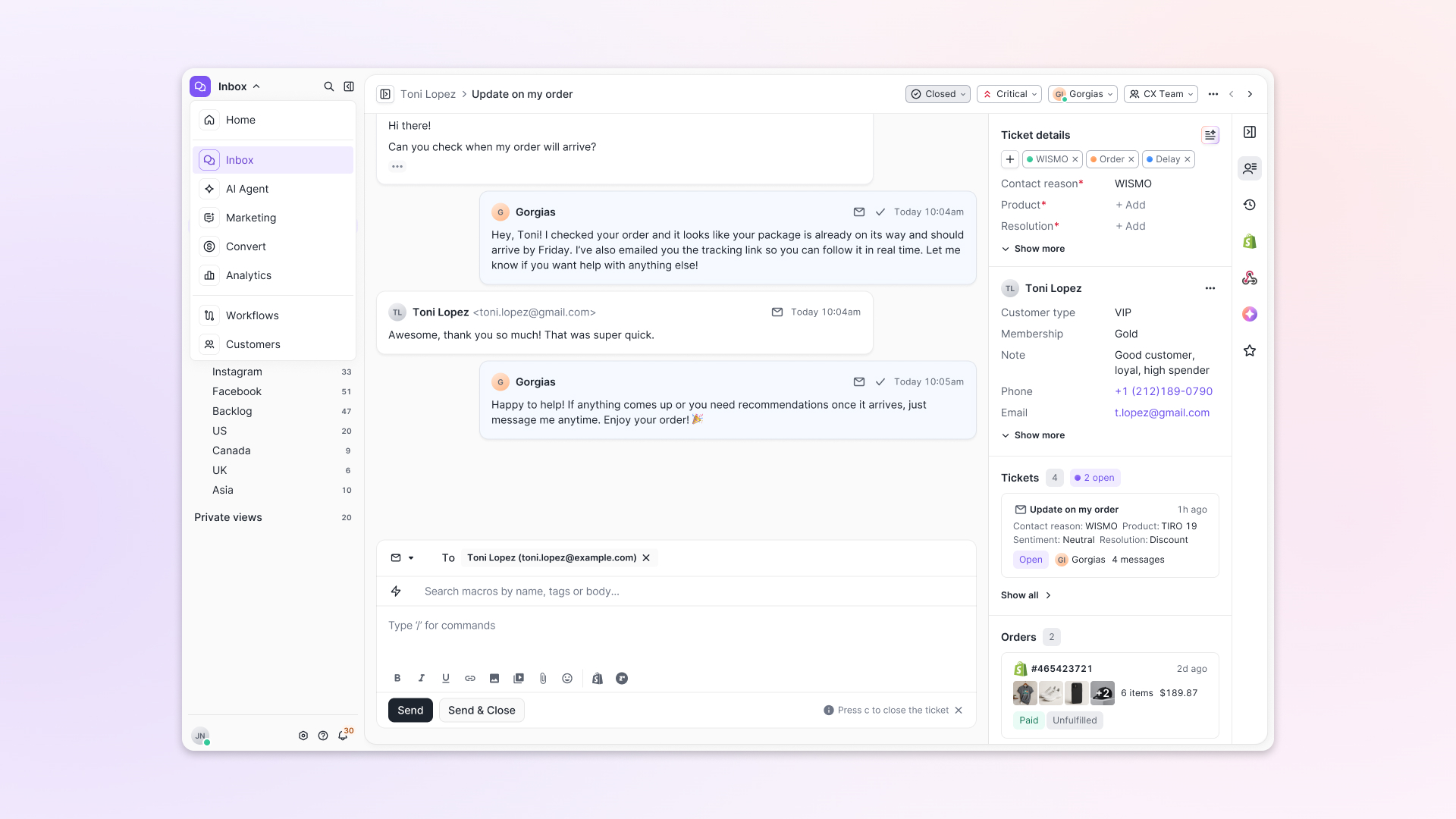
Say goodbye to the 2000s email interface and hello to chat bubbles. This updated design changes how quickly you can orient yourself and resolve the ticket in one go.
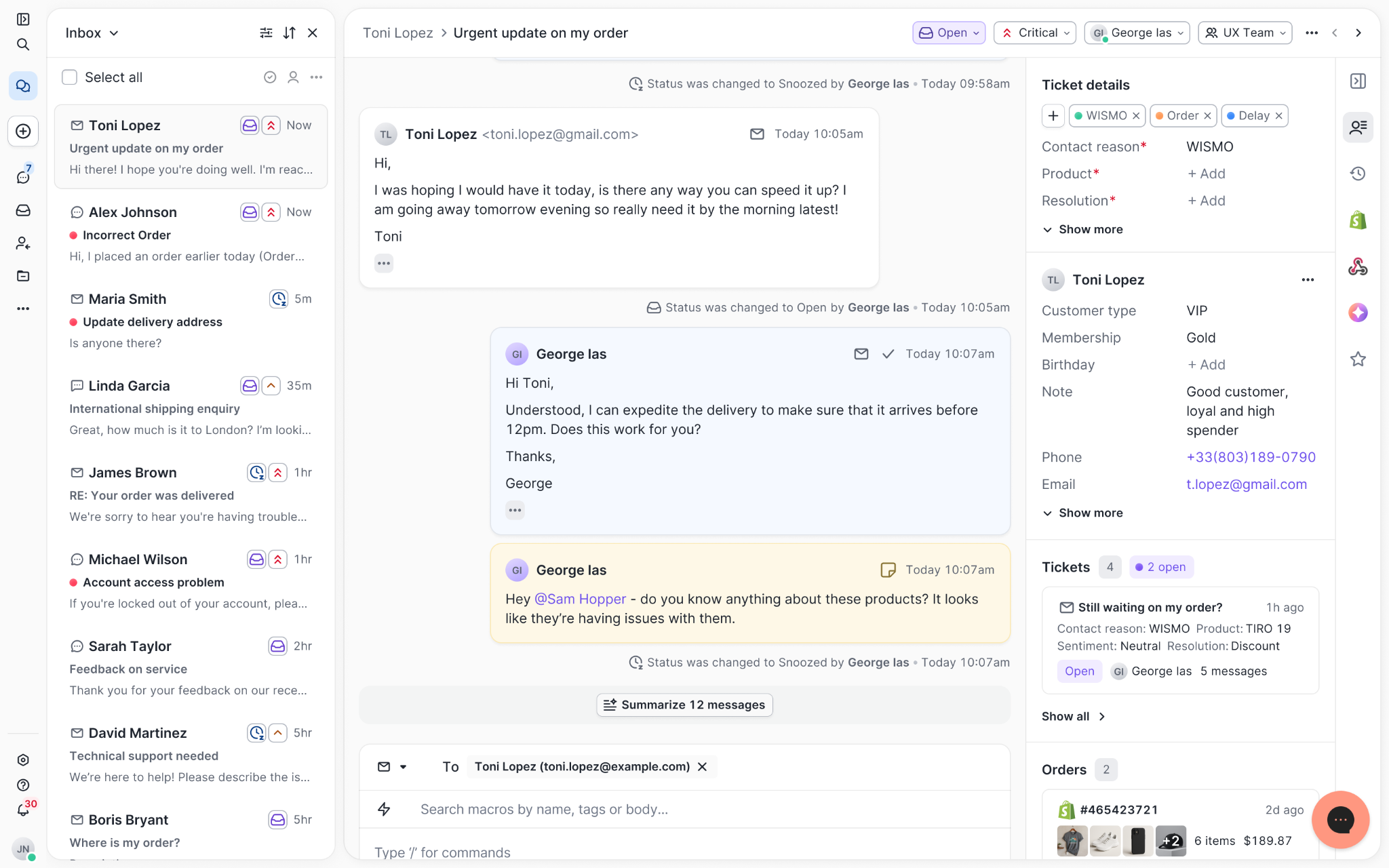
Chats with customers now look like real conversations, using the speech bubble style you’re familiar with on popular messaging apps.
Check customer history without losing your place
Checking a customer's history used to mean leaving the conversation, an extra step that interrupted what should have been a smooth workflow.
Now, past conversations open in a sidebar next to the active conversation. You can view a customer’s full history, search through their timeline, and open prior tickets without going to a new page.

Check past conversations, orders, and customer details in the brand-new Customer Timeline.
See order details the moment you open a ticket
Order information is easier to reference than ever. Open a ticket, and you instantly see the customer's recent orders, marked with product images and invoice details at a glance. Need to dig deeper? Click on an order, and the expanded information appears in the same panel.
For teams using custom integrations, apps are fixed in a quick-access integration menu on the right.
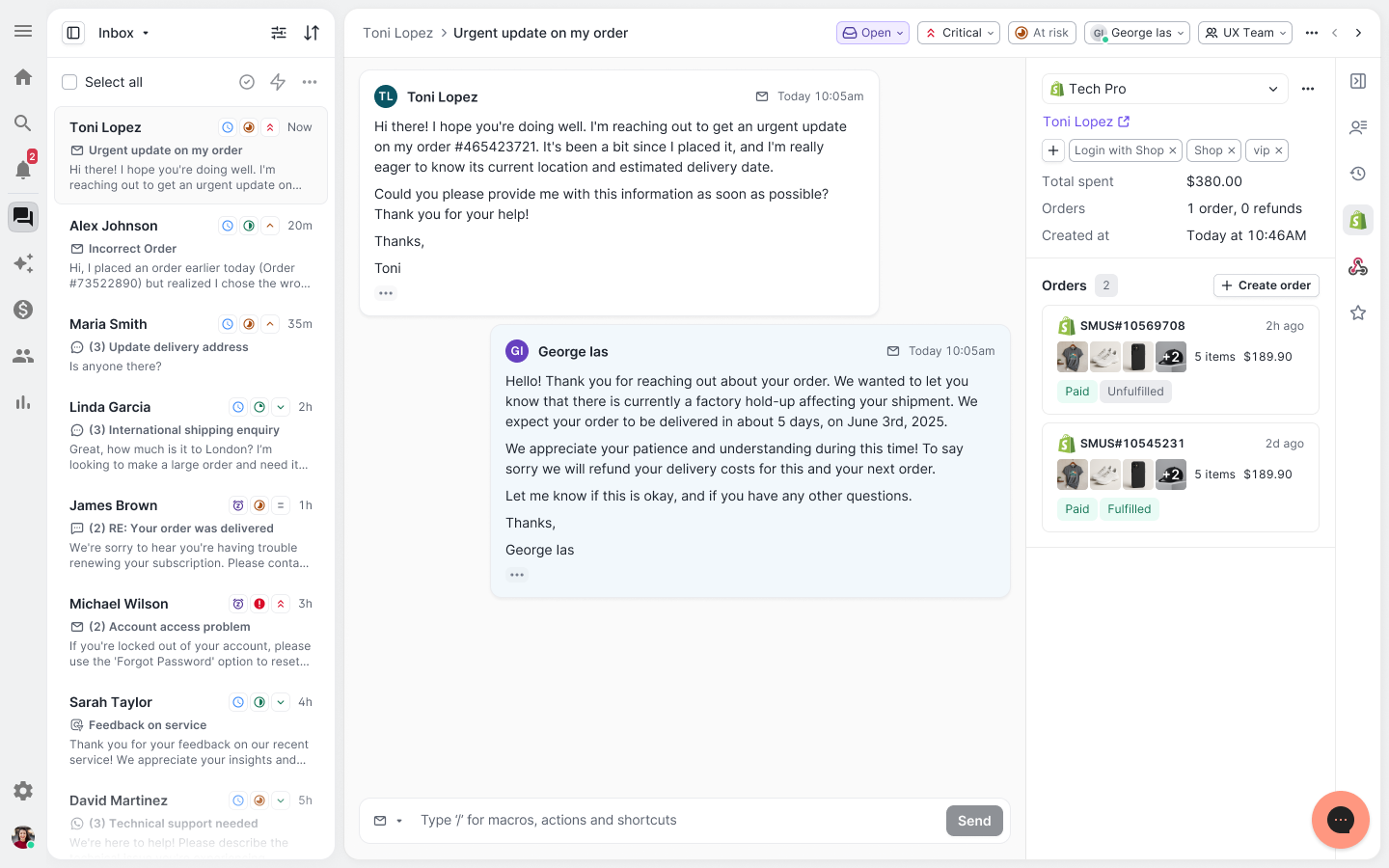
See order details, product images, and totals at a glance on the right panel, without leaving the conversation.
Pick up where AI left off
You shouldn't have to dig through a thread to figure out what AI already tried. Now you don't have to.
When AI Agent escalates a conversation, it includes a concise handover summary that mentions the issue, what actions were taken, and why it was passed to your team.
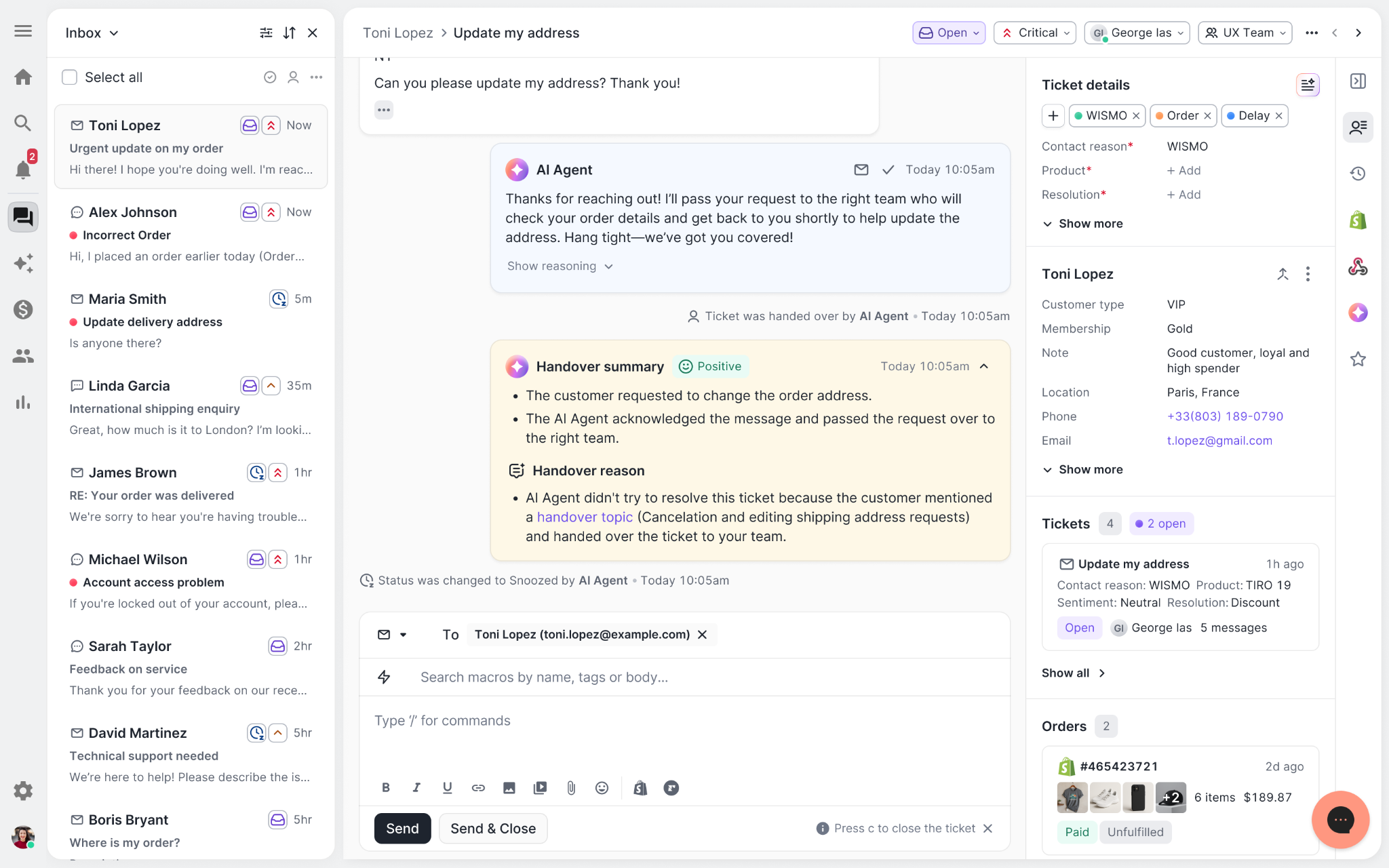
Escalated tickets include a brief AI-generated handover summary, marked in yellow, for quick reference.
Move faster across every store and team
We restructured and simplified the navigation. The left sidebar organizes everything into clear categories: Inbox, AI Agent, Marketing, and Analytics, so anyone on your team knows exactly where to go.
To quickly update your knowledge base or adjust a workflow, both now live right in the sidebar. For teams managing multiple stores, switching between them is just as straightforward, accessible from the sidebar, so agents can move between inboxes without breaking their flow.
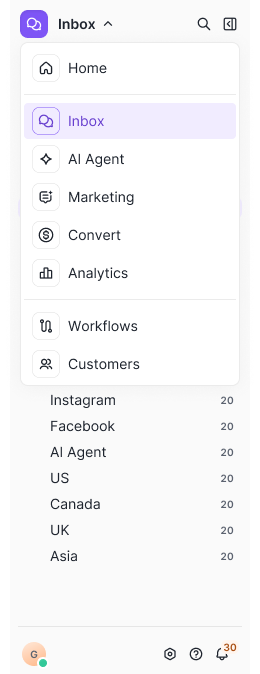
Agents can switch between stores and their corresponding inboxes directly from the left menu.
A workspace that works the way agents do
Support comes down to the person on the other end of the conversation. We built Helpdesk 2.0 is to make sure they have everything they need to show up for that moment.
The best way to see the difference is to work in it. Start a free trial today.


Further reading


Average Response Time: How Fast Is Fast Enough?
TL;DR:
- Average response time measures how long it takes your team to reply to customer inquiries across all channels
- Fast response times boost customer satisfaction, reduce churn, and can deliver an estimated revenue lift of two percent when you resolve issues within six hours.
- Calculate ART by dividing total response time by number of responses.
- Best-in-class benchmarks vary by channel: under 1 hour for email, under 30 seconds for live chat, and under 1 hour for social media.
- Improve ART with live chat, self-service deflection, automation, smart routing, and templated responses without sacrificing quality.
Average response time measures the duration between when a customer submits a support inquiry and when they receive their first reply.
For ecommerce brands, this metric directly impacts customer satisfaction, loyalty, and revenue. 90% of customers rate an immediate response as "important" or "very important" when they have a support request, with 60% defining "immediate" as 10 minutes or less.
This guide covers everything you need to calculate your average response time and understand channel-specific benchmarks. You'll also learn proven tactics to reduce your response times while maintaining support quality.
What is average response time in customer service?
Average response time (ART) is a customer service metric that measures the time between a customer's inquiry and the first reply from your team.
Average response time applies across all support channels your brand uses:
- Email support
- Live chat
- SMS and messaging apps
- Social media (Facebook, Instagram, and Twitter/X)
- Phone and voice support
ART measures the time to first reply, not full resolution. This differs slightly from first response time (FRT), which tracks only the initial contact on a new inquiry. ART includes all replies across the ticket lifecycle, while FRT focuses exclusively on that critical first touchpoint.
You can measure average response time during business hours only or across all hours. Business-hours measurement accounts for when your team is actually available, while all-hours measurement reflects the true customer experience, including wait times outside your operating schedule. Most ecommerce brands track both to gauge staff performance and identify gaps in coverage.
Why average response time matters for ecommerce brands
Average response time directly impacts customer satisfaction scores and loyalty. Even if your support team is friendly and helpful, the customer experience suffers when they wait too long for a response. Fast response times reduce frustration and show customers you value their time.
By improving customer loyalty and boosting average customer lifetime value, offering a low average response time can directly benefit your brand's revenue. Brands that resolve their customers' concerns within six hours or less see an estimated revenue lift of two percent.
Response speed also affects your brand reputation.
In competitive ecommerce markets, response time becomes a competitive advantage. When customers compare similar products at similar prices, superior support responsiveness can be the deciding factor. Meeting or exceeding service level agreements (SLAs) also builds trust and sets clear expectations with your customers about when they'll hear back from your team.
How to calculate average response time
You can calculate average response time with a simple formula:
Average response time = Total response time ÷ Number of responses
When calculating, you can measure during business hours only or across all hours, including nights and weekends. Business-hours calculation shows your team's performance when they're actually working, while all-hours measurement reflects the complete customer experience, including wait times when you're closed.
Exclude automated chatbot replies and out-of-office responses from your calculation — these don't represent actual human support interactions. Also, exclude tickets that were spam or never required a response.
Average response time differs from first response time (FRT) and resolution time. FRT measures only the time to initial contact on new inquiries, while resolution time measures the total time from inquiry to full resolution.
When you add average handle time (AHT) and ART together, you get average resolution time. This metric measures the total time it takes to resolve a customer's issue.
Most brands filter their average response time data by team, agent, channel, or time zone to identify specific performance patterns and improvement opportunities.
Calculate ART with total response time ÷ number of responses
Let's walk through a real example. If you had four support tickets one week that took 10 minutes, 15 minutes, 25 minutes, and 20 minutes to respond to, here's what your average response time calculation would look like:
Step 1: Add up all response times: 10 + 15 + 25 + 20 = 70 minutes total
Step 2: Divide by the number of responses: 70 minutes ÷ 4 tickets = 17.5 minutes
Average response time = 17.5 minutes
That said, calculating average response time by hand isn't feasible for most brands, especially as your customer base and number of responses increase. Fortunately, most customer service platforms and helpdesks calculate these performance metrics for you automatically.
In Gorgias, you can also break down real-time support metrics (like first reply time, resolution time, revenue generated by support, customer satisfaction (CSAT), and more) by:
- Agent: To understand each agent's performance and workload
- Time period: To understand how a new process compares to an old one
- Ticket type: Using tags like Urgent, VIP, Return Request, and more
Average response time benchmarks by channel
The answer to what constitutes a good average response time depends on the customer support channel you use. Each channel has different customer expectations and urgency levels. Average response time benchmarks for email requests will naturally be much higher than those for live chat messages, when the customer is actively waiting for a response.
Your industry can also impact what constitutes a good average response time. A company selling B2B software is likely to have longer response and resolution times than an ecommerce company due to the technical nature of their product and different customer expectations.
Here are best-in-class, average, and below-average response time benchmarks based on the customer support channel you're using, according to our Senior Director of Customer Success, Bri Christiano:
ART benchmarks for email:
- Unacceptable: Multiple days
- Below average: 1 day
- Average: 12-24 hours
- Above average: Under 4 hours
- Stellar: Under 1 hour
ART benchmarks for social media:
- Unacceptable: Multiple days
- Below average: 1 day
- Average: 12-24 hours
- Above average: Under 4 hours
- Stellar: Under 15 minutes
ART benchmarks for SMS:
- Unacceptable: Over 1 hour
- Below average: 1 hour
- Average: 10 minutes
- Above average: Under 5 minutes
- Stellar: Under 1 minute
ART benchmarks for live chat:
- Unacceptable: Over 1 hour
- Below average: 1 hour
- Average: 10 minutes
- Above average: Under 5 minutes
- Stellar: Under 1 minute
If your reply times aren't close to these benchmarks, don't worry. It's much more important to continually improve on your current performance than it is to match industry benchmarks. Focus on developing your customer service automations, customer service training, and templates to help your team offer fast replies.
How to improve average response time without hurting quality
If you want to improve your average first response time, here are proven strategies that Gorgias customers have used to speed up their response times. The key is balancing speed with personalization and accuracy — faster replies shouldn't come at the cost of helpful, accurate support.
Offer live chat and SMS to accelerate replies
Real-time support channels like live chat and SMS inherently support faster response times than social media and email channels. This is likely why, based on Gorgias data, chat is the second-most preferred support channel, next to email.
Adding a live chat widget to your website, such as Gorgias live chat, enables anyone who visits your website to quickly connect with a support agent. Gorgias live chat also integrates with SMS, Facebook Messenger, WhatsApp, and other social media platforms, so you can offer live chat support via these channels as well.
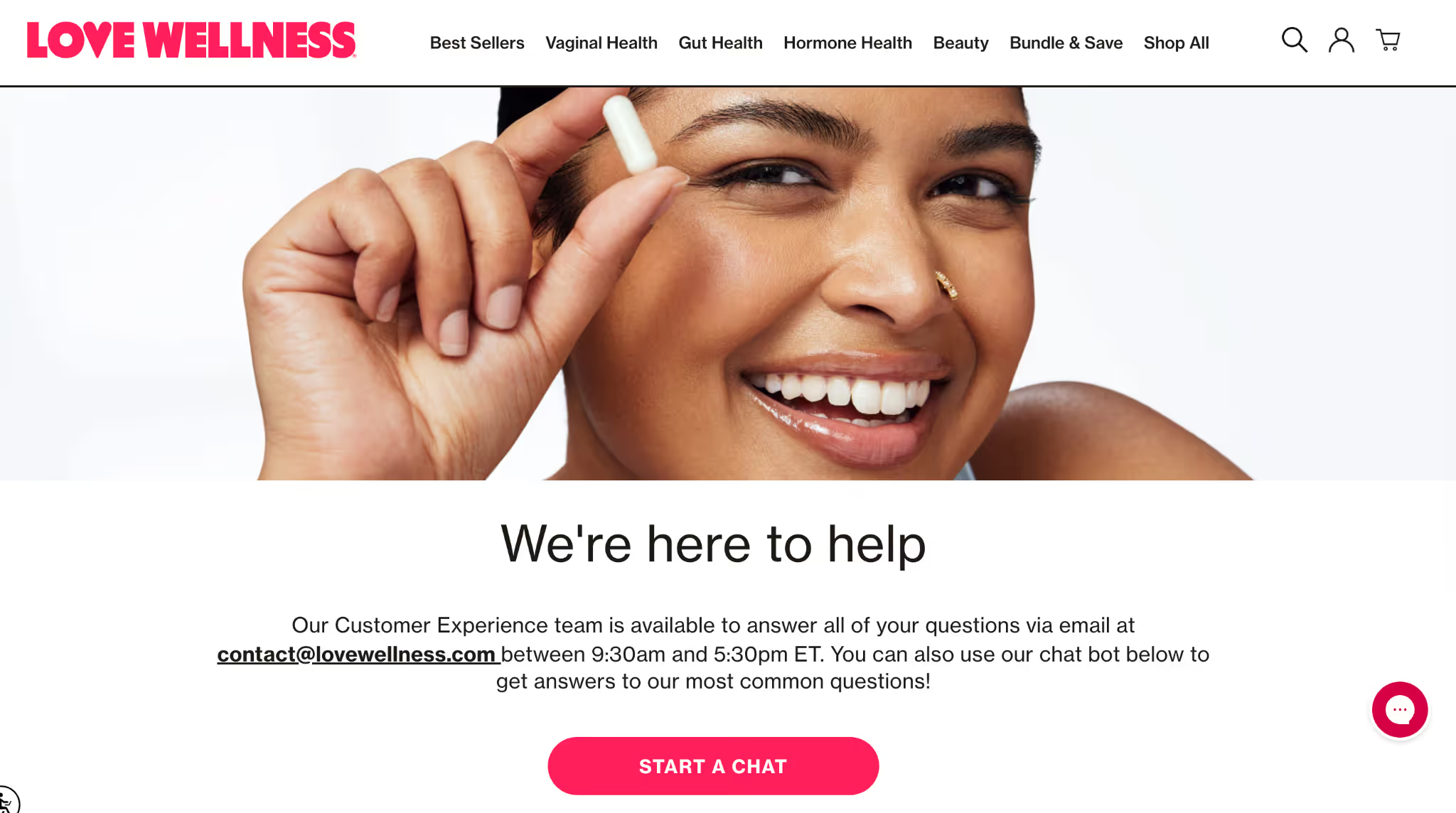
You can also incentivize your customers to use these faster channels by sharing a service-level agreement (SLA) that lets them know they won't have to wait as long if they use live chat or SMS.
Love Wellness, a Gorgias customer, does this brilliantly by pointing customers to their chat for quick answers:
Deflect FAQs with self-service in chat and Help Center
Installing self-service options (like chatbots and automated flows) in your chat widget is an excellent way to ensure customers on your website can get quick answers to common questions. This directly lowers ART by reducing your support team's workload so they can respond to complex tickets that can't be resolved with self-service faster.
Gorgias lets you create automated conversations called Flows to deliver the answers to your most frequently asked questions. Here’s how Gorgias customer, OSEA, uses Flows on their website:
Automate common questions with an AI chatbot
You can use AI to answer simple customer questions that come in via email, social media, SMS, and more. Letting an AI chatbot handle straightforward questions such as "where is my order" and "what is my tracking number" can reduce the volume of support tickets upfront, freeing your team to focus on more complex inquiries.
Take a look at how Gorgias AI Agent handles makeup questions naturally:
Set autoresponders to acknowledge messages after hours
Remember that first response time is an entirely different metric from resolution time. You don't have to immediately resolve a customer's issue to achieve faster response times — you just have to respond to the customer's request and let them know you're working on the issue.
One great way to do this is to use autoresponders that acknowledge the customer's request the instant they send it in. This way, customers know your team received their message.
Some examples of acknowledgment messages:
- Thank you for your message! Our team is offline right now, but we’ll get back to you as soon as we can!
- Thanks for sending your message! Leave us your email, and we’ll get back to you as soon as possible.
- We hear you! Provide us with your email, so our team can reach out to you as soon as they’re online.
- Thanks for leaving a message! We’re currently offline, so please leave your email, and we’ll respond when we’re back online.
While an automated response doesn’t resolve the issue, it still shows your customers that you’re paying attention and ready to support their needs at any time.
Prioritize and route tickets by intent, sentiment, and value
Some tickets demand a faster response than others. If you detect that a customer is upset or angry, then it's important to respond to their request as quickly as possible to prevent them from churning. With intelligent routing, you can automatically send tickets to the right agent based on VIP status, issue urgency, or negative sentiment detected in the message.
Gorgias lets you prioritize tickets automatically so your agents can focus on responding to the most important tickets without manually triaging each one. Since agents aren't required to manually triage tickets that are prioritized automatically, they'll be able to respond to them faster.
With Gorgias's Intent and Sentiment Detection features, you can automatically analyze each ticket using powerful natural language processing (NLP) technology.
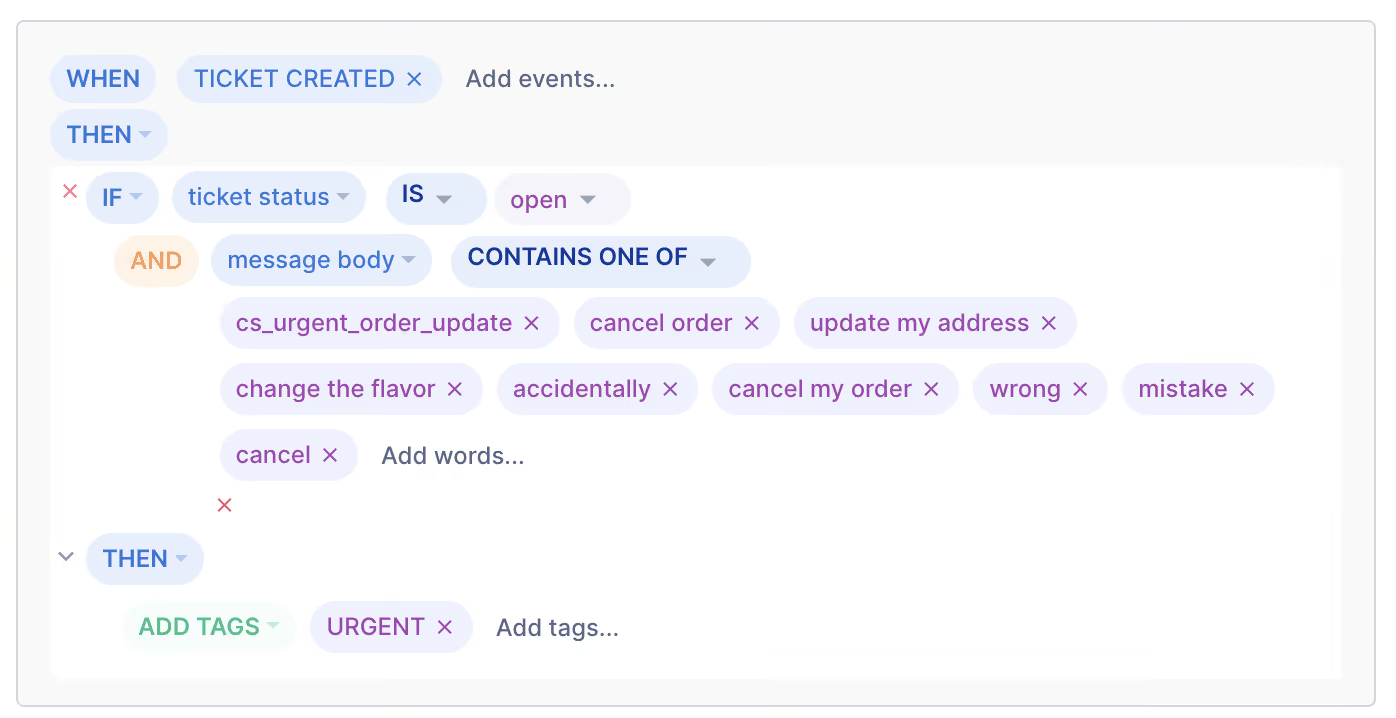
You can then create Rules to automatically assign a priority level to each ticket.
Here's an example of a Rule that automatically tags tickets with "URGENT" whenever a customer mentions anything about an address update, flavor change, order cancellation, or mistake:
Use macros with variables to personalize messages faster
An easy way to accelerate your ART is to create template responses for your most-asked questions. In addition to reducing ART, these templates can serve as helpful resources for your agents, allowing them to respond without starting from scratch each time.
Gorgias's templates are called Macros, and they're much more powerful than run-of-the-mill templates thanks to variables. Variables are like blanks in the template that automatically populate with personalized customer information pulled from ecommerce platforms (like Shopify, BigCommerce, and Magento) and other ecommerce tools (like Klaviyo, AfterShip, and more).
Here’s a Macro in action:
Build out a knowledge base or help center
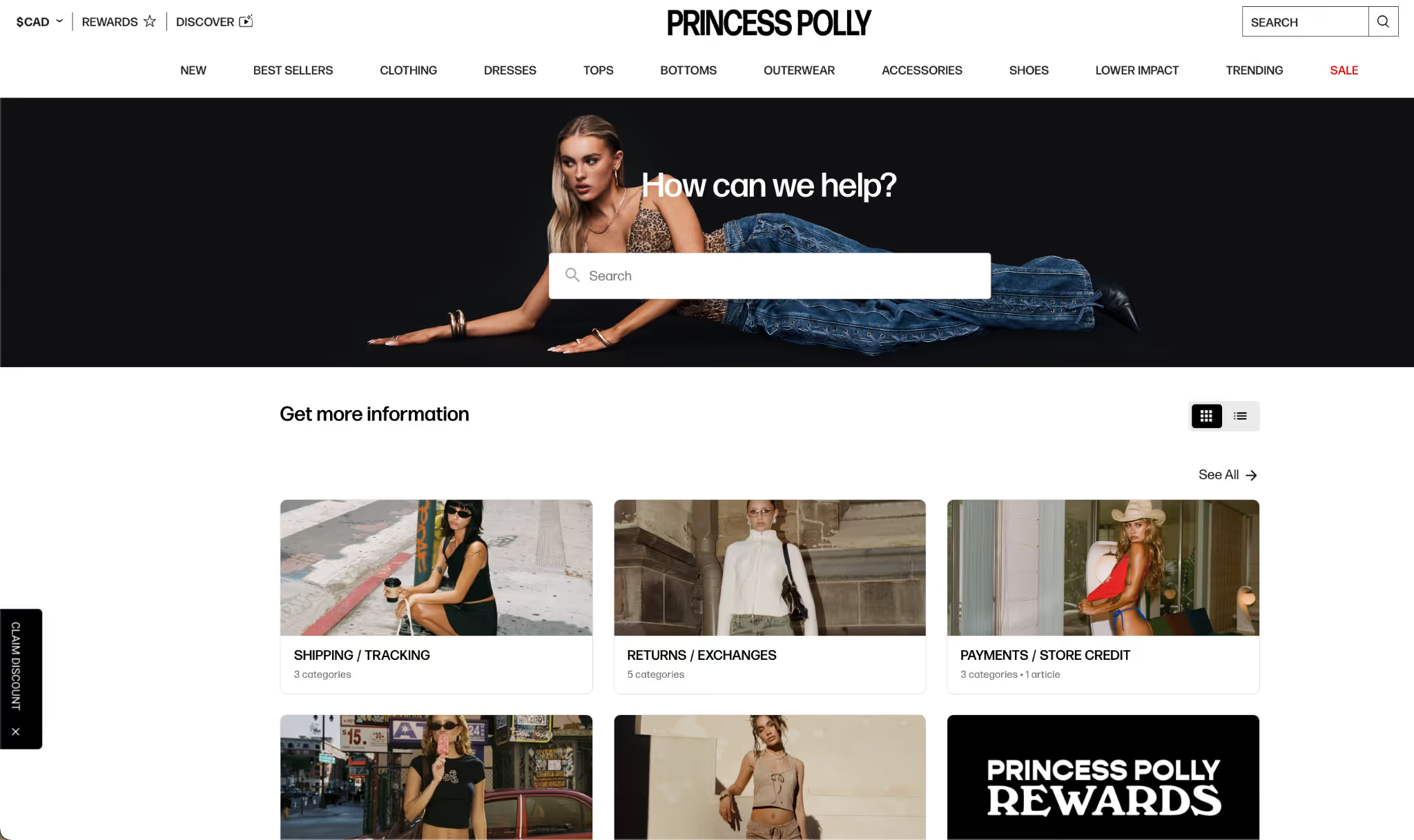
A comprehensive knowledge base or help center allows customers to find the information they need on their own. While this won't be directly reflected in your average response times, you’ll find that your inbox receives fewer of the same questions. That means agents have fewer tickets to handle and more time to strengthen customer relationships.
Take a look at Princess Polly’s polished Help Center made with Gorgias:
How to track and report average response time in Gorgias
Gorgias automatically tracks average response time and displays it in your Support Performance dashboard. You get real-time visibility into how quickly your team responds across all channels, with no manual calculation required.
You can filter your average response time data by multiple dimensions to spot trends and identify improvement opportunities:
- Channel (email, live chat, SMS, social media)
- Team or individual agent
- Date range (today, this week, this month, custom periods)
- Ticket tags (VIP, Urgent, Return Request, etc.)
- Time zone
Gorgias also provides SLA breach alerts that notify you when tickets are at risk of missing your response time targets. This lets you intervene before a customer has a poor experience. The platform tracks related metrics alongside ART, including first response time, resolution time, customer satisfaction (CSAT) scores, and revenue generated by support, giving you a complete picture of your team's performance.
Use this data to coach agents on response speed, identify training opportunities, and refine your support processes. For instance, if you notice one agent consistently has faster response times, study their workflow and share those best practices with the rest of your team.
Deliver instant, reliable support they can count on
Reducing your average response time is a crucial part of providing a great customer experience — and it's one of the many goals we help ecommerce brands realize.
See how Gorgias can help your brand improve response times and deliver faster, better support. Book a demo today.
{{lead-magnet-2}}

10 Ways To Reduce Ecommerce Product Returns With Great CX
Online shopping is at an all-time high. Unfortunately, so is the rate of returned items.
In 2021, online shoppers returned over 20.8% of all merchandise ordered, according to the National Retail Foundation. Added up across all ecommerce businesses, this means $761 billion of merchandise gets sold but doesn’t actually become revenue.
We’ll cover some of the top reasons for customer returns below but most of the reasons boil down to one thing: a poor customer experience. If customers feel misled, duped, or unsupported, they’ll quickly send back an item and take their business elsewhere.
In this post, we’ll share 10 actionable strategies (including tools and examples) to help you develop a return-proof customer experience.
{{lead-magnet-1}}
The top reasons that customers return products
%2520(1).webp) |
No brand can completely eliminate returns, and that’s because customers return items for a wide variety of reasons — some of them outside of your control. The top reasons that customers choose to return products purchased via online shopping include:
- Item didn't match its product description and/or customer expectations
- Item arrived late and the customer no longer needs it
- "Wardrobing," defined as items returned by serial returners who never have any intention of actually keeping the products that they purchase
- Merchant shipped the wrong product
- Item was damaged or defective
When exploring how to reduce returns, examining these common reasons for online store returns and how they apply to your own business is an important place to start.
Why reducing returns matters for most ecommerce stores
According to data from the National Retail Federation, U.S. consumers returned an estimated total of $761 billion in merchandise in 2021 alone. Thanks in part to supply chain challenges and rising prices, processing the return of a $50 product is now expected to cost ecommerce stores an average of $33 according to Axios.
The cost of having a high return rate goes far beyond lost profits. In addition to losing out on a sale, processing a returned product also means that you have to pay return shipping costs as well as any labor costs associated with your returns process, like assisting customers with returns and restocking returned products. When you consider the fact that ecommerce return rates can climb as high as 30% or higher, these expenses can quickly add up. This makes reducing your number of returns an essential goal for your ecommerce brand.
10 proven ways to minimize returns from your ecommerce customers
- Encourage product exchanges over product returns
- Provide in-depth and accurate product descriptions
- Display multiple high-quality product photos that offer context
- Leverage reviews of your product that assist other customers (especially as it relates to size and color)
- Optimize the accuracy and speed of fulfillment
- Don't skimp on packaging that protects your customer's product
- Develop a clear, proactive post-purchase experience
- Identify customers who abuse your return policy
- Expand the length of your return policy
- Use gift cards and loyalty points
Offering high-quality products is the first step to reducing your return rate, but great products are just the beginning. Below, read more about the 10 additional ways to boost your customer experience and reduce returns.
{{lead-magnet-2}}
1) Encourage product exchanges over product returns
Encouraging customers to exchange products rather than return them for a refund won't eliminate all of the expenses associated with processing a return. Even with exchanges, you still pay for return shipping and any labor costs associated with your returns process.
However, exchanging a product rather than refunding it does mean that you get to keep whatever profit margins you earn from the sale, which can sometimes be a big boost to your company's bottom line. Plus, you still have a chance to delight the customer with a product and hopefully build up loyalty from there.
How you go about encouraging exchanges is ultimately up to you. Some online stores only offer store credit for returns, and state in their return policy that they will not provide cash refunds. However, refusing to offer refunds altogether may yield a returns experience that leads to a lot of unhappy customers. Another option is to encourage product exchanges with carefully-crafted messaging or incentives, like an additional store credit.
Example of exchanges over returns
 |
If you look at Jaxxon's FAQ page, you'll see the brand has a standard 14-day returns and exchange policy that allows customers to get a refund or new product for any reason. But Jaxxon uses Loop Returns as a self-service return portal, which has two major benefits:
- The portal is self-service, meaning customers can return or exchange an item without creating a ticket and waiting for an agent
- The portal gently guides users to request an exchange over a refund by giving bonus credit for exchanges and simplifying exchange shopping
 |
Bonus credit is exactly what it sounds like: Customers can have more in-store credit than they would get as a refund in the original form of payment. This strategy is effective: Shopify stores that use Loop issue 15% fewer refunds than brands that don’t. As a result, Jaxxon rescues a sale and keeps the opportunity to delight the customer for greater customer retention.
Learn how the Gorgias + Loop integration unites your helpdesk and returns management software.
Jaxxon also uses live chat support on their returns portal page, which is yet another line of real-time defense against an avoidable return. If customers are considering a return, they may instead reach out to customer support to resolve whatever issues drove them to the page.
 |
The customer service agent on the other end of the live chat might be able to fix the issue, especially if it came down to user error, and lead the customer to keep the item. Or, the live chat agent gives recommendations for products that won’t have the same issue to steer toward an exchange instead of a return.
Adding live chat to your returns portal is one of the revenue-generating tactics from our CX-Driven Growth Playbook, which is based on research of over 10,000+ top ecommerce brands. Check out the playbook for 17 more actionable tips to drive revenue by improving your CX.
2) Provide in-depth and accurate product descriptions
One of the biggest reasons why online purchases have a higher return rate than products purchased from brick-and-mortar stores is the fact that customers cannot examine products in person. This makes it much more likely for a customer who purchases a product online to end up returning their purchase due to it not meeting their expectations.
The best way to combat this is to make your product descriptions as in-depth and accurate as possible. When customers know exactly what to expect from the product they are purchasing, the odds of them being dissatisfied when it arrives are much lower.
This is especially true for apparel: size charts, size guides, and any other information to help the customer avoid buying the wrong size. Likewise, any sort of furniture must include clear dimensions, and any sort of technology must include detailed specifications.
Example of in-depth product descriptions
Marine Layer is one example of an online store that has in-depth product descriptions to minimize returns. To help customers choose the right clothing and accessories, Marine Layer offers details information in their product descriptions such as the exact dimensions of the item, the size of the model who is wearing it in the product images, and helpful size charts.
The brand uses tabs to include more information without making the page too long. Here’s the description for a pair of pants:
 |
3) Display multiple high-quality product photos that offer context
Keeping with the theme of letting customers know exactly what they are getting, there is no element of your product description more important than your product images.
Along with using high-quality product images that display your products in the most appealing way possible, it is also a good idea to use product images that provide context about the product. For example, you may wish to display photos of your product in action to show its intended use. Or, you can show your product next to household items to give customers a better idea of the size and dimensions. Even better, you can include product videos to show the product in action.
By displaying multiple high-quality photos that offer context, you can ensure that there are no unwelcome surprises when your customer uses your product for the first time.
Example of contextual product photography
 |
Native Union’s online store sells tech accessories such as charging cables and phone cases. They make use of multiple photos on each product description, including photos that display how the product is meant to be used. For example, the charging pad shown above clearly shows compatibility with iPhones, AirPods, and Apple Watches.
4) Leverage reviews of your product that assist other customers (especially as it relates to size and color)
Customer reviews are one of the most powerful sales tools that ecommerce stores have, since they provide customers with social proof and an unbiased source of information to guide their purchase decision.
Along with helping online retailers boost their conversion rates, customer reviews can also be leveraged to reduce return rates. Displaying reviews that provide greater details and context regarding a product — such as how an article of clothing fits certain body types or how the color of a product in-person compares to its photos — can go a long way toward helping your customers make informed purchases that they are much less likely to return.
Example of helpful product reviews
Steve Madden is one company that makes excellent use of product reviews. Each product page features searchable, filterable product reviews to set customer expectations. Steve Madden is an apparel brand, so they let you sort reviews by sizing, whether they contain images and videos, the age of the reviewer, the pros of the product (like “cute,” “comfortable,” or “value,”) and whether the reviewer recommends the product.
 |
They also have a section where shoppers can ask questions that people who previously purchased the product can answer (e.g., “Can you exercise in these shoes?”) as well as an overall sizing scale, which shows whether reviewers tend to think the product is true to size:
 |
5) Optimize the accuracy and speed of fulfillment
One common reason why a customer may choose to return a product is that the product showed up late and they no longer need it. To keep your customers as satisfied as possible post-purchase, optimize the accuracy and speed of fulfillment to make sure that every customer receives the exact products they purchase within the promised timeframe.
Tips to improve your shipping accuracy and speed
There's no better example of an ecommerce platform that has optimized its fulfillment process than Amazon. Offering two-day shipping on the vast majority of its products is just one way that Amazon can prioritize customer satisfaction and limit returns.
However, most brands can’t match Amazon’s speed of delivery, at least in-house — that appealing offer is only possible for massive-scale, high-GMV companies. One strategy to reduce shipping-related returns is to provide accurate shipping estimates for all customer orders: clear expectations are better than nothing at all.
Another strategy is to work with a fulfillment partner like the Shopify Fulfillment Network or ShipBob to achieve Amazon-like shipping. Both of these fulfillment partners help DTC brand offer expedient shipping that can both drive sales and reduce returns.
6) Don't skimp on packaging that protects your customer's product
Receiving a damaged product is another common reason why online shoppers make returns. While good quality control can ensure that a damaged product doesn't leave your warehouse, there's only so much you can do to prevent a product from becoming damaged en route to the customer. What you can do is protect your product as much as possible by using high-quality packaging. For some products, this might not be much of a concern. However, if your products are fragile or prone to damage, put some extra padding or structural protection into the packaging to protect them in transit. Reducing the risk of damage during transit can go a long way toward lowering your return rate.
Example of protective product packaging
Apple’s packaging is renowned for its minimalist, yet immediately recognizable design. While it looks simple from the outside, Apple’s product packaging features multiple layers of sturdy cardboard and styrofoam padding to thoroughly protect Apple devices en route to the customer.
 |
7) Develop a clear, proactive post-purchase experience
An amazing pre-purchase experience is essential for optimizing your store's conversion rate. But the buck doesn’t stop when a customer completes the purchase. A clear post-purchase experience can drive repeat business and proactively minimize your return rate.
There are several ways to offer a positive post-purchase experience for your ecommerce customers. You use self-service automation flows that let customers know about the status of their order, create and share help center articles that explain how to use the product, schedule a call to walk customers through the ins and outs of their new product or offer discounts — just to name a few.
Example of a great post-purchase experience
Warby Parker lets any customer try on a pair of glasses before confirming the purchase. In the post-checkout email, they include tips for the home try-on kit.
 |
While this is a little different than most use cases, since it’s a try-on shipment instead of a purchase, the step-by-step tips provide a strong example of the type of guidance that can set customer expectations, reduce avoidable issues when the customer receives the product, and directions for where to find support if an issue does arise.
8) Identify customers who abuse your return policy
The majority who return products have a legitimate reason for doing so. However, there are those known as “serial returners” who abuse ecommerce return policies. These dishonest customers purchase products with no intention of keeping them, essentially renting products for free at the expense of the store they purchased them from. If you can identify customers who are abusing your return policy in this manner, the best thing you can do is ban them from making further purchases from your store.
Resource for reducing return policy abuse
Most companies choose not to publicize their policies for dealing with serial returners. However, here is an excellent resource from Shopify on how online store owners can address this common problem.
9) Expand the length of your return policy
It may sound counterintuitive, but giving customers a longer window to return products can actually reduce the return rate for your ecommerce site. If you only give customers a short period of time to decide whether they want to keep or return a product, they often feel rushed to make a decision. Giving your customers more time to become comfortable with your product before they are forced to decide whether they want to keep or return it increases the likelihood that they will choose to keep it.
Example
New mattresses tend to take a little getting used to. To prevent customers from returning mattresses before they have the chance to break them in and become used to them, Mattress Firm allows customers to return their mattresses up to 120 days after the date of purchase.
10) Use gift cards and loyalty points
At the end of the day, returns will always happen. One strategy is to mitigate losses from returns by doubling down on a customer loyalty effort like gift cards and loyalty points.
In addition to driving long-term loyalty and repeat purchasers, loyalty points and gift cards can also be offered in place of a cash refund for returned products. This enables you to offset some of the expenses you incur when a product is returned, because it encourages customers to exchange their product rather than return it for a refund.
Example of gift cards and loyalty points
There are plenty of examples of companies that leverage gift cards and loyalty programs in a variety of different ways. The North Face's loyalty program, however, stands out because customers can earn points for many reasons — not just making a purchase — and the brand’s rewards are custom-tailored to each individual customer.
Easily manage ecommerce returns from one central customer support hub
Product returns can be a massive expense for ecommerce stores due to the high rate at which ecommerce products are returned and the high cost of processing online purchase returns. By following the 10 tips outlined above, you should be well on your way to reducing this frustrating expense.
As you read, improving your customer experience helps you lower your return rate and process returns more efficiently. Gorgias’ customer service platform helps you do just that. With Gorgias, you can limit product returns and boost customer satisfaction by offering fast, omnichannel, and self-service customer support.
Learn more about how Gorgias can integrate with returns management software and help you reduce your ecommerce store’s return rates with outstanding customer service — contact us today.

How and Why You Should Implement a Personalized Customer Service Strategy in 2024
In the quest for ever-increasing efficiency, it’s easy to lose sight of a core business reality: Your customers are humans, and they still like to be treated as such.
Customer service departments certainly should leverage automation technology and work toward greater efficiency — but not in a way that frustrates customers. Instead, businesses should use automation to enhance a personalized customer service approach.
In this guide, learn personalized customer service is a top trend in customer service. Then we’ll give you nine ways to start providing more personalized customer service that you can implement right away.
What is personalized customer service?
Personalized customer service is the strategy of using individual customer information to tailor customer interactions. This information can include the customer’s name, purchase history, past support tickets, and anything else that your business might already know.
5 concrete examples of personalized customer service
Personalized customer service can be delivered throughout the whole customer journey, from the pre-sales stage to post-purchase. Here are five fantastic examples of personalized customer service:
- Using a customer's purchase history to send them relevant product recommendations
- Customizing communications to include customer information such as name and most recent orders
- Sending birthday discounts on a customer's birthday
- Notifying customers about back-in-stock items based on their browsing history
- Sending a personalized check-in or follow-up message after a purchase, return, or exchange
9 steps to provide personalized customer service at scale
Providing excellent personalized customer service can seem overwhelming for many businesses, especially during periods of rapid growth. It’s true that developing a comprehensive personalization strategy takes resources and effort, but there are all sorts of simple ways to start transitioning to a more personalized approach:
- Proactively reach out before a customer even needs support
- Mention specifics in customer messages
- Use customer data to inform the support you provide
- Unify conversations in one platform
- Employ an omnichannel approach
- Use social media to your advantage
- Create low-effort experiences
- Ask for feedback
- Prioritize requests in order of importance or urgency
1) Offer proactive support
Proactive customer service anticipates when customers might need assistance, and offers help before they reach out. For example, some brands use proactive support as part of their marketing strategy. They might use an automated live chat pop-up to share product recommendations, offer to answer questions or help new customers make a purchase, or share that a live chat support option is available, should they need it.
Proactive support has many forms, like providing self-service resources like an FAQ page to answer repetitive questions or help with common pain points. It also might be an email that says “Can I help you with anything?” Offering help before people need it feels infinitely more personal than forcing the user to comb the website and find the right contact information.

Proactive support helped Gorgias customer Loop Earplugs increase their revenue by 43% with pre-sales flows. “When customers get a quick and honest answer, they often end up buying more than one product in a short span of time,” says Customer Service Manager Milan Vanmarcke.
The first step towards implementing a proactive strategy of your own is to take a look at past customer conversations and look for common threads. Once you identify your most frequently asked questions, create an FAQ page with them. Be sure to link to any policies you have as well, like shipping, returns, exchanges, and where folks can reach out to get more help if needed.
📚Recommended reading: Our complete guide on proactive customer service.
2) Mention specifics in customer messages
There’s a reason that car salespeople learn prospective customers’ first names within the first few seconds of an encounter. It’s a science-backed approach that builds trust and familiarity.
Using specifics like a customer’s name or last order number goes a long way toward making the customer feel trust for your brand. It also shows that you’re listening, that you care, and that you have accurate information in front of you. Though this type of approach can be more time consuming, using templates with dynamic variables can help. Plus, it’ll lessen the need to go back and forth with customers to get that information in the first place.
Next steps
Consider signing up for a centralized helpdesk. Some helpdesks allow you to use templates with dynamic fields that pull in customer data like tracking information or the date their recent order shipped. On Gorgias, these templates are called Macros, and you can use them throughout your communication channels, on chat, or via email.

3) Use customer data to inform support
As you work to further customize your approach, refine the way you use the customer data you already have from your other ecommerce tools to inform the kind of care you provide.
Analyzing data from your CRM (customer relationship management system) can help you identify trends and common issues. This data can help you find common questions that are better handled via a FAQ or knowledge base, or that can be generated through automated chatbots or emails, saving your CS teams and your customers time.
Take a look at the demographic information you have about your audience to learn more about what might be most important to them. Use metrics like CSAT to understand how your support is performing, or retention numbers to see how many customers make second and third purchases, especially after requesting support.
How Gorgias can help
With a helpdesk like Gorgias, you can use the Customer Sidebar to pull customer data from different app integrations. Pull loyalty information from LoyaltyLion, get insight into reviews from Yotpo, or get marketing data from Klaviyo.

This type of information can aid in your personalization efforts by providing further insights into how customers are feeling and what kind of support they’re looking for. For example, you might find some negative reviews and be able to send those customers a follow-up email to see how you can help.
4) Unify your conversations in one platform
Personalization at scale requires the use of tools that keep your customer data safe, centralized, and accessible so that agents can answer questions with a consistently high level of care.
Unifying all your customer touchpoints in one helpdesk platform lets reps see all past interactions and information, so they avoid asking customers to repeat themselves. They’ll be able to see information like past order history, returns, past support conversations and resolutions, and how long someone has been a customer.
That’s been a key differentiator for Gorgias customer Absolute Collagen. "We hear all the time in a Facebook group or on the phone how much customers trust us because they know we'll get back to them and resolve the issue quickly,” says founder Maxine Laceby. “It's a real point of difference for us that our customer service team can do that. And the reason they can do that is that all of our channels are in one place."
How Gorgias can help
Gorgias is an all-in-one platform for ecommerce merchants looking to improve their customer service and helpdesk functions, from chatbot-like menus to customer self-service. It’s the perfect place for DTC ecommerce brands to start scaling their personalization efforts and drive more revenue.
5) Employ an omnichannel approach
Customers want to interact with your brand in different ways, and an omnichannel approach to customer support takes customers’ preferences into account. By offering support across all channels, like social media, email, phone, live chat, and SMS, you can better meet customers where they are and give support on their terms.
To do this effectively, you’ll need to ensure that all of your channels connect (a helpdesk like Gorgias will do this for you). And, that you have a support strategy for each channel.

Unifying platforms into one place helped the team at Lillie's Q, a shop that sells authentic Southern barbecue sauces and rubs, offer a true omnichannel experience to its customers. Before using Gorgias as its centralized helpdesk, messages on different platforms were getting passed manually to customer support, a tedious task with a big room for error.
"We received comments and questions from Instagram and Facebook, organic and paid. Our digital content manager was passing a lot of these questions and comments on to our customer service team before we were with Gorgias," says Nicole Mann, the Marketing Director at Lillie’s Q.
📚Recommended reading: Check out our guide to omnichannel customer service.
6) Use social media to your advantage
Support requests come into social media channels for many reasons. For example, angry customers might send a direct message or comment on a post because it feels more immediate, especially if a brand is active. Or, they could respond to a post asking for more information about a featured product they’d like to purchase.
Whatever the reason, people spend 147 minutes on social media per day, which means that by offering support there, you’re able to engage with people directly within the apps where they already spend time. This also allows you to engage with people in positive ways by sharing relevant content with them, posting packing videos of their orders to make them feel special, or reposting a picture of them using your products in real life.
{{lead-magnet-1}}
7) Create low-effort experiences
According to The Effortless Experience, only 4% of customers who had a high-effort customer support experience will return to make another purchase from that brand.
When a customer decides to contact support, they’re already likely a little bit frustrated to have to put in any effort at all. But actions like having to go back and forth with a support agent to give simple information like order numbers, shipping address, or email can increase the time it takes to get a resolution.
This effort increases with the amount of time it takes for the agents to respond each time, and whether support even responds at all the first time a shopper reaches out. These high-effort experiences ignore the customers’ needs, which drives disloyalty and can make a big impact on revenue long term.
Self-serve resources or automated responses can get people an immediate response, which means a lot less effort for them, and takes the burden off of your team.

"We realize the impact of building relationships and trust with our customers,” says Caela Castillo, the Director of Customer Experience at jewelry shop Jaxxon. “Quick Response Flows help us do that by allowing us to provide a customer experience that meets expectations and drives lifetime value (LTV) up per customer."
Other options include using a centralized system that shows a customer’s information all in one place, eliminating the need for timely back and forth.
8) Ask for feedback
Customer feedback is valuable data collection for your customer service team. It can help you provide more personalized support based on the information you get.
All you have to do is make it easy for your customers to provide feedback, and take action on the notes you do receive, especially if they cite negative experiences.
A quick way to ask for feedback is to send an email survey that takes less than 2 minutes to fill out. A simple star rating on the experience and comment box should be enough to give you some valuable insight into where you can improve.
📚Recommended reading: Our Director of Support’s guide to collecting customer feedback from your helpdesk.
9) Prioritize customer service requests
Prioritize customer service requests to provide faster, more bespoke service to VIP customers. With customer acquisition becoming more costly and time consuming, keeping existing, loyal customers around can produce more revenue for your business overall.
These customers, especially those with a high lifetime value, should get your most real-time support. Other high-priority conversations include very angry customers and time-sensitive requests.
A helpdesk can help you assign value to tickets, and bring the most urgent ones in front of agents so that they can treat them with high priority.

The four benefits of personalized customer service
98% of companies say that personalization increases customer loyalty and 83% of customers agree, according to a 2022 study by Twilio. Continue reading to understand why personalization is such a key aspect of delighting your customers, making it an undeniable best practice for customer support. A more personalized approach to customer support can help you:
- Meet customer expectations
- Drive more sales
- Raise customer satisfaction
- Get more consistent business and loyal customers
Meet customer expectations
Regardless of whether a customer’s chatting with human customer service agents or some automation tool like an artificial intelligence (AI) chatbot, nearly 70% of them want to receive personalized communications. Personalization starts with simple steps like including the customer’s first name in email correspondence. Because that’s how people communicate with each other — by name.
Fun fact: While people want personalized communication, they would rather have prompt, helpful customer service. 90% of customers expect a near-instant response to questions, according to a HubSpot survey.
The takeaway? Only use personalization if you can do some promptly.
📚 Recommended reading: Our tips to improve customer service response times and resolution times.
Drive more sales
Personalization matters for another crucial reason: It makes potential customers more likely to place an order. As many as 80% of respondents to an Epsilon/GBH survey indicated they were more likely to make a purchase after a personalized message than a non-personalized one.
For example, imagine a customer asks a video game distributor’s customer support team which game they should get for their child for Christmas. Without personalization, you’d either have to ask follow-up questions or provide a generic recommendation. With customer data, however, you might be able to:
- Greet the customer by name
- See the customer’s previous orders to know whether their child has a Playstation, Nintendo, or X-Box
- See the customer’s location and tell them the last day they can place an order to receive it by Christmas
- See the customer’s 5-star review of the last game they purchased to offer a more tailored recommendation
This is just a short list of potential ways to personalize a message, but it’s clear that personalization offers the best customer experience and gives the customer a much shorter path to a confident purchase.
Joseph Piazza, Senior Customer Experience Manager at messenger bike bag brand Timbuk2 says it best: “Increased customer support should go hand in hand with revenue growth. We want to turn customer experience into a profit center.”
Learn how Timbuk2 raised overall revenue by 35% with Gorgias.
Raise customer satisfaction
Personalized customer service greets your customers quickly and personally. It also reduces the time to problem resolution because your customer service agents have better information at the point of first contact.
Absolute Collagen saw firsthand how fast, personalized service can raise customer satisfaction (CSAT) to near-perfect levels (4.9/5), thanks to mitigating non-personalized “pre-determined, pre-scripted” responses:
Lead to consistent business and loyal customers
When businesses improve their customer service efforts through personalization, they typically see an increase in brand loyalty. HubSpot found that 93% of customers were more likely to return as repeat customers at businesses they categorized as having an excellent customer service experience.
Customer retention doesn’t just lead to more repeat business. A loyal customer base also leaves reviews, refers new customers through word of mouth, and places larger orders than new customers. That’s why repeat customers generate 300% more revenue than first-time shoppers.
📈 Want to gauge the impact of your customer support? Read our take on the importance of customer service and check out our guide to customer service ROI.
The challenges of offering personalized service
Most businesses would agree that personalizing interactions is wise. But we all know from numerous personal encounters with airlines, warranty call centers, and maybe even healthcare providers that personalized customer service is far from universal. Many businesses have yet to find a way to successfully bring that personal touch, tailoring their efforts to the individual customer — especially at scale.
Local and small businesses tend to have an easier time offering personalized customer service because they have fewer customers. Think of a local coffee shop or boutique retail outlet that sees regular, repeat traffic: Staff at stores like these tend to learn their customers’ names and preferences and can offer a level of service that big-box stores can’t match.
Digital-first businesses and large ecommerce brands can’t develop these in-person relationships so they need an alternative approach to offer personalized experiences. Specifically, they need tech solutions that collect and use customer data. This means storing customer data in customer relationship management (CRM) software, surfacing that data throughout the customer journey, and implementing it in smart ways.
Deliver world-class personalized customer service faster than ever with Gorgias
If you’re ready to offer personalized customer service, the right tools will help you get there. Gorgias empowers ecommerce businesses to deliver world-class personalized customer service and helpdesk services faster than ever, thanks to deep integrations with Shopify, Magento, and BigCommerce — plus dozens of other ecommerce tools — to put customer data front-and-center.
Book your demo to learn more about how Gorgias can transform your customer support into a revenue-generating machine.
{{lead-magnet-2}}
Ecommerce Product Categorization: How To Organize Your Products
Ecommerce product categorization is an excellent way to streamline the online shopping process and optimize customer experience. But if your ecommerce company offers more than just niche products, then separating those products into different categories can be time-consuming — and your team's time is better spent on tasks that tie directly to revenue generation.
To help you organize your product listings to make it easy for customers to find the types of products they are looking for, let's take a look at everything you need to know about ecommerce product categorization.
What is ecommerce product categorization (taxonomy)?
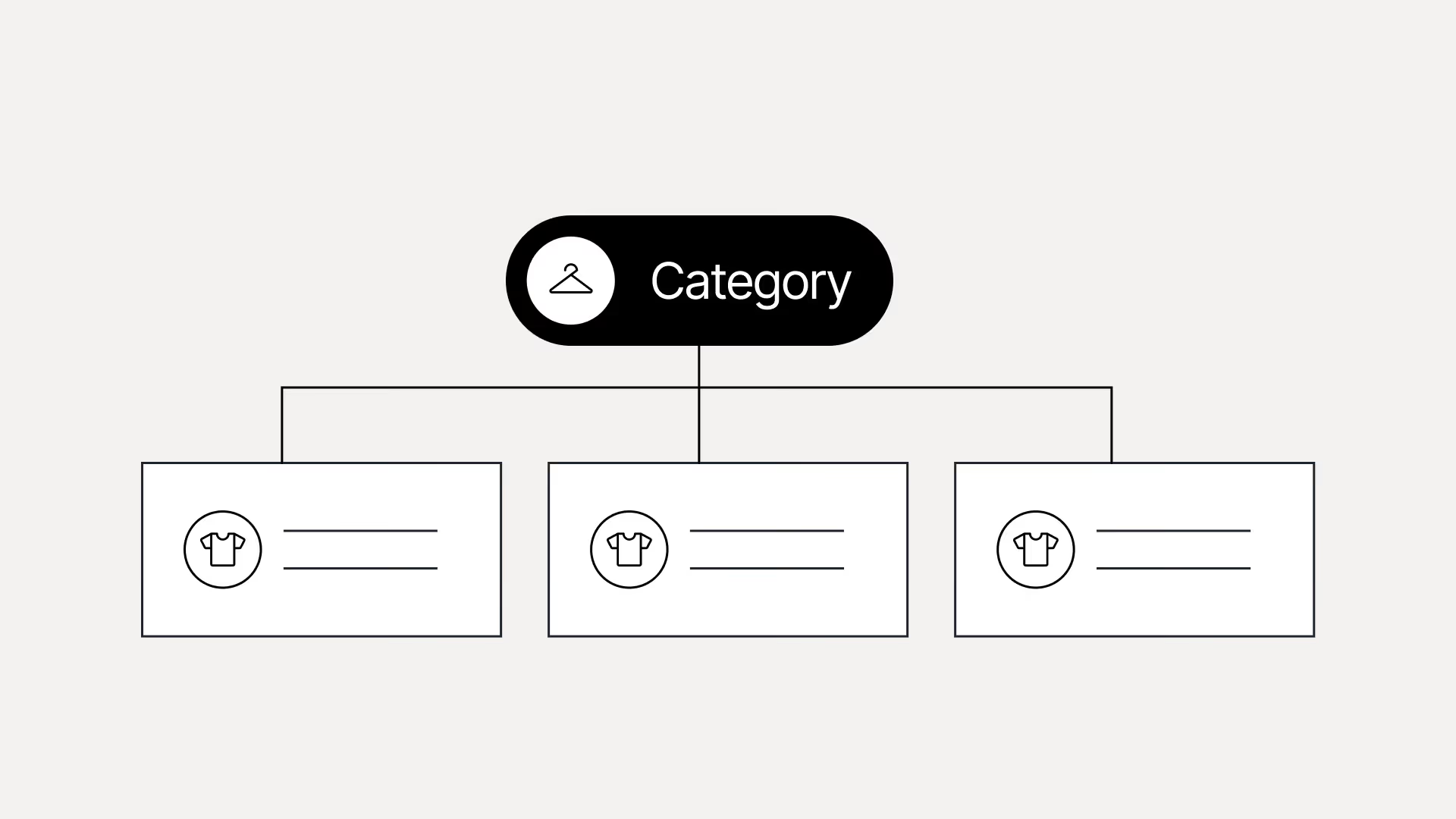
Product categorization, also called product taxonomy, aims to create an organized and searchable shopping experience by breaking products down into intuitive categories and subcategories.
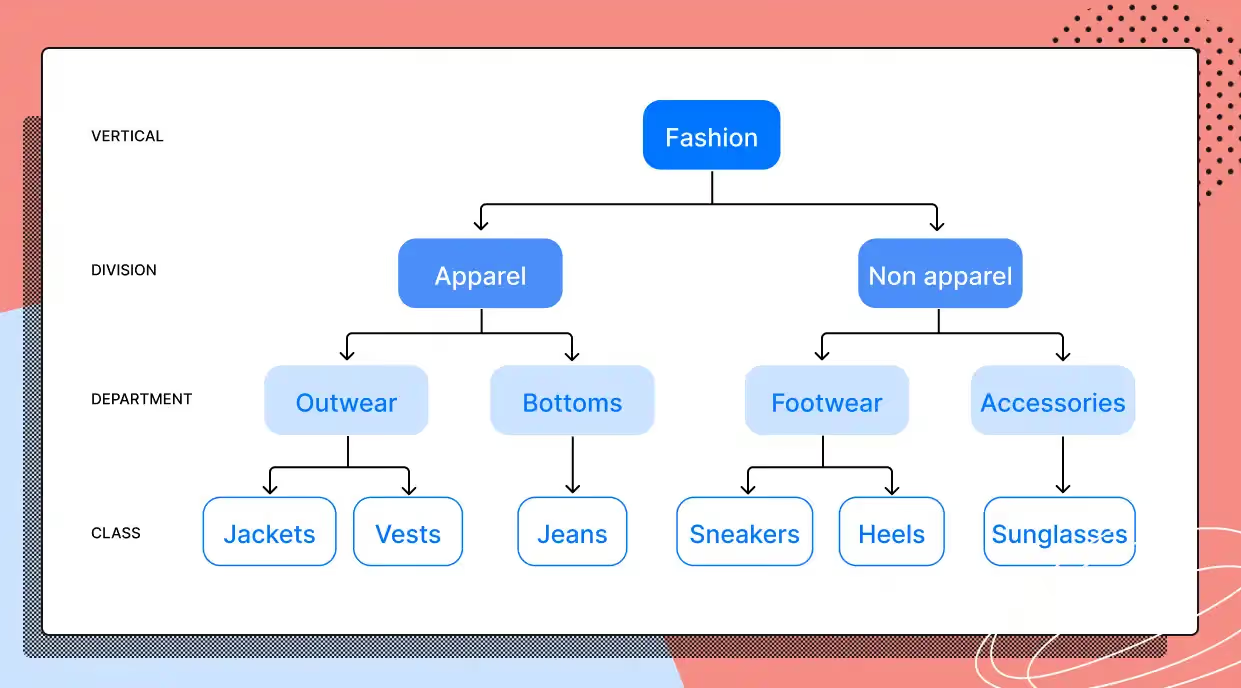
Why is product categorization important in ecommerce?
Product categorization isn't usually a concern for ecommerce stores that offer just a handful of products. But stores with large-scale catalogs of different products need a way of organizing them so that it's easy for customers to find what they need. Product categorization can also be strategic: Your product taxonomy can promote certain product types (e.g. “Accessories”), occasions (e.g. “Father’s Day”) boost average order value (e.g. “Best Sellers”), and more.

Today, the process of ecommerce product categorization is often done using machine learning and natural language processing (NLP). When fed with the right training data, these algorithms allow ecommerce platforms to categorize products based on their descriptions and customer behavior — without having to organize their catalog manually. We won’t go too in-depth into these advanced tools in this post, but will recommend additional tools and reading if this is the kind of information you’re looking for.
Overall, proper product classification and categorization create a better user experience — which, as we know, is mission-critical for any brand. Customers can easily find similar products, search for products using common keywords, and enjoy a more organized and streamlined shopping experience. Some of the top benefits of ecommerce product categorization include:
Organized ecommerce sites with clean organizations sell more
Create a path of least resistance for your customers. Better organized ecommerce sites make it as easy as possible for them to find what they’re looking for. When you can eliminate obstacles that might otherwise keep them from buying, you have a better chance at generating more sales.
Plus, effective product categorization can act as a kind of upselling or cross-selling strategy. If customers are looking for adorable earrings, for example, they’re more likely to buy two or three pairs if they see an entire category page full of great options.
Product organization and categorization enable better search functionality
If you have a search function on your store (and you should), then organizing and categorizing your store's products improves its functionality and accuracy.
Along with optimizing your website's search functionality, proper product categorization can help optimize your website for search engines like Google and boost its SEO. While the number of product searches that originate from search engines instead of marketplaces is shrinking as marketplaces like Amazon and eBay have come to dominate the ecommerce space, it still accounts for 19% of all product searches.
Product categorization helps with monitoring data
Breaking your products down into categories enables you to monitor which category pages get the most visits and which ones have the highest conversion rate instead of doing this for product pages alone. This provides additional data that you can use to generate more insights into customer behavior. If your ecommerce store uses Shopify, you can pull these metrics out of your Live View analytics:

Product organization creates a streamlined shopping experience for your customers
Imagine walking into a department store to find products scattered randomly with no organization: dishware next to gardening supplies, cosmetics on the same shelf as cat food, sports equipment on the same aisle as canned goods. Organizing these products into categories helps users find what they’re looking for quickly or discover new products based on their interests or the occasion. For example, tech accessory brand has categories based around collections (on top of more standard categories), which could catch a browser’s eye and draw them onto a product page:

A step-by-step guide for ecommerce product categorization
If you want to organize and categorize your store's products in a way that will create an optimized shopping experience for your customers, here are the steps that you should follow:
1) Collect essential product data
Product data includes any information that can be used to organize your products: brand, material, size, color, and any other important product attributes. If you don’t have updated product information from which to source this data, you can request it from your suppliers.
Once you have gathered all available product data, a Product Information Management (PIM) system like Jasper PIM (available as a Shopify app) lets you organize and analyize product datasets automatically and provides a centralized environment for managing product data over time.

However, before you dive too deep into your data, take a step back and brainstorm some taxonomy structures that might work for your shoppers.
2) Create potential categories for your products
Creating a baseline for product categorization is pretty straightforward. Before diving into a teched-out process, put yourself in the shoes of the shopper and brainstorm ways But if you have a wide range of products for sale, it can get a little tricky. Here are a few tips for creating great product categories:
- Look at established ecommerce sites for inspiration
- Avoid being so specific that you end up with an excessive number of product categories
- Navigate your online store yourself to get a feel for the experience that your product hierarchy create
- Create clear and easy-to-understand titles for your product categories — remember, clear is better than clever
3) Use keyword research for product category/page optimization
Putting carefully chosen keywords in your product descriptions and category pages can improve your store's product search functionality. It can also improve your site's SEO, bringing in more traffic from search engines.
You can find the best keywords for your store using keyword research tools like SEMRush, Google Keyword Planner, and Ahrefs. These tools let you see the search volume for common keywords and provide keyword suggestions based on your input.
4) Categorize your products based on user behavior
Based on our analysis of data from 10,000 ecommerce merchants, sorting your product categories based on user behavior (like past purchases) using tools like Crossing Minds and Wiser can increase revenue by up to 10%.
Here are a few examples:
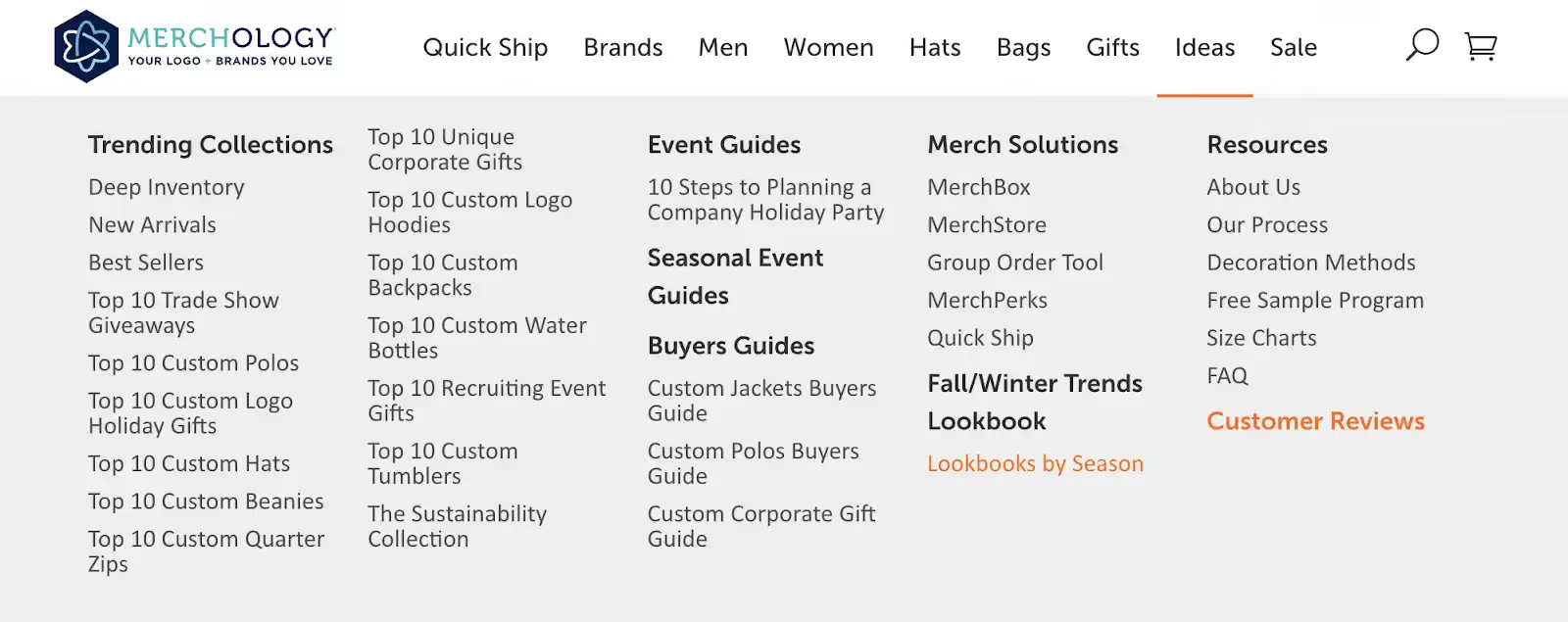
Merchology, a corporate apparel brand, uses customer data to create “Gifts” and “Ideas” categories for products that are commonly purchased for specific reasons. They sort by user behavior by categorizing products into “Top 10s” for many occasions:
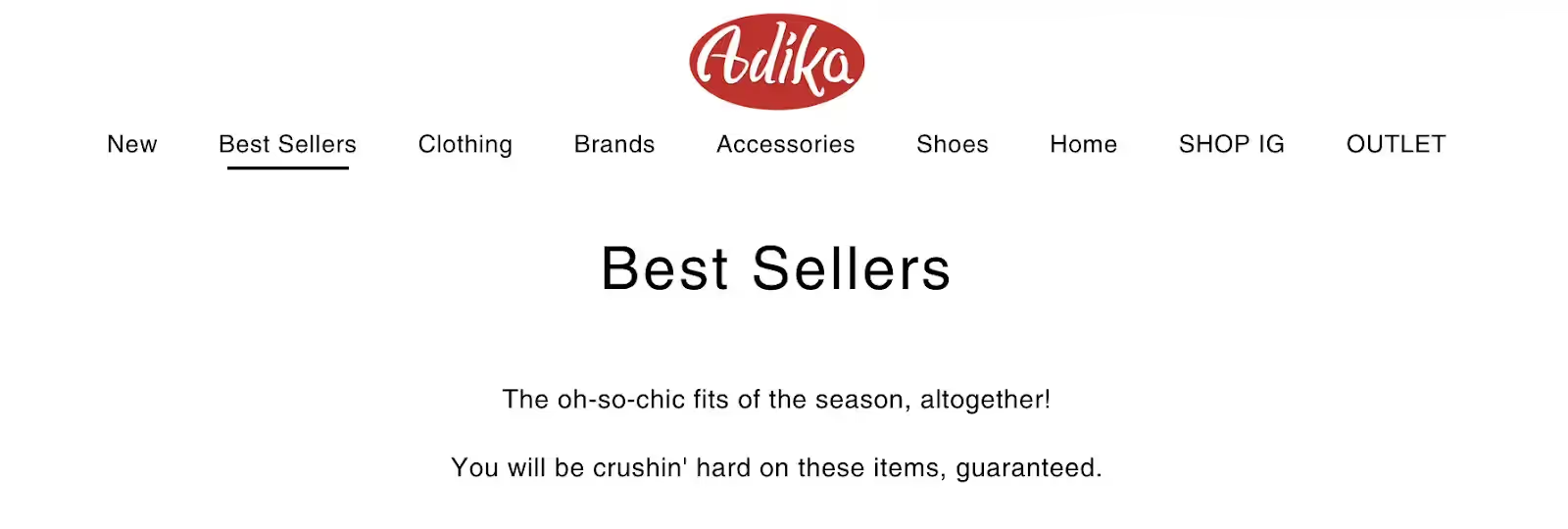
Similarly, Adika has a category called “Best Sellers” to promote its products with the highest conversion rates:
5) Scale and iterate your product categorization efforts
Categorizing your products based on user behavior is an excellent strategy, but user behavior sometimes changes over time. Therefore, don't be afraid to adjust and rearrange your product categories over time based on what your metrics tell you.
On top of your standard categories, you can also include “facets,” which operate more like tags that categories. Facets are details about a product that may not be in the product title or significant enough to be its own category. For example, the cut of or material of a dress:

Facets act like keywords to give your shoppers another way to browse your store and find the exact kind of item they want. As your store grows (and your products change), keeping up with facets — especially because it’s difficult to anticipate all the ways customers might go about searching for products.
As you scale your categorization efforts, it’s also important to be careful not to overcomplicate your store’s navigation. New products may require new categories, but it may also become necessary to combine and condense some categories to avoid overwhelming your shoppers.
Product Information Management (PIM) systems, which we mentioned earlier, will also likely offer automation and other features to manage product data and keep your store up to date. For example, you can use your PIM as a single source of truth for listings across your ecommerce platform (Shopify, BigCommerce, Magento, etc.) and marketplaces like Amazon and eBay. That way, you can iterate on product descriptions and categories in one place, rather than changing them in the backend of each platform.
Ecommerce product categorization best practices
As you go about organizing and categorizing your ecommerce products, here are a few best practices to keep in mind:
Adjust your product categorization based on geolocations
You don't want to show products to customers who can't purchase them. If you don't ship certain products to certain states or countries, then you will need to categorize your products based on geo locations using a product like Advanced Store Localization or Geo Targetly.
Shakti is one Gorgias customer that uses Advanced Store Localization to adjust their product categories based on the customer's location. Because Shakti doesn't ship all of its products to all countries, they use the tool to hide certain products from viewers in those countries.

Avoid using "other" as a category
Instead of creating an “other” category (which will only confuse your shoppers) simply put products into the category where they fit most naturally. Use keywords to ensure that customers can easily find them — even if it isn’t all that clear which category they should search.
Keep products limited to one category at a time — except special categories
Having products appear in multiple categories often makes for a confusing product catalog that is difficult to navigate. Instead, keep products limited to a single category at a time. While this can sometimes be a little tricky for products that could fit in multiple categories, assign the one that fits best and use keywords within the product description to make up the difference.
The only exception to this is special categories, like Best Sellers, Valentine’s Days, Last Chance, etc. These categories aren’t based on product or customer types, so overlap won’t be confusing.
Product categories should all be unique from one another
Keep your product categories as simple as possible to avoid overlap and confusion. For example, having an "athletic apparel" category and a "sports apparel" category is redundant and unnecessary — choose one or the other. There's no benefit to having a larger number of categories, so don't feel the need to force them if they don't already cluster naturally.
Keep branding tone in mind while creating product categories and descriptions
But branding doesn’t just apply to color schemes and company logos: It’s your messaging, too, so keep it in mind when developing your product categories and product descriptions.
Categories and descriptions need to communicate key product information above all else, so be sure that you aren't sacrificing clarity for the sake of branding. Include the basics (color, dimensions, materials, size, and any other relevant descriptive information) and use simple, jargon-free language. ASOS product descriptions do this particularly well, balancing their conversational writing style with clear, useful keywords.

Consider adding a product quiz to help customers find the right product
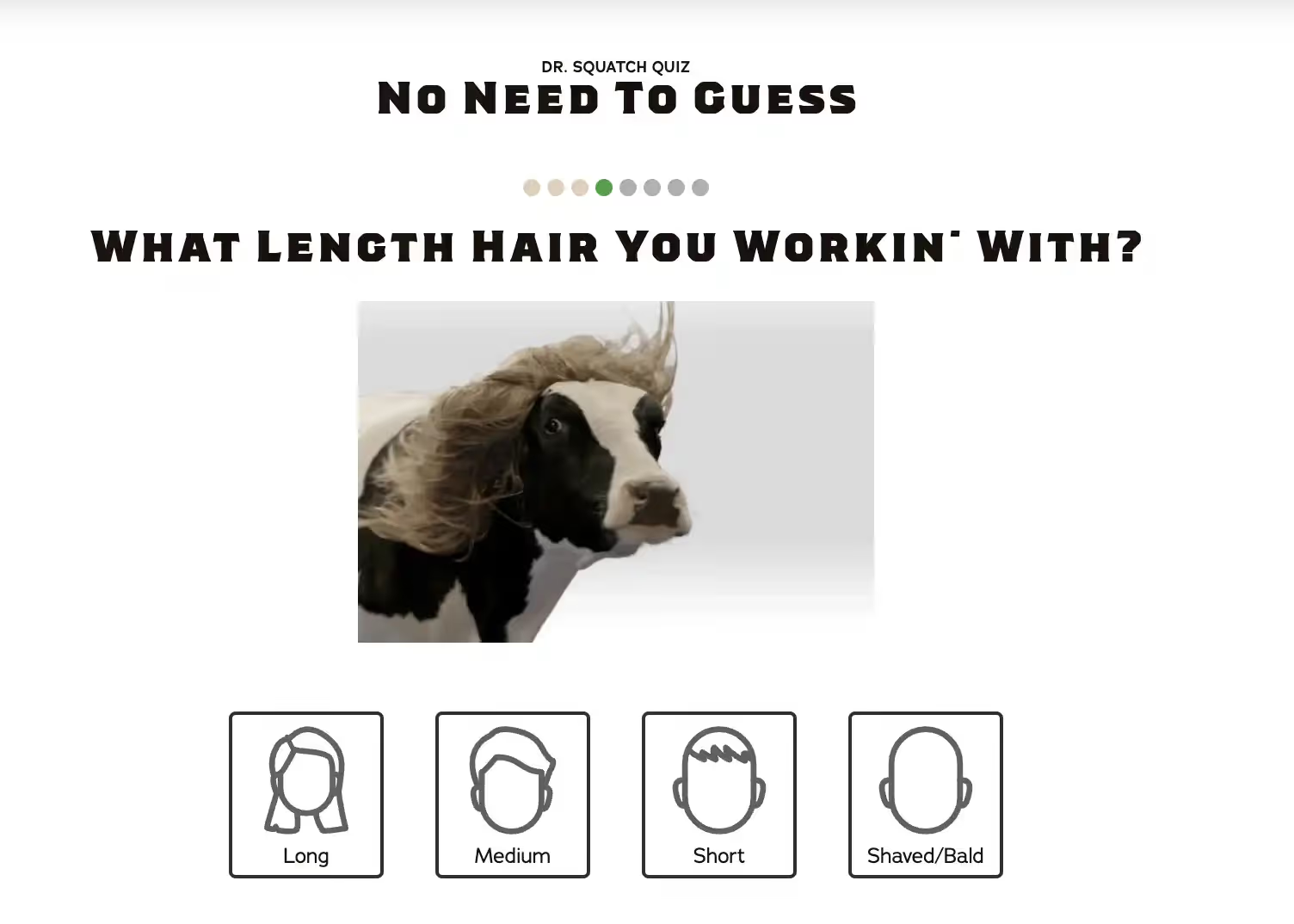
Ninety-three percent of marketers agree that interactive content like product quizzes are effective at helping educate customers. Product quizzes designed to identify a customer's tastes or needs can be great tools for further helping customers find what they're looking for.
Dr. Squatch is one example of an ecommerce company that uses these quizzes effectively. If you want to create your own branded product quizzes, consider using a tool like the Product Recommendation Quiz app.
Building a category tree for your ecommerce store
Large catalogs of ecommerce products are typically separated into different categories and subcategories to build a hierarchical category tree. For a pair of women's sneakers, the level-categories might look like: Clothing & Apparel > Women's Footwear > Women's Sneakers.
After separating products into different categories and subcategories, you can further break them down with product attributes and facets.
Going back to our last example, the pair of women's sneakers might be assigned product attributes like size and color. You can then assign values to those attributes (7, 8, or 9 for the attribute "size," and red, white, and black for the attribute "color").
Jaxxon’s online store, which sells mens jewelry, is one example of a great category tree. There you will find numerous product categories, subcategories for each, and attributes that allow customers to filter their search further. For example, Rings breaks down further into Best-Selling Rings, Tungsten Rings, Iced Out Rings, and Wedding Bands:

Take care of your ecommerce shoppers with Gorgias
With the right tools and strategy, you can create a categorization system optimized for customer happiness and revenue generation.
With Gorgias' industry-leading customer insight tools, you can fine-tune your ecommerce store to give your shoppers exactly what they want. On top of product categorization, you can provide self-service resources like FAQ pages, Help Centers, and automated Quick Response Flows so customers have more answers, faster.
Providing instant, self-service answers to customers is how customers like Loop Earplugs lift revenue by up to 43%:
“We’ve seen 43% increase in revenue from customer support since we launched pre-sales flows. Quick response flows give us the ability to build trust with our customers and that’s priceless. When customers get a quick and honest answer, they often end up buying more than one product in a short span of time. Seeing customers live the life we’re aiming to create for them in Loop Earplugs is extremely rewarding for us.”
- Milan Vanmarcke, Customer Service Manager at Loop Earplugs
Get started with Gorgias to get on track to an organized ecommerce store that converts more shoppers into buyers.
{{lead-magnet-2}}

Ecommerce Returns: 10 Best Practices for Taking Your Online Store to the Next Level
Handling returns isn’t the most enjoyable aspect of running an online store. However, every ecommerce business needs to create a clear, thoughtful return policy and keep customer satisfaction and customer loyalty levels high.
Want to create a returns process that’s ideal for both your ecommerce website and customers? Below, we’ll explore ecommerce returns data and factors to consider as you build or re-examine your policy, and then go over 10 best practices for handling customer returns.
Table of Contents
- Not Every Return Program Is Right for Your Business
- Building Your Ecommerce Return Program: Factors to Consider
- 10 Best Practices for Your Ecommerce Returns and Refunds
- Ecommerce Return Software Worth Considering
- Take Ecommerce Customer Support to the Next Level With Gorgias
Not Every Return Program Is Right for Your Business
Although every ecommerce website deals with returns, return policies look very different from one site to another. Some businesses choose to offer a full refund on online returns, while others offer store credit in exchange for returned products. Some businesses provide free return shipping on product returns, while others pass shipping costs to customers.
Ultimately, a good return program fulfills the goals of your company without being too costly to operate or too difficult for your customers to find, understand, or use.
Enterprises and large businesses are more likely to offer free, no-questions-asked returns as a means of brand-building and promoting a better customer experience at scale. It may also be more profitable and productive than operating a stricter or more complex program. Customer service teams save significant time, which is key with a larger customer base and inventory volume.
Smaller businesses, by contrast, may benefit from a less generous program. According to data from CNBC, the average return represents 30% of the purchase price. For businesses operating on tight margins, this cost may be too much to swallow. Instead, many smaller businesses choose to offer stricter return policies, such as charging for shipping or only offering store credit.
Of course, there are downsides to stricter return policies. Namely, many customers expect hassle-free returns, and 79% of consumers want free return shipping. If you choose to implement a stricter ecommerce return policy for your online store, maintaining customer satisfaction and a high customer retention rate may be more of a challenge.
In the end, there's no one-size-fits-all return program. You’ll need to crunch the numbers and take into account how much each aspect of your policy could impact your bottom line. We’ll examine some of these costs in the next section.
Once this is done, enter the details into our return or refund policy template generator and edit your new policy as needed.
Building Your Ecommerce Return Program: Factors to Consider
Let's take a closer look at the most important factors to consider when it comes time to create or update your store's return policy.
The High Cost of Ecommerce Returns
According to The National Retail Federation (NRF), ecommerce returns are a “major driver of the overall growth of [retail] returns.” Online returns more than doubled from 2019 to 2020, with consumers returning nearly $102 billion in merchandise bought online.
Although the COVID-19 pandemic and rise of online shopping can explain some of the increase, ecommerce returns have been rising for years. There are four main categories of return-related expenses that combine to make up the high cost of ecommerce returns:
- Cost of refunding customers: The first and most obvious expense associated with offering a full refund on returns is the loss of profit your business incurs. This means that any additional expenses you incur, such as return shipping and restocking returned products, will lead to a net loss for your company.
- Cost of additional shipping: If you choose to cover the shipping costs on returned products, the cost of printing a return label and paying for shipping will add up as well. If it’s an exchange rather than a return, you’ll have to pay for shipping on the replacement product(s) as well.
- Cost of sorting and reshelving returned items: These expenses can be substantial depending on the types of products you're selling and the exact logistics of your ecommerce operation. Some businesses offset these expenses by charging a restocking fee on returned items, typically 15-20% of the item’s price.
- Cost of not meeting customer expectations: While the financial element of handling returns is important, you should also consider the impact of your return policy on your brand image and customer satisfaction. A poor returns experience can easily lead to a lost customer and negative reviews. The long-term costs of dissatisfied customers may be more damaging to your company than the costs of offering a more generous return policy.
If you’re looking for fresh ideas to reduce the cost of returns and exchanges, read our blog to learn how gift cards and loyalty points could be key.
Ecommerce Return Rate Benchmarks
According to data from Invesp, 30% of all products ordered online are returned, compared to only 8.89% of products that are purchased from a physical store. Here’s a snapshot of retail return rates by industry (online and in-store) from an NRF and Appriss Retail analysis of 40,000 stores:

As you can see, the data varies widely by industry, among other factors. A good general benchmark for ecommerce returns is 20-30%. The important takeaway here is that if your return rates are much higher than these averages, there may be issues you need to address.
Top Reasons That Customers Return Products
Here are the leading reasons why customers say they return products according to Invesp:
- 23% of returns are due to customers receiving the wrong item
- 22% of returns are due to the customer receiving a product that doesn’t match the product description or image
- 20% of returns are due to customers receiving a damaged product
- 35% of returns are due to unspecified reasons
There’s also the fact that 58% of consumers intentionally buy more items than they plan to keep. Customers are increasingly using return programs as an easy way to test out or try on ecommerce products, which leads to more returns overall.
Looking at these statistics, it’s evident that it's possible for ecommerce stores to drastically lower the number of returns with the right adjustments. By ensuring that you're shipping quality, undamaged products, providing detailed descriptions and images that perfectly match the product, and shipping the right product to the right customer, you could potentially reduce or eliminate up to 65% of all online returns.
10 Best Practices for Your Ecommerce Returns and Refunds
- Understand the Federal and State laws governing returns
- Make your return policy easy for customers to find
- Reduce returns by providing important details on every product page
- Build a return policy that's easy to understand
- Create trust by focusing your return policy on customer acquisition
- Reduce the cost of refunds by building an exchange-based return policy
- Offer free shipping wherever possible
- Track the cost of your returns and adjust accordingly
- Make your return program part of your marketing strategy
- Allow customers to make returns by mail or in person
1. Understand the Federal and State Laws Governing Returns
Certain aspects of your store's return policy aren’t up to you to decide. According to the Federal Trade Commission (FTC), if a customer receives a defective product, you’re required by law to issue a refund.
There are also a variety of state laws governing how returns and refunds must be handled. The major requirement is that you have to post your return policy in a clear, conspicuous place, but some laws go further.
In Minnesota, for example, stores are required to display their return policy in a boldface font set at a minimum size of 14 points. If these standards aren’t met, the store is required to offer cash refunds for acceptable returned items, regardless of their policy.
Research your state’s or country’s laws or work with a lawyer while designing your ecommerce return policy to avoid legal issues.
2. Make Your Return Policy Easy for the Customer to Find
According to data from Invesp, 67% of shoppers check a store's return page before making a purchase decision. Whatever your ecommerce return policy happens to be, you need to make it easy for customers to access, whether they’re on a mobile device or desktop.
Creating a dedicated return policy page on your website — and providing a link to this page on every product page — ensures your return policy is highly visible. You can also add it to your FAQ page and your chatbot scripts. Briefly informing customers of your return policy at checkout is another effective option to consider.
3. Reduce Returns by Providing Important Details on Every Product Page
Product pages are the heart of any online store, and it’s essential that they provide customers with a complete and accurate description to reduce returns. As we noted earlier, nearly one-quarter of returns are due to products not meeting customers’ expectations or lacking key information in the first place.
Make sure your description includes size, dimensions, color, weight, care instructions, and any other relevant info. Beyond written text, you can show customers exactly what they’ll get with tools like interactive 360-degree images or videos. You can also provide your products next to other common items to give an idea of size and scale.
4. Build a Return Policy That's Easy to Understand
In addition to making your return policy easy for customers to find, it's also important to design a return policy that’s easy to skim and understand quickly. No customer wants to hunt through 20 pages of fine print to see whether there are return shipping fees.
Even if you decide to publish a lengthier, more complex policy somewhere on your website for legal purposes, you should still provide customers with a condensed version of your return policy. Think about the key bullet points like return shipping instructions, deadlines, and criteria they have to meet to qualify.
Making sure that customers fully understand your return policy before they make a purchase helps avoid confusion — and angry customer emails — later on.
Use our free Return Policy Template Generator to get started. We’ve used our experience working with thousands of online stores and partnering with leading ecommerce platforms to build a simple, reliable template.
5. Build Trust by Focusing Your Return Policy on Customer Acquisition
When over two-thirds of shoppers pause to check out a store's return policy before buying, your policy may be their first accurate impression of your brand. So, a strict or unforgiving return policy could end up hurting your customer acquisition goals. It could scare away first-time customers that don't yet trust your business enough to purchase without knowing they’ll be able to easily return products if they’re dissatisfied.
By contrast, a transparent and thoughtful return policy can go a long way toward fostering trust with your customers and ultimately boost the number of new customers that your store acquires. Think about your buyer personas and acquisition goals to develop the right program. This can also inform your brand’s tone of voice throughout the policy.
6. Reduce the Cost of Refunds by Building an Exchange-Based Return Policy
A straightforward way to reduce the return and refund expenses is to offer an exchange-based return policy or promote alternative refund options like store credit via gift cards or loyalty points.
Although exchanges may come with reshelving fees, they keep the customer’s dollars circulating in your ecommerce store. Gift cards, for example, offer an opportunity to increase your customer’s average order value (AOV).
Imagine a customer with a $25 gift card. They want to use the full value of their card in one transaction, so they buy something slightly more expensive, like a $26.50 sweater. With that, you’ve raised AOV by 6% on a simple credit-based return, and you can scale this up across your business for hundreds or thousands more per year.
7. Offer Free Shipping Whenever Possible
We mentioned earlier that 79% of consumers value free return shipping when making a purchasing decision. Nearly half of online retailers currently offer this no-cost option. While it can be painful to absorb these costs, offering free return shipping is important if you want to meet customer expectations and keep up with the competition. If you're looking for ways to reduce your return expenses, requiring that customers cover return shipping should likely be a last resort. Another option is to set a threshold for free shipping, such as a $40 pre-tax order value.
8. Always Track the Costs of Your Returns and Adjust Accordingly
Tracking the costs of your returns can also allow you to make informed decisions around your return process, from hiring more customer service team members to trying different shipping carriers. This figure should be estimated before your policy is implemented and re-evaluated on a regular basis afterward when you have real data to crunch.
By carefully tracking the cost of your returns, you can determine whether you need to make adjustments. For example, if you determine that your return policy is eating up too much of your store's profits, you may test a shorter return window or store credit options. Or you may determine that a reverse logistics process could streamline work and lower costs as well.
9. Make Your Return Program a Part of Your Marketing Strategy
Customers love a convenient, hassle-free returns process, and if that’s something you offer, you can use it to promote your brand and earn a reputational boost.
Consider Amazon’s return policy. Customers shopping on Amazon know that they have the option to return products — no questions asked — for a full refund. The peace of mind that comes with this guarantee is a big part of why Amazon has been able to build such a high degree of trust with its customers. It should come as no surprise then that Amazon actively promotes the benefits of its return policy to attract potential customers.
If your business boasts a generous, transparent, or stress-free return program, let your customers know about it. This could be an incredibly effective email or social media message during shopping-heavy periods like Black Friday and Cyber Monday.
10. Make Returns Possible by Both Shipping and In-Store Returns (If You Have a Brick-and-Mortar Location)
If you have an online store as well as a brick-and-mortar store, you'll want to make it possible for customers to return products by either shipping them to you or bringing them to your physical location.
The reasons why this is beneficial are twofold. For one, offering customers more return options will only help improve your customer satisfaction rates. Convenience is top of mind for online shoppers. Second, returns processed in-store are less costly than returns that are processed online since you don't have to pay for return shipping.
Ecommerce Return Software Worth Considering
The right ecommerce return software can go a long way toward making your return process more efficient and affordable. Here are some of the top-rated tools:
- ReturnLogic: ReturnLogic works to simplify the returns process and improve your inventory management through automation, like automatically processing requests and sending status updates. ReturnLogic also provides you with detailed analytics you can use to streamline your business.
- Loop: Loop is an “exchange-first” solution designed for Shopify stores. It provides customers with an on-demand returns portal for managing their exchange-based returns or traditional refunds.
- Returnly: Returnly provides customers with a portal where they can return and exchange products independently without needing to contact your customer support team. Returnly also claims to be the only returns software solution that allows customers to receive the right product before returning the wrong one.
- LateShipment.com: LateShipment.com is an all-in-one platform for managing customers’ post-purchase needs, including order updates, shipping, returns, and exchanges. It allows you to track return shipments across carriers and offers valuable insights into your shipping costs.
For more recommendations, check out our list of the top returns management software.
Take Ecommerce Customer Support to the Next Level With Gorgias
If you’re ready to build an efficient and effective returns process for your online store — that’s also backed by the latest returns software — Gorgias can help.
Our platform streamlines your returns process, integrating return software solutions like Loop, Returnly, and ReturnLogic and empowering you to offer top-quality customer service from a single, convenient hub. We also provide detailed developer documentation to build your own Gorgias integrations.
To learn more about how Gorgias can help you create a returns process that leverages the power of automation and in-depth analytics, book a demo today.

25+ Customer Service Scripts Inspired by Top Brands
When customers reach out to your support team, they expect their problems addressed promptly and accurately. Providing an effortless experience for your customers is one of the best ways to nail customer support — it may be the difference between keeping that customer for years and never seeing them again.
The best customer service agents can solve issues quickly and provide high-quality, personalized customer support without delay. But since many issues crop up repeatedly, written and call center scripts are a smart way to empower agents when they're dealing with frustrated or angry customers.
Not all customer service interactions can (or should be) scripted. But by developing scripts for your most repetitive questions you can give more time and attention to complex and high-impact tickets that need a human touch.
Below, we put together customer service scripts for 29 common scenarios, inspired by top ecommerce brands that use Gorgias, like Steve Madden, Timbuk2, and Vinter’s Daughter.
 |
What are customer service scripts?
Customer service scripts are pre-written answers to questions that customers commonly ask. By proactively writing out answers, or creating scripts, companies prepare team members with thorough, correct answers, thereby helping them build strong problem-solving skills. This creates a more helpful, supportive experience than expecting customer service reps to think of good answers on the fly, especially if they’re dealing with frustrated customers.
When are customer service scripts useful?
Scripts can be useful at any point in the customer interaction, however, they’re particularly useful during situations that recur often: calming angry customers, directing customers to resources like your returns policy, and answering frequently asked questions just to name a few. These are responses that will change very little from one customer to the next, so using a script can save time and provide a consistent customer service experience.
Customer service scripts can live in an internal knowledge base or standalone document library. However, scripts are most helpful when they’re integrated into your helpdesk or customer service platform. This way, your customer service agents can pull up, populate, and modify scripts without any copy/pasting or tab switching — no matter which customer support channel they’re using, from social media and email to live chat and SMS.
Related: Read our guide on omnichannel customer service to learn how to unite all these channels.
On Gorgias, scripts are called Macros and include variables that automatically populate with customer information, like the customer’s name, order number, and more:
 |
29 customer service scripts categorized by topic
Customer service scripts are a highly effective way of keeping your team members on the same page and providing quick resolutions for customer issues. However, you do need to take some time upfront to create different scripts that specifically address common issues and questions. Otherwise, they won't be valuable or hit the mark.
Below, we’ve categorized several common potential customer service issues and provided several sample scripts for each one. Feel free to use them as inspiration as you create your own templates, but remember to adjust the language to fit your branding — no two companies have the exact same style.
Scripts to cover shipping issues
These scripts deal with lost or slow shipments, questions about shipping costs, and needing to change the shipping date after an order has been placed.
1) Tracking shipment
Hello! Thanks for reaching out! Here is the link that you can use to track your shipment: [support agent pastes tracking number for last order]. Alternatively, we have also sent a follow-up email with your tracking information. Look for the subject line, “Your order has shipped!”
We are here if you need more information!
Enrich your responses with real-time data from Shopify
Using a customer helpdesk connected to your ecommerce platform, you could insert customer variables like the last order ID and tracking URL dynamically into your answer. Here is what could look like the previous template:
Hello! We are happy to help! Your tracking number is {{Tracking number of last order}}, and I have also included a link to track your package below for your convenience: {{Tracking URL of last order}} For further questions regarding your shipment or anything else, please feel free to contact us!
2) Late shipment
We are terribly sorry about the delay in the shipment! Sometimes, the delivery is out of our hands and unfortunately we cannot speed things up. We do appreciate you and we are always transparent about any shortcomings from our side. For your convenience, we are sharing the tracking link {{Tracking URL of last order}}. Please let us know if there is anything else we can do for you!
To thank you for your patience, here’s a $10 coupon off your next order.
3) Lost shipment
Thank you for reaching out! Our team is so sorry to hear that you were unable to locate the missing package. Rest assured we will remedy this situation for you.
We can offer two options: we can ship a replacement to you or a full refund for the order instead. In case you prefer a replacement order, we kindly ask that you please confirm the shipping address of where you would like the replacement order sent. We are looking forward to receiving your reply.
4) Need to change shipping options after ordering
I understand that you want to change your shipping option so you can receive this order as quickly as possible. If this is correct, not a problem :) We just cancelled the order and can re-order the item with your desired shipping option. Please note that the additional cost is [$]. Let us know if there is anything else we can do for you!
Scripts to address order issues
Few things get under a customer's skin quicker than having trouble placing an order. Dealing with these customer interactions quickly and helpfully can be the difference between creating a loyal customer, or losing a first-time customer.
5) Can’t place an order
Thank you for reporting this! I will make sure this is addressed with our team. Would you mind letting me know which product you are purchasing so that we can help right away? Thank you :)
6) System placed order incorrectly (system error)
We are terribly sorry for this inconvenience. I can fix this right now for you. Would you mind sending us your order number so that we can change and remove incorrectly added items?
7) Customer wants to change their order within the allowable time limit
Hey there! I have just checked your order information, and since it was purchased within an allowable timeframe, we would be happy to make the requested changes. If you would like to fully cancel the order instead, just let us know and we can do that for you as well.
8) Customer wants to change their order outside of the allowable time limit
Thank you for your request! We are sorry to say that we are not able to process the change, since your order is currently on the way. If you are interested in returning your order, please follow the instructions from our page here, you will find all the needed details! We are sorry that we are not able to help more and we thank you for your understanding!
9) No order confirmation email
I understand that you didn’t receive an order confirmation. How long ago was the order placed?
Did you see a thank-you page screen after ordering? Thank you for the details provided, this will help us fix the issue fast!
Scripts to address product issues
Being able to use customer service scripts to address issues customers experience with your product mitigates the issue quickly and increases the chances you can keep customer satisfaction intact.
10) Product listing issues (not as described, pictured)
Thank you for reaching out and for the details you have provided! To process your return, would you mind clicking on “Get a return label” link here? Once this is done, we will continue processing your refund. If you have any other feedback regarding the product, we would be happy to hear it!
11) Negative product reviews
I understand you have concerns about some of the reviews you’ve seen. Our product isn’t a fit for everyone, but we have 2,000 positive reviews from customers who love it and we are always transparent and upfront! There are no risks, as we offer a full refund if you ship the unused portion back to us within 30 days.
12) Product questions
I see you’ve got some questions about your product! We would be happy to help. Ask away.
13) Damaged products
We are terribly sorry for this inconvenience. We aim to provide the most excellent service and carry our business to high standards We try our best to make sure items reach you in perfect condition, but sometimes mistakes happen that are out of our reach. Please send the item back to us using a prepaid label, which you can print here: (link). We’ll ship you a replacement right away.
Thank you for understanding!
Scripts to cover returns
Requests for returns are one of the most common queries to come through customer service tickets. Customers often looking to bend the rules during the phone call or live chat session can pose a unique challenge to representatives who need to provide good service, but also follow company policies. Here are three must-have scripts for addressing tricky returns issues.
14) Request to return the product
Thanks for contacting us! We allow returns up to 30 days from the purchase date for all items except clearance items. You can initiate your return and print a shipping label with our easy return portal here: (link)
15) Request to return a product outside of policy
Thank you for contacting us. Unfortunately, your order is outside the window of return. However, because it is only outside the window by a couple of days, I can allow you to return the item. Please confirm you’d still like to return it and I will email the prepaid shipping label. If we don’t receive the product within 10 days, we will not be able to accept your return.
Or...
Thank you for contacting us. Unfortunately, your order is unable to be returned because it is well outside of the time window (30 days) outlined in our return policy.
16) Tracking the status of a return
Thank you for reaching out! Let us provide a timeline here. We typically refund orders within 3 to 5 business days from receiving them. I can see that your package is expected to arrive tomorrow, so you should expect to receive your refund within 2 weeks.
Integrate customer service and returns software for a better CX
Leveraging product integrations that work seamlessly with your customer service platforms can put the power of returns primarily into the customer’s hands. Gorgias’ Loop integration does exactly that, letting customers take control of their returns on their own time and giving them a better customer experience in the process.
The integration is valuable to your support team, too: Instead of spending time on return tickets, they can focus on new customers, shipping issues, etc.
{{lead-magnet-1}}
Scripts to cover billing and payment inquiries
Staying friendly and accommodating during a customer service call can be difficult, depending on the customer's attitude. Customer service scripts keep your team members — especially new customer service agents — on track and focused on resolving the problem at hand.
17) Accepted payment options
Hi, thank you for contacting us. Regarding payment, we accept Visa, Mastercard, American Express, PayPal, and gift cards. Anything else we can help you with?
18) Paypal acceptance
Yes, we do offer PayPal! Just select PayPal and you’ll be prompted to log in and choose your payment method through PayPal.
19) PayPal issues
Thank you for reporting that. Like all platforms, unfortunately, PayPal has issues sometimes. Since this is a third-party app, we don’t have access to troubleshoot your account. Please ensure that your login information is correct and contact PayPal support with any issues. Alternatively, you can complete your order using a credit card or debit card. Let us know if there is anything else we can help you with!
Scripts to address gift card questions or problems
Many ecommerce companies receive lots of questions about using gift cards. From checking its balance to troubleshooting why it’s not working, answering gift card questions is crucial to maintaining customer satisfaction and building brand loyalty.
20) Gift card balance
Thanks for contacting us about your gift card balance. You can find that information by entering the gift card number here: (link)
Let me know if I can help you with anything else!
21) Gift card policy
Gift card balances expire after 6 years and can be used for any purchase, including clearance items. For our full gift card policy, please visit this link: (link)
22) Gift card not working
We will look right into that, thank you for reporting it. Would you kindly provide us with the gift card number?
Scripts to cover coupon code questions or problems
Issues with using coupons can enrage even the calmest customer. You can avoid this problem by having friendly, helpful customer service scripts on hand to solve the most common problems that come up with coupon codes.
23) Coupon code not working
Not to worry, we will look into that immediately! It seems that the coupon doesn’t apply to your order. However, here’s a coupon for free shipping that you can use for orders over $50.
24) Stacking coupon codes
Unfortunately, coupon codes can’t be used together. Would you mind choosing one coupon code to use per order? If there is anything else needed please let us know!
Scripts to address user account issues
There can be a lot of user account issues that can frustrate customers who are trying to log in, check order status, or initiate a return. Make sure that your customer service team is trained in requesting the additional information needed, such as their account number or order number, to troubleshoot the issue. The following three scripts can help address common customer requests regarding user accounts.
25) Can’t log in
Not a problem, we can definitely help with that. Can you please use the “forgot username” or “forgot password” buttons here? (login link)
26) User account not showing order
I understand that the order isn’t showing up in your account. Please note that it can take up to 30 minutes for the order to show on your account. Would you mind confirming that this timeframe has passed since you placed the order? Thank you.
27) Other user account issues
We are terribly sorry for this inconvenience. Would you mind sharing a bit more details about the issue you have experienced so that we can fix that for you?
Scripts to answer website QA issues
When customers discover issues on your site, use the right words to show your appreciation. Check out these quick scripts to use when a customer discovers a bug or issue on your website or ecommerce store.
28) Error discovery
Great catch! Thank you for reporting it. Our development team will fix it ASAP. Can I help you with anything else?
29) Confusing pages or elements
I’m sorry about that! I can see what you mean — that is confusing and could be improved. We appreciate you taking the time to let us know about this issue. Our development team will fix it ASAP. Can I help you with anything else?
The benefits of customer service scripts in ecommerce
As touched on above, customer service script templates help support agents address customer needs with consistent, uniform responses. They also help with customer service training and strengthen customer relationships. Beyond being an excellent way to mitigate customer issues with ease and consistency, customer service scripts offer the following benefits:
Unlocks cost savings by reducing manual work
Make it easy for your customer service representatives to instantly access scripted responses inside of your ecommerce helpdesk. This reduces the time it takes to either craft a response from scratch or hunt for the template in a wiki.
You can further cut back on manual time by automating ecommerce customer service, which we’ll cover in more detail towards the end of this guide.
Minimizes customer service team stress
Providing great customer service can be stressful, even for senior support reps. They need tools like customer scripts to help them be prepared and stay on top of issues — fast. Instead of expecting your team members to formulate and articulate answers as they're dealing with impatient, frustrated, and difficult customers, scripts help them keep a cool head. Positive scripting reduces customer frustration and relieves stress on both sides as your team members work toward a resolution.
Standardizes support quality
You don’t want one customer to have a great customer service experience and another customer to have a bad one. This inconsistency can reflect poorly on your brand: Customers won’t know what to expect when contacting you, and you’ll end up with some negative online reviews and social media comments.
Scripts help everyone — even new agents — follow company procedures and policies, and even adopt a standardized tone of voice.
Here are the four core ingredients to high-quality support:
 |
Related: Our best strategies for improving the quality of your customer service program.
Streamlines the onboarding process
Customer support positions are prone to twice the average rate of employee turnover. You can mitigate high employee turnover with faster onboarding. Get new customer service team members up to speed with ready-to-use scripts. Scripts reduce many of the customer problems that crop up during a team member’s first few days or weeks on the job, like “How do I answer this question?” and “What’s the protocol for this type of customer issue?”
However, scripts only help if your team uses them. An internal knowledge base is a great way to house your scripts so that your team members can easily access them when needed, whether they’re a new hire or an established employee.
Here are a few signals your customer service team may need some additional training and resources like customer service scripts:
 |
Related: Our Director of Support’s guide to training for customer service.
Allows for faster issue resolution
When your support team uses customer support script templates, they can resolve issues more quickly, leading to increased customer satisfaction and effortless customer experience.
It is always a good practice to incorporate articles from your knowledge base or FAQ into your scripts. For example, your scripts and FAQ page should both address common customer questions, like those about your shipping policy.
For example, men’s jewelry brand Jaxxon makes their shipping policy available as a Quick Response Flow (or an autoresponse) in their live chat widget and on their FAQ page. This way, shoppers have two methods of understanding the company’s shipping process without having to reach out to customer service:
 |
If your business doesn’t have an FAQ or knowledge base yet, consider adding one to your ecommerce store as an easy way to address customer questions and improve user experience. These resources can deflect repetitive tickets by giving customers self-service information with minimal (or even zero) direction from an agent. Find out more about how to set one up and take a look at some great FAQ pages in action.
Related: Our guide to reducing resolution time, with insights from our Director of Customer Support.
How to automate customer service responses
Automation is one of the best ways to build an efficient customer support team, and this includes prewritten live chat scripts. While leaning on technological functionality like automated responses saves time and effort while ensuring consistent quality, it also has the added benefit of providing much more step-by-step information for customers.
 |
For example, a scripted response to, “Where is my order?” still requires the agent to manually go look up the order and shipping details. But when utilizing technology like Gorgias’ Macros, that information can be automatically pulled from Shopify or BigCommerce and sent to the customer — in a templated format that’s consistent with your brand’s voice:
 |
The response is only the beginning. When you pair Macros with automated Rules, you can also trigger actions like assigning tickets to agents, prioritizing tickets, changing shipping addresses, refunding orders, and so much more:
 |
With a helpdesk for ecommerce like Gorgias, your entire team can access and use your library of templated customer service scripts (Macros) to accelerate and improve their responses.
 |
Gorgias also offers robust, intuitive customer service automation tools that are much more customer-friendly than most other platforms’ chatbots. Through Gorgias’ Automate, merchants don't even have to dig into Shopify data and send a scripted response — customers can find and change order details right within the chat box, no agent attention required:
Go beyond customer service scripts with dynamic auto-responses and self-service
Customer service scripts are priceless tools for your customer service agents. Using them effectively reduces response times, and helps with resolution time since your agents will have everything prepared for them upfront. This workflow keeps everyone satisfied: customers for getting fast resolution and agents for not having to type in the same response over and over again.
Gorgias’ deep integration with Shopify and other ecommerce platforms makes it easier than ever to set up Rules and Macros that empower your agents to work through repetitive tickets faster so they can focus on the most important customer conversations.
Check out our Loop Earplugs customer story to see how Gorgias helped Loop decrease WISMO (“where is my order”) tickets from 17% to 5% by providing self-service information, and increase revenue from CX by 43% using Gorgias Automate.
“We’ve seen 43% increase in revenue from customer support since we launched pre-sales flows. Quick response flows give us the ability to build trust with our customers and that’s priceless. When customers get a quick and honest answer, they often end up buying more than one product in a short span of time. Seeing customers live the life we’re aiming to create for them in Loop Earplugs is extremely rewarding for us.”
— Milan Vanmarcke, Customer Service Manager
{{lead-magnet-2}}

How to Calculate + Use Gross Merchandise Value (GMV)
Quick summary:
- Gross merchandise value is the total value of goods sold on a platform before any deductions.
- GMV offers an incomplete view of financial health because it doesn’t include the cost of fees and returns.
- Compare GMV with other metrics like revenue, customer acquisition cost (CAC), average order value, churn rate, and customer satisfaction to get a full view of business performance.
- Increase GMV by offering free shipping, upselling and cross-selling, creating product bundles, offering discounts and great customer service.
Gross Merchandise Value (GMV) is a useful metric to monitor when running an ecommerce site. Traditionally, it’s one of the first numbers online merchants try to improve sales. It sounds simple enough: If you increase GMV, you’ll make more money, right?
Not so fast.
Like any single metric, GMV has its shortcomings, too. Below we’ll explain the right way to think about GMV and ways to increase GMV that can lead to more profit, not just more revenue.
What is Gross Merchandise Value (GMV)?
Gross merchandise value measures the total value of goods sold on a platform or marketplace over a specific period of time. GMV is the full amount customers pay before deductions like fees, discounts, or returns.
GMV and revenue are not interchangeable. Revenue is what remains after subtracting deductions from the GMV.
{{lead-magnet-1}}
How to calculate Gross Merchandise Value (GMV): formula + example
You can use the following formula to calculate GMV:
Gross merchandise value = sales price of goods x number of items sold
Example of GMV
If you sell something for $100 through Etsy and Etsy takes a 10% commission, that’s $100 GMV for Etsy.
In terms of revenue, $90 of revenue is for you and $10 of revenue for Etsy.
If you sell something for $100 on your own website, your GMV and revenue are $100.
What Gross Merchandise Value does (and doesn’t) tell you
GMV provides insight into a platform's sales strength before considering deductions, but it doesn't reflect actual revenue or profit.
In this section, we'll examine the advantages, limitations, and risks of depending solely on GMV to evaluate your business' performance.
Benefits of using GMV
GMV is a versatile metric that can be used for more than just evaluating how profitable your business is. Here are the five benefits of using GMV:
- Provides a performance snapshot. GMV offers a quick and straightforward snapshot of a platform's sales volume, making it easy to gauge how well products or services are moving.
- Helps to inform pricing and strategy. GMV data can inform pricing and marketing strategies which can help optimize your approach to increasing sales.
- Makes identifying trends easier. Being able to access and compare data from different time periods, products, or platforms allows you to detect patterns and ecommerce trends more easily.
- Attracts investors. Investors often use GMV as an indicator of a business's growth potential, making it a valuable metric for attracting investment.
- Can be used as the baseline for sales targets. GMV can serve as a useful reference point for setting sales targets and assessing progress toward those targets.
What GMV doesn’t tell you
Although GMV offers valuable insights, it falls short of capturing a complete financial overview of your business. Let's look at some drawbacks of relying on GMV alone.
- Lacks profit information. GMV doesn't reveal actual profit figures, preventing you from gauging your business’ financial health accurately.
- Excludes expenses. GMV doesn’t account for any accrued fees and expenses associated with sales, like shipping cost, marketing, and platform fees. This incomplete metric may lead to an overly optimistic view of your business’s profitability.
- Ignores customer returns. GMV doesn't account for customer returns, potentially overstating sales figures and misleading investors.
- Inconsistent growth. When you prioritize GMV, you may want to push sales volume rather than focusing on profitability. There are plenty of ecommerce growth tactics beyond increasing sales.
- Vulnerable to manipulation. Unfortunately, GMV can be manipulated by companies to create the appearance of growth without corresponding financial gains.
How to use GMV properly
The best way to use GMV is to complement it with other essential key performance indicators (KPIs). Here's how you can use GMV in tandem with other metrics:
- Revenue: Combine GMV with actual revenue to understand the impact of deductions like returns, discounts, and fees. This helps you assess how efficiently GMV translates into actual income.
- Customer Acquisition Cost (CAC): By comparing GMV with CAC, you can evaluate the effectiveness of your ecommerce strategy and help determine your return on investment (ROI).
- Average Order Value (AOV): Analyzing GMV alongside AOV allows you to explore opportunities to increase revenue by encouraging larger or more frequent purchases.
- Churn rate: GMV coupled with churn rate helps you assess the impact of losing customers on your sales. A high GMV may be exacerbated by a high churn rate, leading to lower overall profitability.
- Customer Satisfaction (CSAT) and Net Promoter Score (NPS): Combining GMV with customer satisfaction metrics can help identify the correlation between customer happiness and spending, enabling you to prioritize efforts that improve both.
How to increase Gross Merchandise Value
If you’re looking for ways to improve GMV for your ecommerce website, here are four ways to do that.
1. Offer free shipping
Free shipping is a popular option for online shopping, where customers don’t have to pay for delivery. Free shipping is attractive to customers who are sensitive to price and prefer a simple pricing structure.
Here is a good example from Teddy Fresh:

Two different ways to offer free shipping to increase GMV:
- Order over a specific dollar amount: Highlight a free-shipping threshold to encourage customers to order more items to meet that limit and receive free delivery.
- Offer free shipping within a specific period: Do this if you want to improve GMV during slow periods.
🛒 Setting up an ecommerce store? Check out our list of the best Shopify themes.
2. Upsell and cross-sell products
Upselling is a strategy to sell a superior, more expensive version of a product that a customer already owns (or just bought). Meanwhile, cross-selling means selling related products to the one a customer already owns (or just bought).
To upsell products, you can offer larger sizes, adding more features, or increasing performance. For example, if a customer wants a 4GB graphics card, upsell them to 16GB with a limited-time discount and a slightly higher price than their previous choice.
For cross-sell, you can add a “frequently bought with this item” or “who bought this bought this” section on your product pages. Or promote accessories on the cart page as Cariuma does in the below example:

3. Add bundles
Product bundling is when you package complimentary products as a group of items that can be purchased together at a discount or a lower price than when purchased separately.
You can bundle products together as an upsell or a cross-sell. Alternatively, you can create a unique product bundle, either in a gift box or special wrapping.
Winc is just one example of an online store that has capitalized on an opportunity for product education and curation with subscription boxes. The brand uses a quiz to help customers determine the right bottle of wine that satisfies their tastes. Then, offer curated boxes of items that meet their preferences.

When you have a lot of slow-moving inventory products, it’s a great idea to bundle them with popular items. Doing that will help freshen up your old or overstocked inventory and increase sales.
By offering bundles, you can also make customers feel that they got a good deal — even though they’ve likely spent more than they planned to.
Setting up your Shopify store? See our list of the best Shopify apps for ecommerce merchants.
4. Offer bulk discount
Bulk discount (also known as bulk pricing or volume discount) is a sales strategy that encourages customers to purchase more and with higher quantities at a lower price. This is particularly useful if you’re selling items that are typically bought in bulk.
Note that you can also use free gifts or free products to incentivize customers who spend more on your store. Cotopaxi did a great job of using this tactic. This store offers customers free masks if they spend beyond a certain threshold.

5. Provide top-notch customer service
Approximately 95% of customers say that customer service is important to their choice of and loyalty to a brand. And 80% of customers consider the experience a company provides as important as its products.
These are just a few of many key customer service statistics, but enough to prove that an excellent customer service experience impacts your bottom line.
When you take time to answer customers’ questions on social media and live chat, you build trust with them and make them feel safe to buy from you.
When you’re proactive in reducing returns, you have a chance to turn them into new sales. Your customer might be satisfied with an exchange instead of asking for a refund.
That strengthens your brand confidence and encourages customers to come back to your store.
After all, retaining an existing customer is five times cheaper than finding a new one. By delivering exceptional customer service, you give your customers a convincing reason to stay with your business forever.
A final thought about GMV
GMV is helpful if you’re selling on marketplaces like Etsy, Amazon, or Alibaba. But as said earlier, you shouldn’t focus too much on improving GMV. There are more important ecommerce KPIs you should follow to measure how your store performs.
Also, it’s one thing to increase GMV; it’s another thing to maintain excellent customer service when you have more orders. Take care of your customers first to create an incredible shopping experience for them, and you’ll improve your bottom line sooner or later.
If you’re looking for a solution to help you handle a flood of customer requests, let Gorgias lend you a hand.
Sign up for a Gorgias account and enjoy all the features you need in an ecommerce help desk in a 7-day free trial.
{{lead-magnet-2}}
Building delightful customer interactions starts in your inbox
