Join us for Moments That Matter: Meet the Modern Helpdesk
September 10 at 12PM EST.
Save your seat


TL;DR:
Most shoppers arrive with questions. Is this the right size? Will this match my skin tone? What’s the difference between these models? The faster you can guide them, the faster they decide.
As CX teams take on a bigger role in driving revenue, these moments of hesitation are now some of the most important parts of the buying journey.
That’s why more brands are leaning on conversational AI to support these high-intent questions and remove the friction that slows shoppers down. The impact speaks for itself. Brands can expect higher AOV, stronger chat conversion rates, and smoother paths to purchase, all without adding extra work to your team.
Below, we’re sharing real use cases from 11 ecommerce brands across beauty, apparel, home, body care, and more, along with the exact results they saw after introducing guided shopping experiences.
When you’re shopping for shoes similar to an old but discontinued favorite, every detail counts, down to the color of the bottom of the shoe. But legacy brands with large catalogs can be overwhelming to browse.
For shoppers, it’s a double-edged sword: they want to feel confident that they checked your entire collection, but they also don’t want to spend time looking for it.
How Shopping Assistant helps:
Shopping Assistant accelerates the process, turning hazy details into clear, friendly guidance.
It describes shoe details, from colorways to logo placement, compares products side by side, and recommends the best option based on the shopper’s preferences and conditions.
The result is shoppers who feel satisfied and more connected with your brand.
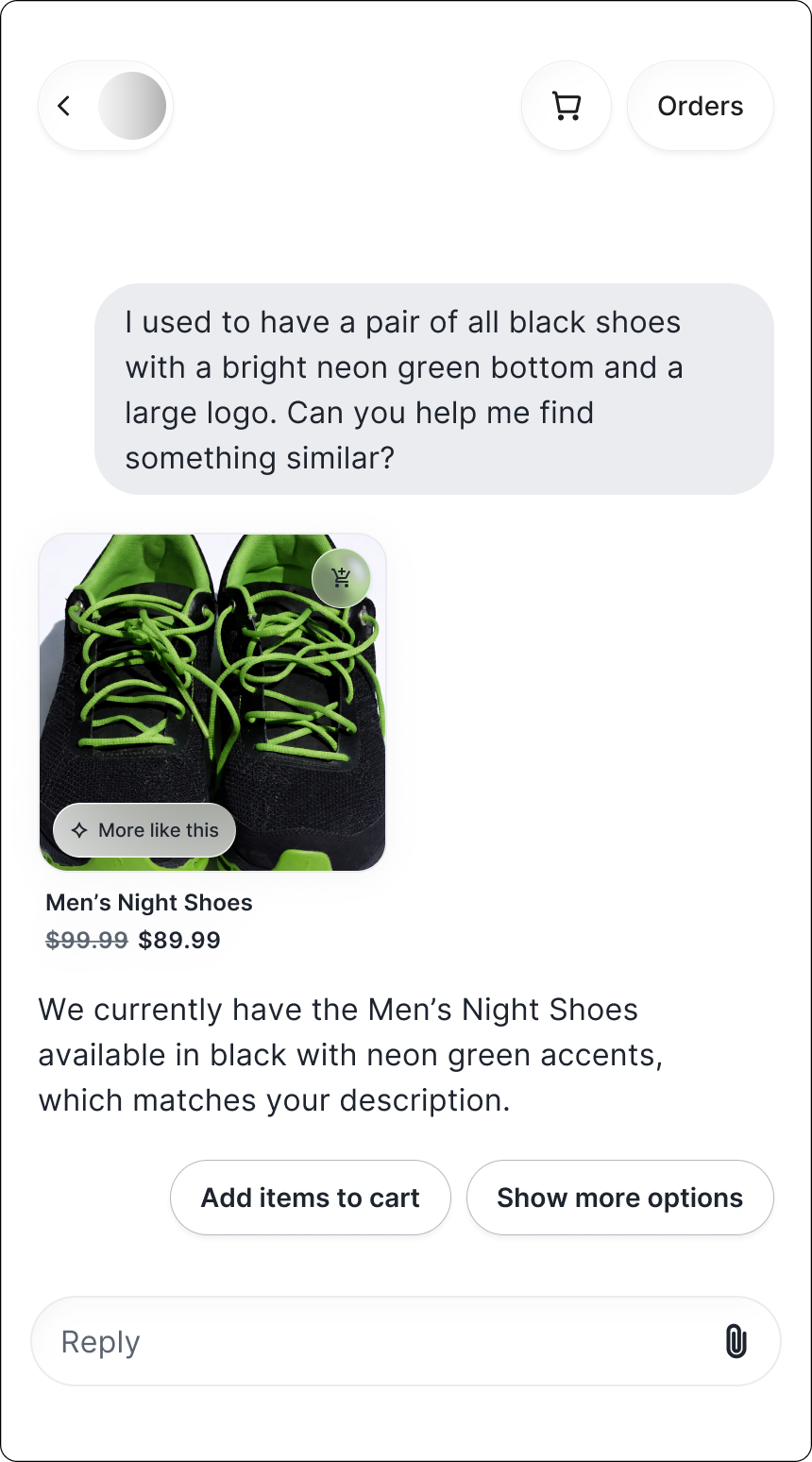
Results:
Big events call for great outfits, but putting one together online isn’t always easy. With thousands of options to scroll through, shoppers often want a bit of styling direction.
How Shopping Assistant helps:
Shoppers get to chat with a virtual stylist who recommends full outfits based on the occasion, suggests accessories to complete the look, and removes the guesswork of pairing pieces together.
The result is a fun, confidence-building shopping experience that feels like getting advice from a stylist who actually understands their plans.
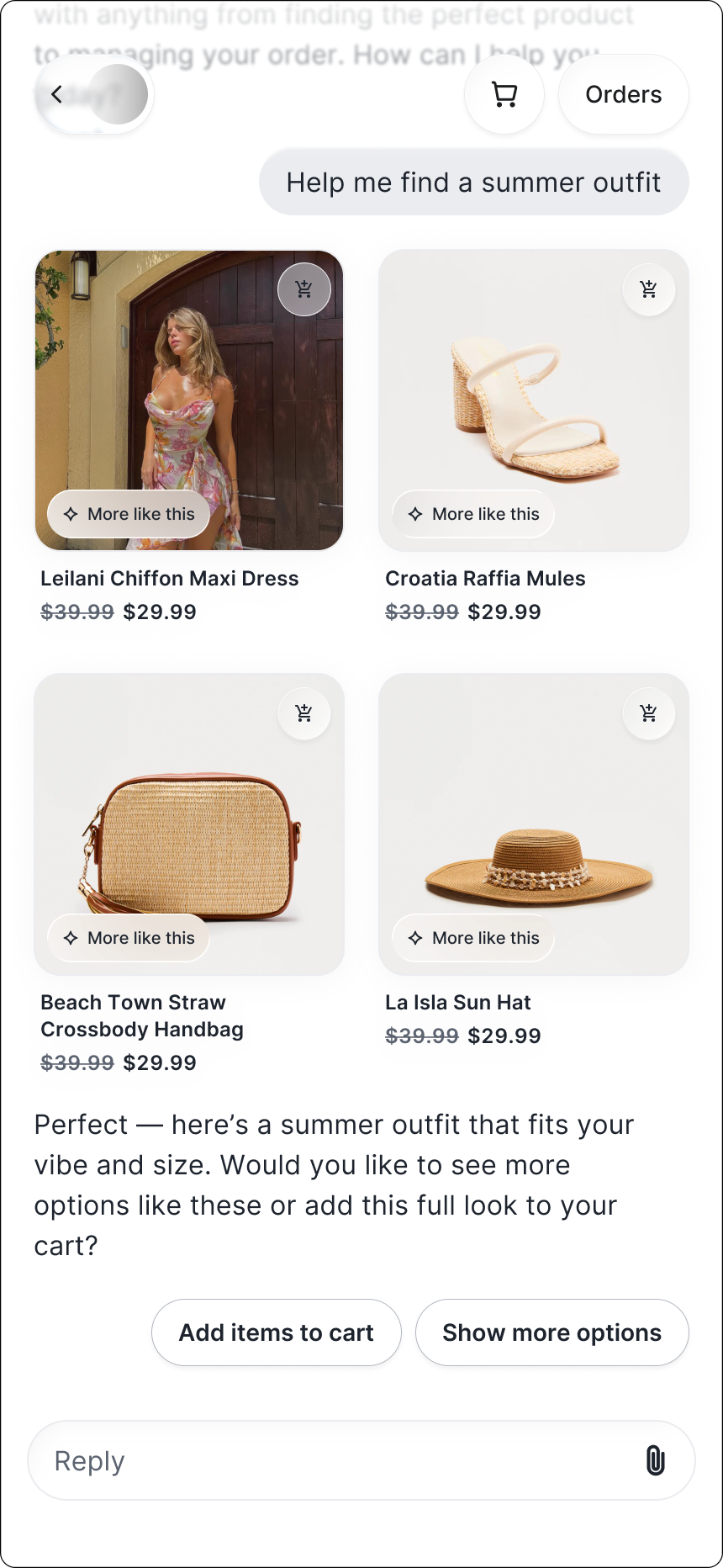
Results:
Shade matching is hard enough in-store, but doing it online can feel impossible. Plus, when a longtime favorite gets discontinued, shoppers are left guessing which new shade will come closest. That uncertainty often leads to hesitation, abandoned carts, or ordering multiple shades “just in case.”
How Shopping Assistant helps:
Shoppers find their perfect match without any of the guesswork. The assistant asks a few quick questions, recommends the closest shade or formula, and offers smart alternatives when a product is unavailable.
The experience feels like chatting with a knowledgeable beauty advisor — someone who makes the decision easy and leaves shoppers feeling confident in what they’re buying.
Katia Komar, Sr. Manager of Ecommerce and Customer Service Operations at bareMinerals UK says, “What impressed me the most is the AI’s ability to upsell with a conversational tone that feels genuinely helpful and doesn't sound too pushy or transactional. It sounds remarkably human, identifying correct follow-up questions to determine the correct product recommendation, resulting in improved AOV. It’s exactly how I train our human agents and BPO partners.”
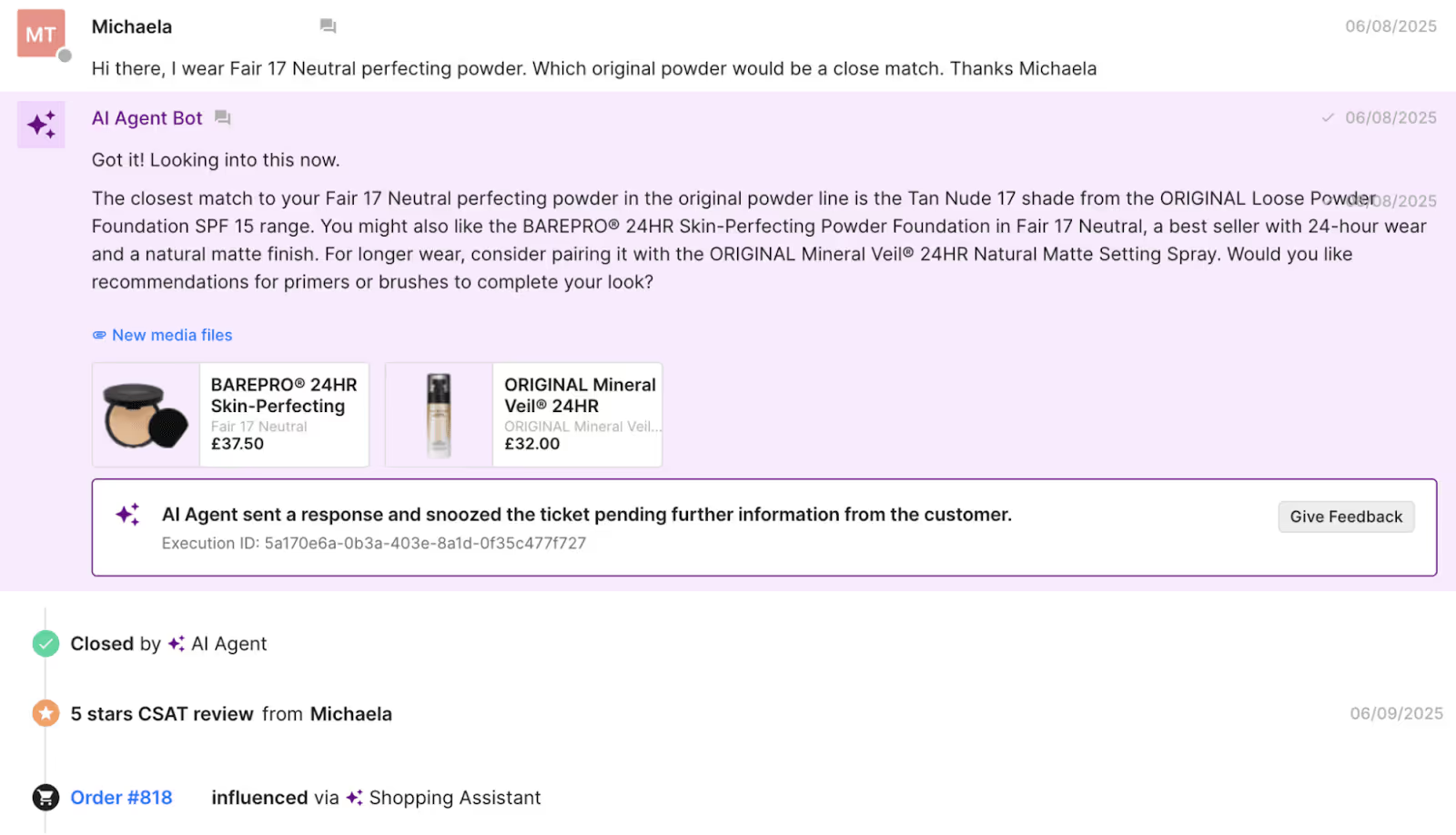
Results:
When shoppers are buying gifts, especially for someone else, they often know who they’re shopping for but not what to buy. A vague product name or a half-remembered scent can quickly make the experience feel overwhelming without someone to guide them.
How Shopping Assistant helps:
Thoughtful guidance goes a long way. By asking clarifying questions and recognizing likely mix-ups, Shopping Assistant helps shoppers figure out what the recipient was probably referring to, then recommends the right product along with complementary gift options that make the choice feel intentional.
It brings the reassurance of an in-store associate to the online experience, helping shoppers move forward with confidence.
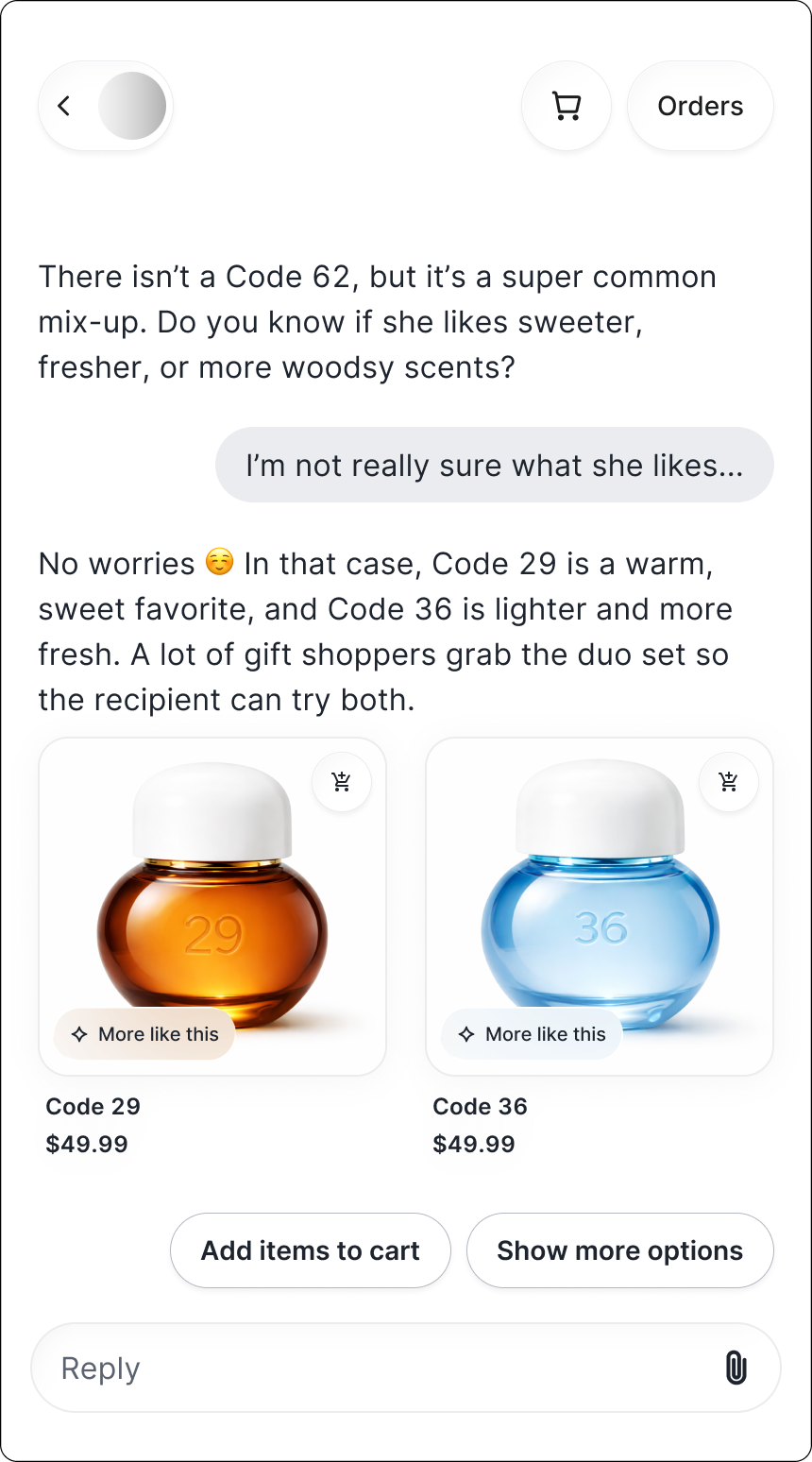
Results:
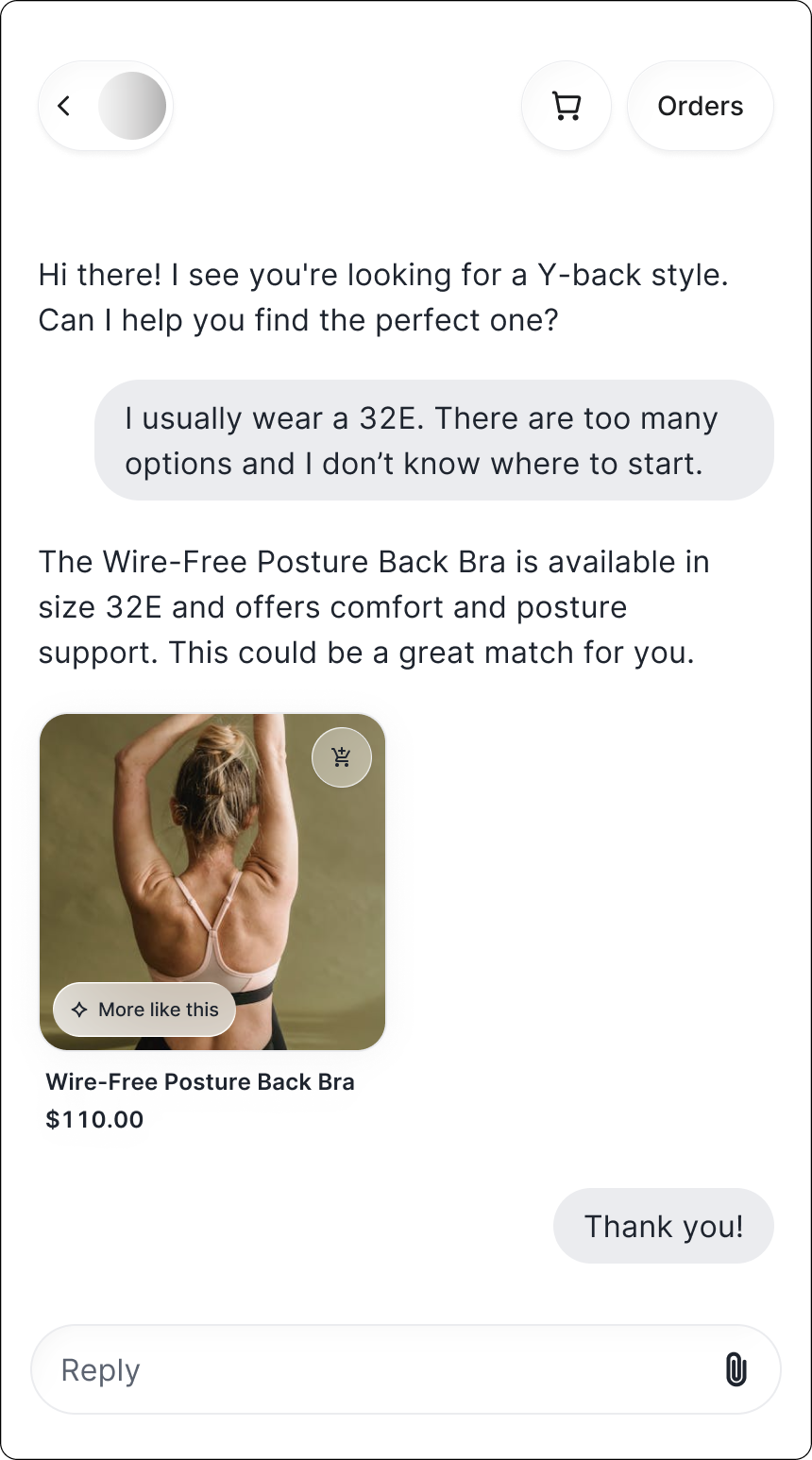
Finding the right bra size online is notoriously tricky. Shoppers often second-guess their band or cup size, and even small uncertainties can lead to returns — or abandoning the purchase altogether.
Many customers just want someone to walk them through what a proper fit should actually feel like.
How Shopping Assistant helps:
Searching for products is no longer a time-consuming process. Shopping Assistant detects a shopper’s search terms and sends relevant products in chat. Like an in-store associate, it uses context to deliver what shoppers are looking for, so they can skip the search and head right to checkout.
Results:
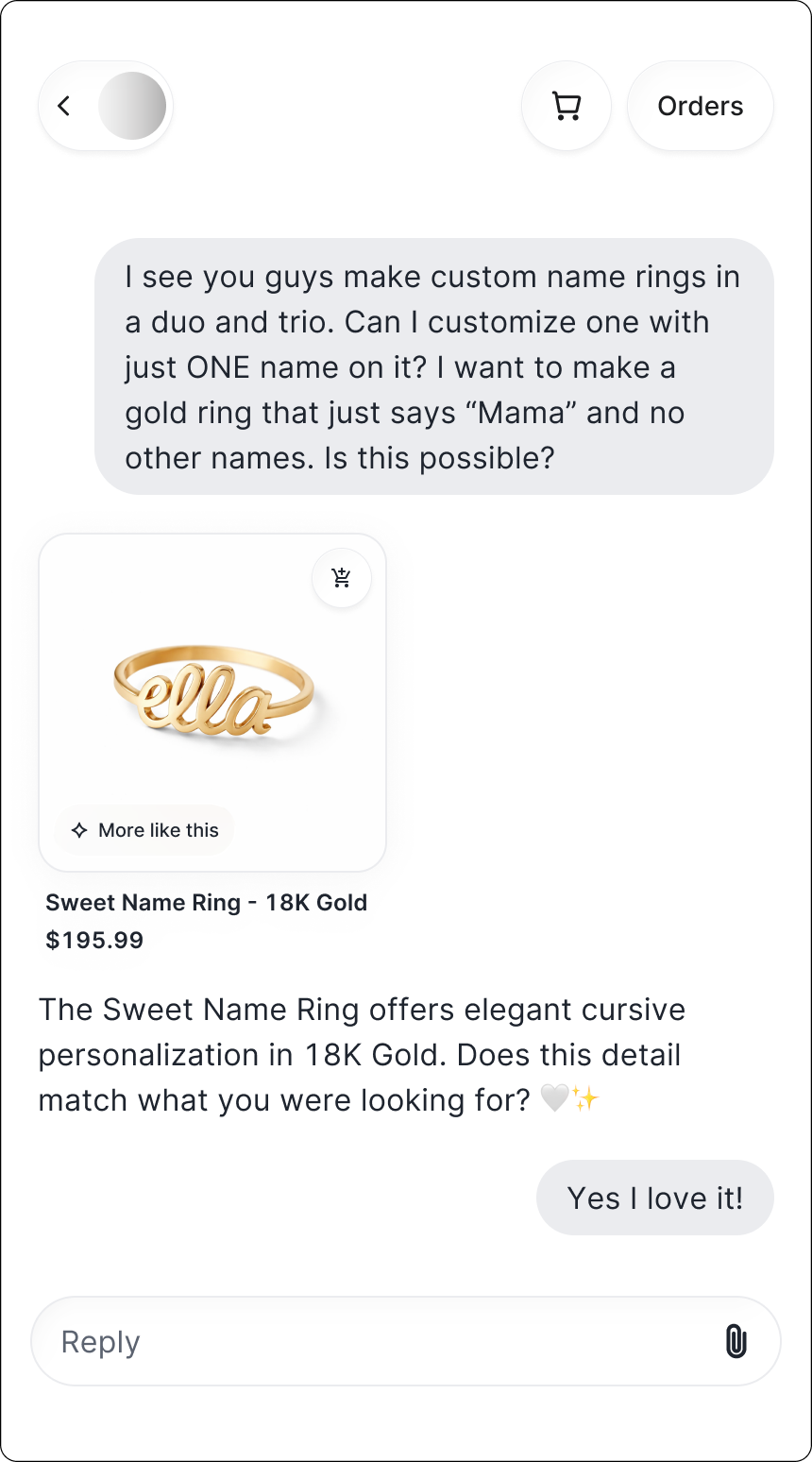
For shoppers buying personalized jewelry, the details directly affect the final result. That’s why customization questions come up constantly, and why uncertainty can quickly stall the path to purchase.
How Shopping Assistant helps:
Shopping Assistant asks about the shopper’s style preferences and customization needs, then recommends the right product and options so they can feel confident the final piece is exactly their style. The experience feels quick, helpful, and designed to guide shoppers toward a high investment purchase.
Results:
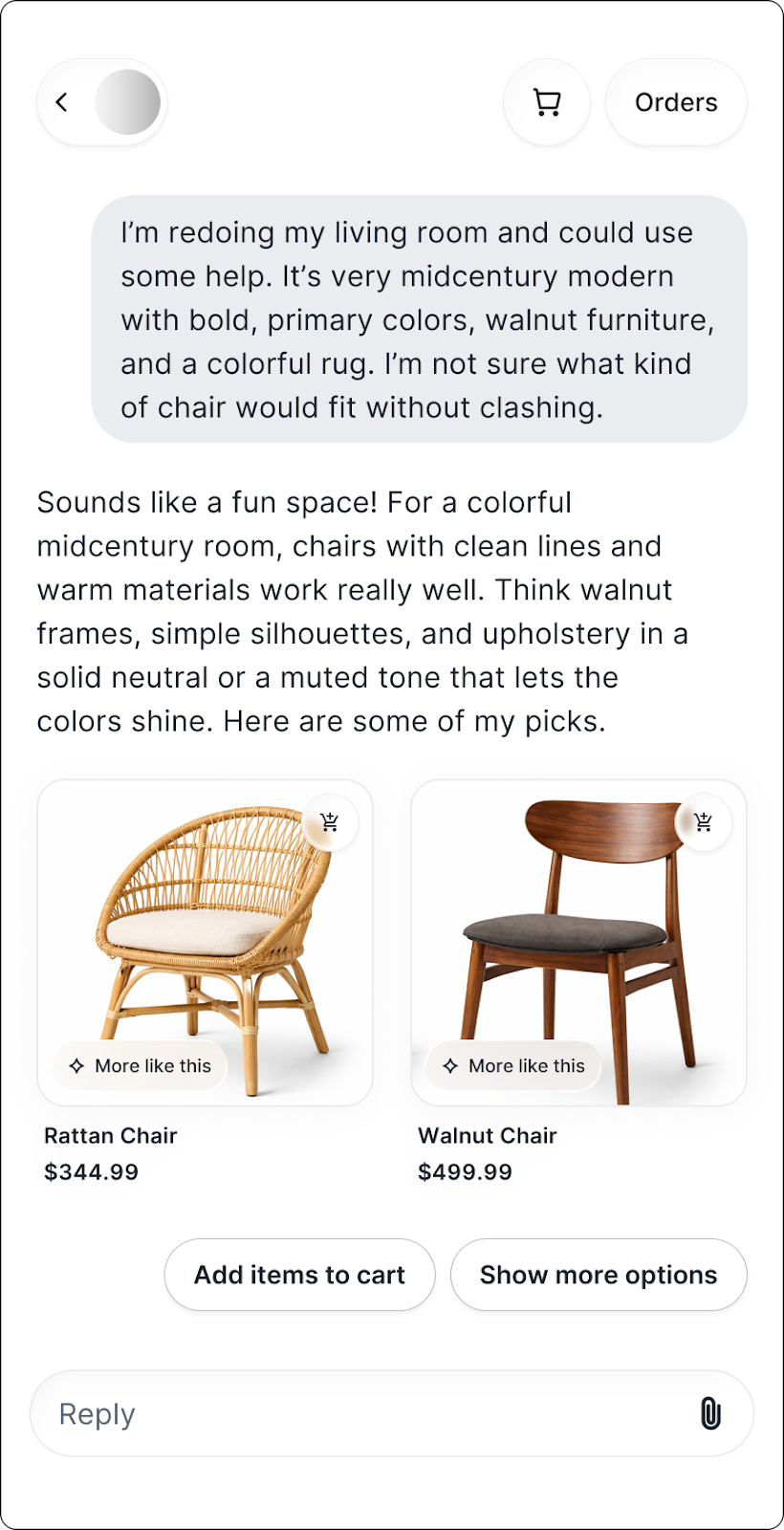
Decorating a home is personal, and shoppers often want reassurance that a new piece will blend with what they already own. Questions about color palettes, textures, and proportions come up constantly. And without guidance, it’s easy for shoppers to feel unsure about hitting “add to cart.”
How Shopping Assistant helps:
Giving shoppers personalized styling support helps them visualize how pieces will work in their home.
Shoppers receive styling suggestions based on their existing space as well as recommendations on pieces that complement their color palette.
It even guides them toward a 60-minute virtual styling consultation when they need deeper help. The experience feels thoughtful and high-touch, which is why shoppers often spend more once they feel confident in their choices.
Results:
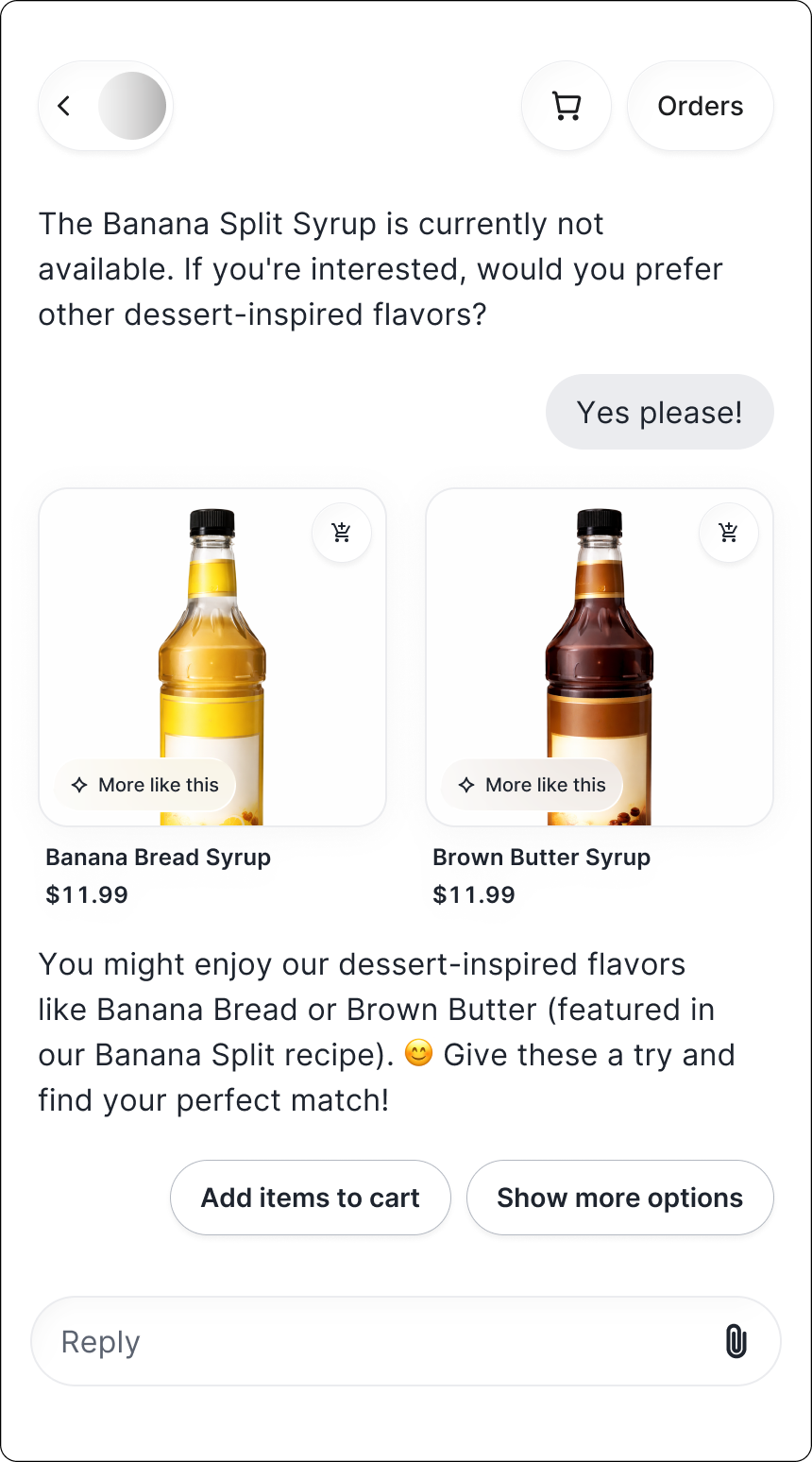
When shoppers discover a new drink mix, they’re bound to have questions before committing. How strong will it taste? How much should they use? Will it work with their preferred drink or routine? Uncertainty at this stage can stall the purchase or lead to disappointment later.
How Shopping Assistant helps:
Clear, friendly guidance in chat helps shoppers understand exactly how to use the product. Shopping Assistant answers questions about serving size, flavor strength, and pairing options, and suggests the best way to prepare the mix based on the shopper’s preferences.
Results:
Shopping for health supplements can feel confusing fast. Customers often have questions about which formulas fit their age, health goals, or daily routine. Without clear guidance, most will hesitate or pick the wrong product.
How Shopping Assistant helps:
Shopping Assistant detects hesitation when shoppers linger on a search results page. It proactively asks a few clarifying questions, narrows down product options, and points shoppers to the best product or bundle for their needs.
The entire experience feels supportive and gives shoppers confidence they’ve picked the right option.
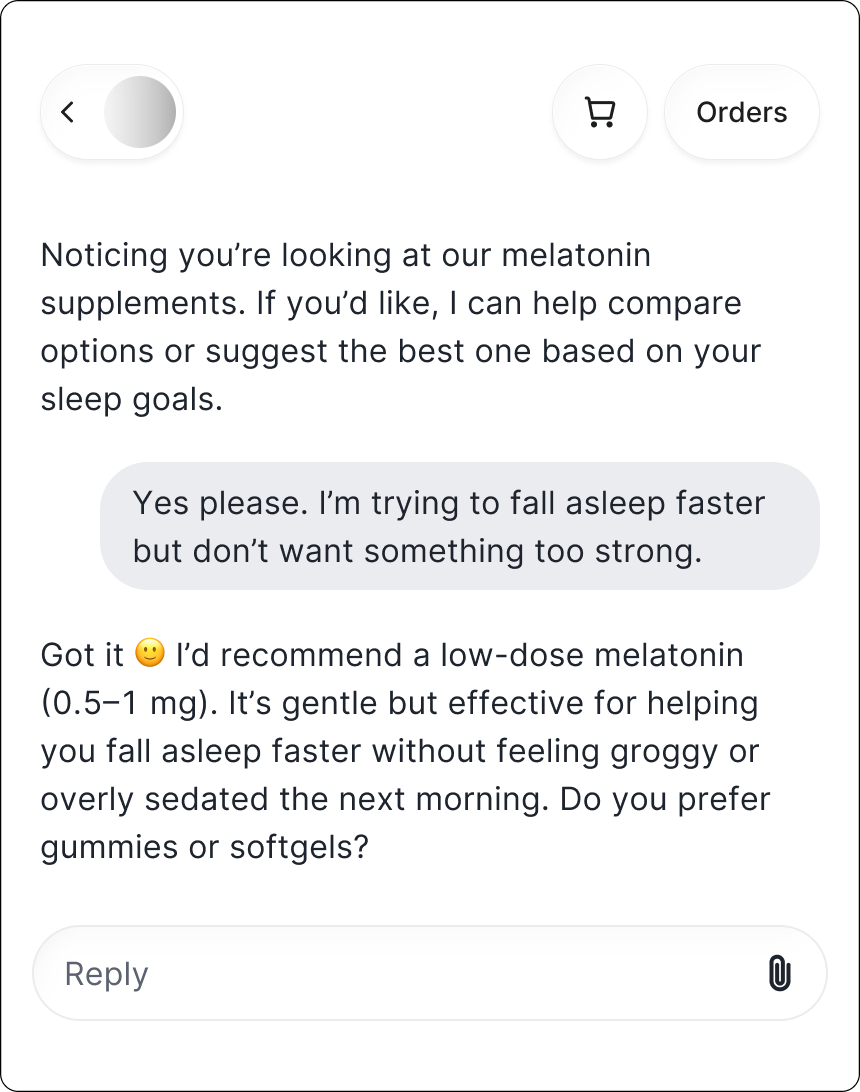
Results:
Shopping for kids’ furniture comes with a lot of “Is this the right one?” moments. Parents want something safe, sturdy, and sized correctly for their child’s age. With so many options, it’s easy to feel unsure about what will actually work in their space.
How Shopping Assistant helps:
Shopping Assistant guides parents toward the best fit right away. It asks about their child’s age, room layout, and safety considerations, then recommends the most appropriate bed or furniture setup. The experience feels like chatting with a knowledgeable salesperson who understands what families actually need as kids grow.
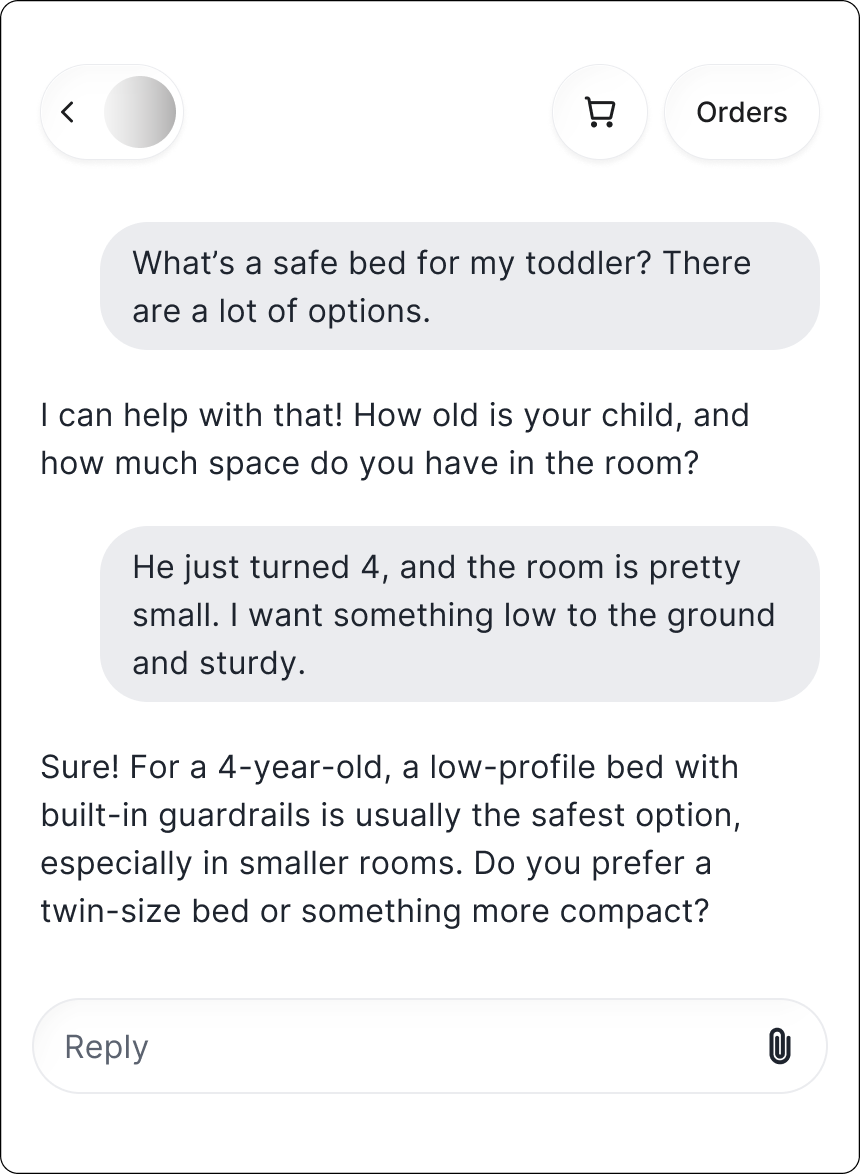
Results:
Even something as simple as choosing a toothbrush can feel complicated when multiple models come with different speeds, materials, and features. Shoppers want to understand what matters so they can pick the one that fits their routine and budget.
How Shopping Assistant helps:
Choosing between toothbrush models shouldn’t feel like decoding tech specs. When shoppers can see the key differences in plain language, including what’s unique, how each model works, and who it’s best for, they can make a decision with ease.
Suddenly, the whole process feels simple instead of overwhelming.
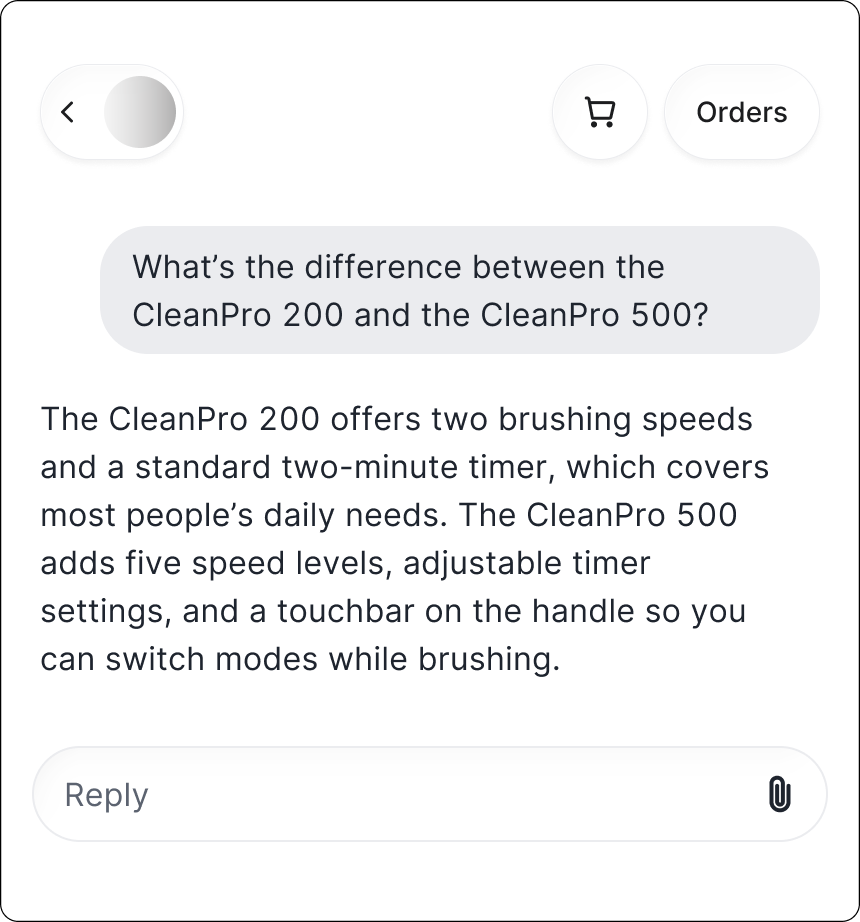
Results:
Across all 11 brands, one theme is clear. When shoppers get the guidance they need at the right moment, they convert more confidently and often spend more.
Here’s what stands out:
What this means for you:
Look closely at your most common pre-purchase questions. Anywhere shoppers hesitate from fit, shade, technical specs, styling, bundles is a place where Shopping Assistant can step in, boost confidence, and unlock more sales.
If you notice the same patterns in your own store, such as shoppers hesitating over sizing, shade matching, product comparisons, or technical details, guided shopping can make an immediate impact. These moments are often your biggest opportunities to increase revenue and improve the buying experience.
Many of the brands in this post started by identifying their most common pre-purchase questions and letting AI handle them at scale. You can do the same.
If you want to boost conversions, lift AOV, and create a smoother path to purchase, now is a great time to explore guided shopping for your team.
Book a demo or activate Shopping Assistant to get started.
{{lead-magnet-2}}
TL;DR:
Rising customer expectations, shoppers willing to pay a premium for convenience, and a growing lack of trust in social media channels to make purchase decisions are making it more challenging to turn a profit.
In this emerging era, AI’s role is becoming not only more pronounced, but a necessity for brands who want to stay ahead. Tools like Gorgias Shopping Assistant can help drive measurable revenue while reducing support costs.
For example, a brand that specializes in premium outdoor apparel implemented Shopping Assistant and saw a 2.25% uplift in GMV and 29% uplift in average order volume (AOV).
But how, among competing priorities and expenses, do you convince leadership to implement it? We’ll show you.
Shoppers want on-demand help in real time that’s personalized across devices.
Shopping Assistant recalls a shopper’s browsing history, like what they have clicked, viewed, and added to their cart. This allows it to make more relevant suggestions that feel personal to each customer.
The AI ecommerce tools market was valued at $7.25 billion in 2024 and is expected to reach $21.55 billion by 2030.
Your competitors are using conversational AI to support, sell, and retain. Shopping Assistant satisfies that need, providing upsells and recommendations rooted in real shopper behavior.
Conversational AI has real revenue implications, impacting customer retention, average order value (AOV), conversion rates, and gross market value (GMV).
For example, a leading nutrition brand saw a GMV uplift of over 1%, an increase in AOV of over 16%, and a chat conversion rate of over 15% after implementing Shopping Assistant.
Overall, Shopping Assistant drives higher engagement and more revenue per visitor, sometimes surpassing 50% and 20%, respectively.
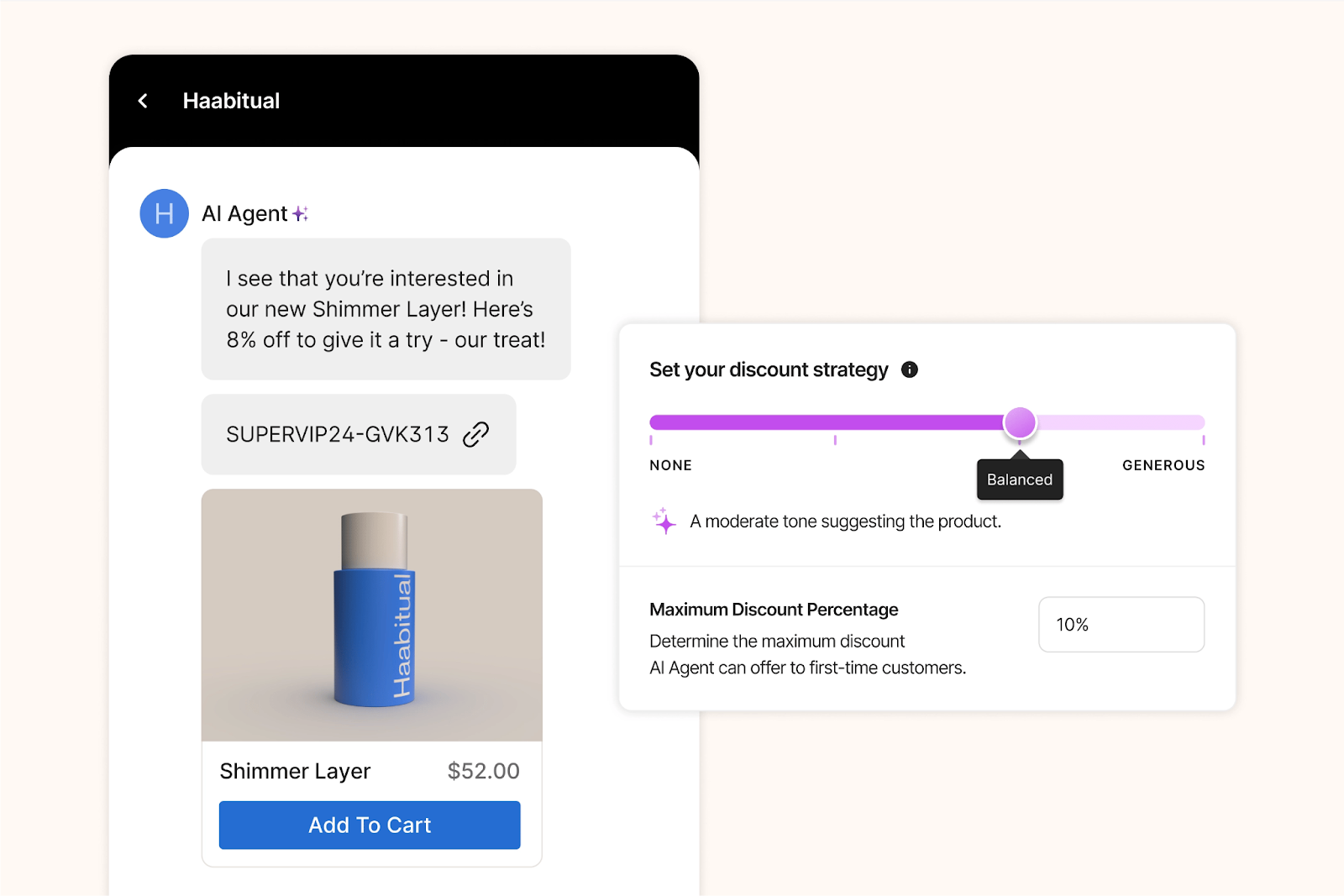
Shopping Assistant engages, personalizes, recommends, and converts. It provides proactive recommendations, smart upsells, dynamic discounts, and is highly personalized, all helping to guide shoppers to checkout.
After implementing Shopping Assistant, leading ecommerce brands saw real results:
Shopping Assistant drives uplift in chat conversion rate and makes successful upsell recommendations.
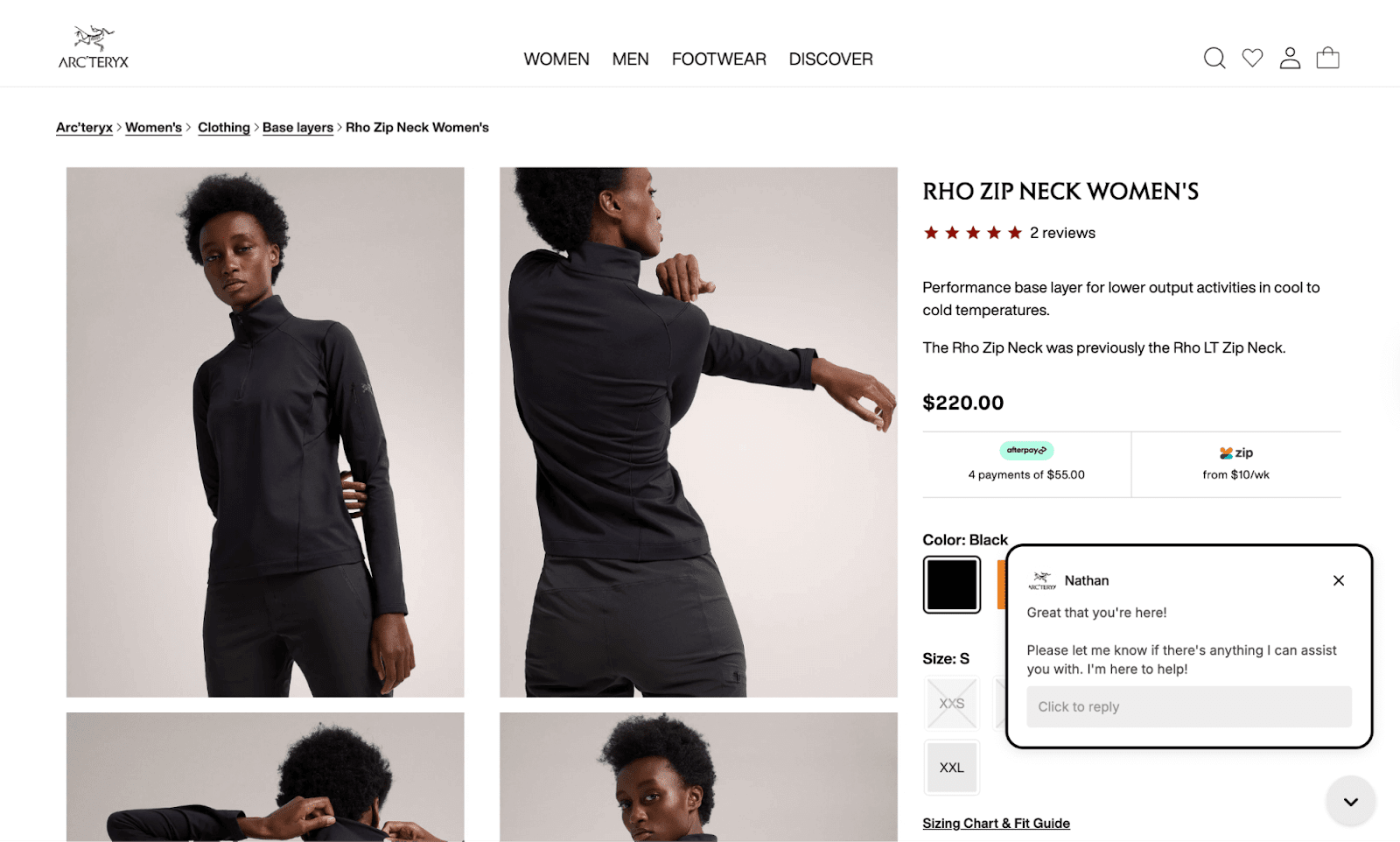
“It’s been awesome to see Shopping Assistant guide customers through our technical product range without any human input. It’s a much smoother journey for the shopper,” says Nathan Larner, Customer Experience Advisor for Arc’teryx.
For Arc’teryx, that smoother customer journey translated into sales. The brand saw a 75% increase in conversion rate (from 4% to 7%) and 3.7% of overall revenue influenced by Shopping Assistant.
Because it follows shoppers’ live journey during each session on your website, Shopping Assistant catches shoppers in the moment. It answers questions or concerns that might normally halt a purchase, gets strategic with discounting (based on rules you set), and upsells.
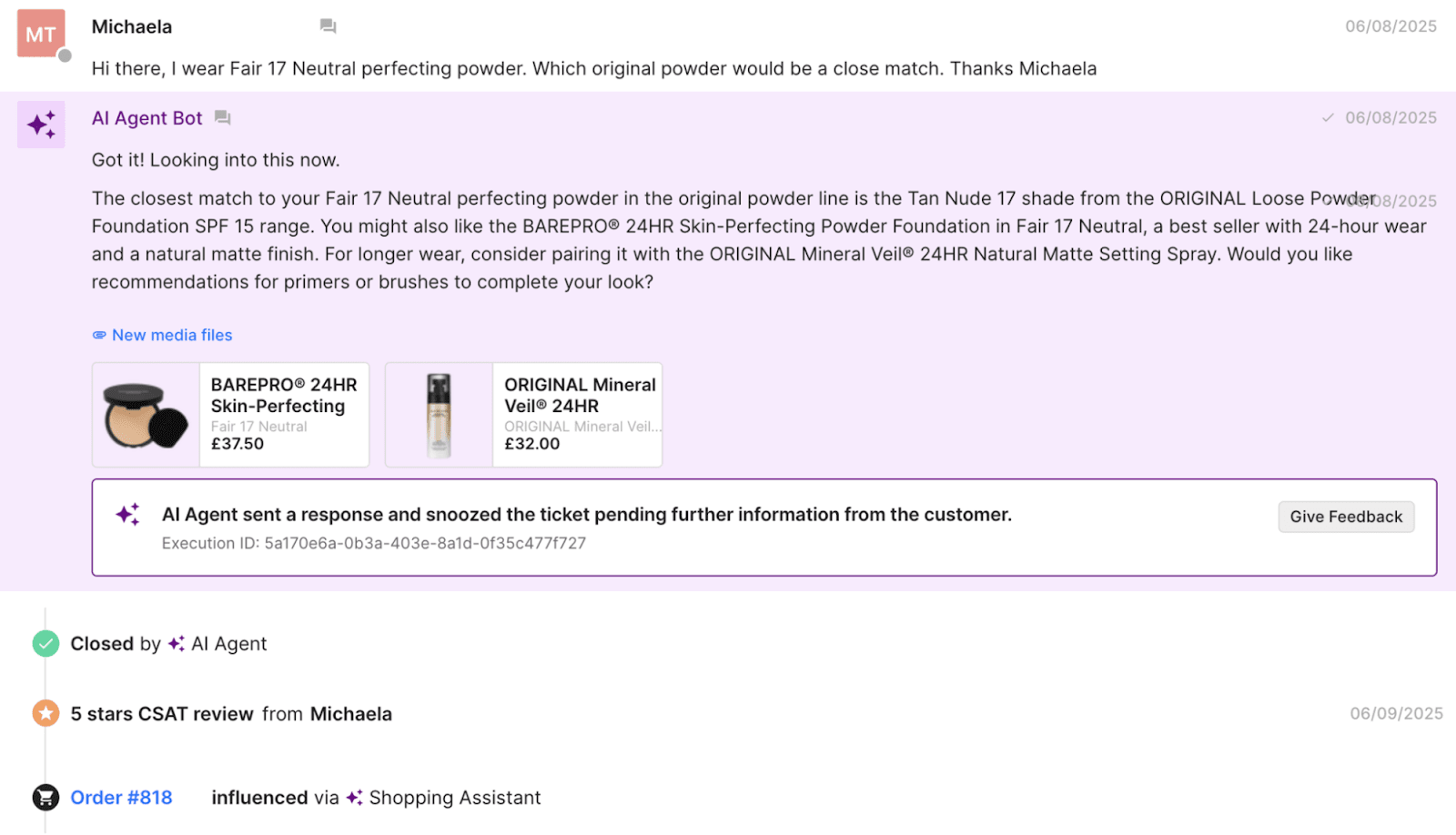
The overall ROI can be significant. For example, bareMinerals saw an 8.83x return on investment.
"The real-time Shopify integration was essential as we needed to ensure that product recommendations were relevant and displayed accurate inventory,” says Katia Komar, Sr. Manager of Ecommerce and Customer Service Operations, UK at bareMinerals.
“Avoiding customer frustration from out-of-stock recommendations was non-negotiable, especially in beauty, where shade availability is crucial to customer trust and satisfaction. This approach has led to increased CSAT on AI converted tickets."
Shopping Assistant can impact CSAT scores, response times, resolution rates, AOV, and GMV.
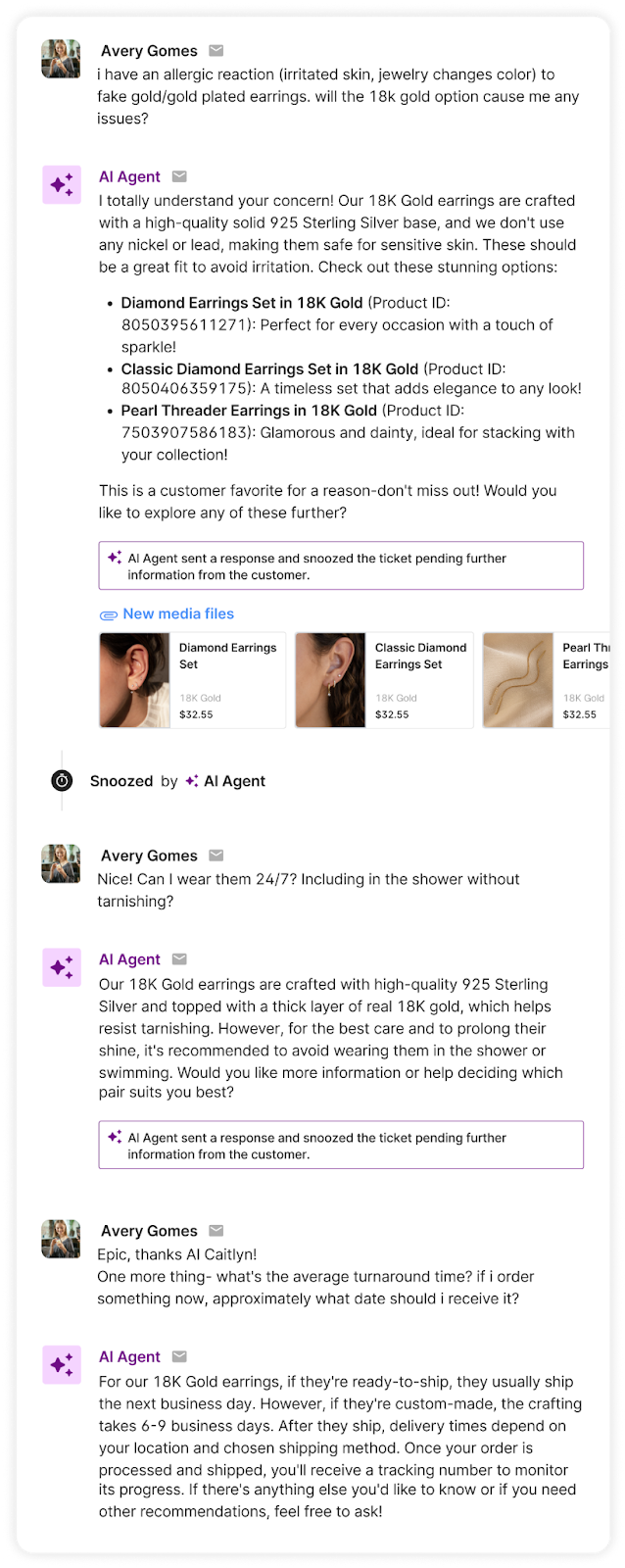
For Caitlyn Minimalist, those metrics were an 11.3% uplift in AOV, an 18% click through rate for product recommendations, and a 50% sales lift versus human-only chats.
"Shopping Assistant has become an intuitive extension of our team, offering product guidance that feels personal and intentional,” says Anthony Ponce, its Head of Customer Experience.
Support agents have limited time to assist customers as it is, so taking advantage of sales opportunities can be difficult. Shopping Assistant takes over that role, removing obstacles for purchase or clearing up the right choice among a stacked product catalog.
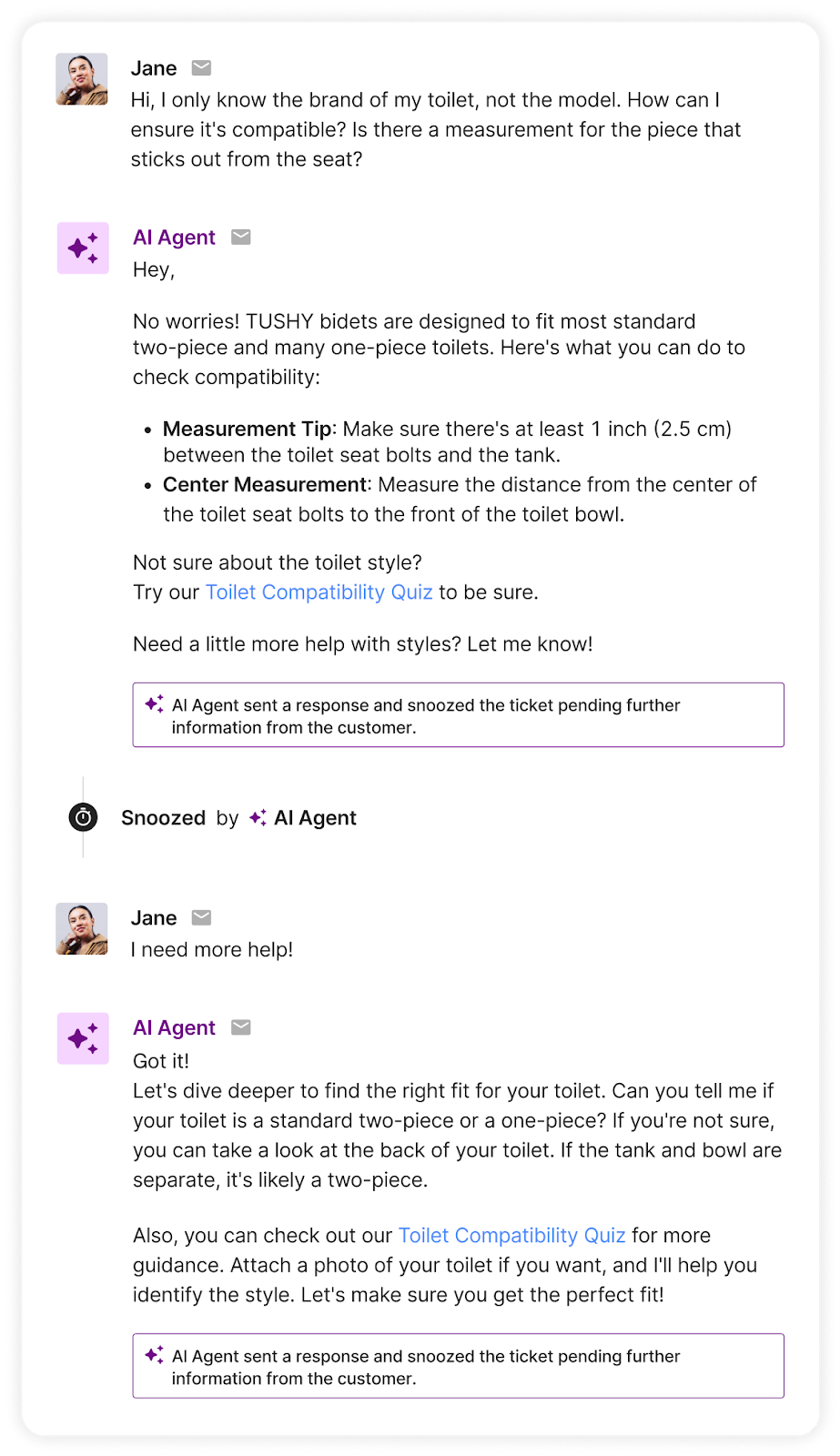
With a product that’s not yet mainstream in the US, TUSHY leverages Shopping Assistant for product education and clarification.
"Shopping Assistant has been a game-changer for our team, especially with the launch of our latest bidet models,” says Ren Fuller-Wasserman, Sr. Director of Customer Experience at TUSHY.
“Expanding our product catalog has given customers more choices than ever, which can overwhelm first-time buyers. Now, they’re increasingly looking to us for guidance on finding the right fit for their home and personal hygiene needs.”
The bidet brand saw 13x return on investment after implementation, a 15% increase in chat conversion rate, and a 2x higher conversion rate for AI conversations versus human ones.
Customer support metrics include:
Revenue metrics to track include:
Shopping Assistant connects to your ecommerce platform (like Shopify), and streamlines information between your helpdesk and order data. It’s also trained on your catalog and support history.
Allow your agents to focus on support and sell more by tackling questions that are getting in the way of sales.
{{lead-magnet-2}}

TL;DR:
Conversational commerce finally has a scoreboard.
For years, CX leaders knew support conversations mattered, they just couldn’t prove how much. Conversations lived in that gray area of ecommerce where shoppers got answers, agents did their best, and everyone agreed the channel was “important”…
But tying those interactions back to actual revenue? Nearly impossible.
Fast forward to today, and everything has changed.
Real-time conversations — whether handled by a human agent or powered by AI — now leave a measurable footprint across the entire customer journey. You can see how many conversations directly influenced a purchase.
In other words, conversational commerce is finally something CX teams can measure, optimize, and scale with confidence.
If you want to prove the value of your CX strategy to your CFO, your marketing team, or your CEO, you need data, not anecdotes.
Leadership isn’t swayed by “We think conversations help shoppers.” They want to see the receipts. They want to know exactly how interactions influence revenue, which conversations drive conversion, and where AI meaningfully reduces workload without sacrificing quality.
That’s why conversational commerce metrics matter now more than ever. This gives CX leaders a way to:
These metrics let you track impact with clarity and confidence.
And once you can measure it, you can build a stronger case for deeper investment in conversational tools and strategy.
So, what exactly should CX teams be measuring?
While conversational commerce touches every part of the customer journey, the most meaningful insights fall into four core categories:
Let’s dive into each.
If you want to understand how well your conversational commerce strategy is working, automation performance is the first place to look. These metrics reveal how effectively AI is resolving shopper needs, reducing ticket volume, and stepping into revenue-driving conversations at scale.
The two most foundational metrics?
Resolution rate measures how many conversations your AI handles from start to finish without needing a human to take over. On paper, high resolution rates sound like a guaranteed win. It suggests your AI is handling product questions, sizing concerns, shade matching, order guidance, and more — all without adding to your team’s workload.
But a high resolution rate doesn’t automatically mean your AI is performing well.
Yes, the ticket was “resolved,” but was the customer actually helped? Was the answer accurate? Did the shopper leave satisfied or frustrated?
This is where quality assurance becomes essential. Your AI should be resolving tickets accurately and helpfully, not simply checking boxes.
At its best, a strong resolution rate signals that your AI is:
When resolution rate quality goes up, so does revenue influence.
You can see this clearly with beauty brands, where accuracy matters enormously. bareMinerals, for example, used to receive a flood of shade-matching questions. Everything from “Which concealer matches my undertone?” to “This foundation shade was discontinued; what’s the closest match?”
Before AI, these questions required well-trained agents and often created inconsistencies depending on who answered.
Once they introduced Shopping Assistant, resolution rate suddenly became more meaningful. AI wasn’t just closing tickets; it was giving smarter, more confident recommendations than many agents could deliver at scale, especially after hours.
That accuracy paid off.
AI-influenced purchases at bareMinerals had zero returns in the first 30 days because customers were finally getting the right shade the first time.
That’s the difference between “resolved” and resolved well.
The zero-touch ticket rate measures something slightly different: the percentage of conversations AI manages entirely on its own, without ever being escalated to an agent.
This metric is a direct lens into:
More importantly, deflection widens the funnel for more revenue-driven conversations.
When AI deflects more inbound questions, your support team can focus on conversations that truly require human expertise, including returns exceptions, escalations, VIP shoppers, and emotionally sensitive interactions.
Brands with strong deflection rates typically see:
If automation metrics tell you how well your AI is working, conversion and revenue metrics tell you how well it’s selling.
This category is where conversational commerce really proves its value because it shows the direct financial impact of every human- or AI-led interaction.
Chat conversion rate measures the percentage of conversations that end in a purchase, and it’s one of the clearest indicators of whether your conversational strategy is influencing shopper decisions.
A strong CVR tells you that conversations are:
You see this clearly with brands selling technical or performance-driven products.
Outdoor apparel shoppers, for example, don’t just need “a jacket” — they need to know which jacket will hold up in specific temperatures, conditions, or terrains. A well-trained AI can step into that moment and convert uncertainty into action.
Arc’teryx saw this firsthand.
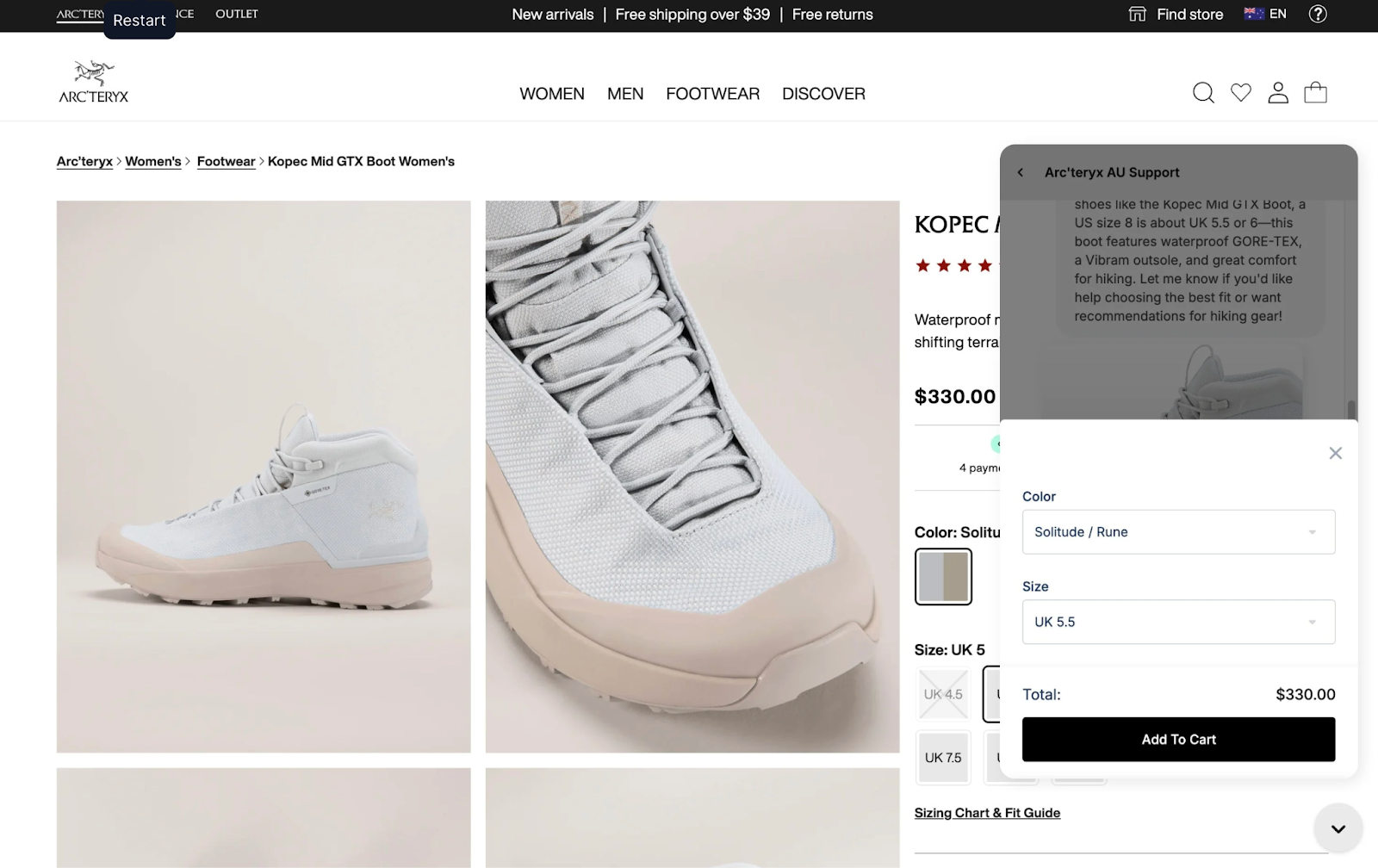
Once Shopping Assistant started handling their high-intent pre-purchase questions, their chat conversion rate jumped dramatically — from 4% to 7%. A 75% lift.
That’s what happens when shoppers finally get the expert guidance they’ve been searching for.
Not every shopper buys the moment they finish a chat. Some take a few hours. Some need a day or two. Some want to compare specs or read reviews before committing.
GMV influenced captures this “tail effect” by tracking revenue within 1–3 days of a conversation.
It’s especially powerful for:
In Arc’teryx’s case, shoppers often take time to confirm they’re choosing the right technical gear.
Yet even with that natural pause in behavior, Shopping Assistant still influenced 3.7% of all revenue, not by forcing instant decisions, but by providing the clarity people needed to make the right one.
This metric looks at the average order value of shoppers who engage in a conversation versus those who don’t.
If the conversational AOV is higher, it means your AI or agents are educating customers in ways that naturally expand the cart.
Examples of AOV-lifting conversations include:
When conversations are done well, AOV increases not because shoppers are being upsold, but because they’re being guided.
ROI compares the revenue generated by conversational AI to the cost of the tool itself — in short, this is the number that turns heads in boardrooms.
Strong ROI shows that your AI:
When ROI looks like that, AI stops being a “tool” and starts being an undeniable growth lever.
Related: The hidden power and ROI of automated customer support
Not every metric in conversational commerce is a final outcome. Some are early signals that show whether shoppers are interested, paying attention, and moving closer to a purchase.
These engagement metrics are especially valuable because they reveal why conversations convert, not just whether they do. When engagement goes up, conversion usually follows.
CTR measures the percentage of shoppers who click the product links shared during a conversation. It’s one of the cleanest leading indicators of buyer intent because it reflects a moment where curiosity turns into action.
If CTR is high, it’s a sign that:
In other words, CTR tells you which conversations are influencing shopping behavior.
And the connection between CTR and revenue is often tighter than teams expect.
Just look at what happened with Caitlyn Minimalist. When they began comparing the results of human-led conversations versus AI-assisted ones over a 90-day period, CTR became one of the clearest predictors of success. Their Shopping Assistant consistently drove meaningful engagement with its recommendations — an 18% click-through rate on the products it suggested.
That level of engagement translated directly into better outcomes:
When shoppers click, they’re moving deeper into the buying cycle. Strong CTR makes it easier to forecast conversion and understand how well your conversational flows are guiding shoppers toward the right products.
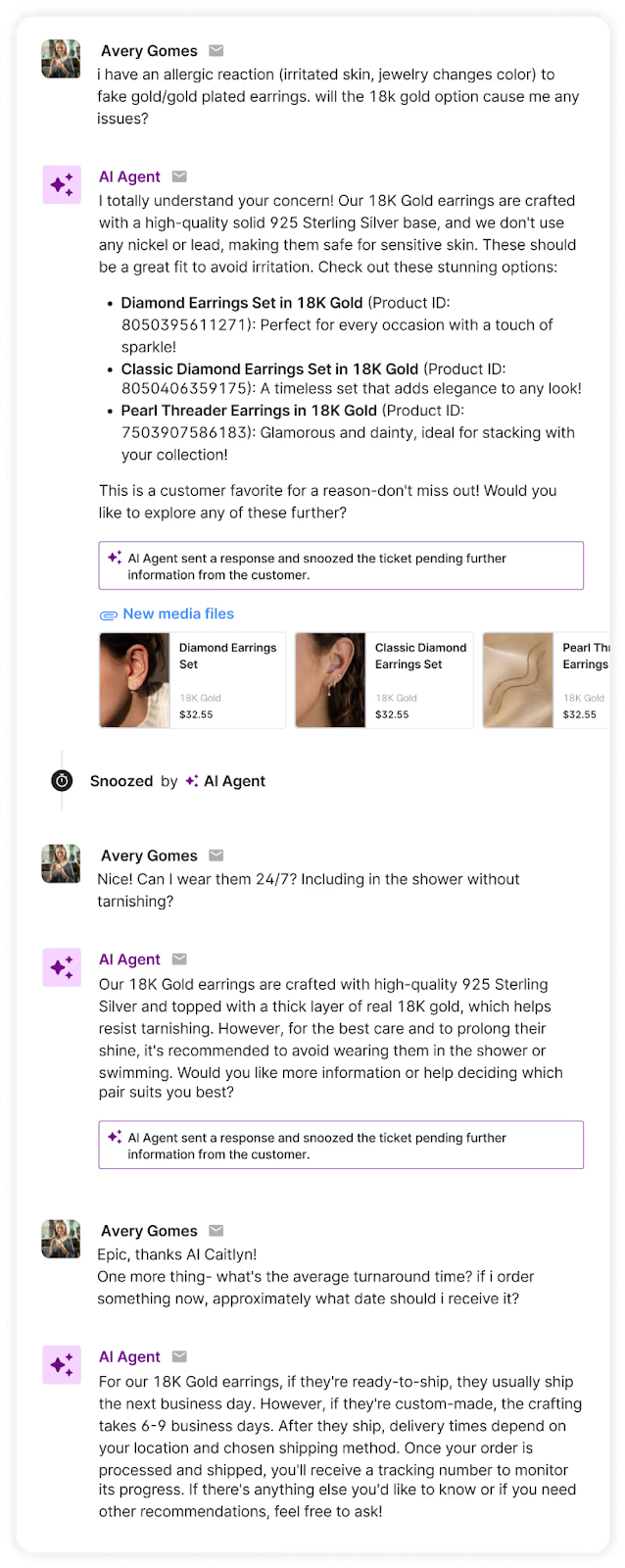
Discounting can be one of the fastest ways to nudge a shopper toward checkout, but it’s also one of the fastest ways to erode margins.
That’s why discount-related metrics matter so much in conversational commerce.
They show not just whether AI is using discounts, but how effectively those discounts are driving conversions.
This metric tracks how many discount codes or promotional offers your AI is sharing during conversations.
Ideally, discounts should be purposeful — timed to moments when a shopper hesitates or needs an extra nudge — not rolled out as a one-size-fits-all script. When you monitor “discounts offered,” you can ensure that incentives are being used as conversion tools, not crutches.
This visibility becomes particularly important at high-intent touchpoints, such as exit intent or cart recovery interactions, where a small incentive can meaningfully increase conversion if used correctly.
Offering a discount is one thing. Seeing whether customers use it is another.
A high “discounts applied” rate suggests:
A low usage rate tells a different story: Your team (or your AI) is discounting unnecessarily.
This metric alone often surprises brands. More often than not, CX teams discover they can discount less without hurting conversion, or that a non-discount incentive (like a relevant product recommendation) performs just as well.
Understanding this relationship helps teams tighten their promotional strategy, protect margins, and use discounts only where they actually drive incremental revenue.
Once you know which metrics matter, the next step is building a system that brings them together in one place.
Think of your conversational commerce scorecard as a decision-making engine — something that helps you understand performance at a glance, spot bottlenecks, optimize AI, and guide shoppers more effectively.
In Gorgias, you can customize your analytics dashboard to watch the metrics that matter most to your brand. This becomes the single source of truth for understanding how conversations influence revenue.
Here’s what a powerful dashboard unlocks:
Some parts of the customer journey are perfect for AI: repetitive questions, product education, sizing guidance, shade matching, order status checks.
Others still benefit from human support, like emotional conversations, complex troubleshooting, multi-item styling, or high-value VIP concerns.
Metrics like resolution rate, zero-touch ticket rate, and chat conversion rate show you exactly which is which.
When you track these consistently, you can:
For example, if AI handles 80% of sizing questions successfully but struggles with multi-item styling advice, that tells you where to invest in improving AI, and where human expertise should remain the default.
Metrics like CTR, CVR, and conversational AOV reveal the inner workings of shopper decision-making. They show which recommendations resonate, which don’t, and which messaging actually moves someone to purchase.
With these insights, CX teams can:
For instance, if shoppers repeatedly ask clarifying questions about a product’s material or fit, that’s a signal for merchandising or product teams.
If recommendations with social proof get high engagement, marketing can integrate that insight into on-site messaging.
Conversations reveal what customers really care about — often before analytics do.
This is the moment when the scorecard stops being a CX tool and becomes a business tool.
A clear set of metrics shows how conversations tie to:
When a CX leader walks into a meeting and says, “Our AI Assistant influenced 5% of last month’s revenue” or “Conversational shoppers have a 20% higher AOV,” the perception of CX changes instantly.
You’re no longer a support cost. You’re a revenue channel.
And once you have numbers like ROI or revenue influence in hand, it becomes nearly impossible for anyone to argue against further investment in CX automation.
A scorecard doesn’t just show what’s working, it surfaces what’s not.
Metrics make friction obvious:
Once you identify these patterns, you can run targeted experiments:
Compounded over time, these moments create major lifts in conversion and revenue.
One of the biggest hidden values of conversational data is how it strengthens cross-functional decision-making.
A clear analytics dashboard gives teams visibility into:
Suddenly, CX isn’t just answering questions — it’s informing strategy across the business.
With the right metrics in place, CX leaders can finally quantify the impact of every interaction, and use that data to shape smarter, more profitable customer journeys.
If you're ready to measure — and scale — the impact of your conversations, tools like Gorgias AI Agent and Shopping Assistant give CX teams the visibility, accuracy, and performance needed to turn every interaction into revenue.
Want to see it in action? Book a demo and discover what conversational commerce can do for your bottom line.
{{lead-magnet-2}}
The best in CX and ecommerce, right to your inbox
TL;DR:
In 2024, Shopify merchants drove $11.5 billion in sales over Black Friday Cyber Monday. Now, BFCM is quickly approaching, with some brands and major retailers already hosting sales.
If you’re feeling late to prepare for the season or want to maximize the number of sales you’ll make, we’ll cover how food and beverage CX teams can serve up better self-serve resources for this year’s BFCM.
Learn how to answer and deflect customers’ top questions before they’re escalated to your support team.
💡 Your guide to everything peak season → The Gorgias BFCM Hub
During busy seasons like BFCM and beyond, staying on top of routine customer asks can be an extreme challenge.
“Every founder thinks BFCM is the highest peak feeling of nervousness,” says Ron Shah, CEO and Co-founder of supplement brand Obvi.
“It’s a tough week. So anything that makes our team’s life easier instantly means we can focus more on things that need the time,” he continues.
Anticipating contact reasons and preparing methods (like automated responses, macros, and enabling an AI Agent) is something that can help. Below, find the top contact reasons for food and beverage companies in 2025.
According to Gorgias proprietary data, the top reason customers reach out to brands in the food and beverage industry is to cancel a subscription (13%) followed by order status questions (9.1%).
Because product detail queries represent 5.7% of contact reasons for the food and beverage industry, the more information you provide on your product pages, the better.
Include things like calorie content, nutritional information, and all ingredients.
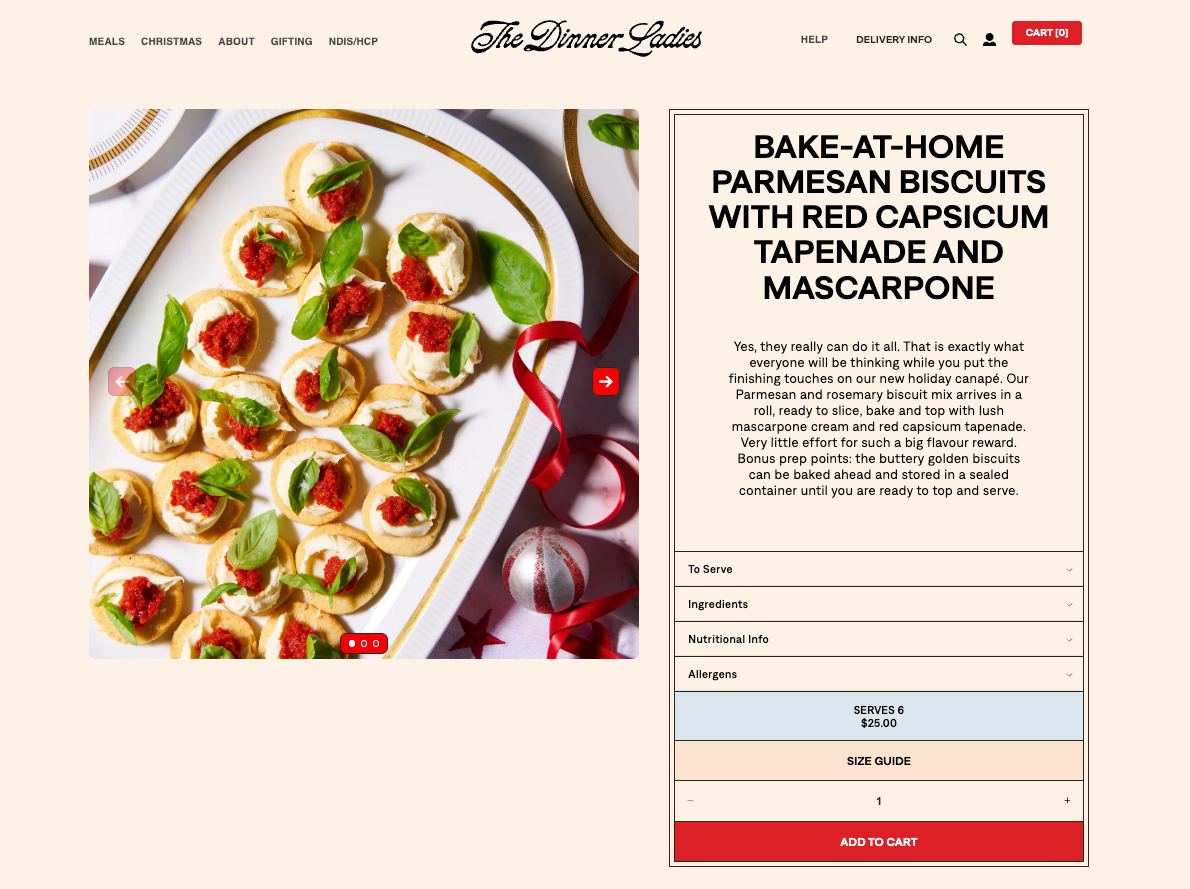
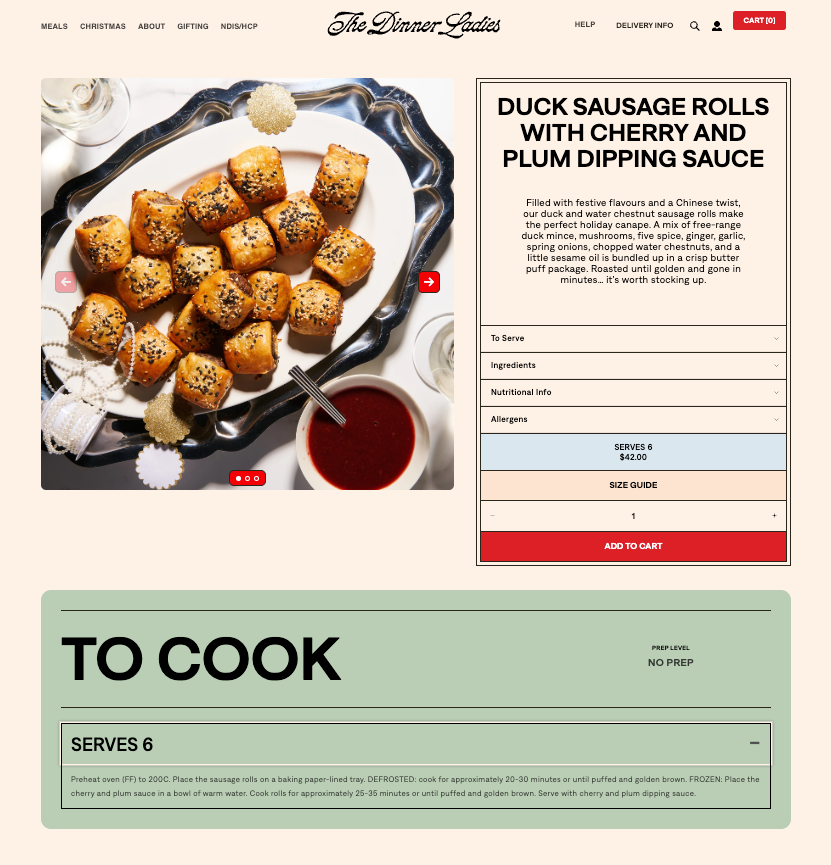
For example, ready-to-heat meal company The Dinner Ladies includes a dropdown menu on each product page for further reading. Categories include serving instructions, a full ingredient list, allergens, nutritional information, and even a handy “size guide” that shows how many people the meal serves.
FAQ pages make up the information hub of your website. They exist to provide customers with a way to get their questions answered without reaching out to you.
This includes information like how food should be stored, how long its shelf life is, delivery range, and serving instructions. FAQs can even direct customers toward finding out where their order is and what its status is.

In the context of BFCM, FAQs are all about deflecting repetitive questions away from your team and assisting shoppers in finding what they need faster.
That’s the strategy for German supplement brand mybacs.
“Our focus is to improve automations to make it easier for customers to self-handle their requests. This goes hand in hand with making our FAQs more comprehensive to give customers all the information they need,” says Alexander Grassmann, its Co-Founder & COO.
As you contemplate what to add to your FAQ page, remember that more information is usually better. That’s the approach Everyday Dose takes, answering even hyper-specific questions like, “Will it break my fast?” or “Do I have to use milk?”
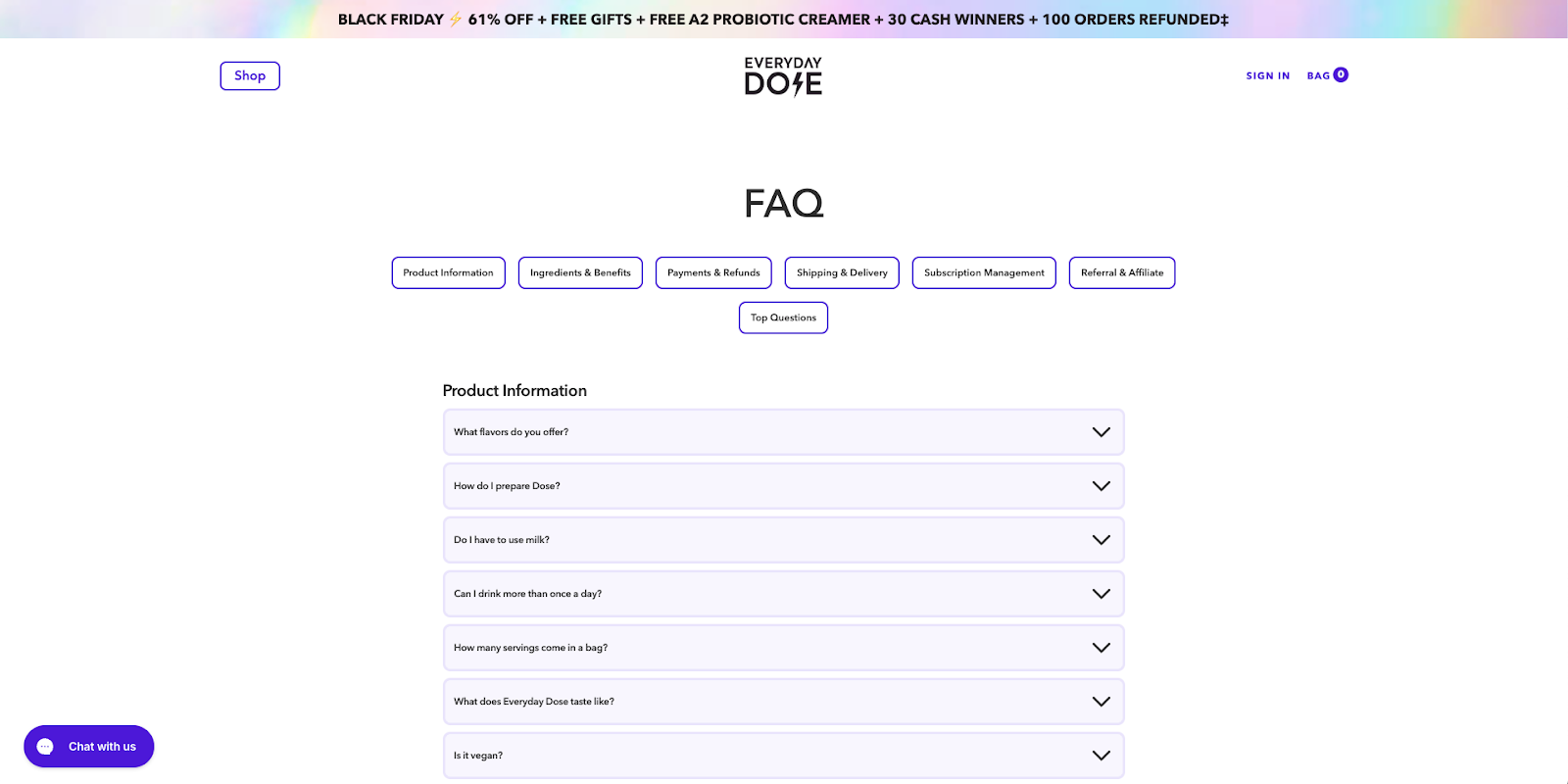
While the FAQs you choose to add will be specific to your products, peruse the top-notch food and bev FAQ pages below.
Time for some FAQ inspo:
AI Agents and AI-powered Shopping Assistants are easy to set up and are extremely effective in handling customer interactions––especially during BFCM.
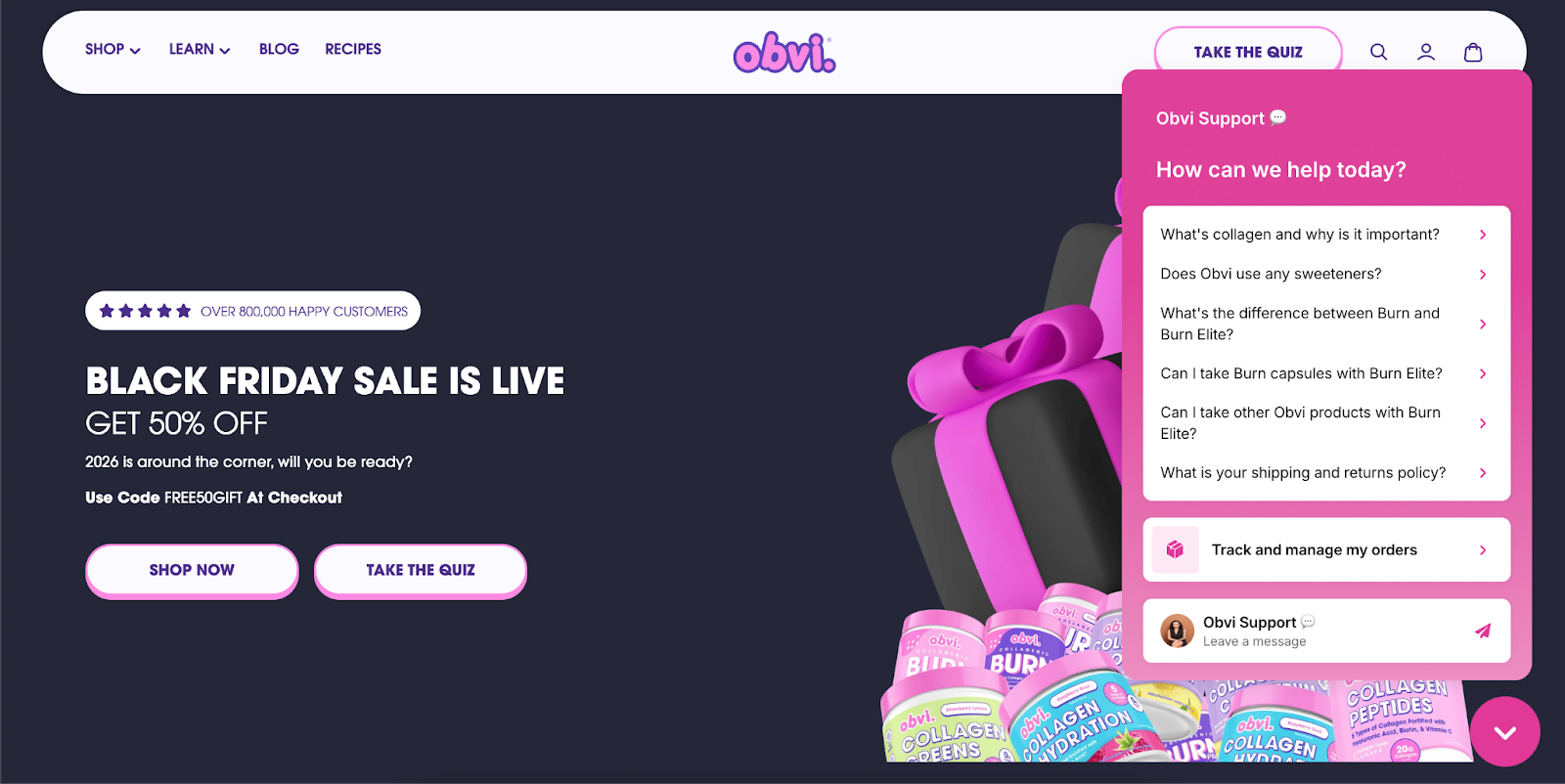
“I told our team we were going to onboard Gorgias AI Agent for BFCM, so a good portion of tickets would be handled automatically,” says Ron Shah, CEO and Co-founder at Obvi. “There was a huge sigh of relief knowing that customers were going to be taken care of.”
And, they’re getting smarter. AI Agent’s CSAT is just 0.6 points shy of human agents’ average CSAT score.
Here are the specific responses and use cases we recommend automating:
Get your checklist here: How to prep for peak season: BFCM automation checklist
With high price reductions often comes faster-than-usual sell out times. By offering transparency around item quantities, you can avoid frustrated or upset customers.
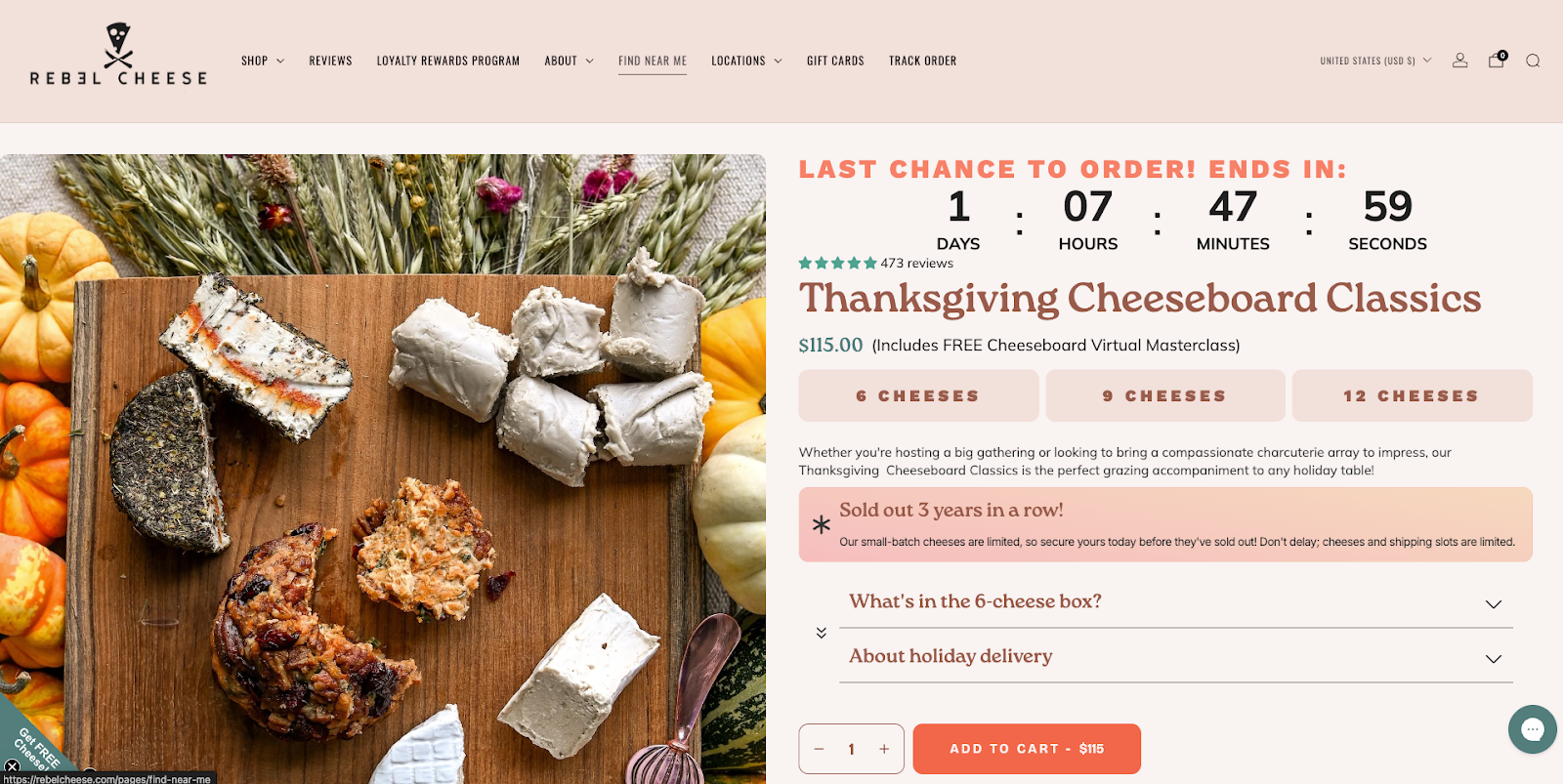
For example, you could show how many items are left under a certain threshold (e.g. “Only 10 items left”), or, like Rebel Cheese does, mention whether items have sold out in the past.
You could also set up presales, give people the option to add themselves to a waitlist, and provide early access to VIP shoppers.
Give shoppers a heads up whether they’ll be able to cancel an order once placed, and what your refund policies are.
For example, cookware brand Misen follows its order confirmation email with a “change or cancel within one hour” email that provides a handy link to do so.
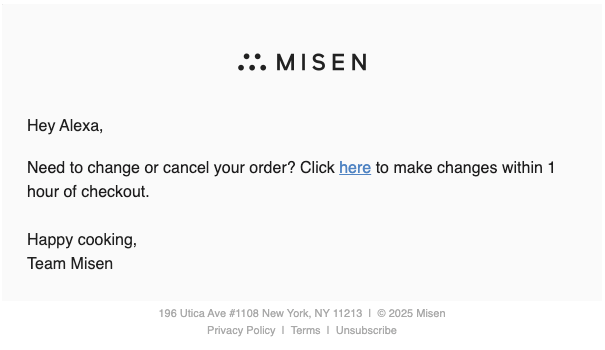
Your refund policies and order cancellations should live within an FAQ and in the footer of your website.
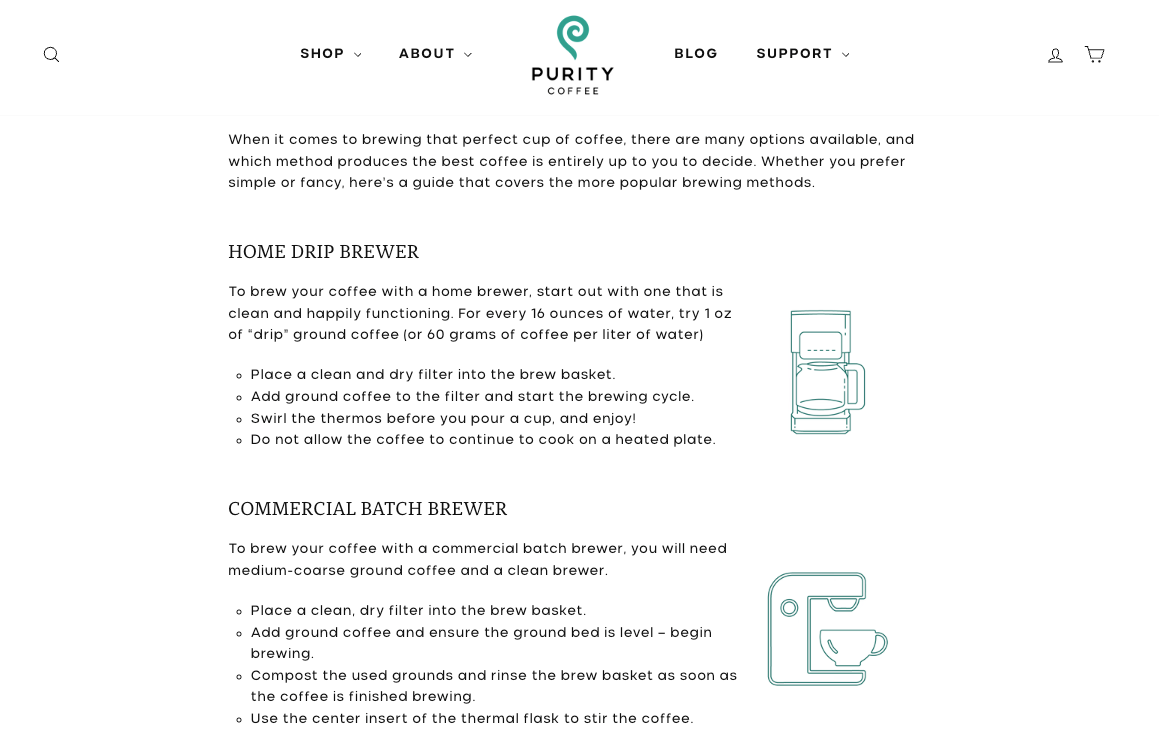
Include how-to information on your website within your FAQs, on your blog, or as a standalone webpage. That might be sharing how to use a product, how to cook with it, or how to prepare it. This can prevent customers from asking questions like, “how do you use this?” or “how do I cook this?” or “what can I use this with?” etc.
For example, Purity Coffee created a full brewing guide with illustrations:
Similarly, for its unique preseasoned carbon steel pan, Misen lists out care instructions:

And for those who want to understand the level of prep and cooking time involved, The Dinner Ladies feature cooking instructions on each product page.
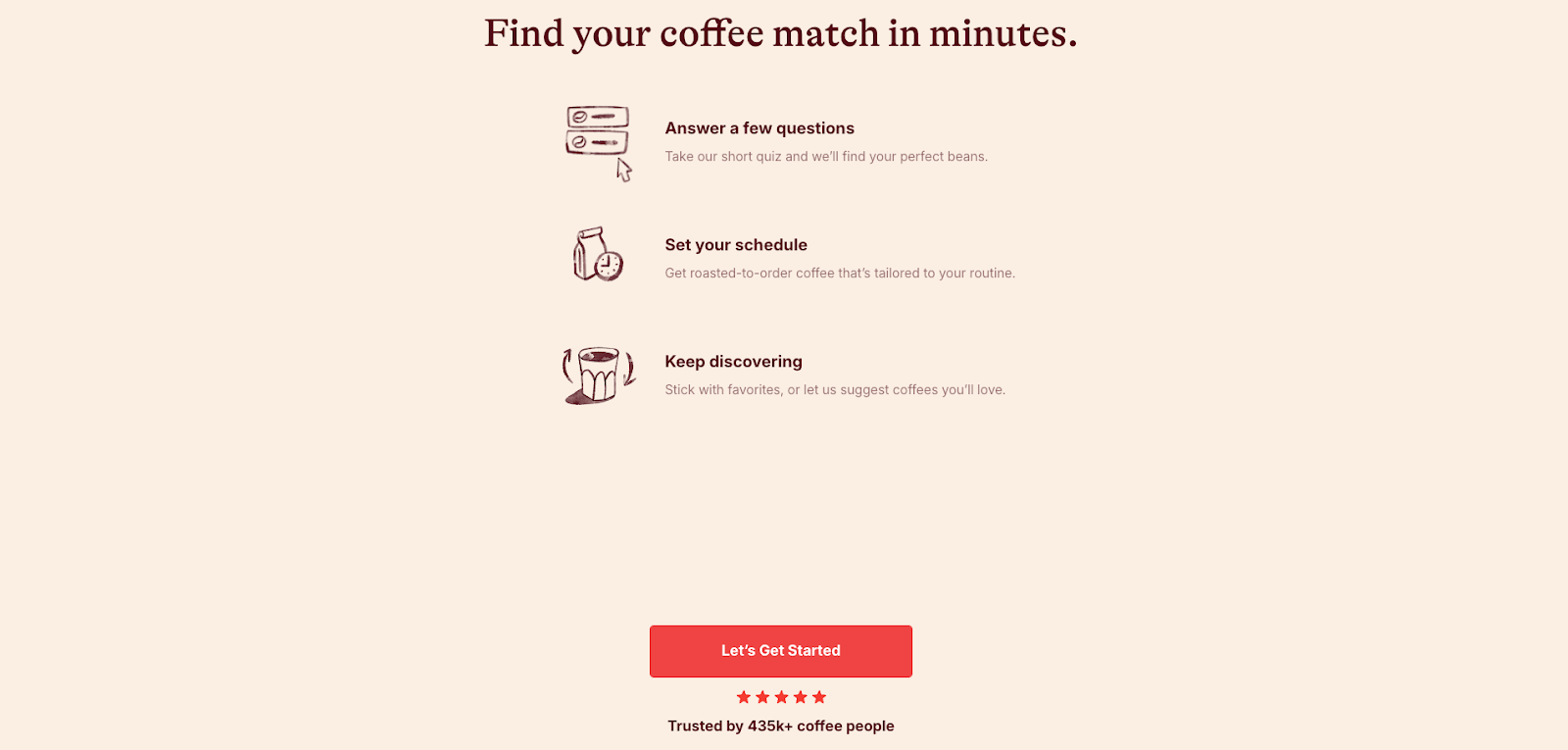
Interactive quizzes, buying guides, and gift guides can help ensure shoppers choose the right items for them––without contacting you first.
For example, Trade Coffee Co created a quiz to help first timers find their perfect coffee match:
The more information you can share with customers upfront, the better. That will leave your team time to tackle the heady stuff.
If you’re looking for an AI-assist this season, check out Gorgias’s suite of products like AI Agent and Shopping Assistant.
{{lead-magnet-2}}
TL;DR:
As holiday season support volumes spike and teams lean on AI to keep up, one frustration keeps surfacing, our Help Center has the answers—so why can’t AI find them?
The truth is, AI can’t help customers if it can’t understand your Help Center. Most large language models (LLMs), including Gorgias AI Agent, don’t ignore your existing docs, they just struggle to find clear, structured answers inside them.
The good news is you don’t need to rebuild your Help Center or overhaul your content. You simply need to format it in a way that’s easy for both people and AI to read.
We’ll break down how AI Agent reads your Help Center, finds answers, and why small formatting changes can help it respond faster and more accurately, so your team spends less time on escalations.
{{lead-magnet-1}}
Before you start rewriting your Help Center, it helps to understand how AI Agent actually reads and uses it.
Think of it like a three-step process that mirrors how a trained support rep thinks through a ticket.
Your Help Center is AI Agent’s brain. AI Agent uses your Help Center to pull facts, policies, and instructions it needs to respond to customers accurately. If your articles are clearly structured and easy to scan, AI Agent can find what it needs fast. If not, it hesitates or escalates.
Think of Guidance as AI Agent’s decision layer. What should AI Agent do when someone asks for a refund? What about when they ask for a discount? Guidance helps AI Agent provide accurate answers or hand over to a human by following an “if/when/then” framework.
Finally, AI Agent uses a combination of your help docs and Guidance to respond to customers, and if enabled, perform an Action on their behalf—whether that’s changing a shipping address or canceling an order altogether.
Here’s what that looks like in practice:
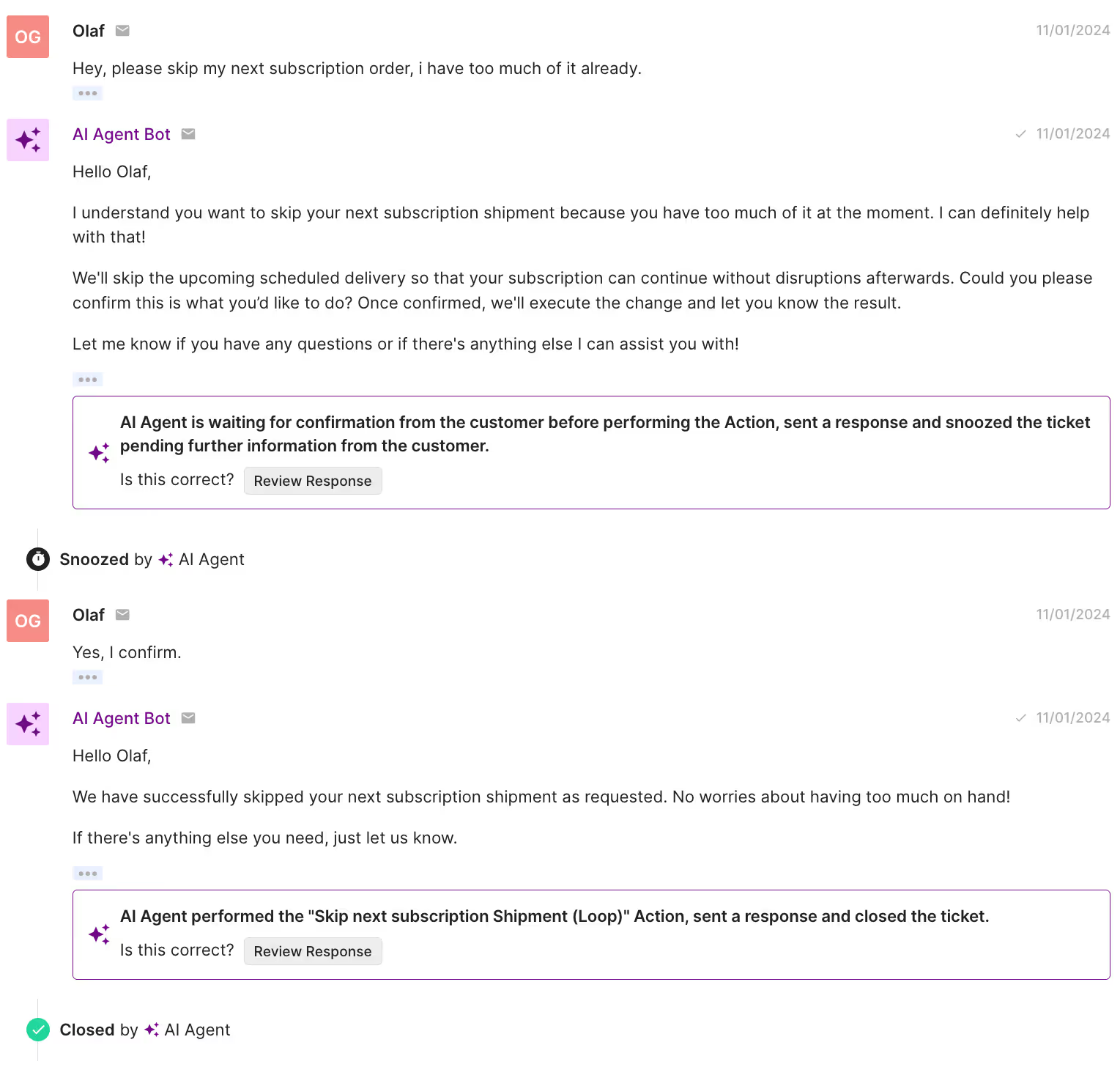
This structure removes guesswork for both your AI and your customers. The clearer your docs are about when something applies and what happens next, the more accurate and human your automated responses will feel.
A Help Center written for both people and AI Agent:
Our data shows that most AI escalations happen for a simple reason––your Help Center doesn’t clearly answer the question your customer is asking.
That’s not a failure of AI. It’s a content issue. When articles are vague, outdated, or missing key details, AI Agent can’t confidently respond, so it passes the ticket to a human.
Here are the top 10 topics that trigger escalations most often:
Each of these topics needs a dedicated, clearly structured Help Doc that uses keywords customers are likely to search and spells out specific conditions.
Here’s how to strengthen each one:
Start by improving these 10 articles first. Together, they account for nearly half of all AI Agent escalations. The clearer your Help Center is on these topics, the fewer tickets your team will ever see, and the faster your AI will resolve the rest.
Once you know how AI Agent reads your content, the next step is formatting your help docs so it can easily understand and use them.
The goal isn’t to rewrite everything, it’s to make your articles more structured, scannable, and logic-friendly.
Here’s how.
Both humans and large language models read hierarchically. If your article runs together in one long block of text, key answers get buried.
Break articles into clear sections and subheadings (H2s, H3s) for each scenario or condition. Use short paragraphs, bullets, and numbered lists to keep things readable.
Example:
How to Track Your Order
A structured layout helps both AI and shoppers find the right step faster, without confusion or escalation.
AI Agent learns best when your Help Docs clearly define what happens under specific conditions. Think of it like writing directions for a flowchart.
Example:
This logic helps AI know what to do and how to explain the answer clearly to the customer.
Customers don’t always use the same words you do, and neither do LLMs. If your docs treat “cancel,” “stop,” and “pause” as interchangeable, AI Agent might return the wrong answer.
Define each term clearly in your Help Center and add small keyword variations (“cancel subscription,” “end plan,” “pause delivery”) so the AI can recognize related requests.
AI Agent follows links just like a human agent. If your doc ends abruptly, it can’t guide the customer any further.
Always finish articles with an explicit next step, like linking to:
Example: “If your return meets our policy, request your return label here.”
That extra step keeps the conversation moving and prevents unnecessary escalations.
AI tools prioritize structure and wording when learning from your Help Center—not emotional tone.
Phrases like “Don’t worry!” or “We’ve got you!” add noise without clarity.
Instead, use simple, action-driven sentences that tell the customer exactly what to do:
A consistent tone keeps your Help Center professional, helps AI deliver reliable responses, and creates a smoother experience for customers.
You don’t need hundreds of articles or complex workflows to make your Help Center AI-ready. But you do need clarity, structure, and consistency. These Gorgias customers show how it’s done.
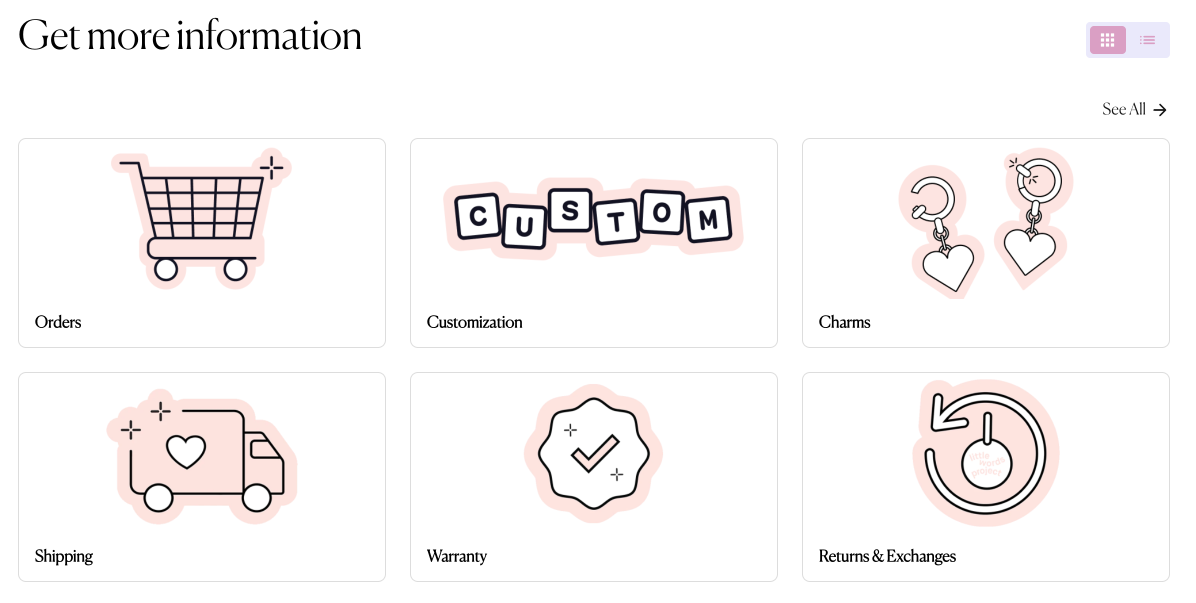
Little Words Project keeps things refreshingly straightforward. Their Help Center uses short paragraphs, descriptive headers, and tightly scoped articles that focus on a single intent, like returns, shipping, or product care.
That makes it easy for AI Agent to scan the page, pull out the right facts, and return accurate answers on the first try.
Their tone stays friendly and on-brand, but the structure is what shines. Every article flows from question → answer → next step. It’s a minimalist approach, and it works. Both for customers and the AI reading alongside them.
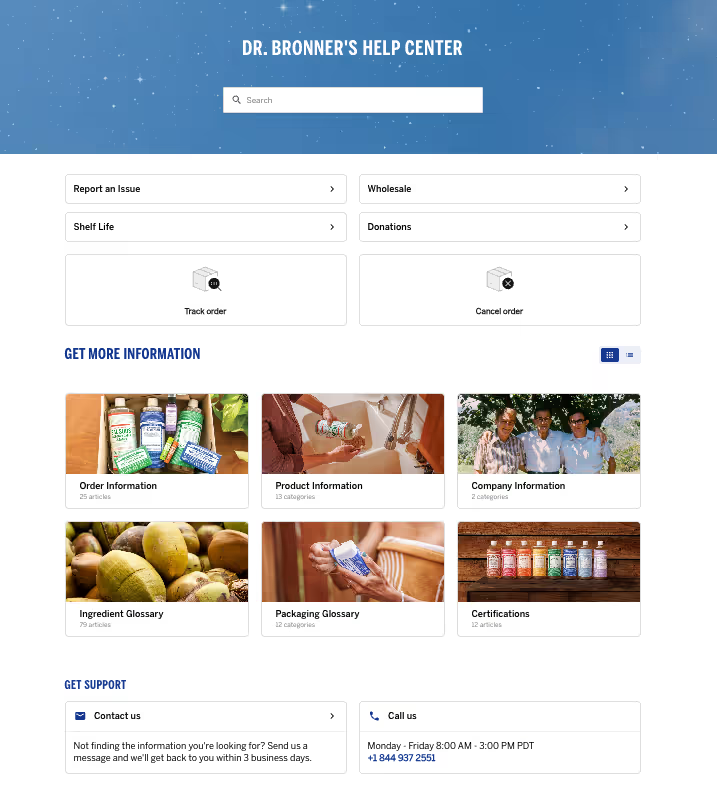
Customer education is at the heart of Dr. Bronner’s mission. Their customers often ask detailed questions about product ingredients, packaging, and certifications. With Gorgias, Emily and her team were able to build a robust Help Center that helped to proactively give this information.
The Help Center doesn't just provide information. The integration of interactive Flows, Order Management, and a Contact Form automation allowed Dr. Bronner’s to handle routine inquiries—such as order statuses—quickly and efficiently. These kinds of interactive elements are all possible out-of-the-box, no IT support needed.

When Ekster switched to Gorgias, the team wanted to make their Help Center work smarter. By writing clear, structured articles for common questions like order tracking, returns, and product details, they gave both customers and AI Agent the information needed to resolve issues instantly.
"Our previous Help Center solution was the worst. I hated it. Then I saw Gorgias’s Help Center features, and how the Article Recommendations could answer shoppers’ questions instantly, and I loved it. I thought: this is just what we need." —Shauna Cleary, Head of Ecommerce at Ekster
The results followed fast. With well-organized Help Center content and automation built around it, Ekster was able to scale support without expanding the team.
“With all the automations we’ve set up in Gorgias, and because our team in Buenos Aires has ramped up, we didn’t have to rehire any extra agents.” —Shauna Cleary, Head of Ecommerce at Ekster
Learn more: How Ekster used automation to cover the workload of 4 agents
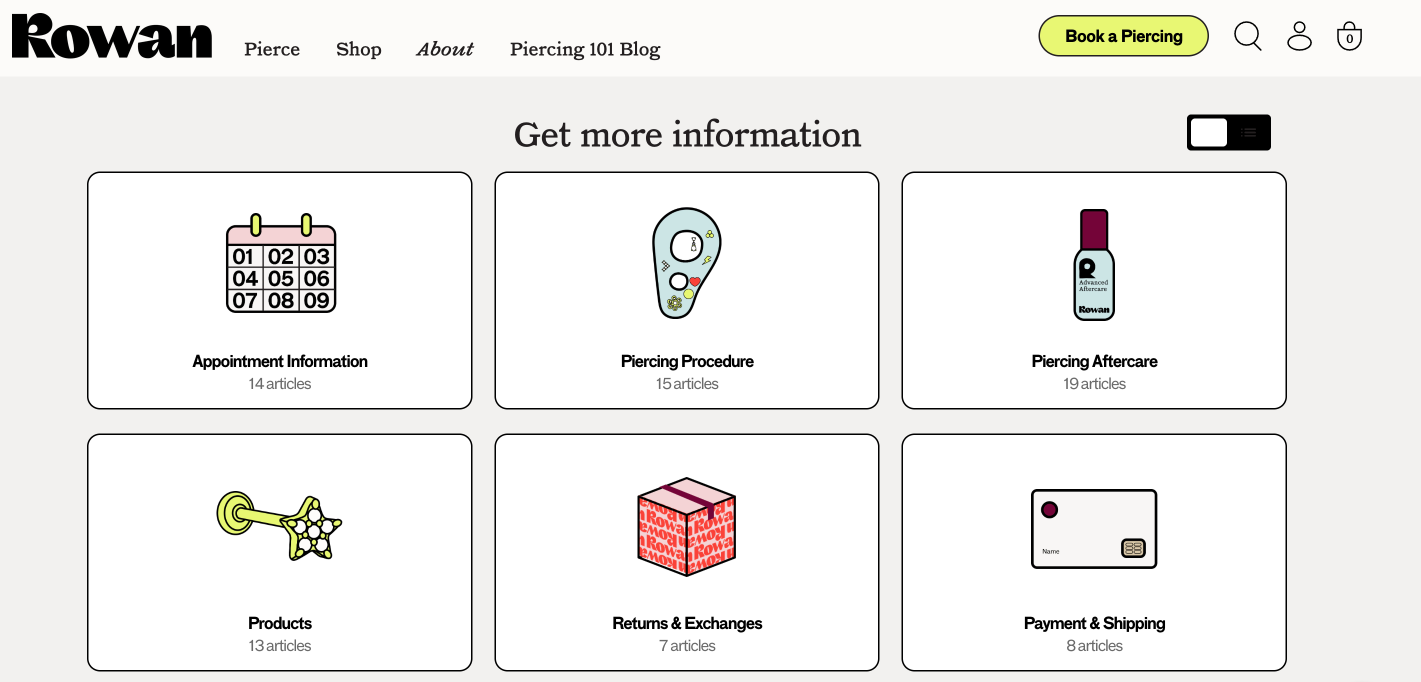
Rowan’s Help Center is a great example of how clear structure can do the heavy lifting. Their FAQs are grouped into simple categories like piercing, shipping, returns, and aftercare, so readers and AI Agent can jump straight to the right topic without digging.
For LLMs, that kind of consistency reduces guesswork. For customers, it creates a smooth, reassuring self-service experience.
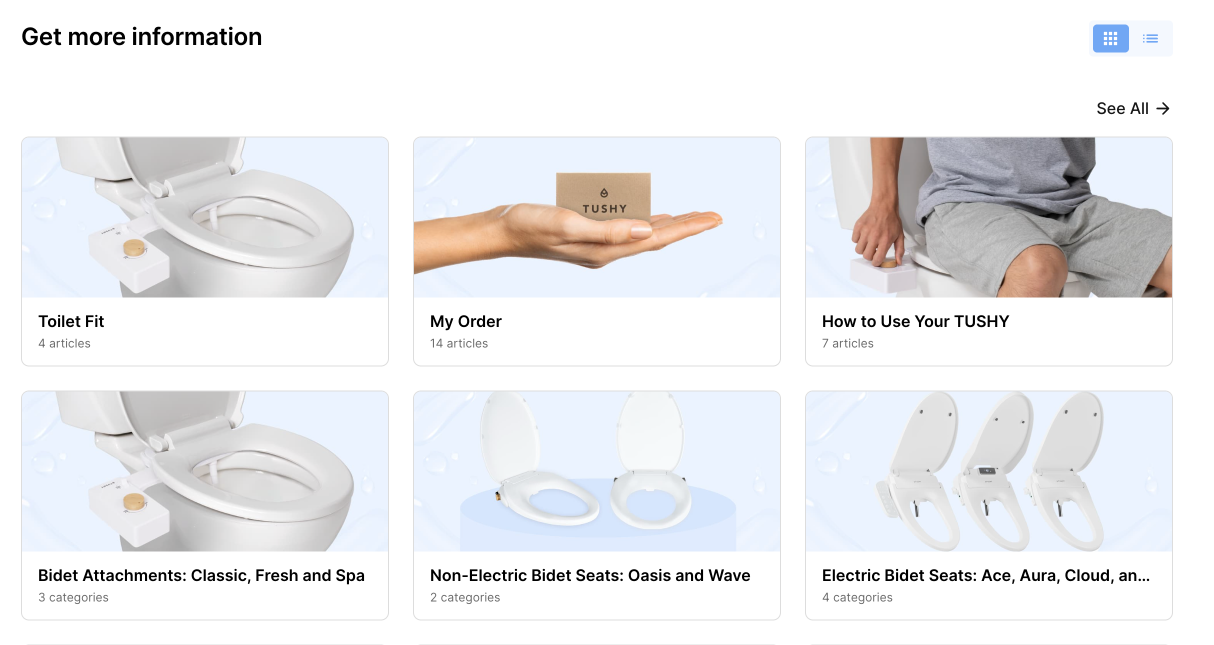
TUSHY proves you can maintain personality and structure. Their Help Center articles use clear headings, direct language, and brand-consistent tone. It makes it easy for AI Agent to give accurate, on-brand responses.
“Too often, a great interaction is diminished when a customer feels reduced to just another transaction. With AI, we let the tech handle the selling, unabashedly, if needed, so our future customers can ask anything, even the questions they might be too shy to bring up with a human. In the end, everybody wins!" —Ren Fuller-Wasserman, Senior Director of Customer Experience at TUSHY
Ready to put your Help Center to the test? Use this five-point checklist to make sure your content is easy for both customers and AI to navigate.
Break up long text blocks and use descriptive headers (H2s, H3s) so readers and AI Agent can instantly find the right section.
Spell out what happens in each scenario. This logic helps AI Agent decide the right next step without second-guessing.
Make sure your Help Center includes complete, structured articles for high-volume issues like order status, returns, and refunds.
Close every piece with a call to action, like a form, related article, or support link, so neither AI nor customers hit a dead end.
Use direct, predictable phrasing. Avoid filler like “Don’t worry!” and focus on steps customers can actually take.
By tweaking structure instead of your content, it’s easier to turn your Help Center into a self-service powerhouse for both customers and your AI Agent.
Your Help Center already holds the answers your customers need. Now it’s time to make sure AI can find them. A few small tweaks to structure and phrasing can turn your existing content into a powerful, AI-ready knowledge base.
If you’re not sure where to start, review your Help Center with your Gorgias rep or CX team. They can help you identify quick wins and show you how AI Agent pulls information from your articles.
Remember: AI Agent gets smarter with every structured doc you publish.
Ready to optimize your Help Center for faster, more accurate support? Book a demo today.
{{lead-magnet-2}}


TL;DR:
Customer satisfaction scores (CSAT) have long been the go-to metric for measuring support quality, with 53% of customer experience leads relying on them. However, CSAT only tells you part of the story.
When customers rate their experience 3 out of 5, what does it really mean? Did they rate the agent’s actions or the company’s policies? Was an agent helpful or inefficient? Did they take unnecessary steps to get to the answer?
Quality assurance checks can fill these gaps, but manual QA is a heavy lift. Team leads often struggle to review more than a small sample of conversations, leaving many issues unchecked.
Auto QA redefines quality assurance for today’s support teams. It transforms QA from a manual task into an automated feedback engine that helps your team deliver excellent support, every single time.
Let's dive into how Auto QA works, how accurate its scoring is, and how you can add it to your support workflow to start improving customer conversations today.
Gorgias Auto QA upgrades the customer service QA process by automatically evaluating 100% of private text conversations, whether handled by a human or AI Agent.
Each message is scored on metrics like Resolution Completeness, Brand Voice, and Accuracy, helping teams fix and address areas of improvement.
With an automated QA process, brands can:
Let's explore a real-life scenario: A customer reaches out about a product issue, seeking troubleshooting help. Here’s how the interaction unfolds:
Customer: "Hi, my device broke, and I bought it less than a month ago. -Kelly"
Support Agent: "Hi Kelly, please send us a photo or a video so we can determine the issue with your device. -Michael"
The ticket is eventually closed, but the customer doesn't leave a CSAT score.
In this case, Auto QA would provide the following insights:

Auto QA uses a comprehensive scoring system that evaluates conversations on communication proficiency and knowledge accuracy.
To ensure accuracy, Auto QA only scores interactions with at least 250 characters and messages from both agents and customers. It's also smart enough to filter out automated responses, spam, and bot messages.
Auto QA automatically scores three main aspects:
For deeper feedback, certain criteria require manual scoring from team leads:

Whether you're just starting with quality checks or transitioning from manual QA, Auto QA can seamlessly fit into your existing processes. Here's how to get started.
What does “good” look like for your team? Review Auto QA's scoring system and decide which metrics matter most for your brand, from Resolution Completeness to Brand Voice. This will help you set realistic targets for your team to work toward.
Tip: Start by prioritizing a couple of areas. This could look like prioritizing a 5/5 Resolution Completeness score while deprioritizing Brand Voice. As your team gets comfortable with Auto QA, you can ramp up to improving Brand Voice.
Since some criteria—Accuracy, Efficiency, Internal Compliance, and Brand Voice—require manual scoring, it’s best to agree on how your team will use the scoring scale.
For example, each score from 1 to 5 receives a distinct piece of feedback. Here’s what that would look for the Efficiency criteria:
Start rolling out Auto QA through individual meetings with agents rather than overwhelming your team with a general training session. One-on-one conversations allow you to better address each agent's specific questions and concerns. Make sure to cover the following:
If regular one-on-one meetings aren't part of your routine, consider introducing Auto QA during your weekly team meetings or through a dedicated training session. Just remember to leave plenty of time for questions and walk through multiple examples to ensure everyone is comfortable with the system.
To solidify QA checks, create a simple routine for reviewing Auto QA insights with the Auto QA Report (navigate to Statistics > Auto QA).

Once you’ve collected a substantial amount of Auto QA data, there are a few follow-up actions you can take to continue having high-quality conversations:
Remember, Auto QA works alongside your existing processes—it doesn't replace them. Start small, focus on the metrics that matter most to your team, and scale up as you get comfortable with Auto QA.
We invited leading ecommerce brands to beta test Auto QA, and their feedback highlights how it's transforming quality assurance across support teams of all sizes.
amika's support team values the complete visibility beyond CSAT: "Auto QA dramatically widens the volume of tickets we can review," they share. "A 5-point scale only tells you so much, and relying on consumers providing feedback limits what you're able to learn from."
Peachybbies' CX team enjoys real-time improvement: "Being able to give real-time feedback is pivotal, especially during peak times," their team explains. "Auto QA catches pretty much everything I'd want a human QA agent to catch."
OSEA Malibu's managers discovered operational insights: "It helps managers understand when a macro or process is leading to incomplete conversations versus when an agent made a mistake," their support lead shares.
By prioritizing QA, your team can identify potential problems early, reduce errors, and improve overall performance, leading to a smoother, more reliable experience for customers––and your CX team.
In the long run, brands focusing on QA can gain a competitive edge. Book a demo now to see what Auto QA can do for you.
{{lead-magnet-1}}

There are tons of CX metrics you could be tracking. But where you spend your time is crucial as a customer experience leader.
According to recent data, these are the top five CX metrics for you to prioritize and improve on in 2025.
{{lead-magnet-1}}
Not tracking CX metrics is like putting a loaf of bread in the oven but leaving baking time to chance. Without a set timer, you could end up with an underbaked bowl of dough or a burnt mess. Unless you have a sixth sense, it’s going to be really challenging to end up with something good.
In the same vein, metrics provide clear parameters for success. Meet or exceed them and your team is doing well; fall short and you’ll be better equipped to identify pain points and solve them.
Here are a few additional reasons why setting customer support metrics is key to success.
Tip : AI and automation can be valuable sidekicks as you look to optimize and improve on metrics. That’s especially true for busy periods: in 2024, 70% of CX leaders relied on AI and automation during peak seasons.

Customers are done with being patient. One study found that two thirds of respondents valued speed to reply just as much as product price.
A recent survey we ran found the same thing.
In our 2024 customer expectations survey, we asked CX leads and agents which metric they used to track success. Here’s what they said:
Resolution time is going to be a key differentiator for your team this year. It should be your primary focus when it comes to optimizing different facets of your customer service strategy.

Resolution time is the average time it takes to resolve a customer request from start to finish.
To calculate resolution time, you’ll take the total resolution time within a set period and divide it by the total number of customer interactions your team tackled within that same time frame.
Average resolution time = Total resolution time in a defined period / Total number of customer interactions resolved in that period
According to a 2023 study from Statista, 70% of support leaders noted that the customer support metrics that AI had the greatest positive effect on was resolution time.
You can use automation features to send Macros to answer common questions, or leverage AI to interact as an agent via email or chat. The instant nature of these tools means that customers won’t have to wait in a queue for your team to get to them.
For example, Wildride implemented Gorgias AI Agent to manage an influx of 1,000 tickets per week. After AI Agent took over 33% of email inquiries, the team saw a 24% decrease in resolution time. That allowed the team to focus on more complex issues, streamline their support process, and make their customers happier.
First response time is the length of time it takes for a customer service team to send the initial reply to a customer inquiry.
To calculate average first response time, take the total amount of time it took for your team to respond to initial customer requests and divide by the total number of tickets within a set time frame.
Your team is busy––when they’re not tackling repetitive questions, they’re helping customers with complicated or high-effort requests. All of that work is going to bog down your FRT, especially during more buzzy periods like sales, new releases, or over the holidays.
By using AI to jump in to handle those more routine requests, you can significantly reduce your FRT and give your team time back to tackle more heavy-lift needs.
For example, AI Agent helped Glamnetic achieve a 91% improvement in first response time during Black Friday Cyber Monday (BFCM) 2024. They got FRT down from their pre-AI Agent time of eight minutes to 40 seconds.
Here’s what that looked like in practice:

CSAT scores show how satisfied customers are with a product, service, or interaction, typically gathered through surveys.
CSAT is calculated via a five-point rating scale survey sent to customers after a support interaction, where one is the worst experience and five is the best. While it can be calculated in different ways, at Gorgias the average of all survey responses is your CSAT score.
When customers reach out for support, they’re expecting a fast response––regardless if they have an issue or are contemplating their next purchase.
That’s why using automation or AI tools to provide that lightning quick response, even if it directs shoppers to a self-service resource, can be extremely effective in raising CSAT scores. These responses could be sent by an AI agent that responds like a human agent would or an automated Macro built to fire off pre-crafted templates to common questions.
In luxury golf brand VESSEL’s case, customers felt that the AI responses were helpful and seemed on-par with the level of support they’d expect from a human agent.
“Our customers expect almost immediate responses, and so being able to automate that, even if it's not necessarily the exact answer that they're looking for, but being able to send over information to give them the reassurance that we're looking into it or trying to find an answer, whatever it may be, that's been a huge help to our team,” says Lauren Reams, the Customer Experience Manager at VESSEL.
The direct or indirect effect of customer service or business activities on generating sales or revenue.
There are different ways to calculate revenue generated and the sales impact of customer support, and quantifying the indirect impact can be difficult. But generally, the formula looks like this:
ROI = [ (Money earned - Money spent) / Money spent ] x 100
Resource: How to measure & improve customer service ROI
Leveraging AI and automation can provide significant cost savings because it acts as an additional agent who can tackle repetitive questions, translating to money saved on the time it would take for human agents to manually answer those questions.
The results are tangible: by automating 48% of inquiries, Dr. Bronner's saved $5,248 in the first month, and $100K in the first year.
Jonas Paul Eyewear saw revenue influenced by AI Agent as well: the team tracked $600 of sales revenue directly to the tool after it effectively answered pre-sales support questions from shoppers.

Ticket volume is the total number of customer service inquiries that a team receives over a specific period of time.
The customer support tool you use will be able to calculate ticket volume for you, as it’s the total number of tickets that have come in within a set amount of time. If you don’t use a CX platform yet and are still using something like Gmail or Excel, you’ll perform this count manually.
Set rules to trigger automated responses to common questions, or ask an AI agent to completely take them off your team’s plate.
Arcade Belts, for example, saw a 50% reduction in ticket volume by using Gorgias AI Agent.
Tracking CX metrics is valuable for more than just gauging your program's effectiveness. The more you improve upon your CX metrics, the more you can leverage them to prove your support function’s value within your company.
How to use metrics to evaluate AI performanceIf you want to transform customer experience for the long term, the AI tools you use should never be “set it and forget it” solutions. Just as you do with your human agents, you can use metrics to evaluate your AI agent to make sure it’s performing well. If you use Gorgias, you’ll find these metrics under the AI Agent dashboard.
To review AI Agent’s performance:


It’s also easy to retrain your AI's performance by adjusting settings like Guidance, refining the internal documents it draws from, setting up brand voice, or creating a Handover topic list to escalate certain types of tickets to human agents.
Whether you’re new to being a CX leader or you’re a seasoned pro, tracking and improving on your CX metrics will help your team stand out among the rest. A key way to improve them is to leverage AI and Automation tools, and Gorgias is here to help you do it.
{{lead-magnet-2}}

TL;DR:
It’s clear that shoppers want answers fast—chat accounts for 20% of all customer support tickets.
The appeal is obvious: Chat is an easy-to-access customer service channel for quick questions and a convenient and subtle way to cross-sell complementary products.
But without the right chat tool, brands risk losing these valuable opportunities.
Introducing AI Agent on Chat, a conversational AI assistant that can automate up to 50% of chat conversations. This new feature upgrades chat by combining agent knowledge with superhuman efficiency and response times.
Now, customers can guarantee personalized interactions at any point of the shopping journey—whether they’re looking for a quick answer or a tailored recommendation.
With AI powering every interaction, one-to-one conversations become a seamless part of every customer experience.
Before AI Agent, customers reaching out through chat outside business hours had two options: following pre-set Flows (automated FAQ conversations) or browsing through suggested Help Center articles.
These features are great for quick answers to basic questions, but AI Agent takes support to the next level by handling more complex needs like modifying orders or offering personalized product recommendations.
With AI Agent in Chat, customers enjoy dynamic, real-time conversations available on multiple channels. AI Agent generates personalized responses that match exactly what customers ask for, automating 50% of chat interactions so agents get time back to upsell, create stronger relationships, and craft better experiences.
Related: How to optimize your Help Center for AI Agent
Upgrade your chat support from a basic Q&A tool into an intelligent assistant that handles customer inquiries 24/7. Here's how AI Agent makes that possible:
AI Agent responds within 15 seconds or less, offering fast responses that result in frictionless conversations. Unlike traditional chatbots, AI Agent also adapts to your brand’s unique tone of voice to enhance the customer experience and assure shoppers their questions will be taken care of.

Today’s shoppers expect instant responses regardless of time zone or business hours. AI Agent on Chat means customers get the help they need, when they need it. This availability leads to higher customer satisfaction and fewer abandoned carts.
AI Agent understands context and customer intent. Whether a shopper needs help finding the right product size or changes their mind and wants to compare features, AI Agent customizes its recommendations for each person.
Some conversations, like technical issues or complaints, need a human touch. AI Agent recognizes these situations and smoothly transfers them to the right agent.
Using Handover topics, you can choose which types of inquiries should go straight to human agents. Then, if AI Agent lacks the confidence to provide an answer or can’t locate relevant knowledge in its database, it automatically escalates the conversation.
Read more: Handover rules
Based on Hiver’s 2024 study, 62% of customers prefer live chat to other support channels. With AI Agent in Chat, agents can cut down average response times while customers get the answers they need in one conversation with zero wait times or follow-ups.
AI Agent on Chat is ready to use in a few clicks. Simply connect your Shopify store and Chat widget to AI Agent, and you’re ready to resolve questions asked by visitors and loyal customers faster than you ever have.
Chat is often a customer’s first touchpoint with your brand, whether they’ve just discovered your brand or are on their third order. Meet customer expectations by being available with AI Agent on Chat. The faster you can ease their concerns, the faster they can head to checkout.
AI Agent makes scaling support effortless, especially during peak seasons like Black Friday. While it handles repetitive support tickets like order status and shipping questions, your team can focus on high-priority tasks like requests from VIP customers.

Drawing from knowledge sources like your Help Center and policy pages means AI Agent can often resolve inquiries within one conversation. No more unnecessary back-and-forths. Quick resolutions = happier and more loyal customers.
Ready to get started? Here’s how to activate AI Agent on Chat:
Already use AI Agent for email? No need to set up Guidance and Handover topics all over again—AI Agent will behave the same way in Chat.
Get the most out of AI Agent on Chat by following these best practices.
The Help Center is AI Agent’s brain. This customer knowledge database is the key to AI Agent’s accurate and on-brand responses. To ensure your AI Agent is as trained as your human agents, include important topics in your Help Center like shipping, returns, cancellations, and account management.
No articles yet? No problem! Gorgias has 20+ article templates for you to use and modify. Or, even better, check out the AI Library for AI-generated articles based on your customer tickets.

AI tools perform best when you set limitations. A Guidance is the main way to control AI Agent’s behavior. It is a set of written instructions that outline how AI Agent should interact with customers, handle certain requests, and more.
We recommend publishing a Guidance on the top five questions you receive from customers.
Tip: AI Agent prioritizes Guidance above Help Center articles. Unlike Help Center articles, the content in your Guidance will not be customer-facing.

The beauty of AI Agent is its ability to speak like one of your agents. Select from Friendly, Professional, or Sophisticated presets—or create a custom tone that aligns with your brand.

Need help finding your brand voice? Here are seven brand voice examples.
Use test scenarios to see how AI Agent responds to common customer questions, such as order status, shipping questions, and return policies. To cover all your bases, test AI Agent as both a new and returning customer to make sure it delivers accurate responses no matter the customer's need.

AI Agent becomes smarter as it learns from you. Like a human agent, give your AI Agent feedback on its responses, from how it speaks, which topics it escalates, and what actions it takes in certain scenarios.
There are multiple ways to give AI Agent feedback on a ticket:

AI Agent can also perform actions like accessing Shopify order details and executing third-party app actions, such as updating shipping addresses and order cancellations, directly in Chat.
Excited to deliver an elevated chat experience? Book a demo now to experience the power of AI Agent on Chat.
{{lead-magnet-1}}

TL;DR:
Managing customer support as a Shopify store owner can feel like juggling too many tools at once.
Constantly switching tabs to look up orders, update customer information, or track returns wastes valuable time. Plus, it prevents your team from focusing on what really matters––delivering quick, personalized customer service.
Gorgias’s Shopify integration solves this. It keeps all your Shopify data in one place, so your team spends less time toggling tabs and more time helping customers. The result? Faster responses, better service, and more revenue.
Below, we break down the eight key capabilities of this integration, each paired with practical use cases to showcase its real-world value.
{{lead-magnet-1}}
What it does: Shopify order data is displayed directly within support tickets, allowing agents to view essential details like order status, customer information, and transaction history without leaving the helpdesk.
Use case: An agent handling a “Where’s my order?” request can instantly check tracking information and update the customer.
The fashion retailer Princess Polly improved their customer experience team’s efficiency by using Gorgias's deep integration with Shopify. Agents can view and update customer and order data directly within Gorgias, eliminating the need to switch between multiple tabs.
Taking a streamlined approach led to a 40% increase in efficiency, an 80% decrease in resolution time, and a 95% decrease in first response time.

What it does: Agents can update Shopify order and customer data with Shopify Actions right in Gorgias.
Key features:
Use case: Agents can perform Shopify actions directly from Gorgias, such as adding products, applying discounts, updating quantities, or issuing refunds.

What it does: Create templated responses called Macros with dynamic Shopify variables to automatically incorporate customer-specific information.
Key features:
Use case: A customer inquires about their order. With one click, the agent uses a Macro that pulls in the order status and expected delivery date, creating a faster and more personalized response.
Take Try The World, a gourmet subscription service, needed a robust Shopify integration to handle an increasing volume of customer inquiries. By switching to Gorgias, they gained the ability to unify conversations and embed Shopify data directly into Macros. Now, agents can quickly generate personalized responses that includes order details, tracking links, and customer-specific information.
Try the World’s support team’s efficiency skyrocketed, enabling them to handle 120 tickets per day, up from 80, and reduce response times to just one business day.

What it does: Macros with embedded Shopify data let agents quickly and accurately share pre-sale information like product links, stock availability, and discount codes, helping to convert prospective customers into buyers.
Key features:
Use case: A customer asks if a specific product is available in their size and color. The agent can apply a Macro that automatically pulls the product's inventory details and includes a discount code, sending a response like this:
“Hi [customer name Macro],
Great news! The product [Shopify product information Macro] is currently in stock in the size and color you’re looking for. You can check it out here: [Product Link]. Use the code WELCOME10 at checkout for 10% off your first order! Let me know if you have any other questions!”
How it helps:
What it does: Using Gorgias Chat, customers can track orders or manage their purchases on their own with no agent assistance needed.
Key feature:
Use case: A customer wants to check the status of their recent purchase. By accessing Chat on your website, they can enter their email and order number and receive instant updates on their order's progress, including shipping and delivery information, without waiting for an agent's response.
How it helps:
What it does: Rules paired with Shopify variables can automate various support tasks, such as identifying specific customer segments or tagging tickets, to boost efficiency and consistency.
Key features:
Use case: A customer with a history of substantial purchases contacts support. A rule detects that the customer's total spending exceeds a predefined threshold and automatically tags the ticket as "VIP."
This tag can then trigger other workflows, such as assigning the ticket to a senior support agent or escalating its priority.
How it helps:

What it does: Gorgias offers comprehensive reporting that allows you to measure how your support interactions influence sales.
Key features:
These metrics are accessible under Statistics → Support Performance → Revenue in your Gorgias dashboard. You can filter the data by integration, ticket channel, tags, or specific time periods to gain detailed insights.
Use case: By analyzing Revenue Statistics, you can identify which support channels or agents are most effective in driving sales. For example, if live chat interactions have a higher conversion rate, you might allocate more resources to that channel.
Additionally, recognizing top-performing agents can inform training programs to elevate overall team performance.
For example, One Block Down, a Milan-based streetwear brand, struggled to manage a growing volume of customer inquiries across multiple platforms. By integrating Gorgias with Shopify, they centralized all customer interactions into a single platform, giving agents instant access to crucial information like order history and returns directly within tickets.
The setup allowed the team to measure the direct impact of their support efforts on revenue.
The result? An impressive 1,000% increase in support-generated revenue and a 1-hour average first response time. By connecting the dots between customer service and sales performance, One Block Down demonstrated how proactive, data-driven support can directly influence the bottom line.
How it helps:

What it does: AI Agent automates Shopify actions like canceling orders, editing order details, and reshipping items.
Key features:
Use case: A customer realizes they've entered an incorrect shipping address shortly after placing an order. They contact support, and AI Agent promptly verifies that the order is unfulfilled, confirms the correct address with the customer, updates the shipping information in Shopify, and sends a confirmation email—all without human intervention.
How it helps:

{{lead-magnet-2}}

TL;DR:
Looking to grow an email list to capture leads or offer welcome incentives? These days, the default solution is to plaster a full-screen pop-up on your homepage.
It seems effective on the surface, collecting emails right off the bat, but dig deeper, and these pop-ups disrupt the shopping experience and skyrocket bounce rates—with 72% of customers exiting a website.
But how else do you get your message across?
That’s where Gorgias Convert comes in—a smarter, more customer-centric tool to drive conversions without pushing your visitors away.
Below, we’ll explore why it’s time to move on from full-screen pop-ups and how Gorgias Convert offers a better alternative for Shopify brands looking to boost engagement and revenue.
Pop-ups can be an effective marketing tool, but their full-screen counterpart often creates more problems than they solve. These intrusive overlays pose several challenges that can harm both user experience and your bottom line.
Full-screen pop-ups demand attention, often at the worst possible moment—like when a customer is browsing products or is just about to check out. This experience can frustrate visitors and lead them to abandon your site entirely.
The BBC says every extra second a page takes to load can cost you 10% of your users—and pushy pop-ups don’t help. If your pop-ups are poorly timed or overly intrusive, visitors feel unwelcome, causing them to leave before exploring your offerings.
Traditional pop-ups are static and one-size-fits-all. They can’t adjust messaging based on where the customer is in their shopping journey or their behavior on your site.
Many users employ ad blockers that filter out pop-ups altogether, meaning your message never even reaches a portion of your audience.
Gorgias Convert flips the script by offering a subtle, customer-friendly way to capture leads and drive sales without the drawbacks of full-screen pop-ups. Here’s why your Shopify brand should make the switch:
Gorgias Convert integrates seamlessly into your store, using a chat-based widget that feels like a natural part of the browsing experience. Using chat to double as a supporting and converting tool is less disruptive, allowing customers to explore your store at their own pace.

Convert makes it easy to bring any type of campaign to life. Catch the attention of the exact shoppers you want by detecting their browsing behavior, customer profile, cart attributes, and more.
For example, the exit intent campaign is the top-performing Convert campaign—it detects when a user is about to leave and displays a discount code. It’s fully customizable, allowing you to tailor offers based on how much time they’ve spent on a page, the number of items in their cart, or if they’ve visited more than three times without making a purchase.

Unlike one-size-fits-all pop-ups, Convert lets you tailor your messaging based on customer behavior, order history, and engagement. For example, if a customer is browsing a specific product, Convert can offer a relevant discount or incentive tied directly to that item.
With Convert, you’re not just collecting an email address—you’re starting a conversation. The tool allows you to engage with customers in real-time through pre-set flows that guide them toward taking action, whether it’s signing up for your newsletter, redeeming an offer, or completing a purchase.

Related: 6 types of conversational customer service + how to implement them
In 2024, smartphones were responsible for generating 68 percent of online shopping orders. To meet shoppers where they are, Convert’s chat-style interactions are optimized for mobile users. Unlike traditional pop-ups that don’t display correctly on smaller screens, Convert maintains a seamless experience for shoppers who prefer to shop on the go.

Using Convert means you can combine immediate assistance with smart marketing through its native integration with Gorgias and Shopify. For example, if a customer hesitates to make a purchase, you can intervene with a live chat offer or product recommendation in real-time.
The Shopify integration also allows you to generate unique discount codes that expire within 48 hours—preventing them from being shared on unauthorized coupon sites. These codes are automatically created with customizable thresholds, such as discounts for specific collections or individual users, without manual setup.

Convert allows you to test different messages and incentives, giving valuable insights into what resonates most with your audience. This data-driven approach ensures your lead capture strategy evolves with shoppers over time.
Read more: How campaign messaging can increase conversions
Shopify brands using Gorgias Convert have led to a conversion rate boost of 6-10% more across their website, up to a 24% click-through rate and 43% click-to-order rate, and improved customer satisfaction. By prioritizing a frictionless shopping experience, these brands are turning casual visitors into loyal customers.
Here’s what some happy brands have to say about Convert:
Haircare brand, Kreyol Essence, influenced 13% of revenue with Convert campaigns: “With Convert, we’ve not only improved our conversion rates but also created a seamless, personalized shopping experience that our customers love. It’s like having a personal assistant for each shopper. Thanks to Convert, we can interact with our customers and surface key information at the right time, turning clicks into connections."
Brands using customer service management agency, TalentPop, love how easy it is to generate revenue with Convert: “Clients are constantly surprised and delighted by how effective Gorgias Convert is for revenue generation. They especially appreciate that Convert can be used to target a diverse range of customers across the entire purchasing journey.”
In five months, yoga brand Manduka, increased revenue by 284.15% after using Convert: “Gorgias Convert has helped us make the shopping experience more intuitive. We can give a nice prompt to remind people of promotions we’re running, highlight specific product features, or just remind them we're here to help and answer questions. The chat campaigns make it easy for customers because they lead them to us, as opposed to them having to search for how to contact us for assistance.”
Shoppers want personalized experiences that respect their time and preferences. Full-screen pop-ups belong to an era of intrusive marketing that shoppers would rather leave in the past.
Gorgias Convert for your Shopify brand means delivering impactful interactions, more conversions, and an easy path to long-term customer loyalty.
Ready to make the switch? Start your effortless shopping journey today with Gorgias Convert. Chat with our team!

Today, we’re announcing our deeper investment in conversational AI for ecommerce.
"Since day one, Gorgias has been dedicated to helping ecommerce brands deliver exceptional customer experiences. We started with a helpdesk to centralize support, then introduced AI Agent to instantly resolve support questions,” says Romain Lapeyre, CEO of Gorgias.
“Now, we're taking the next leap forward with an AI Agent that powers the entire customer journey—anticipating buyer needs, boosting sales, and automating high-quality support. Today, I'm happy to announce Gorgias as the Conversational AI platform for ecommerce.”
Gorgias’s Conversational AI platform will let teams provide fast, scalable, and cost-effective support while helping them drive revenue growth. From automatic order changes and refunds to product recommendations and cross-sells, brands will be able to flawlessly combine their support and sales efforts.
The end result is an AI-powered customer journey where every customer interaction feels complete, personal, and connected, both before and after purchase.
Last year, we introduced AI Agent for email.
Some brands call their AI Agent Lisa, some call it Wally, and most treat it like a real member of the team. But this reliable support sidekick was only available to answer customers on email—until now.
Get ready for instant responses that tackle support inquiries of all sizes. Now, your customers can enjoy fast responses that keep their shopping experience as smooth as possible.
On top of improving first response times, AI Agent can play an even more critical role in unblocking sales, suggesting products, and driving upsells and cross-sells.
With responses sent in 15 seconds or less, brands can delight customers with near-instant resolutions.

Actions let AI Agent perform customer requests on behalf of your support team. This includes changing shipping addresses, fetching fulfillment status, canceling orders, adding discounts, and more.
You can use a library of pre-configured Actions for popular apps like Shopify, Rebuy, Loop, and more. And you don’t need any technical skills to set them up.
With almost half of queries requiring some kind of update, Actions is your go-to for complete resolutions so you can get more accomplished.

Quality checks have traditionally been manual, time-consuming, and inconsistent. Our brand new Auto QA feature changes that by automatically scoring 100% of conversations on resolution completeness and communication quality—whether from a human or AI agent.
With Auto QA, team leads can:

Support teams should be in complete control of their AI. That’s why the AI Agent Report and AI Agent Insights were created—to help you know exactly how your AI Agent is performing and contributing to your customer service operations.
The AI Agent Report provides full visibility into AI Agent’s performance, covering metrics like first response Time, CSAT, and one-touch ticket resolutions. Fully integrated into your Support Performance Statistics dashboard, the report includes:

AI Agent Insights takes it a step further. It analyzes AI Agent’s performance data and provides you with a dashboard of recommendations, including potential automation opportunities, popular ticket intents to optimize, and knowledge base improvements.

Soon, we’ll be expanding AI Agent's skills with the launch of Shopping Assistant, a tool designed to assist customers on their shopping journey.
Shopping Assistanthelps brands boost their sales capabilities through smart product recommendations, on-page checkout assistance, and personalized conversations. Now it's easier to reduce cart abandonment, suggest complementary products to boost average order value, and overcome pre-sale objections.
This new tool will bridge the gap between marketing and CX, ensuring brands can scale personalized interactions 24/7 without increasing headcount.
As we continue to innovate with conversational AI, our focus remains on helping you succeed.
By combining smarter tools with valuable insights, we’re creating opportunities for you to put your customers first and build deeper connections at every touchpoint.
Join us as we pave a new way for the future of ecommerce.
{{lead-magnet-1}}

TL;DR:
Your customer service conversations contain a goldmine of insight about your shoppers—like why they reached out, trends in shopper behavior, and how your products or services perform.
But how do you turn thousands of unstructured support tickets into accurate, digestible, and actionable takeaways?
Ticket Fields are the answer. They give support teams extra layers of data by labeling tickets in a much smarter way than traditional tags. With the right setup, Ticket Fields can help you uncover patterns, make smarter decisions, and highlight the value customer experience (CX) brings to your entire organization.
{{lead-magnet-1}}
Ticket Fields are customizable properties that allow CX teams to collect and organize information about tickets. Agents fill in ticket fields before closing the ticket, making it much easier to scale data collection.
Ticket Fields can be mandatory, requiring an agent to populate a field before closing the ticket. They can also be conditional, only appearing when relevant to the ticket.
There are four types of Ticket Fields: Dropdown, Number, Text, and Yes/No. Here are some ways to use each:

Unlike Tags, which are single-reason and non-conditional, Ticket Fields ensure key information, such as fulfillment details or cancellation reasons, is built into a ticket.
Think of Tags as stickers added to a ticket, while Ticket Fields are part of the ticket’s DNA itself, giving you much more control and insight.
Let’s take a closer look at why Ticket Fields are far superior at collecting data than Tags:
Agents manually apply Tags, which means it’s easy to forget to tag a ticket.
Ticket Fields, however, enforce structure by allowing CX managers to decide which fields are mandatory and which are optional. This flexibility ensures that all tickets contain the same basic details.
Ticket Fields can be conditional, meaning certain types of tickets automatically include fields that must be filled in.
How does it work? Take a look at this example:
If the Contact Reason field is Cancellation, conditional ticket fields like Cancel Reason, Did We Cancel Subscription, and Order Number must also be filled out.
Here’s how it looks in the Field Conditions settings:

No more missing context, gaps in the data, or typing N/A in a field. Support teams can capture the data they need from each ticket every time.
For CX teams transitioning from other helpdesks, being able to import historical ticket data with the field information intact is significant. This preserves workflows and existing data, helping teams get set up in no time without losing crucial information.
Tags, on the other hand, should be used to:
Ticket Fields are incredibly adaptable, allowing you to capture the exact data your team needs to meet your goals—whether it’s tracking product trends, choosing a shipping carrier, or increasing customer satisfaction.
Here are 12 examples of custom Ticket Fields to level up your data analysis.
Type of ticket field: Dropdown
What to do with the data: Identify common reasons customers contact you and take proactive steps to address them.
The Contact Reason ticket field is an easy way to figure out why customers reach out to your support team in the first place.
You can quickly identify trends, such as a sudden spike in return requests, and investigate whether it's a website, fulfillment, product, or service issue.
Some common contact reasons:
Note: Gorgias AI automatically suggests contact reasons, pre-filling the field with a prediction based on message content. Agents can accept or adjust the suggestion, helping the system become smarter over time as it learns from these interactions.

Type of ticket field: Dropdown
What to do with the data: Assess the effectiveness of resolutions and refine your service level agreement.
The Resolution ticket field tracks the action taken to resolve a ticket. Analyzing how your team handles tickets and identifying opportunities to improve resolutions is essential.
For example, you could analyze how often issues are resolved with replacements versus discounts. If you find replacements are overused for minor issues, you might implement a policy to provide discounts instead, helping to reduce costs without harming customer satisfaction.
Here are some values to add to the Resolution ticket field:

Type of ticket field: Dropdown
What to do with the data: Use both positive and negative feedback to update your policies, escalation process, customer-facing resources, product, and more.
The Feedback ticket field can capture general feedback about your brand or feedback specific to your products.
This field is an excellent way to carry out product research. For example, if you’re a food brand, you can create a dropdown that categorizes feedback by sentiment, such as “Too Sweet,” “Too Salty,” “General Dislike,” and “Artificial Taste.” Once you’ve received a decent amount of feedback, you can return to the test kitchen and perfect your recipe.

Type of ticket field: Dropdown
What to do with the data: Track product trends and prioritize improvements.
The Product field is valuable for tracking which items generate the most inquiries. If you have a large inventory, incorporating a Product ticket field can help flag which products are causing the most issues or trouble for shoppers.
If a product is the most used value, this could indicate frequent issues with the product, such as quality issues, defects, or missing information on its product page.
If a product is the least used value, it may not be generating much attention. If this is due to low sales, consider enhancing its visibility through marketing to attract more shoppers. However, being the least used value can also be good news, meaning your product performs well, and shoppers have no complaints.
Pro Tip: To understand which specific products are getting returned, add a conditional “Product” ticket field.

Type of ticket field: Dropdown + conditional field
What to do with the data: Identify recurring quality issues and fix root causes.
Track the most prominent defects reported by customers with a Defect ticket field. This can help you monitor product quality and adjust production, manufacturer, or supplier processes.
For deeper insights, add a conditional “Product” field to pinpoint which products experience specific defects. For example, if you’re a bag brand, you might find that a certain backpack is usually tied to a “Zipper” defect. This can be a valuable insight to pass on to your product team to alter the design or adjust your manufacturing process.
Here’s a look at the dropdown values for the Defect ticket field:

Type of ticket field: Dropdown
What to do with the data: Lower churn by addressing cancellation triggers.
If you’re a subscription-based business with a climbing cancellation rate, adding a Cancellation Reason ticket field can help you stop the churn. This field tracks why customers cancel orders or subscriptions. It’s a powerful way to identify patterns, such as price sensitivity or delivery delays, and to take steps to retain customers.
Cancellation reason examples:
Type of ticket field: Dropdown + conditional field
What to do with the data: Evaluate shipping carrier performance and improve logistics.
For any ecommerce brand, your shipping carrier is a big contributor to customer satisfaction. The faster a customer’s order gets to them, the better.
Use a Shipping Carrier ticket field to track the shipping carrier for tickets related to delivery issues. This will provide insights into which carriers perform poorly, enabling you to modify your logistics and order fulfillment processes.
Pair the Shipping Carrier field with a conditional “Shipping Issue” field to identify potential correlations. For example, if “Delayed” is a top shipping issue for a certain carrier, it may be time to change your logistics process.

Type of ticket field: Dropdown
What to do with the data: Learn how customers find your brand and see what types of customers and issues are tied to the purchase source.
The Purchase Origin field helps you see where customers are coming from. Are they buying directly from your website? Or from social media platforms like Instagram or TikTok?
Dig deeper, and you may also spot connections between purchase origin and common issues.
For your marketing team, this data will help improve strategies at all levels, from advertising and messaging to targeting the right platforms.

Type of ticket field: Yes/No
What to do with the data: Reduce escalations by revising escalation processes and retraining agents.
The Customer Escalation field tracks whether a ticket was escalated to a manager. It helps teams identify training needs and improve processes to reduce escalations.
As the use of AI agents increases in ecommerce customer service, having a clear view of which tickets are escalated can help pinpoint gaps in AI performance and identify scenarios that require human intervention.
Analyzing this data over time can guide updates to AI workflows and agent training, reducing the need for escalations altogether.
Type of ticket field: Number
What to do with the data: Understand how discounts impact customer satisfaction.
The Discount Percentage ticket field tracks the percentage of a discount applied to a customer's order, offering insights into how promotions affect customer behavior.
For example, if customers using a 20% discount frequently contact support about order confusion or dissatisfaction, it might indicate unclear promotion terms or product descriptions. This data helps brands refine promotional messaging and determine whether higher discounts lead to increased ticket volumes, customer satisfaction, or sales.

Type of ticket field: Yes/No + conditional field
What to do with the data: Improve the customer experience for brand new customers.
The First-Time Buyer field flags whether a customer is making their first purchase, making it easier to spot and support new shoppers. When a customer is marked as a first-time buyer, a conditional “Customer Sentiment” field can appear to capture how they feel about their experience.
First-time buyers often have questions about products or need recommendations to feel confident about their purchase. Pairing this ticket field with sentiment data helps to identify common pain points, preferences, and patterns among new customers so your team can finetune the customer experience and leave a lasting first impression.

Type of ticket field: Number
What to do with the data: Analyze product performance over time.
The Months in Use field tracks how long customers have been using a product. It’s perfect for spotting when items start breaking down, spoiling, or losing effectiveness.
This data helps brands figure out where durability, shelf life, or packaging could be improved to keep customers happy and products performing as expected.
Ticket Fields provide value across the entire CX ecosystem, from agents to decision-makers.
Ticket Fields are only as powerful as the processes that support them. Follow these five steps to help your team turn support tickets into valuable data for better reporting.
Decide what insights your team needs to improve workflows, product quality, or customer satisfaction. For example, if you want to track cancellations, set up fields like "Cancellation Reason" and "Refund Amount." Keep your Ticket Fields focused on data your team can use.
Use Gorgias to configure Ticket Fields in a structured and easy-to-use format. Keep dropdown options concise and specific to avoid confusion. Then, run a test ticket or two to confirm the setup works smoothly for agents.
Read more: Create and edit Ticket Fields
Create a presentation deck that clearly explains the purpose of every Ticket Field, the options agents can select for each field, and how the fields tie into the team’s data goals. For added visuals, include flowcharts to show when and how to use each field.

Pro Tip: Give agents a quick reference tool they can easily consult by providing a cheat sheet summarizing Ticket Field best practices.
Whether the data points to gaps in your workflows, product details, or customer education, acting on these patterns is how you drive meaningful change.
Here are some fixes, from low to high effort, that your team can implement:
Schedule a monthly meeting to review your Ticket Fields Statistics and evaluate their impact on your support workflows and customer satisfaction.
During the meeting, discuss:
Lastly, remember to document the insights and update your team regularly to keep everyone aligned.

Gorgias’s Ticket Fields turn ticket data into insights you can actually use. Spot trends, improve workflows, and make faster, smarter decisions.
Are you ready to see it in action? Book a demo, and let us show you how Ticket Fields can elevate your support.
{{lead-magnet-2}}

TL;DR:
According to Salesforce research, 77% of support staff have dealt with increased and complex workflows compared to the year prior. In addition, 56% of agents have experienced burnout due to support work.
As teams transition into the next era of CX—one where almost every customer expects efficiency, convenience, and friendly and knowledgeable service –– they’ll need the support of more than just a stellar lead to avoid the stress that comes with the job.
AI and automation are valuable and impactful tools that can aid teams in providing these top-notch experiences while helping agents lower their own stress.
Here are seven ways to leverage AI and automation to increase agent productivity, meet customer expectations, and decrease burnout on CX teams.
{{lead-magnet-1}}
While there will always be reasons for human intervention, here are seven support challenges that AI and automation can solve for CX teams long term.
Every CX team receives repetitive questions like “where is my order” (WISMO), “can I change my shipping address,” or “what is your return policy” every single day. These questions add up over time, creating frustration and burnout for agents and longer response times for customers.
Instead, teams can leverage AI and automation to answer these questions and take time back for other essential tasks.
If you use Gorgias, there are a couple of ways to put automation to work.

"Gorgias's AI Agent has been a game-changer for us, allowing us to automate nearly half of our customer service inquiries. This efficiency means we don’t need to hire additional staff to manage routine tasks, which has saved us the equivalent of two full-time positions.
—Noémie Rousseau, Customer Service Manager at Pajar
Resource: How to automate half of your CX tasks
Many customers get frustrated due to delayed support responses, especially if (they believe) they’re asking a simple question. Not only can AI and automation support by offering responses to these questions, they allow human agents to respond faster to customers who have more complex questions.

AI Agent has been an effective tool for the team at luxe golf accessory shop VESSEL. “Now we’re able to get back to people so much faster than before,” says Lauren Reams, their Customer Experience Manager.
“We can quickly collect information – avoiding the back and forth questions like what is your name, email or shipping address. Using AI to eliminate the back and forth has been great, and getting back to customers much faster than before has been the biggest win for our team.”
If customers see an inconsistent tone of voice across responses, it’ll affect your brand credibility. It also causes confusion and may create issues maintaining repeat and loyal customers.

Manual quality assurance checks are time-consuming and often inconsistent. But they’re key to providing great support at scale while maintaining a high standard across thousands of interactions. Aside from catching any errors, a regular QA process also builds trust with customers, increases personalization, and helps agents improve over time.
Automated quality assurance can provide up to 90% accuracy, according to research by McKinsey. To ensure 100% of your customer conversations are checked, used Auto QA. This AI-powered QA tool evaluates your team's responses—AI or human—based on Resolution Completeness, Communication, and Language Proficiency.
When CX teams are bogged down with an overwhelming amount of tickets, there’s going to be a lack of time and opportunity to upsell in customer conversations. This is especially true when dealing with angry or upset customers, and during high-impact periods like BFCM.
Activate onsite marketing campaigns with Gorgias Convert to provide product recommendations and promote current discounts, sales, or campaigns.
For example, you can use AI to promote relevant items to shoppers to increase their cart value. You might highlight items that are frequently bought together, or show a bundle that would make a great gift for someone. Research shows that these types of personalized recommendations can increase average order value (AOV) by 15%.

Resource: 5 Holiday Onsite Campaigns to Maximize Year-End Sales
The National Retail Federation (NRF) projects that retail returns will total $890 billion in 2024. With so many brands losing money from returns, it’s essential that you find ways to mitigate them.
By switching to Gorgias, Audien Hearing saw nearly a 5% drop in return rates. And Rumpl saw $8,000 in recouped return fees by integrating Loop Returns with Gorgias.
Loop lets customers self-serve returns through a returns portal that encourages exchanges instead. It makes the entire process a breeze, and eliminates back and forth between customers and busy support teams.

Many times, issues that were completely avoidable are escalated, leaving support teams with more tickets and already frustrated customers. These issues are likely common points of confusion that you can easily solve before they ever reach your customers.
If you use Gorgias, here’s how you can leverage automation:

“I’ve been in this role for four years and this was probably our best back to school season yet. In past years, you knew you were going to come in and be bogged down – but this year was way more seamless and much less stressful and that’s thanks to AI Agent.”
—Danae Kaminski, Customer Care Team Lead at Jonas Paul Eyewear
At Gorgias, our goal is to create solutions to the real problems CX professionals face every day. Tools like AI Agent make it possible for teams to provide better customer experiences, reduce agent stress, and create more cohesive and positive working environments overall.
”Thanks to the time we've saved by automating many of our routine tasks, our team has had the chance to bond more,” says Noémie.
“We even had time for a team picnic and painted a picnic table outside! It’s been great to step away and spend time as a team occasionally, knowing that our customers are still being taken care of by the AI Agent. It’s really improved team morale.”
{{lead-magnet-2}}


