
.png)

Newsletter Signup
The best in CX and ecommerce, right to your inbox
Featured articles
Ticket Volume: How to Measure It, Benchmark It, and Reduce It
Gorgias AI Agent Pricing, Explained
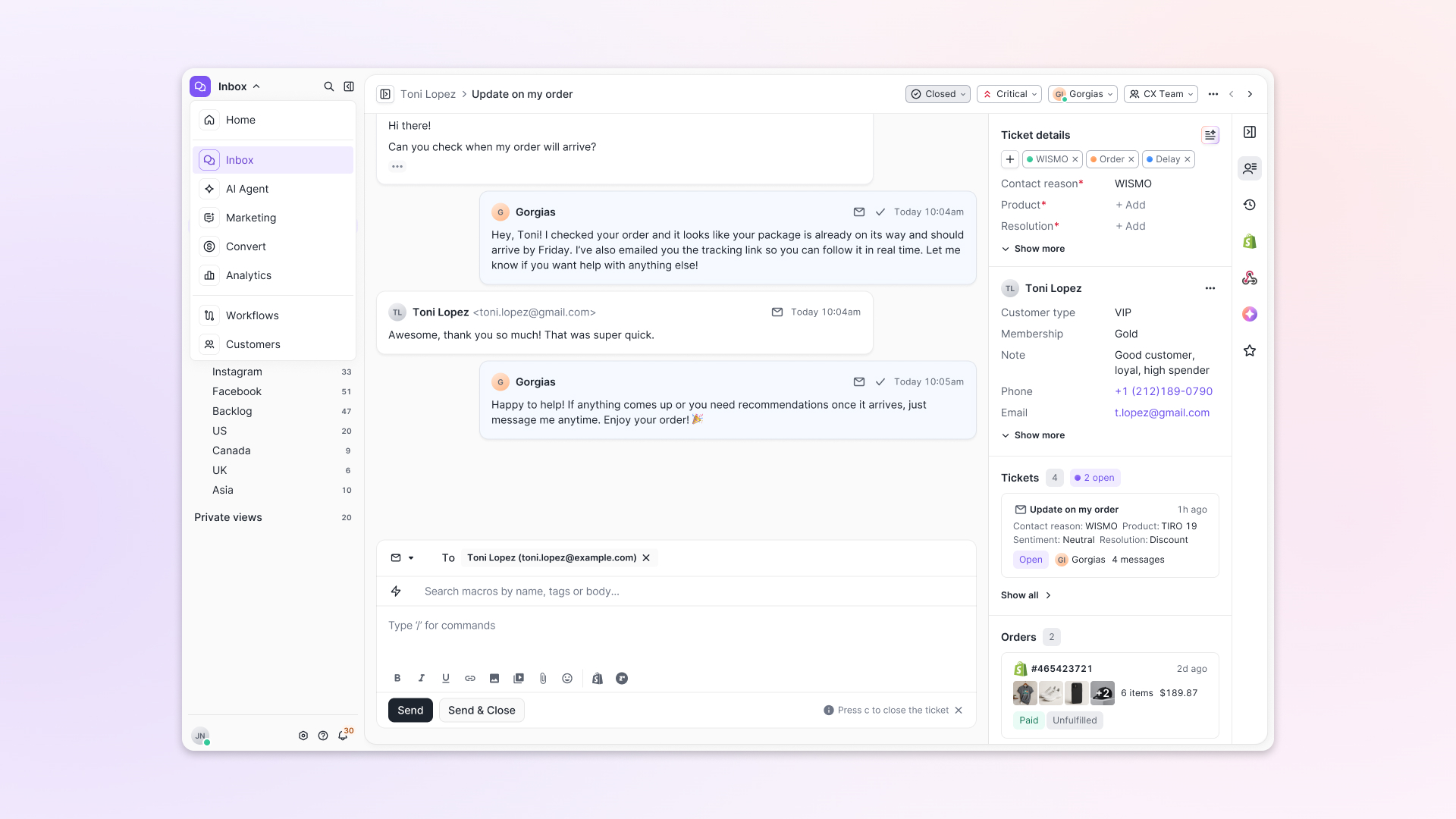
Introducing Helpdesk 2.0: Built for How Agents Work
TL;DR:
- Built directly from agent feedback, Helpdesk 2.0 fixes real workflow pain points. The redesign focuses on reducing friction and helping agents handle more context-heavy tickets.
- A chat-style interface replaces the old email layout. Conversations are easier to follow and resolve in one view.
- Customer context is shown beside the conversation in a right-side panel. Agents can view history, orders, and details without leaving the ticket.
- AI handoffs come with clear summaries. Agents instantly see what happened, what was tried, and what to do next.
- Navigation is simpler and faster across teams. Clean menus, structured queues, and multi-store access keep agents moving efficiently.
Helpdesk 2.0 starts with the people who use it most: the agents.
We spent time understanding customer support from the agent's seat. What do they reach for constantly? What slows them down? What does a better workday look like?
Everything we found is in this brand-new update.
Why we redesigned Helpdesk
Conversational commerce is the new standard.
In customer support, this means customers expect context to remain intact wherever they reach out, whether a conversation starts on social, moves to email, or ends on a call.
This new approach to support has also changed the agent's role. Recurring tickets, like order status checks, shipping updates, and returns, are now handled by AI. What lands in the agent inbox are edge cases that require human judgment and troubleshooting, or tickets that require the full picture.
However, the original Helpdesk was built for a different era of support.
Context was separated across views rather than built into the conversation itself. It's something one in five Gorgias customers flagged, through support tickets, NPS surveys, and conversations with our team. So, we got to work.
Helpdesk 2.0 is the result.
What's new in Helpdesk 2.0
Here's a look at everything that changed.
Read conversations the way they're meant to be read
Conversations have a natural rhythm, one that’s already found in every messaging tool we use. We brought that same layout into the helpdesk.
Say goodbye to the 2000s email interface and hello to chat bubbles. This updated design changes how quickly you can orient yourself and resolve the ticket in one go.
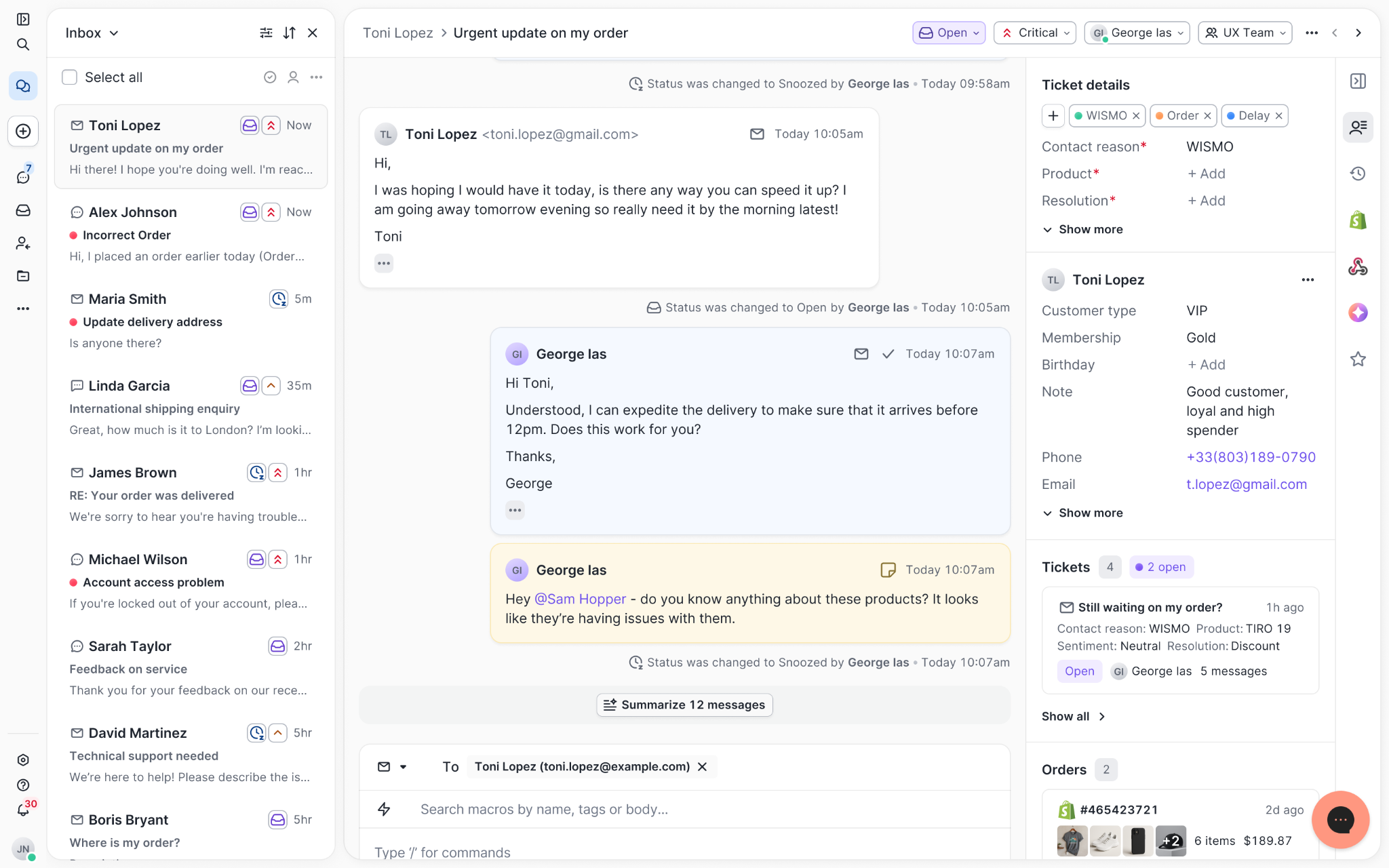
Chats with customers now look like real conversations, using the speech bubble style you’re familiar with on popular messaging apps.
Check customer history without losing your place
Checking a customer's history used to mean leaving the conversation, an extra step that interrupted what should have been a smooth workflow.
Now, past conversations open in a sidebar next to the active conversation. You can view a customer’s full history, search through their timeline, and open prior tickets without going to a new page.

Check past conversations, orders, and customer details in the brand-new Customer Timeline.
See order details the moment you open a ticket
Order information is easier to reference than ever. Open a ticket, and you instantly see the customer's recent orders, marked with product images and invoice details at a glance. Need to dig deeper? Click on an order, and the expanded information appears in the same panel.
For teams using custom integrations, apps are fixed in a quick-access integration menu on the right.
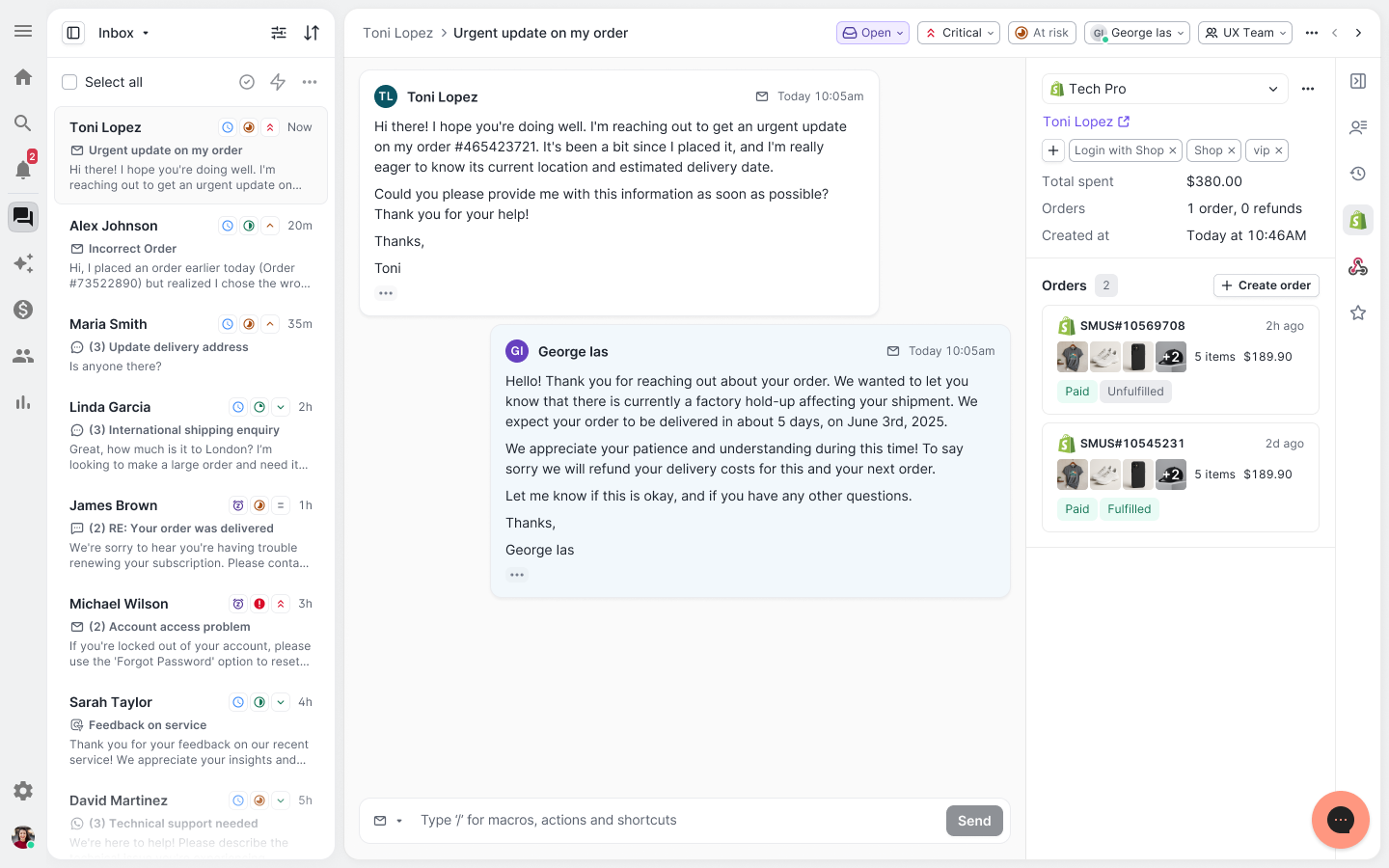
See order details, product images, and totals at a glance on the right panel, without leaving the conversation.
Pick up where AI left off
You shouldn't have to dig through a thread to figure out what AI already tried. Now you don't have to.
When AI Agent escalates a conversation, it includes a concise handover summary that mentions the issue, what actions were taken, and why it was passed to your team.
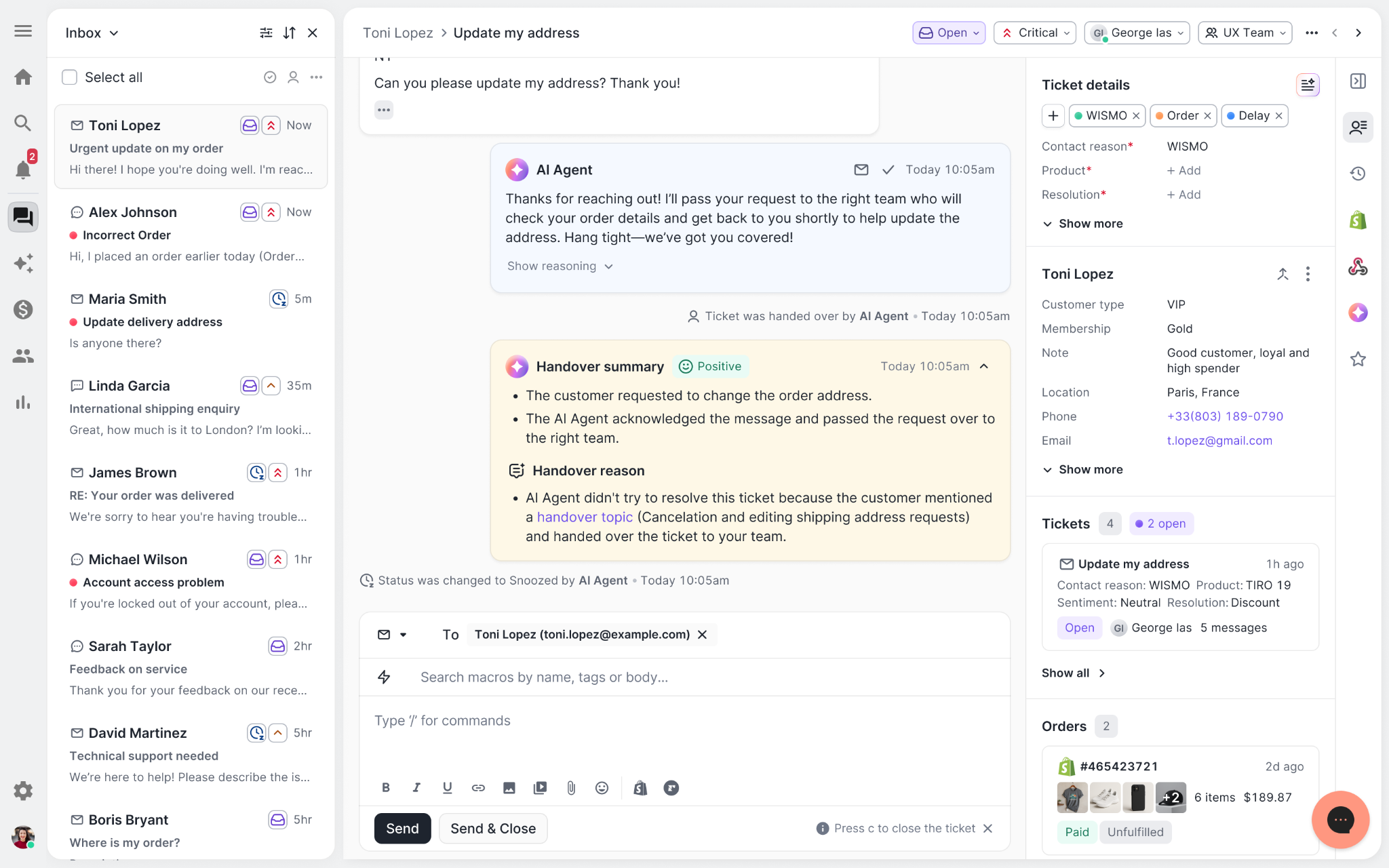
Escalated tickets include a brief AI-generated handover summary, marked in yellow, for quick reference.
Move faster across every store and team
We restructured and simplified the navigation. The left sidebar organizes everything into clear categories: Inbox, AI Agent, Marketing, and Analytics, so anyone on your team knows exactly where to go.
To quickly update your knowledge base or adjust a workflow, both now live right in the sidebar. For teams managing multiple stores, switching between them is just as straightforward, accessible from the sidebar, so agents can move between inboxes without breaking their flow.
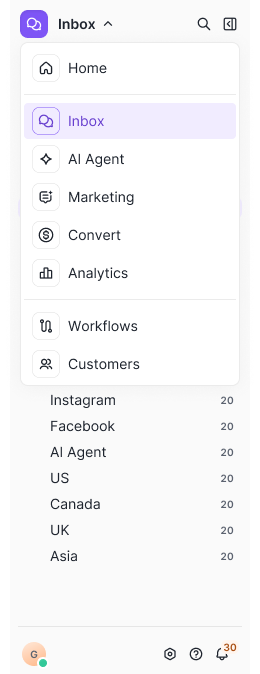
Agents can switch between stores and their corresponding inboxes directly from the left menu.
A workspace that works the way agents do
Support comes down to the person on the other end of the conversation. We built Helpdesk 2.0 is to make sure they have everything they need to show up for that moment.
The best way to see the difference is to work in it. Start a free trial today.


Further reading

Increase Retention and Reward Your Super Fans with Yotpo + Gorgias
With visibility into product reviews right in the Yotpo widget in Gorgias, your support agents will know right away if they're talking to someone who didn't love their last product, or someone who is a big fan of your brand. This knowledge will help you customize the conversation for the best experience possible.

"At OLIPOP, we’re always looking to have a holistic view of the customer to be able to offer the best possible experience. Having the ability to see their most recent reviews within the Gorgias platform is a total game-changer. " - OLIPOP, Director of Customer Experience, Eli Weiss

How to make the most of this integration
You can use Gorgias macros to quickly respond to customers that leave 5-star reviews to build brand loyalty. You can also create macros for customers who leave negative reviews to ensure their concerns are properly addressed, and send them a discount code to help rebuild trust!
By looking at the shopper's review history, your support agents can also quickly shift from just offering customer service to acting as members of the sales team. They can recommend products that are either similar to something the customer previously loved, or different than something they had a bad experience with.


"Gorgias clearly understands the needs of customer service agents, and with this new feature is working towards making all the day-to-day tools accessible from one tab, making work even more agile and with less distractions. We're particularly excited about the ability to understand customer sentiment from the get go, and how we can better approach our users based on the feelings they have shared about their past TUSHY purchases. If we see they are a super fan, we can go heavy on the butt puns, but if they've had a less than stellar experience we will aim to make up for it in our subsequent conversations, and even address things they don't directly mention! We're excited to see how this feature will help us deepen our genuine human connections. " - TUSHY, Director of Customer Experience, Ren Fuller-Wasserman


How to Write the Perfect Answer to Social Comments
So, how can you write the perfect answer to social media comments?
An answer that addresses the customer’s issue while upholding your brand?
Ecommerce companies are tasked with maintaining this balance every day. (Particularly companies that spend a lot on social media ads.) These brands are inundated with comments on their promoted content from happy customers, unhappy customers, prospective customers, and social media trolls.
In this post, we explore the depths of using social media for customer service.
Read on for tips and plenty of examples.
{{lead-magnet-1}}
Spending a lot on Facebook ads? (You need great social media customer service)
If you spend a lot of money on Facebook and Instagram ads, you’ll undoubtedly get dozens of comments per day. You can’t afford to ignore them.
Why your responses to comments matter
Responding to social media comments on your ecommerce posts and ads is critical.
74% of consumers rely on social media to help them make purchasing decisions. 71% are more likely to make a purchase based on a social media referral.
While the design and copy of your posts and ads are important, the comment section has equal swaying power.
Potential customers scope out the comments in an ad from an ecommerce company. They’ll read the positive comments, the negative comments, and how your company replies to both.
An amazing customer endorsement can fall flat if your brand didn’t comment with a grateful reply and simply ignored your raving fan.
Meanwhile, a customer complaint can have a less disastrous impact on a shopper’s purchasing decision if you reply and seek resolution with the customer.
How to excel at social commerce
Social commerce is a booming trend. TikTok is building out Shopify shopping capabilities in the app. Meanwhile, Facebook is also adding a Shopify pay button, and the social media platform already allows small ecommerce businesses to run a shop directly from their business page.
These social commerce developments are designed to keep consumers in the social media app, to the benefit of both parties (the social platform and the ecommerce business).
Consumers can be converted to paying customers without having to leave the app. This reduces the required steps to making a purchase, and increases conversions.
By responding to social media comments like a pro, your ecommerce company can also capture this social commerce trend. You’ll reduce the need for customers to go and read reviews elsewhere. They can get answers to their questions right in the social media channel. They can read the answers that your team has already written to other commenters.
By reducing the review-hunting step, you can increase conversions. Customers that have read comment threads can feel comfortable making a purchase immediately.
Related: Our list of the best social media integrations for Shopify.
Top ways that customers engage with your posts and ads
31% of consumers say that they use social media like Twitter and Instagram primarily to browse products. Consumers are accustomed to being shown products through organic posts and paid media.
They feel comfortable giving their opinion and speaking directly with a brand.
The top ways that customers engage with posts and ads are product endorsements, negative reviews, customer support complaints, and product questions.
Here’s an example of a customer commenting on a social media ad with a favorable opinion of the product:

These sorts of comments can have a huge impact on your conversions. While it’s hard to measure the exact impact, you might find that ads with a lot of positive comments perform better than new ads or ads with fewer comments.
{{lead-magnet-2}}
Why customers reach out through social media platforms
Today, social media is one of the most important customer service channels.
But some ecommerce companies are hesitant to spend too much time providing social media customer service. The management of the company might feel frustrated by the expectation to respond there, rather than through their customer support software.
If someone at your company is advocating against allocating support time to social media comments, ask them to consider customers’ needs.
Ultimately, the most successful ecommerce businesses get as close to their customers as possible. They listen to feedback and open up lines of communication on customers’ terms.
Customers leave important comments on your social media posts and ads because:
- It fits with their user flow - Consumers don’t want to have to leave their favorite social media app to find where else to communicate with you.
- They have come to expect a response - Because so many ecommerce brands excel at social media customer service, consumers expect all brands to respond to their comments.
- They want to feel like they have direct access to your brand - This goes beyond just getting a response. Customers want to feel heard and seen by your brand. They want to know that you offer true customer care, not just basic service.
If after empathizing with customers, someone at your company still doesn’t see the need to invest in customer service on social media channels, the following statistic might help...
A whopping 83% of global consumers expect a response time of 24 hours or sooner. If you want to meet those expectations, aim to automate at least 40% of your tickets — brands at that level respond in just 12 minutes on average, compared to 736 minutes for brands with near-zero automation.
That stat alone could be the ammunition you need to get your company on board with allocating time towards social media responses.
Related: Our guide to offering great customer service via Facebook Messenger.
Social media customer service strategy
What’s the strategy behind social media customer service?
It comes down to two key things:
- Increasing customer satisfaction
- Converting new customers
Let’s take a look at how to excel at both:
How to increase customer satisfaction
The comments section of your social media posts and ads offers an amazing opportunity to strengthen customer retention.
You might be able to discover:
- Ways to improve your products
- Ways to bundle your products, update your pricing model, offer subscriptions, etc.
- Potential brand ambassadors
- Potential user generated content creators
- Widespread product issues warranting refunds or recalls
- Copy or design ideas to attract more customers with new ads
- Product testimonials to include in ads or landing pages
- Ways to increase clarity in your website pages regarding what’s included with a product, where to locate information, etc.
There are so many incredibly valuable things you can get out of reading and responding to your social media comments, so don’t think of this as just a burden.
For example, in this comment thread, a customer points out the difficulty of finding information for an art subscription box. The social media manager politely accepts the feedback and promises to talk to the team about fixing the issue.
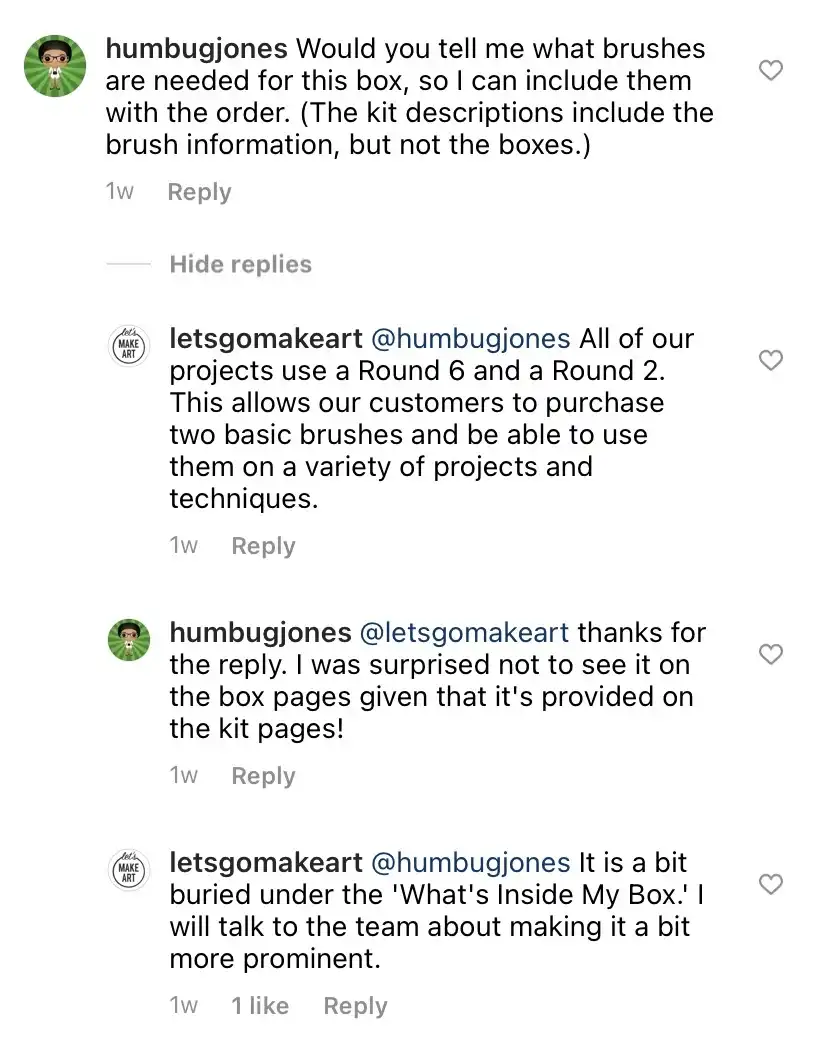
The company not only assists the customer hunting for the information, but also proactively fixes the issue so that other customers don’t experience the same confusion.
You can also drive brand loyalty by engaging with your biggest fans. For example, if a customer often posts positive review comments on your ads, you might thank them with a free gift.
Use social media to drive deeper relationships with your existing customers. Listen to them, heed their guidance, and find ways to thank those who go out of their way to support your business.
How to drive new customers
Use social media comments to convert new customers? Yes, it really is possible.
Here are the key ways to grow your customer base through social media comments:
- Respond to customer issues helpfully - It’s important that you reply politely and helpfully to your current customers. Prospective customers will be paying attention to how you resolve issues. If you don’t respond or respond in a rude or unhelpful way, prospective customers might not purchase from you.
- Respond to prospective customers’ questions - You also need to quickly respond to prospective customers questions. They might ask for help with purchasing the right product or they might have questions about what’s included with the product.
- Uplift positive comments - You should also respond to very positive comments about your products or company. This shows potential customers that you care about your current customers and that you appreciate the time and effort they put into saying something kind about your brand. For example, you might write something like “Thanks so much for letting us know. We’re so happy you love it.”
Here’s an example of a smart way to convert commenters into customers. The commenter is asking for help choosing the right foundation color, and the social media manager responds with the link to take their quiz.
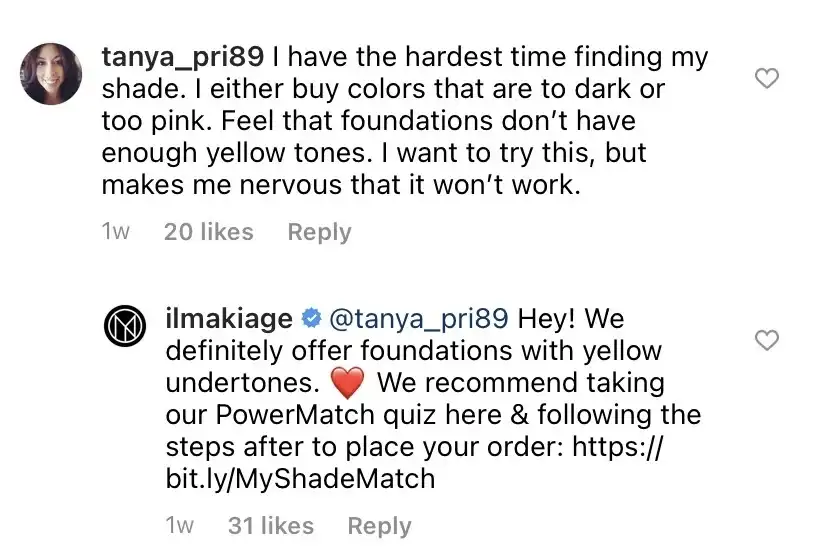
The company has wisely signed up for Bitly’s paid plan to offer easy-to-remember short links in their responses on social networks.
The comment got 31 likes. So, not only did the original commenter get access to the link, but many others saw the response as well. You can use social media customer support to drive traffic to your important website pages.
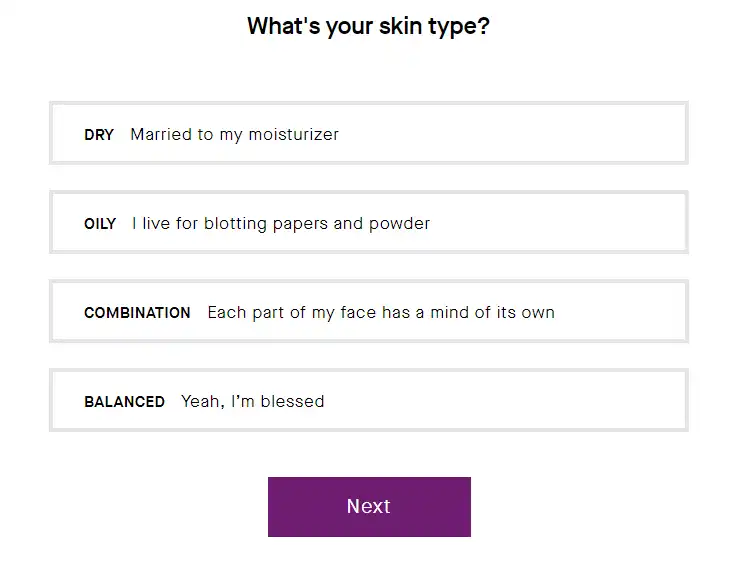
The Bitly link redirects to a quiz. After submitting all of the quiz answers, the user needs to offer up their email address to get their results.
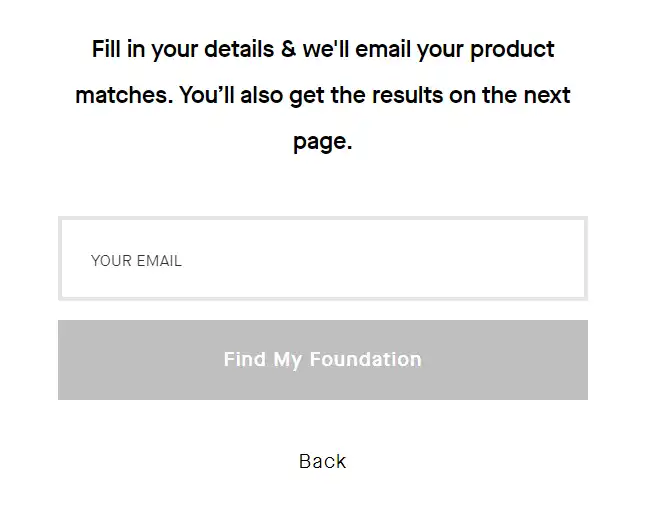
IL Makiage is wisely using social media comments as a way to grow their email list and offer exact product recommendations.
The most common social comments (with example answers from ecommerce companies)
How should your team members respond to social media comments? Across all of your social profiles, and especially where you run ads, you might run into the following types of comments.
Read on for example comments and effective customer service responses.
Shopper concerns and questions
One of the most common types of social media customer care required is simply answering questions and concerns. Potential customers will ask questions in social media comments about products of yours that they haven’t tried yet.
In this example, a customer asks about whether a foundation will be so heavy that it will cover her characteristic freckles. The social media manager offers an excellent response by sharing that the coverage is buildable.

In this example, a social media manager assures the potential customer that the product won’t exacerbate acne.
Note that the response quells concerns by sharing specific product details (oil-free and water-based).
Similarly, the customer service team member or social media manager handles a question with the opposite concern. One commenter worries about how the product will affect dry skin. The response features specific product details to address the issue (hyaluronic acid and vitamin E).

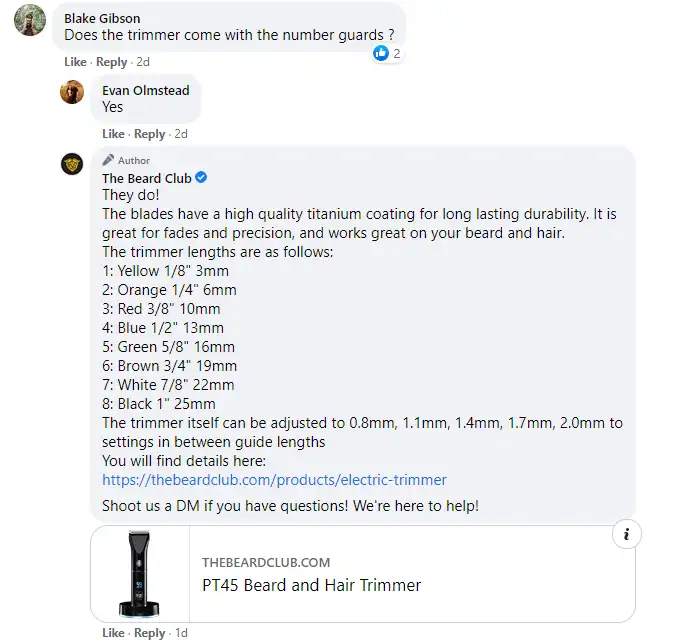
Details are the best way to address customer concerns. Just take a look at this example with features a very thorough response about the number guards included in a beard trimmer.
Customer questions
Your paying customers might ask questions as well. This is your chance to drum up excitement with current customers, engage with them on an emotional level, and show that you’re here to provide excellent customer service, even on social media.
In this example, a customer asks about whether or not the ad is featuring the next month’s art subscription box.

By answering with an upbeat tone, the social media manager gets the customer and other people reading the comment excited to receive the subscription box.
Customer endorsements
You’ll also receive customer endorsements and positive reviews in the comments section of your social media ads.
If you get an enthusiastic comment, don’t let it go unnoticed. You should reply to all of the detailed comment reviews you receive from customers.
Check out this example. The social media manager makes it clear that they are ready to offer excellent customer service if needed.
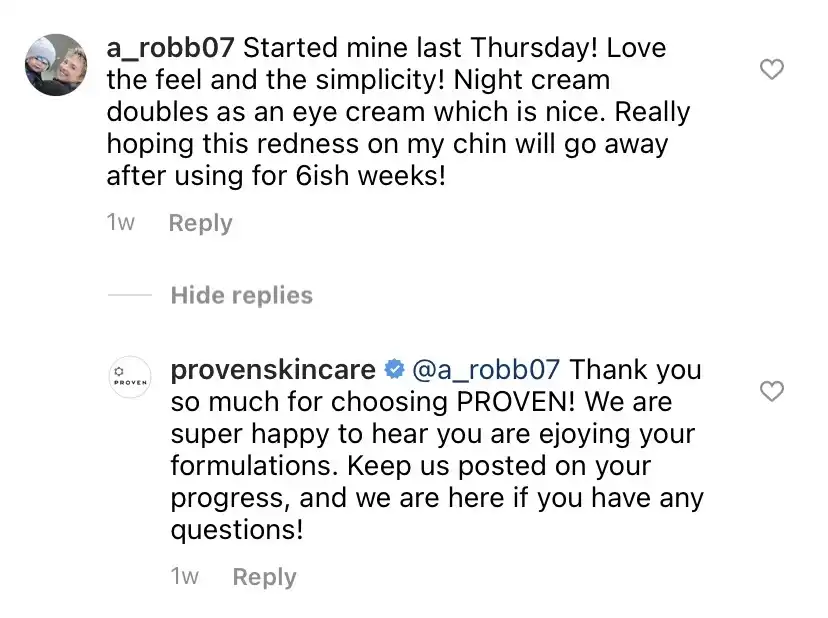
When reading this response, prospective customers can see that the company cares about their results and is available to happy to provide customer service solutions.
This can increase potential customers’ likelihood of purchasing from you.
Customer complaints
Of course, you’re likely to receive customer complaints as well.
You might get negative reviews about the delivery date, the cost of returns, or even the product itself.
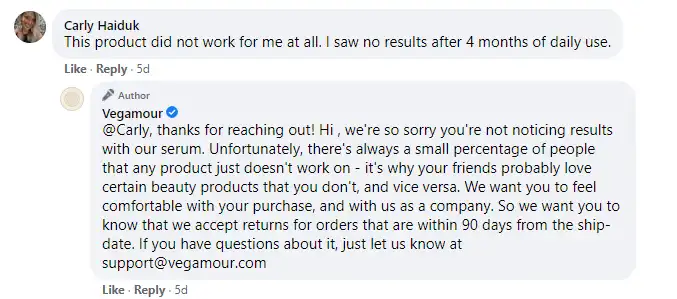
Check out this example response, which deftly handles a negative review.
When customer support shouldn’t respond
Social media monitoring is critical. But that doesn’t mean you have to respond to every comment written across your entire social media presence.
If you respond to certain comments, it could come off as creepy.
For example, social media users will often tag each other in the comments sections of ads they find intriguing or humorous. They might recommend one of your products to a friend.
In this case, they are not expecting the social media manager or customer support team to respond to them. They are expecting a response from their friend.

If someone from your company responds and says something like “You should buy them!” or “You would love them!” it will appear too pushy and salesy. Worse, the social media users might feel like you are infringing on their private conversation. Although these comments are public, to the users they are more like private messages.
If customers tag other users, not you, don’t respond unless there are serious service issues, such as product malfunctions or delivery delays mentioned in the comments.
You also don’t need to respond to very short positive comments like “love this!” You can simply like the comment if it’s something positive but lacks depth and detail.
Crafting the perfect social media customer service response
Customer service agents and social media managers can’t prepare for everything. Sometimes, comments will catch you off guard.
To offer amazing social media customer service, follow these steps every time.
1. Take time to fully understand the context
While responding quickly is important, you don’t want to respond too quickly. If you rush your response, you might miss out an important element.
For example, if someone asks about the nutritional value of a product, you might quickly offer a canned response. But if you consider the context of the ad, which talks about weight loss rather than speed of cooking like your other ads, this might help you highlight more relevant product details.
2. Craft your response, following these guidelines
When you’re sure you’ve got all the contextual information required to respond, you can go ahead and craft your response.
Make sure you hit these important points:
Product questions:
- Answer the question clearly
- Backup your answer with real, specific product details and information
Positive reviews:
- Thank the customer in a way that matches your brand voice
- If it fits your product, ask them to keep you posted of further results
- Let them know you’re here for them if they have any questions
Negative reviews:
- Empathize with the customer
- Accept their feedback in a mature way (as opposed to disagreeing with them or attempting to silence them)
- Share the potential resolution
- Divert the customer towards your helpdesk, knowledge base, or customer service team (as appropriate)
In all interactions, the customer service experience should match your brand’s personality.
3. For contentious issues, get approval before responding
Companies can get themselves in hot water when they’re too quick to respond to controversial comments. You might need to run your answer by your PR or communications team, especially if the topic is about sustainability, equity, diversity and inclusion, or the founders’ political beliefs or actions.
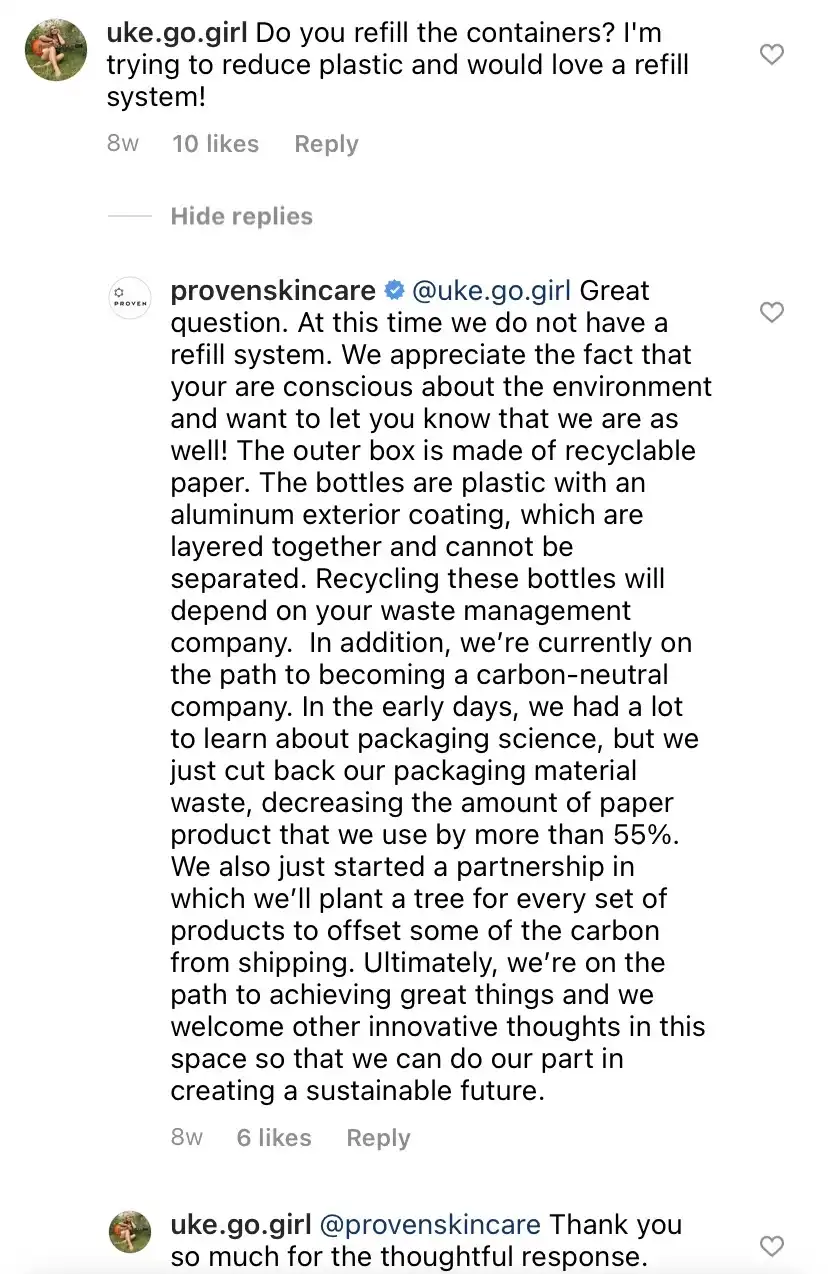
Here’s an example response to a question about plastic use reduction:
Sometimes, you might need to get a second opinion from the head of customer support for simple questions. Contentious responses don’t always have to be about political hot-button issues.
Here’s a great example response to a customer being shocked that there isn’t a customer support hotline.
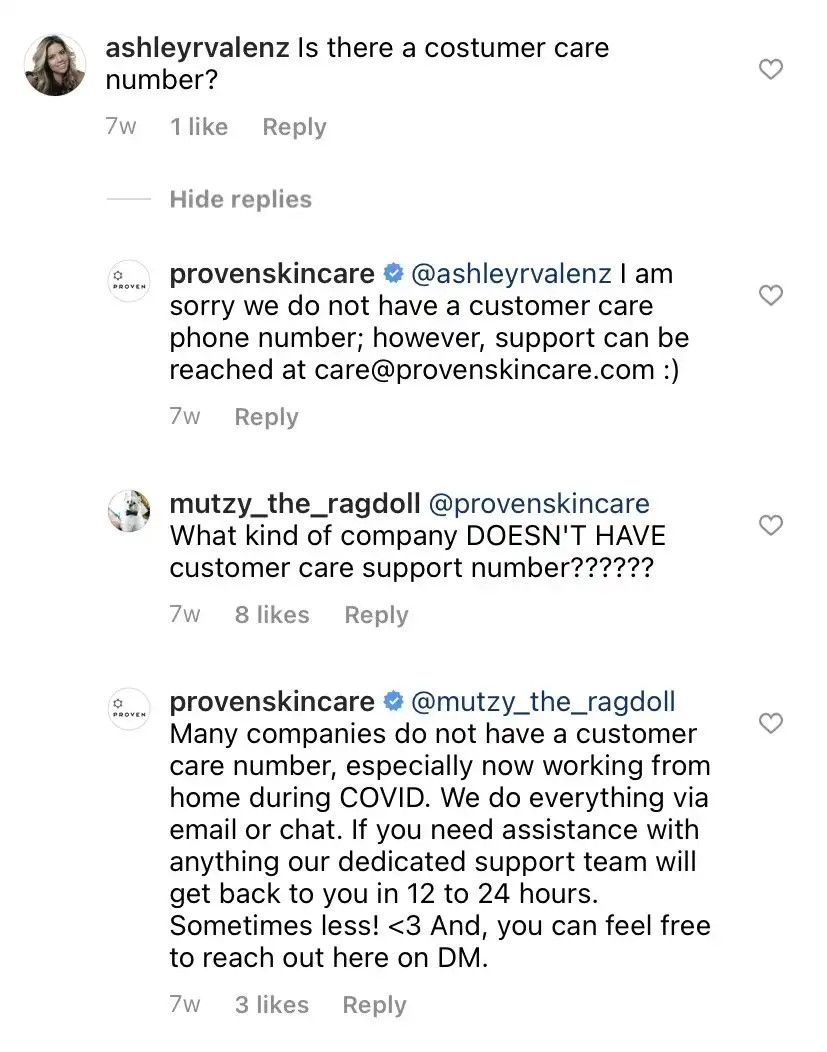
You don’t need to get every response reviewed. But when in doubt, play it safe and get a second opinion from the head of social media management or communications.
4. Respond to the comment, and create a ticket if needed
When you’ve got the right response, go ahead and comment. Don’t forget to tag the person you’re responding to.
If the social media commenter brought up an important customer support issue, you should create a ticket for the comment thread in your customer service software.
This way, you can track the resolution.
5. Make sure customer support sees the issue through to resolution
With a ticket open in your helpdesk, you won’t have to worry about remembering to check if the person wrote back. Instead, you’ll be able to see that open ticket, and you can then click through to the post or ad with the comment thread.
If it’s an important issue (the customer wants a return or hasn’t received their product in the mail), you should do one follow up comment and tag them to make sure they saw your response.
Follow these guidelines to social media customer service, and you’ll gain new fans while deepening your connection with your current customers.
Gorgias helps ecommerce companies grow through exceptional customer service. Learn more about Gorgias' social media features.
{{lead-magnet-2}}

The Annual Roadmap for Growing Your Ecommerce Store in 2021
Did you know that back in 2019 ecommerce sales worldwide were $3.5 trillion?
We don’t have the data for 2020 yet, but worldwide sales last year were projected to reach $4.2 trillion, though they have almost certainly exceeded that due to the pandemic.
And the ecommerce market is likely to continue growing in the foreseeable future, with the projected worldwide sales for 2022 being $6.54 trillion.
To ensure that your company continues to get a piece of the ever-expanding ecommerce pie, you must research, think strategically and plan your objectives annually by creating a roadmap.
In this post, we are going to discuss exactly how to create an ecommerce roadmap. It will display where your ecommerce store is going and the steps it will take to get there.
We will cover:
- Setting goals
- Creating a budget
- Building a team
- Managing that team
- Project planning
…and more.
Let’s dive in.
Analyze Your 2020 Performance
Okay, so before we start discussing the 2021 roadmap, it’s important to look back at the previous year.
Seasonal Trends and Peak Periods From the Previous Year
Every ecommerce business is subject to seasonality.
Some are seasonal in nature, such as those that sell winter sports gear.
But the vast majority of them see spikes in sales on Black Friday, Cyber Monday, and winter holidays.
You need to analyze the performance of the entire previous year if you want to properly prepare for 2021.
- Which month was the busiest?
- Which month was the least busy?
- Which products brought in the most sales during specific seasons?
Understanding this will help you create a more robust budget that won’t be thrown off by the seasonal ebb and flow of sales.
Moreover, once you know which periods resulted in the biggest increase in sales, you will be able to allocate your marketing spend more effectively. Tim Katz, Co-Founder of DYODE explains why this is important:
“Ensure that you have your merchandise, marketing communications, and project calendar planned out for the year; while this may seem like a trivial task it is a helpful habit to ensure cross-functional partners are aligned and in sync to support your growth. Look to refresh your remarketing efforts with relevant creative and messages and exclusive content and offers in order to ensure you are maximizing your most loyal audience.”
He continues:
“As online competition increases so does the cost of acquisition. Because of this, you should focus on nurturing your biggest fans with exclusive content, product, and communication. This is a new world that we live in and you should continue to evaluate your branding and product mix in order to stay relevant.”
Which of Your Channels Were Strongest/Weakest and Why?
Look at the campaigns you ran in the previous year and what marketing channels they utilized.
You need to figure out which of these marketing channels are the right ones to get your store the most ROI. Marketing channels can range from search engine optimization, PPC, social media, referrals, email and more.
Ask yourself:
- Which marketing channels brought the most sales?
- Which marketing channels brought the least sales?
You may want to apply the Pareto principle, also known as the 80/20 rule, which states that:
For many outcomes roughly 80% of consequences come from 20% of the causes.

The odds are that 80% of your sales come from 20% of your marketing channels while only 20% of your sales come from the remaining 80% of marketing channels.
Once you have identified the 20% of the marketing channels that generate 80% of your sales, consider allocating a significant amount of your marketing budget there.
Note: the exact ratio may be different, but a few marketing channels are likely producing disproportionate results. You want to double down on them.
Set Long Term and Short Term Goals for Your Ecommerce Store
Now that you have analyzed the previous year’s performance, it’s time to set goals for 2021.
Make Sure That Your Goals Are SMART
Arguably the most common mistake that people make when setting goals is being too vague.
That’s why it’s so important to set SMART goals.
SMART is an acronym that stands for:
- Specific. What exactly are you trying to achieve?
- Measurable. How will you measure whether you have achieved?
- Achievable. Is it realistic?
- Relevant. How does it fit into the big picture?
- Time-bound. By when do you intend to achieve it?

For example:
Instead of saying that you want to “make more money”, you can set a goal to “increase the annual profit by 25%”.
Why You Need Key Performance Indicators (KPIs)
Which metrics should you use to measure your progress towards your goals?
That’s where the Key Performance Indicators, also known as KPIs, come in.
Here’s the KPI definition:
A KPI is a business metric that is directly relevant to a specific business goal.
For example:
Let’s say that your goal is to increase the annual profit by 25%.
Obviously, the main KPI here is the annual profit, but what other metrics are relevant?
- Revenue
- Profit margin
- Number of sales
- Average order value
- Cost per customer acquisition
They are directly relevant to the goal because improving them would lead to an increase in annual profit.
You want to pick 3-5 KPIs to focus on.
Now let’s take a quick look at the important ecommerce metrics that you want to pay attention to in more detail:
Cart Abandonment Rate
Cart abandonment rate is the percentage of customers who put items in their carts but do not finalize the purchase.
For example:
Let’s say that 100 people put an item in their carts.
Out of those 100 people, 88 of them left without buying.
That means that your cart abandonment rate is 88%.
And if that number seems crazy high to you, note that the average cart abandonment rate worldwide in March 2020 was 88.05%.

Customer Acquisition Cost
Customer Acquisition Cost (CAC) is a metric that shows how much it costs you to acquire a new customer.
Its basic formula is this:
Marketing Expenses + Sales Expenses / The Number of New Customers Acquired = CAC
Customer Lifetime Value
Customer Lifetime Value (CLV) is a metric that shows how much an average customer spends throughout their “lifetime” as a customer.
It’s a more complicated metric, but here’s the main equation:
Average Order Value x Purchase Frequency x Estimated Customer Lifespan = CLV
Average Order Value
Average Order Value (AOV) is a metric that shows the average value of a sale.
It’s a simple metric to calculate:
Revenue / The Number of Orders = Average Order Value
Note that all these metrics have a direct impact on the bottom line which is why it makes sense to consider using them as KPIs.
Create a Budget
Cash is the lifeblood of any business.
Once you run out of it, that’s it, you’re done.
That is why it’s so important to be financially responsible, manage cashflow well, and establish an emergency fund.
In psychology, there’s a phenomenon called the planning fallacy:
“The tendency to underestimate the time, costs, and risks of future actions and at the same time overestimate the benefits of the same actions.”
Basically, everything will probably take longer, cost more, involve more risk, and yield fewer benefits than you think.
It’s crucial to keep the planning fallacy in mind when creating the budget for the upcoming year for your ecommerce store.
Make sure to:
- Be realistic. Look at the historic cashflow data. What can you reasonably expect?
- Add slack. Once again, everything will likely cost more than you think, so don’t make your budget so tight that every cent is allocated before it is even earned. Leave some slack in your budget.
Your top priority should be the growth of your ecommerce store.
Build Your Team
Ecommerce growth requires constant human resources and infrastructure.
This is why it’s crucial that you recognize there’s only so much that your current team can do to successfully scale your store. In fact, the chances are that in order to achieve your goals you may need to hire more employees throughout the year.
Begin this process by accurately determining your staffing needs.
Who Should Hire And When Should You Hire?
Company leadership should be working on the business, and not in the business. However if you are currently without an HR department, you may need to dedicate some time to finding the right hires and training them.
That’s why it makes sense to start hiring as soon as you map out what departments need additional roles.
Hiring Full-Time Vs. Hiring a Freelancer
When it comes to expanding an ecommerce team, you have two options for most positions:
Full-time employees and freelancers.
Full-time employees can be expensive. It’s not only their salary that you need to think about. There’s also sick leave, vacation days, health insurance, etc.
However, when you hire a full-time employee, you can expect them to give your business their undivided attention. Moreover, a full-time employee is likely to feel invested in the success of your company. Why? Simple. They don’t want to suddenly find themselves out of a job!
You only hire freelancers when you need them, you only pay for the work they do, you don’t need to provide any employee benefits.
However, they are likely juggling a bunch of clients, projects, and deadlines, which means that they won’t be as focused on your business.
It’s up to you to decide what is more suited to your ecommerce store.
Where To Find Top Performers?
Hiring a full-time employee?
Then your best bet is probably DynamiteJobs job board, assuming that you are hiring for a location independent position.

Meanwhile, if you are looking for a freelancer, then UpWork is a good place to start.

You may also want to post your job ad on skill-specific job boards.
Problogger job board is the most popular writing job board, so if you need written content, you can probably find a writer there.

Manage Your Team
Building a great team is not enough.
You also need to manage it well if you want your team members to do their best work.
Create a Job Description for Each Role
You want to have a specific job description for each role that explains exactly what that role entails.
That way you’ll avoid confusion, resentment, and shifting of responsibility (e.g. “I thought John was supposed to do that!”).
Assign Key Performance Indicators to Each Role
You should also assign KPIs to each role so that each team member would know what they should focus on. Dan LeBlanc, Founder of CEO Daasity explains:
“For the Merchants we worked with that saw triple-digit-growth in the past year they heavily invested in aligning their teams around the essential metrics to prioritize key initiatives. They ruthlessly tracked performance across their teams to make quick decisions on where to invest and where to reallocate budget.”
This also makes it easy to evaluate their performance.
Create a Timeline and Set Milestones
You also need to manage each project correctly if you want it to be done on time and at the expected cost.
Mapping out milestones and timelines in detail will do exactly that, by helping your team members know exactly what they need to do to get their tasks completed.
Step 1: Write a Project Scope Statement That Outlines the Deliverables
Every project should start with outlining the deliverables and what needs to be accomplished for it to be a success.
These deliverables should be specific.
For example:
If you want to build a blog this year, then one of the deliverables could be to publish one article per week for the entire year (52 articles in total).
Note that this is a deliverable that the person who owns this project can control.
Articulate the steps it will take to achieve your objectives.
Step 2: Create a Work Breakdown Structure (WBS)
Once you have defined the deliverables for the project, you need to create a Work Breakdown Structure (WBS). What’s that?
Here’s one definition:
“Deliverable-oriented hierarchical decomposition of the work to be executed by the team to accomplish the project objectives and create the required deliverables.
Here’s an example:

Step 3: Create a To-Do List for Each Work Package and Assign It to the Right Team Member or Department
Once you have created your Work Breakdown Structure, it’s time to assign each work package to the team member who will own it.
You also want to create a to-do list for each work package so that the person would know exactly what is expected of them. To-do lists are essentially checklists that list the actions one needs to take to perform a specific task. They reduce the number of mistakes team members make.
Step 4: Determine Total Time for Each Task and Therefore for Each Deliverable
Now that everyone has their work packages and to-do lists, you should estimate the total time required to complete each task.
Once you have these estimates, use them to determine the time required for each deliverable. This will speed up the process because the person working on a task doesn’t need to waste cognitive energy thinking about how long they should set aside.
Just remember the previously mentioned planning fallacy. Everything will probably take longer than you thought it would. Make sure to account for that.
Organize Quarterly Reviews
It’s crucial to regularly evaluate your progress if you want your team to stay on track throughout the year.
You can do that by organizing quarterly reviews where you:
- Evaluate the progress of each team member
- Evaluate the progress of the entire team
- Determine how you can help people to get back on schedule if they have fallen behind
- Evaluate each marketing campaign
- Evaluate analytics closely
- Decide on the next steps to take
Now let’s take a look at the marketing strategies of your roadmap.
Q1: SEO Planning and Content Creation
Want to get more organic traffic from Google?
Then you need to step up your SEO game. First, you must:
Conduct a website audit
You should start with auditing your ecommerce website. Site preformance is particularly important, as Ben Crudo, CEO of Diff agency explains:
“Don’t let your store slow down. Customer experience, sales, the Google ranking of your website, and mobile performance are all impacted by site performance. Making a habit of regularly auditing your site for speed, and taking steps to optimize it will ensure that your store keeps up with customer’s expectations for performance.”
Here’s what you want to know:
- Is your website mobile-friendly?
- Are there any outdated pages, broken links, etc. that need to be updated?
- Which content gets the most organic traffic?
- How is product organization?
- How are usability and speed?
- How is the customer experience?
You also want to critically evaluate your content. How can you make it better?
Choose keywords
Next, you want to identify keywords that you could rank for.
Here’s an overview of the keyword research process:
Find Keyword Ideas
You can use your knowledge of your niche to find keyword ideas. What are your potential customers interested in? Brainstorm these seed keywords.
You may also want to go where your customers hang out online and observe the conversations happening there.
Finally, be sure to check out what your competitors are doing, especially what content ranks well on Google.
Create a Keyword List
Once you have identified enough promising keywords, you should compile them into a keyword list.
Do Keyword Analysis
Once you have your keyword ideas, use a tool like Ahrefs to analyze the relevant keywords.
Which ones seem promising? Look at metrics like keyword difficulty, search volume, clicks and traffic potential.
Note that you want to focus on keywords that you can realistically rank for.

Develop a content strategy
Now that you have a keyword list, it’s time to develop a content strategy.
Go through your keyword list and turn each of these keywords into an article topic.
Then create a content calendar so that you would know when each article should be published.
Content creation
Once you have a content calendar, it’s time to start writing.
You can write the articles yourself or you can hire a writer to do it for you.
You may want to post a job ad on the previously mentioned ProBlogger job board if you choose the latter option.
Plan link building opportunities
It’s important to understand that creating great content is not enough. You also need other people to link to that content. Why?
Google uses backlinks as one of the top ranking factors to determine how valuable the page is to the visitors and where it should be placed in the search results pages for that keyword.
But not all links are made equal. The higher the domain authority of a website, the more valuable the link.
You can use the Moz free Website Domain SEO Analysis Tool to see the domain authority of a specific website.

Your aim should be to get as many backlinks as you can from authoritative websites so that your content will rank and in return, your ecommerce store will gain organic traffic.
Tackle the technical SEO basics
You also need to have your technical SEO on point if you want your content to rank on Google.
Here are a few basics of you need to optimize:
- Site structure
- Site speed
- Indexing issues
Q2: Focus on your website
Okay, so now you are on track to increasing your organic traffic, but how can you make the most of it? By optimizing your website.
That’s what you should focus on in the second quarter of the year.
Customer Journey Analysis
You want to start by analyzing the customer journey.

Look at your data.
What steps do the customers take to get from that first interaction with your company to completing a purchase?
You want to map this out so that you can then improve this process by finding the answer to questions like:
- Why did that customer not find what they searched for?
- Did this person not complete their order?
- What changes do I need to make to the layout of my ecommerce site to increase conversions?
Create a customer support powerhouse
There is often a lack of personal interaction between consumers and companies. This has led to a growth in customers feeling frustrated, since they often run into issues and can't easily find a customer support agent to talk to.
Even worse, some companies make their customers wait a long time for a response or don’t get back to them at all.
And since 95% of consumers say that customer service is important for brand loyalty, your ecommerce store needs to implement a fast and proactive customer support strategy that guides visitors through the customer journey.
The following tactics will delight your customers and keep them coming back for more.
Reduce your first response time
First response time (FRT) is the time elapsed between a customer submitting a query and how long it takes a customer service agent to get back to them.
Today, customers expect a fast response. In fact, data shows that 88% of customers expect a response to their email within 60 minutes and 30% expect a response within 15 minutes or less.
Fortunately, a helpdesk like Gorgias now offers the ability to create macros.
Macros are canned responses that agents can use for dealing with specific topics. This makes it much easier and faster to answer your customer’s queries. You can also add other pieces of information to your macro, such as Shopify data, like a customer’s order number.
Reduce your resolution time
Resolution time is the average amount of time it takes your customer service agents to close a ticket after it has been opened.
To reduce your resolution time, all of your customer’s tickets must be managed from one centralized hub in a multichannel helpdesk. This means your customer support team will have a full view of all your customer’s messages, no matter what channel they reach out from.
Keep in mind that your customers reach out through various channels, (i.e. social, chat, email, phone).
The number of your one-touch closed tickets will also increase, which is important. After all, 33% of all consumers consider the most important aspect of good customer service experiences to be being able to get their problem solved in one single interaction.
High customer satisfaction (CSAT) score
One way ecommerce stores measure their success is with the key performance indicator Customer Satisfaction Score (CSAT). It is a survey that determines a customer’s level of satisfaction at key interaction times, such as a support ticket exchange.
The types of questions you would ask in your survey would be variations of “How would you rate the support you received?”.
Then, respondents answer by using the following 1 to 5 scale:
- Very unsatisfied
- Unsatisfied
- Neutral
- Satisfied
- Very satisfied
I recommend that you present a CSAT survey after a ticket resolution, since this would be the perfect time to gather customer sentiment.
Then, take onboard their feedback and see how you can make your other customers happier by improving your customer support strategy.

The Best Ecommerce Communities To Join To Grow Knowledge as an Online Merchant
Let’s keep it real:
Growing an ecommerce store can be difficult. You need to consistently compete to attract customers to your website and win sales.
There are so many business decisions that you need to make, from product selection to logistics to marketing.
That’s why it’s so important to study every facet of running an ecommerce business. It will allow you to stay on top of your game at all times.
One of the best ways to learn more about the ecommerce industry is to join an ecommerce community.
Want to take your ecommerce career to the next level? Keep reading.
{{lead-magnet-1}}
What Are Ecommerce Communities and Why Do They Matter?
Ecommerce communities are specialized online communities dedicated to ecommerce businesses.
These communities are meant to be a gathering place for ecommerce professionals where they can meet, share what they have learned, and get advice.
Some of these communities exist as standalone online forums, some of them as subforums of large online discussion platforms, and some as user groups on social media networks.
Some of them are free for everyone to join, some are exclusive to paying members.
But whatever the particular setup is, the aim of all these ecommerce communities remains the same: helping ecommerce professionals connect and learn from each other.
By the way, if you're just starting your online store, check out our ecommerce launch checklist to make sure you cover all your bases.
Why Should You Join an Online Ecommerce Community?
Joining an ecommerce community can help you grow your ecommerce knowledge and make your sales soar.
Here’s how...
1) Peer Effect & Feedback
Ecommerce communities are full of ambitious, hard-working, motivated ecommerce professionals who are passionate about selling online.
Hanging out with fellow online merchants will fuel your ambition, inspire you to work harder, gather ideas that will gain more sales and keep you motivated day in and day out. Especially if you can find a community dedicated to your specific ecommerce niche.
In fact, studies have shown that when performance feedback is received, it has both a cognitive and a positive motivational impact on individuals.
2) Mutual Help
Mistakes are unavoidable.
But they are also expensive.
And they can seriously set back the growth of your ecommerce store if you make the wrong decision and implement an incorrect strategy.
That’s why it makes sense to ask for advice when you have to make an important business decision.
When you are a member of an online ecommerce community, you can post a question and get various perspectives. This can help you see the situation in a new way.
Moreover, these communities are often frequented by seasoned ecommerce professionals, which means that you can get advice from people who have achieved more than you.
3) Build Relationships
You have probably heard the saying:
“It’s not about what you know, it’s about who you know.”
And while it may be an exaggeration since your actual skills are definitely important, there’s no doubt that there’s a lot of truth in that phrase.
Relationships with the right people can lead to:
- New business ideas
- Lucrative collaborations and partnerships
- Mentorships that accelerate your progress
...and more.
But you can’t just go about your daily life expecting to somehow bump into the right people by accident. You need to get out there and proactively build your network.
And what could be a better place to start than an ecommerce community that’s full of ecommerce professionals just like you?
4) Accountability
To grow your ecommerce store, you need to go above and beyond your customer’s expectations. That’s how you will stand out from everyone else.
But this can be easier said than done. You want to show initiative, you want to prove how excellent your products are, you want to add value… But the competition can be fierce, especially since there are currently 7.9 million online retailers in the world and 2.1 million of them are in the United States.
That’s where joining an ecommerce community can help as well. You can keep yourself accountable by announcing your extra-curricular project and then posting progress updates. You can even get an accountability buddy with whom you can check in with.
Social pressure is an extremely powerful thing. No one wants their store to fail. So make yourself accountable and start getting things done.
{{lead-magnet-2}}
The Best Ecommerce Communities
Okay, so now that you understand how joining an online ecommerce community can help you gain ecommerce knowledge and perform better, let’s take a closer look at some of the best ecommerce communities out there.
Shopify Plus Community

The Shopify Plus Community is an official Shopify Facebook group. It currently has 7.1k members. It is a closed group and you can only become a member if you are a Shopify Plus Merchant.
It’s a great place to access and network with other growth-minded business leaders who have already scaled their ecommerce store.
You will be able to discuss experiences and strategies with high-volume merchants that will help you not only survive in the commerce world, but thrive.
Members are also known to provide recommendations of the tools they use that help them achieve sucess, like push notification apps and multi-channel helpdesks. This will help you avoid the trial and error phase that inevitably comes along with trying new software that you need for your ecommerce store.
Ecommerce Elites Mastermind

This is a private Facebook group that was created by ecommerce entrepreneurs Steve and Evan Tan who have built several million dollar stores.
This is a large and active ecommerce community that has 107k+ members at the time of writing.
It’s a great place to discuss any ecommerce topics, like Shopify/Magento tips, Facebook ads, social media marketing, and conversions. But it’s especially useful if you need advice on international ecommerce as there are a lot of members from outside the U.S.
Shopify Ecommerce Group

Shopify Ecommerce Group is an unofficial Shopify public Facebook group for ecommerce professionals who use Shopify. It has 29k+ members at the time of writing.
You can get help on various topics related to the Shopify platform, from using the core software to various helpful apps to conversion optimization tips.
You don’t need to join the group to browse the posts, so you can check them out and see if you find them useful before you commit to joining the community.
Ecom Empires

Ecom Empires is a private Facebook group created by Nick Peroni for ecommerce professionals. It has 97k+ members at the time of writing.
Here you can find discussions on a wide variety of ecommerce topics, from software to logistics to marketing. Whatever your question is, the chances are that someone on the Ecom Empires group has an answer.
Shopify Entrepreneurs

Shopify Entrepreneurs is another unofficial private Facebook group that caters to ecommerce professionals who use Shopify. It has 106k+ members at the moment of writing.
It is full of a diverse group of people, from Shopify store managers, store owners and expert service providers that include marketers, designers and developers.
This makes it a great place to get feedback on Shopify stores, but keep in mind that the moderators need to approve each post manually. Not all posts get approved.
Although this may seem like an unnecessary hurdle when you want to ask a question, it also means that the content quality remains high.
The Ecommerce Marketing Community

The Ecommerce Marketing Community is designed to connect ecommerce founders who are growing their brands from $0 to $1 million in sales. They bring in ecommerce experts every month for a monthly AMA, along with having daily posts sharing what founders are learning. With over 1,200 members, the community is growing every day and the perfect place to share e-commerce marketing tips you're using to grow your brand.
WooCommerce Community

WooCommerce Community is the official WooCommerce ecommerce platform Facebook group. It has 40k+ members at the time of writing. It was created to help online merchants with features and functionality of their WooCommerce store.
It’s one of the best places online to get answers to questions related to WooCommerce software. It also provides an opportunity for WP developers and WooCommerce euthanists to connect and discuss ideas.
Cener Ecommerce Mastermind

Cener Ecommerce Mastermind is a private Facebook group for ecommerce professionals that has 52k+ members at the time of writing.
It was founded by a successful ecommerce entrepreneur Justin Cener who has built and sold a 7-figure ecommerce business. It was originally a closed Facebook group made specifically for Justin’s clients.
It’s a great place for online merchants who want to gain ecommerce knowledge as he still hangs around and answers as many questions as he can.
Ecommerce Entrepreneurs

Ecommerce Entrepreneurs is a private Facebook group that is affiliated with the popular website A Better Lemonade Stand.
It’s an active community that has strict rules and is heavily moderated.
They only accept users that:
- Have been active on Facebook for over a year
- Have valid profile photos
- Belong to less than 50 Facebook groups
You will need a password to access the group, which you will get immediately after reading and agreeing to the group rules.
Ecommerce Fuel Forum

Ecommerce Fuel Forum is an exclusive online community for 7-figure ecommerce business owners.
This is probably the best place for successful ecommerce entrepreneurs to network with other successful ecommerce entrepreneurs.
You will need to apply and pass the vetting process to join this community, but it’s worth the hassle.
SEO Chat

Does search engine optimization (SEO) feature heavily in your company’s marketing strategy?
Then you may want to check out SEO Chat, an online forum dedicated to the topic of getting organic search traffic from Google.
Being a member of an SEO community can help you stay up to date on the latest SEO strategies and tactics. This is important given the fast-paced, ever-changing landscape of search engine optimization.
Digital Point Ecommerce Forum

Digital Point is a massive online forum that has subforums for pretty much everything related to developing stores, from SEO to pay-per-click advertising to copywriting. It even has subforums for web development and web design!
You may want to check out the ecommerce subforum. At the time of writing, the last message on it is almost a week old, so it’s not particularly active. Still, you can post your question there and see if you get replies.
Plus, it may be worth your while to browse the archives, since some popular threads have received 1,000+ replies. You may find valuable business insights buried in those discussions!
BigCommerce Forums

BigCommerce is a sophisticated ecommerce platform that provides all the functionality needed for running a medium to large ecommerce business.
They have an official online forum where anyone can ask questions related to ecommerce in general and BigCommerce software in particular. You will find that the forum is split into various different groups.
Reddit Ecommerce Subreddit

You are probably familiar with Reddit, which is one of the largest online discussion websites in the world.
On it, you can discuss pretty much anything, from cute pet videos to business to politics.
At the moment of writing, the Ecommerce subreddit has over 140k subscribers. You can post your own threads as well as participate in other members’ threads.
It’s a public forum, so the discussion quality can be hit and miss, but if you keep an eye on this subreddit you will almost certainly stumble across some gems (detailed case studies that companies share are especially valuable).
Reddit allows you to sort posts by popularity over a certain time period, which is a handy feature if you want to quickly check the most upvoted posts of the day, week, month, or year (or even of all time).
Shopify Community

Shopify, one of the most popular ecommerce platforms out there, has its own official forum called Shopify Community.
You can ask questions on a variety of ecommerce topics, from the technical stuff to store design to marketing to payments to selling internationally.
There is even a subforum focused on the social impact of ecommerce where people can discuss how to grow sustainable and socially conscious brands.
Plus, there’s also a subforum specifically dedicated to feedback requests, so if you want feedback on a Shopify store, that’s the place to go to.
Shopify Community is an active online forum. At the time of writing, the latest messages in quite a few subforums were posted less than half an hour ago, in some cases as little as 3 minutes ago.
So if you want to get answers to your Shopify questions, you should definitely check out this ecommerce community.
Gorgias Community

Gorgias Community is an official group created and managed by the team at Gorgias. It is a closed group that only existing Gorgias customers can join.
The group is a place where customer support teams can collaborate and share ideas on training, strategy, tactics and more. Being an active member of this Facebook group will help you take your ecommerce store’s customer support to the next level.
Since it and covers all types of customer support topics, it is a great place where you can share your successes and help others in the ecommerce community solve their problems too.
Wrapping Up
Ecommerce communities are places where you can find inspiration, learn the latest tactics, and network with other ecommerce professionals.
They are an ideal place where online merchants will find invaluable information that will help them take their ecommerce store to the next level.
We recommend that you not only join ecommerce communities, but be active in them. You won’t regret it.

8 reasons why ultra-fast fulfillment should be your new normal in 2021
In 2019, Amazon Prime broke records, delivering a bottle of Oyster Bay Sauvignon Blanc in just 13 minutes. But what was a novel example of ultra-fast fulfillment is quickly heading towards normality, as customer expectations rise beyond the buy button and beyond Amazon.
Only a third of customers will wait three or more days for an online delivery, and one in four shoppers will choose a retailer because they have better delivery options than their competitors. In other words, fast fulfillment is the new eCommerce standard for 2021.
But you don’t want your eCommerce brand to be standard; you want it to be exceptional, and this is where ultra-fast fulfillment comes in.
This blog will go over ultra-fast deliveries and how to get them for your eCommerce store.
What is ultra-fast fulfillment?
Ultra-fast fulfillment is an eCommerce delivery standard that beats standard fulfillment speeds by delivering orders in 3, 2, and even next day.
The actual date of ultra-fast delivery depends on the customer location and your fulfillment partner’s order cut-off time. For example, a customer living 3 kilometers from your warehouse, placing an order at 10 a.m. on a Monday, could receive their order the same or next day. A customer living 4,000 kilometers from your warehouse placing an ordering at 5 p.m. on Monday would receive their order later.
To make this possible, eCommerce sellers can use a combination of distributed warehouses, an array of carriers and overnight shipping services, or leave it to an all-inclusive outsourced fulfillment provider.
First, let’s look at why ultra-fast delivery is critical for eCommerce success this year.
8 reasons ultra-fast fulfillment is critical for 2021
Ultra-fast delivery isn’t anything new; as you heard, Amazon has been delivering items super quick for years. But events in 2020 have made ultra-fast fulfillment crucial for eCommerce success in 2021, for several reasons.
1. Providing ultra-fast fulfillment as your eCommerce differentiator
eCommerce is becoming an increasingly noisy industry, with more people selling online than ever before.
Last year, we witnessed the shift from physical to online retail accelerate by approximately five years. eCommerce is booming, and so is the competition. Accordingly, you need a sustainable differentiator to stand out;- something that can set you apart without significantly diminishing your profits, as price wars can do.
Ultra-fast fulfillment is your eCommerce differentiator. It’s dynamic, specific, and convenient -- providing customers with something valuable, personalized, and noticeable to distinguish you from your competitors.
Shoppers also like talking about and listening to positive delivery experiences -- allowing you to further differentiate your customers using positive user-generated content and feedback to secure more conversions.
Relevant reading: How fast delivery can help your Shopify store stand out
2. Winning customers from Amazon
Amazon ships fast, and shoppers know that - it’s why 63% of consumers head straight there. However, 2020 caused a change in shopper behavior, with more consumers wanting to shop directly with brands rather than via an online marketplace.
According to RetailDive back in 2018, 81% of consumers planned to shop directly by 2023 - and with Amazon Prime suffering notable outages last year, we expect this statistic to be achieved earlier than expected.
Ultra-fast fulfillment provides shoppers with the convenience of Amazon’s shipping speeds with the personal and rewarding experience of shopping directly with online brands. It allows you to offer the best of both worlds and benefit from Amazon’s disloyal customer base.
3. Increasing your visibility online
To stand out, you must be seen, and ultra-fast shipping speeds help with that too.
If you’re a multi-channel seller, fast shipping programs such as Walmart TwoDay and Wish 2-day increase your visibility with search rankings, fast shipping tags, fast shipping-filters, and buy box preference. This, in turn, boosts your website traffic, as people learn about your brand and google you to find out more.
You can also increase the visibility of your website among paid advertisements. Dynamic, fast shipping ad tags display 2-day or next-day delivery tags on your Facebook and Google Shopping advertisements, depending on the customer’s location. This makes your ads visually stand out to attract customer attention.

4. Providing Insta-gratification
May 2020 saw Instagram Shops hit the eCommerce scene, bringing a whole new level of instant gratification.
Shoppers use Instagram to seamlessly browse products and place orders without leaving the platform - increasing the speed they can purchase.
Ultra-fast fulfillment ensures you don’t ruin an Insta-worthy customer experience by slow deliveries. Instead, customers receive their product while they’re still excited and engaged, making them more likely to share their buying experience on the platform.

5. Providing more control to your buyers
Buying products online can be unpredictable. Customers don’t know if the product quality will match expectations, when the order will arrive, or if it will arrive at all. This makes shopping online stressful for many, and the panic buying of 2020 only made things worse.
Ultra-fast shipping comforts customers and provides reassurance and convenience in an unpredictable world. Customers know when their order will arrive, meaning they spend very little time in that gray area between order placement and receipt.
Let’s also not forget that sometimes shoppers have no control over how quickly they need an item - think forgotten anniversary gifts or empty beauty products. Ultra-fast shipping allows customers to regain control over the situation by rectifying it as soon as possible.
6. Meeting the emotional needs of shoppers
Customers have certain emotional needs you need to meet when selling online, and that’s gotten even more prominent over the past 12 months.
2-day and next-day delivery speeds cater to these emotional needs in four different ways:
- Providing easy-to-understand shipping expectations that reduce ambiguity and increase certainty.
- Delivering products as soon as possible to provide instant gratification and remove worry.
- Highlighting exceptional customer care to increase trust.
- Providing strong customer service to support the customer through their purchasing journey.
Ultimately, fast shipping excites customers during the purchasing phase, supports them during the delivery phase, and pleases them during the receipt phase.
7. Creating business resilience during growth periods
eCommerce has been running at a peak since the middle of last year, creating certain industry strains.
Amazon FBA couldn’t keep up with the demand, resulting in the suspension of non-essential inbound deliveries and slow delivery speeds - while other sellers faced broken supply chains, insatiable demand, and overwhelmed shipping carriers.
Successful brands were those that could rely on a strong and fast fulfillment infrastructure to maintain delivery speeds and meet the demand of their customers.
8. Reducing strain on your customer service
Customer relations are integral to your store’s success and reputation, necessitating fast, easy, and helpful customer support.
Ultra-fast fulfillment helps your customer service team reduce the number of “where is my order?” queries, by removing uncertainty and delivering before frustration sets in.
This gives your customer service team more time to handle other customer matters, initiate proactive customer support, and nail your customer service in 2021.
How to attain ultra-fast fulfillment speeds
Perhaps the biggest question in your mind isn’t the benefits of ultra-fast deliveries, but the practicalities of them. How do you match the speeds of Amazon Prime to provide next-day and 2-day deliveries on your Shopify store or other eCommerce platform?
Distribute inventory across the country
The first step in attaining ultra-fast fulfillment is distributing your SKUs across the country. The closer your inventory sits to the end customer, the less time it takes to get to their front door.
This enables you to increase delivery speed - providing 2-day deliveries across the country and next-day deliveries to customers living within a certain radius of your warehouses. And the less distance orders must travel, the less money you spend on shipping costs.
For example, Deliverr strategically distributes inventory across the country based on historical demand. That means we predict where your most demand will be, and preemptively store SKUs near buyers.
Optimize internal fulfillment processes
The less time it takes between receiving an order and handing that order to your shipping carrier, the more time your shipping carrier has to deliver an order expeditiously.
If you fulfill orders in-house, optimize your internal fulfillment processes to minimize order handling time by:
- Using real-time order management software to download new orders and print shipping labels upon receipt.
- Adapting your warehouse layout to mimic your order fulfillment workflow (for example, order download station > fast-moving stock > packaging station > warehouse door).
- Using temporary staff during peak retail periods such as the holidays or ‘Back to School.’
Package orders properly
A lost, damaged, or incorrectly delivered package is a surefire way to downgrade your delivery service from ultra-fast to ultra-slow.
Reduce the chances of this happening to your order by securely packaging orders using the right materials, eCommerce dunnage, shipping labels, and traceable shipping service.
Tip: If you’re outsourcing, send your items into your fulfillment center as you want your customers to receive it.
Partner with an outsourced eCommerce fulfillment service
If you don’t have the time, space, or expertise to achieve ultra-fast fulfillment yourself, it’s time to switch from in-house to outsourced fulfillment.
An ultra-fast fulfillment service like Deliverr is optimized for 2-day and next-day deliveries, using:
- A network of warehouses across the country
- Intelligent stock distribution software
- Scalable storage and staff to manage peak periods
- Fast-shipping designed processes and practices
You simply distribute your stock according to their instruction, and they do the storing, picking, packing, shipping, and everything in between.
Outsourcing your fulfillment doesn’t have to cost more either. The buying power of third-party fulfillment services often results in better bulk rates, and Deliverr provides an all-inclusive fulfillment cost that makes ultra-fast deliveries more affordable for your business.
How to promote ultra-fast fulfillment speeds
Before we leave you to get started and reap the benefits of ultra-fast fulfillment in your eCommerce business, lets cover the best ways to promote those shipping speeds to your customers.
When you’ve gone to the time and trouble of achieving 2-day and next-day delivery, you want to share them in as many places as possible.
Get on marketplace fast shipping programs
Many marketplaces will take care of highlighting your fast shipping offerings for you. For example, Walmart has Walmart TwoDay Delivery, eBay has eBay Fast ‘N Free, Wish has Wish 2-day, and Amazon has Amazon Prime.

Fast shipping tags and banners
Add branded fast shipping tags to your listings, making it one of the first things customers notice when clicking through to a product page. You can also add fast shipping banners on your home and category pages to reinforce the message and appeal to all customers - regardless of how urgent their purchase is.

Fast shipping countdown timers
Use a fast shipping countdown timer on product pages to tell customers exactly how long they have left to order their product in time for 2-day or next-day delivery. Not only does a fast shipping countdown timer create certainty, but it also creates a sense of urgency that pushes many customers over the conversion line.

Dynamic fast shipping ad tags
Add dynamic fast shipping tags to your online advertisements that use a customer’s current location to display next-day or 2-day delivery tags as appropriate. These set realistic customer expectations while making your ad stand out among others.

Your customer service and marketing teams
Get your customer service and marketing teams talking about and using your ultra-fast delivery speeds when dealing with customers. For example, your customer service agents can provide free ultra-fast delivery for replacement products or as a gesture of goodwill. At the same time, your marketing team can share ultra-fast delivery feedback on your social media accounts.
Wrapping it all up
Fast shipping has been getting faster for a long time now, but 2021 is the year where ultra-fast fulfillment becomes critical to business success.
Delivery speeds of 2-day, next-day, and same-day shipping have the power to:
- Distinguish your store
- Win customers
- Increase online visibility
- Satisfy customer needs
- Increase business resilience
- Reduce strain on your customer service team
Together, these benefits propel your eCommerce business forward to scale great heights. And, with ultra-fast fulfillment services that can handle allocating, storing, packing, and shipping for you, there is no excuse not to get started

9 Ways to Sell on Instagram for Free
You asked Google “how to sell on Instagram for free” and found yourself on this page? Good for you! You’re about to learn 9 ways to make a lot of money on this social platform without spending a dime.
Selling on Instagram has been red-hot since it introduced several ecommerce features like Instagram Live Shopping and Instagram Guides.
Whatever you’re selling, you can make use of Instagram to increase sales for your ecommerce business.
Excited to learn? Let’s waste no time.
{{lead-magnet-1}}
1. Optimize Your Instagram Business Profile
First things first, you should create an Instagram business profile and optimize it as much as possible. It matters a lot.
Why? Because more and more customers are turning to Instagram instead of Google to search for brands, sales, product reviews, and recommendations.
- 145k+ posts using the hashtag #flashsales
- 10m+ posts using the hashtag #discount
- 39m+ posts using the hashtag #giveaway
These numbers don’t lie.
Another reason is an Instagram business profile offers a bunch of extra features and tools you can use to grow your business, compared with a normal profile. For example, Instagram Shopping, Instagram Ads, Instagram Guides, Instagram Reels Shopping, and Instagram Insights.
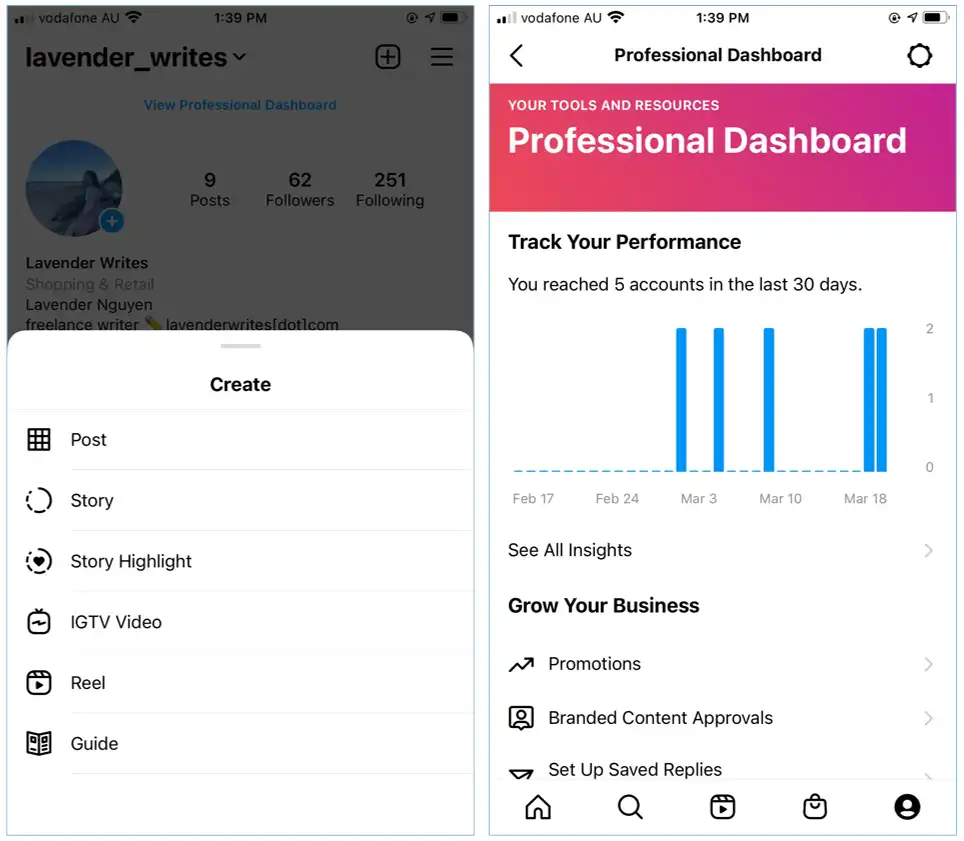
Tips for creating an Instagram business profile that sells:
- Use a branded Instagram profile picture. It should be the same picture you’ve used for your profiles on other social media platforms. Doing that will help strengthen your brand presence.
- Choose a simple, recognizable, and easy-to-find name for your Instagram username.
- Include a short description (a maximum of 150 characters) of your business. Explain who you are, what you’re offering, and what makes you different.
- Add a compelling call to action to urge visitors to take a specific action, for example, “shop now” or “download a free holiday gift guide.”
- Optimize your call-to-action link. Use tools like Bitly to create a trackable link to your store or a promotion landing page. This is the only clickable link you can add to your Instagram page, so ensure you use it!
- Showcase content and offers with Instagram Stories Highlights.
Take a look at Skirt Society’s Instagram business profile:

What Skirt Society does well:
- Use the same name for username (@skirtsociety) and business name (Skirt Society)
- Emphasize the benefits of their products, “modest, classic, affordable XS-3X”
- Show a compelling offer, “free shipping on orders $150 and up” for U.S. customers
- Include a strong call to action, “shop now, wear now, pay later with @afterpayusa”
- Use Instagram Story highlights to showcase new arrivals, customers wearing their products (lovelies), shoutouts, restocks, shop small, blog posts, and reviews.
See? Skirt Society’s Instagram bio is all about their customers or what customers will get when shopping with the brand.
{{lead-magnet-2}}
2. Set up Instagram Shopping to Sell Products
Instagram Shopping allows you to create an Instagram shoppable feed and a digital, shareable product catalog right on Instagram.
With Instagram Shopping, people can learn more about your products and purchase your products directly from the app (with Instagram Checkout) or click through to complete the order on your ecommerce store.
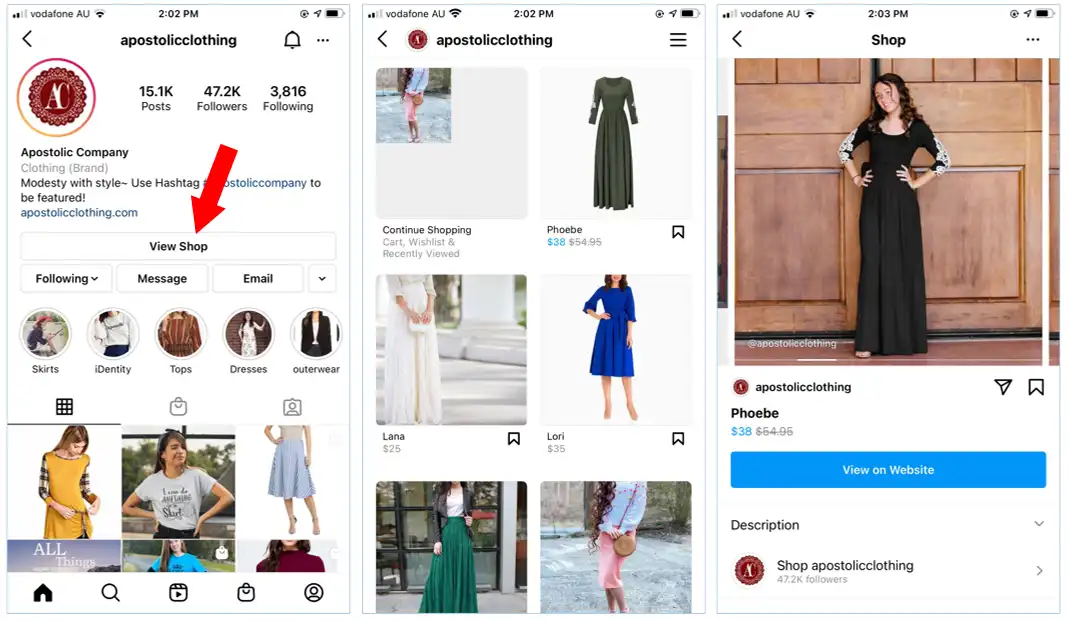
Instagram Shopping’s key features:
- An Instagram Shop as your customizable digital storefront
- Product detail pages display your product information
- Product collections showcase products in a curated category
- Shopping tags allow you to tag products from your catalog in your Stories or Instagram posts
- Instagram Checkout allows your customers to complete their purchase without leaving the app. This feature is currently available in the U.S. only.
Here is an excellent example from @camillerosenaturals. Their Instagram profile is filled with many posts with a shopping bag icon tagged in the top right corner. Tap on the product tagged, and you can see additional product details like this:

To set up Instagram Shopping, ensure your business checks a few boxes for eligibility:
- You have an active Instagram business account
- You own an ecommerce website (Shopify, BigCommerce, etc.)
- You connect your Instagram profile with a Facebook page
- You sell eligible physical goods
- You comply with Instagram's merchant agreement and commerce policies
3. Create Instagram Stories Shopping
Instagram Stories allows you to connect with your followers on a more personal, casual level. It brings you a huge opportunity to build trust and increase engagement in a short time.
In fact, Gorgias research shows that chat is 38 times faster than email on first response — making real-time channels like Instagram Stories and DMs a powerful way to engage shoppers when purchase intent is highest.
Mention’s 2020 Instagram Engagement report reveals many interesting statistics about Instagram Stories. Here are some of them:
- 58% of Instagram users watch personal stories multiple times a day
- 19% of users watch Stories from beginning to end
- 26% of users comment on or share personal Instagram Stories
they watch - 67% of users have ‘swiped up’ on the links of branded Stories
- 44% of users use Instagram Stories to promote products or services
That’s awesome, right?
Here are some Instagram Stories’ sales and conversion features you should keep in mind:
Shopping stickers: Use them to tag physical products in your stores. There are four types of stickers, including a shopping bag icon, a sticker with a product name in rainbow or grey, and translucent text.
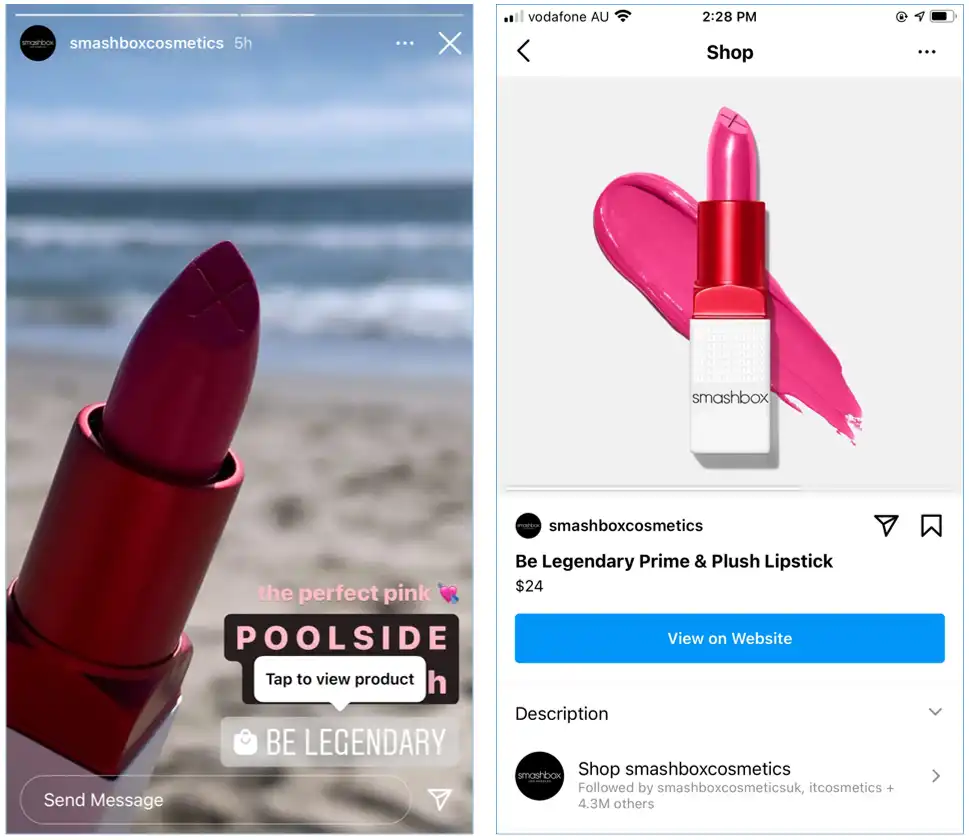
What makes this feature so great is that no matter how many followers you have, you can drive traffic to your website through your stories.
Swipe up: Once you reach over 10k followers, you can add a “swipe up” to your Instagram Stores — another big opportunity to promote products, blog posts, and sign-up pages.
For example, @covergirl includes the View Product button at the bottom of their story. Viewers can simply tap on the button to access the link.

Note that you must have an Instagram business profile and over 10k followers to access this feature.
4. Establish Partnerships With Instagram Influencers
According to Morning Consult’s The State of Consumer Trust 2020 report, 69% of consumers say it’s very important brands deliver consistently on what they promise when considering trust. Nielsen’s research also shows that consumers trust personal recommendations above paid ads.
How can brands gain customer trust? One of the best practices is working with Instagram influencers.
Instagram influencers are a reliable source for product reviews, recommendations, opinions, and more. They share content in an authentic way, helping them gain a high level of trust from their followers.

By partnering with Instagram influencers, brands can take advantage of their influence on their audiences to promote products, encourage purchases, and gain a loyal following.
Another great thing about Instagram is that you don’t need to work with mega influencers like Selena Gomez and pay them thousands of dollars for a sponsored post.
Today, ecommerce merchants and small business owners have many choices to establish a partnership with an influencer.
If you have a tight budget, you can find nano-influencers (having 1k-10k followers) or micro-influencers (10k-100k followers) and offer them free products in exchange for sharing branded content on their profiles.

According to Mention, an enthusiastic micro-influencer with a smaller, but keen and dedicated following, provides better value for money.
Also, micro-influencers are experts of their niche and more personally invested in their online presence. They spend a lot of time creating high-quality content, reading comments, and addressing their followers’ inquiries personally.
5. Run Instagram Giveaways
Want to give your followers a bit of fun while still making a lot of sales? Enter Instagram giveaways.
With a giveaway, you can invite your followers to join a competition in which they have to do a couple of things to have a chance to win a prize.
For example, you can ask them to share a video of themselves using your product, use your branded hashtag, or tag a friend in your post. The rules should be as simple as possible so your followers can follow them without taking much effort.
Here is a great example from Pacifica Beauty (@pacificabeauty):

Some tips for creating a successful Instagram contest:
- Determine your prize. It doesn’t have to be something big. You can offer a discount, a free gift, a free consultation, a book, a sample of your latest product, or anything else as long as you know it’s valuable and relevant to your followers.
- Decide how people will participate in your contest. You can make two or three simple criteria for entry, like “follow this account, like this post, and tag a friend below.”
- Be sure to include the hashtags #contest, #giveaway, and #yourbrandname in your giveaway post.
6. Offer Instagram-exclusive Offers
One of the most common ways brands leverage exclusivity in their Instagram marketing strategy is by giving their followers exclusive access to deals… just for being part of their Instagram community.
Sattwa Skincare (@sattwaskincare) knows how to start off on the right foot. From their post, they state clearly what they’re offering and frame the offer around exclusivity.

What’s more, Sattwa Skincare limits the offer “until Sunday evening,” giving followers a little push to take action before the deal ends. This is an excellent example of creating a sense of urgency with an exclusive deal.
7. Show Your Followers You Care
Gaining audiences’ attention is one thing; getting them to stay longer (and forever) with you is another.
When you show people you’re truly interested in them and want to create a meaningful relationship with them, they’ll show their caring back to you.
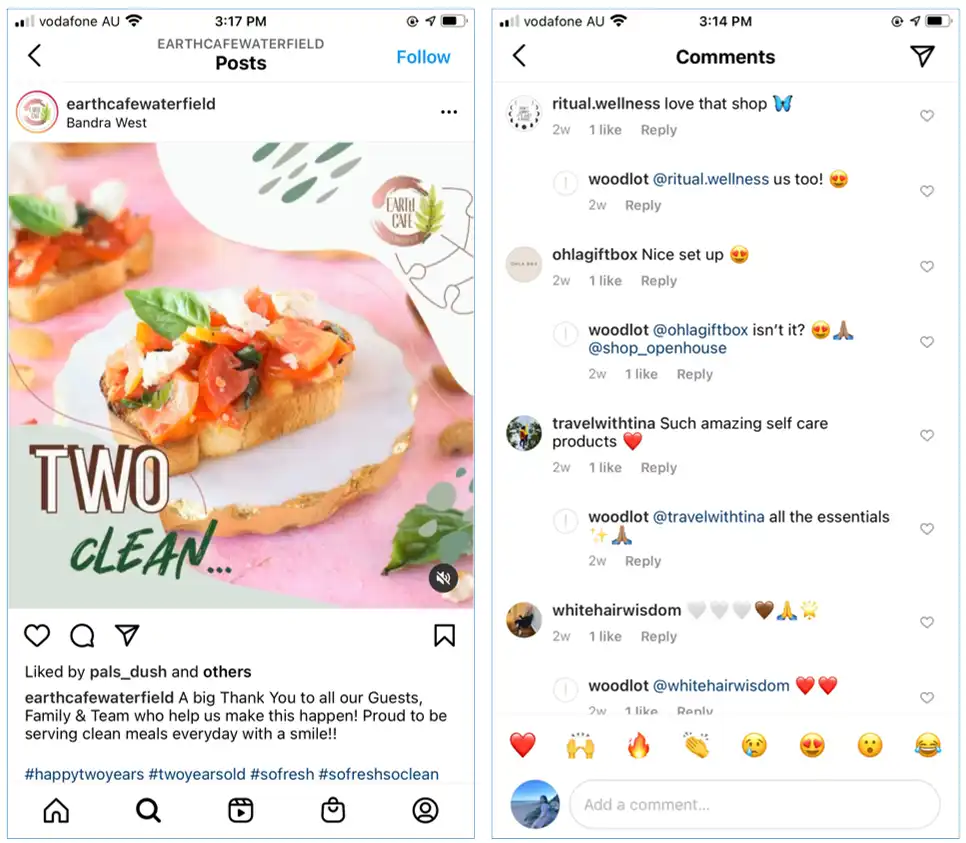
Follow these tips to build great connections with fans on Instagram:
- Communicate with your followers. Respond to their comments and mentions, tag them in your photos if you reshare their post, watch their stories if you can.
- Send a direct message to foster a more authentic relationship with loyal followers. Be careful with this tactic because you don’t want to look spammy.
- Be friendly and flexible when dealing with customer complaints on Instagram. When you receive negative reviews or comments, do your best to resolve them quickly, directly, politely. Don’t let your customers wait so long to receive your support.
- Install customer service tools like Gorgias to create a seamless omnichannel support experience for your customers. Gorgias allows your agents to handle Instagram comments, mentions, and messages in a centralized dashboard, helping them remove distractions, work more effectively, and have more time to close the deals.
Related: Learn how to use social media for customer service. Or, if you're just interested in Instagram, check out our in-depth guide on Instagram for customer service.
8. Sell through IGTV
IGTV is both a standalone video-sharing app and an extension of the existing feature on Instagram. IGTV supports vertical and horizontal videos with a 10-minute length for most Instagram accounts and up to one hour for larger accounts.
Done right, IGTV can bring a great opportunity to build engagement, collaborate with influencers, drive sales, and many other things.

Here are some ideas for your IGTV videos:
- Create tutorial videos. For example, if you’re selling cosmetics, you can create a series focused on lip care tutorials or maybe another about body care routine.
- Host a Q&A session. It’s great for answering questions about your shipping, payment, etc.
- Go behind the scenes. You can share how you source ingredients, how you manufacture products, or how your company looks like. Use it to build transparency for your brand.
- Stream an event. If you plan to host a flash sales event, be sure to share it on IGTV.
9. Sell through Instagram Reels
Instagram Reels allows you to create interactive videos, add effects, and stitch the video together right within the app. It’s a new way to make fun and engaging video content on Instagram.
With Instagram Reels, you can record and edit together 15 to 30-second video clips set to music and share them to your Stories, Instagram feed, and the Reels tab on your profile.
Brands use Reels to share stories, user-generated content (UGC), new product teasers, and tutorials. They even collaborate with influencers to promote products, announce sales, and more. As an online store, you should start creating Reels right away to reach more potential customers.
Start Selling on Instagram!
Many merchants think they have to make huge investments on Instagram to get a significant level of return. But that’s not true. You can start selling on Instagram for free with these 9 tips:
- Optimize your Instagram business profile
- Set up Instagram shopping to sell products
- Create Instagram Stories Shopping
- Establish partnerships with Instagram influencers
- Run Instagram giveaways
- Offer Instagram-exclusive offers
- Show your followers you care
- Sell through IGTV
- Sell through Instagram Reels
In case you’re looking for a help desk tool to manage Instagram customer requests, give Gorgias' social media features a try. Sign up for an account to get a full-featured 7-day free trial. You’ll be amazed at what Gorgias can do for your customer service experience.

Why you haven't made your first sale yet: a brutal look at early stores
With so many choices and so little time, it can seem an impossible task to gain the attention (and wallets) of your target audience, especially if you’re just starting out! It of course doesn’t help that there are thousands of guides out there teeming with ecommerce tips telling you the one thing you’re doing wrong or the best way to grow 300% year-over-year...all before you’ve even made a sale.
At Gorgias, we prefer to cut through all that noise and get straight to the point. After all, we can’t consider our job well done until your store starts making bank. But before we take a second look at your store, consider this: websites are not dissimilar to shops in a mall (remember those?) where the first impression is everything.
For example, Apple’s simple, structured aesthetic seems to encourage a sense of order and management. It stands out from the dying electronic stores of yesteryear that piled their wares in the front window and whose own employees struggled to tell you what was in stock on any given day.
The key takeaway for you is that before doing anything consider applying a holistic approach to your online store. Ask a fresh pair of eyes to take a look and give you their initial impression if it’s clear from the start what you’re selling and how to learn more. Once you’ve done this brief exercise you’re ready to dig deeper. So let’s get on to our list of common ecommerce mistakes that might be preventing your first sale.
You’re missing the basics
Okay so maybe your website looks pretty but did you spend too much time focusing on the aesthetic and too little time ensuring you had all the basics in place before launching?
Your design needs to be clear, clean and simple, in other words make sure you’re focusing on the sale first and foremost. You’ll also want all the usual elements to be easily findable, that means including clear and well-defined Return Policy, Terms of Service and About Us pages in your website’s footer.
Make sure your site navigation is as easy to use as possible. Since research shows that most visitors only read about 20% of the text on any given page, your customers need to be able to find their way around your store easily and quickly. Achieve this by making sure your menu is clear, concise and easier to locate.
Finally, don’t forget to verify your domain with Google (as well as other major search engines) by submitting your sitemap to them and always include any security badges your site uses. Considering almost 50% of Americans have been victims of credit card fraud in the last five years, letting your users know you’re trustworthy is fundamental to securing a sale.

You’ve got lame product pages
No two product pages are created equal and chances are yours could be working way harder. Start with the quickest fix: your copy. As your customers aren’t able to see and feel your products in-store, you need to describe them in a way that gives them the confidence to buy. Here’s a few characteristics to apply to your writing:
- Make product descriptions accurate, educational and engaging
- Turn features into benefits (e.g. instead of describing a stove as “sleek with two-burners” you can say “The perfect size to fry up omelettes for the whole family”)
- Anticipate your customer’s pain points and proactively reply to them
- Include relevant keywords in titles and descriptions to help search engines find your products
Balance detail with skimmable content and avoid long paragraphs that could cause a user’s eyes to look away. And where photos are concerned, the more the better. Multiple photos at different angles are proven to convert better than one single image.

You lack reviews
As mentioned earlier on, trust is essential when it comes to getting customers to hand over the sensitive data required to make a purchase. If they’ve never heard of you before, it might be harder to convince them you’re a trustworthy seller.
Of course it’d be easy to tell you to just incorporate product reviews on your product pages (which you definitely should do) but if you haven’t yet made a sale then that’s not a possibility for you yet. Instead, embrace the fact that we’re living in the age of the influencer and reach out to a few relevant figures in your target market. Offer to send them your products to test out in exchange for a testimonial you can put online. Some may even agree to post about your product.

If you target micro-influencers (people with 1000 to under 1 million followers) you can avoid running expensive search ads but still enjoy traffic from your target market and possibly sales as you’ll be benefiting from their pre-established trust. Keep in mind some influencers will charge a rate on top of the “free product” you’ve sent, but these fees are always negotiable and in some cases can be avoided if your product is of enough interest to the influence.
Finally, don’t forget to just ask for reviews in the first place. Make it part of the process with automated emails that remind customers to leave a review after they’ve made a purchase. You can also make posts calling for feedback and reviews on your social accounts as well.
You aren’t targeting the right audience
Maybe you’ve built the best website imaginable, with emotive product photos, great emails and dazzling social accounts to boot, but have you considered how relevant your traffic is? You might already be getting all the traffic in the world but if you haven’t defined and appealed to the right target audience, the significance of a large traffic volume quickly becomes a vanity metric.

Getting the right people to your website is the result of a few factors. First, it’ll be easier if you’re a fan of what you’re selling. Why? Because if you’re your own target audience you already understand the lifestyle, behaviour and unique selling points that get people to buy products like yours. Use this research to create customer profiles (built on demographics like location, pages visited, etc) that then inform the style of content you create.
Are athletic people more interested in your product? Do you have a lot of site visitors from a particular state or province? You can use this information to personalise some marketing materials like emails. These practices apply across social media and your main site - you can do this kind of research and targeting everywhere.
Finally, make sure you’re using relevant keywords on your site. Do you h2s and h3s and meta descriptions use phrasing and specific wording that aligns with what you’re selling and who you’re selling to? Understanding what your customers are searching for will help you answer those needs and get the low-funnel traffic that converts.
You haven’t chosen the right payment gateway
Payment gateway technology is what store owners use to accept credit and debit cards from shoppers. The term refers to both physical, card-reading devices found in stores and the digital payment processor apps that exist on ecommerce websites. Now that you’re caught up on the lingo, let’s explain why choosing the right payment gateway is essential to making sales.
There are frankly hundreds of different payment platforms you can choose from and picking the right one can be difficult. But as we describe in detail here, there are three specific factors to consider before surrendering yourself over to one specific gateway. They are:
The benefits of on vs off-site processing
For example, PayPal requires users to leave your website in order to complete the payment process. If you want, you can pay a $30 fee to make sure the payment is processed without requiring shoppers to go to the external site but why do that when there’s providers out there like Shopify who have on-site processing built in to the experience?
Accepting relevant payment methods for our market
Maybe your customers are the kind of people who would prefer to pay in a digital currency. Not all payment providers will support this. Not all payment providers even support the use of gift cards. Consider a provider that can grow with your business because one day you might want to have these options even if you don’t right now!
Customer protection should come first
Nobody likes data hacks. If your provider runs a less-than-secure operation that means your customers’ data is vulnerable and if they suffer a breach it might make even the loyalist fan think twice before shopping with you again.
A smooth customer experience built-in
There’s offering options and there’s drowning people in so many choices you inadvertently cause the dreaded “abandoned cart” outcome. Pay attention to which payment gateways your customers are primarily using and stick to a small number (certainly not 5) of the most relevant ones.
Once these factors are considered you’ll want to know which options are out there. We talk in depth about different providers in the article linked above but check out these names and weigh which one makes sense for the size and priorities of your business: Amazon Pay, Square, Apple Pay, Stripe, Google Pay, and WooCommerce Payment.
You’re spread too thin on customer support
Whether your online store is a one person show or a small team that includes a trusty support agent, you might be missing out on sales simply due to a lack of customer service. That doesn’t mean you don’t have the skills required to provide superb support, instead the problem is likely that you aren’t making tech work for you.
For example, let’s say you have your online store but you also have an Instagram channel, a Facebook page and a Twitter account. You might be getting emailed about questions and concerns via your website while also getting bombarded with DMs and comments across your socials. Despite your best efforts, if you’re checking everything manually across apps and websites - you’re going to miss something.
But that’s okay! You’re only human. And lucky for us humans, we’ve got some pretty incredible tech on our side to streamline manual (yet important) tasks.
With Gorgias, you can view your customer’s order history easily from the BigCommerce backend, personalise the experience by integrating data relevant to the customer, automate answers to common questions to save time and more. The sky’s the limit and even a one-person team will be able to deliver the support of 10 with the help of a few simple integrations.
You can see which e-commerce platforms we support on our website and check out the support channels we can give you a hand with by visiting our integrations page.
It’s too early
Now listen, we left this one for last because nobody likes to hear but maybe, just maybe you haven’t given your store enough time to reap the benefits of all your hard work. The story of the best e-commerce stores are rarely the ones that describe themselves as an “overnight success.”
Be patient and if you’re applying the tips we’ve mentioned above you’ll start to see things like relevant traffic and conversions pick up on your site before you know it.
And if you ever need more advice or a helpful tool, we’ve got you covered! Good luck!

How to Add a Live Chat to Your Shopify Store?
But before going into details, let’s learn why you should add a chat button to your online store.
Why does your Shopify store need a live chat?
If you’re running an ecommerce business, you know how difficult it is to turn every visitor into a customer and then a repeat one. With a live chat, you can deliver personal touches that help make your job much easier.
Here are the benefits of adding a live chat to your online store:
- Catch potential customers as they’re contemplating a purchase. When a website visitor is in the midst of their decision-making process, you can send a proactive message letting them know you’re available to chat immediately.
- Increase conversion rate. According to Forrester’s research, customers who engage in a live chat conversation with a business are 2.8 times more likely to complete a purchase.
- Improve customer engagement. A live chat is a 1:1 conversation, which is a great way to engage potential customers on a personal level and make them feel more connected to you.
Sounds great, right?
You might be excited to have one! So, let’s move on to discover the best live chat app for your Shopify store.
{{lead-magnet-1}}
Gorgias live chat: The best Shopify live chat app
Gorgias gives you a powerful live chat widget that you can add to your Shopify store or other ecommerce stores like Magento and BigCommerce. It’s one of the best Shopify live chat apps, with over 400 reviews on the Shopify App Store.
Gorgias live chat features:
- Trigger personalized live chat conversation with shoppers on product pages to boost sales
- Answer visitors customer support requests in real-time to remove any sales objections or doubts
- Know on which pages customers are
- Get all previous customer purchase information and conversation history (regardless of the channel) close to the conversation thread to provide personalized advice and support
- Install live chat, SMS, and other messaging apps for multiple stores and centralize all conversation in one place
- Respond in one click using pre-made templates
- Perform actions like rewarding loyalty points without leaving the chat
- Display data from third-party ecommerce tools like Smile.io, Yotpo, Klayvio, etc., in your live chat backend and insert them in any message in one click
- Respond in one click using pre-made templates
- Set up automated responses and bot for common tickets like “Where’s my order?”
- Classify, assign and prioritize tickets depending on the content, but also on the sentiment and intent detected by AI
About pricing, Gorgias offers you a 7-day free trial with full access to premium features. Its pricing plans are reasonable and affordable than Zendesk Chat, Tidio Chat, and other live chat software.
Bonus: Gorgias is also an ecommerce ticketing system! It offers omnichannel communication, i.e., email, live chat, phone, SMS messaging, and social media.
Use Shopify Inbox? Learn why Gorgias is the #1 Shopify Inbox alternative.
Steps to integrate Gorgias with your Shopify store
To follow along in this tutorial, you’ll need a Gorgias chat account. If you haven’t had it, click here to sign up for an account and enjoy a 14-day free trial with full access to all advanced features.
After that, take these steps to install Gorgias on your Shopify store:
Step 1: Log in to your Gorgias helpdesk.
Then, from the right sidebar, click Connect Shopify to enter the Shopify integration page.
 |
Step 2: In the Shopify integration page, click the Add Shopify button at the top-right corner.
 |
Here’s what you’ll see:
 |
Type your store name in the Store name box. Then, click Add integration, and your Shopify store will be integrated into Gorgias in a second:
 |
Done! You’ve just integrated your Shopify store with Gorgias successfully. Move on to learn how to create your first Gorgias live chat.
Steps to create a live chat widget
Do as follows:
Step 1: Click the Connect live chat option on the right menu of the Tickets view.
 |
You’ll be directed to the Chat integration page as below.
 |
Step 2: Click Add chat to open the New chat integration page.
 |
On this page, you can add a chat title, edit introduction text during and outside business hours, change colors and language of the chat window.
When you’re done with customization, click Add new chat.
 |
At this point, you already have a real-time chat box. Now you need to add it to your Shopify store.
Steps to add a live chat to your Shopify store
To add a live chat to your Shopify store, just switch the button on the right side of your Shopify store name from OFF to ON.
 |
Then, go to your Shopify store to see how Gorgias live chat appears:
 |
To further customize your live chat widget, check out these tutorials:
Note: If your store isn’t on Shopify, you can copy the JavaScript code and paste it on your website above the </body> tag. No plugin required.
Start talking with your Shopify customers in real-time!
Create a Gorgias account right now and follow this guide to add a live chat to your Shopify store. Your customers are waiting to talk with you.
In case you have any questions, don’t hesitate to contact our fantastic customer support team. We’re more than happy to help you.
{{lead-magnet-2}}
Building delightful customer interactions starts in your inbox
