Join us for Moments That Matter: Meet the Modern Helpdesk
September 10 at 12PM EST.
Save your seat


TL;DR:
Conversational commerce finally has a scoreboard.
For years, CX leaders knew support conversations mattered, they just couldn’t prove how much. Conversations lived in that gray area of ecommerce where shoppers got answers, agents did their best, and everyone agreed the channel was “important”…
But tying those interactions back to actual revenue? Nearly impossible.
Fast forward to today, and everything has changed.
Real-time conversations — whether handled by a human agent or powered by AI — now leave a measurable footprint across the entire customer journey. You can see how many conversations directly influenced a purchase.
In other words, conversational commerce is finally something CX teams can measure, optimize, and scale with confidence.
If you want to prove the value of your CX strategy to your CFO, your marketing team, or your CEO, you need data, not anecdotes.
Leadership isn’t swayed by “We think conversations help shoppers.” They want to see the receipts. They want to know exactly how interactions influence revenue, which conversations drive conversion, and where AI meaningfully reduces workload without sacrificing quality.
That’s why conversational commerce metrics matter now more than ever. This gives CX leaders a way to:
These metrics let you track impact with clarity and confidence.
And once you can measure it, you can build a stronger case for deeper investment in conversational tools and strategy.
So, what exactly should CX teams be measuring?
While conversational commerce touches every part of the customer journey, the most meaningful insights fall into four core categories:
Let’s dive into each.
If you want to understand how well your conversational commerce strategy is working, automation performance is the first place to look. These metrics reveal how effectively AI is resolving shopper needs, reducing ticket volume, and stepping into revenue-driving conversations at scale.
The two most foundational metrics?
Resolution rate measures how many conversations your AI handles from start to finish without needing a human to take over. On paper, high resolution rates sound like a guaranteed win. It suggests your AI is handling product questions, sizing concerns, shade matching, order guidance, and more — all without adding to your team’s workload.
But a high resolution rate doesn’t automatically mean your AI is performing well.
Yes, the ticket was “resolved,” but was the customer actually helped? Was the answer accurate? Did the shopper leave satisfied or frustrated?
This is where quality assurance becomes essential. Your AI should be resolving tickets accurately and helpfully, not simply checking boxes.
At its best, a strong resolution rate signals that your AI is:
When resolution rate quality goes up, so does revenue influence.
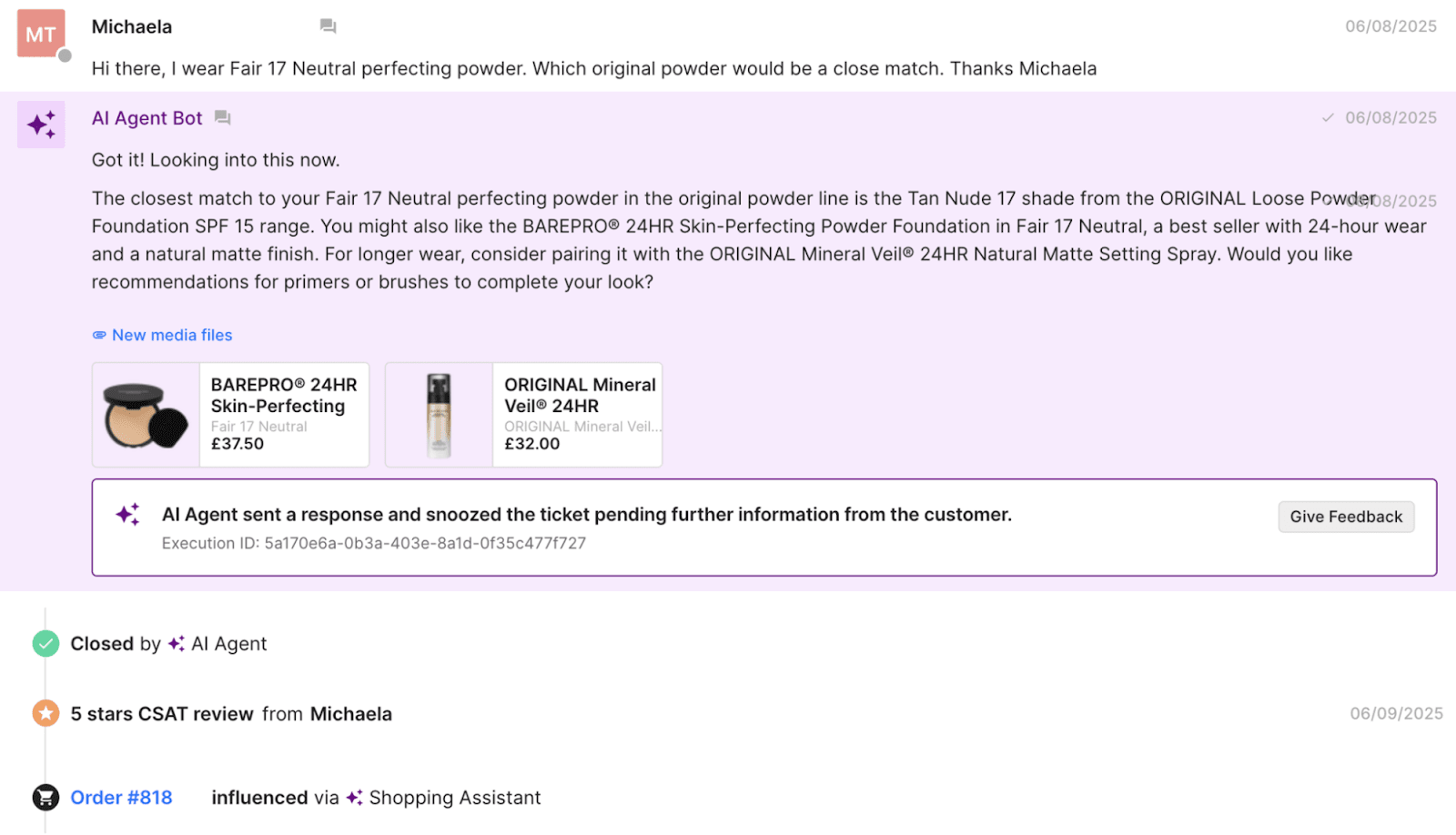
You can see this clearly with beauty brands, where accuracy matters enormously. bareMinerals, for example, used to receive a flood of shade-matching questions. Everything from “Which concealer matches my undertone?” to “This foundation shade was discontinued; what’s the closest match?”
Before AI, these questions required well-trained agents and often created inconsistencies depending on who answered.
Once they introduced Shopping Assistant, resolution rate suddenly became more meaningful. AI wasn’t just closing tickets; it was giving smarter, more confident recommendations than many agents could deliver at scale, especially after hours.
That accuracy paid off.
AI-influenced purchases at bareMinerals had zero returns in the first 30 days because customers were finally getting the right shade the first time.
That’s the difference between “resolved” and resolved well.
The zero-touch ticket rate measures something slightly different: the percentage of conversations AI manages entirely on its own, without ever being escalated to an agent.
This metric is a direct lens into:
More importantly, deflection widens the funnel for more revenue-driven conversations.
When AI deflects more inbound questions, your support team can focus on conversations that truly require human expertise, including returns exceptions, escalations, VIP shoppers, and emotionally sensitive interactions.
Brands with strong deflection rates typically see:
If automation metrics tell you how well your AI is working, conversion and revenue metrics tell you how well it’s selling.
This category is where conversational commerce really proves its value because it shows the direct financial impact of every human- or AI-led interaction.
Chat conversion rate measures the percentage of conversations that end in a purchase, and it’s one of the clearest indicators of whether your conversational strategy is influencing shopper decisions.
A strong CVR tells you that conversations are:
You see this clearly with brands selling technical or performance-driven products.
Outdoor apparel shoppers, for example, don’t just need “a jacket” — they need to know which jacket will hold up in specific temperatures, conditions, or terrains. A well-trained AI can step into that moment and convert uncertainty into action.
Arc’teryx saw this firsthand.
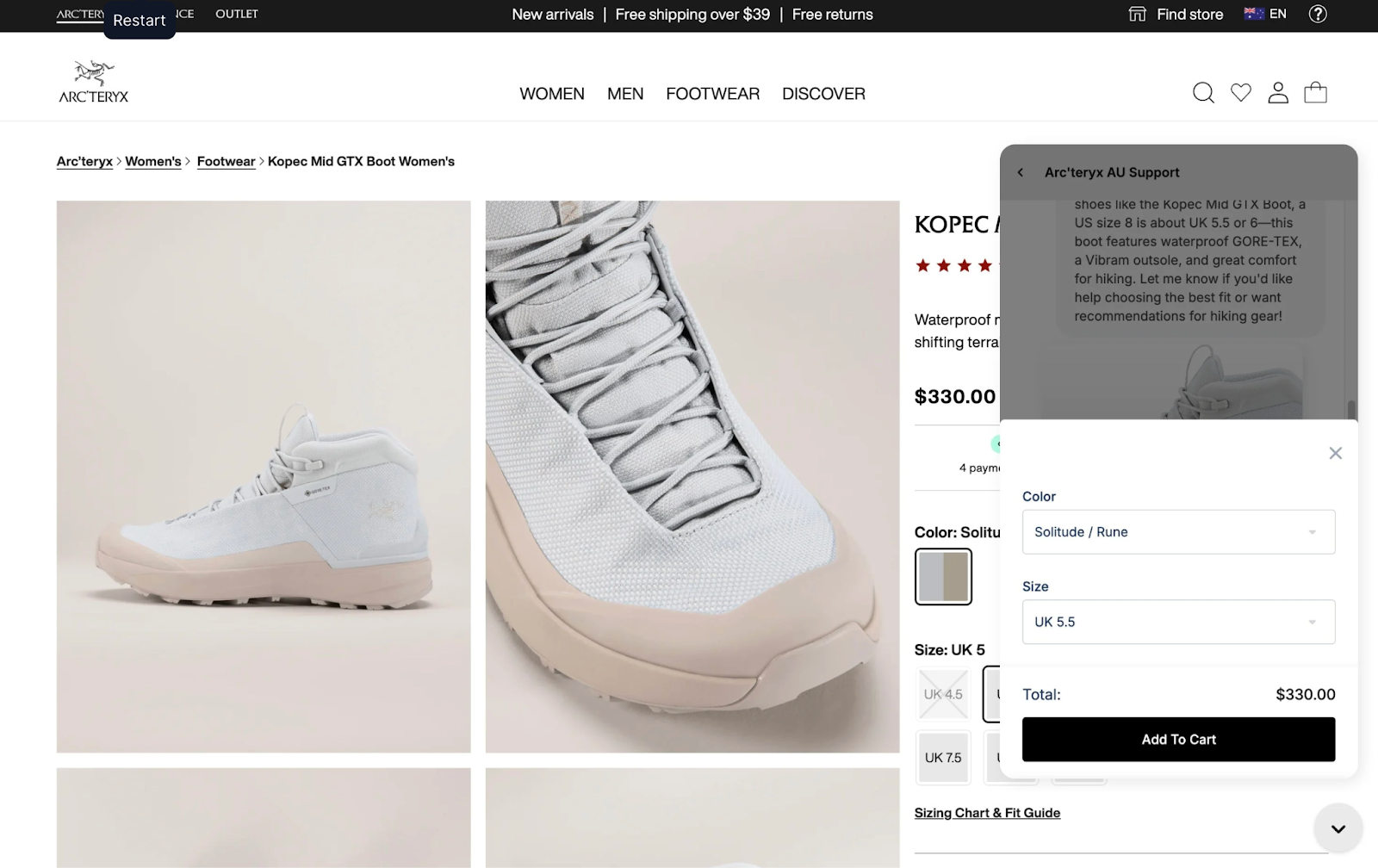
Once Shopping Assistant started handling their high-intent pre-purchase questions, their chat conversion rate jumped dramatically — from 4% to 7%. A 75% lift.
That’s what happens when shoppers finally get the expert guidance they’ve been searching for.
Not every shopper buys the moment they finish a chat. Some take a few hours. Some need a day or two. Some want to compare specs or read reviews before committing.
GMV influenced captures this “tail effect” by tracking revenue within 1–3 days of a conversation.
It’s especially powerful for:
In Arc’teryx’s case, shoppers often take time to confirm they’re choosing the right technical gear.
Yet even with that natural pause in behavior, Shopping Assistant still influenced 3.7% of all revenue, not by forcing instant decisions, but by providing the clarity people needed to make the right one.
This metric looks at the average order value of shoppers who engage in a conversation versus those who don’t.
If the conversational AOV is higher, it means your AI or agents are educating customers in ways that naturally expand the cart.
Examples of AOV-lifting conversations include:
When conversations are done well, AOV increases not because shoppers are being upsold, but because they’re being guided.
ROI compares the revenue generated by conversational AI to the cost of the tool itself — in short, this is the number that turns heads in boardrooms.
Strong ROI shows that your AI:
When ROI looks like that, AI stops being a “tool” and starts being an undeniable growth lever.
Related: The hidden power and ROI of automated customer support
Not every metric in conversational commerce is a final outcome. Some are early signals that show whether shoppers are interested, paying attention, and moving closer to a purchase.
These engagement metrics are especially valuable because they reveal why conversations convert, not just whether they do. When engagement goes up, conversion usually follows.
CTR measures the percentage of shoppers who click the product links shared during a conversation. It’s one of the cleanest leading indicators of buyer intent because it reflects a moment where curiosity turns into action.
If CTR is high, it’s a sign that:
In other words, CTR tells you which conversations are influencing shopping behavior.
And the connection between CTR and revenue is often tighter than teams expect.
Just look at what happened with Caitlyn Minimalist. When they began comparing the results of human-led conversations versus AI-assisted ones over a 90-day period, CTR became one of the clearest predictors of success. Their Shopping Assistant consistently drove meaningful engagement with its recommendations — an 18% click-through rate on the products it suggested.
That level of engagement translated directly into better outcomes:
When shoppers click, they’re moving deeper into the buying cycle. Strong CTR makes it easier to forecast conversion and understand how well your conversational flows are guiding shoppers toward the right products.
Discounting can be one of the fastest ways to nudge a shopper toward checkout, but it’s also one of the fastest ways to erode margins.
That’s why discount-related metrics matter so much in conversational commerce.
They show not just whether AI is using discounts, but how effectively those discounts are driving conversions.
This metric tracks how many discount codes or promotional offers your AI is sharing during conversations.
Ideally, discounts should be purposeful — timed to moments when a shopper hesitates or needs an extra nudge — not rolled out as a one-size-fits-all script. When you monitor “discounts offered,” you can ensure that incentives are being used as conversion tools, not crutches.
This visibility becomes particularly important at high-intent touchpoints, such as exit intent or cart recovery interactions, where a small incentive can meaningfully increase conversion if used correctly.
Offering a discount is one thing. Seeing whether customers use it is another.
A high “discounts applied” rate suggests:
A low usage rate tells a different story: Your team (or your AI) is discounting unnecessarily.
This metric alone often surprises brands. More often than not, CX teams discover they can discount less without hurting conversion, or that a non-discount incentive (like a relevant product recommendation) performs just as well.
Understanding this relationship helps teams tighten their promotional strategy, protect margins, and use discounts only where they actually drive incremental revenue.
Once you know which metrics matter, the next step is building a system that brings them together in one place.
Think of your conversational commerce scorecard as a decision-making engine — something that helps you understand performance at a glance, spot bottlenecks, optimize AI, and guide shoppers more effectively.
In Gorgias, you can customize your analytics dashboard to watch the metrics that matter most to your brand. This becomes the single source of truth for understanding how conversations influence revenue.
Here’s what a powerful dashboard unlocks:
Some parts of the customer journey are perfect for AI: repetitive questions, product education, sizing guidance, shade matching, order status checks.
Others still benefit from human support, like emotional conversations, complex troubleshooting, multi-item styling, or high-value VIP concerns.
Metrics like resolution rate, zero-touch ticket rate, and chat conversion rate show you exactly which is which.
When you track these consistently, you can:
For example, if AI handles 80% of sizing questions successfully but struggles with multi-item styling advice, that tells you where to invest in improving AI, and where human expertise should remain the default.
Metrics like CTR, CVR, and conversational AOV reveal the inner workings of shopper decision-making. They show which recommendations resonate, which don’t, and which messaging actually moves someone to purchase.
With these insights, CX teams can:
For instance, if shoppers repeatedly ask clarifying questions about a product’s material or fit, that’s a signal for merchandising or product teams.
If recommendations with social proof get high engagement, marketing can integrate that insight into on-site messaging.
Conversations reveal what customers really care about — often before analytics do.
This is the moment when the scorecard stops being a CX tool and becomes a business tool.
A clear set of metrics shows how conversations tie to:
When a CX leader walks into a meeting and says, “Our AI Assistant influenced 5% of last month’s revenue” or “Conversational shoppers have a 20% higher AOV,” the perception of CX changes instantly.
You’re no longer a support cost. You’re a revenue channel.
And once you have numbers like ROI or revenue influence in hand, it becomes nearly impossible for anyone to argue against further investment in CX automation.
A scorecard doesn’t just show what’s working, it surfaces what’s not.
Metrics make friction obvious:
Once you identify these patterns, you can run targeted experiments:
Compounded over time, these moments create major lifts in conversion and revenue.
One of the biggest hidden values of conversational data is how it strengthens cross-functional decision-making.
A clear analytics dashboard gives teams visibility into:
Suddenly, CX isn’t just answering questions — it’s informing strategy across the business.
With the right metrics in place, CX leaders can finally quantify the impact of every interaction, and use that data to shape smarter, more profitable customer journeys.
If you're ready to measure — and scale — the impact of your conversations, tools like Gorgias AI Agent and Shopping Assistant give CX teams the visibility, accuracy, and performance needed to turn every interaction into revenue.
Want to see it in action? Book a demo and discover what conversational commerce can do for your bottom line.
{{lead-magnet-2}}
The best in CX and ecommerce, right to your inbox
TL;DR:
In 2024, Shopify merchants drove $11.5 billion in sales over Black Friday Cyber Monday. Now, BFCM is quickly approaching, with some brands and major retailers already hosting sales.
If you’re feeling late to prepare for the season or want to maximize the number of sales you’ll make, we’ll cover how food and beverage CX teams can serve up better self-serve resources for this year’s BFCM.
Learn how to answer and deflect customers’ top questions before they’re escalated to your support team.
💡 Your guide to everything peak season → The Gorgias BFCM Hub
During busy seasons like BFCM and beyond, staying on top of routine customer asks can be an extreme challenge.
“Every founder thinks BFCM is the highest peak feeling of nervousness,” says Ron Shah, CEO and Co-founder of supplement brand Obvi.
“It’s a tough week. So anything that makes our team’s life easier instantly means we can focus more on things that need the time,” he continues.
Anticipating contact reasons and preparing methods (like automated responses, macros, and enabling an AI Agent) is something that can help. Below, find the top contact reasons for food and beverage companies in 2025.
According to Gorgias proprietary data, the top reason customers reach out to brands in the food and beverage industry is to cancel a subscription (13%) followed by order status questions (9.1%).
Because product detail queries represent 5.7% of contact reasons for the food and beverage industry, the more information you provide on your product pages, the better.
Include things like calorie content, nutritional information, and all ingredients.
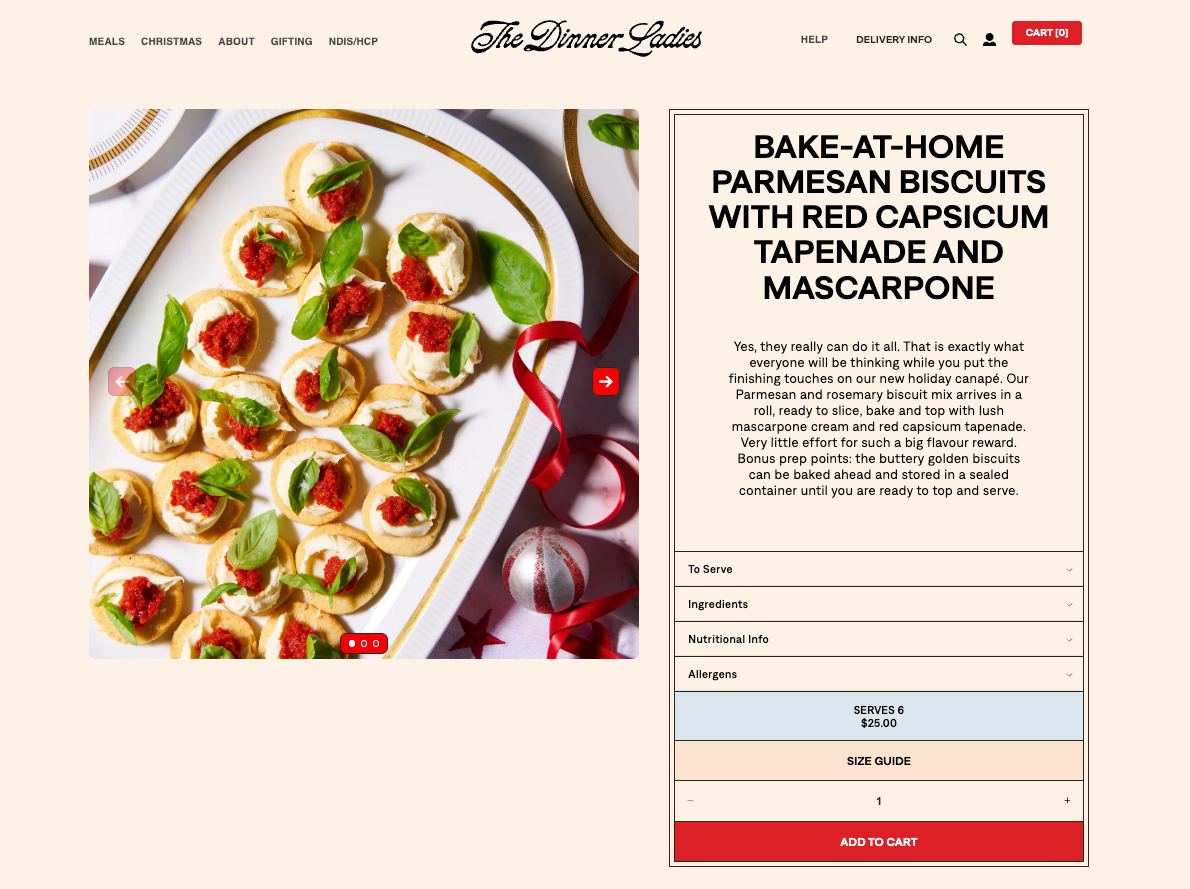
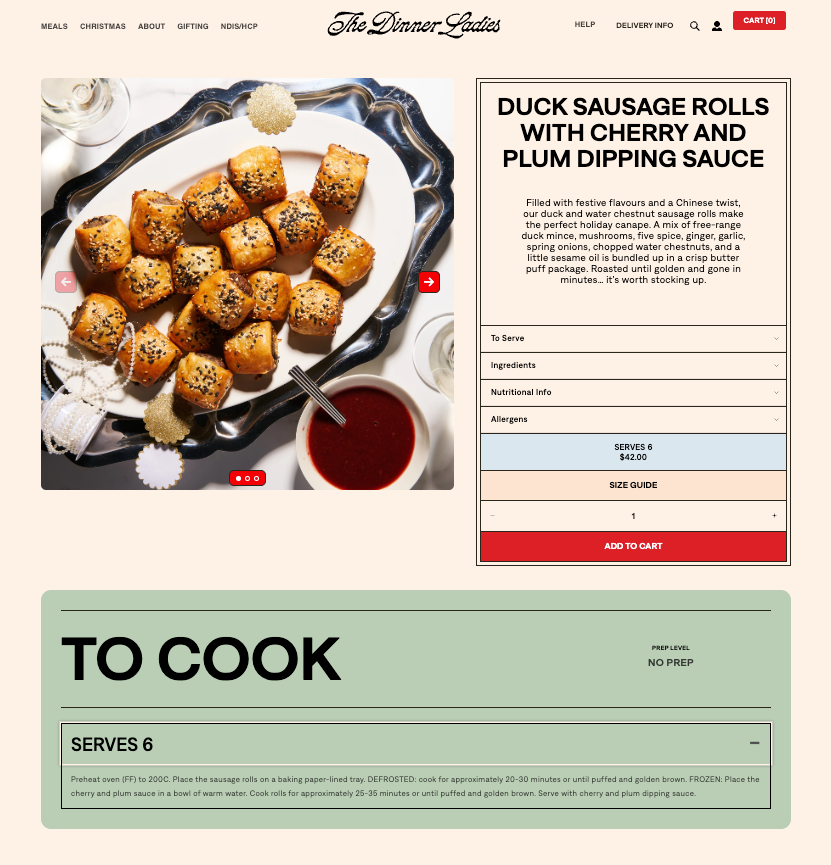
For example, ready-to-heat meal company The Dinner Ladies includes a dropdown menu on each product page for further reading. Categories include serving instructions, a full ingredient list, allergens, nutritional information, and even a handy “size guide” that shows how many people the meal serves.
FAQ pages make up the information hub of your website. They exist to provide customers with a way to get their questions answered without reaching out to you.
This includes information like how food should be stored, how long its shelf life is, delivery range, and serving instructions. FAQs can even direct customers toward finding out where their order is and what its status is.

In the context of BFCM, FAQs are all about deflecting repetitive questions away from your team and assisting shoppers in finding what they need faster.
That’s the strategy for German supplement brand mybacs.
“Our focus is to improve automations to make it easier for customers to self-handle their requests. This goes hand in hand with making our FAQs more comprehensive to give customers all the information they need,” says Alexander Grassmann, its Co-Founder & COO.
As you contemplate what to add to your FAQ page, remember that more information is usually better. That’s the approach Everyday Dose takes, answering even hyper-specific questions like, “Will it break my fast?” or “Do I have to use milk?”
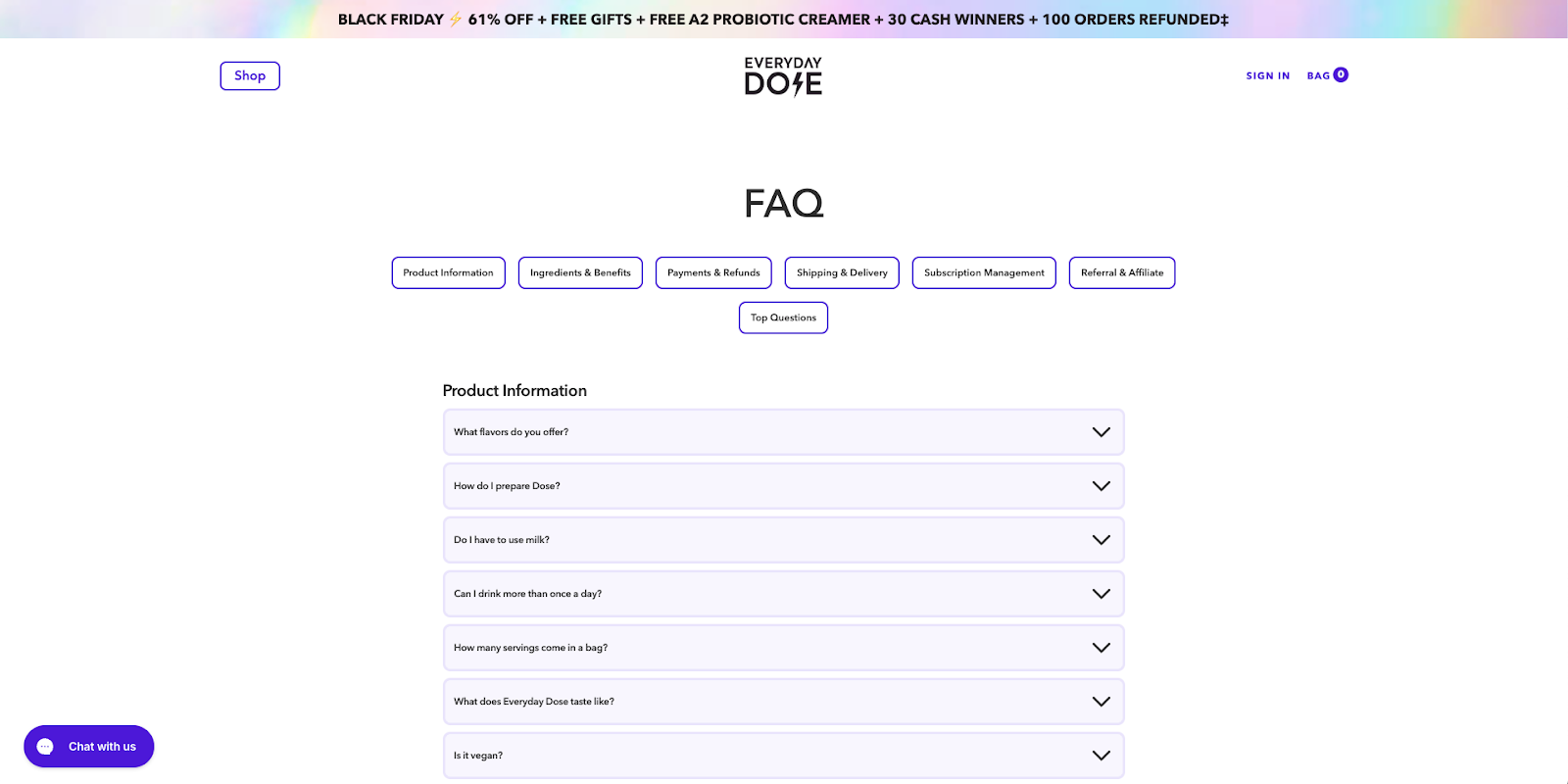
While the FAQs you choose to add will be specific to your products, peruse the top-notch food and bev FAQ pages below.
Time for some FAQ inspo:
AI Agents and AI-powered Shopping Assistants are easy to set up and are extremely effective in handling customer interactions––especially during BFCM.
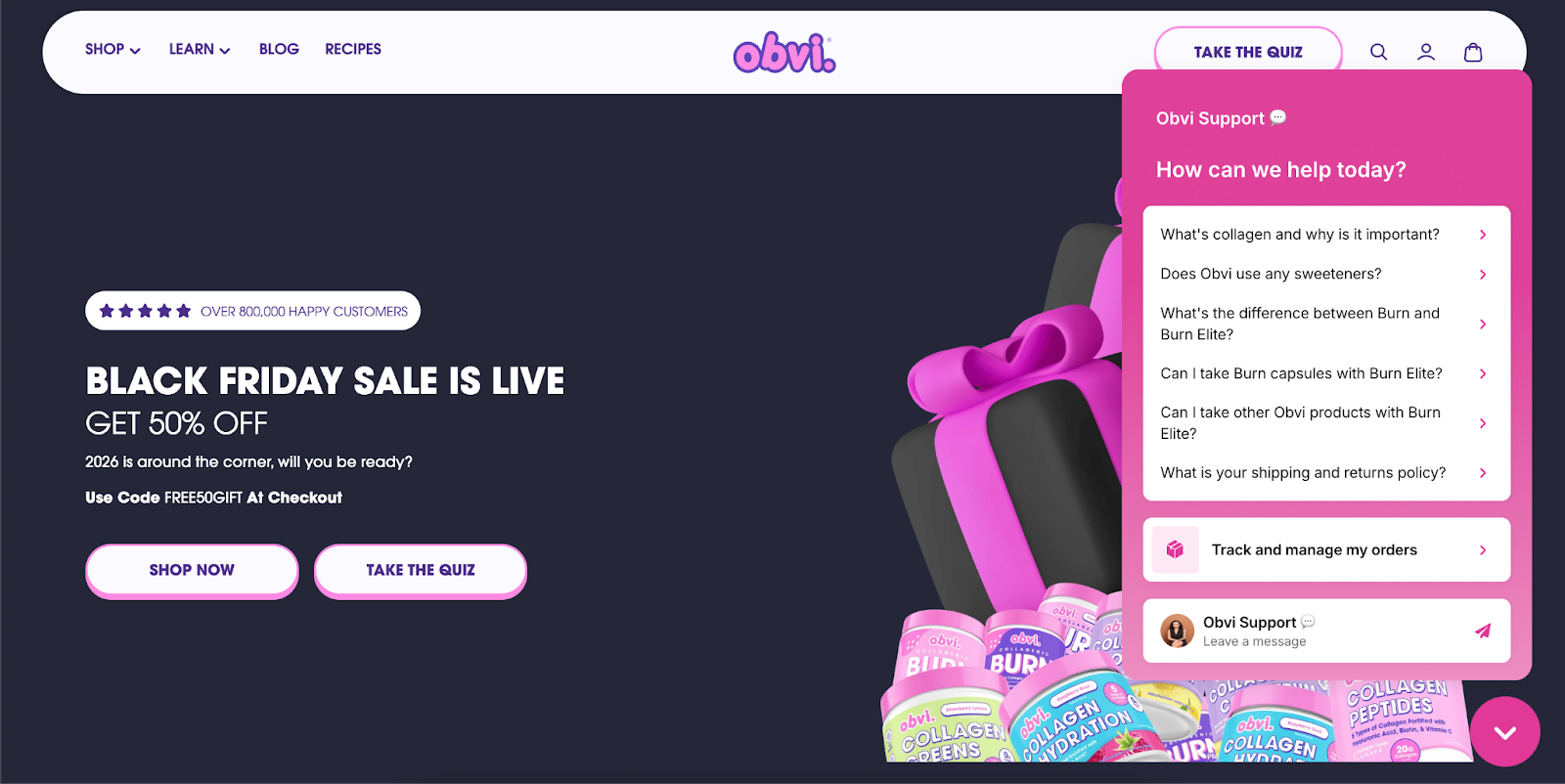
“I told our team we were going to onboard Gorgias AI Agent for BFCM, so a good portion of tickets would be handled automatically,” says Ron Shah, CEO and Co-founder at Obvi. “There was a huge sigh of relief knowing that customers were going to be taken care of.”
And, they’re getting smarter. AI Agent’s CSAT is just 0.6 points shy of human agents’ average CSAT score.
Here are the specific responses and use cases we recommend automating:
Get your checklist here: How to prep for peak season: BFCM automation checklist
With high price reductions often comes faster-than-usual sell out times. By offering transparency around item quantities, you can avoid frustrated or upset customers.
For example, you could show how many items are left under a certain threshold (e.g. “Only 10 items left”), or, like Rebel Cheese does, mention whether items have sold out in the past.
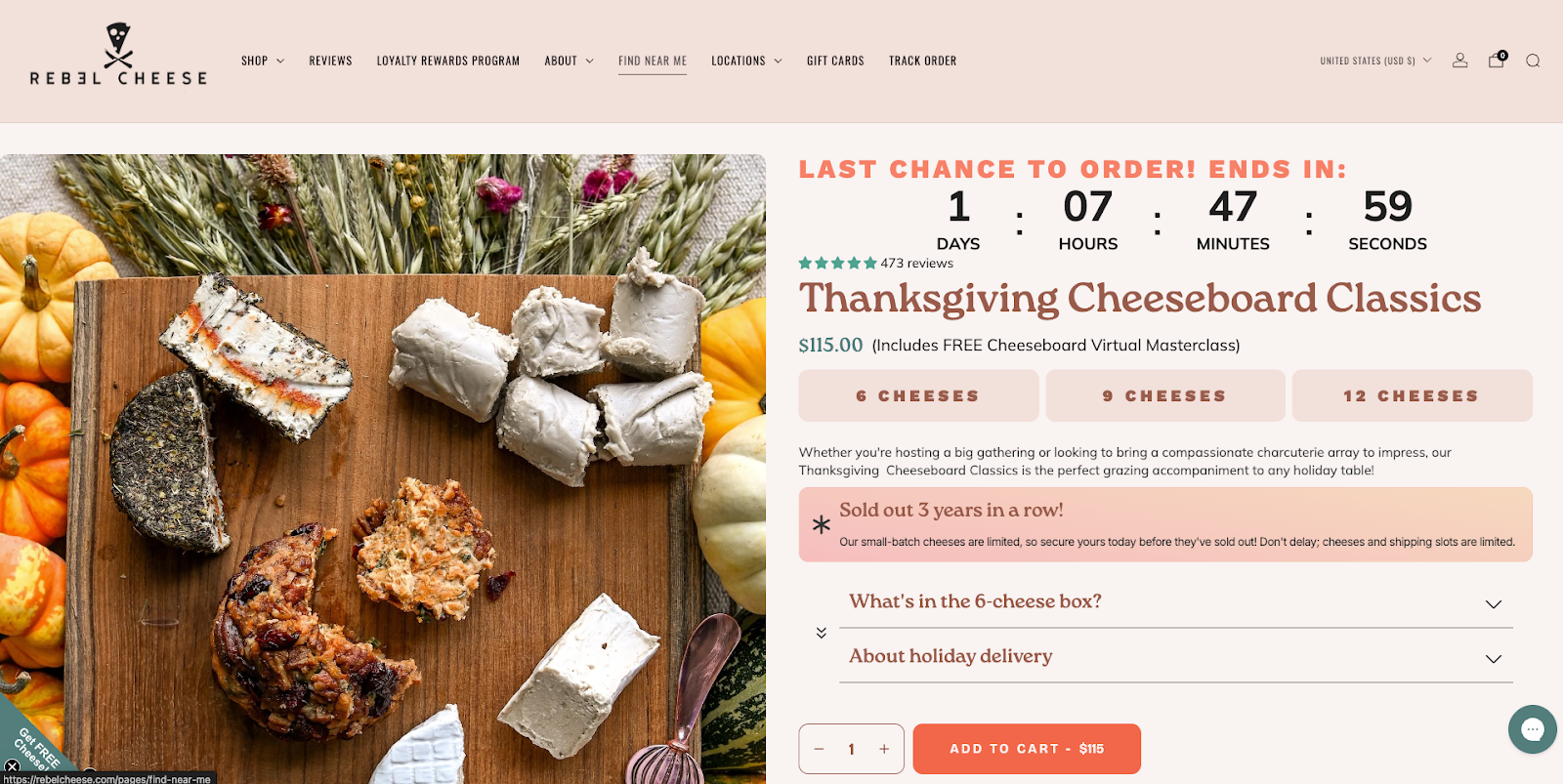
You could also set up presales, give people the option to add themselves to a waitlist, and provide early access to VIP shoppers.
Give shoppers a heads up whether they’ll be able to cancel an order once placed, and what your refund policies are.
For example, cookware brand Misen follows its order confirmation email with a “change or cancel within one hour” email that provides a handy link to do so.
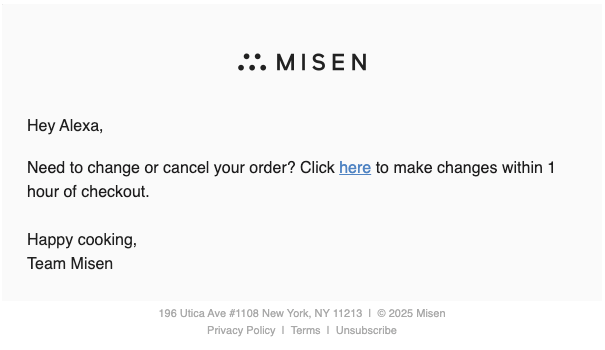
Your refund policies and order cancellations should live within an FAQ and in the footer of your website.
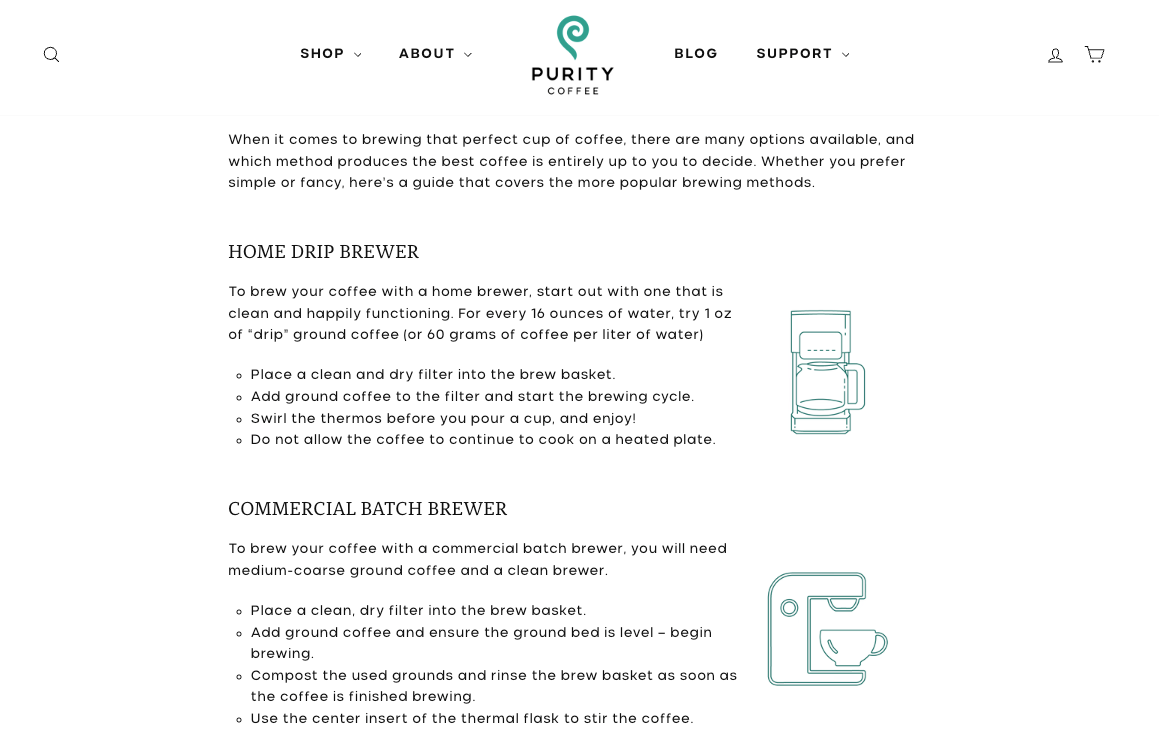
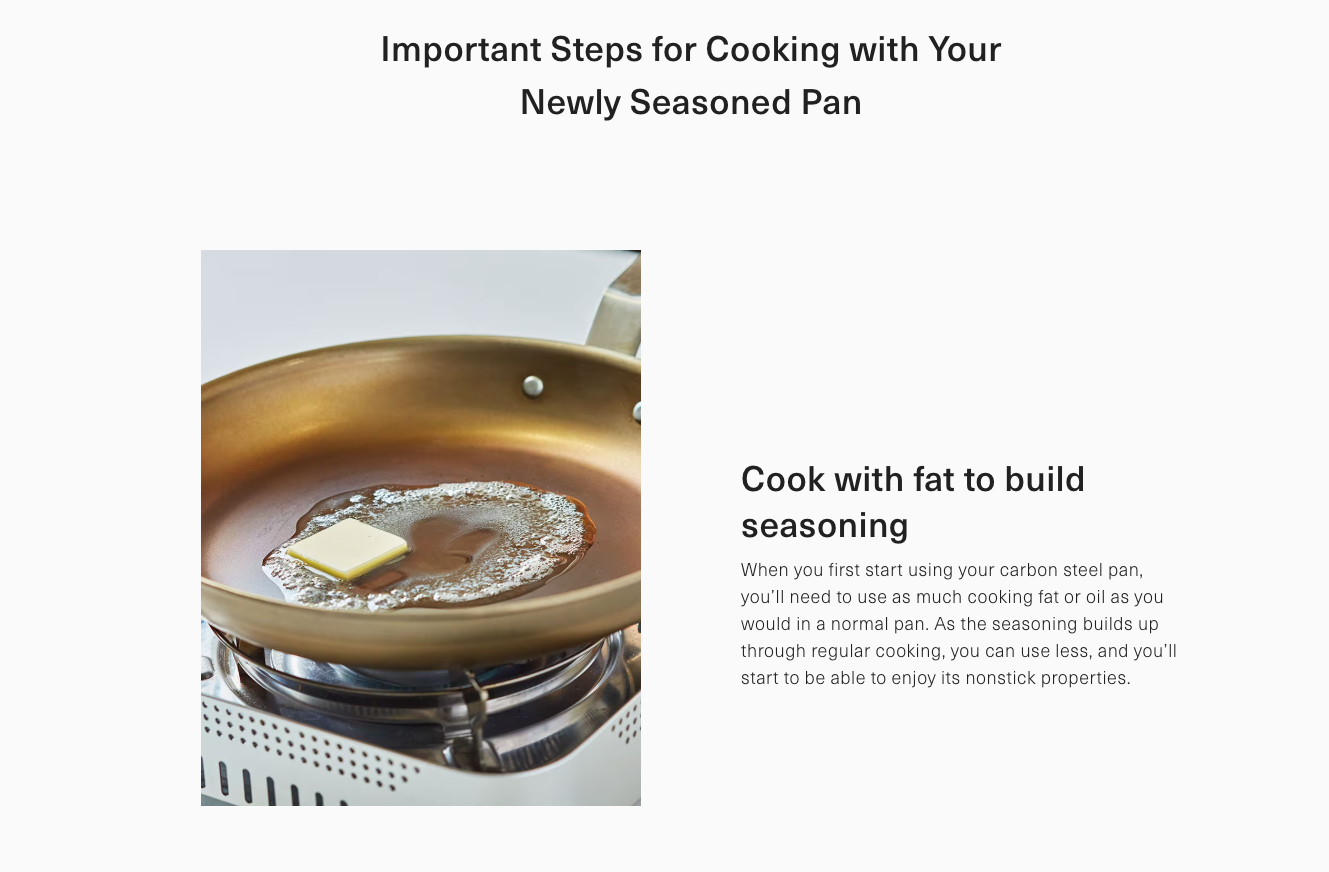
Include how-to information on your website within your FAQs, on your blog, or as a standalone webpage. That might be sharing how to use a product, how to cook with it, or how to prepare it. This can prevent customers from asking questions like, “how do you use this?” or “how do I cook this?” or “what can I use this with?” etc.
For example, Purity Coffee created a full brewing guide with illustrations:
Similarly, for its unique preseasoned carbon steel pan, Misen lists out care instructions:
And for those who want to understand the level of prep and cooking time involved, The Dinner Ladies feature cooking instructions on each product page.
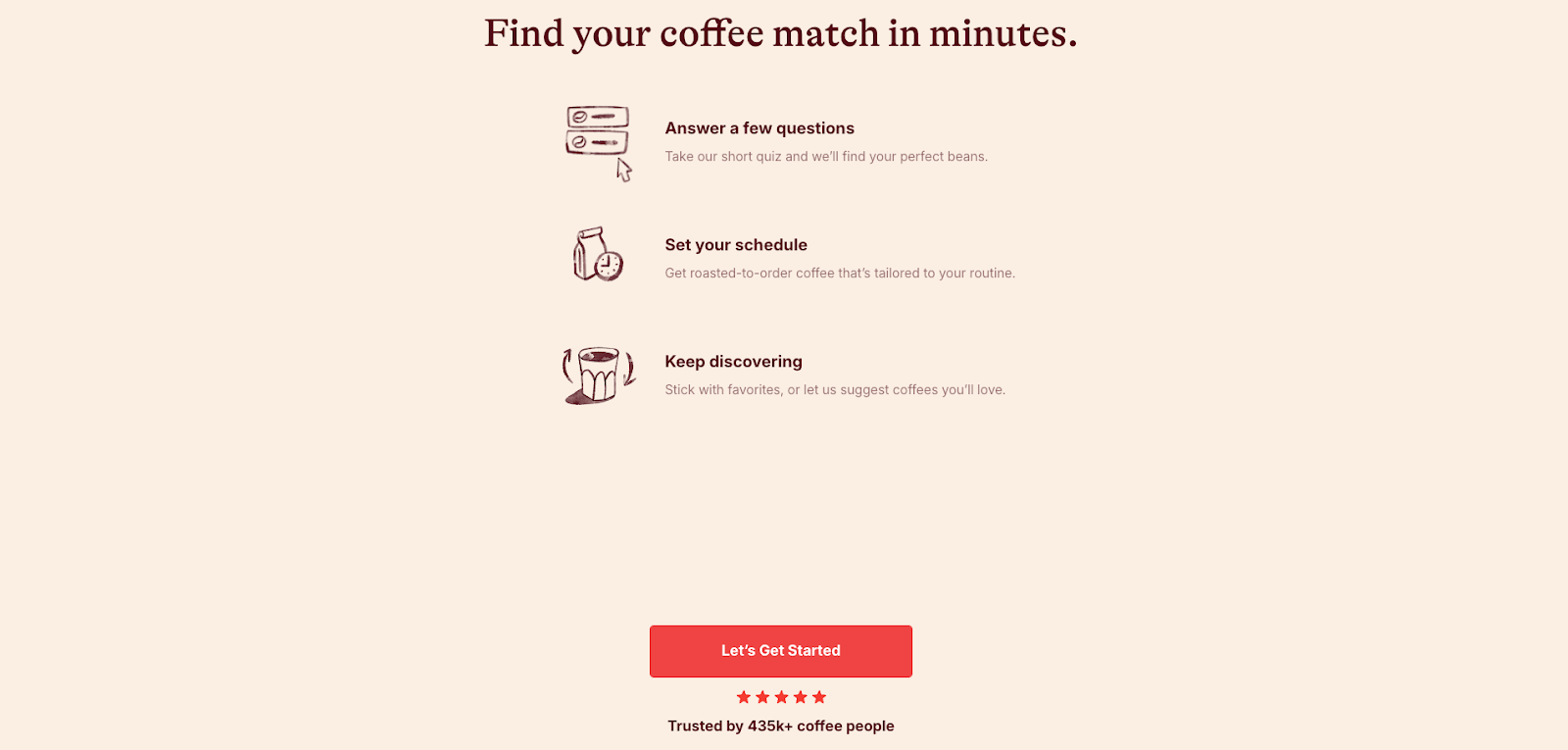
Interactive quizzes, buying guides, and gift guides can help ensure shoppers choose the right items for them––without contacting you first.
For example, Trade Coffee Co created a quiz to help first timers find their perfect coffee match:
The more information you can share with customers upfront, the better. That will leave your team time to tackle the heady stuff.
If you’re looking for an AI-assist this season, check out Gorgias’s suite of products like AI Agent and Shopping Assistant.
{{lead-magnet-2}}

TL;DR:
As holiday season support volumes spike and teams lean on AI to keep up, one frustration keeps surfacing, our Help Center has the answers—so why can’t AI find them?
The truth is, AI can’t help customers if it can’t understand your Help Center. Most large language models (LLMs), including Gorgias AI Agent, don’t ignore your existing docs, they just struggle to find clear, structured answers inside them.
The good news is you don’t need to rebuild your Help Center or overhaul your content. You simply need to format it in a way that’s easy for both people and AI to read.
We’ll break down how AI Agent reads your Help Center, finds answers, and why small formatting changes can help it respond faster and more accurately, so your team spends less time on escalations.
{{lead-magnet-1}}
Before you start rewriting your Help Center, it helps to understand how AI Agent actually reads and uses it.
Think of it like a three-step process that mirrors how a trained support rep thinks through a ticket.
Your Help Center is AI Agent’s brain. AI Agent uses your Help Center to pull facts, policies, and instructions it needs to respond to customers accurately. If your articles are clearly structured and easy to scan, AI Agent can find what it needs fast. If not, it hesitates or escalates.
Think of Guidance as AI Agent’s decision layer. What should AI Agent do when someone asks for a refund? What about when they ask for a discount? Guidance helps AI Agent provide accurate answers or hand over to a human by following an “if/when/then” framework.
Finally, AI Agent uses a combination of your help docs and Guidance to respond to customers, and if enabled, perform an Action on their behalf—whether that’s changing a shipping address or canceling an order altogether.
Here’s what that looks like in practice:
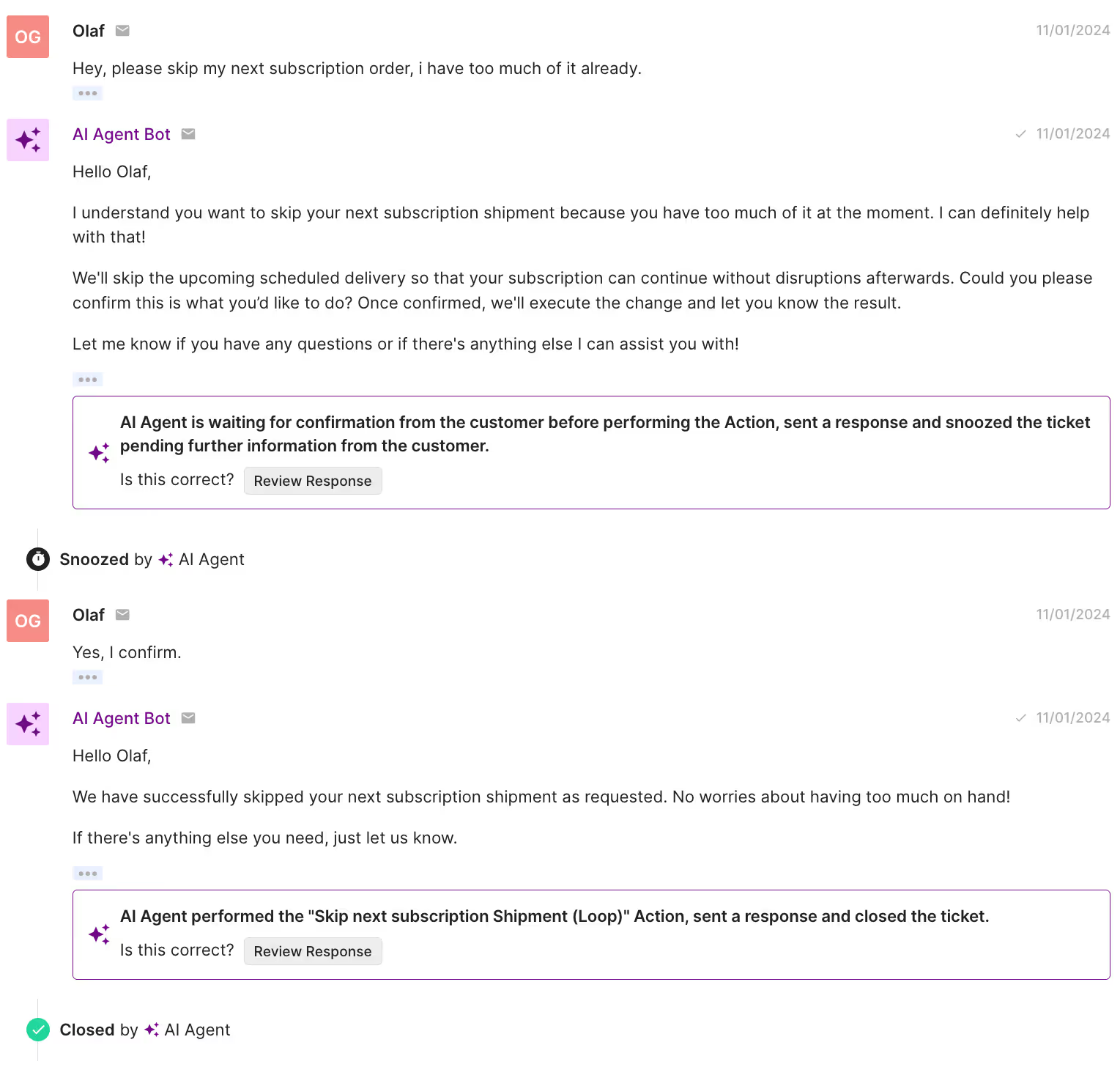
This structure removes guesswork for both your AI and your customers. The clearer your docs are about when something applies and what happens next, the more accurate and human your automated responses will feel.
A Help Center written for both people and AI Agent:
Our data shows that most AI escalations happen for a simple reason––your Help Center doesn’t clearly answer the question your customer is asking.
That’s not a failure of AI. It’s a content issue. When articles are vague, outdated, or missing key details, AI Agent can’t confidently respond, so it passes the ticket to a human.
Here are the top 10 topics that trigger escalations most often:
Each of these topics needs a dedicated, clearly structured Help Doc that uses keywords customers are likely to search and spells out specific conditions.
Here’s how to strengthen each one:
Start by improving these 10 articles first. Together, they account for nearly half of all AI Agent escalations. The clearer your Help Center is on these topics, the fewer tickets your team will ever see, and the faster your AI will resolve the rest.
Once you know how AI Agent reads your content, the next step is formatting your help docs so it can easily understand and use them.
The goal isn’t to rewrite everything, it’s to make your articles more structured, scannable, and logic-friendly.
Here’s how.
Both humans and large language models read hierarchically. If your article runs together in one long block of text, key answers get buried.
Break articles into clear sections and subheadings (H2s, H3s) for each scenario or condition. Use short paragraphs, bullets, and numbered lists to keep things readable.
Example:
How to Track Your Order
A structured layout helps both AI and shoppers find the right step faster, without confusion or escalation.
AI Agent learns best when your Help Docs clearly define what happens under specific conditions. Think of it like writing directions for a flowchart.
Example:
This logic helps AI know what to do and how to explain the answer clearly to the customer.
Customers don’t always use the same words you do, and neither do LLMs. If your docs treat “cancel,” “stop,” and “pause” as interchangeable, AI Agent might return the wrong answer.
Define each term clearly in your Help Center and add small keyword variations (“cancel subscription,” “end plan,” “pause delivery”) so the AI can recognize related requests.
AI Agent follows links just like a human agent. If your doc ends abruptly, it can’t guide the customer any further.
Always finish articles with an explicit next step, like linking to:
Example: “If your return meets our policy, request your return label here.”
That extra step keeps the conversation moving and prevents unnecessary escalations.
AI tools prioritize structure and wording when learning from your Help Center—not emotional tone.
Phrases like “Don’t worry!” or “We’ve got you!” add noise without clarity.
Instead, use simple, action-driven sentences that tell the customer exactly what to do:
A consistent tone keeps your Help Center professional, helps AI deliver reliable responses, and creates a smoother experience for customers.
You don’t need hundreds of articles or complex workflows to make your Help Center AI-ready. But you do need clarity, structure, and consistency. These Gorgias customers show how it’s done.
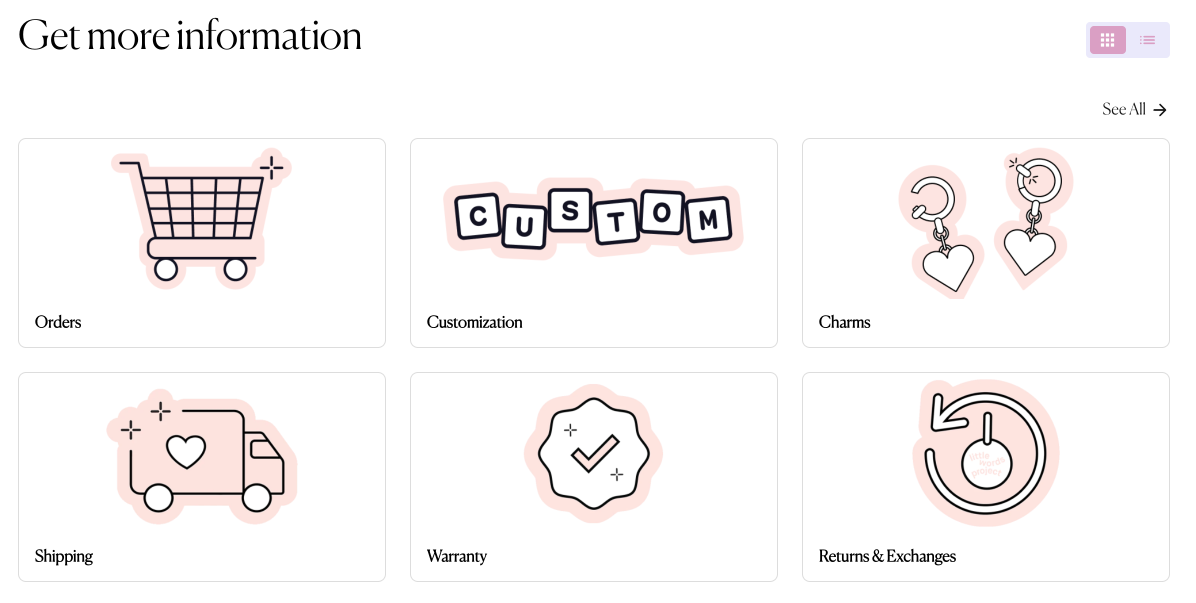
Little Words Project keeps things refreshingly straightforward. Their Help Center uses short paragraphs, descriptive headers, and tightly scoped articles that focus on a single intent, like returns, shipping, or product care.
That makes it easy for AI Agent to scan the page, pull out the right facts, and return accurate answers on the first try.
Their tone stays friendly and on-brand, but the structure is what shines. Every article flows from question → answer → next step. It’s a minimalist approach, and it works. Both for customers and the AI reading alongside them.
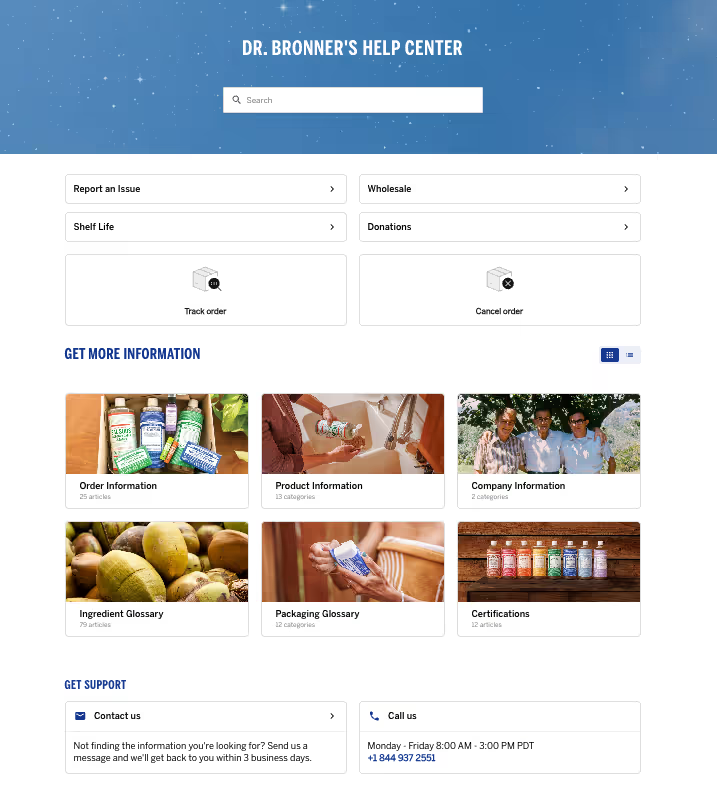
Customer education is at the heart of Dr. Bronner’s mission. Their customers often ask detailed questions about product ingredients, packaging, and certifications. With Gorgias, Emily and her team were able to build a robust Help Center that helped to proactively give this information.
The Help Center doesn't just provide information. The integration of interactive Flows, Order Management, and a Contact Form automation allowed Dr. Bronner’s to handle routine inquiries—such as order statuses—quickly and efficiently. These kinds of interactive elements are all possible out-of-the-box, no IT support needed.

When Ekster switched to Gorgias, the team wanted to make their Help Center work smarter. By writing clear, structured articles for common questions like order tracking, returns, and product details, they gave both customers and AI Agent the information needed to resolve issues instantly.
"Our previous Help Center solution was the worst. I hated it. Then I saw Gorgias’s Help Center features, and how the Article Recommendations could answer shoppers’ questions instantly, and I loved it. I thought: this is just what we need." —Shauna Cleary, Head of Ecommerce at Ekster
The results followed fast. With well-organized Help Center content and automation built around it, Ekster was able to scale support without expanding the team.
“With all the automations we’ve set up in Gorgias, and because our team in Buenos Aires has ramped up, we didn’t have to rehire any extra agents.” —Shauna Cleary, Head of Ecommerce at Ekster
Learn more: How Ekster used automation to cover the workload of 4 agents
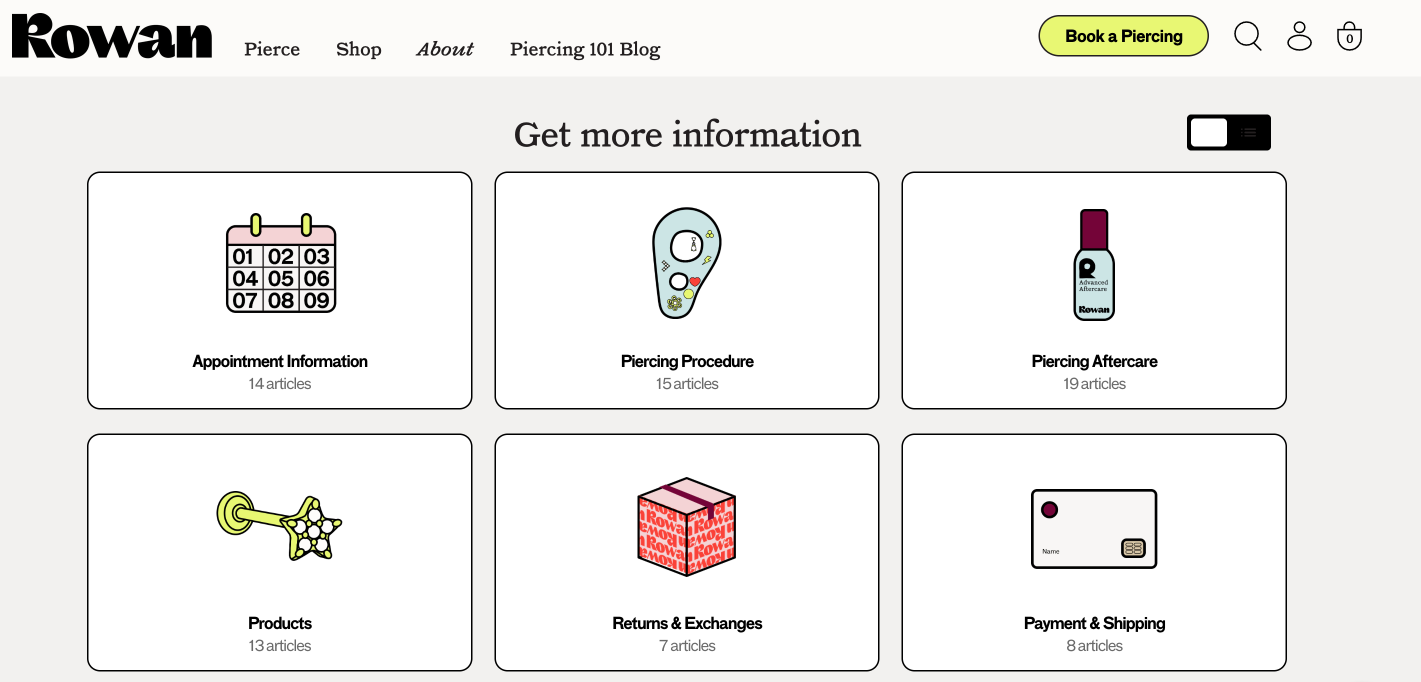
Rowan’s Help Center is a great example of how clear structure can do the heavy lifting. Their FAQs are grouped into simple categories like piercing, shipping, returns, and aftercare, so readers and AI Agent can jump straight to the right topic without digging.
For LLMs, that kind of consistency reduces guesswork. For customers, it creates a smooth, reassuring self-service experience.
TUSHY proves you can maintain personality and structure. Their Help Center articles use clear headings, direct language, and brand-consistent tone. It makes it easy for AI Agent to give accurate, on-brand responses.
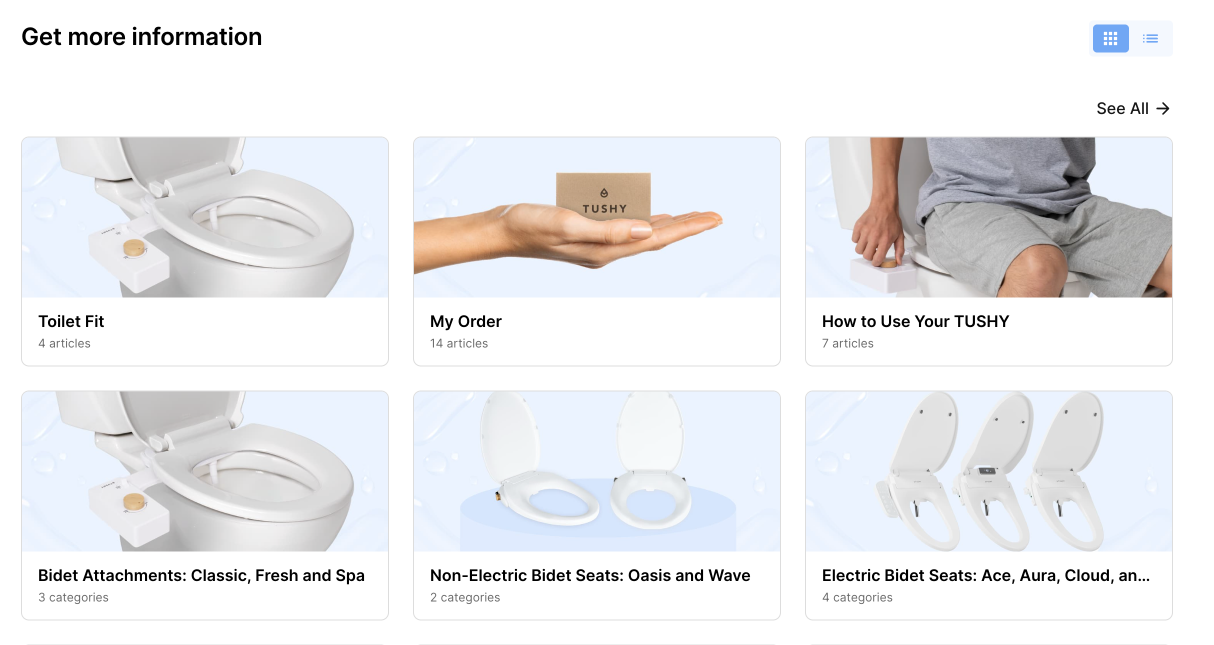
“Too often, a great interaction is diminished when a customer feels reduced to just another transaction. With AI, we let the tech handle the selling, unabashedly, if needed, so our future customers can ask anything, even the questions they might be too shy to bring up with a human. In the end, everybody wins!" —Ren Fuller-Wasserman, Senior Director of Customer Experience at TUSHY
Ready to put your Help Center to the test? Use this five-point checklist to make sure your content is easy for both customers and AI to navigate.
Break up long text blocks and use descriptive headers (H2s, H3s) so readers and AI Agent can instantly find the right section.
Spell out what happens in each scenario. This logic helps AI Agent decide the right next step without second-guessing.
Make sure your Help Center includes complete, structured articles for high-volume issues like order status, returns, and refunds.
Close every piece with a call to action, like a form, related article, or support link, so neither AI nor customers hit a dead end.
Use direct, predictable phrasing. Avoid filler like “Don’t worry!” and focus on steps customers can actually take.
By tweaking structure instead of your content, it’s easier to turn your Help Center into a self-service powerhouse for both customers and your AI Agent.
Your Help Center already holds the answers your customers need. Now it’s time to make sure AI can find them. A few small tweaks to structure and phrasing can turn your existing content into a powerful, AI-ready knowledge base.
If you’re not sure where to start, review your Help Center with your Gorgias rep or CX team. They can help you identify quick wins and show you how AI Agent pulls information from your articles.
Remember: AI Agent gets smarter with every structured doc you publish.
Ready to optimize your Help Center for faster, more accurate support? Book a demo today.
{{lead-magnet-2}}


TL;DR
At Gorgias, we work with over 16,000 ecommerce brands and one common challenge emerges over and over:
Ecommerce tools are essential, but too many tools becomes a burden.
With different teams responsible for different functions, brands risk creating a disconnected tech stack that causes inefficiencies, reduces productivity, and ultimately impacts profitability.
Ecommerce teams are shuffling between tabs, copying and pasting order numbers, searching for customer data, and trying to piece it all together. It’s not only inefficient—it’s expensive, frustrating, and unsustainable as you scale.
So we dug into that data.
Our 2025 Ecommerce Trends Report surveyed ecommerce professionals across industries and job roles to understand what they really think about tech stacks and AI’s role in it.
{{lead-magnet-1}}
There is now an ecommerce app for every possible use case a brand could need. But as businesses adopt new technologies for each part of their customer journey, their teams end up working out of dozens of platforms.
The study found that 42.28% of ecommerce pros use at least six apps daily to perform their role. Regardless of the number of apps used, integration and compatibility are a must. When technologies don’t talk to each other, you spend time context-switching instead of focusing on customer experience.

For Audien Hearing, Gorgias’s open API allowed them to create an integration with its warehouse software to manage returns directly in Gorgias rather than a shared Google spreadsheet. This integration helped them reduce returns by 5%, protecting their margins and leading to higher customer satisfaction.
Read more: How Audien Hearing Increased Efficiency for 75 Agents and Reduced Product Returns by 5%
The most successful ecommerce brands aren’t necessarily using more tools—they’re using smarter tools. Leading businesses are opting for platforms that are deeply integrated, AI-compatible, and built specifically for ecommerce needs.
A growing tech stack also comes with a growing tech budget. Each new app has new costs, including subscriptions, set-up, management, and development fees. They quickly add up.
Nearly 40% of ecommerce professionals spend $5,000 to $50,000 annually on their tech stack.

We asked ecommerce professionals what they actually value in their tools. Unsurprisingly, the answer changed based on who we were talking to.
Top tool benefits included:
There’s a clear difference between what ecommerce leaders and agents value in a tool and considering both is key to success.

Despite the benefits of using fewer, well-integrated tools, there are a few things that hold brands back from consolidating their tech stacks.
We asked respondents:
What, if any, are the biggest deterrents to consolidating your tech stack?
Top concerns are:

AI is dominating the world of ecommerce. It impacts every aspect of the customer journey, from brand discovery to the post-purchase experience. AI is actively reshaping the way ecommerce professionals work, so we wanted to know how they feel about it.
Despite growing usage and excitement, teams still have their concerns with AI:

Read more: 8 AI Trends in Ecommerce: What’s Changing and How to Prepare
The most impactful use cases we’ve seen aren’t just about reducing support ticket volume. AI is now driving revenue, increasing conversion rates, and enabling 24/7 coverage without expanding headcount.
Gorgias’s AI Agent is now capable of virtual sales assistance through personalized product recommendations, dynamic discounts to reduce cart abandonment, and cross-sells and upsells.
Top brands are already leveraging these new capabilities and seeing results. For example:
We asked one final question to make ecommerce folks really reflect on how they work:
How many tabs do you currently have open?
The average ecommerce professional works with 22 open tabs. We’re not here to judge, but if you’re looking to close a few of those tabs, Gorgias might be what you’re missing.
Gorgias replaces all that complexity with a single workspace. From support to sales, order management to automation, it all happens inside one platform.
Ecommerce businesses can now leverage Gorgias’s Advanced AI for both support and sales. Within the same AI Agent, ecommerce brands can
This blog just skims the surface of what we uncover in our 2025 Ecommerce Trends report.
Want the full story?
Download the complete 2025 Ecommerce Trends: AI Adoption & Smarter Tech Stacks report to access:
{{lead-magnet-1}}
.avif)
Not sure where to go once the Black Friday and Cyber Monday excitement settles down? Don't worry—you're not alone. Many ecommerce brands will celebrate the uplift in sales from the four-day shopping frenzy without realizing there's a huge opportunity to keep the momentum going.
The holiday shopping season is your final chance to drive sales, delight customers, and end the year strong. These five proven campaigns will help you capture last-minute shoppers, increase repeat purchases, and maximize results.
Help shoppers find the perfect gift or gift bundle by linking existing resources in the campaign or offering pre-sales assistance through a conversational campaign (recommended).
Shoppers love personalized recommendations. A gift finder campaign highlights curated suggestions that simplify their decision-making.
Pro tip: Highlight top-rated products or seasonal bestsellers to build trust.

Encourage quick action as deadlines approach.
Last-minute shoppers are in a rush, so combining urgency with a discount is the perfect motivator.
Pro tip: ”You can also set a cart value threshold, ensuring that tailored offers are only provided to shoppers once they’ve added the minimum to their cart. You can also use a unique discount code rather than a generic code to drive a higher CTR.

Turn Black Friday shoppers into repeat customers.
Reconnect with returning buyers by rewarding them for their loyalty.
Pro tip: Use the customer’s previous purchase to recommend complementary products.

Suggest relevant items to increase cart value.
Use AI to offer personalized product recommendations based on what shoppers are browsing or have in their cart.
Pro tip: Highlight frequently bought together items or exclusive bundles for the holidays.

You can easily set up product recommendations shown on your cart page with Gorgias Convert:

Build excitement with fresh, holiday-themed products.
Shoppers love discovering new arrivals, especially during the holiday season.
Pro tip: Use festive visuals and emphasize limited availability to drive urgency.

Testing helps you discover what works best for your audience. Experiment with different offers, visuals, or CTAs to optimize results.
Pro tip: Track key metrics like click-through rate (CTR) and AOV to measure success.

These holiday campaigns are proven to boost sales and customer engagement during the busiest time of year. Use tools like Gorgias Convert to launch, personalize, and optimize your strategies seamlessly.
Don’t wait—end the year strong with campaigns that deliver results!
{{lead-magnet-1}}

TikTok Shop generated 68.1% of gross market value sales across all social media platforms in 2024 and $3.8 billion in sales in 2023. Clearly, it’s becoming a massive channel with abundant opportunities for sellers.
To effectively harness TikTok Shop, however, brands with high-volume sales need to understand the specific challenges they will face when launching on the social platform.
Many of these are operational, like maintaining an accurate inventory list between platforms, supporting customers efficiently, and fulfilling a large number of orders.
When used together, AfterShip Feed and Gorgias can help you overcome these operational hurdles and start selling on TikTok Shop sooner.
{{lead-magnet-1}}
TikTok Shop is the commerce-enabled side of TikTok, where brands and creators can list their products for sale. Shoppers then make a purchase through shoppable (in-feed) videos, live shopping, or product showcases. The app aims to provide a “frictionless checkout experience,” enabling shoppers to engage with their favorite accounts and add-to-cart in a flash.

While setting up a TikTok Shop is relatively simple, if you already run an ecommerce store that does a high volume of sales, adding TikTok Shop as an additional channel will be a little more complex. Thankfully, tools like AfterShip Feed and Gorgias can help you solve many operational issues and provide the same best-in-class customer experience on TikTok Shop as you do on your other channels..
Here’s a highlight reel on how you can implement both tools to improve efficiency and customer satisfaction, tackling issues like fulfillment or customer support inquiries from the same customers on different channels.

800+ Gorgias customers currently use the TikTok Shop integration. It’s quick and easy to connect. With it, you can:
Coordinating customer support across different channels can be a pain. With Gorgias, however, you’ll be able to manage inquiries more efficiently and handle all shoppers’ messages by responding to TikTok Shop inquiries directly from Gorgias using text, images, and videos.
Additionally, you can address order-related issues and manage cancellations, returns, and refunds from TikTok Shop in the same Gorgias dashboard you use for your existing channels.
Leverage Gorgias’s automated ticket creation to reduce First Response Time (FRT) and ensure that you don’t miss a single customer inquiry from TikTok Shop. Save time by handling repetitive tasks (like order status updates) with automation.
Enabling the Gorgias TikTok Shop integration will allow you to maintain better control over communication and provide a consistent customer experience. Customers shopping via TikTok Shop will benefit from quicker responses, improving overall satisfaction and boosting brand loyalty.
AfterShip Feed is a reliable TikTok Shop management tool with 1,800 customers. It auto-syncs products, inventory, and orders between TikTok Shop and ecommerce platforms.
Partner AfterShip Feed with TikTok Shop to:

AfterShip Feed makes listing high volumes of products on TikTok Shop easier through bulk uploads and editing, enabling you to update up to 10,000 SKUs at once.
It uses AI to add key product details and keep your product listings accurate and consistent. Tools like category templates and product ID generation make it even easier to list your full catalog.
AfterShip Feed has several features that will help you avoid lost revenue, especially during busy times like BFCM.

Inventory threshold
Inventory threshold helps you determine the minimum amount of inventory you need to have on hand to avoid selling out or buying too much. You can also set a fixed amount of inventory aside for TikTok Shop.
Price rules
Price rules help you set the ideal prices for each item you sell to protect your profit margins.
Fulfillment hold
A fulfillment hold stops an order at the fulfillment stage to ensure sufficient funds on the customer side, sufficient stock on yours—or to solve another issue behind the scenes. TikTok Shop has a standard 1-hour fulfillment hold, which can cause issues with inventory syncing on your main ecommerce platform.
AfterShip Feed supports multiple fulfillment methods and integrates with many returns solutions. Sync orders from TikTok Shop with your existing fulfillment systems, ensuring timely and accurate deliveries. You can sync up to 24,000 orders to Shopify per hour.
Other features include order ID, shipping method, and product-SKU mapping.
Two industries in particular see massive sales from TikTok Shop: beauty and personal care, and womenswear and underwear. According to a 2024 report from Statista, the beauty category saw over 370 million sales and women’s fashion 284 million sales in 2023.

The beauty category alone has generated almost $2.5 billion in GMV, while the womenswear category has seen $1.39 billion.
If your brand belongs to one of these categories, including Gorgias and AfterShip Feed in your TikTok Shop toolkit could be a great fit for you.
Pairing Gorgias and AfterShip Feed will help you deliver a fantastic customer experience and grow your business on TikTok Shop.

TL;DR:
AI changes the way CX teams operate. But we firmly believe that it’s a good thing.
It will help you improve your team’s workload, say goodbye to burnout, and create a more consistent and speedy experience for your customers.
Here’s the process we recommend for pitching Gorgias AI Agent to your boss, complete with an FAQ section for quick answers.
Jump to a section:
{{lead-magnet-1}}
Gorgias views AI as an extension of CX teams, and that’s how many of our customers see AI Agent as well. Baby Gold calls theirs Michelle, Psycho Bunny calls theirs Lisa.
These autonomous agents allow your human agents to focus on more complex and nuanced issues, providing a higher level of service where your customers need it most.
Here are some other things that make AI Agent a great addition to your team:
📚 Further reading: Our AI Approach: Onboard, Automate, Observe, and Coach
Rest assured that AI Agent and Gorgias operate under a zero data retention (ZDR) policy. Once data is used, it isn’t stored.
We’re SOC 2 Type II Certified and follow strict regulations in regards to data security.
You can view the terms that cover the data we collect and how we use Artificial Intelligence by reading Our Master Service Agreement (MSA) and Data Processing Agreement (DPA).
🎯 Resource: How AI Agent works & gathers data

AI Agent provides consistent, accurate, and on-brand responses based on the information in your Help Center, Shopify order data, Macros, handover instructions, and the actual custom Guidance you set for it.
It might just surprise you with just how specialized it can get.
“Sometimes agents forget personal details to call out when communicating with our customers, like birthdays or weddings,” says Sindi Melgar, the Customer Service Manager at Baby Gold.
“But I noticed on a few different occasions where AI Agent (ours is named Michelle) is highlighting these things and is saying, ‘Congratulations on your wedding!’ Just the tone of voice that Michelle is able to adopt is definitely on brand for us.”
When you set up AI Agent, you’ll also let it know the types of topics you’d like it not to answer.
AI Agent automatically hands over tickets to your team whenever it lacks confidence in an answer or detects an angry customer.
But you can also use handover rules to choose how AI Agent behaves when it passes tickets to your human team, and add specific topics that it should always hand over to your team.
🎯 Resource: Customize how AI Agent behaves
Don’t like something AI Agent said? Or, did you love an answer it gave?
It’s easy to let AI Agent know by telling it you liked the response, saying it should have pulled from a different resource, or reporting an issue.

🎯 Resource: How to coach AI Agent and give feedback
AI Agent uses your Shopify order data, Macros, your brand’s webpages, as well as your Help Center to give your customers accurate and on-brand responses. It also prioritizes any Guidance that you set.
🎯 Resource: Why having a quality knowledge base is essential to using AI for CX
We wouldn’t expect you to onboard a new tool without some actual statistics and reviews. Below, browse three success stories and the fantastic metrics that AI Agent helped their teams achieve.

After just one month of implementing AI Agent, the team at VESSEL not only increased the number of emails automated via AI Agent by 20%, but reduced first response time to 58 seconds and saw their resolution time decrease to one minute and six seconds.

When Baby Gold implemented AI Agent, they achieved a 49-second first response time, a one-minute and four-second resolution time, and answered 1,361 tickets. They also quadrupled their email automation rate.

Psycho Bunny saw a 99.8% faster first response time, 99.4% faster resolution time, and 26% of tickets resolved by AI Agent.
“Our customer support KPIs are already fantastic: we're already leading in the industry,” said Tosha Moyer, Senior Customer Experience Manager at Psycho Bunny.
“To improve on that, we need AI—it’s not physically or financially possible with human agents alone.”
AI Agent isn’t going to find lost packages, pick up the phone, or fix damaged products. While this might seem obvious, it’s important to understand AI Agent’s core capabilities, as we want this to be an exciting and useful addition to your team.
“AI Agent does a great job of efficiently handling returns and exchanges, and split shipment tracking info,” shares Tosha Moyer. “The overall tone is good and some of its responses are really excellent.”
Below, find the top use cases for AI Agent, as well as the specific actions you can configure for it within Gorgias.
These are the top AI Agent use cases that we recommend:
The specific actions you currently can configure for AI Agent include:
With more to come! And to quiet any worries, it’s worth mentioning that AI Agent will not perform any actions without you confirming them first.
Offering fast, accurate, and 24/7 support can significantly enhance your brand reputation and build customer trust, which can translate into higher customer loyalty and increased revenue.
{{lead-magnet-2}}

TL;DR:
For support teams, sending the right answer at the right time, every time, is the ultimate goal. But with limited resources and operating hours, how can you be there for your customers 24/7? We’ve got an answer.
Designed specifically for ecommerce brands, AI Agent is conversational AI that steps in where human agents are stretched thin: handling repetitive tickets. AI Agent is trained on your brand’s policies, voice, and instructions, helping you resolve customer inquiries like your agents — but faster.
We’ll cover 10 types of inquiries AI Agent can resolve instantly, complete with template instructions (Guidance) and real-life examples. Plus, keep in mind five best practices to get the most out of your new AI teammate.
{{lead-magnet-1}}
Each use case comes with a template for Guidance instructions that acts like a built-in training manual for AI Agent. Then, see how AI Agent uses those templates to respond to real customer tickets.
Note: Guidance are special instructions that tell Gorgias’s AI Agent exactly how to handle customer questions, including when to hand them off to your human agents. This gives you control over AI Agent, so every AI interaction is always aligned with your brand’s protocols.
90% of shoppers want to be able to track their orders, according to DispatchTrack. Easily fulfill those neverending WISMO requests with one comprehensive Guidance that detects a customer’s current order status to give them the best answer.
Include these key elements in your where is my order? Guidance instructions:
Here’s an example of a where is my order? Guidance setup, available as a template in Gorgias:

Here’s how AI Agent uses that Guidance to assist a customer with their order inquiry:

💡 Pro Tip: Can’t find AI Agent? Double-check that you have an active AI Agent subscription and connect Shopify to Gorgias. To do this, go to Settings > My Apps > Shopify > Update app permissions. You must be an Admin to complete this task.
Shoppers ask product questions to get the clarity they need before buying. These pre-sales questions can make or break their decision to buy your product. Close the gap from browsing to checkout by using AI Agent to deliver quick, accurate answers that help them make confident decisions.
Here’s an example of a product-focused Guidance setup:

Here’s how AI Agent uses that Guidance to assist a customer with their product inquiry:

💡 Pro Tip: AI Agent can also learn information from your web pages. Go to AI Agent > Knowledge > Public URL sources to sync key web pages like sizing guides, blog posts, and more.
Answering ecommerce return requests can be time-consuming. Requests can range from a simple what is your return policy? question to customers wanting to go through the return process. Regardless, return inquiries can easily be handled by AI and handed off to a human agent if necessary.
Include these key elements in your returns Guidance instructions:
Here’s an example of a returns inquiry Guidance setup, available as a template in Gorgias:

Now, look at how AI Agent uses this Guidance to assist a customer with their return request:

💡 Pro Tip: If you’re using Loop Returns, set up AI Agent to automatically send a returns portal link to customers. This Action fully resolves returns inquiries by directing shoppers straight to their orders.
Order issue tickets often require back-and-forth. The customer states their problem, you ask for photo verification and check if the customer has tried all the different solutions — the list goes on. Let AI Agent cover the bases for you every time, and if needed, escalate the ticket to your team.
Include these key elements in your order issues Guidance instructions:
Here’s an example of a Guidance setup for handling order issues, available as a template in Gorgias:

Here’s how AI Agent follows this Guidance to resolve a customer’s order issue:

Canceling orders is pretty much a race against order fulfillment and your third-party logistics. The key is to catch these inquiries as soon they hit your inbox. The problem? Tickets can come late at night or outside of your business hours. However, when you let AI Agent handle them, customers can rest assured that their request will be dealt with.
Include these key elements in your cancellation Guidance instructions:
Here’s an example of a cancellation Guidance setup, available as a template in Gorgias:

Here’s how AI Agent follows this Guidance to handle a customer’s cancellation request:

💡 Did you know? You can let AI Agent cancel an order when the customer and order meet certain conditions. For example, the Action will only be performed if the fulfillment status is still empty. Go to AI Agent > Support Actions > Create from Template > Cancel order.
Come holiday season, including Black Friday, you’ll be swamped with loads of discount inquiries. Whether it’s customers asking about discount codes not working or if you have any codes available, these repetitive inquiries are best resolved by AI.
Include these key elements in your discount Guidance instructions:
Here’s an example of a discount inquiry Guidance setup, available as a template in Gorgias:

Here’s how AI Agent follows this Guidance to handle a customer asking for coupons:

Acknowledging feedback, good and bad, can make customers more willing to keep doing business with you. Maintain an honest rapport with customers by letting them know you’re always listening.
Include these key elements in your feedback Guidance instructions:
Here’s an example of a customer feedback Guidance setup:

Here’s how AI Agent uses this Guidance to respond to positive feedback:

💡 Pro Tip: Let AI Agent automatically tag feedback tickets for you by going to AI Agent > Settings > AI ticket tagging. This way, your agents can find all customer feedback organized in one place.
Account management tasks like updating details or managing subscriptions are tedious, time-consuming, and often things customers can do themselves. Let AI Agent handle these tasks to speed up resolutions.
Include these key elements in your account management Guidance instructions:
Here’s an example of a Guidance setup for account management, available as a template in Gorgias:

Take a look at how AI Agent uses this Guidance to help a customer with managing their rewards:
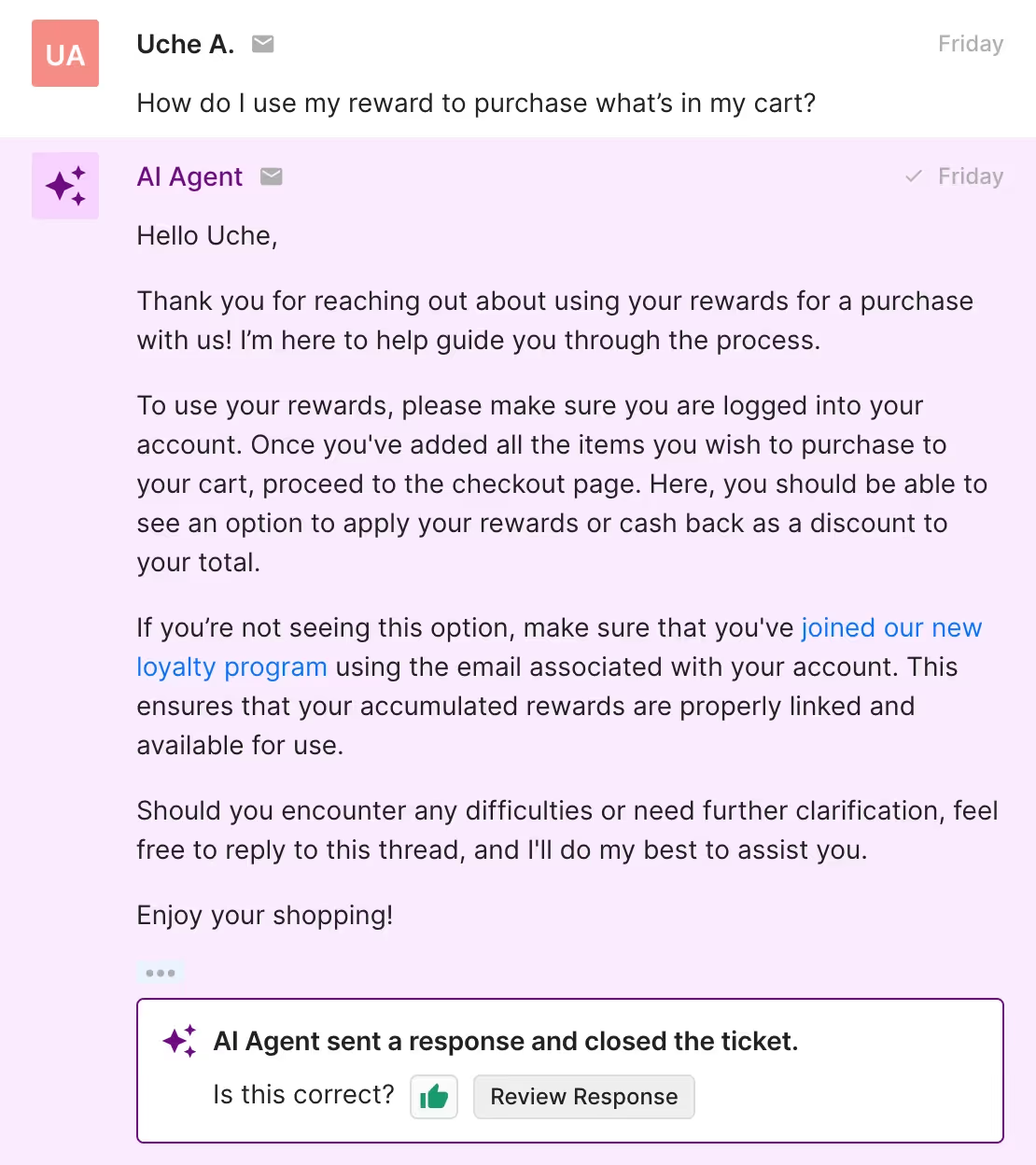
💡 Pro Tip: Use Recharge Actions to automate subscription cancellations or skip shipments with AI Agent. Go to AI Agent > Support Actions > Create from Template > Cancel subscription or Skip next subscription shipment.
Influencer marketing is on the rise as customers look to social proof when deciding what products to buy. With the right Guidance, your AI Agent can easily manage collaboration and marketing partnership inquiries.
Include these key elements in your collaboration requests Guidance instructions:
Here’s an example of a collaboration request Guidance setup:

See how AI Agent uses this Guidance to respond to a collaboration request from a content creator:

AI Agent isn’t designed to handle all tickets. For highly complex and sensitive topics, instruct AI Agent to reroute them to your human agents who are equipped to handle certain subjects with more caution and context than AI.
For example, a makeup brand would disable AI Agent from taking on tickets about allergic reactions or health concerns so customers receive safe advice.
Here are other messages you should prevent AI Agent from answering:
Take a look at how AI Agent escalates a ticket about a damaged product:

Note: AI Agent automatically escalates messages with angry language and sentiment to your support team — no Guidance needed.
While AI Agent answers most customer inquiries, you’ll still need to be there to provide it with the barriers to keep its answers on-brand and accurate.
Here are five best practices to keep in mind when creating Guidance instructions.
Prime AI Agent with essential brand information by creating Guidance for the top five most common customer questions:
You can automate a significant portion of customer support and save time for your team just by letting AI Agent answer these tickets.
Always use clear and descriptive names for your Guidance. AI Agent relies on this information to identify whether the Guidance is relevant to the customer’s question.
For example, instead of naming it “Shipping,” use something like “Shipping policy – domestic & international” to help AI Agent choose the right response.
It’s important to include detailed examples to help AI Agent detect the intent behind your incoming tickets. Clear examples let AI Agent match customer inquiries with the correct response more reliably.
For instance, instead of just saying, “Answer shipping questions,” give it an example: “For domestic orders, say: ‘Shipping takes 5-7 days. For international orders, it takes 10-15 days.’” This helps AI Agent detect when a question is about shipping timelines and respond appropriately.
Customer needs and products change over time, so it’s important to check back on your Guidance to make sure it’s relevant. AI Agent’s responses should reflect any changes to your policies, products, or processes to provide customers with up-to-date information.
Before going live with new or updated Guidance, use Test Mode to make sure AI Agent is responding as expected.
Here are key things to check in Test Mode:
Right out of the box, Gorgias includes Guidance templates to help AI Agent manage your FAQs, like returns inquiries, shipping questions, and more.
Equip your AI Agent with Guidance and watch your support team thrive with more time to nurture your customer relationships and handle complex tasks.
See how AI Agent can transform your support team within minutes by booking a demo today.
{{lead-magnet-2}}

Let’s be clear: a customer knowledge base is not a landing page full of frequently asked questions.
Sure, FAQs can live in your knowledge base, but they can do so much more than simple Q&A.
A well-crafted Help Center is a strategic asset, propelling your conversion goals by easily guiding customers through the sales funnel.
We’ll walk you through what a knowledge base is, how it can support your bottom line, and everything you need to know to create yours successfully.
Customers love having the power to solve problems independently and on their schedule. That's precisely what a knowledge base delivers.
Your knowledge base isn’t just a static library of articles — it's an interactive portal connecting your customers to sales and customer service. That means making it easy for them to find answers before purchasing and helping them troubleshoot any possible issues afterward.
{{lead-magnet-1}}
Now that we've introduced the concept of a knowledge base, let's dive deeper into how these helpful landing pages can drive revenue by leveling up your customer service game.
90% of consumers worldwide consider issue resolution as their top priority for customer service. And with a knowledge base, you can make their dreams come true with 24/7 self-service support.
Think of a customer knowledge base as your company's information powerhouse that includes helpful articles, FAQs, contact methods, and more ––– all readily available 24/7 for your customers to tap into whenever they need help.
And the magic word that describes why a knowledge base is so powerful? Self-service.
Nail this experience, and your knowledge base will serve as a revenue-driving machine for acquisition- and retention-based goals.
No more waiting in line, playing phone tag, or being told the customer support team is “offline until tomorrow.” As long as customers can easily locate the information they’re after (more on this later), they get an immediate response to their questions.
Your support team deals with a mountain of questions every day:
…These are the classics.
Imagine dramatically cutting down the number of repetitive inquiries your team handles or eliminating them entirely. Your knowledge base can make this happen. By leveraging data to pinpoint the most frequently asked questions, you can create help articles that address these issues and showcase them at the top of your knowledge base.
But how do you identify the most common questions? Two straightforward solutions are already at your fingertips in the Gorgias Helpdesk.
1. Monitor commonly used tags: Tags are labels for categorizing tickets by topic or customer intent. Regularly reviewing tags helps identify common customer inquiries. Generally, the more a tag is used, the greater the need for clarity on that topic.
On Gorgias, navigate to Statistics > Ticket Insights > Tags to see the frequency of tag usage. This view gives you an overview of popular tags. You can adjust the view by filtering by app integration, channel, and date range.

2. Review your intent statistics: Intent Statistics provide valuable insights into why customers contact support. You can understand the primary reasons behind customer queries by analyzing these statistics.
On Gorgias, go to Statistics > Ticket Insights > Intents to review the usage frequency of different customer intents.
This feature provides a clear bar graph view of customer concerns frequently mentioned in messages. You can also change the view using channel and date range filters.

The result: Customers don’t have to search through your articles, and your support team frees up time to focus on providing better customer experiences.
Questions answered, problems solved.
Final tip: To streamline the creation of your Help Center, we created 50+ ready-to-use article templates on key topics like shipping, tracking, account setup, and product details. See the templates here.
Customers browsing your store often need help deciding between options or understanding how your product works. Don’t let them leave with uncertainty.
A knowledge base isn't just for answering questions about shipping or order tracking — it can also function as a personal shopper, guiding customers toward the perfect fit or style.
With Gorgias Convert, you can engage customers at key moments with personalized, persuasive messaging. Offer exactly what they need while they’re viewing a product, such as a helpful guide from your knowledge base that:
Take TUSHY, which highlights an article on their toilet compatibility page when customers show a 30-second delay on their bidet product page.

As another example, if a customer asks, "I have wide feet. Will your shoes fit me?" don’t just respond with a simple "yes." Take it further by sharing helpful links to articles about your shoe size and fit. This approach answers their question and boosts their confidence in purchasing.
Delivering information in a consistent tone across all customer interactions builds trust and leaves a lasting impression. You can easily do this in your knowledge base by staying in line with your brand's tone and style and communicating your company’s values.
Let’s run through an example: Let's say you sell organic skincare products, and you want to use your knowledge base to establish your expertise and the brand values you share with like-minded people.
Health-conscious consumers often have specific concerns about product safety, ingredients, and potential side effects. Your knowledge base is the ideal platform to address these concerns transparently. How?
Explain the benefits of organic ingredients, the absence of harmful chemicals, and how your products contribute to healthier skin.
Proactively addressing these concerns promotes a lifestyle choice centered around happy skin and well-being. Doing so will set you up to be seen as a trustworthy source of information about safe beauty.
Next, we’ll walk you through creating and managing your customer-facing knowledge base.
These initial steps are the foundation of a successful knowledge base, ensuring long-term success.
To lay the groundwork for your knowledge base, you need to know your customers like the back of your hand. A few ways you can kick off this research:
Review key questions and phrases from your previous conversations with customers: Dive into your customer support history, whether it’s through email, live chat, or social media.
Look for recurring questions, common issues, or patterns. For example, those should be high-priority topics if you're constantly fielding inquiries about sizing or return policies.
You can learn these by looking into the reasons for contact with Gorgias. This AI-powered feature identifies a ticket's contact reason from its message content. Reasons could range from cancellations and refunds to shipment issues and feedback. The Contact Reason is conveniently located at the top of each ticket, as shown in the image below.

Use customer satisfaction surveys to discover what burning questions are on your shoppers’ minds: To view satisfaction scores on Gorgias, navigate to Statistics > Support Performance > Satisfaction.
This section provides details on surveys sent, response rates, average ratings, and response distribution over three months. Filter for scores of 3 stars or below. Analyzing lower ratings and their accompanying comments will help you pinpoint the topics your Help Center articles should address.

Any customer data you have available becomes your roadmap to creating valuable knowledge base content.
The research step is crucial, and here’s why: In 2022, Deloitte Digital conducted research with Twilio about the business value of trust. The results showed that when companies make it easy to do business with them, 96% of consumers trust the brand more.
When asked how companies can make it easier to do business with them, customers said the following factors are the most important:
Your knowledge base can help with all three factors. As a result, Deloitte’s research found that customers are more likely to reward that trust by making more frequent and higher-value purchases.
Starting a Help Center can be daunting, especially when you're strapped for time already.
Creating a Help Center involves research, brand consistency, copywriting, and page structure. Luckily, platforms like Gorgias provide templates that eliminate the guesswork and lighten the load.
These ready-to-use templates are crafted from successful Help Centers across various industries, giving you a proven framework to structure your own content confidently.
Your knowledge base isn't just a sidekick. It's a key part of your brand's identity. No matter if a new customer lands on your knowledge base through your main site or via a Google search, it should feel like they're interacting with the same business as they jump between the knowledge base and your main site pages.
That’s why you need to ensure your knowledge base’s branding seamlessly matches your website, creating a cohesive experience for your customers.
A few elements to consider:
Princess Polly’s customer knowledge base ties in all of these elements well. Even though the knowledge base is on a separate subdomain, it doesn’t feel any different from the brand’s main domain from a user’s perspective.

Princess Polly's knowledge base design matches its main homepage, keeping the user experience cohesive.
Platforms like Gorgias allow you to edit fonts, logos, and headers for your Help Center without any coding required. If you're craving more customization, you can dip into HTML and CSS to tailor specific elements.
Remember, the goal here is to make things effortless for your customers. If your knowledge base is a maze of articles without clear categorization, it's not user-friendly — it's a Q&A jungle that nobody wants to venture through.
Organize all your articles with crystal-clear categorization — think "Shipping," "Returns," "Loyalty Program," and "Sizing." Don't forget to add a smart search bar that understands keywords and common phrases to recommend relevant articles.
"We have a great Help Center that attracts tens of thousands of monthly visitors who are then redirected back to the main site and in this circular motion where we don't want those customers to drop off. Two critical aspects drive this success: ensuring accessibility so customers can easily find the answers they need, and providing direct contact options for our team. We don't want you to have to go searching for your answer to the point where you're frustrated and you stop that purchasing experience." —Colin Waters, Leading at The Feed & former Associate Director of Customer Experience at BrüMate
Once you’ve gone through the foundational steps, you can work on taking your knowledge base to the next level. This will enhance customer satisfaction and engagement.
In a world where 65% of customers expect companies to adapt to their changing needs and preferences, proactive customer service is essential. One way you can satisfy this expectation is to use automated and interactive FAQs via chatbot that adjust to customer needs.
For example, with Gorgias Automate, you can use Article Recommendations in Chat to help customers out without live agent help. When they type in the Chat, they'll automatically receive a relevant Help Center article suggestion.
The goal is to answer the customer’s question without having to pull in a support agent.
What if automation doesn’t answer a customers’ question? Glad you asked! At the end of the flow, if the customer still requires help then a ticket is then created for an agent to follow up.
Order tracking is a hot topic for customers, so don't be shy about it. Add more than one CTA that customers can click to track their order without having to get in touch with your team.
Feature an order tracking CTA prominently in your knowledge base's header, via chat, and as a main option on the Help Center page.
See the screenshot from Parade below, for example: This may seem overkill, but we promise it’s not. The data to prove it: merchants who use Gorgias’s automation tools reduce support tickets in their helpdesk by 60%.

When it comes to crafting a comprehensive knowledge base solution, text alone might not always suffice. Customers often prefer visual cues, and research has shown that visual content can significantly improve understanding and retention of information.
Think about any time you’ve built a piece of furniture that you bought online. Those manuals are confusing enough as is — even with the images added to every step. Imagine how much head-scratching you’d be doing if you didn’t have the images to accompany you.
That’s why images, videos, and other iconography are useful to include in your knowledge base, so you can eliminate confusion and boost user confidence.
Check out how Loop uses videos along with written instructions for tutorials:

8) Make contact forms easily accessible
Yes, one of the key objectives of a knowledge base is to empower customers to find answers and solutions independently. However, there will always be situations where customers require personalized support — like when an order arrives damaged, for example.
Integrating contact forms directly into your knowledge base provides a straightforward channel for customers to reach out for assistance. But these inquiries can be difficult to keep up with when you have multiple forms living on various parts of your site.
💡 Tip: Add a “contact us” CTA in your knowledge base. If a customer clicks it, they’re redirected to the main contact page on your website. You can also create a knowledge base form that’s separate to track traffic from the Help Center page alone.
Here’s an example from BrüMate, which features its “contact us” form directly on the Knowledge Base domain:

It’d be nice if you could promptly answer every customer’s question, but sometimes, a self-service knowledge base isn't enough. Unique situations will arise, and that's where the human touch comes in.
A staggering 83% of customers agree that they feel more loyal to brands that respond to and resolve their complaints. So, be prepared to chat live when the need arises.
Concerned about managing live chat support? A few ways to make it easier for strapped CX teams:
Here’s another knowledge base example from Princess Polly, which features a live chat widget on its knowledge base page and highlights key FAQs.

⚡ Key Takeaway: Every customer has a different preference for how they want to be communicated with. It’s important that you offer various methods to satisfy those preferences.
Your knowledge base is an ongoing initiative. As you expand your product line and discover new information, you’re going to want to adapt your knowledge base to continue meeting the needs of your buyers.
So lastly, let’s talk about maintaining and evolving your knowledge base to ensure you continue providing a high-quality and effective experience.
Your knowledge base is an evolving entity. Using analytics to your advantage will help you continue to improve it over time.
Here are a few questions to consider:
Gorgias's cloud-based integration with Google Analytics makes tracking engagement a cinch, helping you uncover the most-viewed questions, peak activity times, and top-clicked links.
Metrics from your analytics tools is helpful but becomes even stronger when you combine it with qualitative data. This type of information has to be collected directly from customers, which you can do via feedback forms.
After each support interaction, simply ask customers how you can improve. Some questions you can ask are:
Did you know your knowledge base can be used as an acquisition tool by driving organic traffic to your website? Optimize it for search engines by framing questions as main headings.
For example, article titles can be formatted like, "What is your return policy?" This way, when potential customers search Google for answers, your article will appear.
When building your knowledge base in Gorgias, you can even customize your meta title and description for an extra SEO boost. Check out ALOHAS’ knowledge base as an example. For customers who search “What is Alohas’ return policy?” in Google, this article will show:

The ALOHAS Help Center is the highlighted result on Google thanks to search engine optimization.
We all know things won’t stay the same forever. Products change, ingredients shift, and branding gets a makeover.
When information changes, It's essential to shift the information in your knowledge base too.
What if you decide to change your shipping policy, so it’s only free after a customer spends $50 versus $25? The last thing you want is an irate customer pointing to an old article that mentions the $25 rule.
This is why you must regularly audit and quality check your articles to ensure they're as recent as possible. Failing to do so can impact customer loyalty.
Now that you have the full scoop on building a successful customer knowledge base, looking at specific examples may help.
Here are a few businesses that have integrated automation, clear categorization, and user-friendly interfaces to empower customers to find answers and solutions efficiently.
BrüMate's Help Center stands out for its customer-centric approach. Here's what makes it effective:
Right at the top of the page, BrüMate addresses two of the most common customer queries: the returns policy and compatibility with their products. This ensures that customers can find answers without scrolling.

Directing customers to the right product
BrüMate goes a step further by offering a personalized product finder quiz. This interactive element helps customers discover the perfect BrüMate product that suits their needs without the hassle of extensive research.

“We’ve started pushing people towards resources that are in our Help Center. We're trying to help our customers self-solve.”
—Colin Waters, leading at The Feed & former Associate Director of Customer Experience at BrüMate
The Help Center features easily accessible header links, including options to track packages and return to the main site. The chat bubble is readily available, and if the customer service team is offline, customers can access helpful articles.
ALOHAS’s Help Center excels in providing quick and convenient access to information. Here's what sets it apart:
Just like BrüMate, ALOHAS prioritizes customer needs by featuring top questions prominently at the top of the page. This means customers don't have to scroll to find answers.

ALOHAS puts its most frequently asked questions about refunds and shipping at the top of its knowledge base.
ALOHAS uses icons effectively for Call to Action (CTA) buttons related to orders, including tracking, returns, cancellations, and reporting issues.

ALOHAS makes it easier to navigate their knowledge base with icons and emojis.
The Help Center is well-organized with clear categorization of articles, making it easy for users to navigate and find relevant information.
ALOHAS' search function is highly effective, pulling relevant information based on key phrases, further enhancing the user experience.

ALOHAS includes a search bar to allow customers to find their specific questions quickly.
LUNO takes a minimalist approach that proves simplicity can be highly effective:
LUNO demonstrates that sometimes less is more. The Help Center is clean and uncluttered, ensuring customers can find what they need without distractions.

LUNO's knowledge base is simple without extra decorative elements like images or icons.
Many articles are dedicated to specific product questions, such as compatibility, user manuals, and repair guides. It serves as a virtual manual for customers.
88% of customers already search your website for some kind of knowledge base or FAQ. It's your chance to transform those searches into conversions.
All of the knowledge base tools mentioned today are available with Gorgias, which you can try for free for 7 days.
{{lead-magnet-2}}

TL;DR:
AI Agent is a conversational AI support assistant designed specifically for ecommerce brands. Trained on your store’s Shopify data, policies, and brand guidelines, AI Agent responds to customer interactions with personalized, high-quality answers.
But is it the good type of AI?
As AI emerges more and more as a necessity for CX teams, there are a few common concerns among leaders. Worries that it will steal customer data, use data to enhance OpenAI’s LLM, or leverage shopper data for things outside of its scope are just a few.
To quell those concerns, we’ll go into the specifics of how AI Agent actually collects and uses data.
{{lead-magnet-1}}
Jump to an answer:
Gorgias’s AI Agent uses merchants’ unique data, including orders, ticket information, product catalogs, and store content, and then uses a blend of state-of-the-art LLMs, including OpenAI and Anthropic, to help it construct natural, human-like responses.

The information AI Agent has access to is approximately the same data as the one presented in the Shopify widget in the Gorgias helpdesk. We push this same information to AI Agent to compute the next step for the customer.
Some of the data permissions that AI Agent has when integrated with Shopify include access to all orders, all draft orders, order edits, fulfilments, products, customers, themes, discounts, scripts, and content.
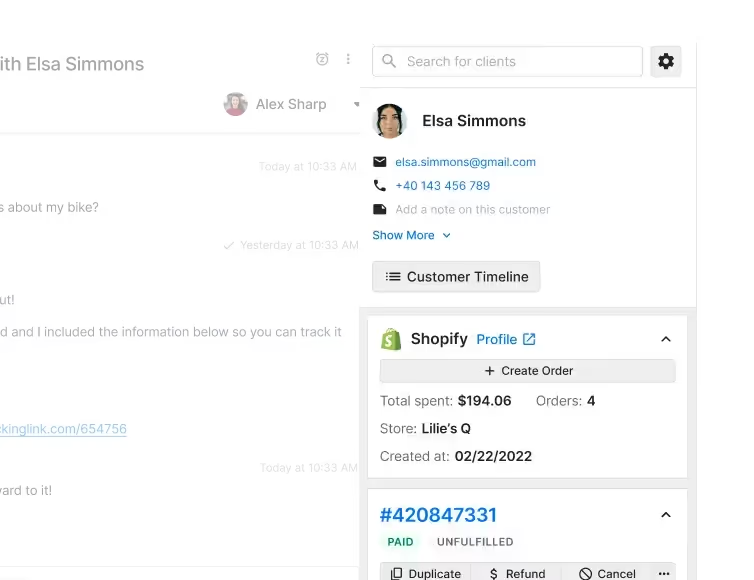
AI Agent processes the information from the ticket to understand where to pull the relevant data from, such as correlating information from the account associated with the interaction as well as the intent of the message. Here’s how it works.
AI Agent first analyzes the content of the ticket to identify the key information and intent behind the customer's inquiry.
It correlates this information with the available data sources, such as Guidance your team sets up (which takes precedence over other knowledge sources), Help Center articles, Macros, and any other integrated knowledge bases.
AI Agent understands the context of the message and retrieves relevant data. If there are multiple sources of information, it determines which source is most pertinent to the query.

If the ticket has vague or insufficient information, AI Agent will ask clarifying questions to ensure it pulls the correct information.
Before sending the response, AI Agent undergoes an internal QA process where it verifies the information and creates an internal note for the merchant. This note includes information on what knowledge and Shopify data was used, and shows "reasoning" for the event if the QA failed.

Merchants or admins can provide feedback on whether the resolution was good or bad, and AI Agent uses this feedback to improve future responses.
Gorgias and AI Agent do not store shopper or customer data.
AI Agent operates under a zero data retention (ZDR) policy, meaning that once the request is processed, the data is not stored.
📚 Further reading: Our Master Service Agreement (MSA) and Data Processing Agreement (DPA) govern the use of all Gorgias services, including AI Agent. If you’d like to learn more, these terms detail the data we collect and how we use Artificial Intelligence.
Data privacy and security are top priorities for us, and our systems are designed to handle data in a secure manner without retaining personal or sensitive information.
AI Agent uses language models developed by OpenAI. OpenAI does not use customer data to train their models, and there is a zero data retention policy. Any data sent through the API is not stored beyond the duration needed to serve the request pulled.
Gorgias is SOC 2 Type II compliant and adheres to strict regulations and standards to ensure the privacy, security, and proper handling of sensitive data.
AI Agent and Gorgias comply with stringent data privacy regulations, such as the General Data Protection Regulation (GDPR) and California Privacy Rights Act (CPRA), ensuring that shopper data is handled securely and responsibly without being used for model enhancement.
This approach ensures that shopper data remains private and is not utilized beyond the scope of providing immediate customer support.
“We were initially nervous about using AI, but it has quickly proven its worth. Our community members have even mistaken the AI Agent for a real person, which speaks volumes about how well it aligns with our brand voice.”
—Zoe Cranney, Community Experience Expert, LSKD
Yes! AI Agent was built not only to provide instant and accurate responses, but also with transparency in mind. For every interaction that AI Agent has, it provides you with an internal note that covers:

While no AI tool is capable of perfect accuracy 100% of the time, we put several safeguards in place to keep AI Agent from sending inaccurate information.
When AI Agent responds to a customer, it pulls from your team’s specific documents. Aside from the Guidance you set, which it prioritizes, AI Agent uses your Shopify order data, Macros, your brand’s webpages, as well as your Help Center.
Using AI Agent is unlike only relying on ChatGPT for answers, which uses broad information. AI Agent draws from your data only, making its responses highly accurate and personalized to your brand.
LLMs like OpenAI and Anthropic’s main role in AI Agent is to recognize and form natural-flowing responses. It can speak in different languages and tones to align with your brand voice. This, combined with your own internal knowledge sources, helps add that human touch that sets it apart from automated emails and bots.
As another layer of control, we let you define topics that AI Agent should completely ignore and hand over to your team.
For example, some topics — such as medical questions or legal threats — are too sensitive to handle with AI. You can add these to your Exclusion or Handover topics to ensure AI Agent does not respond to them.
You can improve AI Agent’s responses by providing feedback on how it handled tickets. You can either approve of its behavior or suggest adjustments to improve future interactions.
For example, when an influencer reached out to hip toddler carrier brand Wildride and said, “I really love you guys,” AI Agent replied, “Love you too ❤️❤️”.
Amber van den Berg, Head of Customer Experience, found this really funny, as it was exactly the type of response the team would have given. But if that response wasn’t quite right, or wasn’t on brand, they could have given AI Agent that feedback.
You have the choice of whether or not to disclose your use of AI in response generated by AI Agent.
However, for maximum legal protection, we recommend using your email signature to indicate that the message your customers receive has been created with AI.
Note: Some laws, such as the California Bolstering Online Transparency Act, prohibit misleading consumers about the use of automated artificial identities.
"I saw how well AI Agent was replying to customers and really started to think about how we could optimize it to work for us even more,” said Amber van den Berg, Head of Customer Experience at Wildride.
“Within one month, AI Agent was answering 33% of emails, which is quite impressive." This was essential for Wildride’s CX team after viral social media content bumped 1000 tickets per month to 1000 tickets per week.
Now, the team is freed up to focus on more complex issues, and AI Agent can fill in the rest.
Book a demo to see how AI Agent can work for you.
{{lead-magnet-2}}


