Join us for Moments That Matter: Meet the Modern Helpdesk
September 10 at 12PM EST.
Save your seat


TL;DR:
In 2025, chat’s growth outpaced email by 2.5x quarter over quarter. Chat has become our most powerful customer experience tool for how shoppers discover products, ask questions, and decide to buy.
We knew it needed an upgrade, so we reimagined the entire experience from the ground up.
The result is 36% more engagement with product recommendations, nearly 2.25x more shoppers add-to-cart, and 7.3% more customer engagement.
In this post, we'll walk you through our thinking, what’s new in Chat, and how brands are already seeing big gains.
Chat has outpaced email support. Today’s shoppers prefer the speed of quick chat conversations over email. And when shoppers make a new move, we watch, listen, and move with them.
This behavioral shift isn’t happening in isolation. It aligns with the rise of conversational commerce and proves a universal move toward real-time conversations in ecommerce.
In fact, the signals were already there. Two years of building AI Agent showed us just how much design shapes behavior. The interface is the experience, and we knew that pushing chat experiences to closely resemble human interactions would transform how shoppers engage.
Our new and updated chat brings that vision to life. We believe that shopping is moving from static pages to conversations. This new update is built for how people actually want to shop.
The new design turns live chat into an interactive shopping surface made for modern shoppers. We've brought together multiple ways for shoppers to jump into chat, added clickable replies instead of typing, browsable product cards right in the conversation, and quick cart access.
Let's walk through what's new.
Chat now comes in a softer color palette that adapts to your store’s branding. We removed message bubbles in favor of an airy design that brings in the familiarity of speaking to your favorite conversational AI assistant. Every interaction now has the breathing room for deeper conversation and personalization.

It’s now easier for shoppers to get an answer with quick reply buttons and suggested questions in Chat. This replaces the tree-based flows of the previous Chat, removing the need to follow a fixed path. Shoppers can find answers faster without typing text-heavy explanations.

Browsing and buying within Chat is now possible. Previously, it only supported product links that would open in a new page. With the upgrade, you can view item details without leaving the conversation. Shoppers can browse, compare products, and add to cart in one place.

We’re keeping the context by removing the external redirects. The new interface lets shoppers browse product recommendations right in chat. View key product details, images, descriptions, variants, and pricing without opening a new tab.

Chat adds clickable questions on product pages — like “Is this true to size?” or “What’s the difference between shades?” — designed to match what a shopper is likely wondering in the moment. These context-aware prompts help remove buying hesitation before shoppers even think to ask.

Chat adds instant access to shopper actions, like a cart button and an orders button for returning customers. Shoppers can jump straight to their cart or check on an existing order without waiting for an agent to give them a status update.

Every update in Chat drives performance. We didn’t simply give it a makeover, we also fine-tuned its underlying mechanics.
When product suggestions are easy to browse, shoppers interact with them more. The new product cards make shopping feel natural, allowing customers to explore items at their own pace. That convenience led to a 36% increase in engagement with recommended products.
Chat keeps the entire shopping journey inside the conversation, from browsing and asking questions, to adding to cart and checking out. This new layout removes the usual tab-switching between chat and the website. Less friction has led to a 58.8% increase in add-to-cart actions.
Chat's cleaner design and contextual entry points make it easier for shoppers to start a conversation. With suggested questions on product pages and quick reply buttons, more visitors are choosing to engage earlier in their journey. This has resulted in a 7.3% lift in chat engagement.
Conversational commerce has moved from concept to reality. Chat makes it part of the everyday shopping experience, letting shoppers browse, ask questions, compare products, and check out in one interaction. It brings the ease of the in-person shopping experience into the digital world.
We built Chat to redefine the shopping experience. We hope you see it reflected in your customers’ journeys.
Book a demo to see what's possible with the new experience.
TL;DR:
Your AI sounds like a robot, and your customers can tell.
Sure, the answer is right, but something feels off. The tone of voice is stiff. The phrases are predictable and generic. At most, it sounds copy-pasted. This may not be a big deal from your side of support. In reality, it’s costing you more than you think.
Recent data shows that 45% of U.S. adults find customer service chatbots unfavorable, up from 43% in 2022. As awareness of chatbots has increased, so have negative opinions of them. Only 19% of people say chatbots are helpful or beneficial in addressing their queries. The gap isn't just about capability. It's about trust. When AI sounds impersonal, customers disengage or leave frustrated.
Luckily, you don't need to choose between automation and the human touch.
In this guide, we'll show you six practical ways to train your AI to sound natural, build trust, and deliver the kind of support your customers actually like.
The fastest way to make your AI sound more human is to teach it to sound like you. AI is only as good as the input you give it, so the more detailed your brand voice training, the more natural and on-brand your responses will be.
Start by building a brand voice guide. It doesn't need to be complicated, but it should clearly define how your brand communicates with customers. At minimum, include:
Think of your AI as a character. Samantha Gagliardi, Associate Director of Customer Experience at Rhoback, described their approach as building an AI persona:
"I kind of treat it like breaking down an actor. I used to sing and perform for a living — how would I break down the character of Rhoback? How does Rhoback speak? What age are they? What makes the most sense?"
✅ Create a brand voice guide with tone, style, formality, and example phrases.
Humans associate short pauses with thinking, so when your AI responds too quickly, it instantly feels unnatural.
Adding small delays helps your AI feel more like a real teammate.
Where to add response delays:
Even a one- to two-second pause can make a big difference in a robotic or human-sounding AI.
✅ Add instructions in your AI’s knowledge base to include short response delays during key moments.
Generic phrases make your AI sound like... well, AI. Customers can spot a copy-pasted response immediately — especially when it's overly formal.
That doesn't mean you need to be extremely casual. It means being true to your brand. Whether your voice is professional or conversational, the goal is the same: sound like a real person on your team.
Here's how to replace robotic phrasing with more brand-aligned responses:
|
Generic Phrase |
More Natural Alternative |
|---|---|
|
“We apologize for the inconvenience.” |
“Sorry about that, we’re working on it now.” (friendly) |
|
“Your satisfaction is our top priority.” |
“We want to make sure this works for you.” (friendly) |
|
“Please be advised…” |
“Just a quick heads up…” (friendly) |
|
“Your request has been received.” |
“Got it. Thanks for reaching out.” (friendly) |
|
“I will now review your request.” |
“Let me take a quick look.” (friendly) |
✅ Identify your five most common inquiries and give your AI a rewritten example response for each.
One of the biggest tells that a response is AI-generated? It ignores what's already happened.
When your AI doesn't reference order history or past conversations, customers are forced to repeat themselves. Repetition can lead to frustration and can quickly turn a good customer experience into a bad one.
Great AI uses context to craft replies that feel personalized and genuinely helpful.
Here's what good context looks like in AI responses:
Tools like Gorgias AI Agent automatically pull in customer and order data, so replies feel human and contextual without sacrificing speed.
✅ Add instructions that prompt your AI to reference order details and/or past conversations in its replies, so customers feel acknowledged.
Customers just want help. They don't care whether it comes from a human or AI, as long as it's the right help. But if you try to trick them, it backfires fast. AI that pretend to be human often give customers the runaround, especially when the issue is complex or emotional.
A better approach is to be transparent. Solve what you can, and hand off anything else to an agent as needed.
When to disclose that the customer is talking to AI:
For more on this topic, check out our article: Should You Tell Customers They're Talking to AI?
✅ Set clear rules for when your AI should escalate to a human and include handoff messaging that sets expectations and preserves context.
We're giving you permission to break the rules a little bit. The most human-sounding AI doesn't follow perfect grammar or structure. It reflects the messiness of real dialogue.
People don't speak in flawless sentences every time. We pause, rephrase, cut ourselves off, and throw in the occasional emoji or "uh." When AI has an unpredictable cadence, it feels more relatable and, in turn, more human.
What an imperfect AI could look like:
These imperfections give your AI a more believable voice.
✅ Add instructions for your AI that permit variation in grammar, tone, and sentence structure to mimic real human speech.
Human-sounding AI doesn’t require complex prompts or endless fine-tuning. With the right voice guidelines, small tone adjustments, and a few smart instructions, your AI can sound like a real part of your team.
Book a demo of Gorgias AI Agent and see for yourself.
{{lead-magnet-2}}
The best in CX and ecommerce, right to your inbox

TL;DR:
Customer education has become a critical factor in converting browsers into buyers. For wellness brands like Cornbread Hemp, where customers need to understand ingredients, dosages, and benefits before making a purchase, education has a direct impact on sales. The challenge is scaling personalized education when support teams are stretched thin, especially during peak sales periods.
Katherine Goodman, Senior Director of Customer Experience, and Stacy Williams, Senior Customer Experience Manager, explain how implementing Gorgias's AI Shopping Assistant transformed their customer education strategy into a conversion powerhouse.
In our second AI in CX episode, we dive into how Cornbread achieved a 30% conversion rate during BFCM, saving their CX team over four days of manual work.
Before diving into tactics, understanding why education matters in the wellness space helps contextualize this approach.
Katherine, Senior Director of Customer Experience at Cornbread Hemp, explains:
"Wellness is a very saturated market right now. Getting to the nitty-gritty and getting to the bottom of what our product actually does for people, making sure they're educated on the differences between products to feel comfortable with what they're putting in their body."
The most common pre-purchase questions Cornbread receives center around three areas: ingredients, dosages, and specific benefits. Customers want to know which product will help with their particular symptoms. They need reassurance that they're making the right choice.
What makes this challenging: These questions require nuanced, personalized responses that consider the customer's specific needs and concerns. Traditionally, this meant every customer had to speak with a human agent, creating a bottleneck that slowed conversions and overwhelmed support teams during peak periods.
Stacy, Senior Customer Experience Manager at Cornbread, identified the game-changing impact of Shopping Assistant:
"It's had a major impact, especially during non-operating hours. Shopping Assistant is able to answer questions when our CX agents aren't available, so it continues the customer order process."
A customer lands on your site at 11 PM, has questions about dosage or ingredients, and instead of abandoning their cart or waiting until morning for a response, they get immediate, accurate answers that move them toward purchase.
The real impact happens in how the tool anticipates customer needs. Cornbread uses suggested product questions that pop up as customers browse product pages. Stacy notes:
"Most of our Shopping Assistant engagement comes from those suggested product features. It almost anticipates what the customer is asking or needing to know."
Actionable takeaway: Don't wait for customers to ask questions. Surface the most common concerns proactively. When you anticipate hesitation and address it immediately, you remove friction from the buying journey.
One of the biggest myths about AI is that implementation is complicated. Stacy explains how Cornbread’s rollout was a straightforward three-step process: audit your knowledge base, flip the switch, then optimize.
"It was literally the flip of a switch and just making sure that our data and information in Gorgias was up to date and accurate."
Here's Cornbread’s three-phase approach:
Actionable takeaway: Block out time for that initial knowledge base audit. Then commit to regular check-ins because your business evolves, and your AI should evolve with it.
Read more: AI in CX Webinar Recap: Turning AI Implementation into Team Alignment
Here's something most brands miss: the way you write your knowledge base articles directly impacts conversion rates.
Before BFCM, Stacy reviewed all of Cornbread's Guidance and rephrased the language to make it easier for AI Agent to understand.
"The language in the Guidance had to be simple, concise, very straightforward so that Shopping Assistant could deliver that information without being confused or getting too complicated," Stacy explains. When your AI can quickly parse and deliver information, customers get faster, more accurate answers. And faster answers mean more conversions.
Katherine adds another crucial element: tone consistency.
"We treat AI as another team member. Making sure that the tone and the language that AI used were very similar to the tone and the language that our human agents use was crucial in creating and maintaining a customer relationship."
As a result, customers often don't realize they're talking to AI. Some even leave reviews saying they loved chatting with "Ally" (Cornbread's AI agent name), not realizing Ally isn't human.
Actionable takeaway: Review your knowledge base with fresh eyes. Can you simplify without losing meaning? Does it sound like your brand? Would a customer be satisfied with this interaction? If not, time for a rewrite.
Read more: How to Write Guidance with the “When, If, Then” Framework
The real test of any CX strategy is how it performs under pressure. For Cornbread, Black Friday Cyber Monday 2025 proved that their conversational commerce strategy wasn't just working, it was thriving.
Over the peak season, Cornbread saw:
Katherine breaks down what made the difference:
"Shopping Assistant popping up, answering those questions with the correct promo information helps customers get from point A to point B before the deal ends."
During high-stakes sales events, customers are in a hurry. They're comparing options, checking out competitors, and making quick decisions. If you can't answer their questions immediately, they're gone. Shopping Assistant kept customers engaged and moving toward purchase, even when human agents were swamped.
Actionable takeaway: Peak periods require a fail-safe CX strategy. The brands that win are the ones that prepare their AI tools in advance.
One of the most transformative impacts of conversational commerce goes beyond conversion rates. What your team can do with their newfound bandwidth matters just as much.
With AI handling straightforward inquiries, Cornbread's CX team has evolved into a strategic problem-solving team. They've expanded into social media support, provided real-time service during a retail pop-up, and have time for the high-value interactions that actually build customer relationships.
Katherine describes phone calls as their highest value touchpoint, where agents can build genuine relationships with customers. “We have an older demographic, especially with CBD. We received a lot of customer calls requesting orders and asking questions. And sometimes we end up just yapping,” Katherine shares. “I was yapping with a customer last week, and we'd been on the call for about 15 minutes. This really helps build those long-term relationships that keep customers coming back."
That's the kind of experience that builds loyalty, and becomes possible only when your team isn't stuck answering repetitive tickets.
Stacy adds that agents now focus on "higher-level tickets or customer issues that they need to resolve. AI handles straightforward things, and our agents now really are more engaged in more complicated, higher-level resolutions."
Actionable takeaway: Stop thinking about AI only as a cost-cutting tool and start seeing it as an impact multiplier. The goal is to free your team to work on conversations that actually move the needle on customer lifetime value.
Cornbread isn't resting on their BFCM success. They're already optimizing for January, traditionally the biggest month for wellness brands as customers commit to New Year's resolutions.
Their focus areas include optimizing their product quiz to provide better data to both AI and human agents, educating customers on realistic expectations with CBD use, and using Shopping Assistant to spotlight new products launching in Q1.
The brands winning at conversational commerce aren't the ones with the biggest budgets or the largest teams. They're the ones who understand that customer education drives conversions, and they've built systems to deliver that education at scale.
Cornbread Hemp's success comes down to three core principles: investing time upfront to train AI properly, maintaining consistent optimization, and treating AI as a team member that deserves the same attention to tone and quality as human agents.
As Katherine puts it:
"The more time that you put into training and optimizing AI, the less time you're going to have to babysit it later. Then, it's actually going to give your customers that really amazing experience."
Watch the replay of the whole conversation with Katherine and Stacy to learn how Gorgias’s Shopping Assistant helps them turn browsers into buyers.
{{lead-magnet-1}}

TL;DR:
You’ve chosen your AI tool and turned it on, hoping you won’t have to answer another WISMO question. But now you’re here. Why is AI going in circles? Why isn’t it answering simple questions? Why does it hand off every conversation to a human agent?
Conversational AI and chatbots thrive on proper training and data. Like any other team member on your customer support team, AI needs guidance. This includes knowledge documents, policies, brand voice guidelines, and escalation rules. So, if your AI has gone rogue, you may have skipped a step.
In this article, we’ll show you the top seven AI issues, why they happen, how to fix them, and the best practices for AI setup.
{{lead-magnet-1}}
AI can only be as accurate as the information you feed it. If your AI is confidently giving customers incorrect answers, it likely has a gap in its knowledge or a lack of guardrails.
Insufficient knowledge can cause AI to pull context from similar topics to create an answer, while the lack of guardrails gives it the green light to compose an answer, correct or not.
How to fix it:
This is one of the most frustrating customer service issues out there. Left unfixed, you risk losing 29% of customers.
If your AI is putting customers through a never-ending loop, it’s time to review your knowledge docs and escalation rules.
How to fix it:
It can be frustrating when AI can’t do the bare minimum, like automate WISMO tickets. This issue is likely due to missing knowledge or overly broad escalation rules.
How to fix it:
One in two customers still prefer talking to a human to an AI, according to Katana. Limiting them to AI-only support could risk a sale or their relationship.
The top live chat apps clearly display options to speak with AI or a human agent. If your tool doesn’t have this, refine your AI-to-human escalation rules.
How to fix it:
If your agents are asking customers to repeat themselves, you’ve already lost momentum. One of the fastest ways to break trust is by making someone explain their issue twice. This happens when AI escalates without passing the conversation history, customer profile, or even a summary of what’s already been attempted.
How to fix it:
Sure, conversational AI has near-perfect grammar, but if its tone is entirely different from your agents’, customers can be put off.
This mismatch usually comes from not settling on an official customer support tone of voice. AI might be pulling from marketing copy. Agents might be winging it. Either way, inconsistency breaks the flow.
How to fix it:
When AI is underperforming, the problem isn’t always the tool. Many teams launch AI without ever mapping out what it's actually supposed to do. So it tries to do everything (and fails), or it does nothing at all.
It’s important to remember that support automation isn’t “set it and forget it.” It needs to know its playing field and boundaries.
How to fix it:
AI should handle |
AI should escalate to a human |
|---|---|
Order tracking (“Where’s my package?”) |
Upset, frustrated, or emotional customers |
Return and refund policy questions |
Billing problems or refund exceptions |
Store hours, shipping rates, and FAQs |
Technical product or troubleshooting issues |
Simple product questions |
Complex or edge‑case product questions |
Password resets |
Multi‑part or multi‑issue requests |
Pre‑sale questions with clear, binary answers |
Anything where a wrong answer risks churn |
Once you’ve addressed the obvious issues, it’s important to build a setup that works reliably. These best practices will help your AI deliver consistently helpful support.
Start by deciding what AI should and shouldn’t handle. Let it take care of repetitive tasks like order tracking, return policies, and product questions. Anything complex or emotionally sensitive should go straight to your team.
Use examples from actual tickets and messages your team handles every day. Help center articles are a good start, but real interactions are what help AI learn how customers actually ask questions.
Create rules that tell your AI when to escalate. These might include customer frustration, low confidence in the answer, or specific phrases like “talk to a person.” The goal is to avoid infinite loops and to hand things off before the experience breaks down.
When a handoff happens, your agents should see everything the AI did. That includes the full conversation, relevant customer data, and any actions it has already attempted. This helps your team respond quickly and avoid repeating what the customer just went through.
An easy way to keep order history, customer data, and conversation history in one place is by using a conversational commerce tool like Gorgias.
A jarring shift in tone between AI and agent makes the experience feel disconnected. Align aspects such as formality, punctuation, and language style so the transition from AI to human feels natural.
Look at recent escalations each week. Identify where the AI struggled or handed off too early or too late. Use those insights to improve training, adjust boundaries, and strengthen your automation flows.
If your AI chatbot isn’t working the way you expected, it’s probably not because the technology is broken. It’s because it hasn’t been given the right rules.
When you set AI up with clear responsibilities, it becomes a powerful extension of your team.
Want to see what it looks like when AI is set up the right way?
Try Gorgias AI Agent. It’s conversational AI built with smart automation, clean escalations, and ecommerce data in its core — so your customers get faster answers and your agents stay focused.

TL;DR:
Rising customer expectations, shoppers willing to pay a premium for convenience, and a growing lack of trust in social media channels to make purchase decisions are making it more challenging to turn a profit.
In this emerging era, AI’s role is becoming not only more pronounced, but a necessity for brands who want to stay ahead. Tools like Gorgias Shopping Assistant can help drive measurable revenue while reducing support costs.
For example, a brand that specializes in premium outdoor apparel implemented Shopping Assistant and saw a 2.25% uplift in GMV and 29% uplift in average order volume (AOV).
But how, among competing priorities and expenses, do you convince leadership to implement it? We’ll show you.
Shoppers want on-demand help in real time that’s personalized across devices.
Shopping Assistant recalls a shopper’s browsing history, like what they have clicked, viewed, and added to their cart. This allows it to make more relevant suggestions that feel personal to each customer.
The AI ecommerce tools market was valued at $7.25 billion in 2024 and is expected to reach $21.55 billion by 2030.
Your competitors are using conversational AI to support, sell, and retain. Shopping Assistant satisfies that need, providing upsells and recommendations rooted in real shopper behavior.
Conversational AI has real revenue implications, impacting customer retention, average order value (AOV), conversion rates, and gross market value (GMV).
For example, a leading nutrition brand saw a GMV uplift of over 1%, an increase in AOV of over 16%, and a chat conversion rate of over 15% after implementing Shopping Assistant.
Overall, Shopping Assistant drives higher engagement and more revenue per visitor, sometimes surpassing 50% and 20%, respectively.

Shopping Assistant engages, personalizes, recommends, and converts. It provides proactive recommendations, smart upsells, dynamic discounts, and is highly personalized, all helping to guide shoppers to checkout.
After implementing Shopping Assistant, leading ecommerce brands saw real results:
Industry |
Primary Use Case |
GMV Uplift (%) |
AOV Uplift (%) |
Chat CVR (%) |
|---|---|---|---|---|
Home & interior decor 🖼️ |
Help shoppers coordinate furniture with existing pieces and color schemes. |
+1.17 |
+97.15 |
10.30 |
Outdoor apparel 🎿 |
In-depth explanations of technical features and confidence when purchasing premium, performance-driven products. |
+2.25 |
+29.41 |
6.88 |
Nutrition 🍎 |
Personalized guidance on supplement selection based on age, goals, and optimal timing. |
+1.09 |
+16.40 |
15.15 |
Health & wellness 💊 |
Comparing similar products and understanding functional differences to choose the best option. |
+1.08 |
+11.27 |
8.55 |
Home furnishings 🛋️ |
Help choose furniture sizes and styles appropriate for children and safety needs. |
+12.26 |
+10.19 |
1.12 |
Stuffed toys 🧸 |
Clear care instructions and support finding replacements after accidental product damage. |
+4.43 |
+9.87 |
3.62 |
Face & body care 💆♀️ |
Assistance finding the correct shade online, especially when previously purchased products are no longer available. |
+6.55 |
+1.02 |
5.29 |
Shopping Assistant drives uplift in chat conversion rate and makes successful upsell recommendations.
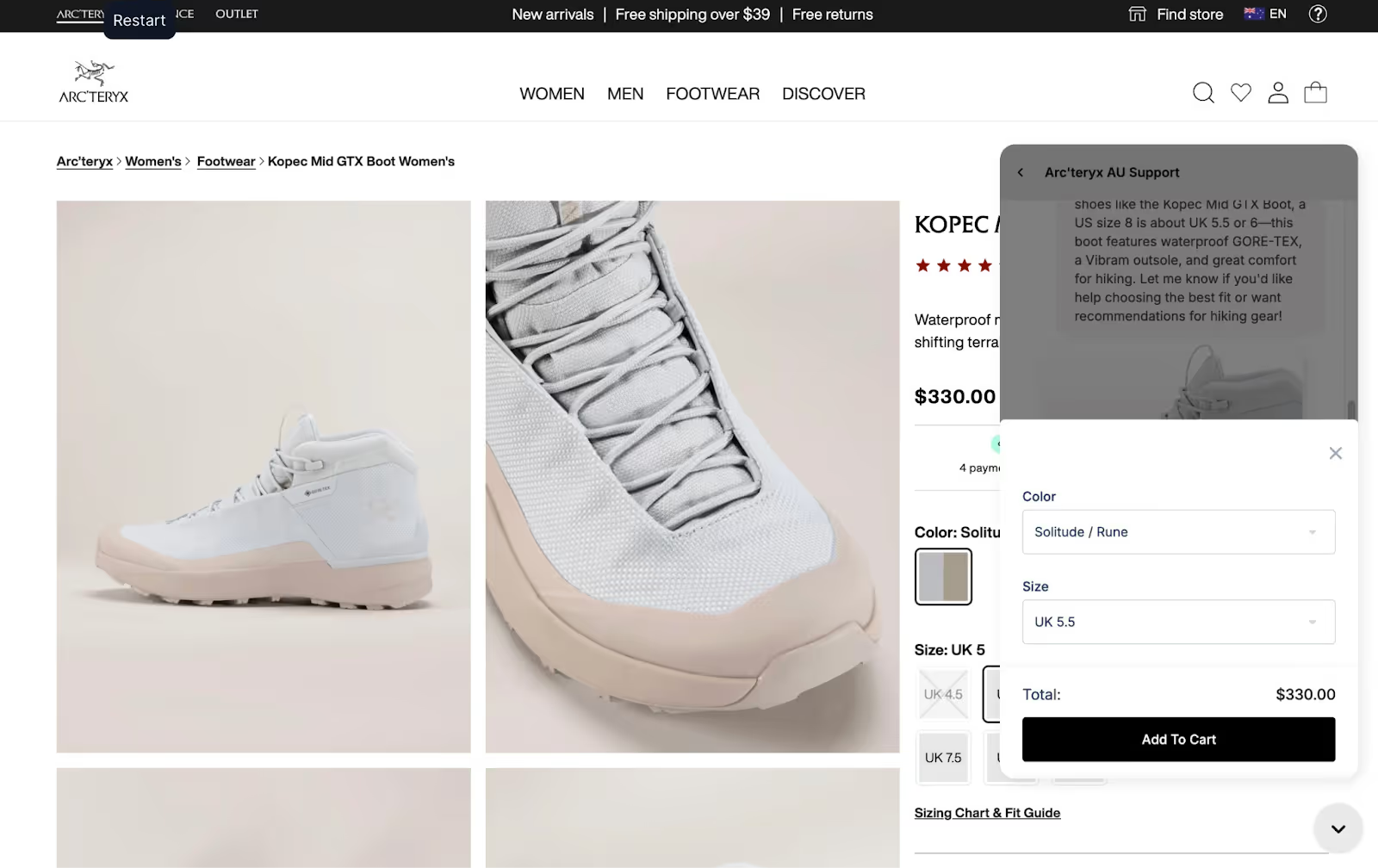
“It’s been awesome to see Shopping Assistant guide customers through our technical product range without any human input. It’s a much smoother journey for the shopper,” says Nathan Larner, Customer Experience Advisor for Arc’teryx.
For Arc’teryx, that smoother customer journey translated into sales. The brand saw a 75% increase in conversion rate (from 4% to 7%) and 3.7% of overall revenue influenced by Shopping Assistant.

Because it follows shoppers’ live journey during each session on your website, Shopping Assistant catches shoppers in the moment. It answers questions or concerns that might normally halt a purchase, gets strategic with discounting (based on rules you set), and upsells.
The overall ROI can be significant. For example, bareMinerals saw an 8.83x return on investment.
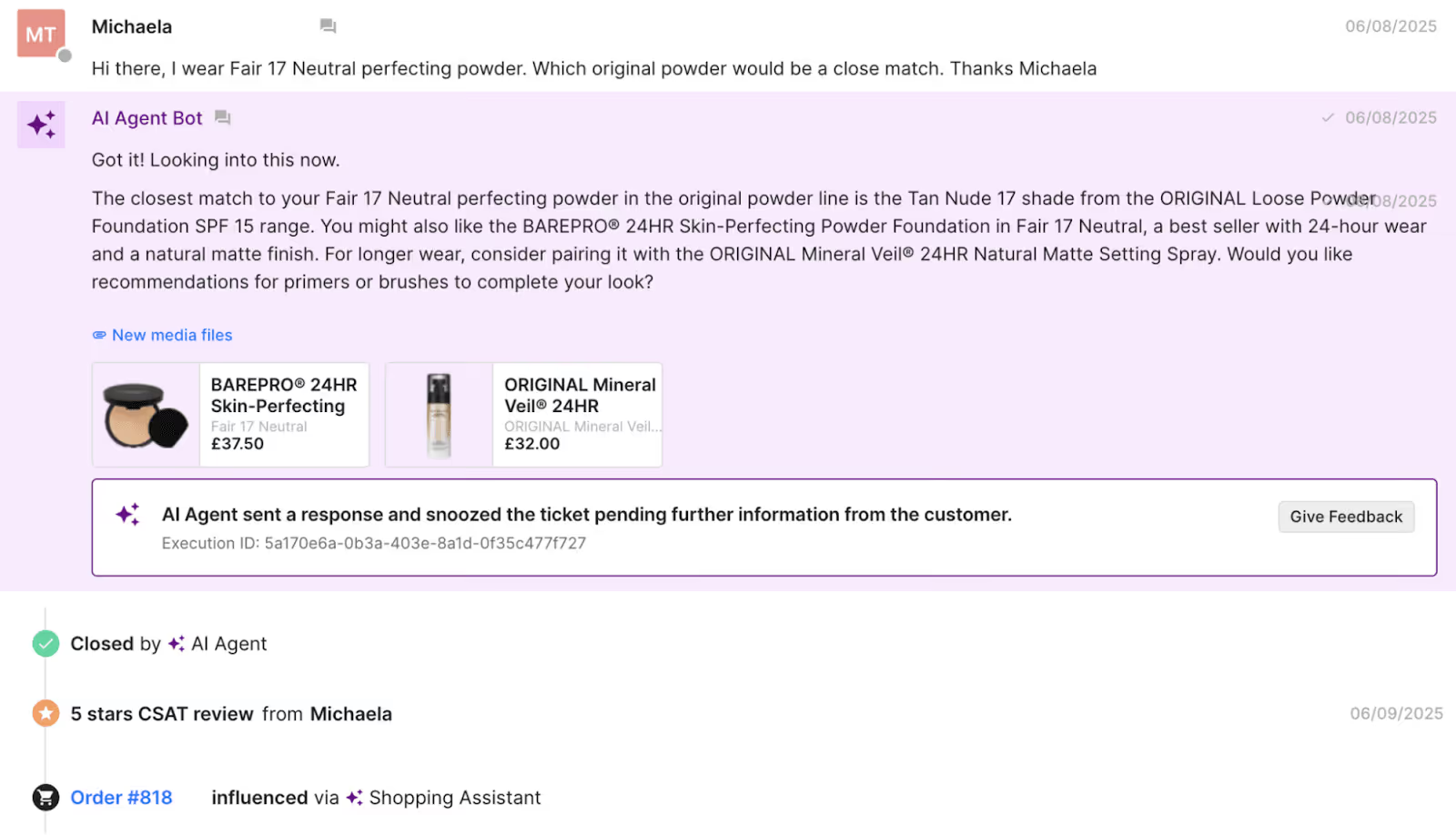
"The real-time Shopify integration was essential as we needed to ensure that product recommendations were relevant and displayed accurate inventory,” says Katia Komar, Sr. Manager of Ecommerce and Customer Service Operations, UK at bareMinerals.
“Avoiding customer frustration from out-of-stock recommendations was non-negotiable, especially in beauty, where shade availability is crucial to customer trust and satisfaction. This approach has led to increased CSAT on AI converted tickets."

Shopping Assistant can impact CSAT scores, response times, resolution rates, AOV, and GMV.
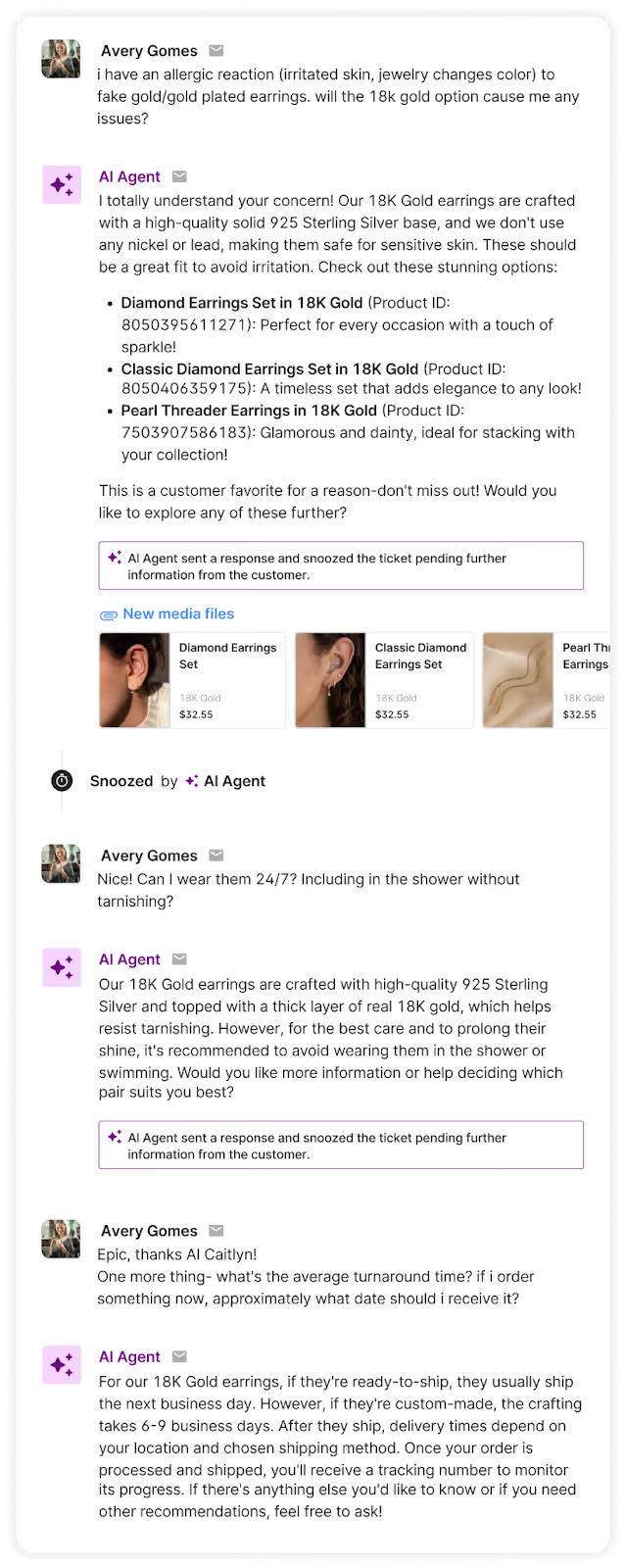
For Caitlyn Minimalist, those metrics were an 11.3% uplift in AOV, an 18% click through rate for product recommendations, and a 50% sales lift versus human-only chats.
"Shopping Assistant has become an intuitive extension of our team, offering product guidance that feels personal and intentional,” says Anthony Ponce, its Head of Customer Experience.

Support agents have limited time to assist customers as it is, so taking advantage of sales opportunities can be difficult. Shopping Assistant takes over that role, removing obstacles for purchase or clearing up the right choice among a stacked product catalog.
With a product that’s not yet mainstream in the US, TUSHY leverages Shopping Assistant for product education and clarification.
"Shopping Assistant has been a game-changer for our team, especially with the launch of our latest bidet models,” says Ren Fuller-Wasserman, Sr. Director of Customer Experience at TUSHY.
“Expanding our product catalog has given customers more choices than ever, which can overwhelm first-time buyers. Now, they’re increasingly looking to us for guidance on finding the right fit for their home and personal hygiene needs.”
The bidet brand saw 13x return on investment after implementation, a 15% increase in chat conversion rate, and a 2x higher conversion rate for AI conversations versus human ones.

Customer support metrics include:
Revenue metrics to track include:
Shopping Assistant connects to your ecommerce platform (like Shopify), and streamlines information between your helpdesk and order data. It’s also trained on your catalog and support history.
Allow your agents to focus on support and sell more by tackling questions that are getting in the way of sales.
{{lead-magnet-2}}

TL;DR:
It’s clear that shoppers want answers fast—chat accounts for 20% of all customer support tickets.
The appeal is obvious: Chat is an easy-to-access customer service channel for quick questions and a convenient and subtle way to cross-sell complementary products.
But without the right chat tool, brands risk losing these valuable opportunities.
Introducing AI Agent on Chat, a conversational AI assistant that can automate up to 50% of chat conversations. This new feature upgrades chat by combining agent knowledge with superhuman efficiency and response times.
Now, customers can guarantee personalized interactions at any point of the shopping journey—whether they’re looking for a quick answer or a tailored recommendation.
With AI powering every interaction, one-to-one conversations become a seamless part of every customer experience.
Before AI Agent, customers reaching out through chat outside business hours had two options: following pre-set Flows (automated FAQ conversations) or browsing through suggested Help Center articles.
These features are great for quick answers to basic questions, but AI Agent takes support to the next level by handling more complex needs like modifying orders or offering personalized product recommendations.
With AI Agent in Chat, customers enjoy dynamic, real-time conversations available on multiple channels. AI Agent generates personalized responses that match exactly what customers ask for, automating 50% of chat interactions so agents get time back to upsell, create stronger relationships, and craft better experiences.
Related: How to optimize your Help Center for AI Agent
Upgrade your chat support from a basic Q&A tool into an intelligent assistant that handles customer inquiries 24/7. Here's how AI Agent makes that possible:
AI Agent responds within 15 seconds or less, offering fast responses that result in frictionless conversations. Unlike traditional chatbots, AI Agent also adapts to your brand’s unique tone of voice to enhance the customer experience and assure shoppers their questions will be taken care of.

Today’s shoppers expect instant responses regardless of time zone or business hours. AI Agent on Chat means customers get the help they need, when they need it. This availability leads to higher customer satisfaction and fewer abandoned carts.
AI Agent understands context and customer intent. Whether a shopper needs help finding the right product size or changes their mind and wants to compare features, AI Agent customizes its recommendations for each person.
Some conversations, like technical issues or complaints, need a human touch. AI Agent recognizes these situations and smoothly transfers them to the right agent.
Using Handover topics, you can choose which types of inquiries should go straight to human agents. Then, if AI Agent lacks the confidence to provide an answer or can’t locate relevant knowledge in its database, it automatically escalates the conversation.
Read more: Handover rules
Based on Hiver’s 2024 study, 62% of customers prefer live chat to other support channels. With AI Agent in Chat, agents can cut down average response times while customers get the answers they need in one conversation with zero wait times or follow-ups.
AI Agent on Chat is ready to use in a few clicks. Simply connect your Shopify store and Chat widget to AI Agent, and you’re ready to resolve questions asked by visitors and loyal customers faster than you ever have.
Chat is often a customer’s first touchpoint with your brand, whether they’ve just discovered your brand or are on their third order. Meet customer expectations by being available with AI Agent on Chat. The faster you can ease their concerns, the faster they can head to checkout.
AI Agent makes scaling support effortless, especially during peak seasons like Black Friday. While it handles repetitive support tickets like order status and shipping questions, your team can focus on high-priority tasks like requests from VIP customers.

Drawing from knowledge sources like your Help Center and policy pages means AI Agent can often resolve inquiries within one conversation. No more unnecessary back-and-forths. Quick resolutions = happier and more loyal customers.
Ready to get started? Here’s how to activate AI Agent on Chat:
Already use AI Agent for email? No need to set up Guidance and Handover topics all over again—AI Agent will behave the same way in Chat.
Get the most out of AI Agent on Chat by following these best practices.
The Help Center is AI Agent’s brain. This customer knowledge database is the key to AI Agent’s accurate and on-brand responses. To ensure your AI Agent is as trained as your human agents, include important topics in your Help Center like shipping, returns, cancellations, and account management.
No articles yet? No problem! Gorgias has 20+ article templates for you to use and modify. Or, even better, check out the AI Library for AI-generated articles based on your customer tickets.

AI tools perform best when you set limitations. A Guidance is the main way to control AI Agent’s behavior. It is a set of written instructions that outline how AI Agent should interact with customers, handle certain requests, and more.
We recommend publishing a Guidance on the top five questions you receive from customers.
Tip: AI Agent prioritizes Guidance above Help Center articles. Unlike Help Center articles, the content in your Guidance will not be customer-facing.

The beauty of AI Agent is its ability to speak like one of your agents. Select from Friendly, Professional, or Sophisticated presets—or create a custom tone that aligns with your brand.

Need help finding your brand voice? Here are seven brand voice examples.
Use test scenarios to see how AI Agent responds to common customer questions, such as order status, shipping questions, and return policies. To cover all your bases, test AI Agent as both a new and returning customer to make sure it delivers accurate responses no matter the customer's need.

AI Agent becomes smarter as it learns from you. Like a human agent, give your AI Agent feedback on its responses, from how it speaks, which topics it escalates, and what actions it takes in certain scenarios.
There are multiple ways to give AI Agent feedback on a ticket:

AI Agent can also perform actions like accessing Shopify order details and executing third-party app actions, such as updating shipping addresses and order cancellations, directly in Chat.
Excited to deliver an elevated chat experience? Book a demo now to experience the power of AI Agent on Chat.
{{lead-magnet-1}}

TL;DR:
Managing customer support as a Shopify store owner can feel like juggling too many tools at once.
Constantly switching tabs to look up orders, update customer information, or track returns wastes valuable time. Plus, it prevents your team from focusing on what really matters––delivering quick, personalized customer service.
Gorgias’s Shopify integration solves this. It keeps all your Shopify data in one place, so your team spends less time toggling tabs and more time helping customers. The result? Faster responses, better service, and more revenue.
Below, we break down the eight key capabilities of this integration, each paired with practical use cases to showcase its real-world value.
{{lead-magnet-1}}
What it does: Shopify order data is displayed directly within support tickets, allowing agents to view essential details like order status, customer information, and transaction history without leaving the helpdesk.
Use case: An agent handling a “Where’s my order?” request can instantly check tracking information and update the customer.
The fashion retailer Princess Polly improved their customer experience team’s efficiency by using Gorgias's deep integration with Shopify. Agents can view and update customer and order data directly within Gorgias, eliminating the need to switch between multiple tabs.
Taking a streamlined approach led to a 40% increase in efficiency, an 80% decrease in resolution time, and a 95% decrease in first response time.

What it does: Agents can update Shopify order and customer data with Shopify Actions right in Gorgias.
Key features:
Use case: Agents can perform Shopify actions directly from Gorgias, such as adding products, applying discounts, updating quantities, or issuing refunds.

What it does: Create templated responses called Macros with dynamic Shopify variables to automatically incorporate customer-specific information.
Key features:
Use case: A customer inquires about their order. With one click, the agent uses a Macro that pulls in the order status and expected delivery date, creating a faster and more personalized response.
Take Try The World, a gourmet subscription service, needed a robust Shopify integration to handle an increasing volume of customer inquiries. By switching to Gorgias, they gained the ability to unify conversations and embed Shopify data directly into Macros. Now, agents can quickly generate personalized responses that includes order details, tracking links, and customer-specific information.
Try the World’s support team’s efficiency skyrocketed, enabling them to handle 120 tickets per day, up from 80, and reduce response times to just one business day.

What it does: Macros with embedded Shopify data let agents quickly and accurately share pre-sale information like product links, stock availability, and discount codes, helping to convert prospective customers into buyers.
Key features:
Use case: A customer asks if a specific product is available in their size and color. The agent can apply a Macro that automatically pulls the product's inventory details and includes a discount code, sending a response like this:
“Hi [customer name Macro],
Great news! The product [Shopify product information Macro] is currently in stock in the size and color you’re looking for. You can check it out here: [Product Link]. Use the code WELCOME10 at checkout for 10% off your first order! Let me know if you have any other questions!”
How it helps:
What it does: Using Gorgias Chat, customers can track orders or manage their purchases on their own with no agent assistance needed.
Key feature:
Use case: A customer wants to check the status of their recent purchase. By accessing Chat on your website, they can enter their email and order number and receive instant updates on their order's progress, including shipping and delivery information, without waiting for an agent's response.
How it helps:
What it does: Rules paired with Shopify variables can automate various support tasks, such as identifying specific customer segments or tagging tickets, to boost efficiency and consistency.
Key features:
Use case: A customer with a history of substantial purchases contacts support. A rule detects that the customer's total spending exceeds a predefined threshold and automatically tags the ticket as "VIP."
This tag can then trigger other workflows, such as assigning the ticket to a senior support agent or escalating its priority.
How it helps:

What it does: Gorgias offers comprehensive reporting that allows you to measure how your support interactions influence sales.
Key features:
These metrics are accessible under Statistics → Support Performance → Revenue in your Gorgias dashboard. You can filter the data by integration, ticket channel, tags, or specific time periods to gain detailed insights.
Use case: By analyzing Revenue Statistics, you can identify which support channels or agents are most effective in driving sales. For example, if live chat interactions have a higher conversion rate, you might allocate more resources to that channel.
Additionally, recognizing top-performing agents can inform training programs to elevate overall team performance.
For example, One Block Down, a Milan-based streetwear brand, struggled to manage a growing volume of customer inquiries across multiple platforms. By integrating Gorgias with Shopify, they centralized all customer interactions into a single platform, giving agents instant access to crucial information like order history and returns directly within tickets.
The setup allowed the team to measure the direct impact of their support efforts on revenue.
The result? An impressive 1,000% increase in support-generated revenue and a 1-hour average first response time. By connecting the dots between customer service and sales performance, One Block Down demonstrated how proactive, data-driven support can directly influence the bottom line.
How it helps:

What it does: AI Agent automates Shopify actions like canceling orders, editing order details, and reshipping items.
Key features:
Use case: A customer realizes they've entered an incorrect shipping address shortly after placing an order. They contact support, and AI Agent promptly verifies that the order is unfulfilled, confirms the correct address with the customer, updates the shipping information in Shopify, and sends a confirmation email—all without human intervention.
How it helps:

{{lead-magnet-2}}

TL;DR:
Looking to grow an email list to capture leads or offer welcome incentives? These days, the default solution is to plaster a full-screen pop-up on your homepage.
It seems effective on the surface, collecting emails right off the bat, but dig deeper, and these pop-ups disrupt the shopping experience and skyrocket bounce rates—with 72% of customers exiting a website.
But how else do you get your message across?
That’s where Gorgias Convert comes in—a smarter, more customer-centric tool to drive conversions without pushing your visitors away.
Below, we’ll explore why it’s time to move on from full-screen pop-ups and how Gorgias Convert offers a better alternative for Shopify brands looking to boost engagement and revenue.
Pop-ups can be an effective marketing tool, but their full-screen counterpart often creates more problems than they solve. These intrusive overlays pose several challenges that can harm both user experience and your bottom line.
Full-screen pop-ups demand attention, often at the worst possible moment—like when a customer is browsing products or is just about to check out. This experience can frustrate visitors and lead them to abandon your site entirely.
The BBC says every extra second a page takes to load can cost you 10% of your users—and pushy pop-ups don’t help. If your pop-ups are poorly timed or overly intrusive, visitors feel unwelcome, causing them to leave before exploring your offerings.
Traditional pop-ups are static and one-size-fits-all. They can’t adjust messaging based on where the customer is in their shopping journey or their behavior on your site.
Many users employ ad blockers that filter out pop-ups altogether, meaning your message never even reaches a portion of your audience.
Gorgias Convert flips the script by offering a subtle, customer-friendly way to capture leads and drive sales without the drawbacks of full-screen pop-ups. Here’s why your Shopify brand should make the switch:
Gorgias Convert integrates seamlessly into your store, using a chat-based widget that feels like a natural part of the browsing experience. Using chat to double as a supporting and converting tool is less disruptive, allowing customers to explore your store at their own pace.

Convert makes it easy to bring any type of campaign to life. Catch the attention of the exact shoppers you want by detecting their browsing behavior, customer profile, cart attributes, and more.
For example, the exit intent campaign is the top-performing Convert campaign—it detects when a user is about to leave and displays a discount code. It’s fully customizable, allowing you to tailor offers based on how much time they’ve spent on a page, the number of items in their cart, or if they’ve visited more than three times without making a purchase.

Unlike one-size-fits-all pop-ups, Convert lets you tailor your messaging based on customer behavior, order history, and engagement. For example, if a customer is browsing a specific product, Convert can offer a relevant discount or incentive tied directly to that item.
With Convert, you’re not just collecting an email address—you’re starting a conversation. The tool allows you to engage with customers in real-time through pre-set flows that guide them toward taking action, whether it’s signing up for your newsletter, redeeming an offer, or completing a purchase.

Related: 6 types of conversational customer service + how to implement them
In 2024, smartphones were responsible for generating 68 percent of online shopping orders. To meet shoppers where they are, Convert’s chat-style interactions are optimized for mobile users. Unlike traditional pop-ups that don’t display correctly on smaller screens, Convert maintains a seamless experience for shoppers who prefer to shop on the go.

Using Convert means you can combine immediate assistance with smart marketing through its native integration with Gorgias and Shopify. For example, if a customer hesitates to make a purchase, you can intervene with a live chat offer or product recommendation in real-time.
The Shopify integration also allows you to generate unique discount codes that expire within 48 hours—preventing them from being shared on unauthorized coupon sites. These codes are automatically created with customizable thresholds, such as discounts for specific collections or individual users, without manual setup.

Convert allows you to test different messages and incentives, giving valuable insights into what resonates most with your audience. This data-driven approach ensures your lead capture strategy evolves with shoppers over time.
Read more: How campaign messaging can increase conversions
Shopify brands using Gorgias Convert have led to a conversion rate boost of 6-10% more across their website, up to a 24% click-through rate and 43% click-to-order rate, and improved customer satisfaction. By prioritizing a frictionless shopping experience, these brands are turning casual visitors into loyal customers.
Here’s what some happy brands have to say about Convert:
Haircare brand, Kreyol Essence, influenced 13% of revenue with Convert campaigns: “With Convert, we’ve not only improved our conversion rates but also created a seamless, personalized shopping experience that our customers love. It’s like having a personal assistant for each shopper. Thanks to Convert, we can interact with our customers and surface key information at the right time, turning clicks into connections."
Brands using customer service management agency, TalentPop, love how easy it is to generate revenue with Convert: “Clients are constantly surprised and delighted by how effective Gorgias Convert is for revenue generation. They especially appreciate that Convert can be used to target a diverse range of customers across the entire purchasing journey.”
In five months, yoga brand Manduka, increased revenue by 284.15% after using Convert: “Gorgias Convert has helped us make the shopping experience more intuitive. We can give a nice prompt to remind people of promotions we’re running, highlight specific product features, or just remind them we're here to help and answer questions. The chat campaigns make it easy for customers because they lead them to us, as opposed to them having to search for how to contact us for assistance.”
Shoppers want personalized experiences that respect their time and preferences. Full-screen pop-ups belong to an era of intrusive marketing that shoppers would rather leave in the past.
Gorgias Convert for your Shopify brand means delivering impactful interactions, more conversions, and an easy path to long-term customer loyalty.
Ready to make the switch? Start your effortless shopping journey today with Gorgias Convert. Chat with our team!

Today, we’re announcing our deeper investment in conversational AI for ecommerce.
"Since day one, Gorgias has been dedicated to helping ecommerce brands deliver exceptional customer experiences. We started with a helpdesk to centralize support, then introduced AI Agent to instantly resolve support questions,” says Romain Lapeyre, CEO of Gorgias.
“Now, we're taking the next leap forward with an AI Agent that powers the entire customer journey—anticipating buyer needs, boosting sales, and automating high-quality support. Today, I'm happy to announce Gorgias as the Conversational AI platform for ecommerce.”
Gorgias’s Conversational AI platform will let teams provide fast, scalable, and cost-effective support while helping them drive revenue growth. From automatic order changes and refunds to product recommendations and cross-sells, brands will be able to flawlessly combine their support and sales efforts.
The end result is an AI-powered customer journey where every customer interaction feels complete, personal, and connected, both before and after purchase.
Last year, we introduced AI Agent for email.
Some brands call their AI Agent Lisa, some call it Wally, and most treat it like a real member of the team. But this reliable support sidekick was only available to answer customers on email—until now.
Get ready for instant responses that tackle support inquiries of all sizes. Now, your customers can enjoy fast responses that keep their shopping experience as smooth as possible.
On top of improving first response times, AI Agent can play an even more critical role in unblocking sales, suggesting products, and driving upsells and cross-sells.
With responses sent in 15 seconds or less, brands can delight customers with near-instant resolutions.

Actions let AI Agent perform customer requests on behalf of your support team. This includes changing shipping addresses, fetching fulfillment status, canceling orders, adding discounts, and more.
You can use a library of pre-configured Actions for popular apps like Shopify, Rebuy, Loop, and more. And you don’t need any technical skills to set them up.
With almost half of queries requiring some kind of update, Actions is your go-to for complete resolutions so you can get more accomplished.

Quality checks have traditionally been manual, time-consuming, and inconsistent. Our brand new Auto QA feature changes that by automatically scoring 100% of conversations on resolution completeness and communication quality—whether from a human or AI agent.
With Auto QA, team leads can:

Support teams should be in complete control of their AI. That’s why the AI Agent Report and AI Agent Insights were created—to help you know exactly how your AI Agent is performing and contributing to your customer service operations.
The AI Agent Report provides full visibility into AI Agent’s performance, covering metrics like first response Time, CSAT, and one-touch ticket resolutions. Fully integrated into your Support Performance Statistics dashboard, the report includes:

AI Agent Insights takes it a step further. It analyzes AI Agent’s performance data and provides you with a dashboard of recommendations, including potential automation opportunities, popular ticket intents to optimize, and knowledge base improvements.

Soon, we’ll be expanding AI Agent's skills with the launch of Shopping Assistant, a tool designed to assist customers on their shopping journey.
Shopping Assistanthelps brands boost their sales capabilities through smart product recommendations, on-page checkout assistance, and personalized conversations. Now it's easier to reduce cart abandonment, suggest complementary products to boost average order value, and overcome pre-sale objections.
This new tool will bridge the gap between marketing and CX, ensuring brands can scale personalized interactions 24/7 without increasing headcount.

As we continue to innovate with conversational AI, our focus remains on helping you succeed.
By combining smarter tools with valuable insights, we’re creating opportunities for you to put your customers first and build deeper connections at every touchpoint.
Join us as we pave a new way for the future of ecommerce.
{{lead-magnet-1}}

TL;DR:
Your customer service conversations contain a goldmine of insight about your shoppers—like why they reached out, trends in shopper behavior, and how your products or services perform.
But how do you turn thousands of unstructured support tickets into accurate, digestible, and actionable takeaways?
Ticket Fields are the answer. They give support teams extra layers of data by labeling tickets in a much smarter way than traditional tags. With the right setup, Ticket Fields can help you uncover patterns, make smarter decisions, and highlight the value customer experience (CX) brings to your entire organization.
{{lead-magnet-1}}
Ticket Fields are customizable properties that allow CX teams to collect and organize information about tickets. Agents fill in ticket fields before closing the ticket, making it much easier to scale data collection.
Ticket Fields can be mandatory, requiring an agent to populate a field before closing the ticket. They can also be conditional, only appearing when relevant to the ticket.
There are four types of Ticket Fields: Dropdown, Number, Text, and Yes/No. Here are some ways to use each:

Unlike Tags, which are single-reason and non-conditional, Ticket Fields ensure key information, such as fulfillment details or cancellation reasons, is built into a ticket.
Think of Tags as stickers added to a ticket, while Ticket Fields are part of the ticket’s DNA itself, giving you much more control and insight.
Let’s take a closer look at why Ticket Fields are far superior at collecting data than Tags:
Agents manually apply Tags, which means it’s easy to forget to tag a ticket.
Ticket Fields, however, enforce structure by allowing CX managers to decide which fields are mandatory and which are optional. This flexibility ensures that all tickets contain the same basic details.
Ticket Fields can be conditional, meaning certain types of tickets automatically include fields that must be filled in.
How does it work? Take a look at this example:
If the Contact Reason field is Cancellation, conditional ticket fields like Cancel Reason, Did We Cancel Subscription, and Order Number must also be filled out.
Here’s how it looks in the Field Conditions settings:

No more missing context, gaps in the data, or typing N/A in a field. Support teams can capture the data they need from each ticket every time.
For CX teams transitioning from other helpdesks, being able to import historical ticket data with the field information intact is significant. This preserves workflows and existing data, helping teams get set up in no time without losing crucial information.
Tags, on the other hand, should be used to:
Ticket Fields are incredibly adaptable, allowing you to capture the exact data your team needs to meet your goals—whether it’s tracking product trends, choosing a shipping carrier, or increasing customer satisfaction.
Here are 12 examples of custom Ticket Fields to level up your data analysis.
Type of ticket field: Dropdown
What to do with the data: Identify common reasons customers contact you and take proactive steps to address them.
The Contact Reason ticket field is an easy way to figure out why customers reach out to your support team in the first place.
You can quickly identify trends, such as a sudden spike in return requests, and investigate whether it's a website, fulfillment, product, or service issue.
Some common contact reasons:
Note: Gorgias AI automatically suggests contact reasons, pre-filling the field with a prediction based on message content. Agents can accept or adjust the suggestion, helping the system become smarter over time as it learns from these interactions.

Type of ticket field: Dropdown
What to do with the data: Assess the effectiveness of resolutions and refine your service level agreement.
The Resolution ticket field tracks the action taken to resolve a ticket. Analyzing how your team handles tickets and identifying opportunities to improve resolutions is essential.
For example, you could analyze how often issues are resolved with replacements versus discounts. If you find replacements are overused for minor issues, you might implement a policy to provide discounts instead, helping to reduce costs without harming customer satisfaction.
Here are some values to add to the Resolution ticket field:

Type of ticket field: Dropdown
What to do with the data: Use both positive and negative feedback to update your policies, escalation process, customer-facing resources, product, and more.
The Feedback ticket field can capture general feedback about your brand or feedback specific to your products.
This field is an excellent way to carry out product research. For example, if you’re a food brand, you can create a dropdown that categorizes feedback by sentiment, such as “Too Sweet,” “Too Salty,” “General Dislike,” and “Artificial Taste.” Once you’ve received a decent amount of feedback, you can return to the test kitchen and perfect your recipe.

Type of ticket field: Dropdown
What to do with the data: Track product trends and prioritize improvements.
The Product field is valuable for tracking which items generate the most inquiries. If you have a large inventory, incorporating a Product ticket field can help flag which products are causing the most issues or trouble for shoppers.
If a product is the most used value, this could indicate frequent issues with the product, such as quality issues, defects, or missing information on its product page.
If a product is the least used value, it may not be generating much attention. If this is due to low sales, consider enhancing its visibility through marketing to attract more shoppers. However, being the least used value can also be good news, meaning your product performs well, and shoppers have no complaints.
Pro Tip: To understand which specific products are getting returned, add a conditional “Product” ticket field.

Type of ticket field: Dropdown + conditional field
What to do with the data: Identify recurring quality issues and fix root causes.
Track the most prominent defects reported by customers with a Defect ticket field. This can help you monitor product quality and adjust production, manufacturer, or supplier processes.
For deeper insights, add a conditional “Product” field to pinpoint which products experience specific defects. For example, if you’re a bag brand, you might find that a certain backpack is usually tied to a “Zipper” defect. This can be a valuable insight to pass on to your product team to alter the design or adjust your manufacturing process.
Here’s a look at the dropdown values for the Defect ticket field:

Type of ticket field: Dropdown
What to do with the data: Lower churn by addressing cancellation triggers.
If you’re a subscription-based business with a climbing cancellation rate, adding a Cancellation Reason ticket field can help you stop the churn. This field tracks why customers cancel orders or subscriptions. It’s a powerful way to identify patterns, such as price sensitivity or delivery delays, and to take steps to retain customers.
Cancellation reason examples:
Type of ticket field: Dropdown + conditional field
What to do with the data: Evaluate shipping carrier performance and improve logistics.
For any ecommerce brand, your shipping carrier is a big contributor to customer satisfaction. The faster a customer’s order gets to them, the better.
Use a Shipping Carrier ticket field to track the shipping carrier for tickets related to delivery issues. This will provide insights into which carriers perform poorly, enabling you to modify your logistics and order fulfillment processes.
Pair the Shipping Carrier field with a conditional “Shipping Issue” field to identify potential correlations. For example, if “Delayed” is a top shipping issue for a certain carrier, it may be time to change your logistics process.

Type of ticket field: Dropdown
What to do with the data: Learn how customers find your brand and see what types of customers and issues are tied to the purchase source.
The Purchase Origin field helps you see where customers are coming from. Are they buying directly from your website? Or from social media platforms like Instagram or TikTok?
Dig deeper, and you may also spot connections between purchase origin and common issues.
For your marketing team, this data will help improve strategies at all levels, from advertising and messaging to targeting the right platforms.

Type of ticket field: Yes/No
What to do with the data: Reduce escalations by revising escalation processes and retraining agents.
The Customer Escalation field tracks whether a ticket was escalated to a manager. It helps teams identify training needs and improve processes to reduce escalations.
As the use of AI agents increases in ecommerce customer service, having a clear view of which tickets are escalated can help pinpoint gaps in AI performance and identify scenarios that require human intervention.
Analyzing this data over time can guide updates to AI workflows and agent training, reducing the need for escalations altogether.
Type of ticket field: Number
What to do with the data: Understand how discounts impact customer satisfaction.
The Discount Percentage ticket field tracks the percentage of a discount applied to a customer's order, offering insights into how promotions affect customer behavior.
For example, if customers using a 20% discount frequently contact support about order confusion or dissatisfaction, it might indicate unclear promotion terms or product descriptions. This data helps brands refine promotional messaging and determine whether higher discounts lead to increased ticket volumes, customer satisfaction, or sales.

Type of ticket field: Yes/No + conditional field
What to do with the data: Improve the customer experience for brand new customers.
The First-Time Buyer field flags whether a customer is making their first purchase, making it easier to spot and support new shoppers. When a customer is marked as a first-time buyer, a conditional “Customer Sentiment” field can appear to capture how they feel about their experience.
First-time buyers often have questions about products or need recommendations to feel confident about their purchase. Pairing this ticket field with sentiment data helps to identify common pain points, preferences, and patterns among new customers so your team can finetune the customer experience and leave a lasting first impression.

Type of ticket field: Number
What to do with the data: Analyze product performance over time.
The Months in Use field tracks how long customers have been using a product. It’s perfect for spotting when items start breaking down, spoiling, or losing effectiveness.
This data helps brands figure out where durability, shelf life, or packaging could be improved to keep customers happy and products performing as expected.
Ticket Fields provide value across the entire CX ecosystem, from agents to decision-makers.
Ticket Fields are only as powerful as the processes that support them. Follow these five steps to help your team turn support tickets into valuable data for better reporting.
Decide what insights your team needs to improve workflows, product quality, or customer satisfaction. For example, if you want to track cancellations, set up fields like "Cancellation Reason" and "Refund Amount." Keep your Ticket Fields focused on data your team can use.
Use Gorgias to configure Ticket Fields in a structured and easy-to-use format. Keep dropdown options concise and specific to avoid confusion. Then, run a test ticket or two to confirm the setup works smoothly for agents.
Read more: Create and edit Ticket Fields
Create a presentation deck that clearly explains the purpose of every Ticket Field, the options agents can select for each field, and how the fields tie into the team’s data goals. For added visuals, include flowcharts to show when and how to use each field.

Pro Tip: Give agents a quick reference tool they can easily consult by providing a cheat sheet summarizing Ticket Field best practices.
Whether the data points to gaps in your workflows, product details, or customer education, acting on these patterns is how you drive meaningful change.
Here are some fixes, from low to high effort, that your team can implement:
Schedule a monthly meeting to review your Ticket Fields Statistics and evaluate their impact on your support workflows and customer satisfaction.
During the meeting, discuss:
Lastly, remember to document the insights and update your team regularly to keep everyone aligned.

Gorgias’s Ticket Fields turn ticket data into insights you can actually use. Spot trends, improve workflows, and make faster, smarter decisions.
Are you ready to see it in action? Book a demo, and let us show you how Ticket Fields can elevate your support.
{{lead-magnet-2}}

TL;DR:
According to Salesforce research, 77% of support staff have dealt with increased and complex workflows compared to the year prior. In addition, 56% of agents have experienced burnout due to support work.
As teams transition into the next era of CX—one where almost every customer expects efficiency, convenience, and friendly and knowledgeable service –– they’ll need the support of more than just a stellar lead to avoid the stress that comes with the job.
AI and automation are valuable and impactful tools that can aid teams in providing these top-notch experiences while helping agents lower their own stress.
Here are seven ways to leverage AI and automation to increase agent productivity, meet customer expectations, and decrease burnout on CX teams.
{{lead-magnet-1}}
While there will always be reasons for human intervention, here are seven support challenges that AI and automation can solve for CX teams long term.
Every CX team receives repetitive questions like “where is my order” (WISMO), “can I change my shipping address,” or “what is your return policy” every single day. These questions add up over time, creating frustration and burnout for agents and longer response times for customers.
Instead, teams can leverage AI and automation to answer these questions and take time back for other essential tasks.
If you use Gorgias, there are a couple of ways to put automation to work.

"Gorgias's AI Agent has been a game-changer for us, allowing us to automate nearly half of our customer service inquiries. This efficiency means we don’t need to hire additional staff to manage routine tasks, which has saved us the equivalent of two full-time positions.
—Noémie Rousseau, Customer Service Manager at Pajar
Resource: How to automate half of your CX tasks
Many customers get frustrated due to delayed support responses, especially if (they believe) they’re asking a simple question. Not only can AI and automation support by offering responses to these questions, they allow human agents to respond faster to customers who have more complex questions.

AI Agent has been an effective tool for the team at luxe golf accessory shop VESSEL. “Now we’re able to get back to people so much faster than before,” says Lauren Reams, their Customer Experience Manager.
“We can quickly collect information – avoiding the back and forth questions like what is your name, email or shipping address. Using AI to eliminate the back and forth has been great, and getting back to customers much faster than before has been the biggest win for our team.”
If customers see an inconsistent tone of voice across responses, it’ll affect your brand credibility. It also causes confusion and may create issues maintaining repeat and loyal customers.

Manual quality assurance checks are time-consuming and often inconsistent. But they’re key to providing great support at scale while maintaining a high standard across thousands of interactions. Aside from catching any errors, a regular QA process also builds trust with customers, increases personalization, and helps agents improve over time.
Automated quality assurance can provide up to 90% accuracy, according to research by McKinsey. To ensure 100% of your customer conversations are checked, used Auto QA. This AI-powered QA tool evaluates your team's responses—AI or human—based on Resolution Completeness, Communication, and Language Proficiency.

When CX teams are bogged down with an overwhelming amount of tickets, there’s going to be a lack of time and opportunity to upsell in customer conversations. This is especially true when dealing with angry or upset customers, and during high-impact periods like BFCM.
Activate onsite marketing campaigns with Gorgias Convert to provide product recommendations and promote current discounts, sales, or campaigns.
For example, you can use AI to promote relevant items to shoppers to increase their cart value. You might highlight items that are frequently bought together, or show a bundle that would make a great gift for someone. Research shows that these types of personalized recommendations can increase average order value (AOV) by 15%.

Resource: 5 Holiday Onsite Campaigns to Maximize Year-End Sales
The National Retail Federation (NRF) projects that retail returns will total $890 billion in 2024. With so many brands losing money from returns, it’s essential that you find ways to mitigate them.
By switching to Gorgias, Audien Hearing saw nearly a 5% drop in return rates. And Rumpl saw $8,000 in recouped return fees by integrating Loop Returns with Gorgias.
Loop lets customers self-serve returns through a returns portal that encourages exchanges instead. It makes the entire process a breeze, and eliminates back and forth between customers and busy support teams.

Many times, issues that were completely avoidable are escalated, leaving support teams with more tickets and already frustrated customers. These issues are likely common points of confusion that you can easily solve before they ever reach your customers.
If you use Gorgias, here’s how you can leverage automation:

“I’ve been in this role for four years and this was probably our best back to school season yet. In past years, you knew you were going to come in and be bogged down – but this year was way more seamless and much less stressful and that’s thanks to AI Agent.”
—Danae Kaminski, Customer Care Team Lead at Jonas Paul Eyewear
At Gorgias, our goal is to create solutions to the real problems CX professionals face every day. Tools like AI Agent make it possible for teams to provide better customer experiences, reduce agent stress, and create more cohesive and positive working environments overall.
”Thanks to the time we've saved by automating many of our routine tasks, our team has had the chance to bond more,” says Noémie.
“We even had time for a team picnic and painted a picnic table outside! It’s been great to step away and spend time as a team occasionally, knowing that our customers are still being taken care of by the AI Agent. It’s really improved team morale.”
{{lead-magnet-2}}

TL;DR:
The start of a new year is the perfect time to give your help center the refresh it deserves. For many ecommerce brands, the help center is one of the most underused support tools—yet it's also one of the most powerful. 88% of customers already search your website for some kind of knowledge base or FAQ.
Customers expect fast answers, and a well-designed, updated help center can meet their needs while taking some weight off your support team. We’ll walk you through why refreshing matters and how to do it.
{{lead-magnet-1}}
90% of consumers worldwide consider issue resolution their top priority for customer service. A robust help center gives you the tools to meet this expectation, delivering fast and reliable solutions that simplify your customers’ lives.
A well-designed help center benefits both your customers and your team. For customers, it lets them solve problems quickly and independently. Instead of waiting for an email response or queuing for live chat, a help center empowers them to find answers on their own terms 24/7.
For your team, a refreshed help center is transformative, too. Here’s what a help center update can achieve:
In short, refreshing your help center will improve customer experience and boost efficiency across your entire customer service strategy. It’s a win-win for everyone.
Refreshing your help center doesn’t have to be overwhelming. By breaking the process into clear, actionable steps, you can transform your help center into a powerful self-service tool that delights customers and supports your team.
Here are four key steps to guide your refresh.
Before making any major changes, you need to understand where your help center currently stands. A thorough audit will help you identify areas for improvement and ensure you make targeted updates.
Here's how to start:
Dive into your help center metrics to spot underperforming content. Look at article views, time-on-page, and bounce rates. Low engagement might mean the content is unclear, irrelevant, or hard to find.
With a customer experience platform like Gorgias, you can view the performance of each article:

Customer feedback is invaluable. Use surveys or follow-up emails to ask customers what information they had trouble finding. Their responses can highlight blind spots in your help center.
At the end of each help center article, include a simple question like, "Was this content helpful?" Use the feedback to pinpoint which articles are effective and which may need improvement.

Put yourself in your customers’ shoes. Try searching for answers to common questions. Is the layout intuitive? Are the search results helpful? A smooth user experience is key to a successful help center.
Check if your articles are outdated or missing important updates, like new product features or policy changes.
Read more: How to create and optimize a customer knowledge base
Fresh, well-organized content is the backbone of a great help center. Customers rely on clear and accurate information, so investing in your content can transform your help center into a powerful self-service tool.
Here’s how to refresh your content and make it shine:
Regularly analyze support tickets to identify common and emerging questions. Integrate these into your knowledge base to address customer needs proactively and reduce incoming tickets.
Text alone isn’t always enough. Use images, GIFs, and videos to break down complex topics and make instructions easier to follow. For example, a quick explainer video can save customers time and eliminate confusion.
Princess Polly’s customer help center exemplifies what a great help center should look like. Its visually appealing design ensures that customers can quickly navigate to the information they need. Whether they’re looking for help with shipping, payments, returns, or any other issue, the intuitive layout makes the process simple and stress-free.

Gorgias lets you customize fonts, logos, and headers for your Help Center without any coding. If you want more customization, you can dip into HTML and CSS to tailor specific elements.
Ensure your content reflects your brand voice while staying approachable and customer-friendly. Consistency builds trust and reinforces your brand identity.
Need help finding your brand voice? Read AI Tone of Voice: Tips for On-Brand Customer Communication for guidance.
Review older content for inaccuracies or missing information, such as policy changes or new product details.
Use bullet points, short paragraphs, and clear headings to make articles easy to scan. Most customers skim for quick answers—design your content to match their behavior.
Even the most well-crafted help center is ineffective if customers can’t locate it. Ensuring visibility across all customer touchpoints is key to driving engagement and making self-service the first stop for support. Here’s how to do it:
Make your help center easily accessible by placing links in strategic locations, such as your website’s header, footer, and main navigation menu. Include links in transactional emails, like order confirmations, tracking updates, or shipping updates, where customers often have questions.
Optimize your help center articles with keywords your customers are likely to search for. Use clear, concise titles, meta descriptions, and headings to boost search engine visibility and help customers find answers directly from Google.
Use tools like automated chat and automated email responses to proactively surface relevant help center articles. For instance, when customers type a question in a chatbox, suggest related articles before escalating to a support agent.
Read more: Offer more self-serve options with Flows: 10 use cases & best practices
Don’t wait for customers to stumble upon your help center—promote it! Highlight it in onboarding emails, social media posts, and banners on your site.

Jonas Paul Eyewear ensures their help center is easy to access by prominently linking it in the website’s footer under the “Quick Links” section. The thoughtful placement ensures customers can quickly navigate to the help center from any page, making it a convenient resource for addressing their questions or concerns.
Read more: Boost your Help Center's visibility: Proven strategies to increase article views
Your help center isn’t just for customers—it will also level up your AI-driven support strategy. By structuring your knowledge base effectively, you enable AI tools to deliver accurate, reliable, and consistent answers to customer queries.
Here’s how to make it work:
Ensure your help center articles cover a wide range of customer questions in detail. This makes it easier for AI tools to pull relevant information and respond accurately.
Organize your content with clear headings, bullet points, and simple language. Well-structured articles are easier for AI to parse and interpret.
Use uniform terminology across articles to prevent confusion and ensure AI tools can quickly identify relevant data.
Keep your knowledge base fresh by adding new FAQs, updating outdated content, and incorporating customer feedback. Up-to-date information ensures AI tools provide answers that align with your latest products, policies, and services.
Periodically review how well your AI tools are using your help center content to address customer needs. Identify gaps in information and fine-tune articles as needed.
Dr. Bronner’s built their help center to power AI Agent, a conversational support assistant that answers both transactional and personalized customer inquiries in the same style as a human agent. Making this change helps the brand save $100,000 a year and decrease their resolution time by 74%.

💡Pro Tip: Transform your help center into an AI training powerhouse with Gorgias’s help center AI optimization guide. This guide offers actionable tips for making your knowledge base AI-ready.

By using your help center to power AI tools, you’ll improve customer self-service options and lighten the load on your support team. AI-enhanced support delivers faster resolutions, higher customer satisfaction, and a scalable approach to customer service.
Refreshing your help center isn’t just about improving customer experience—it’s a game-changer for your entire support strategy. With tools like Gorgias’s Help Center, you can empower customers to self-serve while equipping your team with the resources they need to excel.
In 2025, make your help center the cornerstone of your support operations—and watch the results speak for themselves.
{{lead-magnet-2}}

TL;DR:
This year, 71% of customer experience (CX) leaders are using AI and automation to handle the holiday shopping season. These tools, including AI agents and email autoresponders, speed up tasks like responding to customers and updating orders.
But answering tickets isn't enough. Responses must also be high-quality, whether from humans or AI. And while customer satisfaction (CSAT) is the standard measure of how successful these interactions are, they have major limits.
CSAT scores don’t tell the full story about whether agents were helpful or if they used on-brand language. These gray areas in quality lead to missed sales, higher return rates, and frustrated customers during peak periods.
AI quality assurance (QA) is changing that. In this article, we’ll see what QA looks like today, how AI can simplify the process, and how CX teams can use tools like Auto QA to improve quality across all conversations.
{{lead-magnet-1}}
Today, QA in customer support is a largely manual responsibility. Customer conversations are reviewed by CX team leads to ensure customer satisfaction and identify areas for agent coaching. Team leads evaluate agent responses against a checklist of best practices, including the proper use of language, product knowledge, consistency, and helpfulness.
However, reviewing tickets takes a long time.
QA is important, but it's hard to prioritize when customers are actively waiting for help with refunds, urgent order edits, or negative reviews. And when CX teams are under-resourced and short-staffed, it’s easy to put QA on the back burner.
What’s more, as AI plays a bigger role in responding to customers, quality assurance must evolve to ensure the quality of AI-generated responses, not just human responses.
Over time, the lack of QA in CX can hold back support teams for three reasons:
AI-powered quality assurance (QA) uses AI to automate the process of reviewing customer interactions for resolution completeness, communication, language proficiency, and more.
Instead of team leads spending hours manually sifting through tickets, AI takes over and evaluates how well tickets were resolved by agents.
Shifting this traditionally manual work to an automated process pulls teams out of the weeds and into more beneficial work like speaking to customers and upselling.

With AI QA, routine ticket reviews are not just an optional part of your customer service strategy, they become a permanent part of it. The road to greater customer trust, resolution times, and stronger product knowledge becomes easier.
Read more: Why your strategy needs customer service quality assurance
Manual QA is like trying to review a handful of tickets during an incoming flood of new customer requests. Team leads can only focus on a small sample, leaving most interactions unchecked. Without complete visibility, creating a standard across all interactions is challenging.
Now, switch over to AI QA. You don’t have to choose between QA duty or answering tickets—QA checks are automatically done. You’ll still need to monitor AI’s performance, but now there’s more time to focus on creating strategies that improve the customer experience.
Here’s how AI QA and manual QA measure up to each other:
|
Feature |
AI QA |
Manual QA |
|---|---|---|
|
Number of Tickets Reviewed |
All tickets are reviewed automatically. |
Only a small sample of tickets can be reviewed. |
|
Speed of Reviews |
Reviews are completed instantly after responses. |
Reviews are time-consuming and delayed. |
|
Consistency |
Feedback is consistent and unbiased across all tickets. |
Feedback varies depending on the reviewer. |
|
Scalability |
Scales, regardless of ticket volume. |
Struggles to keep up with high ticket volumes. |
|
Agent Feedback |
Provides instant, actionable feedback for every resolved ticket. |
Feedback is delayed and limited to a few cases. |
|
Leader Advantage |
Frees up leaders to train the team and improve workflows. |
Disadvantageous, as leaders spend most time manually reviewing tickets. |
AI quality assurance helps CX leaders move beyond manual reviews by offering fast, thorough insights into performance and customer needs. Here are seven key benefits it brings to your team.
AI QA reviews every ticket, giving CX leaders a complete view of agent performance and customer trends. Nothing slips through the cracks, so you can act on real data each and every single time.
What the team wins: Key areas to focus on to improve the customer experience.
What the customer wins: A consistent support experience where their concerns are fully addressed.
Only a third of customers highly trust businesses, and without QA checks in place, that trust only deteriorates.
AI QA feedback can highlight confusing policies or common product issues that lead to unhappy customers. With instant feedback, teams can quickly make changes and create better, consistent customer experiences.
What the team wins: Faster fixes for recurring issues.
What the customer wins: A smoother, frustration-free experience.
Agents can receive feedback that instantly highlights gaps in workflows or unclear escalation steps. This is an efficient way to resolve issues within the wider team before they become more significant problems.
What the team wins: Process issues are solved quickly.
What the customer wins: Faster resolutions with little to no delays.
AI QA evaluates both Gorgias AI Agent and human agent interactions using the same criteria. This creates a level playing field and ensures all customer interactions meet the same quality standards.
What the team wins: Fair evaluations for both AI and human responses.
What the customer wins: High-quality support, no matter who handles the ticket.
With less time spent on manual reviews, leaders can dedicate more energy to team development. Training sessions guided by AI insights help agents improve quickly and ensure the team delivers support that aligns with protocols.
What the team wins: More focused skill-building based on data.
What the customer wins: Clearer and more accurate support.
AI QA is helpful for showing agents which areas they need more training on, whether it's being better about using brand voice or polishing up on product knowledge. This leads to better support processes and stronger product understanding across the team.
What the team wins: Better support tactics and product expertise.
What the customer wins: Faster resolutions due to knowledgeable agents.
Since all tickets are reviewed, teams can feel confident they’re delivering high-quality support on a regular basis. Customers get clear, helpful answers, while agents gain insights from every ticket with AI feedback.
What the team wins: Consistent support performance.
What the customer wins: Reliable support they can trust.
AI QA analyzes tickets using predefined categories to evaluate how complete and helpful agent responses are. Let’s take a closer look at how it maintains accurate ticket reviews with an AI QA tool like Gorgias’s Auto QA.
Auto QA evaluates tickets based on three key areas: Resolution Completeness, Communication, and Language Proficiency.
For Resolution Completeness, it checks if all customer concerns were fully addressed. For example, if an agent resolves only one of two issues raised, the ticket is marked incomplete. Tickets where customers resolve issues on their own or don’t respond to follow-ups can still be graded as complete if handled appropriately.
Communication quality is scored on a scale of 1 to 5, assessing clarity, professionalism, and tone. Agents earn higher scores when they provide clear solutions and remain positive throughout the interaction.
Finally, Language Proficiency evaluates whether an agent displayed high proficiency in the language of the conversation. The score considers how well spelling, grammar, and syntax were employed.

Auto QA isn’t set in stone. Team leads can expand on AI-generated feedback by adding their comments. For example, if a resolution is graded as ‘Incomplete,’ a team lead can explain why and provide additional context. This helps clarify the evaluation for the agent and also helps the AI model improve over time.
Ready to bring the benefits of AI QA to your team? Here’s how to get started with Auto QA:
AI QA isn’t just about automating ticket reviews — it empowers CX leaders to focus on what truly matters: training and improving processes.
Leave spot-checking and inconsistent application of policies and brand voice in the past. As a built-in feature of Gorgias Automate, Auto QA makes high-quality customer interactions your brand’s standard.
Book a demo now.
{{lead-magnet-2}}