Search our articles
Search

Featured articles

Food & Beverage Self-Service

How Food & Beverage Brands Can Level Up Self-Service Before BFCM

Before the BFCM rush begins, we’re serving food & beverage CX teams seven easy self-serve upgrades to keep support tickets off their plate.
By Alexa Hertel
0 min read . By Alexa Hertel

TL;DR:

  • Most food & beverage support tickets during BFCM are predictable. Subscription cancellations, WISMO, and product questions make up the bulk—so prep answers ahead of time.
  • Proactive CX site updates can drastically cut down repetitive tickets. Add ingredient lists, cooking instructions, and clear refund policies to product pages and FAQs.
  • FAQ pages should go deep, not just broad. Answer hyper-specific questions like “Will this break my fast?” to help customers self-serve without hesitation.
  • Transparency about stock reduces confusion and cart abandonment. Show inventory levels, set up waitlists, and clearly state cancellation windows.

In 2024, Shopify merchants drove $11.5 billion in sales over Black Friday Cyber Monday. Now, BFCM is quickly approaching, with some brands and major retailers already hosting sales.

If you’re feeling late to prepare for the season or want to maximize the number of sales you’ll make, we’ll cover how food and beverage CX teams can serve up better self-serve resources for this year’s BFCM. 

Learn how to answer and deflect customers’ top questions before they’re escalated to your support team.

💡 Your guide to everything peak season → The Gorgias BFCM Hub

Handling BFCM as a food & beverage brand

During busy seasons like BFCM and beyond, staying on top of routine customer asks can be an extreme challenge. 

“Every founder thinks BFCM is the highest peak feeling of nervousness,” says Ron Shah, CEO and Co-founder of supplement brand Obvi

“It’s a tough week. So anything that makes our team’s life easier instantly means we can focus more on things that need the time,” he continues. 

Anticipating contact reasons and preparing methods (like automated responses, macros, and enabling an AI Agent) is something that can help. Below, find the top contact reasons for food and beverage companies in 2025. 

Top contact reasons in the food & beverage industry 

According to Gorgias proprietary data, the top reason customers reach out to brands in the food and beverage industry is to cancel a subscription (13%) followed by order status questions (9.1%).

Contact Reason

% of Tickets

🍽️ Subscription cancellation

13%

🚚 Order status (WISMO)

9.1%

❌ Order cancellation

6.5%

🥫 Product details

5.7%

🧃 Product availability

4.1%

⭐ Positive feedback

3.9%

7 ways to improve your self-serve resources before BFCM

  1. Add informative blurbs on product pages 
  2. Craft additional help center and FAQ articles 
  3. Automate responses with AI or Macros 
  4. Get specific about product availability
  5. Provide order cancellation and refund policies upfront
  6. Add how-to information
  7. Build resources to help with buying decisions 

1) Add informative blurbs on product pages

Because product detail queries represent 5.7% of contact reasons for the food and beverage industry, the more information you provide on your product pages, the better. 

Include things like calorie content, nutritional information, and all ingredients.  

For example, ready-to-heat meal company The Dinner Ladies includes a dropdown menu on each product page for further reading. Categories include serving instructions, a full ingredient list, allergens, nutritional information, and even a handy “size guide” that shows how many people the meal serves. 
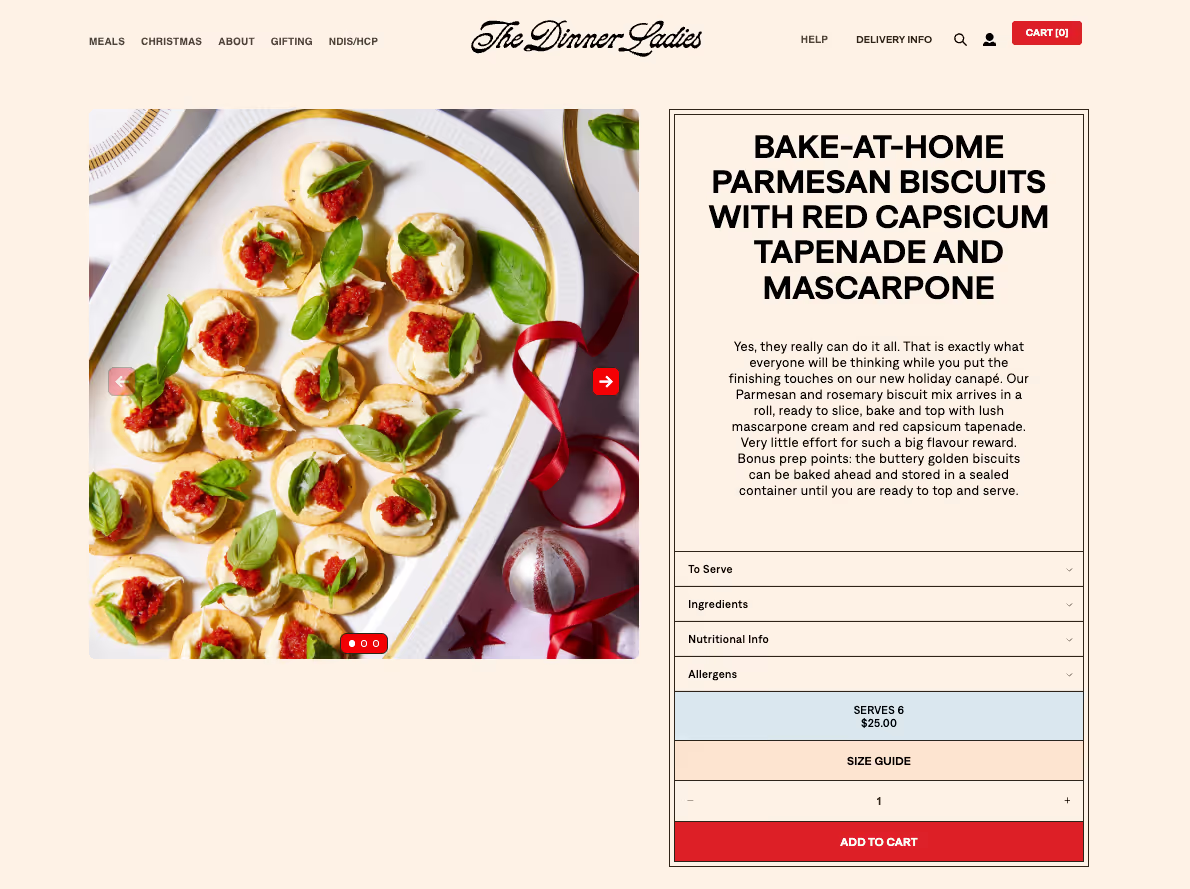
The Dinner Ladies product page showing parmesan biscuits with tapenade and mascarpone.
The Dinner Ladies includes a drop down menu full of key information on its product pages. The Dinner Ladies

2) Craft additional Help Center and FAQ articles

FAQ pages make up the information hub of your website. They exist to provide customers with a way to get their questions answered without reaching out to you.   

This includes information like how food should be stored, how long its shelf life is, delivery range, and serving instructions. FAQs can even direct customers toward finding out where their order is and what its status is. 
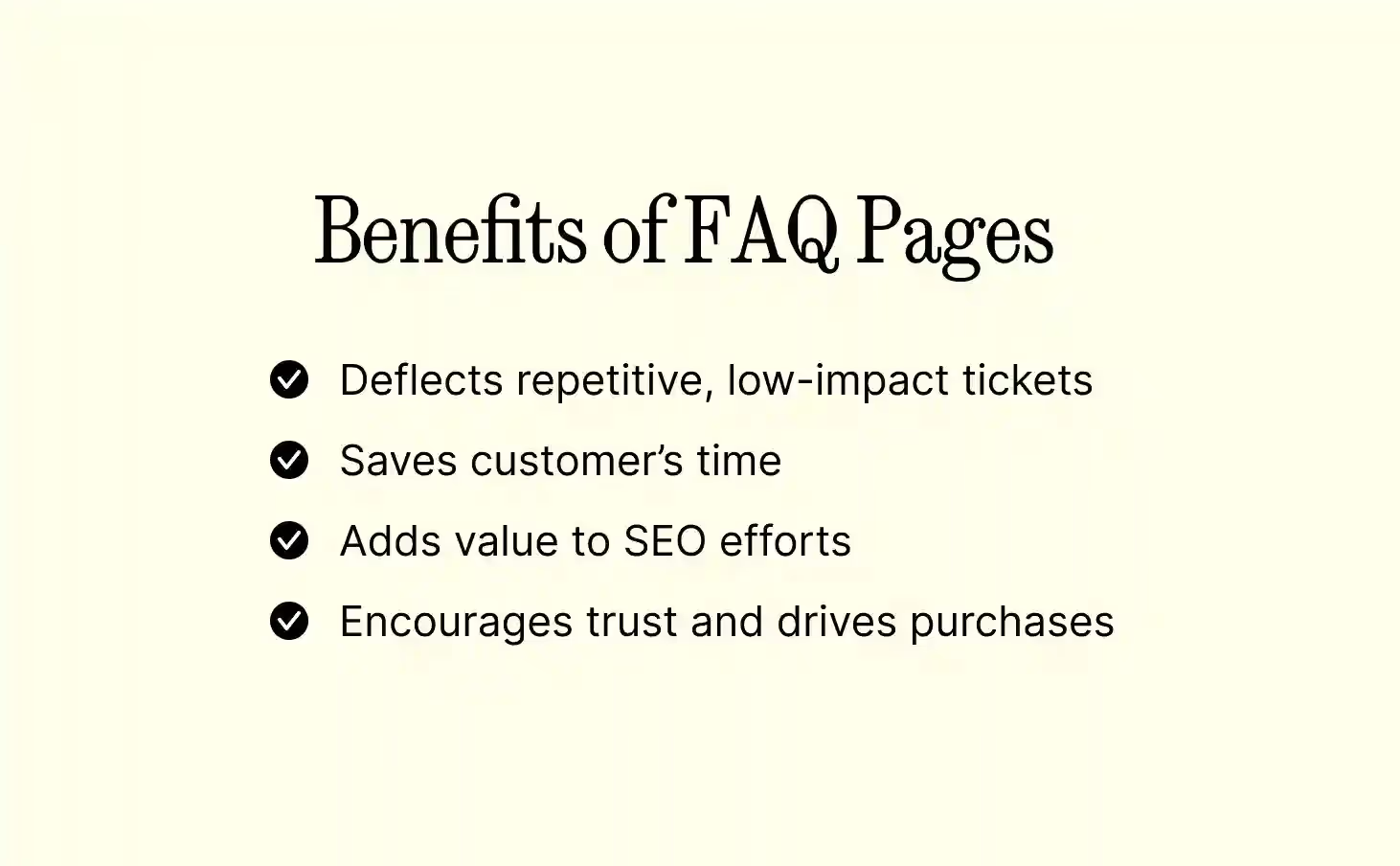
Graphic listing benefits of FAQ pages including saving time and improving SEO.

In the context of BFCM, FAQs are all about deflecting repetitive questions away from your team and assisting shoppers in finding what they need faster. 

That’s the strategy for German supplement brand mybacs

“Our focus is to improve automations to make it easier for customers to self-handle their requests. This goes hand in hand with making our FAQs more comprehensive to give customers all the information they need,” says Alexander Grassmann, its Co-Founder & COO.

As you contemplate what to add to your FAQ page, remember that more information is usually better. That’s the approach Everyday Dose takes, answering even hyper-specific questions like, “Will it break my fast?” or “Do I have to use milk?”
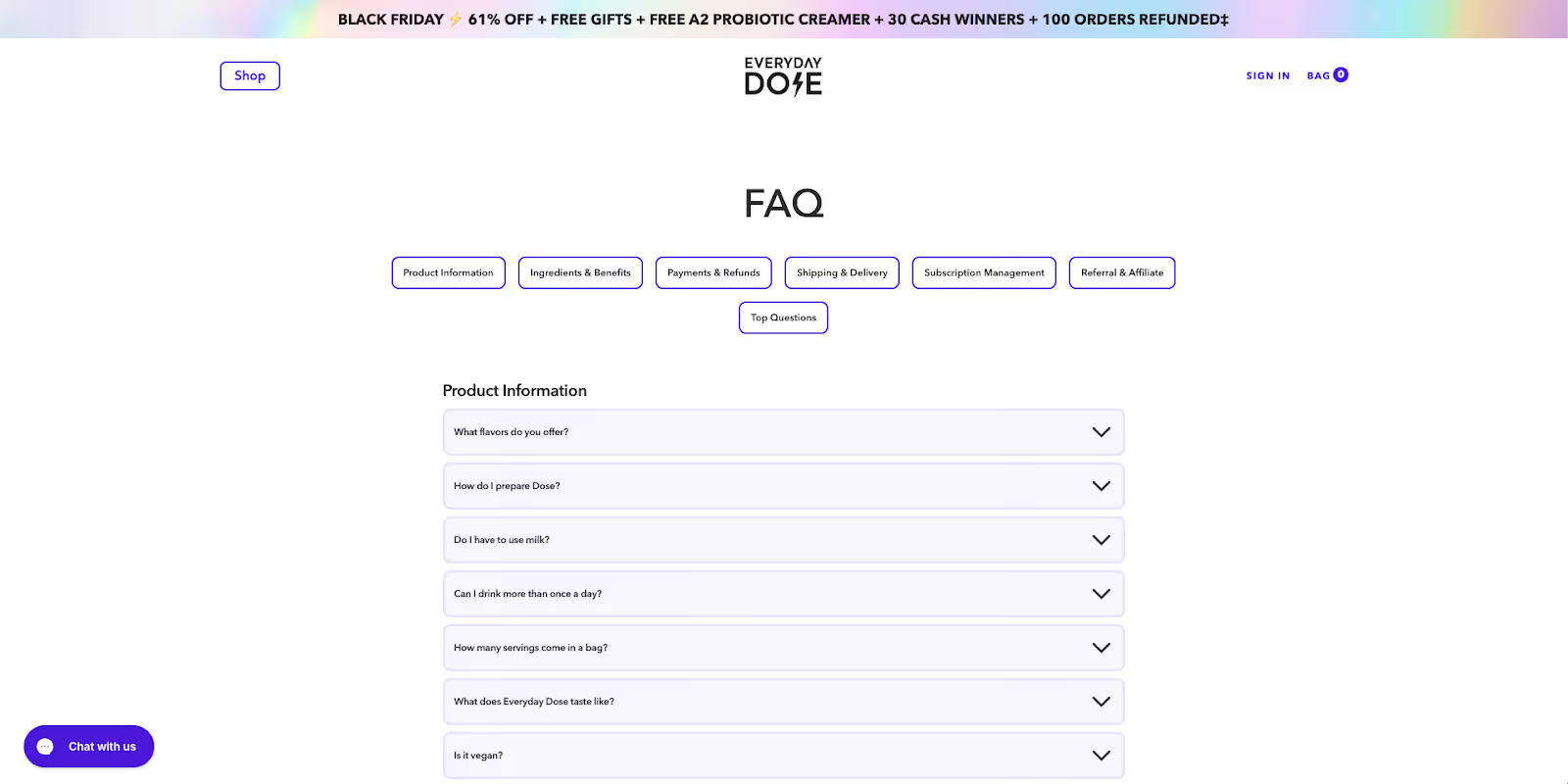
Everyday Dose FAQ page showing product, payments, and subscription question categories.
Everyday Dose has an extensive FAQ page that guides shoppers through top questions and answers. Everyday Dose

While the FAQs you choose to add will be specific to your products, peruse the top-notch food and bev FAQ pages below. 

Time for some FAQ inspo:

3) Automate responses with AI or macros

AI Agents and AI-powered Shopping Assistants are easy to set up and are extremely effective in handling customer interactions––especially during BFCM.  

“I told our team we were going to onboard Gorgias AI Agent for BFCM, so a good portion of tickets would be handled automatically,” says Ron Shah, CEO and Co-founder at Obvi. “There was a huge sigh of relief knowing that customers were going to be taken care of.” 

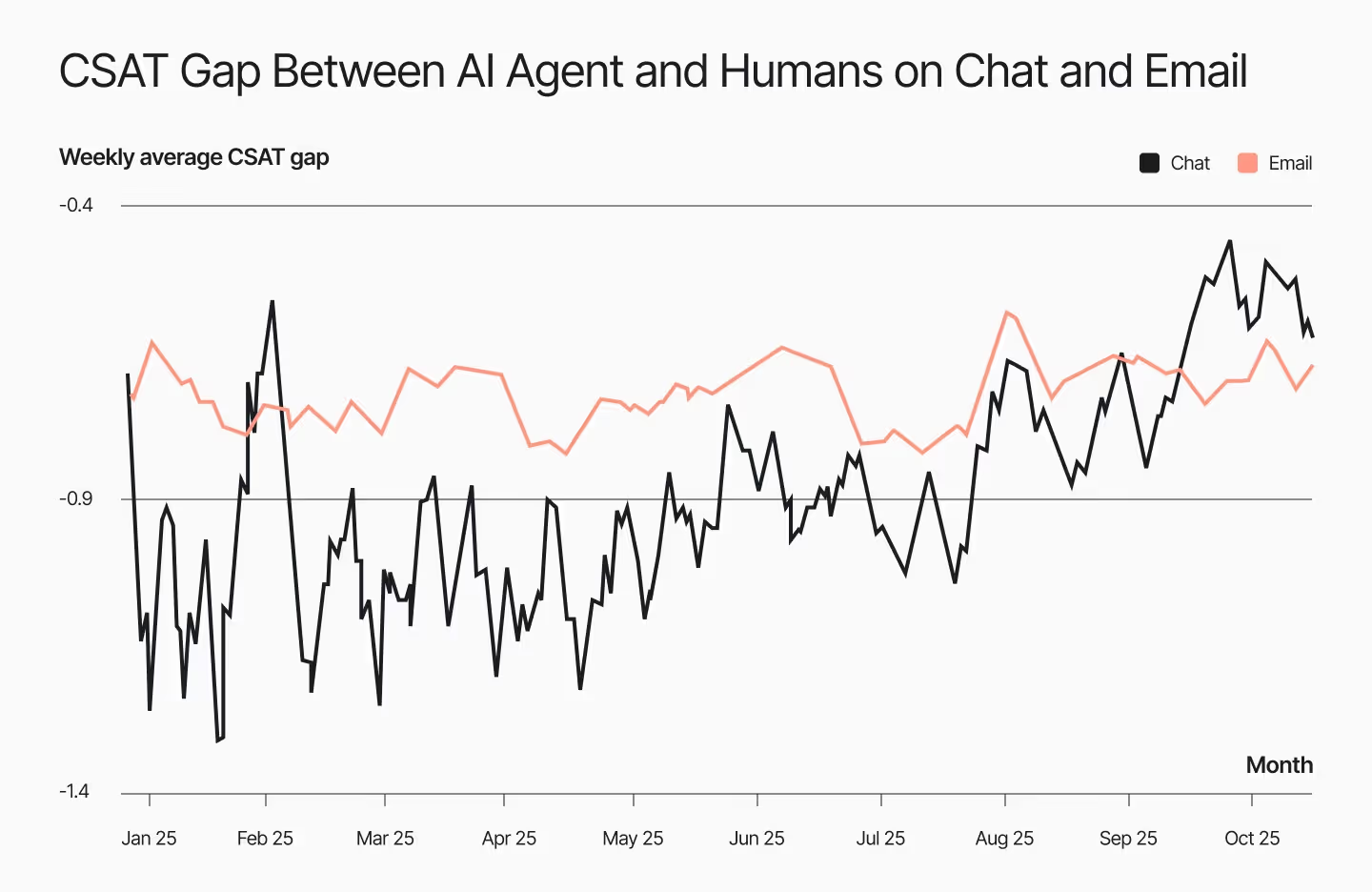
And, they’re getting smarter. AI Agent’s CSAT is just 0.6 points shy of human agents’ average CSAT score. 
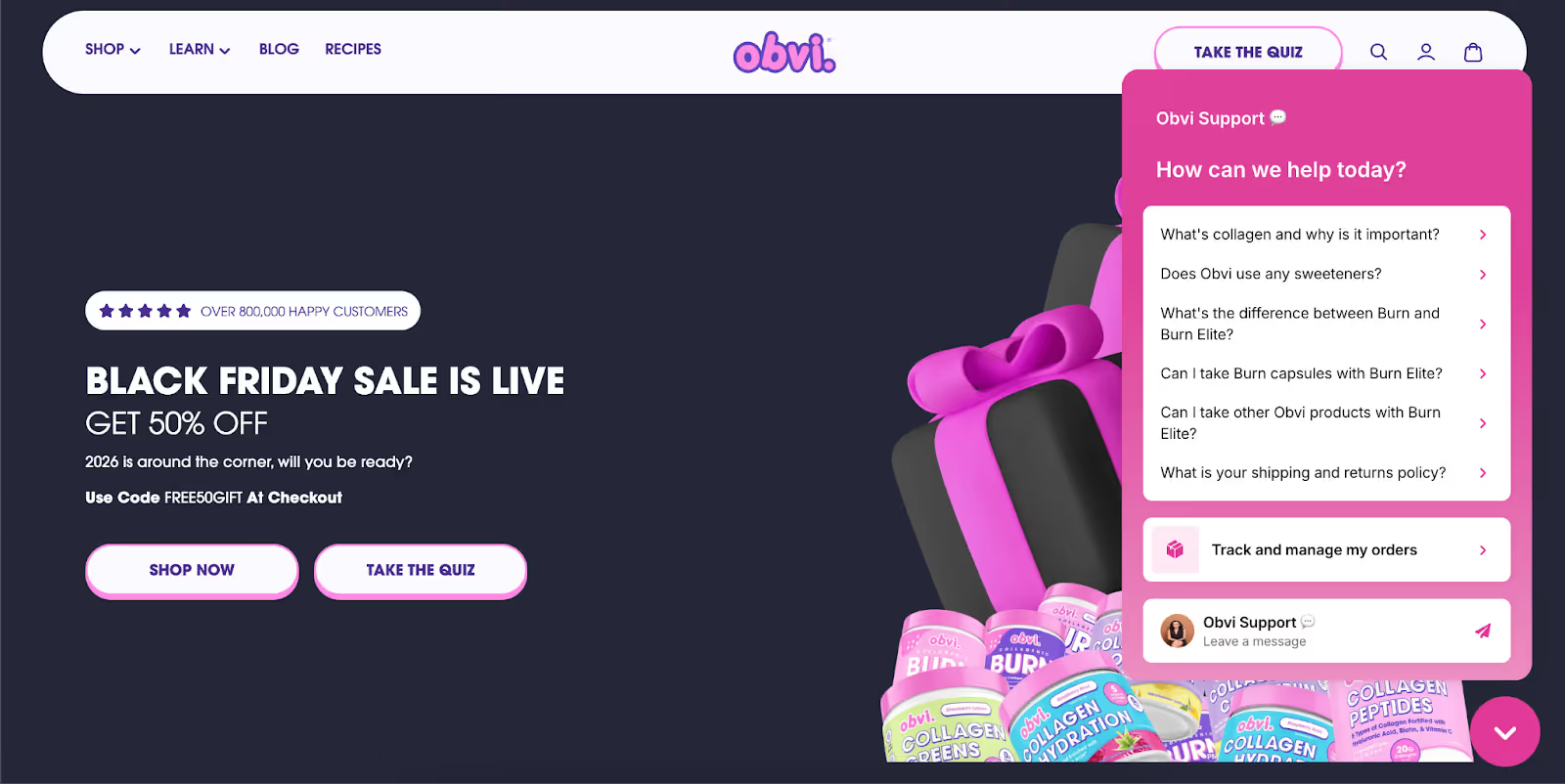
Obvi homepage promoting Black Friday sale with 50% off and chat support window open.
Obvi 

Here are the specific responses and use cases we recommend automating

  • WISMO (where is my order) inquiries 
  • Product related questions 
  • Returns 
  • Order issues
  • Cancellations 
  • Discounts, including BFCM related 
  • Customer feedback
  • Account management
  • Collaboration requests 
  • Rerouting complex queries

Get your checklist here: How to prep for peak season: BFCM automation checklist

4) Get specific about product availability

With high price reductions often comes faster-than-usual sell out times. By offering transparency around item quantities, you can avoid frustrated or upset customers. 

For example, you could show how many items are left under a certain threshold (e.g. “Only 10 items left”), or, like Rebel Cheese does, mention whether items have sold out in the past.  
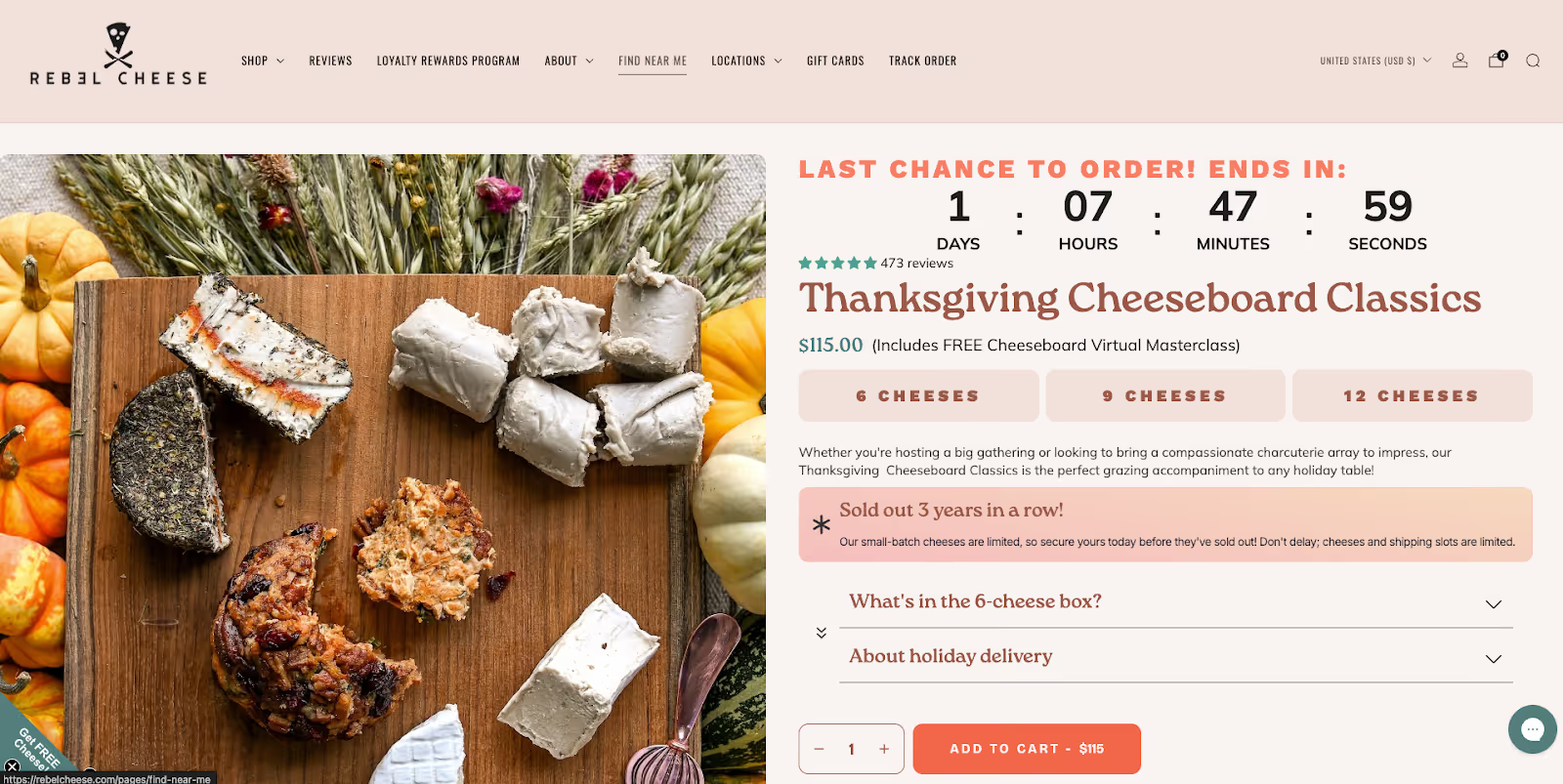
Rebel Cheese product page for Thanksgiving Cheeseboard Classics featuring six vegan cheeses on wood board.
Rebel Cheese warns shoppers that its Thanksgiving cheese board has sold out 3x already. Rebel Cheese  

You could also set up presales, give people the option to add themselves to a waitlist, and provide early access to VIP shoppers. 

5) Provide order cancellation and refund policies upfront 

Give shoppers a heads up whether they’ll be able to cancel an order once placed, and what your refund policies are. 

For example, cookware brand Misen follows its order confirmation email with a “change or cancel within one hour” email that provides a handy link to do so. 
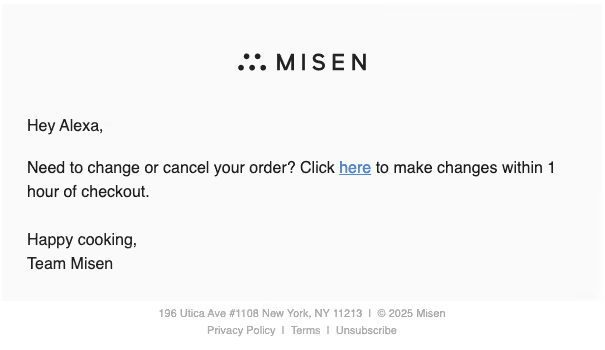
Misen order confirmation email with link to change or cancel within one hour of checkout.
Cookware brand Misen follows up its order confirmation email with the option to edit within one hour. Misen 

Your refund policies and order cancellations should live within an FAQ and in the footer of your website. 

6) Add how-to information 

Include how-to information on your website within your FAQs, on your blog, or as a standalone webpage. That might be sharing how to use a product, how to cook with it, or how to prepare it. This can prevent customers from asking questions like, “how do you use this?” or “how do I cook this?” or “what can I use this with?” etc. 

For example, Purity Coffee created a full brewing guide with illustrations:
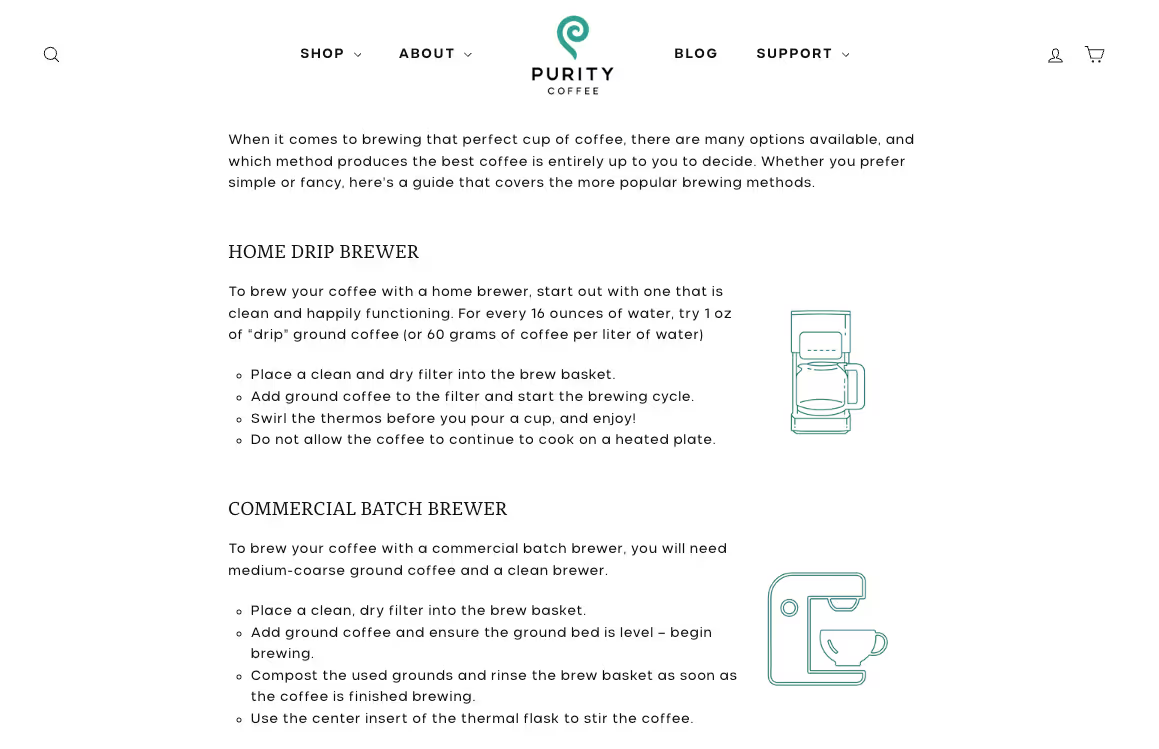
Purity Coffee brewing guide showing home drip and commercial batch brewer illustrations.
Purity Coffee has an extensive brewing guide on its website. Purity Coffee

Similarly, for its unique preseasoned carbon steel pan, Misen lists out care instructions

Butter melting in a seasoned carbon steel pan on a gas stove.
Misen 

And for those who want to understand the level of prep and cooking time involved, The Dinner Ladies feature cooking instructions on each product page. 
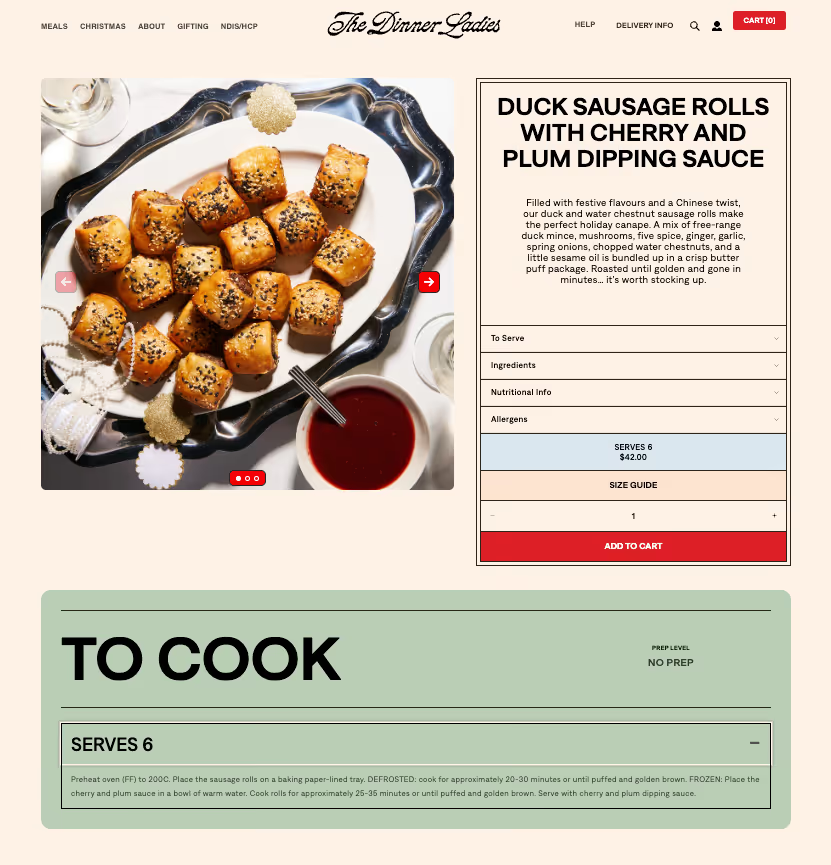
The Dinner Ladies product page featuring duck sausage rolls with cherry and plum dipping sauce.
The Dinner Ladies feature a how to cook section on product pages. The Dinner Ladies 

7) Build resources to help with buying decisions 

Interactive quizzes, buying guides, and gift guides can help ensure shoppers choose the right items for them––without contacting you first. 

For example, Trade Coffee Co created a quiz to help first timers find their perfect coffee match: 
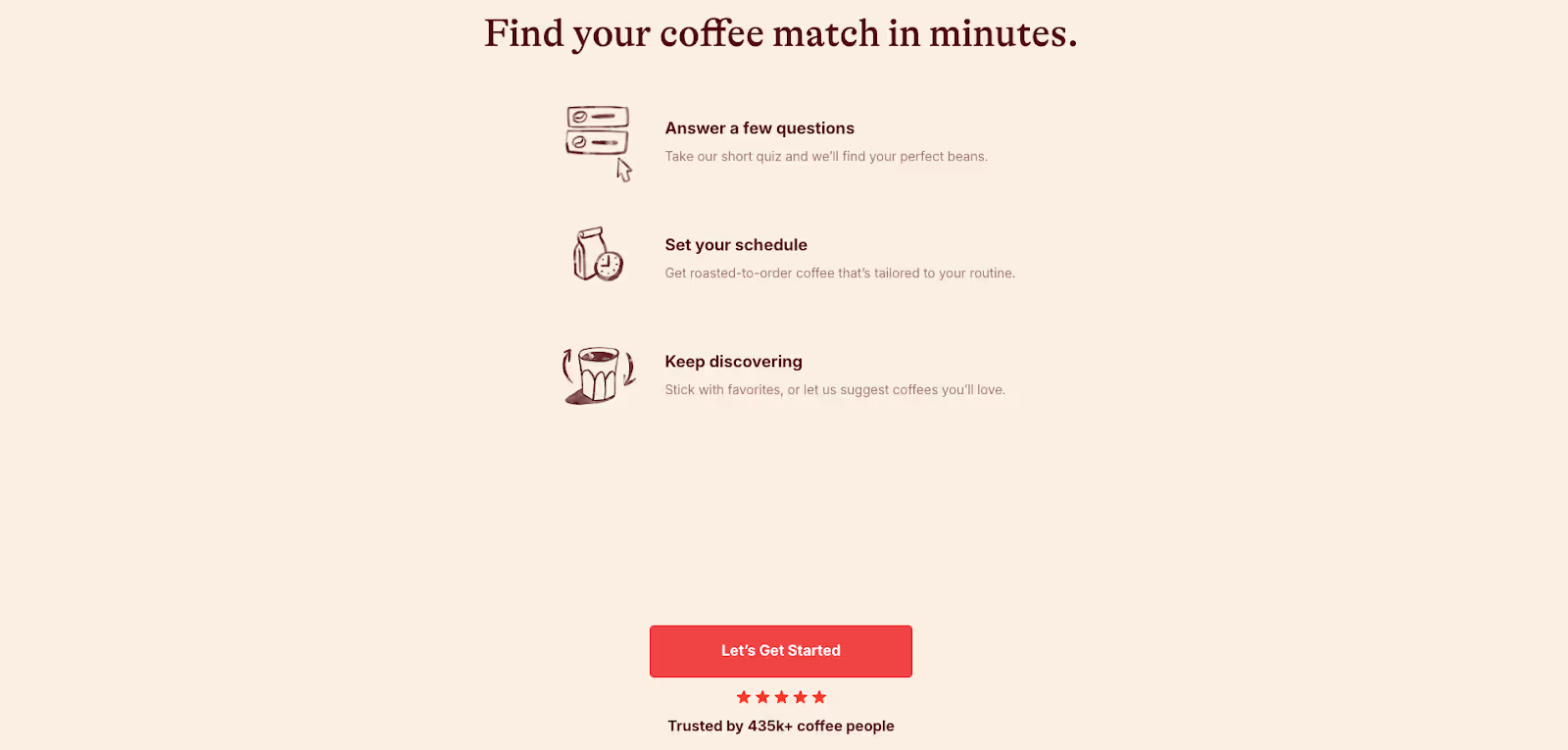
Trade Coffee Co offers an interactive quiz to lead shoppers to their perfect coffee match. Trade Coffee Co

Set your team up for BFCM success with Gorgias 

The more information you can share with customers upfront, the better. That will leave your team time to tackle the heady stuff. 

If you’re looking for an AI-assist this season, check out Gorgias’s suite of products like AI Agent and Shopping Assistant

{{lead-magnet-2}}

min read.

What is Conversational AI? The Ecommerce Guide

Learn about the different types of conversational AI and its benefits for ecommerce.
By Gorgias Team
0 min read . By Gorgias Team

TL;DR:

  • Conversational AI combines natural language processing, machine learning, and generative AI to create human-like interactions
  • For ecommerce, it automates customer service, drives sales through personalized recommendations, and scales support 24/7
  • Key types include chatbots, voice assistants, and AI agents that handle both support and sales tasks
  • Implementation requires defining clear goals, choosing an ecommerce-ready platform, and connecting your tech stack

Conversational AI changes how ecommerce brands interact with customers by enabling natural, human-like conversations at scale, helping reduce customer churn

Instead of forcing shoppers through rigid menus or making them wait for support, conversational AI understands questions, detects intent, and delivers instant, personalized responses. 

This technology powers everything from customer service chatbots to voice assistants, helping brands automate repetitive tasks while maintaining the personal touch customers expect. 

For ecommerce specifically, it means handling order inquiries, providing product recommendations, and recovering abandoned carts — all without adding headcount.

What is conversational AI?

Conversational AI is a type of artificial intelligence that allows computers to understand, process, and respond to human language through natural, two-way conversations. This means your customers can ask questions in their own words and get helpful answers that feel like they're talking to a real person.

Unlike basic chatbots that only recognize specific keywords, conversational AI actually understands what your customers mean. It can handle typos, slang, and complex questions that have multiple parts. The AI learns from every conversation, getting better at helping your customers over time.

Think of it as having a super-smart team member who never sleeps, never gets frustrated, and remembers every detail about your products and policies. This AI team member can chat with customers on your website, answer questions through social media, or even handle phone calls.

What are the key components of conversational AI?

Conversational AI works because several smart technologies team up to understand and respond to your customers. Each piece has a specific job in making conversations feel natural and helpful.

Natural Language Processing (NLP) is the foundation that breaks down human language into pieces a computer can understand. This means when a customer types "Where's my order?" the AI can identify the important words and grammar structure.

Natural Language Understanding (NLU) figures out what the customer actually wants. This is the smart part that realizes "Where's my order?" means the customer wants to track a shipment, even if they phrase it differently like "I need to check my package status."

Natural Language Generation (NLG) creates responses that sound human and helpful. Instead of robotic answers, it crafts replies that match your brand's voice and provide exactly what the customer needs to know.

The dialog manager keeps track of the entire conversation. This means if a customer asks a follow-up question, the AI remembers what you were just talking about and can give a relevant answer.

Your knowledge base stores all the information the AI needs to help customers. This includes your return policy, product details, shipping information, and any other facts your team would use to answer questions.

How does conversational AI work?

Conversational AI follows a simple three-step process that happens in seconds. Understanding this process helps you see why it's so much more powerful than old-school chatbots.

1) It processes input across voice and text with NLP

When a customer sends a message or asks a question, the AI first needs to understand what they're saying. For text messages from chat, email, or social media, the system breaks down the sentence into individual words and analyzes the grammar.

For voice interactions like phone calls, the AI uses speech recognition to turn spoken words into text first. Modern systems handle different accents, background noise, and natural speech patterns without missing a beat.

2) It detects intent and context with NLU

Once the AI has the customer's words, it needs to figure out what they actually want. The system looks for the customer's intent — their goal or what they're trying to accomplish.

For example, when someone asks "Can I return this sweater I bought last week?" the AI identifies the intent as wanting to make a return. It also pulls out important details like the product type and timeframe.

The AI also uses context from earlier in the conversation. If the customer mentioned their order number earlier, the AI remembers it and can use that information to help with the return request.

3) It generates responses with NLG

After understanding what the customer wants, the AI creates a helpful response. It might pull information from your knowledge base, personalize the answer with the customer's specific details, or generate a completely new response using generative AI.

The system also checks how confident it is in its answer. If the AI isn't sure about something or if the topic is too complex, it knows to hand the conversation over to one of your human agents.

What are the types of conversational AI?

Different types of conversational AI work better for different situations in your ecommerce business. Understanding these types helps you choose the right solution for your customers and team.

Chatbots handle scripted and AI-driven chat

Chatbots are the most common type you'll see on websites and messaging apps. Early chatbots followed strict scripts — if a customer's question didn't match the script exactly, the bot would get confused and give unhelpful answers.

Modern AI-powered chatbots understand natural language and can handle much more complex conversations. The best systems combine both approaches: using simple rules for straightforward questions and AI for everything else.

These chatbots work great for answering common questions about shipping, returns, and product details. They can also help customers find the right products or guide them through your checkout process.

Voice assistants manage speech-based requests

Voice assistants bring conversational AI to phone support and other voice channels. These aren't the old phone trees that made customers press numbers to navigate menus.

Instead, customers can speak naturally and get helpful answers right away. Voice assistants can look up order information, explain your return policy, or even process simple requests like address changes.

This works especially well for customers who prefer calling over typing, or when they need help while their hands are busy.

Read more: How Cornbread Hemp reached a 13.6% phone conversion rate with Gorgias Voice

AI agents and copilots assist teams and customers

AI agents are the most advanced type of conversational AI. Unlike chatbots that mainly provide information, AI agents can actually take action on behalf of customers.

These systems connect to your other business tools like Shopify, your shipping software, or your returns platform. This means they can do things like:

  • Process returns: Start a return and send the customer a shipping label
  • Update orders: Change a shipping address or add items to an existing order
  • Handle refunds: Issue refunds for eligible orders automatically
  • Manage subscriptions: Skip shipments or update subscription preferences

Copilots work alongside your human agents, suggesting responses and pulling up customer information to help resolve issues faster.

Read more: How AI Agent works & gathers data

What are the benefits of conversational AI for ecommerce?

Conversational AI delivers real business results for ecommerce brands. The benefits go beyond just making your support team more efficient — though that's certainly part of it.

24/7 availability means you never miss a sale or support opportunity. Customers can get help at 2 a.m. or during holidays when your team is offline. This is especially valuable for international customers in different time zones.

Instant responses prevent cart abandonment and customer frustration, improving first contact resolution. When someone has a question about sizing or shipping, they get an answer immediately instead of waiting hours or days for an email response.

Personalized interactions at scale drive higher average order values. The AI can recommend products based on what customers are browsing, their purchase history, and their preferences, just like your best salesperson would.

Cost efficiency comes from handling repetitive questions automatically. Your human agents can focus on complex issues, VIP customers, and revenue-generating activities instead of answering the same shipping questions over and over.

Multilingual support helps you serve global customers without hiring native speakers for every language. The AI can communicate in dozens of languages, opening up new markets for your business.

What are the most valuable conversational AI use cases for ecommerce?

Certain moments in the shopping experience create the biggest opportunities for conversational AI to drive results. Focus on these high-impact use cases first.

Pre-purchase questions are your biggest conversion opportunity. When someone is looking at a product but hasn't bought yet, quick answers about sizing, materials, or compatibility can close the sale. The AI can also suggest complementary products or highlight features the customer might have missed.

Order tracking makes up the largest volume of support tickets for most ecommerce brands. Customers want to know where their package is, when it will arrive, and what to do if there's a delay. AI handles these WISMO requests instantly by pulling real-time tracking information.

Returns and exchanges can be complex, but AI excels at the initial screening. It can check if an item is eligible for return, explain your policy, and start the return process. For straightforward returns, customers never need to wait for human help.

Cart recovery works best when it's immediate and personal. AI can detect when someone abandons their cart and reach out through chat or email with personalized messages, discount offers, or answers to common concerns that prevent purchases.

Post-purchase support keeps customers happy after they buy. The AI can send order confirmations, provide care instructions, suggest related products, and handle simple issues like address changes.

How do you implement conversational AI in an ecommerce tech stack?

Getting started with conversational AI doesn't require a complete overhaul of your systems. The key is starting with clear goals and building your capabilities over time.

Step 1: Define goals and KPIs for automation

The best automation opportunities are found in your tickets. Look for questions that come up repeatedly and have straightforward answers. Common examples include order status, return policies, and basic product information.

Set realistic goals for your first phase. You might aim to automate 30% of your tickets or reduce average response time by half. Track metrics like:

  • Automation rate: Percentage of tickets resolved without human intervention
  • Customer satisfaction: How happy customers are with AI interactions
  • Revenue impact: Sales influenced by AI recommendations or cart recovery

Step 2: Choose an ecommerce-ready AI platform

Not all conversational AI platforms understand ecommerce needs. Look for a platform that integrates directly with Shopify and your other business tools. This connection is essential for pulling real-time order data, customer history, and product information.

Your platform should come with pre-built actions for common ecommerce tasks like order lookups, return processing, and subscription management. This saves months of custom development work.

Make sure you can control the AI's behavior through clear guidance and rules. You need to be able to set your brand voice, define when to escalate to humans, and update the AI's knowledge as your business changes.

Step 3: Connect Shopify and key tools, then iterate

Start your implementation by connecting your Shopify store to give the AI access to order and customer data. Don’t forget to integrate the rest of your tech stack like shipping software, returns platforms, and loyalty programs.

Launch with a few core use cases like order tracking and basic product questions. Monitor the AI's performance closely and gather feedback from both customers and your support team. Use this data to refine the AI's responses and gradually expand its capabilities. 

The best approach is iterative — start small, learn what works, and build from there.

What are the challenges and risks of conversational AI?

While conversational AI offers significant benefits, you need to be aware of potential challenges and plan for them from the start.

Accuracy concerns arise when AI systems provide incorrect information or "hallucinate" facts that aren't true. Prevent this by using platforms that ground responses in your verified knowledge base and product data rather than generating answers from scratch.

Brand voice consistency becomes critical when AI represents your brand to customers. Set clear guidelines for tone, style, and messaging. Test the AI's responses regularly to ensure they align with how your human team would handle similar situations.

Data privacy requires careful attention since conversational AI handles sensitive customer information. Choose platforms with strong security measures, data encryption, and compliance with regulations like GDPR. Look for features like automatic removal of personal information from conversation logs.

Over-automation can frustrate customers when complex issues require human empathy and problem-solving. Design clear escalation paths so customers can easily reach human agents when needed. Train your AI to recognize when a situation is beyond its capabilities.

Integration complexity can slow down implementation if your chosen platform doesn't work well with your existing tools. This is why choosing an ecommerce-focused platform with pre-built integrations is so important.

Turn conversations into revenue with conversational AI

The brands winning with conversational AI start with clear goals, choose the right platform, and iterate based on real performance data. They don't try to automate everything at once. They focus on high-impact use cases that deliver real results.

Ready to see how conversational AI can transform your ecommerce support and sales? Book a demo with Gorgias — built specifically for ecommerce brands.

{{lead-magnet-2}}

min read.
LLM-Friendly Help Center

How to Make Your Help Center LLM-Friendly

Your Help Center doesn’t need a rebuild. It just needs a smarter structure so AI can find what customers ask about most.
By Holly Stanley
0 min read . By Holly Stanley

TL;DR:

  • You don’t need to rebuild your Help Center to make it work with AI—you just need to structure it smarter.
  • AI Agent reads your content in three layers: Help Center, Guidance, and Actions, following an “if / when / then” logic to find and share accurate answers.
  • Most AI escalations happen because Help Docs are vague or incomplete. Start by improving your top 10 ticket topics—like order status, returns, and refunds.
  • Make your articles scannable, define clear conditions, link next steps, and keep your tone consistent. These small tweaks help AI Agent resolve more tickets on its own—and free up your team to focus on what matters most.

As holiday season support volumes spike and teams lean on AI to keep up, one frustration keeps surfacing, our Help Center has the answers—so why can’t AI find them?

The truth is, AI can’t help customers if it can’t understand your Help Center. Most large language models (LLMs), including Gorgias AI Agent, don’t ignore your existing docs, they just struggle to find clear, structured answers inside them.

The good news is you don’t need to rebuild your Help Center or overhaul your content. You simply need to format it in a way that’s easy for both people and AI to read.

We’ll break down how AI Agent reads your Help Center, finds answers, and why small formatting changes can help it respond faster and more accurately, so your team spends less time on escalations.

{{lead-magnet-1}}

How AI Agent uses your Help Center content

Before you start rewriting your Help Center, it helps to understand how AI Agent actually reads and uses it.

Think of it like a three-step process that mirrors how a trained support rep thinks through a ticket.

1. Read Help Center docs

Your Help Center is AI Agent’s brain. AI Agent uses your Help Center to pull facts, policies, and instructions it needs to respond to customers accurately. If your articles are clearly structured and easy to scan, AI Agent can find what it needs fast. If not, it hesitates or escalates.

2. Follow Guidance instructions

Think of Guidance as AI Agent’s decision layer. What should AI Agent do when someone asks for a refund? What about when they ask for a discount? Guidance helps AI Agent provide accurate answers or hand over to a human by following an “if/when/then” framework.

3. Respond and perform

Finally, AI Agent uses a combination of your help docs and Guidance to respond to customers, and if enabled, perform an Action on their behalf—whether that’s changing a shipping address or canceling an order altogether.

Here’s what that looks like in practice:

Email thread between AI Agent and customer about skipping a subscription.
AI Agent skipped a customer’s subscription after getting their confirmation.

This structure removes guesswork for both your AI and your customers. The clearer your docs are about when something applies and what happens next, the more accurate and human your automated responses will feel.

A Help Center written for both people and AI Agent:

  • Saves your team time
  • Reduces escalations
  • Helps every customer get the right answer the first time

What causes AI Agent to escalate tickets, and how to fix it

Our data shows that most AI escalations happen for a simple reason––your Help Center doesn’t clearly answer the question your customer is asking.

That’s not a failure of AI. It’s a content issue. When articles are vague, outdated, or missing key details, AI Agent can’t confidently respond, so it passes the ticket to a human.

Here are the top 10 topics that trigger escalations most often:

Rank

Ticket Topic

% of Escalations

1

Order status

12.4%

2

Return request

7.9%

3

Order cancellation

6.1%

4

Product - quality issues

5.9%

5

Missing item

4.6%

6

Subscription cancellation

4.4%

7

Order refund

4.1%

8

Product details

3.5%

9

Return status

3.3%

10

Order delivered but not received

3.1%

Each of these topics needs a dedicated, clearly structured Help Doc that uses keywords customers are likely to search and spells out specific conditions. 

Here’s how to strengthen each one:

  • Order status: Include expected delivery timelines, tracking link FAQs, and a clear section for “what to do if tracking isn’t updating.”
  • Return request: Spell out eligibility requirements, time limits, and how to print or request a return label.
  • Order cancellation: Define cut-off times for canceling and link to your “returns” doc for shipped orders.
  • Product quality issues: Explain what qualifies as a defect, how to submit photos, and whether replacements or refunds apply.
  • Missing item: Clarify how to report missing items and what verification steps your team takes before reshipping.
  • Subscription cancellation: Add “if/then” logic for different cases: if paused vs. canceled, if prepaid vs. monthly.
  • Order refund: Outline refund timelines, where customers can see status updates, and any exceptions (e.g., partial refunds).
  • Product details: Cover sizing, materials, compatibility, or FAQs that drive most product-related questions.
  • Return status: State how long returns take to process and where to check progress once a label is scanned.
  • Order delivered but not received: Provide step-by-step guidance for checking with neighbors, filing claims, or requesting replacements.

Start by improving these 10 articles first. Together, they account for nearly half of all AI Agent escalations. The clearer your Help Center is on these topics, the fewer tickets your team will ever see, and the faster your AI will resolve the rest.

How to format your Help Center docs for LLMs

Once you know how AI Agent reads your content, the next step is formatting your help docs so it can easily understand and use them. 

The goal isn’t to rewrite everything, it’s to make your articles more structured, scannable, and logic-friendly. 

Here’s how.

1. Use structured, scannable sections

Both humans and large language models read hierarchically. If your article runs together in one long block of text, key answers get buried.

Break articles into clear sections and subheadings (H2s, H3s) for each scenario or condition. Use short paragraphs, bullets, and numbered lists to keep things readable.

Example:

How to Track Your Order

  • Step 1: Find your tracking number in your confirmation email.
  • Step 2: Click the tracking link to see your delivery status.
  • Step 3: If tracking hasn’t updated in 3 days, contact support.

A structured layout helps both AI and shoppers find the right step faster, without confusion or escalation.

2. Write for “if/when/then” logic

AI Agent learns best when your Help Docs clearly define what happens under specific conditions. Think of it like writing directions for a flowchart.

Example:

  • “If your order hasn’t arrived within 10 days, contact support for a replacement.”
  • “If your order has shipped, you can find the tracking link in your order confirmation email.”

This logic helps AI know what to do and how to explain the answer clearly to the customer.

3. Clarify similar terms and synonyms

Customers don’t always use the same words you do, and neither do LLMs. If your docs treat “cancel,” “stop,” and “pause” as interchangeable, AI Agent might return the wrong answer.

Define each term clearly in your Help Center and add small keyword variations (“cancel subscription,” “end plan,” “pause delivery”) so the AI can recognize related requests.

4. Link to next steps

AI Agent follows links just like a human agent. If your doc ends abruptly, it can’t guide the customer any further.

Always finish articles with an explicit next step, like linking to:

  • A form
  • Another article
  • A support action page

Example: “If your return meets our policy, request your return label here.”

That extra step keeps the conversation moving and prevents unnecessary escalations.

5. Keep tone consistent

AI tools prioritize structure and wording when learning from your Help Center—not emotional tone. 

Phrases like “Don’t worry!” or “We’ve got you!” add noise without clarity.

Instead, use simple, action-driven sentences that tell the customer exactly what to do:

  • “Click here to request a refund.”
  • “Fill out the warranty form to get a replacement.”

A consistent tone keeps your Help Center professional, helps AI deliver reliable responses, and creates a smoother experience for customers.

LLM-friendly Help Centers in action

You don’t need hundreds of articles or complex workflows to make your Help Center AI-ready. But you do need clarity, structure, and consistency. These Gorgias customers show how it’s done.

Little Words Project: Simple formatting that boosts instant answers

Little Words Project keeps things refreshingly straightforward. Their Help Center uses short paragraphs, descriptive headers, and tightly scoped articles that focus on a single intent, like returns, shipping, or product care. 

That makes it easy for AI Agent to scan the page, pull out the right facts, and return accurate answers on the first try.

Their tone stays friendly and on-brand, but the structure is what shines. Every article flows from question → answer → next step. It’s a minimalist approach, and it works. Both for customers and the AI reading alongside them.

Little Words Project Help Center homepage showing six main categories: Orders, Customization, Charms, Shipping, Warranty, and Returns & Exchanges.
Little Words Project's Help Center uses short paragraphs and tightly scoped articles to boost instant answers.

Dr. Bronner’s: Making tools work for the team

Customer education is at the heart of Dr. Bronner’s mission. Their customers often ask detailed questions about product ingredients, packaging, and certifications. With Gorgias, Emily and her team were able to build a robust Help Center that helped to proactively give this information.

The Help Center doesn't just provide information. The integration of interactive Flows, Order Management, and a Contact Form automation allowed Dr. Bronner’s to handle routine inquiries—such as order statuses—quickly and efficiently. These kinds of interactive elements are all possible out-of-the-box, no IT support needed.

Dr. Bronner's Help Center webpage showing detailed articles, interactive flows, and order management automation for efficient customer support.
The robust, proactively educational Help Center, integrated with interactive flows and order management via Gorgias, streamlines detailed and routine customer inquiries.

Read more: How Dr. Bronner's saved $100k/year by switching from Salesforce, then automated 50% of interactions with Gorgias 

Ekster: Building efficiency through automation and clarity

Ekster website and a Gorgias chat widget. A customer asks "How do I attach my AirTag?" and the Support Bot instantly replies with a link to the relevant "User Manual" article.
Gorgias AI Agent instantly recommends a relevant "User Manual" article to a customer asking, "How do I attach my AirTag?", demonstrating how structured Help Center content enables quick, instant issue resolution.

When Ekster switched to Gorgias, the team wanted to make their Help Center work smarter. By writing clear, structured articles for common questions like order tracking, returns, and product details, they gave both customers and AI Agent the information needed to resolve issues instantly.

"Our previous Help Center solution was the worst. I hated it. Then I saw Gorgias’s Help Center features, and how the Article Recommendations could answer shoppers’ questions instantly, and I loved it. I thought: this is just what we need." —Shauna Cleary, Head of Ecommerce at Ekster

The results followed fast. With well-organized Help Center content and automation built around it, Ekster was able to scale support without expanding the team.

“With all the automations we’ve set up in Gorgias, and because our team in Buenos Aires has ramped up, we didn’t have to rehire any extra agents.” —Shauna Cleary, Head of Ecommerce at Ekster

Learn more: How Ekster used automation to cover the workload of 4 agents 

Rowan: Clean structure that keeps customers (and AI) on track

Rowan’s Help Center is a great example of how clear structure can do the heavy lifting. Their FAQs are grouped into simple categories like piercing, shipping, returns, and aftercare, so readers and AI Agent can jump straight to the right topic without digging. 

For LLMs, that kind of consistency reduces guesswork. For customers, it creates a smooth, reassuring self-service experience. 

Rowan's Help Center homepage, structured with six clear categories including Piercing Aftercare (19 articles), Returns & Exchanges, and Appointment Information.
Rowan’s Help Center uses a clean, categorized structure (Aftercare, Returns, Shipping) that lets customers and AI Agents jump straight to the right topic.

TUSHY: Balancing brand voice with automation

TUSHY proves you can maintain personality and structure. Their Help Center articles use clear headings, direct language, and brand-consistent tone. It makes it easy for AI Agent to give accurate, on-brand responses.

TUSHY bidet customer help center webpage showing categories: Toilet Fit, My Order, How to Use Your TUSHY, Attachments, Non-Electric and Electric Seats.
Explore articles covering Toilet Fit, My Order, How to Use Your TUSHY, and various Bidet Attachments, all structured for easy retrieval and use.
“Too often, a great interaction is diminished when a customer feels reduced to just another transaction. With AI, we let the tech handle the selling, unabashedly, if needed, so our future customers can ask anything, even the questions they might be too shy to bring up with a human. In the end, everybody wins!" —Ren Fuller-Wasserman, Senior Director of Customer Experience at TUSHY

Quick checklist to audit your Help Center for AI

Ready to put your Help Center to the test? Use this five-point checklist to make sure your content is easy for both customers and AI to navigate.

1. Are your articles scannable with clear headings?

Break up long text blocks and use descriptive headers (H2s, H3s) so readers and AI Agent can instantly find the right section.

2. Do you define conditions with “if/when/then” phrasing?

Spell out what happens in each scenario. This logic helps AI Agent decide the right next step without second-guessing.

3. Do you cover your top escalation topics?

Make sure your Help Center includes complete, structured articles for high-volume issues like order status, returns, and refunds.

4. Does each article end with a clear next step or link?

Close every piece with a call to action, like a form, related article, or support link, so neither AI nor customers hit a dead end.

5. Is your language simple, action-based, and consistent?

Use direct, predictable phrasing. Avoid filler like “Don’t worry!” and focus on steps customers can actually take.

By tweaking structure instead of your content, it’s easier to turn your Help Center into a self-service powerhouse for both customers and your AI Agent.

Make your Help Center work smarter

Your Help Center already holds the answers your customers need. Now it’s time to make sure AI can find them. A few small tweaks to structure and phrasing can turn your existing content into a powerful, AI-ready knowledge base.

If you’re not sure where to start, review your Help Center with your Gorgias rep or CX team. They can help you identify quick wins and show you how AI Agent pulls information from your articles.

Remember: AI Agent gets smarter with every structured doc you publish.

Ready to optimize your Help Center for faster, more accurate support? Book a demo today.

{{lead-magnet-2}}

min read.
Create powerful self-service resources
Capture support-generated revenue
Automate repetitive tasks

Further reading

How We Keep Talent Density High and Impact Higher at Gorgias

By Adeline Bodemer
min read.
0 min read . By Adeline Bodemer

TL;DR:

  • High talent density means a team where every member is highly skilled and performs at their peak. This creates a positive ripple effect, where talented individuals enhance each other's effectiveness and drive overall success.
  • Gorgias maintains high talent density by following three pillars: hire great talent, part ways with non-performers, and nurture your talent pool.
  • Train managers to share 100% honest feedback with direct reports. Honest feedback, performance improvement plans, and fair severance ensure a respectful and constructive approach to managing team dynamics.
  • Measure talent density with key metrics. These include performance scores over time, cross-evaluation reviews, regrettable attrition rates, and transparent promotions to ensure fairness and improvement.

At Gorgias, we’ve embraced the concept of high talent density, introduced by Netflix co-founder and CEO Reed Hastings in No Rules Rules, as a foundation of how we operate. The idea is simple: a team is at its best when every member is highly skilled and performing at their peak.

I’ll walk you through exactly how we’ve built a workplace that prioritizes talent density by breaking down what the concept means, how it shapes our hiring process, and how we keep Gorgias a rewarding environment to grow in.

What is high talent density?

High talent density refers to having a team where each member is highly skilled and performs at their best. When a group consists of top performers, their collective effectiveness increases. Hastings notes, "Talented people make one another more effective."

For example, in a team of five exceptional employees, each individual's high performance elevates the group's overall success. If there is even one underperformer, a team's effectiveness decreases by 30 to 40 percent.

The three pillars of high talent density

We follow three pillars to maintain and grow high talent density. These pillars guide how we build and sustain a team of exceptional performers at Gorgias.

  1. Hire Great Talent: We look for people who excel in their roles today and show the potential to grow with the company in the future.
  2. Part Ways with Non-Performers: We prioritize honest feedback and offer support for improvement, but we’re not afraid to make changes when necessary.
  3. Nurture Your Talent Pool: We invest in our team’s development, ensuring everyone has the tools and opportunities to succeed as the company grows.

To bring this to life, we’ll use an analogy of colors to represent different types of performers in our talent pool:

Diagram of the 3 pillars of high talent density pillars
At Gorgias, our talent pool consists of great talents (dark green circles), performers (light green), underperformers (pink), and non-performers (red).

Let’s take a closer look at how we practice each of these pillars below.

Pillar #1: Hire great talents

Every manager wants to hire someone exceptional, but even with the best intentions, it doesn’t always work out.

To clarify, we’re looking for someone great to do the job now but has the potential to grow and stay strong as the company evolves. 

Here’s how we approach it.

Pay well (i.e. transparently and competitively)

Let’s be upfront: great talent often comes with a higher price tag. 

The first step in building high talent density is offering competitive pay. Exceptional people expect to be compensated for their contributions, and rightly so.

A single outstanding hire, even if paid 50% more than two average employees, often delivers far greater results. 

This is especially true in creative roles, where the impact of a single talent can be worth that of several others. It’s certainly not easy to prioritize compensation when resources are tight, but talented people are an investment — and talent is usually expensive.

Related: How we built an international SAAS salary calculator for our distributed team

Focus on sourcing, not just applicants

Great candidates don’t always come knocking on your door. The best talent is often already employed, not actively looking for a new role. 

To hire the best, we go beyond applications and invest heavily in proactive sourcing.

Use a structured recruiting playbook

At Gorgias, we rely on scorecards and standardized feedback forms to assess every applicant fairly and thoroughly. We also include role-specific assessments or assignments as part of the process. 

While some argue that take-home tasks are no longer standard, we’ve found them invaluable. A strong interview doesn’t always translate into strong performance, and these assignments often reveal critical insights into a candidate’s true capabilities.

Referrals are another piece of the puzzle. A-players tend to know and recommend other A-players. While leveraging referrals, we also keep a close eye on maintaining diversity to make sure everyone gets the same chance.

Pillar #2: Part ways with non-performers

Regularly assess your talent pool

Performance isn’t static. Someone who was a top performer last year might not meet expectations today, especially as the company grows and their role evolves.

To stay objective, we pair performance reviews with bi-yearly cross-evaluation talent reviews. Cross-evaluations provide a broader perspective, helping managers see beyond potential biases and assess whether a top talent has changed in performance quality.

These regular evaluations ensure we’re always aware of who is meeting expectations and who may need support or a more difficult conversation.

Enforce honest feedback with your managers

While Netflix's philosophy is to immediately separate with employees when they underperform, we believe in a more empathetic approach that follows our company’s core value of being 100% honest.

At Gorgias, we train managers to deliver clear, actionable feedback so team members always know where they stand and how they can improve. To us, honesty means being thoughtful, encouraging, and focused on helping people grow. 

We also use Performance Improvement Plans (PIPs) as a tool for growth. We don’t simply view them as compliance tools, but as opportunities for employees to get back on their feet. In fact, 50% of our PIPs result in team members regaining performance.

Provide fair and generous severance packages

Sometimes, despite feedback and coaching, parting ways becomes the best option for both the employee and company. When that happens, we believe in making the transition as respectful and fair as possible.

Offering a strong severance package not only supports employees during their transition but also empowers managers to make tough decisions confidently. It reflects our shared responsibility and ensures we treat people with dignity, even when their time with us comes to an end.

Pillar #3: Nurture your talent pool

Help talent grow alongside the company

When a company grows, employees need to match that pace to keep delivering at a high level. This requires consistent learning and development to meet the challenges of each new stage.

Growth doesn’t happen by accident. As Daniel Coyle explains in The Talent Code, greatness isn’t born; it’s grown through “deep practice.”

To encourage growth, Gorgias managers hold career conversations every six weeks, focusing on the “3Es”: education, exposure, and experience. These discussions identify growth areas, leverage networks, and clarify the steps team members can take to excel.

We also reward our top performers with opportunities beyond financial incentives. From double learning stipends to travel experiences and executive mentorships, these rewards keep our “dark green” talents motivated and engaged.

Read more: Why we don’t increase salaries based on performance

Cultivate a positive and collaborative environment

In the pursuit of high talent density, results are important, but so is maintaining a positive, team-oriented environment.

A top performer with a toxic attitude can harm the environment you’re working hard to build. For that reason, we hire and nurture people who align with our values, show respect for others, and contribute to a collaborative culture. Both the what (talented employees) and the how (exemplary behavior) matter. 

Implement pressure management programs

I believe this is one of the toughest topics when it comes to talent management.

Top performers are eager to work hard and prove their worth. Oftentimes, they approach work intensely and passionately. However, too much intensity can lead to exhaustion. And, of course, tired employees can’t deliver well.

That’s why managing pressure is crucial to maintaining high talent density. Introducing programs and initiatives that support the well-being of your employees helps prevent stress and burnout.

We take a tailored approach to prevent burnout, recognizing that one size doesn’t fit all. Having strong management training and great HRBPs (HR Business Partners) are the most impactful pieces. They help uncover the underlying issues of burnout: lack of vacation time, heavy workload, personal challenges, or misalignment.

Once the issues are clear, we provide the right tools to help. This could include coaching, training, enhanced benefits, or adjusted workloads.

How we measure, refine, and design our talent pool

We use specific metrics to gain insights into the effectiveness of our talent management strategies and refine our approach as needed.

Here are the metrics we track to evaluate talent density:

  1. Performance scores over time: We track average performance scores across the company (excluding new hires) to monitor overall talent density.
  2. Cross-evaluation reviews: Our biannual talent reviews include cross-evaluations, introducing variables like leadership, learning agility, and drive to ensure a holistic assessment.
  3. Regrettable attrition rate: We analyze turnover rates to identify potential issues and address them proactively.
  4. Transparent promotions: We’ve developed a promotion process that prioritizes fairness and merit. Managers must document and justify promotions, holding them accountable for consistency and equity.

By regularly tracking these metrics, we can see where we may be falling short — whether that’s being slow to part ways with low performers, struggling to attract great talent, or losing top performers unnecessarily.

Building strong organizational design

The ultimate goal of having strong talent density is to build a well-performing organization.

After each talent review, HRBPs will work hand in hand with managers to refine the organizational chart. They identify opportunities for improvement, such as promoting top talent, adjusting scopes of responsibility, or making changes to strengthen the team.

Ultimately, you should always make sure that your top performers are leading the most critical and top-priority initiatives.

Before prioritizing high talent density, your org may be keeping low performers. After following the three pillars of high talent density, your org will be saturated with top performers.

A personal note on the journey to high talent density

In my role as VP of People at Gorgias, I’ve seen how fast growth fuels the resources and opportunities needed to attract and develop exceptional talent. High performers thrive in environments with big goals and fast results, but it’s up to us to create the right conditions for them to succeed.

Sustaining high talent density takes dedication and humility. It means holding ourselves to high standards while being transparent. While we’ve made great strides, there’s always more to learn and refine.

As we continue this journey, let us remain humble, acknowledging that there is always room for growth and improvement.

How 10 Brands Transformed Customer Support Into Revenue in 2024

By Holly Stanley
min read.
0 min read . By Holly Stanley

TL;DR:

  • Support automation cuts resolution times and saves brands thousands. Dr. Bronner's and LSKD automated 40–45% of tickets, saving $100K annually and cutting resolution times to just over a minute.
  • Phone support is a profitable yet underutilized support channel. Obvi boosted revenue by $22K in 2 months using phone support alongside Gorgias for upselling and subscription retention.
  • Automating returns results in new sales and cost savings. Rumpl recouped $8K in return fees with automated returns, while Pajar resolved tickets in 12 minutes using bilingual AI support.
  • App integrations enhance the customer experience. Shopify, Aircall, and Loop Returns integrations helped brands like Jonas Paul Eyewear slash response times by 96% during peak seasons.

Scaling great customer support is often seen as a challenge, especially when ticket volumes climb and customer expectations rise. But for CX leads and executives, it’s essential to recognize that support isn’t just a cost center—it’s a profit driver. Exceptional customer support builds loyalty, drives repeat business, and creates upselling opportunities, directly boosting revenue.

That’s where Gorgias comes in. In this blog, we’ll show you how brands like Rumpl, TalentPop, Stylest, and Baby Gold have turned their support challenges into measurable wins with the power of automation and smart tools.

{{lead-magnet-1}}

1. Obvi boosted revenue by $22,000 in just 2 months with Gorgias and phone support

Obvi was leaving money on the table. Without phone support, they faced challenges like subscription drop-offs and missed upsell opportunities. Voice as a support channel wasn’t on their radar, so valuable revenue streams slipped through the cracks. Plus, they lacked a proactive strategy to retain subscriptions.

By integrating Gorgias’ omnichannel support tech, Obvi transformed their customer experience. They introduced a personalized, phone-based support system tailored to upselling and subscription retention, and partnered with Aventus’ Learning Management System (ALMS) to give their agents expert training.

The result? 

A customer support system that delivered exceptional service while boosting revenue.

Results achieved:

  • Saved 271 subscription orders, equalling $21,244 in revenue.
  • Achieved an average of 20+ upsells per week.
  • Enhanced customer satisfaction and retention through personalized interactions.

With Gorgias and phone support, Obvi unlocked the potential of voice to grow their business and deepen customer loyalty.

2. Jonas Paul Eyewear slashed response times by 96% with AI Agent

During peak seasons like back-to-school, Jonas Paul Eyewear struggled to keep up with the sheer volume of customer inquiries. The small customer care team was overwhelmed with repetitive questions, leading to slower response times and increased stress. They needed an efficient solution to handle the increased load while maintaining excellent service.

By partnering with Gorgias, Jonas Paul Eyewear transformed their customer service operations. AI Agent automated responses to common queries like prescription details and return policies, freeing up their team to focus on more complex issues. 

An integration with Aircall allowed agents to handle phone calls directly within Gorgias, with access to customer interaction history and Shopify data. A Klaviyo integration streamlined inquiries related to home try-on kits and orders. Together, these tools created a customer-focused experience.

Results achieved:

  • Despite a 28% increase in tickets, the team reduced first response time by 96%.
  • AI Agent influenced $600 in sales in a single month, nearly doubling its $360/month cost.
  • Automated over 30% of support volume, eliminating the need for temporary staff during busy periods.
"With faster responses and more proactive support through AI, we are seeing happier customers, which obviously translates into more retention and more brand loyalty. Overall with the improvement in first response time, we've really seen an uptick in customer satisfaction and less of an escalation in tickets."

—Lynsay Schrader, Lab and Customer Service Senior Manager at Jonas Paul Eyewear

3. Dr. Bronner’s saved $100K annually by automating 45% of customer interactions

As Dr. Bronner's business grew, so did their customer support challenges. The limitations of their previous system, Salesforce, made it difficult for their small customer experience (CX) team to handle increasing inquiries, especially repetitive questions. As a result, customers experienced longer response times, and the brand needed a more effective solution.

By switching to Gorgias, Dr. Bronner's transformed their customer support operations. They implemented AI Agent to automate routine inquiries, allowing their team to focus on more complex, personalized interactions.

The addition of a comprehensive Help Center empowered customers to find answers independently. At the same time, integrations with Shopify, Aircall, and Loop Returns streamlined the management of orders, returns, and voice communications — all within a single platform.

Results achieved:

  • Saved $100,000 annually by replacing Salesforce, reducing licensing and development costs.
  • Automated over 45% of customer interactions within two months.
  • Increased customer satisfaction scores by 11% through faster responses and personalized service.
  • Reduced resolution time by 74%, enabling the team to address inquiries more effectively.
Dr. Bronner's help center
Dr. Bronner's Help Center
"Our CX team is small, which is why leaning into automation was so crucial for us. We were really at a turning point at the beginning of the year, and we knew that we had to make a change. We had to make our tools work for us, not against us. Gorgias was a huge opportunity, and we decided to jump in head first. Within the first 30 days, we were able to automate 30% of customer interactions and are now up to 45%."

—Emily McEnany, Senior CX Manager at Dr. Bronner’s

4. Pajar automated 45% of tickets to cut response times from days to minutes

Peak seasons like winter, Black Friday, and Cyber Monday brought immense pressure to Pajar’s small customer service team of five agents. With high ticket volumes and a bilingual customer base (English and French), maintaining quick response times and delivering excellent service became a major challenge. They needed a solution to streamline operations and keep their customers happy.

Partnering with Gorgias proved to be a game-changer. Pajar implemented AI Agent to handle common inquiries in both English and French, freeing their team to focus on complex tickets. Automation reduced repetitive tasks, improving team efficiency, while Gorgias’ 30-in-30 onboarding program helped them quickly hit their automation goals.

Results achieved:

  • Surpassed their 30% goal by fully resolving 45% of queries with automation.
  • Achieved a first response time of just 12 minutes and 15 seconds, and a resolution time of 1 day and 20 hours.
  • Maintained high satisfaction scores by delivering timely, accurate responses in English and French.
Pajar uses Gorgias Automate to automate frequently asked questions on their website
Pajar uses Gorgias AI Agent to automate answers to their most commonly asked questions.
"We were nervous to get started at first, but as soon as we had the implementation call it was a huge weight off of our shoulders — we knew it was going to be great. And we were right. The first day we turned it on, we started seeing results right away."

—Noémie Rousseau, Customer Service Manager at Pajar

5. LSKD tripled email automation and boosted customer satisfaction with AI Agent

LSKD, a popular Australian activewear brand, struggled to keep up with a high volume of customer inquiries during peak periods. Their previous system couldn’t handle repetitive queries efficiently, leading to slower response times and an overburdened support team. To maintain their commitment to excellent customer service, they needed a smarter solution.

Gorgias delivered. By implementing AI Agent, LSKD automated responses to common questions, enabling their team to focus on complex, high-value interactions. Automation streamlined workflows, reducing manual tasks, while integration with Shopify provided instant access to customer order data. LSKD could respond faster and more accurately, improving the overall customer experience.

Results achieved:

  • Automated 40% of tickets overall with Gorgias AI Agent.
  • Reduced first response time from 1 day 2 hours to 1 minute and 2 seconds.
  • Reduced resolution time from 1 day 19 hours to 1 minute and 8 seconds.
How LSKD tripled email automation rate with AI Agent
LSKD tripled their email automation rate by using AI Agent.
"Gorgias AI Agent is going to be a game-changer for us during BFCM. With the ability to provide immediate, personalized responses, we’re confident it will not only reduce the volume of repetitive inquiries but also ensure our community feels supported during the busiest time of the year.”

—Kailey Burton, Community Experience Head Coach at LSKD 

6. Baby Gold automated 20% of emails and cut resolution time down to 1 minute 4 seconds

Baby Gold, a jewelry brand known for its personalized pieces, faced growing challenges in meeting customer demands for quick and efficient support. Their existing customer service system lacked the automation needed to manage repetitive inquiries, leading to slower response times and an increased workload for their team. 

They needed a solution to improve efficiency and meet customer expectations for rapid assistance.

AI Agent autonomously resolved customer email tickets by learning the brand’s unique policies and voice while automation reduced manual tasks. Easy integration with their existing systems provided agents with instant access to customer data, enabling quicker, more accurate responses and improving overall efficiency.

Results achieved:

  • Achieved a 20% email automation rate after joining the AI Agent Beta program.
  • Reached a first response time of 49 seconds and a resolution time of 1 minute and 4 seconds.
  • Answered 1,361 tickets within two weeks.
"I feel that nowadays, people expect quick responses and rapid assistance. AI and tools such as AI Agent are perfect to meet these expectations."

—Sindi Melgar, Customer Service Manager at Baby Gold

7. Psycho Bunny answers tickets 10x faster with AI Agent

Psycho Bunny, a bold menswear brand known for its edgy take on classic styles, faced a challenge: how to maintain a stellar customer experience while scaling their multi-million dollar business. With a focus on improving key performance indicators (KPIs) and customer satisfaction (CSAT), they needed a solution to boost efficiency without adding to their customer support team’s workload.

Psycho Bunny implemented AI Agent to handle routine customer inquiries, such as order status, returns, and exchanges, freeing up human agents to focus on more complex, high-value interactions. 

With automation managing 26% of tickets and integration with existing systems, Gorgias provided the tools to streamline operations and deliver exceptional service, all from one unified platform.

Results achieved:

  • Resolved 26% of customer tickets through AI Agent.
  • Reduced first response time by 99.8% and resolution time by 99.4%.
  • Queries are answered 10x faster than the team average thanks to AI Agent, with a 4.67 CSAT score.
"I already love Gorgias because its email and chat capabilities are ahead of the competition, so I trust Gorgias to also build the best AI agent. And having all our CX tools within the same system is important—I don’t want yet another dashboard to check."

—Tosha Moyer, Senior Customer Experience Manager at Psycho Bunny

8. Stylest achieved a 35.56% conversion rate with Gorgias Convert

Stylest, a swimwear brand, set its sights on a big goal: to boost visitor engagement and convert more casual browsers into loyal customers. They wanted to increase sales and highlight their best-selling styles while providing an enjoyable shopping experience.

To achieve this, Stylest partnered with ECOM DEPARTMENT and implemented Gorgias Convert, an onsite marketing tool designed to optimize customer interactions and drive conversions. With Convert, they launched targeted campaigns that effectively guided visitors toward completing their purchases without disrupting the shopping experience.

Results achieved:

  • Achieved an impressive 35.56% conversion rate through exit intent campaigns.
  • Campaigns contributed to a 20% lift in Average Order Value (AOV) revenue.
  • Over 90 days, campaigns influenced 3% of total revenue, with a peak impact of 18%.

9. TalentPop expanded its customer base by 410 clients through a strategic partnership with Gorgias

TalentPop, a customer service management agency serving ecommerce brands, set out to expand its client base and elevate its service offerings. To achieve these goals, they needed a partner that could align with their go-to-market strategies, provide innovative tools, and help attract new business.

TalentPop tapped into Gorgias’s robust platform and co-selling initiatives to acquire mutual customers.

They received tailored guidance to plan forward-thinking strategies, looking 1–2 years ahead, while maintaining a high standard of service delivery. Access to essential tools and operational support allowed TalentPop to streamline processes, boost efficiency, and increase revenue from customer support services.

Results achieved:

  • Acquired 410 mutual customers through effective co-selling efforts.
  • Perfectly aligned go-to-market strategies with Gorgias, critical for winning key accounts.
  • Helped their client Silky Gem to automate 40% of 5,000 monthly tickets.
"Gorgias has been instrumental in TalentPop’s growth from the start of our partnership. They have provided key prospect opportunities, supported us in winning accounts, and invested in TalentPop by bringing on best-in-class customer service agents to support their teams."

—Olivia Parker, Senior Partnerships Manager at TalentPop

10. Rumpl recouped $8,000 in return fees and achieved 4.89 CSAT

Rumpl’s manual, 3PL-dependent returns process was time-consuming and inefficient, with resolutions taking 2–3 weeks. A reliance on shared Excel sheets created operational bottlenecks during busy periods and frustrated customers.

By integrating Loop Returns with Gorgias, Rumpl automated and streamlined their returns process. Customers could manage returns and exchanges via an automated portal in the Gorgias chat widget. Self-service tools and automated communications reduced manual workloads, while centralized support within Gorgias improved efficiency and visibility.

Results achieved:

  • Cut first resolution time by 39% with automation.
  • Recouped $8,000 in return fees by converting 31.4% of returned revenue into exchanges or store credit.
  • Boosted CSAT to 4.89 by delivering quicker, more efficient service.
"The Gorgias/Loop integration has been really useful for us. Being able to view return info in Gorgias, then open that return in Loop with one click, makes it super easy to navigate and resolve any issues the customer might have."

—Jacob Cantu, Senior Customer & People Experience Manager at Rumpl

Turn customer support into your brand’s growth engine

Great customer support goes beyond answering questions. It involves building trust, driving loyalty, and turning everyday interactions into opportunities for growth. From streamlining returns to automating repetitive tasks, brands like Rumpl, TalentPop, Stylest, and Baby Gold show how the right tools can transform support into a revenue-driving powerhouse. 

With Gorgias, you can work smarter, resolve issues faster, and create exceptional experiences that keep your customers coming back.

Want to see how Gorgias can help you scale your support and grow your business? Book a demo today and discover the tools that will take your customer experience to the next level.

{{lead-magnet-2}}

No items found.

AI Tone of Voice: Tips for On-Brand Customer Communication

By Alexa Hertel
min read.
0 min read . By Alexa Hertel

TL;DR:

  • Tone of voice builds trust. A consistent tone of voice helps create personal connections with customers and builds trust in your brand, even when using AI.
  • Analyze your brand's personality to find your tone. Review customer conversations, website copy, and marketing materials.
  • AI can mimic brand voice by learning your data. This data includes your brand’s help docs, internal guidebooks, macros, and brand guidelines.
  • Keeping AI on-brand requires regular training. Audit your brand voice, set guidance, and monitor responses to keep your AI accurate.

Tone of voice—and a strong brand personality—have become essential components of exceptional customer service. 

As many brands introduce AI to automate customer service interactions, the challenge of ensuring that AI is helpful looms. Part of that helpfulness means speaking to customers in a way that connects with them, not alienates them.

That’s why implementing AI that uses your brand’s signature tone of voice has never been so important.

This post will explore why tone of voice matters in customer service and provide insights on how AI can effectively replicate brand voice, with tips on implementing it successfully. 

{{lead-magnet-1}}

Why tone of voice matters in customer service

Through a customer service lens, tone of voice is the style, word choice, and general vibe of how your brand speaks when it communicates with customers. Tone of voice is one of the key components of brand identity, so the tone of voice a support team uses will always align with its greater brand.

According to Statista, 64% of customers prefer making purchases from companies that create experiences tailored to their needs and wants. A consistent tone of voice does just that, building trust, creating better relationships between customers and brands, and making experiences more personal.

On the flip side, brands that don’t prioritize tone of voice — especially when it comes to AI — will see robotic tones cause a loss of customer trust. 

How AI effectively replicates brand voice

51% of customers share concerns that brands that use AI won’t connect them to a human. But if you choose the right AI tools that leverage your brand’s information and use it effectively, you can train it to mimic your unique voice — sometimes to the point where customers don’t even know that it’s the AI talking.

That’s true for the CX team at toddler carrier brand Wildride

”An influencer emailed us saying, 'I really love you guys,' and our AI Agent replied, 'Love you too,' with heart emojis, which was really funny. It was just like an email from me and my other team members,” says Amber van den Berg, their Head of Customer Experience. 

Wildride trusts Gorgias AI Agent to manage a high volume of tickets while still providing each customer with a great experience.  

📚 Further reading: How Wildride automated 33% of email tickets with AI Agent 

AI Agent uses a few key components to mimic tone of voice, including LLMs (Large Language Models) to form human-like responses, guidance from you, and the internal resources you provide it. 

“We’ve had customers respond to AI Agent thinking they were speaking to a real person. That’s how elevated the response was from AI,” says Emily McEnany, Senior CX Manager at Dr. Bronner’s

Brand voice: Friendly

4 tips for successfully infusing AI with your brand’s tone of voice

You can absolutely train AI to match your brand's specific voice and style. Here are a couple of tips that will help you be successful: 

  • Audit your brand’s existing voice and tone
  • Set up guidance
  • Monitor responses and give feedback
  • Keep up with regular training

1. Audit your brand’s existing voice and tone 

If your brand has an established voice and tone, make sure that you either have internal documents that detail it or can describe it accurately in a couple of paragraphs. 

You’ll use that information to help train the AI, so it’s essential that it’s up-to-date and accurate. 

If you don’t have an established tone, now is a great time to generate your brand voice. Review customer conversations and the copy on your website. Chat with your marketing team and even your brand’s founder to get a clear picture of what it is or what you’d like it to be. 

Here’s a quick-start guide for how to find your tone of voice: 

  1. Think about the brands you want to be similar to and pick two. 
  2. Now, take a look at those brands’ websites. Make a list of what you love — it could be the way these brands speak to customers, leverage active verbs, write their product descriptions, or how they talk on social media. 
  3. Now that you have your list, circle the things that feel most relative to your brand. 
  4. Can you put an overarching “vibe” to this list? For example, you might choose a word like friendly, sophisticated, or fun.  
  5. Then, fill in this sentence: “We are (Your Brand) and our tone of voice is (the vibe word you chose). 
  6. Now, see if you can expand on that a little more, with some thoughts about how you might interact with your target audience or write about your products.

2. Set up guidance

Most AI-powered tools will allow you to set up some sort of guidance around how they interact with customers. If you use Gorgias AI Agent, you’ll be able to set specific tone of voice parameters. Choose from three pre-built options—Friendly, Professional, Sophisticated—or Custom to give it your own instructions.

For example, jewelry brand Baby Gold uses an upbeat, friendly, warm, and personable tone. They would likely choose the Friendly option, which is the go-to option for many teams. 

“Sometimes agents forget personal details to call out when communicating with our customers, like birthdays or weddings,” says Sindi Melgar, their Customer Service Manager.  

“But I noticed on a few different occasions where the AI Agent is highlighting these things and is saying, congratulations on your wedding! Just the tone of voice that Michelle is able to adopt is definitely on brand for us.”

If you’re looking to provide your own specific guidelines, create custom guidance like Wildride did below: 

Choose a custom tone of voice for Gorgias's AI Agent

📚 Recommended reading: How to customize AI Agent with 7 brand voice examples

3. Monitor responses and give feedback

In general, you should always keep an eye on how your AI tool is answering questions to ensure that it’s providing accurate responses and that your customers aren’t getting frustrated. Combing through responses manually can be overwhelming, so that’s why Gorgias offers an AI Feedback feature. 

In the ticket sidebar you’ll find a summary of the response AI Agent provided, including why it responded the way it did and the resource it pulled the response from. 

Mark a response as correct or incorrect with AI Agent

Then, give feedback by using the 👍 or 👎 icons to mark AI Agent’s response as correct or incorrect. AI Agent uses this feedback to improve responses over time.

📚 Recommended reading: How to coach AI Agent and give feedback

4. Keep up with regular training

Any time you add new policies or update existing ones, make sure you add them to your helpdocs and Macros, which are the main resources the AI is going to draw from. 

The more consistently you can go in and provide the AI direct feedback on each response, the more easily AI will nail your unique tone. 

Create on-brand responses with AI 

Your brand’s tone of voice makes a huge impact on the relationships you build with customers. Combining your unique brand voice with AI means you’ll provide more personalized responses and resolve customer issues faster. 

“We were hesitant at first, but AI Agent has really picked up on our brand’s voice,” says Lynsay Schrader, Lab and Customer Service Senior Manager at Jonas Paul Eyewear. “We’ve had feedback from customers who didn’t even realize they were talking to an AI.” 

Gorgias AI Agent is the go-to tool for AI-driven customer support that aligns with brand tone.

{{lead-magnet-2}}

Why Your Strategy Needs Customer Service Quality Assurance

By Alexa Hertel
min read.
0 min read . By Alexa Hertel

TL;DR:

  • Manual QA is time-consuming and inconsistent. Reviewing conversations manually makes it difficult to ensure uniform quality across agents and touchpoints.
  • Automating QA saves time and improves accuracy. Automation ensures all tickets are reviewed with the same quality, freeing up agent time to create stronger customer connections.
  • QA helps teams continuously improve. It enables better agent training and brings forth actionable feedback to exceed customer expectations.
  • Implement QA one step at a time. Begin by setting KPIs, introducing small changes, and investing in automation tools to streamline and measure success effectively.

Forrester’s 2024 Customer Experience Index reports that 39% of brands’ customer experience (CX) quality has declined over the past year.

It can be challenging to get a full understanding of how your team—and AI, if you use it—are truly performing.

This is true even with metrics like CSAT

“A 5-point scale only tells you and your agents so much, and relying on consumers providing feedback further limits what you’re able to look at and learn from,” says Kayla Oberlin, Senior Manager of Customer Experience at amika

Quality Assurance (QA) is becoming a more crucial component of a customer experience strategy, especially one that prioritizes customer happiness. 

We’ll cover the importance of customer service QA, best practices, tools, and tips to implement QA effectively.

🗺️ This article at-a-glance

{{lead-magnet-1}}

What is QA (Quality Assurance) in CX? 

In the CX context, QA (Quality Assurance) refers to reviewing customer conversations to improve your support team’s performance and enhance customer satisfaction. QA ensures a consistent and satisfying customer journey across touchpoints, including your website, support channels, and social media.

Common QA pain points for CX teams 

Aside from accuracy issues, a manual quality assurance process is:

  • Time-consuming: Manual conversation reviews are slow and labor-intensive.
  • Limited visibility: It’s difficult to get a clear, scalable view of team and AI performance.
  • Inconsistent: Maintaining uniform quality across customer service teams can be tough.
  • Resource allocation: Difficulty in ensuring the right skills, training, and resources are in place.
  • CSAT limitations: Negative scores often reflect policies, not agent performance.

The solution isn’t for CX teams to skip the QA process altogether but to automate it.

According to research from McKinsey, “A largely automated QA process could achieve more than 90 percent accuracy—compared to 70 to 80 percent accuracy through manual scoring—and savings of more than 50 percent in QA costs.”

With an automated QA process, brands can:

  • Save time: Automated quality checks help support agents to focus on the most critical tickets.
  • Ensure consistency: Both human agents and AI agents are evaluated with a unified, comprehensive QA score.
  • Boost performance: Agents receive targeted coaching to provide more consistent customer experiences.
  • Meet customer expectations: Customers benefit from higher-quality support with quicker resolutions and accurate responses.

Why QA is critical for customer experience

According to Statista, 94% of customers are more likely to purchase again after receiving top-notch support. Quality assurance ensures that every customer gets the same experience, and provides agents with the feedback to learn and stay on-brand with each resolution.

At its core, QA: 

Consumer attitudes and behaviors based on their customer service experience worldwide as of May 2022, Statista

Prevent errors 

Addressing errors early is important, as even small mistakes can harm customer trust and create lasting negative impressions. QA tools can prevent mistakes because of better coaching and training. This can stop misinformation in its tracks –– and from escalating into bigger problems down the line. 

Ensure consistency 

QA makes sure that all customer touchpoints, like calls, emails, live chat, and even AI responses, are handled with the same level of care. This is especially helpful when training new team members, introducing new products or policies, or during high-traffic periods.

Build trust 

Consistent and reliable experiences build customer trust and loyalty. If you were to reach out to a brand and have an amazing experience the first time but a bad experience the next, you’d probably question which experience was the norm. 

Top-notch experiences that happen time and time again tell your customers that you’ll always be there to help. This can boost repeat sales and even referrals:  According to Statista, 82% of customers recommend a brand after a great experience.

Personalize experiences 

Aside from increasing happiness and making customers feel heard and appreciated, personalized support also affects your bottom line. Statista notes that 80% of businesses found that providing personalized customer experiences led to increased spending for consumers.

Aids in better coaching and training 

With QA, teams are able to rate and review all tickets instead of spot-checking. This provides them with a:

  • Quicker turnaround on coaching opportunities
  • Wider volume of tickets they can review, learn from, and use for training
  • Better understanding of when a Macro or a process is leading to incomplete or unhelpful conversations
  • Bigger opportunity for constructive feedback and flow improvements that are based on real responses and not frustrations with brand policies

Continuously improve

Whether it’s lowering resolution times, introducing a knowledge base, or adding AI Agent to your team, making continuous improvements will help you stay ahead of the competition.

Implementing a QA program (especially if you can automate it) is one of those additions that provides you with the refinements you need on a resolution-to-resolution level.

Best practices for implementing QA in CX

QA best practices include: 

Establish a baseline for metrics and KPIs 

As you set out to integrate a Quality Assurance process into your CX program, first establish benchmarks for various metrics and KPIs. These benchmarks help track and evaluate the performance of QA as you implement it. 

If you don’t already track customer support metrics, CSAT, first response time (FRT), resolution time, and net promoter score (NPS) are great ones to start with. 

💡Tip: If you use Gorgias, you’ll find your current support performance statistics in the Statistics menu. Make sure that you can see back at least six months. Then, compare an equal time frame for post-QA implementation.

Monitor and evaluate regularly

While it might sound a bit “meta” to monitor your quality assurance (which is already monitoring your support responses), it’s still worth noting. 

Ensure that your QA process works smoothly, helps your metrics rather than hurts them, and provides actual helpful feedback to your agents. 

Implement automation tools 

The simplest way to maintain your support quality standards is to use an automated QA tool. Automating the QA process lets CX teams get deeper insights into agent strengths and areas for improvement, and captures deeper insights than a CSAT score could.

Collect customer feedback 

Understanding how customers feel will allow you to fine-tune your processes and ensure you’re delivering a consistent and high-quality experience. Here are a few ways to collect feedback:

  • Surveys and reviews - Post-interaction surveys or direct reviews provide real-time feedback on what customers think of their experience.
  • Social listening and real-time feedback - Monitoring online reviews, social media mentions, and customer comments offers insight into how your customers are feeling that might not be captured through formal surveys. 

Challenges of adding QA

Lack of resources, ineffective training, poor communication between team members, not having the right tools, and doing everything manually are some of the challenges you can encounter when adding a QA process.

Here are a couple of solutions we recommend:

  • Start with phased rollouts. Rather than rolling out a QA process across your whole team, let more seasoned agents experiment with it first to give you feedback and make tweaks.
  • Make incremental improvements. Changing an entire CX process at once to include QA can be overwhelming. We recommend making small changes (like starting to send CSAT surveys if you don’t already) one at a time. These changes will allow you to better measure what’s really working. 
  • Invest in better technology. A manual QA process can be more time-consuming than helpful. Look for an automated QA tool that’s already integrated into your helpdesk. It will allow you to measure AI and agent responses equally, while also measuring results from a handy dashboard. 

Ensure customer experience meets quality standards

By prioritizing QA, your team can identify potential problems early, reduce errors, and improve overall performance, leading to a smoother, more reliable experience for customers –– and your CX team. 

In the long run, brands that focus on QA can gain a competitive edge, building stronger relationships with customers and driving sustainable growth. Book a demo now.

{{lead-magnet-2}}

Building Customer Loyalty Through Effective Post-Purchase Support and Automation in Ecommerce

By Rebecca Lazar
min read.
0 min read . By Rebecca Lazar

Let's talk about something that often gets overlooked in ecommerce: what happens after someone hits that "Place Order" button. You might think the hard part's over once you've made the sale, but here's the thing  the post-purchase experience can make or break your relationship with customers. 

In today's competitive online marketplace, those relationships are everything — especially considering that loyal customers spend an average of 67% more per purchase than new customers.

{{lead-magnet-1}}

The importance of post-purchase support and automation in ecommerce

Providing an excellent post-purchase customer experience can turn one-time customers into loyal advocates who are more likely to make repeat purchases and recommend your brand to others.

It's all about the customer experience

When someone buys from your store, they're not just getting a product — they're starting a relationship with your brand. 

A great post-purchase experience shows customers you actually care about their satisfaction beyond just making the sale. 90% of U.S. customers say that an immediate customer service response is "important" or "very important.”

90% of US customers say that getting an immediate response is important

When you nail this part, something magical happens: one-time shoppers transform into passionate advocates who not only come back for more but can't help telling others about their amazing experience with your brand.

Having accessible support and an efficient and easy returns process may make the difference between a happy customer and an unsatisfied one.

Building trust that lasts

Trust is everything in online shopping. When customers feel supported after making a purchase, they're much more likely to give you the benefit of the doubt if something goes wrong down the line.

It's like building a friendship: every positive interaction adds another layer of trust. And that trust translates directly into repeat business and glowing recommendations. 

The post-purchase support experience makes a huge difference in building that trust. In fact, 96% of customers say excellent customer service builds trust.

Keeping your return rates down

Great post-purchase support can actually help reduce your return rates. By addressing concerns quickly and providing clear information upfront, you can prevent many returns before they happen.

This can save you money on shipping and restocking and create a smoother experience that keeps customers happy and your business healthy.

Making processes more efficient

Automation eliminates manual tasks, freeing up your team to focus on more strategic initiatives. By automating repetitive tasks, you can improve efficiency and productivity, allowing your team to focus on more value-added activities. 

You can automate everything from customer support to returns and exchanges to your order tracking and more. Besides meeting customers' straightforward needs, automation allows you to focus your team's energy on solving bigger problems and strengthening customer relationships.

Accuracy, guaranteed

Automation helps ensure consistency across all your post-purchase processes. 

When customers know they can count on a reliable experience every time they shop with you, it builds confidence in your brand. 

Plus, fewer mistakes mean happier customers and less time spent fixing problems.

Creating better customer experiences

Speed matters in today's world, and automation helps you deliver faster, more personalized responses to customer needs. 

Whether it's instant order updates or quick responses to questions, automation helps you meet and exceed customer expectations. The result? More satisfied customers who feel valued and understood.

How to automate the post-purchase experience for better loyalty

Here are some ways to automate the post-purchase experience:

Automate your returns and exchanges process

Streamline the returns process with automated return labels, tracking, and updates. Use ReturnGO to automate this process, saving time and reducing manual errors. With automated returns, you can provide a hassle-free experience for customers, encouraging them to return to your store in the future.

Automated returns can help to improve the customer experience by making the returns process easier and more convenient. 65% of customers say the speed and ease of refunds affect where they choose to shop. 

By automating tasks such as generating return labels and tracking packages, you can reduce the time and effort required for customers to return items. 

Think about it from their perspective — if returning an item is hassle-free, they'll feel more confident buying from you in the future. It's like having a safety net that makes customers more comfortable taking chances on new products.

Centralize customer support

In today's fast-paced world, customers expect quick and efficient support. Using a customer experience platform like Gorgias, you can manage all your customer support tickets in one place, making it easier to provide fast, accurate help when people need it.

By centralizing your post-purchase support, you can manage support tickets more efficiently, respond to customer inquiries quickly, and provide the most up-to-date information. This centralized approach can hugely improve response times.

Keep customers in the loop

Nobody likes being left in the dark about their order. Automated post-purchase notifications keep your customers informed every step of the way - from order confirmation to delivery and returns. Using tools like ReturnGO, you can send personalized updates that make customers feel looked after. This is essential for building customer loyalty. 

Keeping customers informed about their orders can help reduce customer anxiety. When customers know what to expect, they’re less likely to worry about their purchase and are more likely to keep buying from you again and again. 

ReturnGO keeps customers updated

Create an integrated workflow

To truly streamline your post-purchase customer service, if you connect your returns management system with your customer support system, you really bring all of the pieces of a puzzle together.

When these two systems are in sync, you can create a smooth workflow that makes things easier for both your team and your customers.

By automating tasks like creating support tickets and processing returns, you can save time and create a more reliable, efficient system that helps you serve customers better. No more jumping back and forth between systems to check on a return when a customer reaches out about it.

The ReturnGO-Gorgias integration makes this happen seamlessly, with features like:

  • Automatic ticket generation: When a customer requests a return, a support ticket is automatically created on Gorgias, saving you time and preventing errors.
  • Real-time updates: Return request information is automatically updated from ReturnGO to Gorgias, so your team always has the latest details right there.
  • Centralized system: No more digging through multiple systems. This means your support agents always have access to the most up-to-date information and respond quickly and efficiently to customers.
  • Smart widget: The ReturnGO-Gorgias integration includes a widget embedded in your Gorgias dashboard, for managing RMAs directly from within Gorgias. This widget enables your team to:
    • View RMA information: See all the relevant details about a return, including the customer's information, the items being returned, and the reason for the return.
    • Take actions on the RMA: Easily approve or reject a return request directly from Gorgias.
ReturnGO x Gorgias widget

The ReturnGO-Gorgias integration makes it easy for your team to manage returns and communicate with customers without having to jump between systems to hunt for information.

The path to lasting customer loyalty

So, there you have it! In the world of online shopping, how you handle the after-purchase experience can be just as important as making the sale in the first place.

By automating your post-purchase process, you can create a seamless and satisfying customer experience. 

Tools like ReturnGO and Gorgias can help you create the kind of experience that builds customer loyalty.

{{lead-magnet-2}}

How to Customize AI Agent with 7 Brand Voice Examples

By Christelle Agustin
min read.
0 min read . By Christelle Agustin

TL;DR:

  • AI Agent adapts to your brand's unique tone of voice. Choose from three default voice options (Friendly, Professional, and Sophisticated), or create countless types of tone with the Custom option.
  • Aligning AI with your brand voice builds consistency. A consistent tone in customer interactions helps build trust and brand loyalty.
  • Specify what AI Agent can and can’t say. Like your human agents, tell AI Agent your brand do’s and don’ts. From going all out with fun and emoji-filled replies to avoiding certain words, use custom instructions to make AI Agent sound distinctly on-brand.

People are only able to identify AI-generated content 46.9% of the time. That’s less than half the time!

In the ecommerce customer service industry, this is just one reason teams are getting more comfortable with using AI.

Better language processing abilities mean AI can be a better extension of CX teams, relieving agents of repetitive questions, like where is my order?, while speaking in a way that’s familiar and delightful to customers.

Upholding a strong brand voice should be one of your top priorities in CX. With Gorgias AI Agent, you can choose AI Agent’s exact tone of voice, from sophisticated to fun. Below, check out seven AI Agent brand voice examples from real customer conversations.

“We’ve had customers respond to the AI thinking they were speaking to a real person. That’s how elevated the response was from AI.”

—Emily McEnany, Senior CX Manager at Dr. Bronner’s

What is Tone of Voice?

Tone of Voice refers to how AI Agent communicates with your customers. In Gorgias, you can select from three pre-built tone options: 

  • Friendly
  • Professional
  • Sophisticated

Or, you can create a custom tone, keeping your brand guidelines, style guide, and target audience in mind.

Note: AI Agent and Tone of Voice are only available to Gorgias Automate subscribers.

{{lead-magnet-1}}

7 Tone of Voice Examples for AI Agent to Match Your Brand's Style

Explore how effectively AI Agent adapts to seven distinct tones in the examples below. First, we’ll show you what a preset AI Agent tone option sounds like, then we’ll move on to six examples using custom instructions.

Feel free to copy and paste our provided instructions to set up your AI Agent with the custom tone of your choice, or, even better, take some inspiration to create your own. 

1. Friendly

A friendly AI Agent is the go-to for most CX teams. A Friendly tone of voice is outgoing and welcomes inquiries with enthusiasm. If you were to imagine the model support agent, they would speak like this.

The Friendly tone of voice is available by default in AI Agent’s settings.

How it looks in action

Here’s how an AI Agent with a Friendly tone of voice responds to a customer asking for samples and coupons:

Default Friendly AI Agent voice
AI Agent lets a loyal customer know about the brand’s 10% discount.

2. Direct and brief

Now, we move away from AI Agent’s default Tone of Voice options and toward the vast possibilities of the Custom option.

If you prefer your AI Agent get to the point in as few words as possible, create a Custom tone of voice that breaks up text into separate lines, limits paragraphs to two to three sentences, and keeps responses short. 

💡 Tip: Access a custom tone of voice by going to Automate > AI Agent > Settings > Tone of Voice > Custom. A text field will appear where you can write your instructions.

AI Agent Custom Tone of Voice

Tone of voice instructions:

Acknowledge the customer's feelings by briefly repeating their initial concern(s). Break text up, don’t send entire paragraphs, and keep responses short and easy to read. Keep interactions brief but filled with empathy. We are not long-winded. Keep an informative tone while remaining professional, clear, and easy for customers to follow. Insert links where needed. Don't use too many adjectives when expressing empathy. Never tell the customer to email support or contact our customer service team.

How it looks in action

Here’s how an AI Agent with a direct and brief tone of voice responds to a customer who wants to cancel their order:

Custom direct and brief AI Agent voice
AI Agent directs a customer to their brand’s return portal without being too wordy.

3. Fun (with lots of emojis! 🤗)

Who says support agents can’t have personality? Bring some fun into your conversations by creating a custom tone of voice that allows your AI Agent to use emojis and exclamation points.

Tone of voice instructions:

Greet with first name only. Acknowledge the customer's feelings by repeating their initial concern(s). Be concise and provide shorter responses, try to keep your responses to a few sentences. Use a warm, positive, and engaging—like chatting with a helpful, considerate friend. Sign off with "Best Regards". Avoid jokes or comments related to sensitive topics. Make the customer feel like a friend. You can include approved emojis for a personal touch and exclamation points. Approved emojis to use: 💞🫶✨🥰💖🎀💓💘🥳💗💕💯 You should recognize and celebrate personal milestones mentioned by customers, making the interaction feel more personal. After the customer's initial message, there's no need to restate their issue in follow-up responses.

How it looks in action

Here’s how an AI Agent with a fun tone of voice responds to a customer asking about exchanging their damaged product:

Custom fun emoji AI Agent voice
AI Agent replies to a customer in a bubbly manner, even using heart emojis.

4. Comforting

Customer support often gets a bad rep. Customers anticipate long response times and unpleasant interactions. Flip customer expectations by giving your AI Agent a calming and comforting voice that can instantly fix negative experiences.

💡 Tip: Brands in the wellness and baby industry would do well to use a comforting tone of voice for their AI Agent.

Tone of voice instructions:

Our brand embodies the role of a nurturing parent, promoting happiness, growth, and well-being while creating moments of joy and inspiration. Stay genuine and reflect childlike wonder without being overly sentimental. We maintain a positive and supportive tone, offering a safe, comforting space. Avoid admitting fault or apologizing. Be shorter in replies. Do not offer replacements. Do not give out phone numbers.

How it looks in action

Here’s how an AI Agent with a comforting tone of voice responds to a customer asking about exchanging their damaged product:

Custom positive and comforting AI Agent voice
AI Agent is empathetic and understanding to a customer who is asking about stock availability.

5. Bro-y

Give your AI Agent a laid-back, “we’ve got your back” vibe that feels like chatting with a buddy. This tone keeps things casual, approachable, and like you’re ready to tackle any issue together.

Tone of voice instructions:

Sound like a gym bro. Speak casually and friendly. Be eager to help. However, do not go overboard with puns or stereotypical phrases. You may use the following emojis: 🤙💪🏋️ End responses with "Stay awesome,"

How it looks in action

Here’s how an AI Agent with a bro-y tone of voice responds to a customer asking about glove sizing:

AI Agent responds to a glove sizing question
AI Agent embodies your average bro and answers a customer’s question about glove size.

6. Punny

If your brand isn’t afraid to lean into humor and puns, this tone will definitely connect with your audience. Let your AI Agent use wit and clever wordplay to keep conversations lighthearted and customers smiling at their screens.

Tone of voice instructions:

Speak in bee and honey puns and use colorful emojis. Use at least one emoji per message. Keep your messages brief. Sign off with a different pun in every conversation. If a customer is upset or needs urgent help, avoid puns. 

How it looks in action

Here’s how an AI Agent with a punny tone of voice responds to a customer asking about suit sizes:

AI Agent uses bee puns to answer a customer
AI Agent uses bee and honey puns to reply to a customer asking about size availability. 

7. Bonus: Robotic

In all of our examples, AI Agent responses can easily be mistaken for one of your human agents. But if, for any reason, you want to change that by making your AI Agent sound robotic — it’s possible.

Tone of voice instructions:

Sound like a robot. Make robot sounds and puns. Use short, direct, and easy-to-read sentences.

How it looks in action

Here’s how an AI Agent with a robotic tone of voice responds to a customer asking about exchanging their damaged product:

Custom robot AI Agent voice
AI Agent speaks like a robot to a customer.

Say it how you want with AI Agent

Like a chameleon, AI Agent adapts to your brand voice. Whether it’s friendly, professional, or a custom tone, you can be sure that every interaction aligns with your brand’s identity. 

With AI Agent on your side, you have the power to make each conversation feel authentic. Take it from Psycho Bunny’s Senior Customer Experience Manager Tosha Moyer who says, “The overall tone is good, and its responses are really excellent.” 

Ready to see AI Agent’s excellence for yourself? Book a demo and discover how AI Agent can be a permanent part of your team.

{{lead-magnet-2}}

Nik Sharma on Marketing's Biggest Secret

Marketing's Biggest Secret, Finally Revealed by Nik Sharma

By Lucas Walker
1 min read.
0 min read . By Lucas Walker

This episode’s featured guest is Nik Sharma, the CEO at Sharma Brands. He works with founders and executives of a wide variety of brands to launch their digital platform, develop an acquisition and retention strategy, expand their channels, and optimize their revenue. He has worked with big brands such as Bill Blass, Roc Nation, and Haus, and he is on the podcast today to discuss the importance of customer service.


Customer service is a brand’s frontline of defense. They are the first to know when something is wrong, broken, or if anything can be done better. By identifying the needs, concerns, and issues of the customer faster than anyone else, they can also fix or address problems before it gets any bigger and becomes damaging to the company. For example, when Nik was working with Judy, an emergency kit brand, there was an issue with their discount code. It simply was not working but no one knew until an online shopper got in contact with customer service. Immediately, the code was fixed and although Judy must have lost several potential customers during the mistake, they could have lost far more if customer service were not there to receive and respond to the matter.


It is important to keep the customer happy. If it is their first time ordering from a brand and they have a less than stellar experience, they are most likely not going to order again. They will not give any of the company’s second products a try, such as the more expensive purchases or subscriptions. That is why customer service is there to pacify the consumer and their issues, acting as a prevention method to any bad experiences. By offering even simple solutions from a technical standpoint, such as dealing with refunds or providing a shipping label, the customer is excited that the brand provided them with a solution.


Through this excitement and acknowledgement, an intimate relationship is created between the brand and customer. The customer feels valued as the brand understands and emphasizes with them. They recognize that they will be taken care of and as more customers begin to feel the same way, a community is built. Every company talks about wanting to build a community and all the strategies that it will take to do so, but the easiest and fastest way to accomplish that is by just having an efficient customer support team. Even a simple third-party logistics team can give a significant boost to a brand by providing front-line workers for customers.


It is not an exaggeration to say that customer service is the most vital piece of a brand. Nik has seen firsthand what good customer service can do and how much feedback, both positive and negative, it can receive. By offering world-class customer experiences, it can boost businesses to new heights and maximize profits. To speak to Nik and to get a further insight into the importance of customer service, he can reached via text at 917-905-2340.

Building delightful customer interactions starts in your inbox

Registered! Get excited, some awesome content is on the way! 📨
Oops! Something went wrong while submitting the form.
A hand holds an envelope that has a webpage coming out of it next to stars and other webpages