
Using Social Commerce to Drive Growth & Revenue for Your Business

Using Social Commerce to Drive Growth & Revenue for Your Business
When Mark Zuckerberg, Jack Dorsey, and the other social media pioneers first developed their platforms, they likely never realized the impact they would have on ecommerce — and the world at large.
Today, there are over 3.96 billion social media users across the globe, accounting for well over half the world’s population. When you consider that social media users spend an average of two hours and 27 minutes a day browsing social networks, it’s easy to imagine their influence.
Brands leverage social platforms for more than just marketing: social media profiles are direct social commerce platforms, allowing online shoppers to place an order without leaving an app.
This social commerce strategy enables companies to provide customers with a streamlined online shopping experience.
This comprehensive guide will cover everything you need to know about navigating social commerce, including how it works, its benefits, and proven tips for creating an effective social commerce strategy.
What is social commerce and how does it work?
Traditional ecommerce takes place on a brand’s website, but social commerce takes marketing a step further by enabling brands to turn their social media profiles into shoppable online stores.
With social shopping, customers can browse products and make purchases directly from social media sites without having to navigate away to an ecommerce site. That means a quicker path to conversion.
Social commerce is also everything that goes into a customer deciding to make a purchase via social platforms, such as:
- Discovering new brands organically or via paid ads
- Researching new products
- Connecting with influencers
- Reaching out to customer service
The convenience of social commerce has led to a rapid growth in its popularity, with the U.S. alone reporting $26.97 billion in social commerce sales in 2020.
The benefits of social commerce for businesses
No matter who comprises your target audience, you’ll most likely find them on social media. They’re also ready to shop.
According to Insider Intelligence, social commerce sales are expected to reach $45.74 billion in the US in 2022 with half of US adults expected to make a social commerce purchase.
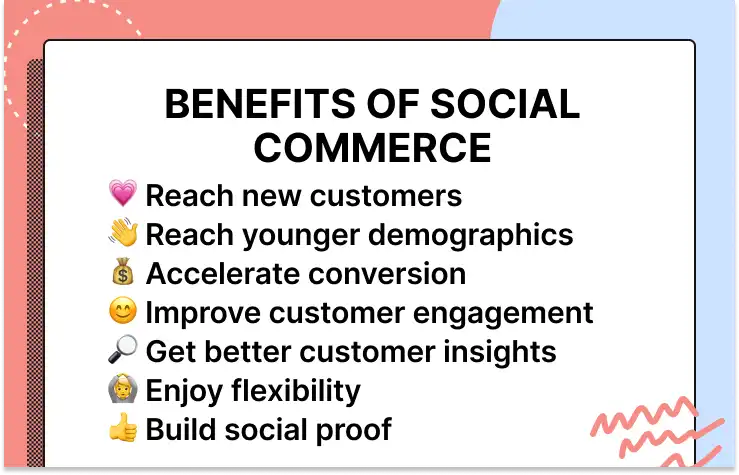
Social commerce is a huge opportunity for your business and here’s why:
- Reach new customers: As we said, over half the world’s population uses social media — these platforms are an opportunity for new customers to discover your ecommerce business.
- Reach a younger demographic: More than half of U.S. shoppers aged 18 to 34 have made purchases via a social channel.
- Accelerate conversion: With social commerce, shoppers can now purchase products directly from social media platforms without navigating to the brand’s website — (and a faster buying process means higher conversion rate).
- Improve customer engagement: Social media makes it easy for customers to engage with your brand via comments, direct messaging, and mentions. In fact, Gorgias Ecom Lab research found that chat volume between brands and customers grew 47% over two years — with most of that growth coming at the expense of social DMs, which dropped 30%.
- Get better customer insights: Every social media platform collects and shares metrics with you, such as impressions, engagement, and reach.
- Enjoy flexibility: Social media platforms allow you to experiment with A/B tests, hashtags, and captions to optimize your social media strategy.
- Build social proof: According to Matter Communications, 61% of buyers are more likely to trust a recommendation from a friend, family member, or influencers on social media.
📚 Read more:
The most popular social commerce platforms (and how to get started on each)
We mentioned above that there are plenty of social media platforms that allow for social commerce. While we don’t recommend trying to focus on all of them at once, it's certainly nice to know your options.
With that in mind, below are some of the most popular social commerce platforms for businesses of all sizes with examples of social commerce for each.
1) Instagram
Instagram is an image-centric social media platform that boasts 1.39 billion active users. A staggering 31.7% of Instagram users are 25-34 years old, making it one of the most popular platforms for millennials.
It’s also a powerful shopping tool. According to Instagram, half its users have used the platform to discover new brands, products, or services and 44% use it to shop every week.
How to sell on Instagram
To get started with social commerce on Instagram, create a business account and then upload your product catalog into the Facebook Commerce Manager. You can do this either manually or by connecting to your ecommerce platform.
From there, you’ll unlock the ability to enable checkout on Instagram and to tag products in your posts and stories the way you’d tag another user.
Plus, other users can tag your products, too. If you’re engaged in influencer marketing, for example, the influencers you work with can tag your products for in-app shopping. This way, even user-generated content is a gateway to sales.
Here’s a few ways to use those tags for social commerce on Instagram.
{{lead-magnet-1}}
Shoppable posts
Once your catalog is active, you can start tagging your products in posts to your Instagram feed. This allows customers to see a product and immediately click to purchase it.
Here’s an example from beauty brand Glossier. They posted a display of several products, and each has a tag to click through and purchase each one.

Shoppable stories
Those tags also work in posts to Instagram stories. When posting a product shot, you can add a tag that links directly to that product in your catalog. Again, that means customers are only a click away from conversion.
Here, the Mom Store, based in New Zealand, tagged the dress featured on the model. Also notice that at the bottom of the screen there’s a “view shop” button so customers can click to browse your entire catalog.

Shop tab
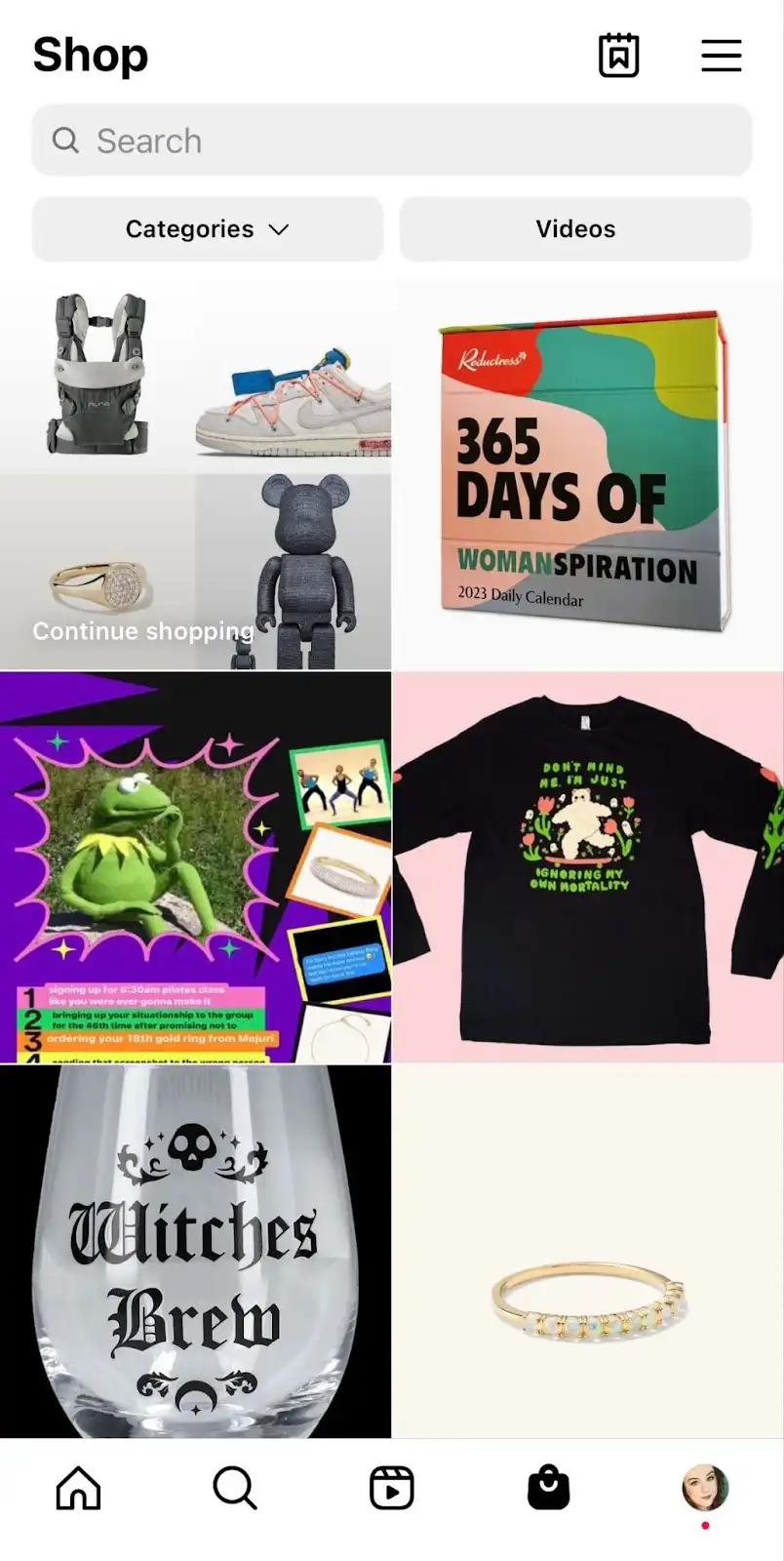
Uploading a catalog means the chance to get featured in the shop tab. You can see this tab anytime when you open the app — it’s the shopping bag icon in the bottom row of icons.
Like your main Instagram feed, the shop tab is controlled by an algorithm so the products displayed are unique to each user based on what Instagram thinks they’re interested in. That also means you can’t directly control if your products will be displayed or not.
If a user follows you or has interacted with your posts and stories, it’s more likely that your products will be displayed here. As well, Instagram curates the first listing as a “continue shopping” collection that contains products a user has previously viewed.
This functionality also comes with a built-in search engine to browse catalogs for products, creating a social commerce market akin to Amazon.
Here’s an example of how a shop tab looks.
2) Facebook
With 2.93 billion monthly active users, Facebook remains the largest social media platform in the world. Nearly 54% of Facebook users are aged 35 or older, making this social media platform geared toward a slightly older audience than other platforms.
How to sell on Facebook
With Facebook Shops, retailers can create a fully customizable storefront on Facebook and import a product catalog from their existing ecommerce site. Because Facebook owns Instagram, it’s the same Commerce Manager used for both.
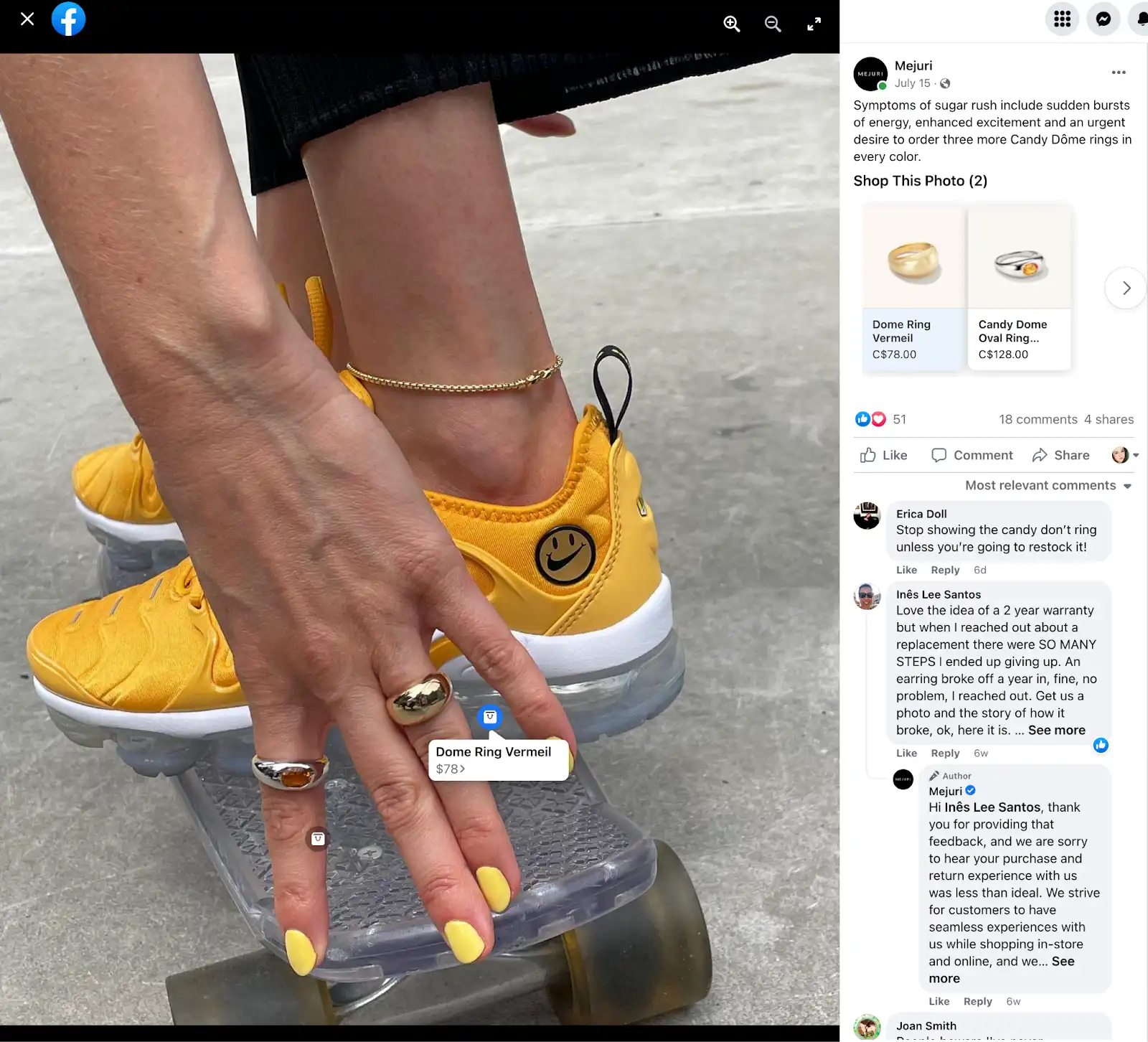
Similar to Instagram, once your catalog is uploaded you can include shoppable tags in posts to your brand’s Facebook page. Here’s an example from Mejuri.
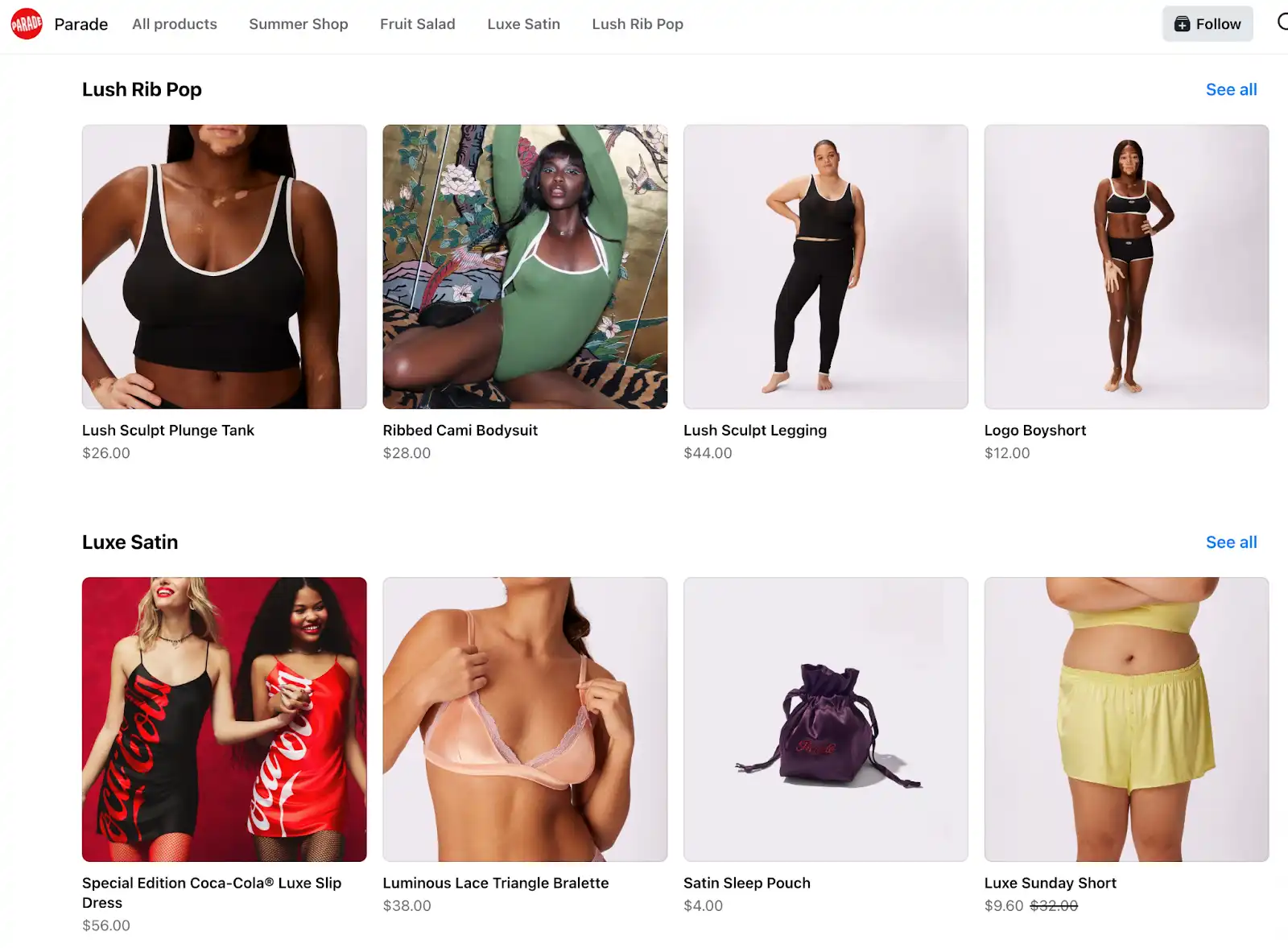
As well, uploading your catalog creates a “view shop” button at the top of your page, which you can see here on Parade’s Facebook page.

When clicked, users can browse all your products and click to buy, either directly on Facebook or by being taken to the exact product page on your ecommerce website by a “shop now” button.
3) TikTok
TikTok is one of the newer social media platforms, but it's also one that has exploded in popularity, boasting 1 billion monthly active users as of 2021. As well, 80% of TikTok users are aged 16-34, making TikTok a great platform for reaching millennial and Gen-Z customers.
In 2021 TikTok unveiled TikTok Shopping — a social commerce feature that allows brands to create a shop tab on their profile and import their product catalog so that users can purchase products within the app.
The downside is that the rollout has been slow and limited to certain countries. So far, users in the UK and some countries in Asia such as Singapore, Thailand, Vietnam, Malaysia, and the Philippines have full access. Rollout began to US brands in 2022.
How to sell on TikTok
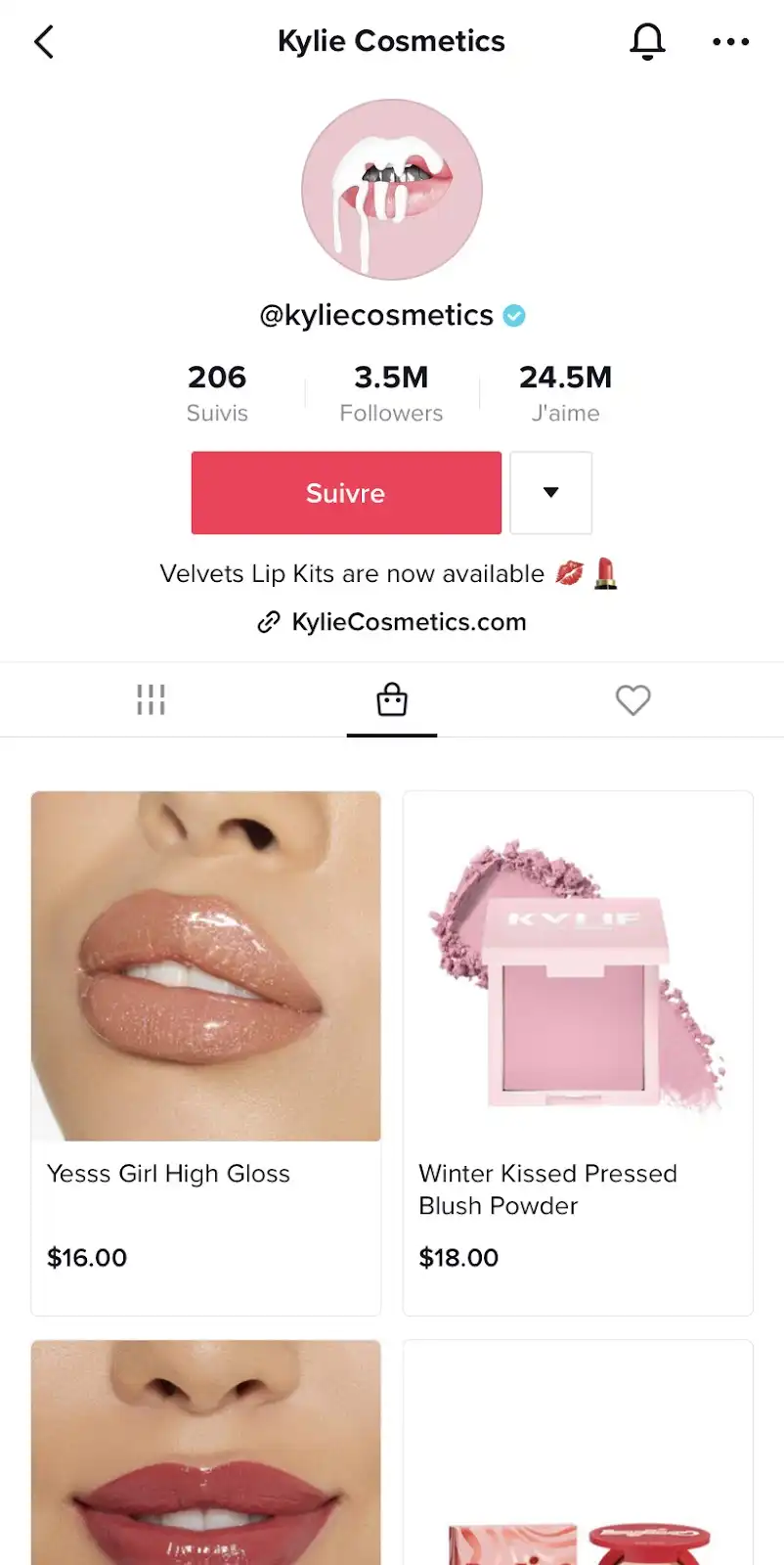
When active, TikTok Shopping creates a shop tab on your user profile, allowing you to display your catalog of products and the ability for your followers to shop directly on the app.
Here’s an example of the shop tab from Kylie Cosmetics:
4) Pinterest
As of 2022, Pinterest had 433 million worldwide monthly active users, with users aged 25-34 accounting for 37.4% of this total.
Pinterest is unique in that it has been used as a shopping inspiration tool for a long time, so the transition to social commerce doesn’t seem too far fetched. In fact, 80% of Pinterest users report that they have discovered a new product or brand on the platform.
How to sell on Pinterest
While Pinterest doesn't offer the same degree of social commerce features as many platforms, Pinterest does allow retailers users to create product pins and catalogs that direct to their ecommerce site's checkout page.
To do this, you’ll need to convert to a business account on Pinterest. From there, you’ll connect your ecommerce site and gain the ability to tag products. Pinterest has full instructions here.
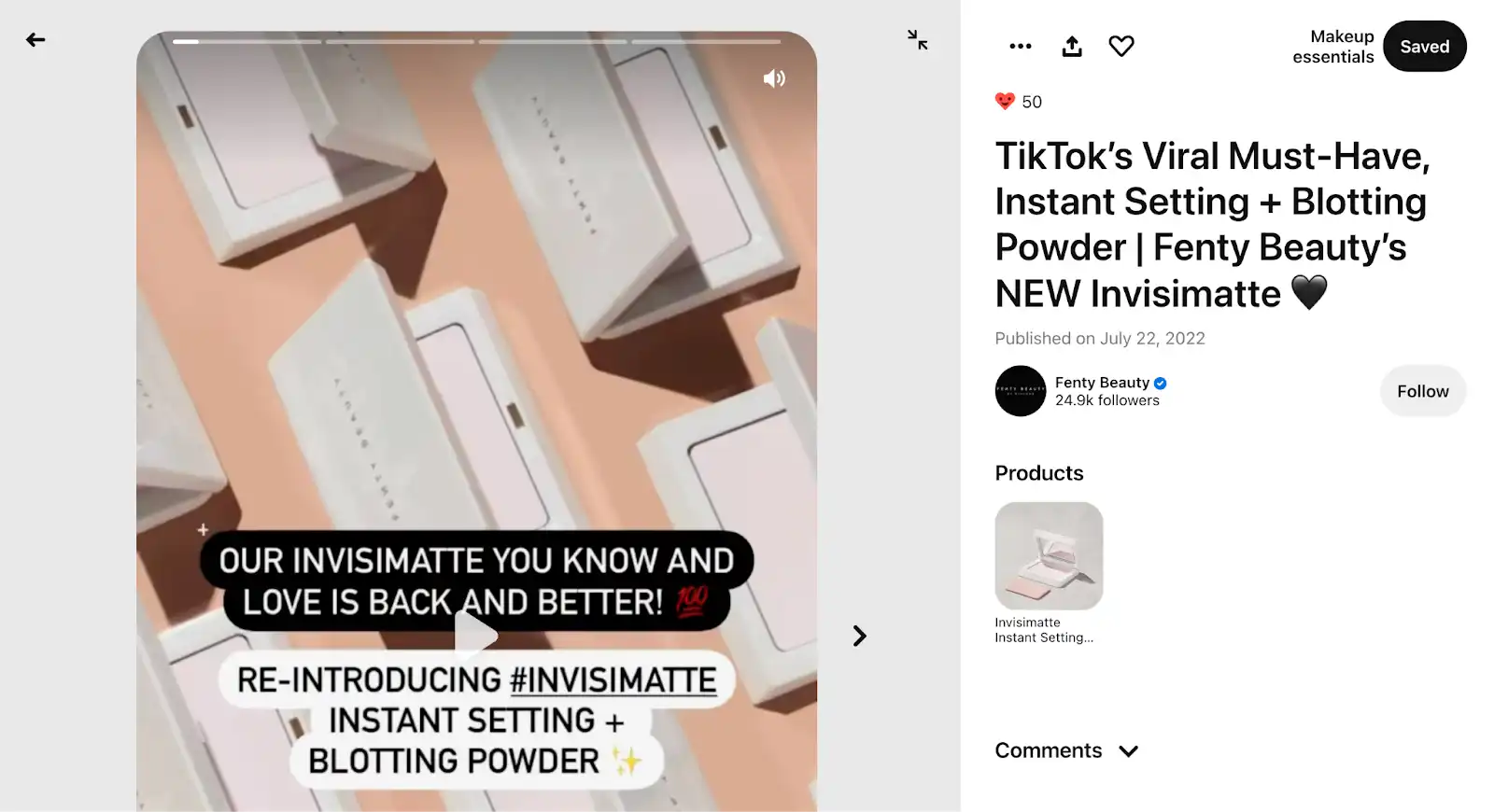
Here’s an example from beauty brand Fenty of a pin that showcases a product. You can see on the right side that their setting power is a featured product, and from that button users can be directed to the product page on Fenty’s website to purchase.
5) Snapchat
One part messaging tool and one part social media platform, Snapchat has a little over 464 million monthly active users, and 39.6% of Snapchat users fall into the 18-24 age range.
Snapchat allows business accounts to create a Snapchat shop where users can purchase products directly within the app, similar to Instagram and Facebook.
How to sell on Snapchat
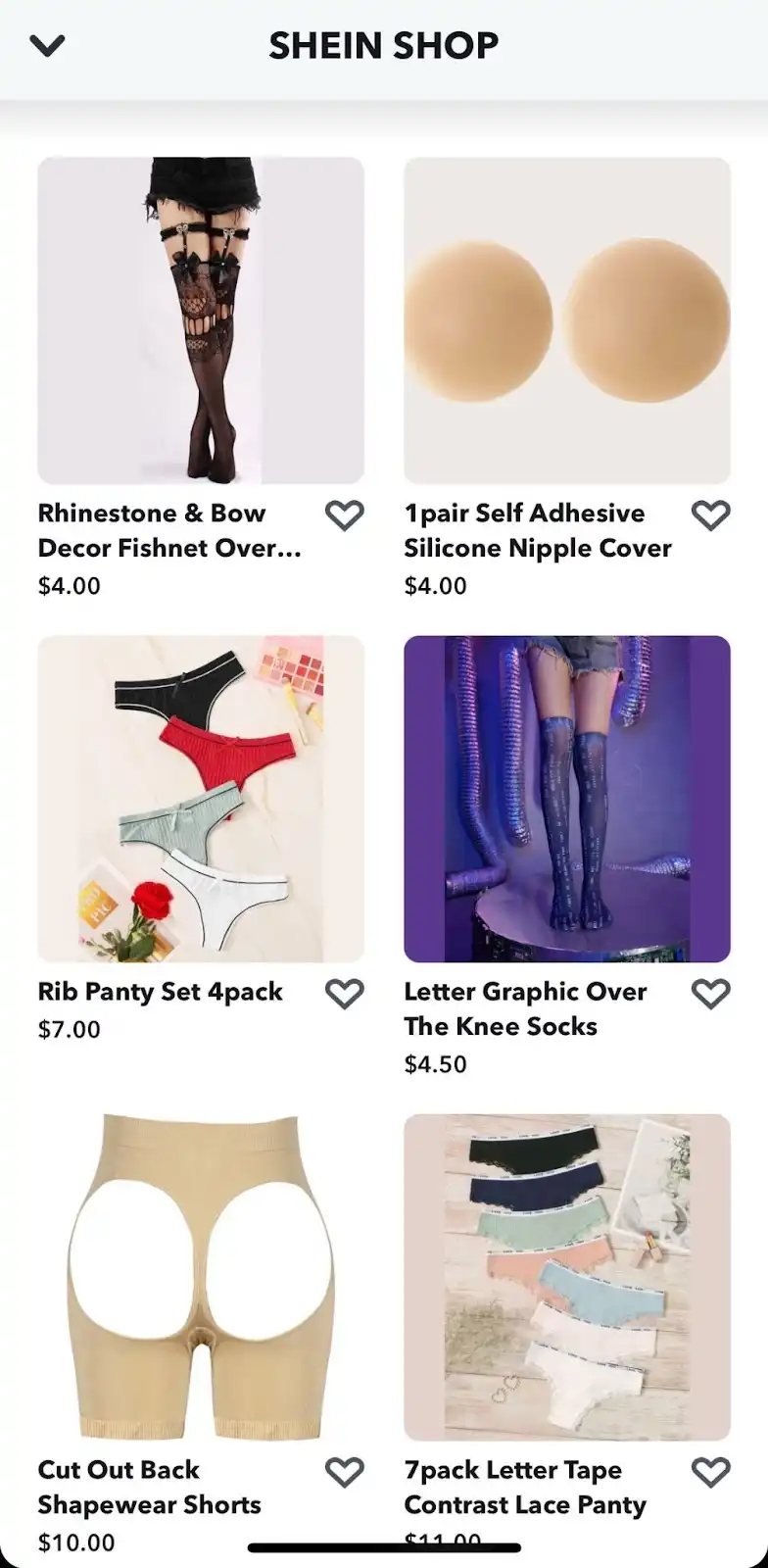
Here’s a story from Shein, for example. As you can see this story includes a “shop” button at the bottom.

From there, users can see Shein’s catalog and shop directly on the app with buy buttons.
The most innovative social commerce feature that Snapchat has unveiled is augmented reality (AR) shopping — a feature that allows users to "try on" products using an AR filter. This requires technical expertise and you can read more about getting started here.
6) YouTube
Many might not think of YouTube as a social media platform, but it meets all the criteria. With 2.6 billion monthly active users, YouTube is second only to Facebook in terms of audience size.
The average age of YouTube users is in the mid-20s, but the platform is popular among older demographics as well — 51% of U.S. adults 75 years and older use YouTube regularly.
How to sell on YouTube
Recently, YouTube has unveiled a variety of social commerce features and partnerships, including product tags and livestream shopping. In particular, Shopify announced an integration in 2022 that connects your product catalog to YouTube.
You can find more information about how to get started here.
How to get started with social commerce
If your business doesn’t already have a social media presence, the thought of building profiles from scratch may seem daunting. However, the process is fairly straightforward — although it does require some time and patience. We’ll break it down into four steps:
1) Choose your platform(s)
First, create profiles on the social media platforms you wish to leverage. There are several high-traffic, mainstream platforms to choose from, but if you’re new to social media, you’re better off choosing one or two to start with.

Focus your efforts on just a couple of platforms rather than trying to cover all your bases at once.
2) Grow your audience
Once you choose the platforms you want to start with, you need to build your audience.
It's much easier to generate sales when your content reaches thousands of users versus a few dozen, so focus on building an audience of engaged followers before you worry about how to generate social commerce sales.
3) Set up shop
Next, you need to set up your social commerce shops. This process varies from platform to platform.
Instagram, for instance, allows you to create an Instagram shopping feed with shoppable posts. These allow customers to browse images of your products and purchase them with a single click.
Facebook, meanwhile, offers a feature called Facebook Shops where you can create a storefront optimized for mobile devices. Facebook Shops also connects your store with WhatsApp and Facebook Messenger for streamlined customer support.
4) Start marketing and selling
The final step is to start marketing and selling your products using proven social media marketing practices and leveraging provided metrics to fine-tune your approach.
By staying on top of social commerce trends and experimenting with new marketing, sales, and customer support tactics, you can turn your brand's social media profiles into profit-generating storefronts.
📚 Recommended reading: Our ultimate guide to providing loyalty-building customer support on social media.
Tips for optimizing your social media strategy for ecommerce
While the exact social commerce tools and features that you will have available will vary between platforms, there are a number of tips for optimizing your social commerce strategy that apply regardless of which platform you choose.
If you want to start generating more sales directly on social media, here are the top strategies to employ:
Build a strong online community
Your first goal on any social media platform is to build followers. If you can build a large audience of engaged followers, other elements of your social commerce strategy will come easier.
Growing your audience should be your primary focus before you even begin to start importing products and setting up your shop. But keep in mind that size alone is not the only factor that defines a valuable social media following.
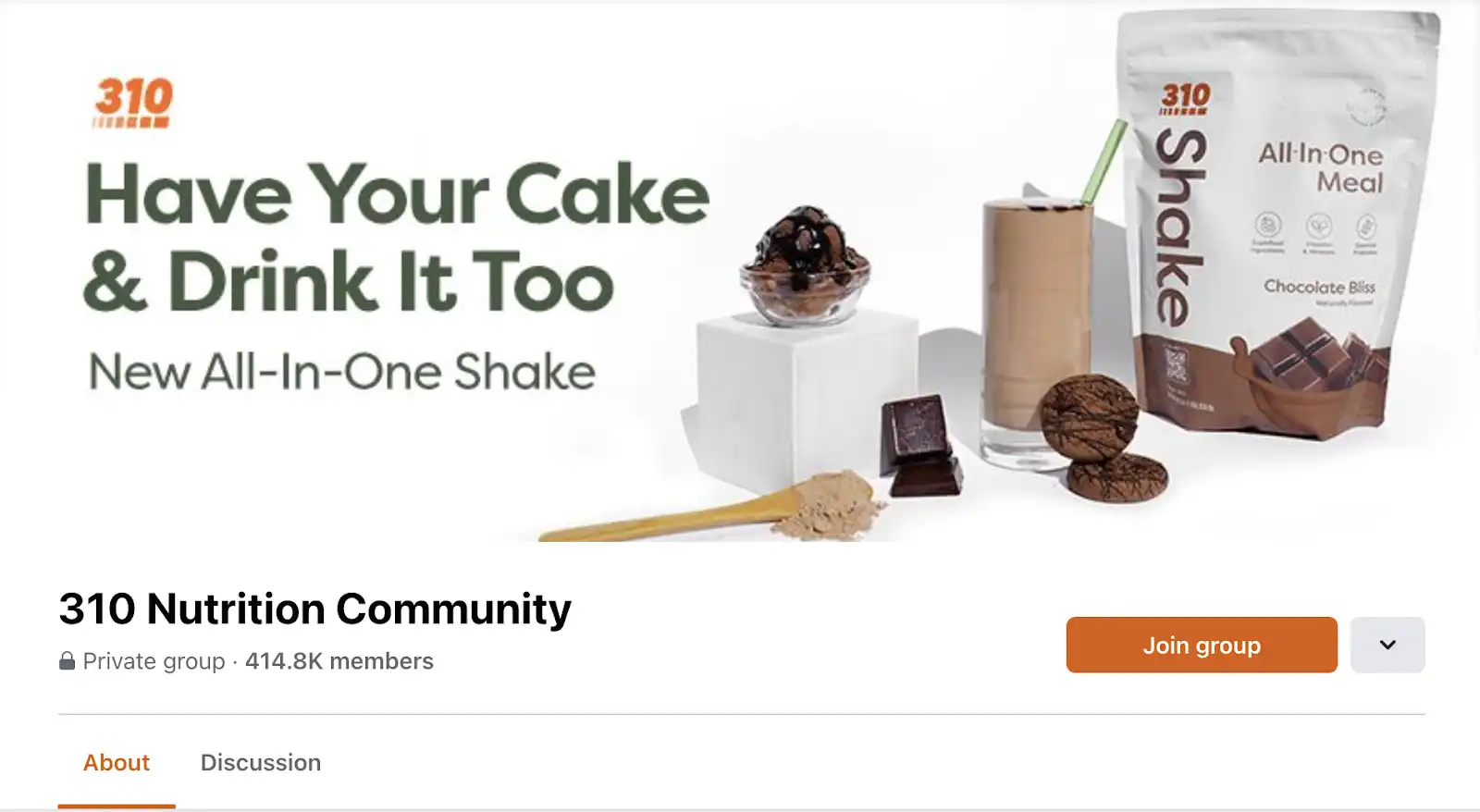
Take a look at 310 Nutrition’s online community, which shares recipes, nutrition advice, and more:
Engagement is highly important as well, and it’s essential to ensure that you provide your audience with engaging, informative, and entertaining content to keep them coming back for more.
When starting out, an organic social media marketing strategy is the best way to build followers. Post about your products, your sales, and find your brand’s voice. Engagement can be built by following other accounts, interacting with users in comments, and posting consistently.
📚Recommended reading: Our guide to ecommerce customer community management.
Measure feedback
Most social media platforms provide plenty of tools for gauging your audience's response to your content in real-time — and you want to take advantage of these tools.
Measuring audience feedback allows you to pinpoint the type of content that your followers respond to best so that you can develop a social media strategy that is optimized for both engagement and sales.
Create a set of KPIs, or goals, for yourself to measure performance. Follow metrics week over week, looking at:
- Follower count
- Comments
- Like or favorites
- Shares
While each platform has their own tools to measure these figures, a tool like Hootsuite combines them all into one place for easy viewing.
📚 Recommended reading:
- 25 Customer Support Metrics To Measure Your Team’s Impact & How to Calculate
- Evaluating Your Customer Service Program: Why, Challenges, and KPIs That Matter
Talk directly with your customers
Your social media accounts should also be a place where you directly interact with your customers. Think of it as a vital channel for customer service and another way to create excellent customer experiences.
First, engage with comments. It’s not uncommon for customers, or potential customers, to ask questions or raise issues in your comments. Responding to a question here could mean the difference between a sale and an abandoned cart.
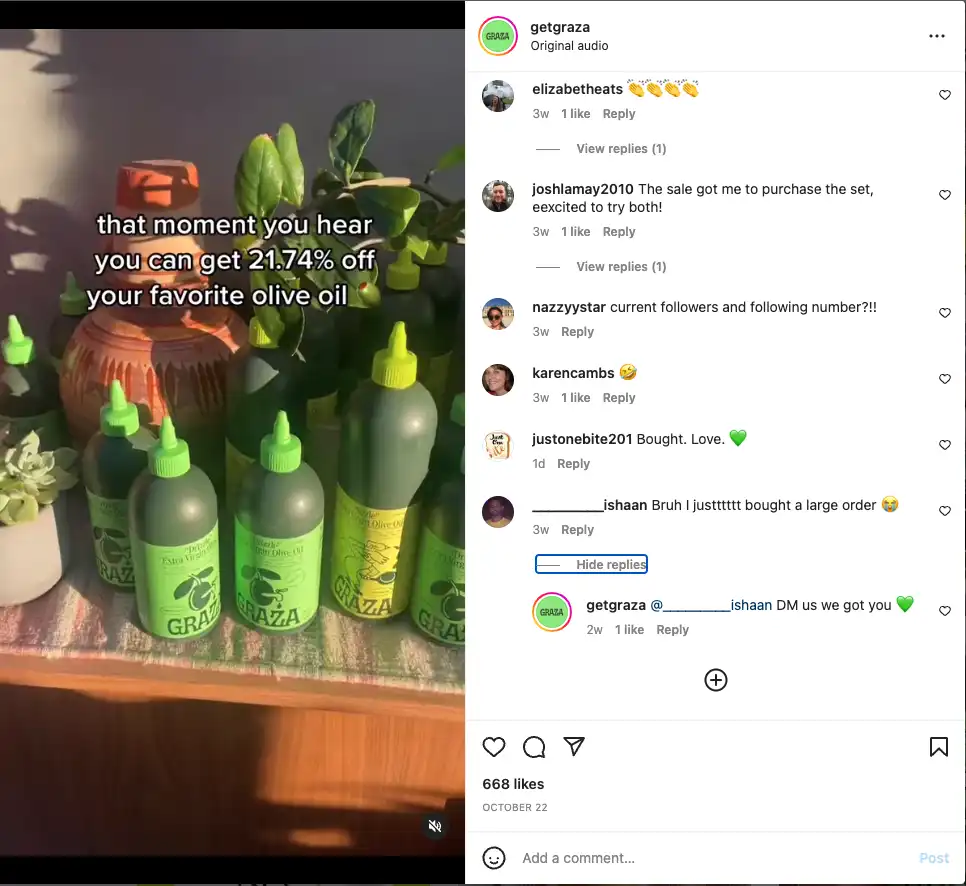
Second, your direct messages should be open and monitored on all platforms. Customers will inevitably write in with questions or concerns instead of using a support email address and they’ll expect help.
A helpdesk like Gorgias streamlines this by pulling messages and comments on platforms like Facebook, Facebook Messenger, Instagram, and WhatsApp right into the helpdesk, so you don’t have to check each platform individually. That means you don’t have to spend all day switching tabs.
Additionally, the Gorgias helpdesk integrates customer information like past purchases and allows you to quickly send product links, customizing every interaction to that unique customer.
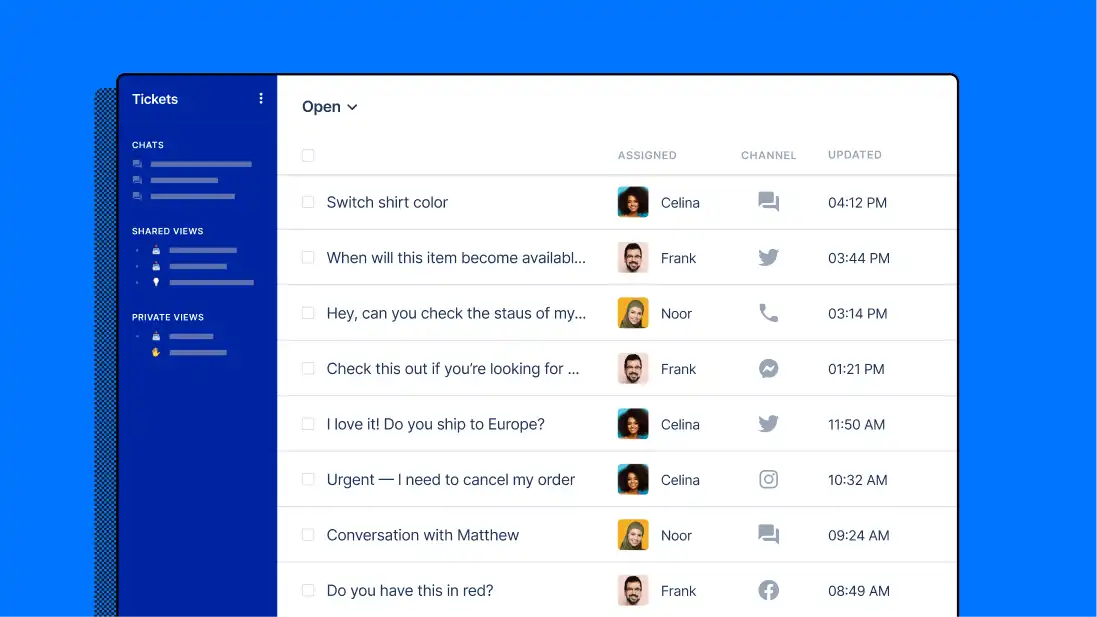
Using this integration, Gorgias helps you respond quickly, build relationships, and provide pre-sales support to convert new customers. (Note: Gorgias no longer support Twitter interactions.)
📚 Read more:
- Social Media Customer Service: How-To Guide & Useful Tools
- How to Track and Monitor Social Mentions
- 9 Tips to Improve Customer Service on Instagram
Integrate social sharing buttons into your website
Directing social media followers to your ecommerce site is one great way to leverage social media marketing, but the reverse is true as well.
Integrating social sharing buttons into your website enables those who discover products on your website to share their discoveries with their social media followers, further growing your brand awareness and expanding its reach.
📚 Recommended reading: Our guide to ecommerce conversion rate optimization (CRO).
Schedule your posts and post at the peak times
It's easy to understand how a post published at 3 a.m. (when the majority of your audience is sound asleep) probably won’t get the same engagement as a post published at 7 p.m.
According to data from HubSpot, the afternoon hours are the peak times for social media posts, with most platforms experiencing peak traffic between 6-9 p.m. HubSpot also found Saturday is the best day of the week to publish social posts, while Monday is the worst.
The future of social commerce
We are already seeing glimpses of what the future holds for social commerce. Customers enjoy the purchase process of being able to browse products, make a purchase decision, contact customer support, and more directly within their favorite social media apps.
Augmented reality (AR) and virtual reality (VR) are both poised to play a major role in the future of social commerce as well. Snapchat's AR filters for shopping is one example of what this might look like, but the possibilities are endless.
Meta, the parent company of Instagram and Facebook, also unveiled their plans for the VR-powered “metaverse.” In the metaverse, social media users can interact with one another, play games, and shop for products within a virtual world.
But you should also know that these social commerce features are controlled by the whims of these platforms and changes are ongoing. Some are even stepping away from social commerce as it exists today.
For example, Instagram has experimented with removing the shop tab for some users, hiding it in the settings menu. Platforms are also rethinking what social commerce looks like after the pandemic online shopping boom.
Keeping up to date on industry news and changes will help you adapt your social commerce strategy as platforms change their tech offerings.
📚 Read more: Our list of the best Shopify apps for social media
{{lead-magnet-2}}
Use Gorgias to take your social commerce strategy to the next level
If you’re looking for tools to provide your social media shoppers with seamless customer support, Gorgias can help. With Gorgias, you can effortlessly turn your social media profiles into customer support channels to facilitate sales and boost retention.
Best of all, Gorgias compiles all of your social media messages and mentions into one user-friendly dashboard, making it easy to manage multiple accounts from a single location.
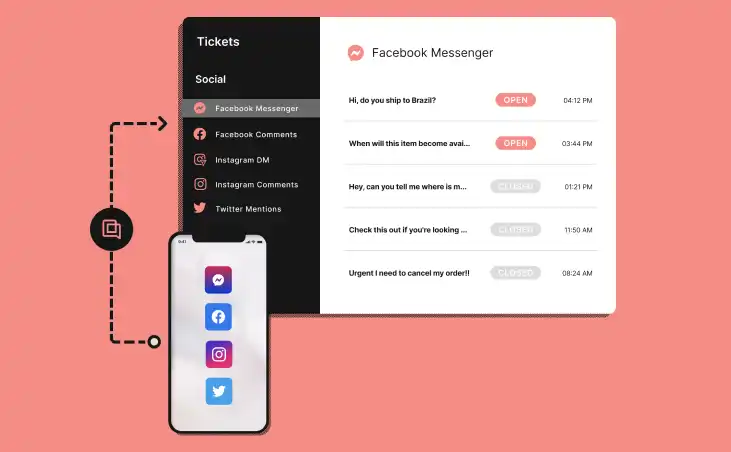
To learn more about how Gorgias empowers a seamless social commerce experience, check out our article on more ways to use social media to grow your store.
FAQs
In comparison to ecommerce, social commerce lets users buy products directly on social media platforms instead of using a company's website. The top advantages of social commerce are convenience and speed since products are easily accessible to users who already frequent social media platforms.
Generally, the best time to post on social media is from morning to afternoon. This timeframe accounts for when users are most active. However, keep in mind that your customer base may differ, depending on their locations and behaviors.
No, it’s free to create a business or professional account on Instagram and Facebook. You may create a new account or switch your regular account to a business account.
Yes. Gorgias integrates with Facebook, Instagram, and Instagram Ads which allows you to view and reply to comments and direct messages. In addition to social media channels, you can view support performance analytics to monitor how efficiently agents are resolving social media tickets.


Recommended Articles


Customer Service Messaging: Tips and Templates for SMS + Conversational Channels
Customer service messaging (also known as conversational customer service) is a powerful way to elevate the customer experience and delight customers beyond their expectations. For customers, texting with a support agent feels much more convenient and casual than slower channels like email. And, SMS is a much better channel for “on-the-go” communication, since most people always have their mobile phones and can usually reply to text messages quickly.
That’s why customer service messaging is one of many recent customer service trends shaking up how ecommerce and D2C businesses offer support.
In this guide, we’ll discuss how your business can implement or improve this type of customer support and other conversational channels in your customer service strategy.
Let’s get started with why it’s important for businesses to offer SMS customer service.
What is SMS customer service?
SMS customer service is when support teams resolve customer questions and issues via text message.
Why SMS text messaging improves the customer service experience
Customers love these one-to-one messaging channels for customer service because they’re so quick and convenient. When implemented well, conversational messaging allows customers to reach your CS team and get answers quickly — within 42 seconds, most of the time. Especially considering that 42% of customers prefer communicating with customer service on messaging apps over any other channel, introducing a conversational channel may do wonders for your brand’s customer satisfaction.
Your customer support team can also use these channels to proactively reach out to customers with important updates and timely discounts.
SMS customer service is especially attractive to your customers because they don’t have to stay glued to your website or check a social media app for new DMs. They can get answers to their questions on a device they already check 96 times per day. Let’s take a closer look at SMS, a channel that’s quickly gaining ground as a standard support option.

10 tips to successfully incorporate messaging into your customer service strategy
Adding each messaging channel at one time might overwhelm your customer support team. Likewise, a new channel may have low adoption if you don’t announce it to your customers. As you begin offering messaging experiences as a part of your customer care portfolio, use our top 10 techniques to maximize the effectiveness of your workflows on those channels.
1) Funnel all interactions to SMS or messaging channels and then move to email or phone if needed
For issues with easy solutions, there’s no reason for customers to engage with email or phone. Emails are slow and clunky and phone calls can lead to customer frustrations, especially if your wait times are excessive. Texts are far faster than either option and can provide simple, accurate information that leads to speedier solutions — and happier customers.
For that reason, we recommend setting up your contact page and information so that text and other live channels are your first line of communication — well, after self-service support. You can always move to email or phone if the customer requests it or if the problem you’re trying to solve is better suited to one of those channels.
Tip: Speed is an important factor in all customer service interactions, but it’s critical when sending any sort of instant message. First response time (FRT) is a key customer service metric you can measure with Gorgias through the analytics dashboard. Make sure to track the speed of your responses when you start your support messaging program.

2) Consistently let your customers know that you’re available on quick messaging channels
To inform your customers they can now text your brand, we recommend adding “Text us,” plus your phone number, in some or all of these places:
- The footer of your website
- The “Contact Us” page of your website
- Your Gorgias Help Center
- Transactional emails (order confirmation, return initiated, etc.)
- The signature of your support agents
You can put your messaging app information in the same spots, and make sure to say you accept support requests via DM in your social media bios so customers know they can shoot you a message.
Tip: Because conversational customer service usually takes place on a user’s phone, you need to keep responses short and friendly. The long, detailed macros and templates you might use for emails won’t work when communicating through short messages — depending on your platform and your customer’s phone, long messages might not send or might get broken into multiple text messages. Plus, depending on your brand’s tone of voice, conversational channels are a great place to use emojis, images, and GIFs to make the conversation even more friendly and casual.

3) Use autoresponders for a lightning-fast first response
Start every messaging interaction with an autoresponder. This tactic lets your customer know that you received their request, and it gives your human agents a small buffer of time to finish up their current encounter before starting the new one. You can also include a link to your help center in case they want to look for their answer on their own.
You can use this tactic whether you’re incorporating chatbots for basic query automation, or using your customer service agents for all customer interactions.
See page XX for an example of an autoresponder Rule for messaging.
4) Create a system to categorize and segment priority tickets
Some customer support tickets should take higher priority than others. A customer that’s reporting a fraudulent purchase with their debit card needs a quicker response than someone who’s asking if there are any discounts they can use.
You can start by prioritizing:
- Tickets that have been open the longest. These are the customers who may be growing impatient, or even angry enough not to shop or work with your business again. This can be set up with a View of tickets that have been open for more than X minutes, where X is an amount of time corresponding to your service-level agreement (SLA).
- Tickets from VIPs and loyal customers. You can tag these customers and make a View based on that tag to surface their questions and concerns.
- Tickets that fall into certain intents, like “order/damaged,” which Gorgias auto-assigns through our proprietary algorithms. You can auto-assign these tickets with a “priority” tag using a simple automation Rule and set up a View that has all open priority tickets.

You can even set up dual priority queues for all priority-tagged tickets: One for priority tickets that are about to go past the first response time in your SLA and another for all other priority tickets. Then prioritize the former, followed by the latter, followed by other tickets, to keep your first response time and resolution time down while giving attention to important tickets.
Beyond prioritizing tickets, it’s also helpful to categorize them if they share similarities. Grouping similar tickets together boosts efficiency. For example, your team can come up with one main solution (create a new discount code because the previous one is buggy) and easily resolve the entire group of tickets in a single pass.
5) Use Macro templates to respond faster to repetitive requests…
If you are responding to customer service messages on a platform like Gorgias that supports Macro templates, you need to take advantage of this time-saving feature. But you can’t just take your existing email templates and drop them into these conversations.
You need to create a specific set of Macros for messaging purposes, using the principles we mentioned earlier: short, friendly, personalized, etc. That means you need to use variables like [Customer first name] or [Last order number] to personalize messages. If you set up your Macros strategically for DM and SMS messaging, many can be reused for live chat, as well.
To prioritize building Macros that will have the highest impact, create Macro templates to respond to the most common questions that have come through your helpdesk. You can also ask your team which responses they end up writing out the most and add those templates too.
Once you create and launch these Macros, you can automatically add Tags to Macros for reporting to see which Macros are being used the most. This will help you understand where you have gaps (or unhelpful Macros) and can make tweaks to improve your agent workflow and customer experience.
6) …Or deflect those repetitive requests altogether with automation Rules
If your customer service platform supports automation, as Gorgias does through our Automation Add-on, you can deflect up to a third of repetitive, tedious tickets instantly, with no human interaction. Much of this automation can be applied to customer service messaging, as well.
When we mention automated answers, some support professionals say something like, “We don’t want to send low-quality automated responses to our customers.” We completely agree: For many tickets, automation doesn’t provide the best customer experience.
However, as you know, most tickets your support team receives are repetitive and low-impact, like questions about order status (WISMO) or your refund policy. We recommend setting up automatic responses for these tickets, so customers get instant answers and agents have more time to respond to tickets that actually need a human touch.
Look through your reporting dashboards to see the tickets that are taking up the most time on your support team, and prioritize those requests for automation with Rules, where appropriate.

7) Go beyond text-only interactions with multimedia messaging
WhatsApp Business, Facebook Messenger, and SMS support images, and luckily so does Gorgias. This is a more engaging way to interact with customers, and it also allows you to exchange relevant images like broken parts, malfunctioning equipment, and screenshots for more helpful instructions.
If you want to go this route, maintain a catalog of fun, topical images that your support team can use in their customer conversations, and give them the freedom to collect their own images to insert. It’s a great way to make your support feel more personal and human, but use common sense: Frustrated customers don’t want to receive a picture or meme, they want their problem solved as quickly as possible.

8) Provide proactive support at scale on platforms that allow it
SMS and other personalized one-to-one support channels can get a little complicated because not everyone wants to interact on the same messaging application. True SMS support goes out over cellular networks and lands in users’ actual text messages, the same way messages from their friends and family do.
But you may need to be ready to handle other support channels that use similar short, text-based communication. These include Facebook Messenger, WhatsApp, and your website’s web chat. Certain channels may be a better fit for your unique customer base — for example, Instagram attracts a younger audience than Facebook Messenger, and WhatsApp is more common outside the US. Likewise, you may have other specialized messaging channels or messaging platforms that you need to support.

As a rule of thumb, you need to be where most of your customers are, which varies across businesses and industries. But to reach the desired level of customer engagement, most businesses need to be reachable via most, if not all, the major applications and support channels.
That’s where a unified customer service platform can be really useful. By keeping all of your customer conversations in one feed, you can handle more channels more strategically, through triage and routing to dedicated agents for specific tasks. For example, you could have one agent who just handles messaging and route all messages to that person for a quicker response.
On platforms like WhatsApp Business, you don’t have to wait around to hear from customers. This allows for a wide range of strategic and proactive support interactions.
For example, you can send out text blasts:
- When you have an issue affecting all customers (i.e. website downtime) to let them know what’s going on (and avoid getting excessive tickets about the issue)
- When you have new product launches or add-ons, driving revenue and customer education
- When you have relevant announcements for customers: limit these to news that actually affects customers (i.e. shutting down your community or a time-sensitive sale), not company news (i.e. your latest fundraising)
A proactive approach builds trust with your audience — they will see you going above and beyond with these efforts, and know that you’ll be upfront with potential issues.
9) Integrate your SMS support with your marketing efforts
SMS marketing is a useful tool for your ecommerce store, but it becomes even more powerful when you integrate your SMS marketing tool into Gorgias. Send out SMS blasts and have support agents on hand to handle any questions you get in response, to help nudge those customers closer to a sale.

With certain integrations — Klaviyo, for example — you can even use Gorgias attributes to segment and build campaigns. Use this function for win-back campaigns, or to send a special offer to customers who posted low CSAT scores.
10) Conduct surveys using text messages to collect feedback from customers
Text messages are an effective method for collecting feedback from existing customers, too. Once customers opt in to SMS communication, you can use this point of contact to launch quick surveys that provide valuable feedback.
Response rate is always an issue with email surveys, and other channels see higher response rates. Using a multichannel approach will supply you with more responses and help you make more data-driven decisions with the results.
Note: In a customer service tool like Gorgias, you would use one of our integrations with Klaviyo or Attentive to send the survey to entire segmented lists of customers or prospects, all at once.
SMS customer service templates for common response types
Ready to start implementing an SMS customer service strategy but not sure what to say? We get it: Staying concise yet friendly is tough, and so is conveying all the needed information in such a short space.
We’ve put together a collection of proven templates you can start using today. Adapt as many of these as you need to fit the contours of your business, and bring them into your customer service platform of choice. In Gorgias, you could auto-populate these responses through our Macros.
Note: We’re sharing these templates as text messages, but they can easily be adapted to other conversational channels like social media DMs and live chat.
Ticket received template
As we mentioned earlier, it’s a good idea to set up an autoresponder. This tactic can buy your team time to finish up a previous interaction or send an email, yet it shows you’re on top of the interaction and will be back soon.
Here’s our template for a ticket received autoresponder:
Thanks for texting {Brand Name}. An agent is reviewing your question now. We’ll get back to you shortly :)
Introduction message template
The introduction message is the point where your autoresponder or chatbot passes off the reins to a human agent. It’s the first point of personalization, and you want to make a solid impression. Still, your agents don’t need to be typing these out every single time. Use a template like this one to break the ice (just with a little less repetitive stress injury):
Hello, {Customer First Name} {Customer Last Name}! I’m {Your Name} from {Brand Name}. Thanks for messaging us. What can I help you with today?

Hours of operation template
There are two frequent scenarios where an hours-of-operations text makes sense. One is as an answer for when customers message you on social media or elsewhere just to ask when you’re open. In those cases, use this template:
Hello, {Customer First Name}! I’m {Your Name} from {Brand Name}. Our hours of operation are Monday through Friday, 9 a.m. to 8 p.m. Best, {Your Name}
The other scenario is when a customer reaches out via a messaging channel and there’s no one on the other end. If your helpdesk isn’t open 24 hours a day, use a template like this when the team isn’t live:
Hello, {Customer First Name}! Our live chat helpdesk is open {list hours}. You’ve reached us outside those hours. Leave a short message here and we’ll get back to you tomorrow.
By the way, if around-the-clock coverage is a goal of yours, you might be interested in introducing contact forms into your live chat widget. These forms let you keep your live chat on 24/7 and, when nobody’s available to answer, they ask customers for contact information so you can be sure to follow up. Learn more about Gorgias’ automation add-on and contact forms.
Order status template
This one’s pretty obvious: You want to let the customer know the status of an order, and there’s no reason to manually type a whole message to do it.
Use this template when a customer asks for their order status. You can create variations of this one for delays or other order status updates, and even customize it further to include tracking information.
Hey {Customer First Name}, great news: Your order has shipped! It will arrive on {delivery date}. Let me know if I can help you with anything else!

Payment reminder template
Customers with recurring subscriptions sometimes forget the frequency they sign up for or when their next payment will be. Use this template if customers frequently ask your brand when their next payment is:
Hello, {Customer First Name} {Customer Last Name}! I’m {Your Name} from {Brand Name}. Your next payment of {amount} is coming up. Your card on file will be charged {due date}. Questions? Reply here or call {phone number}.
Pro tip: While there’s nothing inherently wrong with soliciting payment via SMS, many consumers will view this with suspicion. Text channels may not be the best avenue for inviting bill payments or collecting credit card information. It could also lead to more cancellations, which makes it a balancing act, though customer clarity is important to have. Always track the impact of changes to your process and be mindful of how new touchpoints could affect it.
Deals or rewards template
If you’re trying to build brand loyalty or win back an upset customer, sometimes a simple discount code can go a long way. At the end of an SMS conversation, there may be times when you can surprise and delight customers by sending over an exclusive deal. Here’s a template (though you’ll certainly need to customize this one further to fit the details of your offer):
{Customer First Name}, thanks for being such a loyal customer. We’d like to give you {details of the offer}! Click to redeem: {short URL}
Refund issued template
Refunds happen, and they don’t always require a massively complicated interaction with your contact center. If you’re able to resolve a ticket and issue a refund with a simpler interaction, this template can finish the one-to-one portion of the encounter.
Notice the template specifies that the interaction will finish up asynchronously (via email). It’s a great way to tie off the synchronous, real-time interaction and lead the customer right to the next step (check your email.)
Here’s the template:
Hey {Customer First Name}! We’ve issued a refund for your last order. We’ll send all the details to your email, but feel free to let me know here if you need anything else.

Pro tip: You can tie discounts and future order credits into this template, but make sure your entire team is aligned on your official policy as you update the Macros to match it. You may also want to have different tiers of intervention (and offerings) depending on the severity of the issue.
Customer check-in template
The customer check-in is another asynchronous message that occurs outside of an active conversation. Perhaps the customer walked away from a previous encounter or seems to be stuck on the customer journey based on other CRM data.
Whatever the reason, a gentle, well-timed message can sometimes get the customer back on track.
Here’s a model:
Hello, {Customer First Name} {Customer Last Name}! I’m {Your Name} from {Brand Name}. Just checking in to make sure everything is working well for you. If you have any issues with our {products/service} or need anything else, let me know!
Templates for SMS marketing and relevant integrations
Though a customer service platform can handle the above templates, you’ll likely want to expand even further through additional integrations with the platform. If you take that approach, here are some opportunities that open up:
Discount template
If you’re running a sale or trying to drive traffic to your site, a great way to do so is by texting a discount code to customers on your SMS list. Because their phone is probably close by, it’s great way to promote your sale and make sure it gets noticed. Here’s a template you can use (but remember to update with your own promotion!):
Flash sale, this weekend only! Up to 40% off, including our latest collection. Shop now: {insert URL}

Appointment reminder template
Medical offices and other organizations that schedule appointments or meetings can bolster attendance and reduce no-shows by providing yet another reminder — one that reaches patients and customers directly via phone.
If your SMS system supports it, you can invite an auto-reply to confirm or cancel an appointment, too. Use this template:
Hello, {Customer First Name} {Customer Last Name}! I’m {Your Name} from {Brand Name}. Your appointment is scheduled for tomorrow at {appointment time}. See you then! Reply Y to confirm, N to cancel.
Order confirmation template
Order confirmation messages simply confirm that your business has received and is processing a customer order. These don’t typically take place during an active one-to-one customer service interaction. Instead, they’re sent automatically and asynchronously, whenever the order confirms.
Still, you can set them up as personalized messages and enable replying so that, if something happens to be wrong, the customer knows how to reach out.
Hello, {Customer First Name} {Customer Last Name}! I’m {Your Name} from {Brand Name}. Your order #{order number} has been received, and we’re working on it now! We’ll message you again when it ships. Questions? Reply here.

Pickup notification template
If you’re in an industry that offers pickup services (whether curbside pickup, custom goods like eyeglasses, or anything else), a text message is a great way to let someone know their order is ready for pickup. SMS reaches customers when they’re on the go in a way that email frequently doesn’t.
Here’s an example:
Hello, {Customer First Name} {Customer Last Name}! I’m {Your Name} from {Brand Name}. Your recent order #{order number} is now available for pickup at {location}. Stop by to grab it anytime today before {closing time}!
Survey or poll template
This message asks your customers to respond to a survey or poll. It’s a data-gathering tool that can pull in responses from people who ignore your emails or the messages at the bottom of store receipts. Try a script like this:
Hello, {Customer First Name} {Customer Last Name}! I’m {Your Name} from {Brand Name}. We value your opinion as a customer and we’d love specific feedback on {topic}. Here’s a 5-minute survey: {short URL}
Membership renewals template
Membership renewals, like payments, ought to be set up as automatic occurrences. Still, it’s helpful to remind a customer that a charge will hit their bank account soon — you don’t want to track down non-payments, and you don’t want angry customers who weren’t prepared for a bill.
Here’s an example:
Hi, {Customer First Name} {Customer Last Name}! I’m {Your Name} from {Brand Name}. Your annual membership renewal is coming up on {date}. Your card on file will be charged on that day.
{{lead-magnet-1}}
Is conversational and SMS customer service right for your business?
At Gorgias, we believe any industry can find value in conversational support, though some industries and brands will get more bang for their buck with these channels.
For ecommerce brands that deliver physical products, conversational support is a no-brainer. Imagine your customers get shipping updates via SMS and can just respond to the message if the package isn’t delivered correctly to get immediate help. No need to open up a laptop and log into a support portal or compose an email.
If you’re on the fence about offering conversational customer support, consider whether any of these points are relevant for your business:
First, consider your primary audience. If you sell to millennials and Gen Z, conversational customer service deserves serious consideration. These groups value speed and convenience more than anything: Millennials prefer live chat over every other channel, and 71% of people between 16 and 24 agree that faster customer service would drastically improve the shopping experience.
These two generations grew up texting. It’s a very natural communication style for them, so they’ll feel right at home texting and DMing your brand. They’re also absolutely massive groups — combined, they make up a staggering 42.3% of the U.S. population.
If you’re targeting an older generation, texting may not feel as natural. They have a higher tendency to prefer email or phone, although that’s changing by the day.
Is your marketing team already sending SMS campaigns?
One of the biggest hurdles to implementing conversational support is getting the systems, hardware, and staff in place to respond to SMS texts and messaging app requests at scale. If you’re already sending SMS marketing campaigns, then you already have some of that infrastructure in place.
So, if you’ve already made the investment in SMS for marketing purposes, then integrating messaging with your customer service platform and team requires minimal additional investment.
Fortunately, your helpdesk and SMS marketing software may integrate to give you a centralized way to spark conversations if customers reach out via text or respond to SMS campaigns. With Gorgias and Klaviyo, for example, customer responses to SMS marketing campaigns get assigned directly to an agent for fast response times.

Are customers abandoning conversations on other channels?
One of the benefits of messaging is that customers don’t have to stay on the phone or by their computer — they can easily continue talking even if they have to take the dog out, go to work, or even fall asleep and respond in the morning. Plus, while email conversations often span multiple days which is frustrating for customers with simple requests, requests on messaging channels usually get resolved before customers lose interest or patience.
If you notice that your brand currently sees lots of unresolved email threads or phone calls, you might need to offer customers a more convenient and flexible channel to talk to your team. This is a perfect use case for SMS and other messaging channels.
Are you already active on related channels?
It’s important to show up where your customers are. That’s why most brands post and engage with customers on social media pages. But if you’re posting on social media and not providing support to customers who reach out via DM, you’re missing a big opportunity.
By adding conversational support via Facebook Messenger and Instagram and Twitter DMs, you can maximize your presence on those platforms and provide an omnichannel customer experience for both existing and prospective customers.
Are you struggling to gather customer feedback?
We often discuss the importance of customer feedback to monitor brand perception and constantly improve the product and customer experience. But as most brands know, getting feedback via email can be a challenge because of low survey open rates and lack of follow-up from customers.
Business texting lets you ask your customer base for feedback on a channel they are less likely to ignore. Text messages have a whopping 98% open rate. Consider sending CSAT, NPS surveys, and other requests for customer feedback on this channel to raise your response rate for more accurate customer support metrics. Of course, with great power comes great responsibility: Spamming customers will quickly damage customer relationships, so don’t send too many messages to their personal devices.
What to look for in text messaging tools
SMS customer service is an avenue that customers are growing to expect. But managing yet another communication channel — much less one that demands real-time responses — takes careful planning.
Implementing a messaging strategy requires using tools built for that purpose. Some customer service messaging platforms offer SMS support natively, while others integrate a third-party SMS integration tool to add this functionality.
As you consider the available options, make sure the one you choose offers the features you need. Some tools are full-fledged SMS marketing solutions. Others focus specifically on SMS as a support channel.
It’s easier for most businesses to use an all-in-one customer service platform like Gorgias to support an omnichannel approach. With this kind of helpdesk platform, SMS tickets can be handled in the same feed as your other tickets and benefit from the same workflows and automation.

Here are some other features your customer service tool needs to have to handle SMS ticket effectively:
- Conversation history (for SMS and other text-based channels like Facebook Messenger or webchat) so your agents know what this client has asked about or needed support for in the past
- Ability to create and customize macros as replies to SMS questions
- Ability to send and receive images or videos (this is great if your support teams need to see the damaged item to issue a refund, for example)
- Routing or triaging capabilities to make sure SMS conversations don’t get lost in a queue of tickets
- Integration with other ecommerce tools so your agents have all the context they need to reply in a single space (e.g., surfacing Shopify customer data or CRM data during a support interaction)

Ecommerce SMS marketing tools to complement your customer experience
As we mentioned earlier, SMS marketing lets brands connect with consumers in a personalized and measurable way, just like with customer service. According to Attentive, average read rates of 97% within 15 minutes make SMS a prime channel for connecting with prospects and customers.
If you’re looking for the right SMS marketing tool to work in tandem with your new SMS customer service channel, consider these four leading tools. Each one integrates with Gorgias, along with most of the rest of your tech stack.

Each tool offers a slightly different feature set. Revisit the list of features we compiled earlier in this article to help determine which are the most important to you, then vet these four tools against your customized list.
- Klaviyo, a Gorgias preferred partner, is a leading customer data and marketing automation platform that leans heavily on SMS communications. Automatically create tickets in Gorgias if customers reply to Klaviyo SMS messages, and send Gorgias events into Klaviyo to create targeted audience lists based on support experiences.
- Attentive, also a Gorgias preferred partner, sends automatic text messages to your subscribers at each step of the customer lifecycle. It collects real-time behavioral data on customers as well, and the Gorgias integration allows you to see that customer data within the Gorgias sidebar. If a customer replies to an Attentive SMS, it’ll automatically create a ticket in Gorgias for agents to reply to.
- Postscript is an SMS messaging tool that drives revenue growth and improves the customer experience over SMS. If a customer replies to a Postscript SMS, it’ll automatically create a ticket in Gorgias for agents to reply to.
- SMSBump is a D2C focused SMS customer journey automation tool by Yotpo that boasts powerful results: 45% conversion rate and 25x ROI for D2C brands. By connecting SMSBump with Gorgias, tickets will automatically be created if customers reply to SMSBump campaigns.
Integrate your SMS tool with your helpdesk for a seamless customer experience
Integrating any of these SMS marketing tools with Gorgias is a great way to unify your marketing and support efforts to improve the overall customer experience.
For example, if customers respond to an SMS marketing blast from a tool integrated with Gorgias, the response gets brought into the helpdesk. The agent can see the initial marketing message and the customers response, so they can answer any follow-up questions. It's like an alley-oop from your marketing to your support team.

Also, these integrations help your marketing team be more aware of active support conversations to avoid tone deaf marketing. For example, by integrating Gorgias and your SMS marketing tool, you can pause marketing campaigns on customers awaiting a response from support. (Nobody wants to get marketing messages if they're waiting on a delayed order, or troubleshooting their last purchase).
Message your customers in real time with Gorgias
Customer service messaging across a wide range of message-based platforms can be a powerful addition to your customer service channels. Of these, the SMS channel is one of the most powerful options for businesses that want to reach customers directly where they are.
The scripts and tools provided in this guide should put you well on your way toward a successful SMS support rollout. But make sure that at the core of your customer service operation, you have a platform robust enough to handle everything you need to do — and whatever functionality you might add in the future. For more examples and tactics to launch a successful rollout of SMS support, check out our playbook of Berkey Filters, an online store that released SMS support to great adoption.
{{lead-magnet-2}}
Gorgias is the customer support and helpdesk platform built for ecommerce businesses like yours. Our live chat tools and 150+ integrations equip you to reach your customers — whenever and however you choose.
See how Gorgias supercharges customer support and helpdesk via SMS. Alternatively, check out more information about our integrations with:

Chatbot vs. Live Chat Software: What's the Right Solution?
Imagine leaving your angriest customers to spar with an automated script in your website’s chat window. Now picture your support team reading “Where is my order?” for the hundredth time and glancing at the clock, only to find six hours left in the workday.
Who do you think is more frustrated?
Luckily, you won’t have to answer that, because these are completely avoidable problems. Once you learn the important distinctions between chatbot software and live chat software, you’ll understand how to use them both more effectively and lower blood pressures across the board.
Chatbots rely completely on automation and artificial intelligence (AI) while live chat software connects customers with human agents via a real-time chatbox. A third option, self-service chat, is an appealing alternative.
To determine which solution(s) is best for your business, let’s compare chatbots and live chat software and go through the top use cases for each.
What is live chat software?
Live chat support connects customers with human support agents who can answer their questions and assist them with any issues. When a customer opens the chat box on a live chat support solution, they are connected with a real person from the company's customer support department.
Support agents then use live chat messaging to address customer inquiries and walk customers through the solution to their problem.
Interested in getting live chat software? Check out one of these lists for tailored recommendations:
- Best live chat software for ecommerce
- Best live chat software for Shopify stores
- Best live chat software for general use
Pros and cons of live chat
Pros:
- Live agents have the knowledge base to answer complex queries and customer issues
- 73% of customers state that live chat is the most satisfactory form of customer communication with a company
- Enables multitasking for support agents so they can assist multiple customers at the same time
- The personalized touch of a real human can go a long way toward improving your customer satisfaction
- Support agents can find opportunities to convert visitors or turn support interactions into additional sales
Cons:
- Not available after-hours when your customer team is off the clock
- More expensive to employ agents to respond to chats
- Responses will be slowed down by high volume which impacts resolution times
- Much of your agents’ time will be spent answering the same simple questions over and over
{{lead-magnet-1}}
What is the difference between chatbots vs. live chat?
Unlike live chat software, chatbot software doesn’t connect customers with human agents. Instead, chatbot software connects customers with a chatbot that utilizes AI and machine learning to provide natural language answers to common questions.
Automation assists customers with less complex issues and provides quick answers. Chatbot technology enables companies to reduce their average response time, and frees up support agents to focus on more complex queries.
Pros and cons of chat bots
Pros:
- The ability to answer questions 24/7 without paying for agents to work around the clock. According to a survey by Drift, 64% of customers say that 24/7 service is the best feature of chatbots.
- Chatbots offer instant responses to common questions like pricing inquiries, improving customer experience with quick resolutions to common issues
- Chatbot solutions are a highly cost-effective option, as they allow companies to resolve more customer issues without having to hire new customer support reps
- By answering commonly asked questions and resolving simple issues, chatbot solutions can free up support agents to focus on more complex questions
Cons:
- Chatbots can’t handle complex inquiries requiring human intervention
- Automated responses are a colder, less human form of communication, which can impact customer satisfaction
- No opportunity for agents to elevate an inquiry into an exemplary customer experience, such as offering personalized live chat offers
- Customers will become frustrated if the chatbot can’t properly answer their questions or solve an issue
{{lead-magnet-2}}
Live chat vs. chatbots: Evaluating their strengths to help you choose the right one (or both)
When comparing chatbots with live chat solutions, it's important to recognize that each category offers its own unique advantages. Many companies choose to employ both live chat and chatbot apps on their ecommerce websites.
With that in mind, let's explore the strengths of each solution.
Response times and customer expectations
One of the biggest advantages of chatbot solutions is the fact that they allow for immediate responses to customer inquiries. Live chat solutions can also help companies reduce their wait times, though not to the same degree.
Chatbot advantage: Answers are immediate
According to data from HubSpot, 90% of customers rate an "immediate" response as important or very important when contacting customer service, with 60% of customers defining "immediate" as 10 minutes or less.
With a chatbot app, offering immediate response times to customer queries is a much more attainable goal. Best of all, these immediate response times are a 24/7 offering for customers, whereas live chat agents may not always be on the clock.
Live chat advantage: Solve complex issues
The problem with relying solely on chatbots to reduce customer wait times is the fact that even the best and most intelligent chatbots are often unable to resolve complex issues. Chatbots are excellent at pulling information from internal databases to answer common questions, such as providing the status of a customer's order or editing it.
But for uncommon questions or complex issues, a chatbot alone may not be sufficient. Because they can only handle one thing at a time, it can take forever before you get all of your questions resolved.
Solution: Use both chatbots and live chat
Many companies use chatbots alongside live chat support. This allows businesses to offer both immediate responses, as well as more in-depth support for complex issues.
For example, a customer may first be connected with a chatbot that provides instant responses to their query and assists with gathering initial information. If the chatbot determines the customer's question or issue is too complex to resolve, the customer is then connected to a support agent via live chat.
This combination is an ideal solution for many companies, allowing them to quickly resolve common issues without the need for a live chat agent. At the same time, customers have the option to speak with a real person in cases where assistance from a chatbot alone isn’t sufficient.
Human touch and personalization needs
While chatbot apps can help reduce customer service wait times and the number of customer service reps needed, many customers prefer speaking with a person.
Live chat advantage: The human touch
A CGS study found that 86% of customers would rather interact with a human agent than a chatbot. Further, 71% of customers say that they would be less likely to purchase from a brand that did not have real customer service representatives available.
Chatbot advantage: AI learning
Chatbots have come a long way toward replicating natural language and determining customer intent for better customer engagement. Today, the best chatbot applications can come quite close to sounding like actual human beings.
Chatbots leverage AI and machine learning to deliver personalized responses, as opposed to only “canned” responses, and can better serve your customers.
Solution: Use both chatbots and live chat
Even the most advanced chatbots still fall short of a live representative when it comes to delivering a personalized, human touch. They’re also lacking when it comes to handling more complex questions or customer issues.
Once again, a combination of automation and live chat support is typically the best approach.

Consistency and accuracy
Chatbots and live chat applications have unique advantages when it comes to delivering consistent and accurate responses to customer queries.
Chatbot advantage: Consistency
Chatbots are excellent at delivering consistent, on-brand messaging. They can be programmed to systematically follow templates or scripts to provide a consistent customer service experience.
When working with human customer support agents, this high degree of consistency can be a little more difficult to achieve.
Live chat advantage: Accuracy
While live chat support may not offer the same consistency as chatbots, human support agents do tend to be more accurate when determining the intent of the customer they are assisting.
For example, a simple spelling error can sometimes confuse chatbots, whereas a human customer support agent would be much more likely to look past the error and correctly figure out what the customer needs.
A human agent is also much more likely than a chatbot to accurately interpret questions that are worded strangely.
Solution: Use both chatbots and live chat
For companies that are choosing between chatbots and live chat support, it’s a question of whether they’d like to prioritize consistency or accuracy. This is yet another reason why a combination of chatbots and live chat support is often the best solution.
More chat features to provide self-service support without the bots
Many of the issues your website visitors have with bad chatbots involve their mimicry of support from real people. It’s easy to tell when you’re chatting with a robot, but it’s not always made clear to you by the chat widget.
But there’s a third chat option that you should consider in addition to live chat and chatbot software.
Self-service chat options make it clear to your customers that they are receiving automated help. By presenting menus instead of imitating a human conversation, self-service customer support empowers customers to find the answers they need on their own.
It’s a win-win, because the customers get the answers they need in real time, at any hour. And your team can focus on support tickets that are more important to the business.
Here are a few ways self-service chat options can work.
Self-service order management
Up to 30% of incoming customer service tickets are shipping status requests. With self-service order management in the chat widget, customers are empowered to make these queries on their own — providing fast answers and reducing your support tickets.
These automated options are easy to add with Gorgias. This self-service adds buttons to the chat widget to automatically:
- Track an order
- Return an order
- Cancel an order
Quick service with chat automation provides quick, responsive customer service, which means better customer experience and a positive impact on revenue.
Barcelona-based shoe brand ALOHAS added self-service order management flows with Gorgias after experiencing a high chat volume. This allowed customers to find information on their own without a human needing to respond.
Here’s how a “track order” request looks in action:

Quick answer flows
When using a chat widget, you’ll notice the same questions come up again and again. You can satisfy those FAQs by adding quick answer flows into the chat widget.
These automations can be set up in the widget for questions like:
- What is your shipping policy?
- Are there any discounts available?
- Do you have any new products?
- What materials do you use?
These automations can be customized for whatever FAQs are most relevant to your ecommerce store.
Here’s how it looks, for example, when an ALOHAS customer wants to find out more about the brand’s shipping policy.

Luxury jewelry brand Jaxxon has used these self-service quick responses with great success. The customer service team found themselves overwhelmed with customer questions and unable to respond as quickly as desired.
Jaxxon upgraded their live chat widget with Gorgias Automate with Quick Responses for customers. The result, combined with using Gorgias’ helpdesk, reduced live chat volume by 17% and lifted the on-site conversion rate by 6%.

Autoresponders
Even when a customer chooses to type out a question, automation can be used to provide quick, customized service through the chat widget.
Gorgias can detect questions that come in through chat and provide automatic answers using Rules and Macros.
Here’s how the flow works:
- Intact detection scans the incoming message.
- Rules is triggered when a relevant message is found (such as some asking about where their order us) is responds to the customer.
- Macros is where you create the templated response sent to the customer. The Macro can be set up to pull in a customer’s unique information like order number, their name, and their tracking code.
The best part is this can not only be used for chat, but for responses to tickets coming in through other communication channels like email, social media, and SMS.
Keep customer service running 24/7
With Gorgias, you can make sure your chat widget isn’t missing a single ticket, even if your customer support team is offline.
First, you can set up your business hours to correspond with when you have live chat available. This will show up on your site’s chat widget by either showing the current status as online or offline.
From there, you can create automated responses for whether you’re offline or online. During business hours, this message can tell customers you’ve received their request and give a time by which they can expect a response.
After business hours, the responder can tell customers that although you’re offline, they can expect a response during the next day’s business hours via email.

You can also use a contact form which turns a chat into an emailed ticket. This is great to use after-hours and to make sure chat requests don’t get lost overnight.
Combine automation and human interaction for the strongest customer experience
The use of automation within customer service is multifaceted. As we discussed earlier, a human touch is critical for many customers, and speaking with an automated chatbot can be a turn-off. However, automation certainly has its place in the customer service process.
On the customer’s side, starting with self-service chat helps them receive quicker customer support at scale — a more satisfying experience. On your team’s side, automation allows for sorting, segmenting, and prioritizing tickets.
When self-service chat can’t solve an issue, someone from your support team can easily step into the conversation. You can use Macros — scripts that automatically bring in the customer’s information — to scale the human touch on your support team.
So in reality, it’s not automation vs human support. These are two complementary tools that work better together. And the result is a stronger and faster customer experience for your website visitors, which can increase your conversion rate by as much as 12%.
Still not convinced? In 2021, brands using the Gorgias chat widget generated an average of $38,702 from conversations involving chat. We have a whole post on live chat statistics that can help illustrate the impact our chat widget can have on your business.
Gorgias brings intuitive live chat to your ecommerce business, alongside your other channels
If you’re an ecommerce business looking for an all-in-one customer support solution that includes live chat support and AI-powered chatbots, Gorgias is your one-stop shop.
Our algorithms are trained on hundreds of millions of ecommerce tickets, so you can be sure your customers are getting the right responses every time.
Plus, you can manage both live chat and chatbot conversations in the same dashboard that you use for all your other channels, including phone, email and major social media platforms. Bring in chat from other channels, including Facebook Messenger. We’ll even be supporting Whatsapp in early 2023.
Our customer support platform is available for Magento, Shopify, and BigCommerce users.
Read more about our chat offerings by clicking here.

Customer Delight Is A Losing Strategy in Ecommerce: Here’s What’s Better
Most ecommerce businesses understand that offering great products at a reasonable price isn’t enough. We know that customer experience is key to gaining long-term loyal customers, obtaining reviews and referrals, and growing in the long term. But too many brands believe that a great customer experience means surprising and delighting customers.
Frankly, handwritten notes and freebies don’t make for a great customer experience or a winning strategy. That’s not why customers reach out to your brand, nor is it what drives customer retention. They reach out to support for quick, helpful, effortless experiences; this is what makes top-notch customer service so important. Then (and only then) should you put the cherry on top with surprising, delightful extras.
Why “surprise and delight” is not a viable customer service strategy
Top-notch customer support is like an ice cream sundae, and efforts to thrill customers are the sprinkles and cherries on top. Sprinkles and cherries are great, but they don’t make for a satisfying sundae on their own.
Customers won’t be that amused if you make them wait on hold for 45 minutes and greet them with lighthearted jokes. Likewise, you’ll make a customer feel frustrated if you spend your budget on freebies but ignore implementing customer feedback about the product.
More than anything, customers who contact a brand's customer service team want their problems solved quickly and well. Fast, helpful, low-effort experiences are the base of your sundae, and any extra efforts to delight the customer are sure to fall flat if you can't do that.
Customer service interactions tend to drive disloyalty, not loyalty
According to Emplifi, 49% of consumers have left a brand in the past year due to a poor customer experience. Also, according to The Effortless Experience, an influential customer service book by best-selling author Matthew Dixon, customer service interactions are 4x more likely to drive customer disloyalty than they are to drive customer loyalty.
 |
If 20% of support interactions leave customers delighted and 80% leave customers frustrated, your greatest opportunity is to reduce frustration, not chase after hard-to-achieve delight.
Ecommerce customer delight isn’t linked to loyalty (and it’s expensive)
The Effortless Experience also reveals that going “above and beyond” isn’t even what drives that 20% of loyalty-building interactions. While companies assume exceeding customer expectations generate superfans, customers are generally just as satisfied when companies simply meet their expectations.
And 80% of companies who use customer delight as a strategy say they spend heavily on providing this delight: More overhead from giveaways, VIP kickbacks, refunds, and policy exceptions. Given that these delightful experiences don’t correlate to customer loyalty, this is not money well spent.
Support’s biggest impact is to mitigate disloyalty by reducing customer effort
If we zoom into what drives customers away, the most common issue is a high degree of effort — not a lack of gifts or delightful conversations. Common reasons for high-effort experiences include:
- Multiple contacts to resolve an issue
- Repeating information
- Getting transferred between channels
The negative impact of these high-effort experiences is staggering. According to The Effortless Experience, a whopping 96% of customers who had high-effort experiences feel disloyal to those companies afterward.
 |
To put it simply, most companies are trying to go “above and beyond” before they effectively provide the baseline of customer service, which is a helpful and low-effort experience.
How to minimize customer effort: The better version of surprise and delight
The key to customer retention is reducing customer effort. 94% of customers intend to purchase after a low-effort experience compared to a slim 4% after high-effort experiences, making it an essential part of a best-in-class customer experience. Lowering customer effort involves designing an intuitive user experience, decreasing the number of steps required to complete tasks, improving reply and response times (along with other key customer support metrics), and using forward resolution in support.
Here are five more quick wins to reduce customer effort in ecommerce:
1) Offer self-service functionality on your website
88% of customers expect your online store to offer some kind of self-service. Self-service resources could be as simple as a frequently-asked questions (FAQ) page or more interactive functionality to manage orders without having to reach out to customer support.
For merchants using Gorgias, you can set up a Help Center that does both in just a few clicks. Customers can read articles about your brand and shipping policy, and check their delivery status (which they do an average of 4.6 times for every order) instantaneously.
Here’s a great example of self-service order management on Steve Madden’s Help Center:
 |
Learn more about self-service order management with Gorgias.
2) List answers to pre-sales questions in a help center
Once you have an FAQ page or customer knowledge base, one type of question to proactively answer is pre-sales questions. These are questions potential customers have while mulling over a purchase in their heads before hitting “Place order” at checkout:
- Is it the right size for me?
- Is it compatible with products I already own?
- Can I return it if I’m dissatisfied?
- Will it arrive before the holidays?
If customers have to reach out and wait for an answer, they might just abandon the purchase and look for another online retailer that better addresses their questions. At least, that’s the case for the 63% of customers who attempt to solve issues via self-service support before reaching out.
So, don’t delay in making clear sizing guides, shipping policies, returns policies, and other self-service information that your customers need to confidently make a purchase.
3) Use forward resolution in customer support to avoid unnecessary follow-ups
Forward resolution is the practice of solving anticipated issues for customers before the customer even thinks to ask.
Let’s look at a real-world example: A customer inquires about shipping times to their local region. The support agent can see they have items in their cart that are on pre-order and, while answering the customer’s question about shipping time, also tells them that pre-order items are sent separately and that they can track delivery status through self-service. The agent has answered the initial question and forward-resolved two potential issues — reducing effort for the customer.
If you can, audit multi-touch tickets from the past few months to understand which questions tend to have natural follow-ups you can proactively answer. Then, add that follow-up information to your templates, or Macros if you use Gorgias, to improve your customer experience.
Here’s a Macro that not only answer’s a customer question about the location of an order, but lets them know when that order will be shipped:
 |
Learn more about resolution time from Gorgias’s Director of Customer Support.
4) Know more, ask less
One of the most damaging mistakes is making customers repeat themselves. Agents need that information to do their jobs well, but asking a customer to repeat their story at every juncture is a surefire way to damage a valuable customer relationship.
Instead, give customer service representatives all the customer context they need from the jump. Gorgias’s customer sidebar gives agents valuable context like purchase and communication history (from Shopify or BigCommerce), reviews information, cart data, social media engagement, and much more so customers don’t need to constantly retell their story.
 |
5) Make your support more convenient with automation and omnichannel
90% of customers say an “immediate” response is important, and 78% of customers prefer a variety of support channels to get in contact with customer support.
To answer questions faster, consider using a customer support platform with automation features to help your team move faster and automatically respond to repetitive customer questions. Gorgias’ automated system can help you prioritize customer service requests, tag the appropriate agent, and close no-response tickets so you spend less time on admin work. And, with the help of pre-written Macros, automated Rules, and chatbot-like self-service flows, you can send instant, personalized responses to questions like, “Where is my order?”
 |
Additionally, explore expanding to an omnichannel or multichannel ecommerce customer service strategy, which gives customers more touchpoints for your brand. Customers value the convenience of texting your brand, calling your brand, and hearing from you on social media. If you’re only available via email, you will likely lose customers due to high effort.
Read our guide to omnichannel customer service or check out our unified helpdesk to learn more.
{{lead-magnet-2}}
6 ways to delight ecommerce customers (once they have a low-effort experience)
Don’t get us wrong, customers usually enjoy an extra bit of pizazz or a freebie. And those sprinkles can even boost your brand’s conversion rate in the short term and boost customer loyalty in the long term — as long as they’re not associated with a high-effort experience.
Take a look at the following customer delight strategies and consider adopting them only once you’ve developed a low-effort customer experience as a foundation.
1) Offer free shipping (the new normal for customer satisfaction)
According to a 2021 survey, 66% of customers expect free shipping with every online purchase. This means that free shipping is often more of an expectation than a bonus — thanks, Amazon. Nevertheless, offering free shipping to your customers can still be a great way to encourage customer delight in many cases.
Customers love the word "free," even if the money that they are saving is only a few dollars. In fact, many stores can raise their product pricing slightly to make up for shipping costs and still see a boost in conversion rate from offering free shipping.
If you can’t offer free shipping to every customer, setting qualifying amounts is a good way to delight customers with free shipping while also driving higher average order values.
Woxer is one ecommerce brand that offers free shipping on all domestic orders and some international orders. Plus — another best practice — Woxer makes this information easily accessible as a Quick Response in their live chat widget.
 |
2) Launch a customer referral program
Creating a customer referral portal or program offers dual benefits. For one, it helps your brand attract new customers by encouraging them to refer their friends, family, and colleagues through word-of-mouth advertising. Along with introducing your brand to new potential customers, referral programs can also be a great way to blow away your customers: Everyone loves the opportunity to earn discounts and rewards!
If your ecommerce company has a strong net promoter score (NPS), you’re positioned to launch a referral program, capitalize on that goodwill, and delight your customers. If you want to start a referral marketing program, check out tools like Extole which systematically reward customers who bring you business via word of mouth.
3) Post user-generated content on social media
Recognition is its own reward, and a shout-out on social media is something most customers enjoy. Highlighting customers who use your products, positive customer reviews, and other delightful interactions allow you to celebrate customers and add social proof to your social media profile. It also reduces the number of content marketing materials you need to produce on your own.
Marine Layer's Instagram is full of customer shout-outs and other user-generated content that your brand may be able to pull inspiration from:
 |
4) Use loyalty programs to reward VIP customers
Like a referral program, a loyalty program rewards customers for repeat purchases and continued brand loyalty. If your customer experience is already smooth enough to bring in repeat customers, delighting those superfans with rewards is a strong strategy.
If you already use Gorgias, you can integrate loyalty platforms like LoyaltyLion to make the customer experience even more seamless. For example, esmi Skin Minerals uses Gorgias and its integration with Loyalty Lion to bring loyalty data into Gorgias and provide even more personalized, automated service to shoppers. Thanks to this powerful integration, esmi achieved a 58% boost in brand loyalty program enrollment and a 2X increase in average loyalty program member spend.
5) Celebrate customer milestones for loyal customers
Even if you don’t have an official loyalty program, you can celebrate your VIP customers at key milestones like birthdays or the anniversary of their first purchase. On top of sharing some warm and fuzzies (and maybe free product), one benefit of this kind of celebration is to potentially get a shoutout from customers on social media for your surprise.
Check out our CX Growth Playbook to learn how to implement this tip with Zapier, plus read about 18 other tactics to drive growth through customer experience.
{{lead-magnet-1}}
6) Optimize proactive customer service across the customer journey
One way to delight customers is to move beyond purely reactive customer service, which requires customers to reach out to get help. With proactive customer service, a combination of directly reaching out to customers and creating self-service resources, you can help more potential customers, reduce cart abandonment, and improve your brand’s customer experience.
Proactive customer support could include self-service resources, like those described above. It also includes non-intrusive chat campaigns, which let you automatically reach out to customers who display certain behaviors to offer support. For example, you could reach out to customers who linger on a product page to ask if they have questions about the product or need a recommendation on sizing.
Here’s what Ohh Deer, an online retailer that sells delightful stationery, says about chat campaigns:
“With chat campaigns, the goal is to remove any customer equivocation and get the customer to the product they really want.”
– Alex Turner, Customer Experience Manager at Ohh Deer
Learn how Ohh Deer drives $12,500 each quarter through Gorgias chat.
Delight and retain your ecommerce customers with low-effort support
The key to great customer service isn’t some sparkly delight. It’s efficient, convenient, and helpful support that customers can access in a variety of ways.
With Gorgias, ecommerce brands can access the tools and integrations they need to automate time-consuming tasks, provide instant answers, and reduce the number of times customers have to write in and wait for your customer support team’s answer. Through our platform, your customer support team becomes more than just a team to answer customer questions — it becomes a revenue-generating machine.
Book a demo to see how Gorgias can help your ecommerce brand.