


Newsletter Signup
The best in CX and ecommerce, right to your inbox
Featured articles
Ticket Volume: How to Measure It, Benchmark It, and Reduce It
Gorgias AI Agent Pricing, Explained
Introducing Helpdesk 2.0: Built for How Agents Work
TL;DR:
- Built directly from agent feedback, Helpdesk 2.0 fixes real workflow pain points. The redesign focuses on reducing friction and helping agents handle more context-heavy tickets.
- A chat-style interface replaces the old email layout. Conversations are easier to follow and resolve in one view.
- Customer context is shown beside the conversation in a right-side panel. Agents can view history, orders, and details without leaving the ticket.
- AI handoffs come with clear summaries. Agents instantly see what happened, what was tried, and what to do next.
- Navigation is simpler and faster across teams. Clean menus, structured queues, and multi-store access keep agents moving efficiently.
Helpdesk 2.0 starts with the people who use it most: the agents.
We spent time understanding customer support from the agent's seat. What do they reach for constantly? What slows them down? What does a better workday look like?
Everything we found is in this brand-new update.
Why we redesigned Helpdesk
Conversational commerce is the new standard.
In customer support, this means customers expect context to remain intact wherever they reach out, whether a conversation starts on social, moves to email, or ends on a call.
This new approach to support has also changed the agent's role. Recurring tickets, like order status checks, shipping updates, and returns, are now handled by AI. What lands in the agent inbox are edge cases that require human judgment and troubleshooting, or tickets that require the full picture.
However, the original Helpdesk was built for a different era of support.
Context was separated across views rather than built into the conversation itself. It's something one in five Gorgias customers flagged, through support tickets, NPS surveys, and conversations with our team. So, we got to work.
Helpdesk 2.0 is the result.
What's new in Helpdesk 2.0
Here's a look at everything that changed.
Read conversations the way they're meant to be read
Conversations have a natural rhythm, one that’s already found in every messaging tool we use. We brought that same layout into the helpdesk.
Say goodbye to the 2000s email interface and hello to chat bubbles. This updated design changes how quickly you can orient yourself and resolve the ticket in one go.
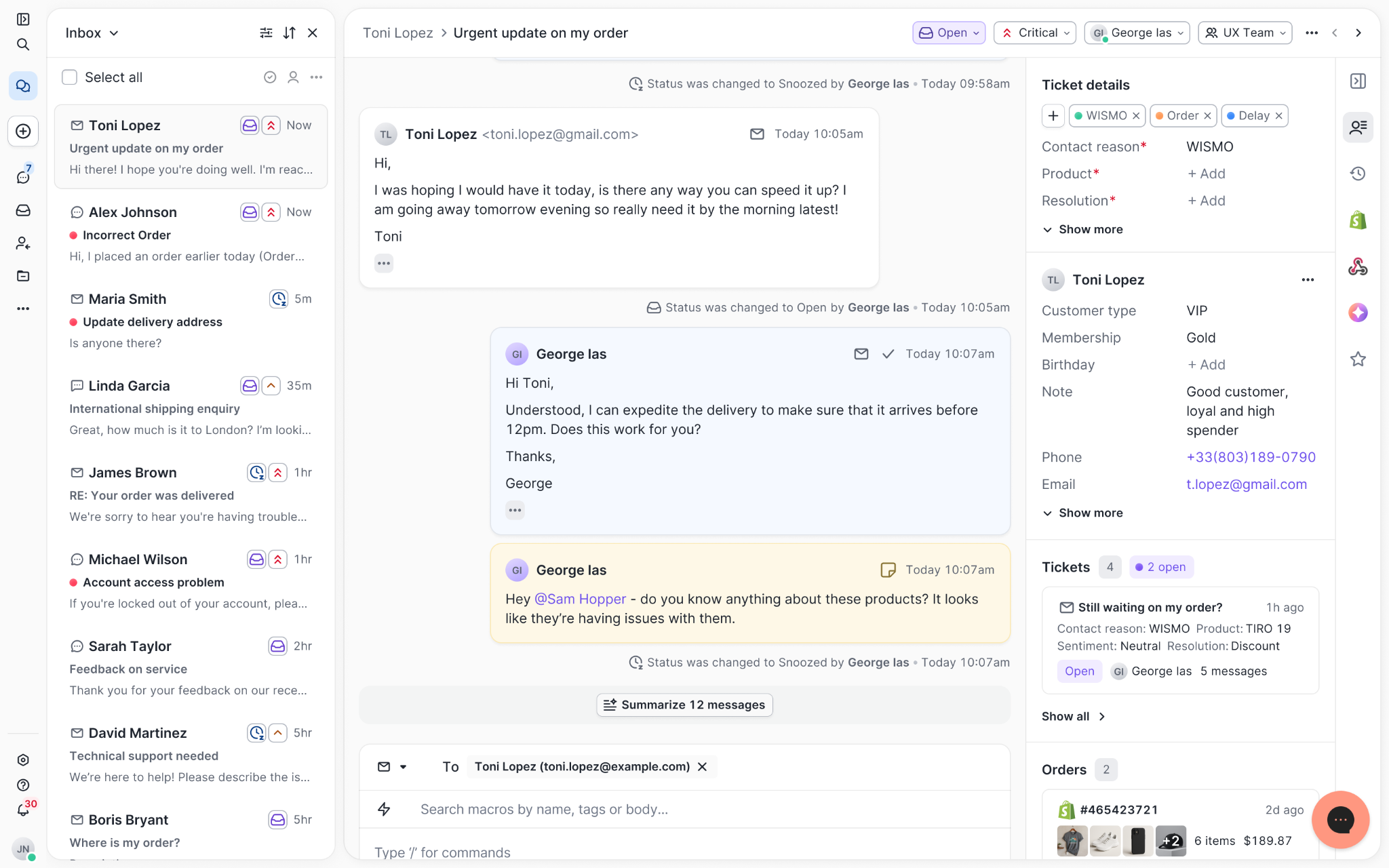
Chats with customers now look like real conversations, using the speech bubble style you’re familiar with on popular messaging apps.
Check customer history without losing your place
Checking a customer's history used to mean leaving the conversation, an extra step that interrupted what should have been a smooth workflow.
Now, past conversations open in a sidebar next to the active conversation. You can view a customer’s full history, search through their timeline, and open prior tickets without going to a new page.

Check past conversations, orders, and customer details in the brand-new Customer Timeline.
See order details the moment you open a ticket
Order information is easier to reference than ever. Open a ticket, and you instantly see the customer's recent orders, marked with product images and invoice details at a glance. Need to dig deeper? Click on an order, and the expanded information appears in the same panel.
For teams using custom integrations, apps are fixed in a quick-access integration menu on the right.
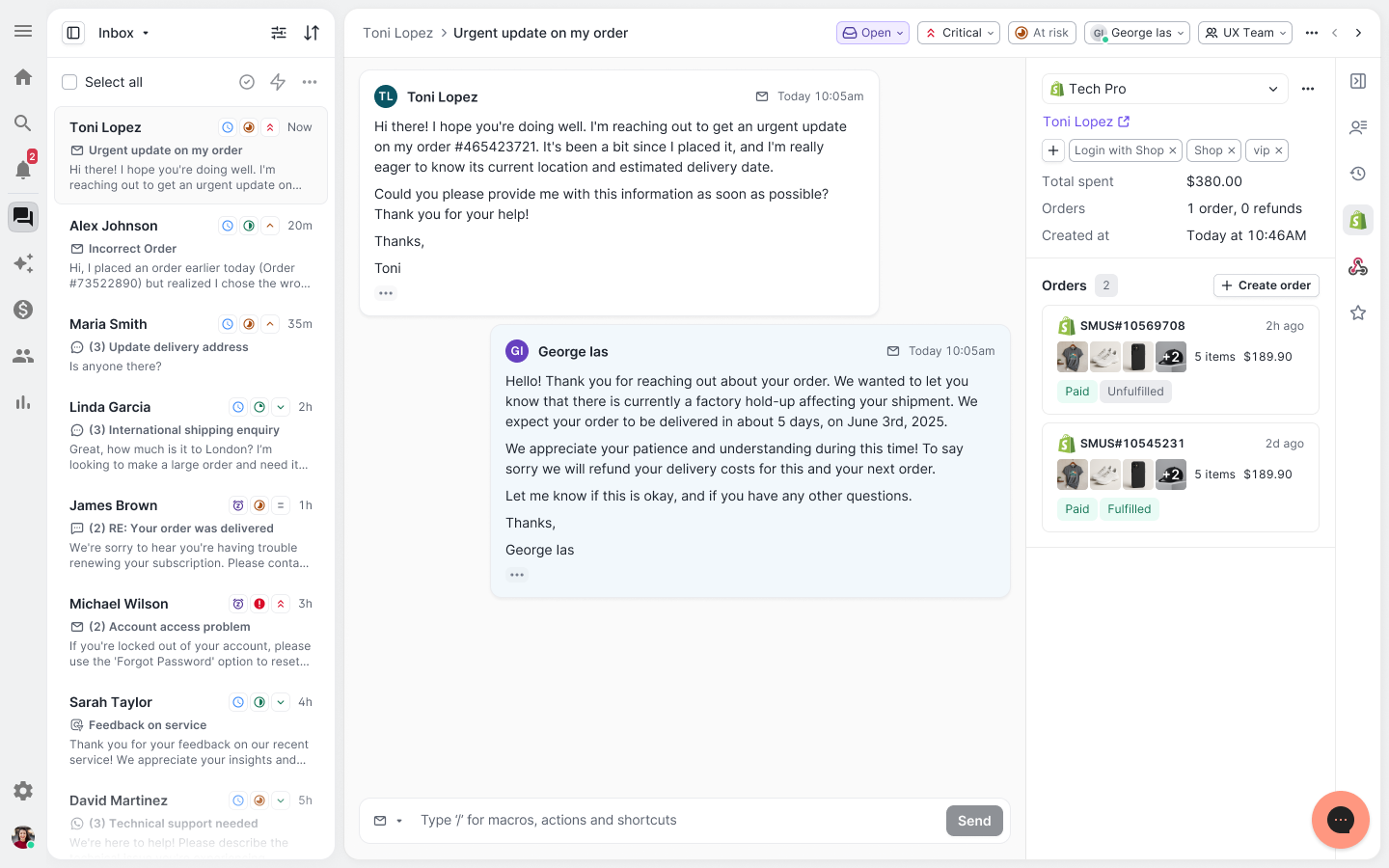
See order details, product images, and totals at a glance on the right panel, without leaving the conversation.
Pick up where AI left off
You shouldn't have to dig through a thread to figure out what AI already tried. Now you don't have to.
When AI Agent escalates a conversation, it includes a concise handover summary that mentions the issue, what actions were taken, and why it was passed to your team.
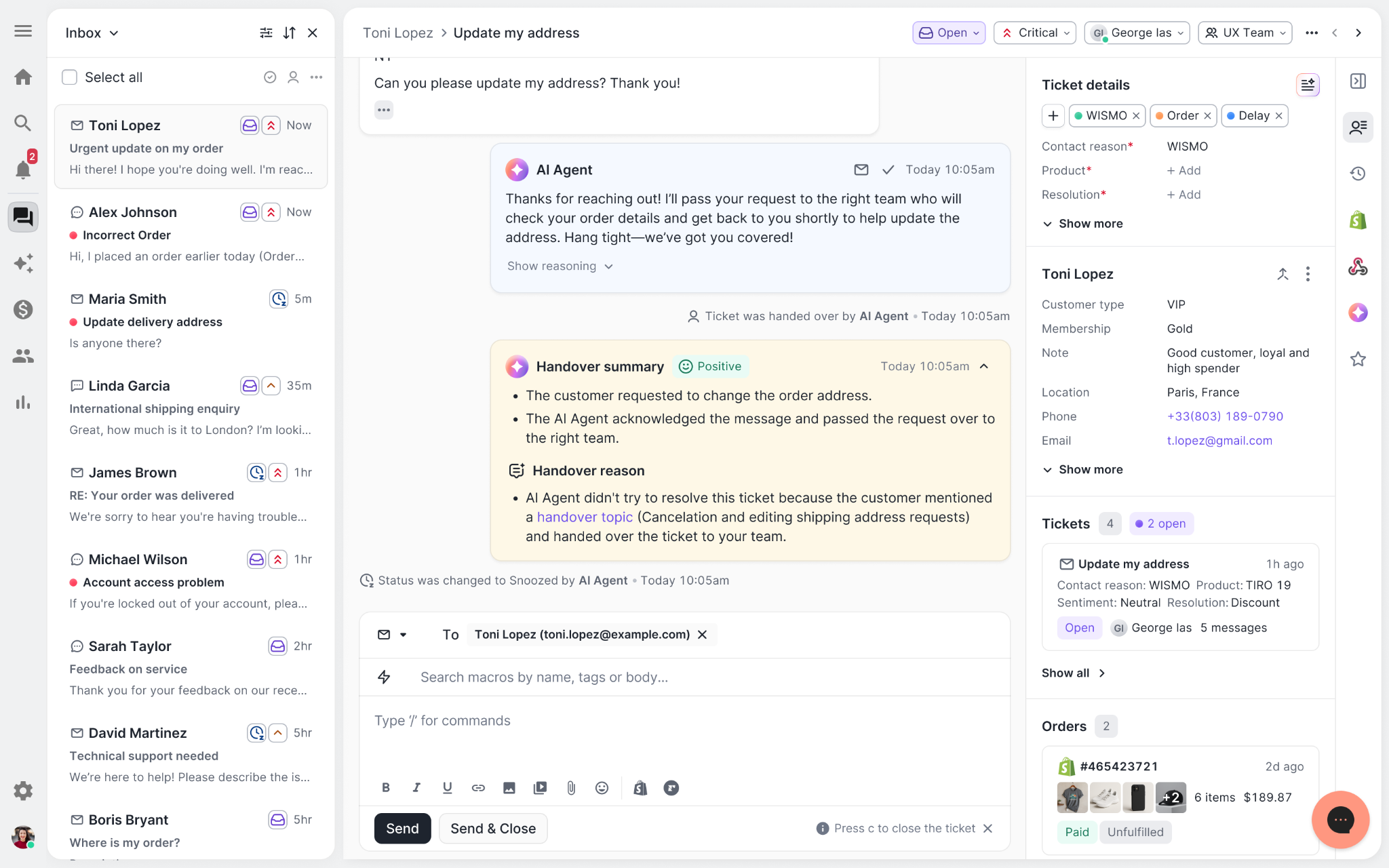
Escalated tickets include a brief AI-generated handover summary, marked in yellow, for quick reference.
Move faster across every store and team
We restructured and simplified the navigation. The left sidebar organizes everything into clear categories: Inbox, AI Agent, Marketing, and Analytics, so anyone on your team knows exactly where to go.
To quickly update your knowledge base or adjust a workflow, both now live right in the sidebar. For teams managing multiple stores, switching between them is just as straightforward, accessible from the sidebar, so agents can move between inboxes without breaking their flow.
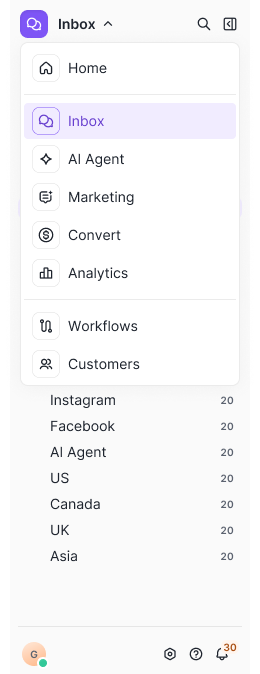
Agents can switch between stores and their corresponding inboxes directly from the left menu.
A workspace that works the way agents do
Support comes down to the person on the other end of the conversation. We built Helpdesk 2.0 is to make sure they have everything they need to show up for that moment.
The best way to see the difference is to work in it. Start a free trial today.


Further reading

First Response Time: Your Guide to Understand + Lower the Metric
It's tough to point to a single most important metric in customer service. But if we had to, first response time would be a top contender.
First response time (FRT) is the time between a customer asking a question and your team’s initial response. When your FRT is too long, customers are left wondering whether you even received their question, let alone will get them an answer.
"Of course, the best-case scenario is quickly answering the customer's question (or automating the answer). But even if you can't solve the question right away, letting the customer know you received their inquiry — and that it didn't get sent into the void — is great for customer confidence and satisfaction.” —Bri Christiano, Director of Customer Support at Gorgias
Let’s dive into first response time to understand why it’s so make-or-break for your team. Then, we’ll unpack best practices you can use to lower FRT for your team, plus how to use this KPI alongside other metrics to support your overall customer service strategy.
Why is first response time important in ecommerce?
A quick first response time is a key way to build customer trust, letting customers know right away that you are taking their inquiry seriously and that you will resolve the issue as fast as possible.

Here are a few reasons a strong FRT improves your customer experience and your support team’s impact on the business:
Meet customer expectations
According to our research, 90% of U.S. customers say an immediate customer service response is “important” or “very important.” Plus, 60% of people who need support want it in 10 minutes or less.
In other words, near-instant FRTs are important to 90% of shoppers — and after 10 minutes, you’re disappointing over half of your shoppers.
Drive conversion rate
First-response time is especially important for pre-sales support questions, like "Will this arrive before Christmas?" or "Which size is right for me?". Any customer reaching out about pre-sales support likely needs their questions answered before they commit to click checkout, or before they hop over to Amazon to buy it.
A speedy response is just the thing to give the shopper the information they need to make a confident purchase decision and boost their trust in your brand — two factors that can contribute to high conversion rates.
Increase revenue-related KPIs
First response time also impacts other important support metrics, including ones that impact your revenue:
- Resolution time: A fast response time often leads to a quicker resolution — and a customer who’s more likely to cite a positive shopping experience with your brand.
- Lower return rate: Give a customer a fast response to their questions, especially in pre-sales moments, and they’ll have the information they need to make a confident purchase decision. This lowers the likelihood that they’ll need to return the item later.
- Higher conversion rate: If a customer has a question about a product, they need a quick response to convince them to click checkout. Otherwise, they’re just going to go to a competitor.
- Customer satisfaction: Fast response times go a long way to show a customer they are valued. Offer a quick response to increase brand trust, which leads to improved customer satisfaction.
{{lead-magnet-1}}
How to calculate and track first response time
Luckily, you don’t have to be a math wiz to find your brand’s first response time.
Start by simply looking at your tickets. Compare the time the ticket came in with the time a support agent responded. That time difference is your FRT.

For example, if a ticket comes in at 8 am Monday, and an agent responds at 8 am Tuesday, your response time is 1 day.
You can also keep track of first response times across a certain period, or from a certain agent, to understand the average response time. Simply collect response times over a certain period, then, divide that number by the total number of resolved tickets during that same time frame.
The equation looks like this:
Total first response times during chosen time period / total # of resolved tickets during chosen time period = Average first response time

Here’s what calculating FRT averages looks like, using real numbers: 85,000 seconds / 900 resolved tickets = 94.4 seconds (average first response time)
That means that, on average, your agents are able to respond to customer tickets within 94.4 seconds of receiving a request (for that period).
If math isn’t your thing, don’t sweat it. Most helpdesks these days automatically calculate and report on average first response time for you.
Gorgias calculates important metrics, like first response time, automatically. Plus, you can slice and dice the information to understand FRT by factors like:
- Channel (email, SMS, social media, etc.)
- Contact reason (to understand what kind of questions to automate)
- Agent (to inform coaching)
- Time period (to understand if it changed after implementing something)

This way, you’re never left in the dark about how your support strategy is performing.
First response time benchmarks by support channel
Customers want the option to get in touch with your customer service team on the channel of their choice. Even more, Salesforce reports that 74% of shoppers want a variety of channels to choose from.
If you’ve adopted an omnichannel support strategy, keep in mind different channels have varying response times.
We’ve broken down a few of the most popular channels to give you an idea of what to expect — and what response times Gorgias customers achieve, on average.

- Stellar: 1 hour
- Above average: 2 hours
- Average: 1 day
- Unacceptable: More than 24 hours
Gorgias customers see an average email FRT of 7 minutes and 57 seconds.
Chat
- Stellar: Under 1 minute
- Above average: Under 5 minutes
- Average: 10 minutes
- Unacceptable: Over 1 hour
Gorgias customers see an average chat FRT of 7 minutes and 54 seconds.
SMS
- Stellar: Under 1 minute
- Above average: Under 5 minutes
- Average: 10 minutes
- Unacceptable: Over 1 hour
Gorgias customers see an average SMS first response time of 59 seconds.
Social media
- Stellar: A few minutes
- Above average: Under 2 hours
- Average: 1 day
- Unacceptable: More than 1 day
Gorgias customers see a slightly different average FRT depending on the social media platform.
- Facebook Messenger: 4 hours and 30 seconds
- Instagram DM: 7 hours and seven minutes
- Twitter DM: 7 hours and 58 minutes
Automation is preferable to offer a quick response to your customers. Either an instant automated answer to their question, or an automation to let them know you’re on the way.
5 tactics to reduce first response time
Reducing your FRT is a great way to optimize for customer satisfaction. Luckily, there are a few tactics you can take now to reduce FRT that also reduce the load on your support team.
1. Automate repetitive questions to reduce ticket volume
Automating responses to repetitive customer questions has a two-fold benefit:
- Automating answers with a helpdesk effectively means achieving one-touch resolutions for your most common customer inquiries.
- It reduces the overall number of tickets reaching your agents, letting them focus on high-impact inquiries that automation can’t handle.
How this works in Gorgias
Gorgias Automate deflects up to 30% of tickets (meaning 30% of customer issues were resolved without human interaction.) If 30% of your helpdesk is cleared, that means you can get to the leftover tickets faster.
Two great features in Automate are Flows and Article Recommendations, which provide personalized, automated answers to customer FAQs.
Both features give customers a 0-second first response time, but these interactions don’t impact your measured FRT since no ticket is created.
You can then track how much time and money automation saves your customers in first response time:

Take a look at how skincare brand Topicals implemented Flows to help shoppers navigate their product offerings. So, when a customer asks, “How do I find the right face wash?” Flows will ask a series of questions and offer a personalized recommendation based on the customer’s answers.

2. Automatically send a message that you’re on your way
Even if you can’t use automation to answer a customer question, it can let customers know their message has been received and that an agent is on their way to help.
Leaving customers in the dark about when they’ll receive a response is likely to make any customer anxious. An automated response not only lowers your FRT by responding immediately, but it also quells your customers’ fears that their questions will not be answered.
"Offer an automated message to fire almost instantly so customers know their question was received and someone will be looking into it shortly. Fire it off regardless of channel — the only exception being if your human agent happens to be available to respond."
—Bri Christiano, Director of Customer Support at Gorgias
Berkey Filters built a Rule using Gorgias to automatically reply to SMS messages as they came in.

In their message, Berkey Filters starts by thanking the customer for reaching out. It also sets expectations by sharing customer support’s hours of operation. That way, if a customer messages outside of operating hours, they aren’t left waiting for a response.
By adding in an "If the message from agent is false" condition, it also protects you from accidentally firing off this response if a live agent has already responded.
This is only one example of how to use Rules, or Gorgias automations, to automatically reply to tickets. With Gorgias, you could set this up for any channel, or set up a Rule so that it only fires outside of your set business hours, on live chat, when your agents are away, and so much more.
3. Assign and prioritize tickets automatically
Some tickets need a more immediate response than others. Angry or upset customers require ticket escalation to try and salvage the relationship and prevent negative reviews, returns, or customer churn.
Prioritizing your incoming tickets will help your agents lower FRT on tickets that need the fastest responses. They can respond to high-priority tickets first. Any other tickets that automation can’t cover can wait.

Instead of manually sorting your tickets day in and day out, Gorgias can automatically prioritize tickets as they come in.
Gorgias makes use of AI to analyze incoming tickets based on natural language processing (NLP). The platform also lets you create Rules to determine a ticket’s priority level. Then, it processes language on incoming tickets using the Rule you set in order to take an automatic action.

This is also where Gorgias’s deep integration with Shopify really shines. The integration lets you pull in customer information, like order number and order status, to help prioritize tickets.
For instance, you can prioritize cancellation requests from customers that placed an order in the last 24 hours, to avoid shipping products with the wrong shipping address. You could also prioritize messages from customers who have spent more than $100 (or any amount) from your store, to make sure your VIP customers are taken care of.
4. Drive support traffic to messaging channels (and away from email)
Email is notoriously one of the slowest customer support channels out there. The good news? This aligns with customer expectations: A customer who sends an email isn’t waiting at the computer for a response, whereas one who sends a live chat message probably is.
With all the faster options out there, don’t rely on email as your most prominent support channel. Deprioritize email by adding a live chat option, or by making your email address a little harder to find on your website. Consider also adding a robust Help Center and guiding shoppers toward self-service channels.
You can easily use email as a springboard to push customers to other, faster channels.
Berkey Filters does this by using an automated response to inform customers about faster options to connect with an agent. Plus, they share a link to the Help Center, so customers can see if they can find a solution to their problems themselves, without needing human interaction.

Customers were informed right away that they were placed in the email queue, but were offered the option of texting or joining a chat with a live agent to resolve their problem even faster.
5. Give your agents templates and Macros
One of the most time-saving tools you can give yourself and your team is templated responses, which help your agents avoid typing messages from scratch, or copy/pasting customer information.

At Gorgias, these templates are called Macros. These are canned responses you can use to populate answers to customer questions. You can also personalize these responses by pulling data from your Shopify account.
If you can't automate an answer, the Macro gives your agents a headstart so they aren't wasting time remembering what the right policy is, typing out a message from scratch, or manually copying/pasting the customer's information (like name or order number).
First response time works best when it’s combined with other metrics
First response time isn’t a be-all, end-all KPI — it’s just one metric, best used in concert with others to get a broader understanding of how your team is performing.
Average Resolution time
Average resolution time (ART) is the amount of time it takes your customer support team to fully solve a customer’s problem and close the ticket.
Gorgias customers have an average resolution time of 1.67 hours.
Read our guide on resolution time to learn best practices to improve this metric for your brand.
How Average Resolution Time works alongside FRT
The initial response time is vitally helpful to understand how quickly your agents can spring into action, but it’s your resolution time that speaks to how helpful your responses are.
If you have a great first response time but have unhelpful answers, or just go back and forth with a customer, your resolution time is going to suffer. Calculating both helps you make sure you're balancing speed (FRT) with quality answers that lead to a full Resolution (RT)
OLIPOP grew quickly and needed help from Gorgias to keep up with their exceptional customer support.
Gorgias helped them reduce Response Time by 88% and Resolution Time by 91%, which led to a 1,200% increase in revenue from customer support.
"We wanted to make sure customers can reach out to us via any platform and we'd have the ability to quickly answer it all in one place." —Eli Weiss, Director of CX, OLIPOP
📚 Related reading: How OLIPOP decreased their response time by 88% and resolution time by 91% with 25x ROI
CSAT
Customer satisfaction score, or CSAT is an important metric to measure your customer base’s level of satisfaction with their shopping experience.
The more satisfied a customer is, the more likely they are to become a repeat shopper, refer friends, or leave a great review.
Using Gorgias, you can automatically send customer satisfaction surveys and track your scores over time. Learn more about our satisfaction survey and dashboard:

How CSAT works alongside FRT
First response time is a metric that goes hand-in-hand with your CSAT.
If you slow response time, you can expect your CSAT to be similarly low. A customer who has to wait days for an email response, or several minutes on hold during a phone call is likely to have an unsatisfactory experience.
Decreasing your first reply times will inevitably increase customer satisfaction.
Read our Director of Support's guide to improving CSAT scores for more guidance.
Contact rate
Customer contact rate is a metric to measure the percentage of active customers in contact with your support team over a specified period.
Generally speaking, you want your customer contact rate to be low. A low rate means most customers are satisfied with their shopping experience and don’t require further support.
One tactic to lower your contact rate is to offer more self-service options, like a knowledge base or FAQ. That way, your customers can help themselves with frequently asked questions like “Where’s my order?” or “Do you accept returns?” Then, higher-priority tickets can be tackled by your reps.
How Contact Rate works alongside FRT
While you want your first response time to be low, even better is reducing your contact rate.
That means your customers are running into fewer issues that would lead them to reach out to customer support in the first place. Or, that they turn to self-service resources when they do have an issue.
Gorgias: your ecommerce helpdesk for cutting first response times
If your support agents have to answer every question by hand, or toggle between a dozen different tabs to respond to different challenges, your first-response time will always suffer.
A helpdesk like Gorgias has an immediate positive impact on your FRT because it collects messages from every channel, automatically responds to basic questions, and gives agents powerful tools to respond to messages as fast as possible.
Before implementing Gorgias, Timbuk2’s customer service team took, on average, 2 days to respond to customer inquiries. They knew they needed to centralize and automate their customer support — that’s where Gorgias came in.
Making the leap to Gorgias helped Timbuk2 streamline its support strategy, gaining a 96% faster response time and a nice 35% boost in revenue.
"Increased customer support should go hand in hand with revenue growth. We want to turn customer experience into a profit center and we have more opportunities to grow with Gorgias." —Joseph Piazza, Senior Customer Experience Manager, Timbuk2
Gorgias helps ecommerce companies improve their first response time, along with other key metrics, to build exceptional customer experiences that drive revenue.
Sign up for Gorgias or book a demo to start tracking and improving your first response time today!
{{lead-magnet-2}}


Playbook: How Love Wellness Gets Every Employee Into Gorgias To Improve Cross-Functional CX
At my company, every single employee — from office manager to the CEO — must create a Gorgias account and spend 20+ hours answering customer support tickets. It’s an unusual program, but it’s incredibly impactful.
My name’s Amanda Kwasniewicz, VP of Customer Experience at Love Wellness, a brand dedicated to helping women improve their gut, brain, and vaginal health.

When everyone interacts with customers and learns how customer support operates, we become a more customer-centric, collaborative company. Below, I’ll share more details about this program so you can build something similar at your company.
Why you should have non-support employees answer support tickets
In my eyes, this program truly adds so much value back to the company. It always generates insights and improvements for the CX team (as well as other departments). Plus, it facilitates ongoing collaboration between support and other departments, long after the program ends.
Here are some specific benefits, each illustrated by real-life wins, to help you understand why this program is so impactful:
Establish respect for support
Customer support was never disrespected. But this program helped the entire company understand how much we’re responsible for. Plus, it gives everyone a better idea of how our work impacts the rest of the business (and vice versa).
At many companies, all kinds of decisions are made in silos that impact customer experience, and a handful of people on the CX team are left to clean up the mess. This program helps the rest of the company consider the downstream impact on the customer’s experience for whatever they’re working on — whether that’s updating the website, developing a product, or planning logistics.
In other words, it helps give CX a seat at the table and encourages everyone to think proactively about how their work will impact customers.
Find areas to improve support
Getting all kinds of skill sets and perspectives into the helpdesk has sparked many smart improvements to the CX team’s processes. A couple of examples:
- Someone from our Ops team recognized a high number of DNRs (orders the customer never received). They suggested we turn on an “Order delivered” notification so customers can grab the order the minute it hits their doorstep, or can reach out to our team right away if they can’t find it.
- Another Ops team member suggested an app that tracks delivery issues (like failed delivery attempts and returns to sender). Now that we track these issues, we can proactively reach out to impacted customers to better manage the issue. (By the way, the app we use is Trackhive, but it’s no longer available — a simple app like TrackingMore should work!)
Find areas of opportunity outside of support
When other departments get into the helpdesk, they discover tons of ways their work impacts the customer. This program always sparks ideas for changes in other parts of the business to improve CX:
- The Product Development Team noticed customer complaints about our packaging and pushed our manufacturers to update the packaging so it’s easier to open.
- A marketing email was sent out with a broken link and an incorrect promotion, which led to an influx of support tickets. The marketing built a new process to test marketing emails before they go live, preventing countless mistakes going forward.
- Our Retail Team discovered a product issue caused by the way retailers stored one of our products. They jumped on the issue, and are now attuned to these kinds of issues, and quickly help solve issues stemming from retail orders.
- Our VP of Finance learned we had an effective system to track replacement orders and was able to use that data to improve the company’s operational budgeting.
Improve cross-functional collaboration
Once non-CX employees understand the value and processes of Support, they’re more likely to rope you into conversations and support your team down the road.
Here are a couple of examples from my experience:
- When the company evaluated a new 3rd-party logistics (3PL) partner, we were roped into the conversation to ensure we chose an option that let us automate more support tasks, like canceling orders and editing addresses.
- During a particularly busy period, our small team of 5 needed help managing the support inbox. 3 non-CX employees (who had previously gone through this program) stepped in to catch up with our inbox. It’s a great strategy to manage the Black Friday — Cyber Monday surge!
{{lead-magnet-1}}
How I structure this kind of program
Getting non-CXers into the helpdesk and answering tickets requires customer service training and guidance. Especially since we’re pulling employees away from their roles, we need to make sure it’s an efficient and effective program.
Here’s how my team manages it:
Train a cohort every 4-6 weeks
Training new hires one at a time would be a big timesuck for my team. So instead, we train a group of new hires (or anyone else we missed in the past) once every few months or so. For us, groups of 6-8 work well — but adjust for the size of your team.
Onboarding is a 2-hour session run by me, where we cover the fundamentals of CX, the tools we use, and the processes they need to know to answer tickets. Here’s a checklist of what I cover:
- Customer Experience fundamentals (including Love Wellness’s CX philosophies)
- Where our information lives (the Help Center for customer-facing content, and Guru for employee-facing content)
- Shopify 101: A tour of the checkout flow and order details
- Gorgias 101: A tour of the helpdesk, including how to respond to tickets
- A tour of Macros (listed in the image below), so they rarely have to draft emails from scratch

Set up a dedicated View in Gorgias
During the last 30 minutes of onboarding, we give each employee their own Gorgias login and set them free to start answering emails. To make the inbox more digestible (and steer trainees away from complex emails), we set up a View with simple inquiries as a sort of training ground, in addition to adding them to a Training Team.
We prefer to manually add tickets to this view when the CX team stumbles across simple questions. But you could easily set up an auto-tag to send simple questions — like subscription renewals or requests to edit orders — to this View.
We also have a simple process for trainees to hand off tickets that become complicated to the CX team. They simply send the handoff Macro, which lets the customer know an answer is coming and automatically assigns the ticket to the CX team.

Require 20 hours of support work over 4 weeks
Once training is complete, the cohort is set free! The expectation is that everyone who participates in this program spends 20 hours on CX over a month.
How they choose to spend that 20 hours is choose-your-own-adventure style. They can answer 1-2 emails daily, for 3-4 days a week, to meet the 20-hour requirement. During lighter periods, they can also study past tickets or read FAQ content — anything that helps them better understand CX and how we communicate with customers.
Appoint a CX’er to be available for support
While trainees self-guide their 20 hours, one member of the CX team is available to answer questions or jump in to provide support. We also schedule a 30-minute, 1-on-1 shadowing session so the trainee and the CXer can deep-dive on any topics that come up.
These 1-on-1 sessions are where we spark a lot of great ideas. Naturally, the trainee and the CXer learn more about one another’s departments and processes and find opportunities to collaborate or support one another.
The CXer that manages the program has a few additional responsibilities over the 4 weeks:
- Monitoring a Slack channel where trainees can ask for help
- Sending weekly updates on each trainee’s stats
- Running a survey to gather feedback from the trainees
How to get buy-in
This program requires 20 hours from every employee, which is no small ask. If you’re excited about implementing something like this at your company, I recommend preparing a business case to convince your boss that it’s worth the investment.
Here are some tips as you prepare your case:
Find an executive champion
I was lucky that a previous boss had an operational background and understood how CX is deeply interconnected with other parts of the business. She was actually the one who suggested this program, and her executive support was essential to put the plan into action.
If possible, find someone with leadership status to champion this program. They can help convince whoever has the power to approve the program and get the rest of the company excited to participate.
Regardless of whether you’re trying to implement this program, I want to encourage you to frequently showcase the work of your CX team to executives and the rest of the company. It’s not often that CX gets a spotlight for their work — unless something is on fire. By showing how complex and impactful the team’s work is, you’ll boost team morale and get buy-in for out-of-the-box initiatives like this.
Emphasize the cross-functional benefits
This program is great for your CX because you’ll get new ideas to improve processes and a trained staff of agents who can step in during busy periods. But the larger benefits — the ones to emphasize when building your case — are the cross-functional collaboration and improvements.
Be sure to underscore how this program orients the entire company to think about CX and adopt a more customer-centric mindset. Plus, share a few examples about how Marketing, Product, and other teams (like Logistics and Wholesale) could refine processes by understanding how their work overlaps with the CX team’s work.
Share this article
A testimonial from someone with first-hand experience goes a long way — let this article be that testimonial! My anecdotes about the benefits of this program are 100% real, and I’m confident any company could see similar improvements.
Plus, you’re welcome to use my structure as a template to get started.
Choose a helpdesk with unlimited seats
Most helpdesks charge per user seat, which makes this kind of program impossibly expensive. You’d have to pay for each account, limiting your ability to get additional help in a pinch or share CX insights from customer conversations with the rest of your team.
One of the (many!) reasons we chose Gorgias is because it allows you to have unlimited users, so every single person in the company can create an account, interact directly with customers, develop a great understanding of CX, and find ways to refine processes and implement customer feedback throughout the business.
If you haven’t yet, I strongly recommend chatting with the Gorgias team — it’s a no-brainer for any ecommerce brand looking to make their CX more effective and efficient.
{{lead-magnet-2}}

Which Customer Service Channels Should You Use?
TL;DR:
- Customer service channels are touchpoints where shoppers interact with support teams — including phone, email, chat, social media, self-service, and AI agents
- Modern brands need multiple channels because customers have different preferences, and issues vary in complexity and urgency
- Choose your channels based on customer demographics, journey stage, cost-to-serve, and team capacity
- An omnichannel approach with unified customer data across all channels delivers the best customer experience and highest agent efficiency
- Measure performance with customer satisfaction (CSAT), average handle time (AHT), first contact resolution (FCR), and service level agreement (SLA) adherence to continuously optimize your support strategy
Customers are everywhere, and they expect you to be right there with them. According to McKinsey, over 80% of customers would likely contact multiple channels, including email, live chat, and phone support, if they needed additional assistance. This means expanding where you offer support to meet customer expectations.
A good customer experience isn’t only about the one-on-one interaction between an agent and customer, it’s also about everything else that happens before — including the freedom to choose how they communicate with you.
This guide covers 9 essential customer service channels and how to choose the right mix for your brand. We’ll also show you how to measure and optimize channel performance for maximum efficiency and customer satisfaction.
What are customer service channels?
Customer service channels are the touchpoints where shoppers interact with your support team to get help, ask questions, or resolve issues. These channels range from traditional options like phone and email, to digital channels like social media and AI-powered chatbots.
Channels fall into two main categories: synchronous and asynchronous.
- Synchronous channels like phone and live chat enable real-time conversations where both parties are engaged simultaneously.
- Asynchronous channels like email allow customers to send messages and receive responses at different times. Understanding this distinction helps you match the right channel to the urgency and complexity of customer issues.
Most businesses need multiple channels because shopper preferences vary widely — and most prioritize immediacy. According to Gorgias’s customer expectations survey, 76.5% of customers care about fast answers. Choose your channels based on how your shoppers want to talk to you and the types of issues they typically face.
The top customer service channels (2026)
Most ecommerce brands rely on offering multiple channels to meet varying customer expectations and handle issue complexities.
Here are the top 10 channels to offer for consistently exceptional customer experiences.
Phone support
Phone support remains one of the most powerful channels for resolving complex issues and building customer trust. Despite the rise of digital channels, reliable phone support provides a human connection that is preferred and appreciated across all generations. Voice conversations allow agents to pick up on emotional cues and demonstrate empathy in ways that text-based channels can’t match.
“I’ve seen that a phone call can actually turn things around,” says Bri Christiano, Senior Director of Customer Success at Gorgias. “Some people just need to be heard on the phone, especially people who are more used to having conversations over the phone. I’ve called angry customers, and if you let them speak and hear them out, and repeat back to them their frustrations, that alone will save that customer in the end.”
How it works in customer service:
Modern phone support uses technologies like interactive voice response (IVR) for call routing, automatic call distribution (ACD) to connect customers with the right agents, and computer telephony integration (CTI) to pull up customer data instantly.
Best for:
- Complex issues requiring detailed explanation or troubleshooting
- Urgent inquiries where customers need immediate resolution
- High-value customers or escalated complaints
- Older demographics who prefer voice communication
- Situations requiring emotional connection
Limitations:
- Most expensive channel to staff and maintain
- Agents can typically only handle one call at a time (low concurrency)
- Requires adequate staffing during business hours
- No written record unless call is transcribed
- Can be stressful for agents handling difficult conversations
Email support
Email serves as the primary channel for asynchronous support. Unlike real-time channels, email lets customers explain their issues in detail at their convenience and gives agents time to research and craft thoughtful responses. This makes email particularly valuable for complex inquiries that benefit from documentation and detailed explanations.
Most customers expect a quick response to their issues — and treating an email like the first step before a shopper leaves a bad review helps prevent escalation. If an agent receives a customer service email from an angry customer, a great first step is to apologize right away and take steps to de-escalate the situation with a thoughtful solution.
How it works in customer service:
Modern email support relies on ticketing systems to organize incoming messages, service level agreements (SLAs) to set response time goals, and macros or templates to speed up responses to common questions. Collision detection prevents multiple agents from responding to the same ticket, while threading keeps conversation history organized.
Best for:
- Non-urgent inquiries that don’t require immediate resolution
- Detailed explanations or step-by-step instructions
- Documentation needs where customers want written records
- Product recommendations requiring research
- Follow-up communication after initial contact
Limitations:
- Slower response times compared to real-time channels
- Can feel impersonal without proper personalization
- High volume can overwhelm teams without automation
- Back-and-forth exchanges take longer to resolve
- Email threads can become confusing with multiple replies
Live chat
Live chat provides real-time support directly on your website or app. This channel has become increasingly popular because it combines the immediacy of phone support with the convenience of digital communication.
Shoppers prefer chat because they can multitask while waiting for responses and get help without interrupting their shopping experience. In fact, a 2019 CGS survey found that 86% would rather interact with a human over a bot.
The team at CROSSNET made use of live chat to quickly handle support tickets, and their efforts resulted in massive growth, including $450,000 USD in a single sale.
How it works in customer service:
Key features of live chat tailored for customer support teams include agent concurrency (handling multiple chats simultaneously), AI agent compatibility, escalation rules for transferring conversations, and transcript history.
Best for:
- Pre-sales questions from shoppers browsing your site
- Quick answers to simple inquiries
- Tech-savvy customers comfortable with digital communication
- Capturing high-intent visitors before they leave
- Order tracking and status updates
Limitations:
- Requires real-time staffing during business hours
- Can feel rushed if agents handle too many concurrent chats
- Limited for complex issues requiring detailed explanation
- Customers may abandon chat if wait times are too long
- Typing speed can slow down resolution compared to phone
SMS & messaging (WhatsApp, Messenger)
Customer service SMS and messaging apps like WhatsApp and Facebook Messenger are quickly rising in the ranks as preferred ways for shoppers to get in touch with brands. A text message is convenient — most people have mobile devices with them, and they’re more willing to respond to a quick text than find your contact page.
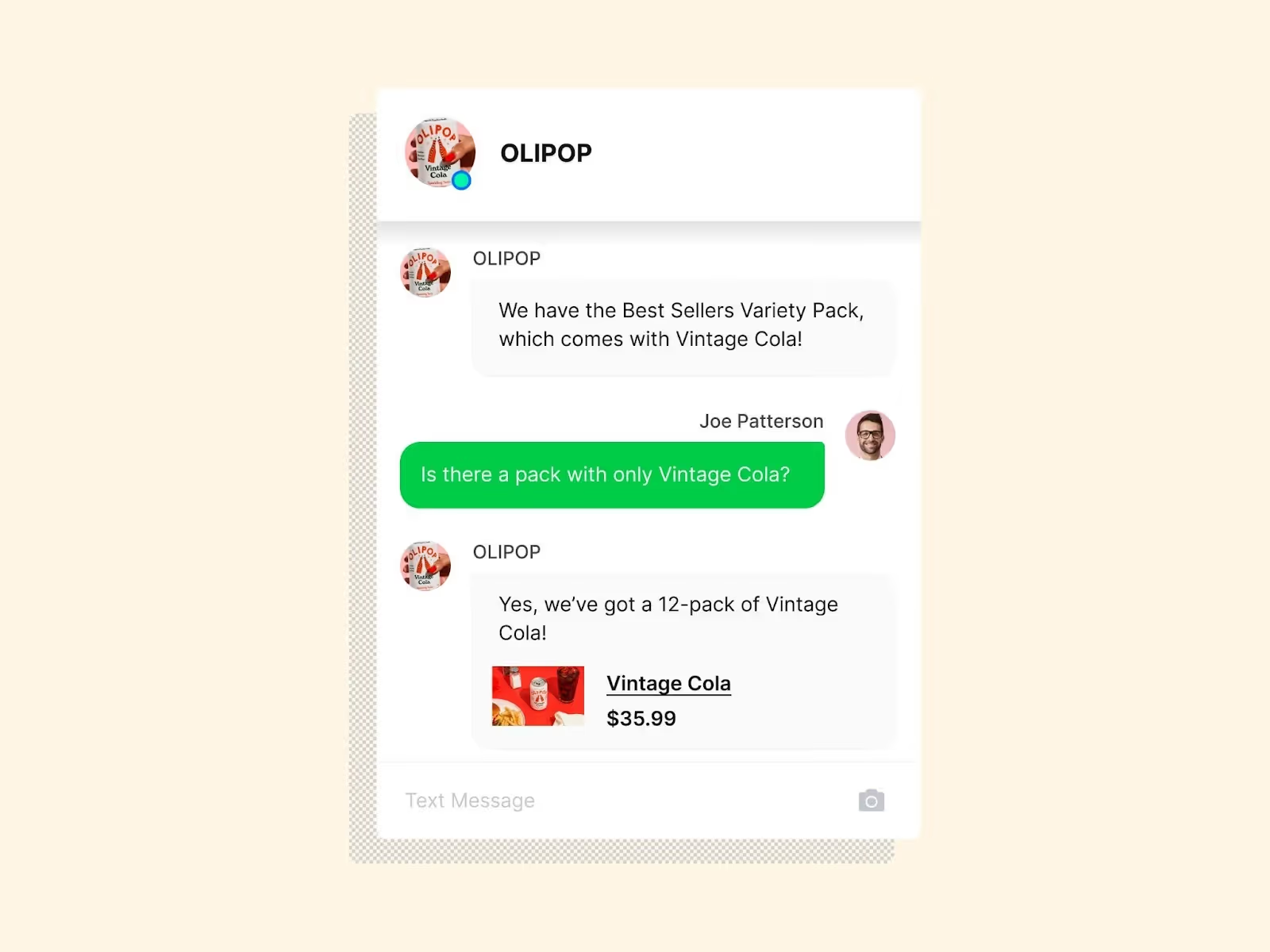
One reason for messaging’s popularity lies in fast response times and high engagement rates. Most customers expect to have a response to their message within 10 minutes. OLIPOP has seen an 88% decrease in response time since implementing SMS messaging — powered by Gorgias — in their customer support strategy.
How it works in customer service:
Top brands that offer SMS support include opt-in compliance (customers must consent to receive messages), session messaging windows (time limits for brands to respond), and two-way communication capabilities.
WhatsApp Business API and Rich Communication Services (RCS) let brands send messages with media and interactive elements.
Best for:
- Order updates and shipping notifications
- Appointment reminders and confirmations
- Mobile-first customers who prefer texting
- Quick questions that don’t require detailed responses
- Younger demographics comfortable with messaging apps
Limitations:
- Character limits can restrict detailed explanations
- Compliance requirements vary by region and platform
- Platform fragmentation (WhatsApp, Messenger, SMS) requires multiple integrations
- Customers may not check messages as reliably as email
- Limited formatting options compared to email
Social media support
Social media platforms like Instagram, Facebook, and X (formerly Twitter) have become essential customer service channels. In fact, 80% of millennials prefer social media to other channels.
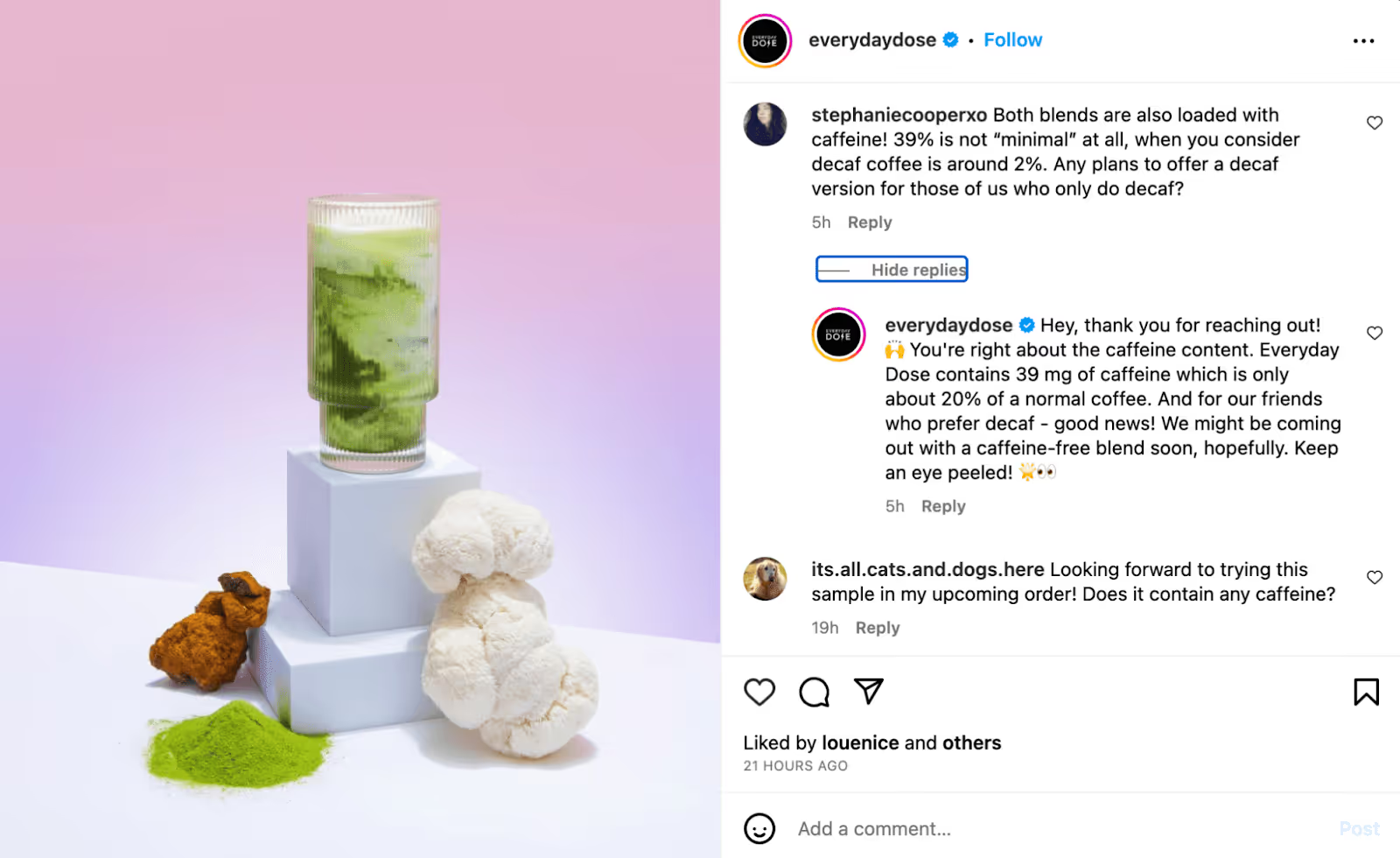
Social media support happens in two ways: public interactions through comments and posts, and private conversations through direct messages (DMs). Both are important because public responses demonstrate your commitment to customer service to potential customers, while DMs allow for personalized support on sensitive issues.
A growing number of younger shoppers — particularly Gen Z-ers — treat social media like a search engine, using these platforms to answer their questions about brands and products by scrolling through content created by real customers.
How it works in customer service:
Effective social media support requires social listening tools to monitor brand mentions, rapid-response SLAs to address complaints promptly, and clear escalation policies to move complex issues to other channels.
“It’s really important to be monitoring social posts, even if you don’t have a massive following,” says Bri Christiano, Senior Director of Customer Success at Gorgias. “These are public platforms where potential new customers are going to look at your brand and see immediately how you engage with customers.”
Best for:
- Public accountability and demonstrating responsive service
- Brand visibility and turning support into marketing opportunities
- Younger demographics who prefer social platforms
- Quick acknowledgments before moving to private channels
- Community building and customer engagement
Limitations:
- Public complaints can damage brand reputation if not handled quickly
- Resource-intensive monitoring across multiple platforms
- Platform dependency and algorithm changes affect reach
- Limited control over conversation flow and format
- May attract trolls or negative attention
Self-service (knowledge base & portals)
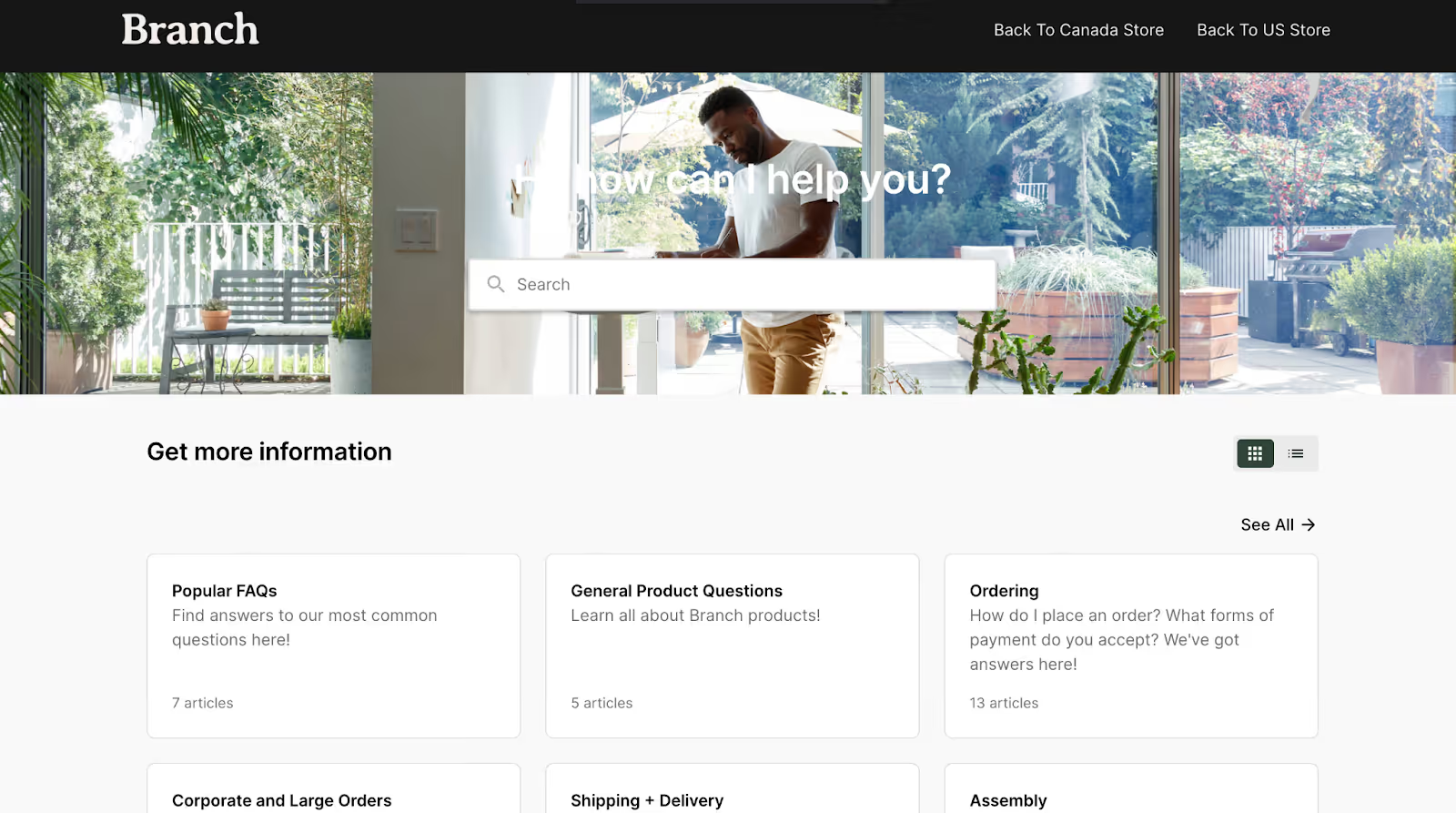
Self-service options let customers solve questions and issues on their own. This channel includes knowledge bases or help centers, FAQ pages, and customer portals where shoppers can manage their accounts and orders.
Self-service benefits both customers and support teams. Customers get instant answers, regardless of timezone, without waiting for agent availability. For support teams, self-service reduces ticket volume by deflecting common questions, freeing agents to focus on complex issues that truly require human expertise.
How it works in customer service:
A help center works great when used with automation features like Flows to create a complete self-service experience. It is also the main data source for AI agents to deliver human-like answers to customers.
If you’re not ready to create a comprehensive Help Center, you can start with a simple FAQ page. Check out our free FAQ template generator to get started.
Best for:
- Common questions with straightforward answers
- After-hours support when agents aren’t available
- Scalability as your customer base grows
- Customers who prefer finding answers independently
- Reducing cost per contact through ticket deflection
Limitations:
- Requires ongoing content maintenance and updates
- Can’t handle all issue types or complex scenarios
- Effectiveness depends on article quality and search functionality
- Some customers will always prefer human interaction
- Initial investment in content creation can be substantial
AI chatbots & agents
Unlike chatbots that follow pre-defined decision trees, AI agents use natural language understanding (NLU) to comprehend questions and provide relevant answers independently.
AI agents work 24/7 to provide instant responses even when your support team is off the clock. They excel at answering frequently asked questions, tracking orders, qualifying leads, and guiding customers through common processes.
One way to meet rising customer expectations is to consider implementing both live chat and AI agents that work in tandem. This way, you can leverage live agents during working hours, then let the bots take over customer queries when it’s time for your reps to clock out.
How it works in customer service:
AI tools made for customer service use guardrails or guidance instructions to ensure it doesn’t violate customer service policy. It’s important for customer service teams to build a smooth handoff process so customers can talk to live agents when AI can’t resolve their issue.
Off-limit topics for AI may include:
- Angry messages and complaints
- Emotional situations
- Legal and compliance inquiries
- Medical, financial, or health guidance
Best for:
- High-volume repetitive questions like order status and return policies
- 24/7 coverage without staffing overnight shifts
- Instant responses during peak traffic periods
- Qualifying leads before routing to sales teams
- Initial triage to categorize and route inquiries
Limitations:
- Requires training data and ongoing optimization
- Can’t handle all nuance and complex scenarios
- Needs clear escalation path to human agents
- May frustrate customers if responses feel robotic
- Initial setup investment in configuration and testing
Community forums
Online forums provide a space for customers to help one another through peer-to-peer support. Forums work particularly well for brands with passionate user communities or complex products where experienced customers can share expertise.
The beauty of forums lies in the social proof they generate. When customers see that others have successfully solved similar problems, they gain confidence in your product and brand. Build them using free apps and websites, like Discord, Slack, Reddit, or Facebook groups.
How it works in customer service:
Successful forums require moderation to maintain quality and safety. Features like accepted solutions, upvoting, and superuser programs help surface the best answers and recognize valuable community members. Do your research before building from scratch to see if your brand already has a word-of-mouth presence on a third-party forum.
Best for:
- Product communities with engaged user bases
- Technical troubleshooting where customers can share solutions
- Long-tail questions that don’t fit standard documentation
- Building brand loyalty through community engagement
- Reducing repetitive support inquiries through peer answers
Limitations:
- Requires active moderation to prevent misinformation
- Slower responses compared to direct support channels
- Not suitable for urgent issues or account-specific problems
- Community needs critical mass of active users to be effective
- Risk of negative conversations if not properly managed
Video support
Video support enables face-to-face conversations for complex issues that benefit from visual demonstration or screen sharing. This channel combines the personal connection of phone support with the added dimension of visual communication.
Customers appreciate video support when they need to show a product issue, follow technical instructions, or receive personalized guidance. The visual element helps agents diagnose problems faster and provide more accurate solutions, making it ideal for high-touch support in enterprise sales or premium services.
How it works in customer service:
WebRTC for real-time video streaming, screen sharing for technical support, co-browsing for guiding customers through processes, and sometimes facial recognition for identity verification (know your customer, or KYC).
Bandwidth requirements and scheduling challenges mean video support works best for specific use cases rather than as a primary channel.
Best for:
- Complex technical issues requiring visual troubleshooting
- High-touch support for premium customers
- Product demonstrations and setup assistance
- Visual verification of product defects or damages
- Building personal relationships with key accounts
Limitations:
- Bandwidth and technical requirements can create access barriers
- Scheduling challenges compared to on-demand channels
- Privacy concerns for customers uncomfortable on camera
- Requires stable internet connection for both parties
- More resource-intensive than other channels
How to choose and resource your channel mix
Building the right channel mix requires balancing customer needs with operational realities. Follow these steps:
1. Understand where your customers are
Analyze customer demographics and communication preferences. Topicals uses SMS to connect with Gen Z skincare shoppers, while Comme Avant handles most support through social media DMs.
2. Map channels to the customer journey
Match channels to shopping stages: social media and live chat for awareness, chat and email for pre-sales questions, and phone or video for complex post-purchase issues.
3. Consider cost-to-serve
Phone and video support cost the most because agents must serve a single customer at a time. Live chat is more efficient since agents handle multiple conversations. Self-service and AI agents offer the lowest cost-per-contact after initial setup.
4. Start with pilot programs
Test one channel at a time, measure performance, and optimize before expanding. This staged approach helps you work out operational challenges and validate value.
5. Resource appropriately
Train teams for channel-specific skills — phone agents need empathy and active listening, while chat agents need quick typing and multitasking abilities. Ensure your technology infrastructure supports your chosen channels.
Measure and optimize channel performance
Measurement drives improvement in customer service. Without clear metrics, you can’t identify which channels deliver the best results, where to invest resources, or how to justify your support budget.
Tracking the right key performance indicators helps you spot trends, optimize operations, and demonstrate the value your support team delivers to the business.
Key metrics to track by channel:
- CSAT (customer satisfaction score): Measures customer happiness with support interaction
- NPS (net promoter score): Measures customer loyalty and likelihood to recommend
- AHT (average handle time): Measures efficiency of support interactions
- FCR (first contact resolution): Measures percentage of issues resolved in first interaction
- SLA adherence: Measures whether team meets response and resolution time commitments
- Occupancy rate: Measures percentage of time agents spend on active support work
Manage all your channels in one place with Gorgias
When your tools don’t integrate, your team wastes time switching between systems, customer data stays siloed, and the experience feels disjointed.
Gorgias provides a unified helpdesk built specifically for ecommerce brands, bringing email, chat, phone, SMS, social media, and more into one inbox. Deep integrations with Shopify and 100+ apps give agents complete context with order data and purchase history — no tab switching required. Plus, Gorgias AI Agent handles 60%+ of tickets automatically, freeing your team to build deeper customer relationships.
Book a demo and see how Gorgias creates the best ecosystem for all your customer service channels.
{{lead-magnet-2}}


15 Best Practices for Ecommerce Customer Service
With a decade of experience in customer service roles, I’ve recognized that ecommerce customer service goes beyond answering questions.
The best experience you can give customers is proactively providing them with what they need so they don't have to contact support at all. In instances where customers do need to talk to someone on the team, interactions that surprise and delight help keep them coming back.
Ecommerce customer service may feel less personal than it would in person, but there are a multitude of ways you can make it special.
Whether you’re building an online store from scratch or need extra hands to handle your growing customer base, I’ve rounded up the top 15 best practices for ecommerce customer service that you can start using to improve your support team.
The top 15 ecommerce customer service best practices to implement
1. Use a customer service helpdesk specifically built for ecommerce stores
 |
If I could only recommend one tool, it would be a helpdesk. A helpdesk is a customer service software that allows support agents and teams to manage customer data, inquiries, and orders in one platform.
If you run an online store, Gorgias is the perfect helpdesk specifically designed for ecommerce tasks. It smoothly combines order management, order fulfillment, and customer service in one tool, so that you can speak to customers and resolve their issues while being able to pull up their order data in one window.
{{lead-magnet-1}}
2. Combine all your support channels on one platform
 |
When customers can receive help the way they want — whether that’s a phone call or Facebook messages — they feel more comfortable initiating a relationship with your brand. Establishing a positive first impression can be the fuel you need to turn them into returning customers.
💡 Tip: Phone support can be the key to keeping customers. Throughout the years, I’ve seen first-hand how a simple 10-minute phone call can turn a sour interaction around. Most customers may prefer written communication, but being able to hash out an issue over a voice call can be the difference between losing a customer and keeping them.
The top support channels you should offer:
- Email: Provides customers a channel to voice in-depth and detailed inquiries.
- Chat: Useful for quick questions that can be answered within one interaction.
- Social media: The best channel for new customers who want quick answers.
- Voice/phone: A valuable channel to explain and resolve complicated issues.
3. Automate responses with reusable Macros
 |
To cut down first response times, use Macros or customer service scripts. On Gorgias, Macros are pre-written responses that can be applied to the most common customer interactions.
The best way to use Macros is by applying them to what I refer to as empty-calorie tickets. Empty-calorie tickets are repetitive inquiries that people ask over and over again, such as “Where is my order?” Automating the responses to these low-effort tickets is the easiest way to incorporate Macros into your workflow.
When to use Macros:
- Welcome emails
- Order status emails (transaction completed, order shipped, order delivered)
- Refund processed emails
- Customer loyalty emails
4. Trigger shopping cart abandonment notifications
Customers who abandon their carts are inevitable, but you don’t have to leave it there. Sending an email to a customer who still has items in their shopping cart can be the final push to trigger a purchase. You can even pair the notification with a discount to make the purchase more appealing.
Acquiring new customers is expensive, so it’s extremely important to recapture customer attention when you have the chance.
5. Respond to social media comments quickly
Pay attention to your social media presence because 26% of people learn about a product through social media, according to a 2023 study by Statista. Public social media comments have the power to either bring in new customers or completely turn them off from your brand. For this reason, it’s important to actively engage with social media users who mention your brand.
Having an active social media presence is an easy way to show you care about what your customers have to say. When you address comments publicly, prospective customers will trust you more for your ability to be transparent and authentic.
📚 Related reading: 5 tips to leverage social media for your store
6. Send order status and shipment update emails
Customers like to know when an action they’ve taken was successful. When it comes to ecommerce, you can easily check this best practice off your list by making it a routine to send order status emails, like when an order has been shipped.
On Gorgias, we take the manual work out of sending routine emails with Macros. If you’re a Shopify store, Gorgias automatically populates your emails with important customer information pulled from Shopify such as customer name, order number, tracking number, and more.
7. Offer self-service options
88% of customers like to find answers on their own and expect a brand to have a self-service portal, according to Statista. You can help make the search easier by filling your website with self-service options.
Self-service options are resources for customers to get the answers they need without contacting an agent. These include FAQ pages, help centers, chat widgets, and interactive quizzes.
Here’s how each self-service option can benefit you:
- FAQ page: Centralizes customers’ most commonly asked questions on one page to prevent your inbox from being filled with the same questions.
- Help Center: Larger in scope than an FAQ page, a Help Center is a database of detailed resources like articles and how-to videos to help customers learn more about your brand and product.
- Chat widget: Chat widgets can turn into a self-service option with the implementation of Quick Response Flows, or preset conversations that can answer customers without a live agent.
- Interactive quiz: A fun self-service addition to online stores that carry highly specialized products, like skincare, health supplements, and apparel.
📚 Related reading: A guide to building an FAQ page
8. Collect email addresses
Data collection makes up a large chunk of customer service, and it doesn’t have to be complicated. The easiest way to gather customer data is by collecting email addresses via newsletter signups and contact forms on your online store.
Customer service is important and shouldn't stop when your agents are off the clock. On Gorgias, you can add a contact form to your chat widget when your store is offline, so you have the opportunity to turn first-time customers into loyal followers.
 |
Benefits of collecting customer emails:
- Allows you to entice new customers with promotional offers and discount codes
- Boosts customer data with requests for feedback
- Personalizes customer interactions
9. Optimize your website for mobile
Three-quarters of Americans are shopping with their smartphone. It’s time to shift your focus. To take advantage of this customer behavior, match a convenient tool like the smartphone with an equally convenient and optimized website.
A website optimized for mobile includes:
- A responsive layout that adapts to all device sizes
- An easy-to-use menu
- Limited popups and distractions
- Legible fonts and text sizes
10. Create a customer returns and exchanges portal
If your store accepts returns and exchanges, it’s a good idea to automate the process with a portal. Returning an item is essentially just one step: getting an item out of a customer’s hands. It shouldn’t require a live agent. So, when your customers can return an item on their own, it becomes a huge time-saver for both them and your agents.
For example, when I worked at Stitch Fix, every time a customer needed an exchange, they'd have to reach out to support. It was a huge friction point. Eventually, we decided to build an exchange tool that became part of our checkout flow. From then on, our customers didn’t even need to think about contacting support because it was just an automatic part of the process.
💡 Tip: The easiest way to make a returns portal is by connecting Loop Returns with Gorgias. Loop Returns simplifies the return and exchange process by routing customers to a link, not an agent. By automating this part of the customer journey, your support team can deal with more urgent tickets.
11. Feature customer reviews to amplify your brand
Showcasing personal experiences can be the magic ingredient that adds credibility to your product. When potential customers read about real-life encounters with your product, they gain trust in your brand. Customer reviews can even nudge hesitant buyers toward making a purchase.
 |
For example, PuffCuff does an amazing job at making their product shine. Not only do they feature reviews, but they also include a customer review video. Being able to add a visual element that shows how conveniently your product solves a problem can convince customers who are on the fence.
Where to feature customer reviews:
- Homepage
- Product pages
- Social media posts
- Welcome emails
12. Create a loyalty or rewards program
Attracting new customers requires extra marketing that you may not have the budget for. Here’s a different approach: increase the value you get from your current customers with a loyalty program.
With a loyalty program, customers who already love your brand are incentivized to buy more while earning exclusive perks. An easy way to set up a program is by integrating LoyaltyLion with Gorgias. You instantly get customer retention features like shopping cart rewards, in-site notifications, and loyalty emails.
13. Use high-quality product photos
Without a physical storefront, your product photos will be doing all the talking. Customers want to get as close to the product as they possibly can to make an informed purchase. In short, gaining customer trust depends on the appearance of your products.
Here’s how to build trust through product photos:
- Standardize product photos across your website. Using the same high-quality camera, lighting, and background will show customers your brand pays attention to details, allowing them to trust your products more.
- Display multiple angles of your product. Allow customers to envision how your product will fit into their lives with accurate photos.
- Implement zoomable photos. Letting customers zoom in on your products can show them the exact qualities of your product, such as color, texture, and build quality.
📚 Learn more: Improve your product photography with these 3 tips
14. Improve your checkout experience
When customers get to checkout, they’re inches away from the finish line. Don't risk hampering their journey by subjecting them to a bad checkout experience. In fact, a staggering 17% of US online shoppers abandoned their orders in 2022 because of a "too long/complicated checkout process," according to Baymard.
Here's how to improve the checkout experience:
- Offer guest checkout. Customers want fast service and that means letting them skip the tedious account creation process.
- Present all extra fees and costs. Surprise fees can turn customers off from buying a product. Be transparent by including any extra fees at the checkout page to avoid losing their trust.
- Accept a variety of payment options, including Buy Now, Pay Later. A brand that caters to all wallet sizes is likely to bring in more customers.
- Include a checkout progress bar. Visually guiding your customer through the buying journey allows them to feel at ease with manageable steps and provides them with a sense of achievement once they reach the end.
15. Track trends by using customer service metrics
 |
You’ve got pages of customer emails, buying behavior data, and feedback — now what? The next step is to use this data to track customer buying trends and your support team’s performance. With Gorgias, you can track how well your customer service operates with Support Performance Statistics.
Track these support performance metrics to improve your processes:
- First response times: The faster you answer tickets, the more satisfied customers will be.
- Average resolution times: How effectively is your team resolving tickets? You can track this number to pinpoint gaps and inefficient steps in your process.
- Average number of tickets: A high number of tickets may indicate that you need more self-service options.
💡 Tip: Great customer service should have clear KPIs that are aligned with company goals such as customer retention and revenue generation that clearly demonstrate how your customer service creates value for the company and enable you to evaluate the effectiveness of your support program.
The bottom line: Delight your customers at every stage
Making every customer interaction delightful goes a long way. Customers are more motivated to keep interacting with your brand and can even inspire new customers to join in. When you show customers that you care, you give way to loyalty.
At Gorgias, we quickly get support teams the customer trust they need with an all-in-one helpdesk. Our helpdesk streamlines the customer experience with omnichannel communication, ecommerce platform integration to Shopify and BigCommerce, Revenue Statistics, and automation in one convenient platform.
Ready to put these best practices into practice? Book a demo now.
{{lead-magnet-2}}

Customer Service Messaging: Tips and Templates for SMS + Conversational Channels
Customer service messaging (also known as conversational customer service) is a powerful way to elevate the customer experience and delight customers beyond their expectations. For customers, texting with a support agent feels much more convenient and casual than slower channels like email. And, SMS is a much better channel for “on-the-go” communication, since most people always have their mobile phones and can usually reply to text messages quickly.
That’s why customer service messaging is one of many recent customer service trends shaking up how ecommerce and D2C businesses offer support.
In this guide, we’ll discuss how your business can implement or improve this type of customer support and other conversational channels in your customer service strategy.
Let’s get started with why it’s important for businesses to offer SMS customer service.
What is SMS customer service?
SMS customer service is when support teams resolve customer questions and issues via text message.
Why SMS text messaging improves the customer service experience
Customers love these one-to-one messaging channels for customer service because they’re so quick and convenient. When implemented well, conversational messaging allows customers to reach your CS team and get answers quickly — within 42 seconds, most of the time. Especially considering that 42% of customers prefer communicating with customer service on messaging apps over any other channel, introducing a conversational channel may do wonders for your brand’s customer satisfaction.
Your customer support team can also use these channels to proactively reach out to customers with important updates and timely discounts.
SMS customer service is especially attractive to your customers because they don’t have to stay glued to your website or check a social media app for new DMs. They can get answers to their questions on a device they already check 96 times per day. Let’s take a closer look at SMS, a channel that’s quickly gaining ground as a standard support option.

10 tips to successfully incorporate messaging into your customer service strategy
Adding each messaging channel at one time might overwhelm your customer support team. Likewise, a new channel may have low adoption if you don’t announce it to your customers. As you begin offering messaging experiences as a part of your customer care portfolio, use our top 10 techniques to maximize the effectiveness of your workflows on those channels.
1) Funnel all interactions to SMS or messaging channels and then move to email or phone if needed
For issues with easy solutions, there’s no reason for customers to engage with email or phone. Emails are slow and clunky and phone calls can lead to customer frustrations, especially if your wait times are excessive. Texts are far faster than either option and can provide simple, accurate information that leads to speedier solutions — and happier customers.
For that reason, we recommend setting up your contact page and information so that text and other live channels are your first line of communication — well, after self-service support. You can always move to email or phone if the customer requests it or if the problem you’re trying to solve is better suited to one of those channels.
Tip: Speed is an important factor in all customer service interactions, but it’s critical when sending any sort of instant message. First response time (FRT) is a key customer service metric you can measure with Gorgias through the analytics dashboard. Make sure to track the speed of your responses when you start your support messaging program.

2) Consistently let your customers know that you’re available on quick messaging channels
To inform your customers they can now text your brand, we recommend adding “Text us,” plus your phone number, in some or all of these places:
- The footer of your website
- The “Contact Us” page of your website
- Your Gorgias Help Center
- Transactional emails (order confirmation, return initiated, etc.)
- The signature of your support agents
You can put your messaging app information in the same spots, and make sure to say you accept support requests via DM in your social media bios so customers know they can shoot you a message.
Tip: Because conversational customer service usually takes place on a user’s phone, you need to keep responses short and friendly. The long, detailed macros and templates you might use for emails won’t work when communicating through short messages — depending on your platform and your customer’s phone, long messages might not send or might get broken into multiple text messages. Plus, depending on your brand’s tone of voice, conversational channels are a great place to use emojis, images, and GIFs to make the conversation even more friendly and casual.

3) Use autoresponders for a lightning-fast first response
Start every messaging interaction with an autoresponder. This tactic lets your customer know that you received their request, and it gives your human agents a small buffer of time to finish up their current encounter before starting the new one. You can also include a link to your help center in case they want to look for their answer on their own.
You can use this tactic whether you’re incorporating chatbots for basic query automation, or using your customer service agents for all customer interactions.
See page XX for an example of an autoresponder Rule for messaging.
4) Create a system to categorize and segment priority tickets
Some customer support tickets should take higher priority than others. A customer that’s reporting a fraudulent purchase with their debit card needs a quicker response than someone who’s asking if there are any discounts they can use.
You can start by prioritizing:
- Tickets that have been open the longest. These are the customers who may be growing impatient, or even angry enough not to shop or work with your business again. This can be set up with a View of tickets that have been open for more than X minutes, where X is an amount of time corresponding to your service-level agreement (SLA).
- Tickets from VIPs and loyal customers. You can tag these customers and make a View based on that tag to surface their questions and concerns.
- Tickets that fall into certain intents, like “order/damaged,” which Gorgias auto-assigns through our proprietary algorithms. You can auto-assign these tickets with a “priority” tag using a simple automation Rule and set up a View that has all open priority tickets.

You can even set up dual priority queues for all priority-tagged tickets: One for priority tickets that are about to go past the first response time in your SLA and another for all other priority tickets. Then prioritize the former, followed by the latter, followed by other tickets, to keep your first response time and resolution time down while giving attention to important tickets.
Beyond prioritizing tickets, it’s also helpful to categorize them if they share similarities. Grouping similar tickets together boosts efficiency. For example, your team can come up with one main solution (create a new discount code because the previous one is buggy) and easily resolve the entire group of tickets in a single pass.
5) Use Macro templates to respond faster to repetitive requests…
If you are responding to customer service messages on a platform like Gorgias that supports Macro templates, you need to take advantage of this time-saving feature. But you can’t just take your existing email templates and drop them into these conversations.
You need to create a specific set of Macros for messaging purposes, using the principles we mentioned earlier: short, friendly, personalized, etc. That means you need to use variables like [Customer first name] or [Last order number] to personalize messages. If you set up your Macros strategically for DM and SMS messaging, many can be reused for live chat, as well.
To prioritize building Macros that will have the highest impact, create Macro templates to respond to the most common questions that have come through your helpdesk. You can also ask your team which responses they end up writing out the most and add those templates too.
Once you create and launch these Macros, you can automatically add Tags to Macros for reporting to see which Macros are being used the most. This will help you understand where you have gaps (or unhelpful Macros) and can make tweaks to improve your agent workflow and customer experience.
6) …Or deflect those repetitive requests altogether with automation Rules
If your customer service platform supports automation, as Gorgias does through our Automation Add-on, you can deflect up to a third of repetitive, tedious tickets instantly, with no human interaction. Much of this automation can be applied to customer service messaging, as well.
When we mention automated answers, some support professionals say something like, “We don’t want to send low-quality automated responses to our customers.” We completely agree: For many tickets, automation doesn’t provide the best customer experience.
However, as you know, most tickets your support team receives are repetitive and low-impact, like questions about order status (WISMO) or your refund policy. We recommend setting up automatic responses for these tickets, so customers get instant answers and agents have more time to respond to tickets that actually need a human touch.
Look through your reporting dashboards to see the tickets that are taking up the most time on your support team, and prioritize those requests for automation with Rules, where appropriate.

7) Go beyond text-only interactions with multimedia messaging
WhatsApp Business, Facebook Messenger, and SMS support images, and luckily so does Gorgias. This is a more engaging way to interact with customers, and it also allows you to exchange relevant images like broken parts, malfunctioning equipment, and screenshots for more helpful instructions.
If you want to go this route, maintain a catalog of fun, topical images that your support team can use in their customer conversations, and give them the freedom to collect their own images to insert. It’s a great way to make your support feel more personal and human, but use common sense: Frustrated customers don’t want to receive a picture or meme, they want their problem solved as quickly as possible.

8) Provide proactive support at scale on platforms that allow it
SMS and other personalized one-to-one support channels can get a little complicated because not everyone wants to interact on the same messaging application. True SMS support goes out over cellular networks and lands in users’ actual text messages, the same way messages from their friends and family do.
But you may need to be ready to handle other support channels that use similar short, text-based communication. These include Facebook Messenger, WhatsApp, and your website’s web chat. Certain channels may be a better fit for your unique customer base — for example, Instagram attracts a younger audience than Facebook Messenger, and WhatsApp is more common outside the US. Likewise, you may have other specialized messaging channels or messaging platforms that you need to support.

As a rule of thumb, you need to be where most of your customers are, which varies across businesses and industries. But to reach the desired level of customer engagement, most businesses need to be reachable via most, if not all, the major applications and support channels.
That’s where a unified customer service platform can be really useful. By keeping all of your customer conversations in one feed, you can handle more channels more strategically, through triage and routing to dedicated agents for specific tasks. For example, you could have one agent who just handles messaging and route all messages to that person for a quicker response.
On platforms like WhatsApp Business, you don’t have to wait around to hear from customers. This allows for a wide range of strategic and proactive support interactions.
For example, you can send out text blasts:
- When you have an issue affecting all customers (i.e. website downtime) to let them know what’s going on (and avoid getting excessive tickets about the issue)
- When you have new product launches or add-ons, driving revenue and customer education
- When you have relevant announcements for customers: limit these to news that actually affects customers (i.e. shutting down your community or a time-sensitive sale), not company news (i.e. your latest fundraising)
A proactive approach builds trust with your audience — they will see you going above and beyond with these efforts, and know that you’ll be upfront with potential issues.
9) Integrate your SMS support with your marketing efforts
SMS marketing is a useful tool for your ecommerce store, but it becomes even more powerful when you integrate your SMS marketing tool into Gorgias. Send out SMS blasts and have support agents on hand to handle any questions you get in response, to help nudge those customers closer to a sale.

With certain integrations — Klaviyo, for example — you can even use Gorgias attributes to segment and build campaigns. Use this function for win-back campaigns, or to send a special offer to customers who posted low CSAT scores.
10) Conduct surveys using text messages to collect feedback from customers
Text messages are an effective method for collecting feedback from existing customers, too. Once customers opt in to SMS communication, you can use this point of contact to launch quick surveys that provide valuable feedback.
Response rate is always an issue with email surveys, and other channels see higher response rates. Using a multichannel approach will supply you with more responses and help you make more data-driven decisions with the results.
Note: In a customer service tool like Gorgias, you would use one of our integrations with Klaviyo or Attentive to send the survey to entire segmented lists of customers or prospects, all at once.
SMS customer service templates for common response types
Ready to start implementing an SMS customer service strategy but not sure what to say? We get it: Staying concise yet friendly is tough, and so is conveying all the needed information in such a short space.
We’ve put together a collection of proven templates you can start using today. Adapt as many of these as you need to fit the contours of your business, and bring them into your customer service platform of choice. In Gorgias, you could auto-populate these responses through our Macros.
Note: We’re sharing these templates as text messages, but they can easily be adapted to other conversational channels like social media DMs and live chat.
Ticket received template
As we mentioned earlier, it’s a good idea to set up an autoresponder. This tactic can buy your team time to finish up a previous interaction or send an email, yet it shows you’re on top of the interaction and will be back soon.
Here’s our template for a ticket received autoresponder:
Thanks for texting {Brand Name}. An agent is reviewing your question now. We’ll get back to you shortly :)
Introduction message template
The introduction message is the point where your autoresponder or chatbot passes off the reins to a human agent. It’s the first point of personalization, and you want to make a solid impression. Still, your agents don’t need to be typing these out every single time. Use a template like this one to break the ice (just with a little less repetitive stress injury):
Hello, {Customer First Name} {Customer Last Name}! I’m {Your Name} from {Brand Name}. Thanks for messaging us. What can I help you with today?

Hours of operation template
There are two frequent scenarios where an hours-of-operations text makes sense. One is as an answer for when customers message you on social media or elsewhere just to ask when you’re open. In those cases, use this template:
Hello, {Customer First Name}! I’m {Your Name} from {Brand Name}. Our hours of operation are Monday through Friday, 9 a.m. to 8 p.m. Best, {Your Name}
The other scenario is when a customer reaches out via a messaging channel and there’s no one on the other end. If your helpdesk isn’t open 24 hours a day, use a template like this when the team isn’t live:
Hello, {Customer First Name}! Our live chat helpdesk is open {list hours}. You’ve reached us outside those hours. Leave a short message here and we’ll get back to you tomorrow.
By the way, if around-the-clock coverage is a goal of yours, you might be interested in introducing contact forms into your live chat widget. These forms let you keep your live chat on 24/7 and, when nobody’s available to answer, they ask customers for contact information so you can be sure to follow up. Learn more about Gorgias’ automation add-on and contact forms.
Order status template
This one’s pretty obvious: You want to let the customer know the status of an order, and there’s no reason to manually type a whole message to do it.
Use this template when a customer asks for their order status. You can create variations of this one for delays or other order status updates, and even customize it further to include tracking information.
Hey {Customer First Name}, great news: Your order has shipped! It will arrive on {delivery date}. Let me know if I can help you with anything else!

Payment reminder template
Customers with recurring subscriptions sometimes forget the frequency they sign up for or when their next payment will be. Use this template if customers frequently ask your brand when their next payment is:
Hello, {Customer First Name} {Customer Last Name}! I’m {Your Name} from {Brand Name}. Your next payment of {amount} is coming up. Your card on file will be charged {due date}. Questions? Reply here or call {phone number}.
Pro tip: While there’s nothing inherently wrong with soliciting payment via SMS, many consumers will view this with suspicion. Text channels may not be the best avenue for inviting bill payments or collecting credit card information. It could also lead to more cancellations, which makes it a balancing act, though customer clarity is important to have. Always track the impact of changes to your process and be mindful of how new touchpoints could affect it.
Deals or rewards template
If you’re trying to build brand loyalty or win back an upset customer, sometimes a simple discount code can go a long way. At the end of an SMS conversation, there may be times when you can surprise and delight customers by sending over an exclusive deal. Here’s a template (though you’ll certainly need to customize this one further to fit the details of your offer):
{Customer First Name}, thanks for being such a loyal customer. We’d like to give you {details of the offer}! Click to redeem: {short URL}
Refund issued template
Refunds happen, and they don’t always require a massively complicated interaction with your contact center. If you’re able to resolve a ticket and issue a refund with a simpler interaction, this template can finish the one-to-one portion of the encounter.
Notice the template specifies that the interaction will finish up asynchronously (via email). It’s a great way to tie off the synchronous, real-time interaction and lead the customer right to the next step (check your email.)
Here’s the template:
Hey {Customer First Name}! We’ve issued a refund for your last order. We’ll send all the details to your email, but feel free to let me know here if you need anything else.

Pro tip: You can tie discounts and future order credits into this template, but make sure your entire team is aligned on your official policy as you update the Macros to match it. You may also want to have different tiers of intervention (and offerings) depending on the severity of the issue.
Customer check-in template
The customer check-in is another asynchronous message that occurs outside of an active conversation. Perhaps the customer walked away from a previous encounter or seems to be stuck on the customer journey based on other CRM data.
Whatever the reason, a gentle, well-timed message can sometimes get the customer back on track.
Here’s a model:
Hello, {Customer First Name} {Customer Last Name}! I’m {Your Name} from {Brand Name}. Just checking in to make sure everything is working well for you. If you have any issues with our {products/service} or need anything else, let me know!
Templates for SMS marketing and relevant integrations
Though a customer service platform can handle the above templates, you’ll likely want to expand even further through additional integrations with the platform. If you take that approach, here are some opportunities that open up:
Discount template
If you’re running a sale or trying to drive traffic to your site, a great way to do so is by texting a discount code to customers on your SMS list. Because their phone is probably close by, it’s great way to promote your sale and make sure it gets noticed. Here’s a template you can use (but remember to update with your own promotion!):
Flash sale, this weekend only! Up to 40% off, including our latest collection. Shop now: {insert URL}

Appointment reminder template
Medical offices and other organizations that schedule appointments or meetings can bolster attendance and reduce no-shows by providing yet another reminder — one that reaches patients and customers directly via phone.
If your SMS system supports it, you can invite an auto-reply to confirm or cancel an appointment, too. Use this template:
Hello, {Customer First Name} {Customer Last Name}! I’m {Your Name} from {Brand Name}. Your appointment is scheduled for tomorrow at {appointment time}. See you then! Reply Y to confirm, N to cancel.
Order confirmation template
Order confirmation messages simply confirm that your business has received and is processing a customer order. These don’t typically take place during an active one-to-one customer service interaction. Instead, they’re sent automatically and asynchronously, whenever the order confirms.
Still, you can set them up as personalized messages and enable replying so that, if something happens to be wrong, the customer knows how to reach out.
Hello, {Customer First Name} {Customer Last Name}! I’m {Your Name} from {Brand Name}. Your order #{order number} has been received, and we’re working on it now! We’ll message you again when it ships. Questions? Reply here.

Pickup notification template
If you’re in an industry that offers pickup services (whether curbside pickup, custom goods like eyeglasses, or anything else), a text message is a great way to let someone know their order is ready for pickup. SMS reaches customers when they’re on the go in a way that email frequently doesn’t.
Here’s an example:
Hello, {Customer First Name} {Customer Last Name}! I’m {Your Name} from {Brand Name}. Your recent order #{order number} is now available for pickup at {location}. Stop by to grab it anytime today before {closing time}!
Survey or poll template
This message asks your customers to respond to a survey or poll. It’s a data-gathering tool that can pull in responses from people who ignore your emails or the messages at the bottom of store receipts. Try a script like this:
Hello, {Customer First Name} {Customer Last Name}! I’m {Your Name} from {Brand Name}. We value your opinion as a customer and we’d love specific feedback on {topic}. Here’s a 5-minute survey: {short URL}
Membership renewals template
Membership renewals, like payments, ought to be set up as automatic occurrences. Still, it’s helpful to remind a customer that a charge will hit their bank account soon — you don’t want to track down non-payments, and you don’t want angry customers who weren’t prepared for a bill.
Here’s an example:
Hi, {Customer First Name} {Customer Last Name}! I’m {Your Name} from {Brand Name}. Your annual membership renewal is coming up on {date}. Your card on file will be charged on that day.
{{lead-magnet-1}}
Is conversational and SMS customer service right for your business?
At Gorgias, we believe any industry can find value in conversational support, though some industries and brands will get more bang for their buck with these channels.
For ecommerce brands that deliver physical products, conversational support is a no-brainer. Imagine your customers get shipping updates via SMS and can just respond to the message if the package isn’t delivered correctly to get immediate help. No need to open up a laptop and log into a support portal or compose an email.
If you’re on the fence about offering conversational customer support, consider whether any of these points are relevant for your business:
First, consider your primary audience. If you sell to millennials and Gen Z, conversational customer service deserves serious consideration. These groups value speed and convenience more than anything: Millennials prefer live chat over every other channel, and 71% of people between 16 and 24 agree that faster customer service would drastically improve the shopping experience.
These two generations grew up texting. It’s a very natural communication style for them, so they’ll feel right at home texting and DMing your brand. They’re also absolutely massive groups — combined, they make up a staggering 42.3% of the U.S. population.
If you’re targeting an older generation, texting may not feel as natural. They have a higher tendency to prefer email or phone, although that’s changing by the day.
Is your marketing team already sending SMS campaigns?
One of the biggest hurdles to implementing conversational support is getting the systems, hardware, and staff in place to respond to SMS texts and messaging app requests at scale. If you’re already sending SMS marketing campaigns, then you already have some of that infrastructure in place.
So, if you’ve already made the investment in SMS for marketing purposes, then integrating messaging with your customer service platform and team requires minimal additional investment.
Fortunately, your helpdesk and SMS marketing software may integrate to give you a centralized way to spark conversations if customers reach out via text or respond to SMS campaigns. With Gorgias and Klaviyo, for example, customer responses to SMS marketing campaigns get assigned directly to an agent for fast response times.

Are customers abandoning conversations on other channels?
One of the benefits of messaging is that customers don’t have to stay on the phone or by their computer — they can easily continue talking even if they have to take the dog out, go to work, or even fall asleep and respond in the morning. Plus, while email conversations often span multiple days which is frustrating for customers with simple requests, requests on messaging channels usually get resolved before customers lose interest or patience.
If you notice that your brand currently sees lots of unresolved email threads or phone calls, you might need to offer customers a more convenient and flexible channel to talk to your team. This is a perfect use case for SMS and other messaging channels.
Are you already active on related channels?
It’s important to show up where your customers are. That’s why most brands post and engage with customers on social media pages. But if you’re posting on social media and not providing support to customers who reach out via DM, you’re missing a big opportunity.
By adding conversational support via Facebook Messenger and Instagram and Twitter DMs, you can maximize your presence on those platforms and provide an omnichannel customer experience for both existing and prospective customers.
Are you struggling to gather customer feedback?
We often discuss the importance of customer feedback to monitor brand perception and constantly improve the product and customer experience. But as most brands know, getting feedback via email can be a challenge because of low survey open rates and lack of follow-up from customers.
Business texting lets you ask your customer base for feedback on a channel they are less likely to ignore. Text messages have a whopping 98% open rate. Consider sending CSAT, NPS surveys, and other requests for customer feedback on this channel to raise your response rate for more accurate customer support metrics. Of course, with great power comes great responsibility: Spamming customers will quickly damage customer relationships, so don’t send too many messages to their personal devices.
What to look for in text messaging tools
SMS customer service is an avenue that customers are growing to expect. But managing yet another communication channel — much less one that demands real-time responses — takes careful planning.
Implementing a messaging strategy requires using tools built for that purpose. Some customer service messaging platforms offer SMS support natively, while others integrate a third-party SMS integration tool to add this functionality.
As you consider the available options, make sure the one you choose offers the features you need. Some tools are full-fledged SMS marketing solutions. Others focus specifically on SMS as a support channel.
It’s easier for most businesses to use an all-in-one customer service platform like Gorgias to support an omnichannel approach. With this kind of helpdesk platform, SMS tickets can be handled in the same feed as your other tickets and benefit from the same workflows and automation.

Here are some other features your customer service tool needs to have to handle SMS ticket effectively:
- Conversation history (for SMS and other text-based channels like Facebook Messenger or webchat) so your agents know what this client has asked about or needed support for in the past
- Ability to create and customize macros as replies to SMS questions
- Ability to send and receive images or videos (this is great if your support teams need to see the damaged item to issue a refund, for example)
- Routing or triaging capabilities to make sure SMS conversations don’t get lost in a queue of tickets
- Integration with other ecommerce tools so your agents have all the context they need to reply in a single space (e.g., surfacing Shopify customer data or CRM data during a support interaction)

Ecommerce SMS marketing tools to complement your customer experience
As we mentioned earlier, SMS marketing lets brands connect with consumers in a personalized and measurable way, just like with customer service. According to Attentive, average read rates of 97% within 15 minutes make SMS a prime channel for connecting with prospects and customers.
If you’re looking for the right SMS marketing tool to work in tandem with your new SMS customer service channel, consider these four leading tools. Each one integrates with Gorgias, along with most of the rest of your tech stack.

Each tool offers a slightly different feature set. Revisit the list of features we compiled earlier in this article to help determine which are the most important to you, then vet these four tools against your customized list.
- Klaviyo, a Gorgias preferred partner, is a leading customer data and marketing automation platform that leans heavily on SMS communications. Automatically create tickets in Gorgias if customers reply to Klaviyo SMS messages, and send Gorgias events into Klaviyo to create targeted audience lists based on support experiences.
- Attentive, also a Gorgias preferred partner, sends automatic text messages to your subscribers at each step of the customer lifecycle. It collects real-time behavioral data on customers as well, and the Gorgias integration allows you to see that customer data within the Gorgias sidebar. If a customer replies to an Attentive SMS, it’ll automatically create a ticket in Gorgias for agents to reply to.
- Postscript is an SMS messaging tool that drives revenue growth and improves the customer experience over SMS. If a customer replies to a Postscript SMS, it’ll automatically create a ticket in Gorgias for agents to reply to.
- SMSBump is a D2C focused SMS customer journey automation tool by Yotpo that boasts powerful results: 45% conversion rate and 25x ROI for D2C brands. By connecting SMSBump with Gorgias, tickets will automatically be created if customers reply to SMSBump campaigns.
Integrate your SMS tool with your helpdesk for a seamless customer experience
Integrating any of these SMS marketing tools with Gorgias is a great way to unify your marketing and support efforts to improve the overall customer experience.
For example, if customers respond to an SMS marketing blast from a tool integrated with Gorgias, the response gets brought into the helpdesk. The agent can see the initial marketing message and the customers response, so they can answer any follow-up questions. It's like an alley-oop from your marketing to your support team.

Also, these integrations help your marketing team be more aware of active support conversations to avoid tone deaf marketing. For example, by integrating Gorgias and your SMS marketing tool, you can pause marketing campaigns on customers awaiting a response from support. (Nobody wants to get marketing messages if they're waiting on a delayed order, or troubleshooting their last purchase).
Message your customers in real time with Gorgias
Customer service messaging across a wide range of message-based platforms can be a powerful addition to your customer service channels. Of these, the SMS channel is one of the most powerful options for businesses that want to reach customers directly where they are.
The scripts and tools provided in this guide should put you well on your way toward a successful SMS support rollout. But make sure that at the core of your customer service operation, you have a platform robust enough to handle everything you need to do — and whatever functionality you might add in the future. For more examples and tactics to launch a successful rollout of SMS support, check out our playbook of Berkey Filters, an online store that released SMS support to great adoption.
{{lead-magnet-2}}
Gorgias is the customer support and helpdesk platform built for ecommerce businesses like yours. Our live chat tools and 150+ integrations equip you to reach your customers — whenever and however you choose.
See how Gorgias supercharges customer support and helpdesk via SMS. Alternatively, check out more information about our integrations with:

12 Customer Service Challenges Harming Your Team and Revenue (+ How To Solve Them)
As a manager of customer experience and retention, I've seen my fair share of customer service challenges. I even co-host the Oopsie Podcast, where we chat with leaders in DTC about their biggest on-job mistakes.
While the occasional error is inevitable, these random blunders don’t determine the quality of your company’s customer support. It’s really about how you address not only these one-off situations but also the bigger challenges that customer service teams face, day in and day out.
In this article, I'll talk through 12 of the most common pitfalls plaguing growing support teams, and give actionable advice to resolve each one.
With some awareness of these challenges, and the right systems to solve them, you’ll set your team up for success and give your customers the A+ experience that keeps them coming back.
Team management and resourcing challenges
Striking the right balance of staffing and skills for a customer service team is tricky. Under-resourcing leads to agent burnout, but overstaffing drives up costs and causes even bigger problems.
Use the strategies ahead to better allocate your company resources, increase the productivity of your team, and maintain consistent service quality (without going over budget).
1) Proving the team’s ROI and getting buy-in for additional agents and tools
Let’s bring it back to basics for a moment: a customer support agent’s job is to answer questions and address customers’ problems, along with maintaining incredible feedback loops. However, too many teams strictly focus on clearing the ticket queue, measuring the impact of their support teams with non-business metrics like response and resolution times.
Of course, these customer support metrics are important. But they’re only pieces of the larger picture of your team’s impact on the business.
Another common pitfall? Aiming for overly broad goals of “surprising and delighting” customers without a real understanding of how support impacts the whole customer journey or business ROI.
The reality is that customer experience (largely driven by the support team) has many touch points across the entire customer journey (from pre-sales to post-sales) that lead to more sales and customer loyalty.
 |
It’s important for your customer service team to proactively measure and prove ROI. Without knowing how much money your customer experience (CX) drives, you’ll never:
- Actually understand the impact you're having on the business
- Learn about the biggest opportunities to improve your CX
- Have up-to-date data about your impact on revenue to ask for more resources from company leaders
Solution: Shift your support team’s metrics and KPIs
If you only measure first response time and average handle time, you're only seeing whether your agents are good at answering tickets. Not whether they’re boosting revenue.
Expand your KPIs and reporting dashboard to track customer retention rate (CRR), customer satisfaction (CSAT) score, and conversion rate from customer service conversations.
If those are your base measurements, you'll incentivize support team members to act more as sales agents by reaching out to customers proactively to suggest products. This encourages happy customers to leave product reviews and other tactics that boost revenue.
And if you use Gorgias, like my team at Chomps, you can focus on CX-driven revenue even more with this Revenue Statistics dashboard:
 |
{{lead-magnet-1}}
2) Hiring quality customer service agents at scale
As your business gets bigger, it’s tougher to build a team that provides high quality customer support.
Growing a team? Easy, lots of people are looking for jobs. But scaling with the right people? That’s another challenge entirely. If you hire low-quality agents and provide poor training, your team’s morale, performance, and ROI will begin to snowball:
 |
Solution: Hire agents like they’re sales associates
Hiring skilled customer service reps — that you compensate competitively — is the first key to solving this challenge. People often view customer service as a junior, anyone-can-do-it kind of role. That’s just not the case.
Especially in ecommerce, customer support has a huge impact on revenue. Between pre-sales support and post-sales conversations that drive loyalty, it makes much more sense to hire support reps as though they are sales associates. Because, in many ways, they are.
Once you hire an all-star team, choosing a customer support platform that includes built-in product training (like Gorgias Academy) can improve your onboarding process. Base your training on real data about your support team’s performance to help you focus your training on the areas that matter most.
 |
Check out this ultimate guide to customer service hiring for a step-by-step process that attracts strategic, empathetic, and business-minded agents.
3) Too many service tickets for your team to handle (especially during busy seasons)
For all the excitement of shopping events like Black Friday and Cyber Monday, there’s also a bit of pre-holiday scaries. Record sales also mean record tickets and record returns. It’s a great season, but an incredibly busy one.
The challenge is keeping up with a high degree of tickets without losing the fast responses and helpful, customer-centric approach.
Solution: Deflect low-impact tickets (without sacrificing support quality) using self-service
The best way to keep up with tickets (and preserve enough energy to nail the most challenging tickets) is to lean on self-service in your chat widget.
Self-service is a bit like a chatbot, but set up for customer success (rather than customer irritation). While chatbots try and imitate people, self-service provides simple functionality and workflows to answer common questions, track orders, request returns, and more.
Watch this video to understand a bit more about what self-service from Gorgias’ Automate can do for your brand:
If you still struggle to meet demand during busy seasons, even with the help of automation, think about how you can engage your larger team, beyond even CX, to help.
I always talk about how everyone at Chomps is trained on Gorgias (whether they work in CX or not) so that if we have a temporary increase of tickets, we can ask anyone in the company to step in and help out. We love the feature that Gorgias allows unlimited seats that allows this to be possible unlike other helpdesk platforms.
Another option to consider are services such as Simplr which provide remote support agents on demand.
4) Managing stress and avoiding burnout from high-pressure situations
Customer service teams are deeply empathetic, wanting to create the best experience possible for every customer. Unfortunately, this can be a double-edged sword. Even if 99% of customers are patient and understanding, it's hard not to dwell on the 1% who are rude or impatient. The frustrated customer messages and the social media callouts take an emotional toll over time, leading to burnout and turnover.
When good reps leave due to unrelenting pressure, it creates gaps in knowledge and relationships that weaken customer service overall. The long-term effects can ripple through an organization, affecting morale, team cohesion, and the reputation of your customer service department.
Solution: Provide your team with the resources they need — before they need them
The key is being proactive in supporting your team, not reactive. If a rep tells you they need help, it's often too late — the stress has already set in. Instead, provide a range of resources ahead of time.
- Add additional team members. Empower your team to request extra hands based on early warning signs. Bring in temporary contractors to handle seasonal spikes before things get unmanageable. Or, train employees in multiple departments across your company in CX so they can jump in to help.
- Develop go-to templates and scripts. Respond to emails with existing templates (called Macros in Gorgias) — whether that’s replies to shoppers with shipping and delivery problems, customers who got the wrong product, or folks who want to provide positive feedback.
- Wellness resources. Implement wellness initiatives like reset breaks and mental health days before burnout sets in.
Being proactive with resources shows your team you care, prevents disengagement, and ultimately provides better customer experiences. Supporting your team’s well-being strengthens service quality across the board.
Technology and customer service tools
New technologies can improve how your customer service teams operate, giving customers a better overall experience. But there’s always the whole "how the heck do we use this?" phase. offering innovative solutions to better processes and elevate customer experiences.
Balancing the excitement of modernization with the hurdles of integration is a common challenge that teams grapple with.
5) Choosing the right tools (and applying them correctly)
Many companies fall into the trap of investing in customer service tools that promise to do it all — from automated chatbots to crowded helpdesks. But trying to be everything for everyone often leads these generalized tools to frustrate customers more than help them.
A general chatbot, programmed to answer a broad range of queries, can misinterpret nuanced or specific questions, leading to inaccurate responses. Instead of guiding the customer towards a solution, it becomes an obstacle, prolonging the resolution process and frustrating customers more. Without customization, the promise of convenience is overshadowed by the bot's lack of specialized knowledge and inability to provide personalized customer service.
Solution: Select tools built for your business goals
Rather than investing in generic tools that promise to do it all, carefully evaluate solutions purpose-built for your business’s specific needs. For ecommerce, this means identifying where automation can step in to handle high-volume repetitive inquiries like order tracking and refunds. Investing in tools designed to deflect these common questions frees your team to focus on more complex issues that need a human touch.
My team uses Gorgias Order Management Flows for self-service order tracking and automated return/refund requests. Customers can quickly check their status, report issues, or start a cancellation without agent assistance. Not only does this resolve the most frequent customer questions instantly, but it also reduces ticket volume so our customer service reps can spend time building relationships through personalized service.
With the right tools to handle common inquiries in the background, your team is empowered to deliver exceptional human-centric experiences.
6) Creating a unified and seamless customer experience across various platforms
Customers jump between email, social, chat, and self-serve, expecting seamless support. A 2019 report from Salesforce found that 69% of customers want connected experiences, anticipating that the customer service representative they interact with across various channels to have the same information.
Yet, delivering omnichannel customer service across all platforms isn’t easy. Siloed experiences across channels frustrate customers and complicate agent workflows.
Solution: Use an omnichannel helpdesk for a seamless customer experience
An omnichannel helpdesk, like Gorgias, unifies customer service delivery across platforms. Instead of toggling between disconnected inboxes, agents handle all queries from one tool. Customers receive quick, consistent assistance whether they email, chat, SMS, or reach out on social media.
Making use of omnichannel communication comes with a slew of benefits:
- Consistent experiences across all platforms build trust
- Seamless hand-offs between channels reduce repetition
- Unified context gives agents the entire history to personalize interactions
- Meeting customers on preferred channels boosts satisfaction
- Omnichannel analytics uncover service gaps to improve
With a unified helpdesk, interactions build loyalty rather than frustration. The simplicity of managing all touchpoints from a single window creates seamless customer and agent experiences.
Knowledge and training in customer service
Well-informed, knowledgeable agents provide better service. From inconsistent rep expertise to keeping docs updated, knowledge-related challenges impact customer satisfaction.
7) Customer service representatives don’t have the answer to customers' questions
If a customer calls your company and doesn't get the answer to their question, they won’t leave the interaction feeling good about your brand.
Of course, customer service reps can't know the answer to every question off the top of their head. If your team doesn’t have the correct answers, often it’s a leadership issue. This makes it essential to provide your reps with all the resources they need to address each customer’s needs — fast.
Solution: Create a knowledge base, use templates, and thorough onboarding with product and process information
Lean on a knowledge base videos, and other resources that your customer support staff can use to find answers to common questions. It’s different from an external help center or customer-facing knowledge base and more extensive than an FAQ page. Your knowledge base can be an easy reference tool for agents whenever they need to double-check a customer service policy or product.
You can also program that knowledge directly into your helpdesk. Gorgias allows brands to create templated Macros that are easy to use and customize as needed. You can create templates for common questions and issues, building an internal knowledge base for your agents to pull directly into customer tickets.
Here’s an example from our Macros at Chomps, for a technical question that agents might not know off the top of their heads:
 |
This way, customers get consistent, accurate information, and agents don’t have to guess or dig for an answer.
That said, when it comes to instilling product and policy knowledge, nothing replaces your onboarding and training process. I recommend spending these sessions to educate your reps on the following:
- Product and service knowledge
- Policy and process knowledge
- Customer service tools
- Technical skills
- Good vs. bad tickets
- Brand voice and tone
- Soft skills (like how to empathize with customers)
- Helpful customer service phrases
 |
8) No crisis management or escalation policies
Sometimes support tickets need a higher-up to step in and sort them out. If your company doesn't have clear steps for bumping these tickets up, some might slip through the cracks.
This leads to angry customers who feel your company isn’t interested in fixing their problem.
Solution: Automate the ticket escalation process
Creating policies for escalating support tickets is the obvious place to start in addressing this challenge, but it's also helpful to automate ticket escalation to ensure that no ticket (or customer) gets left behind.
With Gorgias’ Rules, support agents can automatically transfer a ticket to another agent or team without having to manually collect customer information and reassign the ticket.
Gorgias also allows you to create rules for escalating tickets automatically, such as a rule for automatically escalating tickets when the platform's Sentiment Detection feature detects that a customer is angry.
Here’s an example of a Rule that uses Sentiment Detection to flag tickets where someone may leave a bad review:
 |
Customer interaction management
Every chat with a customer matters for keeping them happy and loyal to your brand. The tough part? Calming down heated chats, juggling multiple questions at once, and giving that personal touch even when you're swamped. The way agents handle each chat really shapes how the customer feels.
9) Dealing with a frustrated or angry customer
Dealing with angry customers is a part of the job that very few support agents enjoy.
However, empathizing and working with customers, no matter how upset they are, is just part of good customer service.
Angry customers who eventually calm down are potential customers who might return to your company — they are also less likely to leave negative reviews that could damage your brand image.
Solution: Improve your CX proactively with clear product and policy descriptions (plus self-service)
Most blog posts claim the best way to deal with an angry customer is to practice patience and empathy, maybe with a pre-written script. And if you want that kind of advice, check out this blog post with an example script for how to deal with an angry customer.
But let's look closer at the root of most customers' anger: The shopping experience didn't happen like they thought it would. The best way to mitigate that anger is to lean into proactive customer support:
- Create incredibly clear product descriptions (to avoid a customer feeling duped)
- Display detailed policies (for things like shipping and returns) prominently on your website
- Use pop-ups, banners, and mass emails to proactively warn customers about delays and outages before they get frustrated
- Build detailed FAQ pages and Help Centers to help customers find answers fast, before they get angry about having to reach out and wait
 |
For example, develop a great post-purchase experience to avoid customer anger. Send customers a detailed order confirmation, clear step-by-step information about when their product will be shipped, and how to track their order.
If you’re not sure where to start, listen to your customers. This guide to collecting customer feedback explains how to take insights from customer support tickets.
10) Providing customer service to multiple customers at a time
If you want any hope of achieving industry standards for metrics like first response time and resolution time, your customer support reps need to be able to work with multiple customers in real-time, across communication channels (like live chat and social media).
This is one of the more challenging aspects of the job for small teams. Thankfully, it is also something that the right customer service software can go a long way toward helping your customer service agents achieve.
Solution: Use a centralized helpdesk
If you aren’t already, consider using a helpdesk to manage customer conversations across all channels. A helpdesk pulls these conversations into one centralized inbox so your team can offer omnichannel service — a fancy way of saying offering support to customers on all channels without having to switch between tabs.
 |
Once your helpdesk is up and running, direct your customers away from calling your support line and towards your Contact Us page.
I recommend funneling as much traffic to a Contact Us page as possible because we have Rules set up based on the drop downs that the customer chooses. Those Rules organize the tickets into different views so that we can work based on urgency.
If they want to talk to an agent quickly, use channels like SMS or live chat.
 |
Service quality and efficiency
Delivering excellent service quickly is crucial, yet difficult. Customers expect fast, personalized responses and consistent experiences. Challenges include managing wait times, meeting service-level agreements (SLAs), and upholding quality across a growing customer base.
11) Maintaining a singular brand voice across different customer service agents
Customers want the same feel every time they chat with your brand, no matter which agent they get. But since each rep is different, you might find a mix of tones and messages. It's a bit of a balancing act to keep the brand voice consistent while letting agents be themselves.
Solution: Integrate your brand style guide directly into customer service workflows
Having a solid brand style guide keeps things consistent whenever you chat with customers. To create one, define your brand personality, voice, tone, and writing style. Provide guidelines and verbatim examples for everyday interactions like greetings, apologies, confirmations, and closings. Make sure the language aligns with your values.
Here’s how to put your brand style guide into action:
- Incorporate your brand voice directly into canned Macros and automated workflows. Customers will get on-brand, personalized responses.
- Ensure all agents can easily reference the guide as they craft customer conversations.
- In team reviews, collaborate to improve examples and optimize messaging.
- Allow reasonable personalization; agents should represent themselves within the guardrails of your brand voice. The goal is consistency with customer expectations, not rigid uniformity.
12) Slow resolution times
While most customer service teams need to start thinking beyond resolution times, they’re still a tentpole of your team’s performance — and one of the biggest customer service challenges.
Customers expect an immediate response to their questions. This is especially true of younger customers, with 71% of customers between 16 and 24 years old stating that a quick response to questions and issues can drastically improve their customer service experience.
When your team already has more tickets than it can handle, meeting these customer expectations can be a real challenge.
Solution: Give customers instant help with self-service (and prioritize the rest)
Yet again, the answer isn’t to work harder — it’s to work smarter. Rather than trying to answer every question as quickly as possible, set up self-service resources to deflect simple questions and build systems to prioritize the rest of your requests.
 |
I talked about self-service above, but to recap, here are a few easy-to-implement solutions worth considering:
- A robust help center with articles and videos to explain your policies and products
- A public forum where customers can post and answer questions, which becomes a self-service resource for future customers with similar problems
- A customer self-service menu in your chat widget, which customers can click for instant information about their order status or shipping progress
Once you’ve deflected, it’s time to prioritize. While you could prioritize each ticket by hand (sometimes called manual ticket routing), a helpdesk like Gorgias can help you do this automatically. Here’s an example of automation in Gorgias, called a Rule, that will put any customer requests to cancel a recent order (before it ships) into a priority queue:
 |
That’s just one example. Read this full guide to customer service prioritization for more guidance.
Conquer customer support challenges with Gorgias
The common customer service challenges we've explored aren't just annoying — they directly impact revenue and customer loyalty.
Companies need to take CX seriously (and invest accordingly) to boost retention. We all know I’m a Gorgias girlie. My team at Chomps uses Gorgias for support, and it helps us be fast, helpful, and strategic with our support
If you’re an ecommerce company that hasn’t checked out Gorgias, I really recommend giving it a shot. Most of the challenges are going to be extremely difficult to solve without the right tools. And for my money, Gorgias is the best tool for ecommerce support teams.
{{lead-magnet-2}}
Building delightful customer interactions starts in your inbox
