


Newsletter Signup
The best in CX and ecommerce, right to your inbox
Featured articles
Ticket Volume: How to Measure It, Benchmark It, and Reduce It
Gorgias AI Agent Pricing, Explained
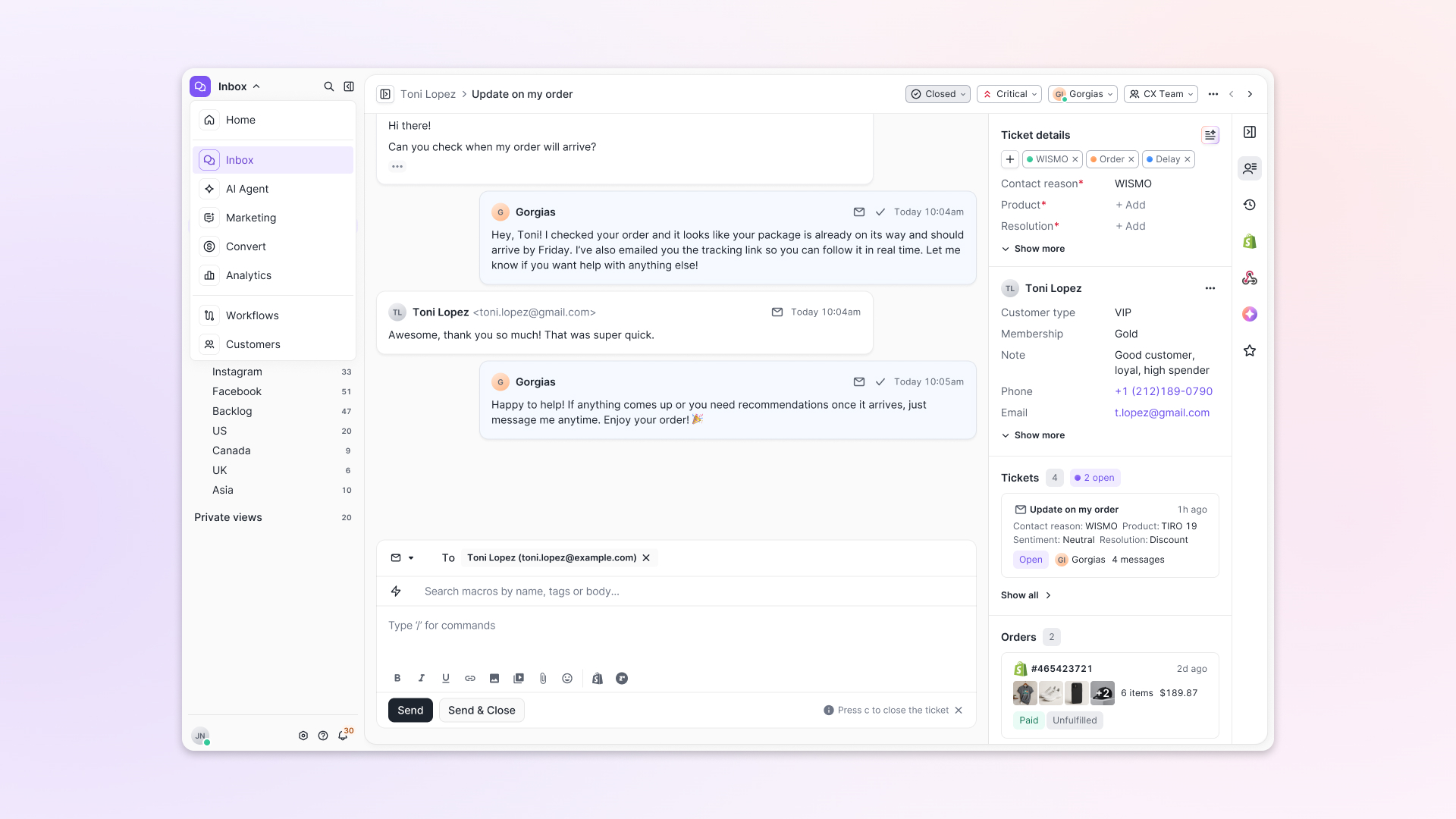
Introducing Helpdesk 2.0: Built for How Agents Work
TL;DR:
- Built directly from agent feedback, Helpdesk 2.0 fixes real workflow pain points. The redesign focuses on reducing friction and helping agents handle more context-heavy tickets.
- A chat-style interface replaces the old email layout. Conversations are easier to follow and resolve in one view.
- Customer context is shown beside the conversation in a right-side panel. Agents can view history, orders, and details without leaving the ticket.
- AI handoffs come with clear summaries. Agents instantly see what happened, what was tried, and what to do next.
- Navigation is simpler and faster across teams. Clean menus, structured queues, and multi-store access keep agents moving efficiently.
Helpdesk 2.0 starts with the people who use it most: the agents.
We spent time understanding customer support from the agent's seat. What do they reach for constantly? What slows them down? What does a better workday look like?
Everything we found is in this brand-new update.
Why we redesigned Helpdesk
Conversational commerce is the new standard.
In customer support, this means customers expect context to remain intact wherever they reach out, whether a conversation starts on social, moves to email, or ends on a call.
This new approach to support has also changed the agent's role. Recurring tickets, like order status checks, shipping updates, and returns, are now handled by AI. What lands in the agent inbox are edge cases that require human judgment and troubleshooting, or tickets that require the full picture.
However, the original Helpdesk was built for a different era of support.
Context was separated across views rather than built into the conversation itself. It's something one in five Gorgias customers flagged, through support tickets, NPS surveys, and conversations with our team. So, we got to work.
Helpdesk 2.0 is the result.
What's new in Helpdesk 2.0
Here's a look at everything that changed.
Read conversations the way they're meant to be read
Conversations have a natural rhythm, one that’s already found in every messaging tool we use. We brought that same layout into the helpdesk.
Say goodbye to the 2000s email interface and hello to chat bubbles. This updated design changes how quickly you can orient yourself and resolve the ticket in one go.
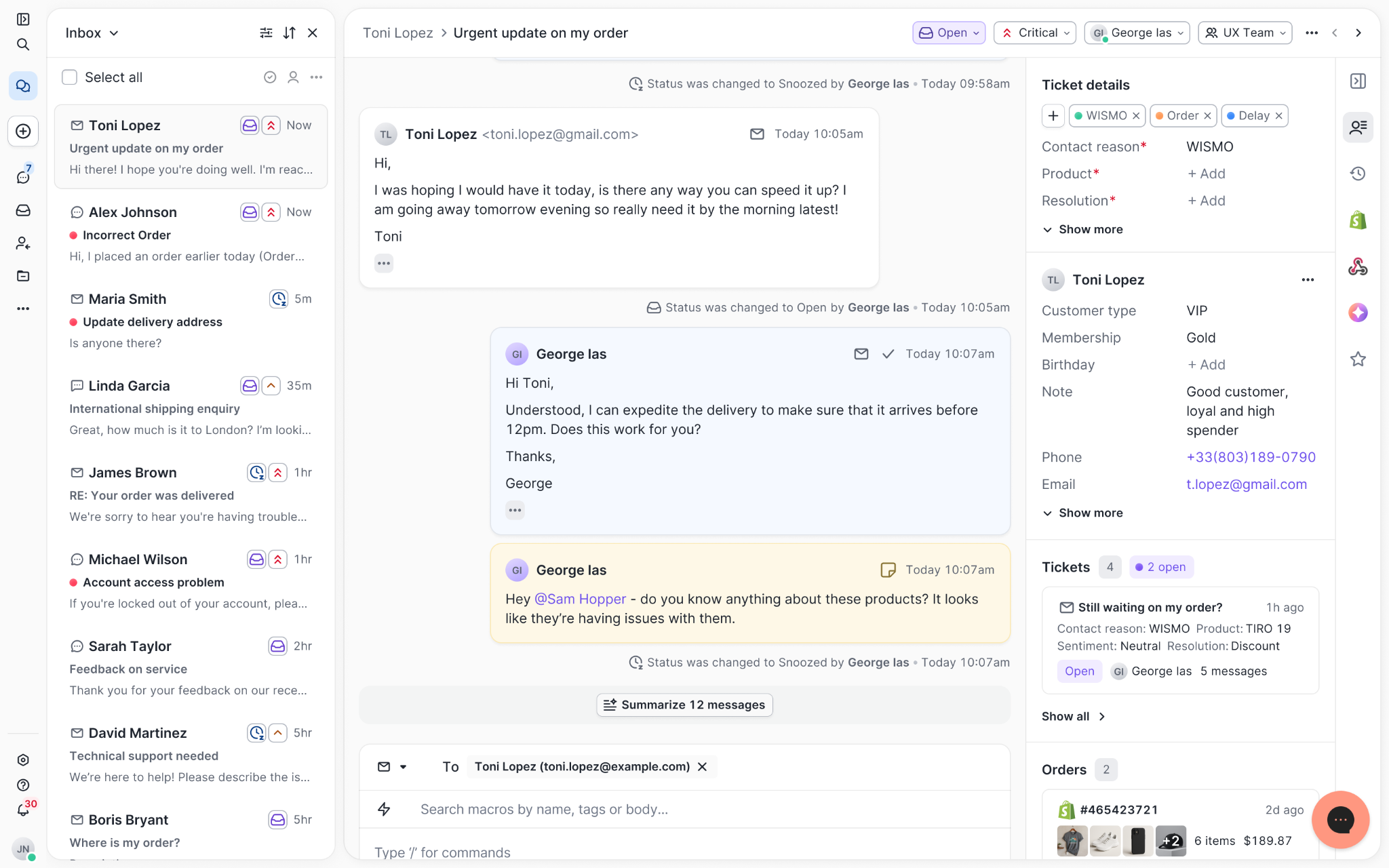
Chats with customers now look like real conversations, using the speech bubble style you’re familiar with on popular messaging apps.
Check customer history without losing your place
Checking a customer's history used to mean leaving the conversation, an extra step that interrupted what should have been a smooth workflow.
Now, past conversations open in a sidebar next to the active conversation. You can view a customer’s full history, search through their timeline, and open prior tickets without going to a new page.

Check past conversations, orders, and customer details in the brand-new Customer Timeline.
See order details the moment you open a ticket
Order information is easier to reference than ever. Open a ticket, and you instantly see the customer's recent orders, marked with product images and invoice details at a glance. Need to dig deeper? Click on an order, and the expanded information appears in the same panel.
For teams using custom integrations, apps are fixed in a quick-access integration menu on the right.
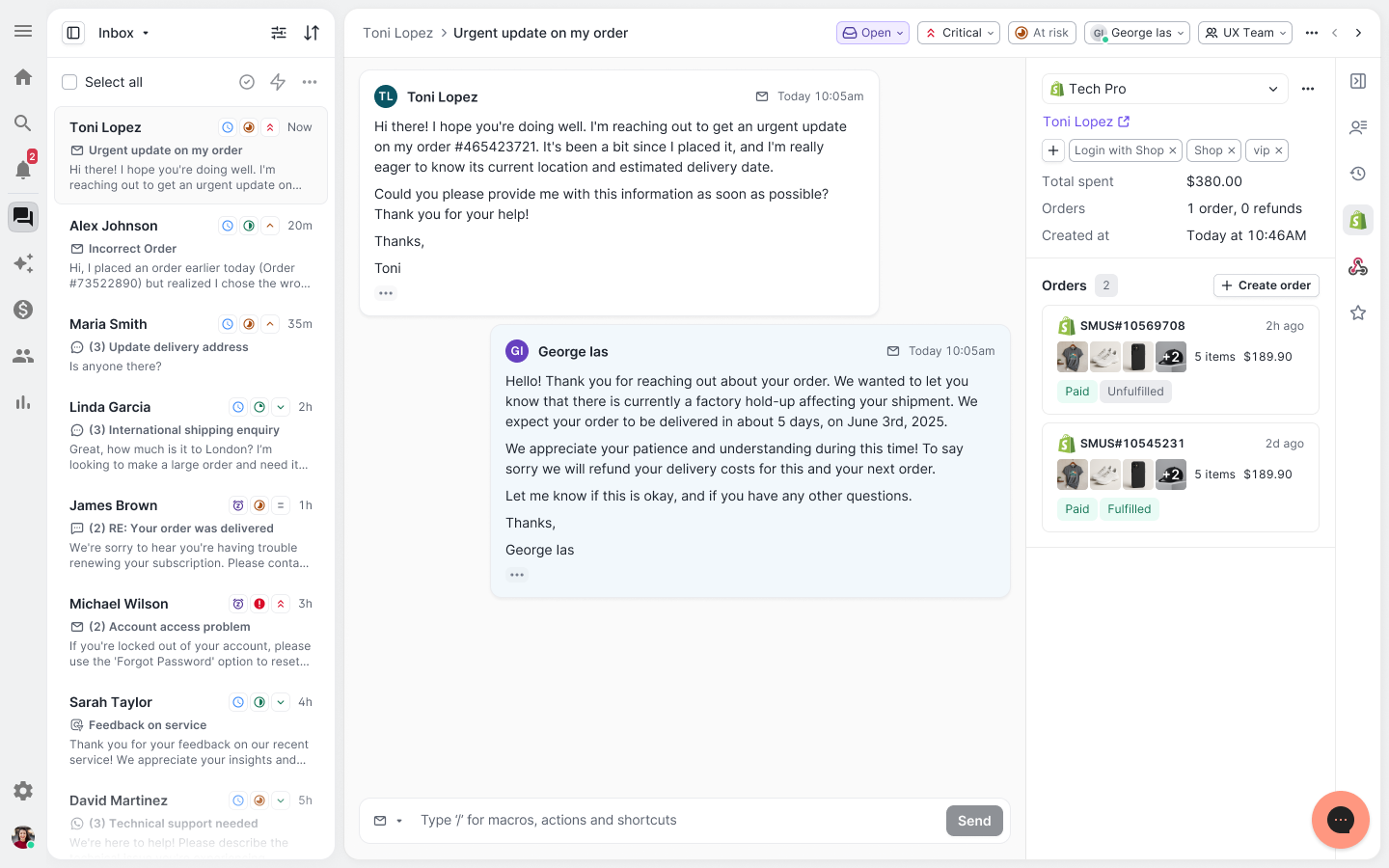
See order details, product images, and totals at a glance on the right panel, without leaving the conversation.
Pick up where AI left off
You shouldn't have to dig through a thread to figure out what AI already tried. Now you don't have to.
When AI Agent escalates a conversation, it includes a concise handover summary that mentions the issue, what actions were taken, and why it was passed to your team.
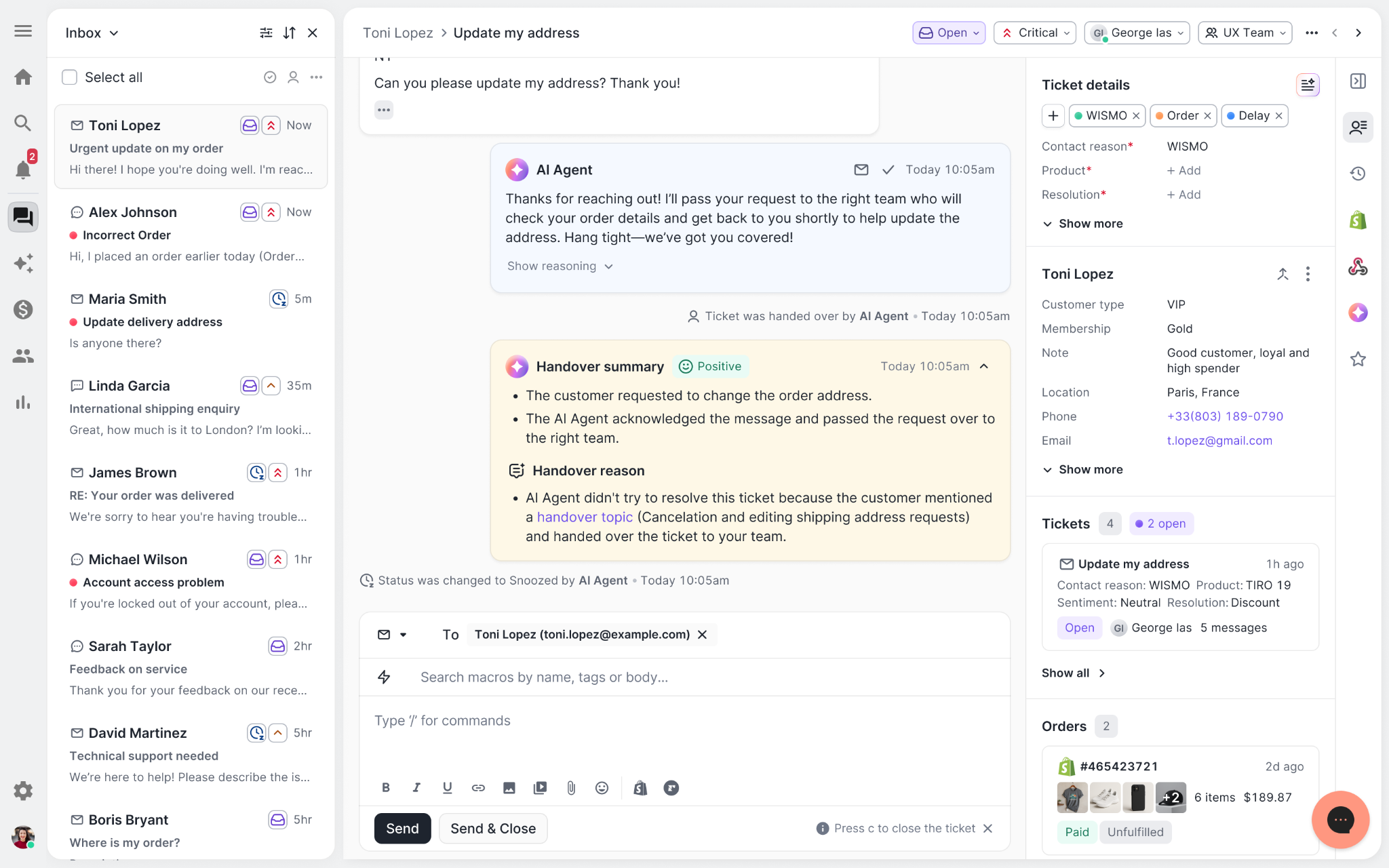
Escalated tickets include a brief AI-generated handover summary, marked in yellow, for quick reference.
Move faster across every store and team
We restructured and simplified the navigation. The left sidebar organizes everything into clear categories: Inbox, AI Agent, Marketing, and Analytics, so anyone on your team knows exactly where to go.
To quickly update your knowledge base or adjust a workflow, both now live right in the sidebar. For teams managing multiple stores, switching between them is just as straightforward, accessible from the sidebar, so agents can move between inboxes without breaking their flow.
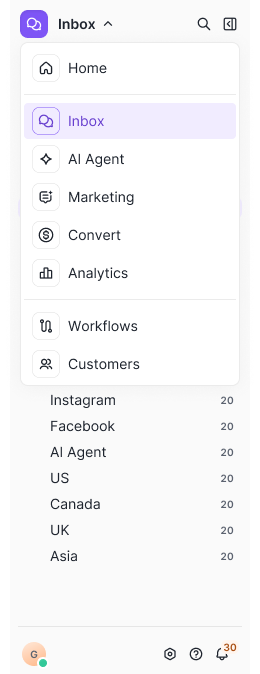
Agents can switch between stores and their corresponding inboxes directly from the left menu.
A workspace that works the way agents do
Support comes down to the person on the other end of the conversation. We built Helpdesk 2.0 is to make sure they have everything they need to show up for that moment.
The best way to see the difference is to work in it. Start a free trial today.


Further reading
.avif)
NPS Survey Best Practices for the Best Response Rate
Some hold up the net promoter score (NPS) as the holy grail of KPIs. While we won’t go so far as to declare it the most important metric of all, we will say that it is one of a few that is absolutely crucial to your brand and customer success.
That’s because you can learn a lot about customers when you dig into NPS feedback. What keeps customers happy, what upsets them, how you can boost retention, how to slow down churn — you name it, NPS can become a valuable feedback loop that reveals insights into all of these things and more.
That’s why we’ve created this guide. Read below to learn how to improve response rates to create a better, more accurate net promoter score.
{{lead-magnet-1}}
NPS formula and calculations
If you’re unfamiliar with net promoter scores, we have a detailed explainer on how to calculate NPS that will tell you everything you need to know. But for now, let’s have a quick refresher.
It all starts with asking your customers a simple question: On a scale of 0-10, how likely are they to recommend your offerings to a friend?
From there, collect these numbers:
- Promoters: People with scores of 9 and 10 who are likely to recommend you.
- Passives: People who gave 7 and 8 scores — not necessarily unhappy, just not happy enough to actively promote for you.
- Detractors: People who gave answers between 0 and 6. These people range from those unlikely to recommend you to those who will actively detract from you via word of mouth, bad reviews, or negative social media posts.
 |
Calculating your NPS is easy. Determine the percentage of promoters and detractors from the total number of responses. Then, subtract the detractor percentage from the promoter percentage for your score. So if you have 70% promoters minus 10% detractors, your NPS is 60.
 |
11 best practices to improve response rates in NPS surveys
Before making business decisions based on your NPS, you need the best possible dataset to work with. That means improving response rates to NPS survey questions creates a larger sample size — and below, we’ll show you the best ways to do that.
1) Choose when to send surveys: Lifecycle-based, transaction-based, and pulse checks
There are three great cadences to send out your NPS surveys:
Lifecycle-based surveys
These should trigger at certain moments of the customer’s lifecycle. They’re a great way to get customer feedback at key points of the customer journey.
This way, you can easily triangulate high-impact changes — for example, if NPS goes way up after customers receive an email with set-up instructions, consider making that information available earlier.
Other examples include:
- 30 days after signing up
- A year after signing up
- After a certain onboarding step
Transactional NPS surveys
A transactional NPS survey gets triggered by set customer interactions. Much like the lifecycle surveys above, this helps you collect customer feedback and take a temperature check where it matters most. In this case, after key customer touchpoints:
- In ecommerce, this will most likely be after a purchase or a subscription renewal
- In the SaaS world, it could trigger after a customer installs a new feature
Pulse-check surveys
Pulse checks are a bit different in that they survey your whole customer base all at once. You can use NPS surveys to gauge customer sentiment following a company rebrand, after a push to get new customer referrals, and so on.
Especially while conducting lots of customer research to ensure product-market fit, conduct pulse-check surveys with some level of regularity to maintain a healthy feedback look. Many companies do pulse checks twice yearly just to get a sense of customer sentiment across the entire customer base.
2) Only ask one question in NPS surveys (most of the time)
Where NPS surveys are concerned, less is more. The longer your survey, the lower the chances are that people will hang around to finish it. Sticking to one question can improve your response rate — and you want a great response rate because larger sample sizes will create a more accurate NPS.
So, what's a good survey response rate? There is no one clear answer because response rates can differ between channels (email surveys versus telephone or in-app surveys, for example) or based on how engaged your customers are with your brand.
However, good response rates can generally vary between 5% and 30%. If your response rate shoots up to 50% or more, you’re doing extremely well — and your customers are highly engaged.
While you want to keep your surveys brief, nothing says you can’t follow up with particular customers individually. In fact, you absolutely should follow up with customers who offer particularly interesting responses in your survey’s feedback section. Send out a more in-depth survey or schedule a 1:1 interview to discover the reasons behind their responses.
Here’s a great example of a one-question survey sent with NPS survey tool Delighted, plus a follow-up question made possible by Delighted’s integration with Gorgias:
 |
When to use multi-question surveys
There are a couple of limited cases when you can send out multi-question surveys:
- When you need deeper feedback on specific new products
- To get in-depth feedback from loyal customers who are willing to spend more time answering questions
Use these longer surveys judiciously to collect highly targeted information — and strive to keep them as brief as possible.
3) Always, always, always A/B test your surveys
A/B testing is a common marketing technique that has users compare multiple pieces of content to determine which pieces perform best. You can — and absolutely should — use A/B tests for your surveys, too. Doing so will help you optimize surveys to get the best response rate.
When you’re designing an A/B test, consider testing for the following:
- Email subject lines: (“Let us know what you think!” vs. “We want to hear from you!”)
- Number of questions (single-question vs. multi-question surveys)
- Delivery channel (email, in-app, after-purchase pop-up, etc.)
- Best time of day (morning, end of day, etc.)
- Best stage of the customer lifecycle (one day, week, or month after purchase)
- Testing by customer segments (repeat customers vs. first-time shoppers)
- Best time to test after an interaction (so the interaction still feels fresh)
Those tests will get you started, but feel free to add more as you spot areas to potentially improve.
4) Make your NPS surveys visual and brand-friendly
The first step to creating an attractive survey is to add visuals. Don’t rely on people typing in answers to questions. Use graphical buttons instead. Be sure to use your company’s logo in the design, and introduce your brand’s colors through borders and other elements.
Make it brand-friendly, too — whatever that means for your brand. If your brand gives off a sleek, posh vibe, then your net promoter score survey should do the same.
Rather than building these emails from scratch, consider using an NPS survey software with convenient templates. There are many great options, but we recommend Delighted — especially given its integration with Gorgias:
 |
Delighted does a great job of letting you brand the survey (using your logo and colors) without over-crowding the email and distracting the survey-taker from the main purpose of the email: Choosing an NPS score.
5) Consider offering a reward for filling out NPS surveys
Free swag is an excellent motivator, and so are discounts. Offer a little something extra in exchange for NPS survey responses, and you’ll likely see your response rate shoot up dramatically.
What can you offer? The sky's the limit. Create swag bags to send out to respondents or offer a limited-time promotional item. You can also offer digital gift cards or discounts, too.
The only issue with offering rewards is that it may not be sustainable. One great way to work around this is to set up a drawing or raffle, so that survey respondents have a chance at winning something awesome. It’ll be more affordable for your brand — and an attractive enough offer that more customers will leave feedback in exchange for a chance at the prize.
6) Add a comment box for customers to explain their numerical answer
NPS survey best practices include always making sure there is a comment box below the numerical survey question. Some customers won’t leave a comment, but some will. Use these comments to understand why your happy customers are so delighted with your offerings and why unhappy customers are less than thrilled with the experience you’ve offered.
If you use an NPS tool like Delighted, you can opt in to include an optional “Tell us more” box:
 |
7) Look deeper into your NPS and customer data to get the most valuable insights
Your NPS score is a valuable tool, but it will only get you so far. It’s essentially a measurement of how “loud” your promoters are compared to the detractors. Focusing too much on the relative volume of each group can be misleading.
For example, you may be tempted to invest a lot of time into rescuing your detractors, but think about this: Maybe the problem isn’t that your detractors are unhappy. Maybe they were never the right target market in the first place.
That’s why you need to dig deeper into the data behind your NPS score. You might find interesting patterns, like nearly all of your detractors live abroad or a huge percentage of your promoters bought the same product. That suggests perhaps you need an audience from closer to home.
- Dive into demographic patterns on Shopify or whatever ecommerce platform you use to learn about the characteristics that make up promoter, passive, and detractor groups.
- Keep track of feedback from comment boxes. Do detractors routinely mention shipping delays? Now you know where to start on improvements.
- Send out follow-ups to members of each group to see if you can learn more about the factors that drove their initial response.
8) Always send a follow-up message to thank customers who filled out the survey
Thank-yous are a fantastic way to build goodwill and customer loyalty. This step doesn’t have to be anything complicated, either. In fact, the CRM tools or survey templates you use to generate surveys should automate the thank-you process — either as a final screen of the survey or a separate email.
Ideally, your survey should pop up with a quick statement of thanks once the survey has been completed. Make sure to personalize the message — but keep it brief to ensure that it’s both seen and appreciated.
This is how a thank you message will appear if sent with Delighted:
 |
Less ideal — but still acceptable — is to send a follow-up email to say thank you. The problem with this method is that people aren’t always appreciative of inbox clutter — plus, there’s a chance customers may delete the email unread.
9) Just get started and aim for statistically significant sample sizes later on
Worried that your survey isn’t optimized to its fullest? Or that your customer base is too small to generate meaningful results? Set those fears aside and launch your NPS survey anyway.
The truth is, even small brands can get a lot out of comparatively few NPS responses. A/B testing your survey to optimize it is important — and it’s also something you can do to improve as you work through the process.
Now, if you’re a super small B2B brand with only a handful of customers, or a brand that is just starting, NPS scores may not be all that worthwhile. Instead, you may need to roll up your sleeves and dive in to ask for feedback the old-fashioned way: with phone calls or messages directly to your point of contact.
10) Test your survey before sending it to customers
We’ve talked about the importance of A/B testing — but what about regular beta testing? It’s an easy and crucial step that ensures an easy-to-use survey tool for your customers.
Just have a handful of people at your company so they can click all the buttons and check various features. Request feedback on the design, and be sure to load the survey on mobile and desktop platforms, too.
Testing the technical aspects of your survey is especially important if you have any sort of automatic personalization. If you use a tool like Retently, for example, send a few test emails to different recipients to make sure the personalization is accurate:
 |
💡Tip: If you use Retnetly, you can integrate with Gorgias to follow up with customers — like winning back unhappy customers or inviting happy customers to a referral or loyalty program.
11) Think beyond the surface of the results
Up above, we mentioned that sometimes you learn important things about your target market based on your detractors — and that’s why you should always look beyond the NPS score itself. Do a deep dive on your detractors to really analyze what is happening. Examine demographic information and pay close attention to any comments they leave.
For example, do you have a large group of detractors who love your product but are unhappy with customer support or your website experience? This might indicate that your customer service team needs additional training or managerial support, which is a straightforward fix to raise your score. Or what if all of your detractors share certain characteristics, like age, income level, and geographical region? It could mean that this subset isn’t your product’s target market, and you’ll be better off re-targeting your product.
Find out how Gorgias helps ecommerce brands increase their KPIs
Ready to boost your NPS? Gorgias makes it easy. It’s customer support software specifically designed for ecommerce, built to integrate with the ecommerce tools (like NPS email software) you already use.
On top of NPS, you can facilitate follow-up questions, automate thank-you emails, and get a real-time view of other statistics like customer satisfaction (CSAT), average response times, and resolution times.
{{lead-magnet-2}}
To learn more, sign up here and check out everything Gorgias offers.
.avif)
Post-Purchase Behavior: Understand How Customers Think & Boost Loyalty
When a shopper places an order, the second phase of customer acquisition begins: Turning new customers into repeat customers. Return customers generate 300% more revenue over first time buyers on average, according to data from 10,000 ecommerce brands.
So, what kind of post-purchase behavior leads to long-term loyalty? Ideally, your customers follow up purchases with:
- Leaving positive reviews and CSAT scores
- Signing up for a customer community or participating on social channels
- Introducing friends and social followers to your brand and products
- Engaging with follow-up marketing email campaigns
- Making repeat purchases with the help of product recommendations or a generous loyalty program
Below, learn more about the psychology of your shoppers once they place an order, and get tactics to improve your brand's post-purchase experience.
{{lead-magnet-1}}
What is post-purchase behavior?
Post-purchase behavior is the set of actions customers take after purchasing an item. Post-purchase behavior can be positive (repeat purchases, raving fans), negative (poor reviews, excessive returns), or neutral (transactional purchases, simply using the product).
Why is it important to understand post-purchase behavior?
Post-purchase behavior matters because making the first sale isn’t the finish line. It’s the beginning of a race to win long-term, loyal customers: people who repeatedly return to your store, have a high customer lifetime value, buy more from you (increasing cart size and transaction value), and send new customers your way.
Gorgias’s data shows that while repeat customers make up 21% of all customers, they bring in 44% of revenue.

What is post purchase dissonance?
Post-purchase dissonance, or what’s also known as “buyer’s remorse,” is when an otherwise positive purchase experience creates cognitive dissonance in the form of discomfort or other negative feelings.
Usually, customers experience post-purchase dissonance when you don’t give enough information about:
- Order confirmation: “Did it go through?”
- Shipping: “When it arrive on time?”
- The product: “How do I set this up?”
- Returns: “Am I stuck with it?”
This often, understandably, dampens positive post-purchase behavior. On the other hand, a great post-purchase experience and strong customer service and support can drive positive post-purchase behavior, including brand loyalty.
{{lead-magnet-2}}
13 ways to provide a pleasant post-purchase experience that leads to more sales
Happy customers tend to become repeat customers. Focusing on creating a positive post-checkout process can increase customer satisfaction, bolster your repeat customer rate, and build customer loyalty.
Here are 13 ways to anticipate what your customers may think after clicking “Confirm order” and how steer your customer’s post-purchase behavior.
1) Do some audience research before getting started
Consider: What metrics are we optimizing for?
The first step in encouraging positive consumer behavior through a thoughtful post-purchase experience is understanding what you want your customers to do. Then, take a look at who they are, what they care about, and how they behave. The key is to fully understand your brand’s customer journey. This will help you craft a better experience for them that’s based on real learnings about your business.
“The first question brands should ask is, what kind of post purchase activities do you want to drive differently,” Bri Christiano, Director of Support at Gorgias, says. “And, who are you really targeting? That's going to dictate what your main metric is, and it’ll determine where you focus.”
After you have a top-level understanding of the kinds of results you want to see overall, you can drill down into the specific activities that will be effective, like timely email sends.
2) Immediately send an order confirmation email
Customer sentiment: “Did my purchase go through?”
In order to ensure a stress-free purchase process for your online store, send shoppers a confirmation email so they can confirm that their transaction went through.
Include details like their order number, the shipping destination address, payment method, product details (in case of an order mistake), and the total cost including any promotional discounts.

Caption: Gorgias customer Printfresh sends a thorough post-purchase email that includes all important order details.
💡Tip: Bri recommends sending timely emails that “catch customers when they're interacting with your brand. Don't send random emails at times when you’re likely not top of mind. Then, add personalization when you can for goals that they have, if your brand aligns with that.”
Even better if your order confirmation email links to a clear and helpful order management portal where customers can track their order, report issues, and modify the order.

3) Set up self-service order management
Customer sentiment: “Shoot, I messed up my order. I need to change it, fast!”
Sometimes a customer realizes that they didn’t make the right decision about an order, or legitimately made a mistake.
Giving customers the opportunity to cancel an order themselves before it ships gives them peace of mind and allows them to correct their mistake in time without having to wait to send in a return. Using a helpdesk like Gorgias, customers can use self-service order management in chat or in the Help Center to cancel a recent order.

If you do require customers to write into support (or if customers bypass your self-service options), set up a ticket prioritization system to surface those urgent tickets before it’s too late. Ensure that your support reps can do a quick information search to find the order and change or cancel it quickly.
Here’s an example of a Gorgias Rule that automatically tags tickets about order cancellation requests from orders within the last two days, so your agents can confirm the cancellation before the order is shipped:

4) Be transparent about shipping times, carrier information, and customer service information
Customer sentiment: “When will it get here?”
Retail disruptions have reached 59% or higher over the past couple of years. With supply chain issues and shipping delays, giving people as much information as possible about how and when their purchase will reach them helps better meet customer expectations.
Plus, questions about order status make up a large chunk of customer service requests. So, preemptively providing this information can help reduce the number of those repetitive tickets that don’t actually require a human touch.
Offering real time order tracking information (ideally, without making customers jump through hopes) provides transparency, sets expectations, and allows customers to stay up to date with any order delays or changes without having to reach out to customer support.

📚Recommended reading: Check out our post on how to offer real-time order tracking for more strategies.
5) Enhance the “unboxing” experience
Customer sentiment: “A package! I hope I love it.”
Every moment, from the moment a shopper makes a purchase to when they unwrap your product for the first time, should build anticipation. Creating a fun and creative unboxing experience will help.
Stationary brand Ohh Deer and its subscription program Papergang sends visually stunning packaging, especially for its monthly boxes. These fun, “keepable” boxes spark joy, can be reused or gifted, and create an overall positive experience that customers can look forward to.

To get started, take a look at brands like Arka or Fantastapack, which provide custom options for enhancing your packaging.
6) Have an honest and forgiving return/refund policy
Customer sentiment: “What if I don’t like it?”
When customers inevitably experience hiccups in the order process, the goal is that their behavior is constructive and positive, rather than angry and combative. To get that kind of post-purchase behavior, you need to offer easy paths to contact customer support and a smooth return or exchange process.
Customers love the peace of mind of knowing that they can return something without hassle, even if they never have the need. Communicating that returns are easy (and free, if you can manage it) upfront can even encourage shoppers to convert.
Still, solely-online retailers can be tricky for consumers. Many are hesitant to make a purchase decision on items that they can’t see in person first. To address that concern, share your returns process and policy in every order confirmation email and in FAQs and the Help Center on your website.
Mattress company Casper created an easy and generous return policy that’s a gold standard for ecommerce: If you don’t like your mattress, tell them within 30 days, and they’ll cover shipping for a free return. With something as bulky as a mattress, free return shipping can eliminate any concerns about not liking such a big investment.

A returns tool like Loop can really help you optimize the product so customers don’t have to jump through hoops to return a product:

7) Encourage exchanges over refunds
Customer sentiment: “I don’t love it. Should I get my money back?”
Encouraging shoppers to make an exchange keeps them around as a customer and also allows you to keep the revenue from the sale, which will help with your bottom line. According to returns tool Loop, “Turning refunds into exchanges is 10x more impactful than reducing return costs.”
Loop incentivizes returns by offering customers slightly more in-store credit than they would get for a refund:

Shopify stores that use Loop for their returns see a 15% reduction in returns on average. If you use Shopify or Gorgias, it’s easy to integrate Loop as an impactful return/exchange tool.
8) Provide detailed instructions on how to use the product or service
Customer sentiment: “It’s here! How do I set it up?”
Devices or tools that arrive with no or unclear instructions, DIY furniture assembly that seems nearly impossible, or even complex software tools with poor onboarding can cause a less than positive experience, even if the end product is great.
Create a simple YouTube video, send clear step-by-step instructions with images, or share a live chat hotline customers can reach out to if they get stuck. These options make it easy for people to get all of the information they need to set up or use the product or service they just purchased successfully.
For example, GEN3 e-bikes come with a paper manual for assembly, but they also send a QR code (using a QR code generator like Beaconstac) that takes shoppers to a short, high-quality how-to video that’s less than 5 minutes long.
9) Send a CSAT survey and request product reviews from high scorers
Customer sentiment: “This is seriously (un)cool.”
Brands usually send a customer satisfaction (CSAT) score after a customer has interacted with customer support. Consider only asking for product reviews from people who score 4 or 5 on CSAT and leave positive feedback about their interaction with support.
If you use a helpdesk like Gorgias, you can likely send these kinds of CSAT surveys automatically after conversations, purchases, and other kinds of transactions:

📚Recommended reading: Our Director of Support’s guide to improving CSAT score and survey response rate
10) Include relevant product recommendations
Customer sentiment: “Loved it! What else do they have?”
The time when shoppers are still deciding on a purchase is a prime opportunity for your support team to cross-sell or upsell them on additional items.
For example, a customer might have trouble finding an item on your website that they saw on social media. Or, they might ask for recommendations for what to purchase or for items that will go best with the item that they already bought from you.

After a purchase is complete, consider surfacing additional product recommendations for customers via email. Even if these don’t result in an immediate second sale, you keep customers engaged and thinking about how that recommended item would improve their lives or enhance the use of the current item they have.
11) Incentivize customers to show off their purchases on social media
Customer sentiment: “This product’s the best — everyone needs it.”
Providing discounts or other perks in exchange for social media shares and reviews brings more exposure to your brand and enhances the post-purchase experience for your fans.
Underwear brand Parade runs a program like this called Parade Friends. Existing customers apply for the program, and once accepted, post pictures of themselves wearing Parade items on social media. Their followers can then use their Instagram handle as a discount code, incentivixzing future purchases (with a discount for customer delight).

That means that both parties benefit, which makes them happy, and you benefit by bringing in new customers and more revenue.
12) Build a community for your customers
Customer sentiment: “I love this brand! Where can I find more?”
For many brands, community drives customer perception of the brand — and drives future sales. Brands have leveraged Facebook groups, Reddit forums, Instagram Live, and more to encourage community among their customers and fans.
For example, soap shop Dr. Squatch hosts its community on Discord, a community-based social and chat platform, so its customers can hang out with each other and chat about the brand.

Creating a community can increase customer engagement and satisfaction, generate trustworthy, quality customer feedback about your products, and make more opportunities for cross selling and upselling.
📚Recommended reading: What is Ecommerce Community Management and Why Does it Matter?
13) Follow up with special offers and marketing sequences
Customer sentiment: “Which brand was that again?”
Inevitably, your brand won’t always be top of mind for customers, even if they absolutely love it and your products. This is where a thoughtful marketing strategy comes in, and where email automation can be really effective.
Set up automated flows that offer personalized product offerings, discount emails based on customer behavior, target returning customers, and ask for feedback.
📚Recommended reading: 8 Ecommerce Email Automation Series for Online Stores
Encourage great post-purchase behavior with Gorgias
Turning first-time customers into repeat, loyal, raving-fan customers takes meticulous attention to the customer experience, especially in the post-purchase window. This is where Gorgias shines.
Ultimately, getting the ideal post-purchase behavior starts — and ends — with delivering a great customer experience, especially in the post-purchase evaluation phase. Gorgias delivers a powerful platform for your customer service helpdesk, tailored to the needs of ecommerce businesses who want to deliver an exceptional customer experience.
Gorgias offers powerful features that drive ecommerce success, including:
- Ticketing system
- Live chat
- Self-service order management
- Intent and sentiment detection
- Data analytics
- Powerful macros and automations
See how Gorgias can transform your customer service efforts. Sign up now!
.avif)

Shopify vs Shopify Plus: Which Version is Right for You?
Quick summary:
- Shopify Core plans are ideal for small and midsize businesses, while Shopify Plus caters to larger enterprises with around $1 million in gross merchandise value (GMV).
- The primary difference between Shopify and Shopify Plus is pricing. Shopify Core plans range from $5–$399/month while Shopify Plus starts at $2,000/month.
- Shopify Plus provides more storefront functionality, unlimited staff accounts, merchant support, lower transaction fees, B2B selling capabilities, and more overall features.
Choosing the right ecommerce platform to host your online store is no small decision, but sometimes it's hard to know which option is right for your business. Shopify and Shopify Plus are two platforms that get a lot of buzz within the ecommerce community, and many store owners give them rave reviews.
What’s the difference between the two, and which plan is best for your ecommerce store? The main difference is that Shopify is for small and midsize businesses (SMBs), while Shopify Plus is for larger, or even enterprise-level businesses.
Below, we’ll discuss what each plan offers before diving into pricing structures and key differences between Shopify and Shopify Plus. Whether you’re considering upgrading to Shopify Plus from the regular Shopify plan or migrating from another ecommerce platform (like BigCommerce or Magento), read on to understand which option is right for you.
{{lead-magnet-1}}
What is Shopify?

Shopify is an ecommerce platform that offers businesses a way to promote, sell, and ship their products. It’s widely recognized as being great for beginners, meaning that the learning curve for new ecommerce store owners is minimal, and provides a level of customization that most small businesses find attractive.
Key features of Shopify
- Shopify point of sale (POS)
- Online sales channels
- Security features
- Mobile functionality
What is Shopify Plus?

Shopify Plus is a Shopify upgrade designed for large enterprises making high-volume sales that total around $1 million in gross merchandise value (GMV). The higher price tag unlocks more storefront functionality, automations, support, and integrations than core Shopify plans.
Key features of Shopify Plus
- Allows up to nine storefronts
- Customizable checkout
- Unlimited staff accounts
- Access to a merchant support manager and 24/7 support
- Lower transaction fees
- Allows B2B selling
Pricing: Shopify vs. Shopify Plus
The main difference between Shopify and Shopify Plus lies in pricing, which is tailored to accommodate the unique needs and budgets of merchants.
Core Shopify plans cater to small to midsize businesses (SMBs) and has fixed pricing plans with the cheapest starting at $5/month. In comparison, Shopify Plus is made for larger enterprise businesses, starting at $2,000 per month and is customized to each merchant via quote.
Let’s take a closer look at the breakdown for each plan within Shopify and Shopify Plus.
Shopify pricing
Shopify has five plans depending on your online store requirements and the size of your team.
- Starter: $5 per month
- Basic: $39 per month
- Retail: $89 per month
- Shopify: $105 per month
- Advanced: $399 per month
It’s important to note that all standard Shopify plans are subject to online and in-store transaction fees, as well as non-Shopify payment fees.

Related: Our comparison of Magento and Shopify for ecommerce merchants
Shopify Plus pricing
Shopify Plus pricing plans can only be determined via quote but start at $2,000 per month, plus a percentage of your store’s monthly sales volume. This enterprise-level commitment comes with additional transaction fees, online store development, site launch, third-party services, and add-ons.
Shopify Plus doesn’t provide flat pricing plans. Instead, you will need to contact a Shopify Plus sales representative to receive your quote.
9 key differences between Shopify & Shopify Plus
Understanding the main differences in the two options is essential to make the best choice for your ecommerce store.
Below, we’ve identified nine ways Shopify and Shopify Plus differ from each other, and what these differences mean for your business.
1) Shopify Plus gives you access to merchant success managers
One of the benefits of Shopify Plus is that users have access to the merchant success program. This exclusive program lets Plus users connect with merchant success managers (MSMs) to optimize their Shopify Plus experience.
Here are a handful of ways MSMs support merchants:
- Assist you through the setup process, including domain setup, building product collections, redirects, and more
- Suggest industry best practices and tools to streamline your operations
- Quickly redirect technical issues to other Shopify teams
- Provide ongoing support
Note: Plus users do not get a dedicated account manager, but they have direct access to a team of MSMs who are available to solve their business needs.
2) Shopify Plus unlocks access to Shopify Plus Academy
Shopify Academy is an educational resource hub full of advanced resources — like courses and webinars — that helps merchants improve their store’s design, marketing, operations, and more.
For merchants interested in self-guided education, the information on Shopify Academy’s information serves as a supplement to your merchant success manager to gain the knowledge you need to grow your store.
Here are a few titles you’ll find in Shopify Academy:
- How to Drive Sales with your Customer Support Team with Gorgias: Explore strategies for enhancing conversion rates by using the ecommerce helpdesk Gorgias.
- Sell in China with Social Media: Great for merchants pursuing internationalization
- How to Optimize your Page and Site Speed: Great for merchants who want to improve load speeds through backend optimization
- Shopify Tools to Accelerate Your Social Commerce: Great for merchants looking to drive sales and reduce shopping cart abandonment while selling on social media
Related: Our list of the best customer service courses and certifications
3) Shopify Plus gives you in-depth control over your checkout
Between Shopify and Shopify Plus, there is one major difference concerning checkout: The checkout page is customizable on Shopify Plus via checkout extensibility, while the checkout page on core Shopify plans are limited to their selected Shopify theme with no additional customization options.
Exclusive to Shopify Plus merchants, checkout extensibility is a code-free feature that allows checkout pages to have completely custom UI and content. This ability to personalize the checkout experience gives online businesses the power to greatly reduce cart abandonment and transform hesitant shoppers into customers.
On core Shopify plans except Shopify Starter, merchants can use Shopify apps to give their checkout page minor modifications to the backend logic and post-purchase experience.

Related: Our Shopify SEO guide to standing out amongst the competition
4) Shopify Plus offers unlimited staff accounts
Depending on which pricing option you choose, you can add between two and 15 users to your standard Shopify dashboard (in addition to your owner profile). Stores on the Starter plan are allowed two staff accounts.

On the other hand, Shopify Plus offers unlimited staff accounts, allowing large teams access to their online store dashboard. This inclusivity allows effortless collaboration within the team when integrating order management and helpdesk tools like Gorgias. When teams combine Shopify Plus with Gorgias, they get:
- Streamlined customer interactions: Gorgias helps Shopify Plus users enhance customer service by consolidating all support requests, order details, and customer data in one platform.
- Improved order management: Shopify Plus users can efficiently find all relevant order information in the Customer Sidebar, automate responses with Macros, and speed up workflows with Rules.
- Scalability: Shopify Plus's unlimited user accounts combined with Gorgias's robust automation features make this combination ideal for rapidly growing businesses.
5) Shopify Plus allows more API integrations
The App Store is one of Shopify’s most enticing features. There are well over 8,000 paid and free Shopify apps in the new app store. Shopify itself is responsible for creating only 34 of them to date, but there are hundreds of other third-party app solutions from everything including marketing, order management, store design and customer support.
Notably, this enables easy integration with ecommerce apps like Gorgias, an excellent Shopify app for customer service and order management. You can elevate customer support with Macros, streamline order processes, and enhance the overall efficiency of your store on both a standard Shopify plan or a Shopify Plus plan.
However, Shopify Plus merchants have much more flexibility when it comes to API integrations. These users can integrate their ecommerce store with their existing ERP or CRM systems, which standard Shopify stores cannot.
A few examples of Shopify Plus API solutions include:
- Gift Card: Create unique gift cards that work in the Shopify POS
- Multipass: Unite customer logins for your forum, website, and online store
- User: Retrieve information about staff permissions on Shopify
Related: The best 40+ Shopify apps to optimize your ecommerce store
6) Shopify Plus has lower transaction fees
Shopify payments are straightforward. Transaction fees are laid out as percentages of the total order volume. The Shopify POS includes a free credit card reader, which conveniently integrates your online and offline sales, no matter which plan you are on. But, what are the differences between Shopify and Shopify Plus’ payment processing and transaction fees?
Standard Shopify Transaction Fees
For businesses using Shopify’s integrated payment system, Shopify Payments, there is no transaction fee as of May 2022. If your business uses an external payment gateway, transaction fees are as follows:
- Shopify Starter: 2%
- Shopify Basic: 2.9% + 30 cents
- Shopify: 2.6% + 30 cents
- Advanced Shopify: 2.4% + 30 cents
- Shopify Retail: 2.7% + 30 cents
Shopify Plus Transaction Fees
Like core Shopify plans, transaction fees are waived if your business uses Shopify Payments. However, for external payment gateways, transaction fees are as follows:
- Domestic: 2.15% + 30 cents
- International/Amex: 3.15% + 30 cents
7) Shopify and Shopify Plus have different promotional discounts
Shopify is designed to set ecommerce merchants up for success. During the checkout process, your page needs to be optimized for high conversion rates. Luckily, promotional discounts can help you achieve just that. Want to run flash sales and seasonal price reductions? Here’s how your ecommerce business can make it happen with Shopify and Shopify Plus.
Standard Shopify Plans’ promotional discount options
There are probably hundreds of apps in Shopify’s add-on marketplace that can help you create discounts to entice your shoppers. Standard plans include the ability to easily create discounts from inside your dashboard. In addition, you can enable shoppers to redeem in-store discounts if you use Shopify’s integrated POS system.
What type of discounts can you create with a standard Shopify plan?
- Fixed-Value: Enable customers to redeem coupons with purchases, such as $5 off an order of $25 or more.
- Percentage: Provide shoppers with discount codes that give them a percentage off of their purchase.
- Shipping: Offer free or reduced shipping on certain orders.
- Buy X Get Y: Give a bonus or gift with specific purchases (available for online sales only).
After you run a promotional discount campaign, you can track its progress using the “Sales by Discount” report. Regular reports provide you with insights about which campaigns are working and which ones aren’t. Use real data to power your marketing campaigns.
Children’s vitamins brand, Hiya, takes advantage of the discount options available with Shopify by doubling-down. First, they offer 50% off first order then follow it up with free shipping. Both promotion types are executable via the discount portal.

Shopify Plus’ advanced promotional discount options
Take your promotions a step further with Shopify Plus. You can increase your cart value with Launchpad, exclusive to the Plus platform. The system automates most aspects of promotional campaigns, discounts, flash sales, and product releases.
Planning and executing an online sale usually involves tedious manual processes. When running a campaign this way, it’s difficult to make real-time optimizations to your campaigns. The add-on makes it much easier, reducing the amount of time spent launching a campaign and the risk for human error.
Here’s what you can expect Launchpad to automate for you:
- Schedule new products and omnichannel campaigns to launch across multiple sales channels
- Generate predetermined discounts for specific products or entire collections
- Stack multiple discounts
- Create and update campaign themes
- Return pricing to normal on campaign end dates
Simba runs percentage discount campaigns for their online store. From a customer perspective, their campaign execution is comparable to that of Hiya above. But, as a Shopify Plus user, you can wager that they use Launchpad to automate the process rather than manually perform the tedious work.

Source: Simba
8) Shopify Plus offers more features for B2B selling
The regular Shopify plan comes with plenty of features that are sufficient for most small businesses and single-store organizations. But larger stores may find the following features and apps, which are only available for Shopify Plus subscribers, worth the higher price tag:
- Shopify organization admin: Manage multiple stores under one organization from a single login
- B2B on Shopify: Create a separate (but unified) Shopify storefront from wholesale customers
- Overview: Get top-level analytics for all the stores under your organization
- Users: Add additional users and manage login and editing permissions for your store
- Launchpad: Schedule and roll out events like promotions, restocks, and product drops
- Script Editor: Create personalized experiences with code that changes your store for certain customer segments
- Bulk Account Inviter: Ask large groups of users to activate accounts on your store (great after migration)
- Transporter app: Ingest customer, product, and other data into your store
- Shopify POS Pro: Sync your POS with your brick-and-mortar store and other stores under your organization
If you’re a Shopify store interested in expanding to B2B selling, you will need to contact a Shopify sales representative to upgrade your Shopify account.
9) Shopify Plus allows you to build custom storefronts with headless commerce
Shopify Plus offers access to headless commerce features not found in Shopify Core plans. With headless commerce, online stores can separate the frontend customer touchpoints from the backend, allowing custom storefronts and immersive shopping experiences. "Going headless" is an excellent choice for enterprise-level businesses aiming to scale, especially with dedicated developers on the team.

On the other hand, standard Shopify plans don't have access to headless commerce and rely on templates and themes for their online store designs. This limitation can be limiting for businesses in the midst of expansion as it restricts them from fully scaling their online presence.
Use Gorgias to grow your Shopify (Plus) store with great customer experience
Shopify and Shopify Plus both have tools to help you reach a bigger audience, scale your business, automate your processes, and stay competitive. If you're trying to decide which one will work best for you, think about the pricing structure that works best for your business, the customization and customer support you need, and the areas of the world you want to reach.
Regardless of your choice, consider how you’ll provide fast, helpful customer service to visitors of your store. Gorgias integrates with Shopify and Shopify Plus and is the only customer service platforms to receive the distinction of being a Shopify Plus Partner.
Want to know more about Gorgias’s centralized, automation-powered, and revenue-generating customer service solution? Yes, book my demo.
{{lead-magnet-2}}

Resolution Time: What It Is and How to Reduce It
TL;DR:
- Resolution time (also called time to resolution or TTR) measures how long it takes to fully resolve a customer support ticket from start to finish
- Faster resolution times improve customer satisfaction and retention, but only when you maintain quality
- Calculate average resolution time by dividing total resolution time by the number of resolved tickets
- Ecommerce brands should track resolution time by channel, ticket type, and complexity to set realistic targets
- Automate high-volume FAQs and order actions with an AI Agent to reduce resolution time without adding headcount
Resolution time measures how long it takes to completely resolve a customer support ticket from the moment they reach out until their issue is closed.
For ecommerce brands, this metric directly impacts customer satisfaction, retention, and revenue. Shoppers expect fast answers to urgent issues like lost packages or billing problems. Tracking resolution time helps you understand team efficiency, identify bottlenecks, and improve the overall customer experience.
This article covers how to calculate average resolution time and set realistic benchmarks by channel and ticket type. We'll also show you how to use tools like Gorgias to reduce resolution time without sacrificing quality.
What is resolution time?
Resolution time is a customer service metric that measures the total time from when a customer reports an issue until that issue is completely resolved and the ticket is closed. Also called time to resolution (TTR) or mean time to resolution (MTTR), this metric tracks the full lifecycle of a support ticket.
Resolution time includes all time spent on a ticket:
- Wait time before the first response
- Investigation time while agents research the issue
- Communication time across all back-and-forth messages
Resolution time is different from first response time. First response time measures how long customers wait before getting an initial acknowledgement, while resolution time measures how long it takes to fully solve their problem and close the ticket.
Why resolution time matters for ecommerce brands
Faster resolutions improve CSAT and retention for online stores
Resolution speed directly impacts customer satisfaction and retention for ecommerce brands. When customers get quick answers to urgent questions like order status or return policies, they're more likely to complete purchases and shop again. Slow resolutions frustrate customers and increase the likelihood they'll abandon carts or leave negative reviews.
Fast resolution time signals to customers that you value their time. This builds trust and encourages repeat purchases, especially when combined with helpful, personalized support.
Reducing ART without hurting quality protects revenue and LTV
The goal is to provide efficient, accurate resolutions. Don't rush through tickets at the expense of quality. Low-quality fast answers damage trust and lifetime value because they often fail to fully resolve issues, leading to repeat tickets and escalations. Maintaining quality standards while improving speed ensures customers receive accurate, complete resolutions.
Customers who receive incomplete or incorrect answers may churn entirely. Balancing speed with thoroughness protects revenue by ensuring customers feel heard and their problems are actually solved.
How to calculate average resolution time (ART)
The ART formula is total resolution time divided by resolved tickets
Average resolution time = Total resolution time in a defined period / Total number of customer interactions resolved in that period
For example, if 3 tickets resolved in 2, 4, and 6 hours, your average resolution time is 12 hours ÷ 3 tickets = 4 hours. This simple formula gives you a baseline to track improvement over time.
Measure ART in business hours when you evaluate team speed
You can measure resolution time in business hours or calendar time. Business hours exclude nights, weekends, and holidays, giving you a clearer view of your team's actual performance during work hours.
Calendar time includes all hours and reflects the customer's experience of waiting. Customers don't care if it's Saturday. They still want fast answers. Track both views to get a complete picture.
Exclude reopened and non-support tickets to keep ART accurate
Clean data requires filtering out tickets that skew your average:
- Reopened tickets count as resolved initially, then restart the clock when reopened
- Non-support tickets like marketing inquiries or internal requests aren't customer service interactions
- Spam and test tickets should be tagged and excluded from reports
Tag and filter these categories to maintain accurate resolution time metrics that reflect actual support performance.
Track ART in Gorgias with built-in dashboards
Gorgias calculates and displays resolution time automatically, so you don't have to manually track timestamps or build spreadsheets. You can filter by channel, agent, and ticket type to identify where resolution times are fastest or slowest.
Gorgias tracks both business hours and calendar time, letting you switch between views depending on whether you're evaluating team performance or customer experience.

Orange represents average resolution time, while red represents the resolution time of the 10% of tickets that took the longest to resolve.
Benchmarks for resolution time and how to set targets
Most ecommerce brands target same-day email resolution
Email is the most common support channel for ecommerce brands. Same-day resolution (within 8 to 12 business hours) is a common target because customers expect email responses to take at least a few hours.
Complex cases like technical troubleshooting or multi-step returns may take longer than one day. The key is setting expectations upfront and keeping customers informed about progress.
Live chat and social DMs should resolve in under 10 minutes
Real-time channels like live chat and social media DMs require faster resolution because customers expect near-instant answers. Simple questions like order status or return policies can resolve in two to five minutes, while more complex inquiries should still close in under 10 minutes.
Customers choose these channels specifically for speed. If resolution takes longer than 10 minutes, they may switch to email or abandon the conversation entirely.
Voice support aims for one-call resolutions
Phone support should resolve issues on the first call whenever possible. One-call resolution (also called first-call resolution or FCR) reduces customer effort and saves time for both customers and agents.
Complex cases may require follow-up, but the goal is to collect all necessary information and provide a complete answer before ending the call. This prevents back-and-forth callbacks and improves satisfaction.
Set targets by ticket type, customer expectations, and seasonality
Not all tickets are equal. Simple FAQs like "Where is my order?" should resolve faster than complex technical issues. Segment your targets by ticket type and customer tier to set realistic goals.
Consider these factors when setting targets:
- Ticket complexity (simple FAQs vs. technical troubleshooting)
- Customer tier (VIP customers may get faster responses)
- Peak season volume (BFCM and holidays may require adjusted targets)
- Historical data showing your team's baseline performance
Review your data regularly and adjust targets based on customer feedback and team capacity. What worked in January may not work during holiday peak.
Factors that influence resolution time
Issue complexity is the biggest driver of ART
Issue complexity determines how long tickets take to resolve. Simple questions like "What's your return policy?" can close in seconds with a templated response, while multi-step technical troubleshooting requires investigation and back-and-forth communication.
Complex issues aren't a problem. They're an opportunity to provide high-quality support. The key is automating simple tickets so agents have time for complex ones.
Volume spikes and staffing levels shift ART up or down
High ticket volume during peak season increases wait times and resolution times because agents have more tickets to handle. Staffing levels also impact resolution speed — understaffing creates backlogs, while adequate coverage keeps queues moving.
Monitor volume trends throughout the year and adjust staffing during peak periods. Seasonal hires or flexible schedules can help maintain resolution time targets when volume spikes.
Agent training and knowledge access reduce investigation time
Well-trained agents resolve tickets faster because they know where to find answers and how to handle common scenarios. Easy access to knowledge bases and internal documentation speeds up resolution by reducing time spent searching for information.
Ongoing agent training also reduces escalations. When agents can handle more ticket types independently, fewer issues require handoffs to senior team members or other departments.
Tools and integrations shorten handle time and avoid tab-switching
Integrated helpdesks like Gorgias connected to Shopify let agents resolve tickets in one tab without switching between platforms. Integrations pull customer data, order history, and tracking information directly into the ticket view, eliminating manual lookups.
Automation and Macros reduce manual work for repetitive tasks. Lack of integration forces agents to toggle between tools, copy-paste information, and manually update systems, all of which inflate resolution time.
Cross-team handoffs and unclear processes inflate ART
Tickets requiring input from engineering, logistics, or third-party vendors take longer to resolve because of handoff delays. Unclear escalation paths create confusion about who should handle each issue and when to escalate.
Define clear handoff protocols to reduce delays:
- Document which team handles each issue type
- Set internal SLAs for cross-team responses
- Create escalation templates with all necessary context
- Track handoff metrics to identify bottlenecks
How to reduce resolution time without hurting quality
Automate high-volume FAQs and order actions with AI Agent
AI Agent instantly resolves common questions like "Where is my order?" and "What's your return policy?" without human intervention. It can also perform actions like canceling orders, sending return links, and updating shipping addresses.
Automation frees agents to focus on complex cases that require empathy, problem-solving, and personalization. Customers get instant answers to simple questions, and agents have more time for high-value interactions.
Deflect simple tickets with a self-service help center
A Help Center lets customers find answers before creating tickets. Self-service reduces ticket volume and speeds up resolution for remaining tickets because agents aren't overwhelmed with repetitive FAQs.
Gorgias Help Center integrates with AI Agent for seamless Self-service. Customers can search for answers, and if they still need help, they can start a conversation with an agent or AI without leaving the page.
Route and prioritize VIP and urgent tickets automatically
Automatic routing sends tickets to the right agent or team immediately based on channel, language, or ticket type. Prioritization ensures urgent issues or VIP customers get attention first, preventing high-value tickets from sitting in the queue.
Gorgias Rules automate routing and prioritization. For example, you can route all refund requests to your billing team and push VIP customer tickets to the top of the queue based on Shopify purchase history.
Equip agents with macros and Shopify actions to resolve in one tab
Macros provide pre-written responses for common questions, letting agents respond with a click instead of typing the same answer repeatedly. Personalization variables like customer name and order number make macros feel custom, not canned.
Shopify actions let agents edit orders, process refunds, and update shipping information without leaving Gorgias. One-tab resolution reduces handle time by eliminating platform-switching and manual data entry.
Create clear escalation paths for technical and 3PL issues
Some tickets require input from engineering, logistics, or third-party vendors. Clear escalation protocols prevent delays by defining who to contact, when to escalate, and expected response times.
Best practices for escalation:
- Document escalation criteria for each issue type
- Set internal SLAs for cross-team handoffs
- Create escalation templates with all necessary context
- Track escalation metrics to identify process gaps
How to measure and report resolution time in Gorgias
Use Gorgias dashboards to track ART by channel, agent, and intent
Gorgias dashboards provide built-in resolution time reports without requiring manual tracking. You can filter by channel (email, chat, social), agent, and ticket intent (WISMO, returns, pre-sales questions) to identify bottlenecks.
Segmented Views help you understand which channels or ticket types have the longest resolution times. This data guides where to focus automation or training efforts.
Set SLAs and alerting to enforce targets
Gorgias lets you define SLA targets for different ticket types and channels. Alerts notify agents when tickets are approaching or breaching SLA thresholds, helping teams stay accountable.
SLA tracking also helps managers spot capacity issues before they impact customer experience. If many tickets breach SLA targets, it's a signal to adjust staffing or improve automation.
Combine ART, FRT, and CSAT with support performance score
Resolution time is one of several key metrics that matter. Gorgias tracks first response time (FRT), customer satisfaction (CSAT), and resolution time together to give you a holistic view of support performance.
Track these metrics alongside resolution time:
- First response time (how long customers wait for initial contact)
- Customer satisfaction score (whether customers are happy with the outcome)
- Ticket volume and deflection rate (how much Self-service reduces load)
A holistic view prevents over-optimizing one metric at the expense of others. Fast resolution time doesn't matter if customers are unsatisfied with the answers they receive.
See how Gorgias helps ecommerce brands reduce resolution time with AI Agent, Help Center, and Shopify integrations. Book a demo to learn more.
{{lead-magnet-2}}

Templates and Tips to Respond to Frustrated Customer Emails
If you’ve ever worked in customer service, you know that unhappy customers are unavoidable. Customer satisfaction has plummeted since 2018, according to the American Customer Satisfaction Index.

That’s why top brands don’t wait until angry customer emails arrive to decide how to respond. By setting up processes and templates ahead of time, your customer support team doesn’t need to craft responses from scratch. Especially while emotions are running high and angry customers are waiting for responses.
Below, you’ll find step-by-step instructions on how to process and respond to angry customer emails, considerations for handling angry or rude customers without making the situation worse, and tips to prevent angry customers by improving your customer experience (CX). We'll also share templates and sample emails for how to respond to:
- Customers who are having product issues
- Customers with shipping and delivery problems
- Customers with missing or late orders
- Customers who got the wrong product
- Customers who have a cancellation request (purchase or subscription)
- Customers who want a refund or exchange
- Customers who had a bad support experience
- Customers with no clear reason to be upset
{{lead-magnet-1}}
Is it worth it to deal with angry customers?
When customers aren’t happy with your product, service, or customer support, the stakes are high. You could lose them as a repeat customer, but that’s just the tip of the iceberg. Angry customers also go and tell their friends and family, either by word-of-mouth, on social media, or via a Google review.

The Effortless Experience found that 96% of disgruntled customers who had a high-effort or bad experience with a brand feel disloyal to that brand afterward. In other words, a frustrating, high-effort experience will irreversibly damage your brand's reputation for almost any customer, whether they’re first-time or regular shoppers. That spells trouble for your bottom line.

Also, your customer service team doesn’t want to respond to nasty emails all day long. Customer service can already be an emotionally challenging role, and spending all day dealing with angry customers is a quick path toward burnout and quitting.
📚 Related reading: Read our guide to hiring A+ customer service agents, written in partnership with customer service agency Helpflow.com.
8 steps to take when responding to frustrated customer emails
Respond to angry customer emails by acknowledging the customer's frustration, owning any mistakes, gathering additional context, confirming you understand the entire situation, and fully resolving the issue.
These messages are high-stakes: When someone writes to your organization with an angry message, they’re angry enough to sit at their keyboard and express their anger. You’re lucky they wrote to you — the next message could be on a review website or social media.
You’re lucky they wrote to you — the next message could be on a review website or social media.
It’s imperative to respond to every single angry customer email — ideally with fast response times.
0) Set up automated responses if you can’t quickly respond
If you have a small team or are only online for certain parts of the day, consider setting up a standard automated reply to confirm receipt of their email. We listed this as step 0 because it’s not a catch-all solution: You should not send this kind of email if you’re able to provide a human response within an hour or two. Nobody likes an extra, unnecessary email.
If you do choose to activate this kind of response, it should:
- Confirm that you received the customer’s email so they don’t have to wonder if it went through
- Tell the customers when they can expect to receive an email response from a human agent
- Thank the customer for writing in
Here’s a mockup of how to create this kind of automated response with Gorgias Rules:

📚 Recommended reading: Get more tips and tricks to improve your response times.
1) Read the email first
This may seem obvious, but unless you address every point the customer makes, you’re only prolonging the correspondence and further irritating them.
It’s easy to overlook something the customer says, particularly if the email’s pretty emotive or raises several points. So, try to summarize what they’re complaining about in a separate text document or as a note on the ticket in your helpdesk.

Consider bullet-pointing each issue to ensure you answer every aspect of their message, as shown in the internal note above.
2) Do your research to understand the problem and context
Before responding, consider if there’s any research you can do on your end to resolve the issue faster. For example, if a customer asks whether an item will come back in stock, you may look up similar items currently available if that customer is in a time crunch (like for the holidays).
You’ll also want to ensure you have all of the context you need to provide a full resolution for that customer.
For example, if a customer is trying to track down a lost package, take a look at the package history and order date to better understand why they’re upset and whether you’ll need to re-send the item or reach out to the carrier on their behalf.
Ideally, your helpdesk has integrations with shipping software (like AfterShip) so you can see this information right next to the customer’s message (rather than having to navigate to a new tool).

3) Escalate if necessary (based on policy)
Some requests, whether from a VIP customer, the urgency of the issue, or its scale, need to be escalated right away. Based on the policy you’ve set out for your support team members, encourage them to forward major concerns to the correct team quickly.

📚 Recommended reading: Read our Director of Support’s guide to prioritizing customer service requests.
4) Thank them for writing
Yes, you've already done this in your automated message – but it doesn't hurt to do it again. So, always say thank you at the start of your email. You must acknowledge their complaint and show you care about their feedback.
For instance, if a customer has written to complain, you could start with something along the lines of:
Thank you for contacting [your company name] and letting us know about your experiences with our [insert name of the product/situation]. We appreciate you contacting us to let us know. We value customer feedback so that we can work to provide you with gold-plated customer service.’
5) Use their name and take a personalized approach
If you're not already, it's time to take a personalized approach to customer service. While this means taking a more holistic approach to the service process in general, the first step is to take note of small details, like using a customer’s name in correspondence.
Consumers crave a personalized experience; they want to be treated as individuals, not as just another support ticket. That means avoiding asking them for information they’ve already given you again. It also means using a customer support tool that provides all of their historical account information in one place. Your helpdesk should show all past orders, correspondence with support, shipping address information, and even marketing emails they’ve received and clicked on.
For example, Gorgias’ Customer Sidebar provides customer information right next to the ticket that can help you personalize the message.

6) Acknowledge their problem
If your customer has taken the time to bring an issue to your attention, it’s polite and good practice to acknowledge that. So, in your response, reflect on what they’ve told you.
For example, you could write something like this:
‘I can see that you’re frustrated [insert a suitable empathic summary of the customer’s feelings] about your experiences with our product/customer service. We can see how, on this occasion, we didn’t reach our normally high standards of delivery.’
7) Provide a solution
Always focus on solving the customer’s problem. Find a solution and clearly explain the resolution to the customer’s complaint.
For example, if they’re upset about a product’s quality or performance, you need to refer them to your returns and replacements policy. On some occasions, it may be necessary to escalate a complaint if it’s not within your power to resolve. In which case, again, follow the protocol your company has to handle the specific issue so that it complements your current chain of command.
According to a research study conducted by Gartner and later coined The Effortless Experience, 45% of customers who have a positive support experience tell less than three people. In contrast, 48% of customers with a negative experience shared it with over ten people.

While a positive, low-effort solution is a short-term expense for you, it could keep the customer on your side, netting future purchases or at least minimizing negative word of mouth and reviews.
8) Avoid offering the same solution twice
If a customer is still upset after you’ve already offered a solution, chances are it wasn’t the right one. Ensure that you’re able to give the customer a few different options for a resolution in case the original one didn’t work for them (or wasn’t the result they hoped for).
Of course, this should only go as far as your support policy states. If possible, tag in a customer service lead to see if you can make an exception to your policy. In a helpdesk like Gorgias, you can tag specific agents or an escalated team.

Considerations when writing responses to angry customer emails
Above, we covered the steps to follow when responding to angry emails. Below, we’ll share some high-level considerations to keep in mind when crafting responses.
Check your language and tone
Use clear language and show empathy. Always consider your audience. Remember, your audience doesn’t know your organization's internal workings or technical aspects.
Interestingly, 65% of online shoppers prefer casual over a formal tone in their customer service interactions. That said, if the customer isn’t happy with your response or solution, 78% said that an overly casual style would elicit an adverse reaction from them.
Why? Because it sounds like you're not taking their problem seriously.
Also, consider the words you use. For example, remove any uses of the “but” from your responses. By eliminating negative terms like this, you’ll exude more of a positive tone, which works wonders for altering perception.
For example:
“Thank you for contacting us, but we don’t provide that service.”
Vs.
“Thank you for contacting us. Unfortunately, we're unable to provide that service. We do, however, provide the following….”
See the difference?
Through practice and experience, you’ll be better positioned to sense your customer’s tone. For example, if the customer’s frustration radiates through their message, show empathy by offering reassurance and the right level of apology.
Check your grammar and spelling
There’s nothing worse than grammatical and spelling errors. Re-read your response and run it through a spelling and grammar checker. If in doubt, ask a colleague to double-check it for you.
Some reputable online spell checkers include Grammarly, Reverso, and Language Tool. Your organization may already have a subscription for marketing or other purposes, so check what’s available.
Decide whether they are frustrated or truly irate
The key to understanding whether a customer is truly angry is empathy and context.
Use empathy to dissect the tone and language a customer uses in their correspondence with you. Then, use the context they've given you and that you have about their order history to piece together their entire situation.
For example, a customer might write in about a lost or delayed package. Based on the language they’re using, and the fact that they paid to upgrade shipping to get it in time for a friend’s birthday, tells you that this customer is angry and in need of a fast resolution.
You should strive to provide top-notch support no matter if a customer is merely frustrated versus angry. But, your communication, time to resolution, and the solution you offer need to be even more considerate when dealing with someone who is truly irate.
Deal with profanity in a professional manner
Sometimes, angry or frustrated customers will use profanity when complaining about an issue. The best responses to rude customers involve focusing on what the problem is to help get them to a solution.
Some customer service phrases to use include:
- “I understand why you’re upset – I would be upset as well in this situation. We will figure out a solution that makes you happy and that fully resolves this issue for you.”
- “I understand how frustrating this must be, especially since it sounds like we really missed the mark here.”
- “I understand how disappointed you are. What kind of solution do you feel would make this right for you?”
17 email templates you can use to respond to different customer issues
You may already have a series of customer service email templates you and your team use to handle various customer complaints. However, it’s always worth doing a little housekeeping to ensure they reflect your commitment to great customer service.
This is especially true if your customer service software comes with a set of templates already in existence. Don't make the mistake of just using these as they are. Instead, personalize them to reflect your own brand’s voice and tone.
With that in mind, we’ve put together a summary version of some of the examples above to illustrate how to respond to an upset customer:
Dear [insert customer name],
Thank you for contacting us. I'm very sorry to hear you experienced poor customer service from the [insert your brand name] team.
It’s important to us that our customers are happy, so we're sorry we could not provide our usual high service standards to you.
Possible paragraph:
Having investigated your complaint about [insert a summary of the complaint]. I'm happy to tell you; we can offer you the following solution [insert an explanation of the answer].
Alternative paragraph:
We're currently investigating your complaint about [insert a summary of the complaint]. Because your complaint involves several departments/strands/suppliers, it will take us a couple of days to get to the bottom of why, on this occasion, you received less than a gold standard of service from us. Thank you for your patience while we investigate this matter. I'll get in contact with you in two days to update you on our progress.
Once the complaint is resolved, you could offer a discount to reduce the number of returns, which are more expensive to your business than exchanges:
We’d like to prove just how important you are to us by offering you a discount of [x%] on your next purchase.
Sign off:
Thank you for bringing this negative experience to our attention. Once again, I apologize for any inconvenience caused.
If there's anything else I can help you with or you have any further questions, please feel free to contact me.
Best wishes,
[Name and contact details]
If you use Gorgias, a helpdesk that deeply integrates with your entire ecommerce tech stack (including Shopify, Magento, and BigCommerce), feel free to use the copy above as a Macro (which is what we call templated responses).
Your agents can use the template as a starting point and tweak it to meet each customer's unique needs.
Below, we’ve put together a series of templates that you can implement for different angry customer situations.
Customers who are having product issues
1) General frustration with the product or experience
Hi {{Customer first name}},
Thank you for reaching out and letting us know about your experience with us. This is not up to our standard and I've passed this along to our team to ensure this doesn't happen again.
In addition, I've {{Insert policy: refund, added a credit, send a replacement, etc.}} to make this right.
We truly value you as a customer and apologize for the inconvenience this caused.
Please let me know if I can help with anything else.
{{Current agent first name}}
Customers with shipping and delivery problems
1) Order/shipping status (Where is my order?): Not shipped
Hello {{Customer first name}},
Thank you for reaching out! Your order {{Number of last order}} has been received and we are working on getting it shipped out. Our processing time to ship an order is 3-5 business days, excluding weekends.
We will email you a confirmation once it ships, which will include your tracking information as well.
If you have any questions in the meantime, please don’t hesitate to reach out.
Thanks,
{{Current agent first name}}
2) Order not shipped because the item is out of stock
Hi {{Customer first name}},
We wanted to let you know that your most recent order {{Number of last order}} is currently out of stock. We’re doing everything we can to get more in stock soon and we apologize for the delay!
The good news is that our next shipment should arrive by {{Date of availability}}, and you should receive your order within {{Number of business days}} once the item(s) gets to our warehouse.
Thanks for your patience! We’ll get you taken care of as soon as possible.
{{Current agent first name}}
3) Item arrived damaged
Hi {{Customer First Name}},
Thanks for reaching out about your recent order {{Number of last order}}. I’m sorry to hear about your experience. As we try our best to provide exceptional service, some factors like shipping and handling are out of our control and issues like this can happen.
Please send us a photo of the broken/damaged item(s) you received and we’ll do our best to resolve this as soon as possible.
{{Current agent first name}}
Customers with missing or late orders
1) Order is lost
Hi {{Customer First Name}},
Thank you for reaching out! I’m so sorry to hear that you were unable to locate the missing package. Rest assured we will remedy this situation for you.
I have two options to offer: we can ship a replacement to you or issue a full refund for the order instead. If you prefer a replacement order, we kindly ask that you confirm the shipping address of where you would like the replacement order sent. We look forward to receiving your reply.
{{Current agent first name}}
2) Order/shipping status (Where is my order?): Delivered, not received
Hi {{Customer first name}},
I'm sorry to hear that you haven't received your order yet. It does appear to be in a delivered status. Sometimes this can be due to an incorrect scan by the carrier. If the package doesn't show up in the next {{Insert the number of days according to your policy}} please reach back out and we will {{insert internal policy}}.
In the meantime, I've contacted the carrier and will be investigating on my end.
Please reach out if I can help with anything else and I will keep an eye out for your email regarding the package.
{{Current agent first name}}
3) Order is late
Hi {{Customer First Name}},
We regret to inform you that your order {{order number}} has been delayed.
We apologize for any inconvenience, and we appreciate your understanding. The reason for the delay is {{reason for the delay}}.
You can track the status of your order using this tracking link {{Link to tracking portal}}.
If you’d like to return or exchange your order, you can do so here {{Link to return/exchange portal}}.
Once again, we apologize for the inconvenience. Please let us know if you have any questions or can provide further assistance.
Best,
{{Current agent first name}}
Customers who got the wrong product
1) Wrong item delivered
Hi {{Customer First Name}},
Thank you for letting us know we sent you the wrong product. We apologize for the inconvenience. We are sending you the correct product, the {{correct product name}} and it will be shipped by {{estimated shipping date}}.
We sent it using expedited shipping, so you should receive it {{estimated delivery date}}. Please return {{old product}} in the original shipping box and packaging using the attached shipping label and instructions. Please contact us with any additional questions.
{{Current agent first name}}
Customers who have a cancellation request (purchase or subscription)
1) Order already shipped
Hi {{Customer first name}},
Thank you for reaching out to us!
Unfortunately, it looks like your order {{Number of last order}} has already been shipped from our warehouse. Therefore, I’m unable to make any changes to it at this time.
If possible, refuse the package at delivery. If that’s not possible, please let me know and I will send you a prepaid shipping label so that you can send the order back to us. Once we receive the order back at our warehouse, I will send a {{Replacement or refund}} to you right away.
{{Current agent first name}}
2) Order change/cancel before the item ships
Hi {{Customer First Name}},
Absolutely! I’ve swapped out {{Item name}} for the {{Item name}} you originally selected for order {{Number of last order}}.
If you need anything else, just say the word.
Best,
{{Current agent first name}}
Customers who want a refund or exchange
1) Item is eligible
Hi {{Customer first name}},
Thanks for reaching out! For your order that was delivered on {{Shipping date of last order}}, we’d be happy to process a refund for you.
To get the return process started, please go to our {{Link to returns portal}} and follow the steps.
If you have any questions, please don’t hesitate to reach out.
{{Current agent first name}}
2) Item not eligible
Hi {{Customer First Name}},
Thank you for contacting us. Unfortunately, your order {{Number of last order}} is unable to be returned because it is outside of the time window (30 days) outlined in our return policy.
I apologize for any inconvenience that you’ve experienced because of this.
If there is anything else I can help you with, feel free to reply to this email or visit {{Link to help center}} at any time.
Thank you again,
{{Current agent first name}}
3) Exchange request after the order arrives
Hey there {{Customer first name}},
Thanks for reaching out about your recent order {{Number of last order}}. I see that you are interested in a product exchange. We do allow exchanges, and I’m happy to help you with this right away.
{{Exchange policy and instructions}}
Once you have {{Required action(s)}}, I can process your exchange and get a new {{Product name}} shipped out to you right away.
Thanks again,
{{Current agent first name}}
Customers who had a bad support experience
1) Non-escalation
Hi {{Customer first name}},
Thank you for reaching out and letting us know about your service experience with us. This is not up to our standard and I've passed this along to our team to ensure this doesn't happen again.
In addition, I've {{Insert policy: coupon, refund, added a credit, send a replacement, etc.}} to make this right.
We truly value you as a customer and apologize for the inconvenience this caused.
Please let me know if I can help with anything else.
{{Current agent first name}}
2) Escalate to technical support
Hi {{Customer first name}},
Thank you for reaching out and letting us know about your experience with us. This is not up to our standard and I've passed this along to our team to ensure this doesn't happen again.
I have CC’d {{Technical/Lead agent first name}} on this email. They will be able to figure out what happened here and will follow up to ensure that we resolve this for you.
{{Current agent first name}}
3) Customer hasn’t received a response or resolution to their problem
Hi {{Customer first name}},
Thank you for following up with us.
We sincerely apologize that we didn’t get back to you — we’ve been overloaded with requests lately and yours slipped through the cracks. This is not the type of support experience we strive to provide.
To answer your original question {{Provide context and a resolution to the original issue or request}}.
I hope this helps!
All the best,
{{Current agent first name}}
Customers with no clear reason to be upset
1) General, sincere apology
{{Customer First Name}},
Thanks so much for your feedback on {{Concern or issue they had with the brand or their experience}}.
We strive to provide an amazing experience for all of our customers, and sometimes we fall short of doing that. We sincerely apologize for the experience you’ve had with our brand.
As a token of our appreciation, we’d like to offer you {{Discount code, free gift, free shipping on next order; whatever aligns with your policy}}.
Have a great day,
{{Current agent first name}}
2) Reply to a bad customer review
{{Customer First Name}},
Thanks so much for your feedback on {{Customer survey, review site, etc.}}.
I wanted to check in and get a little more information from you about your experience. This will help our team improve future experiences for you and other shoppers. If you’re open to it, you can just reply to this email and share your thoughts.
Thanks for your time,
{{Current agent first name}}
How to identify an angry customer (with examples)
Angry customers use harsh language and accusatory words, and often make demands to your company or service team.
Some examples of phrases and words to look out for include:
- I’m very frustrated
- I’m upset because…
- I needed this for an {{important event}} and it’s not here
- You need to fix this right away
- This is all your fault
- I’ll never shop with you again
- This is ridiculous
Additionally, keep an eye out for any language that includes profanity.
As your team grows, you can also use a helpdesk with Intent and Sentiment Detection, which automatically scans tickets to tell you what a customer’s looking for and how they’re feeling. The main benefit is that you can send different automatic responses depending on the customer’s intent and sentiment.

How a frictionless customer experience can prevent angry customers
While every brand deals with angry customers from time to time, the best ones design a customer experience that, hopefully, doesn't produce so much frustration. Customer experience is a broad term, but there are a few areas of opportunity to mitigate customer frustration more proactively.
Build customer self-service resources
Customer self-service resources is a type of customer experience automation (CXA) that allows customers to quickly solve their own problems. They include:

Being able to self-serve information gets them an immediate resolution and saves them the time and hassle of reaching out to you. You might be surprised how many angry emails you avoid by:
- Making your shipping policy easily accessible
- Creating a simple returns process
- Offering real-time order tracking
- Providing visual product troubleshooting guides in your help center
Create a seamless post-purchase experience
A positive post-purchase experience sets the customer up for success from the very beginning, starting with quick order confirmation emails to fast order fulfillment and going all the way to returns.
A great post-purchase experience involves:
- Figuring out the touchpoints on your customers’ journey where you need to be in contact with them
- Setting up email campaigns like welcome emails, order confirmation details, shipping and tracking information, an order tracking page, and notifications when an item gets delivered
- Providing a fun and exciting unboxing experience
- Sharing links to your help center and to how-to content for assembling and using your products
- Creating a simple returns and exchanges portal via a tool like Loop Returns
- Share information about rewards and loyalty programs
- Ask for feedback, both positive and negative, and implement it
- Involve new customers in your brand community
- Provide omnichannel support to meet new customers where they are
Introduce faster support channels
If customers need to reach out to you to ask a question, either pre or post-purchase, your best bet is to make it quick and easy to do so. Channels like live chat support, social media support, and SMS messaging support are more immediate channels where customers can see fast responses.
Live chat and social media, for example, can help you make more sales by answering product questions to quell any objections before a customer makes a purchase. Water filter brand Berkey Filters even advertises their faster channels (live chat and SMS) on the website to steer customers to those fast channels:

The quicker and more seamless you make getting support for your customers, the more likely they are to reach out to you when they have a problem, rather than simply not purchasing from you again.
In addition, some customers look at what support options are available before they make a purchase. Having these options available can help shoppers feel more comfortable and confident that if they have an issue, you’ll be there quickly to help them resolve it.
📚Recommended reading: Check out our CX-Driven Growth Playbook for a more robust list of tactics to improve your customer experience, reduce customer anger, and boost revenue by up to 40%.
Are you ready to improve your customer service copy?
You’re now fully prepped to polish your customer support email copy, so even the most unhappy customers walk away happy. Exceptional copywriting isn’t rocket science; it's a skill you can certainly nurture over time, so keep practicing and paying attention to customer responses.
And when you pair great customer service copy with the right customer service automations, you can delight customers at scale. How? You can respond to low-impact tickets (like, "Where is my order?") with helpful, dynamic responses so you have more human time to deal with high-impact tickets like angry customer complaints.
And you don’t need us to tell you that happy customer relationships lead to higher profits. Check out our guide to customer service ROI to learn how to translate your customer service into meaningful business results.
{{lead-magnet-2}}

Building delightful customer interactions starts in your inbox
