
.png)

Newsletter Signup
The best in CX and ecommerce, right to your inbox
Featured articles
Ticket Volume: How to Measure It, Benchmark It, and Reduce It

Gorgias AI Agent Pricing, Explained
Introducing Helpdesk 2.0: Built for How Agents Work
TL;DR:
- Built directly from agent feedback, Helpdesk 2.0 fixes real workflow pain points. The redesign focuses on reducing friction and helping agents handle more context-heavy tickets.
- A chat-style interface replaces the old email layout. Conversations are easier to follow and resolve in one view.
- Customer context is shown beside the conversation in a right-side panel. Agents can view history, orders, and details without leaving the ticket.
- AI handoffs come with clear summaries. Agents instantly see what happened, what was tried, and what to do next.
- Navigation is simpler and faster across teams. Clean menus, structured queues, and multi-store access keep agents moving efficiently.
Helpdesk 2.0 starts with the people who use it most: the agents.
We spent time understanding customer support from the agent's seat. What do they reach for constantly? What slows them down? What does a better workday look like?
Everything we found is in this brand-new update.
Why we redesigned Helpdesk
Conversational commerce is the new standard.
In customer support, this means customers expect context to remain intact wherever they reach out, whether a conversation starts on social, moves to email, or ends on a call.
This new approach to support has also changed the agent's role. Recurring tickets, like order status checks, shipping updates, and returns, are now handled by AI. What lands in the agent inbox are edge cases that require human judgment and troubleshooting, or tickets that require the full picture.
However, the original Helpdesk was built for a different era of support.
Context was separated across views rather than built into the conversation itself. It's something one in five Gorgias customers flagged, through support tickets, NPS surveys, and conversations with our team. So, we got to work.
Helpdesk 2.0 is the result.
What's new in Helpdesk 2.0
Here's a look at everything that changed.
Read conversations the way they're meant to be read
Conversations have a natural rhythm, one that’s already found in every messaging tool we use. We brought that same layout into the helpdesk.
Say goodbye to the 2000s email interface and hello to chat bubbles. This updated design changes how quickly you can orient yourself and resolve the ticket in one go.
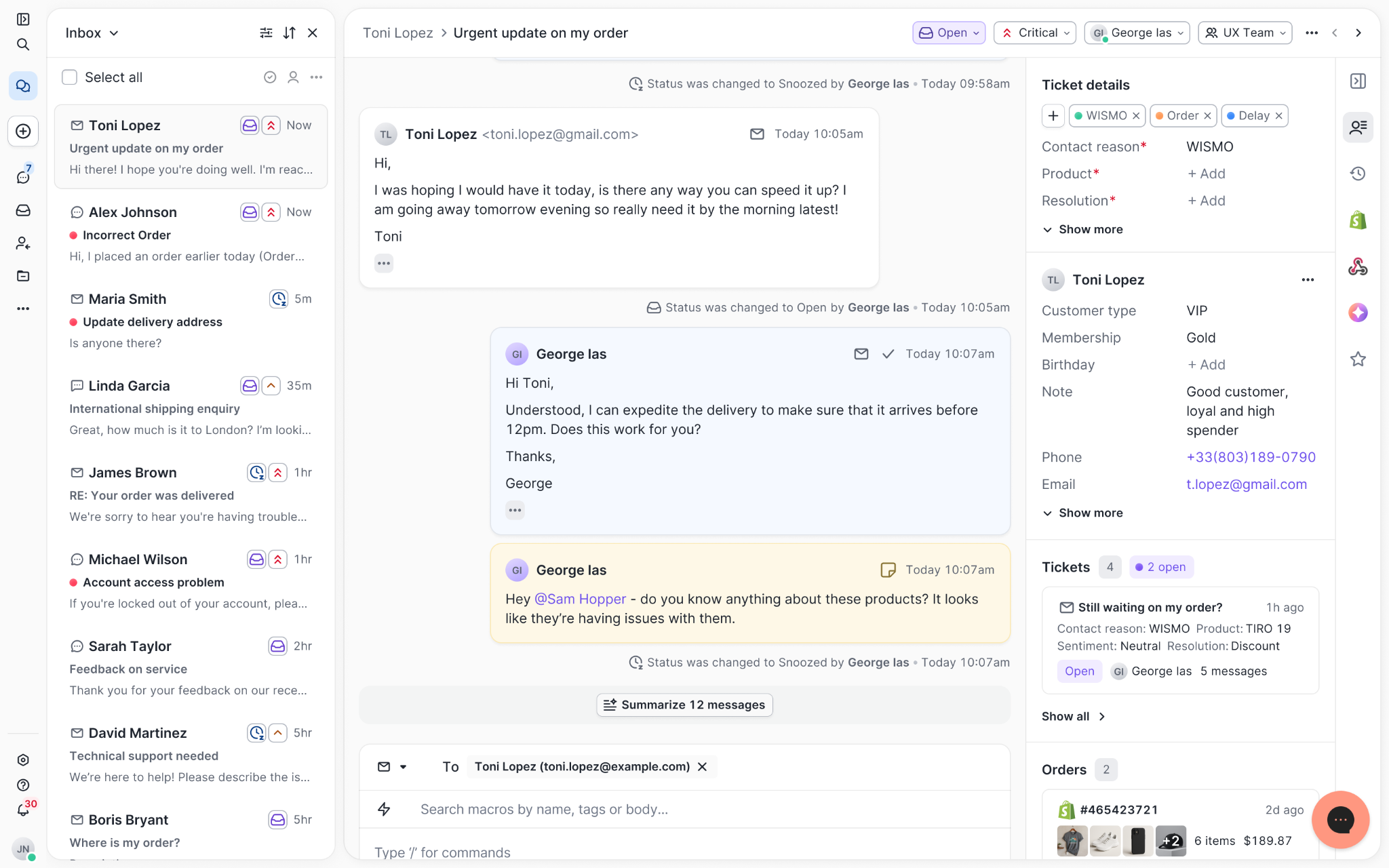
Chats with customers now look like real conversations, using the speech bubble style you’re familiar with on popular messaging apps.
Check customer history without losing your place
Checking a customer's history used to mean leaving the conversation, an extra step that interrupted what should have been a smooth workflow.
Now, past conversations open in a sidebar next to the active conversation. You can view a customer’s full history, search through their timeline, and open prior tickets without going to a new page.

Check past conversations, orders, and customer details in the brand-new Customer Timeline.
See order details the moment you open a ticket
Order information is easier to reference than ever. Open a ticket, and you instantly see the customer's recent orders, marked with product images and invoice details at a glance. Need to dig deeper? Click on an order, and the expanded information appears in the same panel.
For teams using custom integrations, apps are fixed in a quick-access integration menu on the right.
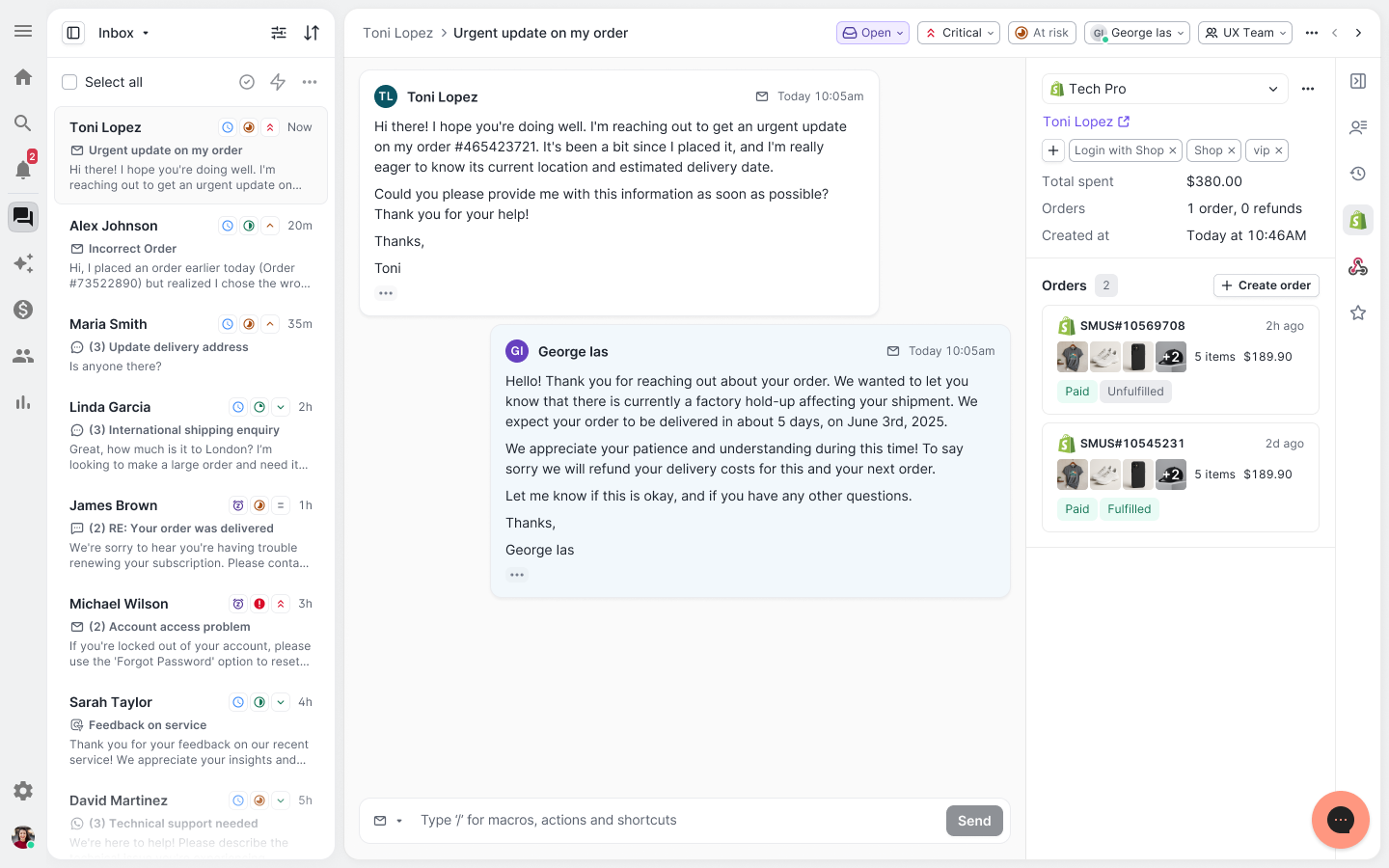
See order details, product images, and totals at a glance on the right panel, without leaving the conversation.
Pick up where AI left off
You shouldn't have to dig through a thread to figure out what AI already tried. Now you don't have to.
When AI Agent escalates a conversation, it includes a concise handover summary that mentions the issue, what actions were taken, and why it was passed to your team.
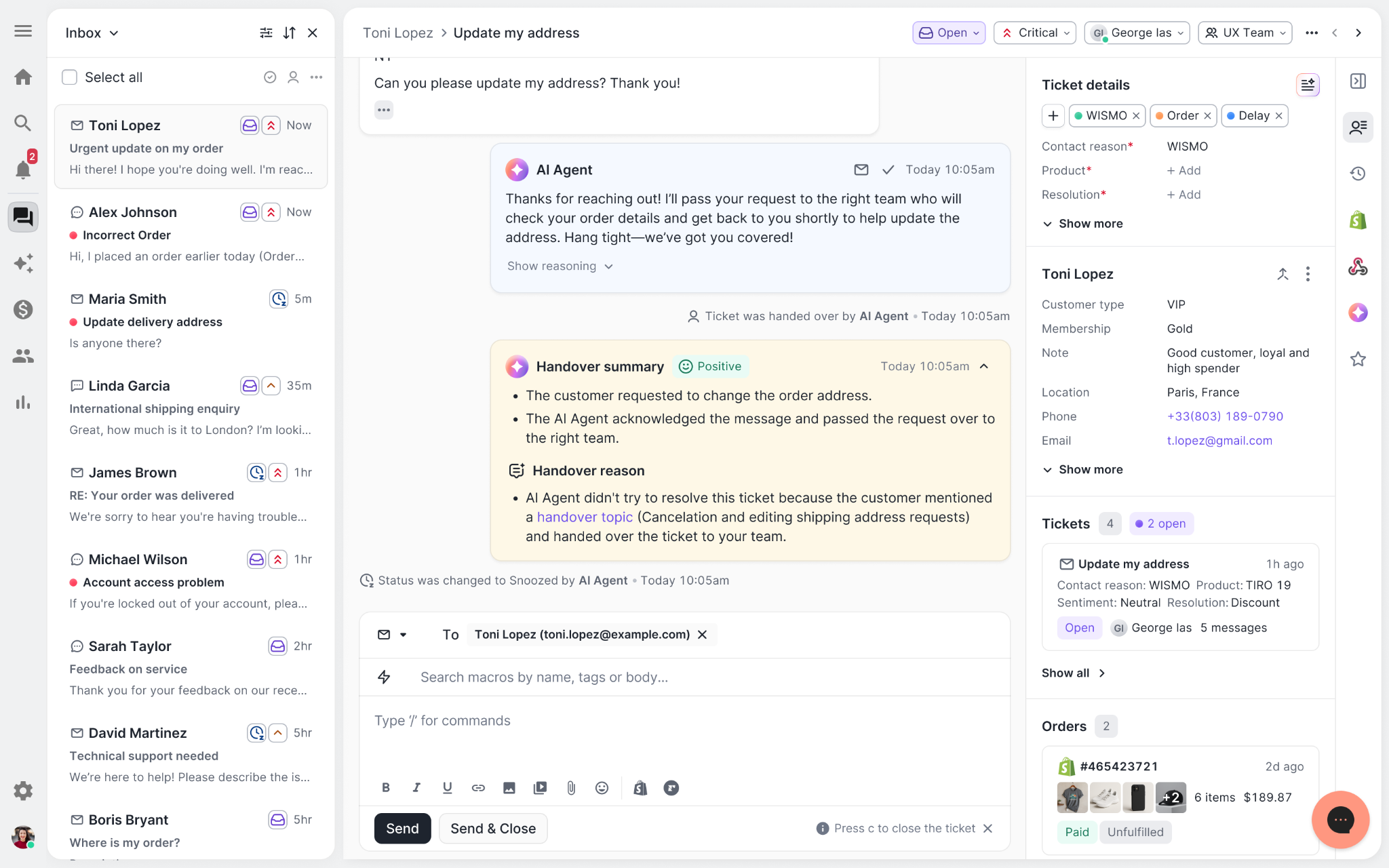
Escalated tickets include a brief AI-generated handover summary, marked in yellow, for quick reference.
Move faster across every store and team
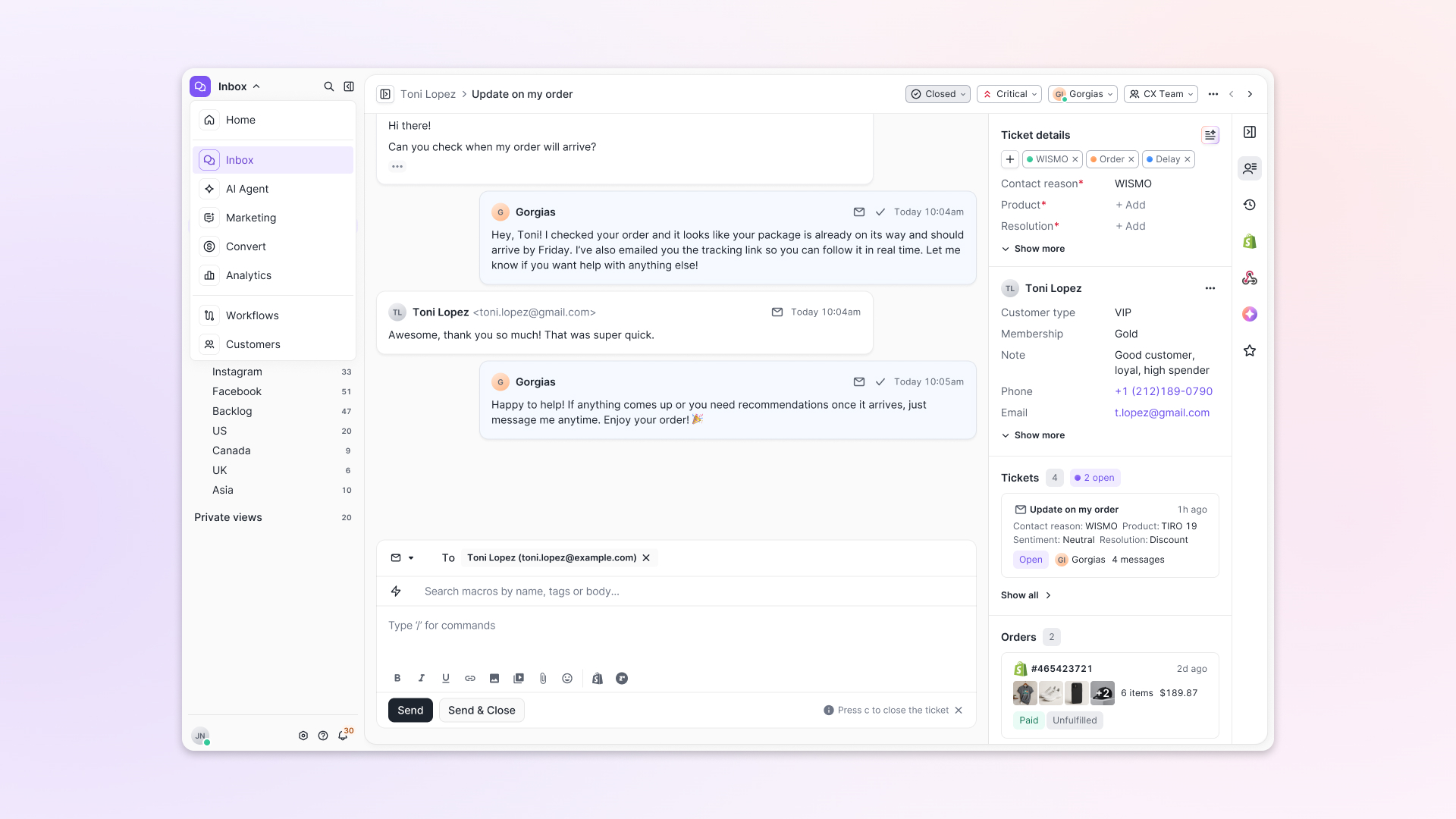
We restructured and simplified the navigation. The left sidebar organizes everything into clear categories: Inbox, AI Agent, Marketing, and Analytics, so anyone on your team knows exactly where to go.
To quickly update your knowledge base or adjust a workflow, both now live right in the sidebar. For teams managing multiple stores, switching between them is just as straightforward, accessible from the sidebar, so agents can move between inboxes without breaking their flow.
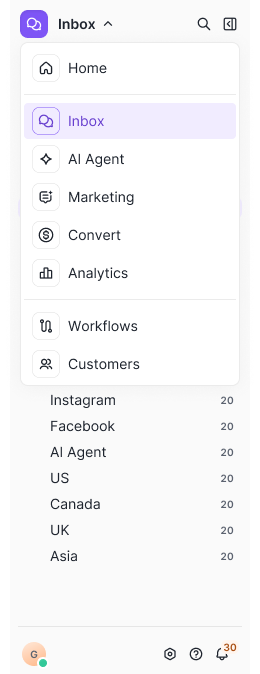
Agents can switch between stores and their corresponding inboxes directly from the left menu.
A workspace that works the way agents do
Support comes down to the person on the other end of the conversation. We built Helpdesk 2.0 is to make sure they have everything they need to show up for that moment.
The best way to see the difference is to work in it. Start a free trial today.


Further reading


How to Offer Free Shipping and Lift Revenue
Free shipping has become so ubiquitous in ecommerce that shoppers now expect it.
According to a survey conducted by Forbes, 77% of respondents abandoned their cart because they were unhappy with the shipping options. 84% made a purchase because it qualified for free shipping.
Free shipping isn’t always an option for ecommerce stores though, especially for those with small margins or where shipping is expensive for every order.
These are the best strategies for how to offer free shipping, even if you’re unsure it’s something your business can afford.
{{lead-magnet-1}}
Is offering free shipping in ecommerce worth the cost?
Free shipping has become a key differentiator in a very crowded ecommerce ecosystem, with 75% of customers now expecting it on all orders.
Offering free shipping can drive more revenue for your business, encourage repeat business, decrease cart abandonment, and even pull customers away from your competition.
Let’s be clear: Offering free shipping for all products is not sustainable for most businesses. But free shipping is not all-or-nothing. Below, explore why providing free shipping in some capacity is worth the expense for your business.

Encourage customers to become repeat buyers
One survey found that 90% of consumers consider free shipping to be the primary factor driving them to shop with online retailers more frequently. And, according to Gorgias, repeat shoppers generate 300% more revenue than first-time shoppers, on average.

When customers are online shopping, they remember easy experiences, which includes not having to pay for shipping when they find something they love. A stress-free experience (without unpleasant surprises at checkout) creates loyal customers who want to shop with your business long term.
📚 Recommended reading: Learn why customer experience is a largely untapped revenue stream for most ecommerce brands.
Incentivize higher average order volume (AOV)
On top of that, some free shipping models encourage customers to place larger orders, generating more revenue per customer.
Take the minimum order value model (what you might call the Amazon not-Prime model), where shipping only becomes free once the cart reaches a certain subtotal. Depending on which study you prefer, at least 84% — and perhaps as many as 93% of customers — have added items to their cart to qualify for free shipping, increasing average transaction value and potentially total revenue per customer.
Sway customers away from competitors
When you offer free shipping and a competitor doesn’t, that single difference can pull new customers your way — and away from the competition. When 90% of consumers consider free shipping their top incentive and a full 60% of them expect free shipping no matter what, offering it is a huge differentiator for your customer base.
📚Recommended reading: 7 Strategies for Creating a Customer-Centric Post-Purchase Experience
Decrease cart abandonment
One firm determined the overall rate of cart abandonment in ecommerce stores is north of 75%, and unexpected charges (including shipping charges) at checkout are the top culprit.

In other words, providing free shipping — and keeping other unexpected fees out of the checkout process — will reduce cart abandonment and increase conversion rate for typical ecommerce businesses.
{{lead-magnet-2}}
Is your online store ready to offer free shipping?
Making the decision to implement free shipping isn’t always as simple as flipping a switch. It takes careful planning and even more careful execution. Consider the following factors to help you understand the cost of free shipping for your business and decide if it’s the right move for you.
Understand how much shipping costs your ecommerce business
The demand for free shipping has changed the way that small businesses choose to operate. For example, writer Amanda Mull at The Atlantic reveals how free shipping priorities (and algorithms favoring the vendors who offer it) have hurt numerous small business owners on Etsy.
If you’re operating on razor-thin margins and you’re already struggling to be price-competitive, pivoting to an always-free shipping model might not be feasible. Even if your margins are healthy, for many smaller ecommerce retailers, blanket free shipping isn’t sustainable or feasible—nor are the extra costs that come with it.
Next steps: How to calculate shipping costs for your business
On a spreadsheet, compile the shipping costs for every product you sell — from the smallest and lightest to the largest and bulkiest — to all four corners of the US (if you’re a US-based store) and anywhere you ship internationally.
This cost will differ based on your preferred shipping carrier, too. Compare rates between FedEx, UPS, and USPS to see who has the most affordable option — we’ve linked shipping calculators for each above. Once you have these numbers, calculate your average shipping cost. Then, multiply it by the average number of orders you get in one month.
You’ll also want to look at your best-selling items and calculate how much it costs to ship them, as you’ll likely be sending these out more often than other items in your catalog.
Don’t worry about exact numbers here. The goal is to get a ballpark number to compare with your monthly revenue. If your estimated shipping costs will put you in the red, free shipping may not be the best option (even with the bump in orders). If this is the case, consider qualified or flat-rate shipping instead — more on both below.
📚 Recommended reading: Our list of shipping best practices for ecommerce businesses.
Consider flat-rate shipping instead
Offering a flat-rate shipping charge is one way to give customers a low-cost shipping option without absorbing the entire cost yourself.
Even if you can’t afford free shipping, charging one flat shipping cost for all orders on your site incentivizes larger orders. And, if you can keep the flat rate low, it can convince customers who just want to make a small order to convert.
Set up flat rate shipping in Shopify
Setting up flat rate shipping is quick and easy if you use Shopify: Here’s how to do it.
Determine your free shipping limit
Most brands can’t support universally-free shipping. That’s why a qualified free shipping option based on factors like order size or location is such a good option.
The most straightforward way to offer qualified free shipping is to set a minimum order amount. But in terms of your bottom line, this minimum threshold needs to be high enough that you aren’t losing money on most transactions.
Here’s a formula for calculating your free shipping threshold:

Free shipping threshold = (Average shipping cost per order / gross profit margin percentage as a decimal) + average value of an order
Free shipping threshold = ($10 / .30) + $50
Free shipping threshold = $83.33
The result you get from this formula is the average amount at which free shipping won’t create a loss for you.
Now in some cases that figure will be too high to be all that relevant. “Free shipping on orders $350+” can make sense for some retailers, but not those with an average ticket of $50.
Fit Small Business gives additional formulas for calculating a minimum threshold that still operates at a loss.
Consider free shipping for returns
Customers hate paying for return shipping. If you can afford it, letting shoppers return an item for free is a great way to avoid driving them away. It also can create repeat business, low-effort experiences, and encourage loyalty.
Of course, free returns leave you vulnerable to expensive spammers and order spikes. So, tighten up your return policy and try to incentivize exchanges over returns to protect lost revenue.
Find other ecommerce differentiators besides free shipping
Ecommerce is a wide field, and your business is competing for only a small slice of the market. Look for differentiators with lower cost pressures and high levels of impact that may be unique to your industry or market.
Free shipping isn’t the only thing that matters. Fast delivery also makes a difference in many industries and markets. Can you outmaneuver your competition by offering next-day shipping, even at a premium price? Perhaps your customers will be willing to pay for faster service if it isn’t available elsewhere.
Here are a few other areas you might explore in search of other ecommerce differentiators:
- Unique services
- Ecosystem effects (think Apple: “Our products all work better together, so stick with us across our catalog”)
- Value-adds (freebies, discounts on future orders, etc.)
- Multiple shipping and delivery options, including fast or flat rate
- Eco-friendly shipping or packaging approaches
Similarly, you may not be able to prioritize free shipping until you figure out other logistics like inventory management, order management, order fulfillment, order tracking, and returns management.
How to offer free shipping on a budget
If you’re ready to put together your free shipping strategy, use these tips to craft a program that’s enticing to online shoppers without destroying your bottom line.
1) Increase product prices to absorb the cost of shipping
According to research from the Baymard Institute, 48% of shoppers abandoned their cart because the extra costs were too high. People like the transparency of seeing one price without getting surprised by additional fees at checkout.
Speaking generally, most customers would prefer to pay $50 for an item that ships free than spend $45 on the same item, only to discover an additional $5 charge for shipping in their shopping carts. Even though you’re passing shipping costs onto the customer in other ways, you still give buyers the perception of lower costs overall.
Consider raising your prices to include shipping costs to limit surprises at checkout and increase transparency.
2) Offer a “free shipping for orders over” model to incentivize higher AOVs
Offering free shipping when a customer reaches a minimum price threshold can be a powerful strategy for raising ticket value.
Customers will frequently add more items to reach that threshold, increasing average order value (AOV), overall revenue, and your business’s order volume as a whole.
To make it easy for customers to see how close they are to free shipping, add an app to your ecommerce store (like the Essential Free Shipping Bar for Shopify stores) that shows progress visually. For example, Gorgias customer OLIPOP makes it easy for folks to see how many more packs of soda they need to purchase to get free shipping.

This is also a great way to build upselling into your strategy. When customers are looking for additional items to meet the free shipping threshold, consider showing items that pair well at checkout. This automation is easy to add via the app store if you’re on Shopify, and you can see how OLIPOP sneaks in suggestions in the screenshot above.
If you’re going to offer completely free shipping, make sure you use it as a marketing tool and make it very clear to shoppers. For example, Woxer uses a banner at the top of its site to announce that it offers free shipping across the US no matter the order total.

A cohesive and realistic shipping strategy is highly valuable to any company that ships products to people because it is part of your brand image.
📚 Recommended reading: Our guide to creating an ecommerce shipping and fulfillment strategy.
3) Offer subscription-based products to increase LTV
In a survey conducted by Salesforce for CFO, more than half of survey respondents said that 40% of their revenue was made up of subscriptions.
A subscription format is powerful because it ensures repeat purchases and raises the overall lifetime value (LTV) of customers who opt in. If you choose to become part of the subscription economy, you could choose to offer free shipping on subscriber orders only. That way you limit the amount of free shipping you give, and further incentivize shoppers to sign up for a subscription.
4) Limit free shipping to certain items, customers, or locations
Stores with wide product catalogs that include many low-dollar items may not be able to offer blanket free shipping. But, you can limit free shipping to certain high-dollar product categories, select items within those categories, people who live within a certain distance, or VIP customers.

Here are a few approaches you can use to limit free shipping:
- Shoppers must reach a designated spend threshold
- Free shipping is limited to members (like Amazon Prime or Madewell Insider)
- Free shipping is limited to shoppers with a certain number of points in a loyalty program (a service like LoyaltyLion can help you manage this)
- Shipping costs are location based (For example, US only if your store is located there)
- Products that cost over a certain dollar amount automatically qualify
5) Partner with a third-party logistics company to offer free (sometimes two-day) shipping at scale
Partnering with a third-party logistics company allows you to split inventory across multiple fulfillment centers throughout the nation. That means they’ll end up closer to customers’ homes, which reduces shipping costs because of location proximity, and means that you can offer faster shipping for less cost.
ShipBob is a great option for this, as they’re a trusted global fulfillment company.
Take care of your shoppers with the Gorgias + ShipBob integration. Sync shipping data with your helpdesk, reduce tab-shuffling, and help you improve customer experience during fulfillment.
6) Optimize your packaging for cost
Shipping fees are calculated based on item weight, size, speed, and distance to destination. And the size and weight of your packaging contribute to that cost. Cutting down on the dimensions of your packaging where possible and using lighter-weight mailers can lower the cost of each package.
📚Recommended reading: 8 Tips to Minimize Shipping Costs and Maintain Quick Delivery
7) Create a limited-time free shipping offer
There’s nothing quite as powerful as a ticking timer, whether it’s a 15% off coupon that’s only good for the next hour or a sale that only lasts for the weekend. Discounts are powerful, but free shipping can be just as enticing.
Consider adding free shipping promotions to existing promotional events such as holiday sales, store anniversary sales, Black Friday and Cyber Monday, and other seasonal events pertinent to your industry and market.
Time-limited holiday sales can be effective, but they also tend to be some of your busiest sales windows in any given year. If you could use some additional help with your logistics this upcoming Black Friday and Cyber Monday, check out our complete guide to BFCM logistics.
📚Recommended reading: The 12 Best Shipping Software Tools for Ecommerce Stores
Provide world-class customer service with Gorgias
Free shipping is often one key to a world-class customer experience in ecommerce. But whatever you choose to do with your shipping policies, you absolutely must pair it with world-class customer service and support. Customers will appreciate your free shipping, but they’ll love you (and show it through repeat business) when you outpace the competition in terms of customer service.
Gorgias is an all-in-one customer service and helpdesk platform built for ecommerce businesses like yours. It integrates with a variety of different apps, like LoyaltyLion, Attentive, and Klaviyo. We operate at the speed of ecommerce, empowering you to serve and scale like never before. We also offer support for logistics like free shipping and order management, largely thanks to our many ecommerce integrations.
Ready to see what Gorgias can do? Get started for free right now!


Hiring for Customer Service: A 6-Step Framework to Recruit Top Agents
When you say the word “growth,” most brand leaders think of customer acquisition, paid ads, or the newest marketing trend — probably something about TikTok influencers. And while acquiring customers is important, we know that truly sustainable growth comes from loyal customers, organic referrals, reviews, and repeat buyers — all of which stem from your customer experience. And at the core of that customer experience is your customer service team.
Your customer service agents spend more time interacting with customers than any other department, including marketing and sales. They manage VIP customers, repair at-risk relationships, and have the opportunity to chat with customers at make-or-break moments (like right before a sale). In other words, your brand’s growth hinges on the quality of your customer service team.
We can’t offer any algorithms or magical software to find and hire talented agents. Hiring takes time, experience, and a strategic approach. That last part — a strategic approach to hiring — is what I’m here to provide.
At HelpFlow.com, we run 24/7 live chat and customer service teams for over 100 brands. We’ve hired hundreds of customer service agents successfully and built scalable, robust customer service operations that provide great customer experiences and drive growth for brands we work with.
In this post, I’ll walk through the framework we use step-by-step. My goal is to help you or your hiring managers simplify your customer service hiring process, find high-impact customer service professionals, and transform your brand’s customer service from a frustrating cost center to a seamless and scalable revenue driver.
But first, what’s really at stake here?
{{lead-magnet-1}}
Bad customer service will kill your brand
If you are like most ecommerce brands, you hire customer service reps when your team needs additional support to keep up with tickets. This purely reactive approach means your support team will always be buried in tickets or onboarding new team members. The constant scramble means they’ll never have the bandwidth to think strategically, improve processes, or work on higher-impact initiatives to help the business.
Here’s the snowball effect we often see. First, your agents become overworked with an ever-growing number of tickets to process each day. This endless sprint to keep up contributes to extremely high turnover in the customer service industry. According to Harvard Business Review, CS reps typically last a job for about a year.

As agents start to burn out and fall behind, customer service experience quality suffers. Customers feel frustrated with slow response times and often disappointed with incomplete or ineffective solutions from junior agents hired just a few months before. A downtrend in customer satisfaction is common with brands as they start to scale.
Eventually, a poorly run customer service operation starts to have a direct effect on sales. First-time shoppers give low NPS scores and never develop brand loyalty. Customer complaints start to appear, scaring off potential customers, and referrals dry up.
As the quality of service goes down, the cost of customer service goes up because you have to spend more time hiring and training customer service representatives that won’t be productive for weeks, if not months. Replacing an employee typically costs 1.5-2x their annual salary when you factor in all the costs, according to Gallup.
The business sees these poor results and high costs, and refuses to invest in the department, which leaves them even more under-resourced. The cycle continues.
Great hiring processes can accelerate growth
A great customer service team (that’s not over-worked and under-resourced) will stop this vicious cycle. But beyond answering customer inquiries and managing ticket load, they’ll systematically improve your brand’s customer experience and, by extension, growth engine.
An excellent customer service team will create replace the vicious cycle with a positive one by:
- Improving your shopping experience by collecting customer feedback, building self-service resources, and studying data for high-impact opportunities
- Intercepting new visitors with proactive support to raise the conversion rate
- Helping customers who have unsatisfactory experiences, winning some of them back
- Encouraging happy customers to purchase more, leave reviews, refer new customers, and remain loyal to your brand

Ready to learn how to fill your customer service positions with agents who will make an impact? Let’s get into it. Here’s our 6-step framework to hire the best customer service teams around.
1) Assess your customer service hiring needs
The first step to hiring great customer service reps is to shift from a reactive hiring process to a proactive one. When you hire reactively, you tend to rush hiring and training to get a body in a seat processing tickets as quickly as possible. Of course, this leads to low-quality interactions and dings to brand perception. By proactively forecasting customer service needs, you’ll have time to run a more thorough hiring process to find and hire the ideal candidate.
Here is a quick overview of how to forecast customer service volume:
- Identify the percentage of orders that typically turn into support tickets. For example, if you historically get about 20 tickets for every 100 orders then you can forecast that 20% of your future orders will turn into tickets.
- Use the traction to ticket ratio to forecast how many tickets you expect to receive in the future, based on your sales forecast for the upcoming quarter or another time period.
- Use the agent ticket capacity per day, accounting for PTO and sick leave, to determine how many agents you need to process that upcoming ticket volume. Account for ramp-up time for new team members.

Forecasting will help you predict your future needs and shift to a more proactive approach. Remember to give yourself enough time to conduct a thorough hiring process and onboarding program. If you anticipate needing two new agents in Q4, start collecting applications by early Q3.
Forecasting is just one strategy to understand when you should hire. Here are a few additional signals that could mean your team is understaffed:
- Declining metrics: Each week, you should check on important metrics that measure your customer service management such as first response time, handle time, and customer satisfaction. If you start to see these metrics decline, it could mean your team can’t keep up with ticket volume and needs additional support.
- Team morale: As part of your customer service team meeting cadence, you should have regular team huddles, manager-led 1:1s, and anonymous climate surveys. Managers should work to foster trust and open dialogue so agents can share their stress. Don’t be afraid to ask them directly about their workload. If agents start to report challenges, especially if the concern comes up across multiple agents, you may need to staff up.
You may find that you need additional support, but you may not need to hire people full-time to solve the problem. You may be able to support your core team with other solutions such as:
- Efficiency improvements: If you’re like most brands, you’ve frankensteined together a customer service process, piece by piece. Consider doing a workflow audit to identify opportunities to improve the team’s workflow with process improvements, email templates, and customer self-service options.
- Changes to coverage schedules: You may have the right amount of agents, but simply have a schedule that leads to ticket buildup. For example, if everyone is staffed M-F, response and resolution times will suffer over the weekend. Look into your hour-to-hour ticket volume, especially on conversational channels like live chat and phone, and schedule agents whenever you have peaks in incoming tickets.
- High-quality outsourced help: Hiring full-time employees is cumbersome and expensive, and sometimes more than you need. By working with a high-quality outsourced team, you can bridge the gap to have additional agents on a custom schedule or just for a season of high volume.
- Overtime opportunities: If your agents are currently salaried, you could change them to an hourly model so they can earn overtime during busy weeks. Don’t make this decision without consulting the agents. They might be enthusiastic, but they might also dislike that your solution for being understaffed involves working more hours.
{{lead-magnet-2}}
That said, you may conclude that you need to hire new agents. Here’s how to do it well.
2) Create a target hire persona for the role
Before you start your search, I recommend taking some time to understand your hiring needs and describe your ideal candidate.
First, take stock of:
- Everything the customer support team does today
- Everything the team wants to do but doesn’t have the bandwidth for
- Everything the team currently does that could be phased out with process improvement or recalibration of ownership
Once that’s done, you’ll be better prepared to understand:
- What existing roles need to be filled or staffed up
- What new roles need to be developed
- What type of skills would match each of those needs — this is where your target persona comes into play

A target persona is a tool we developed to build clarity around your jobs to be done, the skills needed to accomplish those jobs, the type of person who would succeed in this role, and how you’ll measure that person’s success.
The value is similar to an ideal customer profile (ICP) for sales and marketing. By defining the core qualities you need ahead of time, you can create a sharper job description, distribute the job posting in more targeted channels, and decrease the time it takes to find the right person.
What to include in a target hire persona

Below are the key sections to include in a target hire persona:
Mission:
- What is the purpose of this position in your organization?
- Why does it exist?
- What will the role focus on?
- Why are you hiring this person now?
Outcomes:
- How will you measure this person’s success?
- How will you keep this person accountable to the mission described above?
- Use specific, clear, and quantifiable outcomes to answer both questions above.
Competencies:
- What experiences and qualifications should this person have?
- What attributes and customer service skills will help this person succeed? (For example, is it more important to be organized or empathetic for your specific needs?
Culture fit:
- Separate from the role, what are the specific attributes that make someone a culture fit for your team?
- These will vary depending on the company, but it’s very important to define these so that you can screen otherwise qualified applicants if they aren’t a culture fit.
Customer service agent target hire persona example
We put together a full customer service agent target hire persona example that you can access and modify for your own needs. Consider revising the mission and outcomes slightly to match your needs, and adjust the target experience for your specific company.
Have questions? Feel free to reach out!
3) Create a job posting that sells (and market it)
Once you have a target hire persona completed, it’s time to start marketing- yes, I said marketing, just like how you grow your business.
Typically, when someone is hiring they simply put together a job description, post it on a few job boards, and work with the applicants that come in. This is especially true for customer service hires, which are unfortunately seen as low-value.
This approach leads to a small number of low-quality applicants. The kinds of A-players you’re looking for aren’t scouring job boards and responding to basic job postings — they’re likely crushing it at their current role.
Here’s how to create and distribute a job posting that reaches the right people and convinces them to apply:
Sell the role in the job posting
Remember, hiring is a two-way street. You have to impress the candidate just as much as they have to impress you. Don’t just publish a list of duties and requirements on a job posting website with an application link. Instead, sell the role (and the company) by using parts of the target hire persona above:

Clearly explain the company’s current position, mission, and goals. Share a bit of the journey you’ve been on so far and the successes you’ve had. The right candidate will be excited about your particular growth stage and the opportunity to help you with the next leg of the journey.
Also, dedicate some space to selling your team and unique company culture. This doesn’t need to be all rainbows and unicorns: great candidates know building a great company takes hard work. But they should be able to get an understanding of your company’s unique values, priorities, and ways of working. Describe and share examples about how your teams collaborate, the level of autonomy, accountability, coaching, and support they can expect, and the general vibe of a day-in-the-life of your team.
Finally, paint a very clear picture of what success looks like by sharing the outcomes and target metrics. This will ensure the applicants understand what you want to accomplish before your first conversation. Clear success metrics will also attract goal-driven people with an “I can do that” attitude.
This may seem like a lot of work, but you’ll save time by getting higher-quality candidates quickly, and in the long run, having to rehire due to rushing into a bad hire.
How to drive a lot of quality applicants
An enticing job description gets you halfway to an inbox full of strong applications. Now, you have to get that job description seen by a lot of high-quality candidates.
Remember, great team members don’t typically spend their days scouring job boards to find a new job. You need to catch their attention in other ways to spark their interest in jumping ship and joining your brand.

Here are multiple ways to drive a lot of great applicants for your role:
Publish on multiple job boards. For example, if you are working with a remote team, consider publishing on WeWorkRemotely or Remote.co. If you are hiring locally, leverage a few different job boards such as Indeed.com or ZipRecruiter.com to get the best coverage. LinkedIn is also a good option for both local and remote hires. If possible, make the extra investment to make a premium or boosted posting. And, especially if you are in a challenging niche, consider specialized job boards and communities. The Support Driven Slack community, for example, has a job board for ecommerce community service positions.
Another best practice is to share the role with your network. Send a few messages to peers who may know someone fit for the role and publish the posting on your social media. Also, encourage your team to do the same — they’ll be working with this new hire, after all. Again, don’t just copy/paste the link. Sell the role to attract the best candidates.
Finally, involve your customers in the recruitment process. One of your customers may want the job or know someone else who could be a good fit. Customers who love and use your products have a great head start: they’re familiar with your brand, your shopping experience, and the benefits of your products. And since customer service skills can be transferred from many other types of roles, your customer base may have more qualified candidates than you expect.
4) Screen applicants async to avoid wasting time
A great job description effectively shared means you’ll have a steady stream of applicants. You might feel overwhelmed with the workload of screening applicants to find the right hire. And rightfully so: Applicant screening can turn into a lot of work if you do it with typical in-depth reviews of each applicant and blocking out time for interviews.
Interviews are important, and we’ll explain how to hold a customer service interview below (including interview questions to use). But first, here’s how to effectively screen the large number of applicants you’ll receive to find the best possible hires.
Quiz them on the job posting
Screening starts by gauging how well applicants read through the details of the job posting. If they’re not willing to spend the time reading and following the instructions on the job posting, odds are they won’t be detail-oriented in the role.
By asking a simple question or making a request deep within the content of the job posting, you can quickly screen whether applicants read it. For example, you can ask applicants to start their cover letter with, “ready to rock!’“ This way, you can skip over anyone that didn’t catch and follow the instruction.
Optional: Assign a micro take-home assignment
At HelpFlow.com, we skip take-home assignments because our hiring process is so thorough. However, since customer support agents spend most of their days writing, you may choose to request a short writing sample at this stage.
If you opt to include this step, consider keeping the writing sample very short — something applicants can complete in 10-15 minutes. However, be aware that more up-front work from your candidates means:
- You’ll spend more time reviewing applications
- You may lose some qualified job seekers due to a too-strenuous application process — but they likely wouldn’t be the most committed hire
Send them a common customer question or one of your most common customer problems. Give them resources like a knowledge base article and your policies so they have all the necessary information. At this stage, you’re looking for their ability to communicate clearly and empathetically.
Request a brief video questionnaire
Rather than jumping straight to an interview, send a brief questionnaire to the applicant so they can tell you more about their experience in a short video message. There are tools such as Spark Hire that make this easy. But a simple list of questions and instructions to send a response using a screencast tool like Loom is just as easy.
For the questionnaire, you should ask open-ended questions to get a sense of how their experience and capabilities fit your needs. You might also choose to include a fun, get-to-know-you question to get a better sense of their personality.
Asking why they think they are the best fit for the role is a good starting point, as it gives them the ability to provide more context than they typically would in a text response. Also, this gives you the ability to compare their experience to the target hire persona. The way someone answers this question typically makes clear if they’re a fit at a high level.
Consider asking questions like:
- Why do you think you’re the best fit for this role?
- What are you looking for in your next role?
- How are you looking to grow and learn?
- What’s a mistake you made and learned from?
- How would your friends and family describe you?
- If you could have any superpower, what would it be?
In their video response, you’ll see their communication skills, confidence, and personality — without having to schedule dozens or hundreds of 30-minute meetings.
5) Conduct two interviews to assess fit and experience
Interviews can be time-consuming. They take time to schedule and conduct, especially if you put too many people through the entire interview process. Multiple rounds of screening ensure you only invest time in the most promising candidates.
Ideally, your job posting results in hundreds of applicants. Your first screening (described above) gets you down to about a dozen, max. The first interview we’re about to describe gets you down to the single digits — about four or five. Then, you’ll only have to deeply interview those four or five candidates to find your new hire(s).
1) A quick interview to assess skills and mindset

This first interview is a brief (20- or 30-minute) phone call to learn more about each applicant's skill set, goals, and mindset. Skills aren’t the only prerequisite for success: True rock stars have a growth mindset and will look at this opportunity as the next step in a passionate career.
At the beginning of this interview, we like to build up the candidate’s confidence by saying something like, “We had ### applicants and you’ve made it this far, so you’re definitely a strong person for this role. We’re confident you’ll be successful regardless of whether you work for us or get scooped up by someone else.”
Then, you’re ready to start asking questions.
Questions to understand their goals and mindset
- What does success look like for you a year from now?
- What do you want to accomplish in this role?
- What specific achievements will make you feel the most successful?
These questions should feel familiar, and that’s because they should roughly align with the mission and outcomes you chose in the target hire persona. Of course, candidates didn’t read that document so it’s unfair to expect perfect alignment. But they will help you understand which applicants are the best fit for your needs.
For example, if your target hire persona was a systems thinker who can help with problem-solving and organization across your team, you might look for answers about strong processes and great teamwork. Alternatively, if you’re looking for a brilliant customer-facing agent, you might seek answers related to empathy and customer advocacy.
Also, a lack of clear, focused goals at this stage is a red flag. If someone answers vaguely or responds with a variation of “I just want a good customer service job and your company seems great,” then they’re not going to be a rock star on your team.
Questions to understand skillset
Skills are a difficult thing to discuss. If the candidate prepared well, they’ll likely know what skills you need for the role based on the job posting and find ways to weave those skills into their answers. They may also have completed courses or customer service certifications that indicate what they can do, but it's important to go beyond that and get a sense of real-world applications of these skills.We like to ask a series of questions that force candidates to reflect on their skills in a slightly different way. Here’s how we get there:
- We’re going to talk to a few people you’ve worked with at the end of the application process, should you make it that far. What’s a role you succeeded in, and who was your boss in that role? If we talk to them later in the interview process, how do you think they’ll describe you? What parts of the job would they say you excelled at?
Again, you’re looking for clear answers and alignment with your target hire persona.
Second, gauge which parts of the job they’re least skilled and excited about. Here’s how we might get at this answer:
- Now I want to understand the opposite. What are some things that boss would say you’re not great at? Or maybe, what are some things you’re capable of doing but don’t love?
To make this question a bit less intimidating, we usually share an example. We’ve often used the example, “I’m able to whip up some graphic designs for our website and they look pretty good. But graphic design is something I just hate doing. It’s a tedious process and I would rather have a marketing person handle that if at all possible, so I can focus on my strengths.”
This question allows the candidate to essentially complain about select aspects of the role. You’re not looking to trick someone into disqualifying themselves from the running. However, you are trying to avoid a situation in which you hire someone to spend all week doing something they’d rather avoid.
Once they answer, consider asking follow-up questions to get more examples and context.
Questions to understand teamwork and self-awareness
- How would past supervisors rate you on a scale of 1-10?
- How would your peers rate you on a scale of 1-10?
These questions are quick and help you understand whether their previous answers were honest and self-aware.
Ask them for the name of two previous bosses and two previous colleagues. Explain that you won’t reach out to those people yet, but might if you extend an offer.
Once they give you names, ask how each person would rate them on a scale of 1-10 — insist on a single number for each. You’re looking for lots of 8s and 9s. If you see a trend of 7 or lower, that could indicate this person has — and may have oversold themselves when discussing their skillset earlier in the interview. Also, 10s across the board show a lack of self-awareness and growth mindset.
By the end of this interview, you’ll have a solid understanding of whether each candidate’s skills and mindset fit your needs. Move the best candidates onto the final interview, thank the rest for their time, and invite them to re-apply for future roles — after all, each role should have a specific target hire persona, and they might just fit your next opening a bit better. To thank them for their time, you can also refer them to anyone else in your network that’s hiring.
2) A deep-dive interview to know you have a great hire

Each candidate that makes it to this final interview should be a pretty great fit for the role. Some companies might go straight to a job offer at this stage, but the risk of bringing on the wrong new hire still exists.
The deep-dive interview will last two hours. Two hours might seem like a big investment. But two hours is nothing compared to investing two or three months into a candidate before realizing you need to start the hiring process over because they’re not a great fit.
A deep-dive interview gives you a crystal-clear understanding of each candidate’s entire career history, their ability to communicate clearly and effectively in a long-format meeting, and their personality. After this conversation, you’ll have zero doubts about which candidate is your rock star.
Here’s how the deep-dive interview works.
Set up a two-hour conversational interview with a small panel
When you invite the candidate to this meeting, be clear about:
- The goal of the meeting
- The format of the meeting
- The list of attendees
If you give the candidate some context behind such a long meeting, they can approach the interview with more preparation and less anxious energy.
As far as the list of attendees, you can make a decision based on your team’s makeup and availability. If possible, we recommend inviting the hiring manager, a senior manager, and a peer to introduce the interviewee to the team they’ll work with (and vice versa). However, you can also run the interview solo if that works better for your team.

Once you assemble the panel and schedule the interview, the long-form interview itself is quite straightforward and formulaic. Here’s what it looks like:
Discuss every full-time position the candidate has had, in chronological order
Start from the beginning of the candidate’s resume and discuss each and every full-time role in their job history. For early parts of their career (or jobs that are not related to your open role) you can move quickly through these questions. But it is important to discuss each role.
By digging into every single part of the candidate’s career with a standard set of questions, you will get a clear overview of how they’ve performed and what makes them tick.
Ask the same set of questions for each position
What makes this interview process effective and simple is that you ask the same questions for each role. This gives the interview a conversational flow that produces powerful insights. Here are the questions:
- What were you hired to do? This gives you an idea of the mission and outcomes they were hired to accomplish
- What accomplishments are you most proud of? This helps you understand whether they accomplished those goals and what they value in terms of achievement
- What were the low points of the role? This helps show the candidate’s self-awareness and growth mindset, and gives you a chance to spot red-flag trends — that said, recognize every job naturally has high and low points
- Who was your boss? What was it like working with them? This gives you context for your reference call later on and tells you how the candidate likes to be managed
Together, these answers give you a good idea of their specific experience in customer service roles, their experience with handling a helpdesk and the challenges of customer service, and some insight into their soft skills that a shorter interview could never provide.
Don’t bother with a take-home assignment for these qualified candidates
Many companies will assign a test assignment this late in the process to do a final check on the skillset and quality of candidates. We don’t recommend a test assignment — especially at this point — because assignments are too simple to game and sometimes give candidates a bad impression of your company because you asked them to do “free work.”
If you want to use an assignment, keep it short and earlier in the process. But at this point in the process, the deep-dive interview will give you much richer information. Specifically, it helps you understand what the candidate will actually be like on your team before you invest in onboarding and two or three months of work.
6) Use reference checks to get more context and certainty
Most people treat reference checks as a way to make sure the candidate told the truth on their resume and during the hiring process. That can be part of the process, but the greater value of reference checks is to get even deeper context into the candidate’s skills and work style.

Here’s how to approach reference calls:
- Use the deep-dive interview to decide who to contact. If the candidate mentioned a particularly important or interesting relationship, success, or challenge, make a note to call their boss in that position to get more information.
- Chat with references for 5-10 minutes. These conversations should be informal and conversation — you want the major takeaways about what it’s like to work with this person.
- Give the reference person context. Start on a positive note, explaining that you’re hiring for a customer support role and the candidate in question seems like a great fit.
- Ask high-level, open-ended questions. Questions like “Is what they said true?” limit the conversation. Instead, ask questions like “What was it like working with this person?” or “What kind of role would this person excel in?”
- Ask about strengths. For example, ask “What’s a project this person absolutely crushed? What responsibilities did they nail every time?” Ideally, the answers align with the candidate’s self-reported skills and strengths.
- Ask about challenges. For example, say, “They mentioned [the challenge] at your company. How did they handle that challenge?”. Then, open it up: “What are some other areas of improvement for them?” By framing this positively as improvements, you’ll get more direct feedback about the candidate's rough spots.
Each call takes fewer than 10 minutes but gives you valuable insight into the highs and lows of working with this person. Again, similar to the deep-dive interview, you’re looking for patterns across reference calls more than any single answer. If the candidate’s answers line up with the answers you get during the reference checks, the candidate has high self-awareness and emotional intelligence — both important qualities in customer service.
By the time you go through the entire process with multiple candidates, you’ll be certain about the best fit(s) for your open role(s). And once you’ve run this interview process a few times, it will become much more efficient and much less daunting.
Bonus: How to choose a start date and win over unsure candidates
As we mentioned earlier in this guide, hiring is a two-way street. You have to win a candidate over just as much as they have to win you over. Once you choose a candidate, here’s how to give yourself the best chance for an accepted offer and a successful start.

Tips for sending an offer letter they’ll want to sign
If all went well, the candidate should be thrilled that you offer them the job. However, they may be considering other offers and it never hurts to demonstrate that you’re a thoughtful employer that’s genuinely excited about working with them.
First, consider giving them a call before sending the offer letter. Most candidates will appreciate hearing the enthusiasm in your voice and getting the news directly from the hiring manager, who they spent the entire process getting to know. Plus, you have the opportunity to get a verbal yes.
When you send the letter, give them a sign-by date. This gives them some parameters, adds a bit of urgency to the decision, and helps you develop a contingency plan with other top candidates in case your top choice declines the offer.
Last, consider asking everyone involved in the interview process to send a personal note to the candidate, especially if the candidate is on the fence. The candidate will end up working with these people, so an authentic and personalized note expressing excitement could make the difference between an acceptance and a declined offer.
Choose a start date that works for candidates and your business
Throughout the interview process, you should clarify when the candidates hope to start. Once you make the offer, don’t be afraid to encourage them to take a week or two off before starting the new job — they’ll appreciate the time off, plus it’s a signal that your company takes preventative measures against employee burnout. And if you’ve moved away from reactive hiring, this shouldn’t be too big of a hassle for your team.
Last, if you’re hiring multiple agents, work to start them on the same day. This way, you can onboard in cohorts, giving each new hire a buddy for support and companionship. Plus, you’ll save time by giving each training session once instead of multiple times for each hire.
Master Hiring Customer Service Agents with HelpFlow.com and Gorgias
The hiring process isn’t about filling seats, it’s about building a team that strengthens morale, tackles challenges, and ultimately drives your brand forward. While it’s definitely possible to hire agents more quickly, quicker isn’t always better. A single bad experience with a customer service agent can cost you customers and damage brand equity. A team of bad hires can kill the future of your entire company.
If you rush the hiring process, problems during onboarding, new-hire retention plummets, and the top talent you had before these bad hires start to leave. It’s better to invest time upfront to ensure you only hire A-player team members.
Want help scaling your customer support team with agents who can provide an amazing customer experience and work with larger company goals in mind? HelpFlow runs customer service teams for over 100 brands and can help you level up your customer service operation. Check out our Gorgias Premier Partner profile and contact us today to learn more.
And if you’re struggling to streamline the workflow of your team and turn customer service into a profit center, check out Gorgias — the customer service platform built for ecommerce. Sign up for a free trial today.

The 10 Best Social Media Apps for Shopify
According to data from Kepios, there are a total of 4.62 billion social media users in the world as of January 2022 — accounting for well over half of the earth's population. In other words, if you want to go where your customers are as a Shopify store owner, social media platforms are mission-critical.
Social media may be a great opportunity but it isn't exactly low-hanging fruit. Social media is complex and time-consuming. Even seasoned digital marketing professionals can get bogged down by tedious tasks, low-return initiatives, and frustrating obstacles when it comes to marketing products to potential customers on social media.
The good news is that utilizing the right Shopify social media apps can go a long way toward making your social media marketing campaigns more efficient and effective. To help you choose the ideal apps for your social media marketing and social media customer service needs, let's take a look at the 10 most powerful social media apps currently available on the Shopify app store.
{{lead-magnet-1}}
1) Outfy - Automate Social Media by Outfy
With Outfy, store owners are able to automate much of the work that goes into managing social media profiles by curating, scheduling, and publishing posts automatically. In addition to its convenient automation features, Outfy also enables you to easily create high-quality collages, videos, and GIFs to promote your products and boost brand awareness on social media.
Shopify rating ⭐4.8 (1214)
Price: From $15/month
Key features
- Provides a range of customizable promotional post templates
- Auto-generates and publishes promotional posts based on a number of predefined settings
- Makes it easy to turn your product pictures into collages, videos, and animated GIFs
- Hashtag research for helping you select the most effective hashtags for your promotional posts to reach your target audience
What users think of this app
- Exceptional for auto-generating social media posts
- Easy to set up and use
- Hashtag research tools make it easy to select the ideal hashtags for promotional posts
Related: Our guide to customer service automation — set repeatable, low-impact tasks to autopilot.
2) Chatdesk - Email & FB Support by Chatdesk
According to data from Microsoft, 90% of Americans use customer service as a factor in deciding whether or not to do business with a company. With Chatdesk, you are able to outsource your customer support responsibilities to a team of hand-chosen customer support agents who are already fans of your brand. In addition to providing 24/7 live chat and email support, Chatdesk customer support agents also respond to all social media comments, mentions, and direct messages in real-time.
Shopify rating ⭐5.0 (14)
Price: Free plan available
Key features
- Customer support agents are hired and trained on your behalf, and Chatdesk makes an effort to hire agents who are already "superfans" of your brand
- Social media integration for responding to comments, messages, and mentions across all major social media networks
- Provides 24/7 support options to your customers
What users think of this app
- Reliable U.S.-based customer support agents
- Social media integrations are ideal for turning social media platforms into additional customer support channels.
- Exceptional for driving conversions with pre-purchase chat conversations
For Gorgias customers, learn more about our Chatdesk integration here.
3) Facebook Messenger Marketing by ShopMessage
Facebook Messenger Marketing is a Shopify app by ShopMessage that allows you to create automated Facebook Messenger marketing flows. These flows are triggered based on a wide range of customer actions, such as cart abandonment and first-time purchases from new customers. This app also offers customizable opt-in popups designed to help you grow your Facebook Messenger subscriber list and shareable links that will direct to a FB Messenger marketing flow when clicked.
Shopify rating ⭐4.3 (129)
Price: $9/month
Key features
- Messenger Menu feature provides customers with a concierge-like experience by giving them on-demand access to targeted product recommendations, support links, or interactive FAQs
- A guaranteed minimum ROI in your first paid month or you receive a full refund
- Create Facebook ads that direct to FB Messenger marketing flows
What users think of this app
- Excellent customer support
- Targeted product recommendations boost conversion rates
- Series for important revenue-driving initiatives like lowering cart abandonment and upselling at checkout
For Gorgias customers, learn more about our ShopMessage integration here.
4) Octane AI: Quiz Growth Tools by Octane AI
According to data from DemandGen, interactive content elicits twice as much engagement as static content. Interactive content such as surveys and quizzes in particular can be especially useful for providing ecommerce store owners with zero-party data on their customers.
With Octane AI, you can create customizable surveys for your Shopify store, which you can use to learn what your customers like and dislike about their experience with your brand and products. Octane AI also gives you the ability to create customizable quizzes that you can use to provide customers with targeted product information and recommend new products. Best of all, quizzes and surveys created using Octane AI are easily shareable across all social platforms.
Shopify rating ⭐4.8 (200)
Price: From $50/month
Key features
- Octane AI popup gives personalized product recommendations, which users can access and add to their carts
- Integrates with Klaviyo to target your SMS and email marketing campaigns based on data collected using Octane AI
- Dynamic quiz functionality lets you display different questions and Octane AI popup styles based on the demographics of the customer viewing them
What users think of this app
- Product recommendation quizzes lead to increased sales
- Quizzes are customizable and easy to create
- Collects valuable zero-party data
For Gorgias customers, learn more about our Octane AI integration here.
5) Recart: SMS & Messenger by Recart
Recart is an SMS, email, and FB Messenger marketing tool that lets you create popup opt-ins for growing your email list. It also offers a variety of automated flows and templates that you can use to make your FB Messenger marketing strategy more efficient. Additionally, Recart provides built-in SMS stats and a real-time dashboard for you to track your campaigns.

Source: Recart
Shopify rating ⭐4.8 (5506)
Price: Free plan available
Key features
- Edit templates with a no-code, drag-and-drop editor
- Personalize your campaigns with condition splits
- Integrate the tool with others, such as Klaviyo, Gorgias, and Drip
What users think of this app
- Excellent for growing subscriber lists
- Abandoned cart recovery flows are highly effective
- Lots of useful integrations
For Gorgias customers, learn more about our Recart integration here.
6) 20+ Promotional Sales Tools by Zotabox
Zotabox is a platform that offers over 20 different useful sales tools, including customizable banners, countdown timers, social sharing buttons, customizable forms, and push notifications. Whatever you might need to make your social media marketing efforts a success, there's a high likelihood that you'll find what you're looking for on Zotabox.
Shopify rating ⭐4.8 (469)
Price: From $12.99/month
Key features
- Embed videos on your website
- Add customizable forms and live chat windows to your site
- Source and display Facebook and Google reviews on your site
What users think of this app
- Excellent triggering options for popups
- Lots of useful solutions in one package
- All of the tools are highly customizable
Related: How to transform live chat into your a top sales tool.
7) Instafeed: Instagram Feed by Mintt Studio
Instafeed is an app that displays your Instagram feed on your website. Instafeed also enables you to tag products in your Instagram posts in order to create a shoppable Instagram feed.
Shopify rating ⭐4.9 (1183)
Price: Free plan available
Key features
- Display Instagram content in an on-site widget for social proof through user-generated content (UGC)
- Expand the reach of your Instagram profile to your store visitors
- Turn your Instagram profile into a social commerce channel via the option to tag products in Instagram posts
What users think of this app
- Improves the visual appeal of a Shopify store
- Great for converting Instagram into an additional sales channel
- Easy to set up and customize
Related: Our guide to Instagram for customer service.
8) Facebook Channel by Shopify
Facebook Channel is an app by Shopify that automatically syncs products from your store to your Facebook account, making it easy to sell and promote products on Facebook. Facebook Channel also allows you to easily create a variety of Facebook Ads campaigns, including audience-building campaigns and dynamic retargeting campaigns.
Shopify rating ⭐3.5 (3785)
Price: Free to install, additional charges apply
Key features
- Tag products in Facebook or Instagram posts
- Create a custom storefront for your Facebook Shop
- Access a variety of templates for setting up Facebook advertising campaigns
What users think of this app
- Seamless integration with Shopify
- One of the easiest ways to get a Facebook store up and running
- Makes it easier to set up effective Facebook advertising campaigns
Related: Our guide to Facebook Messenger for customer service.
9) Minta Automated Social Videos by Minta Technology
With Minta Technology, Shopify store owners can construct professional social videos and design image posts using a variety of attractive pre-built templates. Minta Technology also gives you the option to schedule social media posts for automatic publishing.
Shopify rating ⭐4.8 (520)
Price: Free plan available
Key features
- Embed videos on your product pages
- Schedule posts up to two months in advance with the content scheduler
- Create fully-branded images and videos for social posts with ease
What users think of this app
- Saves a lot of time otherwise spent scheduling and publishing posts
- Makes bland social media posts much more unique and eye-catching
- An impressive variety of templates to choose from
Related: Our guide to product photography to set customer expectations and boost sales.
10) Gorgias - Live Chat & Helpdesk
Gorgias is an all-in-one customer service helpdesk platform for Shopify stores. Gorgias offers a range of features designed to help you improve your online store’s quality of customer support, while simultaneously reducing your customer support team's workload.
But what makes Gorgias such an excellent social media Shopify app is the fact that Gorgias integrates with Facebook, Instagram, and WhatsApp. This allows your customer support agents to respond to messages and mentions across all social media channels from a single, user-friendly dashboard.
Shopify rating ⭐4.4 (533)
Price: From $10/month
Using Shopify Inbox? Compare Gorgias vs. Shopify Inbox.
Key features
- Connect your social logins with your helpdesk: Generate a customer support ticket anytime someone messages your brand, replies to a post, or creates a post mentioning your brand on WhatsApp, Facebook, or Instagram
- Live chat windows that can be easily transitioned to an email
- Automated Rules and templated Macros to improve your customer service quality and speed
What users think of this app
- One-click integrations with your social media accounts and other ecommerce tools (for marketing, shipping, customer reviews, referrals, and more)
- Automate tedious customer support tasks to save time for your customer support staff and maximize their impact
- Very helpful for prioritizing customer inquiries to ensure that the most important inquiries receive the fastest possible response
- Excellent customer support to help you set up the tool and optimize your Rules, Views, and Macros
- Convenient to have messages from all social channels (Facebook Messenger and comments, Instagram DMs and comments, and WhatsApp conversations) in one place
Related: The best customer service software on the market.
Gorgias lets you manage all of your Shopify social media apps, minus the headache
Choosing the right social media apps for your ecommerce tech stack can provide you with a number of powerful capabilities, from the ability to automatically publish posts across numerous social networks to the ability to turn your social media profiles into convenient customer support channels.
At Gorgias, we are committed to helping our clients make the most of their chosen social media apps by ensuring that Gorgias is capable of integrating with a variety of popular Shopify apps, including Recart, Octane AI, ShopMessage, ChatDesk, and beyond. To learn more about Gorgias's powerful integrations, be sure to check out our social media app integration page.
{{lead-magnet-2}}

Ecommerce Community Management: What Is It and Why Does It Matter?
Some customers will arrive on your website, place an order, and move on with their lives. But ideally, given the outsize returns of returning customers, your shoppers also have the option of joining a strong community where they can:
- Provide feedback that guides product development
- See how other customers use your products
- Engage with relevant (non-sales) content
- Stay up to date with your brand’s promotions and releases
- Become a fully-fledged brand advocates
Thanks to these customer engagement tactics, a community can lead to better word-of-mouth marketing, referrals, and repeat purchases. According to Gorgias research of over 10,000 ecommerce brands, community building can boost a brand’s revenue by an estimated 6%.
In this article, we’ll take a deep dive into all things customer community management: what it entails, the benefits of community marketing at your company, steps you can follow to create a community management strategy, and tips and tricks to use once you’re in the thick of community management.
What is customer community management?
Customer community management is the ongoing process of building and maintaining an authentic social network among your customers, staff members, and partners. You can host communities in various places: your brand's social media channels, dedicated online forums, or in person at networking events or brand get-togethers.
{{lead-magnet-1}}
Two examples of great community management from ecommerce brands include 310 Nutrition and Kitsch.
310 Nutrition sells meal replacement shakes and has a significant member base through their private 310 Nutrition Community Facebook group. There are over 400,000 members that engage in discussions related to the brand but also discuss nutrition and weight loss. It’s a place for like-minded individuals who share a similar goal of becoming healthier:
 |
Beauty accessory and hair care brand Kitsch utilizes a slightly different community management strategy through TikTok. Kitsch has over 45,000 followers on TikTok and focuses on educating about their products, debuting new products, and running giveaways for their loyal fans. The brand does a great job at keeping its TikTok videos authentic and educational, rather than feeling like a salesroom floor:
 |
The many benefits of a sound customer community management strategy
In addition to boosting revenue, a community management strategy can increase customer engagement and happiness, serve as an additional channel for customer service, and provide a platform for your most loyal customers to share their thoughts. And that's just the tip of the iceberg.
So, what other benefits can solid community management offer?
Increases customer engagement and customer satisfaction
If your brand can run an effective customer community management strategy, you’ll start to see an increase in customer engagement as well as customer satisfaction. The more your brand's presence overlaps with where your customers are — especially online — the more you can boost engagement. For example, if you provide valuable content on Instagram and engage with people in the comment section, your audience will see your brand as authentic and committed to customers.
In turn, if customers engage with your brand, they will be more satisfied and will likely return as customers again and again. Even more, for 43% of customers, good customer service breeds more loyal repeat customers — and more brand champions ultimately means more revenue for your brand, thanks to the value of referrals, product reviews, and repeat purchases.
These benefits come at a much lower cost than paid customer acquisition strategies, which require huge investments for customers who might only place one order with your brand — if that.
 |
Related: Our guide to improving customer satisfaction (CSAT) scores, one of the most important metrics for long-term brand growth.
Becomes another convenient and efficient customer service channel
Online community management can also open additional customer service channels for your customers that are more convenient than contacting a call center, using your site’s live chat support, or sending an email. In the community management realm, this could be chatting with a service rep via direct message (DM) on Instagram or troubleshooting an issue on a public Facebook group forum.
Related: Our guide on customer support in ecommerce.
Provides quality feedback about products or services from your most loyal customers
Feedback is vital to your brand’s success, so additional spaces for customers to share feedback can be extremely valuable. You can even encourage customer feedback about products if your community management strategy includes online forums or social media pages like LinkedIn and Facebook.
However, there is some risk in asking for feedback in such a public setting. If you'd rather ease into it, you could create a survey that only shows the results to you and your team. Offer something to customers for their time — such as a gift card or entry to a raffle — to incentivize them to participate.
Collecting customer feedback doesn't need to have a complicated format. For example, furniture brand Sabai uses Instagram polls to gauge customer interest in new product designs:
 |
This kind of customer research is a great way to stoke community engagement and mitigate future customer complaints.
Creates more opportunities for upselling and cross-selling
Community management strategies can be effective sales or upselling channels because they give you the chance to educate customers (and let customers educate one another) about how different or additional products can help their needs.
On top of straightforward product recommendations, you can practice upselling by sharing influencer or user-generated content marketing about new or premium products. Again, the goal isn’t to plug your products directly but incorporate them into content your community might like to see.
A great example of this is Glamnetic’s TikTok about the do’s and don’ts of eyebrow makeup, which features numerous Glamnetic products:
Related: Our guide to ecommerce upselling and cross-selling for higher average order values (AOVs).
Encourages customers to become your best brand ambassadors
Lastly, a benefit of community management is the ability to create brand ambassadors. You can do this organically by engaging with customers with large followings on social media, but you can also do it more strategically through brand ambassador programs.
Brand ambassadors provide a type of advocacy that no paid ads could ever achieve. They convince their friends and followers to try your brand, then those friends and followers convince their friends and followers to try your brand, and the cycle continues. This is also a great way to create social proof, or reviews and testimonials you can attach to product pages and your website.
One ecommerce brand that uses this tactic effectively is athleisure company Fabletics. The brand prides itself on being an inclusive, quality, affordable alternative to other high-end athleisure brands like Lululemon. Thus, Fabletics reflects this in their brand ambassador program, where they encourage real people to apply as influencers regardless of their status. In addition, they also work with celebrity influencers who have a passion for health and fitness, such as Kevin Hart and Maddie Ziegler.
Jaxxon, another brand that creates a community around a niche — chain jewelry for main — capitalizes on brand ambassadors who share content on their own social networks.
 |
A step-by-step guide for creating a customer community management strategy
So, now you have a better understanding of why customer community management has the potential to increase your brand's revenue. But how can you create a community that gets results? Here are six steps to building a customer community management strategy that works for your unique brand.
1) Research social media community management platforms
The first step in developing a community management strategy is to do your research.. Think about where your current customers frequent most when online and where your target audience is. For most brands, the easiest place to gather a group of people will be whichever social media platform you already use the most, whether that’s Facebook, Instagram, LinkedIn, or another platform. However, if you’re trying to launch a more :
- Discord: A robust platform that lets you host channels, forums, private messages, multimedia sharing, and more
- Reddit: A platform known for authenticity and impressive crowd moderation — be wary of Reddit’s anti-marketing guidelines, though
- Slack: Mostly known for business teams, Slack can also host customer communities
- Thinkific: A community platform that also offers great functionality for educational courses
- Mighty Networks: The top-rated community marketing platform on G2
- Tribe Platform: A community platform best known for its high degree of customization
- A forum native to your website: If you want, you can also try and build community functionality directly on your website
2) Create goals regarding what kind of outcome you’re looking for with your brand community
Next, you’ll want to create goals that align with the outcomes you hope to see from the strategy. Your goals could be tied to revenue, customer service effectiveness, brand awareness, and public relations. Some example goals may include:
- Higher customer retention
- Lower contact rate for your customer service center due to customers finding answers themselves in your online communities
- Increased interest in a new product or renewed interest in an old product
- Better public perception of your brand
{{lead-magnet-2}}
3) Get to know your audience
Though you likely have a solid idea of who your audience is at this point, you’ll want to continue getting to know your audience on the platforms you identified in step 1. You may realize you need a slightly different approach when applying your community management plan to TikTok versus a Facebook forum, for example. Though your audience may be similar in both places, folks expect quick, educational, and entertaining videos on TikTok. In contrast, they may want longer-winded discussions with other customers about your brand’s products on a Facebook forum.
One way to stoke community engagement is to try and spark interactions. For National Baking Day, for example, chocolate brand Montezuma’s requested community members’ best recipes instead of just sharing recipes themselves:
 |
Related: Learn how Montezuma’s saves five hours a week and answers customer questions faster with Gorgias.
4) Craft valuable and thought-provoking content
Building off step 3, you’ll want to set up a plan to create valuable and thought-provoking content to ensure your customers come back to the online communities you are building. The type of content you create for your community management strategy should align with your overall brand image, tone, and voice.
For example, let's say you're an ecommerce brand that sells sustainable mid-century furniture. Your community-based digital marketing strategy should include educational content that gives insight into your brand's sustainability: Where your products are made, how you source your materials, what your labor practices are, etc. In addition, you also want to create beautiful imagery (photos and videos) that showcase your brand’s furniture in real peoples’ homes.
For example, fashion brand Princess Polly (and their community members) create outfit inspiration videos that would be independently interesting, regardless of whether you bought the clothes through the brand. Of course, someone watching might also love a particular garment and head to the website:
Related: Learn how Princess Polly helps customers 95% faster with Gorgias.
5) Use tools to measure success and track customer insights
In addition to the actual content that makes up your customer community management strategy, you’ll want to identify ways to measure the success of your program and track insights from your customers. One way to streamline this step is to find a tool that does what you need automatically. We'll highlight a few awesome insight tools below. Keep in mind that a great tool may require more financial investment upfront, but it will save you tons of time in the long run and should eventually pay for itself.
Powerful community management tools to explore
- Gorgias: As an all-in-one customer support solution, Gorgias can be an excellent choice for your customer service team to keep up with both current customers and future customers alike through email, social media, and chat.
- Keyhole: Keeping an eye on what is being said about your brand at any given moment can be a whole job by itself. Using a social listening tool like Keyhole can simplify this process by aggregating all mentions of your brand on social media. You can even keep an eye on your competition this way, which can help keep your brand’s strategy fresh and engaging.
- Tweetdeck: If your brand has a Twitter-heavy strategy, Tweetdeck could assist your team with keeping an eye on specific feeds, hashtags, lists, and even managing your own tweets and messages. The tool also allows for data-driven insights.
- Grytics: If part of your community management strategy relies on running a specific group or online community, such as a private Facebook group, Grytics could help organize your insights, engagement, and overall performance.
6) Assign a community manager to help your community flourish
The last step in creating your customer community management strategy is assigning a community manager. A dedicated community manager on your team will help execute your strategy and ensure the communities you’re building are supported and continue to grow.
A community manager is similar to a social media manager, but there is one major difference. A social media manager typically posts and supports a brand from the inside. This usually means posting from a brand’s social media accounts. On the other hand, a community manager posts as a brand ambassador under their own accounts, not the brand's. The community manager will develop the community as a part of the community. A community manager can also be seen as a brand advocate.
A great community manager would manage your brand’s community with a seriousness that doesn’t jeopardize the brand but also a friendly and personable attitude to keep customers engaged. Specific tasks of a good community manager could include:
- Ensuring customers' questions are answered
- Moderating conflict within the community
- Enforcing terms of service (TOS) policies
- Keeping the community a positive place for customers to interact
Tips and tricks for community management
As you finalize your customer community management strategy and start executing it, here are some best practices to keep in mind to make it as successful as possible.
Always provide a link back to your website
A link to your brand’s website is never a bad idea because each link out there increases the chance of someone in the community going to your website, clicking around, and making a purchase. Even if your community manager can provide an answer with one sentence of text, try to find somewhere to link to on your website, such as an FAQ page.
Check out how Branch’s Help Center links back to the US (and Canada) store at the top of the portal:
 |
Stay consistent with the company branding tone while responding to customers
Customers and even to-be customers come to know certain brands based on their tone. And even if you are new to community management, you can quickly become known if you create a unique brand voice and tone in online spaces and stick to it.
One great way to achieve this is with the help of template responses, which we at Gorgias call Macros. With Macros, you can create and maintain a library of templates for frequently asked questions. But unlike most templates, Macros include variables that automatically populate with information like [Customer name] or [Tracking number of last order]. These Macros accelerate your customer service representatives’s workflows without sacrificing personalization or quality:
 |
Create community guidelines and enforce them
Nobody wants to be the Rule Police, but community guidelines in online spaces are vital for mature, inclusive, and productive discourse. Successful community guidelines will also protect your brand if someone on a forum, for example, starts to get out of hand. Additionally, share your brand’s privacy and data protection standards with community members. 52% of social media users rate their privacy and data protection as highly important, so be sure to let them know how you protect their data.
Ask questions, encourage users to share wins/questions, and find other ways to stoke engagement
Remember that the community isn’t just a place for you to make announcements and sell your own products. Find meaningful ways to get people to talk to one another, share insights, and participate in the discussion.
Always respond to community members in a reasonable time frame
As part of your strategy, be sure to decide on what you and the rest of your team believe to be a reasonable time frame to respond to community members. If a community manager doesn’t respond to a community member’s question for several days, the likelihood of that member using the forum again is unlikely.
Keep content engaging
Even if you are on a forum that uses mostly blocks of text, think of ways to keep the content engaging, such as incorporating photos, videos, infographics, and even podcasts (if applicable).
One company you can look to as a model for great content creation is Casper, an ecommerce brand specializing in mattresses and pillows. Beyond its diverse content on various social media platforms, the brand has the Sleep Channel on YouTube, which includes a 12-part series that features sleep meditations and bedtime stories.
Give back to your community
Lastly, it’s vital to dedicate part of your brand’s community management strategy to give back to your community. This can ensure your brand keeps growing and supports brand loyalty among customers. Ways to give back could include things like hosting contests, giveaways, highlighting user-generated content, and providing other incentives to expand the community.
3 great examples of customer communities
We’ve covered a few examples of great customer communities above, but here are three more that we see as the gold standard.
310 Nutrition’s Facebook Community focuses on education
Though we mentioned 310 Nutrition earlier, the brand is a perfect example of how to run a strong online community focused on education. The fitness and weight-loss brand provides tons of content in its private Facebook group from brand ambassadors who work for 310 nutrition and are experts in the industry, such as trainers and nutritionists.
The brand shares high-quality videos and articles with tips and tricks to encourage community members to stay motivated on their health journey. 310 Nutrition’s Facebook community also provides members exclusive promotions. All of these strategies help 310 Nutrition’s Facebook group attract new members regularly.
Annmarie Skin Care encourages emotional connections
Skincare brand, Annmarie Skin Care, combines its loyalty program (called the Wild & Beautiful Collective) with an exclusive Facebook group only open to loyalty-program members. Connecting a loyalty program to a closed online community can be a great way to give an exclusive benefit to loyal customers without investing too much overhead. In the community, loyal customers get exclusive content, access to the Annmarie team, and promotions.
 |
Oracle offers multiple communities for its powerful software
Even outside of the ecommerce world, online customer communities can be extremely beneficial. Oracle, for example, has different communities to bring together peers who use Oracle products and experts to help navigate the brand’s complex offerings.
Without this kind of interactive community, new and prospective Oracle customers might be confused about the company’s benefits and use cases. The community helps them learn those things without having to talk to a sales agent:
 |
Build a smooth, profitable customer experience with Gorgias
Creating online communities for your customers can take your brand one step closer to improving the overall customer experience. Online community management gives customers a better shopping experience, more avenues to answer their questions, and boosts your company's revenue in the process.
Efficient, helpful customer service and self-service resources like those offered at Gorgias can help you further your community management goals. Sign up and see how our platform can help streamline customer service interactions, automate repetitive tasks so your team members can focus on connecting with customers, and provide customer data to keep you and your team on track. Book my demo.


Customer Delight Is A Losing Strategy in Ecommerce: Here’s What’s Better
Most ecommerce businesses understand that offering great products at a reasonable price isn’t enough. We know that customer experience is key to gaining long-term loyal customers, obtaining reviews and referrals, and growing in the long term. But too many brands believe that a great customer experience means surprising and delighting customers.
Frankly, handwritten notes and freebies don’t make for a great customer experience or a winning strategy. That’s not why customers reach out to your brand, nor is it what drives customer retention. They reach out to support for quick, helpful, effortless experiences; this is what makes top-notch customer service so important. Then (and only then) should you put the cherry on top with surprising, delightful extras.
Why “surprise and delight” is not a viable customer service strategy
Top-notch customer support is like an ice cream sundae, and efforts to thrill customers are the sprinkles and cherries on top. Sprinkles and cherries are great, but they don’t make for a satisfying sundae on their own.
Customers won’t be that amused if you make them wait on hold for 45 minutes and greet them with lighthearted jokes. Likewise, you’ll make a customer feel frustrated if you spend your budget on freebies but ignore implementing customer feedback about the product.
More than anything, customers who contact a brand's customer service team want their problems solved quickly and well. Fast, helpful, low-effort experiences are the base of your sundae, and any extra efforts to delight the customer are sure to fall flat if you can't do that.
Customer service interactions tend to drive disloyalty, not loyalty
According to Emplifi, 49% of consumers have left a brand in the past year due to a poor customer experience. Also, according to The Effortless Experience, an influential customer service book by best-selling author Matthew Dixon, customer service interactions are 4x more likely to drive customer disloyalty than they are to drive customer loyalty.
 |
If 20% of support interactions leave customers delighted and 80% leave customers frustrated, your greatest opportunity is to reduce frustration, not chase after hard-to-achieve delight.
Ecommerce customer delight isn’t linked to loyalty (and it’s expensive)
The Effortless Experience also reveals that going “above and beyond” isn’t even what drives that 20% of loyalty-building interactions. While companies assume exceeding customer expectations generate superfans, customers are generally just as satisfied when companies simply meet their expectations.
And 80% of companies who use customer delight as a strategy say they spend heavily on providing this delight: More overhead from giveaways, VIP kickbacks, refunds, and policy exceptions. Given that these delightful experiences don’t correlate to customer loyalty, this is not money well spent.
Support’s biggest impact is to mitigate disloyalty by reducing customer effort
If we zoom into what drives customers away, the most common issue is a high degree of effort — not a lack of gifts or delightful conversations. Common reasons for high-effort experiences include:
- Multiple contacts to resolve an issue
- Repeating information
- Getting transferred between channels
The negative impact of these high-effort experiences is staggering. According to The Effortless Experience, a whopping 96% of customers who had high-effort experiences feel disloyal to those companies afterward.
 |
To put it simply, most companies are trying to go “above and beyond” before they effectively provide the baseline of customer service, which is a helpful and low-effort experience.
How to minimize customer effort: The better version of surprise and delight
The key to customer retention is reducing customer effort. 94% of customers intend to purchase after a low-effort experience compared to a slim 4% after high-effort experiences, making it an essential part of a best-in-class customer experience. Lowering customer effort involves designing an intuitive user experience, decreasing the number of steps required to complete tasks, improving reply and response times (along with other key customer support metrics), and using forward resolution in support.
Here are five more quick wins to reduce customer effort in ecommerce:
1) Offer self-service functionality on your website
88% of customers expect your online store to offer some kind of self-service. Self-service resources could be as simple as a frequently-asked questions (FAQ) page or more interactive functionality to manage orders without having to reach out to customer support.
For merchants using Gorgias, you can set up a Help Center that does both in just a few clicks. Customers can read articles about your brand and shipping policy, and check their delivery status (which they do an average of 4.6 times for every order) instantaneously.
Here’s a great example of self-service order management on Steve Madden’s Help Center:
 |
Learn more about self-service order management with Gorgias.
2) List answers to pre-sales questions in a help center
Once you have an FAQ page or customer knowledge base, one type of question to proactively answer is pre-sales questions. These are questions potential customers have while mulling over a purchase in their heads before hitting “Place order” at checkout:
- Is it the right size for me?
- Is it compatible with products I already own?
- Can I return it if I’m dissatisfied?
- Will it arrive before the holidays?
If customers have to reach out and wait for an answer, they might just abandon the purchase and look for another online retailer that better addresses their questions. At least, that’s the case for the 63% of customers who attempt to solve issues via self-service support before reaching out.
So, don’t delay in making clear sizing guides, shipping policies, returns policies, and other self-service information that your customers need to confidently make a purchase.
3) Use forward resolution in customer support to avoid unnecessary follow-ups
Forward resolution is the practice of solving anticipated issues for customers before the customer even thinks to ask.
Let’s look at a real-world example: A customer inquires about shipping times to their local region. The support agent can see they have items in their cart that are on pre-order and, while answering the customer’s question about shipping time, also tells them that pre-order items are sent separately and that they can track delivery status through self-service. The agent has answered the initial question and forward-resolved two potential issues — reducing effort for the customer.
If you can, audit multi-touch tickets from the past few months to understand which questions tend to have natural follow-ups you can proactively answer. Then, add that follow-up information to your templates, or Macros if you use Gorgias, to improve your customer experience.
Here’s a Macro that not only answer’s a customer question about the location of an order, but lets them know when that order will be shipped:
 |
Learn more about resolution time from Gorgias’s Director of Customer Support.
4) Know more, ask less
One of the most damaging mistakes is making customers repeat themselves. Agents need that information to do their jobs well, but asking a customer to repeat their story at every juncture is a surefire way to damage a valuable customer relationship.
Instead, give customer service representatives all the customer context they need from the jump. Gorgias’s customer sidebar gives agents valuable context like purchase and communication history (from Shopify or BigCommerce), reviews information, cart data, social media engagement, and much more so customers don’t need to constantly retell their story.
 |
5) Make your support more convenient with automation and omnichannel
90% of customers say an “immediate” response is important, and 78% of customers prefer a variety of support channels to get in contact with customer support.
To answer questions faster, consider using a customer support platform with automation features to help your team move faster and automatically respond to repetitive customer questions. Gorgias’ automated system can help you prioritize customer service requests, tag the appropriate agent, and close no-response tickets so you spend less time on admin work. And, with the help of pre-written Macros, automated Rules, and chatbot-like self-service flows, you can send instant, personalized responses to questions like, “Where is my order?”
 |
Additionally, explore expanding to an omnichannel or multichannel ecommerce customer service strategy, which gives customers more touchpoints for your brand. Customers value the convenience of texting your brand, calling your brand, and hearing from you on social media. If you’re only available via email, you will likely lose customers due to high effort.
Read our guide to omnichannel customer service or check out our unified helpdesk to learn more.
{{lead-magnet-2}}
6 ways to delight ecommerce customers (once they have a low-effort experience)
Don’t get us wrong, customers usually enjoy an extra bit of pizazz or a freebie. And those sprinkles can even boost your brand’s conversion rate in the short term and boost customer loyalty in the long term — as long as they’re not associated with a high-effort experience.
Take a look at the following customer delight strategies and consider adopting them only once you’ve developed a low-effort customer experience as a foundation.
1) Offer free shipping (the new normal for customer satisfaction)
According to a 2021 survey, 66% of customers expect free shipping with every online purchase. This means that free shipping is often more of an expectation than a bonus — thanks, Amazon. Nevertheless, offering free shipping to your customers can still be a great way to encourage customer delight in many cases.
Customers love the word "free," even if the money that they are saving is only a few dollars. In fact, many stores can raise their product pricing slightly to make up for shipping costs and still see a boost in conversion rate from offering free shipping.
If you can’t offer free shipping to every customer, setting qualifying amounts is a good way to delight customers with free shipping while also driving higher average order values.
Woxer is one ecommerce brand that offers free shipping on all domestic orders and some international orders. Plus — another best practice — Woxer makes this information easily accessible as a Quick Response in their live chat widget.
 |
2) Launch a customer referral program
Creating a customer referral portal or program offers dual benefits. For one, it helps your brand attract new customers by encouraging them to refer their friends, family, and colleagues through word-of-mouth advertising. Along with introducing your brand to new potential customers, referral programs can also be a great way to blow away your customers: Everyone loves the opportunity to earn discounts and rewards!
If your ecommerce company has a strong net promoter score (NPS), you’re positioned to launch a referral program, capitalize on that goodwill, and delight your customers. If you want to start a referral marketing program, check out tools like Extole which systematically reward customers who bring you business via word of mouth.
3) Post user-generated content on social media
Recognition is its own reward, and a shout-out on social media is something most customers enjoy. Highlighting customers who use your products, positive customer reviews, and other delightful interactions allow you to celebrate customers and add social proof to your social media profile. It also reduces the number of content marketing materials you need to produce on your own.
Marine Layer's Instagram is full of customer shout-outs and other user-generated content that your brand may be able to pull inspiration from:
 |
4) Use loyalty programs to reward VIP customers
Like a referral program, a loyalty program rewards customers for repeat purchases and continued brand loyalty. If your customer experience is already smooth enough to bring in repeat customers, delighting those superfans with rewards is a strong strategy.
If you already use Gorgias, you can integrate loyalty platforms like LoyaltyLion to make the customer experience even more seamless. For example, esmi Skin Minerals uses Gorgias and its integration with Loyalty Lion to bring loyalty data into Gorgias and provide even more personalized, automated service to shoppers. Thanks to this powerful integration, esmi achieved a 58% boost in brand loyalty program enrollment and a 2X increase in average loyalty program member spend.
5) Celebrate customer milestones for loyal customers
Even if you don’t have an official loyalty program, you can celebrate your VIP customers at key milestones like birthdays or the anniversary of their first purchase. On top of sharing some warm and fuzzies (and maybe free product), one benefit of this kind of celebration is to potentially get a shoutout from customers on social media for your surprise.
Check out our CX Growth Playbook to learn how to implement this tip with Zapier, plus read about 18 other tactics to drive growth through customer experience.
{{lead-magnet-1}}
6) Optimize proactive customer service across the customer journey
One way to delight customers is to move beyond purely reactive customer service, which requires customers to reach out to get help. With proactive customer service, a combination of directly reaching out to customers and creating self-service resources, you can help more potential customers, reduce cart abandonment, and improve your brand’s customer experience.
Proactive customer support could include self-service resources, like those described above. It also includes non-intrusive chat campaigns, which let you automatically reach out to customers who display certain behaviors to offer support. For example, you could reach out to customers who linger on a product page to ask if they have questions about the product or need a recommendation on sizing.
Here’s what Ohh Deer, an online retailer that sells delightful stationery, says about chat campaigns:
“With chat campaigns, the goal is to remove any customer equivocation and get the customer to the product they really want.”
– Alex Turner, Customer Experience Manager at Ohh Deer
Learn how Ohh Deer drives $12,500 each quarter through Gorgias chat.
Delight and retain your ecommerce customers with low-effort support
The key to great customer service isn’t some sparkly delight. It’s efficient, convenient, and helpful support that customers can access in a variety of ways.
With Gorgias, ecommerce brands can access the tools and integrations they need to automate time-consuming tasks, provide instant answers, and reduce the number of times customers have to write in and wait for your customer support team’s answer. Through our platform, your customer support team becomes more than just a team to answer customer questions — it becomes a revenue-generating machine.
Book a demo to see how Gorgias can help your ecommerce brand.
Building delightful customer interactions starts in your inbox
