
.png)

Newsletter Signup
The best in CX and ecommerce, right to your inbox
Featured articles
Ticket Volume: How to Measure It, Benchmark It, and Reduce It
Gorgias AI Agent Pricing, Explained
Introducing Helpdesk 2.0: Built for How Agents Work
TL;DR:
- Built directly from agent feedback, Helpdesk 2.0 fixes real workflow pain points. The redesign focuses on reducing friction and helping agents handle more context-heavy tickets.
- A chat-style interface replaces the old email layout. Conversations are easier to follow and resolve in one view.
- Customer context is shown beside the conversation in a right-side panel. Agents can view history, orders, and details without leaving the ticket.
- AI handoffs come with clear summaries. Agents instantly see what happened, what was tried, and what to do next.
- Navigation is simpler and faster across teams. Clean menus, structured queues, and multi-store access keep agents moving efficiently.
Helpdesk 2.0 starts with the people who use it most: the agents.
We spent time understanding customer support from the agent's seat. What do they reach for constantly? What slows them down? What does a better workday look like?
Everything we found is in this brand-new update.
Why we redesigned Helpdesk
Conversational commerce is the new standard.
In customer support, this means customers expect context to remain intact wherever they reach out, whether a conversation starts on social, moves to email, or ends on a call.
This new approach to support has also changed the agent's role. Recurring tickets, like order status checks, shipping updates, and returns, are now handled by AI. What lands in the agent inbox are edge cases that require human judgment and troubleshooting, or tickets that require the full picture.
However, the original Helpdesk was built for a different era of support.
Context was separated across views rather than built into the conversation itself. It's something one in five Gorgias customers flagged, through support tickets, NPS surveys, and conversations with our team. So, we got to work.
Helpdesk 2.0 is the result.
What's new in Helpdesk 2.0
Here's a look at everything that changed.
Read conversations the way they're meant to be read
Conversations have a natural rhythm, one that’s already found in every messaging tool we use. We brought that same layout into the helpdesk.
Say goodbye to the 2000s email interface and hello to chat bubbles. This updated design changes how quickly you can orient yourself and resolve the ticket in one go.
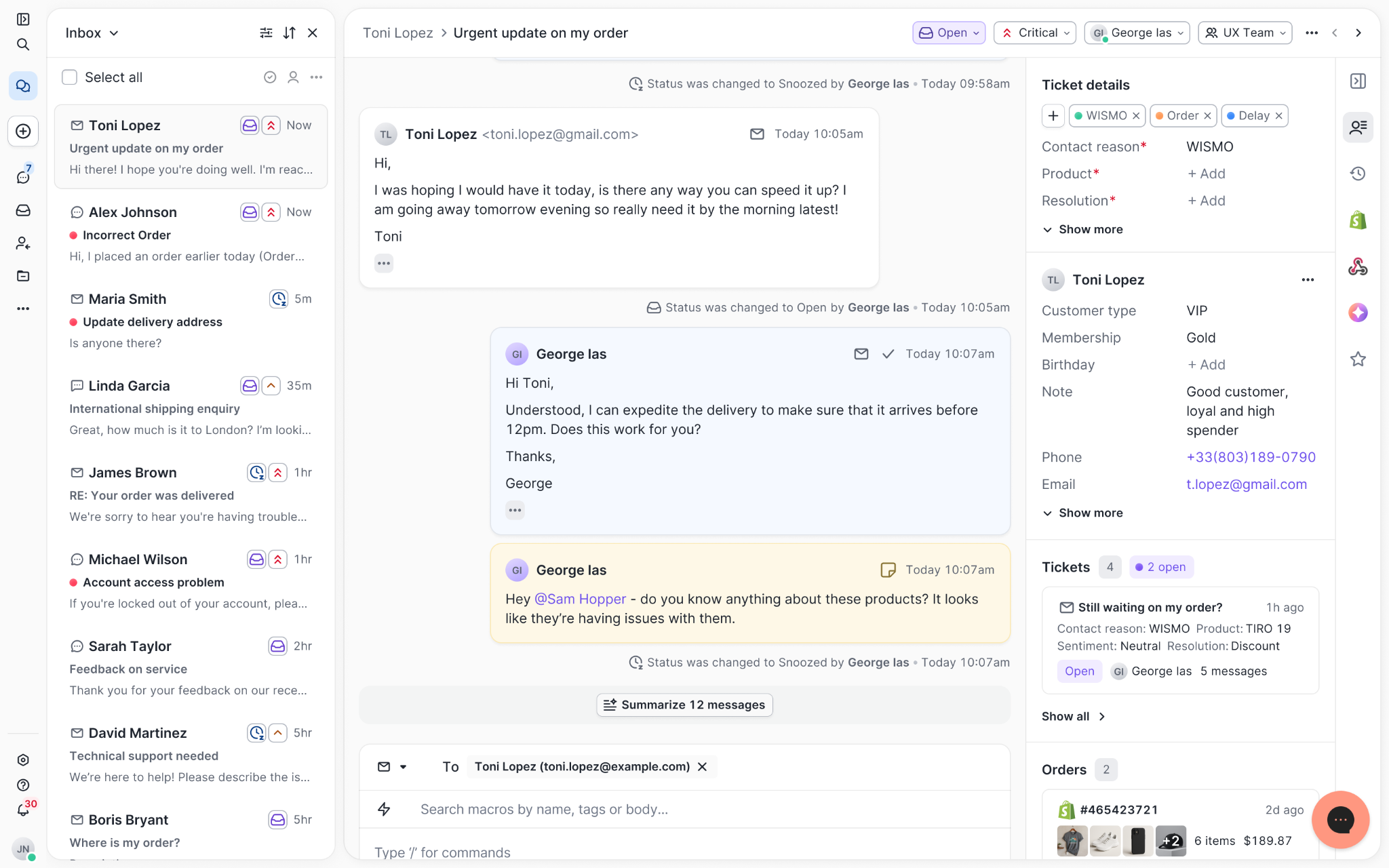
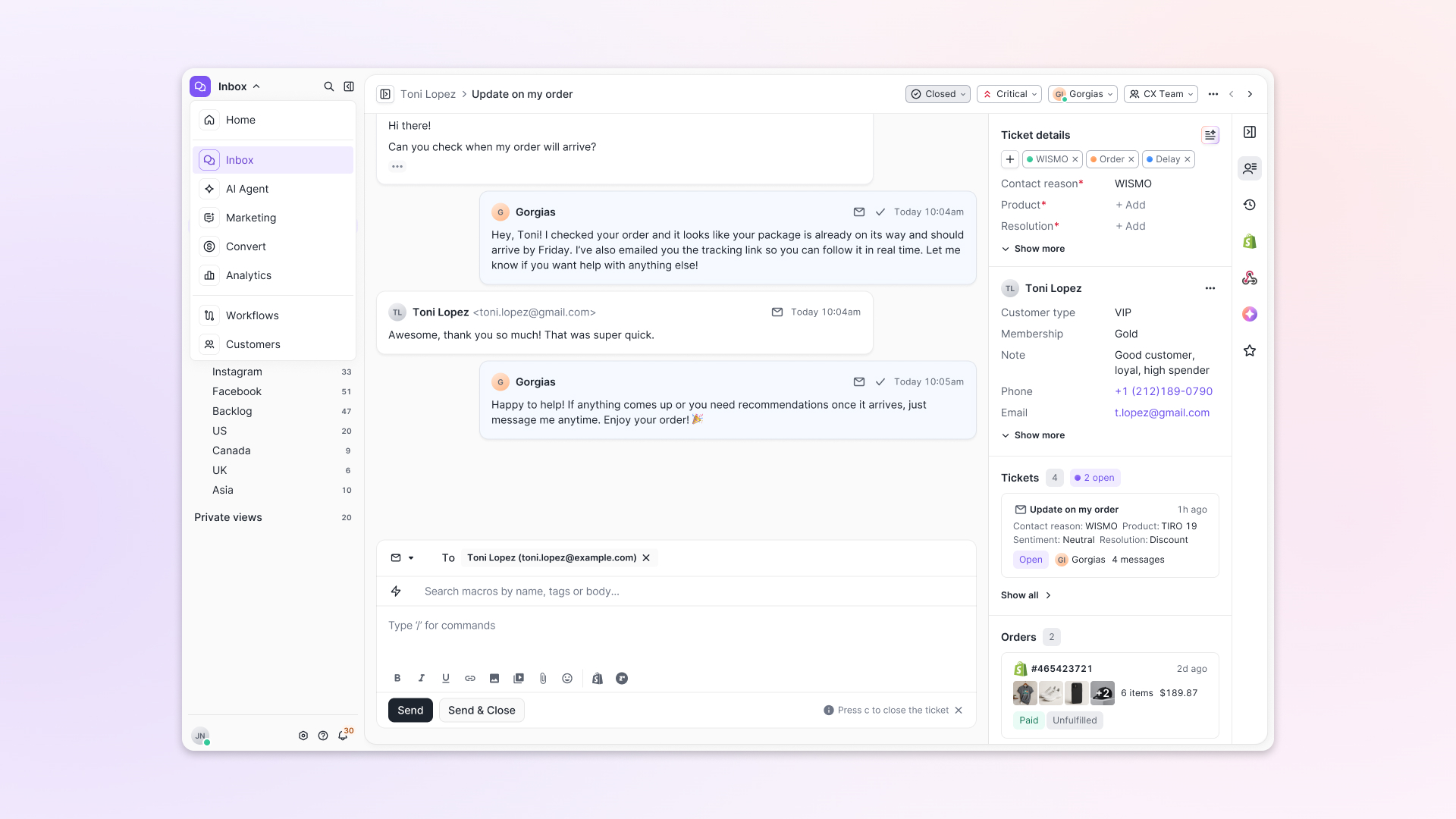
Chats with customers now look like real conversations, using the speech bubble style you’re familiar with on popular messaging apps.
Check customer history without losing your place
Checking a customer's history used to mean leaving the conversation, an extra step that interrupted what should have been a smooth workflow.
Now, past conversations open in a sidebar next to the active conversation. You can view a customer’s full history, search through their timeline, and open prior tickets without going to a new page.

Check past conversations, orders, and customer details in the brand-new Customer Timeline.
See order details the moment you open a ticket
Order information is easier to reference than ever. Open a ticket, and you instantly see the customer's recent orders, marked with product images and invoice details at a glance. Need to dig deeper? Click on an order, and the expanded information appears in the same panel.
For teams using custom integrations, apps are fixed in a quick-access integration menu on the right.
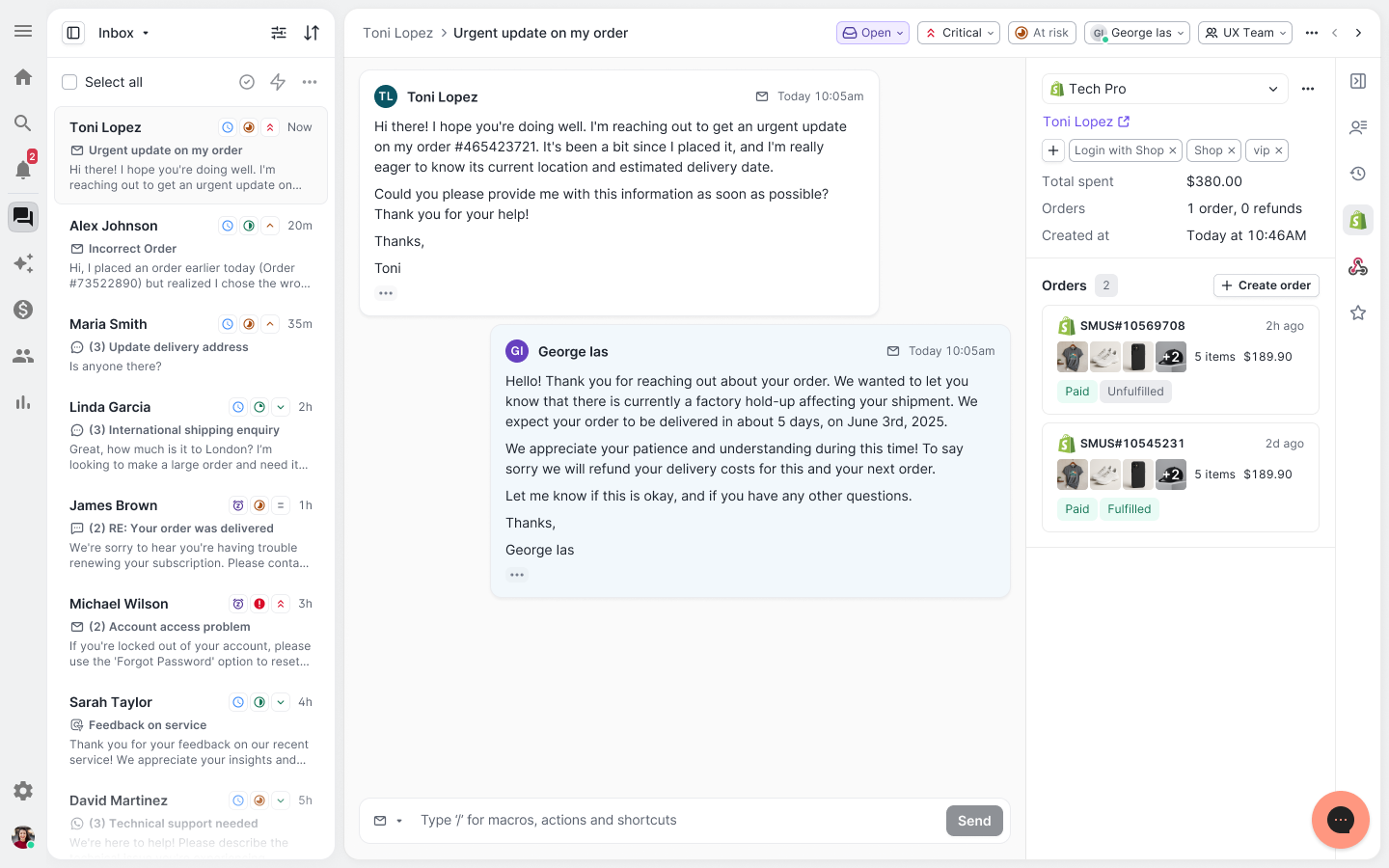
See order details, product images, and totals at a glance on the right panel, without leaving the conversation.
Pick up where AI left off
You shouldn't have to dig through a thread to figure out what AI already tried. Now you don't have to.
When AI Agent escalates a conversation, it includes a concise handover summary that mentions the issue, what actions were taken, and why it was passed to your team.
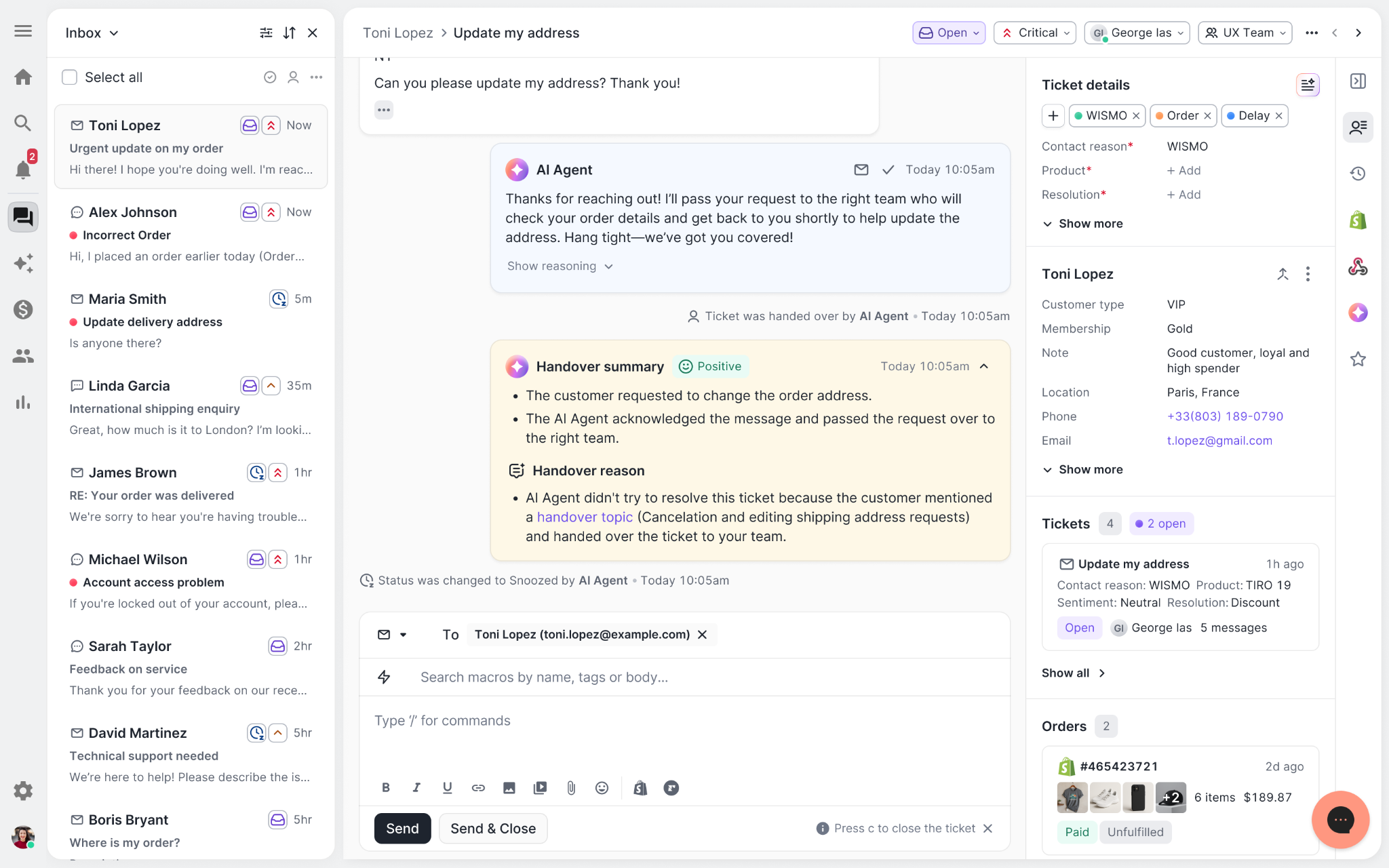
Escalated tickets include a brief AI-generated handover summary, marked in yellow, for quick reference.
Move faster across every store and team
We restructured and simplified the navigation. The left sidebar organizes everything into clear categories: Inbox, AI Agent, Marketing, and Analytics, so anyone on your team knows exactly where to go.
To quickly update your knowledge base or adjust a workflow, both now live right in the sidebar. For teams managing multiple stores, switching between them is just as straightforward, accessible from the sidebar, so agents can move between inboxes without breaking their flow.
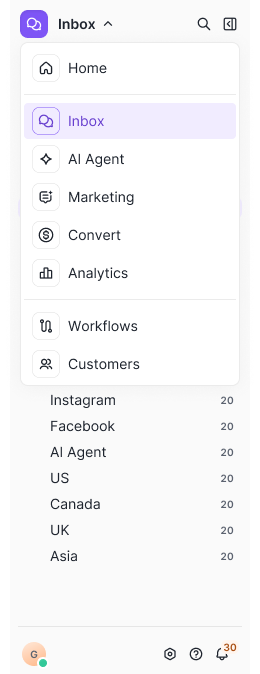
Agents can switch between stores and their corresponding inboxes directly from the left menu.
A workspace that works the way agents do
Support comes down to the person on the other end of the conversation. We built Helpdesk 2.0 is to make sure they have everything they need to show up for that moment.
The best way to see the difference is to work in it. Start a free trial today.


Further reading

How to Deflect Support Tickets & Raise Satisfaction with Customer Self-Service
What if you could deflect a third of your support tickets, automatically, without any agent interaction? With customer self-service and automation, that’s possible. I see it all the time with our customers at Gorgias.
Customer support doesn't always have to mean direct communication with support agents. A healthy support organization also leverages self-service to help customers answer their own questions without waiting for (or dealing with) an agent. On top of helping customers, self-service also reduces ticket volume and first-response time for your support team.
Self-service isn’t just a nice-to-have: 88% of customers in the United States expect company websites to offer a customer self-service portal according to a 2022 survey from Statista. Below, we'll explore the definition and types of customer self-service, the advantages of offering a suite of self-service options, and the best practices to help you meet customer expectations.
What is customer self-service?
Customer self-service is a combination of technology and resources that let customers resolve issues on their own. If a customer answers a question or resolves an issue using resources your company provides (and without messaging your support team), they’ve successfully used self-service.
For example, a customer finding an answer to their question on your website's FAQ page is an instance of customer self-service. Getting information about your order’s status from a chatbot is another. Even though the customer technically receives AI assistance in this second instance, it still counts as self-service because a human support agent isn’t involved.
Does self-service work?
It's fair to wonder whether static resources will actually improve your brand's customer support — and ultimately improve customer satisfaction.
But according to our research at Gorgias, customers with a robust mix of self-service and automation options deflect up to a third of tickets automatically. So there’s no doubt about the benefit to your business.
And keep in mind, most customer issues are not overly unique or complex. Your support team’s time isn’t optimized if they spend a third of the day answering "how do I track my order?" and "how do I return a product?" And your customer’s time isn’t optimized if these questions get routed through a human agent, since they now have to wait for the agent’s response.
Your customers don’t care how they get their answers, they just want them now.
The 9 main types of customer self-service
Customer self-service channels can come in several different forms. While some of these self-service options are more popular than others, it’s typically best to create a self-service portal that offers multiple support options. With that said, here are the four most beneficial types of self-service tools for ecommerce stores.
Editor’s note: We developed a scoring method to represent the difficulty of setting up each method of self-service, as well as the volume of tickets each method usually deflects. More determined faces (😤) indicates that the form of self-service is more difficult and labor-intensive to set up. Lots of tickets ( 🎟) means that the form of self-service will likely deflect a high volume of tickets. Five emojis is the max for both scores.
FAQ page
Difficulty: 😤 /5
Ticket deflection: 🎟 🎟 🎟 🎟 /5
A frequently asked questions (FAQ) page is a great place to start your self-service efforts. These pages list common customer questions that your brand receives, along with answers to each. FAQ pages typically answer straightforward questions that don't require in-depth explanation.
FAQ pages may be simple, but they are incredibly effective. Given that simple questions can eat up a lot of your support team's time, a single FAQ page can do wonders for reducing support ticket volume. If you’re ready to deflect even more tickets, build out your FAQ page into a full-blown help center — a series of FAQ pages organized into searchable categories. More on help centers below.
Quick win to get started: Create a page that lists the five questions that usually fill up your support inbox and answer them fully. If you don't have an FAQ page, use our FAQ template generator to get started.
FAQ page example:
Brümate’s FAQ page — powered by Gorgias — is a great example of an eye-catching, organized, and easy-to-navigate FAQ page. Brümate even separates its FAQs into multiple categories, making it much easier for customers to find what they’re looking for. And they include top articles that would be helpful for specific, common questions.
 |
Knowledge base
Difficulty: 😤 😤 😤 /5
Tickets deflected: 🎟 🎟 🎟 🎟 🎟 /5
A knowledge base is a digital library of customer support content. Written knowledge base articles (or technical documents) are most common, but a knowledge base can include video and audio files as well. This is the natural evolution of your FAQ page.
At Gorgias, we call knowledge bases help centers, and they can end up looking a lot like a company blog (with some important differences). For one, the resources in a knowledge base are specifically geared toward resolving customer issues rather than for general information. An effective knowledge base should also be searchable (or, at the very least, organized and broken into specific categories) so customers can find the answers they need without wading through page after page of irrelevant content.
Quick win to get started: Create a page that lists the ten questions that usually fill up your support inbox and answer them fully.
Knowledge base example
Branch’s help center is a great example of a knowledge base that provides everything customers need (and nothing they don’t). It’s categorized by type of customer question, and even includes a section for the most popular FAQs.
Because this help center is set up on Gorgias, Branch shoppers can also track their packages, alert Branch of any issues, or even start a chat or email — all from the help center’s main page. It’s a one-stop shop for customers who want to find their own answers.
 |
Self-service flows
Difficulty (without Gorgias): 😤 😤 😤 😤 😤 /5
Difficulty (with Gorgias): 😤 😤 /5
Ticket deflected: 🎟 🎟 🎟 🎟 🎟 /5
Self-service flows and customer service portals have been around for a while, and they can be hugely helpful, both for ticket deflection and user experience. Unfortunately, many of the existing ones are difficult to set up and require a login, creating a lot of friction for the customer.
Gorgias’s self-service flows give customers exactly what they’re looking for, nothing more. With seamless verification and an easy transition to a live agent when requested, these flows can automatically deflect a third of your support tickets (while providing customers efficient, low-effort service).
 |
Quick win to get started: Set up Gorgias’ native self-service flows on the default settings and track how many tickets are deflected. (Deflecting order status requests can handle 15%, alone.)
Self-service flow example
Unlike a chatbot, which mimics a human agent, self-service flows use menus. They are easy to navigate and make it clear to the customer that they aren’t yet interacting with an agent.
Our default self-service options are:
- Track an order
- Return an order
- Cancel an order
- Report an issue with an order
And if the customer needs help at any time, they can bring an agent into the conversation seamlessly.
Chatbots
Difficulty: 😤 😤 😤 😤 😤 /5
Tickets deflected: 🎟 🎟 🎟 🎟 🎟 /5
Unlike live chat, chatbot software doesn’t require human interaction — at least at first. Instead, chatbot software connects customers with a chatbot that uses AI and machine learning to provide natural language answers to common questions. Unlike self-service flows, chatbots aim to mimic human agents.
Chatbots solve less complex issues and provide quick answers to your customers. And if you combine it with live chat, staffed by agents, you or your shoppers can easily tag in a human support agent for conversations that need a human touch.
Quick win to get started: It can be difficult to set up a chatbot, but integrating a pre-built chatbot like Ada (which works with Gorgias) can be a huge time saver.
 |
Chatbot conversation example
If your customer breezes by your self-service flows and still wants to know the status of their order, there’s still no reason to waste an agent’s time. Set up a chatbot (Gorgias makes this possible through an integration with Ada) or configure a custom automation Rule (see below) as a second line of defense before an agent receives the question.
Custom automation workflows
Difficulty: 😤 😤 😤 /5
Tickets deflected: 🎟 🎟 🎟 🎟 🎟 /5
Questions that can’t be answered through self-service flows and chatbot conversations can usually be handled by an automation Rule. Rules are another line of defense against the repetitive requests that eat up your agents’ time.
In most platforms, Rules follow a specific logic to make building them easier. And in Gorgias, they can include templated Macro responses that bring in customer and order information automatically, deflecting tickets without an agent’s attention.
If you get a simple question over and over, consider setting up a Rule to deflect that kind of ticket.
Quick win to get started: If you already have self-service flows set up, trigger an automated answer to “Where is my order?” for customers that bypass them.
Automation Rule example
One powerful automation Rule that isn’t covered in self-service is a triage Rule that prioritizes tickets and sends them to the right teams while also sending a message to the customer that the team will be with them shortly.
This Rule can also take advantage of Gorgias’ unique sentiment and intent detection, which can process and tag your ticket automatically. The algorithms are quite precise after training on hundreds of millions of ecommerce tickets.
At Gorgias, we offer 24/7 support and dedicated managers who will help you get custom rules set up for these specific use cases.
Here’s what the Rule would look like when you’re building it:
 |
Check out our guide to ecommerce email marketing automation to learn how automated emails can help you get customers, not just provide great service.
An informative blog
Difficulty: 😤 😤 😤 😤 😤 /5
Tickets deflected: 🎟 /5 (but good for SEO/marketing)
A blog is a valuable marketing tool for ecommerce brands (and something that is sure to boost your website's SEO). And populating it with well-written, informative content can also be a great way to empower customers to resolve issues on their own.
Asking customers to search your blog for the answers that they need might not be the most straightforward approach to customer support. But an informative blog can certainly be a valuable self-service tool when combined with other tools — such as a knowledge base that organizes your blog articles in a way that makes it easier for customers to search.
At the very least, an informative blog will proactively educate your customers, even if it's not the first resource they turn to when they are having issues. Remember: an educated customer base is likely to experience issues less frequently.
Quick win to get started: Blogs aren’t about quick wins — they are long-term investments that only pay dividends over time, with consistent publishing. If you aren’t fully committed, hold off on the blog until you have more resources.
Blog example
Spoonful of Comfort is a great example of an ecommerce brand using its blog to find new buyers and serve current customers. The company sells care packages and uses the blog to (among other things) give customers ideas about what to send for specific situations — like when someone’s in the hospital for Christmas.
 |
Forums and communities
Difficulty: 😤😤/5
Ticket deflection: 🎟 🎟 /5
Most people don't consider browsing online forums as a customer service experience, but many companies host forums as a layer of self-service. Online forums allow customers to collaborate to resolve issues.
Once these communications between customers are live, future shoppers experiencing the same issue can see the solution. In other words, forums can serve as a shopper-generated knowledge base populated with support content your company doesn't even have to create.
Forums are more than a customer self-service strategy: they are also a great way to encourage a sense of community among your customers. That said, consider appointing a forum moderator to keep your forums a friendly, welcoming, and informative space.
Quick win to get started: Create a Facebook or Reddit community. Or show up consistently on existing forums dedicated to your space (or brand).
Forum example
Fitbit has an excellent forum called Fitbit Community. The forum is broken down in many ways: a section for each Fitbit device, features, challenges, and so on. Fitbit users respond to questions and can vote on the best answers.
 |
If you want to get started without setting up forum infrastructure on your website, you can start a community on Reddit, Facebook, or a similar social media site to provide similar support. For example, Gorgias has a community where customers help each other and share ideas, and our support team monitors it to step in and add value.
How-to content or online webinars
Difficulty: 😤 😤 😤 😤 😤 /5
Tickets deflected: 🎟 🎟 🎟 🎟 /5
How-to videos and online webinars can be an excellent way to educate your customers with step-by-step tutorials on the proper use of your brand's products. Customer education is especially relevant for companies in the SaaS space, where confusing or complex software can get in the way of customer adoption.
By saving recordings of your webinars so that they are accessible to anyone who visits your knowledge base, you can double your webinars’ value — first as a lead magnet for those who choose to view the webinar live, and then as a permanent piece of support content future customers can access at any time.
Quick win to get started: Record a welcome video that serves as a product introduction and tour of the main features. Track views and other types of engagement to see if it’s resonating.
Webinar example
ActiveCampaign is a great example of a company that uses webinars to teach customers how to use its products. The above link goes to a page where ActiveCampaign aggregates all of their past webinars in specific categories and shares information on how to attend upcoming webinars live.
 |
In-product tutorials
Difficulty: 😤 😤 😤 😤 😤 /5
Tickets deflected: 🎟 🎟 🎟 🎟 🎟 /5
If you are a software company, in-app tutorials are one of the easiest ways to streamline your onboarding, reduce initial churn, and reduce your support costs.
In-app walkthroughs are powerful because they appear when they’re needed. Webinars, by contrast, are great for in-depth walkthroughs, but customers have to find the webinar when they need it. Many won’t know they exist. In-app tutorials provide guidance automatically, at the ideal moment, to help your users understand how to get value out of your product.
Quick win to get started: Create an onboarding tutorial that guides new users around your platform, highlighting common tools to get started (and shepherding the user away from advanced features they can wait to discover). Candu and Appcues are our favorite tools for in-product training.
In-product tutorial example
We created in-app tutorials for Gorgias to strengthen our new-user journey, improve product adoption, and scale our onboarding efforts. When users log on or navigate to certain pages for the first time, a step-by-step tutorial appears to help them with setup.
{{lead-magnet-1}}
7 best practices for excellent customer self-service
Customer self-service is powerful, but requires a well-thought-out approach. If you would like to start empowering your customers to solve issues on their own, here are the seven most helpful customer self-service best practices to follow.
1) Aim for one-click resolution
Chatbots are a perfect example of self-service taking too many steps and turning customers against the concept. While there are chatbots that streamline the experience — like Ada, which integrates with Gorgias — may lead customers on a multi-message journey that leaves them begging for a live agent.
Anything more than a few clicks is a suboptimal customer experience. That’s why Gorgias starts with self-service flows as the first line of defense. These menus are clearly self-service (whereas a chatbot imitates a real agent) and lead customers to the solutions they’re looking for in one click, in many cases.
 |
2) Start with your frequently asked questions
A knowledge base is one of the easiest options to start executing a customer self-service strategy, and that starts with a strong FAQ page. Compared to managing a community forum or routinely publishing blog posts, an FAQ page is a very light lift. It's also a resource that your customers are sure to find helpful since an FAQ page necessarily addresses the most common questions your customers ask.
Before you create an FAQ page for your website, take the time to truly understand your customers and the issues they experience. Start by speaking with some of the more experienced members of your customer service team to see which questions they encounter most often. Weed out questions that are situational (and don't have a generalized answer), and include the remaining questions on your FAQ page.
If you use a tool like Gorgias, analyzing your tickets at scale to see the most common issues you encounter becomes much easier.
3) Offer a mix of self-service options
Providing multiple self-service options for your customers lets them choose the option they prefer. Not only does this create a better customer experience, but it also increases the likelihood that customers will answer their own questions instead of messaging your agents.
Above, we offered a comprehensive list of self-service options you can use to help your customers help themselves. Once you have built your FAQ page and set up your self-service flows in your chat widget, continue adding self-service options based on what makes sense for your business.
If you have a more complex product, you might prioritize a knowledge base and webinars. If you have a strong community around your offerings, you might focus on building a forum and blog to keep them engaged. There’s no one-size-fits-all solution.
 |
4) Provide useful content such as images, video, and audio
When creating support content — whether it’s knowledge base articles, FAQ questions, or anything else — don't underestimate the power of images, video, and audio to get your point across. Sometimes it's easier to show than tell, and a single image can often do more to resolve a customer's issue than an entire article of text.
For example, if you are helping customers navigate to a specific page on your website in an article on how to track orders, showing screenshots that point out which buttons they need to click makes the process much easier.
Plus, some customers simply don't like to read, and presenting support content in the form of images, video, and audio will make them more likely to enjoy their customer service experience.
 |
5) Improve and update content continuously
Unless your products and services never change, you aren't going to be able to publish support content once and just forget about it. Even if your overall business is relatively static, the rest of the world is not, and the needs and issues of your customers are sure to evolve over time.
While it's a good idea to try and make the content in your support portal as evergreen as possible, it's also important to continually improve and update your support content anytime there are changes to your product, business, or audience.
You'll also want to regularly improve and add to your content. If you notice that a lot of customers are struggling with a specific issue, then it's probably a good time to publish a new article on the topic to your knowledge base.
6) Enhance the mobile functionality of your self-service options
Every page on your website should be mobile friendly, including your self-service options. In fact, it's arguably even more important for self-service options to be mobile friendly because many customers search for solutions while they are actively using a product and may only have access to their mobile phones.
Given that mobile searches currently account for about 63% of all online searches, you’ll provide a poor experience to many customers if your self-service pages don't look, load, and function correctly on mobile devices.
 |
7) Use automated chatbots as a customer support tool
Leveraging automation in the form of customer support chatbots is one of the most powerful customer self-service strategies since it often leaves customers feeling as if they've received immediate help from a live agent.
When integrated with customer service tools such as Gorgias, chatbots powered by artificial intelligence can detect a customer's sentiment and intent, then either answer the customer’s question or direct them to self-service resources where the customer can find what they need.
For example, Gorgias can detect when a customer is frustrated and auto-tag the ticket to trigger an automatic response, letting the customer know someone will be with them shortly. On the backend, that ticket can be prioritized to ensure they don’t wait long and escalate their frustration.
How customer self-service benefits businesses & consumers
The data above shows us that customers expect and value self-service options when communicating with brands. But why, exactly — especially when the conventional wisdom is that the “human touch” always wins?
Below, we’ll explore a few ways that self-service options directly enhance the customer experience, which can help guide you as you build your self-service strategies.
Customer issues get resolved quickly
Unless a support agent picks up the phone immediately, it is almost always going to be faster for customers to solve their own issues — assuming the self-service resources are truly useful. Given the value of swift customer service for today's customers, you cannot overlook the importance of resolving customer issues quickly.
Even if customers have to spend a few minutes to solve their own problem, the fact that they are actively working to solve the problem (rather than waiting on hold) goes a long way toward improving customer satisfaction.
 |
Some customers prefer solving problems on their own
For the independent (and introverted) among us, reaching out for help can feel like an admission of defeat (or at least an unappealing effort). Some customers simply prefer to solve issues by themselves, and giving them the option to do so is an important part of improving their customer experience. In fact, if given the option, most customers would prefer to solve problems on their own before they go through the hassle of contacting customer support.
You can maximize the customer experience by providing a thoughtful mix of self-service features, so shoppers can choose their method of choice. For example, you could have a help center to help provide in-depth information, self-service flows in the chat to deflect conversations, and automation Rules and chatbot integrations for the customers who still want a more conversational approach.
Customer service costs go down
Providing customers with self-service solutions means you can resolve plenty of questions that would have otherwise turned into support tickets for a human agent. Fewer support tickets to deal with means that your company can reduce the size of its customer support team, allowing you to dramatically reduce the expense associated with providing great customer support.
Support team members will be happier and more productive
Most customer support teams spend a great deal of their time responding to mundane, repetitive questions. While these questions and issues typically aren't challenging to resolve, they are tedious and not very stimulating. By eliminating these simple, repetitive issues from your support team's daily routine, you can make their job a lot more enjoyable.
When support agents don't have to answer "where is my order?" a hundred times each day, they are free to focus on resolving more unique and challenging issues. Giving agents more time to tackle challenging issues will enhance their productivity and make their job more interesting and enjoyable.
Customer support is more readily available
Customer self-service tools such as knowledge bases and chatbots are available 24/7 without human intervention. Offering customers these tools is a great way to make omnichannel support options more readily available without any additional staffing.
It empowers your team to spend more time on the tickets that matter
The end goal of automation is not to remove agents from the support process or handle all incoming tickets automatically. Many tickets need a personalized, human touch.
However, your team won't have time to provide a human touch to tickets that need it most — especially as your ticket volume grows. Automating 100% of simple, repetitive tickets is the best way to spend more time on the tickets that matter to your business.
With self-service and automation, you can drive revenue through support and spend more time handling inquiries from VIPs while other companies are busy responding to hundreds of “Where is my order?” tickets.
Provide customers more value, faster
When given the right resources, customers can often resolve issues on their own in much less time than it takes to get a support agent involved.
First response time (FRT) is one of the major metrics in evaluating customer service, and self-service options will help you decrease it dramatically.
Reduce your ticket volume (and spend on support)
A 2019 Microsoft study found two-thirds of customers try self-service before contacting a live agent. Imagine that kind of reduction in the support tickets coming through your inbox.
Whenever customers solve problems on their own, you don't have to pay a support agent to assist them. This means that companies with effective self-service options are often able to save money by reducing the size of their customer support teams.
Generate additional revenue
Use self-service to trigger an automated sales workflow or present customers with upsell opportunities within your self-service content. Customer support should be an important part of your company's sales funnel, and these tactics can help you put that process on autopilot.
Provide around-the-clock support
According to data from HubSpot, 90% of customers expect an "immediate" response when they have a customer service question. However, most companies can’t provide immediate responses — especially not around the clock.
Customer self-service tools such as FAQ pages and knowledge base articles are available at all times, enabling swift 24/7 support without staffing support agents at all hours. Rest easy: your self-service options are handling the night shift.
How Gorgias approaches self-service for online stores
As the team behind the market's leading customer support solution for ecommerce, we at Gorgias designed our self-service flows and portals for online stores, first and foremost. Every feature, process, and design choice was made to serve the specific needs of companies dealing with the shipment of physical goods to their customers.
And while a lot of that process can be unpredictable, you are fully in control of how your buyer moves through delays and issues with your support team.
Our innovative self-service approach includes three main lines of defense meant to deflect time-wasting tickets and save agent time for the tickets that matter.
 |
This self-service process provides:
Proactive support through how-to content
The proactive customer service process starts with a customizable help center that can be populated with FAQs, how-to articles, instructional videos, past webinars, and more. This help center is the first page that customers see when they search for support and is designed to deflect support tickets by encouraging customers to first browse self-service options.
Self-service flows that deflect the most common requests
The second pillar of our approach to customer self-service includes self-service menus that can answer common ecommerce inquiries — both inquiries that have general answers and inquiries with answers that are specific to the individual customer. Our self-service workflows include the following commands that move the customer into a dedicated menu:
- Track my order
- Return my order
- Cancel my order
- Report an issue with my order
In addition to these customer support commands, Gorgias also offers automated flows designed to answer common pre-sale questions such as "How do I pick the right size?" or "Are there any discounts available?" and help ecommerce stores improve their conversion rate.
 |
One of the main benefits of these flows is that they keep users on your site to get the answers they need, instead of bouncing to the shipping carrier's website or elsewhere. And maybe they’ll stick around to put in another order.
Chatbots and automation to mimic traditional support
If customers manage to get past your self-service flows with repetitive questions, a pre-built chatbot can engage them and answer their questions.
Any other advanced queries that aren’t covered by the above self-service options can still be answered automatically. Customizable automation Rules can be tailored to the questions you receive the most, as an additional line of defense against time-wasting tickets.
With intent and sentiment detection powered by AI, Gorgias can detect a customer’s question no matter how it’s worded. Gorgias also allows you to create customizable Rules and flows for each command, making customer self-service a dynamic process that is much more similar to traditional customer support.
 |
Enjoy optimized customer self-service with help from Gorgias
With Gorgias, you can automate the answers to pesky and repetitive questions and deflect up to a third of the tickets in your support process. With a full suite of self-service and automation features, you can provide a mix of options so your customers can choose the ones that suit their needs.
If you would like to improve customer satisfaction while reducing your customer support costs, then Gorgias’s cutting-edge self-service tools are the solution for your business. Find out more about what Gorgias can do to streamline and improve your self-service support strategies.
{{lead-magnet-2}}

SLA Best Practices for Effective Support Ticket Management
TL;DR:
- A service level agreement (SLA) is a promise of how quickly and well a company will help customers.
- Setting SLAs helps support teams meet customer expectations and business goals.
- You can easily create and customize SLAs in Gorgias for different channels like chat, social media, email, and contact form.
- Track how well you’re meeting your SLAs with Gorgias Statistics.
Customer expectations are becoming more demanding as AI technology redefines the meaning of great customer service. Support teams need to catch up, which means monitoring performance with a service level agreement (SLA) to meet efficiency expectations.
In this guide, we’ll walk you through everything you need to know about SLAs, including what they are, why they matter, how to create and measure SLAs in Gorgias, plus some SLA best practices.
{{lead-magnet-1}}
What is an SLA?
A service level agreement or SLA is a document that outlines the expected level of service a company will provide to customers, how responsive the company will be, and how performance will be measured.
In ecommerce customer service, SLAs typically include metrics like first response time, resolution time, and customer satisfaction score (CSAT).
Brands can create an internal SLA for support agents and display a customer-facing SLA for customers.
How brands benefit from setting SLAs
Setting clear expectations and measurable goals with SLAs provides several advantages to your brand and immediate customer service team.
Here are some key benefits you gain from setting SLAs:
- Informs data-driven goals. SLAs can help dictate what business targets to set based on team and agent performance and customer expectations.
- Consistent support standards. The terms laid out in an SLA make it easier for every agent to deliver the same quality of service to customers.
- Manages customer expectations. The customizability of SLAs ensures expectations can be met no matter the customer or scenario.
- Pinpoints support performance gaps. SLAs enable teams to track individual agent performance, which can give insights into the gaps in your customer service operations and escalation processes.
- Enhances marketing strategy. Brands can use SLAs to market their commitment to exceptional customer service to appeal to new and existing customers.
How to create an SLA on Gorgias
Create SLAs with just a couple of clicks with Gorgias, no matter your plan. You can use templates based on support channel benchmarks or create an SLA from scratch to customize your first response and resolution target times.
Follow these three easy steps to get started.
Step 1: Create your SLA
Go to Settings → Productivity → SLAs → Create from Template. For a brand new SLA, click Create SLA.
You can select from three templates based on your channel needs:
- Chat
- Social media
These templates give you baseline recommended first response and resolution times, allowing you to start supporting customers instead of sweating the details.
Step 2: Customize the times
Already know the amount of time responses should take? You can specify the time frame for the first response time and resolution time in hours, minutes, or seconds. Ensure the time frames are realistic and achievable for your support team.
Step 3: Activate or deactivate the SLA policy
Only admins and team leads can activate or deactivate SLA policies. This activation feature can be helpful during peak shopping periods like Black Friday and Cyber Monday (BFCM) when your team needs to switch SLAs to meet faster times.
Navigate to the bottom of the SLA creation page and toggle “Enable SLA” as needed.
How to track and measure SLA performance
Once your SLAs are in place, track your performance to ensure you uphold the terms of your SLA.
Here’s how to track SLA performance on Gorgias:
Find your SLA statistics under Statistics → Support Performance → SLAs.
You will see your SLA performance overview, which includes your Achievement Rate and Breached Rate:
- Achievement Rate: Percentage of tickets that meet the SLA terms.
- Breached Rate: Percentage of tickets that failed to meet the SLA terms.
You can filter SLA performance by channel (chat, email, social media, contact form, etc.), ticket tags, and date.
The graph will change based on your activated filters. It sorts tickets by Satisfied, Breached, and Pending tickets.
In addition, you can gain insights into specific tickets and their achievement rate. This detailed view can help you set realistic target times and find out if agents need more training.
Best practices for creating SLAs
Remember that overpromising can backfire. To set realistic expectations, here are seven helpful tips to set up an SLA that delivers and improves customer satisfaction.
1) Determine the type of SLA to use
Never (ever, ever, ever) copy and paste because an SLA policy is rarely a one-size-fits-all scenario. Your SLA should be designed based on your customer support team’s capacity and target audience.
There are three types of SLAs to consider:
- Customer-based SLAs: This agreement commits to delivering a certain level of service to a customer. It focuses on organizing the customer’s obligations and expectations about the contract. Each customer might have a different SLA. A customer-based SLA may be used for an ecommerce store and a manufacturer.
- Service-based SLAs: Determines the services that will be offered to customers. For example, an ecommerce store may use a service-based SLA to ensure they can support customers from 9 AM to 5 PM on weekdays.
- Multi-level SLAs: This SLA can take several forms and outline expectations if there's more than one service provider and one end-user.
2) Learn the standard SLA metrics for ecommerce brands
Track performance metrics to ensure you’re committed to your SLA’s terms. Consider the following customer support metrics:
- Average resolution time: The average time it takes to respond and resolve a ticket.
- First response time: The average time it takes to reply to a customer’s initial inquiry.
- Customer satisfaction score (CSAT): A measure of how satisfied customers are with your service delivery. CSAT is often measured through single-question surveys asking, “How satisfied were you with our service?”
- Uptime: The percentage of time your website is operating.
- Downtime: The percentage of time your website is not operating. For example, if your brand provides 99% uptime, you won’t be available 1% of the time (this is your downtime).
Check it out: How exceptional is your customer service? (Gorgias customer service benchmark report)
3) Avoid ambiguous language
Don’t use vague phrases like “as soon as possible,” “fast,” or “quickly.” Instead, use clear measures of time like, “We’ll get back to you within 12 hours.” Concrete, measurable language lets customers understand your policies, avoiding confusion.
Here’s an excellent example from olive oil brand GRAZA. Notice their live chat shows “Typically replies in a few hours,” not “We’ll be back soon.”
 |
💡 Pro Tip: Avoid intimidating phrases like “we are not responsible for,” “you are required,” or “you must.” Set your boundaries, but also show empathy.
4) Design your SLA based on data
Basing your SLA terms on past support performance data will set your agents up for success instead of trying to achieve unrealistic goals.
Here is some support data to consider:
- What is our average first response time on [channel]?
- What is our average resolution time on [channel]?
- What is our daily ticket volume?
- How many customers can one agent handle?
Want direct insights? Don’t be afraid to ask customers for feedback about your support services. Ask them what you could do better, if your speed is acceptable, and if your service is missing anything.
Most importantly, consult your support agents’ bandwidth and workflow to ensure your SLAs are achievable.
💡 Pro Tip: It might be time to revamp your SLA if you consistently fail to meet it. Are the expectations you’re setting too high? Are support agents facing roadblocks that prevent them from resolving tickets? Should you hire more agents?
5) Make your SLA flexible
In ecommerce, peak shopping seasons like BFCM entail more customer support traffic. Adjust your SLA based on holidays, sales, and shopper behavior. For instance, provide 24/7 customer service during the holiday season to account for the increased shopping activity.
💡 Pro Tip: You may also want exclusive SLAs for high-value, repeat customers. For example, they might get support priority over first-time visitors.
6) Specify your business hours
Make information about service availability visible on your website. If your support hours are unclear, customers will assume they can contact you anytime — even when agents are offline.
For example, if you provide support from Monday through Friday during business hours, state it in your SLA. This way, customers know you’ll only handle their service requests during that time.
On Nashua Nutrition’s Contact Us page, you’ll find clear information about their operating hours and holiday closure updates. They also explain how they provide curbside order pick-up for local customers.
 |
Besides the Contact Us page, you can also show your SLA on live chat, FAQ page, Help Center, or even on the header as Trimleaf does:
 |
7) Outline your procedures for SLA breaches
Prepare for the unpredictable, like an outage, website crash, or server maintenance, by outlining what your support team will do if these critical issues happen.
When you’re transparent about your service, you build your credibility, and customers trust you more.
Elevate your customer experience with Gorgias
Customer service efficiency and satisfaction are within reach with these SLA best practices. Gorgias offers the tools you need to create and manage SLAs seamlessly while delivering omnichannel communication to your customers.
Ready to take customer experiences to the next level? Book a demo with Gorgias today and drive success for your brand.
{{lead-magnet-2}}
.avif)
How to Remove Powered by Shopify on Your Website (and What To Put Instead)
By default, all Shopify themes include a branded “Powered by Shopify” message at the bottom of every page. The branding appears as a link in the footer that takes users to Shopify’s homepage when they click on it.
 |
If you’ve recently launched a store and now you’re wondering how to remove “Powered by Shopify” from your online store’s footer, you’ve come to the right place. We’ll cover everything you need to know.
Once we explain how to remove this from your footer, we’ll look at some other steps new shops should take to build a custom store that retains shoppers and increases sales.
{{lead-magnet-2}}
How to remove “Powered by Shopify” from the footer of your online store
The “Powered by Shopify” text is part of your Shopify theme code, meaning you’ll need administrative access to your online store’s dashboard and alter its code. Don’t worry, you don’t need much technical knowledge. Shopify makes it easy to edit code, and you don’t need any special additional knowledge beyond what we’ll share below.
1) Log to Shopify
The first thing you will need to do is log in to your Shopify store. Logging in requires your email address and password.
 |
If you’re reading this before launching your Shopify store, bookmark this page and come back once you’ve set up your Shopify store.
2) Navigate to themes under online store
Click Online Store on your shopify dashboard. It can be found near the bottom of the page in the left sidebar. Once you find it, click the button and a dropdown menu will appear. Click the button titled Themes.
 |
📚 Recommended reading: Our ranking of the best Shopify Themes, based on our analysis of over 13,000 themes.
3) Edit theme content or edit language options
Depending on how new your store is, you’ll either see the option to Edit default theme content or Edit language. In the image below, you’ll see Edit default theme content, but select Edit language if that’s what you see.
 |
If you use multiple themes, you’ll want to apply these steps to any themes you wish to remove “Powered by Shopify” from.
4) Type “powered” into the filter items field
There’s a search bar at the top of the page under Theme content. Type in “powered” to the box to see any sections that include this word. (Other guides call this a “translation box,” but that term doesn’t appear in Shopify so no need to worry about that term)
 |
5) Remove any mentions of “Powered by Shopify”
On the filter results page shown in the image above, you are likely to see more than one result. Only pay attention to the last two results:
- Don’t change anything in the first result, the description html section
- Delete the faded text in the Powered by Shopify section by typing a single space
- Delete the text in the Powered by Shopify html section
This will remove the instances of “Powered by Shopify” from appearing on your site.
 |
6) Don’t forget to click save
The final step is to click the save button” in the top right of the screen. Now, the theme will display nothing. You also have the option to change it to say something else related to your store.
 |
How to remove “Powered by Shopify” by editing the code directly
If you’re comfortable editing code, go back to the admin dashboard shown in step 2 and click the Edit code option instead.
 |
On the left-hand portion of your screen, you’ll see a few different folders.
- Expand the sections folder and
- Locate the footer.liquid file in the dropdown of options
- Click the footer.liquid file and the coding window will open on the right side.
 |
Now you’ll want to delete instances of “powered”:
- If you’re using a Mac, click command + f; if you’re on a PC, click ctrl + f
- Type “powered_by_link” into the search box you’ve pulled up
- Delete any instances of “ {{ powered_by_link }}” and click save.
 |
Your theme may also require you to go to the password-footer.liquid file in the section folder and delete “powered_by_link” from there too. This ensures “Powered by Spotify” is removed from your password page as well.
What to put in your Shopify footer after removing “Powered by Shopify”
The footer is where you can demonstrate you’re a professional shop who’s organized and cares about the customer experience.
You can replace the “Powered by Shopify” text with your own logo and implement helpful must-haves like the following:
- Social media icons
- Payment badges
- Privacy policy and terms of use
- Newsletter signup
- Contact information
- Copyright notice
- App download
This is a space to showcase anything and everything a potential customer might be searching for. Keep it neat, otherwise you risk overwhelming and confusing users.
Let’s take a look at Princess Polly’s footer:
 |
This store’s footer is organized and vastly improves the site’s usability. Navigation is clear and customers can easily find what they’re looking for. In addition to the informative pieces, Princess Polly also uses this space to advertise their iOS mobile app, android app, and social media links.
Why does Shopify add this branding to their themes?
Branding is a major part of any business. And — as a major player in the ecommerce platform game — Shopify does this weel. The point of including the “powered by” link in all Shopify stores is to advertise their product to shoppers who visit a site hosted on their platform.
Let’s examine this a bit further.
Imagine that a shopper lands on Olive and Poppy’s store in search of totes or jewelry.
 |
Eventually, the shopper may find themself down in the footer of the site looking for more information about how to find the brand on social media or in search of answers to FAQs.
That’s when they see the “Powered by Shopify” branding and think, “Well, what’s this?” And, they click through to find out, which redirects them to Shopify’s homepage where their question is answered.
 |
The “Powered by Shopify” copy is one tactic Shopify uses to build their business and attract new users who may have an ecommerce site opening soon. Perhaps it’s how you found out about the platform in the first place. So, if it helps them out, why would you want to remove it?
Why should you remove Shopify’s branding?
Consider removing this text to make your shop look more professional, remove a path leading shoppers away from your site, and advertise your own brand. You are undoubtedly in a competitive industry and need to leverage every opportunity to keep shoppers shopping.
One thing we all know is that once a customer moves away from your online store, the chances of getting them to come back — especially if they have not yet entered your sales funnel — are very low. All text on your page should educate customers and move them toward a sale — a process called conversion.
In a nutshell, you don’t want any traffic leaving your site once you’ve put all the work into getting them there in the first place. Instead, use every effort to direct shoppers through your sales funnel to place an order.
Keep reading for a step-by-step guide on how to remove the “Powered by Shopify” link from your store to improve the odds of keeping shoppers on your website and placing an order.
What else should new Shopify stores do?
In addition to removing Shopify’s branding from your store, there are many other steps you can take to ensure that more sales take place on your site. Let’s explore some of them together.
First, we’ll look at some live chat tips, explore an abandoned cart recovery plan, and touch on SEO basics. Then, we’ll touch on a reviews strategy, social media, and the possibility of upgrading to Shopify Plus. Let’s get started!
Double check you have the best theme for your needs
Shopify offers store owners a variety of themes, including paid and free themes. With so many to choose from, how do you select the best theme for your store?
Here are some questions to ask yourself when looking for a theme:
- How many products will I be selling?
- How many unique features do I want?
- How much customization do I want?
- How do I want to display my products?
You can use Spotify’s theme store filters to narrow down your options. Demo any theme before publishing it to your store, and look at reviews for any additional guidance.
See a theme you like being used by another store? Use our Shopify theme detector to identify it.
Consider whether Shopify Plus is right for you
Shopify Plus is a Shopify upgrade designed for large enterprises making high-volume sales and shipments. With its higher price tag, Shopify Plus comes with more storefront functionality, support, and integrations than the basic Shopify plan.
Shopify Plus provides users with unlimited staff accounts. If you find yourself in a position where you need more Shopify admin accounts for your team, it might be a good idea to consider upgrading.
Theme design customization is also enhanced with Shopify Plus — the checkout page is fully-customizable as it’s not part of the main theme file. Shopify Plus allows you more control over your ecommerce website, and additional statistics and data like average order value.
With Shopify Plus, you can provide shoppers with a greater number of user discounts, access more detailed reporting, and leverage a higher level of merchant support. These are just some of the advantages Shopify Plus provides to help you scale your operations.
Install a live chat
Live chat isn’t just for answering questions. You can also use it to upsell, retain customers, and increase sales. Here are 5 ways live chat helps drive revenue:
- Builds trust with first-time visitors
- Provides timely support
- Delivers a superior customer experience
- Helps answer pre-sales questions right before checkout
- Enables chat campaigns to reach out to shoppers in real-time
Even if you’re a smaller business who can’t staff a live chat 24/7, there are some features you can implement to still answer customer questions as they come in. Try out self-service flows, contact forms, quick responses, article recommendations, or set business hours — all of which are covered in the link above.
Learn how to install a live chat widget and start increasing your customer engagement and satisfaction.
Set up a FAQ page/Help Center
Save your customer support teams time by implementing effective self-service resources like an FAQ page or a help center. Follow these steps to create an effective FAQ page:
- Gather the questions your customers actually frequently ask
- Create concise answers to every question
- Provide a navigation system to keep your page clean
- Make the FAQ accessible
- Make timely updates and refreshes when necessary
 |
If your website analytics are showing heavy traffic to your FAQ page or you need more room for organization/categorization, it’s likely time to build out a help center.
Help centers are more robust and detailed than FAQ pages. You can either create a help center that expands on what you address in the FAQ section, or make it full-fledged and include images and video tutorials.
Streamline your checkout flow
Nobody likes abandoned carts — and it’s crucial to understand why customers leave the checkout process mid-way if you want to fix it.
Baymard’s research reveals the top reasons for cart abandonment:
 |
Streamline your checkout flow and make the shopping process easy for customers. Optimize the checkout process by doing the following:
- Offer numerous payment options for your customers
- Don’t require shoppers to create an account in order to buy
- Provide total cost estimates during checkout to reduce sticker shock
- Use breadcrumbs (progress indicators) to show the number of steps in your checkout process
- Create an abandoned cart workflow automation for customers that leave items for later
- Give your customers multiple shipping options
- Offer a live chat feature on the checkout page for customer questions
- Make it easy for customers to move between their cart, product pages, and more in your online store
Check out our detailed list of cart abandonment strategies and tools to implement these solutions on your Shopify store.
Check (and improve) your SEO
Organic website traffic has no upfront monetary investment, yet it yields better ROI than many other paid advertising tactics. The numbers don’t lie, 37.5% of all traffic to ecommerce stores comes from search engines.
Optimize your store’s technical, on-page, and off-page SEO so returning and new customers can find you with ease. To ensure your store boasts great technical SEO, do the following:
- Make your website crawlable
- Resolve any 4xx errors
- Have a flat site architecture
- Add Shopify tags and product schema
Once you’ve checked off those items, you can implement the following into your Shopify store to ensure a fantastic user-experience:
- Relevant title tags
- Enticing meta descriptions
- Unique product descriptions
- Descriptive images
- Usable navigation features
Don’t leave search engine rankings to chance. Most every professional organization has SEO strategies in place — your Shopify store shouldn’t be any different.
Build out your tech stack with essential Shopify apps
Don’t feel like you have to do everything on your own, a solid ecommerce tech stack can optimize many daily business functions for you. You might feel overwhelmed by the seemingly never-ending choices of apps and tools, but it’s easy to find some suitable for you when you define your needs.
Before you start downloading every helpful-looking app, here’s 3 key things to look for:
- Integrates with your other ecommerce tools and platforms
- Allows for customizations
- Receives regular updates
We’ve done some of the hard work already, narrowing down the best of the best. Whether you’re in need of some marketing help or checkout assistance, here’s some of the best apps out there:
- Customer service: Gorgias, Ada
- Email marketing and SMS: Klaviyo, Attentive, Postscript
- Sales and conversions: Cartloop, Recharge, Spently
- Development: Omega Instant Search, Buddha Mega Menu, Smart Bar
- Checkout: One-Click Checkout, Klarna, Fast Checkout In One Click
- Inventory management and returns: Katana Manufacturing ERP, Stock Sync, QuickBooks Commerce
- Social media marketing: Outfy, Zotabox, Instafeed
Implement a centralized helpdesk
Your ability to quickly satisfy customers is key to customer retention and long-term growth. 58% of businesses actively use a helpdesk, for good reason, as they’re a key component to improving the customer experience.
Choosing the right help desk is crucial for your ecommerce business. It doesn’t only help you provide the best customer support, increase engagement, and convert more sales in the process — but it seamlessly integrates with your current ecommerce platform.
If you want to create a truly valuable helpdesk, include these features:
- Multichannel communication
- Ticket management
- Self-service features
- Automation capabilities
- Reporting functionalities
- Third-party integrations
Don’t fall short when it comes to providing exceptional customer service, or it’ll negatively affect your shop’s success.
Get in the habit of ongoing CRO
Conversion rate is arguably the single most important metric in ecommerce: If you don’t have a high conversion rate, all your brand awareness, web traffic, and marketing dollars never turn into revenue.
Ecommerce conversion rate optimization (CRO) is the strategy of gradually improving the user experience on your site to turn more browsers into buyers. If you’re not taking steps to optimize your conversion rate already, now is the time to begin.
Here are a few quick ways to get started:
- Personalize your customer journeys
- Practice landing page optimization
- Use pop-ups and promotions
- Build product pages
- Streamline your customer support
- Launch a customer loyalty program
Add reviews to your Shopify store to boost social proof
Product reviews are a powerful source of social proof, which builds trust and confidence in your brand. You can boost your revenue lift by 1.5% simply by adding reviews to your product pages.
Not only does a reviews strategy let people see what others think of you, it also lets consumers know that you care — especially when you take accountability for negative reviews.
Here’s how you can start receiving reviews and how to strengthen your reviews strategy:
- Ask satisfied shoppers to leave reviews and make it easy for them
- Share user reviews on social media
- Reply to and try to clean up bad reviews by making changes to your internal operations when needed
Integrate convenient payment methods
The payment process isn’t just an ecommerce owner’s backend concern, it’s a core part of the customer experience. If your checkout process is complex or doesn’t allow for multiple payment options, customers might go elsewhere.
Offer a one-click checkout on your Shopify store by integrating popular payment methods like Amazon Pay, Apple Pay, and PayPal. These should be included alongside the traditional option to enter credit card information.
For example, here’s how the checkout screen looks like for jewelry brand Jaxxon:
 |
Remember: Revenue hinges on customer experience
Happy customers drive your sales. They continue to shop at your store and are more likely to refer their friends and family. A seamless customer experience (CX) and a well-organized shop have a huge impact on your overall revenue.
Drive value at every stage of the customer journey and take advantage of every customer interaction to improve your business and boost your sales.
{{lead-magnet-1}}

How to Leverage an Email Signature Marketing Campaign for CX
For every dollar that companies spend on email marketing, they earn an average of $36 in return. The high ROI of email marketing makes it one of the most lucrative marketing channels to leverage, and ecommerce stores should take advantage of the opportunity to promote their products and brand in every email they send to customers.
But marketing emails aren’t the only kinds of emails you can use for marketing purposes. Email signature marketing is a subtle tactic to make all kinds of emails work harder for your brand. When you send customer support emails, for example, you can use the signature to recommend products, announce new products and promotions, and more — assuming you provide great customer service above the signature.
Continue reading to learn why email signature marketing campaigns are such a powerful addition to customer service emails, plus tips and examples to help you develop email signature marketing designs that drive more website visits and purchases.
What is email signature marketing?
Email signature marketing is the strategy of placing marketing messages at the bottom of your customer emails in the signature section. These are not marketing emails: They are usually customer service emails that only use the signature for marketing recommendations.
Common examples of email signature marketing include:
- Your company's phone number, social media icons, or other contact information
- Clickable product recommendations
- Announcements of new products and sales
Thanks to the various marketing opportunities they provide, 82% of email marketers use email signatures to boost brand awareness, get more web traffic, and boost on-site conversion rate. So, while email signature marketing may seem overly salesy, customers are accustomed to marketing messages at the bottom of emails. As long as your email provides adequate value to the email recipient, capping it off with tasteful marketing does more good than harm.
What are the benefits of email signature marketing?
From lead generation to raising brand awareness and social media followers, you can expect a wide range of benefits from email signature marketing. Here are a few of the main advantages:

Provides important contact information
The law of least effort is an important part of great customer support. Once you send an email to a customer, you need to make it as easy as possible for them to contact you back. One simple way to ensure that customers can easily contact you back is to provide your contact information in the email signature. Once the customer is done reading your message, they'll have all the info they need to get in touch right in front of them.
Give customers a clear call to action (CTA)
When a customer support team resolves an issue, that doesn’t have to be the end of the conversation. You can use email signature marketing to give customers a clear path to re-engage with your brand and get excited about shopping on your site with a clear call to action (CTA).
Examples of CTAs in email signature marketing could include:
- Subscribe to our newsletter to stay updated
- Check out our newest drop
- Shop 30% off sitewide this Black Friday
- Follow our new TikTok account for daily giggles
- Sign up to attend our upcoming webinar before the pricing increase — registrations end soon
To maximize the click-through rate (CTR) of your CTA, try and keep them short, active, and value-focused.
Build trust with social proof
The bottom of a customer support email could also be a great place to share positive feedback you’ve gotten from others. You could include a screenshot of a glowing review of your brand, a feature in a publication, a link to a case study, or a shoutout from an influencer in your industry to catch the attention of your email’s recipient and get them even more excited about your brand.
Announce new products and promotions
Sending emails to announce new products, sales, and other events directly is highly recommended as an ecommerce growth tactic — chances are, you already do this kind of email marketing. But even the emails that aren't specifically discussing these things can still be used to promote them.
Again, since customers have come to expect marketing material in the signature section of a business email, they probably won't mind if you get a little off-topic in this section. By designing eye-catching email signature banners to promote sales and new products, you can turn every email your company sends into a marketing effort.
Steer customers toward purchases
Announcing new products and sales is one way to drive conversions with email signature marketing, but it's just one of several marketing strategies. Creating a call to action (CTA) for customers to book a demo or free trial is another option for ecommerce companies selling products that can be demoed.
Using promotional banners to promote product recommendations is another highly effective option. By analyzing customer data, you can even make personalized product recommendations for an even better click-through rate. Lastly, offering discount codes can be an effective way to generate sales from email signature marketing, too.
For more strategies on how customer support reps can steer customers toward purchases in support communications for CX-driven growth, check out our CX-Driven Growth Playbook.
{{lead-magnet-1}}
Boosts email response rates
Business emails that include an eye-catching, professional email signature receive 32% more replies than those that do not. Including contact information makes it more convenient for customers to respond. The fact that many email signatures feature CTAs encouraging the customer to contact them back also helps. Whatever the reason, customer replies are always a positive thing — and the fact that email signature marketing can boost them substantially is a compelling reason to consider it.
What can you include in your email signature marketing?
There are a wide variety of elements that you can include in your email signature. While you probably don't want to include them all in the same email, you can pick and choose different elements depending on your email signature marketing goals.
Here are some marketing and branding elements to consider including in your email signature:

- Individual information about the agent/email writer
- Branded assets (such as your company logo)
- Links to the company website/landing pages
- Additional contact methods (phone number, social media icons)
- Customer service announcements (like new support channels)
- Company announcements (like a rebrand)
- Discount code and promotion announcements
- Product recommendations
- Content (blogs, webinars, and more)
- Clear calls to action (CTAs)
When used correctly, each email signature element presents an opportunity to promote brand awareness, generate sales and other positive customer actions, and make contacting you more convenient for the customer.
Step-by-step guide for creating an email signature marketing campaign
Like every marketing campaign, email signature marketing campaigns need to be given careful thought and consideration. It's important to define your campaigns' objectives and then design them step-by-step to reach those objectives.
To create email signature marketing campaigns that actually generate sales and other positive customer actions, here are the steps that you should follow:
1) Choose a design and location for your email signature
Before you decide on the specific branding and marketing elements that you want to include in your email signature, it's first important to choose a design and location for the signature. Starting with location, you'll obviously want to put your email signature at the bottom of the email. However, you've got many options regarding the size, format, and exact positioning of your signature.
You can get as creative as you want with your signature's design, too. The colors you choose, the fonts you use, and any other design elements you include are all key parts of your email's branding — choose wisely.

If you want more instructions on how to create email signatures, check out:
- How to create email signatures with HTML
- How to create email signatures in Microsoft Outlook or Gmail
- MySignature.io: An easy-to-use email signature marketing software
2) Discuss the goals of the email signature marketing campaign with your team
All email marketing campaigns need to have clear and measurable goals, which is also true for email signature marketing campaigns. From driving visitors to a landing page or homepage to promoting sales, you can design email signature marketing campaigns to accomplish many different objectives. Pinpoint the goals you want your campaigns to accomplish and discuss them with your team before you start to email clients with new signatures. This way, everyone on the team can build a signature that aligns with those goals.
The most common metric for successful campaigns is click-through rate (CTR), or the rate at which people click the link included in your signature. Check out this article to learn how to measure CTR in Google Analytics.
3) Craft your email signature (keep branding in mind)
Once you choose a basic design for your email signature and determine the goals for your email signature marketing campaigns, it's time to craft your email signature. You can hire a designer to create your signature for you, or you can do it yourself. Choose your email signature elements based on your campaign goals and design around these elements. For example, if your goal is to increase sales on a certain product line, make one of your signature elements a product recommendation from the line. Of course, it's essential to keep branding in mind throughout the design process and ensure that your email signature is consistent with your company's overall branding.
If you need help designing a professional and eye-catching email signature, then email signature templates, email signature generators, and other types of email signature software can all be excellent tools.
Check out this article to see 16 useful customer service email templates.
4) Roll out an email signature marketing campaign
Now that you've chosen your email signature design and goals for your email signature marketing campaign, it's time to put that campaign into action. You can choose to have every support agent use the same email signature in their messages, or you can design multiple signature designs/campaigns and deploy them both at the same time. Using multiple email signatures will allow you to A/B test which ones deliver the best results, but many companies prefer to utilize a single signature design for brand consistency.
Whether it's multiple signature designs or a single one, rolling out your email signature marketing campaign is as simple as attaching your signature design to the customer support emails you are already sending.
Related reading: 8 plug-and-play email marketing automation sequences to try today.
5) Monitor your campaign's success with KPIs and metrics
Email signature marketing might be a relatively passive marketing strategy, but it is still essential to closely monitor the results of your campaign. KPIs such as click-through rate, response rate, and conversion rate will all tell you how effectively your campaign is performing so that you can fine-tune it for better results and greater ROI.
The exact KPIs you want to track will depend on your specific campaign goals. If you are trying to drive sales via product recommendations, KPIs such as click-through rate and conversion rate is especially important. If you just want to raise brand awareness and aren't directing your customers to a product page, the response rate might be a more telling KPI.
6) Adjust, improve, and test the campaign
The primary reason for monitoring the success of your campaign is so that you can adjust and improve your email signature design as needed. If your campaign isn't delivering the results you hoped for, fine-tuning the design of your email signature or the marketing elements it includes may yield better results.
A/B testing is one great way to test and improve your email signature marketing campaigns. By using multiple signature designs and measuring their performance, you can determine which ones are most effective for different marketing goals and use those exclusively going forward.
Email signature marketing campaign statistics
A great email signature can be a powerful marketing tool, and plenty of statistics can back it up. Here are a few interesting stats that highly the effectiveness of email signature marketing:
- Eighty-two percent of email marketers use email signature marketing to boost brand awareness
- Emails that include a professional email signature yield 22% more clicks, 32% more replies, 10% growth in social media reach, and 15% more leads
- Forty-five percent of marketers use email signatures for marketing/brand awareness purposes on a regular basis
- Improving brand awareness is the most common goal of email signature marketing, with 41% of marketers stating that brand awareness is the main objective of their email signature
Amazing email marketing signature examples
Given how popular email signature marketing has become, there are plenty of great examples of it being put into practice. Here is a customer support email from Dr. Squatch that includes an excellent email signature:

Note that the email signature includes the agent's full name, the company logo, a link to the home page, and a product link. It's a simple design yet one that includes both brand awareness elements as well as marketing elements. The goal of this signature could be to drive conversions via the product recommendation link or simply raise brand awareness via the logo and home page link.
Here's another example of an attractive email signature from Swordfish Communications. Here the agent gives the recipient the information they need to contact them directly as well as multiple methods for contacting the company, and corporate social media profiles for a nice touch of social proof.

Lastly, here are a couple of examples of email signatures featuring banners that are clearly designed to promote sales:

This email signature features an animated banner, a sale announcement, and a clickable CTA and is a great example of some of the unique and eye-catching things that you can do with email signature banners.
Here's another great example of an email signature banner designed to make the signature timely and promote a seasonal sale:

Along with an eye-catching banner that promotes a seasonal CTA, this email signature also features other attractive seasonal design elements such as pumpkin social media icons and a stylish "happy holidays" sign-off.
How to create PS Macros in Gorgias to drive more sales
In Gorgias, you can (and should) create a permanent signature with your name and contact information. But we believe overly-gaudy messages in the signature get in the way of providing excellent customer service. Below, we’ll share how you can create and include a wide variety of subtler marketing messages at the end of your emails.
In Gorgias, you can create a library of templated Macros for all sorts of purposes. The most common templates are answers to frequently asked questions like “Where is my order?” or “Do you ship internationally?” But you can also create Macros for marketing purposes at the end of your email — we call them PS Macros.
Here’s an example of a PS Macro getting added to a Gorgias user’s library of Macros:

Once this Macro is saved, the user can search for the Macro to include in any message to a customer — regardless of channel (email, live chat, social media, and so on).

Here’s what the complete message, including the support information and the PS Macro, could look like:

You can create a library of these Macros for a variety of purposes:
- Link to a new or best-selling item: “PS - Check out our new collaboration with Rihanna HERE - you don’t want to miss this.”
- Offer a promotion: “PS - Use my code 4UFALL for 15% off your next order. Click HERE to shop now.”
- Create a limited-time offer: “DON’T MISS OUT! Use code HOLIDAY to save 20% on everything in the store this Black Friday.”
- Give customers the VIP treatment: “PS - Use my code VIP15 to get 15% off our new Fall scarves. This herringbone knit is my personal fav.”
Keep customers coming back with Gorgias
Crafting a professional and eye-catching email signature or PS Macro is an excellent way to turn every email your company sends into an opportunity to promote your products and brand.
With Gorgias, you can design multiple PS Macros and automatically attach those signatures to your customer support emails. Gorgias’s Macros provide a better email signature management solution, letting agents choose among email signature templates for different times of the year, customers, and marketing objectives without requiring your agents to change their signatures manually.
That’s just the tip of the iceberg of how Gorgias can turn your customer service operation into a revenue-generating machine. Book your demo to learn how Gorgias can help your brand grow.
{{lead-magnet-2}}

How To Use Social Media To Grow Your Ecommerce Business
If you’re like most ecommerce businesses, you’ve already established some form of social media presence. Most ecommerce companies share images and videos of their products to get them seen by more internet users, develop a following, and direct potential shoppers to their website. However, this is only one dimension of a social media strategy .
Here’s our guide on how ecommerce brands can use social media to develop a following, directly influence sales, and improve the customer experience. We’ll share examples from each social media platform, plus best practices and actionable tips to help you get started or refine your existing efforts.
How to use social media in ecommerce: 6 impactful ways
Most ecommerce stores start using social media to share photo and video content with the hopes of growing their audiences. However, that’s only one way you can use social media in ecommerce.

Here’s a more comprehensive list:
1) Organic social media marketing
Organic social media marketing includes posts from your social media accounts that you’re not paying to promote as an ad. This will be the bulk of your social media posts — your daily updates, photos, and videos. The advantage of organic social media marketing is that it’s free to use on platforms like Instagram, TikTok, Twitter, and Facebook. This kind of non-paid posting is a form of content marketing.
The main goal of organic posts is to build brand awareness on social media platforms. This is an opportunity to showcase your brand, products, and unique voice and build a following.
Organic social media marketing can includes posts about:
- New products or services
- Sales and promotions
- Your products in action
For example, here is a post from lingerie brand Parade promoting their sleepwear line. It’s a series of photos modeling the line and a caption that highlights the brand’s unique selling proposition of fun, comfy, and sustainable clothing. Without paying to boost the post as an ad, Parade reached their target audience who know and love the brand.

2) Paid social media advertising
Every major social media platform has an option to place ads. This can be done by either boosting an existing post from your feed or by crafting a brand new post to be placed as an ad.
The cost of this varies by platform but they all offer sophisticated metrics to track the success of your ads. Platforms typically also let you select and refine a target audience to make sure the right people see your ad.
While ads used to be a major strategy for direct-to-consumer ecommerce brands, this is no longer the case due to the rising cost of advertising on Instagram, Facebook, and other social media platforms.
Paid social media advertising may cost money, but the advantage is that the ads are promoted beyond your existing following to social media users who may not have even heard of you. It’s a great way to expand your following and reach potential new customers. Paid ads can be used to promote products or sales.
Here’s an example from Facebook of an ad from plus-size retailer Torrid promoting their Black Friday sale. Note that the post is marked as “sponsored” which tells users this is a paid-for ad.

3) Social commerce
Major ecommerce service providers such as Shopify and BigCommerce have integrations with social media platforms that allow merchants to list products for sale right on the platform.
The goal with social commerce is to make it easier for followers to convert to customers. Rather than seeing an item in an Instagram post and having to navigate to the website and search for it, social media users can find the item on Instagram itself and make a purchase, leading to faster conversions.
That seamless shopping experience is incredibly valuable. According to Insider Intelligence, social selling sales are expected to reach $45.74 billion in the US for 2022. As well, half of US adults are expected to make a social commerce purchase.
This is an example from jewelry brand Mejuri. On this Instagram post, they have tagged products from the photo that they’ve uploaded to their Instagram catalog.

When a user clicks on one of these product pins, they’re brought to another page where they can easily navigate to a purchase link either on the ecommerce website.

4) Customer service
Social media can be used as another channel to connect with customers and solve issues or give customers the information they’re seeking. This can be done through comments or direct messages (DMs) on various social media platforms.
Many customers prefer to contact brands directly on social media rather than going through traditional channels like calling or sending an email. Responding to these messages meets customers where they’re at, creating a more seamless customer service experience.
Many brands use Twitter, for example, as a place to provide customer service. Have a look at David’s Tea. While their main feed is organic posts promoting products and brand awareness, their replies show them engaging with customers.
Here are two examples. In the first reply, they help a customer find a location. In the second, they help a customer track down their order.

📚Recommended reading:
- 10 Best Practices for Providing Exceptional Customer Service on Twitter
- Facebook Messenger for Customer Service: Benefit, Best Practices, and Set-Up
5) Social listening
Social listening is tracking mentions and discussions of your brand on social media. This can be achieved with something as simple as searching for your brand name on social media or by using a more sophisticated social listening tool.
Customers won’t always tag your brand directly on social media, so social listening will reveal more than simply checking your mentions. You can take this a step further by also looking for mentions of your industry and competing products and brands.
The purpose of social listening is to see how users talk about your brand, whether good or bad. This provides valuable insight into what customers want from you, what problems you can address, and what your competitors are offering that you don’t.
For example, if you sell matcha powder, you could keep track of mentions of “best matcha powder” on Twitter. Looking at the results, you would see:
- Who your top competitors are
- Tweets you could reply to with a promo code
- Potential influencers you could work with
{{lead-magnet-1}}
📚Recommended reading: How to Track and Monitor Social Mentions
6) Influencer marketing
Influencer marketing is engaging with social media personalities to promote your brand to their audience. Typically influencers are offered either payment or free product in exchange for showcasing your brand.
Influencer marketing gets your brand in front of new eyeballs but it’s also a proven way to convert new customers and build trust. According to Matter Communications, 61% of buyers are more likely to trust a recommendation from a friend, family member, or influencers on social media.
For example, here’s a sponsored post from beauty influencer Mikayla Jane. She’s promoting Briogeo hair care and tagged the post #briogeopartner.

📚Recommended reading: Forming Partnerships to Grow with Influencer Marketing
Best social media platforms for ecommerce brands
It seems like a new social media platform pops up approximately every few months, and it can be a lot to keep track of. Every ecommerce business has to start somewhere, and that place is probably on the list below.
If you’re a smaller brand, choose one or two platforms based on your target audience’s preferences (which we share below). You’re far better nailing one platform than barely gaining traction on five.
These are the most attractive social media platforms for ecommerce marketing.
Most people are on Facebook, even if they don't actively post. Parent company Meta’s recent earnings report reveals almost 3 billion monthly active users on Facebook alone. Yes, billion — that’s quite an audience.
Why Facebook great for ecommerce brands
If nothing else, it's great because more than a third of the earth’s population is active on the platform monthly. Facebook may have its problems, but there’s no arguing with that reach. Facebook Shops are also worth investigating for on-platform social commerce.
Example: GoPro uses Facebook to share videos sent in by customers
The videos not only showcase the capabilities of the product but gets customers excited at the possibility of having their videos shared to GoPro’s huge audience.

Born as a short-form, text-driven social platform, Twitter is more about ideas and conversations than it is about ecommerce. It was very late to the ecommerce game, officially launching Twitter Shops in 2022. The platform also has a smaller user base and a very skewed demographic (heavily male, urban, and college-educated).
Why Twitter is great for ecommerce brands
Twitter is great for connecting with fans and building brand awareness (Remember Wendy’s?), but it’s not the best sales platform unless you’re selling products that really resonate with Twitter's specific demographic.
Example: ASOS has over a million followers on Twitter and regularly posts memes and other fun posts
This is a great place for organic social media marketing and engaging in trends, like this meme format, builds brand voice.

Pinterest calls itself a “visual discovery engine” where users can find all kinds of stuff and pin it to one or more boards. People use it to store recipes, fashion inspo, décor trends, and all sorts of other things — including your products if you leverage the platform properly.
Why Pinterest is great for ecommerce brands
Social media marketing on Pinterest is vital, but it’s a little different than on the biggies listed above. Shopify put together a Pinterest Marketing 101 guide that’s worth a look. Key highlights include that 90% of Pinterest users use the platform as a part of their purchasing decision process. Be aware that Pinterest users skew heavily female.
Example: Ruggable is a popular brand on Pinterest and regularly posts home decor images
It’s a great use of the platform because Pinterest is all about inspiration and Ruggable posts collections that tie into different decor aesthetics.

The visual-first sibling to Facebook is heavy on photos, carousels, and videos and is comparatively light on text. Its user base is also in the billions, though not as large as Facebook’s. The visual-forward nature makes it a great fit for social ecommerce.
Why Instagram is great for ecommerce brands
Businesses can create an online store on Instagram and include products in collections. U.S. customers can purchase directly from this store without leaving the Instagram app. Stores can also show off their products in attractive ads that take up the entire dimensions of the news feed.
Example: Makeup brand ColourPop uses Instagram to post photos of customers and influencers wearing their products
Instagram is all about aspirational imagery and these posts inspire potential customers to purchase the products to recreate the looks they see.

TikTok
TikTok is the new king of short-form video content, which can be extremely easy to create — but very complicated to create in controlled, professional ways. It’s a great platform to generate buzz and has high virality potential.
Why TikTok is great for ecommerce brands
TikTok is about exposure, connection, and virality. It’s not about direct ecommerce, as it recently shelved its attempt, TikTok Shop. However, you can link your online store to your TikTok for Business page and sell via advertising and social sharing.
Example: Gymshark uses TikTok to post funny inside jokes about gym culture
Getting users to laugh is a great way to have a TikTok go viral and these videos also showcase Gymshark apparel without directly selling them, which doesn’t play well on the platform.

Snapchat
Snapchat’s original differentiator, messages that disappear after a time, doesn’t seem like a natural fit for ecommerce, but the platform has evolved quite a bit since launch. With a smaller, younger user base, Snapchat isn’t for every ecommerce seller. But its advertising tools are flexible and robust, ranging from photos and videos to ad-based lenses and filters.
Why Snapchat is great for ecommerce brands
If you’re marketing to Gen Z and the youngest portion of the millennial cohort, Snapchat is worth a look because its user base is concentrated in those ages.
Example: Fashion brand Shein posts young influencers showing off their products
This takes advantage of Snapchat’s “shop” button so potential customers can immediately purchase the items they see.

Benefits of using social media to market your ecommerce store
Why use social media marketing at all for your ecommerce store? The obvious answer is sales, but there are several other benefits, too.
Social media marketing can:
- Help your brand reach a wider target audience than traditional marketing
- Expand your brand’s social trust
- Offer customer support where your customers already are
- Strengthen your brand through non-product content like memes and user-generated content
- Increase online store traffic by driving clicks
6 best practices for using social media for ecommerce marketing
Getting your brand on the right networks is the first step, but real success requires doing the right things once you’re there. Follow these best practices to enhance your ecommerce marketing efforts on social media.
1) Optimize your bio for discoverability and links
Social media networks typically offer you only one place to put a link to your ecommerce website in your bio.
Rather than simply linking to the front page of your store, you can use a “link in bio” tool to maximize the potential of that one link. Tools like Later, Linktree, and Shopify’s LinkPop let you curate a list of links on a landing page. Using this, you can link to particular sections or product pages..
When it comes to writing your bio, keep it short and snappy but also by include keywords relevant to your brand for good search engine optimization (SEO).
Ohh Deer’s Instagram is a great example that:
- Hits all the major key words (Cards, Stationary, and Gifts)
- Explains why they’re unique (collaborating with artists)
- Links to more information (with LinkPop)

📚Recommended reading: Learn how Ohh Deer generates $12,500 per year through great customer service with Gorgias.
2) Create platform-native (and platform-appropriate) content
Repurposing social content across networks is a good idea, but simply republishing content isn’t. Facebook users have seen the Reels that clearly came straight from TikTok, and screenshots of Tweets make the rounds elsewhere. But for the greatest reach, build your repurposed social content in native formats for each social media platform.
Reels are huge on Instagram, for example, but are ancillary at best on Facebook. Vertical video is just right for Instagram but looks off on Facebook, etc.
3) Share user-generated content like pictures and videos
Are your fans talking about you on social? Share those posts (with permission, in some cases)! Real people love seeing other real people more than yet another social ad (sorry, but it’s true), so use it if you got it.
Social listening is the best way to find user-generated content, so regularly search for your brand on social media platforms or make use of a tool like Hootsuite to keep tabs on your mentions.
For example, skincare brand Blume uses before and after photos taken by users to show the effectiveness of their products.

4) Add relevant hashtags and tags to increase discoverability
Hashtags work a little differently on each platform, but they’re worth using anywhere that accepts them. On many networks, hashtags are clickable or tappable, allowing users to discover other posts sharing that hashtag. This means that people clicking a hashtag from another brand’s post could end up on yours, no advertising dollars required.
Similarly, tagging customers featured in user-generated content, celebrities seen using one of your products, or other brands can expand the reach of your social media profile.
For an example, look at this post from cereal brand Magic Spoon on Instagram.

In a separate comment, they’ve inserted a series of hashtags to help those who follow certain diets discover their post.

5) Include shoppable links when you post about products
Many social media networks allow brands to add tags or links to let customers directly shop for products from posts.
Shopify, for example, allows brands to upload a catalog of their products to Instagram and Facebook and tag products as shoppable links. That seamless experience means a faster checkout and higher conversions.
According to a Sprout Social report about pandemic shopping habits, 68% of customers made a purchase directly from social media in 2021. Also, virtually all shoppers — 98% — plan to make a purchase through social shopping or influencers in 2022.
6) Combine organic and paid strategies
Organic social traffic happens based on user actions: shares, likes, comments, and discovery-based clicks (reels, pins, hashtags, and more). You don’t pay for that traffic — beyond what it costs to create content. Paid social strategies are (can you guess?) anything you pay for in terms of ads.
Both have strengths and weaknesses, but the best approach is to combine them to yield better results.
For example, you might use paid advertisements to boost posts beyond their organic traffic. Then you might personalize interactions via direct messages with the users that contact you after interacting with a boosted post.
5 tips to use social media for a better customer experience
Social media marketing strategy is important, but it’s only the tip of the iceberg for how your brand can grow with social media. Consider leveraging social media to improve your brand's customer experience.
Below are several tips for accomplishing this. Note that some of these tips won’t be possible with the stock tools various social networks provide to businesses; you’ll need to add external apps. Shopify store owners should check out these 11 powerful social media apps for Shopify.
1) Let customers contact customer support through social media
Social media has made brands even more available to consumers, so much so that people expect near-instant availability from most brands. Not only that, customers want to reach brands on any and all channels — whichever is convenient at the moment.
A helpdesk like Gorgias streamlines this by pulling in comments and messages from Facebook and Instagram, into one shared inbox. That means your customer service team can quickly respond to customers from one location.

2) Engage customers who didn’t even reach out to your brand directly
Social monitoring looks at brand mentions on social media beyond the scope of direct messages. Sometimes, in your social monitoring efforts, you’ll notice a complaint or a flat-out inaccurate claim about your ecommerce business being blasted online.
It’s often worthwhile to reach out to these customers in a visible way (such as a tweet reply or comment reply). Doing this gives you the chance to set the record straight on any factual inaccuracies, and you just might turn a frustrated detractor into a satisfied fan.
📚Recommended reading: Social Media Customer Service: How-To Guide & Useful Tools
3) Move escalated conversations to private channels
Explain that customers are likely to share bad experiences online, and when they’re escalated, you want to manage the interaction privately. Acknowledge their issue in the public channel but move it to DMs or email ASAP. To avoid violating privacy policies, ask customers to send you a message to start the conversation.
4) Welcome new followers with a DM (and a discount!)
When a new customer follows you on social, it usually means they’re expressing interest in your brand. They’re statistically much more likely to be potential customers (or existing ones) than the average social user, so don’t leave them in the cold!
Rather than waiting for them to reach out, you can proactively make the first move.
Our own research and platform data show that ecommerce businesses that send this kind of welcome DM increase brand revenue via social by 4%.
Read our post on welcoming customers proactively with a DM to learn how beauty brand Glamnetic lifted revenue with this digital marketing strategy, and how you can pull it off, too. Not sure what to say? Just say hey, introduce your brand, and sweeten the deal with a new follower discount code.
{{lead-magnet-2}}
Upgrade your customer experience and social media marketing with Gorgias
Social media marketing for ecommerce stores is a broad discipline with significant potential to increase sales and revenue, build social trust, and enhance your brand’s presence online. Mastering social media marketing isn’t easy, but the results tend to pay for themselves many times over when you do it right.
One thing you’ll need to succeed in social media marketing and social commerce is the right set of digital tools. Without them, posting and interacting via social at scale can quickly become overwhelming.
Gorgias is the customer support and helpdesk platform built for ecommerce platforms. Gorgias helps brands respond to social media support messages and comments from within an all-in-one customer service platform, with access to rich data on existing customers, powerful automations and scripts, chatbots, and more.
Gorgias also integrates with social media marketing apps like Recart and ShopMessage, helping you leverage your social efforts even further.
Ready to see what Gorgias can do for your CS, CX, and social media marketing efforts? Sign up now and see Gorgias for yourself.

5 Types of Ecommerce Inventory Management (+ Tips and Tools)
Ecommerce inventory management often seems simple enough on the surface: Make sure that you have enough products to meet demand without being overstocked, and you're good to go — right? Not quite.
In reality, striking this balance is challenging. According to the U.S. Census Bureau, U.S. retailers sit on $1.26 of inventory for every $1.00 of products sold. Of course, even worse than overstocking is not having enough available stock to meet customer demand.
Creating an effective inventory management strategy is key to building a successful ecommerce business and leads to an optimized supply chain.
To help you create an ecommerce inventory management strategy that works for you, we'll take a look at both warehouse management tips as well as the top inventory management solutions.
What is ecommerce inventory management?
Inventory management is the process of ordering, storing, and selling inventory for your company. It also includes tracking amounts, pricing, and location for all your products and your workflow for keeping tabs on it all.
 |
A good inventory management process should ensure that you always have enough inventory on hand to meet customer demand without overstocking.
It may come as a surprise to learn that 43% of small businesses in the United States do not track inventory or do so using a manual system, according to Conveyco Technologies.
If you would like to position your ecommerce store ahead of the competition, identifying your reorder points — the pre-determined level of inventory at which you order a restock — as well as improving inventory forecasting and supply chain management, are great place to start.
5 common types of inventory management
There are several methods for dealing with inventory management for ecommerce businesses. Compare the following types to determine which is best for you.
1) Just-in-time inventory
Also simply called JIT, just-in-time inventory management is like it sounds. Rather than keeping a large inventory on hand, the JIT method is when a business receives goods only as they’re needed.
 |
In ecommerce, for example, that could mean only ordering in a supply of Halloween decorations in time for expected demand in October, rather than stocking them all year.
The goal of JIT inventory management is to keep inventory — and the cost of that inventory — to a minimum. This can be a great benefit for your expenses but the tricky part is being able to accurately predict demand.
Not having enough stock if demand goes up means upset, empty-handed customers. Having too much stock defeats the purpose of the entire method. Therefore, JIT inventory management only works if demand is very predictable.
📚Read more:
- Order Fulfillment for Ecommerce: Definition, Process, Tips, and Tools
- Ecommerce Shipping: Creating a Shipping and Fulfillment Strategy
2) Just-in-case inventory management
This is the opposite of JIT inventory management. Just-in-case, or JIC, inventory management means keeping more stock on hand than you might need to be able to respond to unpredictable demand.
 |
Also called safety stock, having extra products means it’ll be no sweat if there’s a sudden uptick. Say, for example, an influencer surprises you with a great review and hundreds of orders flood in for a product. It sounds like a dream, but only if you can meet the demand.
The upsides of this type of inventory management are obvious, but so are the downsides. This method can lead to deadstock — items sitting in your inventory that you can’t sell.
3) ABC analysis inventory management
Classifying your stock-keeping units (SKUs) based on ABC analysis is one of the best ways to determine which products deliver the most value to your business, a key inventory management consideration.
 |
Under ABC analysis, three categories of products deliver the highest value to a retail business:
- High-value products with a low sales frequency
- Moderate-value products with a moderate sales frequency
- Low-value products with a high sales frequency
Of course, it's also possible for a product to not fit into any of these categories. For instance, you might have a low-value product with a low frequency of sales. In this case, it might be best to remove this product from your catalog altogether.
ABC analysis is meant to help you manage inventory levels for your ecommerce store’s most important products, and any product that falls under one of the following categories deserves special emphasis in your inventory management strategy.
(A) High-value products with a low sales frequency
Products that yield an especially high profit can be incredibly valuable to a company, even if they have a low frequency of sales. For instance, a product that generates $1,000 of profit offers just as much value as selling 100 products that generate $10 in profit each.
It's recommended that products in this category constitute 10-20% of your total inventory.
(B) Moderate-value products with a moderate sales frequency
The second category of high-importance products is moderate-value products with a moderate frequency of sales.
It's recommended that products within this category constitute 30% of your total inventory.
(C) Low-value products with a high sales frequency
Low-value products with a high frequency of sales is the final ABC analysis product category — and the one that most retail products fall under.
It's recommended that these products constitute 50% of your total inventory.
📚Resources:
4) Dropshipping
This is a no-inventory inventory solution. Ecommerce dropshipping is when a business doesn’t hold its own stock. Instead, orders are passed directly to the manufacturer or wholesaler who takes care of fulfilling those orders.
 |
This completely eliminates the cost and space needed for keeping your own inventory or restocking shelves, making it great for first-time operations or for testing a concept.
The downside is that order fulfillment — and all the ways it intersects with the customer experience — are left to a third party. If you want complete control over orders from beginning to end, this isn’t the method for you.
5) First in, first out inventory management
First in, first out, also called FIFO, is an inventory system that prioritizes the products that have been in your inventory the longest to be shipped out first.
 |
FIFO is, of course, a great method for ecommerce businesses selling perishable goods like food or cosmetics. It lowers the risk of a product expiring while still on your inventory shelves, leaving you to eat the cost of unsold goods.
However, this method can be used by any type of business to keep goods moving.
📚Read more:
{{lead-magnet-1}}
6 steps to create a successful inventory management system
Exactly how you manage your inventory is an important business decision, including which method you choose to implement.
If you would like to create an inventory management strategy that is sure to boost your retail business's bottom line, here are six inventory management optimization tips worth considering.
1) Consider implementing an inventory management tool
Today, many excellent inventory management software solutions are available to business owners. Their useful automation features can help streamline your inventory management process and eliminate human error.
Many also include inventory tracking features that make it easy to follow what flows in and out of your warehouses.
We’ll cover some of the top inventory management software later on. For now, it's important to understand that leveraging inventory management software solutions is one of the simplest ways to optimize an ecommerce store's inventory management process.
2) Conduct product demand research
Understanding product demand is key to effective inventory management. If you place purchase orders for all of your products in equal amounts without considering customer demand, you will likely end up with too much of some products and not enough of others.
Instead of falling into this trap, base your inventory replenishment strategy around in-depth product demand research.
Utilizing a tool such as Google Analytics is a great place to start your product demand research. Under the "product performance" section of Google Analytics, you will find a wealth of metrics on how your various products perform, making it easy to estimate product demand.
However, if your online store is relatively new and does not have a lot of past sales to analyze in this manner, research on product demand might be a little more of a guessing game at first. In this case, estimate product demand based on your best analysis of which products will sell the fastest until you generate more sales.
3) Forecast future demand based on historical data
We've already mentioned that analyzing past sales via a tool such as Google Analytics is the best way to forecast future demand. As you begin to analyze this information on a regular basis, you'll have more data to build your forecasts from.
When forecasting future demand based on historical data, there are several important factors to consider. For one, it's important to identify outliers and anomalies that might lead to inaccurate projections.
For example, let's say that a viral marketing campaign leads to a large number of sales for a particular product. Based on these results, your forecasting demand for next month's sales might lead to overstocking once your marketing campaign winds down.
Similarly, forecasting demand for January based on December sales without considering the holiday season's impact might also lead you to order more products than you should.
As long as you perform a thorough analysis of your inventory data and pinpoint any outliers that might skew your forecast, analyzing historical data is the most effective way to achieve accurate inventory demand projections.
4) Determine reorder points and minimum viable stock levels
The next step is to determine your reorder levels and minimum viable stock levels.
- Reorder points are the pre-determined levels of stock at which you place another order
- Minimum viable stock levels are the minimum amounts of product that your online store needs to have on hand to keep up with customer demand without running out of stock
 |
It's also important to consider production times and order fulfillment times. The lead time for products to arrive at your warehouse and the time it takes to process, prepare, and ship products can both impact your minimum viable stock level calculations.
For example, let’s say you know it takes about six weeks after a purchase order is placed before those products are ready to ship to customers. You will need to place a purchase order for new stock at least six weeks before the date you project you'll run out of inventory.
It's also important to note that meeting minimum viable stock levels does not mean stocking the bare minimum product needed to meet forecasted demand. No matter how much research you conduct or historical data you analyze, no demand forecast is 100% accurate.
Only stocking enough products to just meet forecasted demand means that you will run out of stock if actual demand ends up being higher than what you forecast. To prevent this, companies purchase "safety stock," or extra inventory beyond what they forecast selling.
To calculate how much safety stock you should purchase, you first need to determine your desired service level. Service level indicates the percentage of time a retailer has products in stock.
Using this chart, you can use the desired service level to calculate a service factor. Multiplying this service factor by your demand forecast will tell you how much stock you need to order.
 |
According to SKUVault, most retail companies aim for a service level of 90-95%. Assuming that you would like to achieve a service level of 90% and that you forecast selling 100 units per day over the next month, then your minimum viable stock level calculation will look like this:
Minimum viable stock = 1.282 (the service factor for a 90% service level) x 100 units per day x 30 days
Minimum viable stock = 3,546 units
By plugging your own numbers into this formula, you can determine exactly what your minimum stock level needs to be to achieve your desired service level for a given period.
5) Strategize around seasonality
A company selling pool supplies is likely to see much higher sales during the summer months, while a company selling Christmas ornaments may generate almost all of its sales during the holiday season.
In these two examples, it's easy to determine how seasonality will affect demand. In other cases, strategizing around seasonality isn't always straightforward.
While it's helpful to analyze your products and customer base to determine obvious reasons for seasonal demand fluctuations, the best way to strategize around seasonality is to examine historical inventory data.
Suppose you notice demand trends based on seasonality and determine that these trends are due to the time of year and not some other anomaly. In this case, you should certainly take these seasonality trends into account in your inventory control strategy.
📚Related reading: Our guide to Black Friday logistics (for beginners).
Main challenges to ecommerce inventory management
Here are a few challenges your ecommerce business may face when managing your inventory.
Scaling with a system in place
When you start small, it seems to make sense to simply track everything manually on spreadsheets or even written documents. But if you dream bigger, you need systems in place to match.
As your business scales up, your inventory management process needs to scale with it. Manual management just isn’t going to cut it when you’re processing hundreds, thousands, or even millions of orders and tracking inventory along the way.
Overstocking or overselling
These are two sides of the same coin. Overstocking means having deadstock you can’t sell, which equals wasted money. But overselling without enough inventory means not being able to fulfill orders, or missing out on orders altogether.
Not enough data
Accurate product demanding forecasting requires historical data or at least a trends forecast to give you some insight. Just going with a gut feeling could lead to over or understocking.
Ecommerce inventory management software can help with this, as we’ll discuss later.
Lack of oversight across your whole operation
Keeping an eye on your inventory when you’re running your business out of your garage and selling on a single website is one thing. But as your business gets more complex, so will your inventory management needs.
Having multiple sales channels — such as selling on your own ecommerce website, Amazon, and eBay at one time — means your inventory records need to sync across all those places. If not, you could sell out on one platform, but have plenty available elsewhere.
The same is true if you’re large enough to have multiple warehouses. You need to be able to track inventory across all of them in sync.
Again, inventory management software can help with both these challenges.
Best ecommerce inventory management software
If you would like to improve your inventory management and warehousing processes, using inventory and order management software solutions is one of the best approaches to take.
Several inventory management solutions are offering high-quality tools with exceptional functionality. If you would like to start using inventory software to help you streamline, automate, and improve your overall inventory management process, then here are seven great tools.
📚Read more: 12 Best Software Tools for Ecommerce Stores
QuickBooks Commerce
QuickBooks Commerce is an inventory management platform that is ideally suited for multi-channel ecommerce businesses.
With QuickBooks Commerce, you can manage product listings across multiple sales channels from a single platform, easily track products from inventory to fulfillment, integrate across multiple ecommerce platforms, and access a wealth of insightful sales data.
Key features
- Stores both supplier and customer information in one easy-to-access location
- Offers a native iOS app that enables businesses to manage their inventory on the go
- Comes equipped with inventory automation, warehouse management, supply chain management, wholesale management, and stock-tracking features
Sellercloud
Like QuickBooks Commerce, Sellercloud is a comprehensive inventory management platform that enables ecommerce businesses to manage listings across multiple sales channels from a single dashboard.
With Sellercloud, you'll be able to sync inventory across multiple marketplaces and automatically track your inventory from receiving to shipping.
Lastly, Sellercloud's purchasing features make it easy to manage your relationships with vendors by enabling you to manage purchase orders, track the cost of purchased products and raw materials, and stay ahead of customer demand with automated predictive purchasing.
Key features
- Purchase order management functions complete with automated predictive reordering and low stock alerts
- Ability to manage listings, customers, and inventory across multiple sales channels
- In-depth reporting module that provides a broad spectrum of insightful analytics
- Robust warehouse management system that enables you to keep an accurate inventory count, track inventory as it moves in and out of your warehouses
📚Read more: 9 Best Returns Management Tools for Easier Returns
ChannelAdvisor
ChannelAdvisor is an inventory management platform capable of syncing numerous catalogs of products across multiple marketplaces.
ChannelAdvisor makes it easy to streamline and automate your order fulfillment process with support for numerous third-party shipping solutions and warehouse integrations.
This software also automates purchase order management for both wholesale and dropshipping vendors and includes forecasting features to help you determine just how much inventory you need to order.
Along with these inventory management and order fulfillment features, ChannelAdvisor also offers powerful digital marketing features that make it easy to create and manage marketing campaigns for multiple sales channels.
Key features
- Demand forecasting features for optimized inventory management
- Automated purchase order management
- Exceptional marketing features complete with advanced automation to streamline campaign creation and management and multi-channel marketing insights
nChannel
nChannel is a cloud-based SaaS solution that enables ecommerce stores to sync data and automate processes between their ecommerce platforms and ERP, POS, and 3PL systems.
You’re able to integrate with 3PL suppliers and dropshipping vendors for automated purchase order management, sync inventory levels across sales channels, syndicate product catalogs and product listing updates, and eliminate the need for manual data entry.
Key features
- A long list of powerful integrations with ecommerce platforms, POS systems, ERP systems, and 3PL systems
- Exceptional 24/7 phone-based customer support
- Offers the ability to split and route orders to optimize fulfillment
DEAR Systems
DEAR Systems is a cloud-based ERP system designed to help companies connect their sales channels, manage their supply chains, and scale their operations.
The platform gives you instant visibility into stock levels and order status, allows you to create a branded B2B portal for retail and wholesale customers, sync orders and stock levels across multiple marketplaces, and much more.
Key features
- Automatically calculates the cost of goods sold (COGS) as inventory is entered
- Offers a broad range of customization options, making it easy to adapt the solution to your unique inventory management needs
- Tracks inventory from the moment a PO is placed to the moment it arrives at the customer's door
Ordoro
Ordoro is a well-known order fulfillment and inventory management solution that provides several noteworthy features.
To start, Ordoro enables online stores to utilize barcode scanning for fast accurate order fulfillment. Ordoro also consolidates inventory and orders across sales channels and makes it easy to set up automated rules to dictate where orders will ship from.
Lastly, Ordoro automatically tracks inventory levels to eliminate the need for spreadsheets and manual data entry.
Key features
- Offers the ability to construct product kits and bundles and is capable of accurately adjusting inventory when a kit or bundle is sold
- Simplifies the process of creating purchase orders and offers the ability to set up automated backorder POs for when a customer purchases a product that is out of stock
- Provides support for UPC barcodes and barcode scanning
Orderhive
If you are looking for a multi-channel inventory management solution that offers an especially impressive range of features, you will find a lot to like about Orderhive.
With Orderhive, ecommerce store owners can utilize preset triggers to automate a number of inventory management and order fulfillment tasks.
View and manage inventory across multiple marketplaces from a single dashboard, create automated purchase order triggers, access insightful inventory and order fulfillment insights, and do much more within this platform.
If you are looking for a well-rounded and feature-rich inventory management solution, one of Orderhive's four available plans may be a great option.
Key features
- UPC barcode support
- Automated tracking updates for both orders and returns
- Automated low-stock and out-of-stock alerts
📚Read more: 10 Ways To Reduce Ecommerce Product Returns With Great CX
Manage your ecommerce business's inventory and customer service with Gorgias
Inventory management and customer service are often two processes that go hand-in-hand.
A clear and executable inventory management process means faster service, fewer fulfillment issues, and higher customer satisfaction. No inventory management solution is complete without a robust customer support solution to back it up.
Gorgias's comprehensive customer support platform allows you to manage customer inquiries regarding order tracking, returns, and order status from a single dashboard — effortlessly keeping your customers looped into your order fulfillment process.
In the help desk itself, you can track inventory numbers across all your products in real time, and even edit orders right withing the helpdesk. Here’s what your product inventories — separated by store, if you have multiple — will look like within a ticket in Gorgias.
 |
This is helpful when making product recommendations, processing returns and exchanges in Gorgias, and more. Plus, when you edit orders within Gorgias, your Shopify (or BigCommerce) inventory levels will automatically reflect the change:
 |
This powerful feature comes in addition to a broad range of other capacities Gorgias provides, including live chat support, rules and macros to automate time-consuming customer support processes, intent and sentiment detection, and much more.
To learn more about how Gorgias can help you optimize your store's inventory management and customer service, check out Gorgias for Shopify stores, Gorgias for Magento stores, or Gorgias for BigCommerce stores.
{{lead-magnet-2}}
.avif)
Playbook: How Loop Earplugs Made Help Center A Top-Performing Channel
In customer service, few things are as valuable as great self-service.
- For customers, great self-service means easily accessible information without relying on an agent. 88% of customers want some sort of self-service, so they can do things like check the status of their order or answer a pre-sales question without typing out a message and waiting for a response.
- For your team, great self-service means only a fraction of your tickets actually require human effort. Your team has more time to handle complex and urgent issues, and is on standby to answer follow-up questions.
The most central hub for self-service is the Help Center. It’s a powerful knowledge base for customer support articles, supercharged with a customizable Contact Form and (if you use Gorgias Automate) advanced order management and Article Recommendations.
We sat down with Toby Moors, Customer Happiness Specialist at Loop Earplugs, a Belgian DTC company that’s redefined what earplugs sound, look and feel like. We discussed their Help Center — one of the top 10 most visited Help Centers of any Gorgias merchant.
 |
We’ll share what makes Loop’s Help Center so successful, and give you actionable tips you can implement to drive more of your traffic toward this self-serve channel to improve CX and make your customer service program more efficient.
Why you should study the Loop Earplugs Help Center
Before we dive into how Loop set up and optimized its Help Center, you might wonder why this particular Help Center is worth emulating.
 |
- It funnels traffic away from time-consuming support channels. As Loop optimized the Help Center, their overall contact rate fell from over 10% of overall website traffic to just 3%. So, overall ticket volume (especially email tickets) went way down, saving time for the team thanks to the power of self-service.
- It resolves a huge portion of overall tickets. Loop’s automation rate is over 40% of all interactions. This includes automated interactions on other channels, like in the chat widget, but the Help Center plays a major role in the overall automation rate.
- It structures support requests to give agents all the information they need. Loop used to receive nearly 35k monthly email tickets — messages like “Can I get a refund?” with no additional info. Since embedding the Contact Form in the Help Center, these unstructured email tickets have dropped to 10k per month. They're replaced by Contact Form tickets, which prompt the customer to give all the necessary context up front, help agents resolve the issue in one touch.
- It’s localized across 4 websites. Loop is an international company with websites spanning different languages and continents. The Help Center is effectively deployed and localized for each website.
- It maintains Loop’s high CSAT score (4.8/5). Help Center sessions don’t trigger CSAT surveys, so this isn’t a direct measure of the Help Center’s CSAT. But as Loop increases the amount of automation and self-service, customers are just as satisfied — at a fraction of the effort per interaction.
Now, let’s take a step back. Here’s the story of how Loop chose to migrate to the Gorgias Help Center and set it up for success.
Loop migrated from the old system because of a few key advantages of Help Center
Before using the Gorgias Help Center, Loop used a Shopify app for FAQs. They decided to switch after realizing a few advantages of the Gorgias Help Center:
A more accessible self-service solution
The old FAQ page had plenty of useful content, but customers had a much harder time finding it. Like the Gorgias Help Center, it was broken down into categories. But beyond that, there was no structure — just a long list of questions and answers.
 |
This was a great start, but Toby from Loop said customers had to “doomscroll” to find the right question, a big barrier to accessible self-service. He said customers often ended up contacting the support team anyway because they couldn’t find the answer to their questions.
This is especially problematic for brands like Loop Earplugs, with innovative products that customers often have questions about both before and after a purchase.
Better insights with much less effort
With the old helpdesk, Loop had to build custom Google Analytics queries and export them to Excel spreadsheets to understand the Help Center’s performance.
With Gorgias, Loop has more insights about the impact of their Help Center. For instance, customers can leave feedback on each article (with a thumbs up or down) so the team understands which articles need more work. Plus, they can see which articles get sent to customers with AI Article Recommendation in the chat (more on that later).
Note: We’re hard at work to make Help Center Statistics even more powerful and easy. Keep an eye on our product roadmap for updates.
A headache-free way to manage content (across 4 online storefronts)
For Loop, the ability to consolidate tools and manage knowledge base content within Gorgias was a great incentive to switch. And because content management in the Help Center happens within Gorgias, they can update it themselves instead of relying on the website team to update a separate FAQ page.
Loop also has websites for the US, Europe, Japan, and Australia. Each of these domains needs a Help Center with a lot of overlapping content, but some localized elements — like local language and policies specific to each region.
With the old system, Loop had to manage each website’s FAQ page independently. This led to a lot of copy-pasting for every single website, plus plenty of room for human error and accidentally missing an update on one of the Help Centers.
With Gorgias, Loop has control over whether they want to mirror changes across all 4 Help Centers (for global updates, like a new product) or just edit one domain’s Help Center (for local initiatives, like supporting Klarna in Europe but not elsewhere).
 |
How Loop set up its Help Center for success
Once they decided to switch to the Gorgias Help Center, Loop took the following steps to make sure it's effective.
Loop built its Help Center around the theme of accessibility
Once Loop chose to migrate, the Customer Happiness team went through the customer journey themselves to design a standout Help Center. Quite quickly, they identified a major theme: accessibility.
Accessibility is important to Loop for two reasons:
- 1) If a self-service solution like the Help Center isn’t easy to use, it misses the point. Customers must be able to find an answer easily, or they’ll end up contacting support after getting frustrated by a wild goose chase.
- 2) Loop pays extra attention to accessibility to accommodate neurodivergent customers. Many neurodivergent people use Loop in daily life, so Loop strives to make every element of the website and CX is as accessible as possible.
This theme of accessibility comes through in a few ways:
- Specific, unambiguous categories: When people land on the Help Center, they shouldn’t wonder which category to click
- Searchable and non-collapsible: This is true for all Gorgias Contact Forms, but Loop knew it was important to have a Help Center with a functional search bar and without collapsable tabs so people could Ctrl+F to find something specific
- Concise, focused answers: The copywriting team at Loop handles all Help Center content to ensure it’s to-the-point and not one word longer than needed
- Visual navigation. A clear icon serves as a helpful visual aid to illustrate each article category
- Contact Form and chat widget: Customers should always be able to get in touch with an agent, even in the Help Center — as you see below, the Contact Form and chat widget are available on every page of the Help Center
 |
Loop added order management and tracking with Automate
For Automate subscribers, the Help Center has extra functionality: Your customers can easily track the status of their order, request returns and cancellations, and report issues.
 |
Order tracking deflects one of the most common questions in ecommerce customer service — where is my order? — by giving customers real-time information about the status of their orders.
And when customers request returns and cancellations or report issues, they are prompted to fill out forms that give your team all the context they need up front to resolve the issue without additional back-and-forth.
 |
These order tracking and management features are available to customers in the Help Center as well as the chat widget, for customer ease and accessibility:
 |
Loop upgraded the Help Center with some HTML customizations
The Help Center is a turnkey solution for most brands, but it is customizable for brands that desire.
“Gorgias gave us a great wireframe, and we adapted the look and feel from there. The code was easy to adapt and implement — shoutout to our Shopify developer Nathan, who turned our Help Center from good to great in one day.”
— Toby Moors, Customer Happiness Specialist at Loop Earplugs
Nathan was able to develop HTML code to easily modify the Help Center within Gorgias:
 |
Using this built-in editor, Loop made two major customizations:
First, Loop added icons to each of the categories to make the Help Center more visual and accessible. We think this is a brilliant decision — so much so, that we’re excited to share that you can now add images to articles and categories in your Help Center.
 |
Second, they embedded the Contact Form directly in the Help Center. Normally, the Contact Form is just one click away from any page in the Help Center. But with Loop’s customization, it’s available on every page of the Help Center.
 |
How Loop gets the most mileage out of the Help Center
With a highly accessible Help Center customized to fit Loop’s standards, they were off to a great start. But a great Help Center might not have great results if it’s not in the right spots.
Here’s how Loop turned a Help Center with a lot of potential into a Help Center with high-impact performance.
Embed the Help Center on the website’s homepage
While many brands simply link the Help Center in the website footer, Loop prominently links it in the top navigation, greatly improving the Help Center’s discoverability. Keep an eye out — embedding your Help Center directly on your website will soon be much easier.
 |
Before embedding it on the homepage, Loop’s Help Center received about 16k monthly visits. Now, it’s up to 70k — that’s 70k customers learning more about the product, resolving pre-sales objections, resolving issues with their earplugs, or get the basic information they need to submit a support ticket with a more advanced question.
Plus, it’s 70k customers not turning to the support team as the first line of defense.
If you’re currently trying to make your Help Center more discoverable, also consider linking it in your customer support email signatures and any order confirmation emails.
Activate Article Recommendation Flows to deflect chat questions
The content in Loop’s Help Center is valuable outside the Help Center, thanks to Automate’s Article Recommendation feature. When customers send a question in the chat widget, AI scans the message’s contents and suggests a relevant article from the Help Center when appropriate.
If customers still have questions, the support agent is only a click away.
 |
Over the last two months, nearly 16,000 articles were recommended to customers in chat, most of which were successfully deflected (meaning the customer did not have any follow-up questions).
 |
The success rate of Article Recommendations are 15% higher for Loop than the average merchant. That means 70% of customers who receive an article recommendation click through and don't answer follow-up questions, compared to an average of 55%. This is thanks to Loop's robust, clearly labeled Help Center.
Plus, remember how Loop has 4 domains, spanning different languages? Each of those domains has its own chat portal (hosted under one Gorgias account), linked to the appropriate Help Center. So customers get served article recommendations in their language, and associated with their region’s Help Center.
What’s next for Loop’s Help Center
Loop is on the cutting edge of customer experience, so the team is always looking for new ways to improve. Toby had a couple of ideas of what’s next to explore:
First, they’re excited to take advantage of Quick Response Flows in The Help Center, a recently released Automate feature. With this new feature, your Help Center can provide instant answers to FAQs, just like the chat widget. Plus, Quick Response Flows can be interactive, providing personalized answers based on customer inputs.
For example, you could create a product quiz that suggests the right product based on each customer’s unique goals, challenges, and preferences. Here’s a mock-up:
 |
Last, Loop is excited that Gorgias is exploring features that let users generate responses with AI trained on Help Center content. Loop’s got a great head-start here, thanks to their robust library of Help Center content.
Feeling inspired? Your Help Center is just a few clicks away. Go to Settings > Help Center (under Channels) to get started. Reach out to our customer support team if you need help along the way!

Building delightful customer interactions starts in your inbox
