


Newsletter Signup
The best in CX and ecommerce, right to your inbox
Featured articles
Ticket Volume: How to Measure It, Benchmark It, and Reduce It
Gorgias AI Agent Pricing, Explained
Introducing Helpdesk 2.0: Built for How Agents Work
TL;DR:
- Built directly from agent feedback, Helpdesk 2.0 fixes real workflow pain points. The redesign focuses on reducing friction and helping agents handle more context-heavy tickets.
- A chat-style interface replaces the old email layout. Conversations are easier to follow and resolve in one view.
- Customer context is shown beside the conversation in a right-side panel. Agents can view history, orders, and details without leaving the ticket.
- AI handoffs come with clear summaries. Agents instantly see what happened, what was tried, and what to do next.
- Navigation is simpler and faster across teams. Clean menus, structured queues, and multi-store access keep agents moving efficiently.
Helpdesk 2.0 starts with the people who use it most: the agents.
We spent time understanding customer support from the agent's seat. What do they reach for constantly? What slows them down? What does a better workday look like?
Everything we found is in this brand-new update.
Why we redesigned Helpdesk
Conversational commerce is the new standard.
In customer support, this means customers expect context to remain intact wherever they reach out, whether a conversation starts on social, moves to email, or ends on a call.
This new approach to support has also changed the agent's role. Recurring tickets, like order status checks, shipping updates, and returns, are now handled by AI. What lands in the agent inbox are edge cases that require human judgment and troubleshooting, or tickets that require the full picture.
However, the original Helpdesk was built for a different era of support.
Context was separated across views rather than built into the conversation itself. It's something one in five Gorgias customers flagged, through support tickets, NPS surveys, and conversations with our team. So, we got to work.
Helpdesk 2.0 is the result.
What's new in Helpdesk 2.0
Here's a look at everything that changed.
Read conversations the way they're meant to be read
Conversations have a natural rhythm, one that’s already found in every messaging tool we use. We brought that same layout into the helpdesk.
Say goodbye to the 2000s email interface and hello to chat bubbles. This updated design changes how quickly you can orient yourself and resolve the ticket in one go.
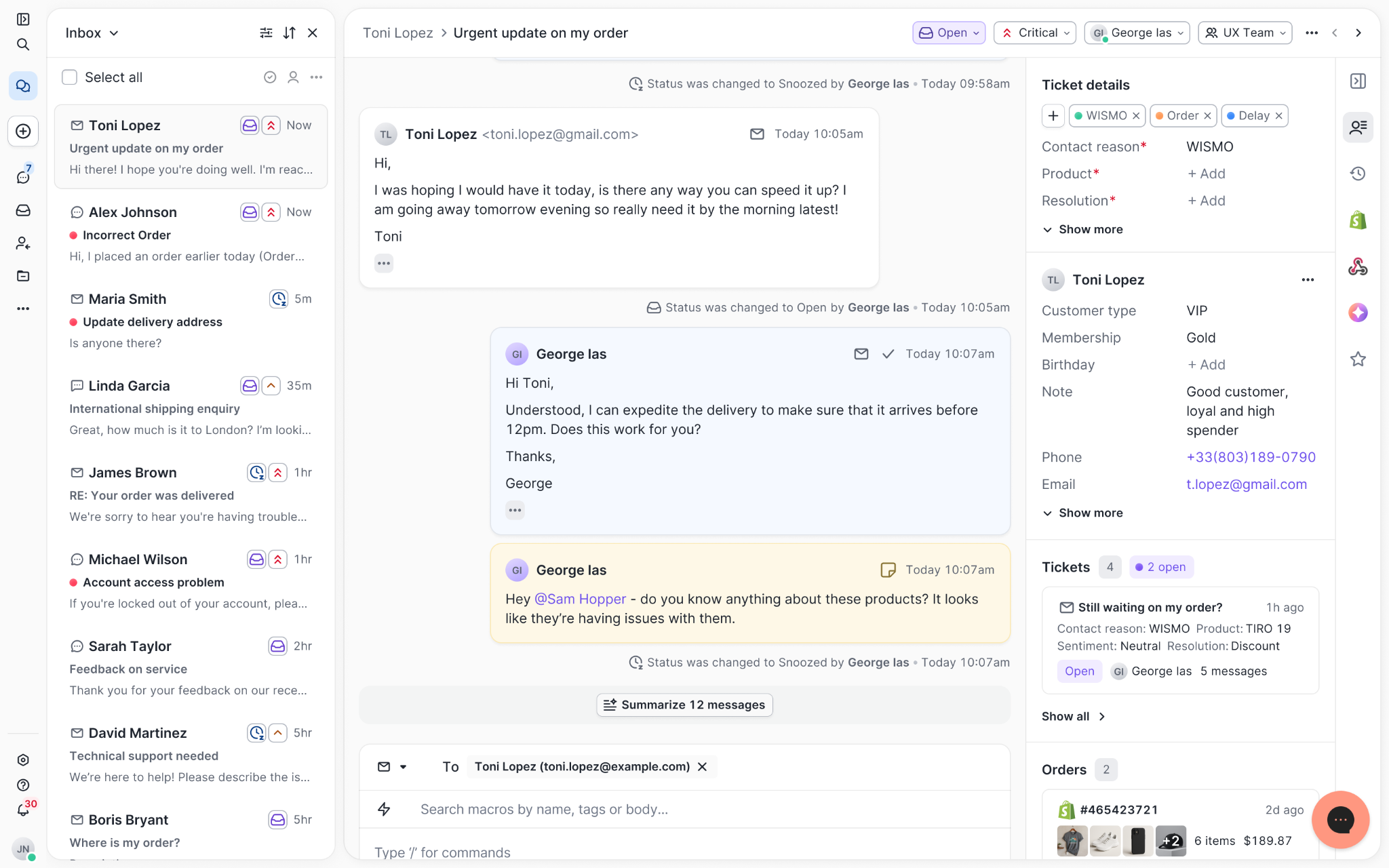
Chats with customers now look like real conversations, using the speech bubble style you’re familiar with on popular messaging apps.
Check customer history without losing your place
Checking a customer's history used to mean leaving the conversation, an extra step that interrupted what should have been a smooth workflow.
Now, past conversations open in a sidebar next to the active conversation. You can view a customer’s full history, search through their timeline, and open prior tickets without going to a new page.

Check past conversations, orders, and customer details in the brand-new Customer Timeline.
See order details the moment you open a ticket
Order information is easier to reference than ever. Open a ticket, and you instantly see the customer's recent orders, marked with product images and invoice details at a glance. Need to dig deeper? Click on an order, and the expanded information appears in the same panel.
For teams using custom integrations, apps are fixed in a quick-access integration menu on the right.
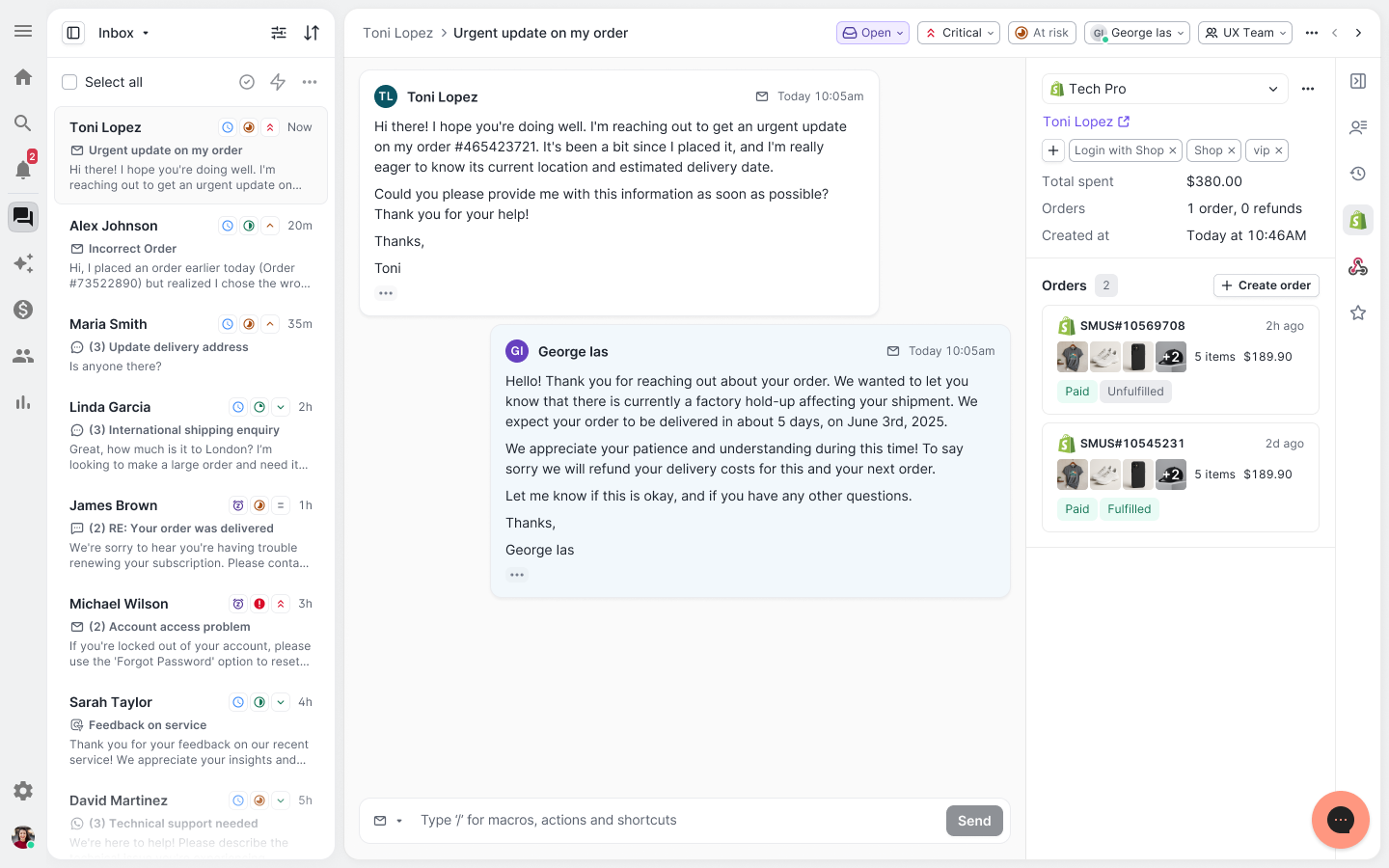
See order details, product images, and totals at a glance on the right panel, without leaving the conversation.
Pick up where AI left off
You shouldn't have to dig through a thread to figure out what AI already tried. Now you don't have to.
When AI Agent escalates a conversation, it includes a concise handover summary that mentions the issue, what actions were taken, and why it was passed to your team.
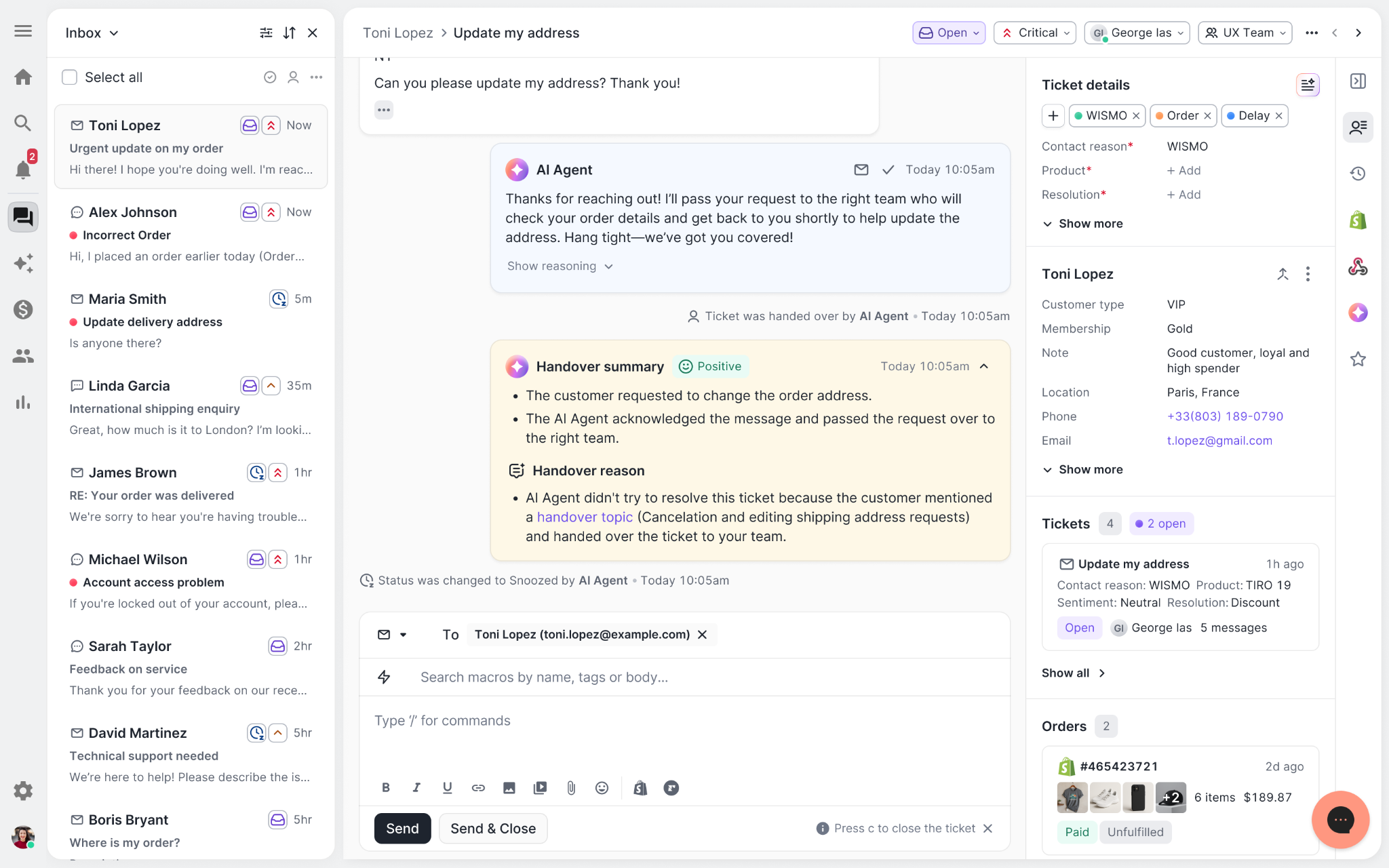
Escalated tickets include a brief AI-generated handover summary, marked in yellow, for quick reference.
Move faster across every store and team
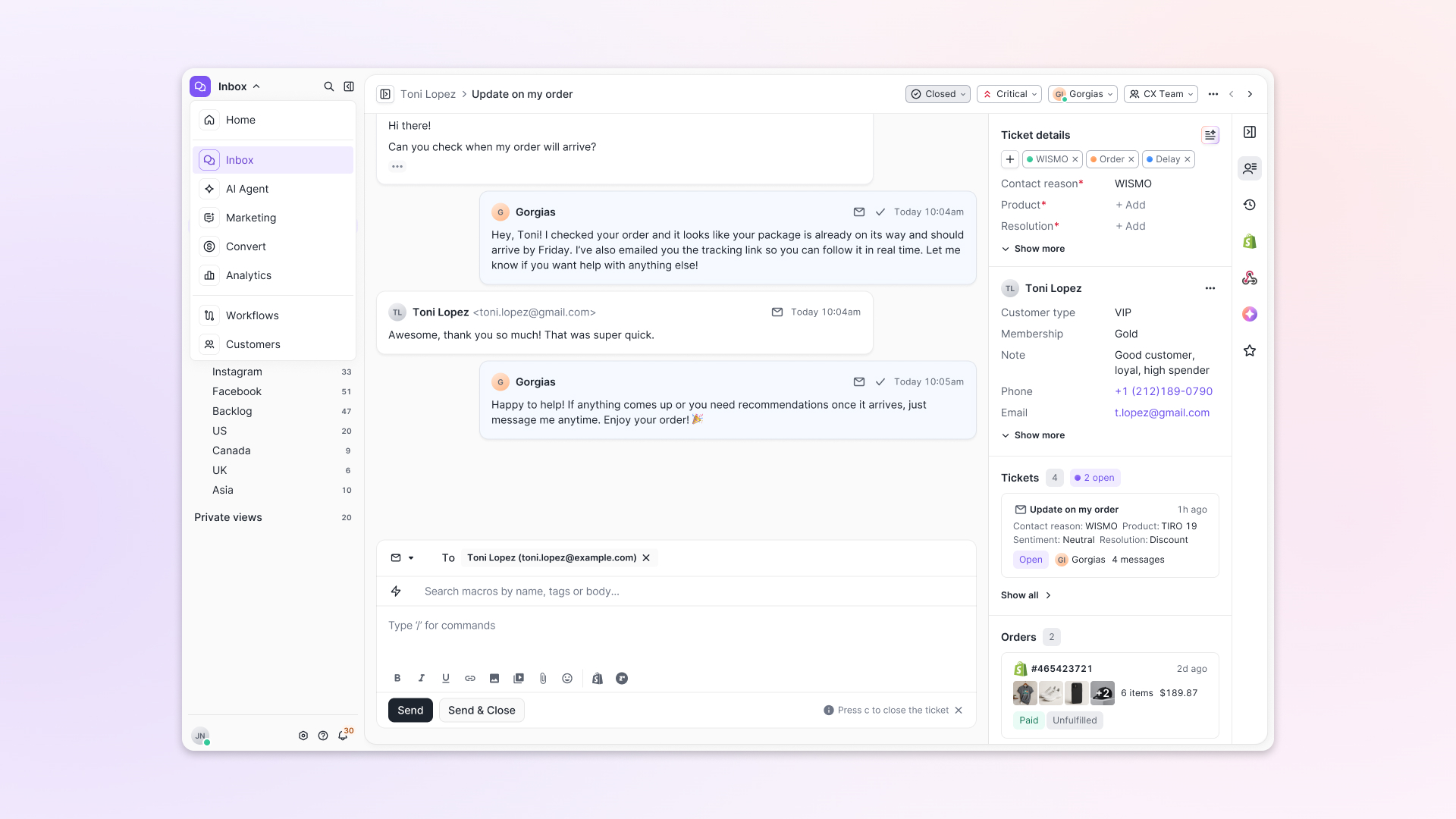
We restructured and simplified the navigation. The left sidebar organizes everything into clear categories: Inbox, AI Agent, Marketing, and Analytics, so anyone on your team knows exactly where to go.
To quickly update your knowledge base or adjust a workflow, both now live right in the sidebar. For teams managing multiple stores, switching between them is just as straightforward, accessible from the sidebar, so agents can move between inboxes without breaking their flow.
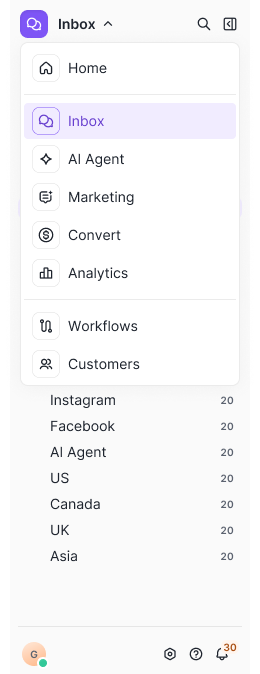
Agents can switch between stores and their corresponding inboxes directly from the left menu.
A workspace that works the way agents do
Support comes down to the person on the other end of the conversation. We built Helpdesk 2.0 is to make sure they have everything they need to show up for that moment.
The best way to see the difference is to work in it. Start a free trial today.



Further reading

Live Statistics for teams who want to perform
Do you switch multiple screens and views to understand what’s going on with your team? If you do, we’re happy to report that there is now a shortcut. 🪄 Live Statistics on Gorgias is your destination to get a quick overview of ticket volume, agent activity and active channels in real-time.
Where is it?
It’s up top! Once you navigate to Statistics, you will see Live Statistics conveniently placed at the top. Click on Overview to see a snapshot of all customer support activity over all channels and agents.

Ok, what am I looking at?
In Live Overview, you will see the number of Agents Online and offline. Next to these, you will find the numbers of Open Tickets in two sections (to indicate whether they’re assigned or unassigned).

Pro tip: Hover over the tooltip to see a quick list of the actual agents who are online and offline. ⬇️

Consider the number of Agents Online compared to Open Tickets
Say it’s late afternoon and you’re seeing a spike in open tickets. In Live Overview, you read 60 Open Tickets, and only 2 Agents Online. → 30 tickets per person 😱
With this information, you can immediately make decisions and take action on how to handle the higher volume your team is experiencing. For example, you may consider:
• Going to Live Agents Statistics to see the number of Chat tickets
• Creating a macro and a rule for your Chat customers who are waiting for longer than 1 minute ⌛️
• Creating a macro and a rule to set expectations around the delay
• Check internally to see if there is a problem with your delivery ops
• Stepping in to answer tickets with the Urgent tag
Knowing exactly what’s going on as it happens live, later observing fluctuations in First Response Time or Resolution Time won’t catch you by surprise. You can make a better assessment on your team’s performance by being fully aware of the circumstances around your metrics.
In Live Statistics, we simplify and organize information so you can be fully aware without needing to contact your team personally or be physically there.
Monitor Support Volume live
In Live Overview, you will see a nice graph to inform you on the hourly Support Volume. Use this graph to see how your team is responding to inquiries as they emerge.

Looking at this graph, you can quickly grasp the volume you’re getting by the number of Tickets Created, Tickets Replied and Tickets Closed separately, but on the same timeline so you can compare.
Observe when Tickets Created see a spike, compare it to Tickets Replied
When do you receive the bulk of inquiries? Does it happen before business hours?

You can see above an example where a lot of customers decided to contact the support team throughout the night. As a manager, you can monitor to see if this is a consistent pattern over time, and develop strategies on the support and operations side to improve experience. Looking at this graph, and seeing this type of pattern, you may want to ask:
• Are these tickets urgent? Are we properly auto-tagging to identify urgency?
• Are my agents ready to tackle this ticket volume at the beginning of their shift?
• Are these tickets auto-assigned?
• If these inquiries are urgent, should we set autoresponders?
• Is it worth getting additional staffing or how can I leverage self-service?
Monitoring the Support Volume graph, you can start to detect patterns that are connected to the entire customer experience. Anticipating problems or delays before they can occur, you can take measures to improve CSAT despite the predicaments due to international shipping challenges or a mix-up on a batch of orders etc. You can use the visibility and insights from Live Statistics to inform your overall operations.
Live means real-time
Live Statistics is designed to inform you on an hourly basis. It gathers the right metrics and combines them strategically so you can get the right information and react quickly without being there.
All metrics in Live Statistics reflect your current day from 12:00 am to 11:59 pm in your time zone. If you need to change the time zone, you can easily do this in Business Hours under Settings.
Who is working?
In Live Agents, you will see whether each team member is currently online or offline, indicated by a green dot if they’re online - 💪 working away, or an orange dot indicating that 💤 they’re offline.

Pro Tip: Hover over these dots to see when they signed in (on the green dot), and when they were last seen that day (on the orange dot).

Live Agents Statistics will show you the exact amount of time each team member has been online in hours and minutes (e.g. 2h 6m). On this table, you will also see the number of Tickets Closed and Messages Sent. The ability to see this exact combination of data per agent will really help you monitor your team’s efficiency and know which agents to coach to improve performance.

Have all of your team use this, so everyone can self-check 🩺 and have their sense of achievement for the day based on data - 😉 not just feelings. Reviewing Live Statistics as a team, you can collaborate to come up with effective strategies to reduce the rate of messages sent per ticket closed.
Who is working on what?
Located in the far right column, Open Tickets 🤩 feature makes Live Statistics whole. This is where you can clearly see who’s working on what. You can see the total number of open tickets currently being helped by each team member. Placed immediately next to this number is the breakdown by channel.

You can read above how Jenny has 15 open tickets, with 3 from Chat, 7 from Email, 3 from Facebook and 2 from Instagram.
Click on this number to see just exactly what Jenny’s working on. Each of the numbers provided under Open Tickets, the total and by channel, is clickable and it will bring you to a readily filtered view where you can take a closer look at what your agent has at hand.
This experience will help you review your team’s activity in microscopic detail as you desire, without needing to interfere or navigate to different Views.
Help your team on the spot
Check out the full combination of Online Time, Tickets Closed, Messages Sent and Open Tickets. Let’s bring back Jenny and look closer to see that she has 3 Tickets Closed, 12 Messages Sent and 15 Open Tickets. Under Online Time, it reads 6h 12m so she is approaching the end of her shift.

Right away, we can notice that she’s approaching the end of her shift with a lot (15) more tickets to go. There’s no need to get alarmed, but it’s better to take a quick look at what’s going on. Clicking on the number listed under Open Tickets, we can easily review the tickets she’s working on. Taking a quick look at her tickets, we notice a shipping problem on multiple orders - all large items shipping internationally with a third party. Knowing Jenny’s not familiar with third party shipping, we can remove these tickets from Jenny’s queue and make sure that we mark our calendar to train her on this topic before BFCM hits. ✅
All of these features in Live Statistics, Overview and Agents are designed to give you full visibility and control so you can take timely action to remove stress from work and from your team. 😅
Still waiting to give it a try? Go to Live Statistics now ➡️
📞 Let’s get on a call to have a quick chat.
✏️ We love hearing your insights, please drop us a note here.

7 new apps that integrate with Gorgias
Gorgias connects to over 70 leading ecommerce applications, giving you the power to centralize customer data in your helpdesk, perform support actions from a single place, and streamline your store’s toolkit.
This month, we launched 7 new integrations:
- LoyaltyLion
- Twitter (No longer supported in 2023)
- Call Hippo
- Shipup
- Tolstoy
- Autopilot
- Sentisum
- Yotpo (updates to our existing integration)
Read on to learn how you can use these tools to help manage your store, and visit the Gorgias App Store to activate them today!
1. LoyaltyLion
LoyaltyLion is a digital loyalty framework that gives ecommerce stores innovative ways to engage and retain customers. If you're using LoyaltyLion for your loyalty program, you can connect it to Gorgias to display information next to support tickets, and reward loyalty points using Macros.

2. Twitter
Note: Gorgias no longer supports Twitter. You can still use Facebook, Instagram, and WhatsApp in Gorgias.
Give your support team the power to provide customer service to shoppers on Twitter, without having to log into another platform or share credentials with your social media manager. View past Twitter conversations, gain cross-channel message context, and customize your replies to provide exceptional customer support.
Note: This integration is currently only available for Enterprise plans. View pricing here.

3. Call Hippo
CallHippo allows startups and businesses to buy instant local support numbers from over 50+ countries around the world. With this integration, you can create tickets in Gorgias for phone calls and SMS conversations via Call Hippo.

4. ShipUp
Shipup follows your packages in real-time to create a seamless, transparent, and branded delivery experience. With the Gorgias integration, you can easily share shipping information with your support team, immediately notify them with a ticket in Gorgias when an incident occurs, and find customer information right next to conversations.

5. Tolstoy
Tolstoy is an interactive video platform, helping users create meaningful and personal conversations at scale. With this integration, Gorgias users can sync their Tolstoy videos and monitor every viewer interaction as a ticket, empowering support agents to engage without ever leaving the help desk.

6. Autopilot
Autopilot is a data and customer journey marketing platform designed for businesses who sell online. With this integration, you can now combine your Shopify and Gorgias data together seamlessly in Autopilot. You’ll not only have a single view of your customer, but you’ll be able to deliver a more personalized marketing experience and get glowing reviews from satisfied customers.

7. SentiSum
SentiSum is an automated ticket tagging engine powered by natural language processing technology. With this integration, SentiSum tags can auto-fill form fields directly in Gorgias. From there, you can implement additional automation that saves agent time and improves customer outcomes.

8. Yotpo
You can now receive Yotpo product reviews right in Gorgias and reply to them as tickets! This gives your agents visibility into how shoppers feel about your product and allows them to address concerns without ever leaving the helpdesk. Each ticket will include the review details (like score and product) and allow you to either reply publicly or privately, so you can customize the support experience.

To add these integrations and discover more, go to the Gorgias App Store.

Top 10 Integrations Used by Gorgias Ecommerce Merchants
Have you ever wondered how other leading ecommerce stores manage customer support, especially when they are using Gorgias? We love identifying these trends and wanted to see what integrations have been the most useful in our customers' ecommerce tech stacks so far.
In order to help you bring all your customer data in one place and offer truly exceptional, personalized support, here are the top 10 integrations being used by Gorgias customers:
- Email, specifically Gmail
- Gorgias Chat
- Facebook and Instagram
- SMS apps
- Klaviyo
- Recharge
- Phone, either our native solution or Aircall
- Yotpo
- Smile
- ChannelReply
1. Email, specifically Gmail
If you've been worried that email is becoming obsolete in the age of chat boxes and SMS support, don't be. Email is the leading support channel on Gorgias, used by 67% of customers.
This make sense. While faster, more instantaneous methods of communications are becoming common, email is still the primary channel to answer complicated support questions and send transactional messages like shipping updates, return logistics, and order/cancellation confirmations.
Of email integrations, Gmail is the leading provider with 59% of Gorgias customers having it active.
To learn more about our Gmail integration, click here.
2. Gorgias chat
Chat support is the second most common channel we see our merchants using, in order to offer real-time communication in addition to traditional emails or tickets. And thanks to our native chat integrations, it's easier than ever to launch a chat widget on your website.
57% of Gorgias merchants use our native chat integrations to offer real-time support.

This allows your shoppers to talk to an agent faster, but also presents a great opportunity to implement self-service options so they can help themselves. (Our Self-Service Chat Portal can help with that!)
3. Facebook and Instagram
Managing inquiries on social media and gaining insights into the conversations happening in those communities is te next priority for our merchants.
Over 50% of Gorgias brands are integrated with Facebook and/or Instagram.
Our Facebook integrations (which also includes Instagram) allows you to manage messages, comments, ad comments, and mentions as tickets in Gorgias. This gives your agents visibility into every conversation no matter where it happens, and empowers them to reply directly to shoppers without having to log into separate platforms or coordinate with your brand's social media team.
"The Gorgias-Facebook-Shopify integration is amazing. We've stopped hunting and matching Facebook users to customer accounts on Shopify. The information we need is surfaced so we can respond better and faster. Gorgias allows us to operate both ecommerce and social commerce business seamlessly." - Guita Gopalan, Chief Revenue Officer at Ellana
Nervous about the quantity of tickets that would be created from integrating social channels with Gorgias? Don't be. You can use Rules to filter out comments your team doesn't need to worry about (like comments that only consist of emojis), or even auto-assign tickets to specify agents/teams so no one has to triage the requests.
4. SMS apps
Text message marketing has become an incredible revenue generator for ecommerce brands, but it also opens another new communication channel with your customers: SMS.
In order to make the most of SMS as a marketing tool, you also need to be ready to support it when customers reply back with questions. That's where Gorgias comes in; we integrate with SMS apps to help you connect your agents with shoppers sooner and collect all customer conversations in one place.
Over 23% of Gorgias customers are integrated with an SMS tool.
The top SMS apps connected to Gorgias are:
- Attentive, used by 10% of merchants
- Postscript, used by 8% of merchants
- SMS Bump, used by 5% of merchants
"Working with Postscript and Gorgias gave us the leverage to keep customers close to deliver the best possible customer experience. It is super helpful to have a full view of the customer, all in one-spot." -Eli Weiss, Director of CX at OLIPOP
5. Klaviyo
The next app on our list will help you collaborate with your marketing team to create a best-in-class shopper experience, whether they are interacting with the support team or receiving the latest promotion.
Klaviyo is an email and SMS marketing app for businesses that sell online. Our integration connects the two platforms, allowing you to use the data to create better campaigns.

17% of Gorgias merchants are integrated with Klaviyo.
With this integration, you can push Gorgias events into Klaviyo for advances and customer-centric email segmenting.
For example, here are some of the ways we've seen customers use the two tools together:
- Promoting sales or new products to customers who had positive support experiences to drive upsell and revenue generation from support.
- Excluding customers with open support tickets from promotional messaging campaigns.
- Sending target coupons or discounts to win back customers who reported poor support experiences.
You can learn more about our Klaviyo integration or activate it here.
6. Recharge
The most common integration will help with subscription management, which is probably no surprise: Even with a great payment platform, subscription questions and transactions tend to result in a lot of support requests.
Recharge us a subscription and recurring payment platform for ecommerce sites, and helps you turn transactions into relationships.
15% of Gorgias merchants are integrated with Recharge.
Connect Gorgias and ReCharge for a simple way to manage customer subscriptions and customer service from one convenient location.
When you integrate Gorgias and Recharge, you can:
- Display ReCharge subscriptions next to support tickets in Gorgias, to gather full customer context before replying to questions.
- Cancel subscriptions, re-activate subscriptions, or refund a charge (either partially or totally) right from the Gorgias helpdesk.
- Embed ReCharge data in your Macro replies to automate the most common support questions.
Click here to learn more about our Recharge integration.
7. Phone, either our native solution or Aircall
It's clear that digital support is the first priority for most of our merchants, as seen by email, chat, and social media being the top three integrations on our list.
Sometimes it's nice to have a real conversation with your customers, however, which is why phone integrations are next.

12% of merchants offer phone support.
Many use our Aircall integration, which is great if you need the advanced feature a dedicated tool like Aircall provides. If you're just adding phones for the first time, we released a native phone integration this year that's helping merchants begin to offer voice support.
8. Yotpo
Beyond answering customer questions, your support team may want to engage with reviews from shoppers in order to address issues, win back unhappy customers, and interact with your biggest fans!
Yotpo, a platform for ecommerce marketing and reviews, is great for this.
Over 8% of Gorgias merchants have activated our Yotpo integration.
The integration allows you to:
- Display customer's Yotpo data un Gorgias customer Activity Sidebar such as loyalty points, provided ratings, latest reviews, etc.
- Manage customer loyalty plans (change point balance, assign VIP tier, honor redemptions, and send rewards) from the Gorgias sidebar.
- Respond to a question with an answer either publicly or privately as new tickets.
- Moderate customer reviews (product and site) and questions from within Gorgias as new tickets.
- Request reviews from a customer.
Click here to learn more about our Yotpo integration and activate it.
9. Smile
No one knows your shoppers quite like your support team, which makes an integration with a loyalty app a natural fit! Smile.io is a favorite of Gorgias merchants, which helps you manage a reward program and build strong relationships with your newest and most loyal customers.
6% of Gorgias merchants integrate with Smile.io.
With this integration, you'll be able to see customer loyalty information right next to tickets in Gorgias, so every agent knows when they are talking to a new customer or one of your VIPs! You can also use this information to help triage tickets or separate ticket views by loyalty status (which is great for managing different levels of support SLAs).

To learn more about our integration with Smile.io and activate it for your account, click here.
10. ChannelReply
If your shop sells on public marketplaces beyond your own Shopify store, the final app on our list is a must. ChannelReply helps you manage messages from Amazon, eBay, and Walmart.
With our integration, you can then manage all those messages right from your helpdesk, eliminating the need for your agents to open different browser tabs for each platform.
Over 5% of Gorgias merchants use the ChannelReply integrations.
To learn more about ChannelReply and activate the integration for your account, click here.
And there you have it: The top 10 integrations with Gorgias in 2021! We hope this helps inspire you how you can use your helpdesk to offer exceptional, conceptual support and how to streamline the tools your store uses everyday to grow your business.
To get more ecommerce tool suggestions, check out our list of 150+ great tools. And to view all integrations with our platform, visit the Gorgias App Store.

12 New Apps That Integrates With Gorgias
Gorgias connects to over 65 leading ecommerce applications, giving you the power to centralize customer data in your helpdesk, perform support actions from a single place, and streamline your store’s toolkit.
This month, we launched 12 new integrations:
- SMS Live
- Checkout Champ
- CallHippo
- Konnektive
- TXTFi
- Shopney
- ReturnLogic
- Stateset
- Gatsby
- Trustpilot
- ShipBob
- AfterShip
Read on to learn how you can use these tools to help manage your store, and visit the Gorgias App Store to activate them today!
1. SMS Live
SMS Live is an SMS texting app for Shopify and Shopify Plus. When you add this integration, you’ll see customer information from SMS Live in the Gorgias sidebar, so your agents don’t have to switch between the two applications. You’ll also be able to respond to SMS messages within the Gorgias helpdesk or switch those conversations to a different channel, such as email or phone.

2. Checkout Champ
Checkout Champ simplifies the checkout process and makes it easy to charge for subscription services or one-click upsells. With the Gorgias integration, you can manage all of your customer interactions to include refunds, fulfillment tracking, purchase alterations, and all messaging and tickets.

3. Konnektive
Konnektive is a cloud-based CRM and order management solution that helps optimize, centralize, and automate ecommerce business processes. With this integration, you can display order information right next to tickets in Gorgias and update customer information between the two platforms. It automatically comes with 10 pre-built Macros, to help you get started right away!

4. TXTFi
TXTFi allows brands to leverage purchasing through SMS and ensures side-by-side customer support to communicate with customers in real time. With this integration, you can manage SMS conversations from TXTFi as tickets in Gorgias in order to quickly connect your shoppers with a live agent.

5. Shopney
Shopney is a mobile app builder for Shopify and Shopify Plus that lets you build an app for your store in just one day. With this integration, the conversations that happen through Shopney’s in-app live chat can be managed in the Gorgias helpdesk for a streamlined experience for your agents.

6. ReturnLogic
ReturnLogic helps D2C brands give their customers an easy returns process while automating workflows for their customer service and warehouse teams. With the Gorgias integration, you can embed the Gorgias Chat Box right on the ReturnLogic portal, giving shoppers another opportunity to make their return, exchange, or warranty process as smooth as possible. You can also manage these chat conversations in Gorgias and populate ReturnLogic data into Gorgias tickets.

7. Stateset
Stateset is your single source of truth for managing your online business and automating your commerce operations. The Stateset AI Responder app uses state-of-the-art artificial intelligence and robotic process automation to quickly and accurately build data-driven responses ready for your customer service team to approve. When you connect the Gorgias integration, you can start generating intelligent and dynamic responses directly from Gorgias or from within Shopify.

8. Gatsby
See Instagram insights when responding to tickets, track Instagram mentions and engagement for your brand, and automate valuable influencer workflows all in Gorgias.
With the Gorgias and Gatsby integration, you can now identify when influential customers are reaching out for support and take that into account when prioritizing tickets, asking them to share positive support experiences and more.

9. Trustpilot Reviews
Trustpilot Reviews is a customer review platform. With the Gorgias integration, you can streamline review responses with machine learning and AI. Trustpilot Review data is displayed in the Gorgias Customer Sidebar, ready to be leveraged by agents to reward happy customers and help recover customers at risk of churn.

10. ShipBob
ShipBob is an ecommerce fulfillment solution for online brands. With the Gorgias integration, you can sync customer and order information associated with a specific ShipBob account into the corresponding Gorgias account. You can also display data from ShipBob in the Customer Sidebar, and use that data in Gorgias Macros to automate responses to common claims.

11. AfterShip
AfterShip is an automated shipment tracking platform for e-commerce businesses. With the Gorgias integration, you can sync and display all customer shipment tracking data in the Customer Sidebar, allowing your agents to quickly answer questions without switching applications.

To add these integrations and discover more, go to the Gorgias App Store.

10 Rules to Help You Efficiently Manage Instagram Interactions on Gorgias
Instagram is really the perfect social channel for Ecommerce brands. You can show off your products, share user-generated content, and engage with your community to build brand loyalty.
All that engagement is great, except it adds a task to your plate that quickly multiplies as your brand grows: You have to interact back. Or at least you should, if you want to capitalize on all that engagement!
Sometimes your marketing team or social media manager will handle Instagram replies, but sooner or later you’ll start to get the “Where is my order?” (or “WISMO”) question from shoppers, regardless of the content being shared. This can result in an inefficient workflow between social and support teams to communicate the question, track down an order status, and get a reply back to the customer.
That’s why Gorgias integrates directly with Instagram (and other social media platforms), to streamline the management and interaction with top-level comments, ad comments, private messages, and replies. Instead of going back and forth between your Ecommerce platform, the social team, and the support team, you can empower your agents to reply quickly and accurately to any question that comes in, thanks to over 50+ integrations with the leading Ecommerce apps. (So all the context they need will be in one single browser tab!)
You could even have your marketing team or social media manager help create Macros, so your support agents can use templated (and on brand) messages that speed up their replies. Getting everything centralized in a single place is the first step to providing excellent social support for your store. The next is to start automating replies to common engagements, so you can free up your agents to focus on more important conversations instead of saying “Thanks for the mention!” for the hundredth time.
To help your store start managing Instagram support more efficiently, I’ve collected a list of Rules that Gorgias customers are using to engage with their shoppers, resolve questions faster, and keep their agents focused on the most important conversations.
Here are 10 Rule ideas for more efficient Instagram support:
- Auto-close tickets from giveaway posts
- Auto-close all Instagram tickets
- Auto-tag all Instagram interactions
- Auto-tag likely buyers & create a specialized view
- Auto-tag interactions from influencers for VIP support
- Auto-tag public comments vs private messages
- Auto-tag Instagram tickets with questions
- Auto-close Instagram tickets the don’t mention support or order status
- Auto-tag negative comments
- Auto-assign Instagram tickets to an agent or team
1. Auto-close tickets from giveaway posts
Giveaway posts are great for brand awareness, but can also result in a large increase in tickets in your help desk. To stop this from ever becoming a problem, you can set up a Rule to auto-close tickets generated from giveaway posts, based on the message content.

In this example, we’re auto-closing tickets without the words “who,” “what,” “when,” “where,” “why,” and “how,” in order to avoid accidentally closing an actual question that your team might want to respond to. You could also customize this to close tickets that include a specific word or phrase, based on the criteria of the giveaway. I recommend working closely with your social media manager whenever a new promotion starts, to make sure your helpdesk is set up to triage tickets accordingly.
2. Auto-close all Instagram tickets
If you want to see Instagram engagements in a contact’s message history, but not necessarily respond to them from Gorgias yet, you can auto-close any ticket generated from Instagram, that way it doesn’t fill up the open queue.

By doing this, your agents will have the full cross-channel message history when interacting with a shopper, so they can customize the conversation and know exactly what they’ve asked in the past.
3. Auto-tag all Instagram interactions
Tagging tickets in Gorgias is a great way to measure channel statistics and create customized Views. While your agents will always have the option to manually add tags, you can create a Rule to do the tagging automatically, that way it’s one less step in their workflow.

Then when you go to Statistics > Tags, you’ll be able to see how many tickets are generated from Instagram during a given period, and what percentage that is of all the tickets you receive.
Pro-tip: If you haven’t started managing Instagram tickets in Gorgias yet because you’re not sure what exactly the ticket volume would be, you can Auto-tag and Auto-close tickets in order to see the stats without conversations counting toward your plan’s ticket count yet.
4. Auto-tag potential shoppers & create a specialized view
Prioritize the messages and comments from those most likely to purchase. By detecting message sentiment and filtering by common phrases, you can automatically tag tickets with a high purchase intent, allowing your agents to answer questions quickly or send along a discount code to speed up the purchase.

Once you’ve set up the Rule, you can create a View to filter tickets that only contain this tag, that way your agents can easily see right in the left-hand sidebar whenever there’s a ticket from Instagram from a likely lead!

5. Auto-tag interactions from influencers for VIP support
If you work with influencers, it’s critical to reply to them right away to maximize the impact of their community. To make sure your team never misses an opportunity, you can auto-tag tickets created from the partners you’re working with based on their email address.

Once the Rule is auto-tagging these tickets, you can also create a view to segment these messages from the others. Depending on how many partners and influencers your brand manages at a time, it may be helpful to set up one View per influencer (in which case you’d want to use separate tags), or group them all together in an “Influencers” section.
6. Auto-tag public comments vs private messages
Whenever you reply to a ticket in Gorgias, you’ll see a small icon next to the customer’s name that signals what channel you’re replying on. If you want some extra assurance that your reps are only replying with personal details in private channels however (such as Instagram messages) you can automatically add tags to designate “public” vs “private,” so everyone can see right at the top of the ticket which type of communication it is.

7. Auto-tag Instagram tickets with questions
Prioritize interactions that are asking your brand something, instead of just commenting with emojis. If your brand receives a lot of engagement, this can help you filter out what needs to be addressed and what can likely just be closed out (or handled by the social team).

8. Auto-close Instagram tickets the don’t mention support or order status
If your support team is only interested in responding to the Instagram tickets that specifically mention customer service, you can auto-close everything else (and assume the brand team will take care of it). To do this, create a rule that closes tickets that do not include phrases like “order” “status” “support” or “customer service.”

9. Auto-tag negative interactions
Escalate the tickets that have negative intent to get them a response faster. You can add keywords (or emojis) and use our sentiment detection to auto-tag negative comments, so your agents see right away what kind of ticket they’re opening.

10. Auto-assign Instagram tickets to an agent or team
If you have a specific person who handles social media, whether that’s an agent or the social media manager, you can automatically assign tickets created via that channel to them, so those tickets never get routed to the rest of your team.

I hope these 10 Rules help you engage with your shoppers, resolve questions faster, and keep your agents focused on the most important conversations. If you haven’t connected your Gorgias account to Instagram yet, follow this guide to get started.
Alternatively, keep reading about social media for customer service, or check out our list of the best social media integrations for your Shopify store.

New integration: Manage Instagram messages from Gorgias
If your store leverages Instagram to drive sales, you know it’s important to engage with every member of your community whether they’re commenting on your posts, engaging with your Story, or sending you a message.
Over 4,000 teams on Gorgias have been using our Instagram integration to respond to (or automate responses to) mentions, comments, and ad comments. Earlier this summer, some customers were able to also start receiving and responding to Instagram messages (but it was limited to accounts with between 1,000-100,000 followers).
Today, we’re excited to share that there’s no longer a follower requirement to use Instagram messaging!
Every Gorgias customer (with a non-legacy plan) can manage Instagram messages (including Story mentions) directly from your helpdesk, allowing you to engage with your shoppers quickly and efficiently so you never miss a conversation.
Plus you’ll also be able to reply to comments with a message, giving your team the option to turn a public conversation into a 1-1 chat.

Customers who were able to start using this feature early have already replied to over 300,000 messages and Story mentions. In fact, about 2% of tickets in Gorgias are Instagram messages!
It’s clear our customers love using Instagram to engage with their communities and drive sales, which is why we’re so excited to open this channel up for all of our merchants regardless of their follower count.
Related: Our list of the best social media apps for Shopify.
To get started, you’ll need to make sure you have the "Allow Access to Messages" setting active in Instagram.
You can do this In Instagram Business Messenger by going to Settings → Privacy → Messages and setting the toggle to active.
Once that’s done, go to the Integrations tab in your Gorgias helpdesk and select “Facebook, Messenger & Instagram.”

Click the green “Reconnect” button to refresh your settings, and then you’ll be able to enable “Instagram Direct Messages” in the checkboxes.

This will connect Messages and Story mentions to Gorgias, allowing you to reply directly from the helpdesk and see previous conversation history (so your agents have all the information they need right in one place).
The following video will show you how to get started, along with some common troubleshooting tips.
If you’re managing a lot of customer support conversations on Instagram, it may be helpful to set up views for each type of interaction. For example, you could have a view for Instagram comments, another for Instagram Messages, and a third for Instagram ad comments.

You can also use Rules and Macros in Gorgias to reply even faster (or automate conversations entirely!) in order to free up your agents to focus on more important conversations.
Here are a few ideas to get you started!
1. Create a Macro sending a message to say “Thanks for the mention!”
If you have customers that love to tag your brand or products in their own posts, an easy way to continue building brand loyalty is to send a quick “thank you.” To save your agents time, you can create a Macro they can re-use anytime you get a Message that you’ve been mentioned in someone’s story or post.

2. Adding tags to track Instagram Story mentions
If you want to track how often your brand is mentioned in Instagram Stories, you can tag tickets that come in from the Messages channel with “Mentioned you” in the message body.
By creating a Rule to do this, you can automate this process so it doesn’t add any extra time or steps into your agents workflow, but gives you powerful insights.

3. Creating a Rule to auto-reply to Instagram messages outside of business hours
If you don’t want to reply to messages 24/7, it may be helpful to create an auto-response to set some expectations outside of your business hours.
You can easily do this with a Rule, and even encourage your followers to go somewhere else in the meantime, such as your website, a specific landing page, or even a partner account!

Hopefully this gives you some inspiration on how you can start using Gorgias to engage with your Instagram community without increasing the workload on your support agents. And if you're interested in messaging customers directly, check out our social media and SMS features. With social media for customer service, you can interact with customers on platforms like Instagram or Facebook. And with SMS for customer service, you can enable texting for your most on-the-go customers.
Related: Lean how Gorgias customer Berkey Filters launched SMS and drove incredible customer adoption to this new, faster channel.
To start simplifying management of your messages, comments, and mentions, get started with Gorgias and add the Instagram integration today!

It’s Official: Gorgias is Now SOC 2 Type II Certified
When you use Gorgias, we know that you’re putting your trust in us. That’s why we hold our commitment to your security as our highest priority and safeguard your data with full transparency. Our security policy contains penetration testing, incident response plan, data lifecycle, comprehensive system status live report, and more.
We're thrilled to share that Gorgias is Service Organization Control (SOC) 2 compliant for Type 2. This achievement follows our numerous investments in platform security over the years as part of our goals to secure customer data.
An independent auditor conducted a thorough audit of our servers, systems, and products over six months. They verified that our information security practices, policies, procedures, and operations meet the thorough SOC 2 standards for security.
2022 update: We're happy to share that we renewed our SOC 2 Type 2 certification to continue protecting our customer data.
This industry-wide recognition serves as our reassurance that your data is managed in a controlled and audited environment.
What is SOC 2 Type II Compliance?
Developed by the American Institute of CPAs (AICPA), SOC 2 defines criteria for evaluating how well a company manages customer data and ensuring a set of security controls are in place. A SOC 2 report is unique to each organization because it’s in line with specific business practices.

There are two types of SOC 2 reports: Type I and Type II. Type I checks if a system can handle issues like data breaches. Meanwhile, Type II examines how the system works and how effective it is to protect data against security threats.
What Does Our SOC 2 Type 2 Compliance Mean for You?
Our completion of the SOC 2 Type II audit is our testament to the fact that we always prioritize your data security and privacy. We appreciate your trust in us and strive to strengthen this trust in the long term.
You can be sure that:
- The data you share with Gorgias meets the AICPA standards for security. That goes for your personal information, ticket inquiries, customer data, and the like.
- Your data is protected with procedures and controls to assess, minimize, and eliminate risks and vulnerabilities.
- We always conduct ongoing monitoring of features and processes across our platform to maintain security.
What’s Next?
We hope our successful SOC 2 Type 2 helps you rest easy knowing that your data in Gorgias is secure. But this update is only the latest milestone in delivering our commitment. We’re continuing to improve our security control and data privacy practices for all merchants. To learn more about our security policies, visit our security page or contact us at support@gorgias.com.

Increase Retention and Reward Your Super Fans with Yotpo + Gorgias
With visibility into product reviews right in the Yotpo widget in Gorgias, your support agents will know right away if they're talking to someone who didn't love their last product, or someone who is a big fan of your brand. This knowledge will help you customize the conversation for the best experience possible.

"At OLIPOP, we’re always looking to have a holistic view of the customer to be able to offer the best possible experience. Having the ability to see their most recent reviews within the Gorgias platform is a total game-changer. " - OLIPOP, Director of Customer Experience, Eli Weiss

How to make the most of this integration
You can use Gorgias macros to quickly respond to customers that leave 5-star reviews to build brand loyalty. You can also create macros for customers who leave negative reviews to ensure their concerns are properly addressed, and send them a discount code to help rebuild trust!
By looking at the shopper's review history, your support agents can also quickly shift from just offering customer service to acting as members of the sales team. They can recommend products that are either similar to something the customer previously loved, or different than something they had a bad experience with.


"Gorgias clearly understands the needs of customer service agents, and with this new feature is working towards making all the day-to-day tools accessible from one tab, making work even more agile and with less distractions. We're particularly excited about the ability to understand customer sentiment from the get go, and how we can better approach our users based on the feelings they have shared about their past TUSHY purchases. If we see they are a super fan, we can go heavy on the butt puns, but if they've had a less than stellar experience we will aim to make up for it in our subsequent conversations, and even address things they don't directly mention! We're excited to see how this feature will help us deepen our genuine human connections. " - TUSHY, Director of Customer Experience, Ren Fuller-Wasserman

Building delightful customer interactions starts in your inbox
