Join us for Moments That Matter: Meet the Modern Helpdesk
September 10 at 12PM EST.
Save your seat


TL;DR:
In 2024, Shopify merchants drove $11.5 billion in sales over Black Friday Cyber Monday. Now, BFCM is quickly approaching, with some brands and major retailers already hosting sales.
If you’re feeling late to prepare for the season or want to maximize the number of sales you’ll make, we’ll cover how food and beverage CX teams can serve up better self-serve resources for this year’s BFCM.
Learn how to answer and deflect customers’ top questions before they’re escalated to your support team.
💡 Your guide to everything peak season → The Gorgias BFCM Hub
During busy seasons like BFCM and beyond, staying on top of routine customer asks can be an extreme challenge.
“Every founder thinks BFCM is the highest peak feeling of nervousness,” says Ron Shah, CEO and Co-founder of supplement brand Obvi.
“It’s a tough week. So anything that makes our team’s life easier instantly means we can focus more on things that need the time,” he continues.
Anticipating contact reasons and preparing methods (like automated responses, macros, and enabling an AI Agent) is something that can help. Below, find the top contact reasons for food and beverage companies in 2025.
According to Gorgias proprietary data, the top reason customers reach out to brands in the food and beverage industry is to cancel a subscription (13%) followed by order status questions (9.1%).
Because product detail queries represent 5.7% of contact reasons for the food and beverage industry, the more information you provide on your product pages, the better.
Include things like calorie content, nutritional information, and all ingredients.
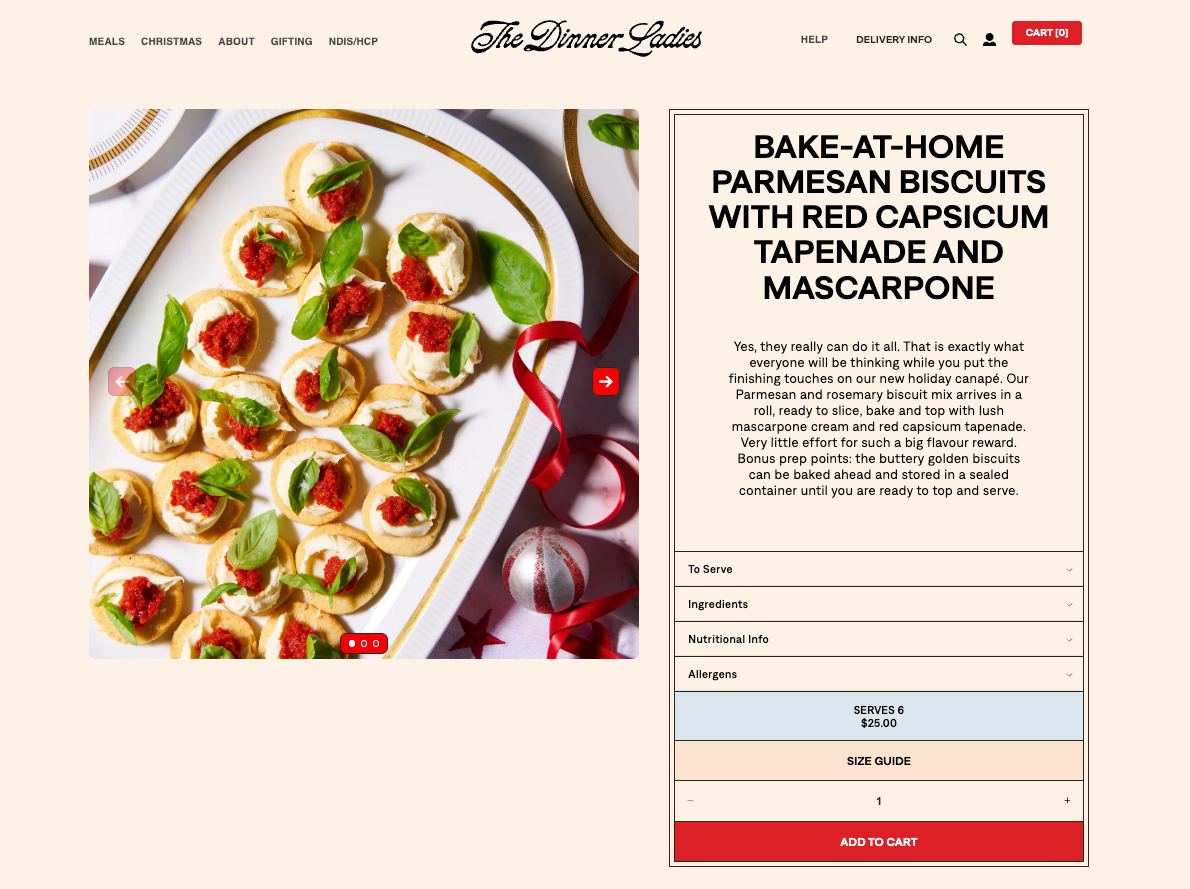
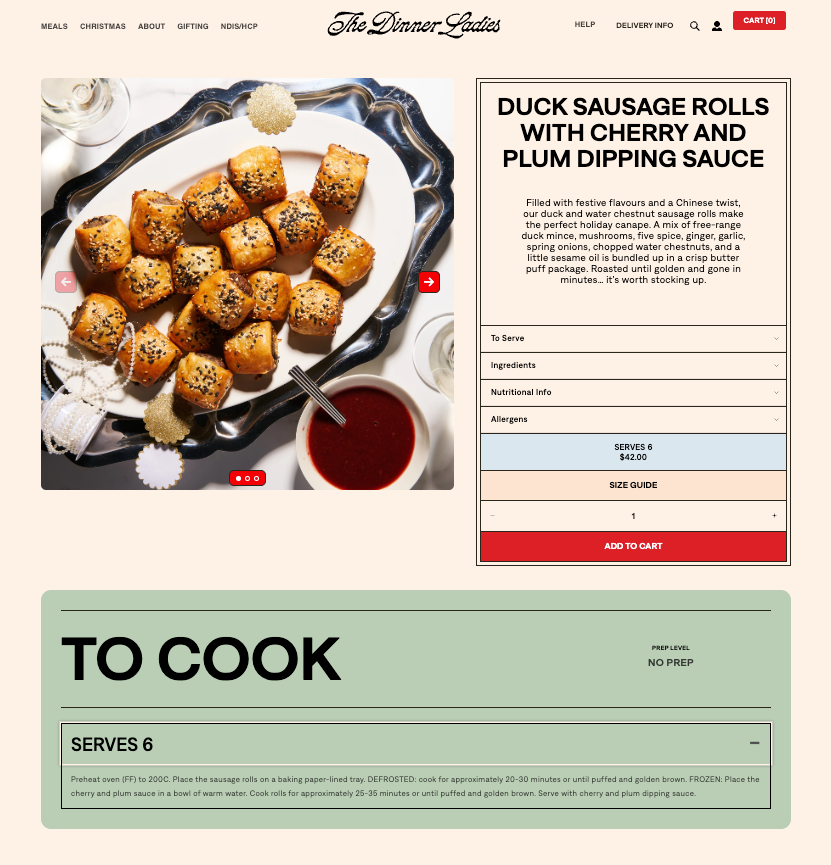
For example, ready-to-heat meal company The Dinner Ladies includes a dropdown menu on each product page for further reading. Categories include serving instructions, a full ingredient list, allergens, nutritional information, and even a handy “size guide” that shows how many people the meal serves.
FAQ pages make up the information hub of your website. They exist to provide customers with a way to get their questions answered without reaching out to you.
This includes information like how food should be stored, how long its shelf life is, delivery range, and serving instructions. FAQs can even direct customers toward finding out where their order is and what its status is.

In the context of BFCM, FAQs are all about deflecting repetitive questions away from your team and assisting shoppers in finding what they need faster.
That’s the strategy for German supplement brand mybacs.
“Our focus is to improve automations to make it easier for customers to self-handle their requests. This goes hand in hand with making our FAQs more comprehensive to give customers all the information they need,” says Alexander Grassmann, its Co-Founder & COO.
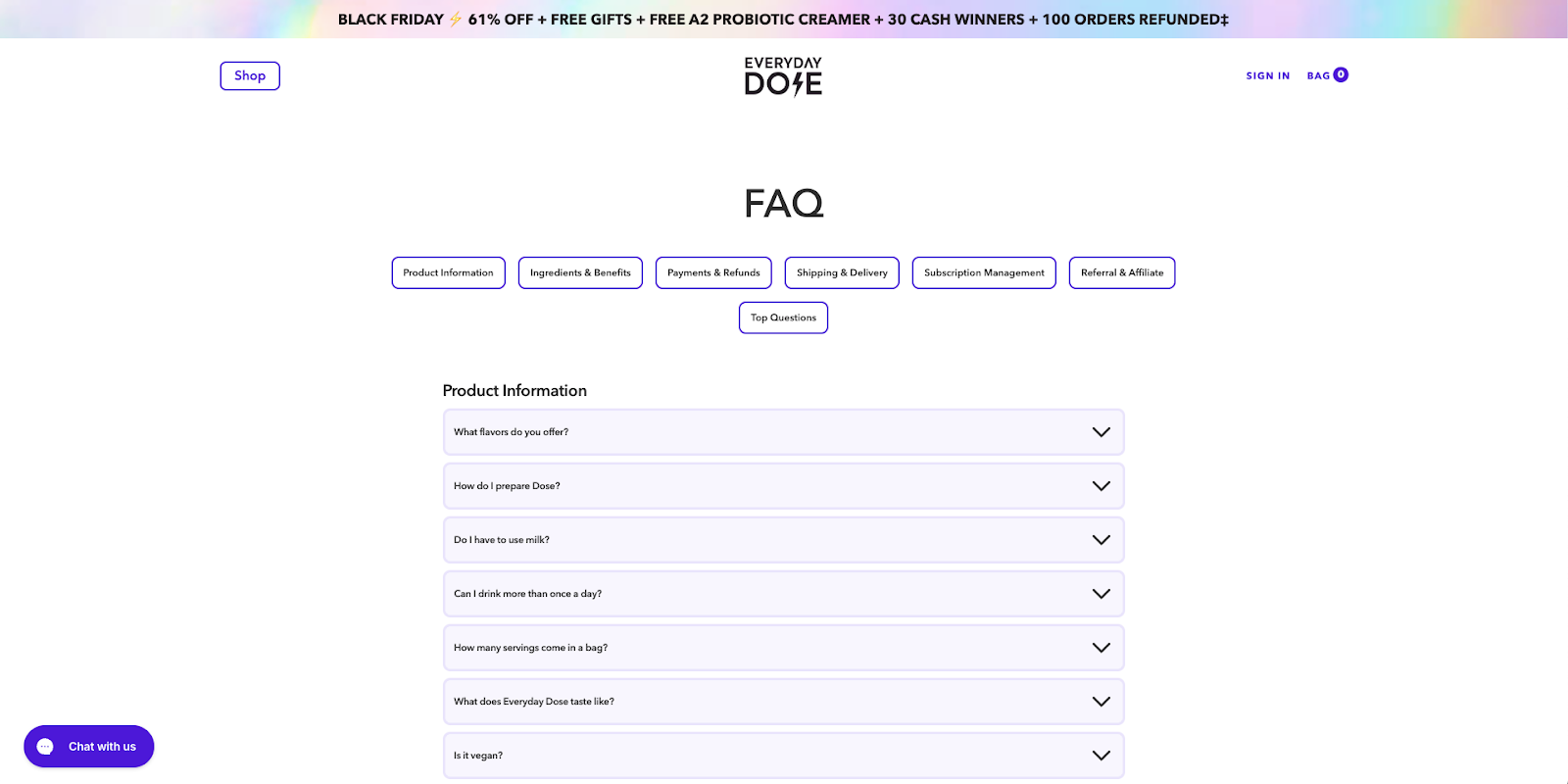
As you contemplate what to add to your FAQ page, remember that more information is usually better. That’s the approach Everyday Dose takes, answering even hyper-specific questions like, “Will it break my fast?” or “Do I have to use milk?”
While the FAQs you choose to add will be specific to your products, peruse the top-notch food and bev FAQ pages below.
Time for some FAQ inspo:
AI Agents and AI-powered Shopping Assistants are easy to set up and are extremely effective in handling customer interactions––especially during BFCM.
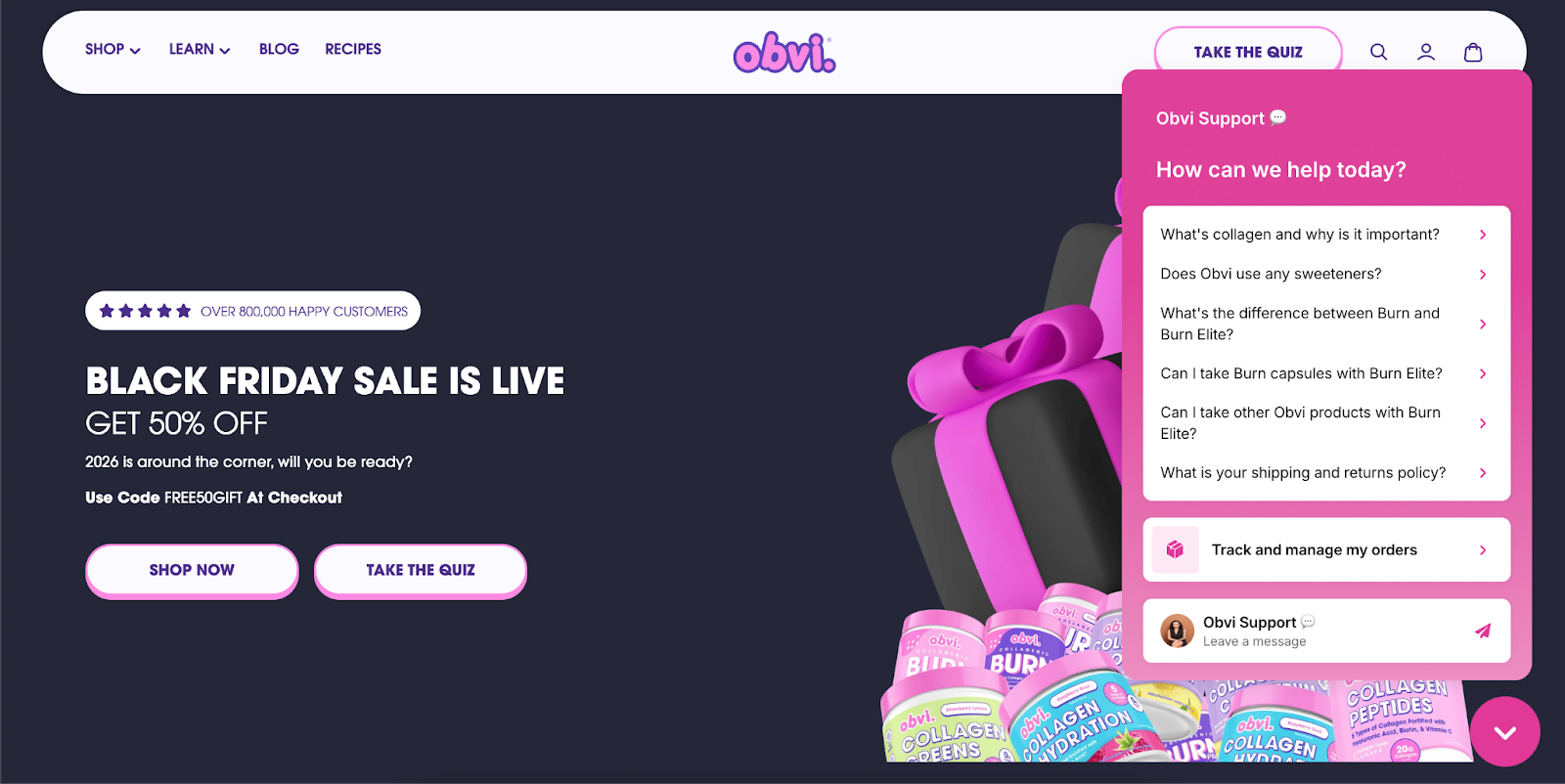
“I told our team we were going to onboard Gorgias AI Agent for BFCM, so a good portion of tickets would be handled automatically,” says Ron Shah, CEO and Co-founder at Obvi. “There was a huge sigh of relief knowing that customers were going to be taken care of.”
And, they’re getting smarter. AI Agent’s CSAT is just 0.6 points shy of human agents’ average CSAT score.
Here are the specific responses and use cases we recommend automating:
Get your checklist here: How to prep for peak season: BFCM automation checklist
With high price reductions often comes faster-than-usual sell out times. By offering transparency around item quantities, you can avoid frustrated or upset customers.
For example, you could show how many items are left under a certain threshold (e.g. “Only 10 items left”), or, like Rebel Cheese does, mention whether items have sold out in the past.
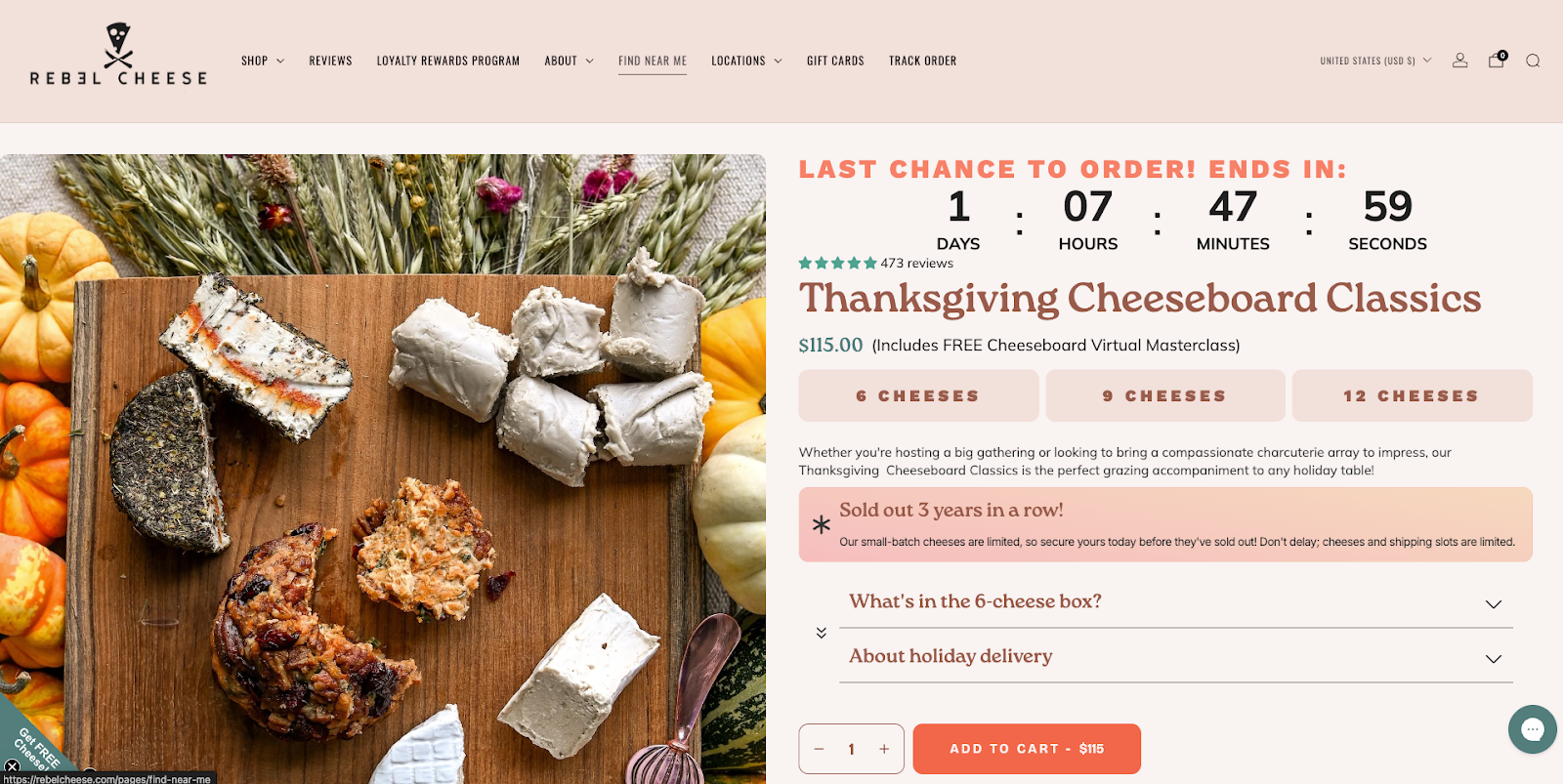
You could also set up presales, give people the option to add themselves to a waitlist, and provide early access to VIP shoppers.
Give shoppers a heads up whether they’ll be able to cancel an order once placed, and what your refund policies are.
For example, cookware brand Misen follows its order confirmation email with a “change or cancel within one hour” email that provides a handy link to do so.
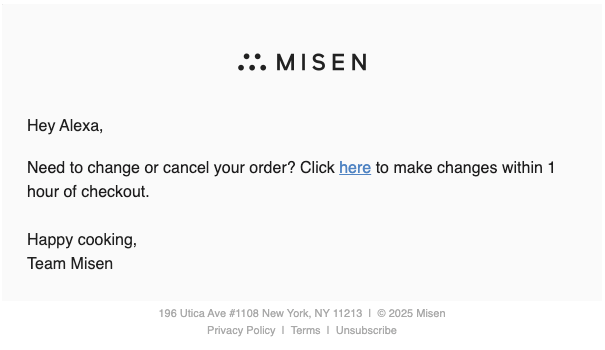
Your refund policies and order cancellations should live within an FAQ and in the footer of your website.
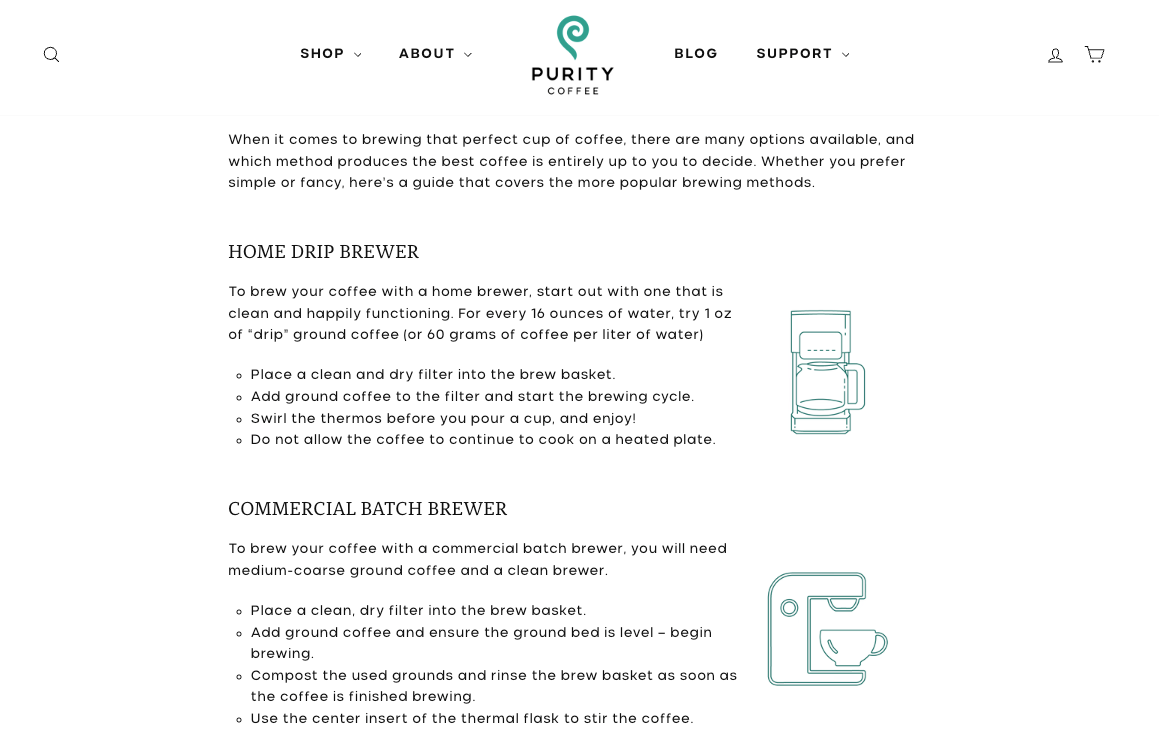
Include how-to information on your website within your FAQs, on your blog, or as a standalone webpage. That might be sharing how to use a product, how to cook with it, or how to prepare it. This can prevent customers from asking questions like, “how do you use this?” or “how do I cook this?” or “what can I use this with?” etc.
For example, Purity Coffee created a full brewing guide with illustrations:
Similarly, for its unique preseasoned carbon steel pan, Misen lists out care instructions:

And for those who want to understand the level of prep and cooking time involved, The Dinner Ladies feature cooking instructions on each product page.
Interactive quizzes, buying guides, and gift guides can help ensure shoppers choose the right items for them––without contacting you first.
For example, Trade Coffee Co created a quiz to help first timers find their perfect coffee match:
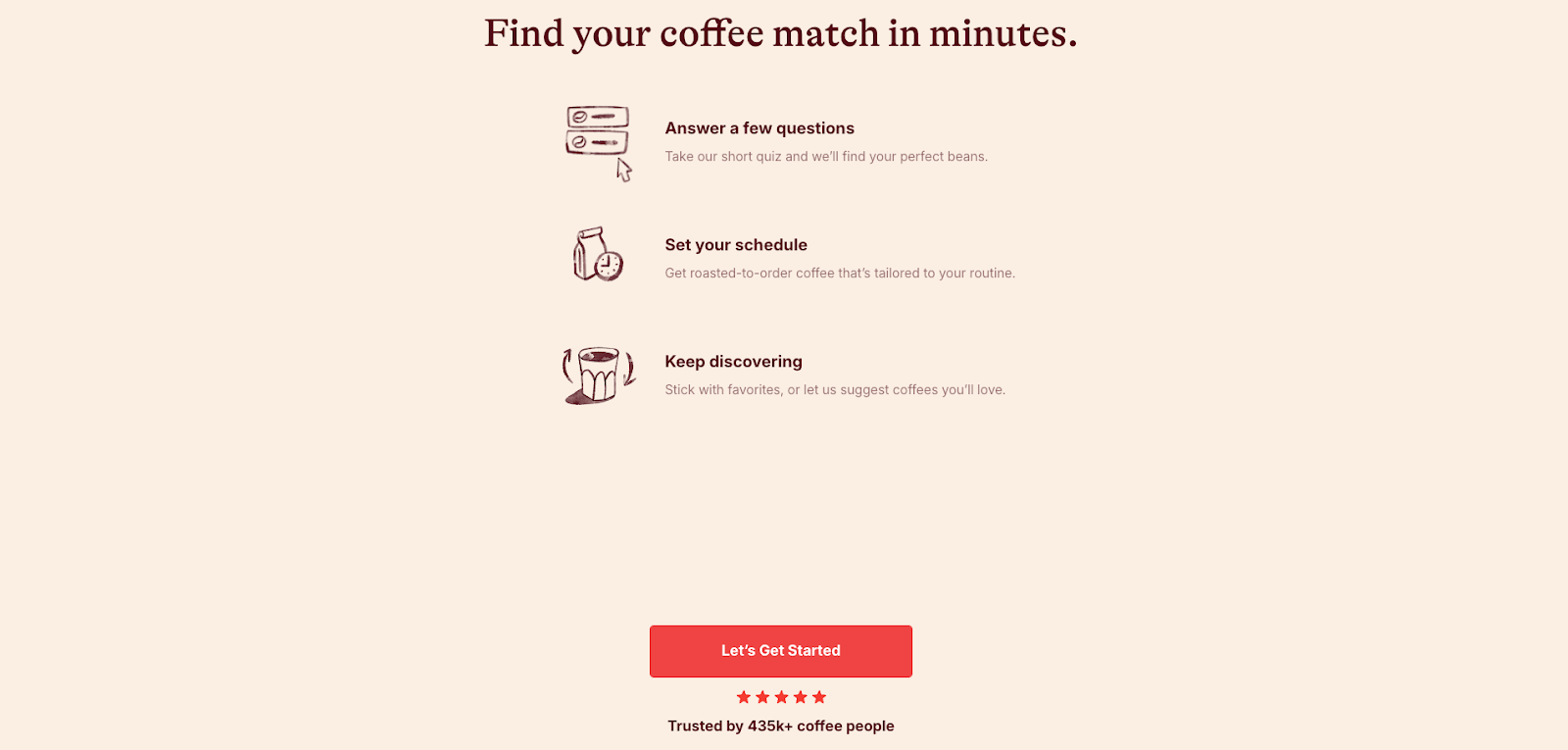
The more information you can share with customers upfront, the better. That will leave your team time to tackle the heady stuff.
If you’re looking for an AI-assist this season, check out Gorgias’s suite of products like AI Agent and Shopping Assistant.
{{lead-magnet-2}}
TL;DR:
As holiday season support volumes spike and teams lean on AI to keep up, one frustration keeps surfacing, our Help Center has the answers—so why can’t AI find them?
The truth is, AI can’t help customers if it can’t understand your Help Center. Most large language models (LLMs), including Gorgias AI Agent, don’t ignore your existing docs, they just struggle to find clear, structured answers inside them.
The good news is you don’t need to rebuild your Help Center or overhaul your content. You simply need to format it in a way that’s easy for both people and AI to read.
We’ll break down how AI Agent reads your Help Center, finds answers, and why small formatting changes can help it respond faster and more accurately, so your team spends less time on escalations.
{{lead-magnet-1}}
Before you start rewriting your Help Center, it helps to understand how AI Agent actually reads and uses it.
Think of it like a three-step process that mirrors how a trained support rep thinks through a ticket.
Your Help Center is AI Agent’s brain. AI Agent uses your Help Center to pull facts, policies, and instructions it needs to respond to customers accurately. If your articles are clearly structured and easy to scan, AI Agent can find what it needs fast. If not, it hesitates or escalates.
Think of Guidance as AI Agent’s decision layer. What should AI Agent do when someone asks for a refund? What about when they ask for a discount? Guidance helps AI Agent provide accurate answers or hand over to a human by following an “if/when/then” framework.
Finally, AI Agent uses a combination of your help docs and Guidance to respond to customers, and if enabled, perform an Action on their behalf—whether that’s changing a shipping address or canceling an order altogether.
Here’s what that looks like in practice:
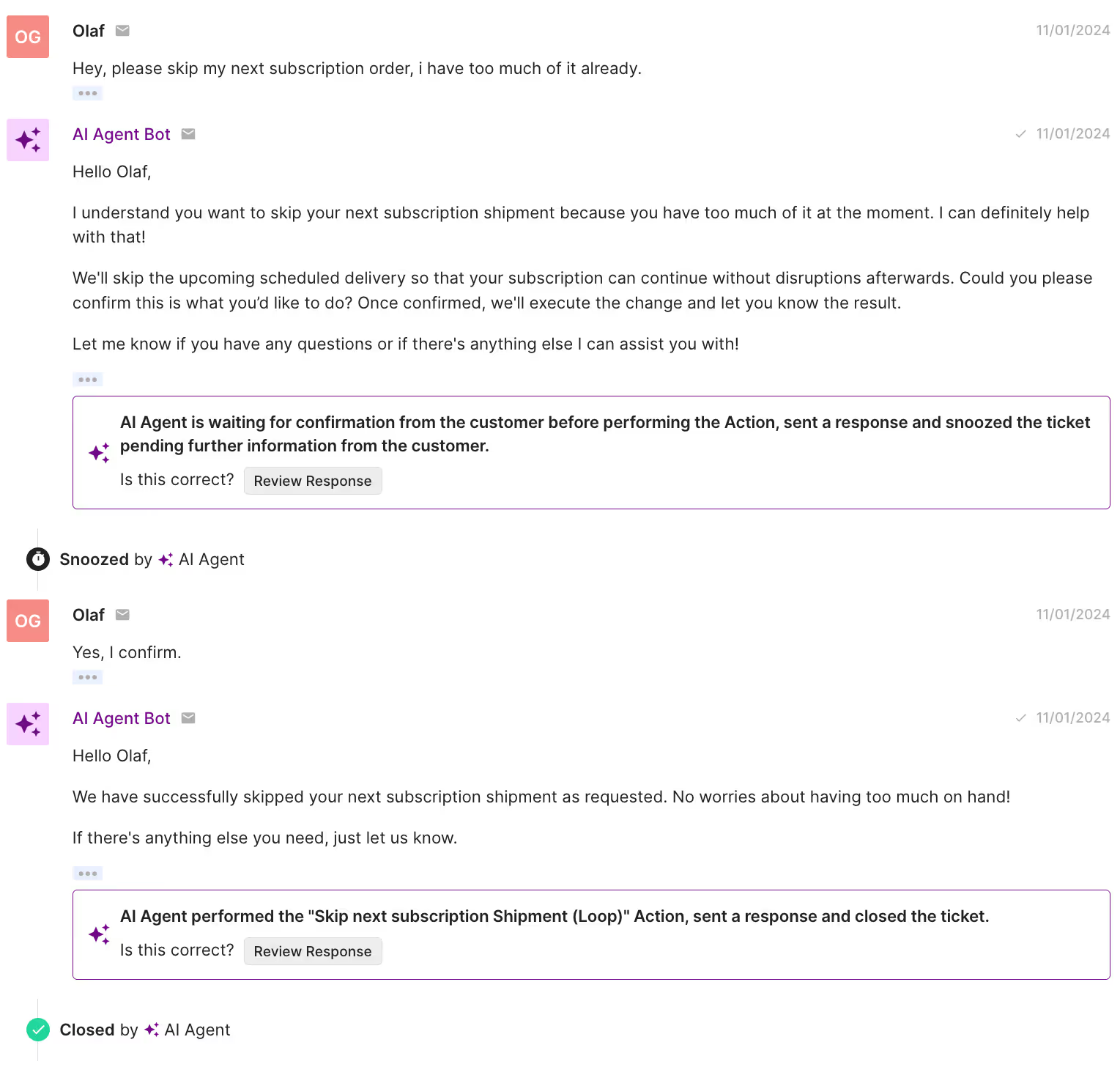
This structure removes guesswork for both your AI and your customers. The clearer your docs are about when something applies and what happens next, the more accurate and human your automated responses will feel.
A Help Center written for both people and AI Agent:
Our data shows that most AI escalations happen for a simple reason––your Help Center doesn’t clearly answer the question your customer is asking.
That’s not a failure of AI. It’s a content issue. When articles are vague, outdated, or missing key details, AI Agent can’t confidently respond, so it passes the ticket to a human.
Here are the top 10 topics that trigger escalations most often:
Each of these topics needs a dedicated, clearly structured Help Doc that uses keywords customers are likely to search and spells out specific conditions.
Here’s how to strengthen each one:
Start by improving these 10 articles first. Together, they account for nearly half of all AI Agent escalations. The clearer your Help Center is on these topics, the fewer tickets your team will ever see, and the faster your AI will resolve the rest.
Once you know how AI Agent reads your content, the next step is formatting your help docs so it can easily understand and use them.
The goal isn’t to rewrite everything, it’s to make your articles more structured, scannable, and logic-friendly.
Here’s how.
Both humans and large language models read hierarchically. If your article runs together in one long block of text, key answers get buried.
Break articles into clear sections and subheadings (H2s, H3s) for each scenario or condition. Use short paragraphs, bullets, and numbered lists to keep things readable.
Example:
How to Track Your Order
A structured layout helps both AI and shoppers find the right step faster, without confusion or escalation.
AI Agent learns best when your Help Docs clearly define what happens under specific conditions. Think of it like writing directions for a flowchart.
Example:
This logic helps AI know what to do and how to explain the answer clearly to the customer.
Customers don’t always use the same words you do, and neither do LLMs. If your docs treat “cancel,” “stop,” and “pause” as interchangeable, AI Agent might return the wrong answer.
Define each term clearly in your Help Center and add small keyword variations (“cancel subscription,” “end plan,” “pause delivery”) so the AI can recognize related requests.
AI Agent follows links just like a human agent. If your doc ends abruptly, it can’t guide the customer any further.
Always finish articles with an explicit next step, like linking to:
Example: “If your return meets our policy, request your return label here.”
That extra step keeps the conversation moving and prevents unnecessary escalations.
AI tools prioritize structure and wording when learning from your Help Center—not emotional tone.
Phrases like “Don’t worry!” or “We’ve got you!” add noise without clarity.
Instead, use simple, action-driven sentences that tell the customer exactly what to do:
A consistent tone keeps your Help Center professional, helps AI deliver reliable responses, and creates a smoother experience for customers.
You don’t need hundreds of articles or complex workflows to make your Help Center AI-ready. But you do need clarity, structure, and consistency. These Gorgias customers show how it’s done.
Little Words Project keeps things refreshingly straightforward. Their Help Center uses short paragraphs, descriptive headers, and tightly scoped articles that focus on a single intent, like returns, shipping, or product care.
That makes it easy for AI Agent to scan the page, pull out the right facts, and return accurate answers on the first try.
Their tone stays friendly and on-brand, but the structure is what shines. Every article flows from question → answer → next step. It’s a minimalist approach, and it works. Both for customers and the AI reading alongside them.
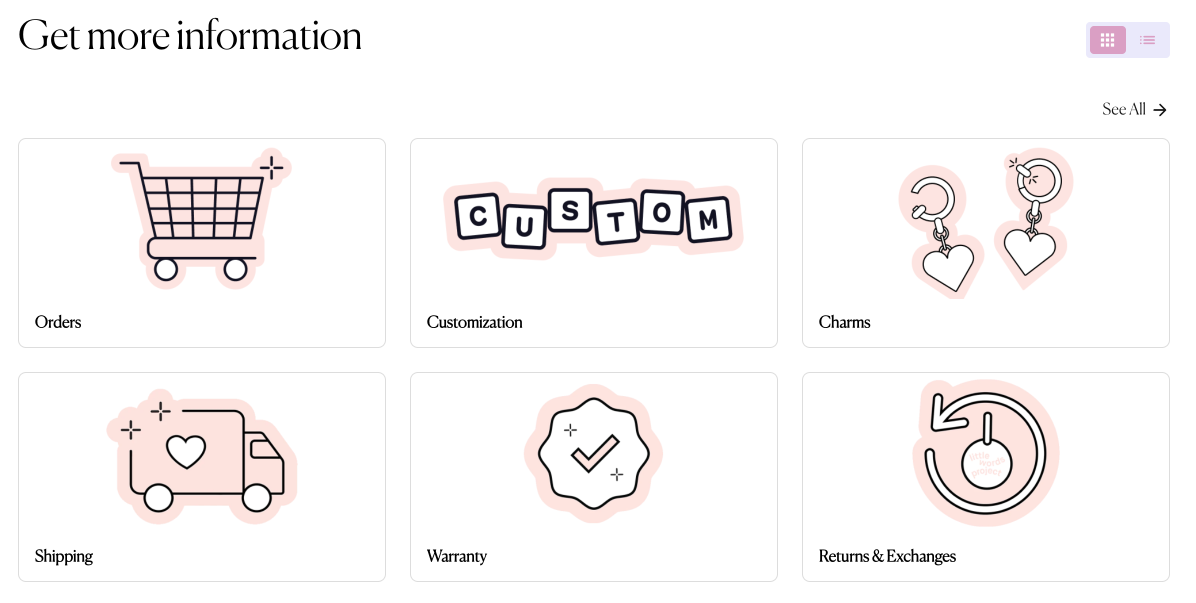
Customer education is at the heart of Dr. Bronner’s mission. Their customers often ask detailed questions about product ingredients, packaging, and certifications. With Gorgias, Emily and her team were able to build a robust Help Center that helped to proactively give this information.
The Help Center doesn't just provide information. The integration of interactive Flows, Order Management, and a Contact Form automation allowed Dr. Bronner’s to handle routine inquiries—such as order statuses—quickly and efficiently. These kinds of interactive elements are all possible out-of-the-box, no IT support needed.

When Ekster switched to Gorgias, the team wanted to make their Help Center work smarter. By writing clear, structured articles for common questions like order tracking, returns, and product details, they gave both customers and AI Agent the information needed to resolve issues instantly.
"Our previous Help Center solution was the worst. I hated it. Then I saw Gorgias’s Help Center features, and how the Article Recommendations could answer shoppers’ questions instantly, and I loved it. I thought: this is just what we need." —Shauna Cleary, Head of Ecommerce at Ekster
The results followed fast. With well-organized Help Center content and automation built around it, Ekster was able to scale support without expanding the team.
“With all the automations we’ve set up in Gorgias, and because our team in Buenos Aires has ramped up, we didn’t have to rehire any extra agents.” —Shauna Cleary, Head of Ecommerce at Ekster
Learn more: How Ekster used automation to cover the workload of 4 agents
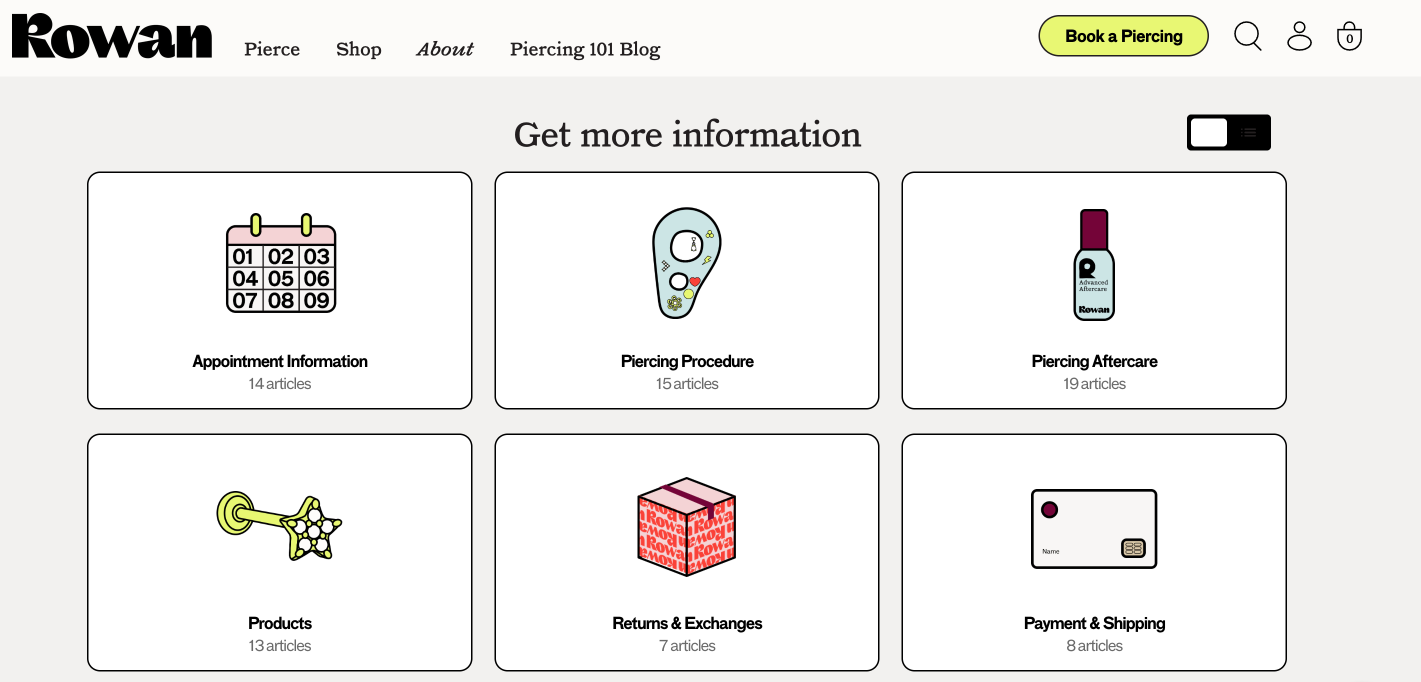
Rowan’s Help Center is a great example of how clear structure can do the heavy lifting. Their FAQs are grouped into simple categories like piercing, shipping, returns, and aftercare, so readers and AI Agent can jump straight to the right topic without digging.
For LLMs, that kind of consistency reduces guesswork. For customers, it creates a smooth, reassuring self-service experience.
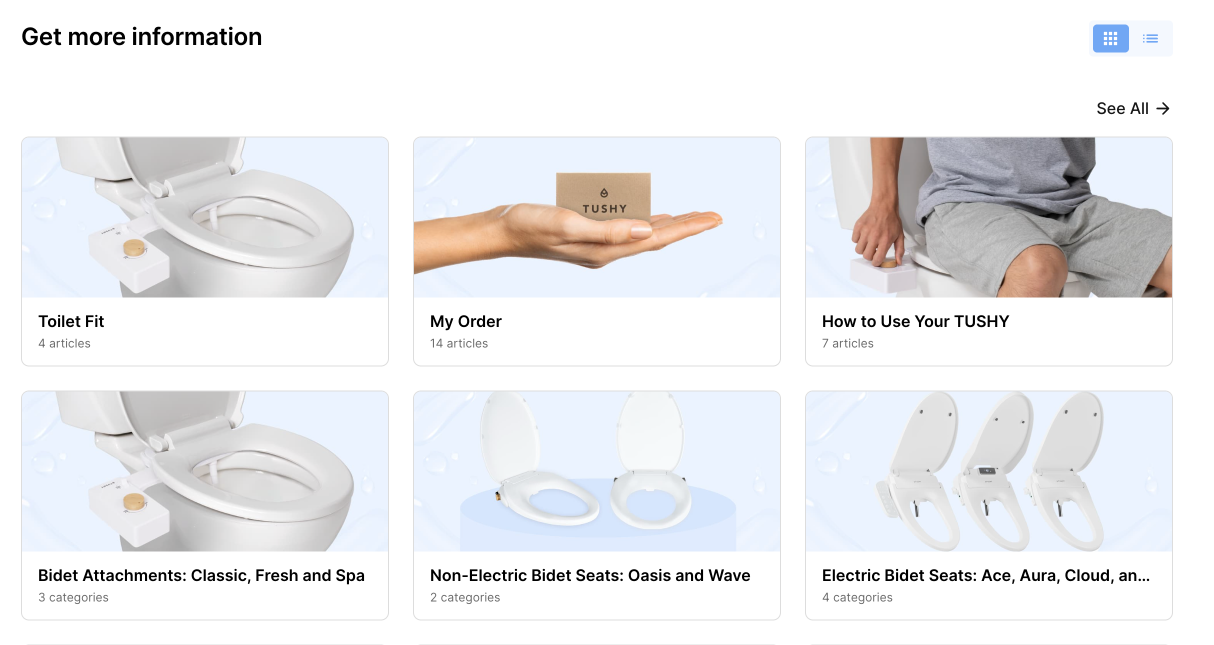
TUSHY proves you can maintain personality and structure. Their Help Center articles use clear headings, direct language, and brand-consistent tone. It makes it easy for AI Agent to give accurate, on-brand responses.
“Too often, a great interaction is diminished when a customer feels reduced to just another transaction. With AI, we let the tech handle the selling, unabashedly, if needed, so our future customers can ask anything, even the questions they might be too shy to bring up with a human. In the end, everybody wins!" —Ren Fuller-Wasserman, Senior Director of Customer Experience at TUSHY
Ready to put your Help Center to the test? Use this five-point checklist to make sure your content is easy for both customers and AI to navigate.
Break up long text blocks and use descriptive headers (H2s, H3s) so readers and AI Agent can instantly find the right section.
Spell out what happens in each scenario. This logic helps AI Agent decide the right next step without second-guessing.
Make sure your Help Center includes complete, structured articles for high-volume issues like order status, returns, and refunds.
Close every piece with a call to action, like a form, related article, or support link, so neither AI nor customers hit a dead end.
Use direct, predictable phrasing. Avoid filler like “Don’t worry!” and focus on steps customers can actually take.
By tweaking structure instead of your content, it’s easier to turn your Help Center into a self-service powerhouse for both customers and your AI Agent.
Your Help Center already holds the answers your customers need. Now it’s time to make sure AI can find them. A few small tweaks to structure and phrasing can turn your existing content into a powerful, AI-ready knowledge base.
If you’re not sure where to start, review your Help Center with your Gorgias rep or CX team. They can help you identify quick wins and show you how AI Agent pulls information from your articles.
Remember: AI Agent gets smarter with every structured doc you publish.
Ready to optimize your Help Center for faster, more accurate support? Book a demo today.
{{lead-magnet-2}}
The best in CX and ecommerce, right to your inbox

TL;DR:
Getting ready for that yearly ticket surge isn’t only about activating every automation feature on your helpdesk, it’s about increasing efficiency across your entire support operations.
This year, we’re giving you one less thing to worry about with our 2025 BFCM automation guide. Whether your team needs a tidier Help Center or better ticket routing rules, we’ve got a checklist for every area of the customer experience brought to you by top industry players, including ShipBob, Loop Returns, TalentPop, and more.
{{lead-magnet-1}}
Your customer knowledge base, FAQs, or Help Center is a valuable hub of answers for customers’ most asked questions. For those who prefer to self-serve, it’s one of the first resources they visit. To ensure customers get accurate answers, do the following:
Take stock of what’s currently in your database. Are you still displaying low-engagement or unhelpful articles? Are articles about discontinued products still up? Start by removing outdated content first, and then decide which articles to keep from there.
Related: How to refresh your Help Center: A step-by-step guide
Are you missing key topics, or don’t have a database yet? Look at last year’s tickets. What were customers’ top concerns? Were customers always asking about returns? Was there an uptick in free shipping questions? If an inquiry repeats itself, it’s a sign to add it to your Help Center.
An influx of customers means more people using your shipping, returns, exchanges, and discount policies. Make sure these have accurate information about eligibility, conditions, and grace periods, so your customers have one reliable source of truth.
Personalization tip: Loop Returns advises adjusting your return policy for different return reasons. With Loop’s Workflows, you can automatically determine which customers and which return reasons should get which return policies.
Read more: Store policies by industry, explained: What to include for every vertical
Customers want fast answers, so ensure your docs are easy to read and understand. Titles and answers should be clear. Avoid technical jargon and stick to simple sentences that express one idea. To accelerate the process, use AI tools like Grammarly and ChatGPT.
No time to set up a Help Center? Gorgias automatically generates Help Center articles for you based on what people are asking in your inbox.

Think of ticket routing like running a city. Cars are your tickets (and customers), roads are your inboxes, and traffic lights are your automations and rules. The better you maintain these structures, the better they can run on their own without needing constant repairs from your CX team.
Here’s your ticket routing automation checklist:
Instead of asking agents to tag every ticket, set rules that apply tags based on keywords, order details, or message type. A good starting point is to tag tickets by order status, returns, refunds, VIP customers, and urgent issues so your team can prioritize quickly.
Luckily, many helpdesks offer AI-powered tags or contact reasons to reduce manual work. For example, Gorgias automatically detects a ticket’s Contact Reason. The system learns from past interactions, tagging your tickets with more accuracy each time.

Custom or filtered inbox views give your agents a filtered and focused workspace. Start with essential views like VIP customers, returns, and damages, then add specialized views that match how your team works.
If you’re using conversational AI to answer tickets, views become even more powerful. For example, you might track low CSAT tickets to catch where AI responses fall short or high handover rates to identify AI knowledge gaps. The goal is to reduce clutter so agents can focus on delivering support.
Don’t get bogged down in minor issues while urgent tickets sit unanswered. Escalation rules make sure urgent cases are pushed to the top of your inbox, so they don’t risk revenue or lead to unhappy customers.
Tickets to escalate to agents or specialized queues:
Ticket Fields add structure by requiring your team to capture key data before closing a ticket. For BFCM, make fields like Contact Reason, Resolution, and Return Reason mandatory so you always know why customers reached out and how the issue was resolved.
For CX leads, Ticket Fields removes guesswork. Instead of sifting through tickets one by one, you’ll have clean data to spot trends, report on sales drivers, and train your team.
Pro Tip: Use conditional fields to dig deeper without overwhelming agents. For example, if the contact reason is “Return,” automatically prompt the agent to log the return reason or product defect.
Macros and AI Agent are your frontline during BFCM. When prepped properly, they can clear hundreds of repetitive tickets. The key is to ensure that answers are accurate, up-to-date, and aligned with what you want AI to handle.
Customers will flood your inbox with the same questions: “Where’s my order?” “When will my discount apply?” “What’s your return policy?” Write macros that give short, direct answers up front, include links for details, and use placeholders for personalization.
Bad macro:
Good macro:
Pro Tip: Customers expect deep discounts this time of year. BPO agency C(x)atalyze recommends automating responses to these inquiries with Gorgias Rules. Include words such as “discount” AND “BFCM”, “holiday”, “Thanksgiving”, “Black Friday”, “Christmas”, etc.
AI is only as good as the information you feed it. Before BFCM, make sure it’s pulling from:
Double-check a few responses in Test Mode to confirm the AI is pulling the right information.

Edge cases and urgent questions need a human touch, not an automated reply. Keep AI focused on quick requests like order status, shipping timelines, or promo eligibility. Complex issues, like defective products, VIP complaints, and returns, can directly go to your agents.
Pro Tip: In Gorgias AI Agent settings, you can customize how handovers happen on Chat during business hours and after hours.
Too few agents and you prolong wait times and miss sales. Too many and you’ll leave your team burned out. Capacity planning helps you find the balance to handle the BFCM surge.
Use your ticket-to-order ratio from last year as a baseline, then apply it to this year’s forecast. Compare that number against what your team can realistically handle per shift to see if your current staffing plan holds up.
Read more: How to forecast customer service hiring needs ahead of BFCM
You still have options if you don’t have enough agents helping you out. Customer service agency TalentPop recommends starting by identifying where coverage will fall short, whether that’s evenings, weekends, or specific channels. Then decide whether to increase automation and AI use or bring in temporary assistance.
Before the holiday season, run refreshers on new products, promos, and policy changes so no one hesitates when the tickets roll in. Pair training with cheat sheets or an internal knowledge base, giving your team quick access to the answers they’ll need most often.
Expect late shipments, low inventory, and more returns than usual during peak season. With the proper logistics automations, you can stay ahead of these issues while reducing pressure on your team.
ShipBob and Loop recommend the following steps:
Shipping costs add up fast during peak season. Work with your 3PL or partners like Loop Returns to take advantage of negotiated carrier rates and rate shopping tools that automatically select the most cost-effective option for each order.
To maintain a steady supply of products, set automatic reorder points at the SKU level so reorders are triggered once inventory dips below a threshold. More lead time means fewer ‘out of stock’ surprises for your customers.
Bad weather, delays, or unexpected demand can disrupt shipping timelines. Create a playbook in advance so your team knows exactly how to respond when things go sideways. At minimum, your plan should cover:
Customers want to know when their order will arrive before they hit checkout. Add estimated delivery dates and 2-day shipping badges directly on product pages. These cues help shoppers make confident decisions and reduce pre-purchase questions about shipping times.
Pro Tip: To keep those timelines accurate, build carrier cutoff dates into your Black Friday logistics workflows with your 3PL or fulfillment team. This allows you to avoid promising delivery windows your carriers can’t meet during peak season.
You’ve handled the basics, from ticket routing to staffing and logistics. Now it’s time to go beyond survival. Upselling automations create an end-to-end experience that enhances the customer journey, shows them products they’ll love, and makes it easy to buy more with confidence. To put them to work:
BFCM puts pressure on customers to find the right deal fast, but many don’t know what they’re looking for. Make it easier for them with macros that point shoppers to bestsellers or curated bundles. For a more advanced option, conversational AI like Gorgias Shopping Assistant can guide browsers on their own, even when your agents are offline.
No need to damage your conversion rate just because customers missed the items they wanted. Automations can recommend similar or complementary products, keeping customers engaged rather than leaving them empty-handed.
If an item is sold out, set up automations to:
Automations can detect hesitation through signals like abandoned carts, long checkout times, or even customer messages that mention keywords such as “too expensive” or “I’ll think about it.” In these cases, trigger a small discount to encourage the purchase.
You can take this a step further with conversational AI like Gorgias Shopping Assistant, which detects intent in real time. If a shopper seems uncertain, it can proactively offer a discount code based on the level of their buying intent.
During BFCM, speed alone is not enough. Customers expect accurate, helpful, and on-brand responses, even when volume is at its highest. QA automations help you prioritize quality by reviewing every interaction automatically and flagging where standards are slipping. To make QA part of your automation prep:
Manual QA can only spot-check a small sample of tickets, which means most interactions go unreviewed. AI QA reviews every ticket automatically and delivers feedback instantly. This ensures consistent quality, even when your team is flooded with requests.
Compared to manual QA, AI QA offers:
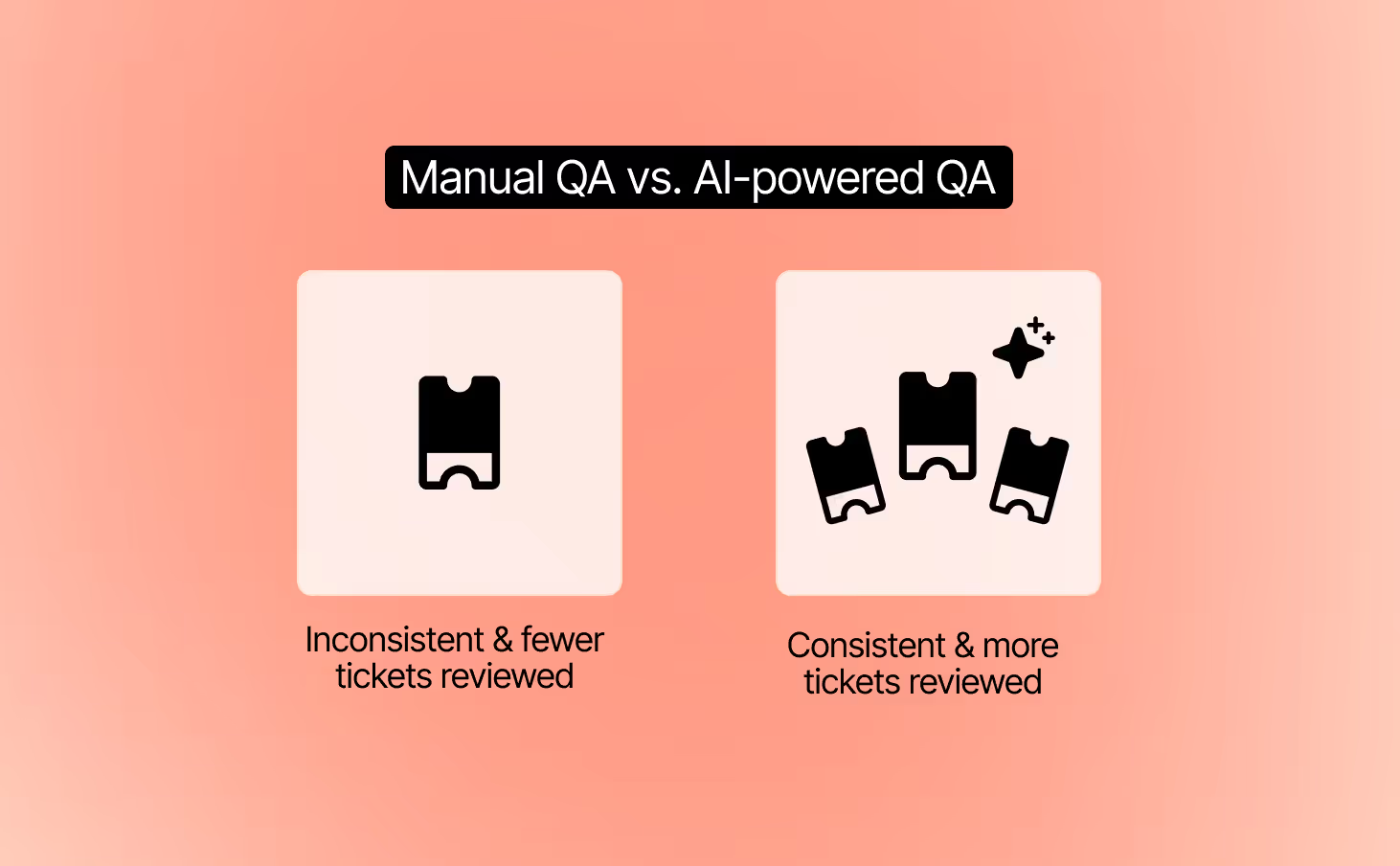
Customers should get the same level of quality no matter who replies. AI QA evaluates both human and AI conversations using the same criteria. This creates a fair standard and gives you confidence that every interaction meets your brand’s bar for quality.
QA automation is not just about grading tickets. It highlights recurring issues, unclear workflows, or policy confusion. Use these insights to guide targeted coaching sessions and refine AI guidance so both humans and AI deliver better results.
Pro Tip: Pilot your AI QA tool with a small group of agents before peak season. This lets you validate feedback quality and scale with confidence when BFCM volume hits.
The name of the game this Black Friday-Cyber Monday isn’t just to get a ton of online sales, it’s to set up your site for a successful holiday shopping season.
If you want to move the meter, focus on setting up strong BFCM automation flows now.
Gorgias is designed with ecommerce merchants in mind. Find out how Gorgias’s time-saving CX platform can help you create BFCM success. Book a demo today.
{{lead-magnet-2}}
TL;DR:
Shopping today isn’t a linear funnel. It’s a fluid conversation. Browse → question → help → buy → return → repeat.
Every step is a dialogue between the shopper’s intent and the brand’s response.
But what bridges the gap between “just looking” and “I’m buying” isn’t persuasion or urgency — it’s suggestion: the subtle design, timing, and language cues that guide action without forcing it.
When done well, suggestion becomes the architecture of trust. It’s also the best way to make AI-powered experiences feel human-first, not tech-first.
This article explores how the power of suggestion — rooted in behavioral psychology and UX design — shapes modern conversational commerce.
{{lead-magnet-1}}
The average ecommerce shopper faces thousands of micro-decisions from the moment they land on a site. Which product? Which variant? Which review to trust? Which shipping method? Each one adds cognitive weight.
Psychologist Barry Schwartz coined the term The Paradox of Choice to describe how abundance often leads to paralysis. In his research, participants faced with too many options were less likely to make a choice and less satisfied when they did.
In ecommerce, that means overload costs conversions. When shoppers must evaluate too many variables, they hesitate, second-guess, or abandon.
Shoppers today expect empathy and ease, not persuasion. When you suggest rather than push, you signal empathy and support.
This is especially important for conversational commerce. Suggestion humanizes automation by making AI interactions feel like conversations rather than transactions.
When you push and persuade, you create a memorable experience for customers — but it’s not the kind you want them to remember.
One Reddit thread perfectly captures the problem: a user tried to cancel their Thrive Market membership and had to ask nine times before the chatbot complied.
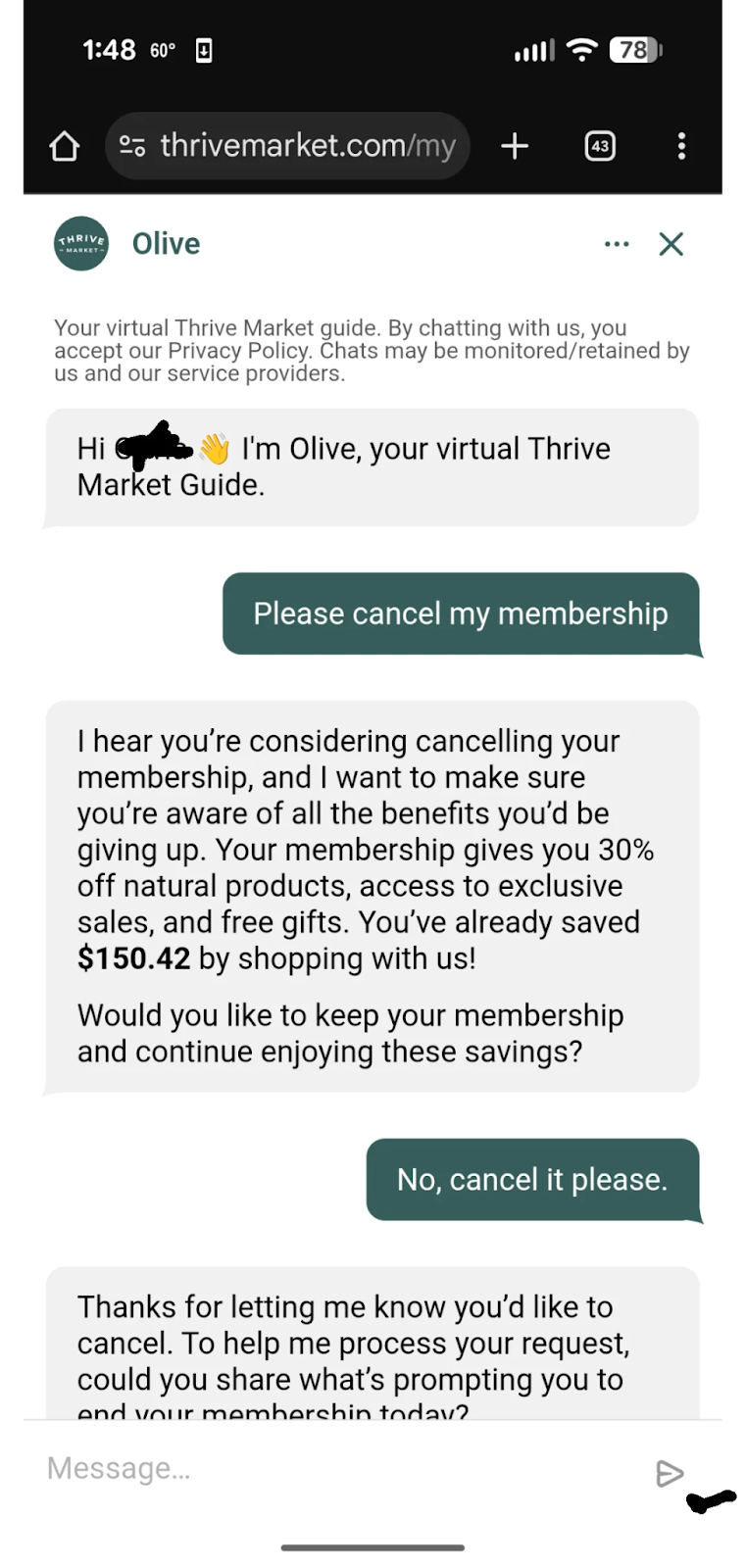
Each time, the AI assistant tried to talk them out of it (offering deals, guilt-tripping responses, or irrelevant messages) until the customer’s frustration boiled over.
The thread exploded not just because it was mildly infuriating, but because it illustrated what customers fear most about automation: a lack of empathy.
Suggestion is how you design for trust, ease, and interaction. And for ecommerce and CX professionals, suggestion bridges browsing and buying by prompting dialogue in a gentle, psychologically sound way.
The magic of suggestion is that it works with human psychology, not against it. It bridges the space between what a shopper wants to do and what helps them do it.
That’s the foundation of the Fogg Behavior Model, developed by Stanford’s Dr. BJ Fogg. The model states that behavior happens when three things intersect:
When these three align, the likelihood of action skyrockets.
In conversational commerce, suggestion is the gentle push that turns intent into interaction.
Below are five ways to apply suggestion with agentic AI (think chat, assistants, and marketing tools) to drive trust, dialogue, and conversion.
A first impression shapes the entire interaction.
A greeting like “Need help?” or “Looking for something special?” signals availability without applying pressure. It’s the digital equivalent of a store associate smiling and saying, “Let me know if you need anything.”
This works because of linguistic framing, which is a form of persuasive language that subtly shapes how people interpret intent.
In practice, this means:
Take a look at Glamnetic. Its shopping assistant sits at the bottom-right corner of every page. While shoppers scroll on the homepage, a prompt appears: “Shop with AI.” It’s transparent about being an AI chat, but subtle enough to be there for shoppers when they’re ready to use it at their own leisure.
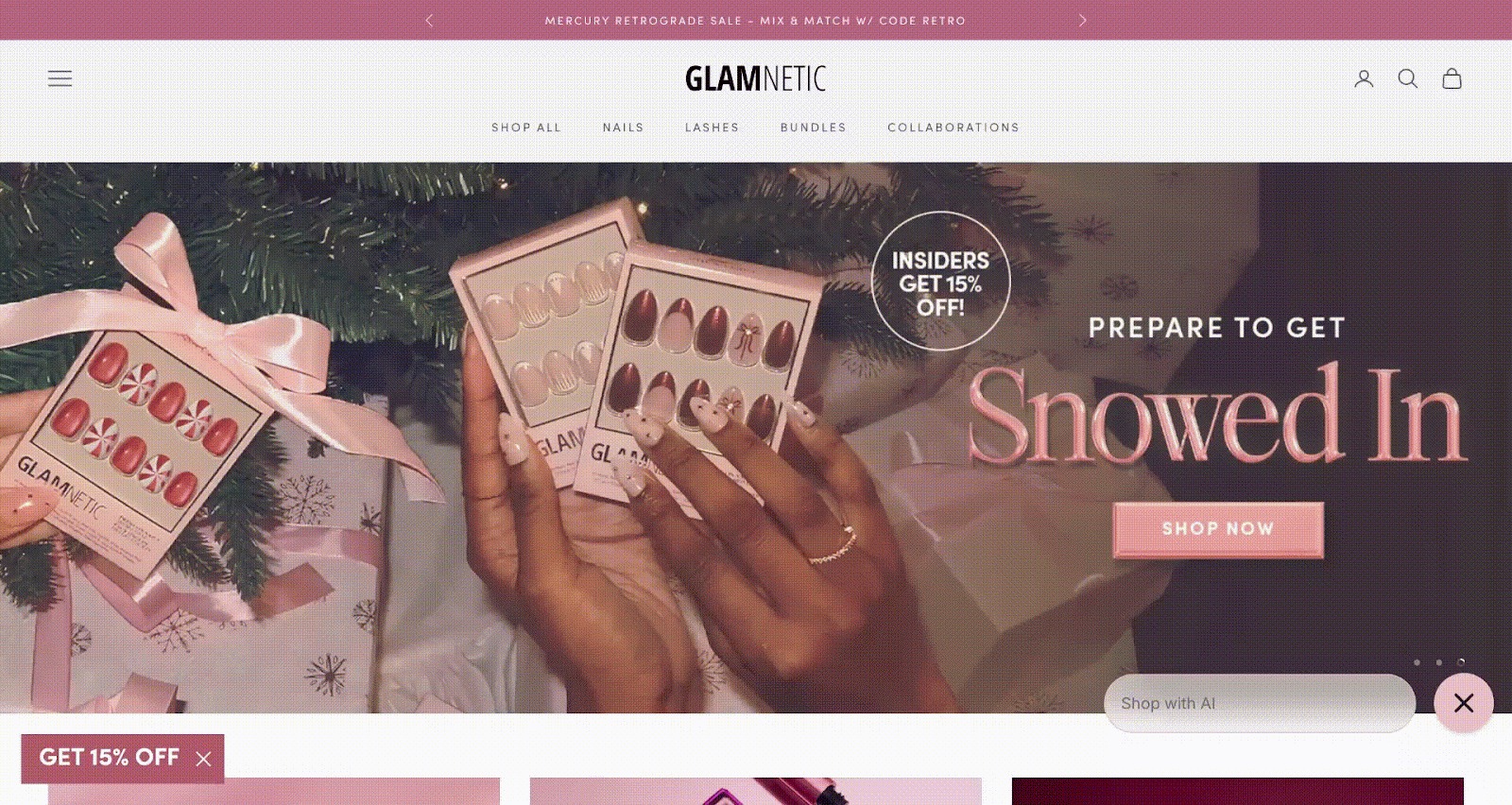
Gorgias Shopping Assistant is an easy way to do this. At the right moment, Shopping Assistant appears with a greeting such as “Need help?” or “Chat with our AI!” It’s friendly, low-pressure, optional, more “Hey I’m here if you need” than “Buy now!”
If you’ve ever scrolled through 80 product filters and given up, you’ve experienced choice overload. This is the Paradox of Choice in action:
More options = higher cognitive effort = lower satisfaction.
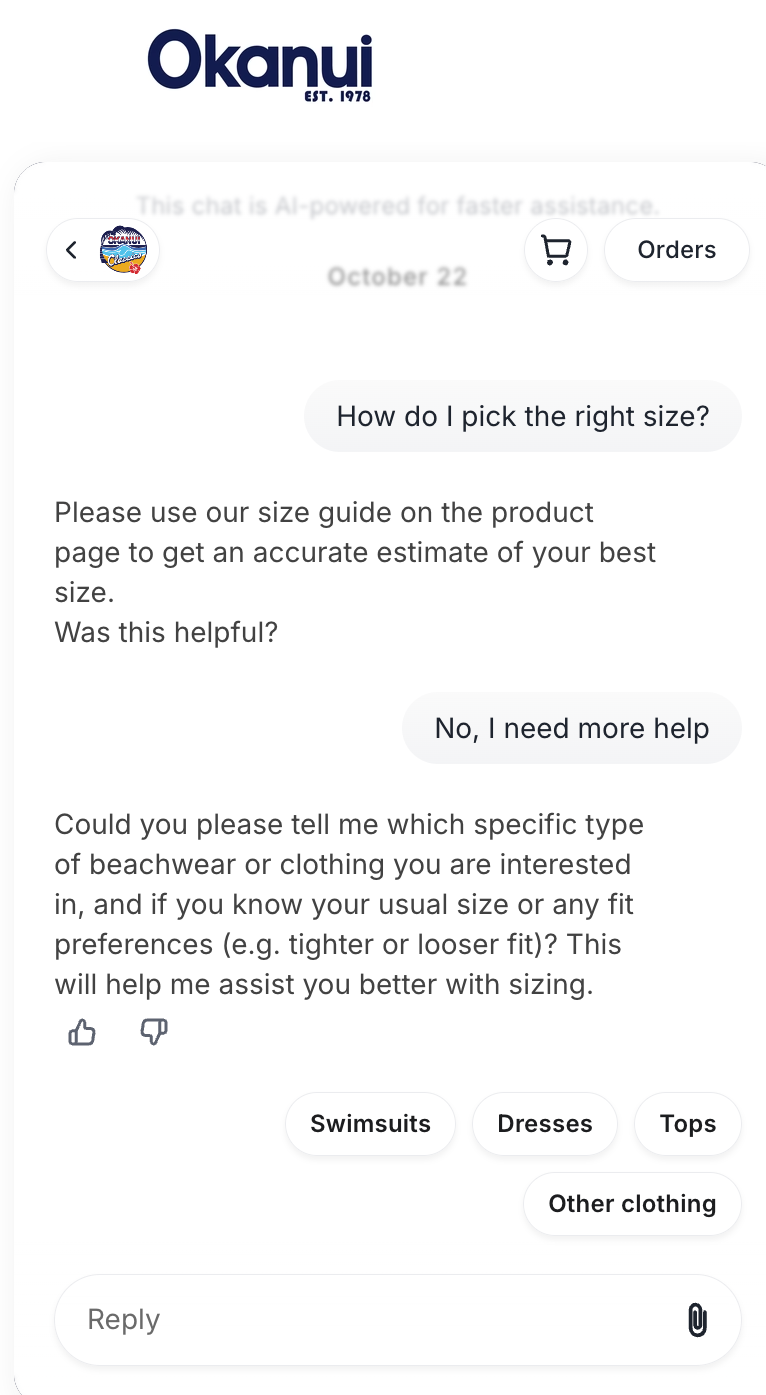
Suggestion works because it reduces mental effort. When an AI assistant limits quick-reply options to just a few (say, “Long sleeve,” “Short sleeve,” “Sleeveless”), it transforms chaos into clarity.
Each small tap provides forward momentum, a concept known as the goal-gradient effect: the closer we feel to completing a goal, the faster and more positively we act.
How can you apply this to agentic AI?
Gorgias’s Shopping Assistant does this well, surfacing only the most relevant next steps. Instead of forcing open-ended typing, it guides shoppers through mini-decisions that build confidence. Here’s an example from Okanui, showing four clear options to reply to Shopping Assistant.
Before a shopper reads a single word of text, their brain has already judged whether your interface feels safe to engage with.
That’s the Aesthetic–Usability Effect — when people perceive something as visually appealing, they assume it will be easier and more trustworthy to use.
Design psychologist Don Norman put it best: “Attractive things work better because they make people feel better.”
Here’s why visual subtlety matters:
OSEA’s product description page is a beautiful example of unintrusive design in action. The buttons have rounded edges, the 10% offer isn’t covering other page elements, and the chat sits in the bottom-right corner, making it easily accessible if a shopper has questions about the product.
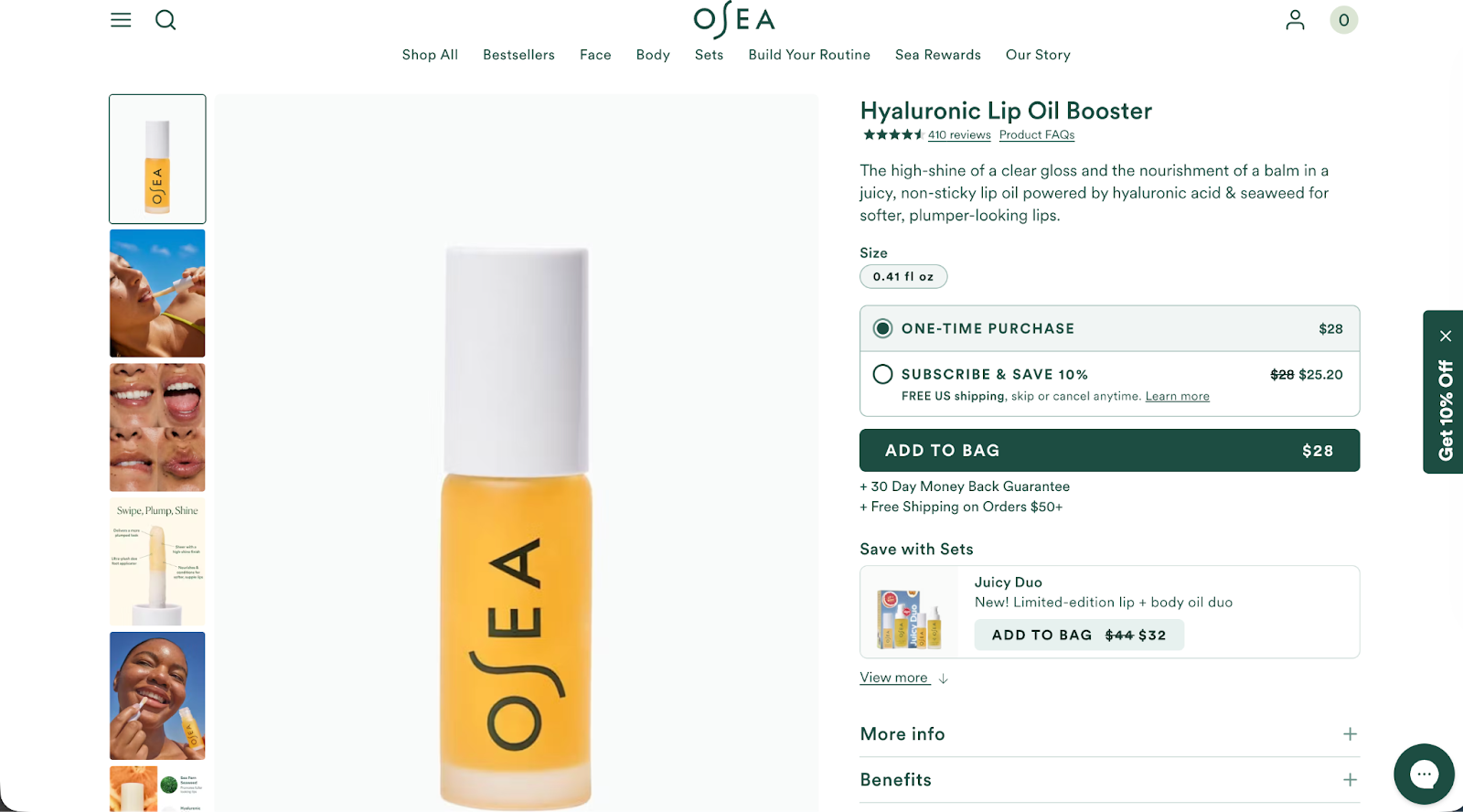
Timing is everything in suggestion-based design. Even the most thoughtful interaction will fail if it appears at the wrong moment.
That’s where the Fogg Behavior Model becomes tactical: Behavior = Motivation × Ability × Prompt
When shoppers are motivated (interested in a product) and able (engaging is easy), a well-timed prompt (chat bubble, message, or offer) turns potential into action.
But mistime it, and you risk the opposite. A chat that appears too early feels like spam. Too late, and the user’s interest window closes.
Here’s how to align the timing sweet spot:
Gorgias Shopping Assistant does all of the above. Using context — such as the current page, conversational context, and cart behavior — helps the AI trigger prompts like “Need help choosing a size?” or “Have questions about shipping?”
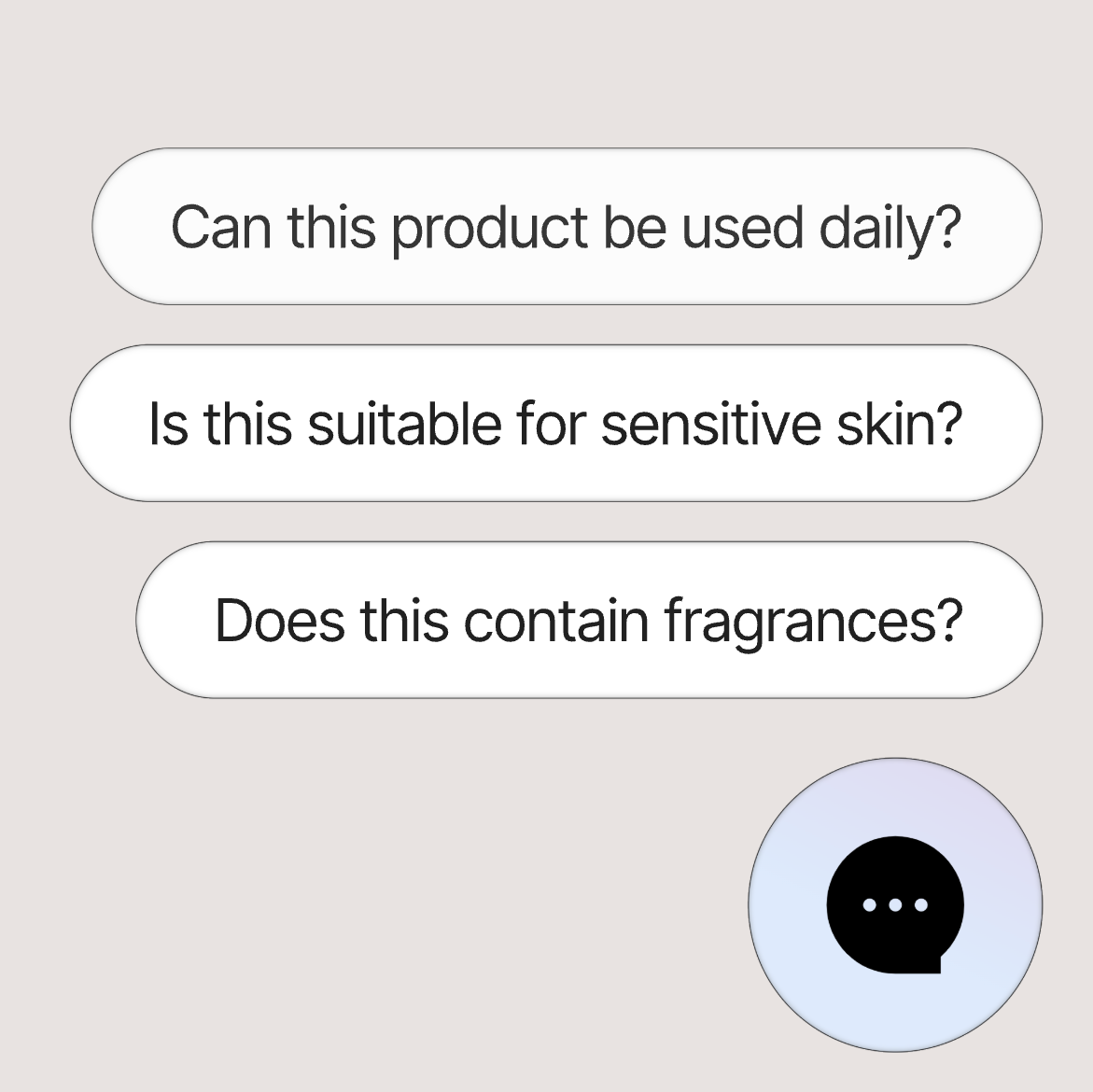
Every small suggestion — a phrase, a button shape, a pause, a tone — creates what behavioral economists call a moment of micro-trust.
Individually, these moments may feel insignificant. But together, they turn a static interface into a relationship.
When greeting, choices, design, and timing align, conversation becomes the natural outcome — not the goal. That’s what conversational commerce gets right: it reframes success from “did they convert?” to “did they connect?”
For CX teams, this shift requires designing for the emotional continuity of the experience:
We love this example from Perry Ellis to drive this tip home:

As AI continues to shape how people shop, brands face a choice: Design for control, or design for trust.
Suggestion is the path to the latter.
The right cue, delivered at the right time, reminds people that even in automated spaces, there’s still room for empathy and understanding.
Gorgias was built on the belief that great commerce starts with conversation, not conversion.
{{lead-magnet-2}}

TL;DR:
Handing trust over to AI can be intimidating. One off-brand reply and you undo the reputation and customer loyalty you’ve worked so hard to build.
That’s why we’ve made accuracy our top priority with Gorgias AI Agent.
For the past year, the Gorgias team has been hard at work fulfilling the pressing demand for accuracy and speed. AI Agent is getting smarter, faster, and more reliable, and merchants and their customers are happier with the output.
Here’s the data.
{{lead-magnet-1}}
This year, AI Agent’s accuracy rose from 3.55 to 4.08 out of 5, a 14.9% improvement from January. This average score is based on CX agents' ratings of AI Agent responses in the product, on a scale of 1 to 5.
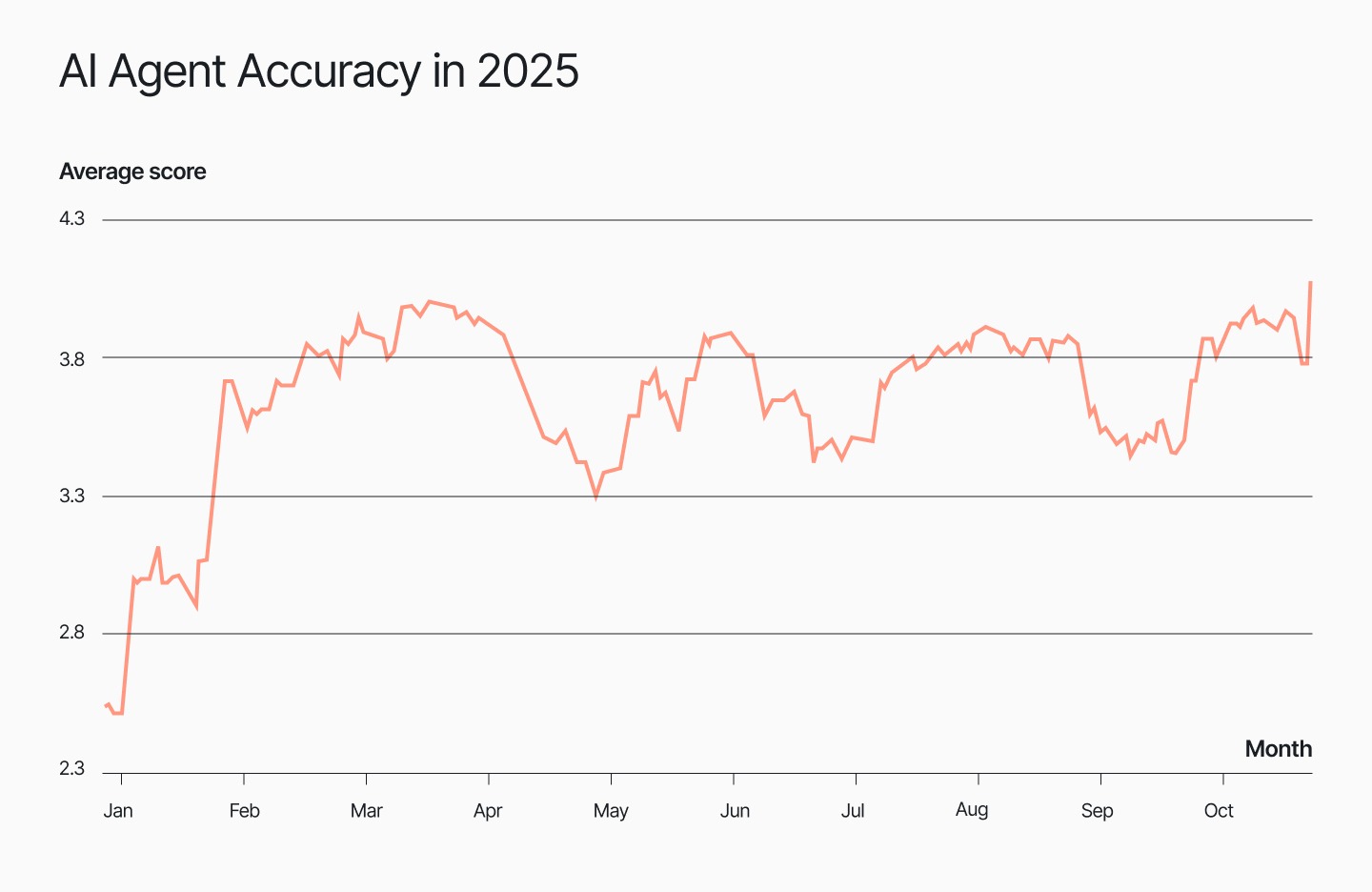
In the past year, we’ve improved knowledge retrieval, added new integrations, expanded reporting features, and asked for more feedback in-product.
We saw the steadiest leap in July, right after the release of GPT-5. AI Agent began reaching levels of consistency and accuracy that agents could trust.
Clear, easy-to-understand language helps people trust what they’re reading. Website Planet found that 85% more visitors bounced from a page when typos were present. That’s why we’ve made it a priority for AI Agent to respond to customers with correct grammar, syntax, and tone of voice.
The efforts have paid off: AI Agent scores a high 4.77 out of 5 in language proficiency compared to 4.4 for human agents. The result is error-free messages that are easy to read and consistent with your brand vocabulary.
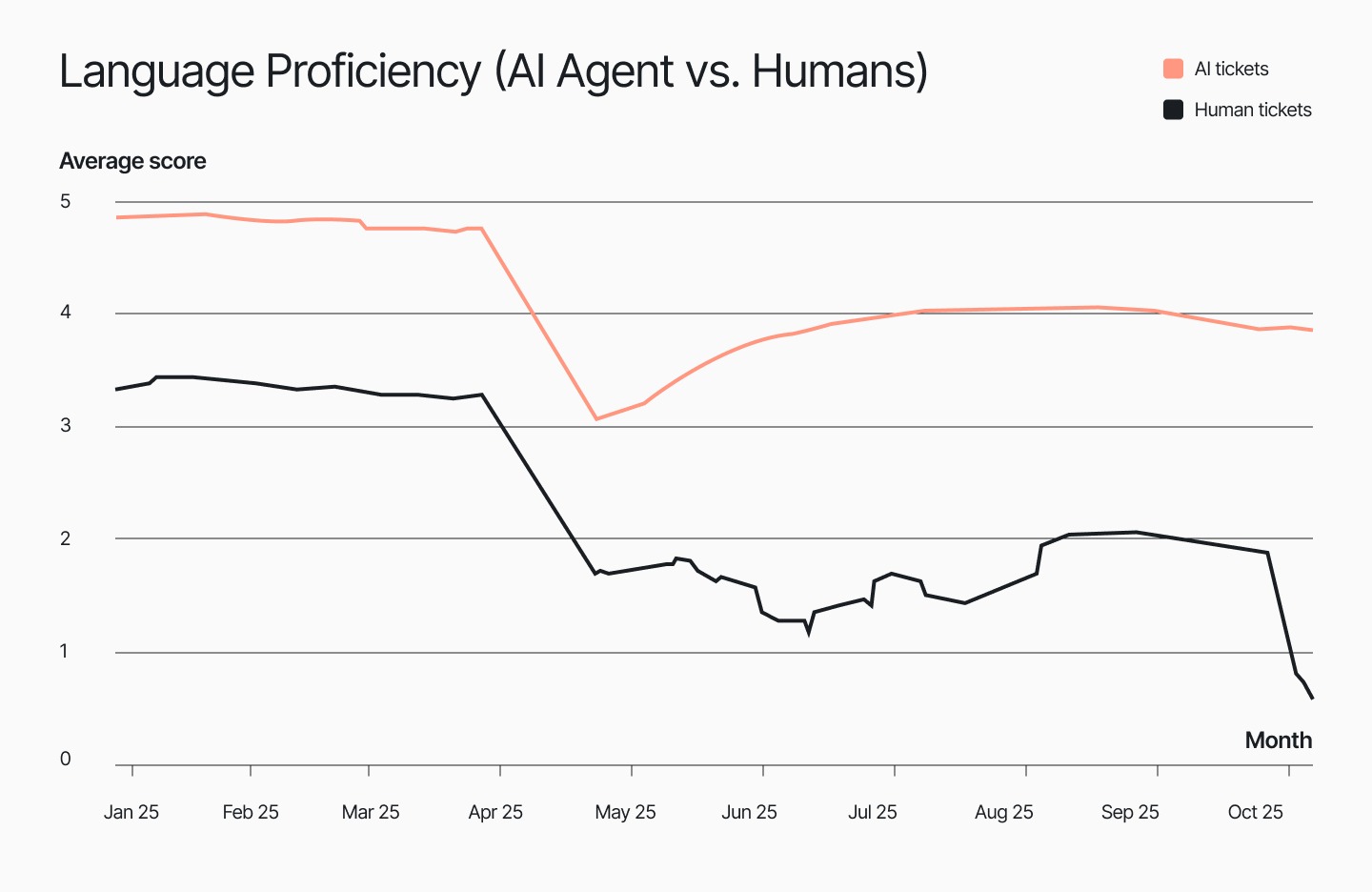
Accuracy isn’t just about saying the right thing; it’s also about how a message lands. For that reason, we track AI Agent’s communication quality. Did it reply with empathy? Did it exhibit active listening and respond with clear phrasing?
Recently, AI Agent is even scoring slightly above humans with 4.48 out of 5 in communication, compared to 4.27. This means AI Agent captures the nuance of every message by considering the background context and acknowledging customer frustration before it gives customers a solution.
What happens when a ticket ends without a clear answer? Customers feel neglected and leave the chat still unsure. This can make your brand look out of touch, leaving customers with the lingering feeling that you don’t care.
But don’t worry, we built AI Agent to close that loop every time: AI Agent’s resolution completeness score sits at a perfect 1 out of 1, compared to 0.99 out of 1 for human agents.
In practice, this means customers feel cared for and understood, while your team receives fewer follow-ups, giving them more time to focus on strategic, high-priority tasks.
Read more: A guide to resolution time: How to measure and lower it
Building a great product is a two-way conversation between our engineers and the people who use it. We listen, review feedback, ship changes, and measure what improves.
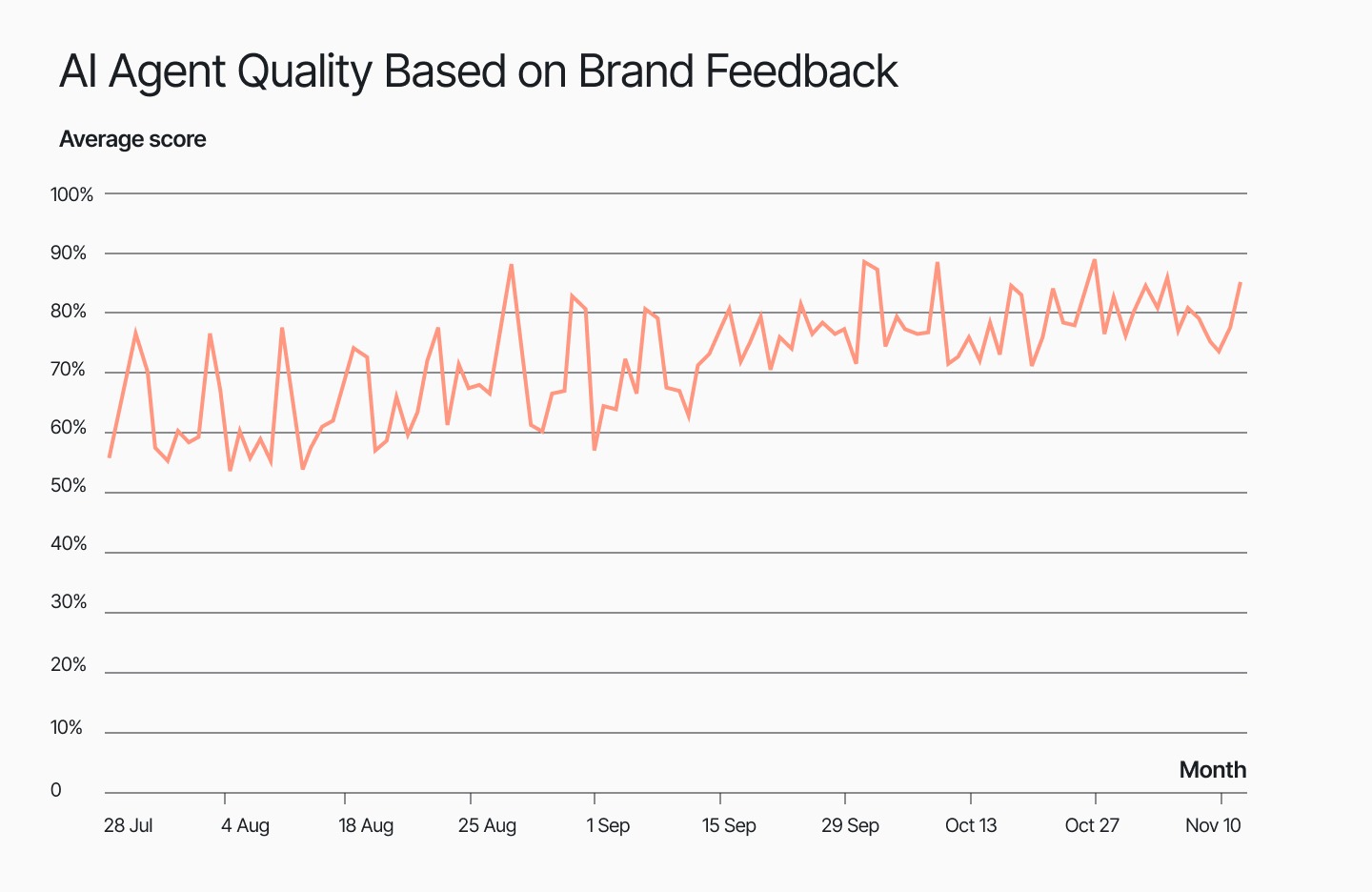
From January to November 2025, AI Agent quality rose from about 57% to 85%. August was the first big step up, and September kept climbing. Brands are seeing fewer low-quality or incorrect answers and more steady decisions.
This is proof that merchants and their shoppers are witnessing the improvements we’ve been making, for the better.
Related: The engineering work that keeps Gorgias running smoothly
At the end of the day, what matters is how customers feel when they talk to support. Do they trust the answer? Do they find it helpful? Are they running into more friction with AI than without it?
Our data shows that customers are appreciating AI assistance more and more. Since the start of 2025, AI Agent on live chat has gotten a CSAT score 40% closer to the average CSAT of human agents. For email, the gap has narrowed by about 8%.
The goal is to eventually achieve a gap of zero. At this point, AI’s support quality is indistinguishable from that of humans. To get there, we’re focusing on practical improvements like accuracy, clear language, complete answers, and better handoff rules.

How we measure CSAT gap: The CSAT gap is calculated by subtracting AI CSAT from human CSAT. When the number is closer to zero, AI is catching up. When it’s negative, AI is still below human results.
Behind every accurate AI reply is a team that cares about the details. AI Agent doesn’t make up answers—it follows what you teach it. The more effort your team puts into maintaining an up-to-date Help Center and Guidance, the better the customer experience becomes.
As we look ahead to 2026, we’re focused on fine-tuning knowledge retrieval logic, refining Guidance rules, and continuously learning from feedback from you and your customers.
We’re proud of the strides AI Agent continues to make, and can’t wait for more brands to experience the accuracy for themselves.
Want to see how AI Agent delivers exceptional accuracy without sacrificing speed? Book a demo or start a trial today.
{{lead-magnet-2}}


Today, we’re announcing pricing updates for our Pro, Advanced, and Enterprise customers, along with customers using our Automate product. We’re also introducing a voice & SMS add-on that will allow you to communicate with customers on even more channels, enabling brands to continue providing the best customer support for their loyal customers.
This follows our recent announcement of a $10 monthly starter plan (50 tickets), which makes our platform more accessible to all merchants.
Over the past few years, we’ve proudly shipped many new features to serve our mission: empowering all merchants to deliver an exceptional customer experience that drives revenue.
Now, with Gorgias, you can:
Here’s a snapshot of the new pricing, which will go into effect in the next few months and empower further innovation on our product:
 |
Here's an outline of everything that's changing:
Pricing is changing for Merchants on the Pro, Advanced, and Enterprise plans.
Updated pricing
We’re also updating the billable ticket limit for Basic and Advanced plans to better reflect the number of tickets merchants of this size typically see each month:
Updated billable ticket limit:
Automate includes several valuable features that allow you to automate up to 25% of total customer interactions. This means you’ll spend more time driving revenue through high-quality support and less time handling repetitive tickets, such as where is my order (WISMO) interactions.
Some of the features only available in Automate include:
We initially launched Automate with introductory pricing in late 2021. We had great feedback from early adopters, especially after improving features like updated Quick Response Flows and Self-Service Flows. Now that Automate is delivering on its promise, we're ending our introductory pricing for the add-on and the full price will be reflected for all add-on subscribers.
Here is the updated Automate pricing:
Updated pricing
Furthermore, some of our legacy customers currently have access to a smaller set of automation features, separate from Automate. We will discontinue support for those legacy automation features for monthly users by December 31st, 2022. For users on annual plans, we will honor their legacy features until their renewal date. We encourage all customers to explore Automate, which provides a superior automation experience.
As part of this pricing update, overages for accounts with Automate will be increased to account for the cost increase for the account. This will help us avoid pricing anomalies and keep things fair for customers across the board.
Currently, some of our oldest customers are on plans that we no longer support. We will migrate customers to the plan that most closely matches their current billable ticket count. This migration will also grant access to a suite of new features that were unavailable on those legacy plans:
We’ve heard from merchants who just launched their stores that they need a way to chat with customers on their website and host help center articles that proactively answer common customer questions. So we introduced a $10 plan with up to 50 tickets, that includes most of the features available to other Gorgias users. We’re excited to serve more small businesses with this new plan.
For our customers paying monthly, these changes will come into effect two billing cycles from today (September 21, 2022). Your plan and price will change by November or December 2022, depending on when you first signed up for Gorgias.
For our annual customers, we will update your plan and prices in 2023 on your billing renewal date. Any annual customers renewing before the end of 2022 will keep their existing prices and features for another year, until 2023.
Our product has grown and evolved significantly in the past three years since we last updated pricing in mid-2019. In order to continue on this trajectory, we plan to heavily invest in our product to bring even more value to our ecommerce merchants, growing their businesses.
Here are the biggest recent areas of growth for Gorgias:
As a merchant, you understand the importance of showing up where your customers are. We have made great strides in this arena to bring you to all of the places your customers are expecting you to be, all in your single Gorgias feed.
 |
Our social media channels have evolved to best-in-class status, allowing you to interact with customers in all of the different ways they might reach out. Whether you’re responding to comments on your ads to increase return on ad spend or handling angry customers that slide into your DMs, we have you covered on major social networks.
And when you want to help customers help themselves, we now have a robust help center to answer all of their top questions without human attention. You can even upgrade your help center with self-service features like order tracking.
Your customer experience should drive revenue — happy customers are the best fuel for growth.
This belief is at the center of Gorgias’ philosophy and guides our product development. As a result, the Gorgias platform has gotten much better at driving revenue for our customers, resulting in $1.1 billion in support-driven revenue in 2021 alone.
Want to learn more? Read our CX growth playbook to drive 44% more revenue through customer experience.
 |
Our chat improvements and native Shopify product links turn your agents into sales reps, and our revenue statistics show just how much impact your team has had.
And this is going to be one of our biggest areas of focus going forward, so expect lots of new features like refined chat campaigns, one-time discount codes, and advanced sales analytics.
We’re even building a full-featured Revenue Add-on to help you increase your revenue impact. More on that in our Series C announcement.
Gorgias is built around the unique needs of ecommerce merchants, and we’ve designed the tool to be the fastest platform for ecommerce customer service teams right out of the box.
Agent and team efficiency have been areas where our platform has seen some of the most improvement over the past few years.
 |
We have Macro suggestions and a Rule library, now, to get you started fast and make sure you’re never at a loss for words. And you can make all the necessary edits to a given Shopify order without leaving the Gorgias platform.
Plus, our advanced dashboards keep your whole team on track and show the impact of your process improvements in real time.
When you spend less time on repetitive tasks and tickets, you can spend more time with the tickets that matter to your business — the ones that actually require human attention.
In 2019, we had just started to connect with your favorite ecommerce apps.
Now, Gorgias is your command hub for the entire customer experience, integrating data from all of your favorite apps to make it all more actionable. That’s a major way we help you make better decisions and provide a world-class experience for your customers.
 |
Our Klaviyo integration has been upgraded to enable even more advanced functionality, and we have also added 80 other integrations that upgrade your support process.
And we’re not done yet — with a host of new integrations coming soon, we’re going to keep bringing more insight to your first-party customer data — across all of the different platforms you use.
We understand you may have further questions about which changes will impact you. For further clarity, please check the emails associated with your account for a more detailed breakdown of the specific changes that apply to your account. You may also reach out to our support team or connect with your Customer Success Manager for additional details.
Our mission continues to be helping merchants deliver an exceptional customer experience. We believe this is how you’ll build long-lasting relationships with your customers to maximize retention and grow your business.

As an online shopper, you don’t typically take products at face value. You’ll only turn over your money if you feel like you can trust what the brand is offering, and product reviews are probably part of your decision-making process when considering a purchase.
Your ecommerce customers think the same way. They use product reviews to determine your product's true value and whether it’s worth buying. Product reviews are the heavyweights in the ring of online shopping, and this article explains how you can leverage them to get more sales and generate more revenue.
{{lead-magnet-1}}
Product reviews are a powerful source of social proof, which builds trust and confidence in your brand. Adding reviews to your product pages can result in an estimated revenue lift of 1.5%, according to Gorgias’ data of over 10,000 ecommerce stores. This is possible because product reviews stand as testimonials for uncertain shoppers — perhaps more convincing than any sales or marketing you can create yourself.
Plus, reviews increase traffic to your product page through SEO. Google My Business and search engines pick up keywords that customers use in their reviews and, with enough reviews, your page will show up on as a result for organic searches of those keywords. Also, getting more eyes on your product increases product awareness — and ultimately, conversions.
But not all reviews are good. There’s a delicate balance between good and bad reviews, and both of them have an impact on your bottom line.
If you use an ecommerce platform to power your ecommerce website, it’s easy to turn on the setting to let users leave reviews. Here are some links to help you get started if you use Shopify, BigCommerce, or Magento:
If you use another ecommerce platform, you’ll likely be able to find a setting or app to activate review functionality.
But just because customers can leave reviews doesn’t mean they will. Here are some tips to get more ecommerce product reviews.
{{lead-magnet-2}}
The business impact of positive product reviews is undeniable. Below, we’ve described six ways to increase your chances of getting positive reviews from customers.
The post-purchase experience is where you transform new customers into your brand’s biggest fans. This is particularly important since customer experience is the top factor driving online consumers' loyalty. An amazing post-purchase experience leaves customers confident that orders are being delivered and provides answers to their most pressing questions. It's also an opportunity for your brand to provide meaningful resources that help them use your products in the best possible ways.
Each confirmation email you send to a customer allows you to position your brand as an expert. But that’s not all: You can use this email to ask customers to leave a review and provide feedback on their experience. Both requests help you better understand how close you are to meeting your customer's needs and make adjustments as necessary.
Here’s a great, branded example of a review request email from Fly By Jing:

Providing incentives increases the number of reviews a company is likely to receive. This is great, but there can be a downside: Incentives can sometimes influence customers to leave positive reviews even if their experiences with your products aren’t necessarily positive. This might sound great, but you want to be sure that you're striving for honest positive feedback.
Incentives can be a great tool, but don’t overuse them since they can skew a review's honesty. Remember, honest insights are the ones that will help your ecommerce brand improve.
Anthropologie recently offered customers a 20%-off coupon for leaving a review:

Automating the “ask for reviews” process allows you to get reviews from customers at exactly the right time. An “ask for review” automation could be as simple as emailing a rating scale that allows customers to rate their most recent experience with your brand. The trick is to send that message at just the right time.
Dmitry Dragilev, Founder of JustReachOut, reveals that automating the company’s review collection process tripled its rate of positive reviews. Automations helped them send review requests immediately after interacting with customers.
Several tools can help you automate the review collection process. Boast and JungleScout are two of the most popular options for ecommerce stores. You can also use Zapier to create automations specific to your preferred tools.
Dragilev also mentions that one of the mistakes he and his team made was asking for a review after every customer support call. This resulted in only 10% of the reviews being positive. Also, they didn’t know whether the customers they were targeting had recently engaged with the product since they only sent out their review emails on Mondays.
It was only after automating sending review request emails to customers who were satisfied with the resolution to their support request that the number of positive reviews increased. The lesson here is that targeting satisfied customers leads to more positive reviews.
A simple review process reduces friction and increases the chances of getting a response to your review request. You can simplify the review process by:
Here’s a great, minimal review request from Book of the Month:

Social media channels are where your customers likely hang out the most. This is why your ecommerce social media strategy should include requesting reviews. The beauty of social media is that there are many ways for you to both ask your customers for reviews and showcase what they have to say about your brand. For instance, you could create a competition based on user-generated content (UGC) that shows how real customers use your product and what they genuinely think about it.
It’s important to consider where you gather reviews from. Here are four of the most common avenues for ecommerce brands to consider:
Imagine you’re searching for an affordable wedding dress online. You see a gorgeous dress you adore but you’re a bit skeptical since you aren’t able to see and feel the dress in person. Worse yet — you can’t even try it on. The next thing you do is scroll down to the reviews. How else will you know what to expect from this dress? To your dismay, there aren’t any reviews! You have two choices — trust your gut and buy the dress blindly or find another dress that has reviews.
Chances are you’ll choose option two and you aren’t alone. 98% of consumers read online reviews before purchasing products. Reviews turn potential customers from skeptics into eager purchasers. Some ecommerce brands do this better than others. Parade’s review section went a step further, allowing reviewers to mark whether or not a clothing item runs big/small, is comfortable, and is good or bad quality. As an apparel retailer, this gives their shoppers valuable information they need to make a purchase decision.

According to a report by GWI, 77% of internet users turn to social networks when looking for information about brands. Also, 16% of internet users discover brands through posts or reviews from expert bloggers, and 23% of internet users discover brands through recommendations or comments on social media. The bottom line is that social media supports brand awareness, so you’re missing out if you don't leverage the social media sites relevant to your audience.
GWI recommends using Instagram for more direct sales since Instagram users are more open to commercial posts. If you’re ready to make Instagram influencer marketing part of your marketing strategy, check out our guide.
Online shoppers turn to popular online marketplaces when searching for products. Amazon, Etsy, and eBay are three of the most popular. Amazon is the largest online marketplace, accounting for 37.8% of the ecommerce market as of June 2022. On Amazon, product reviews and sales influence rankings. This means that the better your reviews, the higher up they appear in product search results, so it’s important to keep your average review as high as possible. The same is true for Etsy and eBay.
Here’s what Sol de Janeiro’s Amazon reviews look like:

Billions of people use Google, Bing, and other search engines to find products. SEO-friendly product descriptions are one way to ensure your products show up in search engines. But product reviews also make you more visible on the search engine results pages (SERPs) since reviewers often use keywords that help with rankings. The more reviews you have, the greater your chances of being discovered in SERPs.
Four review sites are responsible for 88% of all reviews — Google, Yelp, Facebook, and Tripadvisor. It would be wise to invest in your reviews on these popular channels, but boosting your presence on industry-specific review sites is also a good idea. These hyper-specific review sites help you reach a targeted audience, thus increasing your conversion rate.
Getting reviews is great, but you’ll need to dig a little deeper if you want to glean actionable insights from them. Here are eight tips to help you get the most out of your customer reviews.
As previously mentioned, adding reviews to your product pages can help increase revenue through more conversions, making this a great move for your ecommerce business. This isn’t surprising since reviews help build trust and attract buyers to your website, so adding reviews directly to product pages can help seal the deal once the customer lands on your site.
Loop Earplugs has product reviews at the bottom of each product page, plus they curate testimonials pulled from reviews to support their on-page marketing:

Review management software offers the most streamlined way to manage your online reputation. Any review management software you choose should be able to collect and deliver data from the review sources that matter most to your business in the most accurate, timely, and reliable manner. Some of the best options on the market include Grade.us and Podium.
Reviews are great for understanding the needs and interests of customers. When an awesome review comes through, highlight it on your brand's social media channels to showcase customer satisfaction and attract further attention. Ultimately, reviews from existing satisfied customers will help attract even more customers: It's social proof at its finest.
One of the first things some customers do when looking at reviews is search for the images and videos that show the product in action. Product pictures and written reviews say one thing but seeing products in real, unedited photos and videos takes the experience to another level. It’s easier to make a purchase decision when customers reveal a product's good, bad, and ugly in a visual format.
Steve Madden lets buyers upload images to their reviews, which helps browsers see what the clothes look like on other people:

The research doesn’t lie — 89% of consumers are more likely to use a business that responds to all of its online reviews, not just the good reviews. Research by Podium provides a possible explanation: 56% of consumers believe a response from a business changes their perspectives because these responses offer insights into how responsive, responsible, and caring a business is.
These stats may seem contradictory since so many consumers say a negative review convinced them to avoid a business, as we discussed earlier. But ignoring negative reviews altogether results in more people turning away from your business. This is precisely what you’re trying to avoid: Negative reviews are a natural part of the process, so don’t hide from them. Embrace them, respond to them, and try your best to resolve the issues expressed by the customer.
Product reviews help you learn more about what your business is doing right and wrong. Customer feedback surveys are great, but only a small fraction of your customers complete them. More customers are likely to leave non-incentivized reviews that share honest perspectives about their experiences. Use their unfiltered responses to fine-tune your product and customer experience so that you attract future purchases.
A discount incentive can be a great way to get more reviews. But, as previously mentioned, incentives can influence reviewers to leave positive reviews even when their experiences weren’t entirely positive. So, you can give discounts as review incentives occasionally but try not to make this practice a habit. Otherwise, your reviews may be skewed in favor of your brand.
Customers use various filters to find reviews, but the most common review filter is review recency. Research by Power Reviews shows that 97% of consumers consider review recency to be important when considering a purchase. In fact, the survey reveals that 64% of consumers say they’re more likely to buy a product with fewer, more recent reviews than a product with a higher volume of reviews published three or more months ago.
So, allowing customers to sort and see the most recent reviews is critical. Keep your reviews current — more customers are likely to trust your brand that way.
Woxer is a great example of an online store that provides a variety of review filters. You can pull up reviews that mention color, size, material, feel, comfort, and more. You can also use the sort feature to sort the reviews by rating or only show reviews with images:

Product reviews attract new customers and help with customer retention. This is why your product review strategy should focus on encouraging customers to leave authentic reviews, extracting customer feedback so you can improve your product, and responding to all reviews across platforms so you can build trust and resolve issues proactively.
Gorgias is here to help your brand offer world-class customer support. Book a demo to understand how 10,000+ brands use our platform to drive revenue by making customers happy.

When customers order products from your ecommerce store, they expect the products to arrive on time and intact. Even if your shipping carrier is at fault for a lost package, customers will associate the issue with your store and the drop in customer satisfaction will ultimately impact your revenue.
Unfortunately, 15% of all online orders shipped to urban areas fail to reach their destination due to either logistics issues or package theft. Many of the processes in your store's supply chain are probably out of your control, but there are things that you can do to prevent missing packages and salvage the customer relationship.
We put together a step-by-step guide for how ecommerce businesses can deal with lost packages, as well as five tips that you can use to help ensure smooth and on-time package delivery.
{{lead-magnet-1}}
Lost packages aren't typically the shipper's fault, but — fair or not — your customers will still look to you to make it right. Here are the steps that business owners should take when dealing with lost packages in order to ensure customer satisfaction:
When a customer's package doesn't arrive, all that you know at first is that the package is missing. In most cases, the package has been lost or delivered to the wrong address. Sometimes, however, packages go missing because they are stolen. "Porch pirates," or people who steal packages from another person's porch, have become increasingly common with the growing popularity of online shopping. However, there are also rare cases when packages are also stolen in transit.
Here’s a breakdown of some of the top reasons for lost packages:

Contacting the shipping company is the best way to determine if a package was lost or stolen. If the carrier marks the package as being delivered to the correct address, but the customer never got it, chances are it was stolen.
Stolen packages are tricky because the only person truly at fault is the thief who took them. Carriers don't typically offer reimbursement for stolen packages (except under rare, specific circumstances). This means that you will need to carry shipping insurance through a service such as Route if you want to be able to reimburse your customers for stolen packages — without the costs coming out of your own pocket.
{{lead-magnet-2}}
While carriers won't usually reimburse damaged or stolen packages, they are typically willing to reimburse lost packages. Along with recovering the cost of the item, you can also receive reimbursement for any shipping costs that you paid.
Filing these refund claims may be a bit of a hassle, but they have a high success rate, given that lost packages reflect poorly on a carrier. If you can determine that a package never arrived to the customer, usually due to a lack of updates from the carrier, filing a claim with the carrier is your best course of action.

The exact information and documentation you must provide when filing a refund/insurance claim will vary from carrier to carrier. However, you will typically need to provide information such as:
Most carriers offer refund forms and portals that make it easy for shippers to file claims. Here are the links to the refund forms from popular delivery services:
Even if lost packages aren’t your fault, there's a good chance that your customers won't see it that way. In fact, 32% of customers say that they would be reluctant to order again from an online retailer following a failed delivery. This is especially true given the precedent large retailers like Amazon have set with no-questions-asked refund policies.
Replacing lost packages is no doubt an expense and a hassle, especially if the value of the item is high. But the value of the item may be small compared to a customer’s lifetime value (CLV) if you replace the lost item and retain a loyal customer. When you consider that repeat customers generate 300% more revenue than first-time customers, it's easy to see how prioritizing customer satisfaction can be more profitable in the long run.
Again, the right insurance policy can ensure that the cost of the items is covered if they are damaged, stolen, or lost. Filing a refund/insurance claim with your carrier is another way to seek reimbursement so that you can reimburse the customer. Even if it means eating the cost yourself, replacing lost packages still tends to be a more beneficial approach for ecommerce businesses.
If you want to improve customer experience further, check out our guide on how to offer free shipping to your customers.
EasyShip is an ecommerce shipping platform that helps merchants print shipping labels, access discounted shipping rates, and provide customers with real-time tracking notifications. This ability to easily track the location and status of packages and provide that information to your customers can often go a long way toward reducing the frequency of missing packages.
Shipping tools such as EasyShip also help mitigate lost packages by streamlining your order fulfillment process. EasyShip and comparable apps help eliminate errors on your end (such as incorrect delivery addresses that could lead to missing shipments) by making it easy for customers to choose their preferred delivery service for each order.

EasyShip is an excellent tool to consider if you want to improve your order fulfillment process and provide customers with real-time tracking notifications. However, several other shipping apps offer comparable features and capabilities:
To learn more about creating an ecommerce shipping and fulfillment strategy empowered by cutting-edge order fulfillment tools, be sure to check out our ecommerce shipping guide: Creating a Shipping and Fulfillment Strategy.
No matter what your policy for replacing lost, damaged, or stolen packages happens to be, it's important to keep your customers in the loop. If you offer a generous refund/return policy, making sure that customers see it can boost customer confidence and may even improve your store's conversion rate. Or, if you aren't in a position to replace or refund missing packages, letting customers know ahead of time can set expectations upfront. This way, they aren't frustrated by finding out that they won't be reimbursed after the fact.
To ensure that customers know your policy for replacing or refunding missing packages, publish this information on your FAQ page or help center. You may also consider sending a link to this policy in your post-purchase email flow for even more visibility.
Here’s a great example of a reader-friendly shipping policy from Branch, well organized and easily accessible on their Gorgias-built Help Center:

Ecommerce businesses need to have a plan and policies for dealing with missing packages, but there are also steps that you can take to prevent your packages from ever going missing in the first place. Here are five tips for how ecommerce stores can prevent lost, stolen, and damaged packages:
Incorrect delivery information is a common cause of lost packages. While you'd like to think that customers can enter their addresses correctly, this isn't always the case. Thankfully, many shipping apps include address verification tools that allow you to at least ensure that the delivery address you have on file is a properly-formatted address that actually exists. These tools will sometimes be able to correct minor formatting issues automatically. You can contact the customer to clarify if there are bigger problems with the address.
Using shipping apps to verify addresses and streamline your order fulfillment process can also help prevent errors on your end, such as typos when entering an address.
Sixty-nine percent of customers say that the ability to track their order is one of their top three considerations when purchasing a product online. Along with helping your store meet these customer expectations, offering real-time tracking notifications to your customers can also help prevent lost and stolen packages.
Real-time tracking provides visibility that can prevent packages from being delivered to the wrong address or lost along the way. Tracking notifications also enable customers to make sure that they or someone else is home when the package arrives so that it isn't stolen.
Most carriers will provide a tracking number to forward to your customers in a post-purchase email. However, you can improve the customer experience even further by offering your own tracking portal. Shipping apps such as LateShipment.com and some of the others that we mentioned allow you to create branded tracking portals and shipping notifications that your customers are sure to appreciate:

And if you use Gorgias, you can integrate with tools like LateShipment.com to see order status and tracking information within your help desk, so you can quickly — or automatically — answer customer questions about order status, whether they come through social media, texting, email, or another channel.
Letting customers schedule deliveries won't prevent packages from getting lost in transit, but it can help prevent them from being stolen. The vast majority of package theft occurs after the package has been delivered. If the customer can choose a delivery time when they’re home, then porch pirates have less opportunity to steal it.
Your ecommerce platform likely has add-ons that let your customers choose their delivery date and time, although it may be limited to local deliveries only. If you use Shopify, check out the following tools to see if they could fit your needs:

Along with using proper packaging, one way to prevent damaged items is to provide your carrier with instructions on how they should handle packages. If you are shipping fragile items, this should be communicated to your carrier so that they can properly mark the package.
It's also sometimes necessary to provide additional instructions to your carrier to ensure that a package goes to the correct address. If the customer provides any additional shipping instructions during checkout (such as where to leave the package, gate codes, etc.), then your team should pass this information on to the carrier, too.
If the product is especially valuable, you may want to consider requiring a signature upon receipt of the package. Requiring a signature (which guarantees in-person delivery) offers a couple of protections to both you and the customer. For one, it guarantees that the package will not be stolen after delivery. It also prevents the customer from fraudulently claiming they never received the package. Lastly, requiring a signature upon delivery allows customers to inspect the package and ensure there is no obvious damage before they sign for it.
It probably isn't necessary to go to these lengths for every ecommerce product. But if the item you are shipping is worth several hundred dollars or more, it's probably worth (strongly) considering. Most customers will have no problem signing for high-value items — and will likely even prefer it.
As an ecommerce store, dealing with missing packages correctly is one of the many elements of developing a great customer experience. At Gorgias, we help ecommerce stores create a post-purchase experience optimized for customer satisfaction.
Gorgias helps you educate your customers about your refund/replacement policies for missing packages, give real-time updates about the status of their order, and provide helpful support in case something goes wrong. Better customer service leads to a better customer experience, helping you build a loyal customer base — and boosting your revenue in the process.
As the world's leading customer support platform, Gorgias also provides all of the tools and features your support team needs to offer the swift, helpful support that customers expect when their packages are missing. With our platform, your team also benefits from several deep integrations with many of the market's top shipping and fulfillment apps.
See for yourself how Gorgias improves the customer experience, from browsing to post-purchase, by booking a demo today.

Does your business have an ecommerce upselling strategy in place?
If not, you’re leaving money on the table.
Ecommerce upselling involves selling higher quantities and more expensive products to shoppers who are already considering a purchase. And for most ecommerce companies, the bulk of upselling and cross-selling happens when the customer support team interacts with customers who are already on your site or have already purchased an item. One reason is that returning customers spend 67% more than first-time shoppers, according to Bain and Co. Plus, it costs about five times more to acquire a new customer than it does to retain one.
In other words, chasing after new customers is expensive and brings in lower-value sales. Upselling, cross-selling, and customer-experience strategies to keep customers coming back — and spending more and more each time — is more profitable.

Whether you’re just starting to explore upselling or it’s time to retool your current efforts, these 11 best practices can improve your efforts and help you reach greater results.
{{lead-magnet-1}}
Ecommerce upselling is a sales technique of allowing customers to purchase a higher-priced item instead of the item they selected from your ecommerce store, to convince the customer to spend more money. When successful, ecommerce upselling provides additional perceived value to the customer and nets your store a higher sale price (and higher profits). A simple example is a shopper deciding to get an expensive camera after initially coming in for a more basic model.

Ecommerce upselling is the digital equivalent of old-fashioned, in-person upselling. Instead of speaking to an in-store associate, customers get recommendations from pop-ups, customer support agents, and other prompts throughout your website: usually on product pages, in the cart, or at checkout.
Here’s an example. Say you’ve launched an ecommerce venture that sells high-end, organic toothpaste. A customer adds a single tube of toothpaste to their cart and heads to checkout. At the checkout page, you trigger a pop-up that offers:
Buy 3 tubes and save 20%!
Or perhaps:
Try Our Variety Pack, Get One Tube Free!
You could create an endless variety of deals here, but you get the idea: You’re offering customers more (usually with some kind of discount or value proposition) to entice them to spend more and increase your average order value (AOV).
Ecommerce cross-selling is a similar sales tactic where you strategically recommend add-ons related to whatever the customer has put in their cart. The goals are the same: higher ticket value, greater sales, and greater customer satisfaction. Instead of upgrading to a fancy camera, a shopper who accepts a cross-selling offer might also buy a roll of film and an extra battery in addition to the basic camera.

If the camera example above doesn't make sense, let’s go back to our toothpaste company. A great example of cross-selling would be something like this:
Got toothpaste? Don’t forget the brushes! Add 3 bamboo brushes for just $5!
For this brand, other great cross-selling opportunities could include floss, electric toothbrush heads (assuming you sell an electric toothbrush), and maybe even night guards. All appeal to health-conscious customers looking for oral hygiene products.
Upselling and cross-selling are similar concepts, but the terms aren’t interchangeable.
With upselling, you’re offering the customer more of a product or a better version of a product at a higher price point. If the customer bites, the upsell item replaces the original item in their cart.
For a real-life example of upselling, think of Apple. Each of their products has multiple storage levels, premium versions, and newer models they could (and do) push customers toward.
With cross-selling, you’re offering the customer additional products, usually related items that work in tandem with that original item. Cross-selling opportunities don’t replace the original item but stack on top of it.
For a real-life example of cross-selling, think of Amazon. No matter what you buy — or even look at — you’ll inevitably be shown a “People also bought…” section. It’s usually full of on-topic and useful add-ons, like battery packs or chargers for phones or cables and USB mice for laptops.
{{lead-magnet-2}}
Whether upselling is new for your ecommerce business or you’re looking to retool your existing upselling strategies, check out these eleven quick tips that can help you drive more revenue more effectively.
For small and medium ecommerce businesses, using a tool that’s already done the work of building out support for ecommerce upselling is the single most important step to take.
Dynamic, beautiful, frictionless upselling is prohibitively complex to create on your own, requiring a serious resource outlay for even the largest ecommerce sites. But several ecommerce platforms have already done this hard work and make upselling and cross-selling easy to implement for any vendor using their platform.
Many Shopify stores already take advantage of upselling thanks to the company’s smooth interface enabling the offering. If you’re a current or prospective Shopify user, check out 30+ of the best Shopify apps to boost your performance.
Some of our favorite Shopify apps for upselling include:
Not a Shopify user? We’ve created similar guides for BigCommerce and Magento. Check out the best extensions for BigCommerce or the best extensions for Magento and start powering up your store today!
Your customer support agents speak to customers more than anyone. They have a huge opportunity to drive sales — up or down, depending on the quality of service — for your brand.
Here are a few examples of moments when customer support agents can cross-sell or upsell clients:
If you use Shopify, Gorgias makes giving great product recommendations easy thanks to our integration with the product picker, which lets agents add product recommendations to tickets without leaving the helpdesk:

Agents will pursue more product upsells and cross-sells with the right incentives, so we encourage larger teams to reward agents for driving revenue. Measuring the amount of revenue generated by customer support is challenging, which is why we built the revenue dashboard in Gorgias, which gives you a breakdown of revenue metrics, such as tickets coveted by each agent or your team’s conversion rate:

Using products that have already sold well in the past will significantly improve the chances of cross-selling or upselling.
For upselling, this isn’t the place to push your most exclusive, niche products. Focus on popular upgrades instead, ones in the same price range as whatever’s in the customer’s cart. People looking to spend around $20 might be convinced to spend $30 or $35, but they’re unlikely to jump to a $250 item no matter how amazing it is.
For cross-selling, make sure you’re using highly targeted, highly useful products, and make sure they’re already good sellers. If you’re selling whole coffee beans, a hand or electric grinder makes great sense. A nice $50 manual brewer (like a siphon or AeroPress) might make sense too.
But a $999 espresso maker? Not so much.
Likewise, aim to recommend similar products whenever possible. A related product is anything that compliments the product in the customer’s cart or a product that better satisfies the customer need that drove them to add the original item.
(Pro tip: People shopping for a dozen roses right before Valentine’s Day are never going to go for a bell pepper instead.)
If you use live chat for customer support, you may be able to start conversations with website browsers proactively. This allows your customer support team to speak when they’re deciding whether — and how much — to purchase. Your customer support team can answer questions that get, recommend products, and offer discounts to drive a sale.
We call these proactive chats “chat campaigns” and recommend designing them around key points of the customer journey. For instance, if a customer spends a lot of time on your website without adding an item to their cart, you can fire a live chat asking whether they need any help finding a product:

Likewise, you can message customers if they add a product to their cart but don’t place a purchase for a few minutes. You can open the door for them to ask any questions that might be stopping them from making a purchase:

Or, to bring it back to cross-selling, you can offer product recommendations and discounts to motivate shoppers to add more items to their carts:

The possibilities of chat campaigns are wide-ranging. If you want to learn more, book a demo and ask about the many ways Gorgias’ live chat can drive sales on your site. Or, if you want to spend more time researching live chat, check out one of these resources:
Your post-purchase experience is everything that happens after a customer completes a purchase, from the digital receipt they receive to follow-up marketing materials.
Consider using your purchase confirmations as a place to send out product recommendations, discounts, announcements about new products, subscription offers (“Never run out again!”), or whatever else makes sense for your business model.
Strict upselling is likely out at this point (they already bought the original item), but you have all sorts of opportunities for convincing that customer to spend more with you during an extended sales session.
You can manually chase after customers post-purchase, but those efforts will be disorganized and time-consuming. Plus, you might run into trouble if you try to cross-sell a customer that’s dissatisfied with their purchase. Klaviyo is one of the best tools on the marketing for email and SMS marketing (plus, it integrates with Gorgias to help you unify your customer support and marketing).

And if you sell subscription-based products, Recharge (and its Gorgias automation) can help you manage your subscription customers and put them on larger plans.
The best upsells and cross-sells are the ones that feel smooth and simple. You want to keep your upselling tactics subtle, not pushy, and make sure your tech tools and partners enable a smooth and frictionless experience.
All it should take is a click or a tap, maybe two, for the upsell to be completed. Anything more complex than that could start getting in the way and might even drive customers away out of frustration or “move on” syndrome (they move on to another tab or app and never come back).
One approach to one-click upselling is to target customers who have already added items to their cart and even inputted their credit card information. Then, your buyers can click to add the item to their cart directly, rather than having to go to that item’s product page, add it to the cart, and then checkout. It’s kind of like an easy-to-grab candy bar put right next to the checkout counter.
Here’s an example from Little Poppy Co., a brand that smartly tries to upsell shoppers with a subscribe-and-save option during the checkout flow:

If you use Shopify, One Click Upsell can add this functionality to your store.
Next, make sure you aren’t overwhelming new customers with too many choices. At the point where a customer is ready to put a product from your online store in their cart, they’re already pretty far down the purchase path. Whether you’re cross-selling or upselling, keep your set of upselling options small — no more than three at most.
Why? Because successfully upselling products needs to feel like simply making a better choice — not like going back to square one and comparing a half dozen new options.
Make your upsell offer clear and concise so you can have the best chance of increasing that cart value without frustrating or confusing your users.
Next up is a crucial upselling strategy: You’ve got to sweeten the pot. Use discounts and specials to motivate your customer to action.
Yes, discounts cut into your bottom line, but their ability to attract customers and increase revenue is undeniable. Simply build the discount into your asking price, and all is well.
Think of it this way: If your customer came to your site intending to purchase a single tube of toothpaste or a pound of coffee or a bucket of protein powder, it’s safe to assume they’re going to be biased toward the thing they meant to buy (in the size they meant to buy it).
You won’t convince many of them to simply buy two or three instead of one just because you asked them to in the checkout process. Most will simply say “no thanks, I only need one” and skip the offer.
What moves hearts and minds (and credit cards) is the perception of value. Offering a discount or free shipping for certain cart values is a great way to make cross-sell offers sweeter. And one of the best upselling techniques is to include a subscribe-and-save option to motivate customers to sign up for repeat purchases from the jump:

Next up, if your chosen tools and ecommerce platform allow you to make this distinction, focus your cross-selling and upselling efforts on your returning customers, not on new ones.
For one, it’s way easier to sell to an existing customer than to a new one. Customer acquisition costs can be five times as much as customer retention costs, and you don’t want anything scaring off those new customers, including an upsell attempt that feels a little too pushy.
Your repeat customers are also much more likely to have a positive opinion about your business and your ecommerce site. This segment of your market is already primed to like what you have to offer and is much more likely to trust your recommendations based on their previous positive experiences with your brand.
If you use Gorgias, you can integrate with customer loyalty tools like Yotpo or LoyaltyLion, both of which help you identify and nurture customers that love your brand (and who would therefore be good candidates for upsell and cross-sell campaigns.)
When you add these integrations to your Gorgias account, you bring that loyalty data inside your helpdesk, giving your agents the context they need to determine whether to try and sell more to a repeat customer:

Whatever recommended products you’re presenting to customers, create a sense of urgency or scarcity by setting a time limit for the discount or special offer. Yes, this can be cheesy, and it might not be right for high-end or prestigious brands. But it’s highly motivating — and highly effective.
The reasons why get into some of the psychology surrounding shopping. Discounts are highly motivating, but savvy shoppers can see through “permanent discounts” well enough that the perception of value starts to disappear. By setting a timer (and displaying it in countdown fashion, if your plugins allow), you send some key messages:
So how long should your offer last? It depends on the nature of your business. Small-dollar retailers might make the window as short as 30 minutes. 48 hours makes sense for many, and one to two weeks can be a good timeframe for larger commitments that might have their own email sequences and funnels.
Instead of limiting availability with timing, you can also opt for a longer-term selling strategy and ask for a customer’s email address instead. That information will let you sell more in the long term:

Not every offer is a winner. The same goes for headlines, email subjects, and all sorts of elements in the marketing world.
But how can you determine which ones are working and which are falling short? A/B testing.
A/B testing is the process of trying two different sets of wording on a smaller subset of an audience to determine which one lands better.
You see this most often with marketing emails, where two initial test emails are sent to two small subsets of a list. Whichever subject line gets a better open rate wins the day and gets attached to the main email going out to the entire list.
You can apply this concept in numerous spaces. YouTubers A/B test video titles. News organizations do the same with some articles. And you can do it with your upselling offers.
Set up two similar offers (or an identical offer worded two different ways or using two different visual styles) and unleash both on your customer base. After enough customers receive one or the other offer, it’ll become clear which one has the better conversion rate and the best effect on the bottom line.
This is worth the investment: Forrester found that a strong UX can increase conversion rate by 400% over a weak one. That’s a lot of extra tubes of toothpaste!
Of course, you need an ecommerce platform that allows you to implement A/B testing on upselling and cross-selling initiatives, so make sure you have access to that feature through your chosen platform.
By implementing (or refreshing) ecommerce upselling and cross-selling strategies for your ecommerce site, you’ll enjoy a range of benefits, with improved customer experience and higher average cart value sitting at the top of the list. And with the eleven best practices we’ve provided here, you’re now ready to take your upselling efforts to the next level.
Of course, succeeding in ecommerce and upselling requires the right suite of ecommerce tools and partners. Gorgias integrates instantly with more than 150 top ecommerce tools like Shopify, Yotpo, Klaviyo, LoyaltyLion, and so many more.
Ready for a better (and more profitable) helpdesk experience? See what Gorgias can do for you and sign up for free now.

TL;DR:
Many customer service guides focus on individual actions: be patient, show empathy, and listen actively. While these customer support tips are valuable, they only scratch the surface.
The goal of ecommerce customer service isn’t just to please customers. Just like any function of a business, great customer service has to drive revenue — and having positive interactions with customers is just one part of that goal. Excellent customer service can help an online store grow its bottom line revenue through:
With that in mind, here are 20 customer support tips for improvements on many levels, from operational changes down to individual agents’ day-to-day.
{{lead-magnet-1}}
For a top-down revamp, focus on high-impact, cost-effective changes that customer support leaders can implement.
Here are five tips to tackle major customer service challenges and elevate your service experience:
Customer feedback is the single best resource to improve the overall quality of your product and customer experience. Analyzing customer feedback from support tickets, NPS and CSAT surveys, and face-to-face conversations can surface patterns harming customer satisfaction and opportunities for improvement.
Consider the following example: if customers frequently ask questions about return policies, you may need to make the policy clearer. Or, if feedback shows frustration with response times, consider implementing real-time support options, such as social media, chat, or SMS. You could also consider using automation and templated responses to resolve common questions quickly.
These direct channels provide immediate answers and reduce wait times for customers who want quick resolutions.
Your customer service team can use feedback to share insights with product, shipping, and other teams—often leading to broader improvements. For example, feedback about shipping issues can guide adjustments in fulfillment, while comments on product quality can drive updates in manufacturing.
We recommend setting up a system to pass feedback to relevant departments. With Gorgias, you can automatically tag feedback for specific teams, create custom views, and invite team members to access this feedback directly. Plus, with unlimited seats on most Gorgias plans, it’s easy to involve everyone who needs to see it.

Automating responses to frequently asked questions, such as “where is my order” (WISMO), has two major benefits. First, it reduces response times by instantly providing answers to common inquiries. Fast, accurate responses to these questions are crucial for reducing customer effort.
Second, automation lets your agents focus on more complex inquiries. Without having to handle repetitive tickets, they can prioritize high-impact conversations that involve troubleshooting or personalized assistance. In practice, this means fewer hours spent on “one-size-fits-all” tickets and more time available to resolve unique customer issues and address inquiries that require customer service skills.

Most customers prefer to find answers on their own when possible––according to Heretto, customers overwhelmingly prefer self-service solutions as their first point of contact for support.
Options like knowledge bases, detailed FAQ pages, and interactive help centers help customers solve issues independently, without relying on customer service representatives.
Here’s a quick breakdown of effective self-service solutions:

Automated chat bridge self-service and hands-on support, offering customers a personalized experience without tying up your team. With Gorgias, you can set up flows in your help center or chat, allowing customers to find answers or track and modify orders—all without waiting for an agent.
Read our complete guide to customer self-service.
Effective customer service skills go beyond soft skills like empathy. Agents need a deep understanding of your product to give accurate advice and solve issues effectively. Similarly, they need to deeply understand customer service techniques and processes (for things like escalation and returns) to give clear, accurate instructions.
Here’s how you can set your customer service reps up for success:
When guiding customers—like through checkout—agents must provide accurate information to avoid negative interactions. Macros help standardize responses and reduce human error.

In training, prioritize product knowledge and create an internal knowledge base for quick reference. It’s also key to train agents on your service tools. Gorgias Academy offers courses and certifications, along with help center documentation for setting up automation and managing accounts.
Plus, our help center has detailed documentation on how to configure your account, set up new automation, and so much more.

Explore effective ways to organize your customer service team for a more streamlined operation.
Exceptional customer service doesn’t just benefit the customer—it can also contribute significantly to revenue. Satisfied customers are more likely to become repeat buyers, and customer loyalty directly impacts long-term revenue.
In-depth tracking is a challenge, but you can start by seeing how many customers place an order within five days of a customer service interaction and attribute that revenue to customer service.
If you want more suggestions, check out our list of 25 customer support metrics, which walk through revenue-related metrics like customer churn, revenue backlog, and more.
Tracking this revenue contribution will help you understand the value of great customer service. With revenue statistics, brands can access detailed metrics and analysis regarding how much revenue their customer service team generates. By using Gorgias to analyze support ticket details and identify sales trends, you'll be able to figure out what works and what doesn't and use data to develop a customer service strategy optimized for revenue generation.
Explore more about how to drive customer retention through effective customer service.
Customer service is more than damage control—it’s a chance to boost sales and drive revenue. By empowering your team to focus on increasing customer satisfaction, you can turn each interaction into a sales opportunity.
Here are three tips to help you get started:
Around 70% of all online shopping carts get abandoned. While there are many reasons why shoppers abandon shopping carts, questions or issues arising during the checkout process are some of the most common reasons.
Adding Gorgias chat to your checkout page helps prevent this by allowing customers to request help instantly.
With Gorgias, you can also reach out proactively during checkout—offering assistance, reminding customers of free shipping thresholds, or sharing discounts. This approach reduces cart abandonment and boosts average order value through strategic upsells and recommendations.

You can boost conversion rates by proactively assisting customers through chat at key points in their journey. For example, if a customer has placed best-selling items in their cart, reaching out with a discount or answering questions could make the difference between a completed purchase and an abandoned cart.
By offering discounts, personalized recommendations, or quick assistance, you can turn an abandoned cart into a completed sale.
With Gorgias, you can automate these interactions through Gorgias Convert. Trigger responses based on customer actions—like adding high-value items or pausing on the checkout page.
Taking proactive approach drives sales and reduces cart abandonment, even when your customer service agents are offline.

Boosting agent productivity speeds up response and resolution times, freeing your team to focus on delivering value. Here are three effective customer service techniques to help eliminate productivity blockers:
Sitting for prolonged periods takes a mental and a physical toll on a person, even if they don't notice it at first.
Taking brief breaks throughout the day helps agents stay focused and reduces burnout. Something as simple as stepping away for a few minutes or doing light stretches can reset their energy and prepare them to handle the next ticket with a clear mind.
Setting daily and long-term goals provides direction for customer service reps and keeps productivity high.
Setting daily goals keeps agents focused and motivated. These short-term goals might include:
Setting long-term goals helps reps stay committed to growing and developing their skillset, some goals might include:
Encourage agents to discuss any roadblocks openly. By supporting them through challenges, you create a positive environment that helps them achieve their goals without added stress.
With remote work becoming the norm––87% of support agents worked from home in 2021 maintaining a clear boundary between work and home life is essential. Creating a dedicated "work corner" helps remote agents stay productive.
Here are some tips to help you set up a workspace optimized for productivity:
Avoiding common mistakes is just as crucial as following best practices. Here are three frequent support agent pitfalls to watch out for to protect your brand’s reputation and meet customer expectations:
One of the most critical rules in customer service is to never interrupt a customer. Your customers may think you don’t want to listen to them and don’t respect them.
They probably aren't going to be very happy as a result — even if the rep who interrupted does eventually resolve their issue.
Words can have a huge impact on people. A customer support team needs to understand the power of words and always use positive language while avoiding phrases that customers could interpret as rude.
Check out our guide to customer service phrases for additional phrases to avoid.
Canned responses speed up replies but can fall flat if overused. The best practice? Personalize each response—adding the customer’s name or tweaking it for the situation can make a big difference.
That way, agents don’t need to recreate the wheel with every response, but it still puts a personal touch on each response; even something as small as including the customer’s name can make a big difference.
Avoid canned responses if you’re unsure what the customer needs. And if there’s no relevant template, ask a teammate instead of forcing a one-size-fits-all answer.
Check out these 16 email templates to get started. Or, if you use phone support heavily, check out these customer service scripts.
Handling unhappy customers is one of the toughest but most important parts of support.
Here are six tips to help your team turn complaints into good customer experiences.
Customers may not always have the kindest words for support agents, but it’s essential for your agents to always use positive language themselves — no matter what the customer is saying to them.
For example:
Training agents to use positive language helps build better customer relationships. Creating a library of positive response scripts can also be a valuable resource for your team.
Dealing with angry customers can be challenging, but staying calm is crucial to avoid negative fallout. If emotions take over, customers may share their experience online, potentially deterring future shoppers.
Here are a few tips to keep your cool:
For more insights, check out our guide to handling angry customer emails.
Attempting to fully understand a customer's problems first before you try to resolve them can go a long way.
Empathy is the ability to understand the issue from their perspective. Practicing this often leads to deeper understanding and better solutions.
Brands should take ownership of mistakes rather than cover them up. Be completely transparent about whatever happened, as your customers will likely get agitated if they feel like you're giving them the runaround.
Your customers need to know you’re always going the extra mile to help them resolve whatever issue they’re experiencing. If the problem was from your end, you need to communicate what you’re doing to prevent it from happening again.
No matter the outcome, customers want to feel heard. If agents aren’t truly listening, frustration can grow.
Active listening means fully understanding the customer’s concerns and responding with feedback that shows you’re paying attention. Repeating details of what a customer tells you back to them is one effective way to demonstrate active listening and is sure to help calm a frustrated customer.
When an upset customer shares their issue, thank them. Negative feedback is valuable, as it highlights areas for improvement. Showing genuine appreciation reassures customers that you’re committed to solving their problem, which can help diffuse frustration.
With Gorgias and Yotpo, you can track customer reviews to tailor responses or even launch win-back campaigns, like offering a discount.

Implement a few of these customer support tips and see how much you boost revenue and productivity. Start by giving your customer service reps in-depth product training and automating simple responses that don’t require a human touch.
Find out how Gorgias' industry-leading customer service tools helped Kirby Allison boost conversions by 23% after automating 30% of tickets.
To learn more about how Gorgias' cutting-edge customer service and automation features can help you improve customer service at every level, book a demo with Gorgias.
{{lead-magnet-2}}

Inventory management and order fulfillment are often two of the more time-consuming tasks of running a Shopify store. However, the ability to ship orders on time is also key for ecommerce businesses to deliver a great customer experience. 22% of online shoppers will abandon their order if they see that it will take too long to be delivered.
Relying on a third-party fulfillment solution is one way to mitigate the challenges of order fulfillment and provide the speedy fulfillment services that today's customers have come to expect. Of the various fulfillment providers online retailers have available, the Shopify Fulfillment Network is one option to consider for merchants who sell on Shopify.
In this Shopify Fulfillment Network review, we'll cover everything you need to know about outsourcing your order fulfillment responsibilities to Shopify. We'll dive into what the program is and how it works, the biggest benefits it offers to online retailers, comparable alternatives, and a conversation with Supply CEO and co-founder Patrick Coddou on his company's experience with Shopify Fulfillment Network.
Don't have time to read our full review of the Shopify Fulfillment Network? Here’s a summary of our thoughts on the program:
Joining the Shopify Fulfillment Network won't reduce your order fulfillment expenses. As a matter of fact, it will more than likely increase them due to the various fees that Shopify charges as part of the program. However, joining the network will allow you to:
If you can afford to join the network and don’t have the know-how or in-house capacity to handle fast fulfillment, the SFN. If you’re a small operation and longer shipping times haven’t hurt your purchase rates, then you might consider an alternative fulfillment solution.
The Shopify Fulfillment Network (SFN) program is similar to Amazon's FBA (Fulfillment by Amazon). It lets you ship your products in bulk to a single Shopify warehouse, where they are then distributed to a network of fulfillment centers across the United States and Canada.
Along with inventory storage and warehousing services, SFN also offers ecommerce fulfillment services. When a customer orders one of your products, Shopify will pick and pack the product from the nearest fulfillment center and ship it to the customer on your behalf.
This program allows business owners to reduce the tedious tasks associated with ecommerce fulfillment. It also offers additional benefits as well, such as the ability to provide faster shipping and access to powerful analytics for demand forecasting and improved inventory management.
{{lead-magnet-2}}

In June 2019, Shopify announced that it would be spending $1 billion to launch the Shopify Fulfillment Network. A few months later, in October 2019, this plan was accelerated when Shopify acquired 6 River Systems — a company that produces robotics for warehouse management.
By October 2020, the SFN had increased its shipping volume by 2.5x compared to the first quarter of 2020. One driving factor behind the network's faster-than-expected growth was the increase in online shopping driven by the COVID-19 pandemic. In comments made to the Wall Street Journal, the program director stated that the pandemic pushed the program's development forward by about 10 years.
In 2022, the SFN continues to go through some understandable growing pains. The program continues to add new merchants and fine-tune its services. Today, the network has nine different centers in North America that are all operated by third-party fulfillment partners.
Joining the Shopify Fulfillment Network offers merchants plenty of benefits, allowing them to create a fulfillment operation that essentially runs itself. The biggest benefit of outsourcing your order fulfillment is saved time.
As Sergio Tache, CEO of Dossier says, “I shipped everything myself and made a lot of trips to the post office. It was intense and pretty tough. You quickly reach that breaking point, where you cannot do it any longer, and it’s not worth the compromised quality of life.”
Along with saved time, the SFN offers several other noteworthy benefits, including:

One key benefit of the SFN compared to similar networks such as FBA is that the SFN lets you customize your product packaging. This enables you to develop branded packaging for your products to help market your store instead of shipping your packages in Shopify-branded packaging. This gives you greater control over your branding and marketing overall.
Best of all, packaging comes free to SFN merchants. While there is still a fulfillment cost associated with using the FSN (and it might be higher than your current shipping costs — more on that later), paying for packaging is not one of those expenses.
Even if you sell from multiple marketplaces and sales channels, partnering with the Shopify Fulfillment Network makes inventory management a breeze. All you have to do is ship your products in bulk to a single SFN fulfillment center, and Shopify and its partnering third-party logistics companies will take care of the rest. Shopify even provides recommendations for minimum inventory levels, allocation, and when it's time to reorder products.
All these tedious logistics being handled elsewhere can be a huge weight off your shoulders — and a great way to lighten the load on your employees as well.
By simplifying your inventory management responsibilities, joining the SFN can free you up to focus on other tasks and ensure that you don't encounter any inventory management mistakes that lead to out-of-stock products and unhappy customers.
Another way that the Shopify Fulfillment Network helps simplify inventory management and ensure fulfillment success is through insightful real-time analytics that you can use for demand forecasting. Members of the SFN can look forward to having a wealth of customer data at their disposal — data to forecast demand so that your inventory is kept at optimum levels all year long.
One of the biggest benefits of the Shopify Fulfillment Network is the potential for expedited shipping. Thanks to the network's streamlined and automated order fulfillment process and its strategic inventory distribution, the SFN can ship products to most US customers within two days. In many cases, merchants who are members of the SFN can even offer customers same-day fulfillment. This is nearly impossible for most brands — especially smaller brands — that manage fulfillment in-house.
Given current customer expectations, this ability to offer faster shipping is something that could make your products far more appealing to online shoppers. Research by Deloitte indicates that 67% of online shoppers want their items delivered in two days or less.
One of the ways that the Shopify Fulfillment Network can expedite order fulfillment is through an optimized inventory distribution strategy. By distributing products across a network of fulfillment centers that spans the U.S. and Canada, the SFN can ship orders from the fulfillment center closest to the customer for faster delivery times. And faster delivery times lead to greater customer satisfaction.
Shopify doesn't just spread products across these warehouses blindly, though. Instead, the SFN uses machine learning to predict demand and strategically distribute inventory. This is a strategy that large corporations have been using to optimize their supply chains for several years now. Thanks to the SFN, it's a strategy that ecommerce stores of all sizes can now leverage to meet consumers' increasingly short delivery window expectations.
There's no denying the fact that the Shopify Fulfillment Network offers great functionality and a number of considerable benefits. However, these benefits do come at a cost.
There are several different fees that you will incur as a member of the SFN, and these fees will vary depending on factors such as your inventory volume, the number of product returns that are processed, and more. Shopify doesn't provide pricing for most of these fees and instead requires merchants to apply for the program to receive a custom quote.
However, Shopify does include an interactive tool to estimate the domestic fulfillment rate per item, depending on the number and weight of items, on their website:

One of the more substantial fees that you will incur as a member of the SFN is storage fees. Shopify doesn't charge storage fees for products sold within six months of being shipped to an SFN fulfillment center. But if your products sit for longer than six months, you will begin incurring storage fees of $2.25 per cubic foot per month. This makes it essential to develop an inventory management strategy that limits the number of products sitting in storage for long periods.
If you have any additional requirements, such as the need to put together special bundles for the holiday season, you will have to pay a one-time "special projects" fee. This fee is variable depending on the project's scope but can often be substantial.
Now that we've looked at the benefits and costs of the Shopify Fulfillment Network, the question is whether its benefits outweigh its costs. As with the fees themselves, though, the answer to this question will vary from business to business. To help you decide if joining the SFN is the right choice, let's look at a few instances when it is and is not worth the cost.
There comes a point in a company's growth when many business owners have more money available than time. If you are trying to scale your ecommerce store but are too bogged down by day-to-day responsibilities such as order fulfillment, the SFN can be a great way to take a lot of burdens off your shoulders. However, it won't reduce your shipping costs and will likely increase the money you spend on inventory management and order fulfillment rather than reduce these expenses.
Of course, you need to factor the potential revenue-boosting benefits of the SFN into this calculation. Along with freeing you up to grow your company and make it more profitable, the expedited shipping that the SFN allows may also directly boost your sales by making your offerings more appealing to potential customers.
A few other qualifications can easily determine whether or not your business is a good fit for the Shopify Fulfillment Network. For one, you need not apply to the SFN if you are shipping less than 10 orders per day; the program does not accept merchants with lower volumes, and it wouldn't be worth your time even if they did.
The program is also only available to sellers in the U.S. or Canada, and only to companies with under 2,000 unique SKUs.
If you meet all of these qualifications and can justify the fees, joining the SFN can be an excellent way to scale your company without building your own supply chain from the ground up.

ShipBob is a third-party order fulfillment provider that offers services similar to those of the Shopify Fulfillment Network. Like the SFN, ShipBob enables you to ship your products in bulk to a single ShipBob warehouse, where they are then distributed to fulfillment centers all over the globe.
The "All over the globe" is actually one advantage that ShipBob has over Shopify’s fulfillment services — with ShipBob, you can ship products from 30+ fulfillment centers across six different countries. Ecommerce businesses that sell to a lot of European and Australian customers are therefore likely better off choosing ShipBob than the Shopify Fulfillment Network.
Like SFN, one of ShipBob’s biggest benefits is helping brands of all sizes offer fast shipping — ShipBob even guarantees two-day shipping everywhere in the US.
ShipBob is a 3PL, or a third-party logistics provider. Shopify itself is not a 3PL, it’s a middleman between Shopify stores and other 3PLs and warehouses. This isn’t a bad thing, per se, but it introduces an additional player and potential for disconnect, confusion, and lack of accountability that you wouldn’t have by partnering directly with a 3PL.
As with the SFN, pricing for ShipBob varies depending on your needs, and ShipBob requires you to contact them for a custom pricing quote. This makes it difficult to compare the cost of ShipBob vs. the cost of the SFN in a blog post. However, ShipBob packs quite a bit more value than SFN due to its focus on order fulfillment and maturity. Here are a few of the pros ShipBob has over Shopify’s fulfillment system:
Applying for the Shopify Fulfillment Network is a quick and simple process. All you have to do is create a Shopify account, ensure that your business meets the qualifications to join, and apply online by contacting Shopify. You can start the process by clicking “Learn more” on this page.
Once Shopify receives your application, their team will review your business to see if it is a good fit for the SFN. If accepted, Shopify will provide you with a custom quote detailing all the one-time and ongoing fees you will have to pay. If you choose to proceed, you will gain access to the Shopify Fulfillment Network app within your Shopify store.

To better understand the value of the Shopify Fulfillment Network, we sat down for a discussion with Patrick Coddou — co-founder and CEO of Supply, the personal-grooming ecommerce store. You can listen to our conversation in the last third of this podcast episode:
From what Patrick remembers, Shopify reached out to him about Supply being one of the early adopters of the Fulfillment Network. Since he has long supported Shopify and openly acknowledges that it allowed him to accomplish his dreams, Patrick was excited about the opportunity. He told us that he sees this as another way that Shopify will continue to change people’s lives for the better, and he wanted to be a part of it. He was also interested after hearing all the buzz about Shopify's new program.
So, he said yes (obviously).
He told us that right now it’s still a small program — almost the equivalent of a beta project — and they have strategically dispersed warehouses that are white-labeled for their merchants.
We’re here for it. And so far, Patrick is, too: After months of experiencing it firsthand, he’s still loving it.
Supply's Shopify Fulfillment Center is in Austin, Texas, and across the U.S. there are about three centers in total with approximately 10 or fewer merchants (Note: This is Patrick’s best guess on numbers). As Shopify continues to test and perfect the program, these numbers will undoubtedly increase.
One of the biggest value-adds from the Shopify Fulfillment Network is that the software actually lives in your online store. There’s a fulfillment app, which is how Patrick and the Supply team review their inventory levels, along with other settings that really come in handy.
Though it’s not a very robust software right now, and merchants such as Supply are still waiting on Shopify to work through some of the kinks, there’s a very clear and strong potential here that could help countless ecommerce businesses.
{{lead-magnet-1}}
Joining the Shopify Fulfillment Network can be an excellent way to streamline your order fulfillment process, speed up your delivery times, and reduce your daily workload. However, it isn't the only order fulfillment solution available today.
At Gorgias, we recognize how important it is to have effective inventory management and order fulfillment. That's why we've designed our comprehensive customer support platform to integrate with numerous inventory management and order fulfillment solutions, including ShipBob, ShipMonk, LateShipment.com, and more.
To learn more about these powerful integrations, check out our full list of shipping and fulfillment integrations.
TL;DR:
Customer service forecasting is tough in any season. But during Black Friday and Cyber Monday, it’s even harder. Fast growth can throw your estimates off, and miscalculations have real costs. Too few agents can lead to burnout and long wait times, while too many means wasted budget on unused headcount.
The good news is forecasting doesn’t have to be guesswork. Instead of trying to predict the future, it’s better to forecast customer service volume as a percentage of revenue growth.
Following this best practice gives you a much clearer picture of staffing levels, when to bring in more help, and how to plan your support team for BFCM and beyond.
At HelpFlow, we run 24/7 live chat and customer service teams for over 100 stores. We’ve helped brands improve their customer experience through huge holiday seasons, new product launches, and even lean downturns with our accurate forecasting model.
{{lead-magnet-1}}
For CX leaders, forecasting helps make sure your team is ready for whatever comes next.
Accurate forecasts help you:
Bottom line: Forecasting volume lets CX managers run proactive, not reactive, support operations.
Don’t wait until your agents are overwhelmed to decide if you need more help. Forecasting support volume should be proactive and data-driven. The good news is you only need two inputs to get started: sales transaction volume and ticket volume over a set period of time.
With data from Shopify and Gorgias (plus Google Analytics if you’d like more context), you can calculate your ticket-to-order ratio, or how many tickets your team receives for every 100 transactions. This ratio stays surprisingly steady as you grow, making it one of the most reliable ways to forecast ticket volume and plan headcount.
To find your ticket-to-order ratio, divide tickets by orders within a set period of time.
To find your average number of orders on Shopify, go to Analytics -> Reports and select your date range. Find your total orders under the Orders column. On other ecommerce platforms, the process is similar—look for order or transaction reports in your analytics dashboards.
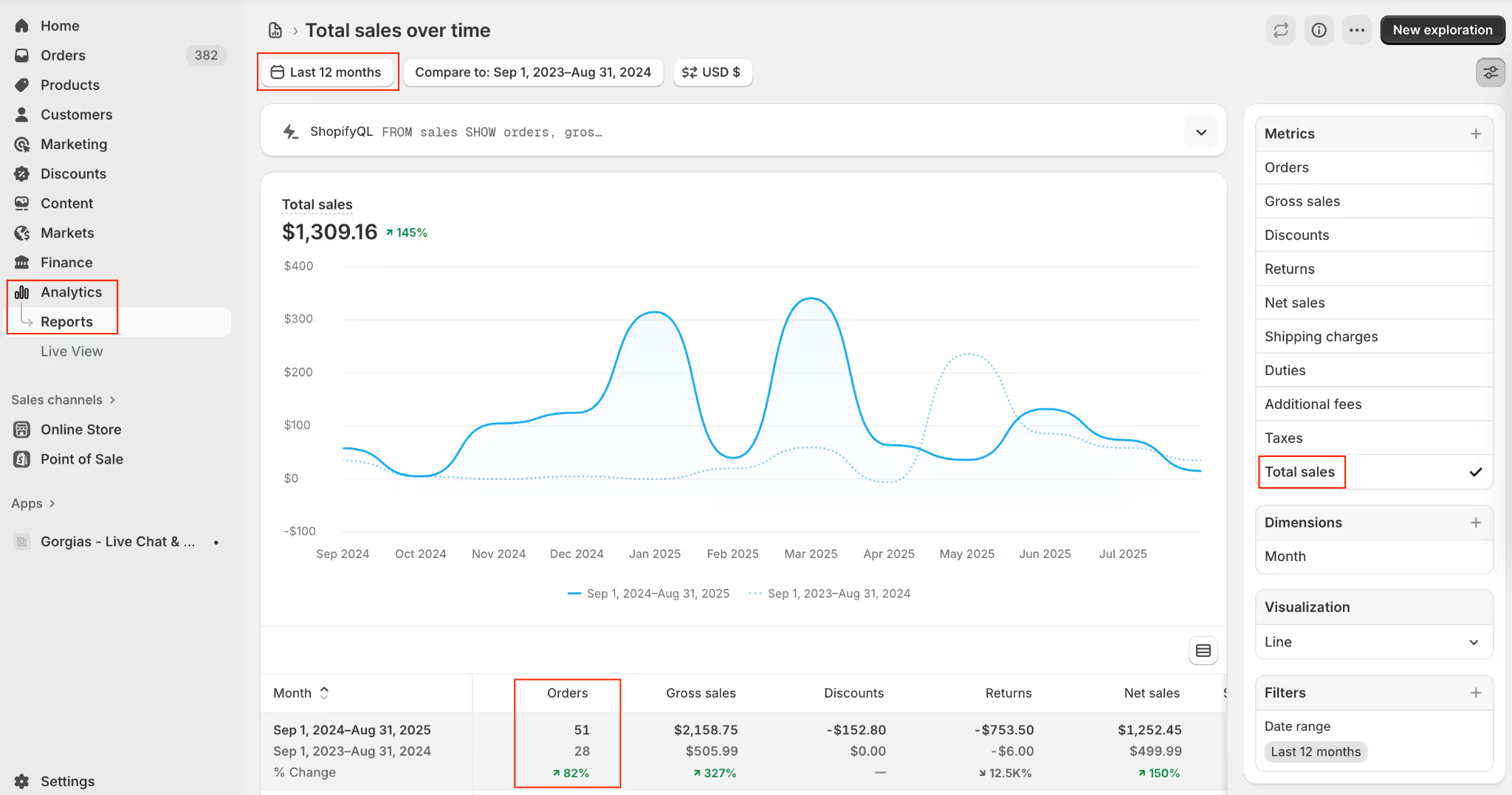
Note: You can also get this data from Google Analytics by going to Conversions -> Ecommerce -> Overview and selecting the target date range. The transaction count will be under the Transactions field.
This might not be accurate if a significant portion of your orders are subscriptions that are not tracked in Analytics. Still, it will be close enough for now as long as you continue to use this transaction count in future calculations.
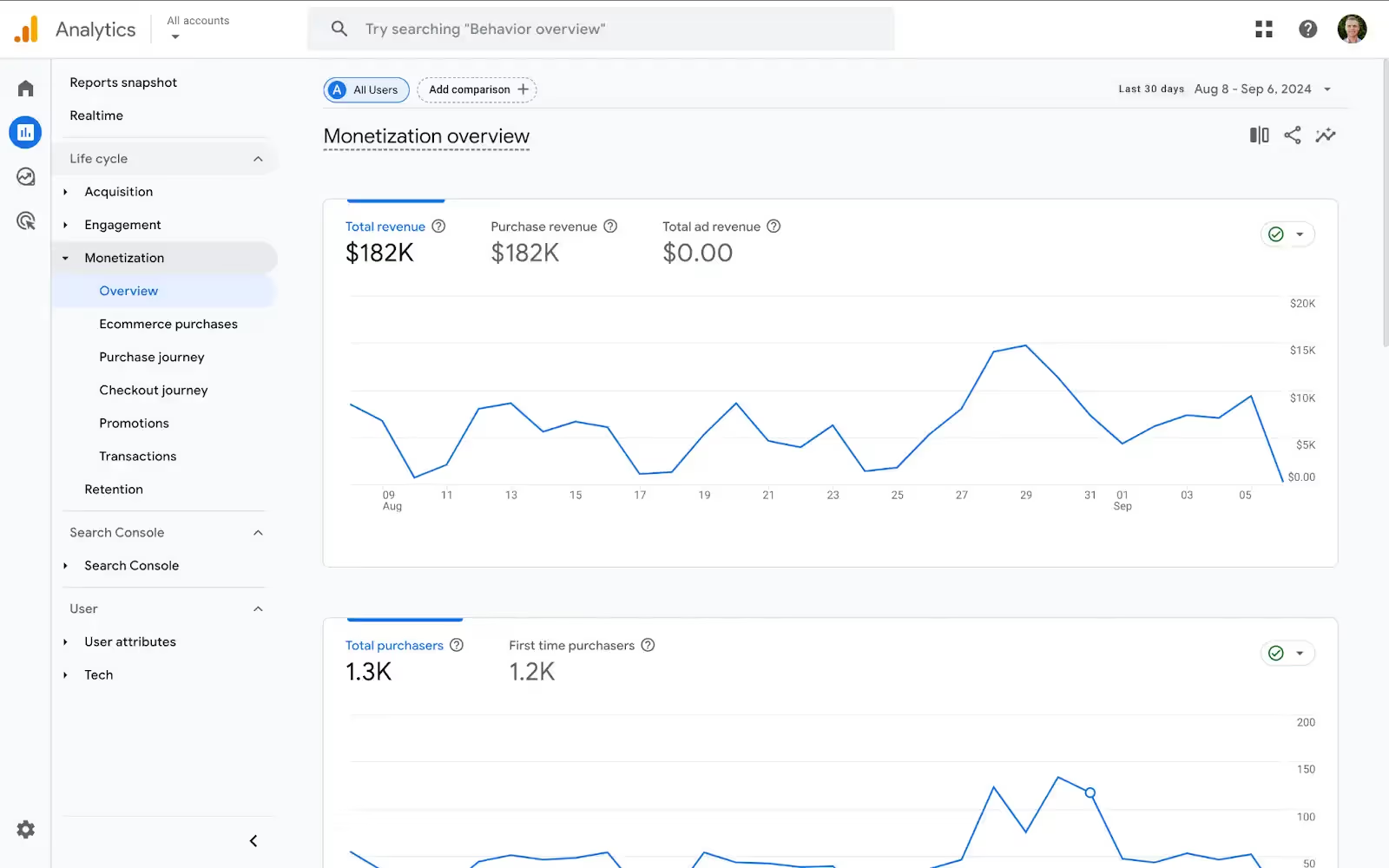
Next, you need your average ticket volume. In a customer experience platform, like Gorgias, find this number by going to Statistics -> Support Performance -> Overview → Created Tickets and select the same time period.
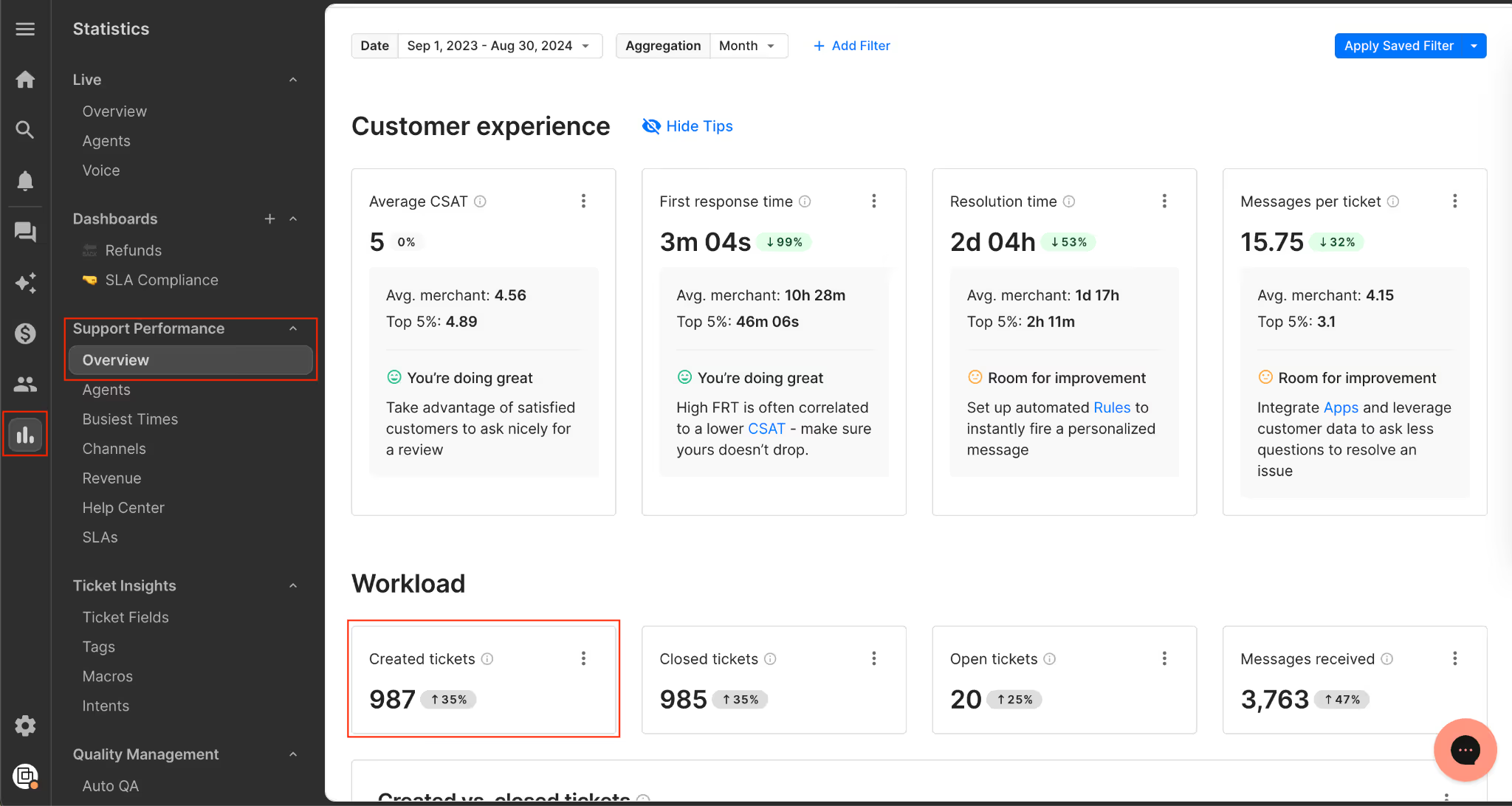
Put it all together: Plug in your order number and ticket volume into this formula: tickets ÷ orders. For example, if you had 1000 orders and 400 tickets, then your ticket ratio is 40. This means for every 100 transactions, 40 tickets are created.
Pro Tip: We typically see the ticket ratio anywhere from 30% to 50%. For stores that use customer support automation in their helpdesk workflow, the ticket ratio normalizes to about 20%.
Related: Orthofeet took a step in the right direction by automating 56% of tickets in 2 months with Gorgias
Once you have the ticket-to-order ratio, you need a baseline business metric to anchor your forecast. In other words, you need a way to estimate how many orders will be placed. That order volume is the bridge between sales activity and customer service demand.
Here’s how to project ticket volume using cost per acquisition, average order value, or ticket ratio.
Once you’ve forecasted ticket volume, the next step is translating it into how many team members you’ll need.
Related: How Psycho Bunny avoided adding additional headcount while doubling revenue
At some point, you can’t just throw more people at the problem. People are a finite resource, and it takes time to hire and train competent agents. Don’t let yourself end up in that position as you drive growth.
To run an effective customer service operation, you should have benchmarks set for agents’ capacity to handle tickets. With this data, you can convert the forecasted ticket volume into a forecasted agent headcount needed to handle that volume.
How to calculate agent capacity: Find the average number of tickets resolved per agent over a specific time period. Be sure to focus your analysis on full-time agents, not part-timers who jump in from time to time.
In Gorgias, navigate to Statistics -> Support Performance -> Agents, and locate the data under the Closed Tickets column.
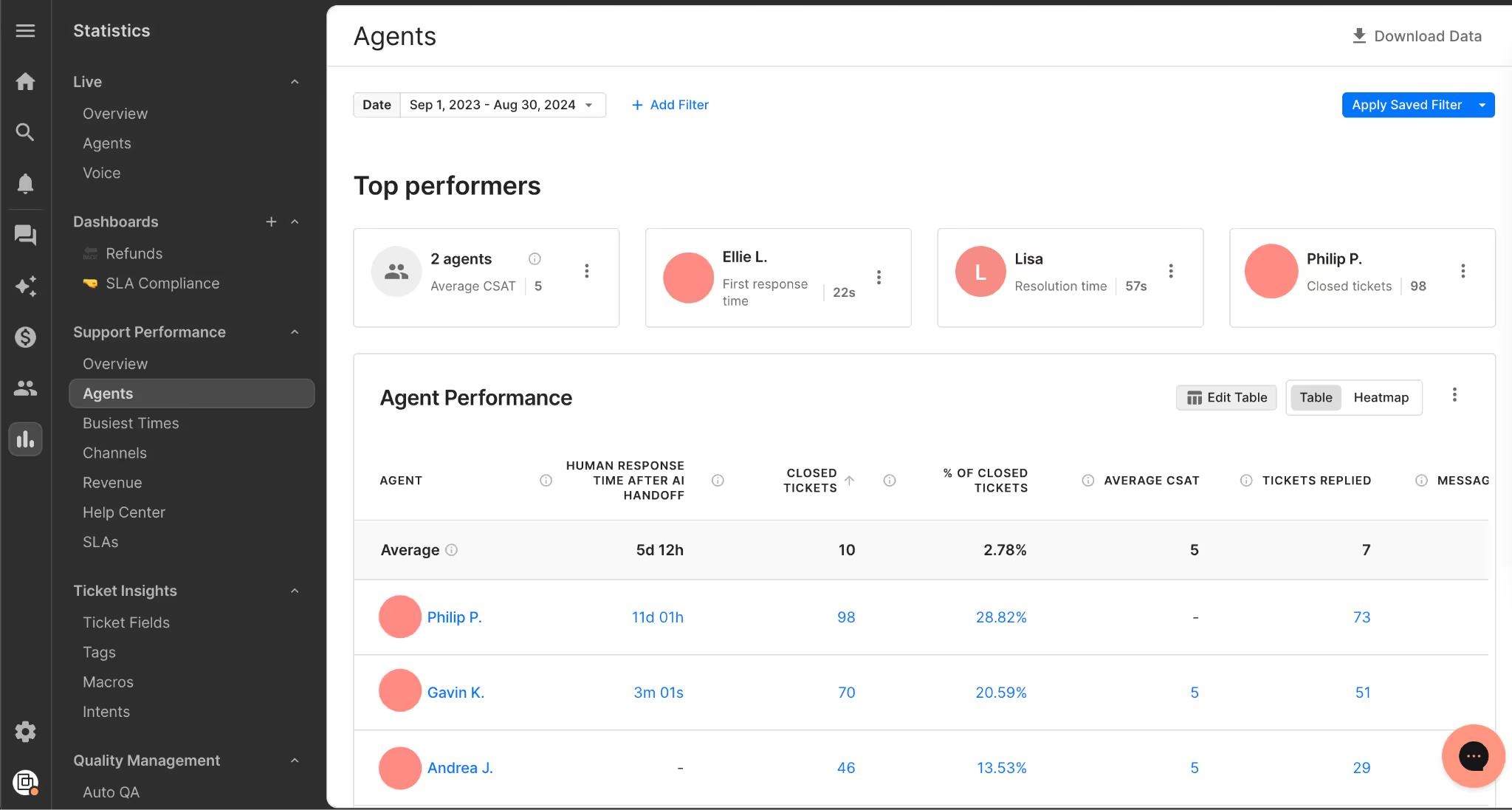
Pro Tip: We typically see anywhere from 40 to 60 tickets per day per agent as a healthy benchmark.
Once you’ve forecasted ticket volume, the next step is turning that into staffing needs (so start preparing your interview questions). Here’s how it works in practice:
Projected tickets: 4,000 (Nov–Dec)
Agent capacity: 40 tickets/day
Monthly agent capacity: 40 tickets/day × 5 days/week × 4.3 weeks/month = 860 tickets per agent per month
Required agents:
This gives you a concrete, data-backed number you can use for BFCM staffing plans, instead of guessing or waiting until your team feels overwhelmed.
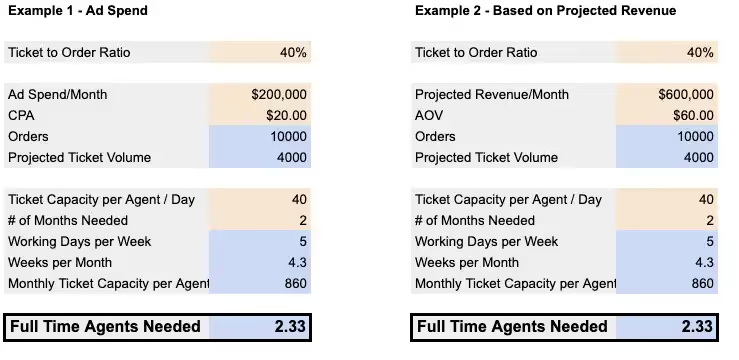
This is a little simplistic since it assumes the tickets come fairly uniformly during that time, but the basic forecasting process here is sound.
Check out HelpFlow.com's free Customer Service Forecast Calculator (no email address required).
The way you handle customer service has a massive impact on sales. Based on Gorgias support performance data across all customers:
Slow responses cost revenue, and live chat conversion rates drop sharply when first replies take more than 10 seconds. If your team is overloaded, hitting <10 minutes on tickets or seconds on chat just isn’t realistic without the right tools.
Two options to consider:
{{lead-magnet-2}}

In August 2020, Amy started her job at Gorgias as a Customer Success Manager. Fast forward to today: Amy has held four positions in the company, pioneered two brand-new Gorgias programs, and holds a new position as the Manager of Customer Education.
How is that possible in only two years? What special sauce has she found at Gorgias that keeps her going? And what kind of higher education was the precursor to her professional success?
Read the interview with Amy to learn more about her dynamic career evolution and the support Gorgias provided to make it possible.
My career path is a little unconventional. After finishing school I decided against going to university and launched into full-time work instead, picking up study later in life.

I was fortunate to find a field where adaptability, problem-solving, and experience in customer relationships held high value in junior roles. When I transitioned to tech in my mid-twenties I had six years of hands-on experience which was a huge advantage in the startup space. From there, all of my training has been “on the job.”
I’ve been lucky to work underneath brilliant managers, most of whom were female. They provided me with excellent opportunities to benefit from industry-leading mentorship.

It is a classic story — I stumbled across a position on LinkedIn.
After doing the case study the product had me hooked. I saw its potential to help merchants deliver an exceptional customer experience and drive revenue from happy shoppers. From that point, all my eggs were in the Gorgias basket.
!["I saw [Gorgias'] potential to help merchants deliver an exceptional customer experience and drive revenue from happy shoppers."](https://cdn.prod.website-files.com/5e78f62c08f1bb8c2d788576/63a9c40df3ba37100afc0a0c_6304d1ab8bf1e187b7cc7795_amy-quote-final-3.webp)
At that point, Gorgias had just raised a 25M series B funding and had around 75 employees and 5,000+ customers.
Back in August 2020 when I initially started in Gorgias, I was a Customer Success Manager. I started when the Success team had half a dozen people wearing many hats.
The CSM role was originally a hybrid position — encompassing both CSM and Onboarding Manager responsibilities. The focus was on managing full-cycle customer relationships: retention, churn, and expansion.
As Gorgias grew, Success roles were split into specialties, and a new department was created to service our non-managed merchants. I transitioned into Scaled Programs, a two-woman team led by Elena Balagush (who we recently welcomed back to the Gorgias family.)
Being a new function there was plenty of trial and error but always support from leadership which was essential to our success.

In this role, I managed merchant relationships using a one-to-many approach and maintained a local book of business. After a few months, I was promoted to senior CSM — a natural progression for anyone at Gorgias who performs well. While continuing the above duties, I took on additional education duties running webinars and creating educational content.
After realizing the value of education, I upskilled in eLearning, content creation, and instructional design. The culminating project was setting up the Gorgias Academy.
While I built the academy, I needed to prove its impact (one of Gorgias’ values is to maximize your impact, so everyone is accountable for delivering measurable results). I focused on before/after data comparisons to show the substantial impact the academy was having.
After proving the function was valuable, I moved into the Customer Education Specialist role as a one-woman show.

From there, the upskilling continued. With incredible guidance and investment from my brilliant manager Elise Kubicki, I was equipped with the tools necessary to make the Customer Education function (CEd) a success.
One of the most valuable strategies I had was connecting with industry leaders. I became an active member in a few CEd communities and leveraged group tips/feedback to guide decisions in lieu of a team. One particular community is called Customer Education Org run by Sumeru Chatterjee. The support from other CEd leaders has been instrumental to my career growth.
After managing a substantial workload and delivering high-quality results consistently, Elise generously promoted me into a management position which I’m thrilled to be in today.
Elise, my manager, has been incredible. She led by example and gave me an excellent benchmark for what a manager should look like. She encouraged me to be brave with ideas and trust my intuition and experience. She listened to me pitch new strategies, provided feedback to strengthen my proposals, and gave me the confidence to execute my ideas.
Without a manager who fostered open communication and responded with encouragement and empathy, I would never have advanced this quickly.
Gorgias is also committed to getting the right tool for the job. We invest in technology. I could not have performed at the volume or velocity I did without a company that understands the benefit of a solid tech stack.
Elena Balagush was my manager when I was on the Scales Programs team, and she is also amazing. She celebrated my wins and gave me the freedom to go after new, out-of-the-box ideas.
Honestly, balancing all my responsibilities took a whole lot of time. But Gorgias investing in the right technology is a big factor — if I had to work without the right equipment, I could not have delivered quality content on time. I’m extremely grateful for this. Not enough businesses respect the impact the right tools can make.
The $2,000 learning stipend is also amazing. I managed to do most of my training for free but having funds available gives me the confidence to take on projects that require new skills. I used a portion of it to complete certifications in different areas like SQL.
Gorgias is also full of amazing, collaborative people. Openness with colleagues and genuine interest in sharing skills is not common. It’s one of the things that makes Gorgias an incredible place to work.
I don’t think many companies would match the level of trust Gorgias had when I was piloting new projects. Beyond that, there are a few factors that other companies struggle with that I feel are important to mention:
If departments operate in closed silos, they can find themselves striving toward opposing goals. At Gorgias, we are all aware of the major targets and work toward them together. We celebrate wins as a team and take responsibility for setbacks as a team.
This unity gives us a huge advantage because everyone wants everyone to do well.
Healthy competition is good. But too often, leadership uses competition as the primary way to drive results. The notion that only one can win can be archaic and doesn’t motivate all personality types.
At Gorgias, we have the understanding that if everyone exceeds the target, everyone is eligible to advance their career, be it in a different role or a different team. That’s motivating.
At Gorgias, the idea is to hire the best of the best. The result is that everyone is hungry to become a better version of their professional selves, and Gorgias repays that hunger with great career progression, room (and budget) to learn new things, and a healthy collaborative atmosphere.
The combination of the enormous amount of work to do and the brightest minds around means you are constantly encouraged to push yourself to deliver great work, fast. We all help each other to upskill and remove bottlenecks that occur when there isn’t enough work to go around.
Not knowing why decisions have been made can plant the seed of doubt in the workforce, causing staff to be in a constant low-level state of panic. Gorgias operates with radical candor, meaning no matter what happens — good or bad, at the individual contributor level or in leadership — we understand why. This alleviates the stress associated with ‘the unknown’ and leaves employees' minds free to be creative and push harder in the right direction.
To recap, Gorgias’ values are:

The honesty value is a huge benefit to me, personally. I am relaxed knowing leadership is open to hearing feedback from all levels of staff and that blindspots I have will be flagged. I have the confidence to speak my mind and know I will be heard.
Also, I respect how truly customer-first Gorgias is. Every company says they are customer first but I’ve never seen it lived the way it is at Gorgias. At all levels, we have an unprecedented number of conversations with merchants to learn about their challenges and develop new solutions.
Lastly, my experience hinged on taking extreme ownership. Taking extreme ownership means passing the buck is not an option. This encourages people to think things through and rationalize the why. Knowing I own a project from end to end makes me push harder to deliver work I’m truly proud of.
Elise is amazing (I know I say it a lot but she really is). She started as an Onboarding Manager and is now leading the whole success department — and that’s a mammoth workload.
She moved from onboarding manager to interim head of success in less than a year. She is now our VP of Success and, gosh, she earned it. She lives and breathes Gorgias' values - it shows in the team she’s chosen, of which I’m honored to be a part.
We also recently welcomed back Elena Balagush, who was my manager before Elise. When staff return to an organization it speaks volumes about the environment.
Does it have to be just one? Here are a few of the standouts:
A great deal of my success at Gorgias is due to supportive management. First, in Success from Chloe Kesler, then in Scaled Programs from Elena Balagush, and in the last 12 months from our outstanding VP of Success Elise Kubicki.
I have a particular soft spot for Elise, as she gave me the skills to develop strategies and concepts of my own but, more importantly, instilled in me the confidence to put them into practice.
The Gorgias team, internally, is jam-packed with team members who are experts in their field. This has given many of us a rare opportunity to learn on the job from the industry's best performers.
Following on from my earlier point, the collaborative culture at Gorgias is second to none. I have experienced first-hand the way sometimes competitive nature can become engrained at companies with aggressive goals.
At Gorgias, you won’t find a skerrick of this. Instead, the value of 100% honesty and having a unified goal breeds an undercurrent of genuine camaraderie and a sense of drive to achieve as a collective.
Knowledge is freely shared across all departments and seniority levels. This flat structure encourages curiosity and discussions between everyone — regardless of role.
That we can’t hire everyone. There isn’t a single tech person I know who wouldn’t benefit from the experience of working here.
In the future, I’m going to do everything I can to develop a winning Customer Education program and (fingers crossed) position us as industry leaders in this field.
I’d like to see us continue to roll out new initiatives to help our merchants thrive, especially given the difficult landscape at this time.
I’ll continue to learn and grow in the Customer Education space. I still have plenty of areas to work on — I’m just grateful I’m part of an organization that gives me every possible opportunity to do this.
I’d love to carry on in Customer Education and one day move up into a director position. I’ve got a long way to go but I’m confident Gorgias is the most suitable place for me.
I couldn’t wish for a better manager, better team, or better organization. Results are rewarded and I’m incredibly proud of not just the growth that we’ve seen but the way we got here — we move fast, we make mistakes, we learn and we adapt. Rinse and repeat. That’s the kind of company I want to be with for life.
Interested in joining Amy and the rest of Gorgias team? Check out our jobs page to learn more about our benefits, interview process, and open roles.


